🇰🇵 North Korea at a Glance
🌍 Overview — the Country You Cannot Visit
The Democratic People's Republic of Korea occupies the northern 120 540 km² of the Korean peninsula and holds about 26 million people. It has been ruled since 1948 by three men from one family, it possesses nuclear weapons, and it is the only state on earth that has built its entire political system on the proposition that it owes the outside world nothing.
Two things have changed fundamentally in the last three years and almost everything written about the country online predates them. In January 2024 Kim Jong-un abolished the goal of Korean reunification — seventy-five years of official doctrine — and had the monument to it demolished. And in June 2024 he signed a mutual-defence treaty with Russia and subsequently sent troops to fight in Europe, ending the country's isolation on terms nobody predicted.
⚠️ Can you go?
Almost certainly not. As of September 2026 the DPRK remains closed to virtually all foreign tourists. Russian nationals have limited access; a small group of Westerners was allowed into the Rason zone in February 2025 and the experiment was not repeated. This is the single most important fact on the page and it has its own section.
What it calls itself
Chosŏn Minjujuŭi Inmin Konghwaguk — the Democratic People's Republic of Korea. Internally the country is simply Chosŏn, the old dynastic name for Korea; the South uses Hanguk. Two Koreas that do not even use the same word for "Korea" is not a translation quirk — it is the argument in miniature.
Who runs it
Kim Jong-un, since December 2011, as General Secretary of the Workers' Party of Korea and President of the State Affairs Commission. His grandfather Kim Il-sung remains Eternal President — the office is held by a man who died in 1994, which is not a joke but constitutional text.
The ideology
Juche, usually rendered "self-reliance", supplemented by Songun (military-first) and more recently Kimilsungism-Kimjongilism. What it functions as, rather than what it says, is covered in the Juche section.
The economy
Officially a planned socialist economy. Actually a hybrid in which a tolerated market sector — the jangmadang — feeds most of the population while the state takes its cut and denies the arrangement exists. See the markets section.
Why it matters to Europe
Because of Kursk. North Korean soldiers have fought and died in a European war, and Pyongyang has publicly honoured them as heroes. A state that spent thirty years being discussed as an Asian security problem is now, directly, a European one.
🏷️ Chosŏn, Hanguk and the Word for "Korea"
Chosŏn
The North's word for the country, from the Chosŏn dynasty (1392–1897) and behind that from Gojoseon, the legendary first Korean state. It is usually glossed as "land of the morning calm", a translation that is more poetic than exact. North Koreans are Chosŏn-saram; the language is Chosŏn-mal.
Hanguk
The South's word, from the Three Han confederacies of the southern peninsula and from the Daehan Jeguk, the Korean Empire of 1897–1910. South Koreans are Hanguk-saram and the language is Hangugeo. The two states have used different names for their shared country since 1948.
⚠️ Why the vocabulary split matters
Because the divergence goes well past the name. Seventy-five years apart have produced measurable differences in vocabulary, loanwords and even some spelling rules — the South absorbed English freely, the North coined native replacements and purged Sino-Korean and Japanese forms. Defectors arriving in Seoul routinely need language help, and phone apps exist to bridge the gap.
"Hermit Kingdom"
A nineteenth-century Western label for the whole of Chosŏn Korea, which had a deliberate policy of keeping Europeans out. It gets recycled for the DPRK constantly, including in the title of the page this one replaces. It is vivid, it is not very accurate — the DPRK trades with China, hosts embassies, sends workers abroad and now fights in Russia's war — and it flattens a functioning state into an oddity.
The flag and the emblem
Red, white and blue horizontal bands with a red five-pointed star in a white disc. The state emblem shows a hydroelectric dam beneath Mount Paektu and a red star — industry, the sacred mountain, the revolution, in that order.
Time
UTC+9. In 2015 the DPRK created its own "Pyongyang Time" at UTC+8:30, to break with a time zone set under Japanese rule. In 2018, during the brief thaw with Seoul, it changed back to align with the South. The clock has been a diplomatic instrument here twice in a decade.
🗺️ Eighty Per Cent Mountain
North Korea is mountainous, cold and short of arable land — and that combination explains a great deal of its history, including the famine. Roughly 80 % of the territory is upland, and the fifth that is not carries almost all of the farming and most of the people.
The shape of it
Mountains run down the east side in the Hamgyong and Nangnim ranges, dropping steeply to a narrow eastern coast. The land falls away west into the plains of Pyongan and Hwanghae — the rice bowl, the industrial belt and the capital. The Taebaek range continues south across the DMZ into South Korea.
The borders
1 416 km with China, along the Yalu (Amnok) and Tumen rivers — by far the most important frontier, commercially and for anyone trying to leave. A 17 km border with Russia at the Tumen mouth, crossed by a single rail bridge, which now carries a great deal more than it used to. And 238 km with South Korea, which is the DMZ and is not a border anyone crosses.
⚠️ Arable land
Only about 17 % of the country can be cultivated, in a climate with a short growing season and a real risk of both flood and drought. The DPRK has never been reliably able to feed itself, and in years when fertiliser, fuel or the weather fail, the margin is not thin — it is negative. See the famine section.
Deforestation
One of the most severe cases anywhere. Hillsides were cut for fuel and cleared for terraced private plots during and after the famine, and the result is catastrophic erosion and flash flooding that makes each bad harvest worse than the last. Replanting campaigns run constantly and satellite imagery shows the problem is far from solved.
What is underground
Genuinely rich: coal, iron ore, magnesite (among the world's largest reserves), graphite, zinc, tungsten and gold, plus rare earth deposits whose size is disputed. Mineral wealth is the DPRK's main hard-currency export and the main target of sanctions enforcement.
Climate
Continental and harsh. Pyongyang runs from about −6 °C in January to 25 °C in August, with most of the year's rain in a short, heavy summer monsoon — which is also when the typhoons and the floods arrive. Winters in the northern provinces are brutally cold and heating fuel is not guaranteed.
🌋 Paektu — the Sacred Mountain and the Political One
Mount Paektu (2 744 m), on the Chinese border, is the highest point on the Korean peninsula and the most loaded piece of geography in Korean culture. It is an active stratovolcano with a spectacular caldera lake, Chŏnji — "Heaven Lake" — at about 2 190 m, and it is sacred to Koreans on both sides of the DMZ.
The myth that unites
In Korean foundation legend Tangun, founder of the first Korean kingdom, was born at Paektu. That story belongs to all Koreans and predates any division; the mountain appears in the South Korean national anthem as readily as in the North's.
⚠️ The myth that divides
DPRK doctrine holds that Kim Jong-il was born in a secret guerrilla camp on the slopes of Paektu in 1942, heralded by a double rainbow and a new star. Soviet records place his birth in a camp near Vyatskoye, in the Russian Far East, in 1941. The claim exists to fuse the dynasty to the sacred mountain, and the phrase "Paektu bloodline" is the formal justification for hereditary rule.
The volcano
It is not extinct. The Millennium Eruption of roughly 946 CE was one of the largest of the last two thousand years, dropping ash as far as northern Japan. Seismic swarms in 2002–05 were serious enough that the DPRK — remarkably — invited British and American volcanologists in, producing one of the very few genuine scientific collaborations of the period.
The political stage
Kim Jong-un makes a visit to Paektu before major decisions, and state media reports it in advance. The visits preceded the 2013 purge of Jang Song-thaek and several turns in policy. When the cameras go to Paektu, something is about to happen.
Seeing it
Both sides can be climbed. The Chinese side, Changbaishan, receives large numbers of Chinese tourists every year and is entirely accessible. The North Korean side has been part of DPRK tour itineraries when tours have run at all. For the foreseeable future, the practical answer for a foreign visitor is China.
Samjiyon
The town below the mountain on the DPRK side was rebuilt from 2019 as a showcase — ski slopes, apartment blocks, a museum complex — with the labour of "shock brigades" whose working conditions have been the subject of serious reporting. It was declared complete in 2021 and is the clearest single example of how DPRK development projects are actually built.
📕 Juche — What the Ideology Actually Does
Juche (주체) is usually translated "self-reliance" and was formally elaborated from the mid-1950s. Read as philosophy it is thin — man is the master of his destiny, the nation must be independent in politics, self-sufficient in the economy, self-reliant in defence. Read as a function, it is the most successful legitimating device any communist state produced.
What it replaced
Marxism-Leninism, deliberately and gradually. Juche let Kim Il-sung navigate the Sino-Soviet split without becoming a client of either Moscow or Beijing, take aid from both, and claim an intellectual tradition that was Korean rather than imported. By the 1972 constitution it was the guiding ideology; by 2009 Marxism-Leninism was gone from the text entirely.
⚠️ The contradiction
A doctrine of self-reliance in a country that has been dependent on external support for most of its existence — Soviet and Chinese aid until 1991, emergency food aid in the 1990s, Chinese trade ever since, and Russian support now. The gap between the doctrine and the balance of payments is the country's oldest open secret.
Juche time
The country runs a Juche calendar in which Year 1 is 1912, Kim Il-sung's birth. 2026 is Juche 115. Dates on official documents carry both. Very few states have restarted the calendar; the ones that did were making the same claim.
Songun
Military-first politics, elevated under Kim Jong-il in the 1990s: the army as the leading force of society, with first claim on resources. It was introduced as the state was failing to feed people, and the two facts are related. Kim Jong-un has tilted the emphasis back towards the Party and towards byungjin — nuclear weapons and the economy developed in parallel.
The Tower
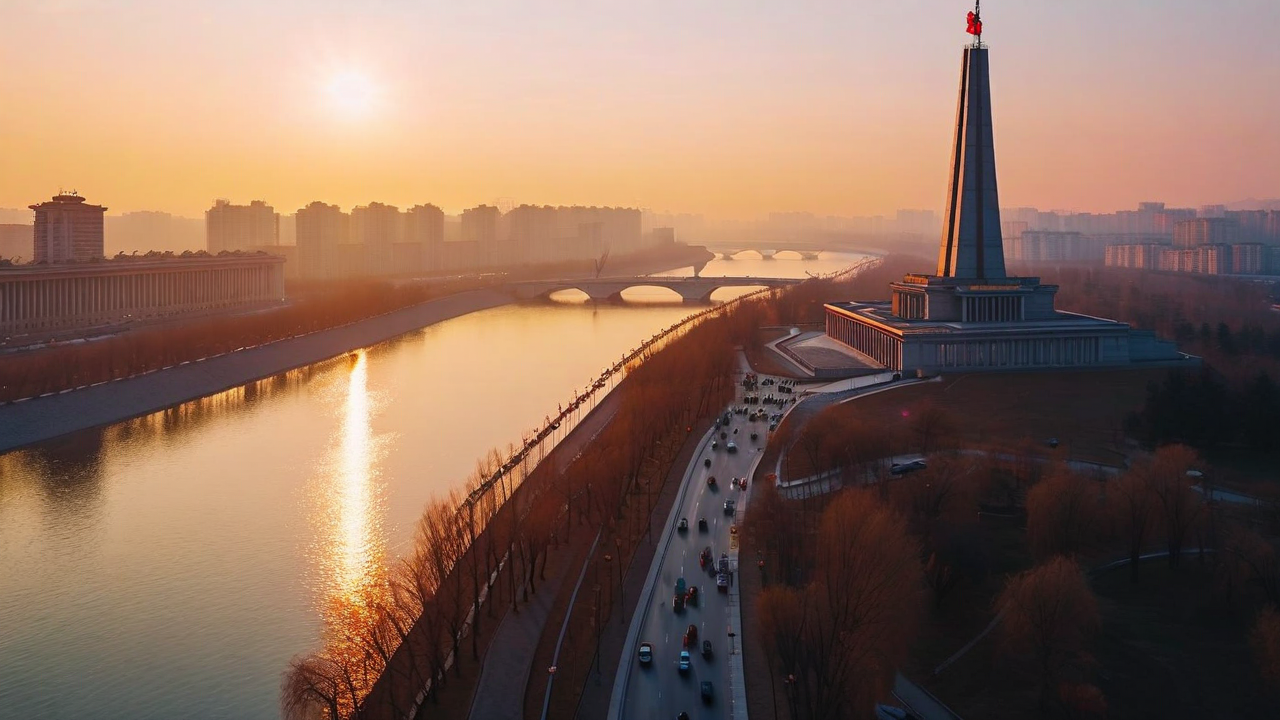
The Juche Tower on the Taedong, built in 1982 for Kim Il-sung's seventieth birthday, is 170 m tall and faced with 25 550 granite blocks — one for every day of those seventy years. It is in the photograph at the top of this page, and the arithmetic tells you most of what you need to know about the system that built it.
How to read it abroad
Foreign Juche study groups were cultivated across the developing world from the 1970s, and a handful still exist. They were always more a foreign-policy instrument than a movement. Reading Juche as a serious philosophical system misses the point; reading it as an apparatus for making a family's rule feel like a nation's identity gets it right.
👑 Three Generations, One Family
No other communist state produced a hereditary monarchy. The DPRK has now done it twice, and is visibly preparing to do it a third time. Understanding the country means taking the dynastic frame seriously rather than treating it as a curiosity.
Kim Il-sung (1912–1994)
Anti-Japanese guerrilla in Manchuria, Soviet Red Army captain, installed by Moscow in 1945 and in power until his death. Launched the Korean War, survived it, purged every rival faction by the 1960s, built the personality cult and made it hereditary. Still Eternal President, and still the face on the wall in every room.
Kim Jong-il (1941–2011)
Groomed from the 1970s, took over in 1994 and ruled through the famine. Built Songun, conducted the first nuclear test in 2006, and cultivated an image — the films, the trains, the sunglasses — that the outside world found funny and that was, domestically, entirely serious. See his section.
Kim Jong-un (b. 1984)
Third son, educated partly in Switzerland, unknown outside the family until 2010, in power since December 2011. Executed his uncle Jang Song-thaek in 2013, had his half-brother Kim Jong-nam killed with VX at Kuala Lumpur airport in 2017, met Donald Trump three times, then abandoned diplomacy, the economy-first line and reunification in turn.
The women of the family
Kim Yo-jong, his sister, is the most visible official in the country after him and issues many of its harshest statements — a genuinely powerful figure, not a spokesperson. Ri Sol-ju, his wife, appears selectively. Kim Kyong-hui, his aunt and Jang's widow, reappeared publicly after years of absence, which in this system is itself a message.
⭐ Kim Ju-ae
His daughter, first shown to the world in November 2022 at a missile launch, has since been given steadily more prominent billing — titles in state media that escalate, position in group photographs, foreign trips. The reading in Seoul and among most analysts is that she is being prepared as the heir. See the succession section.
⚠️ The Paektu bloodline
Formal doctrine: legitimate rule belongs to the descendants of the guerrilla fighters of Mount Paektu, meaning this family. It is why a hereditary succession does not need to be explained domestically, and why anyone outside the line with a power base — Jang Song-thaek, Kim Jong-nam — has been removed rather than sidelined.
🗾 Japanese Korea, 1910–1945
Everything about the two Koreas starts with the thirty-five years in which there was no Korea at all. Japan annexed the peninsula in 1910 and ran it as a colony until its surrender in August 1945, and the way it did so shaped both successor states — including the fact that the north, not the south, was the industrial half.
What Japan built in the north
Heavy industry. Japan put its chemical plants, steel mills, mines and the huge Sup'ung hydroelectric dam on the Yalu in the northern provinces, close to the coal and the ore and to Manchuria. At liberation the north held most of the peninsula's industrial capacity and electricity generation; the south held most of the farmland and most of the people.
⚠️ The repression
Korean-language education restricted and then suppressed, a name-change campaign pressing Koreans to adopt Japanese names, forced labour conscription, and the "comfort women" system of sexual slavery. These are not contested facts and they remain live in the politics of all three countries today.
The guerrillas
Armed resistance operated mostly from Manchuria, where a large Korean population lived under Japanese occupation as well. Kim Il-sung commanded a unit in the Chinese Communist-led Northeast Anti-Japanese United Army and led the raid on Poch'onbo in June 1937 — a small action, real, and later inflated into the founding epic of the state.
Where he actually was
By 1940–41 Japanese pressure had driven the surviving guerrillas across into the Soviet Union, where Kim served in the 88th Separate Rifle Brigade of the Red Army and reached the rank of captain. He returned to Korea in September 1945 aboard a Soviet ship. DPRK historiography omits the Soviet years entirely.
The other nationalists
There were many: the Provisional Government in Shanghai under Kim Ku and Syngman Rhee, Christian nationalists in Pyongyang, domestic communists under Pak Hon-yong in Seoul, and the Korean volunteers of the Yan'an faction with Mao. Kim Il-sung's achievement was less winning the resistance than outliving and purging everyone else who had a claim to it.
The inheritance
A colonial administrative state, a police apparatus, an industrial base, and a nation that had just spent a generation being told it did not exist. Both Koreas built on that, in opposite directions, and both have been arguing about collaboration ever since.
✂️ The 38th Parallel — a Line Drawn in Thirty Minutes
The division of Korea was not the result of a war, a treaty or a Korean decision. It was an administrative expedient invented in a Washington office on the night of 10–11 August 1945, and it has now lasted longer than the colonial period it ended.
⭐ The map in the room
With Soviet forces already entering Korea and the US far away, two American colonels — one of them Dean Rusk, later Secretary of State — were told to find a line that put Seoul in the American zone. Working from a National Geographic map and with about half an hour, they chose the 38th parallel. Moscow accepted it. No Korean was consulted.
Two occupations
The Soviets ran the north through a civil administration and built up Kim Il-sung; the Americans ran the south through a military government that initially kept colonial-era officials in post, which cost it enormously in legitimacy. Both zones suppressed the people's committees that Koreans had formed spontaneously at liberation.
⚠️ 1948: two states
The UN called elections; the Soviets refused access to the north. The south voted in May and the Republic of Korea was proclaimed on 15 August 1948 under Syngman Rhee. The DPRK followed on 9 September 1948 under Kim Il-sung. Each claimed the whole peninsula. Each still did, formally, until January 2024.
Land reform
The north redistributed land in 1946, fast and without compensation, breaking the landlord class. It was genuinely popular among tenant farmers and is one reason the early DPRK had real support. It also drove a wave of landowners, Christians and professionals south — an emigration that reshaped both societies.
Before the war
The border was violent from the start. Thousands died in clashes along the parallel in 1948–50 and in the suppression of southern insurgencies, notably the Jeju uprising. Historians differ on how much this makes the Korean War a civil war that was internationalised, but nobody argues it began cleanly in June 1950.
The families
Around ten million Koreans ended up separated from close relatives. Reunion events were held sporadically from 2000 to 2018, each reuniting a hundred or so families for a few hours, with participants selected by lottery. None have been held since 2018, and the applicants are dying.
⚔️ The Korean War, 1950–1953
The war killed somewhere around three million people, most of them Korean civilians, destroyed almost every city on the peninsula, and ended within a few kilometres of where it started. It is the single most important fact about the DPRK, and it has never formally ended.
25 June 1950
North Korean forces crossed the parallel in strength and took Seoul in three days. The archives opened after 1991 settled the long argument: Kim Il-sung pushed for the invasion and obtained Stalin's approval, with Mao's assent, after repeated requests. The UN Security Council authorised intervention because the Soviet delegate was boycotting the Council and was not there to veto it.
The swings
The North nearly won by August, holding all but the Pusan Perimeter. MacArthur's Inchon landing in September reversed it and UN forces drove almost to the Yalu. In late October China entered with hundreds of thousands of troops and drove them back past Seoul. By mid-1951 the front had stabilised near the parallel, and there it stayed for two more years of attritional fighting and negotiation.
⚠️ The bombing
This is the part Western accounts underweight and North Koreans do not. US air power dropped more ordnance on Korea than in the entire Pacific theatre of the Second World War, including large quantities of napalm, and destroyed the DPRK's major dams late in the war. Curtis LeMay's own later summary was that they burned down every town in North Korea. Estimates of civilian dead in the north run to the high hundreds of thousands. Whole populations lived underground for months.
What that produced
A state whose founding trauma is annihilation from the air by the United States — and which built, in response, one of the most extensively tunnelled and hardened territories on earth, a permanent war footing, and eventually a nuclear deterrent. Any analysis of DPRK behaviour that starts in 1990 is missing the reason.
The prisoners
The talks stalled for eighteen months over repatriation: the UN command insisted prisoners should not be returned against their will, the communist side insisted all must be returned. Tens of thousands of Chinese and North Korean prisoners ultimately refused repatriation. It is the issue that kept the war running long after the front had frozen.
The numbers
Roughly three million dead in total, of whom perhaps two-thirds were civilians; around 36 500 American and 1 100 other UN military dead; Chinese losses of several hundred thousand, including Mao's son. Every figure here is contested and the DPRK has never published its own.
📜 The Armistice — a Ceasefire That Is Now 73 Years Old
On 27 July 1953 an armistice was signed at Panmunjom. It was a military ceasefire, explicitly temporary, meant to be replaced by a political settlement within three months. That settlement has never been negotiated. The Korean War has not legally ended.
Who signed
The UN Command, the Korean People's Army and the Chinese People's Volunteers. South Korea refused to sign — Syngman Rhee wanted the war continued — which is why the ROK is not formally a party to the agreement governing its own border, a point Pyongyang has exploited for seventy years.
The DMZ
A strip roughly 250 km long and 4 km wide along the Military Demarcation Line. It is described as demilitarised and is the opposite: minefields, wire, artillery and something over a million troops facing each other. The Joint Security Area at Panmunjom is the one place the two sides physically meet, across a line running through the middle of blue huts.
⭐ The unintended nature reserve
Seventy years with almost no human entry have made the DMZ one of the best-preserved temperate habitats in Asia — home to red-crowned and white-naped cranes, Asiatic black bears, musk deer and, credibly if unconfirmed, the Amur leopard. Conservationists on both sides have proposed a peace park. The mines are the obstacle and also, for now, the protection.
The incidents
The armistice has been violated continuously and sometimes lethally: the Blue House raid (1968), the seizure of the USS Pueblo (1968, the ship is still on display in Pyongyang), the axe murder incident (1976), the Rangoon bombing (1983), the sinking of the Cheonan and the shelling of Yeonpyeong (2010). None escalated to war, all could have.
The Supervisory Commission
The armistice created two bodies to watch it. The Neutral Nations Supervisory Commission — Sweden and Switzerland for the UN side, Czechoslovakia and Poland for the communist side — and the Military Armistice Commission. The Czechoslovak half of that story has its own section and is the reason this page has a particular Czech interest.
⚠️ Why no peace treaty
Because the price has never been agreed. Pyongyang wants a peace treaty with Washington, recognition and the end of the US troop presence in the South; Washington has tied any treaty to denuclearisation; Seoul insists on being a party. After January 2024 the DPRK's position is that it is not negotiating with the South at all — which makes a settlement harder, not easier.
🏗️ The Years When the North Was Winning
It is almost impossible to believe now, and it is essential context: for roughly two decades after the war, North Korea was richer than South Korea. The comparison that everyone makes today — the satellite photograph of the dark north and the blazing south — would have looked the other way round in 1965.
Chollima
The "thousand-li horse" movement from 1957, a mass mobilisation campaign modelled loosely on the Soviet Stakhanovites and running alongside China's Great Leap. Rebuilding from total destruction with Soviet and Chinese aid, heavy industry and an intact northern industrial base, the DPRK posted genuinely extraordinary growth rates through the late 1950s and 1960s.
The record
Free universal education and healthcare, near-total literacy, rapid urbanisation and electrification. These were real achievements, not propaganda, and they were widely acknowledged at the time — visiting economists in the 1960s wrote about the North as a developmental model.
⚠️ Why it stalled
A command economy that could rebuild but could not innovate; the exhaustion of easy gains from heavy industry; Songun military spending at a share of output no economy could carry; the debt default of the mid-1970s that cut the DPRK off from Western credit permanently; and a refusal to reform when China did. By the early 1980s the South had passed it and the gap has widened every year since.
The purges
Kim Il-sung consolidated by eliminating every faction in turn: the domestic communists under Pak Hon-yong, executed in 1955 as an American spy; the Soviet Koreans; and the Yan'an faction in the August 1956 incident, when an attempt to criticise him at a plenum failed and was answered with expulsions and executions. By 1960 there was one faction left.
The non-aligned turn
From the 1960s the DPRK worked the Non-Aligned Movement hard, cultivating post-colonial Africa and Asia with aid, scholarships, arms and monumental sculpture. The Mansudae Art Studio built statues and monuments across Africa for decades — a genuine export industry, and one that sanctions have targeted.
What is left of it
The rhetoric, the Chollima statue in Pyongyang, and a large generation of elderly citizens who remember when the system worked. That memory is politically valuable to the state and it is one reason older North Koreans and those who grew up after the famine tend to see the country very differently.
🇨🇿 Czechoslovakia at Panmunjom, 1953–1993
For forty years a Czechoslovak delegation sat inside the Korean DMZ as one of the four members of the Neutral Nations Supervisory Commission. It is the deepest connection any Czech institution has ever had with Korea, it ended badly, and almost nobody in the Czech Republic knows about it.
What the NNSC was
The armistice needed neutral inspectors. The UN side nominated Sweden and Switzerland; the communist side nominated Czechoslovakia and Poland. They were to verify that neither side reinforced beyond agreed limits, with inspection teams at ports of entry on both halves of the peninsula.
⚠️ How neutral it actually was
Not very, on either side, and the Czechoslovak delegation reported to Prague and through Prague to Moscow. Work on the North Korean side was obstructed from early on — the DPRK restricted inspections it disliked and the inspection teams in the north were effectively shut down in 1956. Recent archival research on the 1980s describes Czechoslovak officers caught between their formal mandate, their alliance obligations and a host state that regarded them as an irritant.
Living in the camp
Officers rotated through a small compound inside the DMZ for tours of duty, with limited contact and limited purpose. Their photographs and reports — increasingly published in recent years — are among the very few sustained European eyewitness records of the DPRK across four decades.
⭐ 3 April 1993
When Czechoslovakia split on 1 January 1993, the Czech Republic offered to take over the mandate and was supported by the UN Command, the other NNSC members and China. North Korea refused. Pyongyang no longer wanted a post-communist state watching the armistice, and the Czech delegation was pressed to leave Panmunjom on 3 April 1993 — ending four decades of Czech and Slovak presence.
What Pyongyang did next
Poland's delegation was expelled from the northern side in 1995 and now participates from Warsaw and Seoul. Only Sweden and Switzerland remain physically in the DMZ. The NNSC that survives is half of what the armistice designed, and the DPRK dismantled its own half deliberately.
The rest of the Czechoslovak connection
A field hospital and reconstruction aid after the war; the town of Sinchang rebuilt with Czechoslovak help; hundreds of North Korean students and orphans educated in Czechoslovakia in the 1950s and then abruptly recalled; and Tatra trucks, which have been visible in DPRK parades and construction footage for decades. This is a longer shared history than most Czechs realise.
🗿 Kim Il-sung and the Building of a Cult
Kim Il-sung ruled for forty-six years and has now been dead for thirty-two without leaving office. The cult he built around himself is the most elaborate any modern state has produced, and it is load-bearing: remove it and there is no explanation for why this family rules.
The scale of it
Portraits in every home, office and railway carriage, maintained to a standard and inspected. Lapel badges worn by adults. The Mansu Hill bronzes, over twenty metres high. Tens of thousands of monuments and "on-the-spot guidance" plaques marking places he once stood. Children learn his biography before they learn arithmetic.
⚠️ Kumsusan
His residence became his mausoleum, where his embalmed body lies, joined by Kim Jong-il's in 2011. Visitors — including foreigners, in the years tours ran — pass through in silence, in formal dress, and bow at each of three sides. Reported refurbishment costs run to hundreds of millions of dollars, spent in a country that has not reliably fed itself since 1994.
The 1994 death
He died of a heart attack on 8 July 1994, days before an unprecedented planned summit with the South. The televised public grief was extraordinary — and the standard outside reading, that it was entirely staged, is too simple. For a generation that had known nothing else, much of it was real.
Eternal President
The 1998 constitution abolished the presidency and gave the title to Kim Il-sung in perpetuity. Kim Jong-il ruled as chairman of the National Defence Commission instead. It is the clearest single expression of how the system works: the dead man holds the office, the living man holds the power.
What he actually did
Beyond the cult: he unified a fractured communist movement, rebuilt a destroyed country at genuine speed, delivered universal education and healthcare, and then presided over a slow economic strangulation he refused to reform. He also launched a war that killed three million people and purged every colleague he ever had.
Day of the Sun
His birthday, 15 April, is the biggest holiday of the year and the day parades and anniversaries are timed to. The Juche calendar starts from his birth. The state is, quite literally, organised around one man's life.
🎬 Kim Jong-il — the Years of the Arduous March
Kim Jong-il inherited a country in 1994 at the worst possible moment: Soviet support had ended three years earlier, the economy was collapsing, and within a year the floods came. He ruled for seventeen years, kept the state intact through a famine that killed hundreds of thousands, and built a nuclear weapon. Outside Korea he is remembered mostly as a caricature.
The grooming
Designated successor at the 6th Party Congress in 1980, after a decade of building a base in the Party's propaganda apparatus — he ran the film industry and personally shaped the cult of his father before it was turned on him. The first hereditary succession in a communist state was a decade in preparation.
⚠️ Shin Sang-ok
In 1978 DPRK agents kidnapped the South Korean director Shin Sang-ok and the actress Choi Eun-hee from Hong Kong to build a film industry. They made seventeen films under his patronage, including the monster movie Pulgasari, and escaped in Vienna in 1986. This is documented, not folklore, and it tells you something about how a personal enthusiasm operated at state scale.
Songun
Military-first: the army as the core of the state, with first claim on food, fuel and foreign exchange. Introduced as the civilian distribution system failed, it kept the armed forces loyal through the famine and locked in a budget priority the country has never escaped.
The nuclear turn
The 1994 Agreed Framework with Washington froze the plutonium programme in exchange for fuel oil and light-water reactors. It collapsed in 2002–03 amid a dispute over a covert uranium programme; the DPRK left the NPT and tested its first nuclear device on 9 October 2006. The single most consequential decision of his rule.
The caricature
The platform shoes, the hair, the sunglasses, the cognac, Team America. All of it circulated internationally and none of it is the point. He was a careful, well-briefed and ruthless operator who held together a state that every observer in 1996 expected to collapse within the year.
2011
He died on 17 December 2011, reportedly on a train, having suffered a stroke in 2008 that accelerated the succession. His youngest son had been publicly visible for barely a year.
🌾 The Arduous March, 1994–1998
The famine the DPRK calls the "Arduous March" is the hinge of modern North Korean history. Estimates of the dead range from around 240 000 to over a million — the wide spread reflects an absence of data rather than disagreement about whether it was catastrophic. Everything about the country today, including the markets that feed it, comes out of those four years.
What caused it
Four things at once. The collapse of Soviet subsidies in 1991 ended cheap fuel and fertiliser, on which DPRK agriculture was wholly dependent. China cut concessional trade. Catastrophic floods in 1995 and 1996 destroyed harvests and grain reserves. And an inflexible state distribution system kept prioritising the army and the capital while the provinces starved.
⚠️ The distribution failure
The Public Distribution System had fed nearly the whole population. When it failed it did not fail evenly: Pyongyang and the military kept rations longest, and the north-eastern provinces — Hamgyong, furthest from the centre and lowest in the political hierarchy — were effectively abandoned. Where you lived, and your songbun, determined whether you ate.
The lasting damage
A measurable height gap between North and South Koreans; widespread stunting in the generation born in the 1990s; and tuberculosis and hepatitis rates that have never come down. The demographic scar is visible in the country's population pyramid.
Aid
The DPRK appealed for help in 1995 — an extraordinary admission — and the World Food Programme and others mounted a major operation. It saved many lives and was persistently obstructed: no-go counties, no random monitoring, aid workers shadowed. Several NGOs withdrew rather than accept conditions they judged made them complicit in diversion. The argument about whether to feed a regime to feed its people started here and has never been resolved.
⭐ What grew out of it
The jangmadang. When the state stopped delivering food, people traded to survive — on the street, across the Chinese border, in whatever they had. The state first tried to suppress it, then taxed it, and today most North Koreans get most of their food and goods from markets. The famine destroyed the command economy and built its replacement. See the markets section.
And the defections
The great wave of escapes across the Tumen into China dates from these years, and with it the flow of information both ways. The people who left in 1997 are the reason outsiders know anything about what happened. See the section on defectors.
🎯 Kim Jong-un, 2011 to Now
He was under thirty, unknown, and widely expected to be a figurehead for the generals. Fifteen years later he has executed his uncle, killed his half-brother, tested a hydrogen bomb, met an American president three times, walked away, sent an army to Europe and rewritten the constitution. He has been consistently underestimated.
⚠️ Jang Song-thaek
His uncle by marriage and the second most powerful man in the country was arrested at a Politburo meeting in front of cameras in December 2013, denounced in language of remarkable violence, and executed within days. State media published the whole thing. It was a deliberate demonstration, aimed inward, and it worked.
Kim Jong-nam
His estranged half-brother, living in exile in Macau, was killed at Kuala Lumpur airport on 13 February 2017 with VX nerve agent smeared on his face by two women who said they believed they were filming a prank show. The use of a chemical weapon in a civilian airport terminal was, even by DPRK standards, an escalation.
Byungjin
His early doctrine: nuclear weapons and the economy in parallel. For a few years the economic half was visible — construction in Pyongyang, tolerated markets, some managerial autonomy for factories and farms. Living standards in the capital genuinely improved. Then sanctions, then the border closure, and the emphasis reverted to control.
The diplomacy
2018–19: three meetings with Donald Trump (Singapore, Hanoi, and the handshake at Panmunjom), summits with Moon Jae-in, a suspension of testing. Hanoi collapsed in February 2019 over how much sanctions relief a partial dismantlement would buy. Nothing has been negotiated since, and the DPRK's price has gone up, not down.
⚠️ The COVID closure
In January 2020 the DPRK sealed its borders more completely than any state on earth — no trade, no diplomats in or out, reportedly shoot-on-sight orders in the border zone. Trade with China fell by around 80 %. Diplomats and aid agencies left and mostly did not come back. The closure did more economic damage than a decade of sanctions and the country has still not fully reopened.
Where he is now
Secure. Nuclear-armed and constitutionally so since 2022. Allied with Russia on terms that pay in food, fuel and technology. Freed of the reunification commitment. And presiding over a country whose door to the outside world he has chosen, so far, to keep mostly shut.
☢️ The Bomb
North Korea is the only state to have joined the Nuclear Non-Proliferation Treaty and then left it, and the only one to have tested a nuclear weapon this century. Its arsenal is now written into its constitution, and the policy debate about denuclearisation has quietly become a debate about arms control.
How it got here
A research reactor at Yongbyon from the 1960s with Soviet help; a plutonium programme from the 1980s; NPT accession in 1985 and the first crisis over inspections in 1993; the Agreed Framework freeze in 1994; withdrawal from the NPT in 2003; and the first test on 9 October 2006.
The tests
Six, all at Punggye-ri: 2006, 2009, 2013, twice in 2016, and September 2017 — the last of these claimed as a thermonuclear device and estimated at well over a hundred kilotons, large enough to move the mountain above it measurably. The site's tunnels were demolished for the cameras in 2018 and there has been credible reporting of re-excavation since.
The missiles
A full ladder: short-range systems aimed at the South, the Hwasong-12 over Japan, and the Hwasong-15, -17 and -18 intercontinental missiles — the -18 solid-fuelled, which matters because solid fuel can be launched without the hours of visible preparation liquid fuel needs. Add submarine-launched systems, cruise missiles and, claimed, hypersonic glide vehicles.
⚠️ Why they will not give it up
Look at the comparison set. Iraq had no weapon and was invaded. Libya gave up its programme in 2003 and Gaddafi was killed in a ditch in 2011. Ukraine gave up Soviet warheads in 1994 under security assurances from Russia. Pyongyang cites all three, by name, and from its own point of view the argument is not irrational.
2022–23
A law in September 2022 declared the nuclear status irreversible and set out conditions for first use, including automatic retaliation if the leadership is attacked. A constitutional amendment in September 2023 wrote the nuclear force into the constitution itself. These were signals that the negotiation Washington wants is over.
What is left to negotiate
Realistically: testing moratoria, risk-reduction and communication channels, and caps rather than elimination. Nobody in Seoul or Washington can say that out loud, which is part of why nothing moves. Meanwhile the South Korean debate about acquiring its own weapons has become mainstream in a way it was not five years ago.
🛑 Sanctions — and the Watchdog Russia Killed
The DPRK is under the most comprehensive UN sanctions regime ever imposed on a state. It is also, in 2026, less constrained by them than at any point in fifteen years — because the body that monitored them no longer exists.
What is banned
Successive Security Council resolutions from 2006 to 2017 prohibit the export of coal, iron ore, seafood and textiles, cap refined petroleum imports, ban joint ventures, and require member states to repatriate North Korean overseas workers. Layered on top are far broader unilateral US, EU, Japanese and South Korean measures.
⚠️ March 2024
Russia vetoed the renewal of the UN Panel of Experts — the eight-member body that had investigated and publicly reported sanctions violations since 2009 — and its mandate expired on 30 April 2024. China abstained. The sanctions remain legally in force; the mechanism that documented breaches is gone, which is a different thing entirely.
What replaced it
In October 2024 eleven countries — the US, South Korea, Japan, the UK, France, Germany, Italy, the Netherlands, Canada, Australia and New Zealand — launched the Multilateral Sanctions Monitoring Team (MSMT) outside the UN. It publishes credible reports. It has none of the Security Council's authority, and Russia and China simply do not engage with it.
How they are evaded
Ship-to-ship transfers at sea with transponders off, flag-of-convenience registries, front companies in third countries, and coal and oil moving in defiance of the caps. Add the largest state-run cryptocurrency theft operation in the world: the Lazarus Group and related units have stolen sums running into billions of dollars, and the proceeds are now a major source of regime revenue.
The overseas workers
Tens of thousands of North Koreans have worked abroad — construction in Russia and the Gulf, logging in Siberia, seafood processing and IT in China — with most of their wages taken by the state. Repatriation was required by 2019 and has been widely ignored, and the flow into Russia has increased since 2024.
⚠️ The honest assessment
Sanctions have imposed real costs and have not changed the behaviour they targeted. With Russia's protection at the Security Council and China unwilling to squeeze a neighbour it does not want to see collapse, the regime that existed from 2016 to 2023 is effectively over, whatever the resolutions still say on paper.
🗿 January 2024 — Deleting Reunification
In a speech to the Supreme People's Assembly on 15 January 2024, Kim Jong-un declared that reunification with South Korea was no longer a goal, that the two Koreas were "two hostile states", and that the constitution should name the South as the DPRK's "primary foe and invariable principal enemy". He then ordered the monument to reunification torn down. Within days, satellite imagery showed it gone.
⚠️ What was abandoned
Seventy-five years of doctrine. Every DPRK constitution, every Kim, every propaganda campaign had held that the peninsula was one nation temporarily divided and would be made whole. Kim Il-sung's Three Charters for National Reunification were his father's and grandfather's signature legacy. His grandson called the monument commemorating them an "eyesore".
The arch
The Monument to the Three Charters for National Reunification — two Korean women in traditional dress leaning towards each other to hold up a map of a unified peninsula — stood about 30 m high over the highway south out of Pyongyang towards Kaesong. Built in 2001. Demolished in January 2024.
The institutional clear-out
The agencies that handled the South were abolished: the Committee for the Peaceful Reunification of the Fatherland, the National Economic Cooperation Bureau, the Mount Kumgang tourism body. Inter-Korean road and rail links were blown up on the northern side. Radio broadcasts aimed at the South were shut down. This was implementation, not rhetoric.
⭐ Why
The readings differ and are not exclusive. Defensive: unification on any realistic terms means German-style absorption by a country with fifty times the GDP, so removing the goal removes the threat. Ideological: if the South is a foreign enemy rather than estranged kin, its prosperity is no longer a comparison that damages the regime. Legal: it clears the obstacle to treating any future conflict as a war between states. And it fits the Russian alignment, which needs no Korean framing at all.
Seoul's problem
South Korea's constitution defines its territory as the whole peninsula and its entire North Korea policy apparatus — a ministry, a legal framework, a national narrative — is built on eventual unification. Pyongyang has unilaterally removed the shared premise, and Seoul has not worked out what to replace it with.
⚠️ Is it reversible?
In principle yes; in practice the monuments are rubble, the agencies are dissolved and the constitutional language is written. The most sober assessments treat reunification as deferred rather than dead — the peoples are not going anywhere — but as a matter of state policy in Pyongyang it is over, and pages that still describe the DPRK as seeking reunification are simply out of date.
🤝 Russia — the Alliance Nobody Predicted
In June 2024 Vladimir Putin flew to Pyongyang, his first visit in twenty-four years, and signed a Comprehensive Strategic Partnership Treaty with Kim Jong-un containing a mutual-defence clause: if either party is attacked, the other provides immediate military assistance by all means. It is the strongest defence commitment either state has held since the Cold War, and it has been acted on.
⭐ The troops
Western, South Korean and Ukrainian officials assessed that the DPRK sent as many as 12 000 soldiers to Russia from autumn 2024, deployed in Kursk oblast. Pyongyang denied it, then in April 2025 publicly confirmed the deployment and honoured the dead as heroes. In October 2025 Kim Jong-un decorated the "Kursk liberators" personally. North Korean soldiers have fought and died in a European war.
How they fought
Ukrainian accounts describe troops who were disciplined, ideologically committed and initially tactically naive against drones, taking heavy casualties before adapting. Casualty estimates vary widely and none can be verified. In June 2025 the DPRK also announced it was sending military construction units to help rebuild Kursk.
What flows the other way
Not fully known, which is itself the concern. Assessed and reported: food, refined petroleum above the sanctions cap, hard currency, labour placements, and — the part that matters most — possible assistance with satellite launch, missile re-entry and submarine technology. Any of these shortens the DPRK's timelines by years.
⚠️ What it ended
The DPRK's dependence on China as its sole patron, and the Security Council's willingness to act on North Korea at all. Russia's veto of the Panel of Experts in March 2024 was the practical expression of the new relationship. Pyongyang now has two great-power protectors who disagree with each other, which is a stronger position than one.
Beijing's discomfort
China has watched a neighbour it regards as within its own sphere acquire an alternative sponsor, and has been visibly cooler. The restoration of the Beijing–Pyongyang passenger train in March 2026 after six years, and Air China's resumption of the route, read as Beijing competing for influence rather than as a general reopening.
The precedent
A nuclear-armed state supplying manpower to another nuclear-armed state's war of aggression, in exchange for technology, with the Security Council paralysed. Whatever else the Ukraine war changes, that combination is new, and North Korea is no longer a regional file.
👧 Kim Ju-ae and the Fourth Generation
Kim Jong-un's daughter, born around 2012 or 2013, was shown to the world for the first time in November 2022, holding her father's hand at a Hwasong-17 intercontinental missile launch. In a state where nothing appears by accident, that choice of setting was the message.
The escalation
State media titles have climbed in careful steps — from "beloved child" to "respected" — she has been placed centrally in group photographs, given a position in the protocol order that outranks senior officials, and included on foreign trips. Each step has been small, deliberate and visible to the analysts who watch for exactly this.
⭐ Why a daughter
This would be a first. The DPRK is a deeply patriarchal society and no woman has held supreme power. But the Paektu bloodline doctrine is about descent, not sex, and Kim Yo-jong has already demonstrated that a woman of the line can wield real authority. Analysts who thought a female heir implausible have mostly revised the view.
The alternatives
Kim Jong-un is believed to have at least one older child, probably a son, who has never been shown. That may mean he is being kept in reserve, or that he is unsuitable, or nothing at all. The DPRK has never explained anything about the family and is not about to start.
Why now
Kim Jong-un was unknown until he was twenty-six and inherited at short notice after his father's stroke, and the hurried handover of 2010–11 is thought to have alarmed the system. His own health — weight, reported gout, visible fluctuation — is the subject of permanent speculation. Starting the process fifteen years early is a rational response to both.
⚠️ How much to read into it
Care is warranted. This is a state that shows the world exactly what it intends to show, and every conclusion here is inferred from photographs and honorifics. The succession narrative is the consensus reading, not a confirmed fact, and anyone presenting it as settled is overstating the evidence.
What it signals regardless
That the system intends to continue as a dynasty, and that Kim Jong-un is planning in decades. A state preparing its fourth-generation succession is not a state that expects to negotiate itself out of existence.
📋 Songbun — the Caste System
Songbun is the DPRK's system of hereditary political classification, and it is the single most important thing to understand about daily life there. Every citizen is assigned a status based on their family's loyalty going back to before 1950, and it governs where they may live, what they may study, what work they may do and, in the famine, whether they ate.
The three classes
Core (haeksim) — descendants of guerrillas, war heroes, workers and poor peasants. Wavering (tongyo) — the bulk of the population. Hostile (joktae) — descendants of landlords, collaborators, religious believers, merchants, and anyone with family who went south. Within these are dozens of finer sub-categories.
⚠️ It is inherited
Through the male line, and it does not change for what you do. A great-grandfather who owned land, went to church or had a brother in Seoul in 1950 still determines a young person's life in 2026. Rehabilitation is rare; demotion for a relative's offence is routine.
What it decides
Residence — living in Pyongyang requires good songbun and people are expelled from the capital for family disgrace. University admission. Party membership, which is the gateway to any career. Military assignment. Marriage prospects, since families check. And the order in which rations reached people when there were not enough.
The crack in it
Money. Since the markets took over the economy, a donju — one of the "masters of money" who emerged from the jangmadang — can buy what songbun used to allocate: a Pyongyang residence permit, a university place, a favourable posting, a bribe past an inspection. Songbun is no longer the only ladder, and the regime has not decided what to do about that.
The camps
The kwanliso political prison camps sit at the bottom of the system, holding an estimated 80 000 to 120 000 people, some under the doctrine of "guilt by association" that imprisons three generations of a family for one member's offence. They are visible from orbit and their existence is denied. See the next section.
Why it holds
Because it makes loyalty an inheritance rather than a choice, and because it gives a large, privileged core class a concrete personal stake in the system continuing. Any collapse scenario has to explain what happens to the several million people whose status depends entirely on this regime.
⚖️ The 2014 Commission of Inquiry
In February 2014 a UN Commission of Inquiry chaired by the retired Australian judge Michael Kirby published a 372-page report on human rights in the DPRK. Its conclusion was that the violations it documented constituted crimes against humanity, that they were committed pursuant to state policy, and that they had "no parallel in the contemporary world".
What it found
Extermination, murder, enslavement, torture, imprisonment, rape, forced abortion, persecution on political, religious, racial and gender grounds, the forcible transfer of populations, enforced disappearance, and the knowing causing of prolonged starvation. It took public testimony from defectors in Seoul, Tokyo, London and Washington, on the record and on camera.
The camps
The kwanliso — political penal labour colonies — hold people without trial, frequently for life, frequently with their families. Satellite imagery has tracked their perimeters, guard towers and expansion for two decades. Survivor accounts, of which there are now many and which corroborate one another in detail, describe starvation rations, public executions and deaths from overwork.
⚠️ The abductions
The DPRK abducted foreign nationals, most notoriously Japanese citizens — it admitted thirteen in 2002 and returned five; Japan says the real number is higher and the fate of the rest unresolved. Also hundreds of South Koreans, and citizens of other countries. This is among the few DPRK human rights issues the regime has ever partially conceded.
What happened next
The report recommended referral to the International Criminal Court. The General Assembly endorsed it; the Security Council has discussed North Korean human rights repeatedly since; and China and Russia have blocked any referral and will continue to. There has been no accountability of any kind.
The DPRK's answer
Total rejection. It calls the report a fabrication by hostile forces and the defector witnesses paid liars. It has occasionally engaged with UN human rights machinery on narrow technical points when it wanted something, and it has never permitted an independent visit.
⚠️ Reading this honestly
Much of the evidence comes from defectors, whose testimony is not uniformly reliable — one prominent witness substantially revised his account, which opponents of the report used to attack all of it. The COI was aware of this and built its findings on patterns corroborated across many independent accounts and against satellite imagery. The methodological caveat is real; the conclusion has survived it.
🚶 Leaving
Around 34 000 North Koreans have reached South Korea since the 1990s. The route is long, illegal at every stage, and has become far harder in the last six years — arrivals have fallen from over 2 900 in 2009 to a few hundred, then to double figures during the border closure.
The route
Across the Tumen or Yalu into China, usually at night in winter when the rivers freeze, usually with a paid broker. Then three to five thousand kilometres across China — where discovery means repatriation — to Laos, Vietnam, Myanmar or Mongolia, and finally to a South Korean embassy in Thailand, from which entry to the ROK is automatic under its constitution.
⚠️ China's position
China classifies North Koreans as economic migrants, not refugees, and forcibly repatriates those it catches — including, according to credible reporting, several hundred at once after the border reopened. Repatriation means interrogation and, depending on what the person did and who they met, a labour camp or worse. This is the single greatest obstacle on the route.
Who leaves
Overwhelmingly women — around 70–80 % of recent arrivals — largely because women have more freedom of movement in the market economy and because brokers' networks are built around them. Mostly from the north-eastern border provinces. Many are trafficked into forced marriage or the sex trade in China, and their children born in China are stateless.
Arriving
Months at the Hanawon resettlement centre learning the South Korean version of a shared language, how a bank works, what a job interview is. Then a support payment, housing and a country where their accent is instantly recognisable. Unemployment, income and reported discrimination are all markedly worse than the South Korean average, and some have gone back.
⚠️ The border now
Since 2020 the DPRK has reinforced the border zone with new fencing and guard posts and reportedly issued shoot-on-sight orders; China has tightened surveillance on its side. Escapes have become drastically more expensive and more dangerous, and the number of people getting out is a fraction of what it was.
What they carry out
Information — the single most valuable commodity in this subject. Nearly everything the outside world knows about daily life, prices, rations, market operation and the camps comes from people who left. Outlets like Daily NK and NK News are built on it, and the closed border has degraded the picture everyone works from.
💹 An Economy Nobody Can Measure
The DPRK has published no meaningful economic statistics since the 1960s. Every figure you will see — GDP, growth, trade — is an estimate, most of them produced by the Bank of Korea in Seoul from proxy data. Treat all of them, including the ones here, as order-of-magnitude indications.
The rough shape
Estimated GDP per capita somewhere around 1 000–1 400 US dollars, against roughly 35 000 in South Korea — a gap of twenty-five to thirty times between two halves of one nation. The Bank of Korea has estimated contraction in most recent years, with a partial recovery as trade with China resumed.
What it sells
Coal, iron ore and other minerals (sanctioned, still moving), labour placed abroad, arms, textiles and seafood produced under contract, and — in scale terms now significant — the proceeds of state-run cybercrime. Legitimate exports are a small fraction of what they were in 2016.
⚠️ Dependence on China
Historically around 90 % or more of external trade. It fell close to zero during the border closure of 2020–22 and has recovered substantially since. The Russian relationship diversifies this for the first time in thirty years, but China remains the artery.
Energy
Chronic and structural. Electricity supply outside Pyongyang is intermittent to the point that households plan around it, industry runs below capacity for want of power, and the famous satellite photograph of the dark peninsula is not propaganda — it is a straightforward measurement. Solar panels bought at market are now common on apartment balconies, an entirely bottom-up adaptation.
The two currencies
The won officially; in practice the Chinese yuan and the US dollar for anything that matters. The 2009 currency redenomination, which wiped out household savings overnight and triggered rare public anger — the official blamed for it was reportedly executed — destroyed what remained of trust in the won and accelerated dollarisation permanently.
What it does have
Mineral wealth of real value; a literate, healthy-by-regional-standards workforce where food allows; and a location between China, Russia and the world's twelfth-largest economy. None of it is usable under present conditions, which is what makes the DPRK economy a political problem rather than an economic one.
🛒 Jangmadang — the Economy That Grew in the Gap
The most important thing that has happened in North Korea in thirty years was not a missile test. It was the emergence of markets. The jangmadang began as desperate survival trading during the famine, and today it is where most North Koreans get most of what they eat, wear and use.
How it started
The Public Distribution System stopped delivering in the mid-1990s and people had two options. They traded — vegetables from a private plot, goods carried from China, a repaired bicycle, a haircut, a meal — or they starved. The state initially treated it as criminal, then as unstoppable, and finally as taxable.
⭐ The scale now
Satellite analysis has identified four hundred-plus official markets with fixed stalls, and the informal trade around them is larger still. Stall fees are a significant revenue source for local administrations. Surveys of defectors consistently find that the market, not the state, is the main source of household income.
The donju
The "masters of money" — a genuine entrepreneurial class, often with official connections, financing construction, running truck and bus routes, importing wholesale, lending at interest. They operate in a legal vacuum: what they do is not exactly permitted and not exactly forbidden, and their protection is personal rather than legal.
⚠️ The regime's dilemma
The markets feed the country and pay the state a cut, so they cannot be shut. They also create private wealth, independent information flows and a generation — the "jangmadang generation", born in the 1990s — that has never depended on the state and knows the outside world exists. Kim Jong-un has alternated between tolerating and squeezing them, most recently tightening controls on grain trading and on foreign currency.
Information travels with goods
The same routes carry USB sticks and SD cards loaded with South Korean drama, Chinese film and music. The regime treats this as a first-order threat: the Reactionary Thought and Culture Rejection Act of 2020 prescribes penalties up to and including death for distributing South Korean media, and further laws have targeted South Korean speech patterns and slang among young people.
What it means
A state that no longer feeds its population has lost the main lever it held over them, and has replaced it with surveillance and punishment. Whether that trade is stable over another generation is the most interesting open question about North Korea, and nobody knows the answer.
🏙️ Pyongyang — the City That Is an Argument
Pyongyang holds around three million people and is not a capital in the ordinary sense. It is a reward: residence requires good songbun, and people are expelled from it for political disgrace. Everything a visitor was ever shown was here, and that is the point.
Rebuilt from nothing
The city was flattened by bombing — by 1953 a handful of buildings were standing. What exists was designed from scratch from the mid-1950s, largely with Soviet and East German planning input, which is why it has the monumental axes, vast squares and wide boulevards of an idealised socialist capital, executed more completely than anywhere in Europe.
The monuments
Kim Il-sung Square, where the parades happen. The Juche Tower across the river (in the photograph at the top of this page). The Mansu Hill Grand Monument, where visitors are expected to bow and to photograph the statues whole. The Arch of Triumph, deliberately built taller than the one in Paris. The Kumsusan Palace of the Sun.
⭐ The Ryugyong Hotel
A 330 m, 105-storey pyramid begun in 1987 and never opened. Construction stopped in 1992 when the Soviet money ended; the concrete shell stood empty and windowless for sixteen years; glass was added from 2008; LED panels now play propaganda animations across one face at night. A hotel that has never had a guest is the most honest monument in the city.
The metro
Among the deepest in the world — over 100 m in places, because it was built as a nuclear shelter. Chandeliers, mosaics, marble, revolutionary murals, and a flat fare of a few won. Two lines, sixteen stations. It is genuinely beautiful and it was for years the one part of a tour where visitors moved among ordinary residents.
⚠️ Reading it correctly
Pyongyang is a showcase and its residents are the most privileged twelve per cent of the population. Nothing seen there generalises. The old version of this page put it well — the visit is stage-managed — and the single most useful discipline for anyone looking at North Korean material is to keep asking what is outside the frame.
New construction
Kim Jong-un has built visibly: the Mirae Scientists Street and Ryomyong Street high-rise developments, water parks, a ski resort at Masikryong, and a programme of 50 000 new Pyongyang flats announced in 2021. Construction quality and the labour used to achieve the speed are both open questions.
🏔️ The Other Twenty-Three Million
Almost everything written about North Korea describes Pyongyang, because Pyongyang is what anyone was ever allowed to see. The country outside it is poorer, colder, darker and far less documented, and it is where the great majority of North Koreans live.
Hamhung
The second city, around 750 000 people, on the east coast — the chemical industry capital, built up under Japanese rule and rebuilt after the war with East German assistance, which left a distinctly GDR-flavoured townscape. It was among the places worst hit by the famine.
Chongjin
A northern industrial port of roughly 600 000, in North Hamgyong — the province furthest from the centre in every sense. Devastated in the 1990s, and the subject of the best long-form reporting on the famine years. A large share of defectors come from this region, which is why more is known about it than about anywhere else outside the capital.
Kaesong
Close to the DMZ and the only major Korean city not destroyed in the war, so it retains genuine traditional architecture and the royal tombs of the Koryo dynasty, which are UNESCO-listed. Site of the Kaesong Industrial Complex, the joint North–South venture that employed 50 000 North Koreans until Seoul shut it in 2016; the DPRK blew up the liaison office there in 2020.
Wonsan and the east coast
A port city with real beaches, and the site of the Wonsan-Kalma coastal tourist zone — thousands of hotel rooms, inaugurated with great ceremony in mid-2025 and built for a mass foreign tourism that has not been allowed to arrive. Nearby Mount Kumgang, the Diamond Mountains, hosted South Korean tourists from 1998 until a visitor was shot dead by a soldier in 2008; the South Korean facilities there have since been demolished.
Rason
A special economic zone in the far north-east where the Chinese, Russian and Korean borders meet, with a deliberately looser regime. It is where the DPRK experiments: it was the one place a small group of Western tourists was admitted in February 2025, and it was not repeated.
⚠️ The countryside
Collective farms, much mechanisation abandoned for want of fuel, heavy reliance on human and animal labour, and mobilisation of students, soldiers and city workers for planting and harvest. Electricity is intermittent, heating is a winter problem, and the gap between the capital and a county town in Ryanggang is larger than the gap between many separate countries.
🔒 Panmunjom and the Line
The Joint Security Area at Panmunjom is the only point on earth where North Korean and American soldiers stand within a few metres of each other, separated by a line of concrete running through the middle of a row of blue huts. It is the most photographed piece of the Cold War still in operation.
What is there
The blue Military Armistice Commission huts straddling the demarcation line, so that a visitor inside one can technically stand in the other country; the Freedom House and Peace House on the southern side; the Panmungak on the northern. Tours ran from both sides — the northern version framed entirely differently, with the same buildings in the frame.
⚠️ The axe murder incident
In August 1976 a UN Command work party trimming a poplar that blocked a sight line was attacked by North Korean soldiers; two American officers were killed with axes. The US response, Operation Paul Bunyan, cut the tree down three days later with an escort of infantry, helicopters, B-52s and a carrier group. It is the closest the peninsula came to a second war.
The 2017 defection
A North Korean soldier drove a jeep to the line and ran across under fire from his own side, hit five times. The surgery in Suwon that saved him — and the parasitic worms found in his intestine, reported worldwide — became an unexpected window into conditions in an elite unit.
2018 and after
The thaw produced real change here: the Panmunjom Declaration, the handshake across the line, the removal of weapons from the JSA and the demolition of guard posts. Almost all of it has been reversed. The DPRK has restored guard posts, and after January 2024 it blew up the inter-Korean road and rail links on its side.
The tunnels
Four infiltration tunnels dug under the DMZ by the North have been found since 1974, the largest big enough to move a division. South Korea assumes more exist and still runs detection operations. Three of the four are open to visitors from the southern side.
⚠️ Seeing it
From the South, realistically and for the foreseeable future — organised tours run from Seoul, though JSA access specifically is suspended and reinstated depending on the security situation, so it must be checked at the time. Tours from the northern side ended with the border closure in 2020 along with everything else.
📰 What Gets In, What Gets Out
The DPRK operates the most complete information control apparatus in the world, and it leaks. Understanding both halves of that sentence is the difference between reading North Korea well and reading it badly.
Inside
Radios and televisions are sold fixed to state frequencies and are subject to inspection. There is a domestic intranet, Kwangmyong, with no connection to the global internet; unrestricted access is limited to a very small elite. Mobile phones are widespread — several million subscribers on the Koryolink network — but cannot call abroad, and the Red Star OS operating system watermarks files so that a shared document can be traced.
⚠️ The crackdown
The Reactionary Thought and Culture Rejection Act (2020) made distributing South Korean media punishable by up to death and watching it by long imprisonment. Later laws targeted South Korean speech habits — slang, intonation, the way young couples address each other. A state legislating against how its teenagers talk is telling you how worried it is.
It gets in anyway
USB sticks and SD cards across the Chinese border, Chinese mobile phones used within signal range of the frontier, and shortwave broadcasts. Surveys of defectors have consistently found that a large majority had consumed foreign media before leaving. The jangmadang generation grew up knowing the South is rich.
⭐ Getting information out
Almost everything outsiders know comes from four sources: defector testimony, satellite imagery (38 North, Beyond Parallel and others track construction, camps and test sites in near-real time), trade data from partners — China reports what it imports even when the DPRK does not report what it exports — and a small number of specialist outlets with sources inside, chiefly Daily NK and NK News.
⚠️ How to read DPRK news
Two failure modes dominate. Sensationalism: the executed-by-anti-aircraft-gun, eaten-by-dogs, general-executed-for-sleeping stories that circulate globally and are frequently sourced to a single unnamed intelligence claim — several "executed" officials have later appeared alive on television. And credulity about state media, which is an authoritative guide to what the regime wants said and to nothing else. Prefer imagery, trade data and named analysts.
KCNA
The Korean Central News Agency publishes in several languages and is genuinely worth reading — not for facts, but because the exact wording, the order of names at an event, and who is absent from a photograph are the primary sources analysts actually work from.
🚫 Can You Actually Go? — September 2026
The honest answer is almost certainly not, and anyone selling you a trip should be asked hard questions. The DPRK sealed its borders in January 2020 and, more than six years later, has still not reopened to general foreign tourism.
⚠️ Where it stands
As of September 2026 the country remains closed to virtually all foreign tourists. Russian nationals have had limited access under specific arrangements since early 2024. Everyone else is, for practical purposes, excluded.
Rason, February 2025
A small group of Western tourists was admitted to the Rason special economic zone — the first since 2020. It was brief, tightly limited, and not repeated. Read it as a controlled experiment rather than as a first step; five months later nothing had followed.
Wonsan-Kalma
The largest tourism development in DPRK history was inaugurated in mid-2025 with thousands of hotel rooms on the east coast. It has not been opened to general foreign tourism. A resort of that size cannot be filled by domestic visitors, so the capacity is a signal of intent — but intent is not a schedule.
What has actually reopened
Transport links, which is the thing to watch. The Beijing–Pyongyang passenger train resumed in March 2026 after six years, running four times a week, and the shorter Dandong–Pyongyang service returned with it. Air China announced resumption of the Beijing–Pyongyang route. Trains and aircraft come back before tourists do.
If it does reopen
Independent travel will still be impossible. Every visitor travels on an organised tour through an approved agency, accompanied by two government guides at all times, on a fixed itinerary, with photography restricted and no unsupervised contact with residents. South Korean passport holders are not admitted, and US citizens have been barred by their own government's passport restriction since 2017, renewed annually.
⚠️ The Warmbier question
Otto Warmbier, an American student, was arrested in January 2016 for allegedly taking a propaganda poster, sentenced to fifteen years' hard labour, and returned to the United States in June 2017 in a coma from which he never recovered; he died days later. Before you weigh the ethics of going, weigh that. There is no consular protection worth the name, and a minor infraction can end catastrophically.
🍽️ Korean Food, the Northern Half
Northern Korean cooking is colder, plainer and less chilli-driven than the southern food the world knows. The north is buckwheat and potato and millet country rather than rice country, the kimchi is less red and more brined, and the signature dishes are broth-based. It is also a cuisine that has been shaped, in living memory, by not having enough to eat.
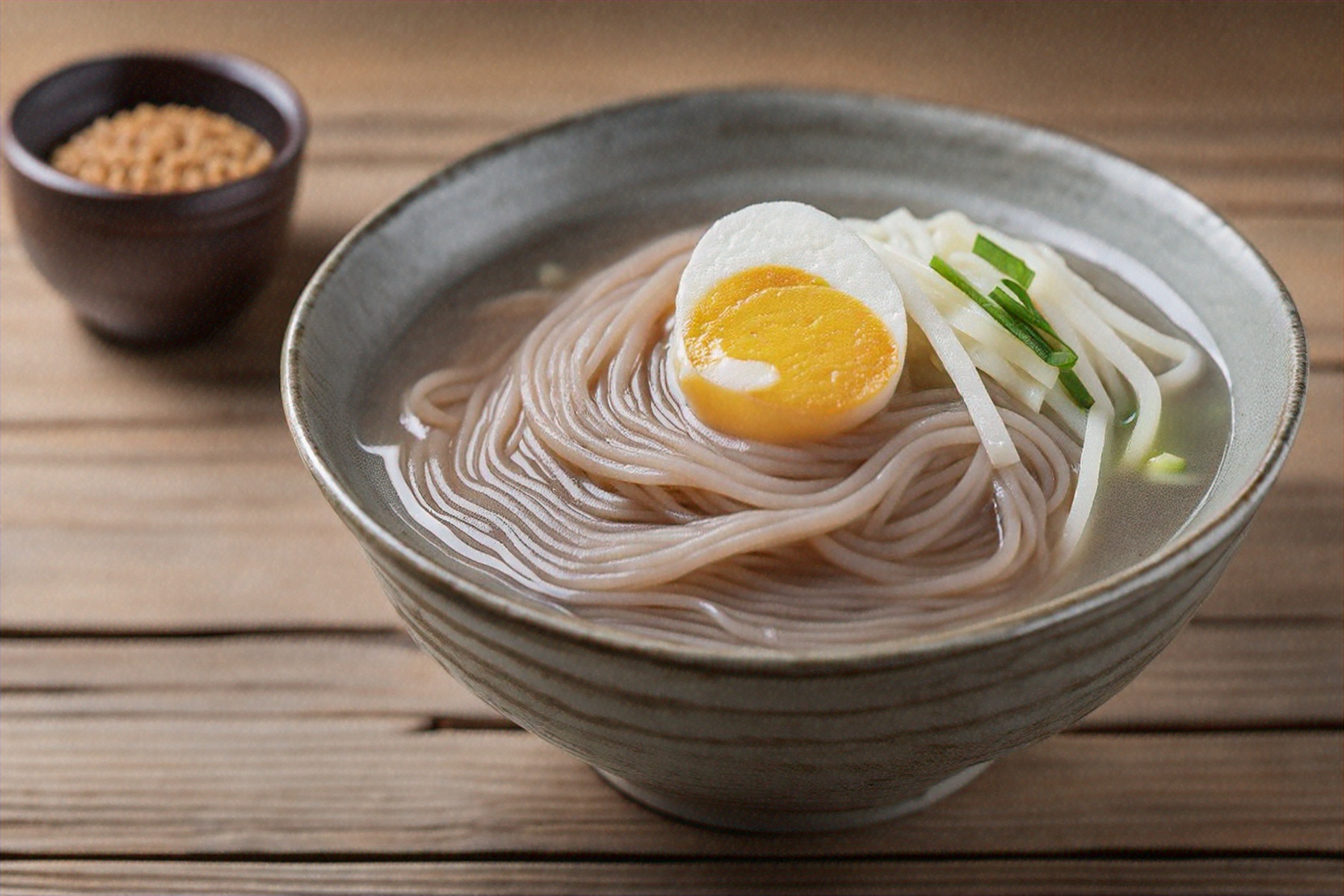
⭐ Pyongyang naengmyeon
The dish. Buckwheat noodles in an ice-cold beef-and-dongchimi broth, with slices of beef, pear, cucumber and half a boiled egg, seasoned at the table with vinegar and mustard. Eaten with scissors to cut the noodles. Northern in origin and now beloved on both sides of the DMZ — it was served at the 2018 inter-Korean summit, deliberately, and Seoul's naengmyeon restaurants had queues the next day.
Pyongyang onban
"Rice with warm broth" — rice in a clear chicken broth topped with a mung-bean pancake, mushrooms and a sliced egg. A winter dish, less famous abroad than naengmyeon and the one Pyongyang residents are more likely to name as their comfort food.
⚠️ Injogogi bap
"Artificial meat rice." Defatted soybean meal — the by-product left after pressing soy oil — pressed into sheets, rehydrated, wrapped around rice and eaten with a fiery sauce. It was invented out of desperation during the famine, when there was no meat, and it has since become the most common street food in the country. Nothing else on this page tells you as much about modern North Korea as a snack made from the leftovers of oil pressing.
The northern larder
Potato in the cold northern provinces, where the Ryanggang potato noodle is a regional speciality; maize as the staple substitute when rice is short; pollock (myeongtae) from the east coast, dried, frozen and made into soup; freshwater fish from the Taedong; and dog meat, which is eaten in summer and which this page mentions because pretending otherwise would be dishonest.
Kimchi
Made in enormous quantity in the kimjang at the start of winter and buried in jars. Northern kimchi is typically less spicy, less salty and wetter than southern, because it did not need the preservation load of a hotter climate. For many households it remains the main source of vitamins between November and April.
⚠️ And the honest caveat
Everything above describes food as it exists. Whether a given family eats it depends on songbun, province and the harvest. UN agencies have repeatedly assessed that a large share of the population is undernourished. A cuisine section on a country like this should say so rather than leave the impression of a nation at the table.
📖 Three Recipes
Two you will want to eat and one you should make once because of what it is. Ingredients from any Korean grocer, or online.
Pyongyang naengmyeon — cold buckwheat noodles
Serves 4 · broth made a day ahead · 30 min on the day · the north's signature dish
Ingredients: 400 g naengmyeon (buckwheat) noodles · 1.5 l good beef broth, made from brisket and skimmed clear · 500 ml dongchimi (radish water kimchi) liquid · 200 g cooked brisket, thinly sliced · 2 boiled eggs, halved · 1 Korean pear, julienned · 1 cucumber, julienned · pickled radish · rice vinegar and Korean mustard (yeongyeoja), to serve
Method: Make the broth the day before: simmer brisket with onion, garlic, ginger and spring onion for two hours, skim carefully, strain, cool and refrigerate until the fat sets solid and can be lifted off. It must end up clear. On the day, mix the cold broth with the dongchimi liquid in roughly three parts to one, season with salt, and chill it hard — some cooks put it in the freezer until ice crystals form. Boil the noodles for the time on the packet, no longer; they should stay chewy. Rinse them under cold running water and keep rinsing until they are genuinely cold, then drain well. Coil into deep bowls, pour over the icy broth, and arrange the beef, egg, pear, cucumber and radish on top. Serve with vinegar and mustard at the table and scissors to cut the noodles.
💡 The broth must be ice cold — properly, painfully cold. If it is merely chilled you have made a different and much worse dish.
Injogogi bap — "artificial meat" rice rolls
Serves 4 · 20 min · North Korea's ubiquitous street food, invented during the famine
Ingredients: 150 g dried soy protein sheets or defatted soy flour (Korean grocers sell the sheets as injogogi; textured soy protein sheets work) · 400 g cooked short-grain rice, still warm · 2 tbsp gochujang · 1 tbsp gochugaru · 2 cloves garlic, crushed · 1 tsp sugar · 1 tbsp soy sauce · 1 tsp sesame oil · 2 tbsp water · spring onion
Method: Soak the soy sheets in warm water for 10–15 minutes until pliable, then squeeze them out firmly — they hold a surprising amount of water and a soggy sheet will tear. If using flour, mix with water to a stiff dough, steam for 20 minutes and cut into strips. Mix the gochujang, gochugaru, garlic, sugar, soy sauce, sesame oil and water into a thick, fierce sauce and stir in the chopped spring onion. Season the warm rice lightly. Lay a soy sheet flat, put a heaped spoon of rice along one edge, roll it up tightly and squeeze gently so it holds. Serve with the sauce, either spooned inside before rolling or as a dip.
💡 The soy sheet is bland by design — it is a by-product, not an ingredient — so the sauce carries the whole dish. Make it hotter than feels sensible.
Northern-style kimchi (baek-style, lightly spiced)
Makes one large jar · 4 hours plus 3–5 days fermenting · the wetter, milder northern version
Ingredients: 1 napa cabbage (about 1.5 kg) · 100 g coarse sea salt · 1 l water · 1 Korean pear, grated · 1 small daikon, julienned · 4 cloves garlic · 15 g ginger · 2 tbsp gochugaru (a fraction of what a southern recipe uses) · 2 tbsp fish sauce or salted shrimp · 2 spring onions · 1 tbsp glutinous rice flour cooked into 200 ml water as a thin porridge, cooled
Method: Quarter the cabbage lengthways, dissolve the salt in the water and soak the cabbage for 3–4 hours, turning occasionally, until the thick stems bend without snapping. Rinse three times and drain upside down for half an hour. Blend the garlic, ginger and pear with the fish sauce. Mix this with the cooled rice porridge, the gochugaru and the julienned daikon and spring onion — the paste should be loose and wet, not the stiff red paste of southern kimchi. Rub it between every leaf, working from the stem end. Pack tightly into a jar, press down until the brine rises above the vegetables, and leave a good gap at the top. Leave at room temperature for 1–2 days until it smells sour and bubbles when pressed, then refrigerate. Ready at 3–5 days, better at two weeks.
💡 Northern kimchi is soupier and much less fiery than the southern kind. If it looks pale next to the kimchi you know, you have got it right.
🍺 Taedonggang and Soju
Drinking in North Korea is social, male-dominated, and organised around soju in the way it is across the peninsula. The country also brews, improbably, a genuinely good beer — on equipment it bought second-hand from England.
⭐ Taedonggang
The state brewery in Pyongyang, opened in 2002 using the entire plant of the Ushers brewery of Trowbridge, Wiltshire, which the DPRK bought, dismantled and shipped. The beer that results is a clean, malty lager that visiting journalists have repeatedly and slightly guiltily described as better than most mass-market beer in Asia. It comes in numbered styles, from pale to dark.
Soju
The peninsula's spirit, made in the north from whatever starch is available — rice where possible, otherwise maize, potato or sweet potato. Typically 20–25 % and drunk in small glasses with food, following the usual Korean etiquette in which you pour for others and never for yourself, and turn away from an elder as you drink.
Pyongyang Soju and the local brands
The state produces branded soju and a range of medicinal liquors, some of which have become minor export curiosities. Provincial distilleries and home brewing fill in the rest, and market-made alcohol of highly variable quality is widely traded.
Insam
Ginseng from Kaesong is genuinely prized — the region has grown it for centuries and its ginseng was a tribute good under the Chosŏn dynasty. It appears in liquors, teas and tonics, and Kaesong Koryo Insam is one of the few DPRK consumer brands with a real reputation abroad.
Tea and coffee
Tea is drunk, mostly local and mostly plain. Coffee is a genuine luxury, imported and expensive, and the appearance of cafés in Pyongyang over the last decade is one of the small, telling markers of how much the market economy has changed the capital.
⚠️ A note on the beer stories
Taedonggang gets written about disproportionately because it is a safe, charming, harmless story a journalist can file from Pyongyang. Enjoy it, and notice that the availability of good lager in the capital tells you about the capital and nothing at all about the country.
📋 Practical Information — Mostly About Not Going
⚠️ Entry
Tourist entry is closed to almost everyone (see the tourism section). Everyone who does enter does so on a visa issued for a specific organised itinerary — there is no visa on arrival, no independent travel and no unaccompanied movement. South Korean nationals are refused. US passports are not valid for travel to the DPRK under a State Department restriction in force since 2017 and renewed annually; a special validation is required and is rarely granted.
Getting in, when it runs
Two routes, both through China. Air Koryo from Beijing to Pyongyang, and the train from Beijing or Dandong — the Beijing service resumed in March 2026, four times a week. There is also a limited connection from Vladivostok. Everything routes through a third country; there are no direct flights from Europe.
Money
Euros, Chinese yuan and US dollars in cash, and nothing else. No foreign cards work — no Visa, no Mastercard, no ATMs. There is no way to obtain money once inside, so whatever you carry in is what you have. Foreigners have historically been kept away from the won entirely.
Phones and internet
Your phone will not roam. SIM cards sold to foreigners have historically provided expensive international data and no calls to local numbers — you can call Berlin but not the next room. Assume everything is monitored, because it is.
⚠️ Rules that are not negotiable
Do not fold, tear or sit on a newspaper carrying a Kim portrait. Photograph statues of the leaders whole, never cropped. Bow when your guides do. Never photograph soldiers, checkpoints, construction sites or anything that looks poor. Never leave your hotel alone. Never give anything to a resident, who will be the one to pay for it. And take nothing — a poster, a leaflet — that is not offered to you, which is the mistake that killed Otto Warmbier.
Health and consular help
Medical facilities are poor by any standard and serious cases require evacuation to Beijing. There is no meaningful consular protection: most Western countries have no embassy in Pyongyang, and those with one operate under severe constraints. Sweden has historically acted as protecting power for the United States, Australia and Canada.
🇨🇿 For Czech Readers
Czech readers have a closer connection to North Korea than almost any other European nation, and almost none of it is widely known at home. It is worth setting out properly.
⭐ The embassy
The Czech Republic maintains an embassy in Pyongyang — at Taedonggang district, Taehak Street — and is one of a small handful of EU states that does. It inherited the Czechoslovak mission, which dates to the 1950s. For Czech citizens this matters practically: consular help exists in a country where most nationalities have none, and other EU citizens can request assistance there under the EU consular protection arrangements.
⚠️ MZV ČR travel advice
The Czech Ministry of Foreign Affairs advises against travel to the DPRK, and the point is not formal. Entry is closed in any case, independent travel does not exist, and the ministry's capacity to help a detained Czech citizen is extremely limited even with an embassy in the city. Anyone who does travel should register in DROZD (drozd.mzv.cz) beforehand — here it is not a formality.
Panmunjom
For forty years a Czechoslovak delegation sat inside the DMZ as part of the Neutral Nations Supervisory Commission, and in April 1993 North Korea refused to accept the Czech Republic as its successor and forced the delegation out. It is the deepest institutional connection any Czech body has had with Korea and it has its own section on this page.
The 1950s aid
Czechoslovakia sent a field hospital and reconstruction assistance after the Korean War and rebuilt the town of Sinchang. Hundreds of North Korean students and war orphans were educated in Czechoslovakia in the 1950s and then recalled abruptly when Pyongyang grew uneasy about what they were learning. Several left descendants and unresolved family stories behind.
Tatra
Tatra trucks have appeared in DPRK construction footage and parades for decades, and the marque is among the very few Czech products a North Korean official might recognise. Whether and how spare parts still reach them is a question nobody has answered publicly.
Getting there, hypothetically
If it ever reopens: Prague → Beijing (direct or via a Gulf hub), then Air Koryo or the train to Pyongyang, on a booked tour with a Chinese visa arranged in advance. Reckon 25 000–40 000 Kč for the Prague–Beijing return and 45 000–90 000 Kč for a week-long DPRK tour including internal transport, guides and accommodation — tours are priced as packages and there is nothing to compare them against.
✍️ Author's Note — Momos, Firm Tofu and a Monument That Does Not Exist
Every rebuild in this series begins by reading the page it replaces and checking it. North Korea's old page was a competent short summary that had gone out of date in the two most important respects possible, and its food section was describing the wrong country.
⚠️ Reunification
The old page said the country "continues missile and nuclear development" and described the standard Korean picture. It was written before January 2024, when Kim Jong-un abandoned reunification, renamed the South the principal enemy in the constitution and demolished the monument. That is the largest single change in DPRK policy since the 1990s and it now has a section of its own.
⚠️ Russia
Nothing in the old page indicated that the DPRK had signed a mutual-defence treaty with Russia in June 2024 and sent up to 12 000 soldiers to fight in Kursk. A guide that describes North Korea as an isolated hermit state in 2026 is describing a country that stopped existing two years ago.
⭐ Sundubu jjigae is South Korean
The old page gave three recipes and one of them — sundubu jjigae — is a South Korean dish with no particular North Korean standing. It has been replaced here by injogogi bap, which is specifically and unmistakably northern: rice wrapped in pressed soy by-product, invented during the famine and now the country's commonest street food. Also fixed: the old page's preparation text read "Sautingé pork", a mangled word that had been sitting on the live site.
The photographs
Three food images, one usable. The naengmyeon is right — the best food photograph this project has audited in months, which supports a hypothesis logged earlier in this series: the image bank is accurate exactly where the wider internet already is, and naengmyeon has a large international profile. The mandu is a Nepali momo, gathered and knotted at the top with a chilli dip and coriander. And the sundubu is firm tofu in cubes — in a dish whose name literally means soft tofu.
⭐ A monument that was never built
The old page's header image shows a tall pale tower with a flared base, an arch through it and an illegible circular emblem at the top. It is not the Juche Tower, not the Arch of Triumph, not the Ryugyong Hotel and not anything else in Pyongyang. It is a plausible-looking building that does not exist anywhere — a new category for this project's running audit, distinct from photographing the wrong real place. The replacement image at the top of this page is genuinely Pyongyang, with one error named in its caption.
Why this page is long
Because the short version of North Korea is always the same short version — hermit kingdom, funny haircut, empty boulevards — and it has not been accurate for years. Twenty-six million people live there. They are fed by markets the state pretends not to see, they are sorted by a caste system based on what their great-grandparents did, and some of them are buried in Russia. That deserves more than six sections and a joke.
Support This Project 🌍
This World Travel Factbook is a labor of love – free to use for all travelers. If you find it helpful, consider supporting its continued development.
