
🇽🇰 Kosovo at a Glance
🌍 Overview
Kosovo is 10,887 km² — about the size of the Ústí and Liberec regions together — with roughly 1.6 million people, wedged between Serbia, North Macedonia, Albania and Montenegro. It declared independence on 17 February 2008, which makes it the newest country in Europe, and its statehood is recognised by rather more than half the world and by none of the states that could most easily make it stop being contested.
It is also, and this gets lost in the politics, one of the best-value and least-visited destinations on the continent: an Ottoman old town at Prizren that would be overrun anywhere else, some of the finest Byzantine frescoes in existence, a serious mountain range on the Albanian border, excellent food, a genuinely good wine region, and prices that have not caught up with any of it.
The state
A parliamentary republic with a 120-seat Assembly, twenty of whose seats are reserved for minorities — ten of them for Kosovo Serbs. The president is elected by the Assembly, not the public. Since early 2025 the country has been in a rolling institutional deadlock: it has held repeated elections, gone months without a confirmed government, and as of September 2026 has an acting president rather than an elected one. See the politics section.
The people
Around 92% Albanian, with a Serb minority of some 4–5% concentrated in the north around Mitrovica and in enclaves further south, plus Bosniaks, Turks, Roma, Ashkali, Egyptians and Gorani. Kosovo has the youngest population in Europe — median age around thirty — and one of its highest emigration rates, which are two halves of the same fact.
The economy
Small, open, euro-denominated and heavily dependent on the diaspora. Roughly 800,000 Kosovars live abroad, mostly in Germany and Switzerland, and their remittances run at something like a sixth of GDP. Growth has been decent by regional standards, GDP per capita is around USD 9,000 nominal, unemployment — especially youth unemployment — is the persistent problem, and the summer months when the diaspora comes home are a visible economic season of their own.
What visiting is like
Easy, cheap and much safer than the reputation. Roads are good, Pristina and Prizren are compact and walkable, English among young people is excellent, and the hospitality is genuinely striking. The complications are practical rather than dangerous: the entry stamp problem if you plan to continue into Serbia, minimal rail, and a north that requires more care than the rest.
🏷️ Two Names for One Place
Almost everything in Kosovo has two names, and which you use is read as a statement. Kosovo is the Serbian form, from kos, blackbird — Kosovo Polje, the Field of Blackbirds. Kosova is the Albanian form. The official name in Albanian is Republika e Kosovës, and English has settled on Kosovo, which is why this page uses it.
The place names
Pristina is Prishtina in Albanian and Priština in Serbian. Peja is Peć. Gjakova is Đakovica. Ferizaj is Uroševac. Rahovec is Orahovac. Both sets are official under the language law and both appear on road signs, frequently with one of them spray-painted out. This page uses the Albanian forms with the Serbian in brackets where it helps, which is the usual English convention and not a political claim.
Dardania
The older name, and the one you will see on football shirts, restaurant signs and a Pristina neighbourhood. Dardania was the Roman province and the kingdom of the Dardani, an Illyrian people, and it is used by Albanians as a claim of deep continuity in the territory. The historiography is genuinely contested — the link between ancient Illyrians and modern Albanians is argued about by serious people — but the emotional weight of the word is not in doubt.
The flag, and the other flags
The official flag is blue with a gold outline of the country's map under six white stars, adopted in 2008 and deliberately designed to have no ethnic content whatsoever — no eagle, no cross, nothing anyone could read as belonging to one community. It is also, for exactly that reason, unloved: what you actually see everywhere is the red Albanian flag with the black double-headed eagle, and in the Serb-majority north the Serbian tricolour. The flag says a great deal about the difference between the state and the nation here.
The country code that had to be invented
Kosovo is not a UN member, so it has no ISO country code. What it has is XK, a "user-assigned" code adopted informally by the European Commission, the IMF and the banks so that Kosovo could have an IBAN and appear in databases at all. The dialling code, +383, was allocated by the ITU only in 2016; before that Kosovo used Monaco's and Slovenia's numbers by arrangement, which is the sort of thing that happens to a country half the world does not recognise.
🗺️ Geography
Kosovo is a basin ringed by mountains — two plains in the middle, high ground on almost every side, and no coastline anywhere near it. It is small enough to cross by car in about two and a half hours and mountainous enough that the crossing is worth doing slowly.
The two plains
The Kosovo plain in the east around Pristina, which drains north to the Danube via the Ibar and the Sitnica, and the Dukagjini plain (Metohija in Serbian) in the west around Peja, Gjakova and Prizren, which drains south to the Adriatic via the White Drin. The watershed between them runs right through the middle of the country, which is unusual for something this small and explains a lot about its climate and its history.
The Accursed Mountains
Bjeshkët e Nemuna — Prokletije in Serbian, the Accursed Mountains in English — along the Albanian and Montenegrin border in the west: limestone, glacial lakes, and Kosovo's high point at Gjeravica, 2,656 m. It is a serious range with real alpine character, and the Peaks of the Balkans trail through it into Albania and Montenegro is the best long-distance walk in the region.
Šar / Sharr
The Sharr Mountains along the North Macedonian border in the south, reaching 2,600 m, gentler in profile than the Accursed range and famous for high summer pasture, the Sharr sheepdog, and the sheep's cheese that comes off those pastures. Brezovica, Kosovo's ski resort, is on the northern slope and has been the subject of stalled investment plans for two decades.
Rivers and one absent thing
The White Drin, the Ibar, the Sitnica, the Lepenac, and the Drini i Bardhë waterfall near Peja, which is the country's most photographed piece of water. What Kosovo does not have is a coast, a navigable river, or a lake of any size — and it is one of the most water-stressed countries in the Balkans, which the coal-fired power stations and a hot dry summer make worse every year.
Climate
Continental, with a Mediterranean influence reaching up the Drin valley into the Dukagjini plain — which is why Prizren, Rahovec and Gjakova are noticeably warmer and can grow grapes and even figs, while Pristina is a straightforward central-European cold winter and hot summer. Snow lies in the mountains from December to April; Pristina in January is genuinely cold and, because of the power stations and household heating, has some of the worst winter air quality in Europe.
Lignite
The awkward geological fact underneath everything. Kosovo sits on one of the largest lignite deposits in Europe — estimates run to several billion tonnes — and generates almost all its electricity from two ageing power stations at Obiliq, Kosovo A and B, which are among the most polluting in Europe. The deposit is a national asset and a public-health problem at the same time, and replacing it is the central question of Kosovo's energy policy.
📜 Dardania, Byzantium and the Ottomans
Before Rome
The territory was the heartland of the Dardani, an Illyrian or possibly Thraco-Illyrian people, who ran a kingdom here from around the fourth century BC and fought Macedon repeatedly. Rome absorbed the area in the first century BC and it became the province of Dardania, valuable for its silver and lead mines — the mines at Novo Brdo and Trepča have been worked, on and off, ever since.
Ulpiana and Justinian
Ulpiana, near modern Pristina, was the Roman and Byzantine town of the region and is a substantial and under-excavated archaeological site. The emperor Justinian I was born in 482 somewhere in this general area — at Tauresium, most likely just over the modern North Macedonian border — and rebuilt Ulpiana as Justiniana Secunda after an earthquake. Slavic settlement followed from the sixth and seventh centuries.
Medieval Serbia
From the twelfth century the territory was the core of the Nemanjić Serbian state, and this is the origin of Kosovo's central place in Serbian national identity. The Patriarchate of Peć became the seat of the Serbian Orthodox Church; Visoki Dečani, Gračanica and the Church of the Virgin of Ljeviša at Prizren were built and frescoed to an extraordinarily high standard. All four are on the UNESCO list today and all four are on its List in Danger.
1389
The Battle of Kosovo was fought on 28 June 1389 at Gazimestan near Pristina between an Ottoman army under Sultan Murad I and a coalition led by the Serbian Prince Lazar. Both commanders died. Militarily it was probably a draw or a narrow Ottoman win, and it did not end Serbian statehood, which continued for another seventy years. What it produced was a myth — of chosen defeat, of the heavenly kingdom, of Miloš Obilić killing the sultan — that became the central story of Serbian national identity and is invoked to this day. The Gazimestan monument is where Slobodan Milošević gave his speech on the six-hundredth anniversary in 1989.
Five Ottoman centuries
Ottoman rule from the fifteenth century reshaped everything. Towns grew — Prizren, Gjakova, Peja, Vushtrri — with mosques, hammams, bridges, bazaars and the guild economy that produced Gjakova's Çarshia e Madhe. The population became predominantly Muslim over several centuries by a mixture of conversion, migration and taxation pressure, and the Albanian share of the population rose while the Serbian share fell, particularly after the Great Migrations of the Serbs in 1690 and 1737, when Patriarch Arsenije III led tens of thousands north to Habsburg territory.
The League of Prizren
In 1878, as the Congress of Berlin prepared to hand Albanian-inhabited land to Serbia, Montenegro and Greece, Albanian leaders met at Prizren and founded the League of Prizren — the first organised Albanian national movement, demanding autonomy within the empire and the unification of Albanian-speaking territory. It was suppressed by 1881. Its building in Prizren is a museum and it is the reason Prizren occupies the place it does in Albanian national memory.
⚔️ From 1912 to 1989
The Balkan Wars
Serbia and Montenegro took Kosovo from the Ottomans in 1912, and the newly proclaimed Albanian state was left outside its borders — the founding grievance of Albanian politics in the region ever since. The conquest and the subsequent colonisation programmes involved considerable violence, documented at the time by the Carnegie Endowment's inquiry into the Balkan Wars. Kosovo became part of the Kingdom of Serbs, Croats and Slovenes in 1918.
Between the wars
Interwar Yugoslavia pursued colonisation: Serb and Montenegrin settlers were given land, Albanian-language schooling was effectively banned, and tens of thousands of Albanians emigrated to Turkey under agreements between Belgrade and Ankara. Albanians were not recognised as a constituent nation. This period is central to how Kosovo Albanians understand the twentieth century and is barely known outside the region.
The Second World War
Most of Kosovo was annexed to Italian-occupied Greater Albania in 1941, which for many Albanians meant Albanian-language schools for the first time and for many Serbs meant expulsion and killing. Partisan and nationalist forces fought each other as well as the occupiers. When Yugoslavia was reconstituted in 1945, Kosovo was returned to Serbia, an armed Albanian revolt was put down, and the returning Serb settlers' property claims were only partly restored.
Ranković and after
Under interior minister Aleksandar Ranković through the 1950s and early 60s, Kosovo Albanians experienced systematic surveillance, arms-collection campaigns and repression. His fall in 1966 opened a liberalising decade: the University of Pristina opened in 1970 teaching in Albanian, cultural rights expanded, and the 1974 constitution made Kosovo an autonomous province with almost all the attributes of a republic — its own assembly, government, central bank, and a seat and a veto in the federal presidency.
1981
Student protests at Pristina University in March 1981, which began over canteen food and escalated into demands that Kosovo become a republic within Yugoslavia, were suppressed with tanks and a state of emergency. The federal response criminalised the demand, and through the 1980s thousands of Albanians were imprisoned for political offences while Serbian public opinion moved sharply in the other direction, driven by claims about pressure on the shrinking Serb population.
1989
Slobodan Milošević built his rise on Kosovo. In 1987 at Kosovo Polje he told a Serb crowd "no one should dare to beat you"; in March 1989 the Serbian assembly, with the Kosovo assembly coerced into consent, stripped the province of its autonomy; and on 28 June 1989 he addressed a vast crowd at Gazimestan on the six-hundredth anniversary of the battle. What followed was the dismissal of Albanians from public employment on a mass scale, the closure of Albanian-language institutions, and the creation of a parallel Albanian society — underground schools, clinics and a shadow government — under Ibrahim Rugova and his policy of non-violent resistance.
💥 1998–99
The decade of parallel institutions and passive resistance ended when it became clear that Kosovo had been left out of the Dayton settlement of 1995 and that non-violence had produced nothing. What followed is recent enough that most adults in Kosovo remember it directly, and it is the single thing a visitor most needs to understand and most needs to handle with care.
The KLA
The Kosovo Liberation Army (UÇK) emerged publicly in 1996–97 and grew rapidly after the collapse of the Albanian state in 1997 flooded the region with weapons. It attacked Serbian police and officials and those it deemed collaborators. Serbian forces responded with operations against villages judged to support it. Through 1998 this became a full counter-insurgency war, with mass displacement and atrocities documented on both sides, though overwhelmingly against Albanian civilians in scale.
Račak and Rambouillet
In January 1999 the bodies of 45 Albanians were found at Račak; the head of the OSCE verification mission called it a massacre, Belgrade called it a staged battle scene, and the finding became the trigger for international escalation. Talks at Rambouillet in February and March failed — the annex providing for NATO movement throughout Yugoslavia was rejected by Belgrade and is still argued over — and the process ran out.
The NATO campaign
NATO began bombing on 24 March 1999 without a UN Security Council resolution, which remains the most legally contested aspect of the whole affair; the Independent International Commission on Kosovo later called it "illegal but legitimate". The campaign lasted 78 days. During it, Serbian forces conducted Operation Horseshoe, expelling something like 850,000 Albanians into Albania and North Macedonia and killing thousands, with mass graves later found in Serbia itself. NATO strikes also killed several hundred civilians.
The end and the reverse
Milošević accepted terms on 9 June 1999; Serbian forces withdrew and KFOR entered. The refugees returned within weeks — one of the fastest mass returns ever recorded. What followed was reverse expulsion: revenge attacks drove out well over 200,000 Serbs, Roma and others, monasteries and churches were attacked, and the Roma quarter of Mitrovica was destroyed. The March 2004 riots, which killed nineteen and destroyed dozens of Orthodox sites, were the worst single episode of the post-war period.
The reckoning
The ICTY at The Hague convicted senior Serbian and Yugoslav figures for crimes in Kosovo; Milošević died in 2006 before judgment. Allegations against the KLA leadership — including organ trafficking claims from a Council of Europe report that a later prosecution did not substantiate — led to the creation of the Kosovo Specialist Chambers in The Hague, a Kosovo court sitting abroad with international judges. Former president Hashim Thaçi and others have been on trial there since 2023. It is deeply unpopular in Kosovo and it is also the country's most serious attempt to account for its own side.
The missing
More than a thousand people from all communities remain missing from the conflict. The commissions still work, remains are still identified and returned, and the annual commemorations are still raw. If a conversation in Kosovo turns to this, listen rather than compare, and do not offer a view about who suffered most — everyone has lost someone and the arithmetic of grief is not a subject a visitor should open.
🕊️ 1999–2008
UNMIK
From June 1999 Kosovo was governed by the United Nations Interim Administration Mission under Security Council Resolution 1244, which affirmed Yugoslav sovereignty while removing every practical attribute of it. UNMIK ran the courts, the police, the customs and the currency — it adopted the Deutsche Mark and then the euro, which is why Kosovo uses the euro today without being in the eurozone or the EU.
Standards before status
The international formula of the early 2000s: Kosovo had to meet benchmarks on minority rights, rule of law and returns before its final status could be discussed. The March 2004 riots destroyed the credibility of that sequencing overnight — the province had plainly failed the standards, and the conclusion drawn was not to postpone status but to accelerate it, on the reasoning that the limbo itself was the destabilising factor.
The Ahtisaari plan
UN envoy Martti Ahtisaari produced a settlement proposal in 2007 providing for supervised independence with extensive guarantees for the Serb community — decentralisation into Serb-majority municipalities, protection of the Orthodox Church, reserved seats. Belgrade rejected it; Russia made clear it would veto it at the Security Council. The proposal was never adopted by the UN and was nonetheless built into Kosovo's constitution more or less wholesale.
17 February 2008
The Assembly declared independence, coordinated with the United States and the major EU states, in a text that explicitly committed Kosovo to implementing the Ahtisaari plan. Recognitions followed within days from the US, the UK, France, Germany and, on 21 May 2008, the Czech Republic. The Newborn monument was unveiled in Pristina that day and has been repainted every year since with a different theme.
The ICJ opinion
Serbia took the question to the International Court of Justice, which ruled in July 2010 that the declaration of independence did not violate international law. The ruling was narrower than the headlines: the court answered only whether the act of declaring was unlawful, and explicitly declined to rule on whether Kosovo is a state or whether anyone must recognise it. Both sides claimed vindication, which tells you how the question was framed.
EULEX and the rest
The EU rule-of-law mission EULEX took over much of the justice and policing function and is still present in reduced form. KFOR, the NATO force, is still deployed and was reinforced after the violence in the north in 2023. The International Civilian Office supervising independence closed in 2012 when Kosovo was declared fully sovereign, which was a genuine milestone and did not change the recognition arithmetic at all.
⚖️ The Status Question
📅 Checked 6 September 2026. This section sets out the positions of the parties. It does not adjudicate between them, and a travel guide is not the place to.
Who recognises Kosovo
Something over a hundred UN member states — the exact number is disputed because Serbia has run a successful campaign of securing withdrawals of recognition and both sides count differently. It includes the United States, the United Kingdom, Japan, Canada, Australia, Turkey and 22 of the 27 EU member states. The Czech Republic recognised Kosovo on 21 May 2008 and has an embassy in Pristina.
Who does not
Serbia, which regards Kosovo as its autonomous province. Russia and China, both permanent Security Council members, which is why Kosovo cannot join the UN. And five EU states — Spain, Greece, Cyprus, Romania and Slovakia — each with its own domestic reason involving its own separatist or minority questions. That EU split is why Kosovo has no candidate status despite applying in December 2022.
The argument for
That Kosovo's population overwhelmingly wants independence and has done for decades; that Serbia forfeited any moral claim by the repression of the 1990s and the expulsions of 1999; that the province was already a near-republic under the 1974 constitution and was stripped of that status unilaterally; that no viable arrangement returning Kosovo to Serbian rule exists; and that eighteen years of functioning statehood is a fact on the ground.
The argument against
That unilateral secession without the parent state's consent sets a precedent that international order cannot absorb — the point Spain, Cyprus and Romania make about their own territory and Russia made explicitly when it cited Kosovo over Crimea; that Resolution 1244 affirmed Yugoslav sovereignty and was never superseded; that the treatment of Kosovo Serbs since 1999 has not met the standards promised; and that the medieval Orthodox heritage is inseparable from Serbian identity.
The dialogue
EU-facilitated talks in Brussels since 2011 have produced real technical results — number plates, customs stamps, freedom of movement, the integration of Serb-majority municipalities' police and courts — and have never resolved the fundamental question. The 2023 Ohrid Agreement on the path to normalisation was accepted verbally by both leaders and signed by neither, and its central bargain — de facto recognition in exchange for an Association of Serb-Majority Municipalities — remains unimplemented on both sides.
The north
The four Serb-majority municipalities north of the Ibar, centred on North Mitrovica, are where the dispute is physical. Kosovo institutions have extended control since 2022–23 in a series of moves Pristina calls establishing the rule of law and Belgrade calls provocation. The Banjska attack of September 2023, in which an armed Serb group killed a Kosovo policeman and fought a siege at a monastery, was the most serious incident since 2004 and hardened everything. Kosovo Serbs have largely boycotted Kosovo elections, which means their reserved seats are held by parties with very small vote totals.
🏛️ Politics Now — 6 September 2026
📅 Checked 6 September 2026. Kosovo is in its second year of institutional deadlock and this is a fast-moving situation. Treat everything here as a snapshot.
How it works
A 120-seat Assembly, of which 20 seats are reserved for minorities — ten for Serbs and ten for others. The government needs a simple majority. The president is elected by the Assembly and needs 80 votes in the first two rounds, dropping to a simple majority of 61 in a third round between the top two candidates. That 80-vote threshold, designed to force consensus, is what has jammed the entire system.
The deadlock
The February 2025 election produced no working majority and the Assembly could not even constitute itself for months. A snap election followed. Then another. The most recent, in June 2026, gave Albin Kurti's Vetëvendosje 53 of 120 seats, ahead of the PDK on 22 and the LDK on 18 — a clear plurality, and still short. Kurti has continued as caretaker prime minister throughout, which means Kosovo has now been governed by an acting administration for well over a year.
No president
Vjosa Osmani's term expired in April 2026 without a successor elected. Under the constitution the Assembly speaker, Albulena Haxhiu, became acting president from 4 April, for a maximum of six months — that is, until 4 October 2026. Votes on 5 March and 27 April both failed for want of the 80-member quorum.
The Sejdiu attempt
Vetëvendosje and the LDK agreed on a consensus candidate, Bekim Sejdiu — a lawyer, diplomat and former Constitutional Court judge, deliberately chosen as a figure without a party profile. In early September six LDK MPs broke with their own leadership and refused to back him, which takes the coalition below the 80 votes needed. Failure in all three rounds dissolves the Assembly and triggers yet another election — the fourth in under two years.
What the fight is actually about
Not policy. Kurti's Vetëvendosje is a left-nationalist movement that came out of street protest, and its combination of a commanding plurality and an inability to work with anyone has met an opposition that will not legitimise him at any price. Underneath sit real disagreements about the north, the Association of Serb-Majority Municipalities and the Brussels dialogue, on which Kurti has taken a harder line than Kosovo's Western partners want.
The cost
Two years of caretaker government means no budget properly passed, stalled reforms, frozen appointments, and a visible loss of patience in Brussels and Washington at exactly the moment Kosovo needs both. EU candidate status, applied for in December 2022, has not moved. It is worth saying plainly that none of this affects a visitor's safety or logistics in the slightest — the country runs perfectly well while its politicians do not.
💰 The Economy
The shape of it
Small and open: nominal GDP around USD 14 billion and USD 9,000 per head, with growth in recent years generally in the 3–4% range — respectable, and from a very low base. The euro is the currency, adopted unilaterally via the Deutsche Mark in 1999, which gives price stability and no monetary policy whatsoever. Services and construction dominate; industry is thin.
The diaspora
The single most important economic fact. Roughly 800,000 Kosovars live abroad — some estimates put the diaspora at a third of the size of the resident population — overwhelmingly in Germany and Switzerland, with communities in Austria, Italy, the US and the Nordics. Their remittances amount to something like a sixth of GDP, they finance most private house-building, and their return every July and August visibly doubles the population of some towns.
Unemployment and the young
The binding constraint. Kosovo has the youngest population in Europe and one of its lowest employment rates, with female labour-force participation particularly low. Youth unemployment has run above 30% for years. The result is emigration on a scale that is now itself a policy problem: since visa liberalisation on 1 January 2024 allowed Kosovars to travel to the Schengen area without a visa, the pull of German and Swiss wages has become much easier to act on.
Mining and energy
Trepča, the great lead-zinc-silver complex north of Mitrovica, was one of Yugoslavia's industrial jewels and is now a fraction of its former self, partly under Kosovo control and partly not. Lignite at Obiliq supplies nearly all electricity from two elderly and heavily polluting plants. Building the replacement — renewables, interconnection, and a solution to the winter demand peak — is the central infrastructure question and is going slowly.
What actually grows
Agriculture on the two plains, particularly fruit, peppers and wine. Ajvar and preserved peppers as an export. Construction, financed by remittances. A young IT and outsourcing sector in Pristina that is genuinely promising and trades on cheap, English-speaking, technically trained graduates. And tourism, which is small and rising and which the Peaks of the Balkans trail and the diaspora together are driving.
The informal economy and corruption
Both substantial. Kosovo consistently ranks poorly on corruption perception indices, public procurement is a standing scandal generator, and a large share of activity is off the books. It is also, in fairness, a state built from nothing in 2008 with institutions younger than the people staffing them, and the anti-corruption platform is what put Vetëvendosje in power in the first place.
🏙️ Pristina
A city of around 200,000 people that is not beautiful and is a great deal more interesting than that suggests: young, loud, cheap, over-caffeinated, and rebuilt so fast after 1999 that whole districts went up without much planning. Pristina is where you understand what a country made of twenty-somethings feels like.
Newborn
The monument unveiled on 17 February 2008, the day of the declaration — the word NEWBORN in steel capitals, originally painted yellow and signed by thousands of people. It has been repainted every year since to a different design: flags of recognising states, barbed wire for visa restrictions, the letters knocked over, and in 2018 the word broken into pieces for the tenth anniversary. It is the best public artwork in the Balkans and a running annual editorial on the state of the country.
The strange buildings
The National Library, ninety-nine domes and a metal net over a brutalist concrete frame, routinely voted one of the ugliest buildings in the world and genuinely magnificent once you stop expecting it to be pretty. The unfinished Cathedral of Christ the Saviour beside it, an Orthodox church begun in the 1990s and left as a shell. The Palace of Youth and Sports with its collapsed roof. And the Bill Clinton statue on Bill Clinton Boulevard, near a boutique called Hillary.
The Ottoman remnant
Not much survived the twentieth century, but what did is worth an hour: the Imperial Mosque of 1461, the Great Hammam, the Clock Tower, and the Ethnographic Museum in the Emin Gjiku complex, two eighteenth-century Ottoman houses which is the single most charming thing in the city and is usually empty.
Coffee, and what it is for
Pristina's café culture is out of all proportion to the city's size and is the central social institution. Macchiatos are ordered constantly, cost about a euro, and are consumed over hours. Streets to walk: Nëna Terezë, the pedestrian boulevard; Rruga B for bars; Pejton for restaurants. The nightlife is very good and starts late.
Gračanica and Gazimestan
Both within twenty minutes. Gračanica Monastery, a five-domed Byzantine masterpiece of 1321 in a Serb-majority village, is a UNESCO site and one of the most beautiful buildings in the region. Gazimestan, the tower on the field where the 1389 battle was fought, is a bare stone monument on a bare plain and is more affecting for it. Visiting both in a morning is the most efficient way to understand what this country is arguing about.
Practical
Pristina International Airport is 20 minutes from the centre. The city is walkable; taxis are cheap and metered. Accommodation is inexpensive and plentiful. Two days is enough for the city and its immediate surroundings, and Pristina is the natural base for a first visit even though Prizren is the prettier town.
🕌 Prizren
The most beautiful town in Kosovo and one of the most beautiful in the Balkans: an Ottoman old town of stone houses and mosques on both banks of a river running down from the Sharr mountains, under a hilltop fortress, with a stone bridge in the middle of it. If Prizren were in Croatia it would be full. It is not.
The old town
Compact and entirely walkable. The Stone Bridge over the Bistrica; the Sinan Pasha Mosque of 1615 dominating the centre; the Gazi Mehmet Pasha Hammam; the Shadervan square with its fountain, which is where the whole town sits in the evening. Alongside them the Orthodox Church of the Virgin of Ljeviša, a UNESCO site of 1307 with outstanding frescoes, badly damaged by arson in the 2004 riots and since restored.
The fortress
Kalaja, above the town, Byzantine in origin and much rebuilt by the Ottomans, reached by a twenty-minute climb from the old town. The view down over the roofs, the minarets and the river at sunset is the single best sight in the country and costs nothing. Go up in the evening; half of Prizren will be up there with you.
The League of Prizren
The complex where the Albanian national movement was founded in 1878 is now a museum, rebuilt after being burned in 1999. Whatever one's view of what followed, it is the birthplace of modern Albanian political nationalism and it is presented as such, plainly and without much subtlety.
Dokufest
Kosovo's cultural export. The Dokufest documentary and short film festival takes over Prizren for a week every August — screens in the river, on the fortress, in the hammam, in the old cinema — and is a genuinely serious international festival that also happens to be the best party in the Balkans. Accommodation that week is impossible without booking months ahead.
Around Prizren
The Sharr mountains immediately above, with high pastures and the Prevalla pass. The Gorani villages of the Gora region in the far south, a Slavic-speaking Muslim community with their own culture and a rapidly emptying set of villages. And the road east to Brezovica and south to the North Macedonian border.
Languages on one street
Prizren is the most genuinely multilingual place in Kosovo: Albanian, Turkish, Bosnian and Serbian are all spoken, and the Turkish community here has been continuously present since the Ottoman period and has its own schools and media. If you want to see what the Balkans looked like before the twentieth century sorted everyone into boxes, this is the place that most survived it.
⛰️ Peja, Gjakova and the West
Peja
Peja (Peć) sits at the mouth of the Rugova gorge under the Accursed Mountains and is the natural base for the west. It has an Ottoman bazaar, an excellent food scene, and the Patriarchate of Peć just outside — four connected churches from the thirteenth and fourteenth centuries that were the seat of the Serbian Orthodox Church, a UNESCO site, still a working convent, and guarded. Visitors are welcome; dress modestly, bring your passport and expect a checkpoint.
The Rugova gorge
A canyon running west from Peja into the mountains, 25 km long and up to 1,000 m deep, with a road along it, a via ferrata, a zipline, ice-climbing in winter and the villages of the Rugova highlands at the top. It is the most accessible piece of serious mountain scenery in Kosovo and you can be in it fifteen minutes after leaving a café in Peja.
Visoki Dečani
Fifteen kilometres south of Peja and, by a considerable margin, the most important building in Kosovo. A monastery church of 1327–35 in banded marble, Romanesque outside and Byzantine within, holding around 1,000 frescoes — the largest surviving cycle of medieval Orthodox painting anywhere. It has been attacked repeatedly since 1999 and is guarded by KFOR. The monks receive visitors; bring your passport, dress properly, no photography inside, and understand you are walking into an active dispute as well as a masterpiece.
Gjakova
Its Çarshia e Madhe, the Grand Bazaar, is the largest old market in Kosovo, burned in 1999 and painstakingly rebuilt — several hundred wooden shopfronts along a stone street. There is also the Hadum Mosque of the sixteenth century and a strong tradition of guild crafts. Gjakova was hit exceptionally hard in the war and the memory is very present.
The Accursed Mountains
Bjeshkët e Nemuna National Park: limestone peaks, glacial lakes, beech and pine forest, and Gjeravica at 2,656 m, an achievable long day from the Rugova side. The Peaks of the Balkans trail — a 192 km loop through Kosovo, Albania and Montenegro, staying in village guesthouses — is the best multi-day walk in south-east Europe and needs cross-border permits arranged in advance. Bears, wolves and lynx are present and essentially never seen.
The waterfall and the mill
The White Drin waterfall at Radavc near Peja, where the river emerges from a cave and drops twenty-five metres, is the country's most photographed natural feature and is a fifteen-minute stop rather than a day out. It is also, in high summer, extremely busy with Kosovar families, which is part of the fun.
🖼️ The Medieval Monuments
Four medieval Serbian Orthodox sites in Kosovo are inscribed by UNESCO as a single World Heritage property, Medieval Monuments in Kosovo, and all four are on the List of World Heritage in Danger. They are the finest art in the country and their situation is the country's dispute in physical form.
Visoki Dečani (inscribed 2004)
The founding inscription, and the greatest of the four. Built 1327–35 for King Stefan Dečanski, in alternating bands of white and pink marble by a Franciscan master from Kotor, which is why the exterior looks Romanesque and the interior Byzantine. Around 1,000 frescoes covering essentially every surface, including a famous depiction long claimed by enthusiasts to show spacecraft and which shows, on inspection, the sun and moon personified in the standard Byzantine manner.
Patriarchate of Peć (2006)
Four churches built together between the thirteenth and fourteenth centuries at the mouth of the Rugova gorge, the seat of the Serbian archbishopric and later patriarchate. The frescoes span two hundred years of changing style and the complex is still an active convent.
Gračanica (2006)
The monastery church of 1321, endowed by King Milutin, near Pristina: five domes rising in a stepped pyramid over a compact cross-in-square plan, and considered by many historians the most architecturally accomplished building of the late Byzantine world. The village around it is Serb-majority.
Church of the Virgin of Ljeviša (2006)
In the middle of Prizren's old town, 1306–07, also endowed by Milutin, built over an earlier basilica and converted to a mosque under the Ottomans, which preserved the frescoes under plaster. Set on fire during the March 2004 riots; the damage was severe and the restoration has been long and internationally supervised.
Why "in danger"
UNESCO placed the property on the danger list in 2006 citing difficulties of management and conservation and the sites' precarious security. Some have been attacked; several are guarded. There is also an unresolved argument about administration — Serbia nominated the sites and regards them as Serbian cultural heritage on Serbian territory, Kosovo regards them as heritage on its territory, and Kosovo's own application to join UNESCO failed in 2015. In practice conservation work happens anyway, funded internationally, and the monks and nuns get on with it.
How to visit properly
All four are open to visitors and the communities are welcoming. Bring your passport: Dečani and Peć have security at the gate and you will be registered. Dress conservatively — covered shoulders and knees, and a headscarf for women inside the church is appreciated. No photography inside. Do not arrive in a large group unannounced, do not discuss politics with the monks unless they raise it, and give something to the collection. These are working religious houses, not exhibits.
🥾 Mountains and the Outdoors
Peaks of the Balkans
The signature trek: a 192 km circular route linking Kosovo, Albania and Montenegro through the Accursed Mountains, typically walked in 10–13 days staying in village homestays. It was developed with German development funding as a peace-building and rural-income project and it works — the guesthouses are family-run, the food is enormous, and the route is well marked. Cross-border permits are required and take a few weeks to arrange; agencies in Peja will do it for you.
Via Dinarica
The white trail of the long-distance Via Dinarica passes through Kosovo's western mountains as part of a route running from Slovenia to North Macedonia. Sections are variably marked and it is more of a framework than a finished trail, but the Kosovo stretch through Rugova and the Accursed Mountains is among the better ones.
Day walks
Gjeravica (2,656 m) from Kuqishtë, a long but non-technical day. The Rugova valley trails and the Liqenat lake. Mirusha waterfalls, a chain of thirteen falls and pools in a canyon between Pristina and Gjakova, busy at weekends and lovely midweek. And the Sharr above Prizren, where you can walk from the Prevalla pass into high pasture in an afternoon.
Skiing
Brezovica in the Sharr mountains has good snow, north-facing slopes up to 2,500 m, and infrastructure dating from 1979 that has been the subject of a series of failed privatisation and investment schemes. Lifts run, the skiing is cheap, the lift queues are chaotic and the off-piste is excellent. Treat it as an adventure rather than as an alpine resort.
Caves and canyons
The Marble Cave (Gadime) near Lipjan, with unusual aragonite crystals. The Radavc cave at the White Drin source. Canyoning and via ferrata in Rugova, run by local operators out of Peja. And rock climbing, which is developing fast in Rugova with new routes bolted every season.
Practical outdoors
Trails are increasingly well marked and mountain rescue capacity is limited — go with a guide or a local group for anything remote, tell someone your plan, and carry your own first aid. There is unexploded ordnance in some border areas from 1999, mostly cleared and clearly marked where known: stay on paths, and take any warning sign seriously. Bears exist; encounters are very rare.
🍽️ Food
Kosovo eats a shared Balkan-Ottoman repertoire with a distinct Albanian accent: grilled meat, dairy, peppers, pastry and bread, cooked well, served in huge quantity and at prices that will not seem serious to a European visitor. It is one of the genuine pleasures of the country and almost nobody outside the region knows about it.
Flia
The national dish and the one that is properly Kosovar. Thin layers of a loose batter are brushed one at a time onto a round pan and cooked under a saç — a metal dome heaped with embers — with each new layer added as the last sets, until a striped, radial, many-layered pancake several centimetres thick is built up. It takes hours, it is traditionally made by women outdoors for celebrations, and it is served with sour cream, yoghurt, honey or ajvar. It is the single most emblematic thing on a Kosovar table.
Qebapa and the grill
Qebapa (ćevapi) — small skinless minced-meat sausages, grilled loose over charcoal, never on a skewer, served by the piece in somun flatbread with raw onion, kajmak and ajvar. Alongside them pleskavica, qofte, shishqebap and grilled lamb. The grill house is the default Kosovar restaurant and the good ones charge very little for a lot of meat.
Tavë kosi and the baked dishes
Tavë kosi: lamb baked in a custard of yoghurt, egg and a little flour until set and golden, served in the earthenware dish it cooked in. Shared with Albania and Turkey (as elbasan tava) and superb. Also tavë dheu, speca me groshë (peppers with beans), and the sarma and dolma that the whole region argues over.
Pastry and dairy
Byrek — filo pastry filled with cheese, spinach, meat or pumpkin, coiled or layered, eaten for breakfast and sold on every corner. Kajmak, the clotted-cream-cheese that goes on everything. Sharri cheese, a hard sheep's cheese from the Sharr pastures with protected status and a genuinely good one. Yoghurt and ayran with everything.
Peppers and preserves
Autumn in Kosovo smells of roasting peppers. Ajvar — red peppers and aubergine roasted, peeled, minced and slow-cooked with oil — is made at home in large quantities in September and is taken seriously enough that people will tell you their family's recipe is the correct one. Also turshi pickles and pindjur.
Sweets
Ottoman and unrepentant: baklava, tulumba, kadaif, trilece (three-milk cake, which has become the region's fashionable dessert), sheqerpare, and revani. Turkish coffee alongside, and the coffee is the point of the meal as much as the food is.
👨🍳 Two Recipes
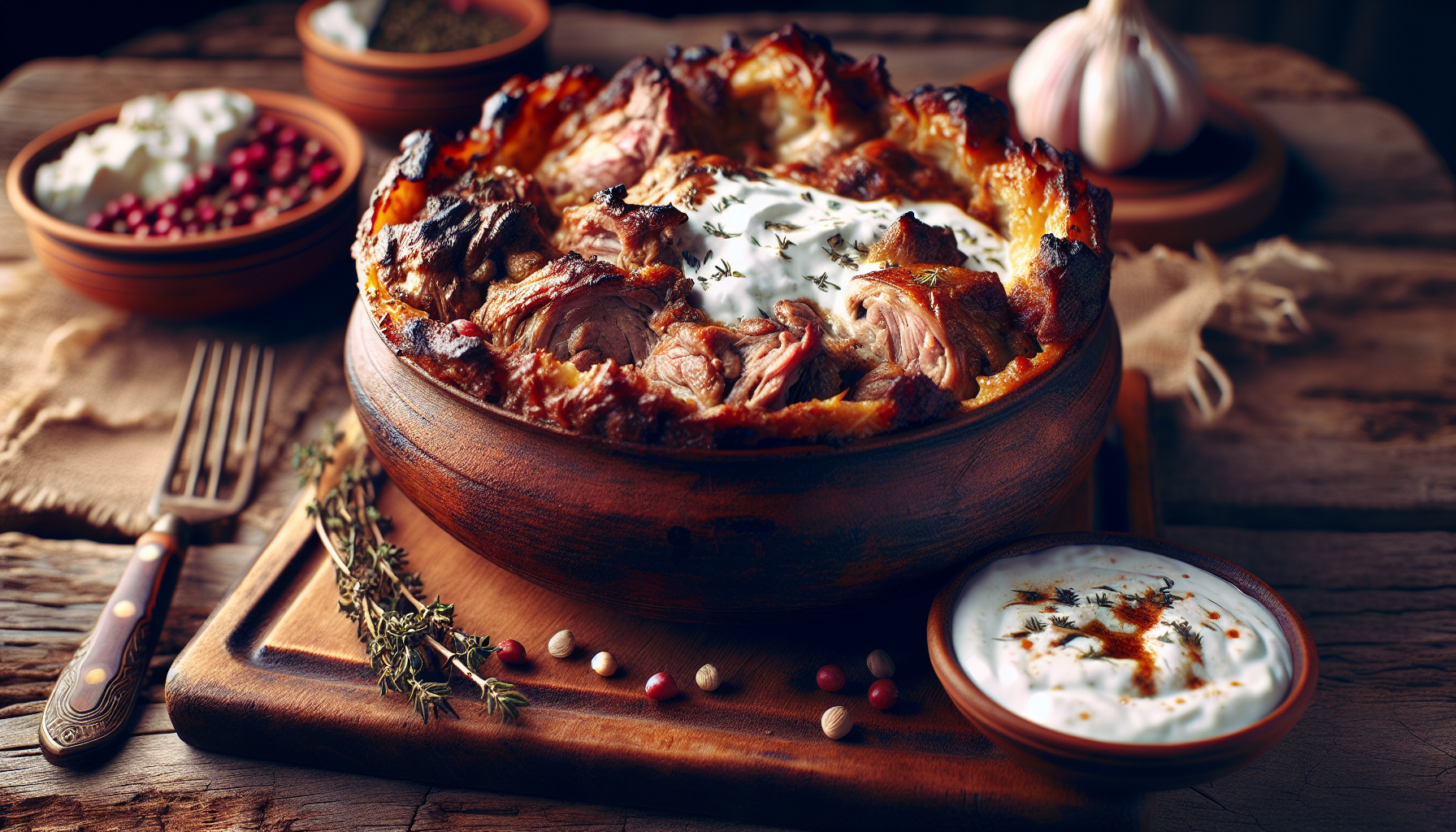
Tavë Kosi
Kosovo and Albania · serves 6 · 30 minutes preparation plus 45 minutes baking · an earthenware or heavy ceramic dish
Ingredients: Lamb: 1 kg lamb shoulder, on the bone or off, in large chunks · 2 tbsp butter · salt, pepper · 1 tsp dried oregano · 2 cloves garlic. Custard: 700 g full-fat plain yoghurt — Greek-style or strained, not runny · 4 eggs · 60 g plain flour · 50 g butter · salt · a little nutmeg. Rice (optional but usual): 100 g short-grain rice, parboiled.
Method: Brown the lamb in the butter in a pan over a good heat until well coloured, season it, add the garlic and about 200 ml water, cover and simmer 45 minutes until tender. Meanwhile melt the butter in a small pan, stir in the flour and cook it for two minutes to a pale roux, then let it cool a little. Whisk the yoghurt with the eggs, salt and nutmeg, then whisk in the roux — off the heat and gradually, because this is where it splits if you rush. Put the lamb and its juices into the dish, scatter over the parboiled rice if using, and pour the custard over so it covers everything. Bake at 180 °C for 40–50 minutes until set, puffed and deep golden on top. Rest it 15 minutes before serving or it will not slice.
💡 Two things matter: thick yoghurt, because a runny one will weep and never set; and not letting the custard boil, which curdles it. It is served warm rather than hot, straight from the dish, with bread and nothing else. Leftovers are good cold the next day, which nobody in Albania or Kosovo will admit to you.
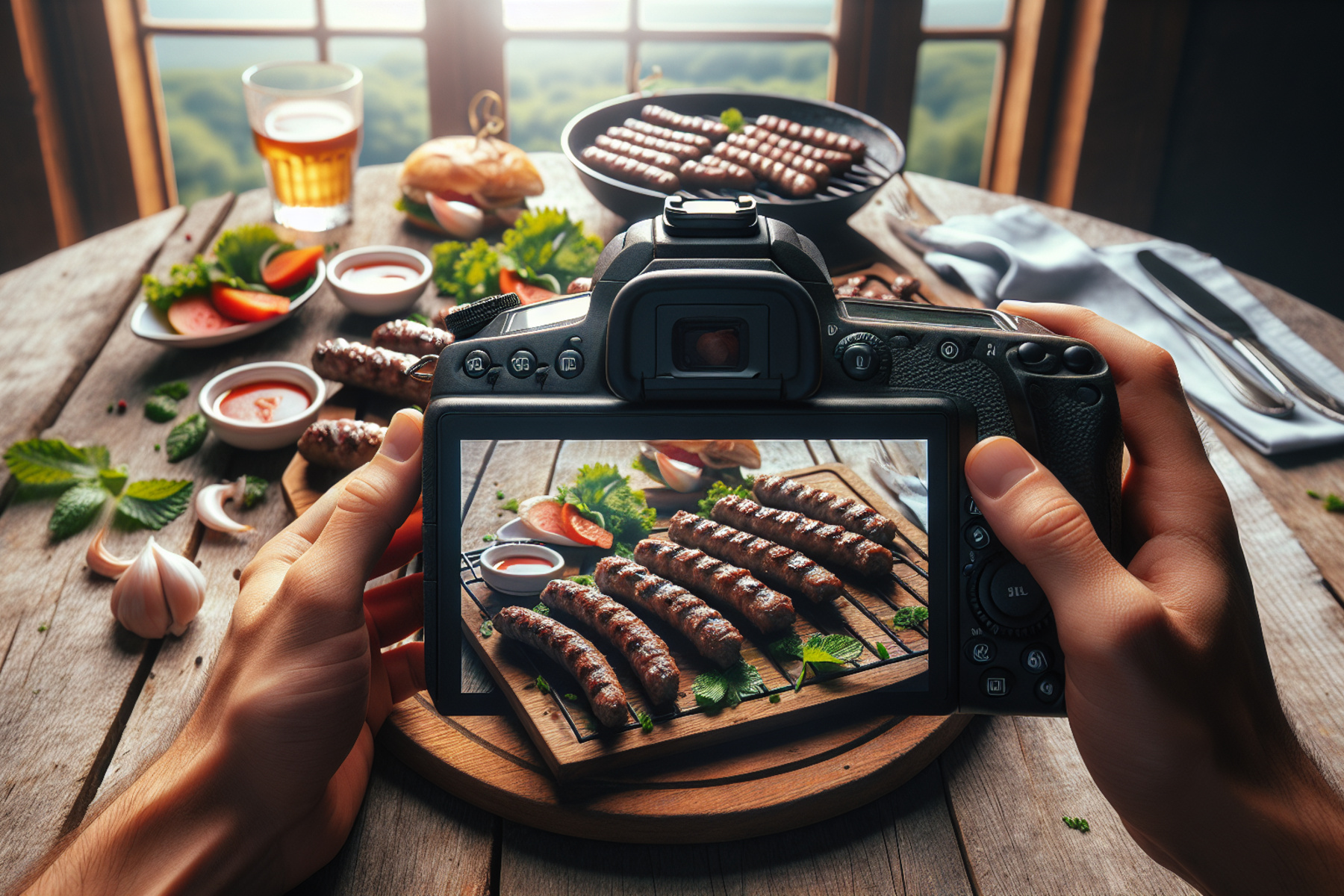
Qebapa with Somun and Onion
Kosovo, Albania and the wider Balkans · makes about 30 · 20 minutes plus overnight resting · charcoal grill strongly preferred
Ingredients: 500 g minced beef (about 20% fat) · 250 g minced lamb · 1 tsp bicarbonate of soda · 2 cloves garlic, crushed to a paste with a little salt · 1½ tsp salt · 1 tsp black pepper · 100 ml sparkling water, very cold. To serve: somun or pitta flatbread, 1 raw onion finely chopped, kajmak or thick sour cream, ajvar.
Method: Mix the meats with the salt, pepper, garlic and bicarbonate of soda — the soda is not optional, it is what gives qebapa their springy texture rather than a burger crumb. Work the mixture hard with your hands for 5 full minutes, adding the cold sparkling water a little at a time, until it becomes smooth, sticky and almost paste-like. Cover and rest in the fridge overnight, or at minimum four hours, which lets the soda work. Roll into fingers about 7 cm long and 2 cm thick with wet hands. Grill over hot charcoal, turning once or twice, for about 6–8 minutes total — they should char in places and stay juicy. Stuff five to ten into a warmed, split somun with a heap of raw onion and a spoonful of kajmak.
💡 The three rules: the soda, the long kneading and the overnight rest. Skip any of them and you get meatballs. And do not put them on skewers — that is a different dish entirely, and doing it in front of a Kosovar will be gently corrected.
🍷 Wine
The history
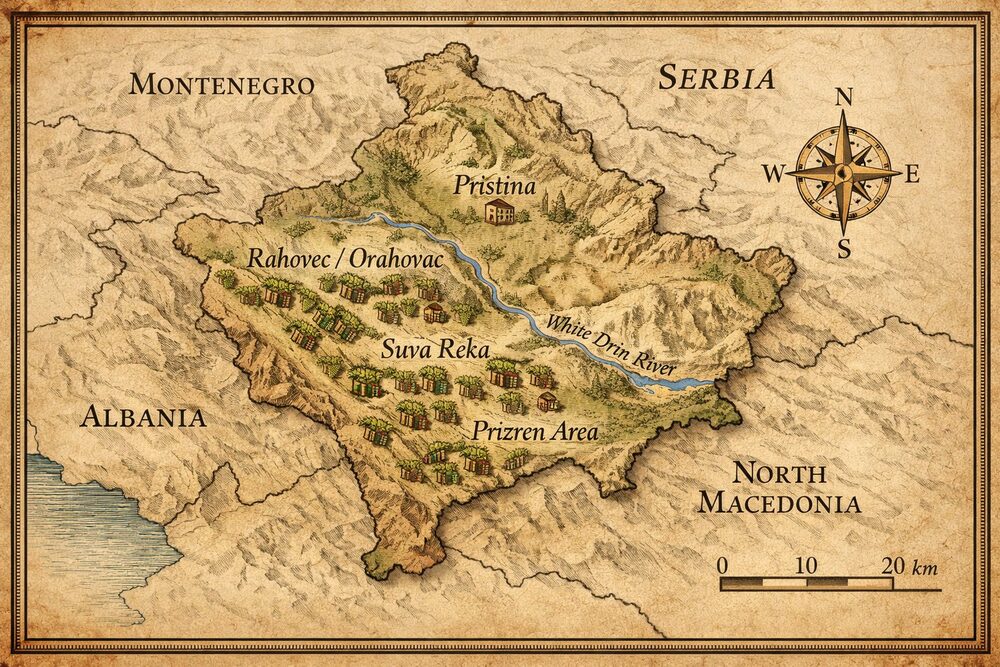
Vines have been grown here since Roman times, and Kosovo was a serious industrial wine producer within Yugoslavia — at its peak in the 1980s something like 9,000 hectares under vine, most of the output shipped in bulk to Germany. The industry collapsed with the war and the loss of markets, and vineyard area fell to a fraction of that. The rebuild since the 2000s has been slower and, on the whole, aimed at quality rather than tanker volume.
Rahovec
Rahovec (Orahovac) is the centre of it: a town of about 20,000 on a south-facing slope in the Dukagjini plain, with cellars under it, an annual grape harvest festival, and the largest producer in the country. Stone Castle, the successor to the old socialist combine, has cellars carved into the hillside with a capacity in the tens of millions of litres and does tours and tastings. Smaller family wineries have grown up around it and are generally the more interesting visit.
What is grown
International varieties dominate the plantings — Cabernet Sauvignon, Merlot, Pinot Noir, Chardonnay, Riesling — a legacy of the export era. More interesting are the regional grapes: Vranac, the dark, tannic Montenegrin-Serbian red that suits the climate, and Prokupac, a native Balkan variety being revived across Serbia and Kosovo and capable of genuinely good, savoury, medium-bodied reds.
Is it any good
Yes, increasingly, and it is a long way from being on anyone's radar. The best reds are the Vranac and the Cabernet blends with a few years on them; the whites are improving fast; and the prices are absurd by Western European standards — a good bottle at the cellar door costs a few euros. It is worth building an afternoon around Rahovec if you are anywhere near Prizren.
Rakia
The other drink, and the more important one socially. Rakia — grape, plum, quince, pear — is distilled at home across the country, offered on arrival, and refusing the first glass is genuinely difficult. Homemade is usually far better and far stronger than shop-bought; strengths of 45–60% are normal and are not always disclosed. Pace yourself and eat something.
Everything else
Peja and Birra Prishtina are the local lagers, both perfectly good and both about a euro. Turkish coffee and macchiato are the real national drinks. Boza, a thick fermented millet drink, is a Prizren speciality worth trying once. Tap water is drinkable in the main cities and locals often drink bottled anyway.
💡 Culture and Etiquette
Hospitality is an institution
In Albanian tradition the guest — mik — has near-sacred standing, codified in the old customary law, the Kanun of Lekë Dukagjini, which devotes a substantial section to the obligations owed to a guest. What that means in practice is that you will be fed, refused permission to pay, and pressed to stay. Accept graciously, bring something small if you are invited to a house, and be aware that trying to pay for a meal you have been invited to is a minor social offence rather than good manners.
Coffee is the unit of social time
An invitation for coffee is not a fifteen-minute proposition. It is one to three hours and it is how relationships are conducted. Do not check your watch, do not order and run, and expect the conversation to be direct and political much sooner than a Czech would expect.
The war, and how to talk about it
Everyone over about thirty-five lived it. People will often bring it up themselves, sometimes within minutes of meeting you, and will talk with striking openness. The rules are simple: listen, do not compare, do not adjudicate. Do not tell a Kosovar Albanian about Serbian suffering or a Kosovo Serb about Albanian suffering. Do not use the word "Serbia" as a synonym for a person you are talking to. And do not ask where someone's relatives are unless they have raised it.
Religion, lightly worn
Kosovo is roughly 95% Muslim by heritage and is one of the most secular Muslim-majority societies anywhere: alcohol is normal, headscarves are a minority choice, and mosque attendance is far from universal. Religious identity here is largely a marker of community rather than of practice — the saying that Albanians' religion is Albanianism is quoted often, usually approvingly. That said, observance has risen among the young since 1999, which is itself a subject of domestic argument.
Practical etiquette
Shake hands on arrival and departure with everyone in the room, including people you have just met. Take shoes off in houses. Cover shoulders and knees in mosques and in Orthodox monasteries; a headscarf for women in both is appreciated. Nodding and shaking the head can be reversed from what you expect — check verbally if it matters. Smoking indoors is banned and this is enforced with varying seriousness.
Music and culture
Traditional çifteli and lahuta music and epic song in the mountains; the polyphonic singing of the region; and, in the present, a pop industry out of all proportion to the population — Rita Ora, Dua Lipa and Era Istrefi are all of Kosovar origin, and Dua Lipa's Sunny Hill Festival in Pristina is a substantial annual event. Dokufest at Prizren is the serious cultural fixture.
🗣️ Albanian, Serbian and English
Kosovo has two official languages, Albanian and Serbian, with Turkish, Bosnian and Romani holding official status at municipal level where the communities are concentrated. In practice Albanian is what you will hear almost everywhere, and English is the second language of anyone under about forty.
Albanian
An Indo-European language forming a branch entirely of its own — no close relatives, which makes it one of the more interesting languages in Europe and one of the harder ones to guess at. Kosovo speaks the Gheg dialect, distinct from the Tosk of southern Albania on which the literary standard is based; the differences are substantial enough to be noticed constantly and not enough to prevent comprehension. Written in the Latin alphabet since 1908, with 36 letters including ë, ç, dh, gj, ll, nj, rr, sh, th, xh and zh.
Serbian
Official nationwide and in daily use in the Serb-majority north and in enclaves such as Gračanica and Štrpce. The implementation of the language law is patchy and is a standing subject of complaint and of monitoring by the language commissioner. For a visitor the practical point is that which language you open in is read as a position: in most of Kosovo, opening in Serbian will not go well; in the north, opening in Albanian will not go well. Open in English everywhere.
English
Remarkably widespread and remarkably good, particularly in Pristina and among anyone under forty. It is a consequence of the international presence after 1999, of the diaspora, and of a young population that has grown up online. German is also very widely spoken because of Switzerland and Germany, and is often the better bet with people over fifty.
Fifteen Albanian words
Përshëndetje — hello (formal); Tungjatjeta or just Tung — the everyday one. Faleminderit — thank you. Ju lutem — please. Po / jo — yes / no. Mirëmëngjes — good morning. Sa kushton? — how much? Shumë mirë — very good. Ujë — water. Bukë — bread. Një kafe, ju lutem — one coffee, please. Shijshëm — delicious. Mirupafshim — goodbye. Gëzuar! — cheers. Nuk kuptoj — I don't understand.
A note on the name of things
Using Kosova rather than Kosovo in Albanian company will be noticed and appreciated; using Albanian place names in Albanian areas and Serbian ones in Serb areas is simply what the people there do. None of this is a trap — nobody expects a foreign visitor to get it right — but the effort is registered, and English usage is the neutral fallback everybody accepts.
The Kanun, and the words from it
The Kanun of Lekë Dukagjini, the customary law codified in the fifteenth century and written down in the twentieth, still supplies vocabulary and concepts: besa, the word of honour that must be kept whatever the cost; mik, guest; gjakmarrja, blood feud, which persisted into the modern era in the northern highlands and has been the subject of long reconciliation campaigns. These words come up in conversation and carry weight.
🚗 Getting There and Around
Flights
Pristina International Airport (PRN) is the only one, 20 minutes from the centre, and is busy out of all proportion to the country's size because of the diaspora. It is served by Wizz Air, Eurowings, Austrian, Swiss, Turkish, Pegasus, Chair, Edelweiss and others, overwhelmingly to Germany, Switzerland, Austria, Turkey and Italy. Fares spike enormously in July, August and around the New Year when the diaspora travels.
Buses
The workhorse. Frequent, cheap, comfortable enough, and running to Skopje (2 h), Tirana (5 h), Podgorica, Sarajevo, Belgrade and directly to Germany and Switzerland. Domestic services connect every town; Pristina–Prizren is about 90 minutes. Buy at the station or on the bus. There is essentially no useful passenger rail — a slow Pristina–Peja line and an international connection to Skopje exist and are not a practical way to travel.
Driving
The best way to see the country. Roads are good — there are modern motorways to the Albanian border and towards Skopje — distances are tiny, and car hire is cheap. Two things to know: local driving is assertive, and a hire car from Kosovo may not be insurable or admissible into Serbia. Check the green card and the plate question with the rental company explicitly before you plan a route through Serbia.
The Serbia entry problem
The single most important practical fact for route planning. Serbia does not recognise Kosovo's borders as international, so it treats an entry stamp from a Kosovo border post as evidence of illegal entry into Serbia. In practice: entering Serbia directly from Kosovo is generally fine if you originally entered Kosovo from Serbia; but entering Kosovo from Albania, North Macedonia or Montenegro and then trying to cross into Serbia has historically resulted in refusal at the border. Enforcement has softened in recent years and remains at the officer's discretion. The reliable workaround is to leave Kosovo the way you came, or to route via a third country. Check the current position before you travel.
Getting around towns
Pristina and Prizren are walkable. Urban buses are cheap and unnecessary for a visitor. Taxis are metered, honest and inexpensive; there is no Uber but local apps exist. Parking in central Pristina is genuinely difficult, which is an argument for leaving the car at the hotel.
Combining countries
Kosovo fits naturally into a Balkan trip. Skopje is two hours, Tirana five, and the Accursed Mountains connect on foot to Albania and Montenegro. The classic pairing is Kosovo with North Macedonia and Albania, all three of which are cheap, close and under-visited, and none of which raises the border complication that Serbia does.
📅 When to Visit
May–June
The best window overall. Everything is green, the mountains are clear of snow from about June, temperatures are pleasant, the diaspora has not arrived and prices are low. Late spring in the Dukagjini plain, with the orchards out and the Accursed Mountains still white on top, is the best-looking Kosovo gets.
July–August
Hot — 35 °C in Prizren is normal — and this is diaspora season. Several hundred thousand Kosovars come home from Germany and Switzerland, the towns fill up, weddings happen every weekend, prices and flight fares double, and the atmosphere is genuinely festive. It is the worst time for value and one of the best for seeing the country at full volume. Dokufest at Prizren falls in August.
September–October
The other good window and arguably the best. The diaspora has gone, the weather is still warm, the mountains are perfect for walking, and it is harvest season — the grape festival at Rahovec, ajvar being made outdoors in every yard, and peppers drying on every wall. Prices are back to normal.
November–March
Cold, grey and, in Pristina, genuinely polluted — the winter air quality in the capital regularly ranks among the worst in Europe, and people with respiratory problems should take that seriously. Against it: Brezovica for cheap skiing, empty museums, and Pristina's café and bar life which is entirely indoor and entirely unaffected. 17 February, Independence Day, is worth being there for.
Dates in the calendar
17 February — Independence Day, and the annual repainting of the Newborn monument. 9 April — Constitution Day. 12 June — Liberation Day, marking KFOR's entry in 1999. 28 June — Vidovdan, the anniversary of the 1389 battle, marked at Gazimestan by Serbs and treated with some tension. Plus Eid twice a year, and Orthodox Christmas and Easter in the Serb communities.
How long
Four to five days covers Pristina, Prizren, Peja and the monasteries at a civilised pace. A week lets you add Gjakova, Rahovec and a couple of days in the Rugova mountains. The Peaks of the Balkans trek is a separate ten-to-thirteen-day proposition. Kosovo is small enough that trying to do it in two days is possible and a waste.
📋 Practical Information
Entry
Czech citizens and all EU nationals enter visa-free for up to 90 days with a passport or, in most cases, a national ID card — Kosovo accepts EU ID cards for entry, though a passport is simpler and avoids arguments. Kosovo also unilaterally admits holders of valid Schengen, US and UK visas and residence permits regardless of nationality. Entry stamps are given at Kosovo border posts; on the Serbia complication, see the getting around section, because it can ruin an itinerary.
Health
No compulsory vaccinations. Standard European precautions; tick-borne encephalitis is worth considering if you will be walking in forest in spring and summer. The EHIC does not apply — Kosovo is not in the EU and has no healthcare agreement with the Czech Republic — so commercial travel insurance is essential, and should cover mountain rescue and repatriation if you are going into the Accursed Mountains. Public hospitals are under-resourced; private clinics in Pristina are decent and are paid for in cash or by card. Emergency numbers: 112, police 192, ambulance 194.
Money
The currency is the euro, adopted unilaterally in 2002, which makes Kosovo one of the cheapest euro-denominated countries in Europe. ATMs are everywhere in the towns and cards are widely accepted in Pristina and Prizren; carry cash for villages, markets, small restaurants and the monasteries. Note that in the Serb-majority north the Serbian dinar was in wide use and a Kosovo central bank regulation restricting it caused a serious dispute from 2024 — carry euros and expect the euro to work.
Connectivity
Good. Kosovo got its own dialling code +383 in 2016; before that it borrowed Monaco's and Slovenia's. Mobile coverage and 4G are solid in populated areas, local SIMs from Vala or IPKO are cheap, and Wi-Fi is universal in cafés. EU roaming rules do not apply in Kosovo — check your tariff, as it can be expensive, though the Western Balkans roaming agreement has reduced costs for regional travel.
Safety
Kosovo is safe, and the gap between its reputation and its reality is one of the widest in Europe. Violent crime against foreigners is rare, Pristina is comfortable at night, and the general attitude to visitors — especially from countries that recognised Kosovo — is warm to the point of embarrassing. The real risks are ordinary: pickpocketing in crowds, aggressive driving, and winter air pollution. Northern Mitrovica and the northern municipalities require more awareness, particularly around political anniversaries; unexploded ordnance persists in some border areas — stay on marked paths and heed signs.
Read before you go
The Czech Ministry of Foreign Affairs advisory at mzv.gov.cz is worth reading because it is specific about the north and about the border-crossing question. Register in DROZD. And check the current position on Kosovo–Serbia crossings within a few days of travelling, because it changes with the political weather.
💵 What It Costs
Kosovo is one of the cheapest countries in Europe and uses the euro, which makes the arithmetic unusually easy and unusually startling for anyone arriving from Vienna.
Sleeping
Hostel dorm €10–15. A decent double in a Pristina or Prizren guesthouse €25–45. A good hotel €50–90. Mountain guesthouses in Rugova and on the Peaks of the Balkans €25–40 per person including dinner and breakfast, which is the best value in the country. Prices roughly double in Prizren during Dokufest and across the country in August.
Eating
A plate of qebapa with bread and onion €3–5. A full restaurant meal with wine €10–18 a head, and you will struggle to spend more. A macchiato €1–1.50. A half-litre of Peja beer €1.50–2.50. Byrek for breakfast under a euro. Kosovo is a country where a serious dinner for two costs less than two cinema tickets in Prague.
Getting about
Bus Pristina–Prizren €4–5; Pristina–Peja about the same. Bus to Skopje €6–10, to Tirana €15–20. A metered taxi across Pristina €2–4. Car hire from about €25–35 a day. Fuel is at roughly European prices, which is the one thing that is not cheap.
Sights and activities
Museums and monasteries are free or charge a euro or two; the monasteries take donations rather than tickets. A guided day in the Rugova gorge with via ferrata or canyoning €30–60. A Peaks of the Balkans permit costs a modest administrative fee; a guided full circuit with transfers runs to several hundred euros. Wine tasting at Rahovec is a few euros and usually includes more wine than is sensible.
A realistic daily budget
Backpacking: €25–35 a day. Comfortable mid-range with a private room, restaurant meals and the occasional car or guide: €50–80. At around 25 Kč to the euro — check the rate — the mid-range figure is roughly 1,250–2,000 Kč a day, and the backpacking figure is under a thousand. Flights from Prague are the main cost of the trip.
Tipping
Round up or leave about 10% in restaurants; it is appreciated and not obligatory. Taxis: round up. Guides and mountain hosts: tip properly, because the sums involved are small to you and meaningful to them. Do not tip in monasteries — put money in the donation box instead.
🇨🇿 Notes for Czech Travellers
Flights from Prague
There is no direct scheduled flight from Prague to Pristina at the time of writing, though the route has appeared and disappeared with charter and low-cost operators. The usual options are Wizz Air or a legacy carrier via Vienna, Munich, Zurich, Istanbul or Budapest, typically 4–7 hours total. Two good alternatives: fly to Skopje (often cheaper, two hours by bus to Pristina) or to Tirana. Driving from Prague is about 1,500 km and perfectly feasible over two days through Hungary and Serbia — but read the border note below before planning that route.
Visa-free, and the Czech recognition
The Czech Republic recognised Kosovo on 21 May 2008 and has an embassy in Pristina. Czech citizens travel visa-free for 90 days on a passport or ID card. Being Czech is, anecdotally, a good thing to be in Kosovo — recognition is remembered, and the Czech Army served in KFOR for years, which older Kosovars bring up unprompted.
The border question, for Czech drivers specifically
This catches people who plan the obvious route. If you drive from Prague through Hungary and Serbia into Kosovo, you can normally drive back out into Serbia without difficulty. But if you enter Kosovo from Albania, North Macedonia or Montenegro and then try to cross into Serbia, Serbian border officers have historically refused entry on the basis that you entered Serbian territory illegally. Enforcement has softened, it is discretionary, and a wrong assumption costs you a long detour. Verify before you commit to a loop.
Money in Czech terms
The euro at roughly 25 Kč — check before you go. That puts a plate of qebapa at 75–125 Kč, a restaurant dinner at 250–450 Kč, a night in a good guesthouse at 625–1,125 Kč, a coffee at 25–38 Kč and a bus across the country at about 100–125 Kč. No currency exchange is needed and no cash-conversion loss is incurred, which is a genuine convenience.
MZV ČR, DROZD and the embassy
The Czech Embassy is in Pristina. Register in DROZD and read the current advisory at mzv.gov.cz, which distinguishes clearly between the safe majority of the country and the northern municipalities. The EHIC does not apply: commercial insurance is required, and if you are trekking, make sure it covers mountain rescue rather than assuming it does.
Czech traces
Real and reasonably recent. The Czech Army served in KFOR from 1999, with a substantial contingent based around Šajkovac in the north for many years, and the deployment is remembered locally. Czech recognition in 2008 came reasonably early among EU states. Czech beer has an enthusiastic following in Pristina, and there is a small but genuine flow of Kosovar students and workers to the Czech Republic, which since the 2024 visa liberalisation has become considerably easier.
🌉 The North, and Mitrovica
Mitrovica is a town of about 80,000 divided by the river Ibar, with an Albanian-majority south and a Serb-majority north, and a bridge in the middle that has been variously barricaded, guarded, closed to vehicles and decorated with flowers for a quarter of a century. It is the most visible unresolved thing in Kosovo and it is not a place to visit casually or thoughtlessly.
The geography of it
The four northern municipalities — North Mitrovica, Zvečan, Zubin Potok and Leposavić — are Serb-majority and abut Serbia. Until recently they operated substantially on Serbian institutions, currency, curriculum and telephone codes. Since 2022–23 Kosovo has extended its administration there in a series of steps, each contested. There are also Serb communities south of the Ibar — Gračanica, Štrpce, Ranilug — whose situation is different and generally calmer.
What happened in 2022–23
The number-plate dispute, in which Kosovo required Serbian-issued plates to be replaced, triggered mass resignations of Serbs from Kosovo's police, courts and municipal government in late 2022. Elections in the resulting vacuum in April 2023 were boycotted, producing Albanian mayors elected on turnout of around 3%, and the attempt to install them in municipal buildings led to clashes in which 30 KFOR soldiers were injured. In September 2023 an armed group killed a Kosovo police officer and besieged the monastery at Banjska — the most serious security incident since 2004.
Where it stands
Calmer than 2023 and unresolved. KFOR was reinforced and remains visible. The Association of Serb-Majority Municipalities promised in 2013 and central to the 2023 Ohrid agreement still does not exist, which Belgrade cites as Pristina's bad faith and Pristina resists as a mechanism for creating a Republika Srpska inside Kosovo. Both positions are held sincerely and they are not reconcilable on current terms.
Visiting the north
It is not off-limits and it is not a war zone. The bridge is crossable on foot. North Mitrovica has cafés, a very good bakery culture and a completely different atmosphere — Cyrillic signs, dinars alongside euros, Serbian flags. What you should do: go in daylight, go without a Kosovo-plated hire car if you can, speak English, do not photograph police, KFOR, barricades or political graffiti with people in shot, and do not go at all around 28 June or during a flare-up. Check the news that morning.
Why go at all
Because a visitor who sees only Pristina and Prizren has seen a country that works and has not seen the thing it is arguing about. Mitrovica in an afternoon, handled respectfully, teaches more about the Balkans than a week of monasteries. If that is not what you came for, skip it entirely — there is no obligation, and gawping is worse than not going.
Trepča
Above Mitrovica stands the skeleton of the Trepča mining and smelting complex, once the largest lead-zinc operation in Europe and the industrial heart of Yugoslav Kosovo, employing tens of thousands. It is now partly working, partly ruined, disputed between Pristina and Belgrade, and visible from both halves of the divided town — which makes it an unusually literal monument to what the argument has cost.
🔬 Curiosities
The country with no country code
Kosovo has no ISO code because it is not a UN member, so the international community improvised XK — a "user-assigned" code adopted by the European Commission, the IMF and the banking system so that Kosovo could have IBANs and appear in databases. It also had no dialling code until 2016, when the ITU allocated +383; before that Kosovar mobile networks ran on Monaco's and Slovenia's numbers by commercial arrangement.
A monument repainted every year
The Newborn sculpture in Pristina has been given a new design every 17 February since 2008 — the flags of recognising states, barbed wire for the visa regime, the letters toppled to represent obstacles, and in 2018 broken into pieces. It is a national monument that functions as an annual op-ed, which is a genuinely unusual thing for a country to do about itself.
The youngest population in Europe
Median age around thirty, and for years it was under twenty-eight — younger than any other country on the continent by a clear margin. That single statistic explains the café culture, the music industry, the emigration, the unemployment figures and the tone of the politics all at once.
Bill Clinton Boulevard
Pristina has a main road named after Bill Clinton, with a three-metre statue of him waving on it, and a nearby boutique called Hillary. There are also streets named after Tony Blair, Madeleine Albright and George W. Bush, and a generation of Kosovar men named Tonibler. Gratitude for 1999 is expressed here with a directness that visitors from Western Europe find startling.
Two Kosovars at the top of the charts
Dua Lipa (born in London to Kosovar parents, who returned to Pristina as a child), Rita Ora (born in Pristina) and Era Istrefi are all Kosovar, which is a remarkable output for 1.6 million people. Dua Lipa's family runs the Sunny Hill Festival in Pristina. Kosovo also produced the judoka Majlinda Kelmendi, who won the country's first Olympic gold in 2016, five years after it was admitted to the IOC.
The spacecraft that are not spacecraft
A fresco of the Crucifixion at Visoki Dečani shows two objects in the sky containing figures, which has been enthusiastically circulated for decades as medieval evidence of UFOs. They are the sun and the moon personified, a completely standard element of Byzantine crucifixion iconography that appears in hundreds of churches. The monks are patient about it.
☪️ Religion and Communities
Kosovo is roughly 95% Muslim by heritage, with Orthodox and Catholic Christian minorities, and it is one of the most religiously relaxed societies in Europe — a fact that surprises visitors who arrive with the Balkans-as-religious-war framing and find a country where the argument is about nationality, not faith.
Islam here
Sunni, of the Hanafi school, arriving with the Ottomans and layered onto older identities rather than replacing them. Practice is light: alcohol is normal and openly sold, headscarves are a minority choice, and Friday attendance is far from universal. There is also a significant Sufi presence — the Bektashi, Rufai and Halveti orders have teqe lodges, particularly around Prizren and Gjakova, and the Rufai ceremony in Prizren at Nowruz is a genuinely extraordinary thing to witness.
Rising observance, and the argument about it
Religious practice has risen among the young since 1999, funded in part by Gulf money that built mosques and offered scholarships, and this is a live domestic argument. Kosovo also produced a disproportionate number of foreign fighters who went to Syria, which the state responded to with prosecutions, a ban on the organisations involved and a repatriation and reintegration programme that has been studied as one of the more serious European attempts at it. Both the phenomenon and the response are part of the picture.
Catholics
A small but historically important minority, concentrated around Gjakova, Klina, Prizren and Pristina, and prominent out of proportion to numbers — Mother Teresa was an ethnic Albanian from Skopje and is claimed enthusiastically here, with Pristina's main cathedral named after her and a boulevard too. Some Albanian families were laramanë, crypto-Catholics who practised Islam publicly and Catholicism at home through the Ottoman period.
Orthodoxy
The Serbian Orthodox Church holds the medieval monasteries and is the institutional heart of the Kosovo Serb community. Its situation is difficult: several sites have been attacked, some are guarded by KFOR, and the church's position is closely aligned with Belgrade's on status, which makes it a political actor as well as a religious one. The monks at Dečani in particular have a long record of sheltering people of all communities during and after the war, which is worth knowing before forming a view.
The smaller communities
The Bosniaks in Prizren, Peja and the Gora. The Turkish community in Prizren, continuously present since the Ottoman period and with its own schools and media. The Gorani, a Slavic-speaking Muslim people in the far south whose villages are emptying fast. And the Roma, Ashkali and Egyptian communities, who were hit exceptionally hard in 1999 and after, remain the most marginalised group in the country, and hold reserved seats they have limited power to use.
What this means for a visitor
Very little in practice, and it is worth understanding anyway: the Kosovo conflict was ethnic and national, not religious, and framing it as Muslims against Christians — which foreign commentary does constantly — annoys almost everyone here for different reasons. Mosques and monasteries alike welcome respectful visitors. Cover up in both, take your shoes off in the mosque, and do not photograph people praying.
👥 A Country of Young People
The demographics
Median age around thirty, one of the highest birth rates in Europe until recently, and a population structure that looks nothing like the rest of the continent. Kosovo has proportionally more people under twenty-five than anywhere else in Europe, and it has the labour market of a country with a fraction of those jobs to offer them.
Emigration, and what changed in 2024
Leaving has been the default option for decades — for work, family reunification or asylum. On 1 January 2024 the EU finally granted visa liberalisation, allowing Kosovars with biometric passports to enter the Schengen area for 90 days without a visa, the last Western Balkan population to get it. It was celebrated as a national milestone and it has also made leaving considerably easier, which the government is publicly worried about.
The diaspora as a season
In July and August the population of some towns visibly doubles as several hundred thousand Kosovars drive home from Germany and Switzerland in cars with foreign plates. Weddings are scheduled for those weeks. House-building is financed by it, restaurants live off it, and the annual return is a social phenomenon in its own right — with a certain amount of friction between those who left and those who stayed that Kosovars discuss with dark humour.
Education and the split university
The University of Pristina teaches in Albanian and is the country's main institution. There is also a University of Pristina in North Mitrovica, teaching in Serbian, which regards itself as the continuation of the pre-1999 institution and is funded by Serbia. Two universities with the same name in the same country, forty kilometres apart, is as clear a summary of the situation as anything on this page.
What the young are doing
An IT and outsourcing sector growing fast on cheap, English-speaking graduates. A music and film scene out of all proportion to the country's size. Civil society and activism, which is where Vetëvendosje came from. And a great deal of unemployment and underemployment, which is why the emigration numbers look the way they do and why the politics has the edge it has.
The optimistic reading and the pessimistic one
Optimistic: a young, multilingual, ambitious, internet-native population in a country with the lowest costs in Europe and a diaspora with capital, one border-normalisation away from being a genuinely attractive place to invest. Pessimistic: the ambitious ones leave, the political class cannot form a government, and the demographic dividend is spent in Munich. Both are supportable from the same data, and which one wins is the actual question about Kosovo's next twenty years.
⚖️ Tourism, Honestly
Kosovo receives a small and rising number of visitors, a large share of whom are diaspora returning to family rather than tourists. Genuine leisure travel is a niche, growing, and one of the better-value propositions in Europe.
Why so few come
The name. For most Europeans over forty, "Kosovo" means the 1999 news, and that association has not been displaced by anything. There is also no beach, no famous single sight, limited international air connectivity from outside the diaspora corridors, and a lingering assumption that it is unsafe — which it is not. The result is a country with Ottoman old towns, world-class frescoes and a serious mountain range that you can visit in September without queueing for anything.
What it is genuinely good at
Prizren, which is as pretty as anything in the region. The monasteries, which are art of the first rank. The Accursed Mountains and the Peaks of the Balkans, which is one of the best treks in Europe. The food and the coffee culture. The prices. And the hospitality, which visitors consistently describe as the thing they were least prepared for.
What it is not good at
Signage and interpretation — sites are frequently unexplained and museums are thin. Public transport beyond buses. Accessibility. Opening hours, which are approximate. And a coherent tourism strategy, which successive governments have promised and no caretaker administration has been in a position to deliver.
Travelling decently
Use local guides, particularly in the mountains and at the war sites, where the difference between a guide and a guidebook is enormous. Stay in family guesthouses on the Peaks of the Balkans, which is the whole design of the route. At the monasteries, behave as you would in any working religious house. And do not treat Mitrovica or the memorials as photo opportunities — read the section on the north before deciding whether to go.
The conversation you will have
Expect to be asked, in a friendly way and quite quickly, whether your country recognises Kosovo. The answer — for a Czech visitor, yes, since May 2008 — matters to people here in a way that is hard to convey. It is not a trap and it is not aggressive. It is a small country checking whether it exists in your mind, and it is worth having a thought ready.
The honest recommendation
Five days to a week, based in Pristina and Prizren, with a car or the buses, adding Peja and the Rugova gorge if you like mountains. Combine it with North Macedonia and Albania rather than trying to make it a standalone trip. Go in May, June, September or October. Expect to spend very little and to be fed a great deal, and expect to come back with a considerably more complicated view of the Balkans than you left with.
🔭 What Happens Next
The immediate question
Whether the Assembly elects a president before the acting mandate lapses on 4 October 2026, or whether Kosovo goes to a fourth election in under two years. As of early September the LDK split has put the 80-vote threshold out of reach. Either outcome leaves the underlying arithmetic unchanged: a dominant party with a plurality and no partners, and an opposition that will not enable it.
The EU track
Kosovo applied for candidate status in December 2022 and has not received it, and cannot easily while five member states do not recognise it. Visa liberalisation in 2024 was the last big deliverable available without resolving that. Realistically, the accession path runs through the Serbia dialogue, and the dialogue runs through governments in both Pristina and Belgrade with the political capital to make concessions — which neither currently has.
The Serbia dialogue
The Ohrid Agreement of 2023 remains the framework: de facto recognition and non-obstruction of Kosovo's international membership on one side, the Association of Serb-Majority Municipalities on the other. Neither side has implemented its half, each blames the other, and the EU's leverage has diminished. There is no realistic scenario in which Kosovo returns to Serbian rule and no near-term scenario in which Serbia formally recognises it; the plausible destination is a durable ambiguity in which both join the EU without ever settling the point.
The north
The most likely place for something to go wrong, and the place where the international presence is calibrated to prevent it. KFOR remains. The Association question is unresolved. The Serb population there continues to shrink. A settlement acceptable to both Pristina and Belgrade would probably have to give Kosovo Serbs something institutionally real without giving them a veto over the state, and that circle has not been squared in eighteen years of trying.
The economy and the people
The binding long-term question is not status but whether enough young Kosovars stay. Visa liberalisation, EU labour shortages and a diaspora that provides landing pads all point one way; a growing IT sector and the lowest costs in Europe point the other. Kosovo's demographic advantage is real and it has a finite window in which to use it.
Why the page ends here
Because a travel guide should be honest about the limits of its competence. Kosovo's status is a genuine dispute between people with real histories and real grievances, and this page's job is to describe the country, set out the positions accurately, and let a visitor arrive informed rather than briefed. What it can say without hedging is that Kosovo is safe, cheap, beautiful in parts, hospitable to an unusual degree, and visited by far too few people.
📸 The Pictures on This Page — and What Was Rejected
A note in the interest of honesty. The image folder for Kosovo holds seven files and the shared recipe folder holds five. Of those twelve, eight are unusable — and the pattern here is different from usual: not one but two duplicate-named pairs, four interchangeable stock photographs of wine, and one invented landmark.
Rejected: the hero
01-hero.jpg is the file the old page nominated as Kosovo's headline image, and it shows a large domed tower topped by a red flag, standing on a cliff above a wide river, with a town on the far bank. No such building exists in Kosovo, and no such landscape does either — the country has no river of that size and nothing resembling that structure. Kosovo's actual landmarks are the Gazimestan tower, Prizren's fortress, Gračanica's five domes and the Newborn monument, none of which look anything like this. It has been replaced as the hero by wine-culture.jpg, which is generic but is at least a plausible picture of the Rahovec hills.
Rejected: three of four wine bottles
kos-biopak-pinot-noir.jpg, kos-bodrumi-i-vjet-r-vranac.jpg, kos-sefa-wine-prokup.jpg and kos-stone-castle-chardonnay-reserve.jpg are named after four specific wines from real Kosovar producers. All four are the same stock composition — an unlabelled bottle and a glass on a plank in front of a blurred vineyard — differing only in whether the wine is red or white. They do not misrepresent a brand, because there is no label at all; they simply are not the wines they claim to be, and one generic bottle would have done the work of four. None is used.
Rejected: the "flia"
kosovo-flia.jpg shows a stack of French-style crêpes dusted with cocoa and scattered with chocolate chips, with hazelnuts in a bowl behind. Flia is Kosovo's national dish: a thick, round, many-layered pancake built up layer by layer under a saç heaped with embers over several hours, savoury, served with sour cream or ajvar. It is not a crêpe, it is not sweet, and it does not come in a stack. Of everything in this folder, this is the one that most needed to be right.
Rejected: the duplicates
Two dishes appear twice under near-identical filenames, and in each pair one file is wrong. kosovo-tave-kosi.jpg is plated fine dining — seared beef cubes on a smear of white sauce with apricots and thyme — where tavë kosi is a set yoghurt-and-egg custard baked in earthenware; the other file, kosovo-tav-kosi.jpg, gets it broadly right and is the one used. kosovo-cevapi.jpg shows chunks of meat on wooden skewers, which is shish kebab; qebapa are skinless minced-meat fingers grilled loose and never skewered. The other file, kosovo-evapi.jpg, shows the real thing and is the one used.
Used with corrections
Four images. wine-culture.jpg — a vineyard and a glass of red, generic stock but a fair likeness of the Rahovec slopes, promoted to hero. kosovo-wine-regions-map.jpg — genuinely the best country map this atlas has encountered, with the wine regions correctly placed, and used with a note about the phantom coastline and the reversed river. kosovo-tav-kosi.jpg and kosovo-evapi.jpg — both correct dishes, both captioned with what the photographer got wrong, one of which is having his own camera in the frame.
What ought to be here
Everything that makes this country worth the trip. There is no photograph in this archive of Prizren or its fortress, the Newborn monument, the National Library, Gračanica or Dečani or a single fresco, the Rugova gorge, the Accursed Mountains, Gjakova's bazaar, the Mitrovica bridge, a plate of flia, or one Kosovar face. Twelve photographs would carry this page; it has four, three of which are food and wine, and it says so rather than filling the gap with a building that does not exist.
Support This Project 🌍
This World Travel Factbook is a labor of love – free to use for all travelers. If you find it helpful, consider supporting its continued development.