
🇱🇹 Lithuania at a Glance
🌍 Overview
Lithuania is 65,300 km² — about five-sixths the size of Czechia — with roughly 2.9 million people. It is the largest and southernmost of the three Baltic states, a flat green country of forest, lake, bog and river with 90 km of Baltic coast, and it has one of the most improbable histories in Europe.
Improbable, because this small country was for a time the largest state in Europe, running from the Baltic almost to the Black Sea; because it was the last country in Europe to accept Christianity, holding out as a pagan state until 1387; and because in 1990 it was the first Soviet republic to declare independence, and did it while Soviet tanks were still in the country.
The state
A parliamentary republic with a directly elected president who has real but limited powers, chiefly in foreign policy and defence. Gitanas Nausėda has been president since 2019 and was re-elected in 2024. Government has been unstable since the 2024 election: Mindaugas Sinkevičius became prime minister in July 2026, the third Social Democrat to hold the post in under two years, after Inga Ruginienė resigned when the coalition with the populist Dawn of Nemunas collapsed.
The border that defines it
Lithuania sits on NATO’s most exposed frontier: it borders Belarus for 680 km and the Russian exclave of Kaliningrad for 275 km, and the 65 km Suwałki gap between them is the only land link between the Baltic states and the rest of NATO. Everything about Lithuanian defence and foreign policy follows from that geography.
Defence, 2026
Lithuania spends more on defence as a share of its economy than any other NATO member. The 2026 budget approved by the Seimas is €4.79 billion, or 5.38% of GDP — a 43% increase on 2025 and the largest in the country’s independent history. Germany is building its first permanent overseas troop deployment since the Second World War here.
What visiting is like
Underrated, inexpensive by Western European standards and genuinely rewarding. Vilnius has one of the largest and least-spoiled baroque old towns in Europe; the Curonian Spit is a UNESCO-listed 98 km ribbon of sand dunes; and the lake country in the north-east is quiet in a way that has become rare. It is also flat, easy to travel and small enough to cross in three hours.
🏷️ Lietuva, and a Language Older Than Latin
Lietuva first appears in writing in 1009, in the annals of the monastery of Quedlinburg, recording the death of the missionary Bruno of Querfurt "on the border of Rus and Lithuania". The country celebrated the millennium of that sentence in 2009. Where the word itself comes from is disputed — the leading theory derives it from a small river, the Lietauka, near Kernavė.
The language
This is Lithuania’s genuine claim to world significance. Lithuanian is the most archaic living Indo-European language, having preserved sounds and grammatical forms — seven cases, a full dual number until recently, pitch accent — that vanished from Latin and Greek thousands of years ago. Linguists studying Proto-Indo-European reach for Lithuanian and Sanskrit first. The often-quoted line that a Lithuanian peasant could make himself understood in Sanskrit is folklore, but the underlying resemblance is real and startling.
The flag and the Vytis
Yellow, green and red horizontally, adopted in 1918 and restored in 1989. The older and more meaningful symbol is the Vytis — a white armoured knight on a red field, sword raised, on a white horse — one of the oldest continuously used coats of arms in Europe, in use since the fourteenth century. It is on the euro coins and it is what Lithuanians actually identify with.
Two alphabets and a ban
From 1864 to 1904, after the failed January Uprising, the Russian Empire banned printing Lithuanian in the Latin alphabet altogether, attempting to force the language into Cyrillic. Lithuanians responded by printing books in Prussia and smuggling them across the border. The knygnešiai — book carriers — are national heroes with their own monument and museum, and are believed to be the only such organised smuggling of books in European history.
Not a Slavic country
Worth stating because it is routinely got wrong. Lithuanians are Balts, not Slavs; Lithuanian and Latvian are the only two surviving Baltic languages, and they are not mutually intelligible with Polish, Russian or Belarusian. Lithuania is also overwhelmingly Roman Catholic, not Orthodox — the confessional line between Catholic and Orthodox Europe runs along its eastern border.
🗺️ Flat, Green, and Full of Water
Lithuania is a lowland country. Its highest point, Aukštojas Hill, is 294 metres — lower than the tallest building in many European capitals, and 1,308 metres below Sněžka. What it has instead of relief is water: about 6,000 lakes, 800 rivers, extensive bog and marsh, and a third of the country under forest.
The Curonian Spit
The country’s natural masterpiece and a UNESCO World Heritage site: a 98 km sand peninsula, in places only 400 m wide, separating the Curonian Lagoon from the Baltic. Half is Lithuanian and half Russian (Kaliningrad). Its Dead Dunes buried whole villages in the eighteenth and nineteenth centuries after the forests were felled; the replanting that stabilised them is one of the great European conservation projects. Thomas Mann had a summer house at Nida.
The lake country
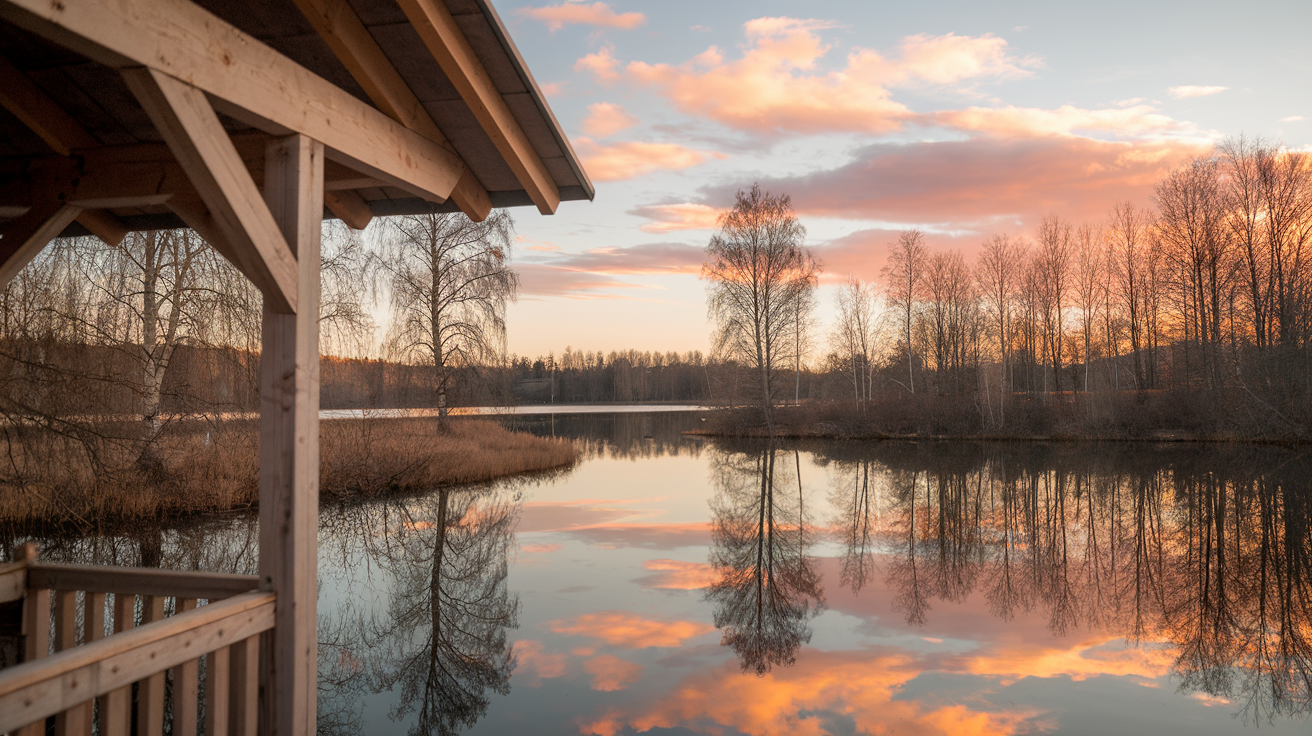
Aukštaitija in the north-east is the classic Lithuanian landscape: a mosaic of lakes, pine forest and wooden villages, with the country’s first national park (1974). Lake Drūkšiai is the largest; Tauragnas the deepest at about 61 m. Canoeing, mushrooming and quiet are the local industries.
Rivers
The Nemunas is the great one — 900 km from Belarus through Lithuania to the Curonian Lagoon, historically the country’s main artery and now partly a border with Kaliningrad. The Neris runs through Vilnius, the Šešupė and Merkys through the south. The Nemunas delta is a major bird migration site.
Forest and bog
Roughly a third of the country is forest — pine on the sandy south, spruce and broadleaf elsewhere. Dzūkija in the south is the great forest region, famous for mushroom picking, which in Lithuania is not a hobby but something closer to a civic activity. The Čepkeliai and Kamanos raised bogs are strictly protected and are among the least-disturbed peatlands in Europe.
The geographic centre of Europe
By one calculation, made by the French National Geographic Institute in 1989, the geographical centre of Europe lies 26 km north of Vilnius, near the village of Purnuškės. There is a monument, a park and a sculpture there. Several other countries dispute it with calculations of their own, which Lithuanians treat with amused tolerance.
Climate and amber
Temperate maritime shading to continental: warm summers around 22–25 °C, cold winters that can reach −20 °C, and a genuinely long, dark December. The Baltic shore is the world’s great source of amber — fossilised pine resin 40 million years old, washed up after storms, and the material around which Lithuanian and Latvian coastal culture is built.
⚔️ The Largest Country in Europe
This is the part of Lithuanian history that outsiders find hardest to believe. In the fifteenth century the Grand Duchy of Lithuania ran from the Baltic Sea to the Black Sea, covering what is now Belarus, most of Ukraine and parts of Russia and Poland — roughly 930,000 km², the largest state in Europe.
Mindaugas, 1253
Lithuania’s only crowned king. Mindaugas united the Baltic tribes against the Teutonic and Livonian crusading orders, accepted baptism for political cover, and was crowned on 6 July 1253 — still the national day. He then apostatised, was assassinated in 1263, and Lithuania reverted to paganism for another 124 years.
The pagan state
For roughly two centuries Lithuania was the last pagan state in Europe, and it survived by winning. It fought off the Teutonic Order — a permanent crusade directed at it specifically, with knights arriving from across Christendom for the seasonal campaigning — while simultaneously expanding east into the Slavic lands weakened by the Mongols. Vilnius was founded, by tradition, by Grand Duke Gediminas around 1323 after a dream of an iron wolf.
1387, and the deal
Christianity came by marriage. Grand Duke Jogaila married Queen Jadwiga of Poland, became King Władysław II Jagiełło, and Lithuania was baptised in 1387 — the last country in Europe to convert. Samogitia, the western region, held out until 1413. The Jagiellonian dynasty that followed ruled Poland, Lithuania, Bohemia and Hungary at its height — including, for Czech readers, the Bohemian throne.
Grunwald, 1410
At Grunwald / Žalgiris / Tannenberg on 15 July 1410, the combined Polish-Lithuanian army under Jogaila and his cousin Vytautas the Great destroyed the Teutonic Order as a military power. It is the most celebrated date in Lithuanian history, and the country’s most famous basketball club is named Žalgiris after it.
Vytautas the Great
Grand Duke from 1392 to 1430 and the figure Lithuanians revere most. Under him the duchy reached its greatest extent, invited Karaim and Tatar communities from Crimea to settle at Trakai, codified law, and came within days of a royal crown — the crown itself was intercepted en route by Polish nobles, and Vytautas died before another could be sent.
The Commonwealth and the end
The Union of Lublin (1569) merged Poland and Lithuania into a single Commonwealth — an elective monarchy with a famously fractious nobility. It was, for a century, one of the largest and most religiously tolerant states in Europe, and then it was steadily paralysed and partitioned. By 1795 Lithuania had disappeared entirely into the Russian Empire, and stayed there for 123 years.
📜 1918, 1940, 1941, 1944
16 February 1918
The Council of Lithuania declared independence in German-occupied Vilnius. The republic that followed fought wars against Bolsheviks, Bermontians and Poland, and then lost its capital: Poland seized Vilnius in 1920 and held it until 1939, so interwar Lithuania governed from Kaunas. That two-decade grievance shaped everything about the period.
The Kaunas years
Provisional capital, and one of the more interesting European experiments of the 1920s and 30s. Kaunas built itself a modern city almost from scratch in a distinctive Lithuanian modernism — some 6,000 buildings — which was inscribed on the UNESCO World Heritage list in 2023. Kaunas was European Capital of Culture in 2022.
The Molotov–Ribbentrop Pact
The secret protocols of 23 August 1939 assigned Lithuania first to Germany and then, in a September revision, to the Soviet sphere. The USSR occupied the country in June 1940, staged an election, and annexed it. Within a year came the first mass deportations to Siberia: on 14 June 1941 alone, around 17,000 people were loaded into cattle wagons.
1941–1944
German occupation followed within days, and with it the annihilation of Lithuanian Jewry — treated in its own section below, because it is not a footnote. The Soviets returned in 1944, and the deportations resumed on a larger scale: an estimated 130,000 to 300,000 Lithuanians were deported to Siberia and Central Asia between 1944 and 1953, with tens of thousands dying there.
The Forest Brothers
Armed resistance to Soviet reoccupation continued for nine years, from 1944 to 1953, with a peak of perhaps 30,000 partisans operating from forest bunkers under a unified command that declared itself the legal authority of Lithuania. It was crushed; around 20,000 partisans were killed. Their declaration of 16 February 1949 was given the force of law by independent Lithuania in 1999.
Soviet Lithuania
Forty-five years of industrialisation, russification, collectivisation and emigration, alongside real increases in education and urbanisation. The Ignalina nuclear plant, built with the same RBMK reactor type as Chernobyl, came to symbolise the arrangement: it powered the republic, and closing it was a condition of joining the EU.
🕯️ 1989–1991: The Baltic Way and the Tower
Lithuania did not drift out of the Soviet Union. It left first, at real risk, and its exit is the single best-documented case of a small nation talking itself out of an empire.
Sąjūdis
The reform movement founded in June 1988, initially within the terms of perestroika and rapidly beyond them. Led by the musicologist Vytautas Landsbergis, it won 36 of the 42 Lithuanian seats in the 1989 Soviet elections and then a majority in the 1990 republican elections, on an explicit independence platform.
The Baltic Way
On 23 August 1989, the fiftieth anniversary of the Molotov–Ribbentrop Pact, roughly two million people joined hands in an unbroken human chain 675 km long from Vilnius through Riga to Tallinn. It was organised without the internet, it worked, and it is on the UNESCO Memory of the World register. It remains the most effective piece of peaceful political theatre of the twentieth century.
11 March 1990
The Supreme Council declared the restoration of independence — the first Soviet republic to do so. Moscow responded with an economic blockade: fuel and gas were cut off for nearly three months. Lithuania did not withdraw the declaration.
January 1991
Soviet forces moved on Vilnius. On the night of 12–13 January, tanks and troops attacked the television tower and the radio and television building, defended by unarmed civilians who had come out in their tens of thousands. Fourteen people were killed and hundreds injured. Live broadcasting continued from the tower until the transmitters were taken. The Soviet Union collapsed before it could try again.
Recognition and departure
Iceland recognised Lithuania first, in February 1991 — a fact Lithuanians have never forgotten, and there is a street in Vilnius named for it. Full international recognition followed the August 1991 coup, and the last Russian troops left on 31 August 1993, earlier than from Latvia or Estonia.
2004 and after
NATO in March 2004, the European Union in May 2004, Schengen in 2007, the euro on 1 January 2015, the OECD in 2018. In February 2025 the Baltic states desynchronised their electricity grid from the Russian-controlled BRELL ring and joined the continental European system — the last physical infrastructure link to Moscow, cut.
🏛️ Lithuania in 2026
The president
Gitanas Nausėda, a former bank economist, president since 2019 and comfortably re-elected in May 2024 against Ingrida Šimonytė. The Lithuanian presidency is stronger than the Czech or German one: the president leads foreign and security policy, nominates the prime minister and can veto legislation. Nausėda has been consistently hawkish on Russia and Belarus and pragmatic at home.
A revolving door of prime ministers
The October 2024 election returned the Social Democrats to power, and they have since been through three prime ministers. Gintautas Paluckas resigned in 2025 over business-dealings allegations; Inga Ruginienė served from September 2025 to July 2026; Mindaugas Sinkevičius now leads the government. Ruginienė returned to the cabinet as social affairs minister.
Why the coalition broke
The Social Democrats had governed with the populist Dawn of Nemunas (Nemuno Aušra), whose founder Remigijus Žemaitaitis faced sustained accusations of antisemitic rhetoric — a charge with particular weight in this country. The Social Democrats ended the coalition agreement on 6 June 2026; Dawn of Nemunas formally withdrew and the cabinet resigned on 23 June.
The Seimas
A single chamber of 141 members, elected for four years by a mixed system — 70 by proportional list and 71 in single-member constituencies with a run-off. That system produces fragmented parliaments and short-lived coalitions, which is roughly what Lithuania has had since 2024.
The steady parts
Whatever happens to governments, three things do not move: defence spending, support for Ukraine, and the hard line on Belarus and Russia. All the major parties agree, the president leads on it, and the 2026 defence budget passed with broad support. Foreign observers who read Lithuanian coalition chaos as instability in policy are reading it wrong.
Corruption and trust
Lithuania scores well by regional standards on Transparency International’s index and has an active, effective special investigation service — two of the last three prime ministerial departures were driven by ethics questions rather than by parliamentary arithmetic. Public trust in political parties, however, is low, which is what feeds the populist vote.
🛡️ Living on NATO's Most Exposed Border
No NATO member is more exposed than Lithuania, and no NATO member behaves more as though it knows it.
The Suwałki gap
The 65 km of Polish-Lithuanian border between Belarus and Kaliningrad is the only land corridor connecting the Baltic states to the rest of NATO. Every serious analysis of a Baltic contingency turns on it. Lithuania has spent a decade making the corridor harder to close — new roads, the Rail Baltica European-gauge line under construction, hardened border infrastructure — and the gap remains the strategic fact of the country’s existence.
5.38% of GDP
The Seimas approved a 2026 defence budget of €4.79 billion, 5.38% of GDP — up 43% on 2025, the highest share in NATO and roughly two and a half times the alliance’s old 2% target. The ruling parties have pledged to hold it at or above 5%. It is funded partly by borrowing and the debt effect is real and openly discussed.
The German brigade
The most significant thing to happen to Lithuanian security in a generation. Germany is establishing Panzerbrigade 45 in Lithuania — its first permanent overseas deployment since the Second World War. On 5 February 2026 two more battalions were subordinated to it, taking it from about 500 to 1,800 troops; the target is roughly 4,800 soldiers and 200 civilians by 2027, based at Rūdninkai, 30 km from Belarus, and at Rukla. Lithuania has committed up to €1.7 billion to build for them.
The balloons
A genuinely strange piece of hybrid pressure. From October 2025, helium balloons launched from Belarus — carrying contraband cigarettes, and by Lithuania’s account tolerated or directed as harassment — forced Vilnius airport to close more than ten times, stranding thousands. Lithuania shut the Šalčininkai and Medininkai crossings, declared a state of emergency on 9 December 2025, and announced it would shoot the balloons down. The crossings reopened, and Vilnius has said openly it will close them again if it must.
Kaliningrad and the transit
Russian goods move between Kaliningrad and Russia proper across Lithuanian territory under an EU-negotiated regime, and it has repeatedly been a flashpoint — most sharply in 2022 when Lithuania applied sanctions to sanctioned goods in transit and Moscow threatened retaliation. The arrangement holds, uncomfortably.
Conscription and civil defence
Conscription was reinstated in 2015 after the annexation of Crimea and is being widened. The state distributes civil-preparedness guidance to households, evacuation planning is being rehearsed publicly, and shelters are being mapped and built. None of this is theatre; Lithuanians take it as ordinary municipal business.
💶 The Quiet Success Story of the Baltic
The trajectory
In 1990 Lithuania was a Soviet republic with a shattered currency. Today it is a high-income EU and eurozone economy whose GDP per head in purchasing power terms has closed most of the gap with the EU average and passed several older member states. The transition was brutal in the 1990s — hyperinflation, collapsed industry, mass emigration — and the recovery has been real.
What it actually makes
Not a single-sector economy. Lasers are the famous one: Lithuania produces a remarkable share of the world’s scientific femtosecond lasers, with firms like Ekspla and Light Conversion selling to research institutions everywhere. Then life sciences and biotech (Thermo Fisher’s Vilnius operation grew out of the Soviet-era Fermentas), furniture, food processing, plastics, and a very large fintech sector built on EU passporting.
Klaipėda and the LNG terminal
The port of Klaipėda is the country’s economic lung and the only ice-free port on the eastern Baltic. The floating LNG terminal there, aptly named Independence and commissioned in 2014, ended Lithuania’s dependence on Russian gas years before the rest of Europe was forced to think about it. Lithuania stopped importing Russian gas entirely in April 2022, first in the EU.
The China episode
In 2021 Lithuania allowed Taiwan to open a representative office under the name Taiwanese rather than Chinese Taipei. Beijing responded by downgrading relations and imposing an unofficial trade blockade, including pressure on third-country firms using Lithuanian components. It cost real money, the EU took the case to the WTO, and Lithuania did not reverse the decision. It is the clearest example of a small state absorbing economic punishment for a foreign-policy position.
Demography, the real problem
Lithuania’s population fell from about 3.7 million in 1990 to around 2.8 million, one of the sharpest peacetime declines in Europe, driven by emigration after EU accession and a low birth rate. It has stabilised and slightly recovered since 2019 — returnees, plus Belarusian and Ukrainian arrivals — but the working-age squeeze is the central long-term economic question.
Energy
Ignalina, the Chernobyl-type nuclear plant, was closed as a condition of EU accession — unit one in 2004, unit two on the last day of 2009 — turning Lithuania from an electricity exporter into an importer overnight. Since then: the LNG terminal, big offshore wind plans in the Baltic, interconnectors to Poland and Sweden, and the February 2025 desynchronisation from the Russian BRELL grid.
🇪🇺 Small State, Loud Voice
The EU record
Member since 1 May 2004, Schengen since December 2007, the euro since 1 January 2015 — the last of the Baltic three to adopt it. Lithuania is a consistent net beneficiary of EU funds and one of the more enthusiastically pro-European electorates, with support for membership routinely above 70%.
Ukraine
Lithuania has been among the largest supporters of Ukraine relative to its size — well above 1% of GDP in military and humanitarian aid, near the top of the international league table per capita. Vilnius hosted the NATO summit of July 2023 at which the Ukraine–NATO Council was created, and Lithuanian politicians have consistently pushed a harder line than the alliance consensus.
Belarus, and the opposition in exile
Relations with Minsk are as bad as relations get short of conflict, and Lithuania is also the headquarters of the Belarusian democratic opposition: Sviatlana Tsikhanouskaya and her office have been based in Vilnius since 2020, along with exiled media, NGOs and tens of thousands of Belarusians. It costs Lithuania in friction and it is a settled national position.
The Polish relationship
Historically the most complicated. Poland and Lithuania shared a state for over two centuries, fought over Vilnius between the wars, and spent the 1990s and 2000s arguing about the Polish minority in the south-east, spelling of names in documents and bilingual signs. Relations are now genuinely good — shared threat perception is a powerful solvent — and the two run joint military units and the Rail Baltica project together.
Rail Baltica
The largest infrastructure project in Baltic history: a European-gauge high-speed line from Warsaw through Kaunas and Riga to Tallinn, replacing the Russian-gauge network the region inherited. It is late and over budget, as such projects are, and it is strategically decisive — it is the first standard-gauge connection between the Baltics and the rest of Europe.
The diaspora
Something like a million people of Lithuanian descent live abroad, with the largest communities in the United States (Chicago above all), the United Kingdom, Ireland, Norway and Germany. The diaspora kept the flag alive through the Soviet decades — the US never recognised the annexation — and diaspora money and expertise mattered enormously in the 1990s.
🏙️ Vilnius: Baroque, Bent Streets and a Breakaway Republic
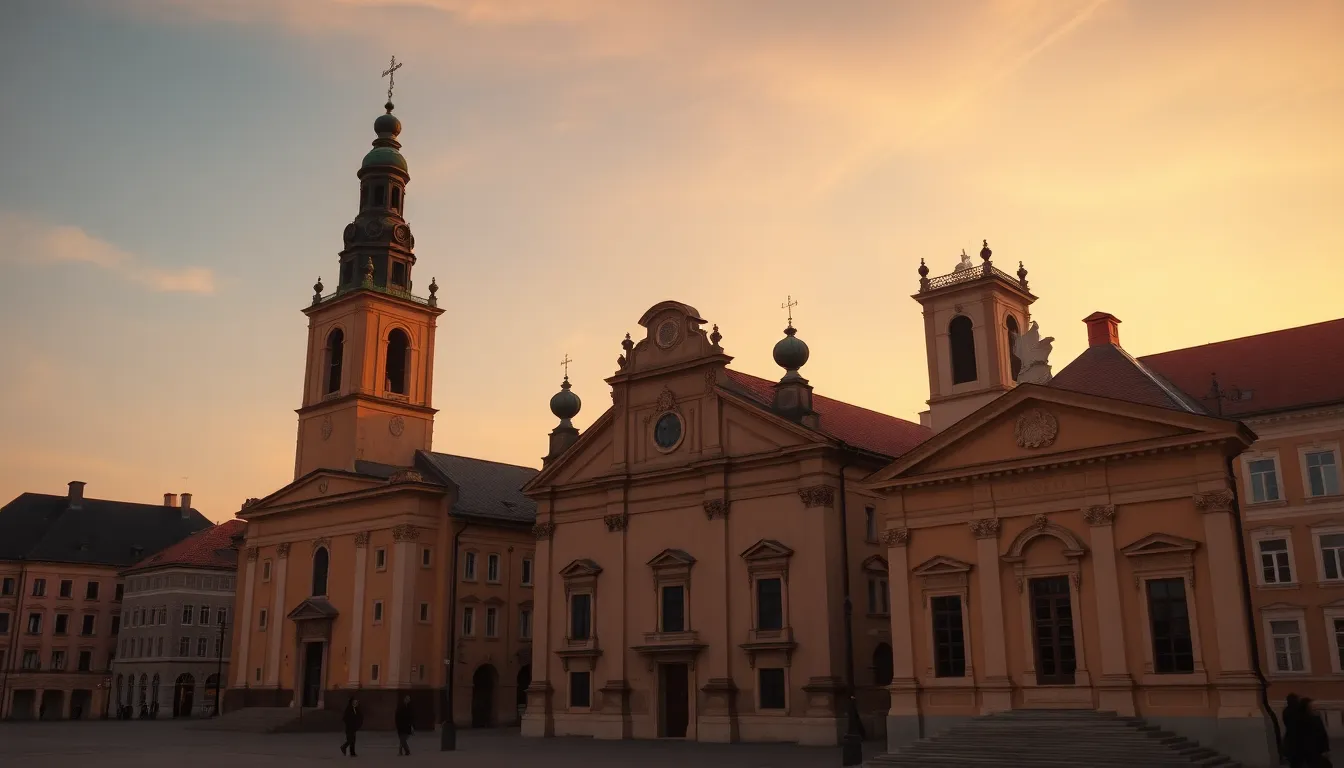
Vilnius has around 590,000 people and one of the largest surviving medieval and baroque old towns in Central and Eastern Europe — about 360 hectares, UNESCO-listed since 1994. It is not a restored showpiece; it is a working city whose centre happens to be four hundred years old and slightly crooked.
Why it looks like this
Vilnius is often called the most baroque city north of the Alps, and the reason is a catastrophe: fires and the Muscovite occupation of 1655–61 destroyed much of the Gothic and Renaissance city, and the rebuilding happened in the seventeenth and eighteenth centuries under Italian architects. The result is a coherent late-baroque townscape of a kind that survives almost nowhere else at this scale.
The churches
There are over forty in the old town. The ones to see: St Anne’s, a flamboyant Gothic brick fantasy of 33 different brick shapes that Napoleon reportedly wanted to carry back to Paris in his palm; St Peter and St Paul, whose interior holds some 2,000 stucco figures and is one of the great baroque interiors of Europe; and St Casimir’s, used as a museum of atheism under the Soviets.
Gediminas Hill and the cathedral
The castle tower on its hill is the city’s symbol; the funicular or a short steep climb gets you up. Below it, Cathedral Square with the white neoclassical cathedral and its separate belfry, and the Stebuklas tile — the “miracle” marker where the Baltic Way began. Locals turn around on it three times and make a wish; visitors do too.
Užupis
A district across the Vilnia river that declared itself an independent republic on 1 April 1997, with a constitution posted on a wall in dozens of languages (“Everyone has the right to be happy”; “A dog has the right to be a dog”), a president, an anthem and an army of about a dozen. It is a genuine artists’ quarter that gentrified, and it is charming rather than twee.
The Jewish quarter, and its absence
Vilnius was Vilna, the Jerusalem of the North — the great centre of Jewish learning in Eastern Europe, home of the Vilna Gaon, with over a hundred synagogues and prayer houses and a Jewish population of around 40%. Almost all of it is gone; one synagogue survives in use. The old ghetto streets are walkable and marked, and the section below deals with what happened.
Practical Vilnius
Compact and walkable end to end. The MO Museum of modern Lithuanian art (Libeskind building, 2018), the Palace of the Grand Dukes, the KGB Museum in the former NKVD headquarters with its cells intact, and the Republic of Užupis will fill two days comfortably. Vilnius airport is 7 km from the centre, twenty minutes by bus.
🏛️ Kaunas: The Temporary Capital That Built a Modern City
Lithuania's second city, about 300,000 people at the confluence of the Nemunas and the Neris, and the most misunderstood place in the country. Visitors skip it. They should not.
Why it matters
When Poland took Vilnius in 1920, Kaunas became the provisional capital of the Lithuanian republic for nineteen years — and had to invent itself as a capital city at speed. Ministries, a bank, a university, a museum, an officers’ club, apartment blocks: roughly 6,000 buildings went up between 1919 and 1939 in a distinctive style now called Lithuanian modernism.
The UNESCO listing
In 2023 that interwar centre was inscribed on the World Heritage list as “Modernist Kaunas: Architecture of Optimism, 1919–1939”. It is one of the very few twentieth-century urban ensembles on the list, and it recognises something real: a small poor country building a modern European capital from nothing, in a nationally inflected Art Deco that exists nowhere else.
Laisvės alėja and the old town
The 1.6 km pedestrian Freedom Avenue runs from the modernist centre to the old town, where Kaunas keeps its Gothic and Renaissance quarter, the castle, the Town Hall (“the White Swan”) and the Perkūnas House. The two halves — medieval and modernist — sit end to end, which is the whole point of the place.
Devils and Čiurlionis
Two museums worth the trip on their own. The Devils’ Museum holds some 3,000 devil figures collected by the painter Antanas Žmuidzinavičius — it sounds like a gimmick and is genuinely fascinating on folk belief. The M. K. Čiurlionis National Art Museum holds the work of Lithuania’s greatest artist, a painter and composer who died at 35 in 1911 and whose synaesthetic canvases anticipate abstraction.
Ninth Fort
On the edge of the city, a tsarist fortress used by the Nazis as a mass killing site, where roughly 50,000 people were murdered, most of them Jews, including some 5,000 deported from France and Germany. There is a memorial and a museum. It is not an optional stop for anyone trying to understand this country.
2022 and after
Kaunas was European Capital of Culture in 2022, which it used with unusual seriousness to confront its own twentieth century rather than to stage festivals. The city has a large student population, a good food scene and a chip on its shoulder about Vilnius that it has largely converted into energy.
🏖️ Klaipėda, Nida and the Curonian Spit
Ninety kilometres of Baltic coast, most of it sand, and one of the most unusual landscapes in Europe.
The Curonian Spit
A 98 km sand peninsula, in places 400 m wide, enclosing the Curonian Lagoon; the northern half is Lithuanian, the southern half Russian. UNESCO-listed in 2000 as a cultural landscape, because what makes it remarkable is not just the dunes but the two centuries of human effort that stopped them moving. Forest clearance in the seventeenth and eighteenth centuries set the sand walking; it buried at least fourteen villages before replanting halted it.
Nida
The main village on the Lithuanian spit: blue-and-white fishermen’s cottages, weathervanes carved with village-specific symbols, an amber gallery and the great Parnidis dune with its sundial above the village. Thomas Mann built a summer house here in 1930 and wrote part of the Joseph novels in it; it is now a museum. He came for three summers, then Germany made it impossible.
The Dead Dunes
Between Juodkrantė and Pervalka, the Grey or Dead Dunes are the ones that buried the villages, now fixed and walkable on boardwalks. Also on this stretch: the Hill of Witches, a forest sculpture trail of some eighty carved wooden figures from Lithuanian folklore, and the great cormorant and heron colony at Juodkrantė, which is noisy, smelly and extraordinary.
Klaipėda
The third city, about 150,000 people, and until 1923 it was Memel — German for seven centuries, seized by Lithuania in 1923, taken back by Hitler in 1939, Soviet from 1945. The half-timbered old town is small but real, and the whole city has a different feel from the rest of the country. Its port is ice-free and it is Lithuania’s gateway.
Palanga
The Baltic resort, and it is a proper one — a long pine-backed beach, a pier, a season that runs mad from June to August and shuts almost entirely in winter. The Amber Museum in the Tiškevičiai palace and its botanical park is the best thing there and holds around 30,000 pieces, including inclusions with insects 40 million years old.
The Nemunas delta
South of Klaipėda, a flat watery landscape of polders, reed beds and flooded meadows that is one of the most important bird sites on the Baltic flyway. Ventės Ragas has run a bird-ringing station since 1929, one of the oldest in Europe, and in migration season the numbers passing through are hard to credit.
🏰 Trakai, Kernavė and the Hill of Crosses
Trakai
The island castle everyone photographs, and rightly: a red-brick Gothic fortress of the late fourteenth century sitting on an island in Lake Galvė, 28 km west of Vilnius. It was the seat of Grand Duke Vytautas, fell into ruin, and was rebuilt in the twentieth century — the reconstruction was controversial and the result is magnificent. Twenty-five minutes by train from Vilnius.
The Karaim
Trakai’s other story. Vytautas brought several hundred Karaim families — a Turkic-speaking people practising a distinct non-rabbinic form of Judaism — from Crimea around 1397 as a bodyguard. Their descendants are still in Trakai, with a wooden kenesa, a street of characteristic three-windowed houses, their own language (critically endangered, with only a few dozen fluent speakers) and their own excellent food.
Kernavė
A UNESCO site since 2004 and the least-visited of them: the first capital of Lithuania, a complex of five hillforts above the Neris valley with a settlement layer running from the late palaeolithic to the fourteenth century. What survives is grass-covered mounds and an excellent museum, and it is far more atmospheric than that description suggests.
The Hill of Crosses
Twelve kilometres north of Šiauliai, a low hill carrying something in the region of 200,000 crosses — from metre-high carved oak to rosaries hung on other crosses. Crosses first appeared after the 1831 uprising; under the Soviets the hill was bulldozed at least three times, in 1961, 1973 and 1975, and each time crosses reappeared within nights. John Paul II visited in 1993 and left one. It is one of the most affecting places in Europe and it costs nothing to enter.
The other castles
Medininkai near the Belarusian border, the largest enclosure castle in Lithuania; Biržai in the north with its bastion fortress; Raudondvaris and Rokiškis manors; and the great baroque Pažaislis monastery outside Kaunas, an Italianate camaldolese complex with a hexagonal church that is arguably the finest baroque building in the country.
Cross-crafting
The carved wooden roadside crosses and shrines you will see everywhere are on the UNESCO intangible heritage list — a craft that fuses Catholic iconography with unmistakably pre-Christian forms: sun discs, snakes, moon symbols, the tree of life. It is the clearest surviving evidence of how Lithuania’s late conversion actually worked.
🌲 Lakes, Bogs and the Mushroom Question
Aukštaitija National Park
The first, established 1974, in the north-east: 126 lakes, pine forest, wooden villages and the ethnographic village of Stripeikiai with its Ancient Beekeeping Museum. Canoe routes link lake to lake through short channels, and it is possible to paddle for days without leaving the park.
Dzūkija
The big southern forest, sandy and poor, with the most traditional villages in the country — Zervynos and Marcinkonys are the ones to look for. Dzūkija is mushroom and berry country in a way that structures the local economy and calendar; the Čepkeliai raised bog on its edge is a strict reserve and one of the wildest places in the Baltics.
Žemaitija
The western uplands, historically the most stubborn part of the country — Samogitia held out against Christianity longest and against Soviet collectivisation hardest. It has its own dialect, sometimes argued to be a separate language, a strong regional identity, and the surreal Cold War Museum in a decommissioned Soviet nuclear missile silo at Plokštinė.
Mushrooms, seriously
This is not a quaint detail. Autumn mushroom picking is a mass activity — families go out at dawn, everybody has a secret spot, and boletus, chanterelles and saffron milk caps are picked, dried, pickled and given as gifts. Roadside stalls appear across the country in September. If you are invited to go, go, and do not expect to be told where.
Storks
Lithuania has one of the highest densities of white storks in the world — around 13,000 pairs — and made the stork its national bird in 1973. Nests on poles, chimneys and purpose-built platforms are everywhere in the countryside, and Stork Day on 25 March is a real thing.
Wolves, bison and lynx
Genuinely wild fauna survives: wolves (a managed population of several hundred, and hunting them is politically contentious), lynx, elk, beaver in large numbers, and a reintroduced herd of European bison at Pašiliai. You are unlikely to see any of them casually, and their presence is what makes these forests feel different from Western European ones.
👥 Two Point Nine Million People
Who they are
About 2.9 million residents, roughly 84% ethnic Lithuanian, with a Polish minority of about 6% concentrated in the south-east around Vilnius and Šalčininkai, a Russian minority of about 5% mostly in the cities and Visaginas, and smaller Belarusian, Ukrainian and Roma communities. The Karaim and Tatar communities are tiny and historically significant.
The emigration wound
Between EU accession in 2004 and about 2019, Lithuania lost people at a rate almost unmatched in peacetime Europe — whole villages emptied, schools closed, and a generation went to London, Dublin, Oslo and Chicago. The flow has reversed modestly since 2019. Nearly every Lithuanian family has someone abroad, and the subject carries real feeling.
Basketball
Not a sport but, as Lithuanians themselves say, the second religion. Lithuania has won three Olympic bronzes as an independent country, the European Championship in 1937, 1939 and 2003, and produced Arvydas Sabonis, Šarūnas Marčiulionis and Jonas Valančiūnas. The 1992 Olympic team — funded partly by the Grateful Dead, who paid for the tie-dyed kit — beating the post-Soviet Unified Team for bronze is a founding story of the restored republic.
Song festivals
The Dainų šventė, held every four years, gathers tens of thousands of singers and dancers in Vilnius’s Vingis Park for a mass choral event whose scale is genuinely hard to convey. The Baltic song and dance celebration tradition is on the UNESCO intangible heritage list, and it is the direct ancestor of the “Singing Revolution” of 1988–91.
Directness and reserve
Lithuanians have a reputation among their neighbours for being reserved with strangers and extremely warm once past that, and it holds up. Service can read as brusque to Southern Europeans; it is not rudeness. Small talk is thin, complaining about the weather and the government is a bonding ritual, and hospitality once you are inside someone’s home is overwhelming.
A young country and an old one
Median age around 45 and rising; one of Europe’s faster-ageing populations. At the same time Vilnius is visibly young, with a large student and tech population, a queue of Belarusian and Ukrainian arrivals, and a startup scene that is disproportionate for the size of the country.
🍲 Potato, Rye, Beetroot, Dill
Lithuanian food is northern peasant cooking that has recently discovered it is interesting. The base is potato, rye, pork, dairy, beetroot, cucumber, dill and mushrooms — everything that grows or keeps in a cold country — and the best of it is very good indeed.
Cepelinai
The national dish, named after zeppelins because of the shape. Large — 10 to 15 cm — dumplings of grated raw and boiled potato moulded around a filling of minced pork (or curd cheese, or mushrooms), boiled, and served under a sauce of fried bacon, onion and sour cream. The texture is dense, glossy and grey-brown, and it is a serious lunch: two is a meal and three is a mistake.
Šaltibarsčiai
The summer dish and the most photogenic food in the Baltic: a cold beetroot soup of grated cooked beetroot in kefir or buttermilk with diced cucumber, spring onion, masses of dill and a halved hard-boiled egg, served shocking magenta-pink with a plate of hot boiled potatoes on the side. The colour is the point and it is not exaggerated in photographs.
Kepta duona
Bar food, and the best argument for Lithuanian beer culture: sticks of dark rye bread, deep-fried until almost black, rubbed hard with raw garlic and usually served with grated cheese and a garlic-mayonnaise dip. Salty, garlicky, faintly bitter from the rye. Every bar has it.
Rye bread
Ruginė duona is a serious cultural object, not a side. Dark, dense, sour, long-fermented and sold in enormous round loaves; there is a well-known Lithuanian habit of bringing a loaf as a gift and of never throwing bread away. It underpins the whole cuisine, including gira (kvass) made from fermented rye.
Kibinai and the Karaim
Half-moon pastries of rich dough filled with chopped lamb and onion, brought by the Karaim from Crimea in the fourteenth century and now a Trakai speciality that has spread nationwide. Genuinely delicious, and a direct edible link to Vytautas the Great’s foreign policy.
Šakotis and the sweet end
Šakotis or raguolis — “branched tree cake” — is batter poured onto a rotating spit over an open fire, building spiky layers into a hollow golden cone up to a metre tall. It is the wedding and Christmas cake. Then curd cheese varškės sūris, honey cakes, and the rye-bread ice cream that has become a modern Vilnius signature.
👨🍳 Two Lithuanian Recipes
One for summer and one for any time. Both are cheap, and both are exactly what Lithuanians actually eat. Quantities serve four.
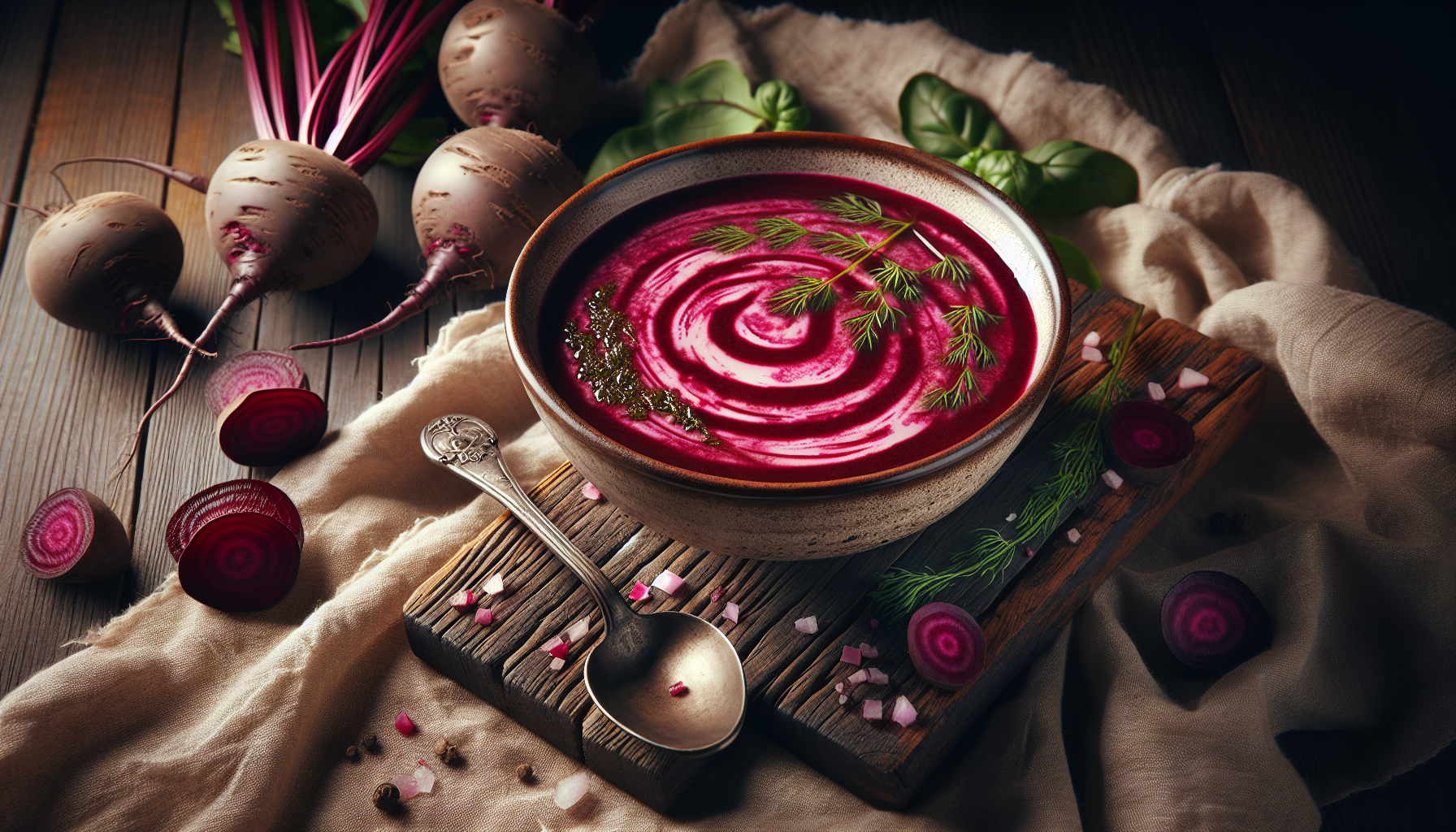
Šaltibarsčiai — cold beetroot soup
Cold soup · 20 minutes plus chilling · the Lithuanian summer, in a bowl
Ingredients: 500 g cooked beetroot (boiled or vacuum-packed, not pickled in vinegar), coarsely grated; 1 litre kefir (or buttermilk, or thin plain yoghurt let down with water); 2 medium cucumbers, peeled and finely diced; 4 spring onions, finely sliced, green parts included; 1 very large bunch of fresh dill, chopped — more than you think; 4 eggs, hard-boiled; salt; a squeeze of lemon. To serve: 800 g small potatoes, boiled hot, with butter and dill.
Method: Grate the cooked beetroot coarsely — do not blend it, the texture is the dish. Put it in a large bowl with the diced cucumber and spring onion, pour over the kefir and stir. The colour turns instantly from dark red to a startling magenta-pink; that reaction is what everyone remembers. Season with salt and a little lemon, stir through the chopped dill, and chill for at least two hours — it must be properly cold. Serve in bowls with half a hard-boiled egg in each, more dill on top, and a plate of hot boiled potatoes alongside.
💡 The hot potatoes with the ice-cold soup are not a garnish and not optional — the temperature contrast is the whole architecture of the dish, and Lithuanians will tell you so at length if you skip them.
Kepta duona — fried rye bread with garlic
Snack · 15 minutes · the standard accompaniment to a Lithuanian beer
Ingredients: 400 g dense dark rye bread, a day or two old; 4–6 fat garlic cloves; sunflower oil for frying; salt. To serve: 150 g hard cheese, finely grated, and a dip of 4 tbsp mayonnaise mashed with 1 crushed garlic clove.
Method: Cut the rye bread into sticks about 1 cm square and 7–8 cm long, crusts left on. Heat 2 cm of sunflower oil in a heavy pan to about 180 °C. Fry the sticks in batches for 2–3 minutes, turning, until they are dark, crisp and almost black at the edges — rye goes much darker than wheat and you must not stop early or they will be soft inside. Lift onto kitchen paper and salt at once. While still hot, rub each stick firmly with a cut raw garlic clove, or toss the lot in a bowl with crushed garlic. Pile onto a plate, cover with grated cheese so it melts slightly, and serve with the garlic mayonnaise.
💡 Use real dark sour rye, not wheat bread or a light rye mix — the bitterness of the rye against the raw garlic and salt is the entire flavour, and wheat bread just tastes like a crouton.
🍺 Beer, Mead and Something Called Midus
Lithuania is a beer country with a genuinely distinctive brewing tradition that outsiders have only recently noticed, and it is a mead country in a way that goes back before Christianity.
Farmhouse beer
This is the interesting one. Northern Lithuania, around Biržai and Pasvalys, preserved an unbroken farmhouse brewing tradition that survived the Soviet period in villages — unfiltered, often raw (unboiled) ales fermented with distinctive local yeasts, sometimes with hops boiled separately or not at all. International beer writers found it in the 2010s and treated it, rightly, as one of the last living archaic brewing traditions in Europe. Look for kaimiškas alus.
The big beers and the craft scene
Švyturys from Klaipėda and Kalnapilis are the mass-market names and are perfectly decent lagers. Beneath them is a strong small-brewery scene in Vilnius and Kaunas, and the country drinks a lot of beer — consumption per head is among the higher figures in Europe.
Midus
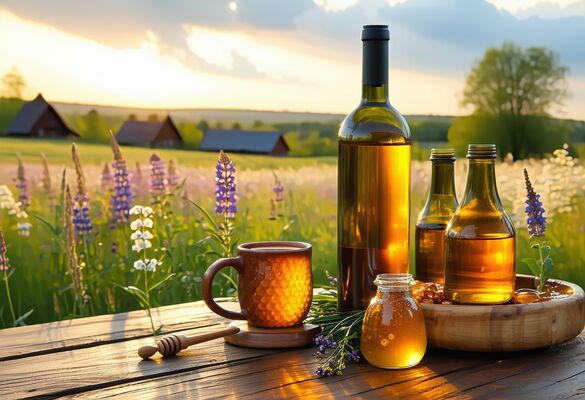
Fermented honey drink, and Lithuania’s oldest. It was drunk in the pagan period, it is mentioned in medieval chronicles, and it survives commercially — the Stakliškės mead has a protected EU designation. Styles range from light and floral at around 10% to strong spiced midaus balzamas at 65–75%, which should be treated with respect.
Spirits and the strong stuff
Starka, a rye spirit aged in oak, is a historic Polish-Lithuanian speciality. Trejos devynerios (“three nines”) is a bitter herbal liqueur of twenty-seven ingredients that Lithuanians drink as a digestif and press on visitors. Home distilling (samagonas) exists, is illegal, and occasionally kills people.
Gira
The non-alcoholic staple: kvass, fermented from dark rye bread, sold from barrels in summer and in bottles year round, faintly sour and genuinely refreshing. It is the drink you should try first and the one visitors most often like unexpectedly.
The rules
Lithuania has among the strictest alcohol laws in the EU, tightened sharply in 2018: the drinking age is 20, off-licence sales stop at 20:00 on weekdays and Saturdays and at 15:00 on Sundays, and alcohol advertising is essentially banned. Drink-driving is 0.0‰ for new drivers and 0.4‰ otherwise, and it is enforced hard. Consumption has fallen substantially since the reforms.
🎨 Čiurlionis, Cross-Crafting and the Singing
M. K. Čiurlionis
Lithuania’s one indisputable genius: Mikalojus Konstantinas Čiurlionis (1875–1911), simultaneously a composer and a painter, who died at 35 having produced some 300 paintings and 400 pieces of music. His painted “sonatas” and “fugues” are among the earliest genuinely abstract works in European art, predating Kandinsky. The national art museum in Kaunas is built around him.
Sutartinės
A form of polyphonic singing found nowhere else — archaic multipart songs in close, deliberately dissonant seconds, sung by small groups of women, on the UNESCO intangible heritage list since 2010. They sound genuinely strange the first time and they are believed to preserve a pre-Christian musical structure.
Theatre
Disproportionately serious. Directors Eimuntas Nekrošius, Oskaras Koršunovas and Rimas Tuminas made Lithuanian theatre internationally significant from the 1990s onward, touring versions of Shakespeare and Chekhov that were treated as major events across Europe. It remains a country where serious theatre has a genuine popular audience.
Literature
Czesław Miłosz, the Nobel laureate, was born in Lithuania and wrote about it constantly, though in Polish. Tomas Venclova, poet, dissident and Miłosz’s friend, is the great living voice. And Rūta Šepetys, an American of Lithuanian descent, brought the Siberian deportations to a mass readership with Between Shades of Gray.
Film and lasers
Two unrelated modern successes worth naming together, because both are export industries. Lithuanian studios have become a favoured location and production base for international series — Chernobyl was largely shot here — and the laser industry supplies research institutions worldwide from a handful of Vilnius companies.
Jonas Mekas
The Lithuanian-born filmmaker who fled in 1944, spent time in a displaced-persons camp, reached New York in 1949 and became the central figure of American avant-garde cinema — founder of Anthology Film Archives, diarist, mentor to Warhol’s circle. He returned to Lithuania late in life and there is now a visual arts centre in Vilnius named for him.
🗣️ The Oldest Living Indo-European Language
Lithuanian is the reason linguists care about this country. It is not merely old — every language is equally old — but it is conservative: it has changed less from Proto-Indo-European than any other surviving language, which makes it a working laboratory for reconstructing what Europeans spoke four thousand years ago.
What survived
Seven noun cases; a distinction between long and short vowels; a pitch accent; and forms that map almost directly onto Sanskrit and reconstructed PIE. The classic teaching example is Lithuanian sūnus against Sanskrit sūnuḥ for “son”, or dūmas against Latin fumus for smoke. The resemblances are systematic, not coincidental.
Two dialects, one standard
Aukštaitian (Highland) and Samogitian (Žemaitian, Lowland). The standard language was built on a southern Aukštaitian base in the late nineteenth century by Jonas Jablonskis. Samogitian is different enough that some argue it is a separate language, and it has its own Wikipedia and a real revival movement.
The State Commission
Lithuania regulates its language actively through a State Commission of the Lithuanian Language, which rules on loanwords, coins native replacements and has been known to fine broadcasters. The policy is contentious — the long-running argument about whether foreign names in passports may use letters like w and x reached the constitutional court — and it is rooted in the memory of the printing ban.
Getting by
English is widely and well spoken by anyone under forty-five, and Vilnius is comfortably navigable in English. Russian is understood by most people over forty-five, though using it with strangers can carry an unwanted political charge; ask in English first. Polish works in the south-east. German is uncommon.
A few words
Labas — hello. Ačiū (AH-choo) — thank you. Prašom — please / you’re welcome / here you are. Taip / ne — yes / no. Į sveikatą! — cheers. Viso gero — goodbye. Skanaus — enjoy your meal. Stress is unpredictable and Lithuanians are patient about it.
Names
Lithuanian surnames mark sex and, traditionally, marital status: a man Kazlauskas, his wife Kazlauskienė, his unmarried daughter Kazlauskaitė. Since 2003 women have been able to use a neutral -ė ending instead, and increasing numbers do. Foreign names are declined into Lithuanian endings in text, which confuses everybody at first.
⛪ Catholic Country, Pagan Substrate
Lithuania is about 74% Roman Catholic and it is Catholic in a specific way: the faith arrived last in Europe, arrived as a political transaction, and settled on top of a pagan religion that never entirely went away. You can see the join.
The old religion
Pre-Christian Lithuanian belief centred on Perkūnas the thunder god, sacred oak groves, eternal fires tended by priestesses, grass snakes kept in houses as household guardians, and a strong cult of the dead. It was a functioning state religion into the 1380s — long after Iceland, Poland and Kyiv had converted — and the Teutonic Order used its survival as the standing justification for two centuries of crusade.
Romuva
The organised modern revival, founded in the 1960s and legally recognised as a religious community. It has a few thousand adherents, celebrates the solstices, and has been in a long fight for the full state recognition granted to other faiths — a case it took to the European Court of Human Rights and won in 2021. Whether Romuva is continuity or reconstruction is argued about; the folk practices it draws on are demonstrably continuous.
Where the join shows
In the carved crosses, with their sun discs and serpents; in Rasos, the midsummer festival on 23–24 June, with bonfires, wreaths floated on rivers and the hunt for the fern flower, celebrated with total enthusiasm by an ostensibly Catholic population; in Užgavėnės, the pre-Lent carnival with wooden masks, devils and the burning of the winter effigy Morė; and in the household use of rue, oak and amber.
Catholicism as resistance
In the Soviet period the Church was the main surviving institution of national identity, and the Chronicle of the Catholic Church in Lithuania — published clandestinely from 1972 to 1989 without a single issue being suppressed — was one of the longest-running samizdat publications in the USSR. The Hill of Crosses became the physical expression of the same thing.
The Divine Mercy and the Gate of Dawn
Two Vilnius shrines of international significance. The Gate of Dawn (Aušros vartai) holds a sixteenth-century icon of the Virgin venerated by Catholics and Orthodox alike, and the last surviving gate of the city walls. Nearby, the original Divine Mercy image was painted in 1934 under the direction of Faustina Kowalska, whose devotion began here and is now global.
Today
Practice has fallen with the rest of Europe — regular mass attendance is a minority activity — while identification remains high. Church influence on politics is real but bounded: Lithuania has no same-sex marriage or civil partnership, an issue that has repeatedly stalled in the Seimas, and this is one of the sharper domestic divides between Vilnius and the countryside.
🕯️ Vilna, and What Was Destroyed
Content note. This section describes mass murder. It is here because no honest guide to Lithuania can leave it out, and because much of what a visitor walks past in Vilnius is unmarked without it.
Before 1941 Lithuania had a Jewish population of around 210,000 to 250,000. Between June 1941 and the end of the German occupation, roughly 195,000 of them were murdered — about 95%, the highest proportion of any Jewish community in Europe.
Vilna, the Jerusalem of the North
For four centuries Vilnius was one of the great centres of Jewish life and learning in the world — the seat of the Vilna Gaon (Elijah ben Solomon, 1720–97), the intellectual capital of Litvak Judaism and of the Jewish labour movement, with over a hundred synagogues and prayer houses, a famous library, the YIVO institute, publishing houses and a Yiddish theatre. Jews were roughly 40% of the city’s population.
Ponary
The killing was mostly done not in camps but in pits, close to home, by shooting. At Paneriai (Ponary), in woods 10 km from Vilnius, around 70,000 Jews and some 30,000 others — Poles, Roma, Soviet prisoners — were shot into fuel-storage pits between 1941 and 1944. It is reachable by suburban train in fifteen minutes and there is a museum. The Ninth Fort at Kaunas served the same purpose in the second city.
The hardest part
It must be said plainly: a significant number of Lithuanians took part, as members of auxiliary police battalions and local “partisan” units, in the shootings — sometimes before German units arrived, as in the Kaunas pogrom of June 1941. Lithuania has confronted this unevenly and often bitterly. The argument is complicated by genuine grievance about the Soviet deportations that preceded the German arrival, and complicated further by the fact that some individuals honoured for anti-Soviet resistance were also implicated in the killings.
The rescuers
Around 900 Lithuanians have been recognised by Yad Vashem as Righteous Among the Nations, a high number for the size of the population. And Kaunas holds the story of Chiune Sugihara, the Japanese consul who in 1940 wrote transit visas by hand, day and night, against his government’s explicit instruction — several thousand of them, saving perhaps six thousand people. His house is a museum.
What survives
One synagogue in use in Vilnius, of over a hundred. The Vilna Gaon Museum of Jewish History across several sites; the marked boundaries of the two ghettos; the Great Synagogue site, where excavation has been going on since 2011 under a Soviet-built school. The Jewish community today numbers around 3,000 people.
How to engage with it
Go to Paneriai or the Ninth Fort. Take one of the Jewish Vilnius walking tours — they are excellent and they are led by people who will tell you the difficult version. And read the street names in the old town: many of them are still the trade names of a community that is not there.
📅 When to Go
June to August — the answer
The Baltic summer is short, intense and worth arranging your year around. Long days — sunset after 22:00 in June — temperatures around 20–25 °C, the coast open, everything outdoors, and a national mood that is visibly different from the rest of the year. It is also when šaltibarsčiai season peaks, which is not a trivial reason.
23–24 June: Rasos / Joninės
The midsummer festival, and the best single date to be in Lithuania. Bonfires on lakeshores and hilltops, women in flower wreaths, singing until dawn, the search for the mythical fern flower, and a great deal of beer. It is a public holiday, it is celebrated everywhere, and it is one of the more genuinely pre-Christian nights left in Europe.
September and early October
The connoisseur’s season: warm days, cold nights, forests turning, mushroom stalls on every roadside, and the tourist numbers gone. If you want the countryside and the lakes rather than the beach, this is better than summer.
Winter
Genuinely cold — regularly −5 to −15 °C, occasionally −20 — and genuinely dark, with sunset before 16:00 in December. Vilnius does an excellent Christmas market and the old town under snow is beautiful. Lakes freeze hard enough for ice fishing. This is the correct season for a museum-and-restaurant city break and the wrong one for everything else.
March and November — avoid
The two months to skip. Grey, wet, thawing or freezing, with the snow gone and nothing green yet. Even Lithuanians describe November as the hardest month, and the country’s All Souls tradition — cemeteries filled with tens of thousands of candles on 1–2 November — is the one genuinely beautiful thing about it, and it is beautiful.
Other fixed dates
16 February (1918 independence) and 11 March (1990 restoration) are both national days with flags on every building. 6 July, Statehood Day, ends with the whole country singing the national anthem simultaneously at 21:00, worldwide. Kaziukas fair in Vilnius in early March is the big folk-craft market and fills the old town.
✈️ Getting There and Around
From Prague
Straightforward. There are direct flights Prague–Vilnius of about 1 hour 45 minutes, operated seasonally and year-round by low-cost and network carriers — check current schedules, as the route has changed hands more than once. Connections through Warsaw, Riga, Frankfurt or Copenhagen are frequent. Fares are usually modest outside July and August.
The airports
Vilnius (VNO) is 7 km from the centre with a bus and a train link and is small and painless. Kaunas (KUN) is a low-cost hub and often cheaper. Palanga (PLQ) serves the coast in summer. Note that Vilnius airport closed repeatedly through late 2025 because of the Belarusian balloon incursions; if that recurs, allow slack around flights.
Overland
By bus is easy and cheap: comfortable coaches run Vilnius–Warsaw (about 8 hours), Vilnius–Riga (4 hours) and onward to Tallinn. By train the network is being rebuilt: a Vilnius–Warsaw rail link operates via Kaunas and Białystok, and Rail Baltica will eventually make this a proper European connection. Driving from Prague is roughly 1,100 km via Poland, twelve to thirteen hours.
Do not enter via Belarus
Worth saying explicitly. The Belarusian border crossings have been repeatedly closed since 2025, transit is unpredictable, and both the Czech and other foreign ministries advise against travel to Belarus. Plan any Lithuanian trip through Poland or Latvia.
Getting around
Intercity buses are the backbone — frequent, cheap, comfortable, and they reach everywhere. Trains serve the main axis Vilnius–Kaunas–Klaipėda well and are modern and inexpensive; Vilnius to Kaunas is about an hour. City transport in Vilnius and Kaunas is good and cheap. Car hire is easy and the roads are excellent.
Driving notes
Right-hand traffic. Headlights on at all times, year round. Winter tyres are compulsory from 10 November to 1 April. Blood alcohol is 0.0‰ for drivers with under two years’ experience and 0.4‰ otherwise, and it is enforced with roadside checks. Motorways are free. Watch for storks nesting on poles and for elk in forest sections at dusk.
📋 Practical Information
Entry and money
EU, Schengen and eurozone. Czech citizens need only an ID card, and the currency is the euro. Cards are accepted essentially everywhere including buses, market stalls and rural petrol stations — Lithuania is one of the most cashless countries in Europe and you can complete a week’s trip without touching a banknote.
Health
Your Czech EHIC card is valid and gives access to state healthcare on the same terms as locals. Standards are good, and Vilnius has private clinics with English-speaking staff. Travel insurance is still worth having for repatriation and for anything the EHIC does not cover.
Safety
Very safe. Violent crime is low, the cities are comfortable at night, and the main practical risks are the ordinary urban ones plus, in summer, ticks — tick-borne encephalitis is genuinely endemic in Lithuanian forests and vaccination is recommended if you plan serious hiking or camping. Check yourself after woodland walks.
Connectivity
Excellent. Lithuania has some of the fastest and cheapest mobile and fixed internet in Europe, EU roaming applies, and free public wi-fi is widespread. Digital government services are advanced — much of what a Czech visitor would expect to do on paper is done through an app here.
Language and manners
English is fine in cities and among the young. Take your shoes off when entering a home — this is not optional. Do not compliment Lithuania by comparing it favourably to Russia, and do not describe the country as “post-Soviet”; both land badly. Toasting is done with eye contact. Flowers as a gift must be an odd number — even numbers are for funerals, and this rule is taken seriously.
Alcohol rules again
Because they catch people out: drinking age 20, shop sales stop at 20:00 Monday to Saturday and at 15:00 on Sunday, and there is effectively no alcohol advertising. Bars and restaurants serve later, but if you plan to buy a bottle for the evening, buy it in the afternoon.
💰 What It Costs
Lithuania is one of the better-value destinations in the EU — noticeably cheaper than Western Europe, and now broadly comparable to Czechia rather than dramatically below it. Figures are indicative for 2026, converting at roughly 1 EUR ≈ 24.5 CZK.
Accommodation
A good three-star double in Vilnius old town runs €60–100 (1,500–2,500 CZK); four-star €100–160; hostels €18–30 a bed. Outside Vilnius everything drops by a third. The exception is Palanga and Nida in July and August, where coastal prices double and rooms must be booked months ahead.
Eating
A main course in an ordinary restaurant €10–16; a plate of cepelinai in a traditional place €8–12; the daily lunch special (dienos pietūs) €6–9 and it is the great value trick of the country; a coffee €2.50–3.50; a half-litre of beer €3.50–5 in a bar. A good dinner with wine in a serious Vilnius restaurant, €40–60 a head.
Transport
Cheap. Vilnius–Kaunas by train about €6, by bus similar; Vilnius–Klaipėda €15–22. A city transport ticket is around €1; a day pass about €5. Car hire from €30–45 a day, and petrol is a little below Czech prices. Taxis and Bolt are inexpensive.
Museums and sights
Modest. The MO Museum around €12, Trakai castle about €12, the Ninth Fort €5–8, the KGB Museum around €6. The Hill of Crosses is free, and so is most of what is best about the country — the old town, the dunes, the forests, the lakes.
A realistic day
Budget, staying in hostels and eating lunch specials: €45–60 (1,100–1,500 CZK) per person per day. Comfortable mid-range with a decent hotel and two meals out: €100–140. Coastal summer is the exception and can double the accommodation line.
The comparison
For a Czech traveller Lithuania is not a bargain destination the way it was fifteen years ago — wages and prices have converged. Restaurant food in Vilnius costs roughly what it costs in Brno; accommodation is comparable; alcohol is dearer because of the tax regime. What is cheap relative to Western Europe is everything, and what is genuinely cheap in absolute terms is transport.
🇨🇿 For Czech Readers
The Jagiellonian link
The closest historical tie, and most Czechs do not know it. Vladislav II Jagiello, king of Bohemia from 1471 and builder of the Vladislav Hall at Prague Castle, was the great-grandson of the Lithuanian Grand Duke Jogaila — the man who converted Lithuania in 1387. The Jagiellonian dynasty of Lithuanian origin ruled Bohemia and Hungary for half a century. The Vladislav Hall is, in a real sense, a Lithuanian dynasty’s building.
Two 1968s and two 1989s
Czechs and Lithuanians recognise each other’s twentieth century immediately: occupation justified as liberation, a national movement crushed, self-immolation as protest — Romas Kalanta burned himself in Kaunas in May 1972, three years after Jan Palach, and the riots that followed were the largest in Soviet Lithuania. Both countries then talked their way out in 1989–91 without a war.
MZV ČR
No warnings of any kind. Lithuania is a safe EU and NATO member and the ministry treats it as any other Schengen destination. The Czech Embassy is in Vilnius (Birutės g. 16). Registration in DROZD is optional and sensible for longer stays or hiking trips, and the EU emergency number is 112.
Money and health
The euro, so budget in euros; and your EHIC card works, since Lithuania is in the EU. Cards are taken everywhere. This is one of the least administratively complicated foreign trips a Czech can make.
Getting there from Prague
Direct flights Prague–Vilnius take about 1 h 45; check current operators as the route changes hands. Otherwise connect via Warsaw or Riga. By car it is around 1,100 km through Poland, comfortably a long day. By bus, Prague–Warsaw–Vilnius is doable and cheap if you have the patience.
Scale, for a Czech reader
Lithuania is 65,300 km² against Czechia’s 78,900 — about five-sixths the size — with a bit over a quarter of the population. Vilnius has roughly half the people of Prague. And the country’s highest point, Aukštojas at 294 m, is 1,308 m lower than Sněžka and barely higher than Petřín hill.
🎲 Things That Are True About Lithuania
The largest country in Europe, once
In the fifteenth century the Grand Duchy of Lithuania covered roughly 930,000 km² from the Baltic to the Black Sea — the largest state on the continent. Today it is 65,300 km². Few countries have shrunk by 93% and survived to talk about it.
The last pagans in Europe
Lithuania accepted Christianity in 1387, and Samogitia in 1413 — nearly four centuries after Poland, and after the Aztecs had built Tenochtitlan. It is the latest conversion of any European state, and it happened by royal marriage rather than by conquest.
An unbroken human chain to another country
The Baltic Way of 23 August 1989: about two million people, 675 km, three countries, one continuous chain of hands, organised without mobile phones or the internet. Nothing quite like it has been attempted before or since.
The Grateful Dead paid for the Olympic kit
In 1992 the newly independent Lithuanian basketball team had no money to get to Barcelona. The Grateful Dead heard about it, funded the trip, and supplied tie-dyed skeleton-and-basketball warm-up shirts. The team beat the post-Soviet Unified Team for bronze wearing them on the podium. The shirts are still sold and the story is told constantly, correctly.
A republic inside the capital
Užupis in Vilnius declared independence on 1 April 1997 and has a constitution, a flag, a president, an anthem and an army of about a dozen. Article 12: “A dog has the right to be a dog.” Article 16: “Everyone has the right to be happy.” Article 17: “Everyone has the right to be unhappy.”
A hill that would not stay bulldozed
The Hill of Crosses was flattened by Soviet bulldozers at least three times in the 1960s and 70s, the area sealed off and the approaches guarded. Crosses reappeared within nights, every time. There are now something like 200,000 of them.
🔭 What Lithuania Is Trying to Become
The numbers
Lithuania receives on the order of 1.5 to 2 million foreign overnight visitors a year — small by European standards, and about a third of what Prague alone takes. The biggest source markets are Germany, Poland, Latvia and the UK, with a large domestic and Baltic-regional element on the coast.
The Vilnius pitch
The city has marketed itself with unusual wit — the “G-spot of Europe” campaign of 2018 and the “nobody knows where Lithuania is” self-deprecation of 2019 both went viral precisely because they conceded the problem. It works: Vilnius has become a genuine city-break destination, and it was European Green Capital in 2025.
What holds it back
Distance, obscurity and a short season. Lithuania is a two-hour flight from most of Europe but is not on any classic itinerary; the coast works for eight weeks a year; and the country has no single globally famous image the way Estonia has Tallinn’s skyline. It also has to compete with Riga and Tallinn for the same Baltic city-break traveller.
What is genuinely growing
Business and conference travel to Vilnius; film production, which brings crews for months at a time; heritage tourism, especially Jewish heritage and diaspora roots travel from the US, Israel and South Africa; and slow outdoor travel — canoeing, cycling the coast, the lake country — which suits what the country actually has.
The security shadow
It has to be said. Balloon incursions closing Vilnius airport more than ten times in three months does measurable damage to a tourism economy, and that is part of the point of them. Lithuania is entirely safe to visit; the disruption is real and the two facts sit awkwardly together in any honest recommendation.
The recommendation
Give it four days, not one. Two in Vilnius, one for Trakai and Kernavė or the Hill of Crosses, one for Kaunas — or trade the cities for a week on the Curonian Spit and in the lakes. Come in June if you can, for the light and for midsummer. It is one of the few countries left in the EU where the good things are not crowded.
🌅 The Next Twenty Years
The security question
Everything else is downstream of it. Lithuania has built the highest defence spending in NATO, hosted Germany’s first permanent overseas brigade since 1945, and reorganised its energy, rail and electricity systems away from Russia. Whether that is sufficient is not a question Lithuania can answer alone, which is the permanent condition of a country of 2.9 million on that border.
Demography
The population fell by nearly a quarter after 1990 and has only just stabilised. Ageing, a low birth rate and a tight labour market are the binding constraints on growth, and the politically difficult answer — sustained immigration — is complicated in a country whose experience of imposed demographic change is what it is. Returnees and Ukrainian and Belarusian arrivals have helped.
The economy
The convergence story has largely worked and the next stage is harder: moving from cost advantage to genuine innovation. The lasers, biotech and fintech clusters are the evidence that it is possible. The risks are the defence-driven debt build-up and exposure to a regional shock.
Belarus
The most consequential unknown. A democratic Belarus would transform Lithuania’s position — reopening the natural hinterland of Vilnius, which sits 30 km from the border and was for centuries the capital of a state centred on what is now Belarus. A further integration of Belarus into Russia would do the opposite. Lithuania hosts the opposition in exile and has staked something on the first outcome.
Climate
A warming Baltic means a longer season on the coast, more winter rain and less reliable snow, and pressure on the peatlands and forests that store a great deal of carbon. Lithuania has one of the higher renewable shares in the EU and large offshore wind plans in the Baltic; it also has an agriculture sector that is a substantial emitter.
What it will probably stay
A small, tough, self-aware country that has been erased from the map twice and come back both times, that punches implausibly above its weight in linguistics, lasers, basketball and diplomacy, and that treats its own survival as an active project rather than a settled fact. Nothing about the last thirty-five years suggests it will stop.
📸 Gallery — and a Serious Problem With This Country's Images
Read this section. Of the twenty-one image files stored for Lithuania, thirteen are photographs of Abkhazia — a disputed territory in the Caucasus, 1,800 km away — and they say so in their own filenames. Only four files on this page could be used. This is the worst case found anywhere in this project so far.
The good news, and it matters: the old live page that this one replaces did not display any of them. It showed three recipe images, one of which — lithuania-sakotis.jpg — has never existed in the bucket and was rendering as a broken image. It also carried the flag 🇦🇼, which is Aruba. All three defects are fixed here.
Thirteen files that are Abkhazia, by name
04-stalin-dacha.jpg, 05-gagra-colonnade.jpg, 06-new-athos-monastery.jpg, 07-new-athos-lake-view.jpg, 08-new-athos-interior.jpg, 09-pitsunda-cathedral.jpg, 13-cuisine-feast.jpg, 16-tkvarcheli-ghost-town.jpg, 17-lykhny-village.jpg, and four gallery-* files covering the Gagra colonnade, New Athos, Lake Ritsa and the Gagra promenade. Every one of those is a place in Abkhazia. Stalin's dacha, Lake Ritsa, Pitsunda, Tkvarcheli and Lykhny have nothing whatever to do with Lithuania. The identical set was found under Lebanon and Lesotho earlier in this project.
And the filenames are not even reliable
Opening 17-lykhny-village.jpg shows a wooden clapboard church with a shingled steeple and elders gathered under an oak — North American or Northern European vernacular. Lykhny in Abkhazia has a tenth-century stone domed church. So the file is wrong twice over: it is not Lithuania, and it does not match its own Abkhazian name either. Nothing in this set can be trusted from its filename alone.
The wine barrels, and the pattern confirmed
14-lithuanian-wines-vineyard.jpg shows oak barrels branded “LYKHNY” and “ANAKOPIA” — Abkhazian wine brands — in rolling vineyard hills that exist nowhere in flat Lithuania, which has no commercial wine industry at all. The equivalent file under Liechtenstein showed bottles carrying the same two names. This is one Abkhazian source image redistributed under the pattern 14-<adjective>-wines-vineyard.jpg across many countries, and it is now confirmed in three of them.
Rejected: the cepelinai
lithuania-cepelinai.jpg shows small pleated dumplings in a bowl — pelmeni or Asian-style wrappers, wheat dough, no sauce. Cepelinai are 10–15 cm zeppelin-shaped potato-dough dumplings, dense and grey-brown, served under fried bacon and sour cream. Wrong size, wrong dough, wrong colour, wrong shape and no sauce. For the national dish, that is not usable.
Rejected: the second beetroot soup
lithuania-saltibarsciai.jpg is a smooth, deep crimson beetroot purée with a cream swirl and a parsley sprig. Šaltibarsčiai is shocking magenta-pink — the kefir does that, and the colour is the single most recognisable thing about the dish — chunky rather than blended, and finished with dill, not parsley. Rejected in favour of the file below.
Used, despite the broken filename
lithuania-altibariai.jpg — the name is a garbled šaltibarsčiai with the first letters lost — is the better of the two beetroot images, and this is a small lesson in not judging by filename. It has the right bright magenta colour and correct dill, where the properly named file has neither. It is still a purée rather than the chunky soup, and the correction is printed under it on the page.
Rejected: the fried bread
lithuania-kepta-duona.jpg shows pale golden fried wheat dough sticks with a sprig of rosemary. Kepta duona is deep-fried dark rye — near-black at the edges — rubbed with raw garlic and served with cheese. Wrong grain, wrong colour, no garlic, and rosemary belongs to a different cuisine entirely.
Where the list came from
The actual S3 bucket listing taken on 7 September 2026: seventeen files under images/lithuania/ and four under countries/images/recipes/. Every candidate was downloaded, hashed and opened before anything was written about it. The recipe file lithuania-sakotis.jpg, which the old live page linked to, is not in the bucket and returns HTTP 404 — a broken image that has been live on the site.
What this page needs
Almost everything. There is no photograph of Vilnius old town, Trakai, the Curonian Spit, the Hill of Crosses, Kaunas, Nida, Palanga or Kernavė — that is, of every single thing that makes Lithuania worth visiting. Four usable files for the largest Baltic state. The text here is written to stand up without them, and the misfiled Abkhazian set has been logged for the site owner with a recommendation to sweep every images/* prefix in the bucket.
Support This Project 🌍
This World Travel Factbook is a labor of love – free to use for all travelers. If you find it helpful, consider supporting its continued development.