
🇱🇮 Liechtenstein at a Glance
🌍 Overview
Liechtenstein is 160 km² — smaller than Brno, about a third the size of Prague — with roughly 40,400 people. It is 25 kilometres long and at most 12 wide, a strip of the Alpine Rhine valley and the mountains above it, wedged between Switzerland and Austria. You can walk across it in a day, and people do.
It is also, per head, one of the richest and most industrialised countries on earth, a hereditary principality where the prince has real constitutional power rather than ceremonial power, and the only country in the world named after the family that bought it — rather than the other way round.
The state
A constitutional monarchy on a democratic and parliamentary basis, which is the constitution’s own careful phrasing. Head of state is Prince Hans-Adam II, born 1945; his son Hereditary Prince Alois has exercised the powers of head of state as regent since 15 August 2004. The 25-member Landtag is elected every four years; the prime minister since 10 April 2025 is Brigitte Haas of the Patriotic Union, the first woman to hold the office.
The news of 2026
On 15 August 2026 — National Day — Hereditary Prince Alois announced from the castle meadow that the princely house had voted to change the succession from male to absolute primogeniture: in future the first-born child inherits regardless of sex. It passed the required two-thirds majority of voting family members. It applies only to future-born descendants of Alois and Princess Sophie’s children, so the current line is unchanged.
The economy
Extraordinary and not what most people expect. Liechtenstein is not primarily a bank — it is an industrial economy, one of the most industrialised in the world by share of GDP, exporting dental prosthetics, power tools, vacuum coatings and precision components. There are more registered companies than citizens and more jobs than residents: over half the workforce commutes in daily from Switzerland and Austria. GDP growth is projected around 1.5% in 2026; unemployment sits near 1.5%.
What visiting is like
Easy, expensive, and stranger than it looks. Most visitors come for two hours from Zurich, photograph the castle from below, buy a passport stamp, and leave — and they miss the country entirely. Stay a night and you get an exposed Alpine ridge path, a Walser village with its own dialect, a princely vineyard, one of the best small modern-art museums in Europe, and the odd sensation of driving out of a country by accident.
🏷️ A Country Named After the People Who Bought It
This is the single fact that explains Liechtenstein, and it is worth stating precisely. The House of Liechtenstein — one of the oldest noble families in Europe, named after a castle near Vienna — was rich, powerful, and ineligible for a seat in the Imperial Diet of the Holy Roman Empire, because none of its enormous holdings in Moravia, Bohemia and Lower Austria were held directly from the Emperor.
The purchase
So the family went shopping. It bought the lordship of Schellenberg in 1699 and the county of Vaduz in 1712 — two small, poor, indebted territories whose only real value was that they were reichsunmittelbar, held directly from the Emperor. In 1719 Charles VI merged them into the Imperial Principality of Liechtenstein. The country is named after the family; the family is named after a castle in Austria.
A hundred and twenty years of absence
Having bought the place for its constitutional status, the princes then did not visit it. No reigning prince set foot in Liechtenstein until 1842 — 123 years after the principality was created. The family lived in Vienna and in its Moravian palaces, and governed Vaduz through officials. Prince Franz Josef II, in 1938, became the first prince actually to live in the country.
Losing the real estate
The irony is complete. In 1945 Czechoslovakia confiscated the family’s Bohemian and Moravian estates — some 1,600 km², ten times the size of Liechtenstein, including the Lednice–Valtice complex now on the UNESCO list — under the Beneš decrees, on the grounds that the family was German. Liechtenstein disputed this for decades, refused to recognise Czechoslovakia and then Czechia until 2009, and lost at the International Court of Justice in 2005. The tiny bought-in principality is all that is left, and it turned out to be the part that mattered.
The flag and the crown
Blue over red horizontally, with a gold crown in the blue. The crown was added in 1937, for an entirely practical reason: at the 1936 Berlin Olympics the Liechtenstein delegation discovered that their flag was identical to Haiti’s. The crown settled it, and it is the reason a flag has a coronet on it at all.
🗺️ Twenty-Five Kilometres Long, Two Thousand Metres High
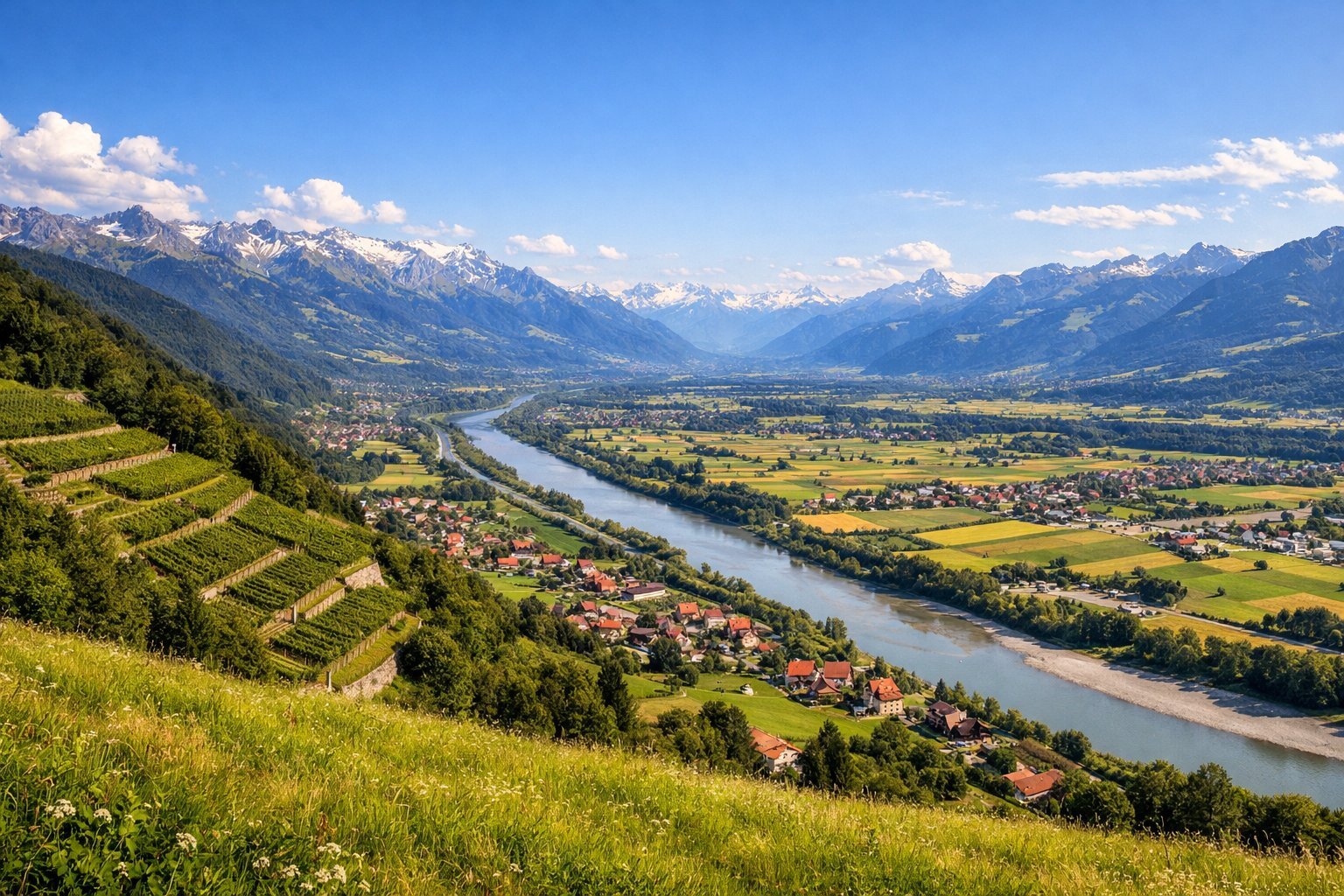
Liechtenstein is a cross-section of the Alps in miniature. The western third is the flat floor of the Alpine Rhine valley at about 450 m, where the Rhine forms the entire Swiss border and where almost everyone lives. The eastern two-thirds climb steeply into the Rätikon, reaching 2,599 m at the Grauspitz on the Swiss border.
Eleven municipalities
Oberland (Upper Country, the historic county of Vaduz): Vaduz, Triesen, Balzers, Triesenberg, Schaan and Planken. Unterland (Lower Country, the historic lordship of Schellenberg): Eschen, Mauren, Ruggell, Gamprin and Schellenberg. The two halves have separate histories, separate dialect shadings and a rivalry that Liechtensteiners will explain to you at length.
The mountains
The Rätikon along the eastern and southern border, limestone and steep. Grauspitz (2,599 m) is the summit; the Falknis, the Naafkopf — where Liechtenstein, Switzerland and Austria meet — and the Three Sisters (Drei Schwestern) above Planken are the recognisable ones. The Three Sisters ridge carries the country’s most famous path.
The valleys behind
The Samina valley runs north–south behind the front range, hidden from the Rhine valley entirely: from Triesenberg up through the Steg plateau to Malbun at about 1,600 m. This is the only part of Liechtenstein that feels genuinely remote, and it is fifteen minutes from the capital.
Doubly landlocked
Liechtenstein is one of only two doubly landlocked countries in the world — landlocked, and surrounded entirely by other landlocked countries. The other is Uzbekistan. To reach the sea from Vaduz you must cross at least two more national borders whichever way you go.
The Ruggeller Riet
The country’s lowest point, around 430 m, and its ecological jewel: a raised bog and wet meadow reserve on the Rhine in the far north, famous for Siberian irises that turn the whole reserve blue in late May, and for breeding birds. It is the quietest place in Liechtenstein and one of the few genuinely wild ones.
Climate
Alpine but unusually mild for the latitude and altitude, because of the Föhn — the warm dry down-valley wind that blows out of the south, raises the temperature sharply, lengthens the growing season and is the reason the valley shoulder can ripen grapes at 47° north. Winters on the valley floor are cold and often fogbound; Triesenberg and Malbun sit above the fog in sunshine.
📜 From Nothing Much to the Richest Place on Earth
Before 1699
Roman road and settlement in the valley — the route over the Alps ran through here; then Alemannic settlement, then the counts of Werdenberg and the barons of Brandis and Sulz, then the counts of Hohenems, who ran the place badly and left it heavily in debt. The Hohenems witch trials of the 1640s–80s killed around one hundred people in a territory of a few thousand, and were the immediate reason the Emperor eventually forced a sale.
The Walsers
In the 13th century German-speaking settlers from the Valais — the Walsers — were invited to settle the high ground at Triesenberg, land nobody else wanted. They cleared it, farmed at altitude, and kept a distinct dialect and identity for seven hundred years. Triesenberg is still visibly different from the valley, and the dialect is still different enough that valley Liechtensteiners notice.
Sovereignty, 1806
When Napoleon dissolved the Holy Roman Empire, Liechtenstein was admitted to the Confederation of the Rhine as a sovereign state — largely because Napoleon liked Prince Johann I, who had negotiated with him. Sovereignty was an accident of an accident: a principality bought for a parliamentary seat became independent because the parliament ceased to exist.
The poor century
The nineteenth century was hard. Liechtenstein was an agricultural backwater with poor soil, repeated Rhine floods — the catastrophic breach of 1927 flooded a large part of the valley floor — and mass emigration to America. The army, all eighty men of it, was abolished in 1868 as too expensive. Its last deployment, to the Austro-Prussian war of 1866, produced the country’s favourite story: eighty men marched out and eighty-one came back, having acquired an Austrian liaison officer on the way.
Turning to Switzerland
The customs union with Austria-Hungary died with the empire. Liechtenstein adopted the Swiss franc in 1920 and signed a customs and monetary union with Switzerland in 1923 that still governs the relationship: Swiss customs officers work the external border, Swiss postal and telecoms standards apply, and there is no border control between the two countries at all.
The wars, and after
Liechtenstein was neutral in both world wars and never invaded. It also has a genuinely difficult chapter: a small domestic Nazi movement, an attempted putsch in 1939, and postwar findings by an independent historians’ commission on the acceptance of “aryanised” assets and on wartime refugee policy, which Liechtenstein commissioned itself and published in 2005. In 1945 it also gave asylum to around 500 soldiers of the anti-Soviet Russian First National Army, and refused to hand them to the USSR — one of the very few European states to refuse.
👑 A Monarch Who Actually Governs
Almost every European monarchy is ceremonial. Liechtenstein's is not, and this is the most interesting thing about its politics. The prince can veto any law, dissolve parliament, appoint and dismiss the government, and call referendums — and unlike his colleagues in Stockholm or Madrid, he uses those powers, or credibly threatens to.
The 2003 constitution
Prince Hans-Adam II proposed a package that expanded his powers — an explicit veto, the right to dismiss the government, control of judicial appointments — and said plainly that if it failed he would move the family to Vienna and Liechtenstein could get on without him. It passed with 64.3%. The Venice Commission of the Council of Europe criticised it sharply as a step away from democratic norms. Liechtensteiners voted for it anyway, twice.
The escape clause
The same constitution contains something no other monarchy has: an explicit right for the people to abolish the monarchy by referendum, and for individual municipalities to secede. Hans-Adam’s argument was that a monarch who can be sacked by a vote holds his position by consent, and can therefore be given real power. It is a coherent argument and it is genuinely unusual.
2012: the veto stays
Campaigners tried to remove the prince’s power to veto the result of a popular referendum. Alois said in advance that he would veto any such change. The proposal was rejected by 76% of voters. Whatever else it is, the arrangement has repeated, tested majority support.
2011: abortion
A referendum would have decriminalised abortion in the first twelve weeks. Alois announced beforehand that he would refuse assent whatever the result. It was narrowly defeated, 52.3% to 47.7%, and the intervention was controversial precisely because it was effective. Abortion remains criminalised in Liechtenstein; in practice women travel to Switzerland or Austria.
The family business
The princely house is not funded by the state — it is the other way around. The family’s LGT Group, a private bank managing several hundred billion francs, plus forestry and agriculture in Austria, funds the monarchy entirely. The Prince of Liechtenstein is one of the wealthiest heads of state in Europe and takes no civil list. That independence is part of why the arrangement works.
Women's suffrage, 1984
The context for the 2026 succession change. Liechtenstein was the last country in Europe to give women the vote in national elections, and it took three referendums — rejected in 1971 and 1973, passed on 1 July 1984 with 51.3% of an all-male electorate. Two generations later the same country changed the succession law so a first-born daughter can inherit. Both facts are true of the same place, and Liechtensteiners will tell you both.
⚖️ 15 August 2026: The Succession Changes
The defining Liechtenstein story of 2026, and the reason this page was rewritten in September of that year.
What was announced
On National Day, 15 August 2026, Hereditary Prince Alois told the crowd gathered below Vaduz Castle that the House of Liechtenstein had voted to move from male-line (agnatic) primogeniture to absolute primogeniture. In future the eldest child inherits, regardless of sex. It required and received a two-thirds majority of the family members entitled to vote on the house law.
Why it matters
Liechtenstein had one of the last strictly male-only successions in Europe, and it had been criticised for it — the UN committee on discrimination against women raised it repeatedly, and it sat oddly beside a country that in every other respect keeps close to European norms. Under the old rule, no daughter of the reigning house could ever inherit, in any circumstances.
What actually changes, and when
Less than the headline suggests, and this is worth being exact about. The change applies only to future-born descendants of the children of Alois and Hereditary Princess Sophie. The current line is untouched: Alois’s eldest child, Prince Joseph Wenzel (born 1995), remains next in line after his father, and his own eldest child — not yet born — would be the first person actually to benefit. In practice this is a change for the 2050s and beyond.
Why the house, not parliament
Because in Liechtenstein succession is governed by the Hausgesetz, the private law of the princely family, not by the constitution or by any act of the Landtag. Parliament had no vote and no veto; the family amended its own statute. That is itself a striking fact about how this state is put together, and it drew comment at the time.
The reception
Broadly positive at home and reported worldwide, mostly under headlines about a fairytale principality catching up with the times. The more interesting local reaction was the observation that a family voting by two-thirds majority to change its own inheritance rules is a form of constitutional change with no democratic input at all — and that this cut both ways, since the same mechanism could have refused.
What it does not touch
The prince’s political powers, which are unchanged. Nor does it change the requirement that a marriage be approved by the head of the house for the children to have succession rights — the rule that has removed several branches of the family from the line over the past century.
🏛️ Liechtenstein in 2026
The government
Brigitte Haas (Patriotic Union, VU) has been prime minister since 10 April 2025 — the first woman to hold the post — leading a coalition with the Progressive Citizens’ Party (FBP), with Sabine Monauni of the FBP as deputy. She is also finance minister. The government has five members in total, which is one of the smaller cabinets in the world and roughly the size of a school board elsewhere.
The two parties
The VU and the FBP have between them dominated Liechtenstein politics since the 1930s and have governed together in coalition for most of that time. The differences between them are historical and personal more than ideological. The newer Free List (green-left) and DpL (populist-right) hold the remaining seats in the 25-member Landtag.
Direct democracy
Liechtenstein runs referendums on the Swiss model, and often. 1,000 signatures force a vote on a law; 1,500 on a constitutional change. Turnout is high and the results are frequently conservative — the electorate has voted down proposals that would have been uncontroversial elsewhere, and voted for ones that surprised outsiders.
Same-sex marriage, January 2026
Adopted by the Landtag in 2024 and in force from 1 January 2026, replacing the registered partnership that had existed since 2011. It passed without a referendum challenge, which in a country where anything can be challenged is itself the story.
Radio Liechtenstein closes
In April 2026 the government shut down Radio Liechtenstein, the country’s only radio station, after no private buyer came forward. It followed a 2024 referendum in which voters narrowly chose to end public funding for it. A country of forty thousand people now has one daily newspaper of record and no broadcaster of its own — a small event that says a good deal about the economics of media at this scale.
Foreign policy
UN member since 1990, EFTA since 1991, EEA since 1995 — and firmly not in the EU, a position it shares with Norway and Iceland but not with Switzerland, its customs partner. It maintains a handful of embassies, punches above its weight in international law, and famously took Germany to the International Court of Justice over the Czechoslovak confiscations.
🏭 An Industrial Country That Everyone Mistakes for a Bank
The stereotype is a letterbox economy of shell companies and discreet vaults. The reality is a manufacturing economy with an unusually high value-added industrial base — industry accounts for a larger share of GDP here than in Germany, Japan or South Korea — and finance is the smaller half of the story.
Hilti
The company that defines the country. Founded in Schaan in 1941 by Martin and Eugen Hilti, now a global maker of power tools, fastening and anchoring systems, employing well over 30,000 people worldwide — more people than live in Liechtenstein. It is owned through a family trust designed to keep it in Liechtenstein permanently, and its red cases are on building sites on every continent.
False teeth
Not a joke and not a minor industry. Ivoclar Vivadent of Schaan is one of the world’s leading manufacturers of dental ceramics, artificial teeth and dental materials. Liechtenstein is, by a comfortable margin, the largest producer of false teeth per capita on earth, and a very large share of the world’s denture teeth have passed through this valley.
The others
Thyssen-Bornemisza, Oerlikon Balzers (thin-film vacuum coatings, a world leader in a technology almost nobody outside industry has heard of), Hoval (heating), Kaiser (walking excavators), Neutrik (audio connectors — if you have plugged in a microphone, you have probably held one). Small country, several genuinely global niche leaders.
More jobs than people
There are roughly 43,000 jobs in a country of 40,400 residents, and over half of the workforce — more than 22,000 people — commutes in every morning from the Swiss Rhine valley, Vorarlberg and the Austrian border towns. The morning traffic on the Rhine bridges is the most visible fact about the Liechtenstein economy.
The finance sector
Real, but reformed. Liechtenstein was a byword for banking secrecy until the 2008 tax data affair, when stolen LGT client data triggered investigations across Europe. What followed was rapid and thorough: information-exchange agreements, adoption of the OECD common reporting standard, removal from grey lists. Today it is a regulated wealth-management centre with strong ratings and no meaningful secrecy left — and it markets itself on stability rather than opacity.
Stamps and sovereignty
For much of the twentieth century, postage stamps were a serious share of state revenue — up to a third at the peak — because collectors worldwide wanted issues from a country most of them could not find on a map. Philatelic income has collapsed with the hobby, but the Postmuseum in Vaduz is free and is a better museum than that sentence suggests.
💼 More Companies Than Citizens
The number
The often-quoted figure is that Liechtenstein has more registered legal entities than inhabitants. It was comfortably true at the peak, when tens of thousands of foundations and establishments were registered here; it is closer to the line now after two decades of reform, but the structure that produced it remains.
The Anstalt and the Stiftung
Liechtenstein’s distinctive legal inventions. The Anstalt (establishment) and the Stiftung (private foundation), introduced by the Persons and Companies Act of 1926, are entities with no members and no shareholders, useful for holding family wealth across generations and jurisdictions. Drafted in part on Anglo-American trust ideas, they made Liechtenstein a financial centre almost overnight.
What changed after 2008
An employee of LGT sold client data to German intelligence; the resulting investigations reached hundreds of taxpayers across Europe and destroyed the old model within a few years. Liechtenstein signed information-exchange agreements, adopted automatic exchange, and moved to a business built on regulated asset management. It is a rare case of a jurisdiction reforming faster than it was forced to.
The public finances
Enviable and slightly absurd: no net public debt, substantial financial reserves, and an AAA sovereign rating. The state budget is roughly the size of a mid-sized Czech city’s, and the reserve fund could run the country for years without any revenue at all. Taxes are low but real — this is not a zero-tax jurisdiction.
Crypto and the Blockchain Act
Liechtenstein passed the Token and Trusted Technology Service Providers Act in 2019, generally called the Blockchain Act — one of the first comprehensive legal frameworks for tokenised assets anywhere. It attracted a cluster of firms and a good deal of attention, and it is a characteristic Liechtenstein manoeuvre: find a regulatory niche too small for a big country to bother with and occupy it first.
The honest caveat
Wealth this concentrated in one small place is not purely the product of virtue. Liechtenstein got rich on a combination of genuine industrial excellence, a hundred years of political stability, a customs union with Switzerland, and several decades of offering discretion that other countries’ taxpayers found useful. Liechtensteiners discuss the first three readily and the fourth less so.
🇪🇺 Two Unions, No Border, No Army
The Swiss union
The 1923 customs and monetary union is the single most important treaty in Liechtenstein’s history. Swiss customs law applies, the Swiss franc is legal tender, Swiss customs officers police the external frontier, and the Liechtenstein–Switzerland border is entirely open and unmarked apart from signs. You cross it without noticing, repeatedly.
Schengen and the EEA
Liechtenstein joined the EEA in 1995, taking on the single market without EU membership, and joined Schengen in 2011. Because of the customs union with Switzerland it negotiated an unusual arrangement to handle the fact that its two neighbours had different statuses. The result is that Liechtenstein is inside the single market, inside Schengen, outside the EU and outside the EU customs union — a combination that exists nowhere else.
The border you can see
The Austrian border, at Schaanwald and Tisis, is the external Schengen line only in name — it is an internal Schengen crossing and open. The Swiss border is not a Schengen border at all in practice, since Switzerland is in Schengen too. What remains is the customs frontier, which for a visitor means nothing.
No army since 1868
Disbanded as too expensive for an eighty-man force. Liechtenstein has no armed forces, has not been invaded since, and relies on Switzerland in practice without any formal defence treaty. It maintains a national police service of around a hundred officers, which is the entire security apparatus.
The 2007 invasion
In March 2007, 170 Swiss infantry on a night exercise took a wrong turn and marched about two kilometres into Liechtenstein before realising and turning back. Switzerland apologised. Liechtenstein had not noticed and said it did not mind. It is the country’s favourite anecdote about itself and it is entirely true.
Czechia, and 2009
Liechtenstein refused diplomatic recognition to Czechoslovakia and then to the Czech Republic for over sixty years, over the 1945 confiscation of the princely estates. Relations were established in 2009, and a joint Czech–Liechtenstein historians’ commission was set up to work through the history. It is the reason a Czech reader may find rather more Liechtenstein in Moravia than they expected.
🏙️ Vaduz: The Smallest Capital You Will Ever Photograph
Vaduz has around 5,700 inhabitants, which makes it one of the smallest capitals in the world and smaller than the largest municipality in its own country — Schaan, just north, is bigger. It is not an old town: there is no medieval centre, because Vaduz was a village until well into the twentieth century. What it has instead is a short, deliberate, modern pedestrian street with a castle above it.
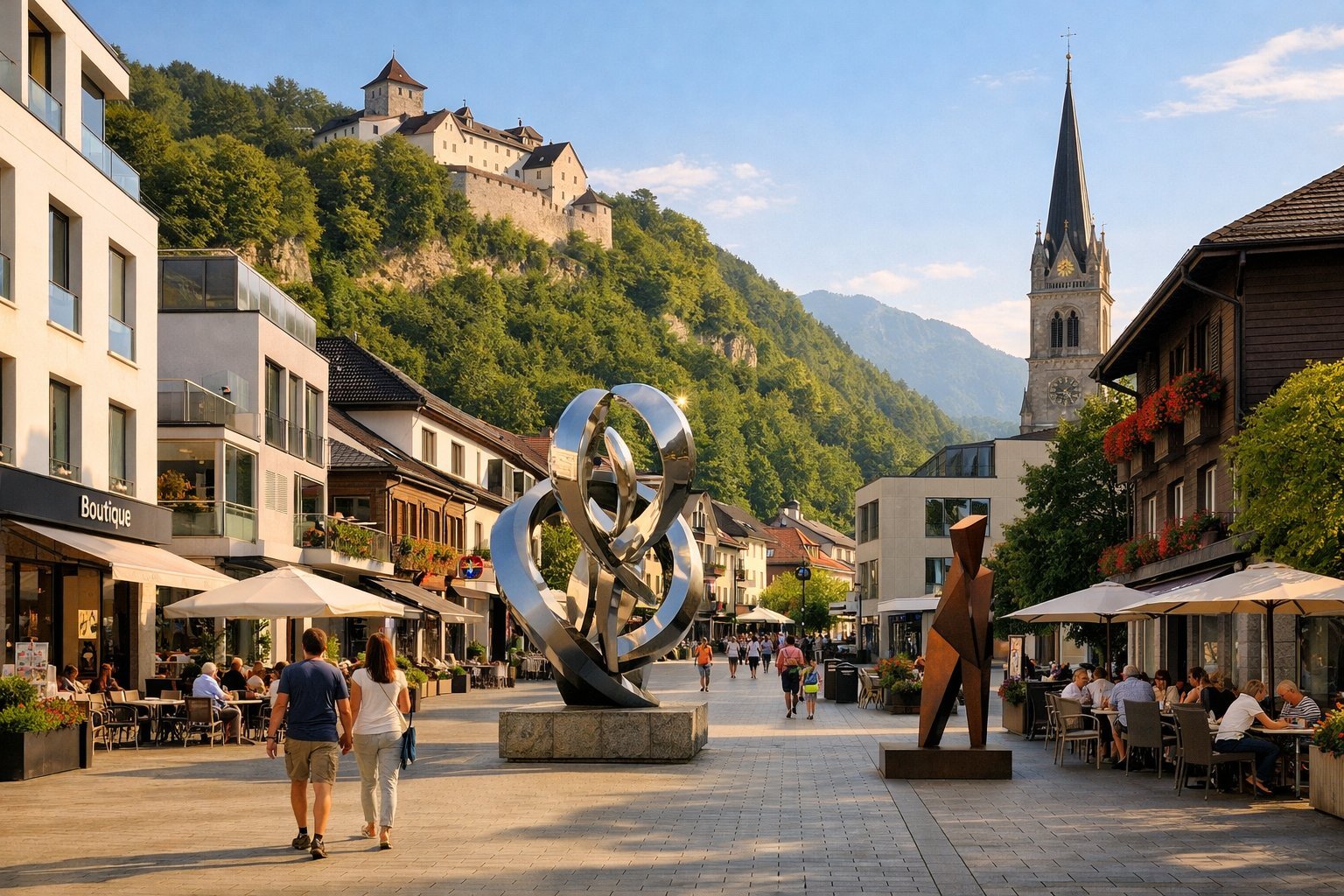
The Städtle
A few hundred metres of pedestrian street holding the government building, the museums, the tourist office (which sells the famous passport stamp for a few francs), cafés and a scattering of contemporary sculpture including works by Botero, Nag Arnoldi and others. It is small, well-kept, and mildly surreal in that everything in the country’s public life is within sight of everything else.
The castle
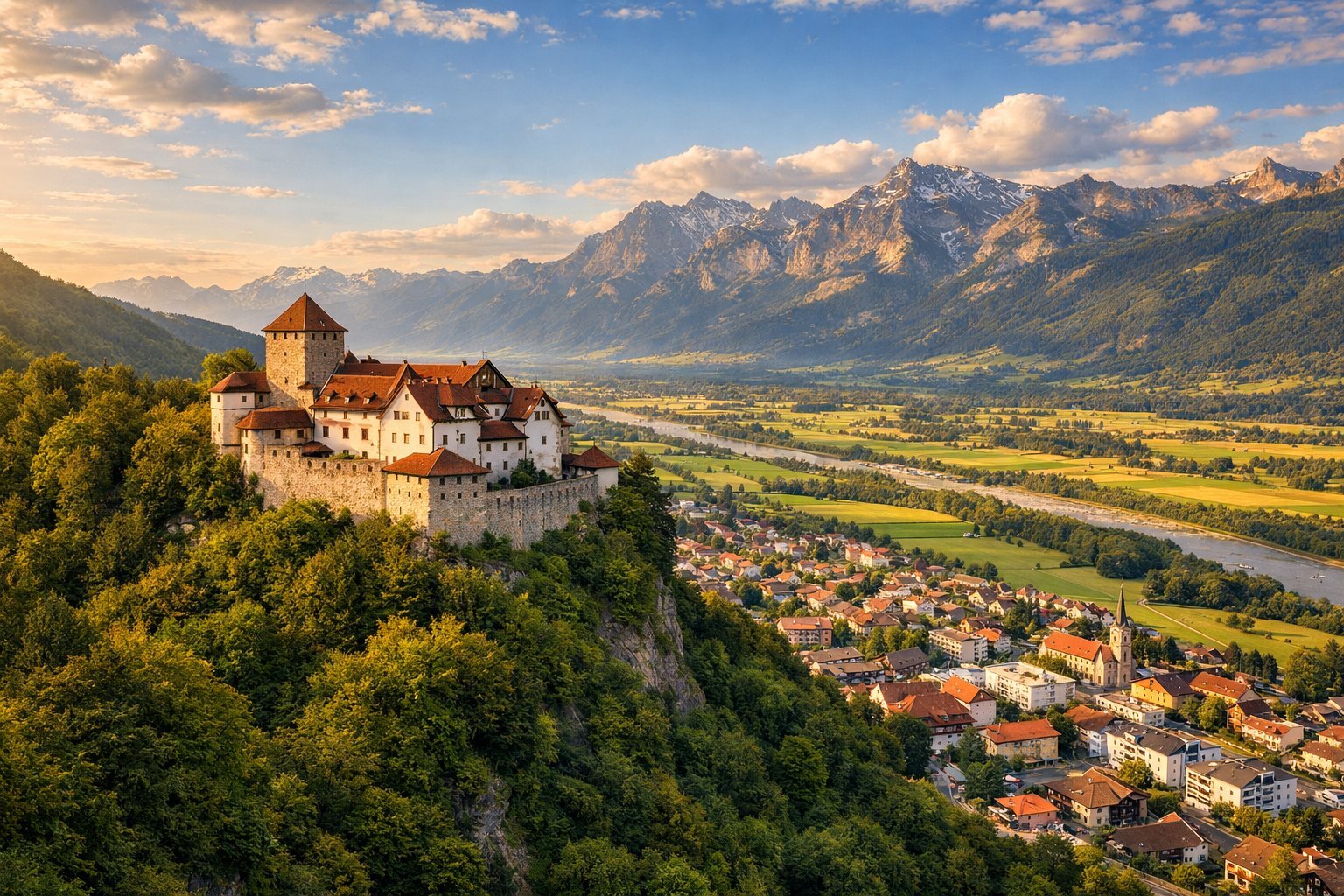
Schloss Vaduz, twelfth-century in origin, heavily rebuilt in the twentieth. The princely family lives in it, and it is not open to the public — not on any day, not for a fee, not for tours. You can walk up to it on a marked path in about twenty-five minutes from the Städtle and stand outside the gate. Once a year, on 15 August, the prince invites the entire country up to the castle meadow for a drink.
St Florin's cathedral
The neo-Gothic parish church of 1873, elevated to a cathedral in 1997 when Liechtenstein got its own archdiocese — a decision made over the objections of much of the local clergy and still quietly controversial. The princely crypt is beside it.
The Government Building
The 1903 Regierungsgebäude, a dignified stepped-gable building that appears on a great many photographs and postage stamps, and which houses a government of five people. Next to it, the modern parliament building of 2008 — a dark brick block with a steep roof, meant to echo a barn, and about the size of a large house.
The Rotes Haus
Vaduz’s prettiest building and its most photographed after the castle: a stepped-gable house painted deep red with an attached medieval tower, standing in vineyard on the slope. It is private property and not open, and it is covered in the Oberland section below with its picture.
What it is not
Vaduz is not a charming old European capital and does not pretend to be. Visitors who arrive expecting Salzburg in miniature are disappointed within ten minutes. Visitors who arrive expecting a very small, very rich, very tidy modern town with an outstanding art museum and a castle on a cliff get exactly that.
🏰 The Oberland: Castles, Vineyards and the Walsers
The six southern municipalities hold the capital, the mountains, the wine and the two castles you can actually get close to.
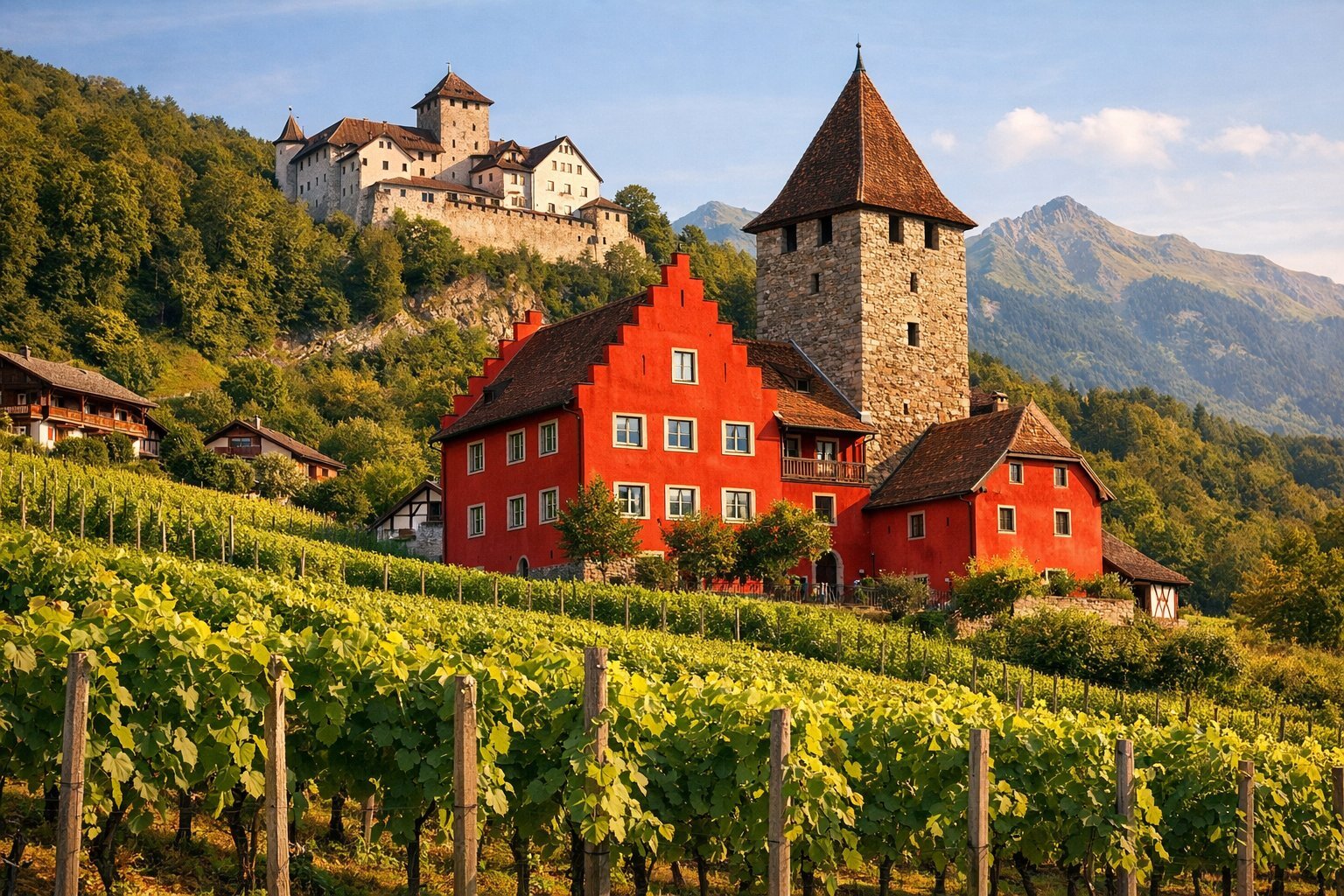
Balzers and Gutenberg Castle
The southernmost municipality, dominated by Gutenberg Castle on its hill — and unlike Vaduz Castle, this one is open. It is state-owned, restored, used for concerts and events, and the grounds and the rose garden can be walked freely. The hill has been settled since the Bronze Age and has produced important archaeological finds.
Triesen
Between Vaduz and Balzers, the old part of the village on the slope is one of the more genuinely historic corners of the country — small chapels, including the twelfth-century St Mamertus, and old houses on a hillside above the industrial valley floor. Most visitors drive straight past it.
Triesenberg and the Walsers
The Walser village on the mountainside above Vaduz, at about 900 m, with its onion-domed church visible from most of the valley. The Walser Museum explains the thirteenth-century migration from the Valais, and the dialect — genuinely distinct, with sounds valley Liechtensteiners find funny — is still spoken. Triesenberg also owns Malbun and the Steg, so a mountain village of 2,600 people administers the country’s entire ski industry.
Schaan
The largest municipality by population, north of Vaduz, and the industrial heart: Hilti and Ivoclar are both here. It has the country’s only functioning railway halt of any consequence, a Roman fort site under the parish church, and the honest character of a working town rather than a showpiece.
Planken
The smallest municipality, about 500 people, on a terrace at 800 m below the Three Sisters — also a Walser settlement, also with a startling view, and the starting point for the walk up to the Gafadura hut and the Fürstensteig.
The princely vineyard
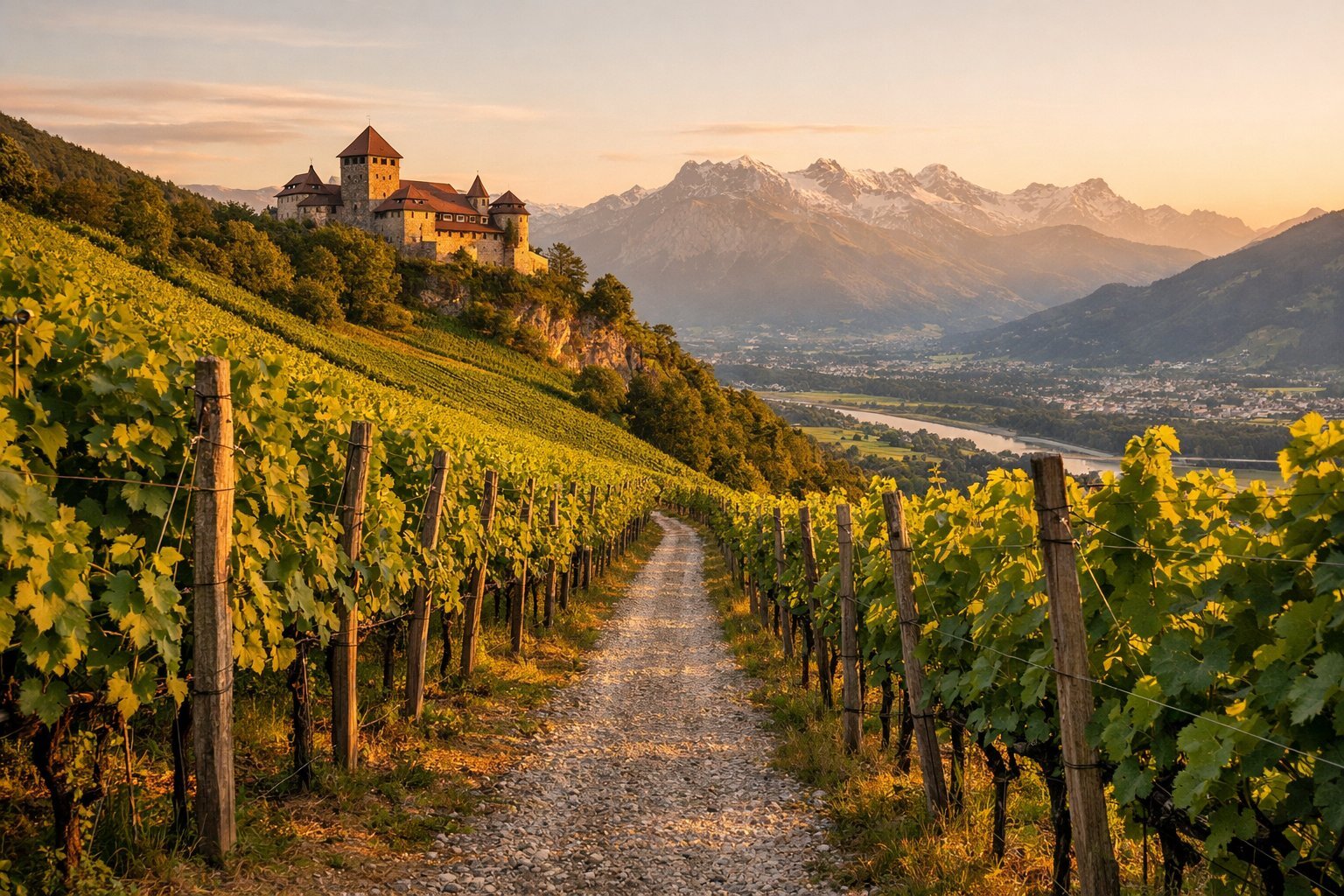
The Herawingert, the four-hectare vineyard directly below Vaduz Castle, is the flagship holding of the Hofkellerei des Fürsten von Liechtenstein. It is the prince’s private business, not a state winery, and the wine it produces — mostly Pinot Noir — is the country’s best-known agricultural product. See the wine section below.
🌾 The Unterland: The Half Nobody Visits
The five northern municipalities were the lordship of Schellenberg, bought thirteen years before Vaduz, and they are flatter, more agricultural, more Austrian-facing and almost entirely ignored by visitors. This is a mistake, though a small one.
Schellenberg
The hilltop village that gave the northern half its name, with the ruins of two medieval castles — Obere and Untere Burg — a short walk apart, both freely accessible, both with wide views into Austria and across the Rhine into Switzerland. There is also the Russian Monument, marking where 500 soldiers of the anti-Soviet Russian First National Army crossed into Liechtenstein in May 1945 and were granted asylum.
Ruggell
The northernmost municipality and the lowest point of the country, next to the Ruggeller Riet nature reserve. Late May, when the Siberian irises flower, is the one week a year this corner of Liechtenstein is genuinely worth a special trip.
Eschen and Mauren
The Unterland’s two larger villages. Eschen has the Holy Cross Chapel on the Rofenberg, a fifteenth-century chapel with a plague cemetery and a Bronze Age settlement site around it. Mauren has a bird sanctuary and the country’s prettiest village centre, which is a low bar honestly met.
Gamprin-Bendern
Small, and historically the most important place in the country: the church hill at Bendern is where in 1699 and 1712 the inhabitants swore fealty to the new Liechtenstein rulers. It is where the country legally begins, and there is a monument and an excellent view of the Rhine.
The Rhine path
A flat, well-surfaced cycle and walking route runs the length of the country along the Rhine dyke — the easiest way to see the whole of Liechtenstein under your own power, about 27 km end to end, with Switzerland on the far bank the entire way and no gradient worth mentioning.
The Unterland's grievance
It is real, and mostly good-humoured. The Oberland has the capital, the castle, the prince, the mountains and the vineyards; the Unterland has the farms and the industrial estates. The two halves have separate historical identities, separate carnival traditions and a football rivalry, and a visitor who spends a day in each will notice the difference.
⛷️ Malbun: A Whole Ski Country in One Bowl
At about 1,600 m, in a high side valley fifteen minutes' drive above Triesenberg, sits Malbun — a village of a few hundred beds that constitutes the entire skiing industry of a sovereign state.
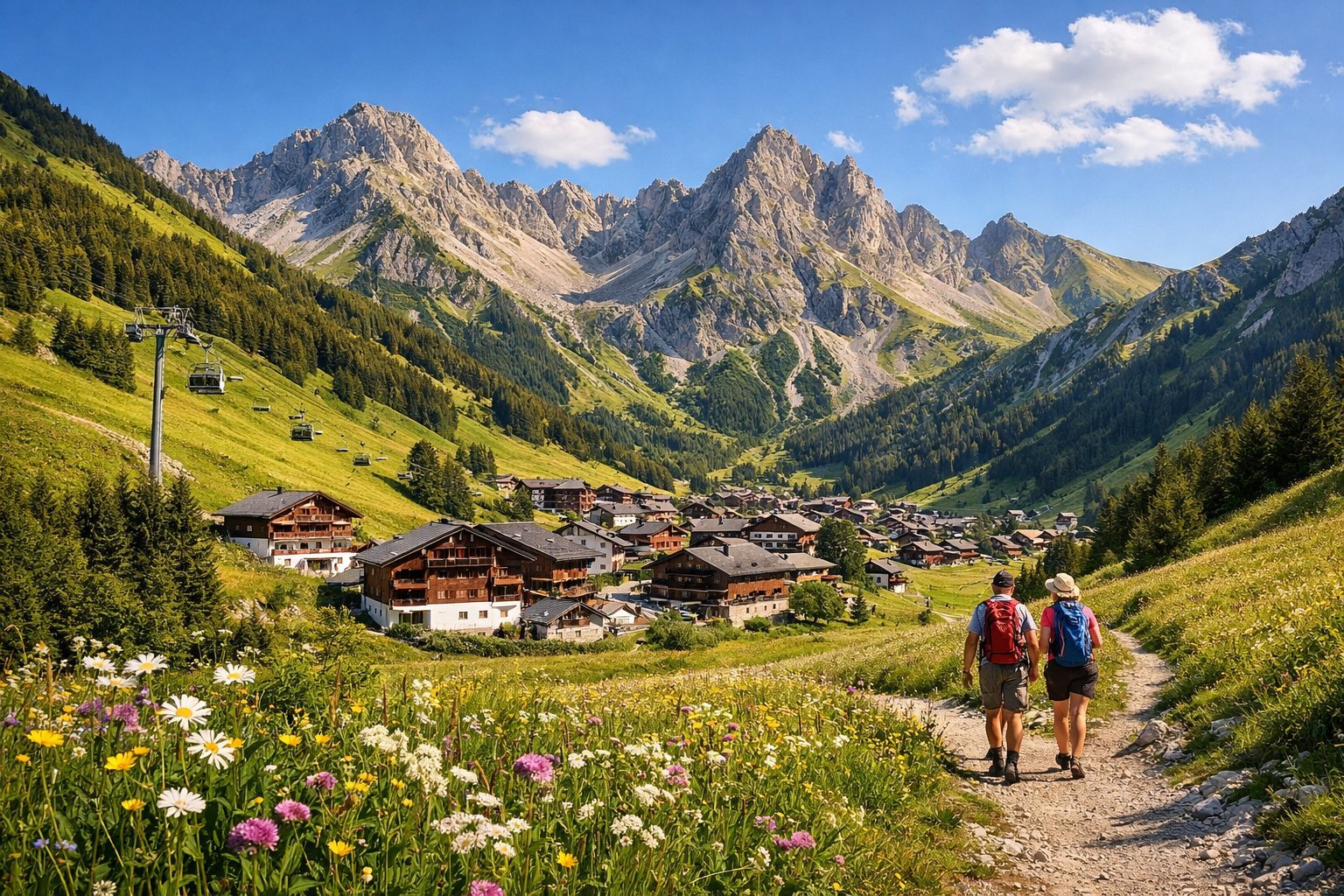
The skiing
Around 23 km of piste served by a handful of lifts, topping out near 2,000 m. By Alpine standards it is tiny; by the standards of a country 25 km long it is remarkable that it exists at all. It is genuinely good for beginners and for families, the ski school is excellent, and lift passes cost noticeably less than at big Swiss and Austrian resorts an hour away.
The royal connection
Prince Charles learned to ski at Malbun as a boy, which the resort has never entirely stopped mentioning. The Liechtenstein princely family skis here too, without fuss, and the general absence of security or ceremony around them on the slopes is one of the small things visitors remember.
Summer
Arguably better. Malbun is the base for the high Rätikon walks, for the Sareis chairlift up to 2,000 m and the ridge walks from it, and for the Alpine adventure trails aimed at children. There is a via ferrata, marmots that are used to people, and in June meadows of orchids and gentians.
Steg and the Valüna
Below Malbun, the Steg plateau holds the country’s only reservoir, a cross-country skiing loop in winter, and the entrance to the Valünatal — a quiet side valley with an alp, cattle and the least-visited walking in Liechtenstein.
Getting up there
By bus from Vaduz or Schaan, roughly an hour with a change at Triesenberg, on the excellent and cheap LIEmobil network. By car it is twenty-five minutes up a road with a great many hairpins, and the road is kept open all winter.
Gaflei and the Fürstensteig
The other mountain road, from Triesenberg to Gaflei at 1,480 m, is the usual starting point for the country’s famous ridge path — covered in the hiking section below, and not to be attempted casually.
👥 Forty Thousand People and a Third of Them Foreign
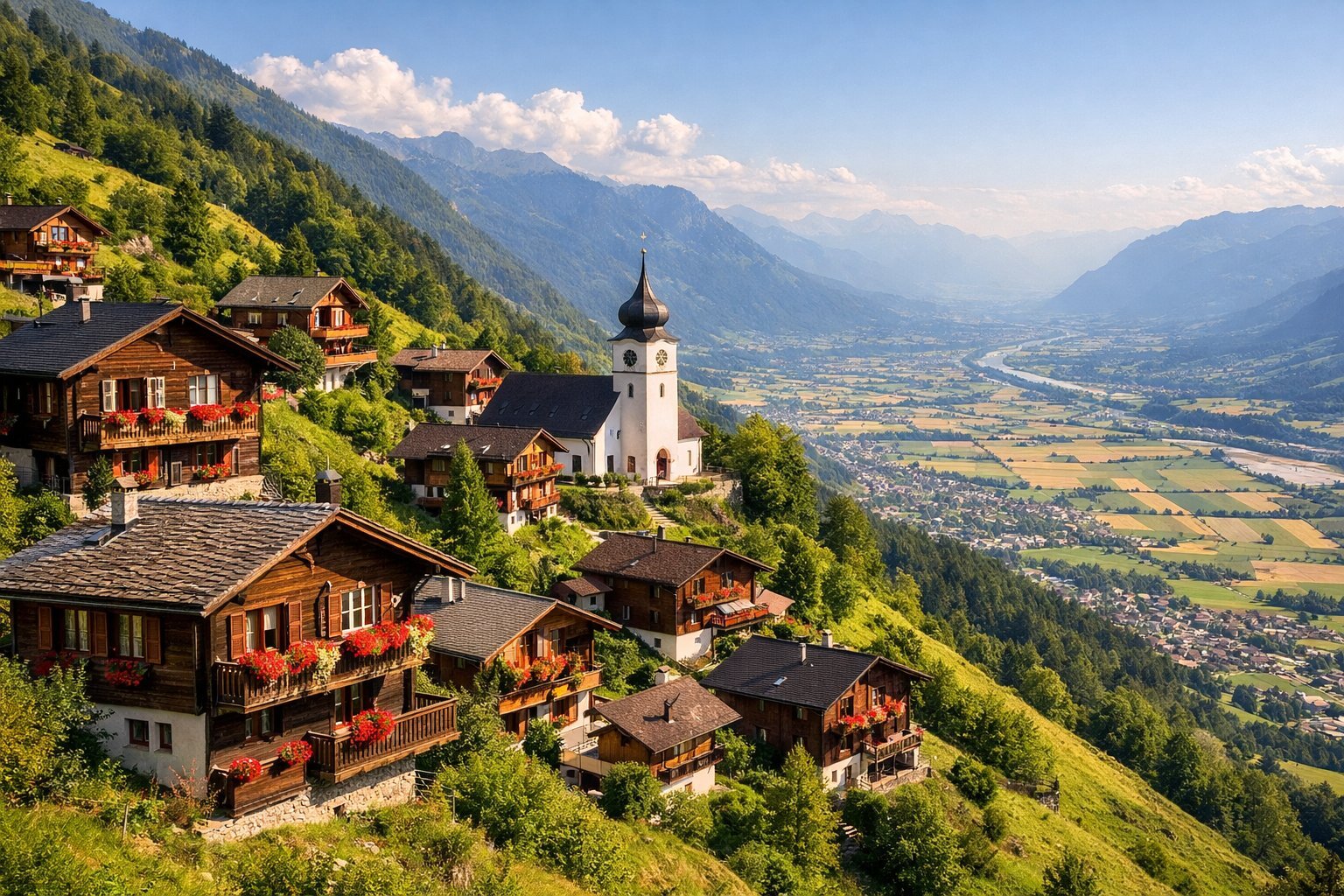
Who lives there
About 40,400 residents, of whom roughly a third are foreign nationals — Swiss, Austrians, Germans, Italians, Portuguese and a substantial Turkish community. Liechtenstein citizenship is famously hard to get: the standard route requires thirty years of residence, or ten years plus a vote of the municipality you live in, in which your neighbours decide.
The municipality vote
That last point deserves a sentence of its own. In the facilitated route, an applicant’s naturalisation is put to a secret ballot of the citizens of their commune. People who have lived and worked in a village for a decade have been refused by their neighbours without a stated reason. It is legal, it is defended locally as the essence of self-government, and it is the most-criticised feature of Liechtenstein law after the abortion ban.
Religion
Historically and constitutionally Roman Catholic — still the state church, though disestablishment has been debated for years — with around three-quarters of the population Catholic, a Protestant minority and a Muslim community of about 6%, mostly of Turkish and Bosnian origin. Practice has fallen off much as elsewhere in Central Europe.
Education
Excellent, and unusual in one respect: Liechtenstein has a university (in Vaduz, specialising in architecture and business) but no medical or general arts faculty, so most Liechtensteiners study in Switzerland or Austria. Many then come home. School is in standard German; the playground is in dialect.
The scale of everything
There is one hospital, in Vaduz, with fewer than a hundred beds. There is one prison, with about twenty places, and prisoners serving longer sentences are transferred to Austria under treaty. There are about a hundred police officers. The Landtag has 25 members. The scale is the country’s defining social fact: everybody is one introduction from everybody.
What that scale does
Two things at once. It produces genuine social cohesion, very low crime, and a politics conducted between people who will meet at the supermarket. It also produces the small-town pressures that go with that — limited anonymity, careful speech, and a well-documented tendency for young Liechtensteiners to spend some years away.
🍲 Alpine Cooking, With Maize
Liechtenstein's food is the food of the Alpine Rhine valley, shared with Vorarlberg, the St Gallen Rheintal and Graubünden: dairy, dumplings, cheese, pork, and — unusually for the Alps — maize, which arrived here in the seventeenth century and stayed as a staple long after it had become fodder elsewhere.
Käsknöpfle
The national dish, and not negotiable. Soft, irregular little dumplings — Knöpfle, the small round cousin of Swabian Spätzle — scraped or pressed into boiling water, then layered with sharp mountain cheese until they are molten, and topped with a great heap of fried onions. Traditionally served with apple sauce, which sounds wrong and is exactly right.
Ribel
The historic staple, and the one that says most about the place. Coarse maize and wheat semolina is soaked overnight in milk or salted water, then fried slowly in butter and broken up until it becomes a pan of loose golden crumbs. Eaten with milky coffee, apple sauce or fruit compote. It was poor food for centuries; now it has a designation of origin and a festival.
Hafalaab
A Liechtenstein speciality found almost nowhere else: dumplings of maize and wheat flour cooked in broth with bacon and served in the soup. The name is dialect and untranslatable, which is a good sign in a regional dish.
Torkarebl and the sweet end
Torkarebel, a sweet baked version of ribel; Riebel with sugar; Funkenküchli, thin fried pastries eaten at the February Funken bonfires; and Nusstorte and Birnbrot borrowed wholesale from Graubünden. Cheese: the alpine dairies at Malbun and in the Valüna still make Alpkäse in summer, in small quantities, and it is worth seeking out.
What you will actually eat
In practice, in restaurants: excellent Swiss-Austrian cooking at Swiss-Austrian prices. Rösti, schnitzel, game in autumn, lake fish, and a surprisingly strong showing of high-end kitchens for a country this size. Liechtenstein has held Michelin stars and is comfortably in the orbit of two of the best-eating regions in Europe.
Where the border shows
Nowhere, culinarily. The Alpine Rhine valley is one food region cut by three national borders, and a menu in Vaduz, Buchs and Feldkirch will look substantially the same. What Liechtenstein has that its neighbours do not is ribel as a matter of identity rather than nostalgia, and the Käsknöpfle argument, which every household wins differently.
👨🍳 Two Liechtenstein Recipes
One national dish and one historic staple. Both are cheap, both are forgiving, and both taste of the Alpine Rhine valley rather than of anywhere fashionable. Quantities serve four.
Käsknöpfle — the national dish
Main course · about 45 minutes · every Liechtenstein household makes it and every household's is correct
Ingredients: For the Knöpfle: 400 g plain flour; 4 eggs; about 200 ml water or milk; 1 tsp salt; a good grating of nutmeg. To finish: 250 g sharp mountain cheese, grated — Alpkäse, mature Appenzeller, Gruyère or a mix; 3 large onions, sliced into rings; 60 g butter; black pepper. To serve: apple sauce.
Method: Beat the flour, eggs, salt and nutmeg with enough water to make a thick, sticky batter that falls slowly from the spoon — it should be looser than dough and much thicker than pancake batter. Beat it hard for a couple of minutes until it blisters; this is what makes the dumplings light. Rest it 20 minutes. Meanwhile fry the onion rings slowly in the butter until deep gold and sweet, not burnt — take a full 20 minutes over this, it is half the dish. Bring a wide pan of salted water to a rolling boil and press the batter through a Spätzle press or a colander with large holes straight into the water, in batches. The Knöpfle rise in 1–2 minutes; lift them out with a slotted spoon into a warmed dish and immediately scatter over a handful of cheese. Repeat, layering Knöpfle and cheese, so the heat melts each layer as it goes. Finish with the remaining cheese, cover for two minutes to melt, then bury the whole thing under the fried onions and plenty of pepper.
💡 Serve with cold apple sauce on the side, and do not treat that as optional or as a garnish — the sharp sweetness against the salt cheese is the entire point of the dish.
Ribel — maize semolina fried in butter
Breakfast or supper · overnight soak plus 30 minutes · the historic staple of the Alpine Rhine valley
Ingredients: 300 g coarse maize semolina (polenta-grind, not fine); 100 g coarse wheat semolina; 600 ml milk, or salted water for the older version; 1 tsp salt; 60–80 g butter. To serve: apple sauce, fruit compote, or milky coffee.
Method: Mix the two semolinas with the salt, pour over the milk, stir once, cover and leave overnight at room temperature — the grain must fully absorb the liquid or the dish will be gritty. Next day it will be a solid, crumbly mass. Melt a generous amount of butter in a wide heavy pan over medium heat, tip in the soaked grain, and press it out flat. Now the technique: let it sit undisturbed for a few minutes until a golden crust forms underneath, then break it up with a wooden spatula, turn it, and press it flat again. Repeat for 20–30 minutes, adding butter as it is absorbed, until the whole panful has become loose, separate, golden crumbs — dry and crisp on the outside, tender within.
💡 Patience is the recipe. Ribel that is stirred constantly turns to porridge; ribel that is left to crust and then broken, over and over, comes out as crumbs. Traditionally it was eaten out of the pan by the whole family with a bowl of coffee.
🍷 The Prince's Vineyard
Liechtenstein makes wine, in genuinely small quantities and to a genuinely good standard. Total vineyard area in the country is around twenty hectares — a single mid-sized estate in Moravia would match it — spread over the south-facing valley shoulder from Balzers through Triesen and Vaduz to Schaan.
Hofkellerei des Fürsten von Liechtenstein
The princely wine cellar, and the reason anyone outside the valley has heard of Liechtenstein wine. It is the private business of the reigning family, not a state enterprise — a distinction Liechtensteiners make firmly — and it farms the Herawingert below the castle plus larger holdings in Wilfersdorf in Lower Austria. Tastings and cellar visits in Vaduz can be booked and are worth the detour.
What grows
Blauburgunder (Pinot Noir) above all — it is roughly two-thirds of production and it is what the region does best, in a light, precise, cool-climate style closer to Graubünden than to Burgundy. Then Müller-Thurgau (locally often just Riesling-Sylvaner), Chardonnay, Zweigelt and a little Gewürztraminer. Vaduzer is the name you will see on the local reds.
Why it ripens at all
The Föhn. The warm dry southerly wind funnelling up the Rhine valley adds enough heat and enough dry autumn days to ripen Pinot Noir at 47° north on a valley shoulder at 500 m. Without it, this would be cider country.
The other growers
Around a dozen small private producers, several of them excellent, plus a cooperative. Weinbau Harry Zech in Balzers is the best-known independent name; there are also good growers in Triesen, Schaan and Eschen. Production is tiny, almost all of it is drunk within the region, and very little is exported — if you want to try it, you have to come.
Beer and spirits
Liechtensteiner Brauhaus in Schaan, founded 2007, is the national brewery and makes a decent unfiltered lager and a wheat beer. Beyond that: Alpine fruit distillates — Träsch, plum, pear, gentian root — made in small quantities on farms and by the two or three commercial distillers, and taken as seriously here as anywhere in the Alps.
Drinking practicalities
Drinking age 16 for beer and wine, 18 for spirits. The drink-drive limit is 0.8‰ — higher than Czechia’s zero and than Austria’s 0.5 — but the roads are mountain roads and the police are attentive, so treat the number as trivia rather than as permission. Wine in a restaurant costs Swiss money: expect CHF 8–12 for a glass of local Pinot Noir.
🎨 One Very Good Museum and a Prince's Collection
Kunstmuseum Liechtenstein
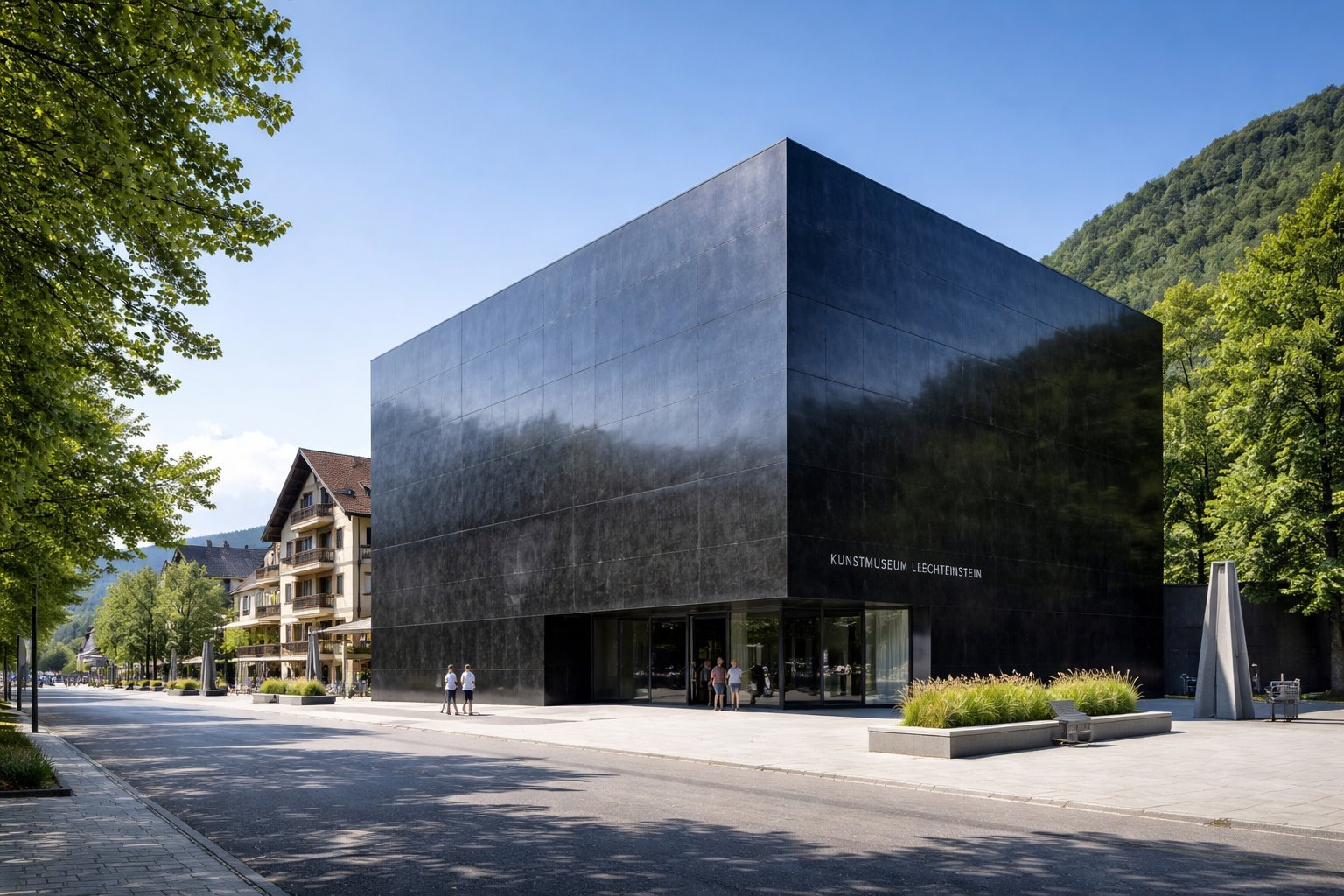
Opened 2000: a black cube of tinted concrete and polished basalt aggregate, deliberately windowless on the street, with a superb top-lit interior. It shows modern and contemporary art and mounts serious international exhibitions on a scale that has nothing to do with the size of the country. It is the single best reason to spend a whole day in Vaduz.
The Hilti Art Foundation
Attached to the Kunstmuseum in a white block added in 2015, and housing a private collection of classic modern art — Picasso, Klee, Giacometti, Modigliani, Beckmann — assembled by the Hilti family. One ticket covers both. For a country of forty thousand people the combined holding is faintly ridiculous.
The princely collections
The Princely Collections of the House of Liechtenstein are among the largest private art collections in the world — Rubens, Van Dyck, Rembrandt, Raphael, an extraordinary holding of Baroque bronzes. Almost none of it is in Liechtenstein: the collection is displayed at the two Liechtenstein palaces in Vienna, and pieces rotate through Vaduz for exhibitions. This surprises visitors and it is worth knowing before you plan a trip.
Liechtenstein National Museum
In an old inn and customs house on the Städtle: the country’s history from the Neolithic through the Romans and the Walsers to the twentieth century, well presented and honest about the difficult parts. Next to it the Postmuseum (free) and the Ski Museum, which is more interesting than it sounds given the Wenzel family’s Olympic record.
Music and theatre
The TAK theatre in Schaan is the main stage; the Liechtenstein Symphony Orchestra plays a full season; and the summer Little Big One and LGT Open Air events bring international names to a country with no venue larger than a few thousand. There is also a strong brass band and choral tradition in every village, which is the actual musical life of the place.
Literature and the record
Small literary output, as you would expect, but a disproportionately serious historical scholarship — the Historisches Lexikon des Fürstentums Liechtenstein is a full national encyclopaedia for forty thousand people, free online, and the independent historians’ commission report of 2005 on the Nazi period is a model of a small state examining itself in public.
🗣️ German on Paper, Alemannic in the Street
The official language is German. The spoken language is Alemannic dialect — the same family as Swiss German and Vorarlbergisch — and the gap between the two is wider than most visitors expect. Written German is standard; spoken German at a bus stop in Balzers will defeat a Prague-trained German speaker entirely.
The dialects, plural
For a country 25 km long, Liechtenstein has a startling amount of dialect variation. Oberland and Unterland speak recognisably differently; Triesenberg speaks Walser German, a distinct High Alemannic variety brought from the Valais in the thirteenth century, and locals will tell you they can place a speaker to a village.
The Walser difference
Walser German preserves features lost elsewhere and has its own vocabulary. Triesenbergers are proud of it, the Walser Museum documents it, and there is an active effort to keep it alive with younger speakers — a small linguistic conservation project inside a country the size of a large town.
English and getting by
English is widely and well spoken in Vaduz, in hotels, museums and banks, and reasonably spoken elsewhere. This is not a place where you will struggle. German gets you further and any attempt at it is received warmly; Czech speakers with school German will manage the written signage without difficulty.
A few words
Grüezi (Swiss-influenced) or Griaß di — hello. Hoi — informal hi, used constantly. Danke vielmal — thanks very much. Käsknöpfle — you will need this one. Gsi — the Alemannic past participle of “to be”, and the marker of the whole dialect area; linguists call this region the Gsi-Land.
Names on the map
Place names in the valley are Alemannic and often opaque: Ruggell, Gamprin, Schaan, Nendeln, Malbun. Several are pre-Germanic — Rhaeto-Romance survivals from before Alemannic settlement, which is a reminder that the valley spoke a Romance language until roughly the Middle Ages, as parts of Graubünden still do.
The written record
One daily newspaper, the Liechtensteiner Vaterland, and one other, the Liechtensteiner Volksblatt, which ceased daily publication in 2023. With Radio Liechtenstein closed in April 2026, national media has thinned markedly in three years — a genuine issue in a democracy this small, and one Liechtensteiners are arguing about.
🎲 Things That Are True About Liechtenstein
Eighty out, eighty-one back
The army marched to the Austro-Prussian war of 1866, saw no fighting, and came home one man heavier — an Austrian liaison officer had joined them on the way. The army was abolished two years later as unaffordable. It is the best national anecdote in Europe and it is genuinely documented.
Invaded by accident, 2007
170 Swiss soldiers on a night exercise walked two kilometres into Liechtenstein by mistake. Nobody in Liechtenstein noticed. Switzerland apologised; a Liechtenstein spokesman said it was not a problem and that these things happen. There is no functioning border to cross, which is precisely how it happened.
You could rent the country
In 2011 Liechtenstein was, briefly and genuinely, available to rent through a company called Rent-a-Village: for around 70,000 US dollars a night you got the use of the country, temporary street signs bearing your name, your logo projected onto the castle, and the keys handed over by the mayor. Nobody appears to have taken it up.
Ten Winter Olympic medals
Liechtenstein has won ten Olympic medals, all of them in Alpine skiing, all won by six athletes, most of them by one family — Hanni Wenzel took two golds and a silver in 1980, her brother Andreas won silver the same year, and Hanni’s daughter Tina Weirather took bronze in 2018. It is by a very wide margin the most Olympic medals per capita of any country on earth.
The whole country as a UNESCO absence
Liechtenstein is one of the few European countries with no UNESCO World Heritage site of its own. It has an inscribed intangible element and it borders Swiss sites, but the list is empty. Given the princely family’s Lednice–Valtice complex in Moravia is on the list, the family has a World Heritage site and its country does not.
The false teeth capital
Worth repeating because nobody believes it. Ivoclar Vivadent in Schaan is one of the largest manufacturers of artificial teeth and dental ceramics on earth. If you have a crown, a veneer or a denture, there is a real chance the material came from a valley 25 kilometres long between Switzerland and Austria.
🥾 The Fürstensteig and Four Hundred Kilometres of Path
Liechtenstein has around 400 km of marked walking trails in 160 km² — which is to say that the country is, functionally, a hiking area with a capital in it. The paths are Swiss-standard: signposted in yellow with walking times, maintained, and honest about difficulty.
The Fürstensteig
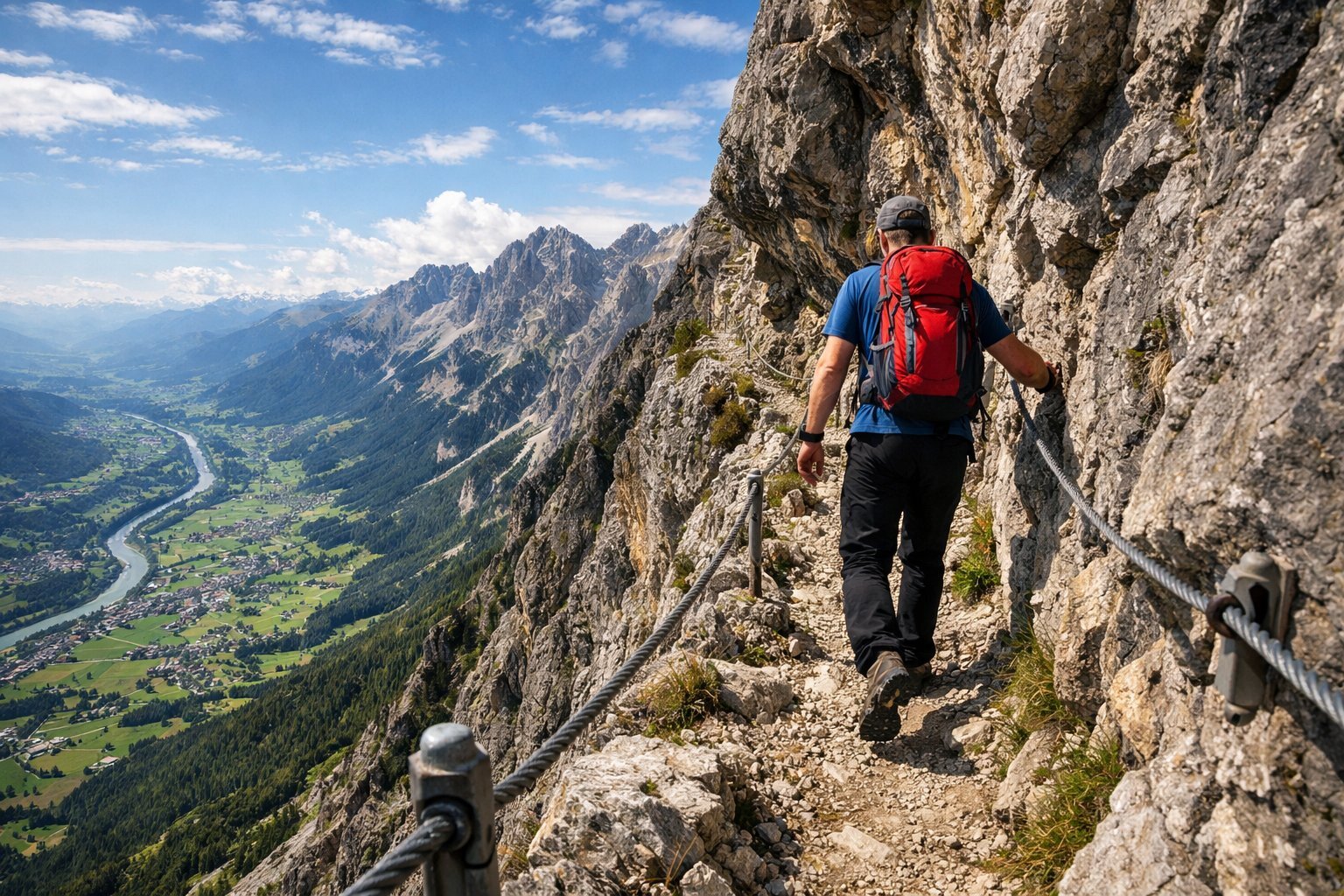
Cut in 1898 and paid for by Prince Johann II, the path traverses the cliffs of the Drei Schwestern ridge on an exposed ledge with fixed cables. The usual round from Gaflei takes 4–5 hours. It requires sure footing, a genuine head for heights and dry conditions; there are sections where a slip is fatal. It is open roughly June to October and is emphatically not suitable for young children or in wet or icy weather.
The Three Sisters traverse
The longer, harder continuation: from the Fürstensteig over the Drei Schwestern summit ridge and down to Planken or across into Austria. Six to seven hours, more exposure, some scrambling. The reward is a summit view taking in three countries and the whole length of your own.
The Liechtenstein Panoramaweg
The country’s long-distance route: a five-stage high traverse from Balzers in the south to Schellenberg in the north, staying high on the eastern slope with the Rhine valley below the whole way. It is the best way to see the entire country in three or four days and it is far less demanding than the Fürstensteig.
Easy days
Not everything is a ledge. The Rhine dyke path is flat and 27 km end to end; the Steg–Valüna valley walk is gentle; the Sareis chairlift from Malbun delivers you to 2,000 m for a ridge stroll with no climbing at all; and the Eschnerberg historical trail in the Unterland is a four-hour cultural walk past castles and prehistoric sites.
Marmots, ibex and the mountain safety point
The Rätikon holds ibex, chamois, marmots and golden eagle, and around Malbun the marmots are habituated enough to watch. On safety: this is real Alpine terrain, weather changes fast, there is no mobile coverage in parts of the Samina valley, and mountain rescue is a helicopter from Switzerland. Tell someone your route.
Winter walking
The valley floor and the Rhine path stay walkable all winter. High routes do not, and the Fürstensteig is closed and dangerous once there is snow or ice on the ledges. Malbun and Steg offer marked winter walking trails and snowshoe routes instead.
📸 What to Actually See
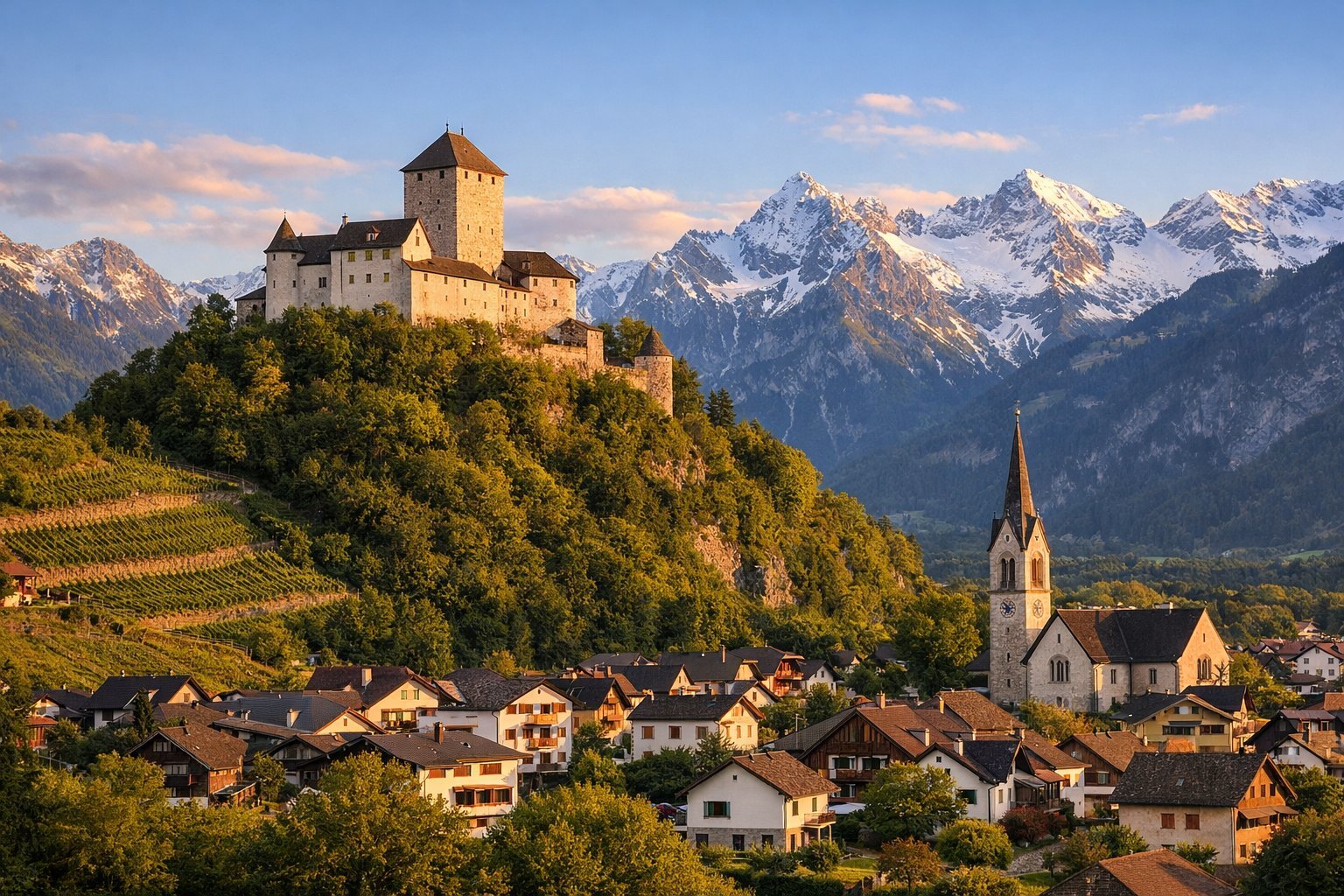
Vaduz Castle, from below
The country’s image, and closed to the public. The Fürstensteig-less option: walk the marked path up from the Städtle in about 25 minutes for the view down the valley from the castle gate, or take the short route to the Känzeli viewpoint for the classic photograph of the castle itself.
Gutenberg Castle, Balzers
The one that opens. Grounds, rose garden and viewpoint freely accessible; the interior is used for events and concerts and is open for those. Combine with the chapel of St Peter and the old village below.
The two museums on the Städtle
Kunstmuseum Liechtenstein plus the Hilti Art Foundation on one ticket — genuinely world-class and the reason to stay past lunch. Then the National Museum next door, and the free Postmuseum.
Schellenberg's ruins and the Russian monument
Two castle ruins a short walk apart on the Unterland hilltop, freely open, with views into three countries — and the monument to the 500 Russian soldiers Liechtenstein sheltered in 1945 and refused to repatriate to the Soviet Union. It is a quiet place with a serious story and almost nobody there.
The Ruggeller Riet
The bog reserve in the far north, and in late May a field of Siberian irises turning blue across the whole basin. Boardwalks, birds, and the only genuinely flat wild landscape in the country.
The passport stamp
Yes, get it. The tourist office on the Städtle stamps passports with a Liechtenstein entry mark for a few francs. It is pure souvenir — there is no border control and no legal meaning — and it is the single most-photographed transaction in the country.
📅 When to Go
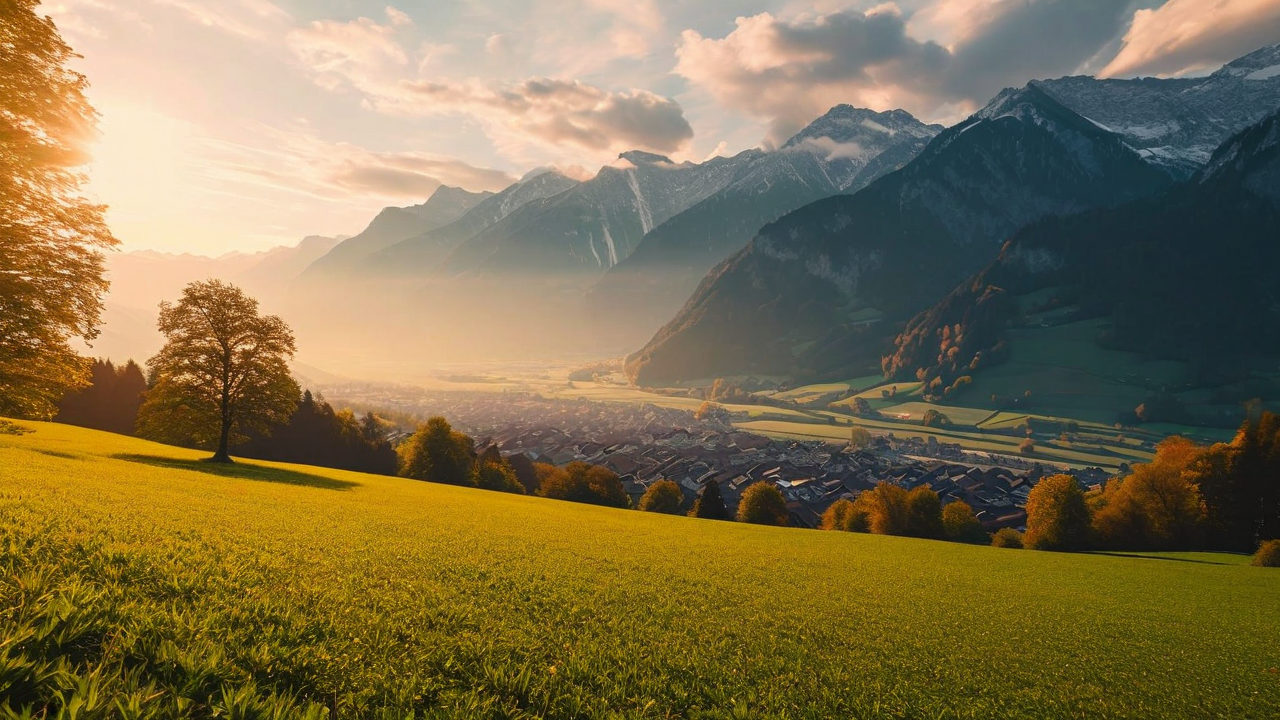
June to early October — the answer
The best window by a wide margin. The high paths are open and dry, Malbun is green and cheap, the meadows are in flower in June, the valley is warm without being oppressive, and the mountain huts are running. September is the connoisseur’s month: stable weather, clear air, harvest in the vineyards, and the crowds gone.
15 August — National Day
The one date to plan around. The whole country is invited to the castle meadow, the prince gives a speech and shakes a great many hands, there is a fireworks display over Vaduz in the evening, and everything is free. It is the single best day to see Liechtenstein being itself — and it was the date of the 2026 succession announcement.
Winter
December to March: Malbun runs, the valley floor is often under cold grey fog for weeks while Triesenberg sits in sunshine above it, and the high walking is closed. Christmas markets in Vaduz and Schaan are small and pleasant. Skiing here is a family proposition rather than a destination one.
Spring and late autumn
April–May and November are the thin months: the high country is still snowbound or newly closed, the weather is unsettled, and some mountain restaurants shut. The exception is late May for the Ruggell irises, which is worth arranging a trip around.
Other fixed dates
Fasnacht (carnival) in February, seriously observed with village guilds and processions; the Funken bonfires on the Sunday after Ash Wednesday, when huge pyres are lit on the hillsides across the whole valley; and the Alpabtrieb in September, when the cattle come down from the alps garlanded.
How long to stay
Most people give it two hours and see nothing. One full day covers Vaduz properly with the museums. Two to three days gets you the mountains as well, which is where the country actually is. A week of walking the Panoramaweg and the Rätikon is a real Alpine holiday and almost nobody takes it.
🚗 No Airport, Almost No Trains
No airport
Liechtenstein has no commercial airport and no scheduled flights. There is a heliport in Balzers and that is all. The practical airports are Zurich (ZRH), about 115 km and 90 minutes away and the sensible choice; St Gallen–Altenrhein, much closer but with few flights; and Friedrichshafen or Innsbruck at a stretch.
The trains that barely stop
This is usually reported wrongly. Liechtenstein does have railway halts — four of them, at Schaan-Vaduz, Forst Hilti, Nendeln and Schaanwald, on the Austrian Federal Railways line from Feldkirch to Buchs. The catch is the service: only a handful of trains a day stop at them. In practice you take a train to Sargans or Buchs SG in Switzerland, or Feldkirch in Austria, and change to a bus.
From Prague
There is no direct route and no obvious one. The usual patterns are fly Prague–Zurich (about 1h20) then train to Sargans and bus to Vaduz, total around 5 hours door to door; or train Prague–Munich–Lindau–Feldkirch and bus, about 10–11 hours and rather beautiful; or drive, about 750 km and 8 hours via Nuremberg, Munich and Bregenz.
LIEmobil
The bus network, and it is genuinely excellent: frequent, punctual, cheap, and it reaches every village and Malbun. A day pass costs a few francs; there are also cross-border services to Buchs, Sargans and Feldkirch. For a visitor without a car this is entirely sufficient — you do not need to hire anything.
Driving
Right-hand traffic, Swiss rules in effect. You need a Swiss motorway vignette for the approach roads in Switzerland, but not for Liechtenstein itself, which has no motorways and charges nothing. Parking in Vaduz is paid and well signed. The mountain roads to Triesenberg, Gaflei and Malbun are steep with hairpins but well surfaced and open all year.
The borders
There is no border control anywhere. The Swiss frontier on the Rhine bridges is unmanned and unmarked beyond a sign; the Austrian frontier is an internal Schengen crossing. You will cross into and out of the country without ceremony, probably several times, and possibly without noticing — which is how 170 Swiss soldiers managed it in 2007.
📋 Practical Information
Entry
Liechtenstein is in Schengen. Czech citizens need only an ID card. Non-Schengen travellers need a Schengen visa, which Liechtenstein does not issue itself — apply through Switzerland, which handles Liechtenstein’s visa representation. There is no passport control on arrival by any route.
Money
The Swiss franc (CHF). Euros are accepted in many shops in Vaduz but at an unfavourable rate — use francs. Cards work everywhere, contactless is universal, ATMs are plentiful. As of 2026 the franc is strong: budget on the assumption that everything costs what it would in Zurich, because it does.
Health and safety
Excellent healthcare, EHIC/EU card not valid — Liechtenstein is not in the EU, and Czech public insurance does not cover you here, so commercial travel insurance is genuinely necessary. Crime is close to nonexistent. The real risks are Alpine: exposure, weather, and the Fürstensteig. Emergency numbers: 112 general, 117 police, 144 ambulance, 1414 for Rega mountain rescue.
Connectivity
Excellent everywhere on the valley floor and patchy in the Samina valley and the high Rätikon. Note that Liechtenstein is not in the EU, so EU “roam like at home” rules do not automatically apply — many Czech operators do include Liechtenstein and Switzerland in their EU zone, but a number do not, and phones happily latch onto Swiss and Austrian networks across the border. Check your tariff before you travel; this is the single most common unexpected cost of a Liechtenstein trip.
Opening hours and Sunday
Central European and conservative. Shops close around 18:30 on weekdays, early on Saturday, and everything is shut on Sunday except restaurants and museums. Plan food shopping accordingly; the country will not save you on a Sunday evening.
Etiquette
Formal, quiet and punctual. Greet on entering a shop, use Sie until invited otherwise, do not be loud, and be on time. The princely family lives among the population without security theatre; if you see them, the local convention is to nod and leave them alone. Photographing the castle from outside is fine; walking up the drive is not.
💰 What It Costs
Liechtenstein is expensive. It uses the Swiss franc, its wage level is Swiss, and prices track Zurich rather than Vienna. Figures are indicative for 2026, converting at roughly 1 CHF ≈ 26 CZK.
Accommodation
Little of it and none of it cheap. A three-star double in Vaduz runs CHF 150–220 (4,000–5,700 CZK) a night; the good hotels go well past CHF 300. Malbun is cheaper in summer than winter. The best value trick is to sleep in Buchs or Sargans in Switzerland, or in Feldkirch in Austria — fifteen to twenty-five minutes away by bus or train, and often half the price. There is a youth hostel in Schaan, which is the only genuinely budget bed in the country.
Eating
A restaurant main course CHF 28–45; a plate of Käsknöpfle in a village inn CHF 22–28; a coffee CHF 4.50–6; a beer CHF 6–8; a glass of local Pinot Noir CHF 8–12. Supermarket food is Swiss-priced, which is roughly double Czech prices. Mountain huts are cheaper than valley restaurants and better.
Getting around
The one bargain. A LIEmobil day pass costs a few francs and covers the whole country including Malbun; a week pass is correspondingly cheap. Museum entry to the Kunstmuseum and Hilti Art Foundation together is around CHF 15. The passport stamp is CHF 3.
Skiing
By Alpine standards, cheap. A Malbun day pass is roughly CHF 50–60 against CHF 80–95 at a large Swiss resort an hour away, and ski school and equipment hire are correspondingly lower. If you want a small, calm, well-taught family ski week rather than a big mountain, the arithmetic is genuinely favourable.
A realistic day
Staying in Liechtenstein, moderate: CHF 250–300 (6,500–7,800 CZK) per person per day including a hotel, two meals out, transport and a museum. Staying across the border in Switzerland or Austria and coming in daily: CHF 130–180. Day-tripping from Zurich with a picnic: CHF 60–80 including the train.
The tax note
Liechtenstein has Swiss VAT (currently 8.1%), which is dramatically lower than Czech or Austrian VAT and makes some goods — watches, optics, certain electronics — genuinely cheaper here than at home. It does not make food or hotels cheaper, because wages swamp the tax difference.
🇨🇿 For Czech Readers
Liechtenstein has more Czech history in it than almost any other small European country, and a Czech visitor arrives with context that other visitors do not have.
The Moravian connection
This is the big one. The House of Liechtenstein was, for six centuries, one of the greatest landowning families in Moravia and Bohemia — Valtice (Feldsberg) was the family seat, Lednice (Eisgrub) the summer residence, and the Lednice–Valtice cultural landscape they laid out is now a UNESCO World Heritage site. Plumlov, Šternberk, Bučovice, Kostelec nad Černými lesy and dozens of other estates were theirs. A Czech reader who has walked the Lednice park has already been in Liechtenstein history.
1945 and after
The estates — some 1,600 km², ten times the area of the principality — were confiscated under the Beneš decrees in 1945 on the grounds that the family was German. Liechtenstein disputed this, and the dispute froze relations completely: Liechtenstein refused to recognise Czechoslovakia and then the Czech Republic until 2009, one of the longest non-recognitions in modern Europe. Liechtenstein lost a related case at the ICJ in 2005.
The commission
Diplomatic relations were established in July 2009 and a joint Czech–Liechtenstein commission of historians was set up to work through the shared past. It has published volumes and organised exhibitions, and the atmosphere now is cordial. Property restitution claims by the princely family continue to be pursued in Czech courts and have consistently failed.
MZV ČR and the practicalities
No travel warnings of any kind — Liechtenstein is one of the safest countries in the world. There is no Czech embassy in Vaduz; Liechtenstein falls under the Czech Embassy in Bern, Switzerland. DROZD registration is sensible for a mountain trip, as it is anywhere you will be walking exposed ridges.
Insurance — read this one
Liechtenstein is not in the EU and your Czech EHIC card does not work here. Czech public health insurance will not cover treatment. Commercial travel insurance including mountain rescue is genuinely necessary, not a formality — a helicopter evacuation off the Fürstensteig is billed and it is expensive.
Scale, for a Czech reader
Liechtenstein is 160 km² — smaller than Brno, about a third of Prague, roughly the size of the Ostrava city area. Its whole population would fit into Kolín or Písek. Its highest point, Grauspitz at 2,599 m, is 971 m higher than Sněžka. And its GDP per head is several times the Czech figure.
⚽ Ten Olympic Medals and a Football Team That Plays Anyway
The skiing dynasty
Liechtenstein’s ten Winter Olympic medals are all Alpine skiing and mostly one family. Hanni Wenzel won two golds and a silver at Lake Placid in 1980; her brother Andreas Wenzel took silver at the same Games; her daughter Tina Weirather won super-G bronze in 2018 and a World Cup globe in 2018. Per capita it is the most successful Olympic nation in history by a distance that is not close.
The 1980 arithmetic
At Lake Placid, a country of about 25,000 people finished ahead of the United Kingdom, Canada and Japan in the medal table. It remains the standard example used to explain why per-capita medal tables are interesting, and Liechtensteiners of a certain age can still tell you where they watched it.
Football, honestly
Liechtenstein has a national team, no domestic league, and a long and cheerfully documented record of defeat — including runs of many years without a competitive win. Its clubs play in the Swiss pyramid; FC Vaduz has played in the Swiss top flight and, remarkably, in European competition, because winning the Liechtenstein Cup earns a UEFA place. A team from a country of 40,000 in the Europa Conference League is a genuinely odd fact.
The famous night
In September 2004 Liechtenstein drew 2–2 with Portugal — the Portugal of Figo, Deco and a nineteen-year-old Cristiano Ronaldo, weeks after they had reached the Euro 2004 final at home. It is still the result, and the goalkeeper Peter Jehle is still recognised for it.
Everything else
Cycling on the Rhine dyke and up the mountain roads, which are a serious climb; Special Olympics and disability sport, in which Liechtenstein invests unusually heavily; and a strong tradition of village shooting clubs and gymnastics societies that function as much as social institutions as sporting ones.
The Malbun factor
All of this comes out of one small ski area. Malbun has 23 km of piste and it produced three Olympic medallists from one family. It is a reminder that what produces athletes is a culture and a hill you can use every day, rather than a large mountain.
📊 A Hundred Thousand Overnight Stays and Half a Million Day-Trippers
The shape of it
Liechtenstein receives on the order of 100,000–120,000 overnight stays a year across all accommodation — a figure a single mid-sized Czech spa town would beat — against something in the region of half a million day visitors. The imbalance is the whole story of Liechtenstein tourism.
The two-hour visitor
The typical visitor arrives by coach from Zurich or Lucerne, spends 90 to 120 minutes on the Städtle, buys the passport stamp and a fridge magnet, photographs the castle from below and leaves. They spend very little, see almost nothing, and are counted as a visitor. Liechtenstein has spent two decades trying, politely, to change this.
What the country wants instead
Walkers, cyclists and skiers who stay two or three nights. The Liechtenstein Trail — a 75 km waymarked route through all eleven municipalities, opened for the 300th anniversary in 2019 with an accompanying app — is the clearest statement of that strategy: a reason to spend three days rather than two hours.
Where the visitors come from
Overwhelmingly Switzerland, Germany and Austria, then the rest of Europe, then a substantial and growing flow from Asia on multi-country European coach tours. Czech visitors are a small but real presence, and the Lednice–Valtice connection gives Czech groups a reason to come that other nationalities do not have.
Capacity is the constraint
There are only a few thousand guest beds in the entire country. Liechtenstein could not absorb mass tourism if it wanted to, and it visibly does not want to. Tourism is a modest and pleasant part of the economy sitting alongside industry and finance, not a pillar of it, and that is a comfortable position to be in.
The advice that follows
Do not come for two hours. If you are passing on the Zurich–Innsbruck axis and can only spare a morning, spend it in the Kunstmuseum rather than on the souvenir street. If you can spare three days, walk the Panoramaweg or the Liechtenstein Trail and you will have seen a country that almost nobody who has “been to Liechtenstein” has actually seen.
🔭 What Happens to a Country This Small
The demographic squeeze
Liechtenstein needs more workers than it has residents and has restrictive immigration and naturalisation rules, which is a contradiction it manages by importing labour daily rather than permanently. Over 22,000 cross-border commuters hold up the economy. It works, and it makes the country structurally dependent on open borders with two neighbours.
Housing and land
160 km², most of it either mountain or floodplain, and a great deal of money chasing the buildable remainder. Land prices are among the highest in Europe, young Liechtensteiners increasingly live in Switzerland or Austria and commute in, and the political debate about densification versus the character of the villages is the most heated domestic argument in the country.
The financial centre after secrecy
The reform of 2009–15 worked, and the sector survived it, but the old proposition is gone for good. The bet now is on regulated wealth management, fund administration and the blockchain framework — competing on rule of law and political stability rather than on discretion. Whether a jurisdiction this small can hold that position against Luxembourg, Ireland and Singapore is the open question.
The monarchy question
Not currently live, and it has been tested twice. But the constitution contains its own abolition clause, the prince’s powers remain unusual by European standards, and each intervention — the 2011 abortion veto, the 2012 referendum — refreshes the argument. The 2026 succession change was made by a family vote with no democratic input, which cut both ways in the commentary.
Climate
Real and visible here. Alpine snow reliability at Malbun’s altitude is not guaranteed in the medium term; the glaciers that fed this landscape are gone from the Rätikon; and the Rhine’s flood regime is changing in a valley whose entire population lives on the floodplain behind engineered dykes. A country this small has no room to retreat inland.
What it will probably stay
Liechtenstein has been quietly excellent at surviving by being too small to be worth taking and too useful to be worth breaking — through Napoleon, two world wars, the end of empires, the collapse of bank secrecy. The most likely future is the most likely past: a very small, very rich, very careful place that outlasts the problem.
📸 Gallery — and What Was Rejected
Twenty-two image files are stored for Liechtenstein. Thirteen are used on this page, two of them with corrections attached. Nine are rejected, and the reasons are set out below, because several of them are the kind of error that would put a factual falsehood on the page.
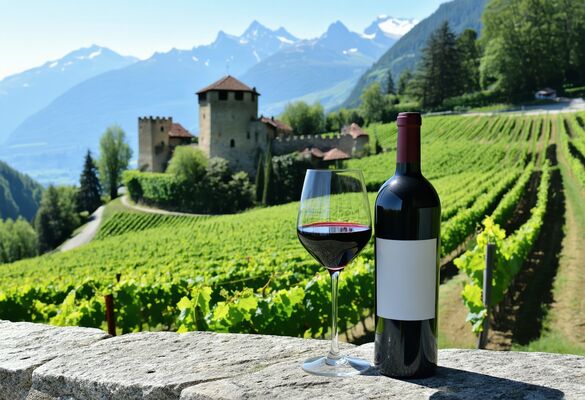
Rejected: the other hero
01-hero.jpg is a beautiful autumn photograph of a castle on a cliff above a river bend, and it is not Vaduz Castle. The building has pointed conical turrets, a red-and-white fairytale profile and a curtain wall that belong to no castle in Liechtenstein; the river below is a wide slow bend with a bridge, where the Rhine at Vaduz runs straight and canalised. It is a composite of the idea of an Alpine castle. Since the store also contains 01-vaduz-castle.jpg, which is a genuine likeness, there is no reason to use this one.
Rejected: the wine map
liechtenstein-wine-regions-map.jpg is a handsome antique-styled map with four serious errors. It labels a town called “Talzens”, which does not exist. It places Balzers north of Triesen, when Balzers is the southernmost municipality in the country. Its scale bar reads “0 20 40 6 km”, which is both garbled and absurd for a country 25 km long. And it labels Vaduz “State Winery Vineyards”, when the Hofkellerei is the prince's private business and explicitly not a state enterprise. A map that invents and misplaces towns is worse than no map.
Rejected: three fabricated wine labels
wine-hofkellerei-pinot-noir.jpg, wine-vaduzer-blauburgunder.jpg and wine-harry-zech-chardonnay.jpg all show bottles carrying the names of real, identifiable Liechtenstein producers — the princely Hofkellerei and the Balzers grower Harry Zech — on invented labels whose smaller text is illegible garbling, and in one case with the wine name printed twice, the second time misspelled. Putting a fabricated label bearing a real company's name on a page is not an illustration, it is a small forgery, and the same rule has been applied on this site to a Lebanese wine and a Liberian beer.
Rejected, and a finding: the Abkhazian bottles
14-liechtensteinn-wines-vineyard.jpg — note the doubled “n” — shows three bottles with garbled labels reading “LLYKHNYY” and “ANAKPOPIA”. Those are Lykhny and Anacopia: Abkhazian place names and Abkhazian wine brands. This is an Abkhazian image filed under Liechtenstein. A file with the identical naming pattern, 14-lesothon-wines-vineyard.jpg, was rejected under Lesotho earlier in this project, which makes this a systematic misfiling across many countries rather than an isolated slip. It has been logged for the site owner.
Rejected: two Käsknöpfle that are not Käsknöpfle
liechtenstein-kasknopfle.jpg and liechtenstein-ksknpfle.jpg — a pair of near-duplicate files with one name garbled — both show flat ribbon pasta, tagliatelle in one and something similar under a dill garnish in the other. Käsknöpfle are short, irregular, soft dumpling nubs buried in melted mountain cheese under a heap of fried onions. Wrong shape, no cheese crust, no onions, and dill has no place anywhere near the dish. Both rejected.
Rejected: the ribel
liechtenstein-ribel.jpg shows sweetcorn kernels, white beans, noodles and pink rings of lunch meat under yellow crumbs. Ribel is coarse maize and wheat semolina soaked overnight and fried in butter until it becomes loose golden crumbs, eaten with apple sauce or milky coffee. The image has caught the word “maize” and nothing else. Given that ribel is the historic staple of this valley and carries a protected designation, an illustration this wrong is worth rejecting outright.
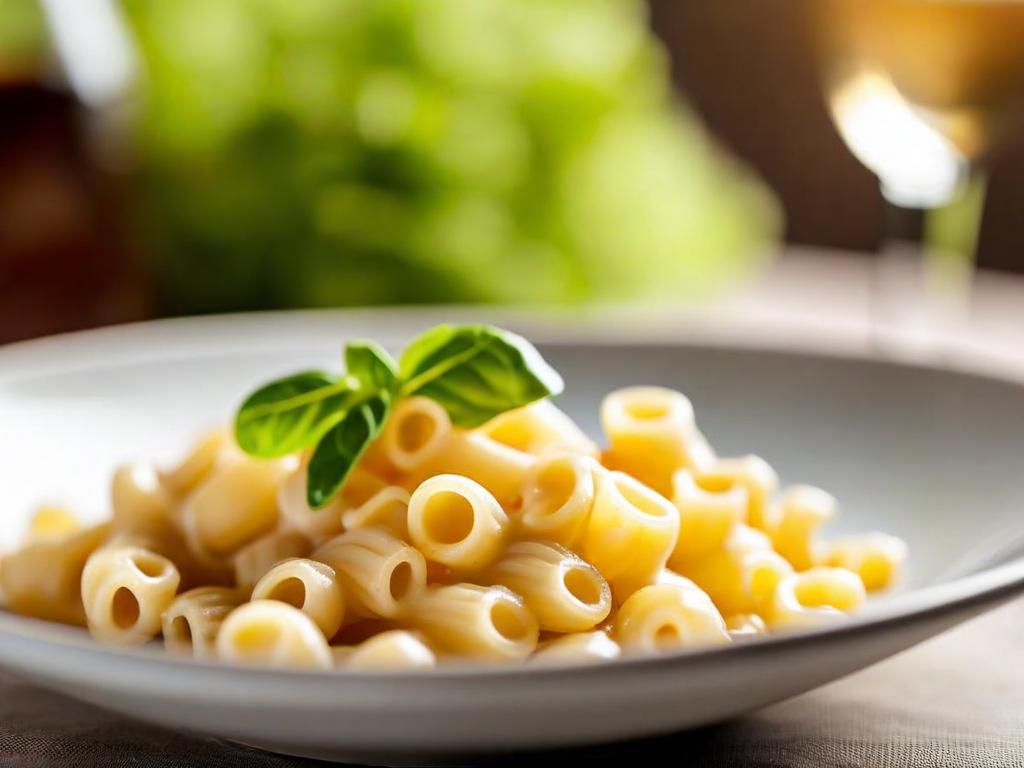
Used with a correction: the Älplermagronen
liechtenstein-alplermagronen.jpg is the one recipe image kept, and it is kept because it is close rather than right: short macaroni in a cream sauce, which is the correct base. Missing are the cubed potatoes boiled with the pasta and the fried onions on top, which are the two things that make the dish Alpine rather than Italian, and the basil garnish is from another kitchen. The correction is printed under the picture on the page, not only here.
Where the list came from
The file list is the actual S3 bucket listing taken on 6 September 2026: eighteen files under images/liechtenstein/ and four under countries/images/recipes/. All twenty-two were downloaded, hashed to check for duplicates — there were none, though hero.jpg and 01-hero.jpg are similar in size and purpose — and every one was opened and looked at before anything was written about it.
The overall verdict on this set
Unusually good, and worth saying so after several countries where almost nothing was usable. The ten numbered location images are among the strongest in the project: the Fürstensteig, the Rotes Haus, the vineyard below the castle and Triesenberg are all both beautiful and materially accurate. The failures cluster entirely in two places — fabricated wine labels and food — which is now a consistent pattern across every country page in this remaster.
Support This Project 🌍
This World Travel Factbook is a labor of love – free to use for all travelers. If you find it helpful, consider supporting its continued development.