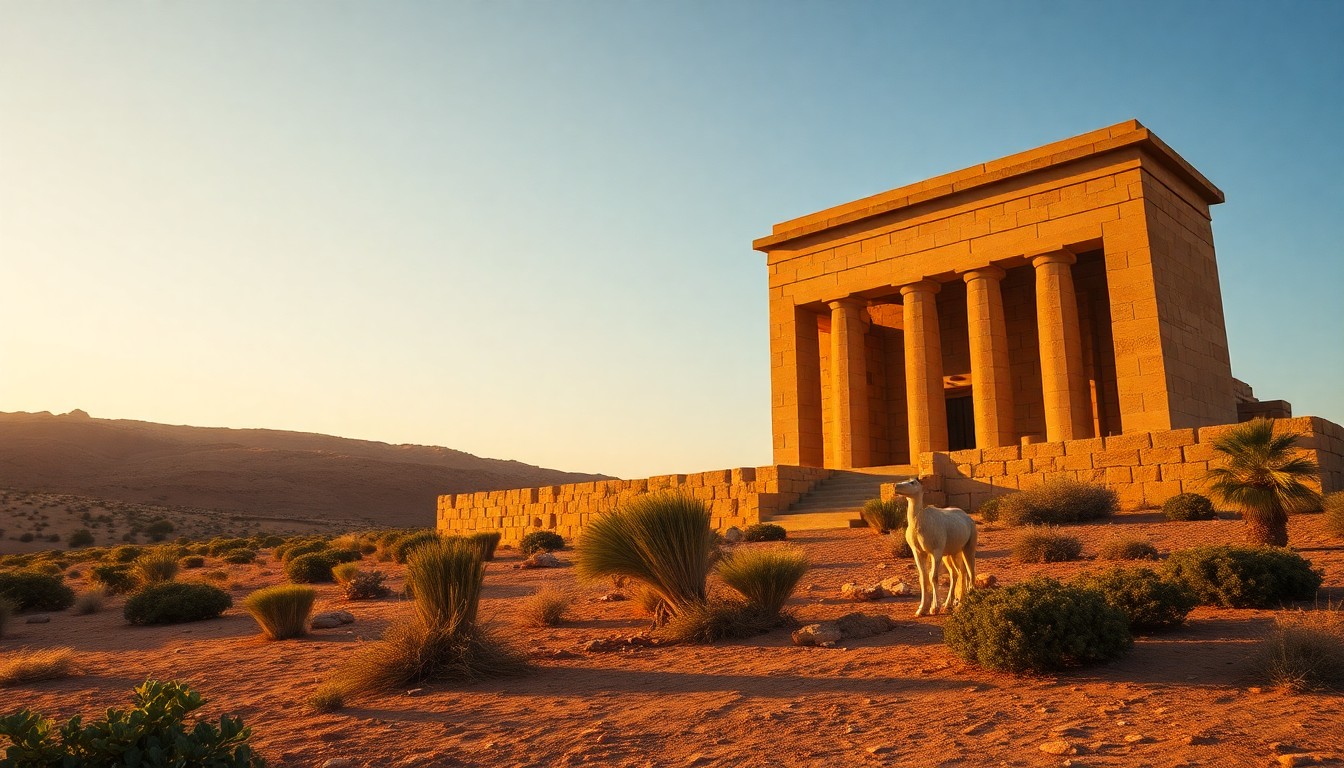


🇱🇾 Libya at a Glance
🌍 Overview
⚠️ Read this first. Libya has had two rival governments since 2014 and no unified state since 2011. Armed groups fight periodically inside Tripoli itself — most recently in May and August 2025 — and large areas are contaminated with landmines and unexploded ordnance. The Czech Foreign Ministry (MZV ČR) advises against travel to Libya, the British FCDO advises against all travel, and the US State Department places Libya at Level 4 “Do Not Travel” (reaffirmed 31 August 2026), with the extraordinary advice that anyone going anyway should write a will and leave a DNA sample. There is no Czech consular office in the country. This page describes Libya; it is not an encouragement to go now.
Libya is 1,759,540 km² — twenty-two times the size of Czechia, the fourth-largest country in Africa and the largest in North Africa — with only around 7.4 million people. Almost all of them live on or near the 1,770 km Mediterranean coast, the longest of any African country on that sea. Behind them lies the Sahara, which is about ninety per cent of the national territory and holds almost nobody.
It is a country of superlatives that history has repeatedly interrupted. It has the largest proven oil reserves in Africa. It has five UNESCO World Heritage sites, among them two of the best-preserved Roman cities anywhere on earth. It had, by the late 1970s, one of the highest per-capita incomes in Africa. And it has spent the fifteen years since 2011 unable to agree on who governs it.
The state, or states
Officially one country; in practice two administrations. The UN-recognised Government of National Unity (GNU) under Abdul Hamid Dbeibah sits in Tripoli and controls the Central Bank and the oil revenue. The eastern Government of National Stability (GNS) under Osama Hammad sits in Benghazi and is backed by Field Marshal Khalifa Haftar’s Libyan National Army. Neither has a current electoral mandate: the election that was to have settled it was scheduled for December 2021 and never held.
The news, as of this writing
On 30 August 2026 the rival factions signed an agreement at UN mission headquarters in Tripoli, in the presence of UNSMIL chief Hanna Tetteh, to reconstitute the electoral commission, settle the legal framework and hold presidential and parliamentary elections within 24 months under a single executive. It needs endorsement from the House of Representatives and the High State Council within a month. Libya has signed roadmaps before. This one is a week old.
The economy
Oil, and almost nothing else. Hydrocarbons are roughly 95% of export earnings and the great majority of state revenue. Production reached 1.49 million barrels a day in June 2026, the highest since 2013, and the National Oil Corporation is targeting 1.6 million by the end of the year. Outside the oil sector there is very little: agriculture is marginal, manufacturing is small, and public employment absorbs much of the workforce.
What visiting is like
For almost everyone, impossible, and that is the honest answer. Visas require an invitation and a sponsor; independent tourism essentially does not exist; the security situation can change in an afternoon. A small number of specialist operators run escorted trips to the Roman coast and the Fezzan rock art, mostly through eastern-controlled territory. Everything on this page about “visiting” should be read against that.
🏷️ Where the Name Comes From — and It Is Older Than You Think
Libya is one of the oldest surviving country names on earth. The ancient Egyptians called the peoples west of the Nile the Rebu or Libu; the Greeks took it as Libýē and used it for the whole of Africa as they knew it, which is why Herodotus divides the world into Europe, Asia and Libya. The name then narrowed over two thousand years to the stretch of coast it now describes — and was applied to the modern country by Italy in 1934, when it merged its three colonies of Tripolitania, Cyrenaica and Fezzan into a single territory.
The three countries inside it
Libya is not naturally one place and never has been. Tripolitania in the north-west looks to Tunisia and the Maghreb; Cyrenaica (Barqa) in the east looks to Egypt and to its Greek and Senussi past; Fezzan in the south-west is Saharan and looks to the Sahel. The 2011–2026 division falls almost exactly along the Tripolitania/Cyrenaica line, which is roughly where the Greeks and Carthaginians drew their border twenty-four centuries ago.
The flag that came back
The red, black and green tricolour with the white star and crescent is the flag of the Kingdom of Libya (1951–1969). Gaddafi replaced it in 1977 with a plain green rectangle — the only national flag in history with no design, no symbol and one colour — and the 2011 revolution brought the old flag back within days. The black band is for Cyrenaica and the Senussi, the green for Tripolitania, the red for Fezzan.
Who Libyans are
Overwhelmingly Arab and Arab-Berber, with a Berber (Amazigh) population that is culturally distinct and numerically significant in the Nafusa Mountains, at Zuwara on the coast and at Ghadames. In the deep south are Tuareg in the west and Tebu in the south-east, both trans-border peoples whose citizenship was systematically disputed under Gaddafi and remains contested. There is also a large migrant population from across the Sahel.
The formal name, four times over
Kingdom of Libya (1951), Libyan Arab Republic (1969), Great Socialist People’s Libyan Arab Jamahiriya (1977) — jamahiriya being a word Gaddafi invented, roughly “state of the masses” — and simply State of Libya since 2013. Each name change was a rewriting of what the country was supposed to be, and none of them settled it.
🗺️ Ninety Per Cent Sand, Ten Per Cent Everything Else
Draw a line 50 to 150 km inland from the Mediterranean and you have drawn the habitable part of Libya. North of it: a coastal plain, the Jefara around Tripoli and the Jebel Nafusa escarpment behind it in the west, the Jebel Akhdar — the Green Mountain — rising to about 880 m behind Benghazi in the east. South of it: the Sahara, in every form the Sahara takes.
The Green Mountain
Jebel Akhdar in Cyrenaica is the anomaly — a limestone massif that catches enough Mediterranean rain (up to 600 mm a year) to support juniper and cypress woodland, wild flowers in spring and real agriculture. It is the greenest place in Libya by a wide margin, it is where the Greeks founded Cyrene, and it is where table grapes are still grown.
The sand seas
The Idehan Ubari and Idehan Murzuq in the Fezzan are classic ergs — oceans of dune, some of them 100 m high. Between the Ubari dunes lie the Ubari lakes, a scatter of hypersaline pools surrounded by palms, fed by the same fossil groundwater the country now pumps. Several of them have shrunk badly or dried out entirely as the water table has dropped.
The mountains of the deep south
The Tibesti range crosses in from Chad and carries Libya’s summit, Bikku Bitti at 2,267 m, in territory so remote it was not accurately surveyed until satellites did it. The Tadrart Acacus, on the Algerian border, is a maze of sandstone towers and arches holding one of the greatest concentrations of prehistoric rock art on earth.
No rivers at all
Libya has no permanent rivers — not one. What it has instead are wadis that run after rain, and an enormous quantity of fossil water in the Nubian Sandstone Aquifer, laid down when the Sahara was green. That water is not being replaced. The country’s entire modern water supply is, in a real sense, being mined.
Climate
Mediterranean on the coast — mild wet winters, hot dry summers — and severely arid everywhere else, with 40–45 °C routine in the interior summer. The ghibli, a hot dry southerly wind off the desert, can raise coastal temperatures by 20 degrees in hours and fill the air with dust for days. Al-Aziziya near Tripoli held the world temperature record at 58 °C for ninety years until the World Meteorological Organization struck it out in 2012 as a bad reading.
The coast
1,770 km of it, and much of it genuinely beautiful and almost entirely undeveloped: white sand, clear water, Roman ruins standing directly on the shore at Leptis Magna and Sabratha. In any other political situation this would be a Mediterranean tourism coast. It is instead the departure shore of the central Mediterranean migration route.
🏜️ The Great Man-Made River and the Water Underneath
The single most consequential thing Gaddafi built was not a monument. It was a pipe. The Great Man-Made River is the largest irrigation project ever undertaken: some 2,800 km of concrete pipe four metres in diameter, buried in the desert, moving on the order of six million cubic metres of fossil water a day from wells in the deep south to Tripoli, Benghazi, Sirte and the coastal farms. Gaddafi called it the eighth wonder of the world, and in engineering terms the claim is not absurd.
Where the water comes from
The Nubian Sandstone Aquifer System, shared with Egypt, Sudan and Chad — one of the largest bodies of fresh groundwater on earth, filled during wet periods that ended thousands of years ago. It is not recharging in any meaningful sense. Estimates of how long Libya can go on pumping range from several decades to a century, and they are estimates.
What it means today
Something like 70% of all fresh water used in Libya comes through the pipe. That makes it critical national infrastructure and therefore a target: sections were hit during the 2011 fighting, the pipe factory at Brega was damaged, wells have been shut down by armed groups, and maintenance has been intermittent for fifteen years. Cities have gone without water for days when a pumping station was seized.
The cost
Officially around 25 billion US dollars, self-financed from oil, and built largely by a South Korean contractor. No foreign loans, which Gaddafi made a point of. Whether it was the right use of the money — against, say, desalination, which the coast is well placed for — is an argument Libyan engineers still have.
The oases it drew from
Kufra, Sarir, Tazerbo, Jaghbub — deep Saharan wellfields, most of them near oases that had lived off shallower water for centuries. Some local water tables have dropped. Kufra, the most isolated permanent settlement in Libya, sits 900 km from anywhere in any direction and is one of the strangest inhabited places in the Sahara.
🏛️ Phoenicians, Greeks, Romans — and Two of the Best Ruins on Earth
Libya's coast was the seam between the Carthaginian and Greek worlds, and both of them built cities on it that the Romans then made magnificent. What survives is exceptional partly because the sand buried it and partly because nobody built a modern city on top: Leptis Magna and Sabratha in Tripolitania, Cyrene and Apollonia in Cyrenaica are among the most complete classical sites anywhere in the Mediterranean.
Leptis Magna
A Phoenician foundation that became the home city of Septimius Severus, Roman emperor from 193 to 211 — who then spent imperial money on it lavishly. The result is a forum, a basilica, a theatre, a four-way triumphal arch, an enormous bath complex and a harbour, standing in sand beside the sea with almost no modern intrusion. It is routinely described by archaeologists as the best-preserved Roman city outside Italy, and the case is strong.
Sabratha
West of Tripoli, smaller and in some ways lovelier: a three-storey theatre facade restored by Italian archaeologists in the 1930s, standing directly above the Mediterranean, plus temples, a basilica and floor mosaics. Sabratha was one of the three cities — with Oea (modern Tripoli) and Leptis — whose name in Greek, Tripolis, eventually became the name of both the capital and the whole region.
Cyrene
Founded around 631 BCE by Greek colonists from Thera (Santorini), and one of the great intellectual centres of the Greek world — home of the mathematician Eratosthenes, who measured the circumference of the earth, and of the Cyrenaic school of philosophy. Its Temple of Zeus is larger than the Parthenon. It sits high on the Jebel Akhdar with its port, Apollonia, below.
Ghadames
Not classical but medieval and older: an oasis town on the Algerian border known as the pearl of the desert, a labyrinth of covered whitewashed streets, palm-beamed houses and separate rooftop walkways used by women. It was a caravan hub for two thousand years. The old town was largely emptied in the 1980s when residents were moved to modern housing alongside, and preservation has been a struggle ever since.
Tadrart Acacus
Thousands of paintings and engravings across a sandstone massif in the Fezzan, spanning perhaps 12,000 years — and recording the Sahara’s transformation. The oldest show elephants, giraffe, rhinoceros and hippopotamus in a wet grassland; later ones show cattle herding; the most recent show camels and a desert. It is one of the clearest visual records of climate change anywhere on the planet.
All five in danger
Leptis Magna, Sabratha, Cyrene, Ghadames and Tadrart Acacus are Libya’s five UNESCO World Heritage sites, and in 2016 UNESCO placed all five simultaneously on the List of World Heritage in Danger because of the conflict — a step taken for an entire country’s inscribed heritage only rarely. Damage has come from fighting, from looting of portable antiquities, from construction encroachment and from the simple absence of funded custodianship.
🇮🇹 The Italian Colony, Omar al-Mukhtar, and the Camps
Libya was Ottoman territory, loosely governed, for close to four centuries. In 1911 Italy invaded, looking for the colony it felt it had missed out on, and what followed was among the most violent colonial episodes in Africa — a fact still underweighted in European accounts and entirely central to how Libyans read their own history.
The invasion
Italy declared war on the Ottomans in September 1911 and took the coastal cities quickly; the interior took twenty more years. The campaign produced one grim first: on 1 November 1911, near Tripoli, an Italian pilot dropped grenades from a monoplane onto Ottoman positions — the first aerial bombardment in the history of warfare.
Omar al-Mukhtar
A Quranic teacher from Cyrenaica who led the Senussi resistance for twenty years from 1911, in his sixties and then his seventies, fighting a guerrilla campaign against an army with aircraft and armour. He was captured in September 1931 and hanged on 16 September 1931 at Suluq, in front of twenty thousand people the Italians had compelled to attend. He is on the banknotes and he is the closest thing Libya has to an undisputed national hero.
The concentration camps
To sever the resistance from its base, Italy under Marshal Rodolfo Graziani deported the population of the Cyrenaican interior — on the order of 100,000 people — into barbed-wire camps on the coast between 1929 and 1934. Tens of thousands died of starvation, disease and execution; the most-cited estimates put the deaths of the Cyrenaican reconquest at around a quarter of the region’s population. Libya received a formal Italian apology and a compensation agreement only in 2008.
The settler colony
By 1939 there were something like 110,000 Italians in Libya, roughly a tenth of the population, farming expropriated land in planned villages along the coast and in the Jebel Akhdar. Mussolini declared coastal Libya part of metropolitan Italy in 1939. Almost all of the settlers left between 1943 and 1970; the last were expelled outright by Gaddafi, who made 7 October a national day of revenge.
The desert war
Libya was the main battlefield of the North African campaign of the Second World War. Tobruk was besieged for 241 days in 1941 and changed hands repeatedly; Rommel’s Afrika Korps and the Eighth Army fought back and forth along the coast road; the war left Libya with cemeteries, wrecked ports and one of the densest minefield legacies in the world, much of it never cleared.
Independence, 1951
After Italian defeat, Libya was administered by Britain and France, and its future was handed to the United Nations. On 24 December 1951 it became the independent Kingdom of Libya under King Idris I, head of the Senussi order — the first and for a long time the only country to achieve independence directly through the UN. It was then one of the poorest countries on earth. Oil was found in 1959, and everything changed within a decade.
🟩 Forty-Two Years of Muammar Gaddafi
On 1 September 1969 a 27-year-old signals captain named Muammar Gaddafi and a group of young officers deposed King Idris while he was abroad taking a cure. Gaddafi then ruled Libya for forty-two years — longer than any other non-royal leader in the modern Arab world — without ever holding a formal office of head of state. His title was simply Brother Leader and Guide of the Revolution.
What he did with the oil
A great deal, and it should be said plainly. Gaddafi forced a renegotiation of the oil concessions that other producers then copied, nationalised the industry, and spent the money on housing, hospitals, schools, roads and the Great Man-Made River. Libyan literacy went from around 20% at independence to over 80%; life expectancy rose by decades; by the late 1970s Libya had among the highest incomes in Africa. Almost every account of Gaddafi that omits this is incomplete.
The Green Book
In 1975–79 Gaddafi published a three-part political tract setting out the Third Universal Theory, an alternative to both capitalism and communism based on direct popular committees, the abolition of wage labour and of representative democracy (“representation is fraud”). Schoolchildren learned it. In practice, the committee system sat on top of an entirely conventional apparatus of secret police, revolutionary committees and personal rule.
The repression
Public hangings of students broadcast on television; assassinations of exiled critics abroad, whom the state called “stray dogs”; the Abu Salim prison massacre of June 1996, in which around 1,270 prisoners were killed in a few hours, denied for over a decade. It was the families of the Abu Salim dead, and their lawyer’s arrest in Benghazi, that lit the fuse in February 2011.
Abroad
Funding and arming an extraordinary range of groups, from the IRA to Sahelian rebel movements; wars in Chad in the 1980s that Libya lost; the Lockerbie bombing of December 1988, which killed 270 people and led to a decade of UN sanctions; the 1989 UTA Flight 772 bombing over Niger. Libya accepted responsibility for Lockerbie and paid compensation in 2003, gave up its nuclear and chemical weapons programmes, and was brought back into diplomatic favour with remarkable speed.
The rehabilitation
Between 2003 and 2010 Western leaders queued to visit. Sanctions lifted, oil majors returned, Gaddafi pitched his tent in Paris and in Rome, and Italy signed a friendship treaty in 2008 that combined colonial compensation with migration control. Libyans watched the same governments that had called him a terrorist shake his hand, and then watched them bomb him three years later. That sequence shapes a great deal of Libyan scepticism about the West.
The system he left behind
Deliberately, almost no institutions. Gaddafi kept the army weak in case it produced another 1969, ran the state through personal networks and revolutionary committees, and left no constitution, no functioning party, no independent judiciary and no succession. When he fell, there was nothing underneath. That absence is the single best explanation for everything that has happened since.
💥 2011: Seventeen February and What Came After
The Arab Spring reached Libya on 15–17 February 2011, when protests in Benghazi over the arrest of the human rights lawyer Fathi Terbil — who represented the Abu Salim families — turned into an uprising within days. Unlike Tunisia and Egypt, it became an armed conflict almost immediately, because the state answered it with heavy weapons and because Cyrenaica had never been reconciled to Tripoli's rule.
The intervention
As Gaddafi’s forces advanced on Benghazi and he promised to hunt his opponents “alley by alley”, the UN Security Council passed Resolution 1973 on 17 March 2011, authorising a no-fly zone and “all necessary measures” to protect civilians. Russia and China abstained. NATO air power then operated for seven months in what was, in practice, close air support for the rebels — a stretching of the mandate that poisoned Security Council politics on Syria and has never been forgiven in Moscow or Beijing.
The end
Tripoli fell in August 2011. Gaddafi held out in his home city of Sirte until 20 October 2011, when his convoy was struck from the air, he was found hiding in a drainage culvert, and he was beaten and killed by fighters on camera. The footage went around the world. It was not a trial, and the manner of it set a tone for the decade that followed.
The first two years
Genuine optimism, and a real election. The July 2012 vote for the General National Congress was Libya’s first free national election in decades, had high turnout, and — unusually for the region — did not produce an Islamist majority. Militias, however, were never disarmed; instead the new state put them on the payroll, which converted revolutionary brigades into permanently funded armed interest groups.
Where it broke
The Political Isolation Law of May 2013, passed with militias surrounding the ministries, barred anyone who had held office under Gaddafi — which removed much of the country’s administrative competence at a stroke. Then the June 2014 elections produced a House of Representatives that the outgoing congress refused to recognise. Two parliaments, two governments, and by August 2014 open war.
Islamic State in Sirte
In 2015 IS took Sirte and held it for around a year — the group’s most substantial territory outside Iraq and Syria. It was retaken in a brutal seven-month battle in 2016 by militias from Misrata, backed by American air strikes, at a cost of some 700 Misratan dead. Sirte, twice destroyed in five years, has still not recovered.
The war for Tripoli
In April 2019 Haftar launched an offensive to take the capital. It lasted fourteen months, killed thousands, displaced hundreds of thousands, and internationalised the conflict completely: Russian Wagner contractors, Emirati and Egyptian backing for Haftar; Turkish drones, troops and Syrian mercenaries for Tripoli. The offensive collapsed in June 2020, and a ceasefire signed in October 2020 has held, in the sense that no front line has moved since.
🧩 Two Governments, One Central Bank, Many Militias
The structure of the Libyan stalemate is worth understanding, because it explains why it persists. It is not simply that two sides want to win. It is that the current arrangement pays both of them, and an election would put that at risk.
The western government
The Government of National Unity, formed through a UN-facilitated process in March 2021 and led by the Misratan businessman Abdul Hamid Dbeibah. It was explicitly an interim body with a mandate to hold elections in December 2021. Those elections did not happen; Dbeibah did not leave; he is still there five years later. He controls the capital, the Central Bank of Libya and therefore the oil money.
The eastern government
The Government of National Stability under Osama Hammad, seated in Benghazi and endorsed by the House of Representatives, which was itself elected in 2014 for a term long expired. Real power in the east lies with Khalifa Haftar, now in his eighties, and increasingly with his sons — Saddam Haftar in particular has taken a prominent military and diplomatic role, which Libyans read as a succession being arranged.
Why nobody wants to finish it
Dbeibah has the revenue; Haftar has military autonomy, control of most oil terminals and infrastructure and reconstruction contracts in the east. An election risks both. Meanwhile the state pays salaries to armed groups on both sides, which means the militias have no incentive to dissolve and every incentive to keep the state weak enough to need them.
The militias of Tripoli
The capital is divided between a handful of armed groups with formal state titles: the Special Deterrence Force (Rada), which holds the airport and Mitiga prison; the 444 Brigade, closer to Dbeibah; and until 2025 the Stability Support Apparatus. Its commander Abdulghani “Ghaniwa” al-Kikli was killed on 12 May 2025, setting off days of fighting across Tripoli neighbourhoods; further clashes between Rada and the 444 Brigade followed in August 2025.
The foreign players
Turkey underwrites Tripoli militarily; Russia has kept a presence in the east through what were Wagner forces and are now the Africa Corps, with reported basing ambitions on the Mediterranean; the UAE and Egypt back Haftar; Italy, France, the United States and the EU pursue overlapping and sometimes contradictory interests in oil, migration and counter-terrorism. Very little that happens in Libya is decided only by Libyans.
The oil weapon
Both sides have shut down oil production to extract political concessions — the eastern blockade of 2020 cost Libya billions, and a fight over the Central Bank governorship halted much of production again in August–September 2024. That episode ended in a negotiated appointment. It demonstrated, again, that the fastest route to leverage in Libya is to switch off the money.
🏛️ Libya in 2026
This section describes the situation as of early September 2026 and will date faster than anything else on this page.
The 30 August agreement
The headline development of the year. At UNSMIL headquarters in Tripoli on 30 August 2026, after months of talks in Rome and Tunis, representatives of the rival factions signed a deal covering the first two pillars of the UN roadmap: reconstituting the High National Electoral Commission and settling the constitutional and legal basis for elections. The parties committed to presidential and parliamentary elections within 24 months, held under a single unified executive.
What has to happen next
The agreement requires endorsement by the House of Representatives and the High State Council within one month, and the creation of a follow-up mechanism. UNSMIL head Hanna Tetteh called it an important step but warned it would need to be “translated into tangible actions” and adopted nationally. Both of those bodies have blocked previous frameworks. Watch the end of September 2026.
The UN roadmap
Announced in August 2025, it has three pillars: an electoral framework; a single unified government to replace both current ones; and a structured national dialogue on governance, the economy, security and reconciliation. Progress through most of 2025 and the first half of 2026 was, by the Security Council’s own assessment, minimal. The August 2026 signing is the first substantive movement.
The unresolved question
Whether Haftar and Dbeibah themselves can stand. This is what wrecked the December 2021 election and it has wrecked every framework since. A serving prime minister and a serving field marshal both running — and both controlling the forces that would police the vote — is the circle nobody has squared. The 2026 agreement addresses the framework; whether it addresses this is not yet clear from the published terms.
Security
The 2020 ceasefire line still holds and there has been no national-scale war since. What there is instead is recurrent, lethal, localised fighting inside Tripoli between state-salaried armed groups, plus tribal and smuggling violence in the south. The country is also heavily contaminated with landmines and unexploded ordnance — from the Second World War, the Chad wars, 2011 and 2019–20 — which kills and maims civilians every year.
What ordinary life is like
Better than the headlines and worse than the oil revenue implies. Salaries are paid, mostly; petrol is among the cheapest in the world; there are cafés, weddings, a large university-age population and a lively social media culture. There are also power cuts, banking restrictions, cash shortages, a currency devalued in 2020 and again under pressure, and the constant background awareness that a firefight can start in your district without warning.
🏙️ Tripoli and the West
Tripoli — Tarabulus, or to Libyans usually just Tarabulus al-Gharb, Tripoli of the West, to distinguish it from Tripoli in Lebanon — holds something like 1.2 million people and is the seat of the government that most of the world recognises. It is a Mediterranean city with an Ottoman core, an Italian colonial centre and a sprawl of concrete suburbs, sitting on a promontory above a working harbour.
The Medina
The walled old city, entered under the Arch of Marcus Aurelius — a Roman quadrifrons of 165 CE, the only substantial Roman monument still standing in the middle of Tripoli. Inside: covered souks, Ottoman mosques including the Gurgi and Ahmed Pasha Karamanli mosques, a former Jewish quarter, and courtyard houses in varying states of collapse. It is atmospheric and it is under-maintained.
The Red Castle
Assai al-Hamra, the citadel above the harbour, a layered fortification going back to Roman foundations and rebuilt by Spanish, Ottoman and Karamanli rulers. It houses the National Museum, whose collection of classical sculpture and mosaic was one of the finest in the Mediterranean. The museum has been closed for most of the period since 2011 and its holdings are a standing concern for anyone who cares about Libyan antiquities.
Italian Tripoli
The seafront lungomare, Green Square (now Martyrs’ Square, Maidan al-Shuhada), the former cathedral turned mosque, and blocks of 1920s and 30s rationalist architecture in ochre and cream. It is one of the better-preserved Italian colonial townscapes anywhere, and Libyans have a complicated relationship with the fact that it is handsome.
Misrata
Libya’s third city and its commercial engine, 200 km east: a merchant town with a strong local identity that endured a devastating siege in 2011, produced the militias that took Sirte back from Islamic State in 2016, and has translated that into serious political weight. It has the country’s busiest functioning port and an unusual degree of local self-government.
Zuwara and the Amazigh coast
West towards Tunisia, Zuwara is the main coastal Amazigh town, where Berber is spoken publicly and where the suppression of Amazigh language and identity under Gaddafi — who denied that Berbers existed as a distinct people — is still a live grievance. The Amazigh flag flies there, and Amazigh institutions have largely opted out of the eastern-western political contest.
The Nafusa Mountains
The escarpment south-west of Tripoli, Amazigh and Ibadi Muslim, with a distinctive architecture of underground courtyard houses at Gharyan and fortified hilltop granaries (qasr) at Nalut and Kabaw — honeycombs of stone storage cells, some still in use. The Nafusa rose early in 2011 and its fighters played a decisive role in the fall of Tripoli.
🏺 Cyrenaica: Benghazi, Derna and the Green Mountain
The east has always been a different country in temperament: Greek before it was Punic, Senussi before it was Italian, the birthplace of both the 1951 monarchy and the 2011 revolution, and the seat of the government that half of Libya's institutions now answer to.
Benghazi
Libya’s second city, around 800,000 people, and the place where the 2011 uprising began. It then endured three years of assassinations and jihadist violence, followed by a three-year battle from 2014 to 2017 as Haftar’s forces retook it street by street. Large parts of the centre and the old souk were flattened. Reconstruction has been substantial since, funded from the east’s own arrangements, and it is a functioning city again — but a physically transformed one.
The Green Mountain towns
Bayda, Shahat (next to ancient Cyrene) and Marj sit in the only genuinely green landscape in Libya: juniper woodland, spring wildflowers, orchards and a Mediterranean feel that surprises visitors who expected desert. This is also the Senussi heartland — the religious order that led the resistance and provided the king.
Derna
A cultured, historically literary coastal town in a gorge below the Jebel Akhdar, with a reputation for producing both poets and militants. It was held by jihadist groups after 2011, retaken in 2018, and then destroyed by water in 2023 when two dams above it failed — see the Derna section below. Its reconstruction has become one of the east’s central political projects.
Tobruk
A deep natural harbour in bare desert, and one of the most fought-over places of the Second World War: the 241-day siege of 1941, the surrender of 1942, the recapture later that year. There are Commonwealth, German and French war cemeteries here, quietly maintained, and the House of Representatives — the parliament elected in 2014 — has sat in the town since it left Tripoli.
Apollonia and the sunken harbour
The port of Cyrene, at modern Susa, where subsidence and sea-level change have put a large part of the ancient city and its harbour works underwater just offshore. On a calm day you can see column drums and quay blocks on the sea floor. It is one of the more haunting classical sites on the Mediterranean and almost nobody sees it.
The Gulf of Sidra oil crescent
Between the two halves of the country, the terminals of Es Sider, Ras Lanuf, Brega and Zueitina handle most of Libya’s oil exports. They have been fought over, blockaded and shut down repeatedly since 2013. Whoever holds the crescent holds the tap, which is why it has been the most strategically contested ground in Libya.
🐪 The Fezzan: Sand Seas, Rock Art and the Roads South
The south-west is the least populated, least governed and least reported third of Libya, and to a traveller with any interest in the Sahara it is also the most extraordinary. It is also where the country's smuggling economy and its most intractable citizenship disputes live.
Sabha and Murzuq
Sabha is the capital of the Fezzan and the hinge of every route between the coast and the Sahel; Murzuq further south was the old capital of a Saharan sultanate. Both have seen repeated fighting between Arab tribal militias, Tuareg and Tebu forces, and Sabha in particular has cycled through control by several factions since 2011.
The Ubari lakes
A string of small hypersaline lakes lying among the dunes of the Ubari sand sea, fringed with palms and reeds — Gaberoun was once the famous one, with a tourist camp beside it. Several of the lakes have shrunk drastically or disappeared as the water table has fallen. They were among the most photographed places in Libya and the photographs increasingly show something that is no longer there.
Tadrart Acacus and Wadi Methkandoush
The Acacus rock art is world-famous; Wadi Methkandoush, north of Ghat, holds thousands of engravings including the celebrated “fighting cats” panel, cut into rock perhaps 9,000 years ago. Both have suffered vandalism and graffiti damage since 2011, some of it deliberate, some of it from armed groups using the wadis as routes.
Ghat and Ghadames
Two oasis towns on the Algerian border, both caravan cities, both with old mudbrick quarters of real beauty. Ghadames is the World Heritage site; Ghat, beneath the Acacus, has an old town crowned by a Turkish-era fort. Both are close to a border that is effectively unpoliced, which is the reason few outsiders reach them.
Tuareg and Tebu
The Fezzan’s two indigenous Saharan peoples, and the ones with the sharpest grievance. Gaddafi recruited heavily from both while denying many of them citizenship documents; after 2011 they fought each other, notably at Sabha and Kufra, over control of routes and over the same unresolved question of who counts as Libyan. It remains unresolved.
The smuggling economy
With no functioning state, the trans-Saharan trade routes carry what pays: subsidised Libyan fuel going south, gold coming north, weapons in both directions, and people. Libya’s heavily subsidised petrol makes fuel smuggling structurally enormous. Whole towns depend on it, which is one reason restoring central authority in the south is not merely a security problem.
👥 How Libya Actually Works: Tribe, Family, City
Foreign coverage tends to explain Libya through tribes, which is partly right and often overstated. The more accurate picture is a set of overlapping loyalties — extended family first, then town or city, then tribe, then region — that carried the country through forty-two years without institutions, and that now substitute for them.
The family
Libyan society is strongly familial and hospitality is close to obligatory. Extended families are large and geographically concentrated; marriage, employment and dispute resolution all run through them. A visitor’s experience of Libya, when visitors were possible, was overwhelmingly of being fed by people who would not accept anything in return.
City identity
Often stronger than tribe in the north-west. Misratans, Zintanis, Zawiyans and Tripolitanians identify by town first, and the militias of 2011 organised on exactly that basis — which is why Libyan politics is frequently a negotiation between cities rather than between parties or sects.
Tribe
Real, and most consequential in the east and south: the Warfalla, Libya’s largest tribe; the Magarha; the Obeidat of Cyrenaica; Gaddafi’s own Qadhadhfa. Gaddafi governed by balancing them, elevating some and punishing others, which entrenched exactly the structure a modern state would have dissolved. Tribal elders still mediate ceasefires that governments cannot.
Youth and education
A very young population — median age around 26 — with high literacy and a great many university graduates for whom there are no jobs outside the public payroll. This cohort is online, multilingual, has no memory of the Jamahiriya, and is the constituency that any eventual settlement will have to satisfy.
Women
Libyan women have high educational attainment — a majority of university students in several fields — and low formal labour force participation, and the space for public political activity narrowed sharply after 2011. The killing of the politician and lawyer Hanan al-Barassi in Benghazi in 2020, and the earlier murder of activist Salwa Bugaighis in 2014, are the cases most often cited for what happened to women in Libyan public life.
Migrants
Hundreds of thousands of people from Niger, Chad, Sudan, Nigeria, Egypt, Bangladesh and elsewhere live and work in Libya — and always have; the oil economy was built on migrant labour. The conditions many of them face, particularly those caught in the detention system, are the subject of repeated and severe UN findings, and are covered further below.
🍲 Libyan Food: Barley, Tomato, Lamb and a Great Deal of Pasta
Libyan cooking is Maghrebi at the base, with a heavy Italian overlay on the coast and a Saharan austerity in the south. It is less known abroad than Moroccan or Tunisian food and it is distinct from both — sparer, more tomato-driven, built on barley and durum wheat rather than on the elaborate spice layering of Morocco.
Bazeen
The national dish and the one that is hardest to explain to outsiders. A stiff dome of barley flour and water — unleavened, dense, cooked and beaten until smooth — set in the middle of a red lamb-and-tomato stew with potatoes and hard-boiled eggs, and eaten communally with the right hand, tearing pieces and dipping. It is a celebration food: weddings, Eid, guests.
Sharba Libiya
The Ramadan soup, and probably the country’s most beloved dish. Lamb, tomato paste, chickpeas, mint and a great deal of rishta or orzo pasta, spiced with cumin and hararat, the Libyan spice blend. Every household breaks the fast with it and every household insists its own version is correct.
Couscous, on Fridays
Kuskus steamed over lamb or camel with pumpkin, chickpeas and carrot, served after Friday prayers. The Libyan version is generally simpler and more tomato-forward than the Moroccan, and the pumpkin is close to obligatory.
The Italian legacy
Real and everywhere. Pasta is a Libyan staple, not a foreign import: mbakbaka is pasta cooked directly in a spiced lamb and tomato sauce, and it is a weekly dish in a great many homes. So is tomato paste in industrial quantity, and so is decent espresso in the coastal cities.
Harissa and hararat
Libyan food is warm rather than fiery. Harissa, the chilli paste, arrives from Tunisia and is used with restraint; hararat — typically cinnamon, turmeric, black pepper, cumin and caraway — is the characteristic warm blend that makes a stew taste Libyan rather than generically North African.
Sweets, dates and bsisa
Dates above all — Libya has millions of palms and the oases produce excellent fruit. Then maqrud (semolina and date pastry, fried and soaked in syrup), ghraiba shortbread, and bsisa, a mix of roasted barley or wheat flour with fenugreek, dates and olive oil that is both a breakfast and a ritual food, made in quantity for the spring festival.
👨🍳 Two Libyan Recipes
Both of these are everyday food rather than restaurant food, and both are more forgiving than they look. Quantities serve four to six.
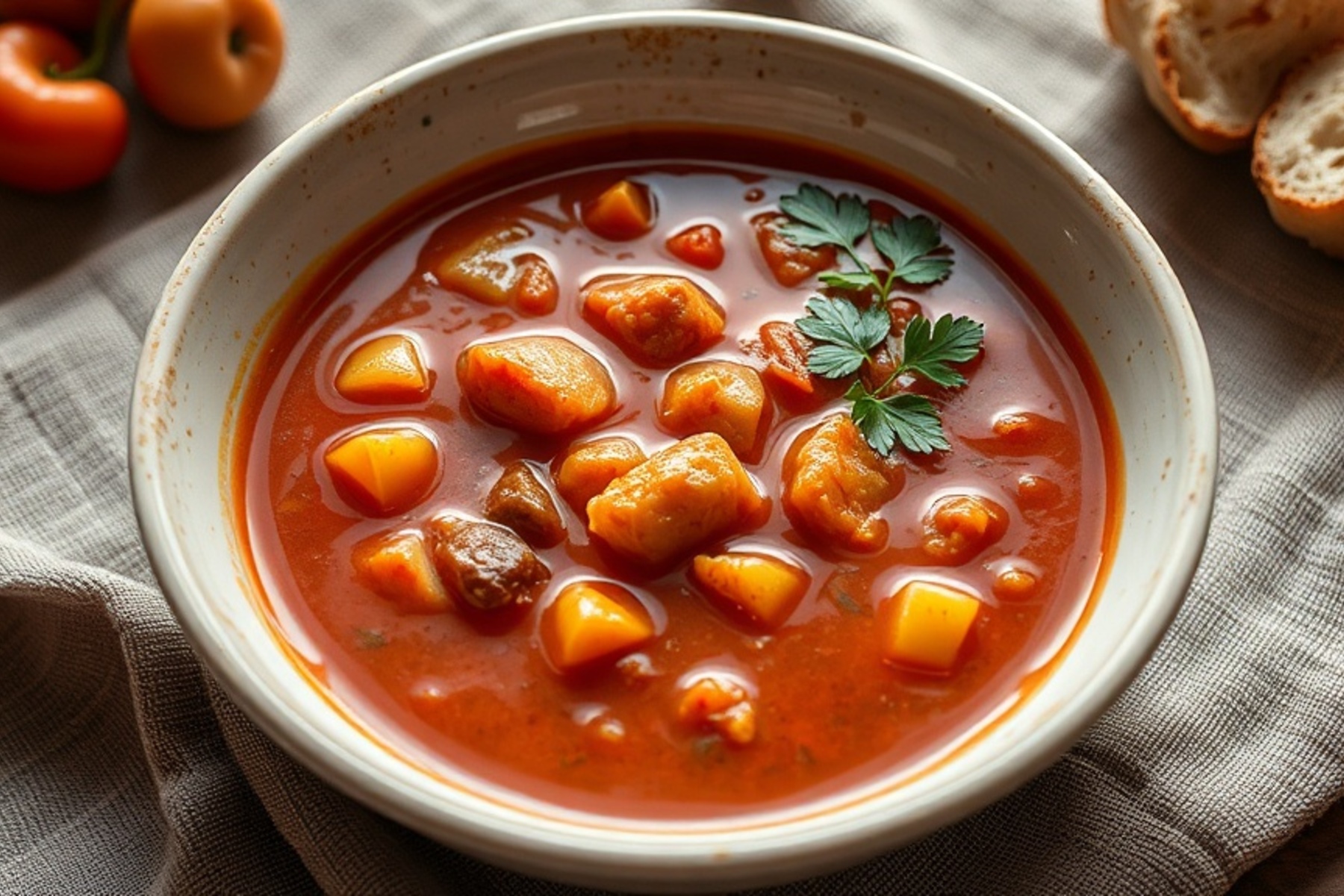
Sharba Libiya — Libyan Ramadan soup
Soup · about 1 hour 15 minutes · the dish that breaks the fast in every Libyan household
Ingredients: 400 g lamb shoulder cut into 1–2 cm cubes (bone-in pieces improve it); 1 large onion, finely chopped; 3 tbsp olive oil; 3 tbsp tomato purée; 1 tin (400 g) chopped tomatoes; 1 tsp ground cumin; 1 tsp hararat (or ½ tsp cinnamon + ½ tsp turmeric + ¼ tsp black pepper); ½ tsp caraway; ½–1 tsp harissa, to taste; 1 tin (400 g) chickpeas, drained; 100 g orzo or broken vermicelli; 1 large bunch fresh mint, plus 1 tsp dried mint; small bunch parsley or coriander; 1.5 l water; salt.
Method: Brown the lamb hard in the oil with the onion until both take real colour — this is where the flavour is, so do not rush it. Stir in the tomato purée and the dry spices and fry for a full minute until the paste darkens and smells toasted. Add the tinned tomatoes, harissa and about 1.5 litres of water, bring to a simmer, cover and cook gently for 45–60 minutes until the lamb is tender. Add the chickpeas and the pasta and cook a further 8–10 minutes, stirring so the orzo does not catch — the soup should end up thick, more stew than broth. Take it off the heat, stir through a generous handful of chopped fresh mint and the dried mint, and let it sit five minutes before serving with lemon.
💡 The dried mint at the end is not optional and it is not the same as the fresh — Libyan cooks add both, and the dried is what makes it taste right.
Mbakbaka — Libyan pasta in spiced lamb sauce
Main course · about 1 hour · the weeknight dish, and the clearest trace Italy left in Libyan kitchens
Ingredients: 500 g lamb or beef, cubed (or chicken thighs); 1 large onion, chopped; 4 tbsp olive oil; 3 tbsp tomato purée; 1 tin (400 g) chopped tomatoes; 1 tsp hararat; 1 tsp ground cumin; ½ tsp turmeric; ½–1 tsp harissa; 1 tin chickpeas (optional but usual); 400 g short pasta — penne, rigatoni or the ridged tubes Libyans prefer; about 1.2 l water or light stock; salt.
Method: Brown the meat with the onion in the oil until well coloured. Add the tomato purée and all the spices and fry for a minute. Add the tinned tomatoes and about 800 ml of water, season, and simmer covered for 40 minutes until the meat is tender and the sauce is dark and reduced. Now add the chickpeas and the dry pasta directly into the sauce with enough extra water to just cover, and cook uncovered, stirring often, for 10–14 minutes until the pasta is done and has absorbed most of the liquid. It should be glossy and coated, not soupy and not dry. Rest it off the heat for five minutes.
💡 Cooking the pasta in the sauce rather than in salted water is the whole point — it is what separates mbakbaka from an Italian ragù, and it means you must taste for salt as you go.
🍵 The Driest Country in the Mediterranean — and Its Tea
Alcohol has been illegal in Libya since 1969, prohibited within weeks of Gaddafi taking power, and the ban has survived every subsequent change of regime. Libya is one of the strictest dry countries in the world. Penalties are severe, enforcement is real, and a foreigner caught importing alcohol is in serious trouble.
This is worth stating alongside the fact that this coast was, for something like a thousand years, a wine country. The Greek colonies of Cyrenaica and the Roman cities of Tripolitania grew vines and shipped wine across the Mediterranean, and the mosaics that survive at Leptis Magna and in the museums show grape harvests, treading vats and Dionysian scenes in exquisite detail. The Italian colonial period revived viticulture around Tripoli in the 1920s and 30s. All of it ended in 1969.
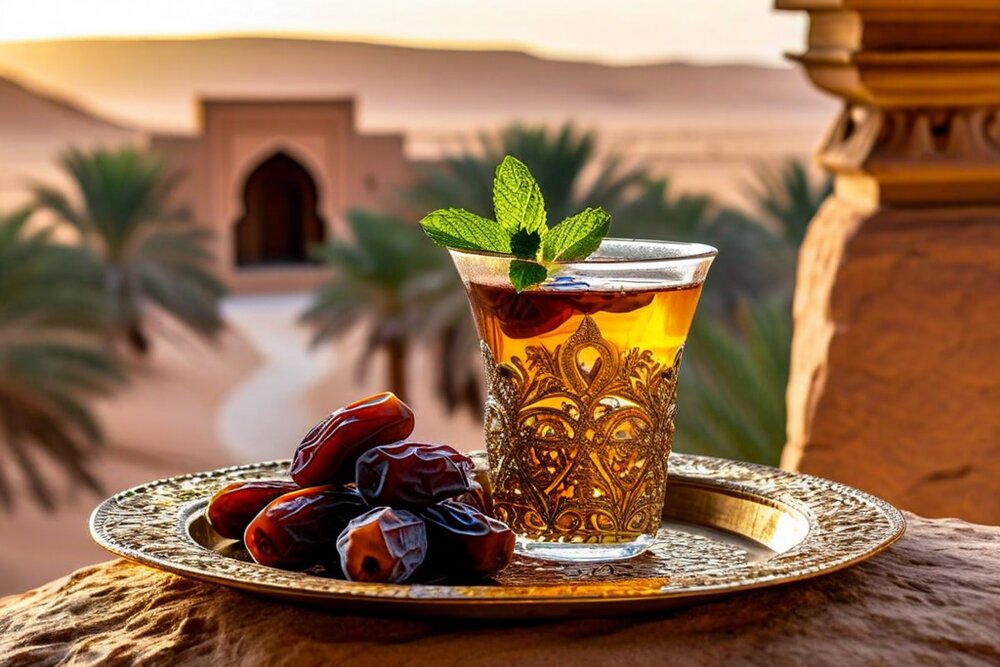
Shahi — the three rounds
Libyan tea is a ceremony and a unit of time. It is boiled long and hard with a great deal of sugar until it is almost a syrup, poured back and forth between pot and glass to build the raghwa, the foam, and served in three rounds: the first plain and bitter-strong, the second with mint, the third topped with roasted peanuts or almonds. Refusing the third round takes some doing. It is the centre of Libyan social life.
Coffee
Italian, and taken seriously in Tripoli, Benghazi and Misrata, where espresso machines outnumber anything else and a proper macchiato is easy to find. Alongside it, Arabic coffee with cardamom in more traditional and eastern settings. The espresso is the more surprising of the two and it is genuinely good.
What people drink instead
Fresh juices — orange, pomegranate, sugar cane; asir laymun, lemon with mint, blitzed with ice; enormous quantities of soft drinks; and buttermilk drinks in the south. Non-alcoholic malt beverages have a following, as they do across the region.
Bokha and the risk
Home-distilled spirit — usually called bokha — exists, illegally, and it kills people. Libya has suffered repeated mass methanol poisonings from bootleg alcohol, the worst of which, in Tripoli in 2013, killed dozens and blinded or hospitalised more than a thousand. This is not a curiosity; it is the single most dangerous thing a visitor could be offered.
Table grapes, no wine
Grapes are still grown on the Jebel Akhdar, where the Mediterranean microclimate supports real horticulture, and they are eaten and dried. No wine is made from them legally, and the Greek and Roman vineyards of the same hillsides are now an archaeological subject rather than an agricultural one.
Sicily, 300 km away
The distance from Tripoli to the Sicilian coast is roughly 300 km — closer than Prague is to Vienna and back. On one side of that water, one of the oldest and most celebrated wine cultures on earth; on the other, total prohibition. Few borders in the world separate two drinking cultures so completely over so short a distance.
🎭 Music, Poetry and What Forty-Two Years Did to the Arts
The poets
Poetry is the prestige art form, as it is across the Arab world, and Libya’s is dominated by the anti-colonial generation — above all Ahmed Rafiq al-Mahdawi, “the poet of the homeland”, whose verses on the Italian occupation are learned in school. Bedouin oral poetry in the Cyrenaican tradition remains a living form, performed and competed at gatherings.
Ibrahim al-Koni
Libya’s major novelist and one of the most significant Arabic writers alive: a Tuareg from the Fezzan who writes desert fiction of a mystical, allegorical kind — The Bleeding of the Stone, Gold Dust, Anubis. He has been widely translated, has won major international prizes, and has lived outside Libya for decades. He is the readiest answer to anyone who asks what Libyan literature is.
Music
Coastal Libyan music sits in the Andalusian maluf tradition shared with Tunisia — suites of sung poetry with oud, violin and percussion — alongside marskawi wedding music and, in the south, Tuareg guitar and Tebu rhythms belonging to a Saharan world rather than a Mediterranean one. Under Gaddafi, Western instruments were periodically banned outright and imported instruments burned.
The cultural desert years
The Jamahiriya was hard on the arts in a specific way: not merely censorship but the abolition of the professional structures that produce art. Private publishing was banned, theatres and cinemas closed or were converted, and books were burned in public in the 1970s — including, notoriously, foreign-language books. A generation of Libyan artists worked abroad or not at all.
Hisham Matar
The Libyan-British writer whose father, a prominent opponent of Gaddafi, was abducted from Cairo in 1990 and disappeared into Abu Salim prison. Matar’s memoir The Return — about going back to Libya in 2012 to look for him — won the Pulitzer Prize in 2017 and is the single best book in English for understanding what the Gaddafi era did to Libyan families.
Since 2011
A real flowering and a real danger at once: independent newspapers and radio stations appeared, then closed under threat; street art covered Tripoli and Benghazi and was painted over; young Libyans have built a substantial online and diaspora cultural scene. Journalists and activists have been killed. The freedom is genuine and it is not safe.
🗣️ Arabic, Amazigh, and the Italian Still in the Vocabulary
The official language is Arabic, and the spoken language of daily life is Libyan Arabic — a Maghrebi dialect closer to Tunisian than to Egyptian, with a heavy Berber substrate and an unusually large number of Italian loanwords. Note that the old page this replaces listed Libya's language as English. That was simply wrong.
Two dialects, roughly
Western Libyan Arabic around Tripoli, closer to Tunisian; eastern Libyan (Bedouin) Arabic around Benghazi, closer to the Bedouin dialects of Egypt and the Gulf. Libyans place each other instantly by accent, and the split runs along the same seam as everything else in the country.
The Italian words
Ordinary Libyan speech is full of them, often unnoticed by the speakers: sarima for zip, banyu for bath, tafulya for table, salata, makina, furno. Mechanics’ and builders’ vocabulary is especially Italian. It is the most audible remnant of the colonial period.
Amazigh (Berber)
Nafusi in the Nafusa Mountains, the Zuwara variety on the coast, Ghadamsi at Ghadames, Tamahaq among the Tuareg of the south-west, plus the unrelated Tebu language (Nilo-Saharan, not Berber) in the south-east. All were suppressed under Gaddafi, who denied Berber identity existed; teaching, publishing and broadcasting in Amazigh resumed after 2011 and its constitutional status is still unsettled.
English and Italian as second languages
English is the main foreign language now, taught in schools — though there was a period in the 1980s when foreign language teaching was largely abolished, leaving a distinct age cohort with none. Italian survives among older people on the coast and in the technical trades, and Italian television was widely watched for decades.
Useful words
Salam alaykum — hello (answer: wa alaykum as-salam). Shukran — thank you. Aywa / la — yes / no. Kif halak? — how are you? Shahi — tea. Yalla — let’s go. Inshallah — God willing, and in Libya as elsewhere it can mean anything from “certainly” to “no”.
Names and script
Arabic script, right to left, and transliteration into the Latin alphabet is wildly inconsistent — Gaddafi/Qaddafi/Gadhafi/Kadhafi is the famous case, with dozens of spellings in circulation. Place names are worse: Sabha/Sebha, Sirte/Surt, Bayda/Beida. Expect any Libyan name you search for to have three spellings.
🕌 Sunni Islam, the Senussi, and the Ibadis of the Mountains
Libya is close to 97% Sunni Muslim, overwhelmingly of the Maliki school, and religious practice is a routine and unremarked part of daily life rather than a matter of political contest between sects — Libya has no significant Shia population and none of the confessional politics of Lebanon or Iraq.
The Senussi order
A Sufi revivalist movement founded in the 1830s that became the organising force of Cyrenaica: it built lodges (zawiya) across the desert, ran the caravan trade, led the resistance to Italy under Omar al-Mukhtar, and supplied King Idris, Libya’s only monarch. Gaddafi suppressed the order thoroughly. Senussi identity persists in the east and there is a recurrent, minority current of monarchist sentiment attached to it.
The Ibadis
The Amazigh of the Nafusa Mountains and Zuwara are largely Ibadi Muslims — a distinct branch, neither Sunni nor Shia, descended from the earliest schism in Islam and found today only in Oman, in the Algerian M’zab, on Djerba and here. It is one of Libya’s least-known distinctions and it reinforces the separateness of Amazigh identity.
Salafism after 2011
The most consequential religious shift of the past fifteen years. Madkhali Salafism — a quietist strand that preaches obedience to the ruler — grew rapidly and its adherents are now embedded in armed groups on both sides of the political divide, including within Rada in Tripoli and within Haftar’s forces. Sufi shrines and libraries have been destroyed by Salafi groups in both halves of the country, a loss of heritage that has drawn far less attention than it deserves.
The Jewish history
Libya had a Jewish community going back more than two thousand years — Cyrene had one in Roman times — numbering around 38,000 at its peak in the 1940s, with a large presence in the Tripoli medina. Pogroms in 1945 and 1948 and then emigration after 1948 emptied it; the last Jews were expelled in 1967–70 and the synagogues were destroyed or converted. The community now exists only in Israel, Italy and Rome’s Libyan-Jewish congregation.
Christians
A small foreign community — migrant workers from sub-Saharan Africa, Egyptian Copts, some Filipinos — served by a handful of churches. In February 2015, Islamic State beheaded 21 Coptic Christians, twenty Egyptians and one Ghanaian, on a beach near Sirte and filmed it. Their remains were recovered and repatriated to Egypt in 2018.
Practicalities
Ramadan changes everything: daytime eating and drinking in public is not done, working hours shorten, and the country comes alive after sunset. Friday is the day off, with Saturday. Modest dress is expected of everyone; for women visitors that means covered arms and legs and, in most settings, a headscarf carried if not worn.
🦎 What Lives in a Country That Is Ninety Per Cent Desert
The Saharan mammals
Thin on the ground and mostly nocturnal: fennec fox, sand cat, Rüppell’s fox, jerboas, gazelles. The addax and the scimitar-horned oryx once ranged here and are now extinct in the wild across the region; the slender-horned gazelle and dorcas gazelle survive in small, hunted numbers. Fifteen years without wildlife enforcement have not helped any of them.
The Green Mountain
The Jebel Akhdar is the biodiversity refuge: juniper and cypress woodland, wild cyclamen and orchids in spring, and the last Libyan populations of several Mediterranean species. It is also where striped hyena and jackal persist, and where the country’s best-known nature reserve, Kouf National Park, was established in 1979 above the coast.
Birds, and the migration
Libya sits directly under one of the great flyways: hundreds of millions of birds cross the Mediterranean and the Sahara twice a year, and the Libyan coast and its wetlands — the sabkhas at Farwa, Ain Zayanah, the Gulf of Sidra — are critical stopovers. Illegal hunting of migrating birds, quail and turtle dove especially, is a significant and poorly documented pressure.
The sea
Libya’s Mediterranean waters are, by an accident of politics, among the least fished and least surveyed in the basin, and marine biologists have long suspected they are correspondingly rich. There are important loggerhead and green turtle nesting beaches on the coast, notably around Sirte and in the west, several of them monitored by Libyan volunteers when conditions permit.
The monk seal
The Mediterranean monk seal, one of the most endangered mammals on earth, has been recorded on the Libyan coast and around the offshore reefs, and Libya’s empty shoreline may hold one of the last unsurveyed refuges for it. “May” is doing real work in that sentence: nobody has been able to run a systematic survey since 2011.
The rock art record
Worth naming here rather than only under archaeology. The Acacus paintings document elephants, giraffe, rhinoceros, hippopotamus and crocodiles in what is now hyper-arid desert — the fauna of the African Humid Period that ended around 5,000 years ago. Libya’s most spectacular wildlife is on the walls, and it has been gone for five millennia.
🛢️ The Oil, and Why It Both Saves and Ruins the Country
Oil was found at Zelten in 1959 and within a decade turned one of the poorest countries on earth into one of Africa's richest per head. Everything about modern Libya — the welfare state, the Great Man-Made River, the wars, the foreign interest, the stalemate — is downstream of that discovery.
The numbers
Libya holds the largest proven crude reserves in Africa, on the order of 48 billion barrels, and among the largest natural gas reserves on the continent. Production reached 1,487,723 barrels per day on 21 June 2026 — roughly 1.44 million of crude plus condensate — the highest since 2013. The National Oil Corporation, under chairman Masoud Suleman, is targeting 1.6 million bpd by the end of 2026 and talks about 2 million beyond that.
The quality
Libyan crude is light and sweet, low in sulphur, easy and cheap to refine, and sits a short tanker run from southern European refineries built for exactly it. That combination makes Libyan barrels disproportionately valuable to Italy, Spain, France and Germany, and disproportionately disruptive to European markets whenever they stop.
The National Oil Corporation
Almost the only genuinely national institution left. The NOC has, remarkably, gone on producing and exporting through fifteen years of division, dealing with whoever holds the ground while insisting it serves one Libya. It has been politicised repeatedly — chairmen have been removed by force and by decree — and it remains the thread holding the state’s finances together.
The shutdowns
Production has been used as a bargaining chip again and again: the terminal blockades of 2013–14, the eastern shutdown of 2020 that lasted months and cost the country billions, and the August–September 2024 halt over the disputed removal of the Central Bank governor. Each one costs money that is never recovered and each one demonstrates that whoever can turn the tap off has leverage over whoever spends the revenue.
The resource curse, textbook edition
Roughly 95% of exports and the bulk of government revenue from one commodity; a public sector that employs a very large share of the workforce; heavily subsidised fuel that fuels a smuggling economy; and almost no incentive to build anything else. Libya is the case study everyone reaches for, and Libyan economists say so themselves.
Gas and the future
The Greenstream pipeline runs Libyan gas under the Mediterranean to Sicily, and the Structures A&E offshore project, agreed with Eni in 2023 at a reported 8 billion dollars, is the largest foreign investment in Libya in two decades. Solar potential is enormous and essentially untapped. What Libya has not built in fifteen years is any economy that does not come out of the ground.
🌊 Derna, 10 September 2023
Content note. This section describes a disaster in which thousands of people died in a few minutes. The third anniversary falls on 10 September 2026, four days after this page was written.
On the night of 10 September 2023, Storm Daniel — a Mediterranean cyclone that had already flooded Greece and Bulgaria — came ashore on the Cyrenaican coast and dropped an extraordinary quantity of rain on the Jebel Akhdar above Derna. Two dams in the wadi upstream of the city, Abu Mansour and al-Bilad, failed in sequence. A wall of water went down the wadi and through the middle of the town, and took entire neighbourhoods, bridges and the people in them into the sea.
The toll
Around 4,000 confirmed dead, with thousands more missing and never recovered; over 40,000 people displaced. Estimates have varied widely because whole families died together with nobody left to report them, and because bodies were recovered from the sea for weeks. Damage and losses were assessed at roughly 1.7 billion dollars, about 3.6% of Libya’s GDP.
Why the dams failed
They were built in the 1970s, they had known structural problems, and a study published years earlier had warned in print that they needed urgent maintenance. Funds for that maintenance had been allocated and not spent. The dams had not been properly maintained since 2002. This was a natural event acting on a decade and a half of institutional collapse, and Libyans say so bluntly.
The divided response
Derna sits in eastern-controlled territory. The initial response was slowed by exactly the fragmentation that had let the dams rot: two governments, competing emergency bodies, uncoordinated foreign offers of help, and confusion over who could authorise what. Protests broke out in Derna within a fortnight and the mayor was dismissed.
Reconstruction
Substantial, and visible. By mid-2026, nearly three years on, Derna has new roads and bridges, thousands of new housing units, a rebuilt hospital and over a hundred and fifty separate construction projects — a university renovation, new dams, parks. The physical recovery has been faster than most observers expected.
And the politics of it
Reconstruction has also been an instrument. It is run through eastern-controlled mechanisms and foreign contractors, it has been a substantial boost to Haftar’s standing and to his sons’ role in particular, and questions about who awards the contracts and on what terms have been raised repeatedly and answered rarely. Rebuilding a city is a legitimate achievement and a political asset at the same time.
What it should be read as
Derna is the clearest single illustration of what fifteen years without a functioning state costs. The storm was extreme and probably intensified by a warming Mediterranean. The dams were the state’s job. In a country with the largest oil reserves in Africa, four thousand people died because two pieces of 1970s concrete had not been inspected.
🚢 The Central Mediterranean Route
Libya's coast is the principal departure shore for irregular migration to Europe, and the treatment of migrants inside Libya is the subject of some of the most severe findings the United Nations has issued about any country in the last decade. It is impossible to write honestly about Libya without covering it.
Why here
Libya has 1,770 km of coast, essentially no border enforcement in the south, an economy that has employed migrant labour for sixty years, and no functioning state to prevent an industry from forming. Sicily and Malta are a few hundred kilometres north. The route runs from West and East Africa and from Asia across the Sahara to the coastal towns of Zawiya, Zuwara, Sabratha and Garabulli.
The detention system
People intercepted at sea or picked up on land are held in a network of official and unofficial detention centres. The UN’s Independent Fact-Finding Mission on Libya concluded in 2021 and again in 2023 that there were reasonable grounds to believe crimes against humanity had been committed against migrants in Libya — documenting murder, enforced disappearance, torture, enslavement, sexual violence and extortion. These are the UN’s words, not a campaign group’s.
Europe's part in it
The EU and Italy have trained, equipped and funded the Libyan Coast Guard to intercept boats and return people to Libya — which means returning them to the system described above. The arrangement has been criticised by the UN High Commissioner for Human Rights, by the Council of Europe’s human rights commissioner and by essentially every humanitarian organisation working on the route. It has also reduced arrivals in Italy, which is why it continues.
The deaths
The central Mediterranean is the deadliest migration route in the world. The IOM’s Missing Migrants Project has recorded well over 20,000 deaths and disappearances on it since 2014, and everyone working on the data agrees the true figure is higher because a boat that sinks with no survivors leaves no record at all. Mass graves have also been found inland, in the desert.
The smugglers as political actors
Some of the militias that control coastal towns are simultaneously state-salaried security forces and the operators of the smuggling networks — the case of the Zawiya coast guard commander sanctioned by the UN in 2018 for people-trafficking while holding an official post is the standard illustration. Attempts to suppress smuggling therefore run into the fact that the suppressors are the smugglers.
Libyans' own view
Frequently ignored in European coverage. Libyans did not choose to become Europe’s frontier, they bear the costs of a large irregular population in a country that cannot govern itself, and a good deal of resentment attaches to an arrangement in which the EU pays for interception and Libya absorbs the consequences. There is also real racism against sub-Saharan Africans in Libya, which Libyan writers document themselves.
📅 When to Go — If Going Becomes Possible
Everything in this section and the three that follow is written on the assumption that the security situation permits travel. As of September 2026 it largely does not, and no seasonal advice overrides that.
October to April — the answer
The coastal winter is Mediterranean and pleasant: 15–20 °C by day in Tripoli and Benghazi, some rain, cool evenings. This is also the only sane time for the Sahara, where daytime temperatures in the Fezzan drop to a workable 20–25 °C in December and January while nights fall close to freezing. March and November are the sweet spots for combining coast and desert.
Spring on the Green Mountain
March and April in the Jebel Akhdar are genuinely lovely — wildflowers across the limestone, green hillsides, the Cyrene ruins at their best. This is the single most attractive fortnight in the Libyan year and almost nobody outside the country knows it exists.
Summer — no
June to September on the coast is 32–38 °C and very humid; the interior runs 40–48 °C and the deep Fezzan higher. Desert travel in July is dangerous rather than merely unpleasant. Add the ghibli, which can raise temperatures 15–20 degrees in a few hours and fill the air with dust for days.
Ramadan
Moveable, running roughly mid-February to mid-March in 2027 and shifting about eleven days earlier each year. Restaurants close by day, working hours shrink, tempers shorten by late afternoon, and everything reopens spectacularly after sunset. Travelling then is not impossible but it is slower, and eating or smoking in public during daylight is genuinely offensive.
The sea
Swimmable from about May to November, warmest in August and September. The Libyan coast has excellent, empty beaches. It also has strong currents, essentially no lifeguards and no organised rescue, and in places unexploded ordnance behind the beach.
Fixed dates
17 February — Revolution Day. 24 December — Independence Day, which is also the date of the election that never happened in 2021 and is therefore politically loaded. Eid al-Fitr and Eid al-Adha move with the lunar calendar and shut the country down for several days each.
🚗 Getting There and Moving Around
Flying in
Mitiga (MJI) serves Tripoli — the old Wheelus air base, in use because Tripoli International has been wrecked since 2014 and its reopening has been promised repeatedly. Benina (BEN) serves Benghazi, plus Misrata, Sabha and others. Libyan Airlines, Libyan Wings, Afriqiyah and Berniq fly regionally; European carriers do not, because EU-registered airlines have been effectively barred from Libyan airspace and all Libyan carriers are on the EU air safety list.
From Prague, realistically
There is no route that is not a connection. The usual patterns are Prague–Istanbul–Misrata or Benghazi with Turkish and a Libyan carrier, or Prague–Tunis–Tripoli, or Prague–Cairo–Benghazi. Count on 10–16 hours door to door in the best case and considerably more when a leg is cancelled, which is routine.
Land borders
The Ras Ajdir crossing to Tunisia is the busiest and closes without notice; the Egyptian border at Musaid opens and shuts with the political weather; the southern borders with Niger, Chad, Sudan and Algeria are, for practical purposes, not crossings but an unpoliced frontier. Overland entry is not a realistic plan for a foreign visitor.
Driving
Libyans drive on the right. The coastal highway from the Tunisian to the Egyptian border is the country’s spine and is mostly in decent condition; desert roads to Sabha, Ghat and Kufra are long, empty and unforgiving. Petrol is among the cheapest in the world at a few euro cents a litre, which is why fuel smuggling is an industry. Driving standards are poor and road deaths are high.
Checkpoints
The defining experience of moving around Libya. Every road is punctuated by them, run by army units, police, or militias with varying degrees of official status. They are usually routine. A foreigner passes them with a local fixer, correct documents and patience, and does not pass them alone.
Internal flights and no railways
Domestic flights link Tripoli, Benghazi, Misrata, Sabha and Tobruk, and are the sensible way to cross the country if they are running — schedules are unreliable. Libya has no operating railway at all: the Italians built some, it was dismantled, and Gaddafi-era plans for a coastal line got as far as embankments and stations that were never finished.
📋 Practical Realities
Visas
Required for essentially everyone including Czech citizens, and not obtainable on arrival. You need an invitation from a Libyan sponsor — a company, an institution or a licensed tour operator — before you can apply. Czechs apply at the Libyan Embassy in Prague (Nad Šárkou 781/56, Prague 6). Processing is slow and unpredictable. Note also that an Israeli stamp in the passport is a problem.
Money
The Libyan dinar (LYD), cash, in practice. Foreign cards do not work; there is no reliable ATM access for international accounts; bring euros or dollars in cash and change them. There is a persistent gap between the official and parallel exchange rates. Budget for the whole trip in cash and expect no financial safety net.
Health
Bring what you need. The health system was hollowed out by the wars and depends heavily on foreign staff who have left; serious treatment means evacuation, usually to Tunis or Cairo. Insurance covering Libya is expensive and many policies simply exclude it — check the wording before, not after. Water: bottled only.
Mines and unexploded ordnance
This is a genuine, current, physical hazard, not a formality. Libya is contaminated from the Second World War, the Chad wars, 2011 and 2019–20; casualties occur every year, including among children. Do not leave marked ground. Do not walk into ruins, abandoned military positions or open desert without local guidance, and do not pick anything up.
Photography
Be careful. Photographing anything that could be read as military, security, port, oil or government infrastructure will get you detained, and the definition is applied broadly. Ask before photographing people, and expect a no from women in more conservative settings.
Connectivity and law
Mobile coverage is decent on the coast and patchy inland; internet is slow and periodically cut. Legally: alcohol and drugs carry severe penalties, homosexuality is criminalised, and proselytising is illegal and prosecuted. There is no functioning tourist police and no consular backstop for Czechs inside the country.
💰 What It Costs
Libya is not a cheap destination, and not for the usual reasons. The country itself is inexpensive; getting into it and moving around it safely is not. Figures below are indicative for 2026 and convert at roughly 1 EUR ≈ 24.5 CZK.
The organised trip
The only realistic way in for a foreigner. Specialist Saharan and archaeological operators — a handful of them, mostly Italian, Polish and Libyan — run escorted programmes of 8–12 days covering the Roman coast or the Fezzan. Expect 2,500–5,000 EUR (60,000–120,000 CZK) per person excluding international flights, which buys vehicles, drivers, permits, security arrangements and the invitation you need for the visa.
Flights from Prague
With a connection through Istanbul, Tunis or Cairo, count 500–900 EUR (12,000–22,000 CZK) return, and more when the direct Libyan legs are disrupted. Prices are volatile because capacity is thin.
On the ground
Genuinely cheap when you get there. A restaurant meal runs 5–15 EUR; a decent hotel room in Tripoli or Benghazi 40–90 EUR; a glass of tea costs small change. Petrol is a few cents a litre. None of this is the constraint on your budget.
The visa and the paperwork
The visa fee itself is modest; the sponsorship and invitation arrangements are what cost, and they are typically bundled into an operator’s price. Independent travellers who arrange their own sponsor still pay for a fixer, a driver and a vehicle, which is where the money goes.
Insurance
The line item people forget. Standard travel policies exclude countries under a “do not travel” advisory, which Libya is. Specialist cover including medical evacuation exists and costs hundreds of euros for a short trip. Going without it is not a saving, it is a bet.
Cash, and only cash
Bring the entire trip’s budget in euro or dollar notes and change locally. No foreign cards, no working ATMs for international accounts, no wire transfers. Carrying several thousand euros in cash creates its own risks, which is a further argument for going with an operator who handles it.
🇨🇿 For Czech Readers
MZV ČR
The Czech Ministry of Foreign Affairs advises against travel to Libya, citing the long-term security situation, armed clashes between hostile factions, and the risk of terrorist attack and kidnapping. That advice has stood for years and has not been relaxed.
No embassy in the country
This matters more than most people realise. The Czech consular operation in Tripoli was relocated to Tunisia on 1 April 2015 and has not returned. Consular assistance for Czech citizens in Libya is provided from the Czech Embassy in Tunis, and it is limited by the simple fact of not being there. The emergency line is +216 98 46 46 17.
DROZD
Register in the ministry’s DROZD system before you go — and for a destination like this, it is genuinely the mechanism by which anyone would know to look for you. Leave a full itinerary with someone at home as well.
The visa, from Prague
Libya has an embassy in Prague — Nad Šárkou 781/56, 160 00 Praha 6. You will need an invitation from a Libyan sponsor before applying. Allow weeks rather than days, and do not book anything non-refundable until the visa is in the passport.
Czechs and Libya, historically
There is a real history here. Czechoslovakia traded extensively with Gaddafi’s Libya — arms, machinery, engineering — and Czechoslovak doctors, engineers and construction workers were a visible presence through the 1970s and 80s. Some Czech firms were still working in Libya up to 2011, and a number of Czechs were evacuated during the uprising.
Scale, for a Czech reader
Libya is 22 times the area of Czechia with two-thirds of its population. Driving the coastal highway from the Tunisian border to the Egyptian border is about 1,800 km — Prague to Madrid. Tripoli to Kufra oasis is 1,500 km, almost all of it desert with nothing in between.
🎲 Things That Are True About Libya
The only single-colour flag in history
From 1977 to 2011 Libya’s flag was a plain green rectangle. No emblem, no stripe, no charge. It remains the only national flag ever adopted with no design element whatsoever, and it was Gaddafi’s personal decision after Egypt made peace with Israel.
The first aerial bombing in history
On 1 November 1911, over the oasis of Tagiura near Tripoli, an Italian lieutenant named Giulio Gavotti leaned out of a Etrich Taube monoplane and dropped four grenades on Ottoman positions. Every air raid since traces to that afternoon in Libya.
The temperature record that wasn't
Al-Aziziya, south of Tripoli, held the official world record for the highest air temperature — 58 °C, recorded 13 September 1922 — for ninety years. In 2012 the World Meteorological Organization formally invalidated it after concluding the observer had misread an unfamiliar instrument. The record passed to Death Valley.
Independence through the UN
Libya is the first country in the world to gain independence through the United Nations, on 24 December 1951, by a General Assembly resolution rather than by war or negotiated handover. In 1951 it was also one of the poorest countries on earth, with an estimated literacy rate around 20% and almost no paved road.
A pipe longer than the country is wide
The Great Man-Made River’s network runs some 2,800 km of four-metre pipe under the desert. Laid end to end it would reach from Prague to beyond Cairo. It is the largest irrigation project ever built and most people outside Libya have never heard of it.
The mosaics under the sand
Because Libya’s classical cities were abandoned and buried rather than built over, the mosaic floors that survive are exceptional. The Villa Silin mosaics near Leptis Magna, and a fifth-century gladiator mosaic found near Wadi Lebda in 2000, are among the finest Roman floor mosaics ever discovered — and almost nobody has seen them in person in twenty years.
🔭 Could Libya Ever Be a Destination?
The honest answer is yes, and the honest follow-up is that nothing about the last fifteen years suggests it will be soon. It is worth setting out what the country actually has, because the gap between the assets and the reality is the point.
What it has
Two of the best-preserved Roman cities on earth, a Greek city of the first rank, a World Heritage caravan town, one of the world’s great bodies of prehistoric rock art, 1,770 km of empty Mediterranean beach, sand seas, and a Saharan interior of real grandeur. On paper this is a top-tier Mediterranean and Saharan destination and it is not close.
What it had
Before 2011, Libya received a small but real flow of visitors — on the order of a hundred thousand a year on organised tours, mostly Italian, German, French and Japanese, doing the Roman coast and the Acacus. Ghadames and the Ubari lakes had tourist camps. It was never mass tourism, but the pattern existed and it worked.
What is missing
Security above all, then a single government able to issue visas and licences, then insurance, then hotels, then trained staff, then air links that European airlines can legally fly. That is a chain, and it starts at the political end. Reconstruction of Tripoli International Airport alone has been announced several times without happening.
The heritage clock
This is the argument for urgency rather than patience. All five World Heritage sites have been on the Danger List since 2016. Looting of portable antiquities has been documented; construction has encroached on buffer zones; Acacus rock art has been vandalised; the National Museum’s collections have been largely inaccessible for a decade. Every year of stalemate costs something that does not come back.
What would happen fast
If the political question were settled, the coast would come back quickly — it is three hours from Rome, the sites are extraordinary, and Italian and French operators have institutional memory of running it. The desert would take longer, because the Fezzan’s problems are not only Tripoli’s problems.
The honest recommendation
Do not go now. Read Hisham Matar, look at the Leptis Magna photographs, and watch what the House of Representatives and the High State Council do with the 30 August 2026 agreement by the end of September. If it holds and an election actually happens inside the 24-month window, this section will need rewriting, and that will be a good day.
📸 Gallery — and What Is Not in It
This page is illustrated from six image files stored for Libya. Three of them are used, one of those with a substantial correction attached. The other three are rejected below, with reasons. This section exists because a country guide that shows the wrong food and calls it the national dish is worse than one that shows nothing.
Rejected: the second tea
libya-drink.jpg shows two glasses of pale green mint tea on a silver tray in a Moroccan riad, over a Moroccan carpet. It is a handsome photograph of Moroccan tea. Filed under Libya and named “libya-drink”, it would tell a reader that the national drink of Libya is Maghrebi mint tea, which is the one thing about Libyan tea that everyone gets wrong. Two tea images and neither shows Libyan tea; keeping the closer one and rejecting this one is the most that could be salvaged.
Rejected: the bazeen
libya-bazeen.jpg, filed as the national dish, shows a dome of whole cooked rice grains topped with pine nuts, standing alone on a plate. Bazeen is a dense, smooth, unleavened barley dough, beaten solid, set in the middle of a red lamb and tomato stew with potatoes and eggs around it. The image has the wrong grain, the wrong texture and no stew at all — it is a rice mould, and the stew is the half of bazeen that makes it a meal.
Rejected: the asida
libya-asida.jpg shows a grainy porridge topped with candied fruit, almonds, cinnamon bark and star anise — a spice from southern China that has no place in a Libyan kitchen. Asida is a smooth, elastic, near-white mound of cooked wheat flour with a well pressed into the top and filled with honey and melted butter, eaten from the outside in. The photograph is a generic sweet porridge with the wrong texture, the wrong colour and the wrong spices.
Used with a correction: the sharba
libya-sharba-libiya.jpg is the one recipe image kept, and it is kept because it is in the right family rather than because it is right: a red tomato and lamb soup of the correct colour and consistency. What it lacks is what defines the dish — orzo pasta and chickpeas — and what it adds is potato chunks that belong to something else, plus parsley where the mint should be. The correction is printed under the photograph on the page itself, not only here.
Where the list came from
The file list is the actual S3 bucket listing, taken on 6 September 2026: images/libya/ holds 01-hero.jpg, libya-drink.jpg and mint-tea.jpg; countries/images/recipes/ holds libya-asida.jpg, libya-bazeen.jpg and libya-sharba-libiya.jpg. Six files, all six opened and looked at before anything was written about them. No stray images belonging to other countries were found under the Libya prefixes, which is not something that can be assumed.
What is missing, and it is a lot
There is no photograph of Leptis Magna, Sabratha, Cyrene, Ghadames or the Acacus in the store — which is to say, no image of a single one of the five things that make Libya extraordinary. Nor of Tripoli, Benghazi, the Green Mountain, the sand seas or the Ubari lakes. Six files for the fourth-largest country in Africa, three of them wrong. This page is written to be worth reading without them.
Support This Project 🌍
This World Travel Factbook is a labor of love – free to use for all travelers. If you find it helpful, consider supporting its continued development.