

🇱🇷 Liberia at a Glance
🌍 Overview
Liberia is 111,369 km² — about a third larger than Czechia — with roughly 5.6 million people on a 560 km stretch of the West African Atlantic coast. It is Africa's oldest republic, independent since 1847, and one of only two African countries never formally colonised by a European power.
That last fact needs an immediate qualification, and it is the key to the whole country. Liberia escaped European colonisation because it was already a colonial project of a different kind: founded by an American society that shipped freed and free-born Black Americans to a coast where perhaps sixteen peoples already lived. The settlers and their descendants — the Americo-Liberians, never more than a small fraction of the population — then ruled the country for 133 years.
The state
A presidential republic with a constitution modelled closely on the American one: a president, a bicameral legislature of Senate and House, and a Supreme Court. Joseph Boakai of the Unity Party has been president since January 2024, having beaten the incumbent George Weah in a run-off — the second peaceful transfer of power between rival parties in Liberia’s history. The next election is due in 2029.
The people
Around sixteen recognised indigenous ethnic groups — Kpelle and Bassa are the largest, with Gio, Mano, Kru, Grebo, Mandingo, Vai, Loma, Krahn and others — plus the descendants of the settlers, who make up perhaps 2.5% of the population and dominated everything until 1980. It is a young country: the median age is around 18 and a majority of Liberians were born after the wars ended.
The economy
Small, extractive and recovering. Growth is projected around 5.4% in 2026, driven by an iron ore boom — mining output rose about 17% in 2025 with iron ore up roughly 42%. Rubber, gold and timber follow. Off the books entirely: the ship registry, the largest on earth, which flags close to 300 million gross tons of the world’s merchant fleet and pays Liberia a fee for each of them.
What visiting is like
Genuinely difficult and genuinely rewarding, in that order. There is almost no tourism infrastructure, roads outside Monrovia are bad to impassable, electricity and water are unreliable, and it is expensive for what you get. What is here: empty Atlantic surf beaches, one of the last blocks of Upper Guinean rainforest, pygmy hippos, and a warmth toward visitors that is hard to overstate.
🏷️ Liberty, Monroe and a Flag Copied from Somewhere Else
Liberia is from the Latin liber, free — "land of the free" — and Monrovia is named after James Monroe, the fifth president of the United States and a supporter of the colonisation society that founded the settlement. It is the only capital city outside the United States named after an American president.
The flag
Eleven red and white stripes for the eleven signatories of the declaration of independence, and a single white star on a blue canton — "the lone star" — for Africa’s first independent republic. The resemblance to the flag of the United States is entirely deliberate. You will see it more often on the stern of a container ship in Rotterdam than anywhere in Liberia, because of the registry.
The motto
The love of liberty brought us here. It is on the coat of arms, and it is one of the most quietly loaded national mottos anywhere: the "us" means the settlers, not the sixteen peoples who were already there. Liberians debate that sentence, and the debate is the country’s central historical argument in five words.
Not colonised, exactly
Liberia and Ethiopia are the standard answer to the question of which African countries escaped European colonial rule, and for Liberia the answer needs its footnote. The state was created by the American Colonization Society, a private American organisation; land was acquired from local rulers under conditions that included a gun pointed at one of them; and the settler class then governed the interior as a colonial administration would have. Liberians make this point themselves and have done since the 1980s.
Two names for everything
The coastal counties carry the names of American benefactors and states — Maryland County, Grand Bassa, Sinoe, Montserrado — and the interior carries the names of its peoples: Nimba, Lofa, Bong, Gbarpolu. Reading a Liberian map is a short lesson in who named what and when.
🗺️ Coast, Forest and Rain
Liberia is a wedge of the West African coast: about 560 km of Atlantic shoreline backed by a narrow coastal plain of mangrove, lagoon and sand bar, then rolling forested hills, then a low plateau and finally the Nimba and Wologisi highlands on the Guinean border. Nothing is high — Mount Wuteve at about 1,440 m is the summit — and almost everything is wet.
The rain
Liberia is one of the wettest countries in Africa. Monrovia records well over 4,000 mm a year and coastal Harbel and Cape Mount are wetter still — the capital has among the highest rainfall of any capital city on earth. It falls in a season: May to October, with a savage peak in June to September when roads dissolve and travel outside the tarred network becomes genuinely impossible.
The forest
Liberia holds the largest remaining share of the Upper Guinean rainforest — something over 40% of what is left of a forest block that once ran unbroken from Guinea to Togo. It is a global biodiversity hotspot, and it is being cut for timber, cleared for oil palm and rubber, and mined for gold from within. Forest cover is falling; how fast is disputed and the direction is not.
Rivers
Six major rivers run roughly parallel from the interior to the sea — the Mano on the Sierra Leonean border, the St Paul, the St John, the Cestos, the Cavalla on the Ivorian border. They were the highways of the interior and they are the reason Liberia has hydropower potential it has barely built, apart from the rehabilitated Mount Coffee dam on the St Paul.
The coast
Sandy, surf-battered and largely undeveloped, with lagoons, sand spits and a handful of headlands: Cape Mount in the north-west with Lake Piso behind it, Cape Mesurado where Monrovia sits, and Cape Palmas in the far south-east at Harper. The Atlantic swell here is serious enough that Robertsport has become a genuine surfing destination.
Climate
Tropical: hot, humid, and around 26–32 °C year-round with very little seasonal variation in temperature and enormous variation in rain. The harmattan, the dry Saharan wind, reaches Liberia weakly between December and February, bringing haze, dust and the only genuinely dry weeks of the year.
Wildlife
Better than most West African countries, because so much forest survives. Pygmy hippopotamus — Liberia holds the largest remaining population of a species found almost nowhere else; forest elephant, chimpanzee, zebra duiker, Diana monkey, the Liberian mongoose. Almost all of it is under pressure from bushmeat hunting and none of it is easy to see.
⚓ The Colonization Society and the 1847 Republic
Why it was founded
The American Colonization Society, formed in 1816, was a coalition of an uncomfortable kind: abolitionists who thought free Black Americans would never be granted equality in the United States, and slaveholders who wanted free Black people removed because their existence was an argument against slavery. Both wanted the same ship to sail. Most Black Americans opposed the scheme outright and only a small minority ever went.
The landing
The first settlers arrived in 1822 at Cape Mesurado. Land was obtained from local rulers by a treaty that the society’s agent, Lieutenant Robert Stockton, is recorded as having secured with a pistol held to King Peter’s head. Disease killed a very large share of the early arrivals. Over the following decades roughly 16,000 people came from the United States, plus around 5,000 Congoes — Africans freed from intercepted slave ships and landed here.
Independence, 1847
Liberia declared itself a republic on 26 July 1847, largely because the society could no longer fund it and because Britain declined to recognise the trading rights of a territory belonging to a private association. Britain and France recognised it quickly. The United States did not recognise Liberia until 1862, because doing so would have meant receiving a Black ambassador in Washington while slavery was still legal.
Two nations in one country
The settlers built a coastal republic in the image of the American South they had left: brick houses with verandas, top hats and frock coats in the tropics, Masonic lodges, Baptist and Methodist churches, plantations. The indigenous majority of the interior were not citizens, could not vote, and were governed indirectly through chiefs. The parallel is uncomfortable and Liberians draw it themselves.
The interior and the border
Liberia’s modern borders were fixed not by conquest but by pressure: France and Britain took large slices of what Liberia claimed in the 1880s and 1890s, and the country avoided being swallowed largely because Washington took a diplomatic interest. The interior was not brought under effective government control until the 1920s and 30s, by force.
The forced-labour scandal
In 1930 a League of Nations commission found that Liberian officials had been shipping indigenous Liberians to Spanish Fernando Pó as effectively forced labour, and that the vice-president was involved. The president and vice-president resigned. It is the moment Liberia’s founding contradiction became internationally visible, and it was not the last time.
🎩 A Hundred and Thirty-Three Years, and Then a Coup
The True Whig Party
From 1878 to 1980, Liberia was a one-party state under the True Whig Party — one of the longest continuous single-party rules anywhere in the world. Power passed within a small number of settler-descended families in Monrovia. Elections were held and the result was known in advance; one presidential result in the 1920s recorded more votes than there were registered voters, by a factor of about fifteen.
Tubman and the open door
William Tubman, president from 1944 to 1971, ran an "Open Door" policy that brought in Firestone, Liberian iron ore concessions and enormous foreign investment, and a "Unification Policy" that extended the vote to the interior in theory while keeping the True Whig machine intact in practice. Liberia had one of the fastest growth rates in the world in the 1950s and one of the least equal distributions of it.
Firestone
In 1926 the Firestone Tire and Rubber Company took a 99-year lease on a million acres at six cents an acre and built what became the largest contiguous rubber plantation in the world at Harbel. It has been the country’s largest private employer for a century, and its labour practices — then and much later — have been the subject of repeated international litigation and reporting.
The flag of convenience
In 1948 Liberia opened its ship registry, designed with American help so that shipowners could avoid the taxes and labour rules of their own countries. It worked. Liberia is now the largest registry in the world by tonnage, ahead of Panama, with close to 300 million gross tons flagged. The registry is administered from Virginia and pays Liberia a substantial and reliable fee, and almost nobody flying the flag has ever been to Liberia.
12 April 1980
Master Sergeant Samuel Doe, of the Krahn, and seventeen soldiers killed President William Tolbert in his bed and, ten days later, executed thirteen members of his cabinet on a beach in Monrovia in front of cameras. It ended 133 years of Americo-Liberian rule in a night and was, for many indigenous Liberians, an act of liberation. What followed was worse.
Doe
Doe ruled for a decade with American backing — Liberia was a Cold War asset with a CIA relay station, a Voice of America transmitter and port rights — while staging a fraudulent election in 1985, purging the army along ethnic lines toward his own Krahn and the allied Mandingo, and answering an attempted coup with mass reprisals against the Gio and Mano of Nimba County. Those reprisals created the constituency that would destroy him.
💥 The Wars, 1989–2003
This section describes mass atrocity in plain terms because there is no honest way to describe Liberia without it. Around 250,000 people died and half the population was displaced. Most Liberians alive today either lived through it or were born to people who did.
The first war
On 24 December 1989 Charles Taylor, a former Doe official who had escaped from an American jail, crossed from Côte d’Ivoire with a small force and found a country ready to rise against Doe. The war fragmented almost immediately into competing militias organised largely along ethnic lines. In September 1990 Doe was captured by Prince Johnson of a breakaway faction, tortured and killed on video.
ECOMOG
West African states intervened through ECOMOG, a Nigerian-led force that fought, kept a kind of peace, and was itself accused of profiteering and abuses. The war ground on through more than a dozen failed ceasefires. Child soldiers were used systematically by every faction; drugs, mutilation and ritual killing were widely documented; and units fought under names like the Butt Naked Brigade whose commander later confessed publicly to hundreds of murders.
Taylor elected
The 1997 election gave Charles Taylor about 75% of the vote, on a campaign whose most famous slogan was reported as "he killed my ma, he killed my pa, but I will vote for him" — a vote for the man judged most able to end the fighting. He did not end it.
Sierra Leone
Taylor armed and directed the Revolutionary United Front across the border in Sierra Leone in exchange for diamonds, in one of the most destructive proxy relationships of the era. It is the crime for which he was eventually convicted — and the reason his conviction is for what he did in Sierra Leone, not in Liberia.
The second war and 2003
Rebel movements LURD and MODEL pushed Taylor back to Monrovia by mid-2003, where the siege known as World War Three shelled the civilian city for weeks. Under pressure from the United States, Nigeria and a mass non-violent campaign by Liberian women — the Women of Liberia Mass Action for Peace, who blockaded the peace talks and threatened to disrobe until an agreement was signed — Taylor left for exile on 11 August 2003. The Accra accord followed six days later.
Afterwards
UNMIL, a UN mission of up to 15,000 troops, kept the peace from 2003 until it left in 2018. Taylor was arrested in 2006, tried at the Special Court for Sierra Leone sitting in The Hague, and in 2012 sentenced to 50 years for aiding and abetting crimes against humanity; he is serving it in a British prison. A Liberian Truth and Reconciliation Commission reported in 2009 and recommended prosecutions. For fifteen years, nobody acted on them.
🏛️ Politics Now — 6 September 2026
📅 Checked 6 September 2026. Liberia is two and a half years into a presidency elected on an anti-corruption promise, sitting for the first time on the UN Security Council, and still arguing about whether to try the people who ran its wars.
Sirleaf and Weah, briefly
Ellen Johnson Sirleaf won in 2005 and became the first elected woman head of state in Africa; she shared the Nobel Peace Prize in 2011 with Leymah Gbowee, one of the leaders of the women’s peace movement, and Tawakkol Karman. She stabilised the country, cleared its debt and was criticised at home for nepotism and for going slow on the war crimes question. In 2018 she handed power to George Weah, the only footballer ever to win the Ballon d’Or and then a national presidency, whose six years produced popular sports diplomacy, inflation and a series of corruption scandals involving senior officials sanctioned by the United States.
Boakai
Joseph Boakai, Sirleaf’s vice-president for twelve years, beat Weah in a November 2023 run-off by roughly one percentage point. Weah conceded before the count finished, which was widely and correctly treated as the most important thing that happened. Boakai took office in January 2024 on a platform of anti-corruption, roads and agriculture; he is in his seventies and the next election is in 2029.
What he has done
Ordered asset declarations and salary cuts including his own, dismissed officials over audits, brought inflation down and rebuilt reserves that the outgoing administration had overstated, and cleared arrears with the IMF and other lenders. Critics say the corruption prosecutions have been slower than the announcements. Supporters point out that the arrears were real and the money is now being borrowed at lower cost.
The Security Council
Liberia was elected to a non-permanent seat on the UN Security Council for 2026–27, taking it up on 1 January 2026 — its first full term since the UN was founded, and a substantial diplomatic achievement for a country that was a UN peacekeeping case until 2018. Boakai has used the platform to press for the war crimes court and for climate finance.
The legislature
Boakai’s Unity Party does not control the House outright and Liberian legislative politics runs on shifting personal alliances rather than party discipline. A protracted fight over the speakership paralysed the House for much of 2025 and is the main reason several of the president’s bills, including the ones the war crimes court needs, have moved slowly.
The mood
Cautiously impatient. Twenty-three years of peace is the achievement nobody disputes and everybody is quietly proud of. Against it: electricity that reaches a minority of the population, roads that vanish every rainy season, a very young population with very few jobs, and a sense that the political class changes names more often than behaviour.
⚖️ The Court That Does Not Exist Yet
The TRC report
Liberia’s Truth and Reconciliation Commission reported in 2009. It named individuals it recommended for prosecution and others it recommended be barred from public office — a list that included, notoriously, Ellen Johnson Sirleaf, who had briefly supported Taylor’s rebellion in 1990 and later apologised for it. Almost none of the recommendations were implemented, by her government or by Weah’s.
Why not
Because many of the people the report named were still in the legislature, in business or in the security forces, and some still commanded loyalty from former fighters. Prince Johnson, who filmed himself drinking a beer while Samuel Doe was tortured to death in front of him, sat as a senator for Nimba County until his death in 2024 and was a kingmaker in two presidential elections. That sentence explains Liberian transitional justice better than any analysis of it.
Boakai’s order
In May 2024 Boakai signed an executive order establishing an Office of the War and Economic Crimes Court, after the legislature passed a resolution supporting one. It was the first serious movement in fifteen years and it was met with a mixture of relief and unease across Liberian society.
Where it has got to
Stuck in the legislature. The office exists and has a head and a mandate; the enabling statutes without which a court cannot legally sit have not been passed, and through 2026 advocates have been publicly urging the president to recall lawmakers to deal with them. There have also been open accusations within Boakai’s own camp that parts of the administration, including at the UN, are slow-walking it. As of September 2026, no Liberian has been tried in Liberia for anything done in the wars.
Trials elsewhere
What accountability there has been has happened abroad, under universal jurisdiction: Liberian commanders have been convicted or charged in the United States, Switzerland, France, Finland, Belgium and the United Kingdom — mostly for immigration fraud in the US, for actual war crimes in Europe. It is an odd and telling pattern: a Liberian who wants to see a warlord in the dock buys a plane ticket.
Ebola, and what it cost
The other national trauma of the modern era. The 2014–16 West African Ebola epidemic killed around 4,800 people in Liberia of roughly 11,300 across the region, closed the schools for months, shut the borders and briefly quarantined the West Point township of Monrovia by force. The health system, already thin, was gutted — a large share of the country’s doctors and nurses died — and the response, when it worked, worked because of community burial teams and Liberian health workers rather than anything international arriving on time.
💰 Iron, Rubber and a Flag
The shape of it
GDP of roughly USD 4.5 billion, one of the lowest per-head figures in the world, and an economy that is essentially three or four commodities plus aid plus remittances. Growth is projected at about 5.4% in 2026, which sounds healthy and is mostly one sector: mining output rose about 17% in 2025 with iron ore up roughly 42%.
Iron ore
The historic mainstay. Liberia was one of the world’s largest iron ore exporters before the wars; ArcelorMittal has been the main operator since 2005 at Yekepa in Nimba County, and an expansion together with the reopening of the Bong and Western Cluster deposits is what the 2026 growth figure is made of. It is capital-intensive and employs relatively few people.
Rubber
A century of it. Firestone at Harbel is still the largest contiguous natural rubber operation in the world and among the country’s largest private employers, and smallholder rubber matters across the south-east. The 10% US tariff announced in 2025 falls directly on it, raising the cost of Liberian rubber in its main market.
The registry
Liberia’s strangest and steadiest income. The Liberian International Ship and Corporate Registry, run from Virginia, flags close to 300 million gross tons — the largest merchant fleet in the world, ahead of Panama for the third year running — and returns a share of the fees to the Liberian treasury. It is a meaningful line in the national budget and it exists almost entirely outside the country.
Aid, and its withdrawal
Liberia has been one of the most aid-dependent countries in the world; official development assistance fell from about 20% of GDP in 2019 to 5.5% in 2024 and is projected to fall further because of the USAID cuts of 2025. In a country where American money paid for a large share of health and education programming, that is not an abstraction.
What ordinary life runs on
Not any of the above. Most Liberians work in subsistence agriculture — cassava, rice, oil palm — or in the urban informal economy, and formal employment is a minority experience. Rice is the political commodity: a rise in the price of imported rice triggered the riots of 1979 that preceded the coup, and every government since has watched it nervously.
🌏 America, the Neighbours and the Sea
The United States
The relationship that defines Liberia. It founded the state, refused to recognise it for fifteen years, built the Firestone plantation and the Roberts Field airbase, propped up Samuel Doe for a decade, then largely walked away in 1990 when the Cold War ended and the war began — a sequence Liberians remember precisely. Ties remain close and asymmetric: the dollar circulates, the diaspora in Minnesota, Philadelphia and Staten Island is large, and Washington’s decisions on aid and tariffs land here directly.
The neighbours
Sierra Leone, Guinea and Côte d’Ivoire, all three of which were drawn into Liberia’s wars or drew Liberia into theirs; Taylor’s support for the RUF wrecked Sierra Leone, and Ivorian territory hosted Liberian rebels in both directions. Relations are now normal and the borders are porous, with cross-border trade, shared ethnic groups and a shared regional currency ambition through ECOWAS, which has its own peacekeeping history here.
ECOWAS and the AU
Liberia is a founding-generation member of ECOWAS and it was ECOWAS — through ECOMOG — that intervened in 1990 when nobody else would. The region’s subsequent record of coups in Mali, Burkina Faso, Niger and Guinea gives Liberians a particular perspective on their own uneventful elections.
China
The largest infrastructure partner: roads, the ministerial complex, stadium refurbishment, and a substantial share of the trade in timber and iron ore. Liberian public debate about Chinese investment is more relaxed than in some neighbours and turns mainly on whether the roads last through the rains.
The Security Council seat
From 1 January 2026 Liberia sits as a non-permanent member of the UN Security Council for two years — the first full term in its history. For a country that hosted a 15,000-strong UN peacekeeping mission until 2018, moving from the agenda to the table is a genuinely symbolic reversal, and the government treats it as such.
The diaspora
Several hundred thousand Liberians live abroad, overwhelmingly in the United States, and remittances are a significant share of household income. American immigration policy toward Liberians — decades of temporary protected status, followed by a limited path to residence in 2019 — is a live Liberian political issue that is decided entirely in Washington.
🏙️ Monrovia
Monrovia holds around a quarter of Liberia's population — well over a million people — on a peninsula and the swampy ground behind it. It was shelled, occupied and looted repeatedly between 1990 and 2003, and it has been rebuilding since, unevenly and without much planning.
Providence Island
Where the first settlers landed in 1822, in the estuary between the city and Bushrod Island. It is a small, scruffy, enormously important site with a memorial and the remains of the old buildings, and it is the place to start if you want the country to make sense. There has been an on-and-off restoration project for years.
The centre
Broad Street and the streets around it, with the National Museum — small, looted during the wars, rebuilt from what could be recovered and worth an hour — the Masonic Temple on the hill, gutted in 1980 and long a ruin, the Executive Mansion, and the Ducor Hotel, once West Africa’s finest, abandoned since 1989 and still standing above the city as its most photographed ruin.
Waterside and the markets
Waterside Market is the commercial heart: crowded, loud, entirely functional and the best place to understand the urban economy. Nearby West Point, a densely populated township on a sandspit, was forcibly quarantined during the Ebola outbreak in 2014 in a decision that produced a riot and a death, and it remains one of the most crowded and least served places in the country.
The beaches
Monrovia has beaches inside the city — Elwa, Thinker’s Village, CeCe Beach and the strip out towards Robertsfield — which are where the city relaxes at the weekend, with beach bars, grilled fish and music. The Atlantic here has a serious undertow; drownings happen every year and swimming out of your depth is a bad idea.
Getting around
Yellow shared taxis and kehkeh three-wheelers work on fixed routes for very little money; motorbike taxis (pen-pen) are fast, everywhere and the leading cause of trauma admissions at the hospital. Traffic in central Monrovia at rush hour is severe and the road out to the airport takes an hour and a half or three depending entirely on luck.
The honest picture
Electricity reaches a minority of the country and Monrovia’s supply is intermittent; generators run everywhere. Water is not drinkable from a tap. Drainage floods in the rains. And it is a friendly, funny, loud, hard-working city where a foreigner walking down Broad Street is greeted rather than hustled, which is not true of every capital in the region.
🌊 The Coast
Robertsport
Two hours north-west of Monrovia at Cape Mount, and the one place in Liberia with a genuine tourism proposition: a right-hand point break that surfers rate among the best in West Africa, long empty beaches, a fishing town of tin roofs and mango trees, and simple beach camps. The surf season runs roughly April to October with the rains, which is a hard sell to everyone except surfers.
Lake Piso
Behind Robertsport, a large brackish lagoon connected to the sea — a Ramsar wetland, good for birds, canoe trips and fishing, and on Liberia’s UNESCO tentative list. It is one of the country’s most obviously beautiful places and has essentially no infrastructure.
Buchanan
Liberia’s second port, and the terminus of the iron ore railway from Nimba — a working industrial town with a long beach, some colonial-era Americo-Liberian buildings and not much tourism. The railway itself, rebuilt after the wars, is one of the more impressive functioning things in the country.
Harper
In the far south-east at Cape Palmas, and the most extraordinary place in Liberia: a nineteenth-century Americo-Liberian town of grand decaying mansions, built by settlers from Maryland who founded a separate republic here before joining Liberia in 1857. President Tubman was from Harper and built it up further. It was smashed in the wars and the mansions stand roofless in the sea air. It is about 500 km from Monrovia on a road that is a serious expedition.
Marshall and the Farmington
An hour from Monrovia, where the Farmington and Junk rivers meet the sea in a maze of mangrove islands and sandbars. The Marshall wetlands are a Ramsar site, they are the easiest wildlife-ish day trip from the capital, and they are on the tentative list too.
Turtles and what the coast is losing
Four species of sea turtle nest on Liberian beaches and there are small community conservation projects along the coast. Against that: coastal erosion is severe and accelerating, taking houses and whole sections of West Point and of the towns near Buchanan into the sea, driven by sand mining and by rising seas. It is the country’s most visible climate problem.
🌴 Sapo, Nimba and the Last Forest
Liberia holds the largest single share of what remains of the Upper Guinean rainforest, a forest block that once ran unbroken across West Africa and is now down to fragments. It is the country's most significant global asset and the one under the most pressure.
Sapo National Park
Liberia’s first and largest national park, established in 1983 in Sinoe County: about 1,800 km² of primary lowland rainforest, more than 90% of it intact, with forest elephant, chimpanzee, zebra duiker, Diana monkey and the largest population of pygmy hippopotamus in Liberia. It was occupied by fighters and later by thousands of illegal gold miners, who were cleared out in operations after 2005; pressure continues.
Visiting Sapo
Hard. There is no lodge, no tourism concession and no road that works in the rains. Visits are arranged through the Forestry Development Authority in Monrovia, take several days, involve driving to Greenville and then a river crossing, and mean camping with rangers. The reward is primary rainforest with almost nobody in it and a small chance of hearing rather than seeing something remarkable. Go in the dry season or not at all.
The pygmy hippo
Choeropsis liberiensis — solitary, nocturnal, forest-dwelling, about a tenth the weight of a common hippo, endangered and found essentially only in the Upper Guinean forest, with Liberia holding the majority of what is left. Almost no visitor sees one. It is on the coins and it is the single best argument for protecting Sapo.
East Nimba
In the far north-east on the Guinean border, the Nimba range is a mountain of extraordinary endemism — including a viviparous toad found nowhere else — and of extremely rich iron ore. The Guinean and Ivorian portions are a UNESCO World Heritage site; the Liberian slope is a nature reserve sitting immediately beside ArcelorMittal’s open pits at Yekepa, which is the country’s central resource dilemma in one view.
Gola
The Gola Forest straddles the Sierra Leonean border and is protected on both sides — Gola Forest National Park in Liberia, Gola Rainforest National Park in Sierra Leone — making it one of the more successful transboundary conservation efforts in the region, with real community forestry and a decent bird list including the white-necked rockfowl.
No World Heritage sites
Worth stating plainly: Liberia has no inscribed UNESCO World Heritage sites at all. It has a tentative list — Sapo, East Nimba, Lake Piso, the Marshall wetlands, Providence Island and others — and no inscription. For a country with this much intact forest and this much documented history, that is a gap that says more about capacity and forty years of crisis than about what is here.
👥 Sixteen Peoples and a Very Young Country
Who lives here
Sixteen officially recognised indigenous groups in three language families. The largest are the Kpelle (about a fifth of the population) and the Bassa; then Gio (Dan), Mano, Kru, Grebo, Krahn, Mandingo, Gola, Vai, Loma, Kissi, Gbandi, Mende, Dei and Belle. Plus the Americo-Liberians and the Congo people descended from recaptured slaves — together a small percentage, historically the ruling class, and the two labels are now often used interchangeably.
Very young
The median age is around 18. Well over half of all Liberians were born after the Accra agreement of 2003, which means the majority of the country has no personal memory of the war and a great deal of second-hand memory of it. It also means an enormous cohort entering a labour market that has very little to offer them.
The Poro and the Sande
Secret societies that run initiation, law and much of traditional authority across a large part of the interior — Poro for men, Sande for women — and that cut across ethnic lines. They are genuinely powerful, genuinely closed, and visitors should not attempt to see, photograph or ask detailed questions about them. Sande initiation includes female genital cutting, which Liberia restricted by executive order in 2022 and which remains a live and difficult national argument.
Health
Among the hardest numbers in this factbook. Life expectancy is around 61; maternal and child mortality are among the world’s highest; the health system lost a large share of its clinicians to Ebola and to emigration and has not replaced them. Malaria is the leading cause of death. The gains since 2016 are real and they are being made from a very low base with money that is now being withdrawn.
Women
Liberia elected Africa’s first woman head of state and its women’s peace movement ended a war, and both facts sit alongside high rates of sexual violence, a rape crisis that successive governments have declared a national emergency, and low representation in the legislature. Liberian women’s organisations say all of this at once and more sharply than any outside observer.
What holds
Extended family and church, in that order, doing most of the work a state does elsewhere. Community structures got the country through the wars and through Ebola, and the willingness of Liberians to be kind to a stranger who is visibly lost is remarked on by almost everyone who goes.
🍲 The Food
Liberian cooking is rice, palm oil, pepper and whatever protein is available — fish on the coast, bushmeat and chicken inland, and a great deal of dried and smoked fish everywhere. It is closely related to the cooking of Sierra Leone and Guinea, and it has one distinctive ingredient in common with nowhere else in the region: an American thread that came with the settlers.
Rice, always
Rice is the meal. A Liberian who has eaten cassava, bread and meat but no rice will tell you they have not eaten today. The staple is the point and the sauce goes over it, and the political salience of the imported rice price is a direct consequence.
Palm butter
The national dish and the one to try: the pulp of the oil palm fruit, boiled and pressed to a rich orange-red sauce, cooked long with fish, chicken, beef or all three, plus chilli and often smoked fish or dried shrimp for depth. Served over rice. It is unlike anything in European cooking and it is the taste people mean when they say they miss Liberia.
Dumboy and fufu
Dumboy is cassava boiled and pounded to a smooth, glossy, elastic mass, served as one large ball in a bowl of soup and swallowed rather than chewed — chewing it is a beginner’s mistake that Liberians find very funny. Fufu is the fermented version, more sour. Both go with pepper soup, palm butter or torborgee.
Soups and sauces
Cassava leaf, ground and cooked long with palm oil, meat and fish, which is the everyday dish above all others; potato greens, the sweet-potato leaf version; pepper soup, thin, scalding and eaten when unwell or hungover; torborgee, fermented and bitter and an acquired taste; and jollof rice, the West African rice-in-tomato dish that three countries fight over.
Street food
Kala, small fried dough balls; roasted plantain and cassava from braziers; rice bread, a dense sweet loaf made with rice flour and mashed banana that is a distinctly Liberian settler-era thing; grilled fish on the beach; and pepper in everything, in quantities that visitors should approach carefully.
Eating out
Monrovia has Lebanese restaurants (a long-established community), Indian, Chinese and a handful of good Liberian places; outside the capital the choice is a cookshop with two or three dishes. Cookshops are cheap, filling and the right way to eat here. Ask what is in the pot rather than for a menu.
👨🍳 Two Recipes
The national sauce, and the West African rice dish that Liberia makes its own way.
Palm Butter (Palm Nut Soup)
Serves 6 · 1 hour 30 minutes
Ingredients: 800 g palm nut concentrate or cream (sold tinned as sauce graine or palm soup base in African and Brazilian shops; do not substitute red palm oil, which is a different product), 700 g chicken or beef in pieces, 300 g firm white fish, 100 g smoked or dried fish, 1 onion chopped, 3 cloves garlic, 1 tbsp ground dried shrimp or crayfish, 1–3 habanero or Scotch bonnet chillies, 1 tsp ground ginger, salt, 1 litre water or stock. Plain white rice to serve.
Method: Season the meat with salt, half the onion, the garlic and the ginger and brown it in a heavy pot. Add the water and simmer 30 minutes. Stir the palm nut concentrate into the pot with a further 300 ml of water and bring back to a simmer — it will loosen and go a deep orange-red. Add the smoked fish, the ground shrimp, the rest of the onion and the whole chillies (pierce them for more heat, leave them whole for less) and simmer uncovered for 45 minutes to an hour, stirring now and then, until an orange oil separates and floats on the surface. That oil is the sign it is ready and it is not to be skimmed off. Add the fresh fish for the last 10 minutes so it does not break up. Check the salt. Serve in bowls over plain rice, with the whole chillies fished out and offered to whoever wants them.
💡 The long uncovered simmer is not optional. Palm butter that has not split its oil tastes raw and thin, and no amount of seasoning fixes it.
Liberian Jollof Rice
Serves 6 · 1 hour
Ingredients: 500 g long-grain parboiled rice, 500 g chicken or beef in pieces, 4 large tomatoes plus 2 tbsp tomato paste, 2 red bell peppers, 1–2 habanero chillies, 2 onions, 3 cloves garlic, 100 ml vegetable oil, 1 tsp thyme, 1 bay leaf, 1 tsp curry powder, salt and black pepper, about 750 ml stock. Optional: 150 g smoked fish, and green beans or carrot.
Method: Season and brown the meat, then set it aside and keep the stock. Blend the tomatoes, bell peppers, chillies, one onion and the garlic to a smooth purée. Slice the second onion and fry it in the oil until soft, add the tomato paste and cook it out for two minutes, then add the blended purée and fry it down over a medium heat for 15 to 20 minutes, stirring, until it darkens, thickens and the oil comes back to the surface — this is the step that separates good jollof from red rice. Add the thyme, curry powder, bay leaf and seasoning, return the meat, and pour in the stock. Bring to the boil, stir in the washed rice, cover tightly — a sheet of foil under the lid helps — and cook on the lowest possible heat for 25 to 30 minutes without stirring. Let it stand 10 minutes off the heat, then fork it through. A little catching on the bottom is wanted, not a fault.
💡 Liberian jollof runs a little softer and a little more stew-like than the Nigerian or Ghanaian versions and often has smoked fish in it. Saying so anywhere in West Africa will start an argument, which is part of the dish.
🍺 Palm Wine, Cane Juice and Club
Palm wine
Tapped from the oil or raffia palm and drunk the same day: milky, faintly sweet in the morning and increasingly sour and alcoholic by the evening as it keeps fermenting in the container. It is sold from demijohns and jerrycans at roadside stalls and it is the genuinely traditional drink of the region. Fresh is better; anything more than a day old is vinegar with ambitions.
Cane juice
Liberian moonshine, distilled from sugar cane and known as cane juice. It is strong, cheap, extremely common and of wholly unregulated quality, which is a real hazard rather than a colourful detail — methanol poisonings have occurred. Commercial gin in sachets is the other end of the same problem and is a recognised public health issue.
Club Beer
The national lager, brewed in Monrovia by Monrovia Breweries and drunk everywhere, alongside Heineken (the parent company) and imported brands. There is also Guinness Foreign Extra, which across West Africa is stronger, sweeter and taken more seriously than the Irish version, and which has been brewed in Liberia.
Ginger beer and the soft end
Home-made ginger beer, fiercely hot and sold in bottles; bissap or sorrel from hibiscus; and the ubiquitous cold-water sachets sold on every street, which are how most Liberians drink water and which are also the single largest source of plastic litter in the country.
Coffee and cocoa
Liberia grows both, in the interior, mostly as smallholder crops, and both were hit hard by the wars. Liberica coffee — a distinct species from arabica and robusta — is named after the country and is being taken seriously again internationally as a climate-resilient crop. You will struggle to buy a good cup of it in Monrovia, which is the usual story.
Practicalities
Alcohol is legal, cheap and widely drunk; Liberia is not a country where drinking is socially fraught. Avoid unbranded spirits entirely. Ice and water should come from a sealed source. And a bar in Monrovia at night is a friendly place, provided you have thought about how you are getting home.
🎭 Masks, Hipco and the Country's Own English
Masks
The masking traditions of the Dan (Gio), Mano, Bassa and Grebo are among the most important in West Africa and Dan masks in particular are in every major museum collection in Europe and America. In Liberia they are not art objects: masks belong to societies, appear at specific moments, and the being that wears one is not treated as a man in a mask. Photographing a masked figure without permission is a serious matter.
Hipco
Liberia’s own hip-hop, rapped in Liberian English rather than American English, and explicitly political — it grew out of the post-war years as a way of saying things about corruption, Ebola and the government that other media would not. Takun J is the name usually given as its founder. It is the clearest evidence that Liberia’s cultural life did not stop in 1989 and did not restart as an imitation of anywhere else.
Music and dance
Traditional Kpelle and Vai music built on drums, the sasaa gourd rattle and complex polyrhythms; church choirs, which are enormous and excellent; palm-wine guitar, the older coastal West African style; and Liberian gospel and Afrobeats on every minibus. The National Cultural Troupe at Kendeja preserved traditional dance through and after the wars.
The Vai script
Something genuinely unusual: the Vai syllabary, invented in the 1830s by Momolu Duwalu Bukele in what is now Grand Cape Mount County, is one of the very few indigenous African writing systems created independently and it is still used. It has around 200 characters, it is taught in Vai communities, and it is in Unicode.
Writers and the record
Liberia’s literature is dominated by the wars and their aftermath — memoir above all — and the best-known internationally is Helene Cooper, whose The House at Sugar Beach tells the Americo-Liberian story from inside it and then from exile. Leymah Gbowee’s Mighty Be Our Powers is the account of the women’s peace movement by one of the people who led it.
Manners
Greet before anything else, and expect the Liberian finger snap handshake — a normal shake that ends by snapping the middle fingers as the hands part. It is friendly and everyone will teach you. Use the right hand. Address people by title. And be aware that Liberians are direct, funny and much more willing to talk about the wars than a visitor usually expects — but let them raise it.
🗣️ English, and the Other English
English is the official language and the language of government, courts and schools. It is also, in practice, not what most Liberians speak to each other — that is Liberian English, a group of related varieties that an English speaker will find intermittently comprehensible and then suddenly not at all.
Liberian Kreyol
The main vernacular, sometimes called Liberian pidgin or Kolokwa, spoken as a lingua franca by most of the country. Standard Liberian English also exists as a distinct educated variety with its own vowels. And Merico or Settler English, descended from the African-American English of the nineteenth-century settlers, survives among Americo-Liberian families — a genuine linguistic relic of the antebellum American South, preserved in West Africa.
A few things you will hear
How da body? — how are you? My people — a general friendly address. Small small — a little, slowly. I coming — I am leaving and will return. You too fine — a compliment. Da so or na so — that is so, said in agreement, constantly. And the finger snap at the end of a handshake, which is punctuation as much as a greeting.
The indigenous languages
Around thirty, in three families: Mande (Kpelle, Vai, Loma, Mandingo, Gio, Mano), Kru (Bassa, Grebo, Krahn, Kru, Dei) and Mel (Gola, Kissi). Kpelle has the most speakers. Several have writing systems, and the Vai syllabary is indigenous rather than borrowed. Most Liberians are multilingual as a matter of course.
What this means for a visitor
You will be able to read every sign and struggle with some conversations, which is a disorienting combination and a common experience here. Slow down, ask people to repeat, and do not pretend to have understood — Liberians switch registers readily and will meet you halfway without any fuss.
Names
Liberian naming often combines a Western first name, an English or Americo-Liberian surname and an indigenous name, and "day names" are common. You will meet a surprising number of people called after American presidents, biblical figures and, since the 1990s, footballers.
A note on tone
Liberian English uses volume and directness in ways that European visitors sometimes read as anger when it is emphasis or humour. Conversation in a market or a shared taxi is loud, fast and usually not a quarrel.
⛪ Churches, Mosques and the Older Layer
The numbers
Around 85% Christian and about 12% Muslim, with a small number identifying with traditional religion alone — though the traditional layer runs through everything and is not really a separate category. Liberia is constitutionally secular and there is a recurring, unresolved political argument about declaring it a Christian nation, which the 1847 preamble gestures at and which Muslim Liberians resist.
The churches
The settlers brought Baptist, Methodist and Episcopalian denominations directly from the American South, and those churches remain socially and politically central — the Providence Baptist Church in Monrovia is where independence was declared. Since the 1990s Pentecostal and charismatic churches have grown enormously, with the usual mixture of genuine community welfare and prosperity-gospel enterprise.
Islam
Long established, mainly through the Mandingo and Vai communities, with the Vai literate in Arabic for centuries before the settlers arrived. Mandingo Liberians were repeatedly targeted during the wars, partly over long-running disputes about citizenship and land, and the question of whether Mandingos are "really" Liberian is an ugly argument that still surfaces.
Poro and Sande, again
The men’s and women’s societies are not a religion in the sense the census means, and they are the framework of authority, initiation and law across much of the interior. Many Liberians are Christian or Muslim and members of a society, without experiencing a contradiction. Outsiders are excluded absolutely.
The churches and the wars
Churches sheltered people during the fighting, and one of the worst single atrocities of the first war was the Lutheran church massacre in Monrovia in July 1990, in which government soldiers killed around six hundred displaced civilians who had taken refuge inside. The church stands and there is a memorial.
For visitors
A Sunday service is long, loud, joyful and one of the easiest ways to be welcomed anywhere in Liberia; dress well and expect to be greeted from the front. Do not photograph inside mosques or churches without asking, and do not go looking for a Poro or Sande site.
🦛 What Lives in the Forest
Pygmy hippopotamus
The flagship. Roughly the size of a large pig, solitary, nocturnal and confined to the Upper Guinean forest, with Liberia holding the largest surviving population and the total global figure believed to be in the low thousands. Captive-bred animals in European and American zoos descend largely from Liberian stock. Almost nobody sees one in the wild.
Forest elephant
Present in Sapo and in the Gola and Grebo-Krahn forests, and in serious trouble — the West African forest elephant population has collapsed and Liberia’s remaining animals are fragmented and poached. They are also, in places, a real human-wildlife conflict problem for farmers.
Chimpanzees
The western chimpanzee, critically endangered, survives in Liberia in nationally significant numbers. Liberia is also home to a specific and difficult story: the chimpanzees used for hepatitis research by an American-funded laboratory near Monrovia from the 1970s, abandoned on river islands when funding stopped in 2015, and now cared for by a sanctuary paid for by international donations — a lasting embarrassment for the institutions involved.
Birds
Around 600 species, including the white-necked rockfowl, a bizarre and much-sought bare-headed bird of forest boulder caves, plus Gola malimbe, Nimba flycatcher and a long list of Upper Guinean endemics. Liberia is genuinely good birding and almost nobody does it here.
The sea
Four species of nesting sea turtle, and offshore an unusual resident population of Atlantic humpback dolphins along the West African coast, which are critically endangered and rarely studied. Liberian waters are heavily fished, much of it by foreign industrial vessels, and enforcement is thin.
Bushmeat
The central conservation problem, and not a simple one: hunting supplies protein and cash income in a country where both are scarce, and it is also emptying the forest. Duiker, monkey and cane rat are openly sold at roadside markets. The trade also carries genuine zoonotic risk, which after Ebola is understood in Liberia rather better than it is by outsiders lecturing about it.
📅 When to Go
Liberia has two seasons and only one of them permits travel. This matters more here than in almost any country in this factbook, because the rain does not merely inconvenience the roads — it removes them.
November to April: the dry season
The answer. Rain drops to little or nothing, the unpaved roads harden, the interior becomes reachable, and Sapo and the north-east are possible. Temperatures sit around 28–33 °C with high humidity. December to February brings the harmattan, hazy and dusty but genuinely drier, and is the most comfortable window.
May to October: the rains
Monrovia gets over 4,000 mm a year and most of it falls now, with June to September the worst. Unpaved roads become impassable, river crossings wash out, flights and boats are cancelled, and a journey that takes four hours in January takes two days or does not happen. Humidity is total and mould is a genuine practical problem for anything you own.
The exception: surfers
Robertsport’s swell is best from roughly April to October, which is exactly the rainy season. Surfers therefore travel at the worst time for everything else, stay on the paved coastal road and accept that the interior is closed. If surfing is why you are coming, the calendar inverts.
Dates in the calendar
26 July, Independence Day, is the big one, with parades and a national address. Thanksgiving on the first Thursday in November is a Liberian public holiday inherited directly from the United States and celebrated with roast chicken and church, which is one of the more startling things about the country. 14 February is Armed Forces Day; Decoration Day in March is when families clean and decorate graves.
Practical timing
Allow far more time between places than the map suggests, in any season. Monrovia to Harper is a serious multi-day expedition, not a drive. Domestic flights barely exist. Whatever you plan, build in slack days, because something will not run.
The security calendar
Liberia has had three peaceful elections in a row and its politics are argumentative rather than violent, but demonstrations do happen in Monrovia and can turn. Election periods — the next is 2029 — are worth avoiding for a first visit. Check current advisories rather than assuming.
🚗 Getting There and Around
Flying in
Roberts International (ROB) at Harbel, about 50 km and one and a half to three hours from Monrovia depending on traffic. Brussels Airlines is the long-standing European connection; Royal Air Maroc via Casablanca, Air France via Paris and Ethiopian via Addis are the other realistic routings, with ASKY and Kenya Airways covering the region. Flights are expensive for the distance because demand is thin.
From the airport
Arrange transport in advance through your hotel; the airport road is long, dark at night and not somewhere to be improvising. A hotel car costs USD 40–70. There is no train and no reliable airport bus.
Roads
The paved network is essentially Monrovia to Ganta, Monrovia to Buchanan and Monrovia to the Sierra Leonean border, plus stretches elsewhere. Everything else is laterite, which is fine in the dry season and a river in the wet. A 4x4 is not optional outside the paved routes and neither is a driver who knows the road.
Shared transport
Between towns, shared taxis and minibuses leave when full from lorry parks in Monrovia (Duala and Red Light are the main ones). They are cheap, extremely crowded and driven fast on bad roads, and road traffic accidents are the single largest physical risk to a visitor in Liberia by a wide margin. Within Monrovia, yellow shared taxis and kehkeh; pen-pen motorbike taxis are fast and dangerous.
Land borders
Open to Sierra Leone (Bo Waterside), Guinea (Ganta) and Côte d’Ivoire (Loguatuo and the Cavalla crossings). All are functional, slow and involve more checkpoints than you expect. Overland travel in the region is a real option for people with time and patience.
The realistic answer
Most visitors hire a vehicle with a driver for the whole trip, at roughly USD 100–180 a day including fuel. It is expensive and it is the difference between seeing the country and seeing Monrovia. Book through your hotel or an established operator rather than at the roadside.
📋 Practical Information
Visas
Required for almost everyone, including EU and Czech citizens, and this is the single most important planning fact. Apply in advance at a Liberian embassy or through the online system at ecas.liberiaimmigration.gov.lr; there is no visa on arrival for most nationalities. Allow weeks, not days. A yellow fever vaccination certificate is mandatory and is checked on arrival.
Money
Two currencies in circulation: the Liberian dollar (LRD) and the US dollar, both legal tender, with US dollars used for larger transactions and Liberian for small ones. Bring US dollars in cash — clean, undamaged notes, a mix of denominations. ATMs exist in Monrovia and are unreliable; cards work in a handful of hotels. Mobile money (Orange, Lonestar) is widely used and worth setting up if you stay a while.
Health
This is the section to take seriously. Malaria is endemic, year-round and the leading cause of death in the country — take prophylaxis without exception and use repellent and nets. Yellow fever vaccination is required; typhoid, hepatitis A and B and rabies are recommended; cholera occurs. Medical facilities are very limited and anything serious means evacuation to Ghana or Europe. Insurance with medical evacuation cover is not optional. Drink only bottled or treated water.
Safety
Liberia is peaceful and Liberians are welcoming, and the risks are ordinary rather than political: road accidents first by a long way, then opportunistic street crime and burglary in Monrovia, which has a real problem with theft. Do not walk at night, do not display phones or cash, keep vehicle doors locked. Beaches have a severe undertow. Demonstrations should be avoided. There is no active conflict and no terrorism problem.
Electricity and connectivity
Grid power reaches a minority of the population and is intermittent even in Monrovia — every hotel has a generator and there are hours without it. Plugs are a mixture of American two-pin and European; bring both adapters. Mobile data from Orange or Lonestar is cheap and reasonable in towns, absent in much of the interior.
Behaviour and law
Photography of government buildings, the port, the airport and any security installation is prohibited and taken seriously; ask before photographing people. Homosexuality is criminalised under a "voluntary sodomy" provision and social attitudes are hostile; LGBT visitors should be discreet. Drug penalties are severe. Dress modestly outside the beach.
💵 What It Costs
Liberia is one of the poorest countries in the world and one of the more expensive to visit, which is a jarring combination and a direct consequence of having almost no tourism industry: everything a visitor needs is imported or scarce.
A bed
A basic guesthouse in Monrovia USD 40–70; a mid-range hotel with a generator that actually runs USD 90–150; the small number of international-standard places USD 180–280. Beach camps at Robertsport are cheaper, from around USD 30 for a hut. Outside Monrovia and Robertsport, options thin to almost nothing and quality is unpredictable.
Food
Cheap if you eat where Liberians eat: a plate of rice and sauce at a cookshop USD 2–4; street food a dollar. A meal in a Monrovia restaurant aimed at expatriates and NGO staff runs USD 15–30, which is the same as a European city and buys you air conditioning. Imported groceries are expensive.
Transport
Shared taxi across Monrovia under a dollar; a kehkeh hop the same; a private taxi within the city USD 5–15. A shared car to Buchanan or Ganta USD 8–15. And the big one: a vehicle with a driver at USD 100–180 a day, which is what any real itinerary costs.
Sapo and the parks
There is no ticket window. Visiting Sapo means arranging permission through the Forestry Development Authority, hiring rangers as guides, providing your own vehicle, fuel, food and camping kit, and budgeting several hundred dollars for a multi-day trip. It is the most expensive and most rewarding thing in the country.
A daily budget
Staying in Monrovia, eating locally, using shared taxis: USD 60–90 a day. Travelling properly with a driver and decent hotels: USD 200–300. The flight is a large fixed cost on top. Liberia does not reward a shoestring approach the way its neighbours do, because the shoestring options mostly do not exist.
Where money should go
Tip generously by local standards; hire Liberian guides and drivers directly rather than through intermediaries; buy from the craft market on Randall Street and from the women’s cooperatives rather than from hotel gift shops. In a country with this much unemployment, who you pay matters more than how much.
🇨🇿 For Czech Travellers
The visa, first
Czech citizens need a visa and there is no Liberian embassy in Czechia. In practice that means applying through the online e-visa system at ecas.liberiaimmigration.gov.lr or through the Liberian embassy accredited to the region — historically Brussels or Berlin. Start at least six to eight weeks before departure and confirm the current procedure with the embassy directly; this is the step that derails Czech trips to Liberia.
Getting there from Prague
No direct flight and no easy one. Realistic routings are Prague–Brussels–Monrovia with Brussels Airlines, Prague–Casablanca–Monrovia with Royal Air Maroc, or via Paris, Istanbul or Addis Ababa. Total 12 to 20 hours with one or two stops. Return fares typically 25 000–40 000 Kč, which is expensive for the distance because almost nobody flies this route for pleasure.
MZV ČR and DROZD
There is no Czech embassy in Liberia. Consular coverage runs through the Czech Embassy in Abuja, Nigeria — verify the current arrangement and the emergency number on mzv.cz before you travel, and read the ministry’s current advisory for Liberia. Registration in DROZD (drozd.mzv.cz) is essential here rather than merely sensible: there is no Czech representation in the country and an evacuation would be organised from another capital.
Health and insurance
The European Health Insurance Card does not apply. Yellow fever vaccination is compulsory and the certificate is checked at the airport — arrange it at a Czech travel-medicine centre at least ten days before departure. Take malaria prophylaxis; this is not a country where the risk is theoretical. Buy insurance that explicitly covers medical evacuation to Europe, and read the exclusions.
Prices in Czech terms
A decent Monrovia hotel night 2 000–3 400 Kč, a cookshop meal 50–90 Kč, a restaurant meal for expatriates 350–700 Kč, a day with a car and driver 2 300–4 200 Kč. Two weeks on the ground for two people with a driver, excluding flights, lands around 70 000–110 000 Kč. Liberia is not a cheap destination despite being a poor country.
Czech connections
Thin, and honestly so: Czechoslovakia had limited dealings with Liberia and there is no Czech community in Monrovia. The connection a Czech reader may find more useful is documentary — Liberia’s wars were covered extensively by Czech photojournalists and reporters working for international agencies in the 1990s, and the country appears in Czech reporting on Ebola in 2014. If you go, you will be among a very small number of Czechs who have.
🏛️ What There Is to See, Honestly
The settler architecture
The most distinctive thing Liberia has and the least protected. Nineteenth-century Americo-Liberian houses — brick, verandas, shutters, an American South transplanted to the equator — survive in Monrovia, in Harper, in Greenville, Buchanan and Robertsport, mostly roofless and being taken by the forest. Nothing is signposted and nothing is being restored at scale.
Providence Island and the museum
The landing site of 1822 and the National Museum on Broad Street are the two places that will actually explain the country to you, and both are modest. The museum lost most of its collection to looting between 1990 and 2003 and what is displayed is what was recovered or returned. Go anyway, and go with a guide who will talk.
Ruins as monuments
The Ducor Hotel, the shell of the Masonic Temple, the abandoned E. J. Roye building, the wrecked ministries. Liberia has an unusual amount of significant modern ruin standing in plain sight and no framework for interpreting it. There is a live argument about whether the Ducor should be restored, demolished or left. Photographing these sites is generally tolerated; ask, and do not climb into anything.
The war memorials that are not there
There is no national museum or memorial of the civil wars — no equivalent of a genocide memorial. There are individual sites, the Lutheran church among them, and there is a great deal of memory held privately. That absence is a deliberate and contested political fact, tied directly to the court that has not been established.
Kendeja and the cultural troupe
The National Cultural Centre at Kendeja preserved traditional dance and craft from across the sixteen groups through the wars and remains the place to see them performed rather than staged for tourists. Ask in Monrovia what is on; it is not reliably scheduled.
The realistic assessment
Liberia is not a sightseeing destination and it will disappoint anyone treating it as one. What it offers is landscape, forest, coast and people, and a history that is genuinely unlike anywhere else on the continent. Come for that, with a guide who can talk about it, or do not come.
🗺️ Routes Through the Country
Four days, the minimum
Monrovia two nights — Providence Island, the National Museum, Waterside, the Ducor, an afternoon on a city beach — then two nights at Robertsport for the coast, Lake Piso and the surf. It is all on paved road, it is feasible in any season, and it shows you the two things Liberia does best.
A week
Add Buchanan and the Marshall wetlands on the way south, or head inland to Ganta and Nimba for the highlands, the iron ore country and the Guinean border. Kpatawee Falls in Bong County is a reasonable stop on that road and is genuinely lovely.
Ten days with Sapo
The real trip. Monrovia → Buchanan → Greenville → Sapo National Park for three or four nights camping with rangers → back north. Dry season only, needs a 4x4, a driver, permission arranged weeks in advance through the Forestry Development Authority and your own kit. Nothing about it is convenient and it is the reason to come.
The south-east expedition
Monrovia to Harper overland, about 500 km through Greenville and Barclayville, taking two to three days each way in the dry season and being genuinely inadvisable in the wet. What you get: the most extraordinary decaying settler town in West Africa, Cape Palmas, and a stretch of coast that sees almost no visitors. This is expedition travel, not tourism.
Regional
Liberia combines naturally overland with Sierra Leone (Bo Waterside to Freetown) and with Guinea or Côte d’Ivoire through Ganta or the Cavalla. A West African overland trip through Freetown, Monrovia and Abidjan is one of the harder and more interesting journeys available and needs visas arranged well in advance for each.
What to be realistic about
Distances take two to four times what the map suggests. The rainy season closes half the country. Sapo needs advance arrangement that cannot be improvised on arrival. And Liberia has almost no infrastructure for independent tourists, so a trip here is planned with a local operator or it is mostly spent in Monrovia.
💡 Things Worth Knowing
Thanksgiving, in Africa
Liberia celebrates Thanksgiving on the first Thursday in November as a public holiday — brought by the settlers from the United States and kept ever since, with church services and roast chicken rather than turkey. It is one of several American inheritances, along with the flag, the constitution, the county names and the dollar.
The largest fleet on earth flies this flag
Liberia’s ship registry, opened in 1948, now flags close to 300 million gross tons — the largest merchant fleet in the world, ahead of Panama for the third year running. The registry is administered from an office in Virginia. Most vessels flying the Liberian flag have never called at a Liberian port.
An alphabet invented here
The Vai syllabary, devised in the 1830s in Grand Cape Mount County, is one of the very few writing systems in Africa created independently of Arabic or Latin models. It has around 200 characters, is still taught and used, and is encoded in Unicode.
A coffee named after the country
Coffea liberica is one of only a handful of commercially grown coffee species and is named for Liberia, where it grows wild. It fell out of favour to arabica and robusta and is being looked at again because it tolerates heat and disease better than either — which, in a warming world, may make Liberia’s forgotten crop suddenly interesting.
The president who was a footballer
George Weah is the only person to have won the Ballon d’Or and then been elected head of state. He played for Monaco, Paris Saint-Germain, AC Milan and Chelsea, was FIFA World Player of the Year in 1995, and served as Liberia’s president from 2018 to 2024. He also played competitively for Liberia’s national team while a serving senator.
A hundred and thirty-three years, one party
The True Whig Party governed without interruption from 1878 to 1980 — among the longest unbroken single-party rules in world history, longer than the Soviet Communist Party managed. It ended in a single night in April 1980.
🧳 Tourism, Honestly
Who actually comes
Almost nobody. Liberia receives a tiny number of leisure visitors a year; the foreigners you meet are NGO and UN staff, mining and shipping people, diaspora Liberians visiting family, missionaries and surfers. There is no tourist trail, no hop-on bus, no hostel scene. That is either the appeal or the disqualification, and you should know which it is for you before you buy a ticket.
What is genuinely worth it
Robertsport and the coast. Sapo, if you can organise it. The settler architecture at Harper and in Monrovia. And the conversations — Liberia is an unusually talkative, funny and open country where a stranger will tell you about the war, the government and their cousin in Philadelphia within twenty minutes.
What will frustrate you
Power cuts, water that stops, roads that eat a day, prices that make no sense against the poverty around them, arrangements that fall through, and the near-impossibility of doing anything spontaneously outside Monrovia. Bring patience as a budgeted resource.
The poverty question
Liberia is among the poorest countries on earth and a visitor is visibly, enormously wealthy in that context. Expect to be asked for money and to be asked to help with school fees; decide in advance how you will handle it, be straightforward, and prefer paying people for work — guiding, driving, cooking — over handing out cash. Do not photograph poverty.
Voluntourism and orphanages
Liberia has a documented problem with residential "orphanages" that recruit children with living parents to attract foreign donations and visitors. Do not visit or volunteer at an orphanage. This is the settled position of every serious child-protection organisation working in the country and it applies here more than most places.
The honest recommendation
Go if West Africa already interests you, if you have travelled somewhere similarly difficult, and if you can afford a driver. Do not go for a first African trip, do not go in the rains, and do not go expecting anything to be arranged for you. What you get in exchange is a country that almost nobody has seen and that is remarkably glad you came.
🔭 What Comes Next
The court
Whether the legislature passes the statutes that would let the War and Economic Crimes Court actually sit is the defining question of this presidency. Twenty-three years after the fighting stopped, the witnesses are ageing and some of the accused have already died in office. A court would be the most significant thing Liberia has done since the peace; not having one is a decision too.
Iron and what it pays for
Growth of around 5.4% built on an iron ore expansion is real money and it employs very few people. The test is whether the revenue turns into roads, power and schools or into the pattern Liberia has followed since 1926, in which a foreign company extracts a resource, pays a fee and changes nothing else.
Aid withdrawal
Official development assistance has fallen from a fifth of GDP to a fraction of that, and the 2025 USAID cuts removed programmes that were paying for health and education delivery. There is no domestic revenue base ready to replace them and the government knows it. What that does to Liberia’s post-Ebola health system over the next few years is the question nobody in Monrovia wants to answer out loud.
The young
A median age of eighteen, an economy that formally employs a small minority, and a generation with no memory of the war and no obvious route into the economy. Every Liberian politician says youth employment is the priority. Nobody has yet shown what it would consist of.
The forest
Liberia holds the largest remaining piece of the Upper Guinean rainforest and has committed internationally to protecting a substantial share of it, including through carbon and conservation finance deals that have been controversial when negotiated without communities. Whether the forest survives the combination of logging concessions, oil palm, artisanal gold and simple need is genuinely open.
What holds
Twenty-three years of peace, three peaceful elections, two transfers of power between rival parties, and a country that has not gone back — which, given what happened here between 1989 and 2003, is a larger achievement than any economic statistic on this page.
📸 About the Pictures on This Page
Liberia's image folder is small and this page uses most of what is usable in it. Below is the whole inventory and what we decided about each file.
How the list was made
This page was first assembled while the storage listing was unavailable, so the file list was reconstructed by probing the live server for likely filenames. The listing was obtained shortly afterwards and, as expected, the guessing had missed four files: a second Club Beer photograph and three recipe images filed under invented dish names. None of the four changed what is on this page, and all four are described below. The inventory here now reflects the full listing: nine files.
The hero: used
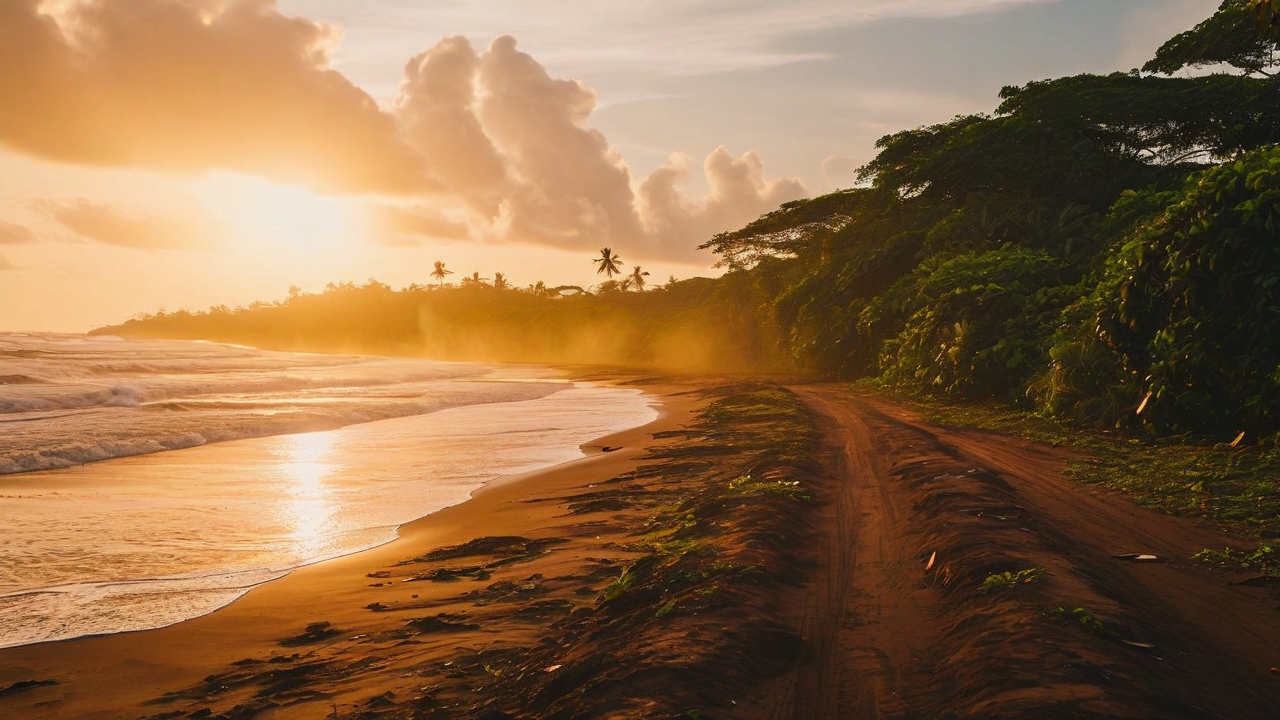
A tropical Atlantic beach at sunset with a red laterite track and coastal forest. That is an accurate picture of the Liberian coast — the surf, the sand, the laterite and the palms are all right. It contains no landmark that identifies it as Liberia specifically, which its caption says.
Jollof rice: accurate
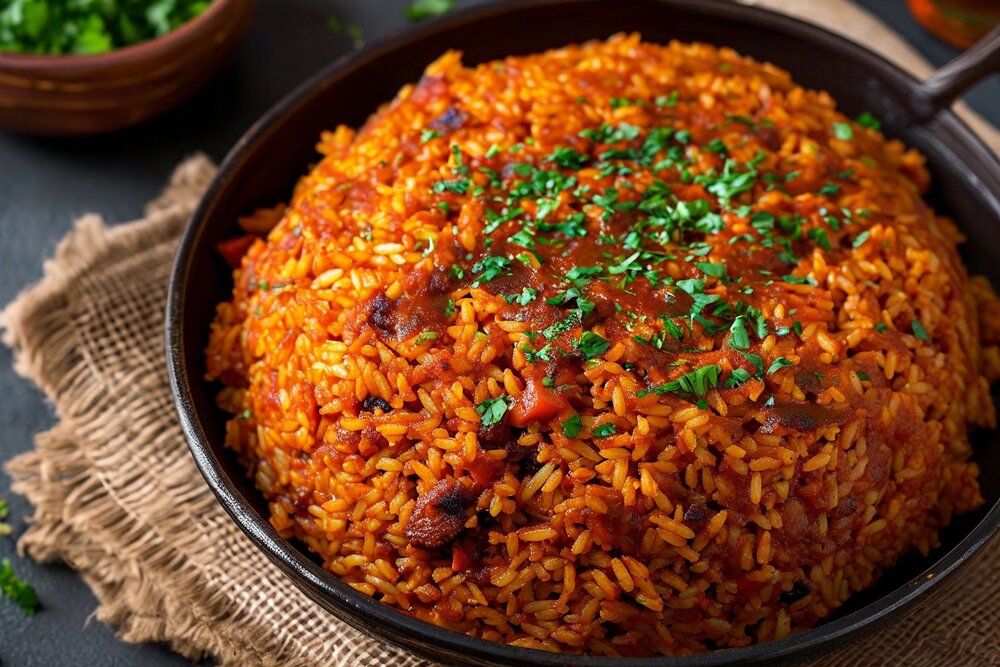
The best image in the set. Long-grain rice properly stained through with tomato and pepper rather than sauced on top, visible pepper pieces and the caught darker grains at the bottom of the pot that a good jollof is supposed to have. Only the chopped green garnish is styling.
Palm butter: used with corrections
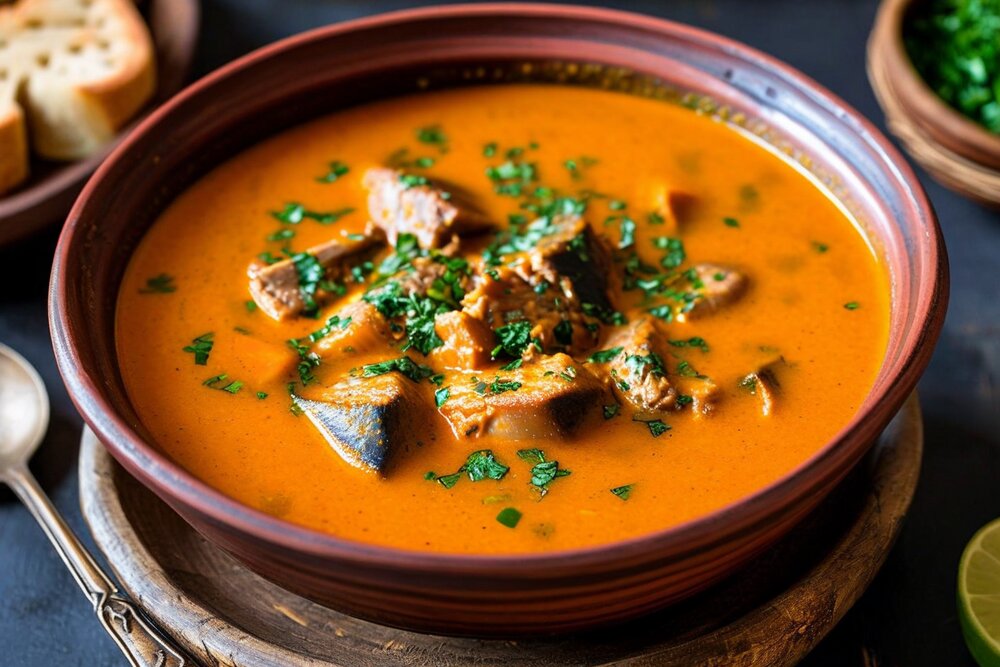
The colour and the fish-and-meat combination are right for palm nut soup. Its caption corrects two things: the bread at the side, since palm butter is eaten over rice and not with bread, and the fine herb garnish. A real bowl also shows more separated orange oil on the surface.
Rejected: the dumboy
liberia-dumboy.jpg shows six small crumbly balls that look like mashed potato in a thin greenish gravy. Dumboy is one large ball of pounded cassava per serving, smooth, glossy and elastic, sitting in soup and swallowed rather than chewed. The picture gets the number, the texture and the whole idea of the dish wrong, so it is described in the food section instead of shown.
Rejected: the beer, twice
liberia-drink.jpg shows a green bottle labelled CLUB beside a palm-wine demijohn under a thatched bar roof; the storage listing later produced a second one, club-beer.jpg, showing a brown bottle on a market table. Club Beer is a real Liberian brand and neither of these is its label: both crests are invented and both carry a garbled second line, reading as "CIUD" on one and "Cllub" on the other. Publishing a fabricated label of a real company’s product is the same error this factbook rejected for a Kenyan beer earlier, and the rule has to apply to all three. The settings — thatched bar, palm wine in a gourd, a market street — are entirely plausible; the bottles are not.
The rule this site applies is simple: an image that is merely imperfect gets a caption saying so; an image that would teach the reader something false gets dropped. Liberia has nine files, of which three are on this page. Two are fabricated labels of a real beer brand, one is the wrong dish under the name of dumboy, and three — filed as liberia-flatbread, liberia-sweet-treat and traditional-liberia-stew — are named after dishes that do not exist. We opened the stew: it is a generic brown meat-and-carrot stew with white rice, containing nothing recognisably Liberian, no palm oil and no cassava leaf. The other two carry the same invented-name pattern and were left alone.
Support This Project 🌍
This World Travel Factbook is a labor of love – free to use for all travelers. If you find it helpful, consider supporting its continued development.