

🇰🇿 Kazakhstan at a Glance
🌍 Overview
Kazakhstan is the ninth-largest country in the world — 2,724,900 km², bigger than all of Western Europe put together and larger than Argentina — with about 20.4 million people in it. That is roughly seven people per square kilometre. It is also the largest landlocked country on Earth, and the only one whose territory sits in two continents by the Ural River convention.
Most people cannot picture it, and that is the honest starting point. The image the name summons is either a film that Kazakhs are extremely tired of hearing about, or nothing at all. What is actually there: snow-capped 7,000 m peaks, a canyon that gets called a small Grand Canyon and deserves better, the world's only functioning crewed spaceport, a capital built from nothing on frozen steppe in twenty years, and the largest dry steppe on the planet.
The state
A presidential republic that rewrote its constitution in March 2026. Kassym-Jomart Tokayev has been president since 2019. The bicameral parliament was abolished and replaced by a single chamber, the Kurultai of 145 deputies, first elected on 23 August 2026. Real power is concentrated in the presidency, opposition is weak and heavily constrained, and the changes are officially presented as democratisation. See the politics section for what actually happened.
The people
About 20.4 million, of whom roughly 71% are ethnic Kazakhs and around 15% Russians, with Uzbeks, Ukrainians, Uyghurs, Tatars, Germans and Koreans making up much of the rest — a demography produced by deportations, famine and the Virgin Lands campaign. The Kazakh share has risen steadily since 1991 as Russians emigrated and Kazakh birth rates stayed higher. Almost the whole population lives in the south, the south-east and the north; the middle is close to empty.
The economy
By far the largest in Central Asia — roughly 60% of the region's GDP — and built on oil, gas, uranium and metals. Kazakhstan is the world's largest producer of uranium by a wide margin, holds enormous reserves of chromium, zinc and copper, and sits on the Tengiz, Kashagan and Karachaganak fields. The vulnerability is that around 80% of its oil exports leave through one pipeline across Russia, which has been repeatedly disrupted.
What visiting is like
Far easier than people expect. Czech and most European citizens enter visa-free, the cities are modern and safe, the food is generous, and the mountains an hour from Almaty are genuinely world-class. What is hard is scale: distances are continental, the interesting places are far apart, and doing Kazakhstan properly means either flying between regions or accepting very long drives.
🏷️ The Name and the Identity
Qazaq is an old Turkic word meaning something like free man, wanderer or one who has broken away — and it is the same root that produced the Russian Cossack. It described people who left a khan's authority to live independently on the steppe, which is exactly how the Kazakh khanate began. The -stan is Persian for place. The country is the place of the free people, and Kazakhs will tell you so.
The spelling
In Kazakh it is Qazaqstan. The English Kazakhstan comes through Russian, and the government has periodically pushed for the Q — the country's official English style is still Kazakhstan, but you will see Qazaqstan on state media and increasingly on signage. The alphabet is changing too: a long-running programme to move Kazakh from Cyrillic to a Latin script has been announced, redesigned and postponed repeatedly, with the current target somewhere around 2031.
The flag
A sky-blue field with a golden sun of 32 rays above a steppe eagle, and a vertical ornamental band at the hoist. The blue is the eternal sky of Tengri, the old steppe religion; the eagle is freedom and the vision of the state; the ornament is the traditional koshkar-muyiz, ram's horn. It is, by fairly wide agreement, one of the better national flags.
The three Juzes
Kazakh society was historically organised into three tribal confederations — the Great Juz in the south-east, the Middle Juz in the centre and north-east, and the Little Juz in the west. The division is centuries old, was reinforced by Russian administration, is officially irrelevant, and is still quietly present in politics, business networks and who marries whom. Kazakhs know their ru, their clan, and traditionally can recite seven generations of ancestors.
Two names for the capital
The city has been Akmolinsk, Tselinograd, Akmola, Astana (1998), Nur-Sultan (2019, after the first president) and Astana again (2022, after his fall from grace). Astana simply means "capital" in Kazakh, which is either admirably practical or a failure of imagination depending on who you ask. Older maps and older people still say Tselinograd.
🗺️ Geography — the Scale Problem
Kazakhstan is 3,000 km from west to east and about 1,700 km north to south. Its western edge is on the Caspian, in Europe by the usual convention; its eastern edge is in the Altai, deep in Asia and closer to Beijing than to its own western border. It borders Russia along 7,644 km — the longest continuous land border in the world — plus China, Kyrgyzstan, Uzbekistan and Turkmenistan.
The steppe
The defining landscape and about a third of the country: the western end of the Eurasian Steppe, a grassland belt that runs unbroken from Hungary to Manchuria. The Saryarka, the Kazakh Uplands in the centre, is a UNESCO natural site for its steppe and lakes. It is flat, enormous, treeless and — in May, briefly — covered in tulips, of which Kazakhstan is the wild ancestral home.
The mountains
The Tian Shan along the Kyrgyz and Chinese borders in the south-east, rising to Khan Tengri at 7,010 m (or 6,995 m if you exclude the ice cap — Kazakh and Kyrgyz sources differ, and it is a border peak). The Altai in the far east, shared with Russia, China and Mongolia. The Zhetysu Alatau between them. Almaty sits directly under a 4,000 m wall, which is why it has ski slopes twenty minutes from the city.
Deserts and the Betpak-Dala
Between the steppe and the mountains: the Kyzylkum and Muyunkum sands, and the Betpak-Dala, the "steppe of misfortune", a semi-desert the size of Britain with essentially nobody in it. This is where the saiga antelope calve and where a great deal of Soviet weapons testing happened, which are related facts.
Water, and the lack of it
The Caspian Sea in the west, which is falling fast. Lake Balkhash, 600 km long and geologically odd — fresh at its western end and saline at its eastern, divided by a narrow strait. The Aral Sea, or what is left of it. The Irtysh, Syr Darya, Ural and Ili rivers, most of which arrive from China, Kyrgyzstan or Uzbekistan and are therefore subject to somebody else's decisions upstream.
Climate
Sharply continental and brutal at both ends. Astana is the second-coldest capital city in the world after Ulaanbaatar, with January averages around −15 °C and readings below −40 °C on record; the same city passes 35 °C in July. The south is hot and dry, the mountains have their own weather, and the wind on the open steppe in winter is the thing that actually hurts. Spring and autumn are short.
Wildlife
The saiga antelope, a bulbous-nosed survivor of the Ice Age, is the great conservation story: poached and diseased down to around 21,000 animals in 2003, it recovered to well over two million by the mid-2020s and was downlisted from Critically Endangered — one of the most dramatic recoveries ever recorded. Also snow leopards in the Tian Shan, Przewalski's horses being reintroduced to the steppe, and the wild apple forests of the Zhetysu, which are the ancestral home of every apple on Earth.
💧 The Aral Sea — and the Half That Came Back
The destruction of the Aral Sea is usually cited as the worst man-made environmental catastrophe of the twentieth century. What is much less known is that Kazakhstan has partially reversed it, and that this is one of the genuinely encouraging environmental stories anywhere.
What was destroyed
In 1960 the Aral was the fourth-largest lake in the world, about 68,000 km². Soviet planners diverted the Amu Darya and Syr Darya — the two rivers that fed it — to irrigate cotton in Uzbekistan and Turkmenistan. By 2010 it had lost around 90% of its volume, split into separate basins, and the eastern lobe had dried completely. The fishing fleet at Aralsk and Moynaq was left standing in sand, which is the photograph everyone has seen.
The consequences
The exposed seabed — the Aralkum, a new desert of about 60,000 km² — carries salt and agricultural chemicals into dust storms that blow across the region and have been detected in Greenland ice. Local rates of respiratory disease, kidney disease, anaemia and infant mortality rose sharply. The climate moderating effect of the water vanished, making local winters colder and summers hotter. Twenty-four fish species were lost.
The Kokaral Dam
Kazakhstan's answer, completed in 2005 with World Bank support: a 13 km earth dam sealing off the northern basin so that the Syr Darya's flow refills it rather than draining south into the doomed larger lobe. It worked. The North Aral Sea's volume rose from about 18.9 km³ at the end of 2022 to roughly 23 km³ by the end of 2025, and the water ministry put it at about 23.5 km³ in July 2026. Fish came back, the fishing cooperative at Aralsk reopened, and the water has advanced kilometres towards the town.
What comes next
A proposed second phase would raise the dam and target roughly 34 km³ and a surface of about 3,900 km². Kazakhstan has also launched a wider water programme — reservoir repair, canal lining, metering — driven by the fact that most of its rivers originate abroad. The southern Aral in Uzbekistan is not recoverable and both governments say so; there the strategy is planting saxaul on the dry bed to hold the dust down.
The Caspian is next
Less publicised and arguably more serious. The Caspian Sea is falling — a combination of reduced Volga inflow, higher evaporation and climate change — and the shallow northern shelf where Kazakhstan's coast and the Kashagan oil field are is the part that goes first. Ports have needed dredging, the Caspian seal is in trouble, and the projections for the rest of the century are alarming.
Can you visit?
Yes, and it is a serious undertaking. Aralsk is reachable by train from Almaty or Astana on the line to Aktobe; from there local drivers run trips to the shore of the restored North Aral and to the ship graveyards. It is dusty, hot, poor and profoundly memorable, and going there puts money into one of the poorest parts of the country.
📜 Horses, Gold and the Steppe
Where the horse was domesticated
At Botai, in northern Kazakhstan, around 3500 BC — the site produced horse-milk residue in pottery, bit wear on teeth and corrals, and was long argued to be the earliest domestication anywhere. Ancient DNA work in 2018 complicated the story by showing Botai horses were ancestors of the Przewalski's horse rather than of modern domestic horses, so the current view is that horses were domesticated more than once. Either way it happened on this steppe, and it changed everything that followed.
The Scythians and the Golden Man
From about the eighth century BC the steppe belonged to the Saka, the eastern Scythians — mounted, gold-obsessed, ferociously good at metalwork. In 1969 a burial mound at Issyk near Almaty produced the Golden Man: a young warrior of the fourth century BC in a costume covered with over 4,000 gold pieces and a tall pointed headdress. It is Kazakhstan's national symbol, it is on the monument in the middle of Astana, and the original is in Almaty.
Turks, and the word Turk
The Turkic Khaganate of the sixth century — the first state to call itself Türk — ran from Manchuria to the Black Sea across this ground. The Silk Road ran through the south: Otrar, Taraz, Sayram. Islam arrived from the eighth century and took hold slowly, spread on the steppe less by conquest than by Sufi preachers, of whom Khoja Ahmed Yasawi was by far the most important.
Genghis Khan and Otrar
In 1218 the governor of Otrar, a rich Silk Road city on the Syr Darya, seized a Mongol trade caravan and executed its merchants as spies. Genghis Khan sent envoys; the Khwarazmian shah had them killed too. What followed was the Mongol invasion of Central Asia, the destruction of Otrar after a five-month siege, and the deaths of a very large share of the region's population. The ruins of Otrar are still there and still being excavated, and Kazakhs regard the episode as the most expensive diplomatic blunder in history.
The Kazakh Khanate
Founded in 1465 when two sultans, Kerei and Janibek, broke away from the Uzbek khan Abu'l-Khayr with their followers and set up on their own in Zhetysu — an act of secession that gave the people their name. The khanate lasted until the eighteenth century, split into the three Juzes, and produced a literature of oral epic, the zhyrau bards, and the code of laws known as the Zhety Zhargy.
The Dzungar catastrophe
The Aktaban Shubyryndy — the "Years of the Great Disaster", from about 1723 — when the Dzungar Mongols invaded from the east and drove the Kazakh Juzes off their pastures with enormous loss of life. It is the central trauma of pre-Russian Kazakh history, it produced the folk song Elim-ai that still makes people cry, and it is the reason the Little Juz asked the Russian Empire for protection in 1731 — a request that turned into two centuries of rule.
☭ Empire, Famine and the Test Site
Russian conquest
Protection became annexation. Through the eighteenth and nineteenth centuries the Russian Empire built forts across the steppe — Semipalatinsk, Ust-Kamenogorsk, Vernyi (later Almaty) — abolished the khans' authority in the 1820s and 1840s, and from the 1890s settled hundreds of thousands of Russian and Ukrainian peasants on land the Kazakhs had grazed. The 1916 revolt against conscription into labour battalions was suppressed with mass killing and drove perhaps 300,000 people into China.
The Asharshylyk
The single worst event in Kazakh history. Soviet collectivisation from 1929 forced nomads to settle and confiscated their herds; livestock numbers collapsed by around 90%. The resulting famine of 1930–33 killed an estimated 1.5 million people — something like 38–40% of the entire Kazakh nation, proportionally the worst famine death toll of any Soviet nationality — and drove hundreds of thousands more into China and Mongolia. Kazakhs became a minority in their own republic and did not become a majority again until after independence.
Deportations
Stalin used the empty steppe as a dumping ground. Volga Germans, Crimean Tatars, Chechens and Ingush, Koreans from the Far East, Poles, Greeks and others were deported here by the trainload. The camps of the Karlag system around Karaganda and ALZHIR, the camp for wives of "traitors to the motherland" at Akmol, are now museums and are among the most affecting places in the country. Modern Kazakhstan's multi-ethnic character is a direct product of this.
The Virgin Lands
Khrushchev's campaign from 1954 ploughed up 25 million hectares of northern Kazakh steppe for wheat and brought in another wave of Slavic settlers. It produced big harvests for a few years and then dust bowls, and it left the north demographically Russian — which is why the capital was later moved there, and why the region's status is watched nervously.
Semipalatinsk
The Soviet Union conducted 456 nuclear tests at the Semipalatinsk Polygon between 1949 and 1989, including 116 in the atmosphere, on an area the size of Belgium where around 1.5 million people lived. Nobody was evacuated for the early tests and some were deliberately monitored. The health consequences run through generations and are still being documented. The Nevada–Semipalatinsk movement, led by the poet Olzhas Suleimenov, forced its closure in 1991 — one of the few genuinely successful popular movements in Soviet history.
Baikonur
The world's first and largest operational spaceport, built in the desert near Tyuratam from 1955 and named after a village 300 km away to confuse Western intelligence. Sputnik launched from here in 1957 and Yuri Gagarin in 1961. Russia leases the complex from Kazakhstan until 2050 for about $115 million a year, and between the retirement of the Space Shuttle in 2011 and the first crewed Dragon flight in 2020 it was the only place on Earth from which humans could reach orbit.
🇰🇿 Independence and the Nazarbayev Era
The last to leave
Kazakhstan declared independence on 16 December 1991 — the last Soviet republic to do so, ten days before the USSR itself ceased to exist. Nursultan Nazarbayev, the republic's Communist Party first secretary since 1989, became president and stayed for twenty-eight years. The date is deliberately loaded: 16 December is also the anniversary of the Zheltoqsan protests of 1986, when Kazakh students demonstrated against Moscow's appointment of a Russian outsider to lead the republic and were violently dispersed.
Giving up the bomb
At independence Kazakhstan inherited the world's fourth-largest nuclear arsenal — around 1,400 warheads, plus the test site, the Semipalatinsk infrastructure and enough highly enriched uranium to matter. It gave all of it up, transferring the warheads to Russia and joining the Non-Proliferation Treaty by 1995 under the Budapest Memorandum, in exchange for security assurances. It remains the largest voluntary nuclear disarmament in history and Kazakhstan raises it, pointedly, whenever the subject of security guarantees comes up.
Moving the capital
In 1997 Nazarbayev moved the capital 1,200 km north from Almaty to a provincial city of 280,000 on frozen steppe. The official reasons were seismic risk in Almaty and central location; the widely assumed reason was to plant a Kazakh-majority capital in the Russian-majority north. Whatever the motive, it worked: Astana is now over a million people and the north's demography has shifted.
Oil, and the money
Foreign majors developed Tengiz from 1993 and the giant offshore Kashagan field — discovered in 2000, one of the largest finds in decades, and delivered years late and tens of billions over budget. Oil made the country by far the richest in Central Asia and also produced the pattern that defines it: enormous wealth, a state sovereign fund, extremely visible inequality, and a set of corruption cases that have run in courts from London to Brussels for two decades.
The handover that wasn't
Nazarbayev resigned as president in March 2019 and handed the office to Kassym-Jomart Tokayev, a career diplomat and former UN under-secretary — while keeping the chairmanship of the Security Council for life, the title Elbasy (Leader of the Nation), constitutional immunity, and the capital renamed after him. It was a managed succession of the kind Central Asia specialises in, and for three years it looked like it had worked.
🔥 January 2022 — Qandy Qantar
The pivot of modern Kazakh politics, and the event that turned a managed succession into a real transfer of power. Kazakhs call it Qandy Qantar, Bloody January.
What happened
On 2 January 2022 the price cap on liquefied petroleum gas — the fuel most cars in western Kazakhstan run on — was lifted and the price roughly doubled overnight. Protests began in Zhanaozen, an oil town in Mangystau with a long history of labour disputes, and spread across the country within days. By 5 January the protests in Almaty had turned violent: the city hall and the airport were seized and buildings burned.
What is disputed
Almost everything about the middle of it. Tokayev described an assault by "20,000 bandits" and "international terrorists", a claim for which no convincing evidence was ever produced; independent observers describe a genuine mass protest that was overtaken in Almaty by organised violence widely believed to be connected to an elite power struggle rather than to the demonstrators. The head of the security service, Nazarbayev's nephew-in-law Karim Massimov, was arrested days later and convicted of treason in 2023.
The response
Tokayev issued a shoot-to-kill order without warning and requested troops from the Russian-led CSTO, which deployed about 2,000 soldiers for roughly a week — the alliance's first-ever operational deployment. The official death toll was 238, including security personnel; human rights organisations documented torture in detention on a wide scale afterwards.
What it changed
Nazarbayev lost the Security Council chairmanship within days, his family lost their positions across the state and the economy, the Elbasy status was stripped, the capital was renamed back to Astana, and a June 2022 referendum removed his special constitutional privileges. Tokayev, who had been widely written off as a placeholder, emerged as the actual ruler. He then won a snap presidential election in November 2022 on a single seven-year term, non-renewable, which he presented as a permanent guarantee against another Nazarbayev.
The unfinished part
There has been no independent international investigation, the accounts of the violence remain contested, and prosecutions of security officers for the deaths have been limited. Kazakh civil society continues to press for one. This is a live and sensitive subject; visitors should be careful about how and where they raise it.
🏛️ Politics Now — 6 September 2026
📅 Checked 6 September 2026. Kazakhstan replaced its constitution in March and its parliament in August of this year. This section is two weeks old and is the newest thing on the page.
The new constitution
A referendum on 15 March 2026 approved a new constitution with about 90% in favour on a 73% turnout. Tokayev signed it on 17 March and it took effect on 1 July 2026. It rewrites roughly 84% of the 1995 text and introduces 95 new articles. The headline change: the bicameral parliament — Senate plus Mazhilis — is abolished and replaced by a single chamber.
The Kurultai
The new legislature is the Kurultai, named after the traditional steppe assembly: 145 deputies, five-year terms, elected entirely by party list with no single-member districts. The first election was held on 23 August 2026 with a turnout of 74.2% and about 9.35 million voters. Seven parties stood and no independent candidates were permitted, which is the detail that tells you most about the reform.
The result
Adilet — a new party that absorbed Amanat, itself the renamed successor of Nazarbayev's Nur Otan, and is led by Tokayev's former head of administration Aibek Dadebay — took 110 of 145 seats. The rest went to Auyl (10), Respublica (9), Aq Jol (8) and the OSDP (8). The government resigned when the new chamber first convened on 29 August 2026, as the constitution requires.
The term-limit question
In July 2026 the Constitutional Court ruled that the constitutional changes reset the clock on Tokayev's previous terms, which means the man elected in 2022 on an explicitly single, non-renewable seven-year mandate can stand again. Supporters present this as a technical consequence of adopting a new constitution. Critics point out that this is precisely the mechanism by which every long-serving Central Asian president has extended their rule, and that it undoes the central promise of 2022.
The pressure underneath
The reform arrived during a genuinely difficult economic moment: inflation at 10.2% in February 2026, tax increases, and public discontent that the authorities are visibly anxious about — the shadow of January 2022 hangs over every decision. Kazakh officials have been unusually explicit that avoiding a repeat is the organising priority.
Foreign policy
A careful multi-vector balancing act that has become much harder since 2022. Kazakhstan is in the Russian-led CSTO and Eurasian Economic Union, has publicly declined to recognise the annexation of Ukrainian territory and has complied with sanctions rules enough to irritate Moscow, is deepening ties with China through the Belt and Road, and is courting the EU, Turkey and the Gulf. The Middle Corridor trade route across the Caspian, bypassing Russia, is the strategic project everyone is watching.
💰 The Economy
Oil
Around a fifth of GDP and well over half of exports. Tengiz in the west, with roughly 11.5 billion barrels recoverable and about 40% of national output; Kashagan, offshore in the shallow northern Caspian and one of the most technically difficult fields ever developed; Karachaganak, gas and condensate. All three are run by consortia of Chevron, ExxonMobil, Eni, Shell and Lukoil with the state company KazMunayGas — an arrangement that has been renegotiated and litigated for thirty years.
The pipeline problem
About 80% of Kazakh oil exports leave through the CPC pipeline to Novorossiysk on the Russian Black Sea coast — a single route through a country at war. In 2025 and 2026 the CPC's infrastructure has been repeatedly hit by Ukrainian drone attacks, and a power failure halted Tengiz. On 25 August 2026 Kazakhstan cut its production forecast for the year from 98 to 96 million tonnes, with losses from the attacks put at about 3.5 million tonnes. Diversifying — via the Caspian, Azerbaijan and Turkey, or via China — is now an existential economic project rather than a preference.
Uranium and metals
Kazakhstan is the world's largest uranium producer by a very wide margin, supplying something over 40% of global output through the state company Kazatomprom, mostly by in-situ leaching. It is also a major producer of chromium, zinc, copper, titanium and, increasingly, the raw materials for batteries. The country is building its first nuclear power plant after a 2024 referendum approved it; the contract went to Russia's Rosatom, which Tokayev frames as completing a full domestic fuel cycle and critics frame as a new dependency.
Everything else
Grain — Kazakhstan is one of the world's larger wheat exporters, a legacy of the Virgin Lands. Livestock. A fast-growing fintech and IT sector centred on the Astana International Financial Centre, which runs on English common law with its own court and was designed to attract capital that would not otherwise come. And transit: the country sits on the land route between China and Europe and has invested heavily in the railways and the Caspian ports to exploit it.
🏙️ Astana
A capital city built almost from scratch on empty frozen steppe since 1997, now home to well over a million people. Astana is not beautiful in any conventional sense and it is one of the most interesting cities in the world to walk around, because it is an unfiltered statement of what a state wanted to say about itself, executed at speed and without a budget constraint.
The axis
The whole left bank is a planned ceremonial axis, largely masterplanned by Kisho Kurokawa. At one end the Ak Orda presidential palace, then the Baiterek tower — a 97 m stylised poplar holding a golden egg, referencing the Samruk bird of Turkic myth and the year the capital moved — then the shopping mall shaped like a tent, the Khan Shatyr by Norman Foster, which is 150 m tall and contains a beach with sand flown in from the Maldives. It is exactly as strange as it sounds.
The other buildings
Foster also did the Palace of Peace and Reconciliation, a 62 m glass pyramid built to host a triennial congress of world religions. The Nur-Astana and the vast new Grand Mosque (2022), one of the largest in Central Asia. The National Museum, which is genuinely excellent and holds the Golden Man replica and the best account of Kazakh history you will get anywhere. The Astana Opera. And the EXPO 2017 site, whose giant glass sphere is now a museum of future energy.
The cold
Astana is the second-coldest capital in the world. January averages around −15 °C with regular spells below −30 °C and a wind off the steppe with nothing to stop it. The city is built for it — heated underpasses, enclosed walkways, the mall as social space — and visiting in January is a genuine experience, but you need proper clothing rather than a good coat.
What is actually good
The right bank, the old Tselinograd, which is low-rise, Soviet, tree-lined and where people actually live. The National Museum. The ALZHIR memorial at Akmol, 40 km out, on the site of the camp for the wives of "traitors" — small, quiet and devastating. And the steppe itself, which starts abruptly at the edge of town and which almost no visitor bothers to walk into.
Practical
The airport is 15 minutes from the centre. The city is laid out for cars and the distances on the ceremonial axis are much longer than they look on a map — use taxis, which are cheap, or the app. Hotel prices spike whenever there is a summit, which is often. Two days is enough unless you are using it as a base for the northern steppe and the lakes at Burabay, which is worth a night.
🏔️ Almaty and the Mountains
The former capital, the largest city with about 2.2 million people, and by a distance the more likeable of the two. Almaty sits at 700–900 m directly beneath the Trans-Ili Alatau, a wall of 4,000 m peaks that is visible from most streets and that puts snow, alpine lakes and a ski resort within an hour of the centre.
The city
Tree-lined, walkable and green, laid out on a grid that slopes downhill from the mountains — which means you can always orient yourself by looking for the peaks. Panfilov Park with the wooden Zenkov Cathedral, built in 1907 without nails and one of the tallest wooden buildings in the world, which survived the 1911 earthquake that flattened the rest of the city. The Green Bazaar for horse sausage, dried fruit and a great deal of shouting. The Central State Museum, where the original Golden Man is.
Up the hill
Kok-Tobe, the hill above town, by cable car, with a Beatles statue for reasons that are locally explained at length. Medeu, the world's highest large speed-skating rink at 1,691 m, where dozens of world records were set. Above it Shymbulak, the ski resort, reachable by gondola, with a season roughly December to April. Then Big Almaty Lake, a turquoise reservoir at 2,510 m, forty minutes from town and one of the most photographed places in the country.
Charyn Canyon
About three hours east: a 154 km canyon on the Charyn river, of which the Valley of Castles — a 2 km section of eroded red sandstone towers up to 300 m deep — is what everyone comes for. It is regularly and lazily called "the little Grand Canyon", which undersells it. Nearby is a relict ash grove of a species that survived the last ice age here and almost nowhere else.
The Kolsai lakes and Kaindy
Further east and the best two days in Kazakhstan. The three Kolsai Lakes are staircased up a spruce valley at 1,800–2,850 m, with homestays at the first one and a walk between them. Nearby Lake Kaindy, formed by a landslide in 1911, has a submerged spruce forest whose bare trunks still stand out of the water like spears — the single most photographed image in Kazakh tourism, and genuinely as odd as it looks.
Tamgaly and the steppe west
Tamgaly, a UNESCO site 170 km north-west of Almaty, holds around 5,000 petroglyphs in a gorge, the oldest from the Bronze Age, including the famous "sun-headed" figures. It is a straightforward day trip and it is almost empty. The Altyn-Emel national park beyond it has the Singing Dune, which hums audibly when the sand slides, and the Aktau multicoloured hills.
Practical
Almaty is where nearly every visitor should start: the airport has the most international connections, the mountains are immediate, and the tour operators for everything else are here. The metro is small but works. Apps (Yandex Go, inDrive) are how everyone moves. And the apples: Almaty means "apple-ful", the wild ancestor of the domestic apple, Malus sieversii, grows in the hills above the city, and the genetic origin of every apple in the world is a forty-minute drive from the centre.
🕌 Turkestan, Shymkent and the Silk Road South
Turkestan
The spiritual capital of the Turkic world and the country's most important building. The Mausoleum of Khoja Ahmed Yasawi was commissioned by Timur in 1389 over the grave of the twelfth-century Sufi poet whose Divan-i Hikmet did more than anything else to bring Islam to the Turkic steppe. Timur died before it was finished, so it stands unfinished — the entrance portal is bare brick with the scaffolding sockets still visible, which is precisely what makes it a textbook of Timurid construction. UNESCO listed it in 2003.
What else is at Turkestan
The town has been rebuilt at speed as a religious-tourism destination, with a new airport, a vast "Karavansaray" complex and hotels, which is either impressive or overdone depending on taste. Nearby: Otrar, the ruined Silk Road city whose governor triggered the Mongol invasion; Sauran, a walled medieval town in the desert; and Arystan Bab, the mausoleum of Yasawi's teacher, which pilgrims visit first by convention.
Shymkent
The third city, close to the Uzbek border, hot, green and much more Central Asian in feel than Almaty or Astana — this is where the country stops being steppe and starts being Silk Road. It has a big bazaar, a strong Uzbek minority and the best food in Kazakhstan by a margin that locals will defend at length. It is the natural base for Turkestan, Sayram and the Aksu-Zhabagly reserve.
Aksu-Zhabagly
Kazakhstan's oldest nature reserve, founded in 1926, in the western Tian Shan and a UNESCO site. Deep canyons, snow leopards that almost nobody sees, bears, and — in April — the Greig's tulip, a wild scarlet tulip the size of a fist that carpets the slopes. Kazakhstan is the wild homeland of the tulip and this is where you go to see it.
Taraz and the Karakhanids
One of the oldest cities in Kazakhstan, on the Silk Road and mentioned by Chinese sources in the seventh century. The eleventh-century Aisha Bibi mausoleum outside it, covered in carved terracotta tiles, is small, exquisite and attached to a love story that every Kazakh knows. The city itself is not much, but the mausoleums are worth the stop between Shymkent and Almaty.
🏜️ Mangystau and the Caspian West
The west is a different country: no mountains, no steppe grass, no trees, and a landscape of chalk cliffs, salt flats and eroded rock that looks like a planet somebody else designed. Mangystau is the most spectacular region in Kazakhstan and the least visited, and it needs a 4×4 and a guide.
Bozzhyra
The image everyone eventually sees: a vast chalk amphitheatre where the Ustyurt plateau breaks off, with white fangs of rock rising out of the floor — a seabed from the Tethys Ocean, now 200 m above a plain that was itself once under water. Camping there overnight is the thing to do, and the drive in is long, rough and worth it.
The rest of Mangystau
Torysh, the "valley of balls", a plain covered in spherical concretions. Sherkala, a solitary yurt-shaped mountain. The Tuzbair salt flat under a white escarpment. Karagiye, a depression at 132 m below sea level, one of the lowest points in Asia. And the underground mosques — Beket-Ata, Shakpak-Ata, Sultan-Epe — carved into chalk cliffs, still active pilgrimage sites, where you should behave as a guest rather than a photographer.
Aktau
The regional capital, a Soviet planned city on the Caspian built for the uranium and oil industries, with no street names — addresses are microdistrict, block and flat number, which visitors find surreal. It was once powered by a fast-breeder nuclear reactor that also desalinated the city's water. It is the gateway to Mangystau and to the Caspian ferry across to Azerbaijan, and it has beaches.
Atyrau and the oil coast
Atyrau, on the Ural river delta at the top of the Caspian, is the oil capital — expensive, functional and full of expatriate engineers — and the city where you can stand with one foot in Europe and one in Asia on a bridge over the river. Nearby is where the Caspian seal, the only marine mammal in the sea and now endangered, hauls out.
Baikonur, from the outside
The cosmodrome is in Kyzylorda region but is leased to and administered by Russia, which means visiting requires a permit arranged weeks in advance through an accredited operator, and the town of Baikonur is effectively Russian territory with its own checkpoints. Launch tours exist and are expensive. Whether launches continue at the current rate through the 2030s is an open question, and the lease runs to 2050.
🌲 The North, the East and the Steppe Reserves
Burabay
The "Kazakh Switzerland", 250 km north of Astana: pine forest, granite outcrops and a cluster of lakes in the middle of flat steppe. It is where the country goes on holiday, it is busy in summer and it has good walking, and the strange rock called Zhumbaktas in the lake is on every domestic postcard. It is not Switzerland, and expecting it to be is the mistake.
Saryarka
A UNESCO natural site covering the Korgalzhyn and Naurzum reserves — steppe and freshwater and saline lakes that sit on a major migration flyway. Korgalzhyn, a couple of hours from Astana, holds the northernmost breeding colony of greater flamingos in the world, which is a genuinely surprising thing to find on the Kazakh steppe, plus enormous numbers of migrating waterfowl in spring and autumn.
Karaganda and the camps
Karaganda is a coal city built substantially by prisoners and deportees, and the surrounding area was the Karlag, one of the largest camp complexes of the Gulag. The museum at Dolinka, in the former camp administration building, is unsparing. Along with ALZHIR near Astana, it is the place to understand what the twentieth century did to this country and to the many nationalities deported into it.
Semey and the Polygon
Semey — formerly Semipalatinsk — is a handsome nineteenth-century river city where Dostoevsky spent five years in exile after his prison sentence, with a good museum in the house he lived in. It is also the gateway to the Polygon, the nuclear test site, parts of which can be visited with permits and a guide. The Stronger than Death monument in the city is one of the more powerful pieces of public sculpture in the former Soviet Union.
The Altai
The far east, where Kazakhstan meets Russia, China and Mongolia: forested mountains, fast rivers, and a landscape completely unlike the rest of the country. Katon-Karagay national park is the largest in Kazakhstan and has hot springs, the Berel Scythian burial mounds where frozen horse burials were excavated, and views of Belukha (4,506 m) across the Russian border. Infrastructure is thin and this is expedition rather than sightseeing.
Eagle hunting
Berkutchi — hunting with golden eagles from horseback — is a genuine living tradition in eastern Kazakhstan and among the Kazakh community in western Mongolia, and it is on UNESCO's intangible heritage list. Festivals are held in winter around Nura and in the Altai. Beware the version staged for coach parties; the real thing involves cold, distance and a bird that weighs six kilos.
🏛️ UNESCO and the Steppe Heritage
Khoja Ahmed Yasawi (2003)
The unfinished Timurid mausoleum at Turkestan, described above — the first Kazakh inscription and the country's single most important monument. Listed both for the building and as an experimental precursor of the architecture Timur went on to build at Samarkand.
Tamgaly (2004)
The petroglyphs in the Tamgaly gorge north-west of Almaty: around 5,000 carvings from the Bronze Age onwards, including the distinctive "sun-headed" deities, in a landscape with settlements, burials and altars that shows continuous ritual use over three thousand years.
Saryarka (2008)
Steppe and lakes of northern Kazakhstan — the Naurzum and Korgalzhyn reserves — inscribed as a natural site for the wetlands on the Central Asian flyway and for the surviving dry steppe ecosystem, including the saiga.
Western Tian Shan (2016)
A transnational site shared with Kyrgyzstan and Uzbekistan, including Aksu-Zhabagly and Karatau: mountains of exceptional biodiversity and the wild ancestors of a striking number of cultivated fruits — apple, apricot, walnut, plum.
Silk Roads: Chang'an–Tianshan corridor (2014)
A transnational serial site with China and Kyrgyzstan taking in eight Kazakh sites — Otrar, Talgar, Aktobe, Kayalyk, Karamergen and others — the caravan cities and staging posts of the northern Silk Road.
Cold Winter Deserts (2023)
The transnational cold desert site shared with Turkmenistan and Uzbekistan, covering parts of the Kazakh deserts. Kazakhstan also has substantial intangible heritage listings: the dombra and its kuy repertoire, eagle hunting, the making of the yurt, the Nauryz spring festival and the game of kokpar.
🍖 Food
Kazakh cooking is nomad cooking: meat, dairy, boiled dough and bread, built for a climate that swings 70 degrees a year and for a life in which the food had to travel on the hoof. It is generous, heavy, and best understood as hospitality rather than gastronomy — the point of a Kazakh table is that there is far too much on it.
Beshbarmak
The national dish, and the centre of every celebration. Boiled horse or lamb, laid on a bed of wide flat squares of boiled dough called kespe, with onions cooked in the broth (tuzdyk) poured over, served on one large communal platter. The name means "five fingers" because it is eaten by hand. There is a protocol: the host distributes cuts by seniority, and the sheep's head goes to the most honoured guest, who is expected to carve it and hand out specific parts to specific people. A clear broth, sorpa, is drunk from a bowl afterwards.
Horse and the sausages
Horse is not a curiosity here, it is the prestige meat. Kazy is horse rib sausage, shuzhuk the general term, zhaya and karta other cuts, all cured and boiled and sliced thin. If you are squeamish about it, say so early and quietly; if you are not, this is the thing to try, and the Green Bazaar in Almaty is where to buy it.
Dough and dumplings
Manti, large steamed dumplings of minced lamb and onion, eaten with sour cream and black pepper. Samsa, baked pastries from a tandyr oven. Lagman, hand-pulled noodles with meat and vegetables, Uyghur in origin and everywhere. Baursak, deep-fried squares of dough that appear on every table at every occasion, sweet or plain, and which no Kazakh gathering happens without.
Dairy
The steppe's core technology. Kurt, hard salty balls of dried strained yoghurt that keep for years and are the original travel food. Kaymak, thick clotted cream. Irimshik, dried curds. Sarymai, clarified butter. And the drinks, which get their own section: kumis from mares and shubat from camels.
The other cuisines
Kazakhstan eats a great deal that is not Kazakh: Uzbek plov and samsa, Uyghur lagman and laghman, Russian pelmeni, borscht and salads, Korean salads — morkovcha, spiced carrot, was invented by deported Koreans in Central Asia and is now sold in every bazaar in the former USSR. Dungan and Tatar food too. In the cities you will eat all of this in a week.
Practical
Portions are large and refusal is difficult. Tea is constant, drunk with milk in the Kazakh style and topped up in small amounts so the host keeps serving you. Bread — nan or lepyoshka — is respected: do not put it upside down, do not throw it away. Vegetarians will find it hard outside the big cities; the honest advice is to lean on the Korean salads, the dairy and the bread.
👨🍳 Two Recipes
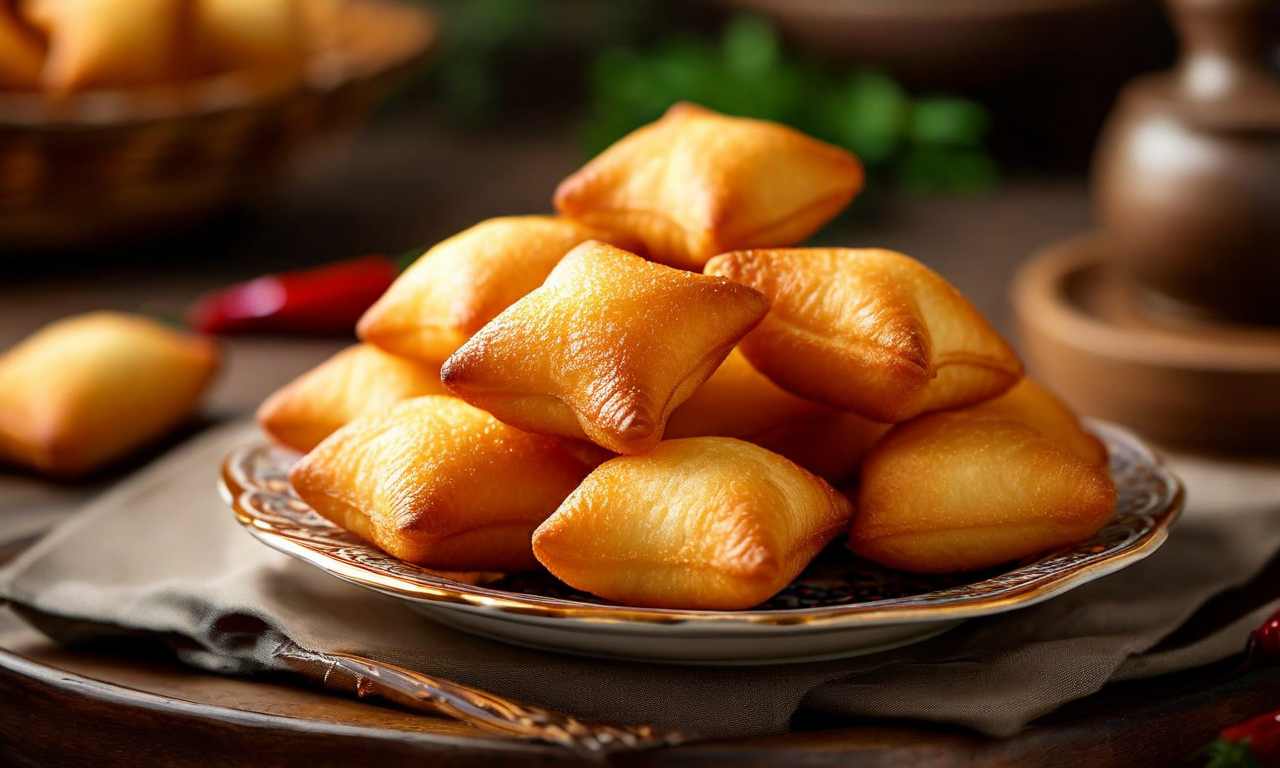
Baursak
Kazakhstan · makes about 40 · 2 hours including two rises · a deep pan and a slotted spoon
Ingredients: 500 g plain flour · 250 ml milk, warm · 1 egg · 50 g butter, melted · 7 g dried yeast (or 20 g fresh) · 1 tbsp sugar · 1 tsp salt · neutral oil or, traditionally, rendered fat for deep frying.
Method: Warm the milk to blood heat, stir in the sugar and yeast and leave 10 minutes until it foams. Add the egg, the melted butter and the salt, then work in the flour to a soft, slightly tacky dough and knead 8–10 minutes until smooth. Cover and rise 1 hour until doubled. Knock back, roll out to about 1 cm thick and cut into 4 cm squares or diamonds. Let the cut pieces rest 15–20 minutes — this is the step people skip and it is why their baursak come out flat. Fry at 170–175 °C, a few at a time so the oil stays hot, turning once, for about 2 minutes until deep gold and hollow-sounding. Drain on paper.
💡 The dough should be softer than you think — a stiff dough gives dense baursak. Do not crowd the pan, and do not roll thinner than a centimetre or they will not puff. Eaten warm with tea and butter, with kaymak, or dipped in honey; and they keep a couple of days, though nobody has ever tested this properly.
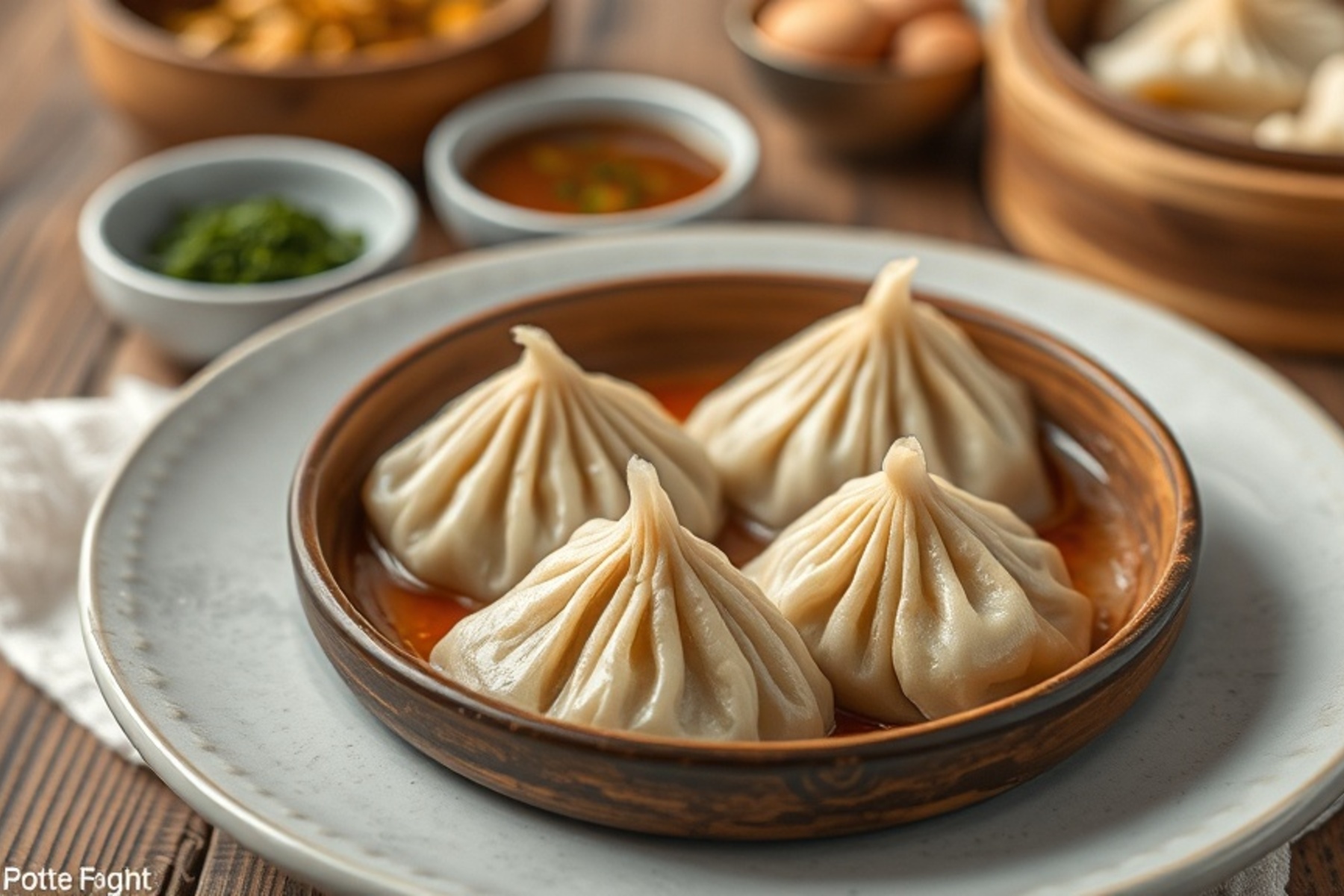
Manti
Kazakhstan and Central Asia · makes about 20 · 1½ hours · a stacked steamer is ideal, a bamboo one works
Ingredients: Dough: 400 g plain flour · 180 ml water · 1 egg · 1 tsp salt. Filling: 500 g lamb, hand-chopped rather than minced, with some fat left on (mutton or beef also work) · 3 onions, chopped as finely as you can bear · 100 g pumpkin, diced small — this is the Central Asian touch and it matters · 1 tsp cumin · salt and a great deal of black pepper · 50 g butter, cut into small cubes. To serve: melted butter, sour cream (smetana), black pepper, and optionally a tomato-and-onion sauce.
Method: Make a firm dough with the flour, water, egg and salt, knead 10 minutes and rest it under a cloth for 30 minutes. Mix the chopped lamb, onion, pumpkin, cumin, salt and pepper — do not use a food processor, the texture is the whole difference between manti and a meatball. Roll the dough very thin and cut 10–12 cm squares. Put a heaped spoon of filling and a cube of butter in each, bring the four corners up to meet, pinch the seams, then join the four resulting points to each other to make the closed purse. Oil the steamer trays, arrange without touching, and steam 40–45 minutes.
💡 Two rules. The onion must be at least as much as feels sensible and chopped fine, because it is what makes the filling juicy. And the dough must be thin — you should almost see the filling through it — but not so thin it splits, because the juice inside is the point and losing it into the steamer is the standard disaster.
🥛 Kumis, Shubat and What Is Drunk
Drinking kumis
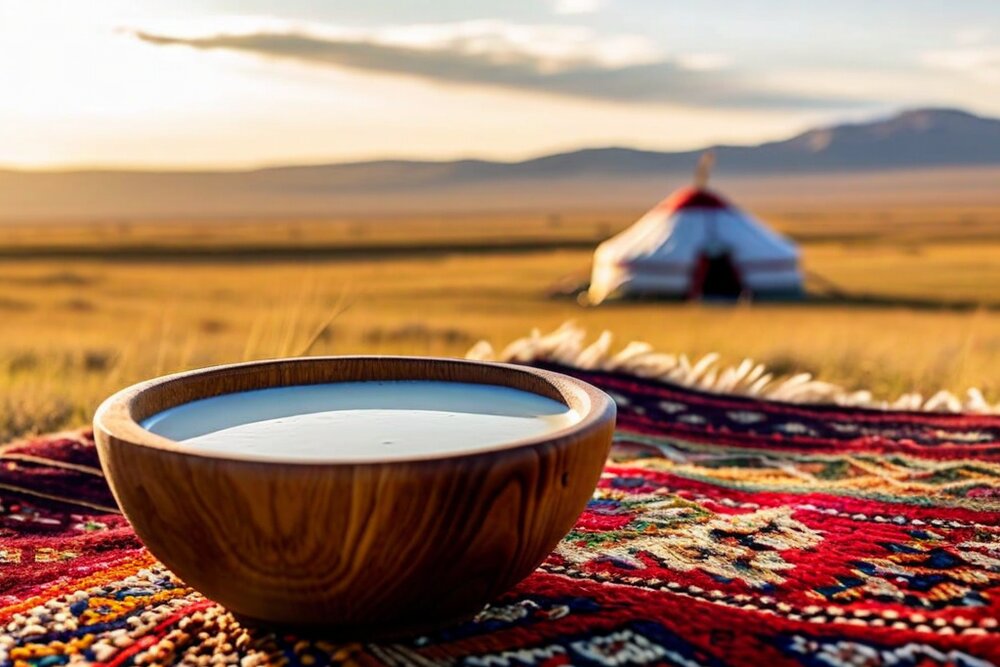
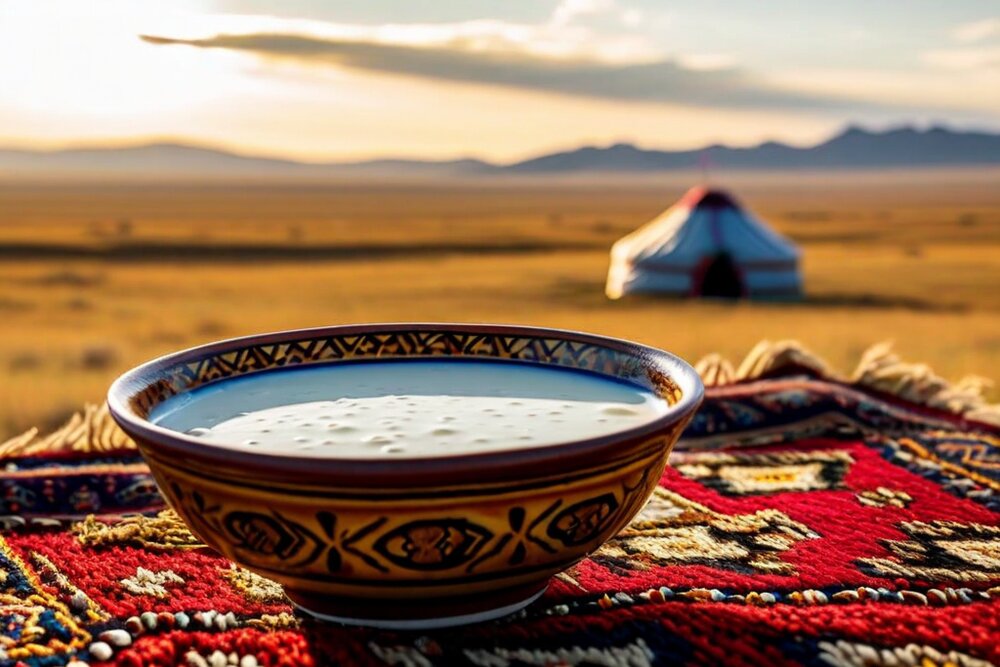
Season is roughly May to September when the mares are in milk. It is sold in bazaars in plastic bottles and served in bowls at any celebration. Expect it to taste like nothing you have had — sour, slightly effervescent, faintly alcoholic and with a long finish that people either take to immediately or not at all. Start with a small bowl; it is a live fermented product and a litre on a first encounter is a mistake with consequences.
Shubat
The camel-milk equivalent, from the south and west where camels are kept, thicker and richer than kumis and higher in fat. It is also credited with a long list of health properties, some of which have actual literature behind them. Camel milk unfermented is sold too, and is sweeter than cow's milk.
Tea
Kazakhstan drinks an extraordinary amount of tea — black, with milk, sometimes with butter or cream, and poured into small bowls or cups only a third full so that the host can keep refilling and the guest is never alone with a full cup. Filling a guest's cup to the brim is a subtle way of saying you would like them to leave, which is a piece of etiquette worth knowing in both directions.
Alcohol
Kazakhstan is a Muslim-majority country with a thoroughly Soviet drinking culture, and the result is that alcohol is legal, cheap and widely consumed. Vodka and brandy (the Kazakh and Armenian ones are decent), local beer, and — genuinely — wine: there is viticulture in the south-east around Almaty and the Assa valley and in the south near Shymkent, with a handful of producers making respectable dry reds and whites. Toasting at a table is formal, sequential and long; if you do not drink, say so at the start and it will be respected.
Practical
Tap water is not recommended for drinking anywhere; bottled is universal and cheap. Coffee culture in Almaty and Astana is now excellent and would not embarrass a European capital. And a warning about drink-driving: Kazakhstan has a zero-tolerance limit and the penalties are severe.
💡 Culture, Etiquette and the Yurt
Hospitality
The organising social value, and it is not decorative. A guest is qonaq and the obligations are traditional and specific: feed them first, ask questions later, give them the best place. Being invited home is likely and refusing is difficult. Bring something — sweets, fruit, a bottle if they drink — and expect the table to hold four times what anyone can eat. Do not offer money; it insults the transaction.
The yurt
The kiiz üy, felt house: a lattice frame (kerege), roof poles (uyq) and a crown (shanyraq), covered in felt, erectable in about an hour and warm at −30 °C. The shanyraq is the family symbol, appears on the national coat of arms, and is inherited by the youngest son. Inside, the space is organised: the honoured place (tör) is opposite the door, men to one side, women and the kitchen to the other. Yurt-making is on the UNESCO intangible list.
Table manners and the sheep's head
At a formal meal the besbarmak platter arrives and the host distributes. If you are given the sheep's head (bas) you are being honoured and are expected to carve it and distribute parts by convention — an ear to a young person to make them listen, the palate to someone eloquent, and so on. If that is beyond you, say so warmly and let the host do it; nobody will mind, and pretending otherwise will be worse.
Basic etiquette
Shake hands with men (both hands, or right hand with left touching the forearm, for respect); do not offer to shake a woman's hand unless she offers first. Take shoes off indoors. Do not step over someone or over food. Accept tea. Use your right hand for giving and receiving. Age is respected explicitly and visibly — stand for older people, let them speak first, do not interrupt.
Music and the dombra
The dombra, a two-stringed long-necked lute, is the national instrument and the vehicle for kuy, short instrumental pieces that are narrative — each tells a specific story that a Kazakh audience knows. Kurmangazy is the great nineteenth-century composer and his Adai is something like an unofficial anthem. Also throat singing in the east and the kobyz, a bowed instrument with a shamanic history.
Sport and the horse
Kokpar — the Central Asian game in which horsemen contest a headless goat carcass — is played seriously and is on the UNESCO list. Kyz kuu, "girl chasing", and audaryspak, mounted wrestling, appear at festivals. Beyond horses: Kazakhstan is very good at boxing and weightlifting, has a strong cycling tradition through the Astana team, and the national football side is in UEFA, which produces some geographically confusing fixtures.
🗣️ Kazakh, Russian and the Alphabet Question
Two languages, in a relationship that is the country's most delicate everyday subject. Kazakh is the state language; Russian has the constitutional status of an official language used alongside it. In practice which one dominates depends on where you are, how old the speaker is, and what the conversation is about.
Kazakh
A Turkic language of the Kipchak branch, closely related to Kyrgyz and Nogai and mutually intelligible with them to a degree. Agglutinative, with vowel harmony and no grammatical gender, and — for a Czech speaker — structurally unlike anything familiar, though the pronunciation is not hard. Roughly 13 million speakers, including large communities in China, Uzbekistan, Russia and Mongolia.
Russian
Still the lingua franca of business, science and much of urban life, and the first language of a large minority including many ethnic Kazakhs in the north and in the cities. The share of the population that speaks Kazakh has risen sharply since independence through schooling and demographic change, and the state pushes it steadily. In Almaty and Astana you will hear both in the same conversation, often in the same sentence.
The alphabet
Kazakh has been written in Arabic script, then Latin (1929–40), then Cyrillic (from 1940), and is now scheduled to return to Latin. The change was announced in 2017 with a target of 2025, the proposed alphabet has been revised at least four times over how to handle Kazakh's extra vowels, and the timeline has slipped to somewhere around 2031. For a visitor this means signage is currently a mixture, and both scripts are worth being able to half-read.
Getting by
English is common among young people in Almaty and Astana, in hotels and in the tourism business, and thin elsewhere. Russian will get you further in most practical situations, and any Czech speaker who has a little Russian will find it disproportionately useful. Translation apps work well for Russian and less well for Kazakh.
Ten words
Salemetsiz be — hello (formal). Rakhmet — thank you. Iya / joq — yes / no. Qansha turady? — how much? Kesirinizben — excuse me. Dämdi — delicious. Sau bolynyz — goodbye. Jaqsy — good. Su — water. Qonaq — guest, which is the word the whole culture turns on. Using rakhmet instead of spasibo is a small choice that is noticed and appreciated.
A sensitivity
Which language you address someone in is read as a statement, especially in the north and especially since 2022. The safe approach is to start in English, let them choose, and follow. Do not assume that an ethnic Kazakh speaks Kazakh or that a Russian speaker is Russian — both assumptions are wrong often enough to cause offence.
📅 When to Visit
May–June
The best window overall. The steppe is green and briefly covered in wild tulips — April in the south at Aksu-Zhabagly, May further north — the mountain passes open, Charyn and the Kolsai lakes are accessible, and it is warm without being brutal. Nauryz, the spring new year, falls on 21–23 March and is the biggest festival of the year, with yurts in the city squares and a great deal of food.
July–August
Hot — 35 °C and above in the south, Almaty uncomfortable at midday — but this is the season for the high mountains, for kumis, and for the far east. The steppe browns off and the western deserts are genuinely dangerous in the heat. Domestic holiday traffic peaks and prices at Burabay and the lakes go up.
September–October
Quietly excellent. September in the mountains is close to perfect — clear, warm days, cold nights, the Kolsai and Kaindy forests turning — and the crowds have gone. October is the last comfortable month before winter arrives properly, and it is the best month for Mangystau in the west.
November–March
Long and hard. Astana in January is one of the coldest inhabited places you can casually fly to, and the steppe wind is the real problem rather than the temperature. Against that: skiing at Shymbulak from December, eagle-hunting festivals in the east, snow-covered Astana as a genuine spectacle, and very low prices. Go if you are equipped for it and not if you are not.
Nauryz and the calendar
Nauryz Meyramy, 21–23 March, is the Persian and Turkic new year and is celebrated seriously across the country — it is the best time to see traditional food, games and music without it being staged for tourists. Other dates: Constitution Day 30 August, Republic Day 25 October, and Independence Day on 16 December, which carries the double meaning described above.
Practical timing
Mountain roads to the Kolsai lakes and the high passes are generally clear from May to October. Mangystau is best in April–May and September–October and should be avoided in July. Kumis is a summer product. And if you want the tulips, that is a two-to-three-week window in April and you need to plan the trip around it rather than hope.
🚆 Getting Around a Country This Size
The single planning fact about Kazakhstan is that Almaty to Astana is 1,200 km, Almaty to Aktau is 2,700 km, and Almaty to Mangystau by road is a three-day drive across empty semi-desert. Underestimating this is the most common mistake visitors make.
Flying
The practical answer for anything beyond one region. Air Astana and its low-cost arm FlyArystan, plus SCAT and Qazaq Air, connect all the regional centres several times a day, and fares are cheap by European standards. Almaty–Astana takes 1h40 and is a shuttle. If your trip includes Almaty, Astana and the west, fly between them and do not attempt otherwise.
Trains
Genuinely good and genuinely slow, and one of the better experiences in the country. Talgo services run Almaty–Astana overnight in about 12–13 hours in comfortable sleepers, and there are long-distance trains to Aktobe, Atyrau, Aktau, Shymkent and beyond, some taking two or three days. Book through the KTZ app or website. The compartments are sociable in the Soviet manner and you will be fed by strangers.
Driving
Main roads between the big cities are now good — the Almaty–Astana and Almaty–Shymkent highways are modern toll roads. Away from them, quality varies enormously and drops to gravel and worse. Distances between fuel stops in the west and centre are serious, and mobile coverage is not continuous. Do not drive Mangystau without a 4×4, a second vehicle or a guide, spare fuel and water. An International Driving Permit is required alongside a Czech licence.
Taxis and apps
Yandex Go and inDrive work in every city and are how everyone gets around; inDrive lets you name your own fare, which is normal here. Informal taxis — flagging any passing car — remain common and are how a lot of intercity travel happens, though a foreign visitor is better off with the apps. City buses are cheap and use contactless cards.
Tours
For Mangystau, the Aral, Baikonur, the Altai and the Polygon you will need an operator: permits, vehicles and local knowledge are not optional in any of them. Almaty has a good selection of small operators running trips to Charyn, Kolsai, Kaindy and Altyn-Emel as day trips or two-day runs, and these are the easiest way to see the south-east without a car.
Crossing borders
Land crossings to Kyrgyzstan (Korday, near Bishkek) and Uzbekistan (near Shymkent and Turkestan) are straightforward and popular — a Central Asia trip usually strings Kazakhstan, Kyrgyzstan and Uzbekistan together. Crossings to China at Khorgos operate. The Russian border is long and open in normal circumstances but is a different proposition since 2022, and the Caspian ferry from Aktau to Baku runs on no timetable worth the name.
📋 Practical Information
Visas
The good news: Czech citizens and nationals of around 80 countries enter visa-free for 30 days, and the scheme has been in place and repeatedly extended since 2017. There is no fee and no application; you get a stamp. Stays longer than 30 days need a visa or an extension. Registration used to be a bureaucratic trap and is now generally automatic at the border for visa-free visitors, but check the current rule before you fly — this is the one piece of Kazakh red tape that has caught people out.
Health
No vaccinations required; hepatitis A and typhoid are commonly advised and tick-borne encephalitis is a genuine consideration if you are walking in the forested mountains of the east and south-east between spring and autumn. The EHIC does not apply and there is no Czech–Kazakh healthcare agreement, so commercial insurance is essential and should cover mountain rescue and repatriation if you are going anywhere near the Tian Shan or Altai. Don't drink the tap water. Emergency number: 112.
Money
The tenge (KZT), which has had a floating rate since 2015 and has depreciated a long way — expect somewhere around 500–560 KZT to the euro and check before you travel. Cards are accepted almost everywhere in the cities, and Kazakhstan's domestic banking apps (Kaspi in particular) are so dominant that some small businesses expect a QR transfer rather than cash. Carry cash for the countryside, bazaars and the west. ATMs are common in cities.
Connectivity
Buy a local SIM — Beeline, Kcell/Activ or Tele2 — at the airport or any shop; you will need your passport. Data is cheap and 4G coverage along the populated corridors is good and non-existent in the deep steppe and the west. Wi-Fi is normal in hotels and cafés. Note that internet has been throttled or shut down during periods of unrest, most comprehensively in January 2022.
Safety
Kazakhstan is a safe country for visitors and violent crime against foreigners is rare. Ordinary precautions in the cities at night; some risk of petty theft in bazaars and stations. The real hazards are environmental: extreme cold, extreme heat in the west, distance, mountain weather that turns fast, and the fact that in large parts of the country nobody will come looking for you. Register mountain trips with the emergency service (there is a formal system, 112), take a satellite communicator into the west or the Altai, and do not go into the mountains alone.
Photography and the law
Do not photograph military installations, border zones, the police or government buildings, and do not photograph at all around Baikonur without permission. Drone use requires registration and permits and confiscations happen. Politically, Kazakhstan is not a police state in the way its neighbours to the south are, but criticism of the president and the security services is legally risky, and January 2022 remains a subject to handle carefully in conversation.
💵 What It Costs
Kazakhstan is inexpensive by European standards for everything except long-distance transport and the specialist trips — Mangystau, Baikonur and the Aral — where you are paying for vehicles, drivers, permits and fuel across enormous distances.
Sleeping
Hostel dorm 4,000–8,000 KZT. Simple hotel or guesthouse double 12,000–25,000. Comfortable city hotel 30,000–60,000. Almaty and Astana are noticeably more expensive than the regions, and Astana prices spike around summits and events. Homestays at the Kolsai lakes and in the villages are around 8,000–15,000 per person including meals and are the best value in the country.
Eating
A bowl of lagman or a plate of manti in a canteen 1,500–2,500 KZT. A proper restaurant dinner 5,000–12,000 a head. Beer 800–1,500. Coffee in a good Almaty café 1,200–2,000, which is the one thing that costs European money. Bazaar food — samsa, horse sausage, kurt, dried fruit — is very cheap and is how to eat well on almost nothing.
Getting about
City taxi across Almaty 800–2,000 KZT. Almaty–Astana flight from about 25,000 one way, train sleeper 8,000–20,000 depending on class. A day tour to Charyn Canyon from Almaty 15,000–30,000 per person in a shared group. Car hire from about 15,000 a day, and fuel is cheap — Kazakhstan subsidises it.
The expensive things
A guided Mangystau trip is typically 4–7 days with a 4×4 and driver and runs to several hundred euros a head. Baikonur launch tours are in the high hundreds to low thousands of euros because of the permits. The Aral requires a long train ride and a hired driver. These are the trips worth the money and they need to be budgeted separately from everything else.
A realistic daily budget
Backpacking with hostels, canteens and trains: 8,000–15,000 KZT a day. Comfortable mid-range with hotels, restaurants and the occasional flight: 25,000–50,000. At roughly 21–23 KZT to the Czech crown — verify the rate, it moves — the mid-range figure is about 1,100–2,400 Kč a day, which makes Kazakhstan one of the better-value destinations in this atlas.
🇨🇿 Getting There, and Notes for Czech Travellers
Flights from Prague
There is no scheduled direct flight. The usual routings are with Air Astana via Astana or Almaty from a European hub, Turkish via Istanbul, flydubai or Emirates via Dubai, Air Astana from Frankfurt or Vienna, or LOT via Warsaw. Total journey time is typically 8–12 hours. Almaty has more international connections than Astana and is the better arrival point for most itineraries; flying into one and out of the other saves a 1,200 km backtrack and is usually cheap to arrange.
Visa-free, which is the headline
Czech citizens do not need a visa for stays up to 30 days. This is much simpler than most of Kazakhstan's neighbours and it is the single biggest practical advantage of the country as a Central Asian destination. Passport must be valid six months beyond entry. Confirm the current rules on the ministry of foreign affairs site before booking, since the visa-free list has been extended and adjusted several times.
Money in Czech terms
The tenge at roughly 21–23 KZT to 1 Kč — check before you go. That puts a canteen lunch at around 70–120 Kč, a restaurant dinner at 220–550 Kč a head, a night in a good city hotel at 1,300–2,700 Kč and a comfortable day at 1,100–2,400 Kč. Take euros or dollars to change if you want a buffer; exchange offices are everywhere and rates are competitive.
MZV ČR, DROZD and the embassy
The Czech Embassy is in Astana, with a Consulate General in Almaty — a useful arrangement, because Almaty is where most visitors actually are. Register in DROZD before you go; for a country where you may be several hundred kilometres from the nearest town this is a genuine recommendation. Check mzv.gov.cz before travelling. The EHIC does not apply — commercial insurance with mountain cover and repatriation is essential.
Czech traces
Real and specific. Thousands of Czechoslovak legionaries passed through and fought along the Trans-Siberian and in northern Kazakhstan in 1918–20 during their extraordinary journey out of Russia, and there are legionary graves in the region. Czechoslovakia supplied machinery, trams and industrial plant to Soviet Kazakhstan for decades, and Tatra lorries were a standard sight on the steppe. A Kazakh community of Czech and Slovak descent survives from the Soviet deportations and settlement, and Czech beer has a considerable following in Almaty.
What surprises Czechs most
The scale, which no map conveys until you have spent nine hours on a train and not left one province. That Almaty is a green, café-filled, mountain-backed city that would not be out of place in the Alps. The visa-free entry and how easy the whole thing is. And the hospitality — being fed enormously by people who have just met you, which Czech visitors consistently report as the thing they were least prepared for.
🔬 Curiosities
Every apple came from here
Malus sieversii, the wild ancestor of all domesticated apples, grows in the mountain forests around Almaty — and genetic work has confirmed that essentially every apple eaten anywhere on Earth descends from it. The city's name means "full of apples". The wild forests are threatened by development and are now the subject of a serious conservation effort, which is a strange sentence to write about the origin of a fruit in every supermarket in the world.
The world's longest land border
Kazakhstan's border with Russia runs 7,644 km — the longest continuous land border between two countries anywhere, longer than the distance from Lisbon to Beijing. Most of it is unmarked steppe.
The saiga's comeback
The saiga antelope fell to about 21,000 animals in 2003 after poaching for horn and a bacterial die-off that killed 200,000 in three weeks in 2015. Protection, anti-poaching work and good luck took the population past two million by the mid-2020s, and the IUCN downlisted it from Critically Endangered to Near Threatened — one of the most dramatic species recoveries ever recorded. The problem is now that Kazakh farmers complain about the numbers.
A city with no street names
Aktau, on the Caspian, was built as a closed Soviet city and never received street names. Addresses are given as microdistrict, building, flat — "14-63-12" is a complete address. Taxi drivers manage fine and visitors do not.
Two hundred and thirty seconds of Kazakh in space
Every crewed launch to the International Space Station between 2011 and 2020 left from Baikonur in Kazakhstan, meaning that for nine years the only way any human being reached orbit was through Kazakh airspace. Three Kazakhs have flown to space, and the country negotiated a seat on a Soyuz as part of the lease arrangements.
The lake that is two lakes
Lake Balkhash is 600 km long and is fresh in its western half and saline in its eastern, divided by a narrow strait at its middle. The Ili river pours fresh water into the west; the east has little inflow and high evaporation. It is one of very few lakes in the world like this, and irrigation upstream in China is putting the whole arrangement at risk.
🦅 The Steppe, and What Lives on It
Kazakhstan holds the largest area of surviving dry steppe on the planet — the western end of a grassland that once ran unbroken from Hungary to Manchuria and of which almost everything west of here has been ploughed. What is left is one of the least-known great ecosystems in the world.
The saiga
The animal to know about. A stocky antelope with a bulbous, downward-pointing nose that filters dust in summer and warms air in winter, essentially unchanged since it shared the mammoth steppe with woolly rhinos. Its recovery from near-extinction is described in the curiosities section. The calving aggregations in the Betpak-Dala are among the great wildlife spectacles nobody has heard of, and they are strictly protected — you cannot simply go and watch.
Birds
Kazakhstan is a serious birding destination and is largely undiscovered as one. The flamingos at Korgalzhyn are the northernmost breeding colony in the world. The steppe holds Pallas's sandgrouse, demoiselle cranes, steppe eagles and the critically endangered sociable lapwing, of which most of the world population breeds here. Spring migration through the lake systems is enormous.
Mountain wildlife
Snow leopards in the Tian Shan and Altai — the snow leopard is on Almaty's coat of arms and is essentially never seen. Also the Tian Shan brown bear, ibex, argali sheep, and in the Altai the full boreal set including elk and lynx. The Przewalski's horse, the last truly wild horse, is being reintroduced to the Golden Steppe from European zoo stock — a return to the region where horses were first domesticated.
The reserves and how to use them
Kazakhstan's protected areas divide into strict zapovedniks, which require permits and often exclude visitors, and national parks, which do not. Altyn-Emel, Charyn, Ile-Alatau, Kolsai, Burabay and Katon-Karagay are all straightforward. Korgalzhyn, Naurzum and Aksu-Zhabagly need arrangements in advance. Entrance fees are small; guides are cheap and often mandatory.
The Golden Steppe project
One of the largest rewilding programmes anywhere: a coalition of Kazakh and international conservation organisations has brought some five million hectares of steppe under protection since 2005, restored degraded land, and returned kulan, Przewalski's horse and saiga to it. It won the Earthshot Prize in 2024. It is also, quietly, an argument that a petrostate can do large-scale conservation when it decides to.
What is still wrong
The Aral, the Caspian, and the water. Legacy pollution from Soviet industry and the Polygon. Overgrazing around settlements. And the tension between conservation and an economy that runs on extraction — the same government funding the Golden Steppe is licensing exploration across the same landscapes. Kazakh conservationists are candid about all of it.
🚀 Baikonur, the Polygon and the Atomic Century
Two Soviet decisions shaped modern Kazakhstan more than anything except the famine: the choice to launch the space programme from here, and the choice to test nuclear weapons here. The country lives with both.
Baikonur, the facts
Built from 1955 near Tyuratam and deliberately misnamed after a village 300 km away. Sputnik 1 launched from here on 4 October 1957; Laika a month later; Yuri Gagarin on 12 April 1961 from the pad now called Gagarin's Start. It remains the world's largest operational spaceport and the only one from which crewed Soyuz flights depart. Russia leases it to 2050 for about $115 million a year, and the city of Baikonur is administered under Russian law inside Kazakhstan.
Visiting Baikonur
Possible and complicated. Access requires a permit applied for six to eight weeks ahead through an accredited operator, and the town has checkpoints. Launch tours include the rollout of the rocket to the pad — a slow ceremonial procession at dawn that is arguably better than the launch — and the museum. It is expensive. Whether the launch cadence continues at current levels into the 2030s is genuinely uncertain, so if this matters to you, do not wait indefinitely.
The Polygon
The Semipalatinsk Test Site: 456 nuclear tests between 1949 and 1989, of which 116 were atmospheric, on 18,000 km² where 1.5 million people lived and were not evacuated. The first Soviet bomb was detonated here in August 1949. Radiation exposure was studied on the local population in a programme that has been described, without much exaggeration, as human experimentation. Cancers, birth defects and mental illness continue at elevated rates across generations.
Nevada–Semipalatinsk
In February 1989 the poet Olzhas Suleimenov read a statement about the tests on Kazakh television instead of his scheduled poem, and a mass movement formed within days — the first significant environmental and anti-nuclear movement in the USSR, and one of the first genuinely successful mass movements of any kind. The site closed on 29 August 1991. That date is now the UN's International Day against Nuclear Tests, on Kazakhstan's proposal.
The disarmament
Kazakhstan inherited around 1,400 warheads and gave them all up, along with the strategic bombers and the missile infrastructure, completing the transfer by 1995. It also cooperated with the United States on Project Sapphire in 1994, which quietly airlifted 600 kg of weapons-grade uranium out of a poorly guarded facility at Ust-Kamenogorsk. Kazakhstan now hosts the IAEA's low-enriched uranium bank and raises its disarmament record in every international forum, with some justification.
Going there
Kurchatov, the closed city that ran the test programme, is now open and has a museum at the National Nuclear Centre. Parts of the Polygon can be visited with a permit and a guide, including the Atomic Lake at Chagan, a crater created by a 1965 excavation test and now filled with water that remains measurably radioactive. This is not a casual excursion and it should be arranged properly.
☪️ Religion and a Society Assembled by Force
Kazakhstan is roughly 70% Muslim and 26% Christian, and it is one of the most religiously relaxed Muslim-majority countries anywhere — a product of nomadic Islam, seventy years of Soviet atheism, and a state that is watchful about religion for its own reasons.
Islam on the steppe
Sunni, of the Hanafi school, arriving from the eighth century and spreading not by conquest but by Sufi preachers — Khoja Ahmed Yasawi above all — working with rather than against the older Tengrist beliefs in the eternal blue sky, the spirits of ancestors and the sacredness of place. The result is a folk Islam full of shrine visiting, ancestor veneration and practices that a Gulf cleric would frown at. Ribbons tied to trees at holy springs are Tengri, not Islam, and nobody sees a contradiction.
How observant
Variably, and much less than in the region to the south. Alcohol is normal, headscarves are a minority choice, and mosque attendance is far from universal — though all of it has risen since 1991, particularly among the young, which the state watches. Ramadan is observed by a minority and does not close restaurants. The great majority of Kazakhs will describe themselves as Muslim as a matter of identity and heritage rather than of daily practice.
Christianity and the others
The Russian Orthodox Church is the second-largest body, following the Slavic population, with cathedrals in every northern city and the wooden Zenkov cathedral in Almaty. There are Catholics, largely descended from deported Poles and Germans — Astana has a cathedral and Pope Francis visited in 2022. Also Lutherans, Baptists, and small Jewish and Buddhist communities. The Congress of Leaders of World and Traditional Religions meets in Astana every three years and is a substantial piece of Kazakh soft power.
The state's line
Officially secular, actively promoting an ecumenical "Kazakhstan model" of tolerance, and simultaneously restrictive: religious organisations must register, unregistered worship and missionary activity are penalised, and Salafism and groups deemed extremist are banned. Jehovah's Witnesses and some evangelical groups have faced prosecution. The stated rationale is stability; the criticism from rights organisations is that the net is drawn too wide.
A society made by deportation
More than a hundred nationalities live in Kazakhstan, and most of them are there because Stalin put them there. Volga Germans, Koreans, Chechens, Crimean Tatars, Poles, Greeks, Kurds. Many left after 1991 — most of the Germans went to Germany — but the mixture and the memory remain, and the Assembly of the People of Kazakhstan exists to manage it. Ask any older Kazakh in the north about their neighbours and you will get a twentieth-century history lesson.
Oralman
Since 1991 the state has encouraged ethnic Kazakhs from abroad — from Mongolia, China, Uzbekistan and Turkey, descendants of those who fled the famine and the Dzungars — to return, offering citizenship and settlement support. Around a million have come. They are called oralman or now qandas, they often speak better Kazakh and worse Russian than the locals, and their integration is a live and sometimes uncomfortable domestic subject.
⚖️ A Country With Almost No Tourists
Kazakhstan received on the order of ten million foreign arrivals a year before the pandemic, and the overwhelming majority were from Uzbekistan, Kyrgyzstan and Russia crossing for work, family or shopping. The number of Western leisure visitors is very small — smaller than for Uzbekistan, which is a fifth the size — and that is the defining feature of travelling here.
What that means in practice
You will be one of very few foreigners in most places, including at the best sights. Charyn Canyon on a weekday in September has more Kazakh families than foreigners. Mangystau has almost nobody. Turkestan is full of pilgrims rather than tourists. English-language infrastructure is thin outside Almaty. The upside is obvious; the downside is that you have to organise more yourself and that things go wrong without a system to catch you.
Where the pressure actually is
Almost nowhere, with three exceptions. The Kolsai and Kaindy lakes at summer weekends are genuinely crowded and the access road and rubbish are a real problem. Charyn on a holiday weekend. And Burabay in July, which is a domestic mass-tourism destination and behaves like one. Visit any of them midweek or out of season and they are transformed.
The government's push
Kazakhstan wants to change this and has been throwing money at it — the visa-free regime, new hotels at Turkestan, the branding of the Kolsai lakes and Charyn, and a campaign around the fact that hardly anybody has heard of any of it. Whether that produces sustainable tourism or a rush of coaches to three fragile valleys is the open question, and Kazakh conservationists are worried about the second.
Travelling well here
Use local guides and homestays — at the Kolsai lakes, in Mangystau, in the Altai, these are often the only income in the village and the quality is good. Take your rubbish out of the canyons and the lakes, because the systems for handling it do not exist. Do not drive off-piste on the steppe or in Mangystau, where tyre tracks last for decades. And in Turkestan and at the underground mosques of Mangystau, remember you are at a working pilgrimage site.
The honest assessment
Kazakhstan is a harder trip than Uzbekistan and a much better one than its reputation, and it rewards two weeks far more than one. The mistake is treating it as a stopover. The way to do it is to pick two regions — Almaty and the south-east plus one of Mangystau, the Aral or the Altai — and give each of them real time, rather than trying to cross the ninth-largest country in the world in ten days.
📸 The Pictures on This Page — and What Was Rejected
A note in the interest of honesty, and an unusually long one, because this is the thinnest and least reliable image archive in this atlas so far. The folder for Kazakhstan holds four files and the shared recipe folder holds four more. Half of them are not usable, and the reasons are worth setting out because they illustrate the failure mode this project exists to avoid.
Rejected: the hero image
01-hero.jpg is the file the old page nominated as the country's headline photograph, and it depicts a place that does not exist: a serpentine turquoise river winding between improbable spiked peaks past a generic blue-domed mosque, with cypress-like conifers on the banks. Nothing in Kazakhstan looks remotely like this. It is an invented landscape with a Persian-Gulf mosque dropped into it, and using it as the first image of a country most readers cannot already picture would be the single most misleading thing this page could do.
Rejected: the wine-regions map
kazakhstan-wine-regions-map.jpg fails as a map on every count. Neighbouring countries are labelled "UBKMENISTAN" and "UZBPISTAN". The Aral Sea is missing entirely — from a map of the country whose most famous geographic fact it is. Astana is not marked. China, which shares a 1,780 km border, is not labelled at all. The scale bar reads "0 10 200 km" for a country 3,000 km wide. And the wine regions it names, Esil and Bayanaul, are in the northern steppe where the January mean is around −17 °C; Kazakh viticulture is in the south-east around Almaty and the Assa valley and in the south near Shymkent, which the map does not show.
Rejected: the "beshbarmak"
kazakhstan-beshbarmak.jpg shows sausage-shaped objects in a pale gravy in a small bowl. Beshbarmak is boiled horse or lamb on a bed of wide flat boiled noodles with onion broth, served on one large communal platter and eaten with the hands — the name means "five fingers". There are no noodles, no platter and no meat on the bone in the photograph. It is the national dish and this is not it.
Rejected: the "kumis"
kazakhstan-kumis.jpg shows a bottle of white liquid with almonds, star anise, rosemary and two bowls of rice pudding. Kumis is fermented mare's milk. Almonds, star anise and rice have nothing whatever to do with it. The country folder already holds two accurate kumis photographs, which is what the drinks section and the top of this page use instead.
What is used
Three images. kazakhstan-drink.jpg — a wooden tostagan of kumis on a felt carpet with a yurt on the steppe, at the top of this page, and the wooden bowl is the correct vessel. kumis-steppe.jpg — the same scene with a ceramic bowl, in the drinks section. kazakhstan-baursak.jpg — accurate. And kazakhstan-manti.jpg, used with a correcting caption because the dumplings shown are Chinese in shape and service rather than Kazakh.
What ought to be there
Everything. There is no photograph in this archive of Astana, Almaty, the Tian Shan, Charyn Canyon, Lake Kaindy, the Yasawi mausoleum at Turkestan, Mangystau, Baikonur, the Aral Sea, a saiga, a golden eagle or the steppe itself. Twelve photographs would carry this page. It has three, and it says so rather than filling the gap with something invented.
Support This Project 🌍
This World Travel Factbook is a labor of love – free to use for all travelers. If you find it helpful, consider supporting its continued development.