

🌍 Bouvet Island at a Glance
🌏 Overview
Rising from the storm-lashed waters of the Southern Ocean like a frozen fortress, Bouvet Island holds a singular distinction: it is the most remote island on Earth. Located about 1,700 kilometers north of the nearest land—the coast of Queen Maud Land, Antarctica—and roughly 2,500 kilometers south-west of South Africa, this 49-square-kilometer Norwegian dependency exists in almost complete isolation, a glaciated volcanic cone where no human has ever permanently lived and only a few hundred people have ever set foot.
Roughly 93% of the island lies beneath permanent ice (the Norwegian Polar Institute puts the figure at 89%), with glaciers calving directly into the sea from cliffs approaching 500 meters in height. The central volcanic peak, Olavtoppen, rises to 780 meters through the ice cap, though the summit is usually shrouded in the clouds and fog that dominate this hostile environment. The surrounding waters are among the roughest on the planet, where the Antarctic Circumpolar Current drives massive swells and storms can last for weeks.
Despite its inhospitable nature, Bouvet Island has captured human imagination since its discovery in 1739. Today, an automated weather station transmits data to Norwegian meteorological services, and occasional scientific expeditions land on the narrow ice-free beach of Nyrøysa. For the vanishingly small number of humans who have experienced Bouvet firsthand, it represents Earth's last true wilderness: a place where nature remains absolutely supreme and human presence is merely temporary and fragile.
ℹ️ Important Information
Status: Bouvet Island is a Norwegian dependency with no permanent population. The island is a protected nature reserve, and all visits require permission from the Norwegian Polar Institute.
Access: There is no regular transportation to Bouvet Island. The only access is via expedition cruise ships (extremely rare) or chartered vessels, typically requiring 5-7 days sailing from Cape Town, South Africa. Landing is weather-dependent and often impossible.
Facilities: There are no facilities whatsoever—no harbor, no airstrip, no shelter, no freshwater source. Visitors must be entirely self-sufficient.
🔵 Realistic Expectations: Fewer than 100 people have ever set foot on Bouvet Island. This entry exists primarily for geographic completeness—the island is effectively unreachable for casual travelers. Information is provided for scientific and educational interest.
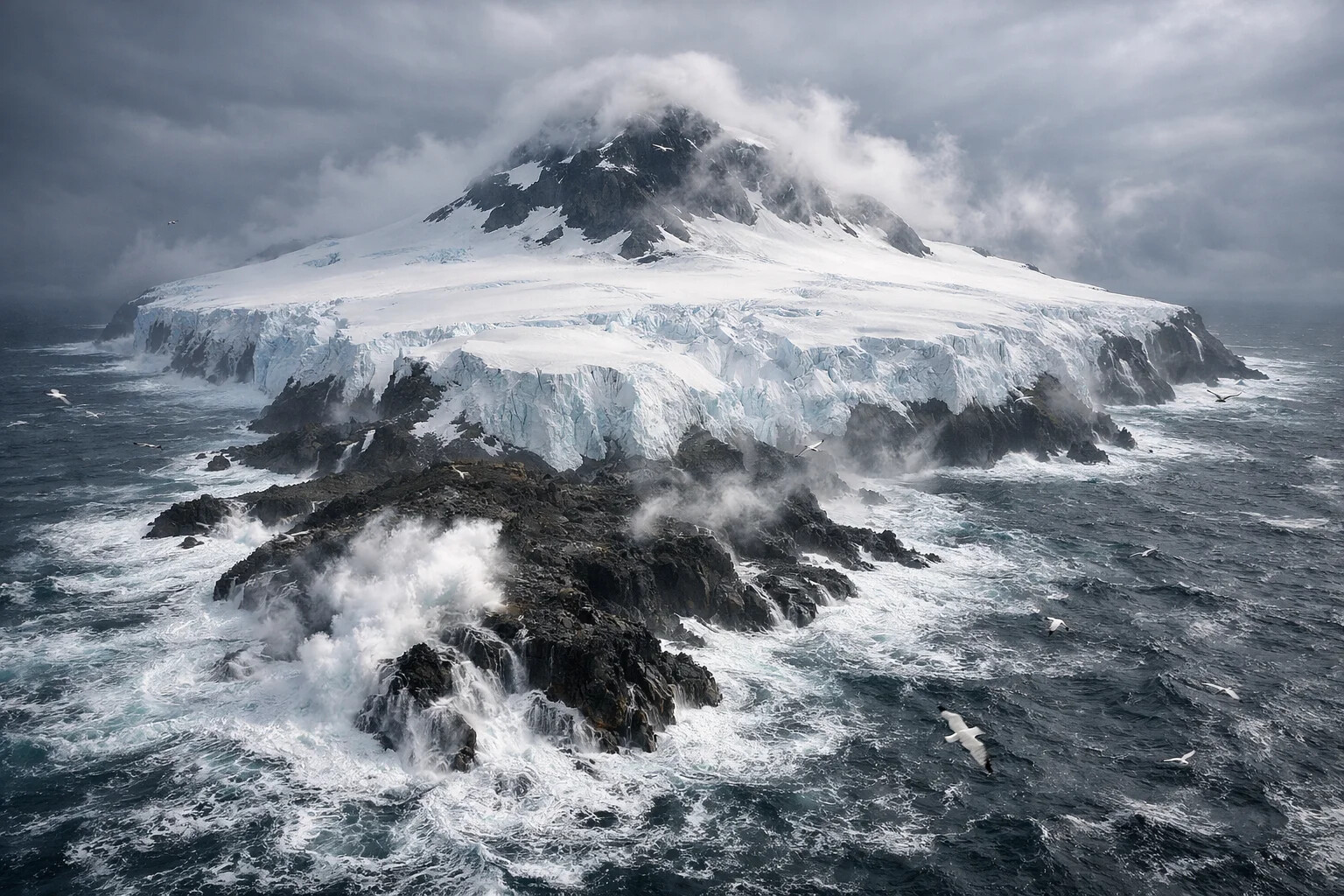
The World's Most Remote Island
Glaciers calve directly into the storm-lashed Southern Ocean as seabirds circle the volcanic peak
🏷️ Name & Identity
The island takes its name from French naval officer Jean-Baptiste Charles Bouvet de Lozier, who first sighted it on January 1, 1739, while commanding a French expedition searching for the mythical "Terra Australis." Bouvet reported seeing land through the fog, but his recorded position was significantly inaccurate, and the island would remain "lost" for nearly a century as subsequent expeditions failed to relocate it.
The Norwegian flag was first raised at Nyrøysa on 1 December 1927 by Lars Christensen's Norvegia expedition. Britain, which had claimed the island in 1825, disputed the annexation but waived its claim in 1929, and the Dependency Act of 27 February 1930 made Bouvetøya a Norwegian dependency—under Norwegian sovereignty, though not part of the Kingdom proper. Its head of state is the King of Norway, Haakon VIII, who succeeded his father Harald V on 28 August 2026. Day-to-day administration sits with the Polar Affairs Department of the Ministry of Justice and Public Security in Oslo, while the Norwegian Polar Institute manages the nature reserve and its small research station.
Bouvet Island gained unexpected fame in 1979 when American Vela satellites detected a mysterious double flash in the South Atlantic near the island—the "Vela Incident"—which many believe was an undeclared nuclear test. The incident remains officially unexplained, adding Cold War intrigue to this remote place.
For the tiny number of visitors who have experienced Bouvet, there is no indigenous culture, no human history beyond scattered expeditions. Bouvet's identity is defined entirely by its isolation, its hostility to human presence, and its absolute wildness.
🗺️ Geography & Regions
Bouvet Island is a shield volcano rising from the South Atlantic seafloor at the junction of the Mid-Atlantic Ridge and a fracture zone. The island measures roughly 9.5 kilometers east to west and 7 kilometers north to south, with a total area of 49 square kilometers. Approximately 93% of this surface is covered by glacial ice, with the Wilhelm II Plateau dominating the interior. The highest point, Olavtoppen, reaches 780 meters.
The coastline consists almost entirely of steep cliffs—many over 400 meters high—where glaciers calve directly into the sea. The only significant low-lying area is Nyrøysa ("New Beach"), a lava platform on the western coast that emerged following a landslide between 1955 and 1958. This narrow stretch of ice-free ground is the only place where landing is even theoretically possible.
The island's volcanic origin is evident in the black basalt wherever ice doesn't cover the surface. The most recent eruption may have occurred as recently as 1955, and the volcano is considered potentially active. Geothermal activity has been detected, and warm ground exists in some areas.
Key geographic features include Kapp Circoncision on the north-west coast, Kapp Fie in the south-east, and Westwindstranda along the western shore. The surrounding waters plunge to depths exceeding 3,000 meters within just a few kilometers of the coast.
🗺️ Map
Interactive map — Bouvetøya, 54°25′S 3°22′E. Markers: Nyrøysa landing site and Norvegia station (NW), Olavtoppen (780 m), Kapp Circoncision, Kapp Fie, Westwindstranda.
📜 History
Jean-Baptiste Charles Bouvet de Lozier spotted the island on New Year's Day 1739 while commanding a French expedition. However, his recorded position was so inaccurate that subsequent expeditions—including James Cook's—failed to relocate it. For decades, the island's very existence was questioned.
British whaler James Lindsay made the first confirmed sighting in 1808. American sealer Benjamin Morrell claimed to land in 1822 (disputed), while the first verified landing came in 1825 when Captain George Norris raised the British flag. Norway's involvement began in 1927 when the research vessel Norvegia made the first scientific landing.
The mysterious "Vela Incident" of September 22, 1979, brought unexpected attention when US satellites detected a double flash consistent with a nuclear explosion near the island. The incident remains unresolved. Declassified U.S. records show that officials examined several possibilities, including South African, Israeli, joint Israeli-South African, Indian, Pakistani and Soviet explanations. The episode highlighted how even Earth's most remote places can become entangled in geopolitics.
Since annexation by Norway in 1930, Bouvet has seen occasional scientific expeditions and amateur radio operations (among the rarest "entities" in ham radio). Norway installed an automated weather station in 1977 and ran a manned station for just two months over the 1978–79 summer. The island and its territorial waters were designated a nature reserve on 17 December 1971. Since the mid-1990s the Norwegian Polar Institute has kept a seasonal field station at Nyrøysa; its predecessor was torn from its foundations by a February 2006 earthquake and the winter storms that followed, and the current Norvegia station was installed in 2014. Most recently, the 3Y0K amateur-radio expedition put 24 operators ashore by helicopter from 28 February to 15 March 2026 and logged more than 100,000 contacts—the largest and longest such operation the island has seen.
🐧 Wildlife
Bouvet Island's only permanent residents are its wildlife. Despite the harsh conditions, the island supports significant populations of Antarctic and sub-Antarctic species. Macaroni penguins dominate, though the colony monitored at Nyrøysa fell from about 5,900 birds in 1990 to 4,700 in 1997 and has been broadly stable since. Chinstrap penguins also breed here, but their numbers collapsed from 2,700 to a few hundred over the same period—squeezed off their nesting ground, the Norwegian Polar Institute believes, by the booming fur seals.
Antarctic fur seals haul out on Nyrøysa and other rocky shores, having recolonized after being hunted to near-extinction in the 19th century; sealing was banned here in 1929, and the Nyrøysa colony grew from about 7,900 animals in 1990 to some 65,000 by 1997, one of the largest in the world. Elephant seals occasionally appear, as do leopard seals hunting in the surrounding waters. The seas around Bouvet teem with life—krill swarms support fish populations that feed seabirds and marine mammals.
The island's birdlife extends beyond penguins. Twelve bird species breed on the island—among them Antarctic, snow, Cape and Wilson's storm petrels and the southern giant petrel—while albatrosses pass offshore. Cape petrels wheel around the cliffs, and giant petrels scavenge along the shores. For ornithologists, Bouvet represents pristine habitat where seabird colonies exist without human disturbance.
Vegetation is almost non-existent—limited to mosses, lichens, and algae clinging to exposed rocks. The island lies far south of the tree line and receives too little sunlight during winter to support significant plant growth. This barren quality only emphasizes the remarkable adaptation of animals thriving at the edge of the habitable world.
🦭 Key Wildlife Species
Penguins:
- Macaroni Penguin — largest colony
- Chinstrap Penguin — breeding population
Marine Mammals:
- Antarctic Fur Seal
- Southern Elephant Seal (occasional)
- Leopard Seal (visitor)
🍜 Cuisine
Polar Fiskeboller
Norwegian Fish Balls
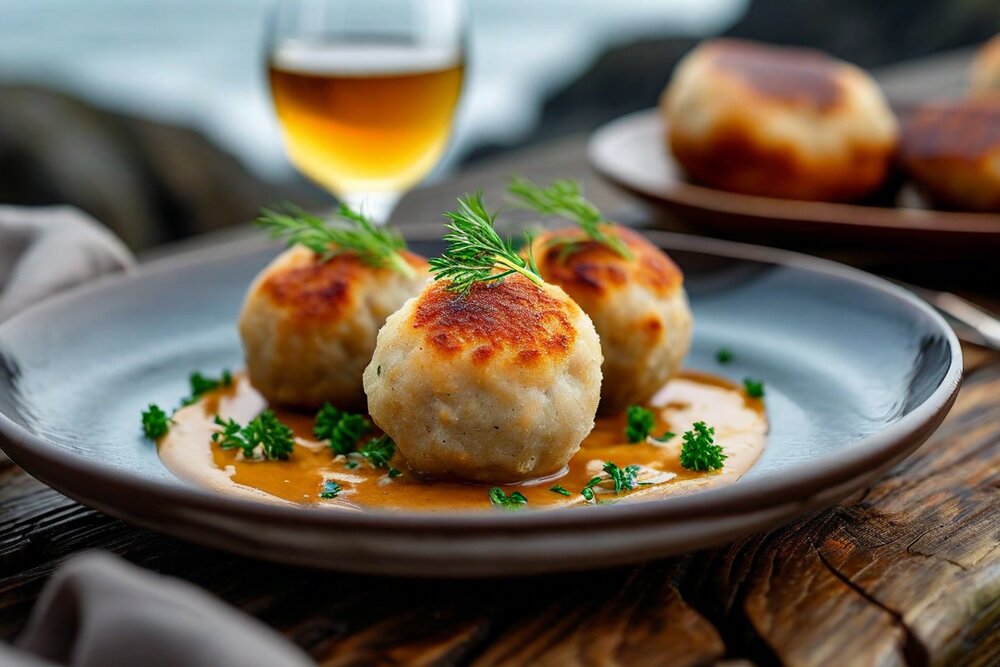
The classic Norwegian fish balls—comfort food carried on every polar expedition, traditionally served in white sauce with potatoes, providing familiar taste of home at the edge of the world. This recipe serves two.
Ingredients: 400g white fish (cod or haddock), 2 tbsp potato starch, 100ml milk, 1 tsp salt, ¼ tsp nutmeg, ¼ tsp white pepper, 1 egg. For sauce: 2 tbsp butter, 2 tbsp flour, 400ml milk, Salt and white pepper, Fresh dill.
Preparation: Blend fish in food processor until smooth paste. Add potato starch, milk, salt, nutmeg, pepper, and egg. Blend until completely smooth and airy—this takes several minutes. Chill mixture 30 minutes. Bring large pot of salted water to gentle simmer. Use two spoons, shape mixture into oval balls about golf-ball sized. Poach in batches 8-10 minutes until they float and are cooked through. For sauce, melt butter, whisk in flour, cook 1 minute. Gradually add milk, whisking constantly until smooth and thickened. Season with salt and white pepper. Serve fish balls in sauce, garnished with dill, alongside boiled potatoes and carrots.
💡 Norwegian expedition crews say these taste like home—powerful medicine for isolation and homesickness.
Smørbrød med Røkelaks
Smoked Salmon Open Sandwich
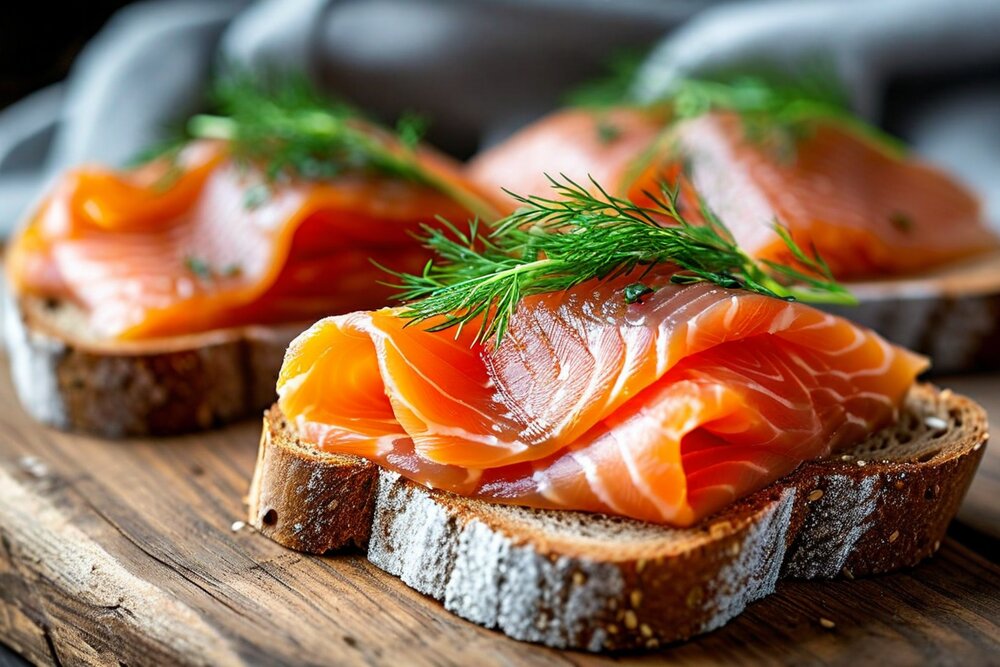
Silky smoked salmon on dense bread—the quintessential Norwegian expedition lunch, requiring no cooking and providing essential omega-3 fats crucial for polar conditions. This recipe serves two.
Ingredients: 4 slices dense rye bread, Butter, 150g smoked salmon, 2 tbsp sour cream or cream cheese, ½ lemon, Fresh dill, 1 small red onion, very thinly sliced, Capers, Black pepper.
Preparation: Butter bread generously—this is non-negotiable in Norwegian food culture. Spread thin layer of sour cream or cream cheese on each slice. Drape smoked salmon in loose folds over bread, covering surface. Top with onion rings, capers, and fresh dill. Squeeze lemon over, season with black pepper. Serve immediately. The combination of rich salmon, sharp onion, briny capers, and fresh dill creates perfect balance. On expeditions, this simple assembly transforms basic provisions into something that feeds the soul as much as the body.
💡 The best smørbrød are eaten with knife and fork, never picked up—this is elegant survival food.
Rømmegrøt
Norwegian Sour Cream Porridge

A traditional Norwegian celebration dish—thick, rich sour cream porridge that provides extraordinary calories for extreme cold, traditionally served at midsummer but beloved by polar crews year-round. This recipe serves two.
Ingredients: 300ml sour cream (full fat), 100g flour, 400ml whole milk, 2 tbsp sugar, ½ tsp salt, Butter, Cinnamon-sugar, Additional sugar for serving.
Preparation: Simmer sour cream in heavy pot 10 minutes, stirring frequently. Sift half the flour over, stir vigorously until butter begins separating out—this is supposed to happen. Remove the melted butter that pools on top, reserve it. Add remaining flour, stir until smooth. Gradually add milk, stirring constantly, until porridge reaches desired thickness—should be quite thick. Add sugar and salt. Simmer 10 minutes more, stirring. Serve in bowls, make well in center, pour reserved butter into well. Sprinkle generously with cinnamon-sugar. Eat from outside edges inward, dipping each spoonful in the butter pool.
💡 The separated butter is not a mistake—it's the best part. Save every drop.
🍷 Wine, Spirits & Drinking Culture
Bouvet Island has no wine production, no permanent inhabitants, and no drinking culture. The uninhabited Norwegian dependency in the South Atlantic — a glacier-covered volcanic island considered the most remote island on Earth (1,700 km from the nearest land, Antarctica) — is visited only by occasional scientific expeditions and amateur radio operators. Any beverages consumed here are brought by visitors.
🌡️ Climate
Bouvet Island experiences a severe polar maritime climate, characterized by persistent cloud cover, frequent precipitation, and howling winds. The mean temperature at sea level is about -1°C, with monthly averages of roughly 1°C in January and -3°C in September. Snow falls throughout the year, though most accumulates during the winter months (June-August in the Southern Hemisphere).
The island sits in the path of the "Roaring Forties" and "Furious Fifties"—the powerful westerly winds that circle the Southern Ocean. Gale-force winds are common and severe storms sweep through, though the Norwegian Polar Institute notes that wind strength here is, by Southern Ocean standards, not exceptional—it is the cloud, the swell and the total absence of an anchorage that make landing so hard. These winds drive enormous waves that make landing extremely dangerous even in relatively calm conditions.
Fog and low cloud blanket the island for much of the year, often obscuring the summit entirely. Precipitation occurs on approximately 300 days annually, mostly as snow but sometimes as freezing rain. Sunshine is rare—the island receives less than 500 hours of sun per year, compared to over 2,000 hours in most temperate regions.
The only "favorable" season for visits is the Southern Hemisphere summer (December-February), when temperatures are slightly less brutal and daylight hours extend. Even then, successful landings depend entirely on brief windows of acceptable weather.
Earth's Most Isolated Outpost
Glaciers meet the Southern Ocean amid perpetual storms and sub-Antarctic wilderness
🔬 Expeditions & Research
Scientific interest in Bouvet Island stems from its isolation and pristine environment. Norwegian expeditions in 1927, 1928-29, 1978-79 and 1985 conducted geological, biological and meteorological research; the 1985 party enjoyed a freak spell of clear skies long enough to photograph the whole island for the first proper map. Since the mid-1990s the Norwegian Polar Institute has monitored fur seals, penguins and other krill predators from the seasonal Norvegia station at Nyrøysa—Norway's contribution to the CCAMLR ecosystem monitoring programme—with field seasons now on a three-year cycle.
Modern research focuses on seabird population dynamics, seal biology, glaciology, and volcanic monitoring. The station's remote weather sensors and cameras transmit year-round via satellite, powered by wind and solar energy through the long months when nobody is there.
Amateur radio operators prize Bouvet Island as one of the rarest "DXCC entities" in the world. Several DXpeditions have activated the island—3Y5X (1989–90), 3Y0E (2007–08), 3Y0J (February 2023) and most recently 3Y0K, whose 24 operators were flown ashore by helicopter from the vessel Argus on 28 February 2026 and stayed until 15 March, logging more than 100,000 contacts with some 25,000 stations. These operations need enormous logistical support, and even on that successful trip storms repeatedly flattened tents and antennas.
For adventurers, reaching Bouvet represents the ultimate achievement. A handful of private expeditions have succeeded, though the combination of extreme remoteness, brutal weather, and lack of safe anchorage makes success far from guaranteed. Most who attempt the journey must content themselves with sailing past at a safe distance.
✈️ Getting There
There is no scheduled transport to Bouvet Island. Reaching it requires chartering an ice-strengthened vessel, typically from Cape Town (≈2,500 km, 5–7 days at sea) or, more rarely, from Tristan da Cunha or the Falkland Islands. Norwegian Polar Institute permission is mandatory, and most successful landings have been by scientific or amateur-radio (DXpedition) parties using inflatable boats or, occasionally, helicopters operating from the deck of the support ship. Weather windows for landing on Nyrøysa beach are measured in hours, not days, and many expeditions are forced to turn back without setting foot ashore.
📋 Practical Info
Visa: no visa exists; entry is governed by a Norwegian Polar Institute permit issued only for science, conservation or sanctioned expeditions. Health: no facilities — every expedition must carry a doctor and full medical kit. Safety: extreme. Hazards include calving glaciers, hypothermia, hurricane-force winds, leopard seal attacks in the water, and the absence of any rescue infrastructure. Communication: Iridium satellite phones only; there is no cellular coverage and no permanent radio station. Currency: Norwegian krone (NOK), though there is nothing to spend it on.
💰 Cost of Living
Bouvet Island has no economy, no shops, no services and no permanent residents, so a conventional cost-of-living index is meaningless. The relevant cost is that of mounting an expedition: chartering a suitable polar vessel runs €15,000–€40,000 per day, and a successful 30-day expedition from Cape Town typically costs €500,000 to over €2 million when crew, fuel, insurance, scientific equipment and Norwegian permit fees are included. The amateur-radio DXpeditions of 2023 and 2026 each relied on hundreds of thousands of dollars in donations and operator contributions to fund a single landing.
🛖 Accommodation
There are no hotels, guesthouses, huts, refuges or shelters of any kind on Bouvet Island. The only structure is the Norwegian Polar Institute's small seasonal Norvegia field station at Nyrøysa—sleeping and laboratory space for a six-person team, installed in 2014 after its predecessor was ripped away by an earthquake and storms in 2006—and it is not open to visitors. Visitors sleep aboard their support vessel offshore and come ashore only for short working visits. DXpedition teams have camped in tents on Nyrøysa—3Y0K's 24 operators lived there for over two weeks in early 2026—but gales shredded tents and antennas repeatedly, and glacial ice fall is a constant risk.
🎉 Festivals & Events
Bouvet Island has no human festivals or cultural events of any kind. Its calendar is biological: the arrival of macaroni and chinstrap penguins to nest in October–November, the return of Antarctic fur seals to breed in December–January, the moult of elephant seals in late summer, and the spectacular winter storms that announce the southern winter from May onward. No one has ever wintered on Bouvet; for the summer field teams, these natural cycles are the closest thing to seasonal celebration the island offers.
🏛️ UNESCO Heritage
Bouvet Island has no UNESCO World Heritage Sites. The entire island and its surrounding waters were, however, designated a Norwegian nature reserve on 17 December 1971—the most remote nature reserve on Earth. It covers the 49 km² of land plus the surrounding territorial sea, roughly 2,200 km² in all, protecting breeding seabirds, fur and elephant seals, and an essentially pristine sub-Antarctic ecosystem.
🎒 Packing Tips
Pack as if going to Antarctica: a multi-layer system with merino base, fleece or synthetic mid, and a fully waterproof, windproof outer shell rated for hurricane-force conditions. Add insulated mountaineering boots, gaiters, two pairs of waterproof gloves, a balaclava, polarised glacier glasses, a personal locator beacon, drybags for everything, and a robust 60–80 L expedition pack. Cameras need extra batteries (cold drains them fast) and waterproof housings. Always carry redundant means of getting back to the ship, plus emergency rations and a bivvy bag in case the weather closes in.
📚 Resources
Norwegian Polar Institute (npolar.no) — the authoritative source on Bouvet's geology, biology and access permits. CIA World Factbook entry on Bouvet Island. The 3Y0J 2023 (3y0j.no) and 3Y0K 2026 (3y0k.com) DXpedition websites for first-hand modern expedition logistics. Norwegian government regulation FOR-1971-12-17-22 on the Bouvet Island nature reserve. Scientific papers indexed in NORA (Norwegian Open Research Archives).
📖 Recommended Reading
Rupert Gould's "Oddities: A Book of Unexplained Facts" (1928) — the classic account of Bouvet's discovery and its century-long "loss" in the chapter on doubtful islands. "Antarctic Oasis" by Tim and Pauline Carr (context on sub-Antarctic island life). Norwegian Polar Institute reports on the 1927–29 and 1978–79 expeditions. Leonard Weiss, "Israel's 1979 nuclear test and the U.S. cover-up" (Bulletin of the Atomic Scientists, 2011) and other Vela Incident analyses. DX magazine archives covering the 3Y5X, 3Y0E, 3Y0J and 3Y0K expeditions.
▶️ YouTube Videos
Search YouTube for "Bouvet Island 3Y0J" to find the 2023 landing by inflatable, and "Bouvet 3Y0K" for the 2026 team's helicopter operations from the Argus. The Norwegian Polar Institute publishes occasional drone flyovers of the ice cap. The "Most Remote Places on Earth" series by various creators usually opens with Bouvet, and short historical retrospectives of the Vela Incident often include archival footage of the surrounding ocean.
✨ Fascinating Facts
Bouvet has its own internet country code (.bv), reserved by Norway but never used. It is closer to Antarctica than to any other land. Approximately 93% of its surface is permanent ice. The 2026 3Y0K radio expedition logged more than 100,000 contacts in sixteen days ashore — more conversations than the island has had human visitors in its entire history. Its highest point, Olavtoppen (780 m), is rarely visible because of constant cloud. The island appeared briefly in the 2004 film "Alien vs. Predator." The 1979 Vela Incident — a possible nuclear test detected in the surrounding ocean — remains officially unexplained.
👤 Notable People
No one has ever been born on Bouvet Island, and there are no notable residents. Notable visitors include Jean-Baptiste Charles Bouvet de Lozier (discoverer, 1739), James Lindsay (first confirmed sighting, 1808), Captain George Norris (first recorded landing, 1825), Lars Christensen (whose 1927 Norvegia expedition led to Norwegian annexation), and the 3Y0J (2023) and 3Y0K (2026) amateur-radio teams led by Ken Opskar LA7GIA, the latter the first to log 100,000 contacts from the island. The island's "history" is a list of those who briefly touched its shores.
⚽ Sports
Bouvet Island has no sports culture, no teams, no clubs and no athletes. With zero population it is not a member of FIFA, the IOC or any sporting federation. The only competitive activity ever undertaken on the island is amateur radio "contesting" — operators racing to make as many contacts as possible with stations worldwide during their brief landings.
📰 Media & Press Freedom
Bouvet Island has no resident media. As a Norwegian dependency it falls under Norwegian press-freedom standards — Norway ranked first in the 2026 Reporters Without Borders World Press Freedom Index. The Norwegian Polar Institute and the Norwegian Ministry of Justice and Public Security release periodic statements and scientific reports about the island. International coverage is sporadic and centred on rare expeditions, the Vela Incident, and conservation news.
🌋 Volcano Under the Ice
Think of Bouvet as a volcano wearing an ice cap, not as a conventional island with a mountain.
Bouvet is not merely an island with glaciers on top; it is the exposed summit of a volcanic edifice rising from deep Atlantic seafloor. The visible land is only the last piece of a much larger submarine mountain, built by eruptions and then sculpted by ice, waves, freeze-thaw weathering and landslides.
The island's black basalt gives the landscape its stark contrast: white ice, dark cliffs and blue ocean. Scientific accounts describe warm ground and fumarolic hints in places, reminders that the island belongs to a living geologic system rather than a dead Antarctic rock. No traveler should read this as a tourist attraction; it is a research clue in an environment where access itself is exceptional.
🧊 Ice Cap & Glaciers
White interior plateau, black basalt rim, surf below: that is the Bouvet profile.
The ice cap is Bouvet's dominant architecture. It rounds the interior into a white shield and sends outlet glaciers down toward cliffs where ice breaks directly into the sea. In clear weather the island can look almost simple from a ship: a white dome, black rock, surf, cloud. On the ground, that simplicity disappears into crevasses, cornices and unstable snow.
Landing parties do not wander freely inland. Even short movements require expert judgment because the apparent surface can hide cracks or undercut snow bridges. For the reader, the important point is this: Bouvet is less a destination with sights than a protected polar system where the ice decides what human beings are allowed to do.
🪨 Nyrøysa — The Landing Shelf
No harbor, no pier, no road: landing means a temporary operation from a vessel under polar conditions.
Nyrøysa is the practical key to the whole island. This lava-and-boulder platform on the north-western coast emerged after a major landslide in the mid-20th century and became the only reasonably usable landing site. The Norwegian field station, wildlife monitoring and most modern shore operations cluster around this narrow shelf.
Even here the word 'usable' needs caution. Surf, swell, fog, falling ice and aggressive weather can close the site with little warning. Expeditions often wait offshore for a weather window, and the window may never come. Nyrøysa is therefore both gateway and gatekeeper: the one place that opens Bouvet to science, and the place that most often reminds visitors to leave.
🛡️ Permits & Nature Reserve Rules
Permission belongs to conservation and research, not casual sightseeing.
Bouvet Island is a Norwegian nature reserve, and access is controlled for conservation reasons. Permission is not a travel formality; it is the central legal boundary around the island. Expeditions must justify their purpose, minimize disturbance and follow strict environmental rules, especially around wildlife colonies.
For ordinary readers, this means Bouvet is not a bucket-list site waiting for tourism to arrive. Its protection regime is part of its identity. The best way most people can respect the island is by understanding it accurately from afar and supporting the principle that some places should remain almost untouched.
🏚️ Norvegia Field Station
A field station for a handful of specialists, not an inhabited settlement.
The small Norvegia station at Nyrøysa is not a tourist lodge. It is a compact research shelter associated with Norwegian Polar Institute work, intended for short field seasons and practical survival rather than comfort. Its existence tells a story of persistence: earlier structures were damaged or removed by the island's forces, including storms and seismic instability.
A station on Bouvet is never permanent in the ordinary sense. It is an object placed temporarily in an environment that does not promise to tolerate it. That fragility is part of the island's lesson: even a wealthy polar nation can only maintain a small, careful foothold here.
🌬️ Weather Windows
On Bouvet, the schedule is subordinate to wind, swell and visibility.
The most important itinerary item for Bouvet is not a museum opening time but a weather window. Low cloud can hide the cliffs, swell can make inflatable boats unsafe, wind can stop helicopter operations, and icing can turn routine deck work into an emergency. Expeditions succeed or fail by reading these short openings.
Because the island sits in the path of the westerlies and the Southern Ocean's moving weather systems, plans must be written in pencil. A ship may spend days near the island without landing. For a travel guide, honesty matters: the realistic experience of Bouvet is waiting, watching weather, and accepting the island's refusal.
🌊 Southern Ocean Setting
Read the island together with current, swell and wildlife movement, not only latitude and longitude.
Bouvet's sea is not a scenic backdrop. It is the transport system, the hazard zone and the ecological engine. The Antarctic Circumpolar Current links the island to a planetary belt of cold, nutrient-rich water where krill, fish, seals and seabirds form a food web far larger than the island itself.
From a map, Bouvet may look like a dot. In ecological terms it belongs to the Southern Ocean's moving life. The surrounding waters explain why seals haul out here, why penguins breed here and why the island's scientific value extends beyond its 49 square kilometers of land.
🐧 Penguin Colonies
The animals are residents; people are temporary intruders.
Macaroni and chinstrap penguins give Bouvet its most visible biological drama. Colonies occupy the few ice-free areas where birds can nest, commute to the sea and avoid the most unstable cliffs. Their numbers have shifted over time, partly through competition for space and changing seal populations.
A visitor cannot treat these colonies like a walk-up wildlife attraction. Distance, hygiene, noise and landing routes matter. The birds are not props in a wilderness photograph; they are the permanent inhabitants of a place where human beings are the disturbance.
🦭 Fur Seals & Elephant Seals
A place with zero people can still have intense pressure for space.
Antarctic fur seals are among Bouvet's great conservation stories. After the catastrophic sealing era, populations recovered strongly, and Nyrøysa became an important haul-out and breeding area. Elephant seals also appear, though less as a symbol of numbers than as part of the wider Southern Ocean mammal community.
A growing seal population can reshape the island's limited ice-free terrain, compressing bird colonies and changing how field teams move. Bouvet may look empty to a satellite, but on its few usable beaches it is crowded with non-human claims.
🪽 Petrels, Skuas & Albatrosses
The best birdwatching here is often from a respectful distance, usually from a vessel.
Beyond penguins, Bouvet supports a cast of seabirds adapted to wind, cliffs and open ocean. Petrels, skuas and other species use the island as a breeding or feeding reference point within a huge marine range. Albatrosses may pass offshore, turning the surrounding sea into part of the island's living perimeter.
For birders, the lesson is restraint. The rarest sight is not a close photograph but a functioning colony in a near-pristine place. Bouvet's value lies in the continuity of these breeding cycles with minimal human interference.
🌡️ Climate Change Watchpoint
Remote does not mean protected from global systems.
Bouvet is a useful climate watchpoint because it combines ice, ocean, wildlife and isolation. Changes in sea temperature, krill availability, snow cover or storm patterns can echo through breeding success and glacier behavior. The island is remote from people, not remote from planetary change.
For readers, this is why a page about a place almost nobody can visit still matters. Bouvet helps make visible the difference between wilderness and immunity. A wilderness can be untouched by tourism and still be touched by a warming ocean and atmosphere.
📡 DXpeditions & the 3Y Call
A radio contact can make Bouvet briefly present in shacks across the world.
In amateur radio, Bouvet is legendary. Its call-sign prefix, 3Y, represents one of the rarest opportunities in the DXCC world. Because the island is so difficult to reach, a successful activation can trigger a global rush of operators trying to make contact during a short window.
The radio story is unusually human: tents in storms, antennas rebuilt after gales, operators working shifts, and thousands of distant voices reaching a beach where no one lives. It is also one of the few ways ordinary people can 'touch' Bouvet without going there: through a signal, a log entry and a confirmed contact.
⚛️ The Vela Incident
The incident is important, but it should be presented as unresolved, not as a settled fact.
The 1979 Vela Incident remains the island's strangest geopolitical association. A U.S. satellite detected a double flash in the South Atlantic region, a signature some analysts considered consistent with a nuclear test. Official conclusions remained disputed, and the episode has never been fully resolved in the public record.
Bouvet was not a participant in that story; it was a geographic marker near an event that may or may not have happened as suspected. Yet the association shows how even the planet's most isolated island can become entangled in Cold War secrecy, intelligence interpretation and the politics of evidence.
🚨 Safety & Rescue Reality
Self-sufficiency is not romantic here; it is the minimum requirement.
There is no local rescue service on Bouvet Island. A serious injury, hypothermia event or boat accident becomes a shipboard emergency in one of the most remote maritime zones on Earth. Satellite communication, medical planning, evacuation routes and weather contingencies are not accessories; they are the expedition itself.
This is why casual adventure language is misleading here. Bouvet is not hard in the way a strenuous hike is hard. It is hard because help is far away, conditions change quickly, and small failures can become strategic problems.
📷 Photography Notes
Bright daylight, real landscape logic, no dark fantasy treatment.
The visual grammar of Bouvet is simple and powerful: blue-black ocean, white ice, dark volcanic rock and a low ceiling of cloud. The challenge is not finding a dramatic composition but keeping equipment alive in spray, cold and wind while remaining far enough from wildlife and cliffs.
A responsible photo set should include distance as part of the story. Wide frames showing scale, sea state and weather are more honest than close-cropped images pretending the island is accessible. For this website, the cover therefore uses the island as an expedition subject, not as a resort fantasy.
📚 How to Read Bouvet Responsibly
Do not turn an effectively unreachable reserve into a casual travel product.
Bouvet challenges the usual travel-guide format. There are no neighborhoods, restaurants, hotels or scenic drives. A responsible guide therefore changes the question from 'what should I do there?' to 'what should I understand about this place?'
That shift is not a weakness. It makes Bouvet one of the clearest entries in the whole factbook: a reminder that geography includes places beyond consumption, and that travel writing can protect a destination by refusing to sell it falsely.
🧭 Compared with Other Remote Islands
Remote islands are not interchangeable; Bouvet is a special case even among them.
Tristan da Cunha has a community. South Georgia has research stations and expedition-ship landings. Heard Island is brutally remote but belongs to a different Australian subantarctic story. Bouvet stands apart because it combines legal protection, absence of population, extreme isolation and very poor landing conditions in one small volcanic package.
Calling it 'the most remote island on Earth' is therefore not just marketing shorthand. It reflects the lack of neighboring land, the absence of infrastructure and the way even specialized expeditions can fail to land after reaching the area.
🔭 The Future of Bouvet Island
The best future for Bouvet is stillness, science and protection.
Bouvet's future will probably remain quiet, which is the right outcome. Scientific monitoring may improve, satellite observation will become more precise, and occasional field seasons will continue when Norway authorizes them. Tourism, if it appears at all, should remain rare, tightly controlled and subordinate to conservation.
The island's strongest value is not development potential but restraint. In a century of expanding access, Bouvet can still teach the older lesson that some places are best known carefully, visited rarely and defended from our habit of turning every horizon into a product.
📸 Photo Gallery


✍️ Author's Note Radim Kaufmann
I have never set foot on Bouvet Island, and I almost certainly never will. Almost no one has. That, more than any temple or beach or boulevard, is what kept me coming back to this page through one quiet weekend after another. Most countries in this factbook ask the question "what is it like to go there?" Bouvet asks the opposite: what is it like for a place to remain entirely itself, unwitnessed, while the rest of the world rushes on?
When I read the logs of the 1927 Norvegia expedition, of the automatic weather station Norway bolted to the rock in 1977, of the 3Y0J team in 2023 riding inflatables through the surf onto a black volcanic beach, and of the 3Y0K crew who spent sixteen storm-battered days in tents on Nyrøysa in March 2026, I do not feel envy. I feel a kind of relief. There is still a piece of the planet whose only inhabitants are macaroni penguins and Antarctic fur seals, where the loudest sound is glacier ice cracking off a 400-metre cliff into a sea no boat can safely anchor in.
Bouvet, for me, is the antidote to the fantasy that travel can be everywhere. Some places are meant to be left alone, written about quietly, and protected fiercely. I will keep it on this map for that reason — and because, on grey afternoons in northern Europe, it helps to remember that Olavtoppen is still up there in the cloud, exactly as it was in 1739, waiting for nobody.
—Radim Kaufmann, 2026
Support This Project 🌍
This World Travel Factbook is a labor of love – free to use for all travelers. If you find it helpful, consider supporting its continued development.
