
🌍 British Indian Ocean Territory at a Glance
🌏 Overview
Scattered across 640,000 square kilometers of the central Indian Ocean lies one of Earth's most paradoxical territories: pristine coral atolls of staggering natural beauty that no civilian is permitted to visit. The British Indian Ocean Territory (BIOT) comprises the Chagos Archipelago—roughly 58 named islands (over a thousand if every islet and sandbank is counted) grouped into seven atolls, with Diego Garcia as the largest and the only island with a permanent military-and-contractor population. Here, turquoise lagoons teem with marine life, white sand beaches stretch endlessly under tropical sun, and somewhere beneath the coconut palms, one of America's most strategically important overseas military installations operates around the clock.
The territory’s history is marked by controversy. Between 1968 and 1973 the UK removed the Chagossian population from the archipelago as the Diego Garcia base was developed. On 22 May 2025 the UK and Mauritius signed a treaty under which Mauritius would become sovereign over the Chagos Archipelago while the UK would retain rights to operate the Diego Garcia base for an initial 99 years. The treaty has not entered into force. The UK implementing bill did not complete Parliament before the 2024–26 session ended on 29 April 2026, so as of 18 September 2026 BIOT remains a British Overseas Territory and access remains tightly restricted.
For the overwhelming majority of would-be visitors, BIOT exists only in satellite imagery, documentaries, and the accounts of the few who have accessed it—military personnel, approved contractors, and occasional scientific researchers. In 2010, the territory was designated as one of the world's largest marine protected areas, though critics argue this was partly designed to further prevent Chagossian return. This entry documents a place that represents both environmental paradise and human tragedy, strategic necessity and colonial injustice.
🚫 Access Strictly Restricted
Civilian Access: Ordinary tourism is not permitted. Access is restricted and requires authorization from the BIOT Administration; Diego Garcia is not a tourist destination.
Who Can Visit: Access is limited to: US and UK military personnel stationed at Diego Garcia, approved defense contractors, scientists with special permits from the BIOT Administration, and occasional official delegations.
Yacht Permits: Private yachts crossing the Indian Ocean can apply to the BIOT Administration in London for a mooring permit for the Outer Islands only (never Diego Garcia): £250 per week, maximum 28 days, at least six weeks in advance, with proof of medical-evacuation insurance. Since 31 March 2026 the Administration has paused consideration of new permit applications (except in exceptional circumstances) while the Chagossian right-of-abode litigation runs. Entering without a permit carries up to three years' imprisonment, a £10,000 fine and forfeiture of the vessel.
🔴 Legal Status (18 September 2026): The UK and Mauritius signed a sovereignty treaty on 22 May 2025, but it has not entered into force. UK implementing legislation failed to complete before Parliament was prorogued on 29 April 2026. BIOT therefore remains a British Overseas Territory for now. The treaty, if brought into force after domestic procedures are completed, would place the Chagos Archipelago under Mauritian sovereignty while preserving UK authority over the Diego Garcia base under the agreed long-term arrangements.
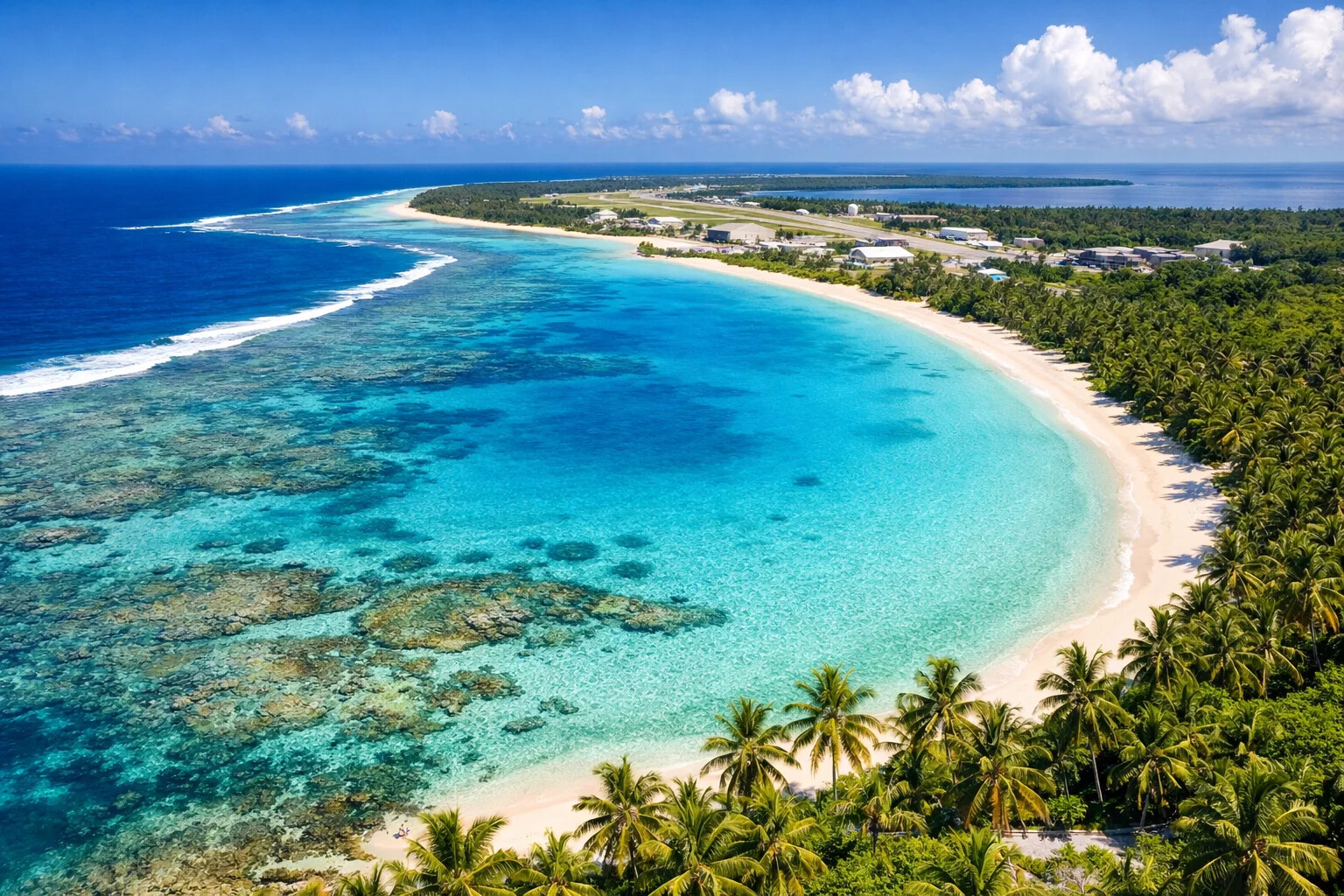
Diego Garcia Aerial View
Pristine turquoise waters of the lagoon contrast with dense coconut palm forests — paradise off-limits to civilians
🏷️ Name & Identity
The British Indian Ocean Territory was created in 1965 when Britain separated the Chagos Archipelago from Mauritius (then still a British colony) specifically to establish a military facility. The somewhat bureaucratic name reflects this administrative origin—it is simply a British territory located in the Indian Ocean, with no connection to any pre-existing political or cultural entity.
The territory's flag features the Union Jack in the canton, with wavy blue and white stripes representing the ocean and a palm tree with crown symbolizing the islands. This relatively recent design (adopted in 1990) replaced earlier generic British colonial flags. The coat of arms shows a palm tree with a crown, supported by sea turtles, with the motto "In tutela nostra Limuria" (Limuria is in our protection).
The indigenous identity of the Chagos Islands belongs to the Chagossians (also known as Îlois or Chagos Islanders), descendants of African slaves and Indian laborers brought to work coconut plantations in the 18th and 19th centuries. They developed their own Creole language, culture, and way of life centered on fishing and copra production. Today, the Chagossian diaspora—approximately 10,000 people in Mauritius, Seychelles, and the UK—continues to identify strongly with their ancestral homeland.
For the territory itself, "identity" is a complex question. It functions primarily as a military installation with no recognised permanent civilian population. The approximately 3,000 people on Diego Garcia are transient military personnel and contractors, not residents with any connection to the land beyond their deployment.
Constitutionally the head of state is King Charles III. There is no governor: the territory is run from the Foreign, Commonwealth & Development Office in London by a Commissioner (Nishi Dholakia since August 2024, succeeding Paul Candler) and an Administrator (Mike Vidler), while on Diego Garcia the officer commanding the Royal Navy detachment—Commander Tracy MacSephney since 24 April 2026—serves as Commissioner's Representative ("BritRep") and magistrate. There is no legislature and there are no elections. Since December 2025 a self-declared Chagossian Government, led by First Minister Misley Mandarin and loyal to the UK rather than Mauritius, has claimed to speak for the islanders; it is recognised by nobody.
🗺️ Geography & Regions
The Chagos Archipelago consists of some 58 named islands spread across seven atolls in the central Indian Ocean, roughly 500 kilometers south of the Maldives, between 4°44′ and 7°41′ S. The total land area is just 60 square kilometers, but the territorial waters encompass approximately 640,000 square kilometers—one of the largest marine protected areas on Earth. The islands sit atop the Chagos-Laccadive Ridge, an underwater plateau formed by volcanic activity.
Diego Garcia is by far the largest island, a V-shaped atoll whose lagoon provides a natural deep-water harbor of exceptional strategic value. The island measures 27 kilometers from tip to tip and covers 32 square kilometers. The lagoon—roughly 21 kilometers long and up to 11 kilometers wide—can accommodate aircraft carriers and submarines. Other significant atolls include Peros Banhos, Salomon Islands, Great Chagos Bank, Egmont Islands, and the Three Brothers.
The islands are classic low-lying coral atolls: the average elevation is a mere 1.3 meters above sea level and nowhere rises more than a few meters, which makes Diego Garcia the US overseas base most exposed to sea-level rise. White sand beaches give way to dense coconut palm groves (planted during the copra plantation era), which in turn surround central lagoons of stunning turquoise water. Coral reefs fringe all the islands, supporting extraordinary marine biodiversity.
The climate is tropical maritime—hot and humid year-round with temperatures averaging 27-29°C. The southwest monsoon (May-September) brings rougher seas and occasional storms; the northeast monsoon (November-March) is calmer. Rainfall is heavy—around 2,600 mm a year on Diego Garcia—and spread across the year. Cyclones are rare because the archipelago lies north of the main Indian Ocean cyclone tracks.
🗺️ Map — Chagos Archipelago
Markers: Diego Garcia (joint UK–US base) · Peros Banhos / Île du Coin (resettled Feb 2026) · Salomon Islands / Île Boddam · Great Chagos Bank strict nature reserves (Three Brothers, Eagle, Danger, Nelson's) · Egmont Islands.
📜 History
The Chagos Islands were uninhabited when Portuguese explorers first mapped them in the early 16th century. French colonization began in the 1770s, with settlers from Mauritius establishing coconut plantations worked by enslaved Africans. Britain took control in 1814 following the Napoleonic Wars, administering the islands as a dependency of Mauritius. Over subsequent generations, a distinct Chagossian community developed—Creole-speaking people of African and Indian descent who made their living from copra production and fishing.
The islands' fate changed dramatically in the 1960s when the United States identified Diego Garcia as an ideal site for a military base. In 1965, Britain created BIOT by separating the Chagos Archipelago from Mauritius (in exchange for £3 million compensation), explicitly to facilitate the base construction. Between 1968 and 1973, the entire Chagossian population was forcibly removed. Islanders were told they were leaving temporarily; instead, they were shipped to Mauritius and Seychelles with minimal support.
The Chagossians' struggle for justice continues. In February 2019 the International Court of Justice advised that Britain's separation of Chagos from Mauritius was unlawful, and in May 2019 the UN General Assembly demanded withdrawal within six months. Negotiations with Mauritius began in November 2022, produced a political agreement on 3 October 2024, and culminated in a treaty signed on 22 May 2025: sovereignty to Mauritius, Diego Garcia leased back to the UK for 99 years (extendable by 40) for an average of about £101 million a year—£3.4 billion over the term—plus a resettlement trust fund for Chagossians on the outer islands.
Then the ground shifted. On 20 January 2026 President Trump called the deal "an act of great stupidity" and on 18 February posted "DO NOT GIVE AWAY DIEGO GARCIA!"; Washington formally withdrew its support, and in April 2026 the UK government shelved ratification indefinitely. Two days before Trump's post, on 16 February 2026, four British Chagossians led by Misley Mandarin landed on Île du Coin and refused to leave; on 31 March the BIOT Supreme Court quashed the constitutional clause denying them a right of abode, a ruling now under appeal. And on 20 March 2026, during the Iran war, Iran launched at least two ballistic missiles toward Diego Garcia—one failed in flight, the other was intercepted—the first attack ever aimed at the base.
👥 The Chagossians & Wildlife
The indigenous Chagossians developed a unique Creole culture over two centuries of settlement. Their language, Chagossian Creole (Kreol Sagosyen), blended French, English, and African elements. Life centered on coconut plantations, fishing, and a close relationship with the sea. Islanders lived in small settlements on Diego Garcia and the outer atolls, maintaining chickens, pigs, and vegetable gardens alongside their copra work.
Officially there are still no permanent civilian residents. The approximately 3,000 people on Diego Garcia are US and UK military personnel and contractors (many of them Filipino and Mauritian) on temporary assignments. Since February 2026, however, six Chagossians—among them Michel Mandarin, who was 14 when he was expelled—have been living in tents and the ruins of the old Perch Settlement on Île du Coin, protected by a court injunction while the Administration appeals. The Chagossian diaspora—estimated at 10,000 people—lives primarily in Mauritius (Port Louis), the Seychelles, and increasingly in the UK, above all in Crawley, near Gatwick. It is itself divided: the Chagos Refugees Group under Olivier Bancoult backs the Mauritius treaty, while the Mandarin-led Chagossian Government opposes it and wants to remain British.
Despite human absence from most islands, BIOT supports extraordinary biodiversity. The marine environment is particularly rich—pristine coral reefs support over 1,000 fish species, including significant shark populations. Green and hawksbill turtles nest on beaches throughout the archipelago. Coconut crabs (the world's largest land-dwelling arthropod) thrive on the outer islands. Seabirds—red-footed boobies, frigatebirds, terns—nest in enormous colonies.
The 2010 designation of the Chagos Marine Protected Area (MPA) made the territory one of the world's largest no-take marine reserves. However, critics—including the Chagossians themselves—argue that the MPA was partly designed to prevent their return by banning fishing, their traditional livelihood. A 2015 arbitration tribunal ruled that the UK acted illegally in creating the MPA without consulting Mauritius.
🐢 Key Wildlife Species
Marine Life:
- 1,000+ fish species documented
- Healthy shark populations (reef, silky, whale)
- Green & Hawksbill turtles (nesting)
- Pristine coral reefs
Land & Birds:
- Coconut crabs (world's largest)
- Red-footed boobies (large colonies)
- Frigatebirds, terns, tropicbirds
- Endemic insects and land crabs
🏛️ Diego Garcia — The Military Base
Diego Garcia is the only inhabited island in the archipelago, serving as a joint US-UK military installation officially known as Naval Support Facility Diego Garcia. The base occupies much of the 32-square-kilometer atoll, with facilities including a 3,660-meter runway capable of handling B-52 bombers, extensive fuel storage, a deep-water harbor, and accommodation for several thousand personnel (the typical population is around 3,000; family members are not allowed, so there are no schools).
Life on base resembles a small American town transplanted to the tropics. There are recreational facilities including a bowling alley, movie theater, gym, and beaches designated for swimming. Personnel typically serve 12-month unaccompanied tours. The base operates its own power plant, desalination facility, and waste management systems. A small number of civilian contractors support base operations.
Security is absolute. The base is off-limits to all unauthorized personnel, and the entire territory is a restricted military zone. Even authorized visitors require extensive clearance. The combination of geographic isolation and strict security has led to Diego Garcia being nicknamed "Fantasy Island" or "Footprint of Freedom" by military personnel who have served there.
🌊 Marine Protected Area
In April 2010, the UK declared the Chagos Archipelago a Marine Protected Area—at 640,000 square kilometers, one of the world's largest at the time. The MPA prohibits all extractive activities including commercial fishing, with the stated goal of protecting the pristine marine environment. Scientific studies confirm the reefs are among the healthiest in the Indian Ocean.
The marine environment is exceptionally rich. Research expeditions have documented over 1,000 fish species, including unusually high numbers of predators like sharks. The coral reefs showed remarkable resilience after bleaching events, recovering faster than reefs elsewhere in the Indian Ocean. The deep waters host migrating whales and significant tuna populations.
However, the MPA has faced significant criticism. Mauritius challenged it at an international tribunal, which ruled in 2015 that the UK had acted illegally by not consulting Mauritius before establishing the protected area. Critics, including Chagossian groups, argue the MPA was partly designed to prevent their return by banning the fishing that would be essential to any resettlement. WikiLeaks cables revealed UK officials discussing the MPA as a way to make Chagossian return "difficult if not impossible."
Scientific access is limited but ongoing. Occasional research expeditions receive permits to conduct surveys, and some monitoring continues. The MPA represents a genuine conservation achievement, but its legacy is complicated by the human rights questions it raises and the geopolitical motivations behind its creation.
⚖️ Legal Status & Future
Mauritius has challenged the UK's sovereignty over the Chagos Archipelago for decades. In 2019 the International Court of Justice issued an advisory opinion that the separation of the Chagos Archipelago from Mauritius in 1965 was unlawful and that the decolonization of Mauritius had not been lawfully completed.
On 22 May 2025 the UK and Mauritius signed an agreement that would transfer sovereignty over the Chagos Archipelago to Mauritius while allowing the UK to exercise authority over Diego Garcia for an initial 99-year period for the joint UK–US military base. The agreement requires both parties to complete their domestic procedures before it can enter into force.
In the United Kingdom, the implementing Diego Garcia Military Base and British Indian Ocean Territory Bill reached its third reading in the House of Lords in January 2026, but the parliamentary session ended on 29 April 2026 and the bill made no further progress. Consequently, as of 18 September 2026, the treaty is not in force and BIOT remains a British Overseas Territory. The long-term sovereignty arrangements therefore remain unresolved in practical legal terms.
🍜 Cuisine
Daube de Poisson
Chagossian Fish Stew
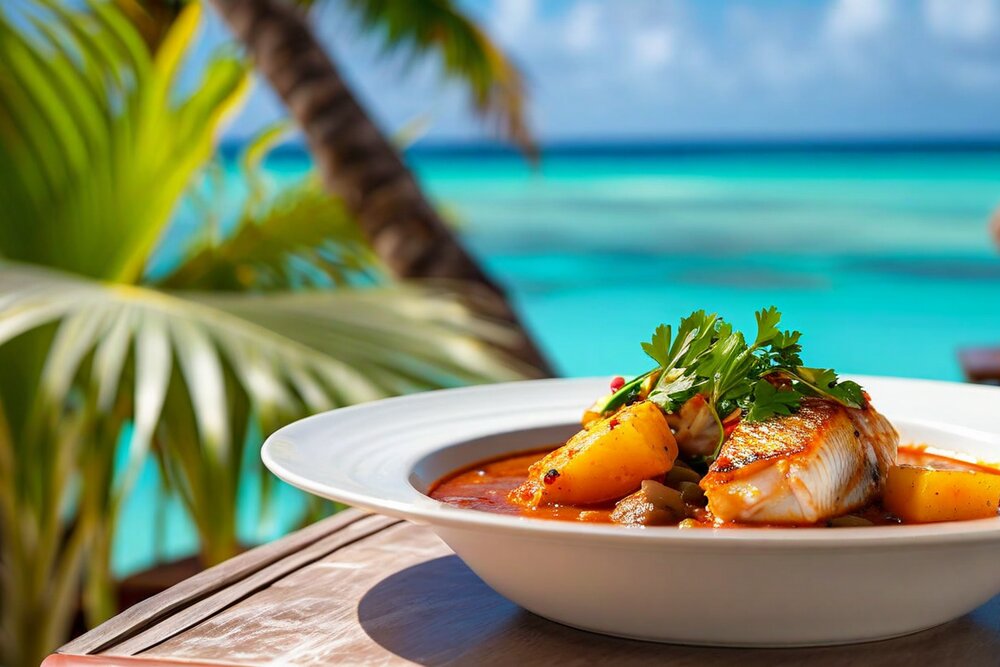
A beloved Chagossian dish—fresh reef fish simmered in spiced tomato sauce, preserved by the exiled community and still prepared at gatherings where they keep their culture alive. This recipe serves two.
Ingredients: 400g firm white fish (snapper or grouper), cubed, 3 tomatoes, chopped, 1 onion, sliced, 4 cloves garlic, minced, 1 inch ginger, grated, 2 green chilies, slit, 1 tsp turmeric, 1 tsp cumin, 200ml coconut milk, 2 tbsp oil, Fresh cilantro, Salt.
Preparation: Season fish with salt and turmeric, set aside 15 minutes. Heat oil in heavy pot, sauté onion until golden. Add garlic and ginger, cook 1 minute. Add chilies, cumin, and remaining turmeric, stir until fragrant. Add tomatoes, cook until broken down into sauce, about 10 minutes. Pour in coconut milk, bring to gentle simmer. Carefully add fish pieces, spooning sauce over to cover. Cook 10-12 minutes without stirring—shaking the pot gently to prevent sticking. Fish is done when it flakes easily. Garnish with fresh cilantro. Serve with rice or bread to soak up the rich sauce.
💡 Chagossians in exile say this dish tastes of home—a homeland most can no longer visit.
Salade de Palmiste
Heart of Palm Salad
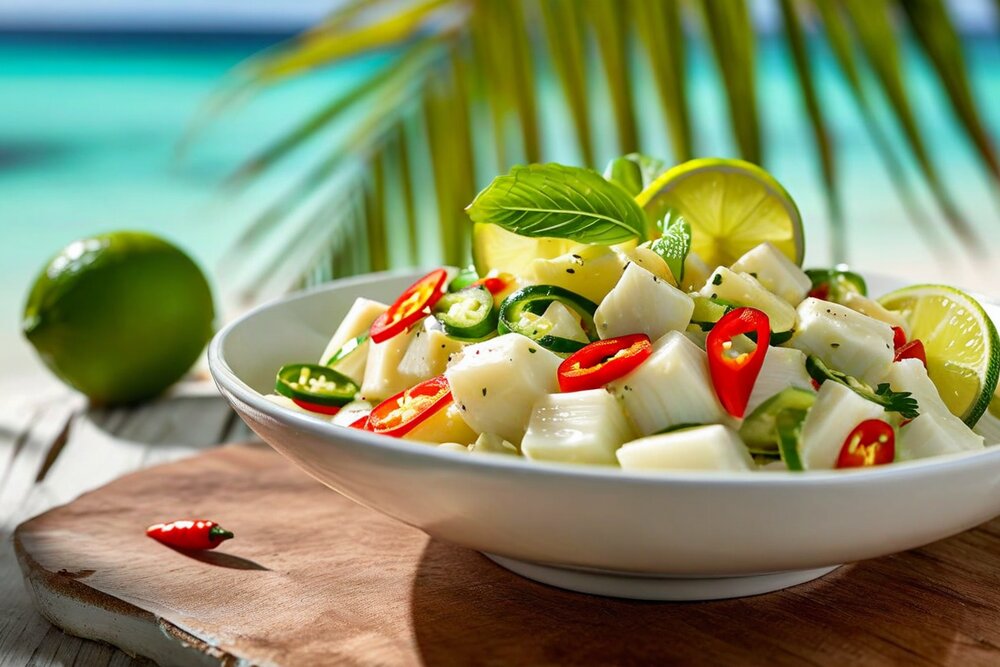
Fresh heart of palm—once abundant on Diego Garcia's coconut plantations—dressed simply with lime and chili, a refreshing salad that connects Chagossians to their lost islands. This recipe serves two.
Ingredients: 300g heart of palm (fresh or canned), drained, Juice of 2 limes, 2 tbsp coconut oil, 1 small red onion, thinly sliced, 1 red chili, finely sliced, 2 tbsp fresh cilantro, chopped, Salt and pepper.
Preparation: If using fresh heart of palm, slice into thin rounds. If canned, drain well, pat dry, and slice. Whisk together lime juice, coconut oil, salt, and pepper to make dressing. Combine heart of palm, onion, and chili in bowl. Pour dressing over, toss gently to coat. Let marinate 15 minutes at room temperature—this softens the onion and melds the flavors. Add cilantro, toss once more. Serve immediately as side dish or light lunch. The delicate, slightly nutty flavor of palm heart was a daily staple on Diego Garcia before the islands were cleared.
💡 Fresh heart of palm is incomparably better than canned—seek it out at Asian or Latin markets.
Ladob
Creole Banana Dessert
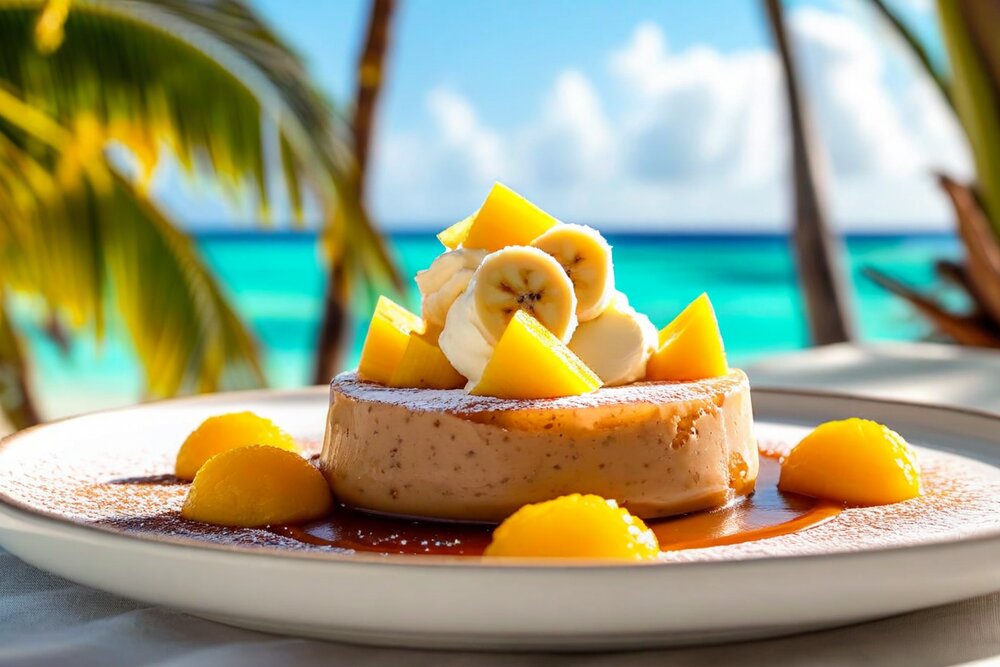
Sweet plantains or bananas cooked in coconut milk with vanilla and nutmeg—a simple dessert shared across the Indian Ocean Creole world, brought to Chagos by the original settlers. This recipe serves two.
Ingredients: 3 ripe plantains or large bananas, 250ml coconut milk, 50g sugar, 1 tsp vanilla extract, ¼ tsp grated nutmeg, Pinch of salt, 1 tbsp butter.
Preparation: Peel plantains and cut into 2-inch chunks on the diagonal. Combine coconut milk, sugar, vanilla, nutmeg, and salt in saucepan. Bring to simmer, stirring to dissolve sugar. Add plantain pieces, reduce heat to low. Simmer gently 15-20 minutes until plantains are very soft and sauce has thickened slightly. Stir in butter at the end for richness. Serve warm in bowls with the coconut sauce spooned over. Can be eaten as dessert or breakfast. The fragrance of vanilla and nutmeg in warm coconut milk transports Chagossians to their childhood islands.
💡 Plantains should be very ripe (black skins)—underripe plantains won't develop the proper sweetness.
🍷 Wine, Spirits & Drinking Culture
The British Indian Ocean Territory (Chagos Archipelago) has no wine production. The remote atoll chain in the central Indian Ocean is home to the Diego Garcia military base (US/UK) and has no indigenous civilian population (the Chagossians were controversially expelled in the 1960s-70s). The military base has standard military recreational facilities including bars, with beer and spirits sold at US exchange prices. Historically the plantation Chagossians brewed their own alcohol from coconut sap, sugar cane and fermented fruit; among the diaspora in Mauritius, Chagossian gatherings run on local rum and beer. No Kaufmann Wine Score applies.
🌤️ Climate
BIOT has a tropical maritime climate, hot and humid year-round with air temperatures averaging 27–29°C and sea temperatures rarely dropping below 26°C. The northeast monsoon (November–March) brings calmer seas and lighter winds, while the southwest monsoon (May–September) brings rougher seas, stronger winds and short, heavy showers. Cyclones are rare because the archipelago lies just outside the main Indian Ocean cyclone belt. Annual rainfall averages around 2,600 mm, distributed throughout the year, with the wettest months from December to February.
✈️ Getting There
There are no commercial flights, no scheduled passenger ships, and no civilian access of any kind to the British Indian Ocean Territory. Diego Garcia is served exclusively by US and UK military aircraft and supply vessels. The only realistic way for civilians to legally enter BIOT waters is by private yacht with a mooring permit issued by the BIOT Administration in London: £250 per week, up to 28 days, Outer Islands only (never Diego Garcia), granted solely for safe passage across the Indian Ocean, never to charter vessels or fee-paying crews, and requiring insurance covering medical evacuation (minimum US$100,000 per person) and wreck removal. Strict nature reserves—Three Brothers, Eagle, Danger and Nelson's Islands and eastern Peros Banhos—may not be approached within 3 nautical miles. Since 31 March 2026 new applications have been paused pending the right-of-abode appeal. For practical purposes, BIOT is the most inaccessible territory on Earth that remains under active administration.
📋 Practical Info
Visa: No tourist visas exist. A BIOT permit must be obtained in advance from the Commissioner's Office in London for any lawful entry (applications paused since 31 March 2026). Currency: US dollar in practice on Diego Garcia; pound sterling de jure (permit fees are paid in GBP). Language: English on the base; Chagossian Creole among the diaspora. Time zone: UTC+6. Electricity: 230 V / 50 Hz officially, though US facilities also run 110 V. Driving: on the right—the only British Overseas Territory to do so. Phone code: +246; postcode BBND 1ZZ; internet domain .io. Internet: only on Diego Garcia (Sure Diego Garcia, fibre since 2022). Head of state: King Charles III, represented by Commissioner Nishi Dholakia in London.
💰 Cost of Living
There is no civilian economy. Personnel on Diego Garcia use base exchange (NEX/NAAFI) facilities at subsidised US prices; meals, lodging and transport are provided by the military. For yachts in transit with permits, the only real costs are fuel, insurance and the BIOT mooring permit itself—£250 per week per yacht (rate set 1 July 2024), for one to four weeks, non-refundable and non-extendable. There are no hotels, restaurants, shops or services available to civilians anywhere in the territory.
🏨 Accommodation
No hotels, guesthouses or rentals exist anywhere in BIOT. On Diego Garcia, military personnel live in barracks ("hooches"), contractor housing or modest officer quarters. The base has a small "Down Town Diego Garcia" leisure area with a few bars, a bowling alley and a movie theatre, but none of it is available to outsiders. Yacht crews with permits sleep aboard their own vessels, anchored only at designated sites in the outer atolls.
🎉 Festivals & Events
There are no public festivals on the islands themselves. The Chagossian community in exile, however, marks several important dates: 25 February, anniversary of the 2019 ICJ advisory opinion; 16 February, which since 2026 commemorates the day the first Chagossians re-landed on Île du Coin; and the gatherings of the Chagos Refugees Group in Port Louis (Mauritius) and of the UK community in Crawley, where sega dancing, séga music and dishes such as daube de poisson keep the culture alive. On Diego Garcia the base marks US and UK public holidays and runs its own sports days.
🏛️ UNESCO Heritage
BIOT has no inscribed UNESCO World Heritage Sites. The Chagos Marine Protected Area, declared in 2010 and covering 640,000 km², is one of the largest no-take marine reserves on Earth and is frequently cited as a candidate for natural World Heritage status, but the disputed sovereignty between the United Kingdom and Mauritius means it appears on nobody's tentative list. The territory is covered by the Ramsar Convention (extended 1998) and lies inside the International Whaling Commission's Indian Ocean Whale Sanctuary.
🎒 Packing Tips
For the rare yacht crews holding a permit: high-SPF reef-safe sunscreen, polarised sunglasses, lightweight long-sleeve shirts, a wide-brimmed hat, sturdy reef shoes, snorkel gear, a good first-aid kit (medical evacuation is extremely difficult), a satellite phone, plenty of fresh water, and copies of your BIOT permit and yacht insurance. Bring everything you might need — there are no shops, no chandlers and no rescue services within hundreds of miles.
🔗 Resources
Useful starting points: the official BIOT Administration site (biot.gov.io), the UK Chagos Support Association, the Chagossian Voices advocacy group, and the Chagos Conservation Trust for marine science.
📚 Recommended Reading
Island of Shame: The Secret History of the U.S. Military Base on Diego Garcia by David Vine — the definitive English-language history. Chagos: A History by Nigel Wenban-Smith and Marina Carter — exhaustive archival study. The Last Colony by Philippe Sands — the legal battle at the ICJ told by one of its key barristers. Freedom Next Time by John Pilger (2006) — includes his long Chagos chapter, companion to the 2004 film Stealing a Nation. Also the Human Rights Watch report "That's When the Nightmare Started" (2023), which calls the expulsion a continuing colonial crime.
▶️ YouTube Videos
Search for John Pilger's documentary Stealing a Nation (2004), Al Jazeera's Diego Garcia: A Story of Forced Exile, BBC's Chagos: A Lost Paradise, and the Royal Geographical Society lectures on the Chagos MPA. Drone footage of Diego Garcia is restricted, but several declassified US Navy films are available.
✨ Fascinating Facts
• Diego Garcia's 3,660 m runway can launch fully loaded B-52 and B-2 bombers. • The lagoon is deep enough for nuclear submarines and aircraft carriers. • BIOT's 640,000 km² marine zone is larger than metropolitan France, on 60 km² of land. • The UN General Assembly voted 116–6 in 2019 demanding the UK withdraw — it has not. • Chagossian Creole survives mainly among the older diaspora and is considered endangered. • The UK signed a treaty on 22 May 2025 to cede the islands to Mauritius and lease back Diego Garcia for 99 years at about £101 million a year; ratification has been frozen since April 2026. • On 2 April 2025 President Trump imposed a 10% tariff on BIOT — a territory with no exports. • The .io domain beloved of tech start-ups is BIOT's country code; Chagossians have demanded a share of its revenues. • Diego Garcia drives on the right, the only British Overseas Territory to do so. • The amateur-radio prefix VQ9 makes Diego Garcia one of the rarest "countries" for DXers, and the runway was a designated Space Shuttle emergency landing site.
👤 Notable People
Olivier Bancoult — leader of the Chagos Refugees Group, the most prominent voice of the displaced community. Lisette Talate (1941–2012) — Chagossian activist whose testimony shaped international opinion. Marie Liseby Elysé — addressed the International Court of Justice in 2018 in Chagossian Creole. David Vine — American anthropologist whose research brought global attention to the expulsion. Philippe Sands KC — Franco-British barrister who argued Mauritius's case at the ICJ. Misley Mandarin — British Chagossian who led the February 2026 landing on Île du Coin and styles himself First Minister of the Chagossian Government; his father Michel Mandarin, born on the islands and expelled at 14, returned with him.
⚽ Sports
There are no national sports teams or competitive leagues. On Diego Garcia, military personnel play softball, basketball, American football, soccer and run a popular annual half-marathon. The Chagossian diaspora plays football and competes in the CONIFA (non-FIFA) federation under the name "Chagos Islands", with most players based in Crawley, England; the team took part in the 2016 CONIFA World Football Cup. BIOT has never sent athletes to the Olympic or Commonwealth Games and has no national Olympic committee.
📰 Media & Press Freedom
There is no civilian press in BIOT and no resident journalists. The base has three FM radio stations run by the American Forces Network and the British Forces Broadcasting Service, plus internal newsletters intended only for personnel. Independent media access has historically been almost impossible — most reporting on Chagos comes from journalists working with the diaspora in Mauritius and the UK. Reporters Without Borders does not rank BIOT separately, but press access is among the most restricted in the world: the Telegraph's Robert Mendick needed a 72-hour boat crossing to reach the Île du Coin settlers in February 2026, and Nigel Farage's attempt to sail in with supplies was refused entry.
📸 Photo Gallery
Only four images of this territory currently exist in our archive; more will be added when generated.
✍️ Author's Note Radim Kaufmann
Of all the places in this Factbook, the British Indian Ocean Territory is the only one I am almost certainly never going to set foot on — and that, in a way, is precisely why it haunts me. I have stood on the dock in Port Louis, Mauritius, looking out at fishing boats whose owners' grandparents were born on Peros Banhos and Salomon, and I have drunk strong Creole coffee with a Chagossian woman in Crawley, England, who described the smell of frangipani on Diego Garcia as if she had left only yesterday. She left in 1971. She was eight years old.
There is a particular cruelty to a paradise made off-limits by your own former government, then renamed a "Marine Protected Area" so that you cannot even fish near your ancestral home. The atolls of the Chagos are, by all accounts of the marine biologists allowed to visit them, among the most pristine reefs left on Earth — and that pristine quality exists in part because the people who lived alongside them for two centuries were physically removed. Conservation, sovereignty, military strategy and human rights collide here in a way that no other territory in this book quite manages.
If this entry feels different from the others, it is because it is different. It is a guide to a place you cannot visit, written in solidarity with the people who cannot return. As I revise it in September 2026, six of them have returned anyway—camped among the graves of Île du Coin, 120 miles from the runway, daring London to remove them—while the treaty that was supposed to settle everything sits in a Whitehall freezer because a president in Washington changed his mind. I do not know how this ends. I only know that the woman in Crawley told me she would go back "even for one night", and that for the first time in fifty years that no longer sounds impossible.
— Radim Kaufmann, 2026
Support This Project 🌍
This World Travel Factbook is a labor of love – free to use for all travelers. If you find it helpful, consider supporting its continued development.
