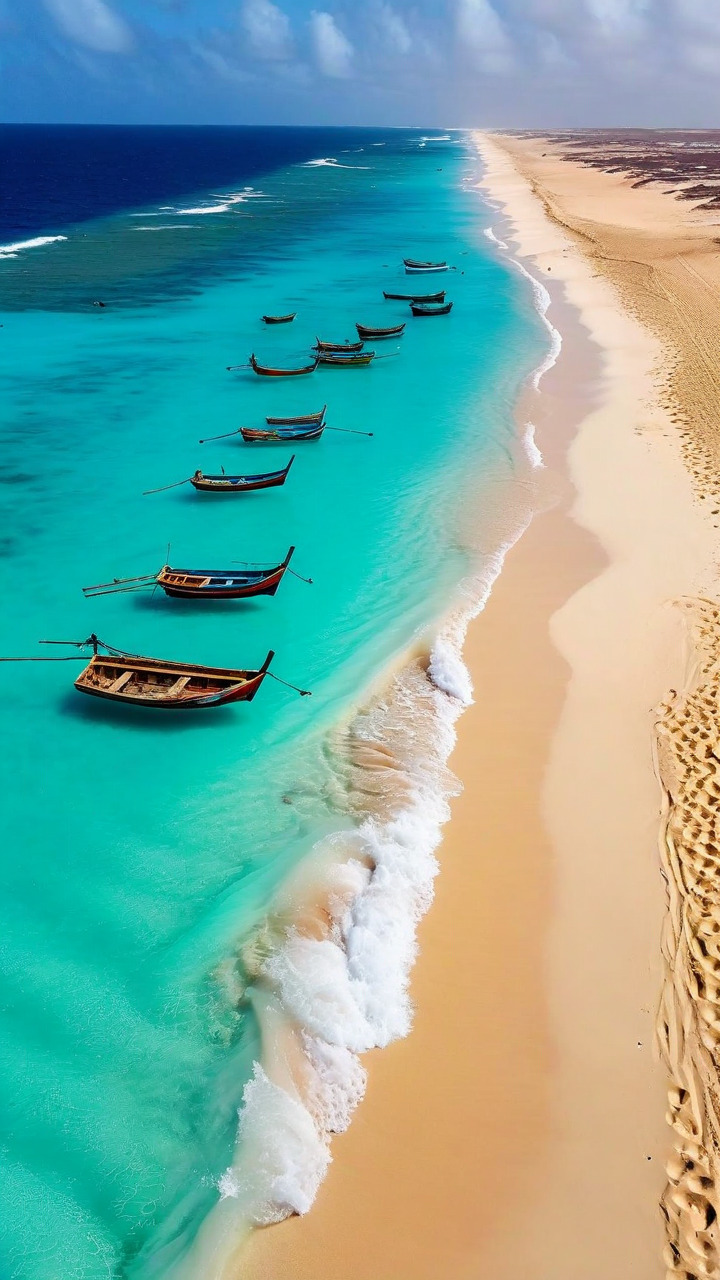


🌍 Cabo Verde at a Glance
🌍 Overview
Cabo Verde – ten volcanic islands scattered across the Atlantic Ocean 570 kilometers off the West African coast – is a nation built on "saudade," that uniquely Portuguese concept of melancholic longing that infuses everything from the haunting morna music to the welcoming spirit of its people.
Discovered uninhabited by Portuguese explorers around 1456, these islands became a crucial waystation in the Atlantic slave trade, creating a unique Creole culture blending African and European influences. Today, Cabo Verde is one of Africa's most stable democracies and a growing tourism destination known for its beaches, music, and volcanic landscapes.
The archipelago divides into two groups: the windward Barlavento islands (Santo Antão, São Vicente, Santa Luzia, São Nicolau, Sal, and Boa Vista) and the leeward Sotavento islands (Maio, Santiago, Fogo, and Brava). Each island has distinct character – from the desert beaches of Sal and Boa Vista to the dramatic volcanic crater of Fogo, from the cultural capital of Mindelo to the hiking paradise of Santo Antão.
With one UNESCO World Heritage Site (Cidade Velha), world-class kitesurfing, authentic Creole culture, and the spirit of Cesária Évora echoing through seaside bars, Cabo Verde offers Atlantic adventures far from mass tourism.
🏷️ Name & Identity
The islands take their name from Cap-Vert, the green headland on the Senegalese coast that Portuguese navigators had rounded in 1444 — an unintended irony, since the archipelago itself is one of the driest inhabited places in the Atlantic. In Kriolu the country is Kabu Verdi; in Portuguese, Cabo Verde.
One name, all languages: In October 2013 the government formally asked the United Nations and all foreign governments to stop translating the country's name. “Cape Verde”, “Kapverden”, “Cap-Vert” and “Kapverdské ostrovy” were retired from official usage; Cabo Verde is now the sole correct form in every language. Older signage, guidebooks and football commentary still lag behind.
Flag and symbols: The current flag was adopted in 1992, replacing the pan-African design of the independence years. A deep blue field stands for the ocean and sky; a white-red-white band for the road to nation-building and the blood shed on it; and a ring of ten golden five-pointed stars for the ten islands. The circle is deliberately off-centre and open to the west — towards the diaspora.
Who is a Cabo Verdean: Islanders distinguish badius (the interior of Santiago, closest to African roots and the source of batuque and funáná) from sampadjudus (the northern islands, historically more Europeanised, home to morna and coladeira). ISO codes: CV / CPV. Internet domain: .cv. Calling code: +238.
🗺️ Geography & Islands
Cabo Verde's ten islands (nine inhabited) emerged from volcanic activity on the African tectonic plate. The archipelago spans roughly 4,033 km² of land across a vast ocean area. The islands vary dramatically in landscape and character.
Windward Islands (Barlavento): Sal and Boa Vista are flat, desert-like islands with stunning beaches – the tourism hotspots. São Vicente hosts Mindelo, the cultural capital. Santo Antão offers dramatic mountains and hiking. São Nicolau is quiet and traditional.
Leeward Islands (Sotavento): Santiago is the largest and most African island, home to the capital Praia. Fogo rises to 2,829 meters at Pico do Fogo, an active volcano that last erupted in 2014. Brava is known for flowers and emigration to the US. Maio remains largely undeveloped.
Climate: Tropical dry with two seasons: the hot, humid season (July-October) and the dry, windy season (November-June). The harmattan wind from the Sahara can bring dust and haze. Average temperatures range from 20-29°C year-round. Water temperature stays warm at 22-27°C.
Best Time to Visit: November-June offers dry weather and good winds for water sports. July-October is warmer and occasionally rainy on mountainous islands.
🗺️ Map
Key destinations marked: click a pin for the section reference. Scroll-wheel zoom is off — use the +/− controls.
📜 History
Discovery (1456-1462): Portuguese explorers found the uninhabited islands around 1456. Settlement began on Santiago in 1462. Ribeira Grande (now Cidade Velha) became the first European city in the tropics.
Slave Trade Era: For centuries, Cabo Verde served as a vital waystation in the Atlantic slave trade. Enslaved Africans from the mainland were held here before transport to the Americas. This brutal history created Cabo Verde's unique Creole culture – a blend of Portuguese colonizers and enslaved Africans.
Colonial Struggles: Recurring droughts caused devastating famines – an estimated 45,000 people — roughly a quarter of the population — died in the famines of 1941–43 and 1947–48 while the Portuguese colonial administration kept exporting food. Fogo lost about 31% of its people, São Nicolau 28%. This suffering fueled independence movements.
Independence (1975): Amílcar Cabral, born in Guinea-Bissau to Cabo Verdean parents, led the independence struggle. He was assassinated in 1973, but Cabo Verde gained independence on July 5, 1975. Initially united with Guinea-Bissau, the countries separated in 1980.
Modern Era: Since transitioning to multiparty democracy in 1991, Cabo Verde has become one of Africa's most stable and prosperous nations. Tourism, remittances from the diaspora, and international aid drive the economy.
👥 People & Culture
Cabo Verdeans are predominantly Creole (mestiço) – mixed African and European heritage shaped by centuries of cultural blending. Roughly 530,000 people live on the islands today (UN estimate for 2026; the 2021 census counted 491,233 residents), but the diaspora is larger still — estimates run from 700,000 to over a million people of Cabo Verdean descent living abroad, primarily in the United States (especially Massachusetts and Rhode Island), Portugal, the Netherlands, and France.
Language: Portuguese is the official language, but Kriolu (Cape Verdean Creole) is the true mother tongue, spoken in daily life. Each island has its own Kriolu variation. The phrase "Morabeza" captures the famed Cabo Verdean hospitality and warmth.
Religion: Predominantly Roman Catholic (77%), with Protestant minorities and syncretic practices blending African traditions.
Saudade: This Portuguese concept of melancholic longing permeates Cabo Verdean culture. It reflects the history of emigration, separation from loved ones, drought, and colonial hardship – but also a deep appreciation for home, tradition, and human connection. You hear it in morna music; you feel it in seaside conversations.
Diaspora Connection: Emigration has defined Cabo Verde for centuries. Those who leave maintain strong ties to their islands. Remittances are economically vital; "no kaza" (homecoming) visits are culturally essential. Many Cabo Verdeans describe themselves as having "one foot here, one foot there."
🏖️ Sal Island
Sal is Cabo Verde's tourism engine – a flat, desert island transformed by international flights and all-inclusive resorts. Named for its historic salt extraction, the island now trades white gold for sun-seeking tourists.
Santa Maria: This beach town on the southern tip is Sal's heart. An 8-kilometer stretch of golden sand meets turquoise waters, lined with restaurants, shops, and watersports operators. The town retains some charm despite development.
Pedra de Lume: An extinct volcanic crater where natural salt pans have been harvested since 1804. Visitors can float in the super-salty water – denser than the Dead Sea.
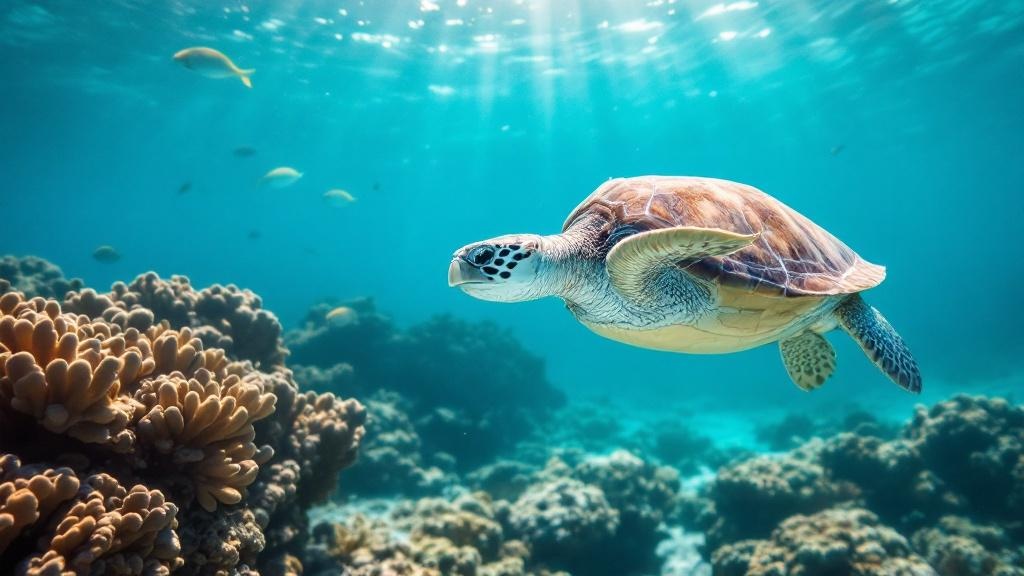
Watersports: Sal is world-class for kitesurfing and windsurfing, particularly from November to May when trade winds blow consistently. Ponta Preta and Kite Beach draw international riders. Diving and snorkeling reveal sharks, rays, and sea turtles.
Reality Check: Sal is the most developed and touristy island. It offers convenience and beaches but less authentic Cabo Verde culture than other islands.
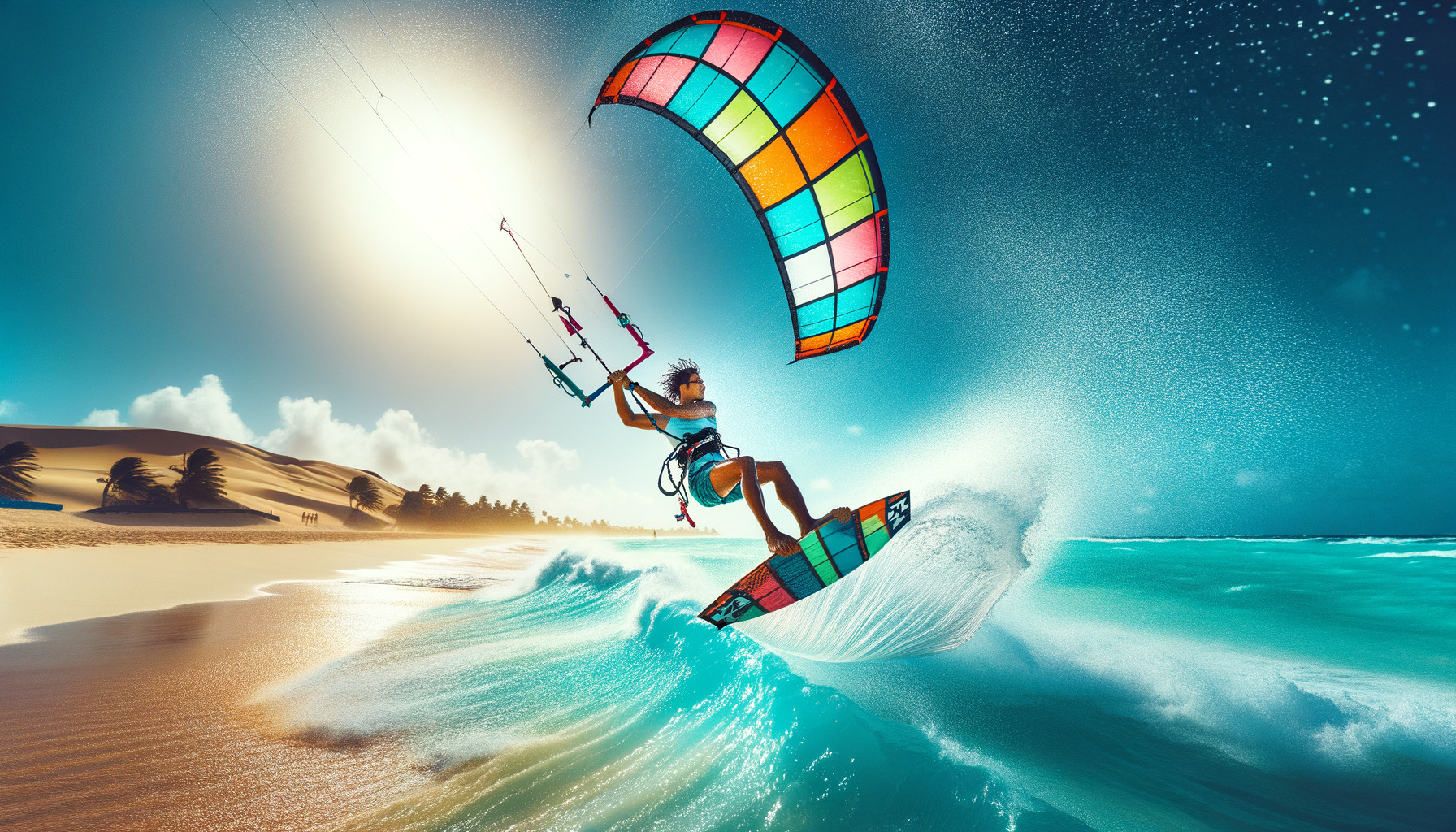
Kite Beach, Sal
November-to-May trade winds make Sal one of the most reliable kitesurfing venues on earth; Ponta Preta is the wave spot.
🏖️ Boa Vista
Boa Vista – "Good View" – is Sal's quieter sibling: more beaches, fewer crowds, and dramatic desert landscapes. This is the closest Cabo Verde gets to the Sahara, with dunes rolling into the Atlantic.
Beaches: Praia de Santa Mónica and Praia de Chaves rank among the world's finest – vast crescents of sand with few footprints. Praia da Varandinha is backed by dramatic cliffs. Sea turtles nest on eastern beaches from July to October.
Viana Desert: Sand dunes blown from the Sahara create an otherworldly landscape in the island's interior. ATV tours explore the desert, abandoned villages, and coastal cliffs.
Sal Rei: The laid-back capital offers colorful buildings, a few restaurants, and genuine local life away from the resorts. The daily fish market is worth visiting.
Note: Boa Vista is developing rapidly. It offers more space and natural beauty than Sal but similar resort-oriented tourism.
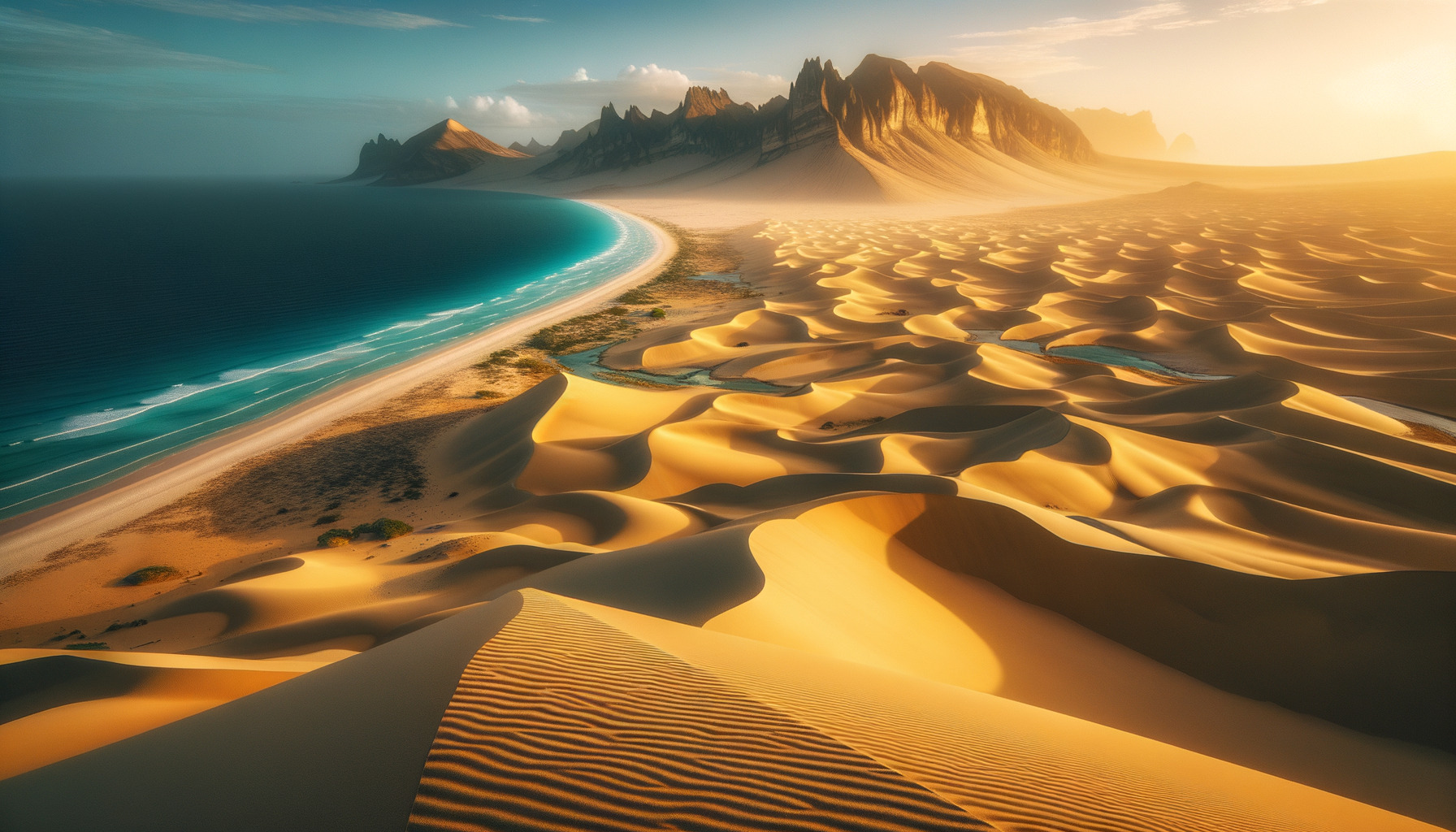
Viana Desert, Boa Vista
Saharan sand blown across the Atlantic and dumped in the island’s interior — dunes to the horizon, ten minutes from a beach.
🏛️ Santiago & Praia
Santiago is Cabo Verde's largest and most African island – the historical heart where Creole culture was born. Here you'll find the capital Praia, the UNESCO World Heritage Site of Cidade Velha, and a more authentic (if grittier) Cabo Verde experience than the beach islands.
Praia: The capital city of roughly 140,000 (2021 census) is chaotic, congested, and challenging but rewards exploration. The Plateau (Platô) historic center features colonial architecture. Sucupira Market pulses with African energy – textiles, produce, and noise. The waterfront promenade offers restaurants and Atlantic views.
Cidade Velha (UNESCO): Just 15 km from Praia, this former capital was the first European city built in the tropics. The "Pillory" (Pelourinho) where enslaved people were punished stands as a haunting reminder of the slave trade. The 16th-century Fortaleza Real de São Filipe overlooks the bay. The UNESCO site preserves this painful but crucial history.
Interior Santiago: The mountainous interior offers hiking, traditional villages, and the Serra Malagueta Natural Park. The contrast with beach-resort Cabo Verde is striking.
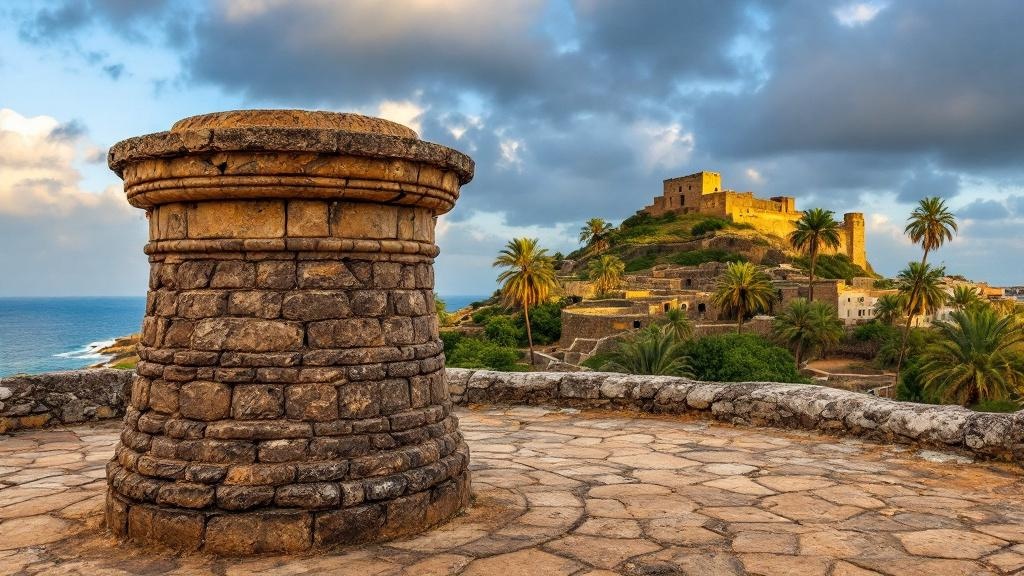
Cidade Velha, Santiago
Founded in 1462 — the first European city built in the tropics, and Cabo Verde’s sole UNESCO World Heritage Site.
🌋 Fogo Volcano
Fogo – "Fire" – is Cabo Verde's most dramatic island, dominated by the active Pico do Fogo volcano rising 2,829 meters from the Atlantic. The island is essentially a massive volcanic cone with people living on its flanks and inside its crater.
Chã das Caldeiras: Inside the ancient collapsed crater, at 1,700 meters elevation, two villages (Portela and Bangaeira) house about 1,000 people who cultivate grapes for wine, grow vegetables, and guide tourists up the volcano. The 2014-2015 eruption destroyed much of these villages, but residents rebuilt.
Climbing Pico do Fogo: The 6-hour round trip to the summit is challenging but rewarding. Volcanic cones, lava flows, and sulfurous vents mark the ascent. The crater rim offers views across the caldeira and Atlantic. Guides are mandatory.
Fogo Wine: Volcanic soil and high altitude produce unique wines – particularly the "Manecom" label grown inside the crater. Wine tasting combines with volcano visits.
São Filipe: Fogo's capital features well-preserved sobrado houses (colonial mansions) and a more traditional atmosphere than tourist islands.
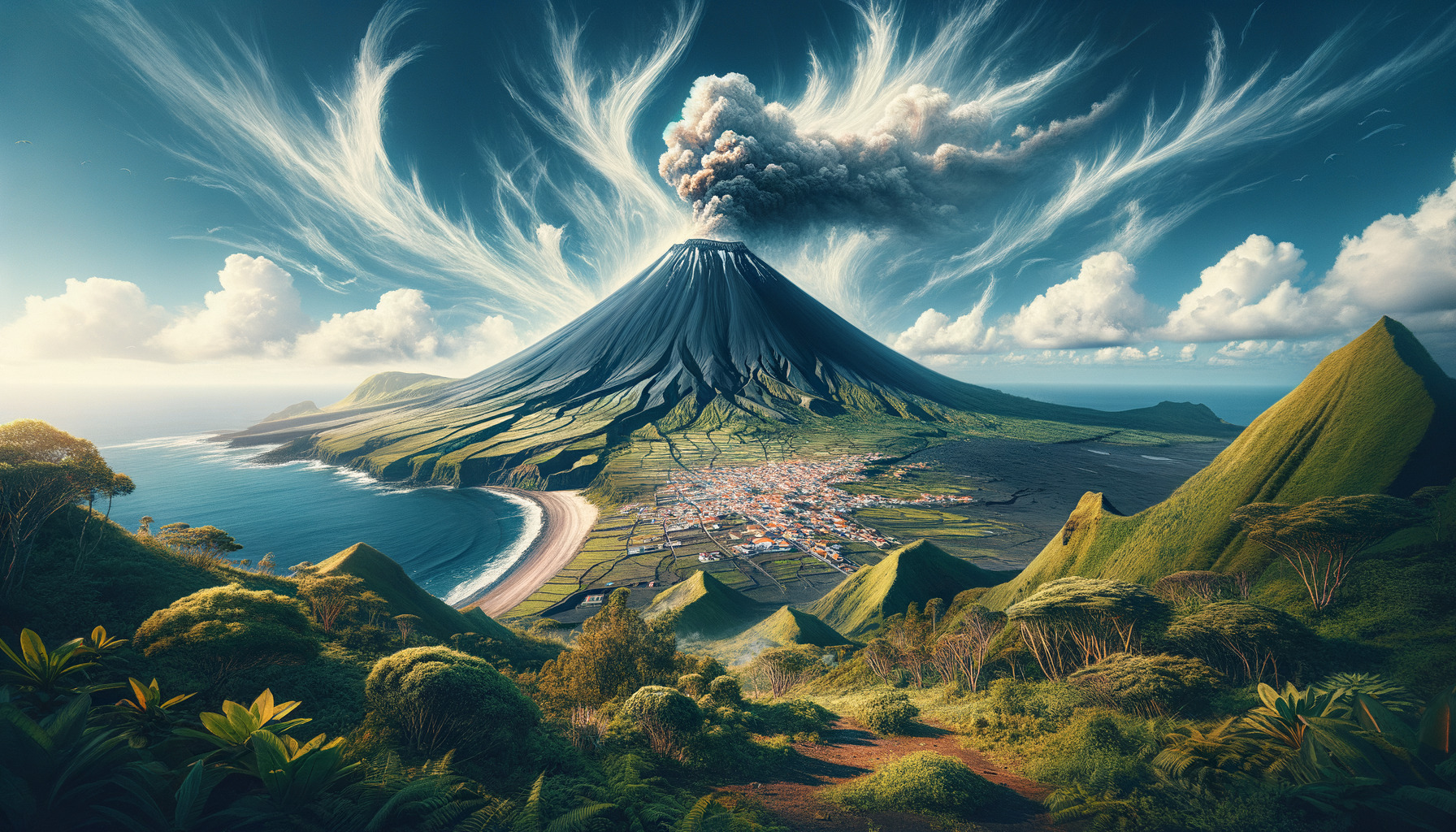
Pico do Fogo, 2,829 m
The Atlantic’s most active volcano, seen from the caldera floor at Chã das Caldeiras — where a few hundred people farm the lava that buried their villages in 2014.
🎭 São Vicente & Mindelo
São Vicente is Cabo Verde's cultural heart, home to Mindelo – the archipelago's most charming and culturally vibrant city. This is where Cesária Évora was born, where morna music fills the night air, and where carnival rivals Brazil's for enthusiasm if not scale.
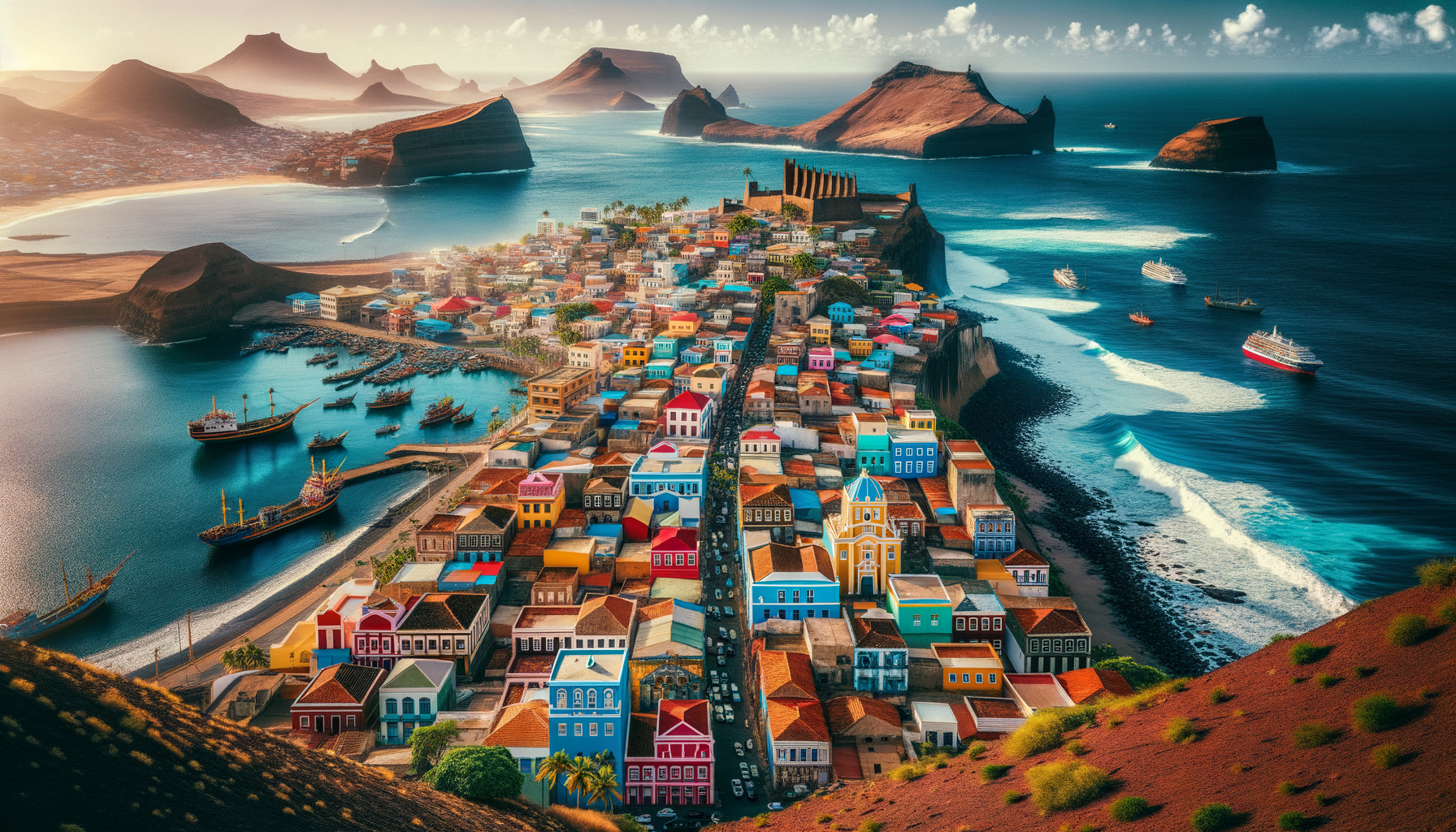
Mindelo: With 70,000 residents, Mindelo is Cabo Verde's second city but feels like its first in terms of culture. Colonial architecture lines the harbor. Music bars (botecos) feature live morna and coladeira. Art galleries, cafés, and a sophisticated atmosphere make this the island for culture seekers.
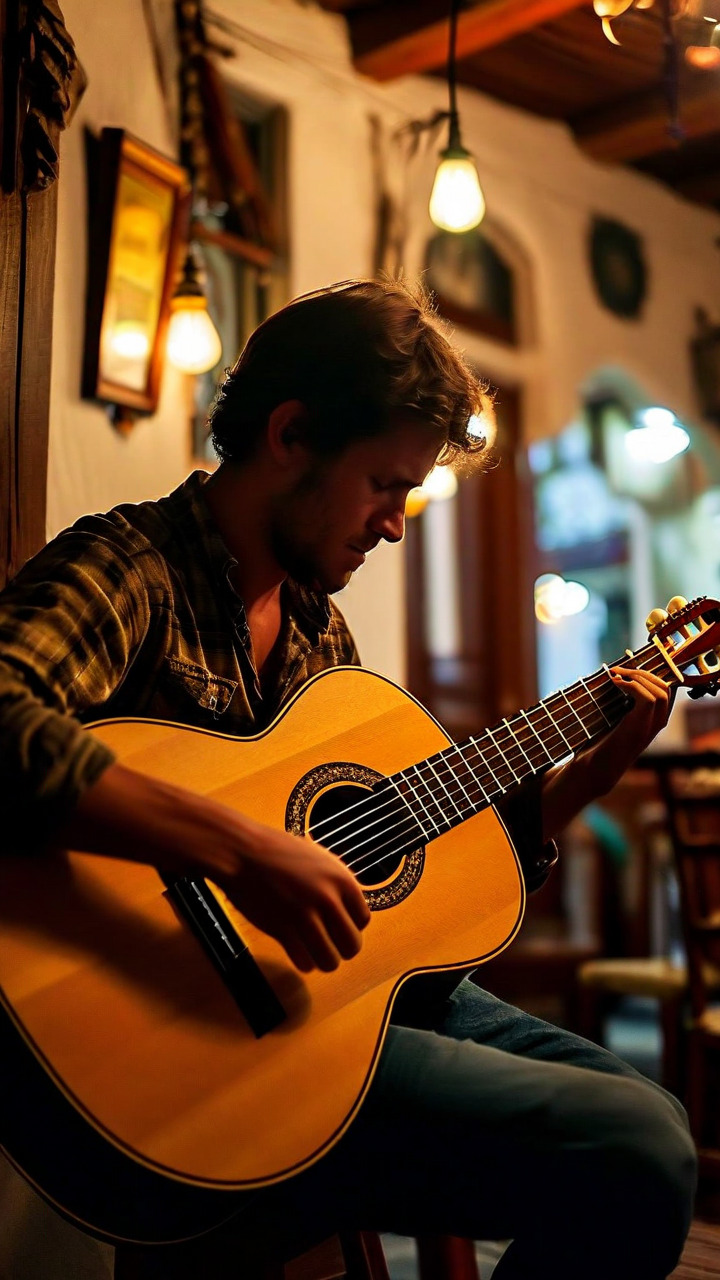
Music Scene: Mindelo's bars come alive at night. Casa da Morna, the center named for Cesária Évora, celebrates the city's musical heritage. Local musicians play nightly in casual venues – an intimate experience far from stadium concerts.
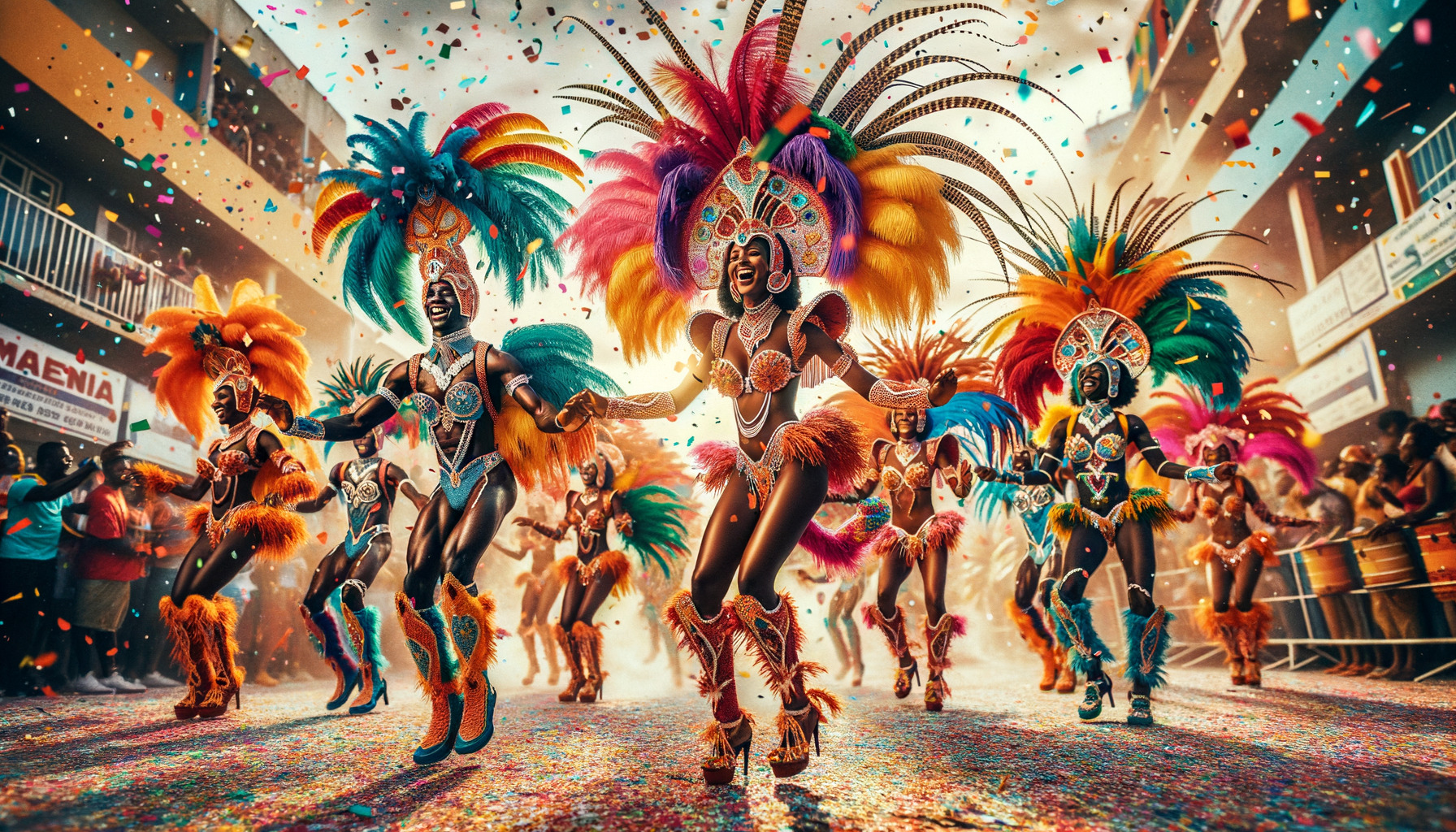
Carnival: February/March brings carnival celebrations that Mindelenses claim are the best in Africa. Parades, costumes, and all-night parties transform the city.
Beaches: São Vicente has some beaches, but most visitors use it as a gateway to Santo Antão's mountains. Ferries run frequently between the two islands.
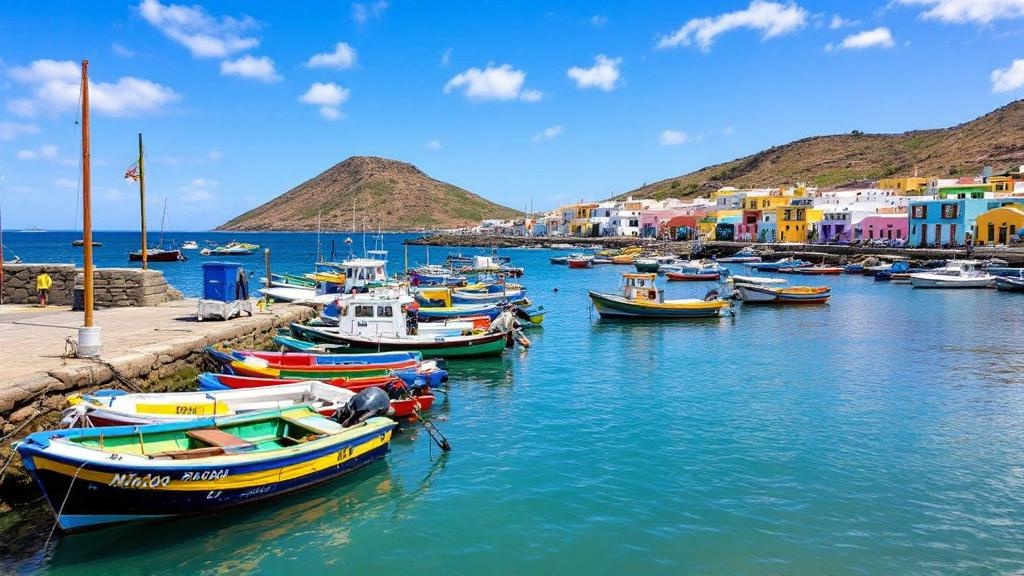
Mindelo, São Vicente
The cultural capital: colonial façades around Porto Grande bay, morna in the bars after dark, and the carnival that empties the rest of the island every February.
⛰️ Santo Antão
Santo Antão is Cabo Verde's hiking paradise – a mountainous island where dramatic valleys, traditional villages, and ancient trails offer some of the finest trekking in the Atlantic. The contrast with desert Sal or Boa Vista is startling.
Paul Valley: This lush valley descends from 1,500 meters to sea level through banana plantations, sugarcane, and terraced agriculture. The hiking trail from Cova crater to Paul is legendary – five hours descending through changing landscapes.
Ribeira Grande: The valley of Ribeira Grande carves deep into volcanic rock. Hiking trails connect villages accessible only on foot. This is traditional Cabo Verde – terraced farms, stone houses, and warm hospitality.
The Road: The dramatic coastal road from Porto Novo to Ribeira Grande (and formerly Ponta do Sol) ranks among the world's most spectacular drives – clinging to cliffs above the Atlantic.
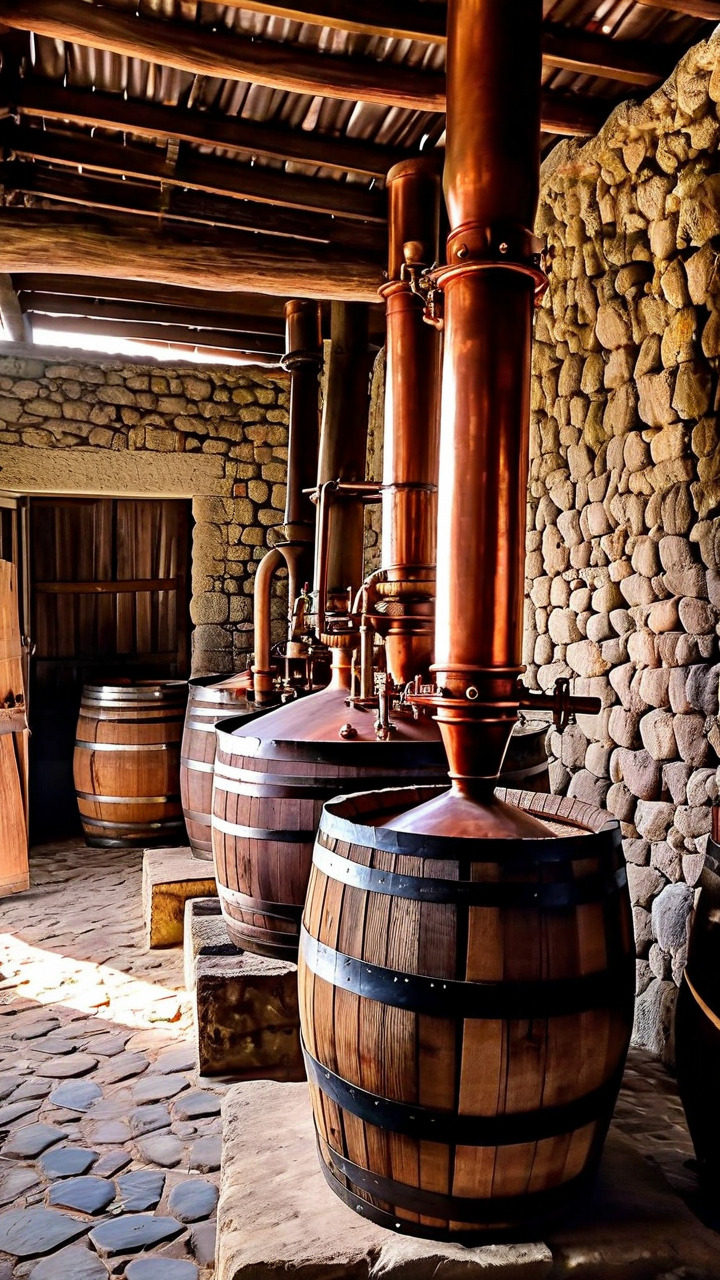
Grogue: Santo Antão is famous for grogue (sugarcane rum), produced in small distilleries called trapiches. Visiting a trapiche and tasting fresh grogue is a quintessential island experience.
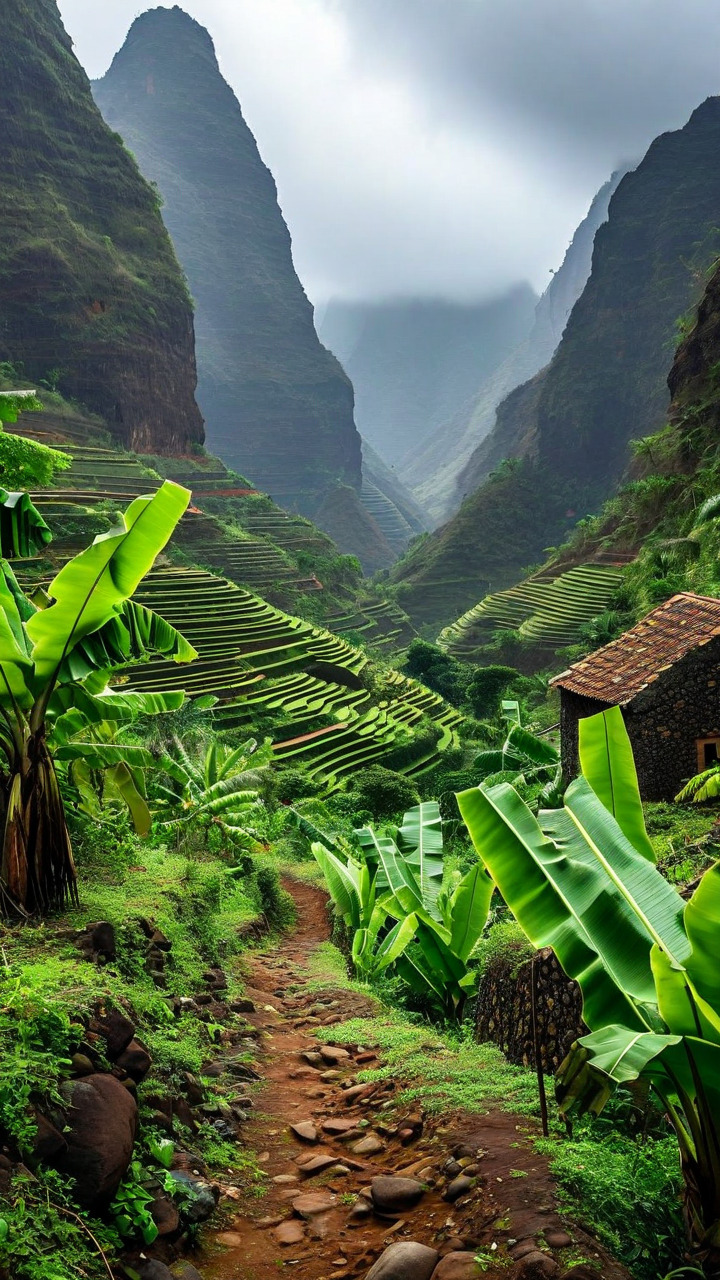
Santo Antão — the hiking island
Terraces, cobbled mule paths and ribeiras dropping from the Cova crater to the sea: the finest trekking in the archipelago.
Explore More About Cabo Verde
Six deep-dive guides live on their own pages so this one doesn't turn into a wall of text.
🏛️ Government & Politics
Cabo Verde is a semi-presidential republic and one of only a handful of African states rated consistently free. Since the introduction of multiparty politics in 1991 every change of government has been peaceful, and power has alternated repeatedly between the same two parties.
The 2026 turnover: Parliamentary elections on 17 May 2026 ended a decade of rule by the Movement for Democracy (MpD). The African Party for the Independence of Cabo Verde (PAICV) took roughly 48% of the vote and 37 of the 72 seats in the National Assembly — an absolute majority. Party leader Francisco Carvalho was sworn in as prime minister on 19 June 2026, succeeding Ulisses Correia e Silva, who had governed since 2016.
Head of state: President José Maria Neves, in office since November 2021 and himself a former PAICV prime minister. The presidency is largely ceremonial but carries real veto and arbitration powers. The next presidential election is set for 15 November 2026, with a run-off on 29 November if no candidate wins outright. Turnout in the May legislative vote was a record-low 46.5%, and Correia e Silva resigned the MpD leadership on election night.
Structure: A unicameral 72-seat National Assembly elected by proportional representation, including seats reserved for the diaspora constituencies of Africa, the Americas and Europe — Cabo Verdeans abroad vote. Below that sit 22 municipalities (câmaras municipais), each with an elected mayor. The capital is Praia, on Santiago.
What it means for visitors: Very little. Cabo Verdean elections are quiet and orderly; campaign season simply means more sound trucks and more flags. No travel disruption has followed any election since independence.
⚠️ Travel Advisory & Safety
🇺🇸 U.S. State Department — Level 1: Exercise Normal Precautions
Cabo Verde carries the lowest of the four U.S. advisory levels, renewed without change on 15 December 2025. It is one of the safest countries in Africa and safer than most European holiday destinations. The advisory nonetheless flags an elevated risk of crime in Praia.
Praia specifics: The Sucupira market and the Fazenda district see pickpocketing, bag-snatching and occasional muggings. The stepped alleyways that climb between Praia's neighbourhoods isolate whoever uses them and should be avoided even in daylight. Don't walk the Platô alone after dark, don't display jewellery or watches, and don't resist a robbery.
Everywhere else: Sal, Boa Vista, Santo Antão, Fogo, São Nicolau, Maio and Brava are quiet. Mindelo is lively but low-risk. Violent crime against tourists is rare across the archipelago.
The ocean is the real hazard. Atlantic swell, rip currents and shore break injure more visitors here than crime does. Most beaches have no lifeguards and no flag system. Santa Maria and Sal Rei are usually calm; north- and west-facing beaches often are not. Ask locally, and take “don't swim here” literally.
Volcanic risk: Pico do Fogo is an active volcano. The 2014–15 eruption buried the villages of Portela and Bangaeira under lava within days. Hiking the caldera is safe under normal conditions and guides are compulsory, but check advisories from the Instituto Nacional de Meteorologia e Geofísica before travelling to Chã das Caldeiras.
Health: No malaria and no yellow-fever certificate required for arrivals from non-endemic countries. Tap water is chlorinated and generally safe on the main islands, though most visitors drink bottled. Medical facilities are basic outside Praia and Mindelo — serious cases are evacuated to Portugal or the Canaries, so carry insurance covering air evacuation. Dengue has appeared in past outbreaks; use repellent in the humid season.
ℹ️ Practical Information
Getting There: International airports on Sal (SID), Boa Vista (BVC), Praia (RAI) and São Vicente (VXE). Plenty of direct flights from Europe (TAP, TUI, Transavia and charter operators), with connections via Lisbon. From North America, Cabo Verde Airlines returned to the United States on 4 May 2026 with a Providence (PVD) service — weekly at first, twice weekly from 5 June — flown by a Boeing 737 MAX 8 on a Praia–Sal–Providence routing with a roughly 90-minute stop on Sal, so it is direct but not nonstop. It is the first U.S. link since the old Boston route ended in July 2021; TACV last served Providence in 2015–18. Between islands, Cabo Verde Airlines now flies the whole domestic network with ATR 72 turboprops (Bestfly, the previous operator, lost its licence in April 2024 and capacity has been tight since — book early), and CV Interilhas runs the ferries.
Visa & entry (changed — read this): Citizens of the United States, the United Kingdom, the EU, Switzerland, Canada and most other Western countries need no visa for stays of up to 30 days. What they do need is EASE (Efficient, Automatic and Secure Entry) pre-registration, completed online at least five days before arrival, together with payment of the Airport Security Fee (TSA) of 3,400 CVE (about €31). Visa-on-arrival has been phased out — turning up without EASE is no longer a workable plan. Stays beyond 30 days require a visa applied for in advance through a Cabo Verdean embassy or consulate (Washington DC and Boston serve the United States).
Money: Cabo Verdean Escudo (CVE). 1 EUR ≈ 110 CVE (fixed rate). Euros widely accepted in tourist areas. ATMs available on main islands. Credit cards accepted at hotels and resorts; cash essential elsewhere.
Transport: Island-hopping requires planning. Domestic flights are efficient but limited. Ferries are cheaper but weather-dependent and less frequent. Taxis and aluguer (shared minibuses) serve local transport. Car rental available on larger islands.
Health: No major health risks. Tap water is generally safe on main islands. Malaria is not present. Bring sun protection – the tropical sun is intense.
Safety: Cabo Verde is one of Africa's safest countries and sits at U.S. advisory Level 1. Petty theft is concentrated in Praia, and Atlantic currents are the more serious risk — see section 13 above for detail.
💶 Cost of Living & Accommodation
The Cabo Verdean escudo is pegged to the euro at 110.265 CVE = €1, a peg inherited from the pre-euro Portuguese escudo and never broken. That makes budgeting unusually predictable. Euros circulate informally in resort areas, but change comes back in escudos, often at a rounded 1:100 — a quiet 10% surcharge.
Daily budget: Backpacker €30–50 (guesthouse bed, local restaurants, aluguer minibuses). Mid-range €60–100 (three-star hotel or apartment, a restaurant meal a day, the odd domestic flight). Comfortable €120–200 (resort or boutique hotel, guided excursions, car hire).
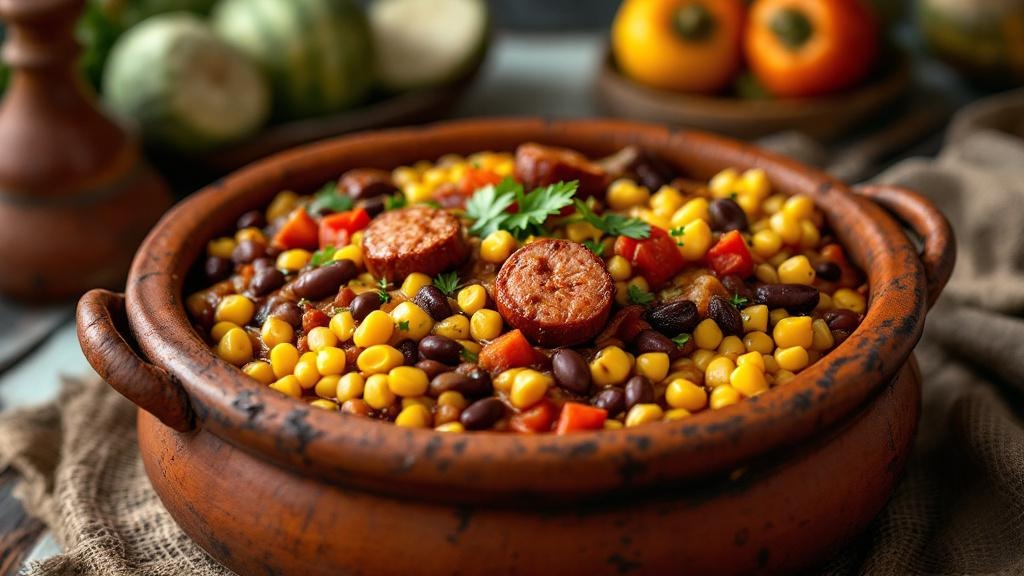
What things cost: A bottle of Strela beer runs €1–2 in a local bar and roughly three times that in a resort; a plate of cachupa €3–5; a grilled-fish dinner €8–15; a short taxi hop in Santa Maria or Mindelo €2–4; a shared aluguer between towns €1–3. Domestic flights on Cabo Verde Airlines typically land in the €70–130 range one way; the CV Interilhas ferries are far cheaper and far slower.
Accommodation styles: Sal and Boa Vista are dominated by large all-inclusive resorts sold mainly as European package holidays; you can book them independently but rarely cheaply. Everywhere else the standard is the residencial — a small family-run guesthouse, clean, plain and inexpensive. Santo Antão has excellent valley guesthouses in Paul and Ribeira Grande; Chã das Caldeiras offers homestays inside the volcanic caldera; Mindelo has a growing crop of boutique conversions in colonial townhouses.
Booking note: Cabo Verdean hotels recorded almost 1.25 million guests in 2025, and the World Cup run has pushed 2026 interest higher still. Book Fogo, Brava and Santo Antão accommodation ahead — supply on those islands is genuinely thin.
🎉 Festivals & Events
Carnaval de Mindelo (February–March) — the big one. São Vicente throws the most exuberant carnival in West Africa, with rival grupos spending the whole year building floats and costumes for a Brazilian-scale parade through a Portuguese colonial town. Mindelo beds sell out months ahead.
Kriol Jazz Festival (Praia, April) — three nights on the Platô mixing Cabo Verdean, West African, Caribbean and Brazilian acts. The most musically serious event on the calendar.
Gamboa Festival (Praia, May) — a free beachfront festival: loud, crowded and entirely local.
Festa de São João Baptista (24 June) — Porto Novo on Santo Antão and Ribeira Brava on São Nicolau fill with drumming colá sãnjon processions. One of the most African of the island festivals.
Independence Day (5 July) — national holiday marking the 1975 separation from Portugal.
Baía das Gatas (São Vicente, August full moon) — a three-day open-air music festival on a bay north of Mindelo. Cabo Verdeans fly home from Lisbon and Boston for it; the whole island decamps to the beach.
Santa Maria Music Festival (Sal, September) — the beach-island counterpart, staged on the sand at Santa Maria.
Tabanka (Santiago, May–June) — not a festival for tourists but a Santiago tradition: neighbourhood mutual-aid brotherhoods parading with drums, conch shells and borrowed saints. Deeply badiu, and worth finding.
🧠 Fascinating Facts
• The smallest nation ever to reach a World Cup knockout round. Cabo Verde debuted at the 2026 World Cup and made the round of 32 with a population of roughly half a million.
• Cidade Velha was the first European city built in the tropics, founded in 1462. Vasco da Gama, Columbus and Darwin all called here.
• The country asked the world to stop translating its name. Since 2013 “Cape Verde” has been officially incorrect in every language — it is Cabo Verde, full stop.
• The escudo has been pegged to the euro since the euro existed, at 110.265 to one, and the peg has never moved.
• Morna — the music of saudade — was inscribed on UNESCO's Intangible Cultural Heritage list in 2019, eight years after Cesária Évora's death.
• Boa Vista hosts one of the world's largest loggerhead turtle nesting populations, in strong seasons ranking among the top three globally.
• Ten islands, nine inhabited. Santa Luzia has been empty since the 1960s.
• You can float inside a volcano. The salt pans of Pedra de Lume sit in a collapsed crater on Sal and are saltier than the Dead Sea.
• The diaspora outnumbers the country. More people of Cabo Verdean descent live abroad — in Massachusetts, Rhode Island, Portugal, the Netherlands and France — than on the islands themselves.
• Amílcar Cabral, the intellectual architect of Portuguese Africa's independence, was an agronomist. His political theory grew out of a soil survey of Guinea.
⭐ Notable People
Cesária Évora (1941–2011) — the “Barefoot Diva” of Mindelo, who sang in bars for four decades before international fame arrived in her fifties and a Grammy in 2004. Her funeral effectively shut down the country; Mindelo's airport carries her name.
Amílcar Cabral (1924–1973) — born in Guinea-Bissau to Cabo Verdean parents, founder of the PAIGC and one of the most influential anti-colonial theorists of the twentieth century. Assassinated in Conakry two years before the independence he engineered.
Germano Almeida (b. 1945) — novelist of Boa Vista and Mindelo, winner of the Camões Prize in 2018, the highest honour in Portuguese-language literature. The Last Will and Testament of Senhor da Silva Araújo is the usual entry point.
Aristides Pereira (1923–2011) and Pedro Pires (b. 1934) — first and third presidents; Pires won the Mo Ibrahim Prize in 2011 for leaving office voluntarily.
The musicians: Bana and Ildo Lobo in the classic morna tradition; Tito Paris in Lisbon; and a modern generation — Mayra Andrade, Lura, and Sara Tavares (1978–2023), whose early death was mourned across the Lusophone world.
Edy Tavares (b. 1992) — born on Maio, 2.21 m tall, EuroLeague Defensive Player of the Year with Real Madrid and briefly an NBA player. Arguably the best shot-blocker Europe has produced.
Mitu Monteiro (b. 1982) — kitesurfing world champion from Sal, the athlete who put Ponta Preta on the global watersports map.
Pedro “Bubista” Leitão Brito — the coach who took the Blue Sharks to a World Cup, and the most quoted man in Cabo Verde in 2026.
⚽ Sports
In October 2025 a country of roughly half a million people qualified for the FIFA World Cup for the first time. A 3–0 home win over Eswatini on 13 October 2025 sealed it, and the islands stopped working for two days.
The 2026 tournament: The Tubarões Azuis — Blue Sharks — were drawn into a group that should have ended them and did not. They held Spain 0–0, drew 2–2 with Uruguay and shut out Saudi Arabia 0–0 to advance as the smallest nation ever to reach a World Cup knockout round in the tournament's 96-year history. Kevin Pina's 21st-minute strike against Uruguay in Miami on 21 June 2026 was the country's first World Cup goal; Hélio Varela added the second. (Curaçao, which qualified a month after Cabo Verde, is smaller by area, so the Blue Sharks went in as the second-smallest qualifier by land and the third-least-populous.)
The Argentina match: In the round of 32 in Miami on 3 July 2026, Cabo Verde twice pulled level with the reigning world champions — Duarte on 59 minutes cancelling out Messi, Lopes Cabral on 103 cancelling out Martínez — before a Diney Borges own goal deep in extra time sent Argentina through 3–2 after extra time. It was, by common consent, the match of the round.
Before that: Cabo Verde reached the AFCON quarter-finals in 2013 on debut, and again in the 2023 edition played in early 2024. It then failed to qualify for AFCON 2025 in Morocco (December 2025–January 2026), finishing behind Egypt and Botswana in its qualifying group — a World Cup qualifier absent from the continental finals in the same season. Domestic football is organised island by island, with island champions meeting in a national playoff; Mindelense and Sporting Praia are the historic powers.
Beyond football: Basketball punches above its weight through the diaspora and through Edy Tavares, with the national team a regular at AfroBasket and, in 2023, the smallest nation ever to play at a FIBA World Cup, where a win over Venezuela was its first on that stage. Kitesurfing and windsurfing are the country's genuine international sporting export — Ponta Preta on Sal is a fixture on the world wave tour, and the November–May trade winds are as reliable as anywhere on earth.
Practical effect on travel: The World Cup run put Cabo Verde on television screens in dozens of countries that had barely heard of it. Expect more flights, more visitors and higher prices on Sal and Boa Vista through 2027.
📰 Media & Press Freedom
Cabo Verde ranks 40th of 180 countries in the 2026 RSF World Press Freedom Index with a score of 71.98 — down ten places from 30th (74.98) in 2025, but still among the strongest results in Africa and ahead of several EU member states. Its best sub-scores are legal (77.38) and social (74.39); its weakest by a wide margin is economic (49.61).
That economic figure is the whole story. Press freedom here is not threatened by censorship but by arithmetic: a market of half a million people cannot sustain many newsrooms, so outlets lean on state advertising and on the goodwill of a small political class in which everyone knows everyone.
Who publishes what: RTC (Rádio e Televisão de Cabo Verde) is the public broadcaster, running TCV on television and RCV on radio. Independent print and online titles include Expresso das Ilhas, A Nação and Santiago Magazine. Portuguese dominates print; Kriolu dominates radio phone-ins and social media.
Caveats: Defamation remains a criminal offence and journalists report self-censorship on stories touching business interests. Access-to-information rules exist but are unevenly applied. For visitors this is academic — there are no restrictions on foreign media, photography or internet access, and connectivity on the main islands is good.
📸 Photo Gallery
✍️ Author's Note
Cabo Verde is two countries in one. The beach islands of Sal and Boa Vista offer sun-and-sand tourism that could be anywhere warm. But venture to Mindelo for morna music, climb Fogo's volcano, hike Santo Antão's valleys, or explore Cidade Velha's sobering history, and you'll discover something far more interesting.
The spirit of "morabeza" – that famous Cabo Verdean hospitality – is real. In a bar in Mindelo, an elderly man explained how his children live in Rotterdam, his sister in Boston, his brother in Lisbon, yet they all remain "Cabo Verdean at heart." The saudade is real too – you hear it in the music, see it in the faces of those left behind when young people emigrate.
Skip the all-inclusive resorts if you can. Eat cachupa in local restaurants. Take a grogue tour on Santo Antão. Watch the sunset from São Filipe. Let the music find you in Mindelo's bars. Cabo Verde rewards those who engage with its culture, not just its beaches.
"Morabeza" — The Spirit of Welcome
—Radim Kaufmann, 2026
Support This Project 🌍
This World Travel Factbook is a labor of love – free to use for all travelers. If you find it helpful, consider supporting its continued development.
