
🌍 Cambodia at a Glance
🌍 Overview
Cambodia is a land of ancient wonders and modern resilience. Home to Angkor Wat — the largest religious monument on Earth — this Southeast Asian kingdom carries the legacy of the mighty Khmer Empire alongside the scars of recent tragedy and the warmth of a nation rebuilding with grace.
For travelers, Cambodia offers extraordinary contrasts: the sublime spirituality of sunrise over Angkor's lotus-covered moats, the sobering history of the Khmer Rouge era, the chaos and charm of Phnom Penh, and pristine islands that rival Thailand without the crowds.
The Cambodian people — survivors of unimaginable hardship — greet visitors with genuine smiles and a hospitality that feels almost spiritual. "Sok sabay" (How are you?) becomes the rhythm of daily interactions, and the response is almost always a smile.
Beyond Angkor, Cambodia reveals rice paddies stretching to the horizon, floating villages on the Tonle Sap, colonial architecture along the Mekong, and beaches where development hasn't yet erased the magic.
Two things have changed the picture since 2025. Fighting broke out along the Thai frontier in July 2025 and again that December; every land crossing with Thailand is closed, tens of thousands of Cambodians remain displaced, and arrivals fell 16.9% on the year. Separately, the industrial-scale online scam compounds along the borders and in Sihanoukville have drawn US, UK, Singaporean and South Korean sanctions. Neither affects a normal temple-and-coast itinerary flown into Phnom Penh or Siem Reap — but both belong in an honest guide, and both are covered below.
🏷️ Name & Identity
Official Name: Kingdom of Cambodia (ព្រះរាជាណាចក្រកម្ពុជា, Preăh Réachéanachâk Kâmpŭchéa)
Short Form: Cambodia (កម្ពុជា, Kampuchea)
Etymology: The name derives from the Sanskrit "Kambuja," meaning "born of Kambu" — the legendary sage who married a celestial nymph to found the Khmer dynasty. The French colonial form "Cambodge" gave us the English "Cambodia."
Demonym: Cambodian, Khmer
National Motto: "Nation, Religion, King" (ជាតិ សាសនា ព្រះមហាក្សត្រ)
🗺️ Geography
Cambodia occupies the heart of the Indochinese Peninsula, bordered by Thailand, Laos, Vietnam, and the Gulf of Thailand. The country is dominated by the Tonle Sap basin — a vast, flat floodplain that becomes Southeast Asia's largest freshwater lake during monsoon season.
The Mekong River flows through the eastern part of the country, meeting the Tonle Sap River at Phnom Penh in a remarkable phenomenon: during monsoon, the Tonle Sap actually reverses direction, expanding the lake fivefold.
The Cardamom Mountains in the southwest remain one of Asia's last great wilderness areas — home to elephants, tigers, and vast rainforests. The southern coast offers beaches and islands along the Gulf of Thailand.
🗺️ Map
Key destinations marked. Red markers = inside the US State Department Level 4 zone (within 50 km of the Thai border) as of September 2026; every land crossing with Thailand is closed.
📜 History
Funan & Chenla (1st–8th century): Early Indianized kingdoms laid the foundations for Khmer civilization, adopting Hinduism and Buddhism, Sanskrit writing, and sophisticated irrigation.
Khmer Empire (802–1431): One of history's greatest civilizations. At its peak under Jayavarman VII, the empire controlled much of mainland Southeast Asia. Angkor was the world's largest pre-industrial city, home to over a million people.
Post-Angkor Decline (15th–19th century): Thai invasions forced the capital's move to Phnom Penh. Cambodia became a buffer between powerful neighbors Thailand and Vietnam.
French Protectorate (1863–1953): France preserved Cambodia from absorption by its neighbors but exploited its resources. Colonial architecture still graces Phnom Penh and Battambang.
The Khmer Rouge (1975–1979): Pol Pot's regime killed nearly 2 million Cambodians — a quarter of the population — in pursuit of an agrarian utopia. The Killing Fields and S-21 prison stand as memorials to this horror.
Recovery (1991–2025): After Vietnamese intervention, UN-supervised elections, and gradual stability, Cambodia has emerged as a tourist destination and developing economy, though challenges remain. Hun Sen governed for almost four decades before handing the premiership to his son Hun Manet in August 2023.
Border war with Thailand (2025–2026): a clash between Thai and Cambodian troops on 28 May 2025 escalated into five days of open fighting in July around the disputed temples of Preah Vihear and Ta Muen Thom. A first ceasefire in July collapsed; heavy fighting resumed on 7–8 December 2025, with Thai airstrikes and a ground operation that seized villages and hills inside Oddar Meanchey, Preah Vihear and Banteay Meanchey provinces, before a second ceasefire was signed on 27 December 2025. It was tested within ten days by a disputed mortar incident in Ubon Ratchathani on 6 January 2026 (Bangkok called it a breach; Phnom Penh said an explosion "in a pile of garbage" had hurt two of its own soldiers). An ASEAN observer team monitors the line. As of September 2026 the ceasefire holds but is tense: a UN expert counted more than 20,000 Cambodians still displaced in July 2026, some border villages remain under Thai occupation, and every land crossing with Thailand stays shut — Thai Prime Minister Anutin Charnvirakul has repeatedly said there is no timeline for reopening.
🎭 People & Culture
About 90% of Cambodians are ethnic Khmer, with Vietnamese, Chinese, and Cham Muslim minorities. Theravada Buddhism shapes daily life — orange-robed monks collect alms each morning, and temple visits mark every important occasion.
Apsara dance, the classical Khmer art form depicting celestial nymphs, nearly disappeared under the Khmer Rouge but has been revived. The krama — a checkered cotton scarf — is ubiquitous, used as headwear, baby carrier, hammock, and everything in between; UNESCO inscribed the practices linked to the krama on its Representative List of Intangible Cultural Heritage on 4 December 2024. Cambodia's other UNESCO intangible inscriptions are the Royal Ballet (2008), Sbek Thom shadow theatre (2008), the chapei dang veng long-necked lute (2016, urgent safeguarding), Lkhon Khol masked dance of Wat Svay Andet (2018) and Kun Lbokator martial art (2022).
Despite recent history, Cambodians are remarkably warm and forward-looking. The median age is just 26 — a young nation determined to build a better future.
🏛️ Government & Politics
Cambodia is a constitutional monarchy with a bicameral parliament. King Norodom Sihamoni — who trained as a classical ballet dancer in Prague and Paris and served as Cambodia's UNESCO ambassador — has occupied the throne since 2004. He reigns; he does not rule.
Executive power belongs to Prime Minister Hun Manet, who took office on 22 August 2023 after his father Hun Sen stepped down following almost four decades in power. Hun Sen did not retire: he chairs the ruling Cambodian People's Party (CPP) and has been President of the Senate since April 2024, and remains the country's most consequential political figure. Hun Manet's cabinet runs to ten deputy prime ministers and roughly thirty ministers, many of them the children of his father's generation.
The CPP holds effectively every seat in the National Assembly. The main opposition party was dissolved by court order in 2017 and its successor barred from the 2023 election on a technicality, so Cambodian elections are contests inside one party rather than between parties. Prosecutions of critics, exiled opposition figures, journalists and land activists continue.
Two issues dominate Cambodian politics in 2026. The first is the armed border conflict with Thailand, which flared into open fighting in July and again in December 2025 and has closed every land crossing between the two countries. The second is international pressure over the online scam-compound industry: in October 2025 the United States and United Kingdom sanctioned Cambodia's Prince Group along with 146 associated people and entities as a transnational criminal network, freezing more than £100 million of London property; Chairman Chen Zhi was arrested and extradited to China in January 2026 after a joint US–China investigation; Washington widened the sanctions on 23 June 2026 (nine more people and 26 companies, including deputy Hu Xiaowei), the EU has sanctioned the group over human-rights abuses, and Singapore, South Korea and Taiwan have taken parallel action. The government denies state complicity and has staged periodic raids on compounds.
🏙️ Phnom Penh
Cambodia's capital sprawls along the confluence of the Mekong and Tonle Sap rivers. Once called the "Pearl of Asia," Phnom Penh blends French colonial elegance, Buddhist spirituality, and modern energy.
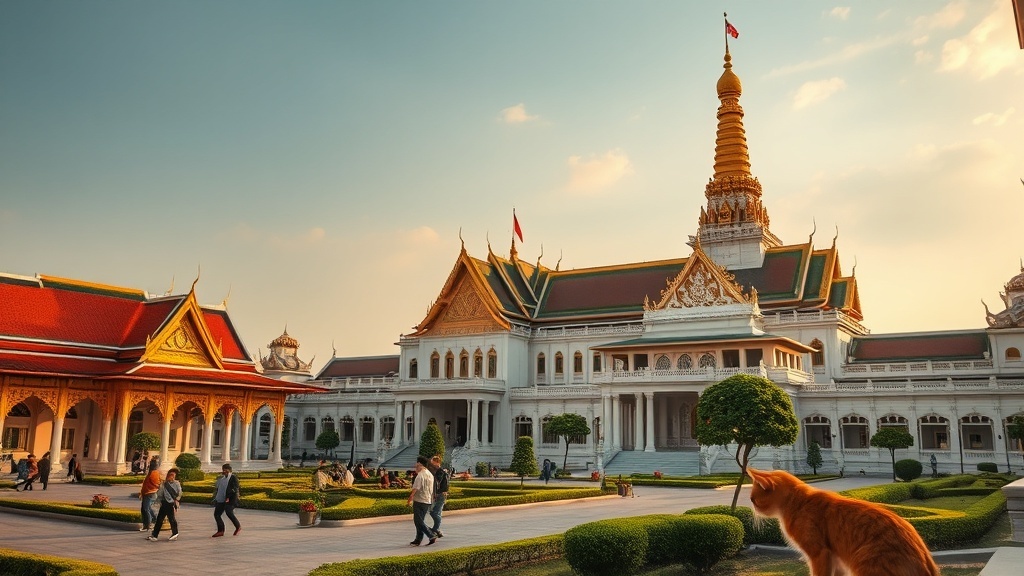
The Royal Palace and Silver Pagoda showcase Khmer architecture at its finest — golden spires, emerald Buddha, and a floor of 5,000 silver tiles. The National Museum houses the world's finest collection of Khmer sculpture.
No visit is complete without confronting history at Tuol Sleng (S-21) genocide museum and the Killing Fields of Choeung Ek — devastating but essential for understanding Cambodia.
The riverside promenade comes alive at sunset with joggers, food vendors, and families. The emerging food scene, rooftop bars, and art galleries reveal a city looking forward.
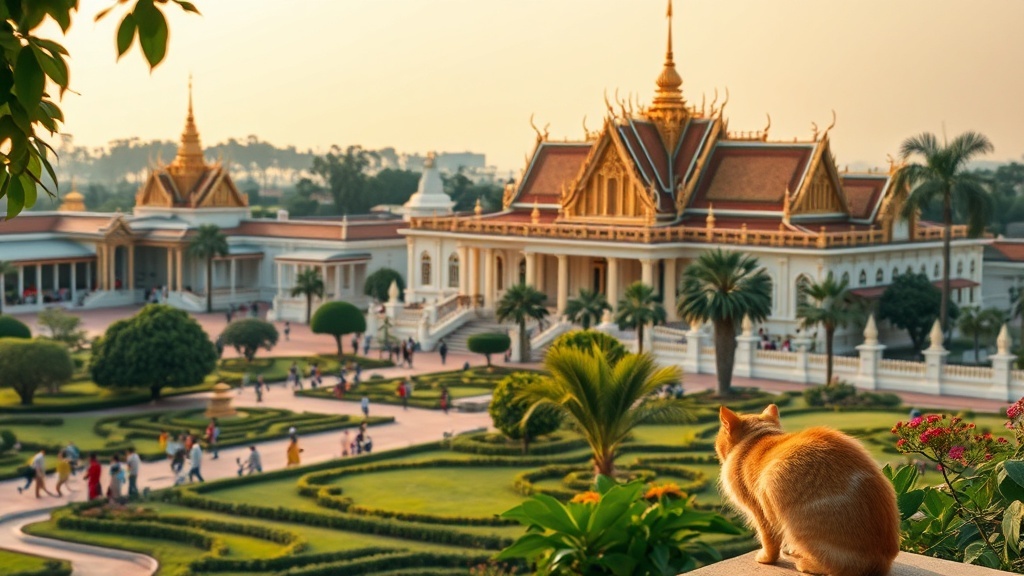
The Royal Palace, Phnom Penh
Golden spires of the Throne Hall beside the Silver Pagoda — the seat of King Norodom Sihamoni on the Tonle Sap riverfront.
🛕 Angkor Archaeological Park
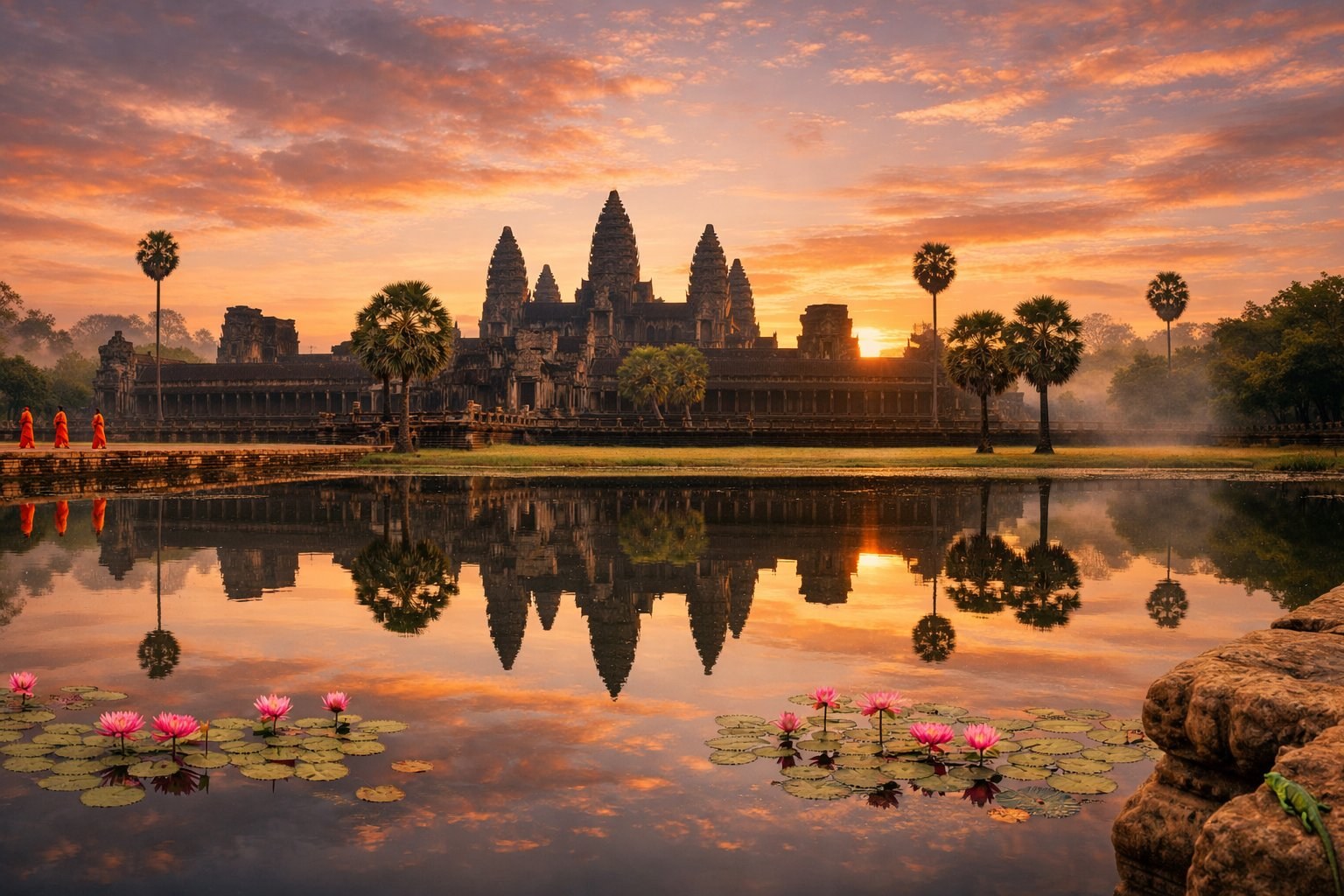
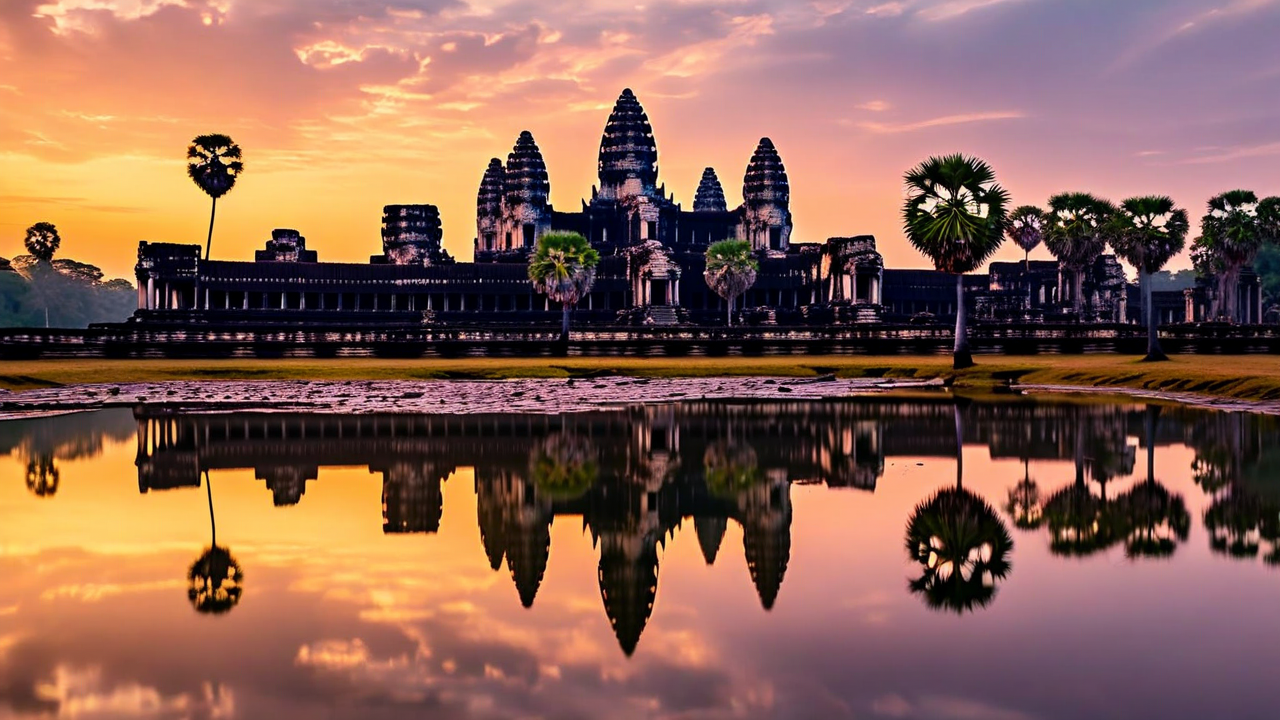
Angkor Wat is the crown jewel — the largest religious monument ever built, originally Hindu, later Buddhist. Sunrise here is a pilgrimage: the five iconic corncob-shaped towers emerge from darkness as the sky turns orange, reflected in the moat. Those towers have a specific architectural name worth knowing: prang (Khmer: brangk) — a tall, tiered, corn-cob-shaped spire that Khmer builders developed as their answer to the Indian shikhara, later adopted wholesale by Thai temple architects in the Ayutthaya and Rattanakosin periods. The stepped, receding tiers of a prang create a deliberate optical illusion, making the tower appear taller than it actually is. The bas-reliefs depicting Hindu epics stretch for 800 meters.
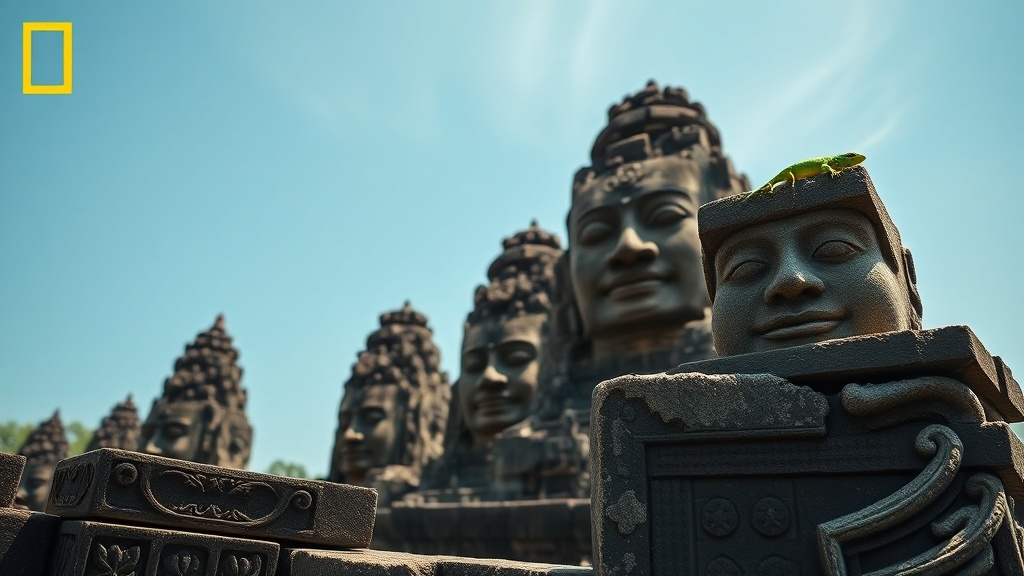
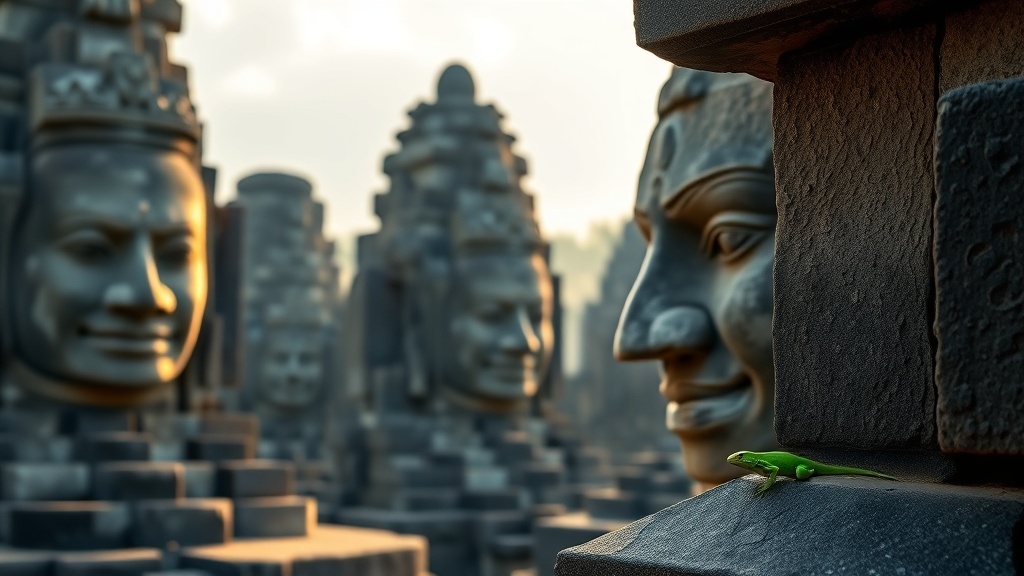
Angkor Thom, the last capital, is entered through gates guarded by 54 stone gods and demons. At its center, the Bayon temple's 216 giant stone faces smile mysteriously from every direction.
Ta Prohm — the "Tomb Raider temple" — remains embraced by strangler figs and silk-cotton trees, a romantic vision of nature reclaiming civilization.
The complex contains over 1,000 temples spread across 400 km². A 3-day pass allows deeper exploration of lesser-visited sites like Banteay Srei, Preah Khan, and Beng Mealea.
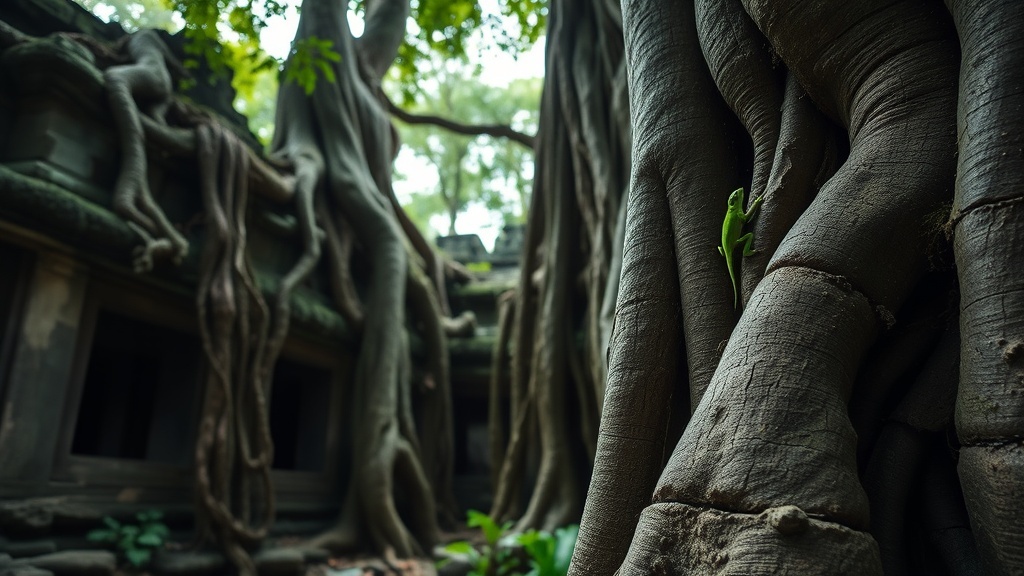
Ta Prohm
Silk-cotton and strangler-fig roots hold the 12th-century monastery in their grip — left largely as the French found it.
🌆 Siem Reap
Siem Reap is the gateway to Angkor but has become a destination in its own right. The Old French Quarter and Pub Street offer restaurants, bars, and night markets. Despite tourism, the town retains charm with its river, colonial buildings, and surrounding rice paddies.
Beyond temples, Siem Reap offers Apsara dance performances, Phare Cambodian Circus (a world-class social enterprise), cooking classes, and visits to floating villages on Tonle Sap.
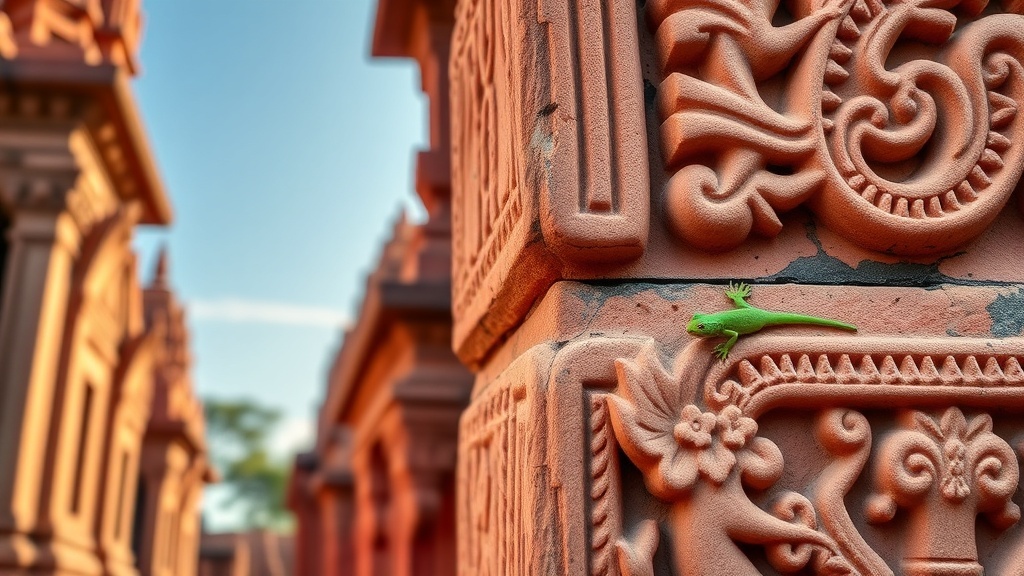
Banteay Srei
The pink-sandstone "citadel of women", 25 km north of Siem Reap — the finest carving in the Khmer world, on the smallest temple.
🚂 Battambang
Cambodia's second city is its most charming — French colonial architecture lines the Sangker River, artists have revitalized old shophouses, and the surrounding countryside offers the famous Bamboo Train and ancient temples like Phnom Banan.
Battambang is the heart of Cambodian arts — home to Phare Ponleu Selpak, the circus school whose graduates perform worldwide.
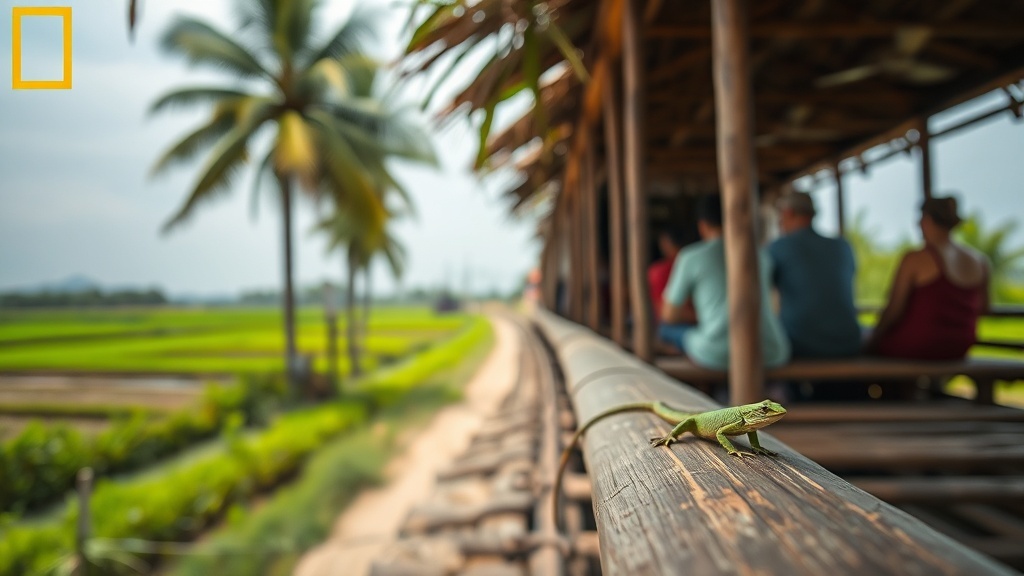
The bamboo train, Battambang
A bamboo platform on two axles, a motorbike engine and 20 minutes of rattling through rice paddies — the norry now runs on a relocated track at Banan.
🏝️ Coast & Islands
The islands offshore — Koh Rong, Koh Rong Samloem, and Koh Ta Kiev — offer white sand beaches, bioluminescent plankton, and hammock-strung bungalows.
Kampot and Kep on the south coast provide a refined alternative: colonial architecture, pepper plantations, cave temples, and Cambodia's famous pepper crab.
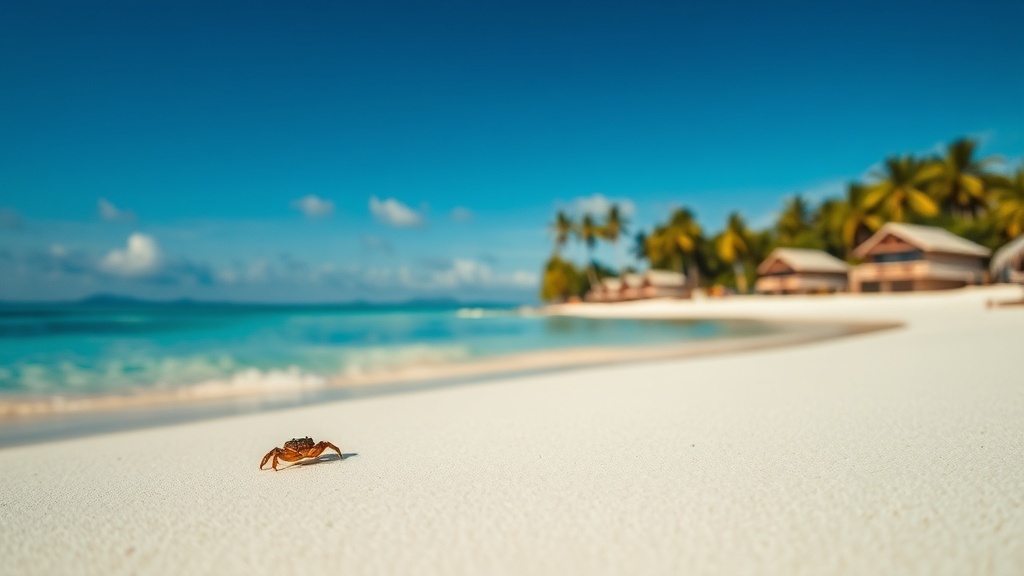
Koh Rong
White sand on Long Set Beach — 45 minutes by fast ferry from Sihanoukville, and still without a paved road across the island.
🚣 Tonle Sap Lake
Southeast Asia's largest freshwater lake is home to floating villages where entire communities — schools, shops, temples — exist on water. The lake expands from 2,500 km² in dry season to 16,000 km² during monsoon.
Boat trips from Siem Reap visit communities like Kompong Phluk (stilted houses in flooded forest) and Chong Kneas (fully floating village).
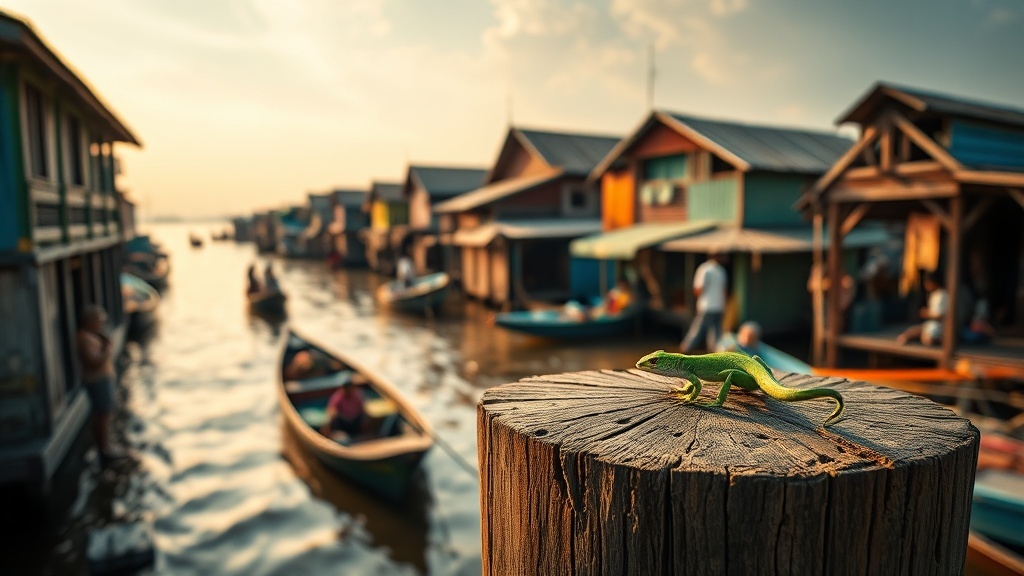
Floating villages on the Tonle Sap
Kompong Phluk in high water — houses on seven-metre stilts, a school, a pagoda and a flooded forest behind.
🥘 Cuisine
Cambodian food is the often-overlooked treasure of Southeast Asia — lighter than Thai, less sweet than Vietnamese, with unique flavors from prahok (fermented fish paste) and Kampot pepper (the world's finest).
Amok Trey
Fish Coconut Curry
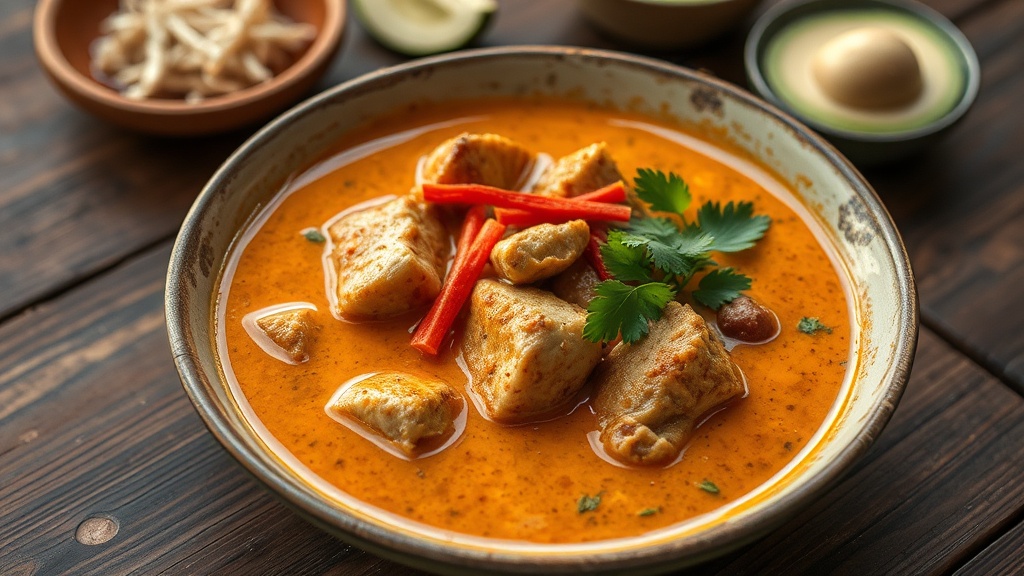
Cambodia's signature dish—fish steamed in coconut curry in banana leaf. This recipe serves two.
Ingredients: 200g white fish, cubed, 240ml coconut milk, Kroeung paste (lemongrass, galangal, turmeric, garlic), 1 egg, Fish sauce, Banana leaves.
Preparation: Blend kroeung ingredients into paste. Then mix fish with paste and coconut milk. Add beaten egg, fish sauce. Pour into banana leaf cups. Then steam 20 minutes. Finally, garnish with coconut cream, chili.
💡 The egg makes it set like a custard—essential texture.
Kuy Teav
Noodle Soup
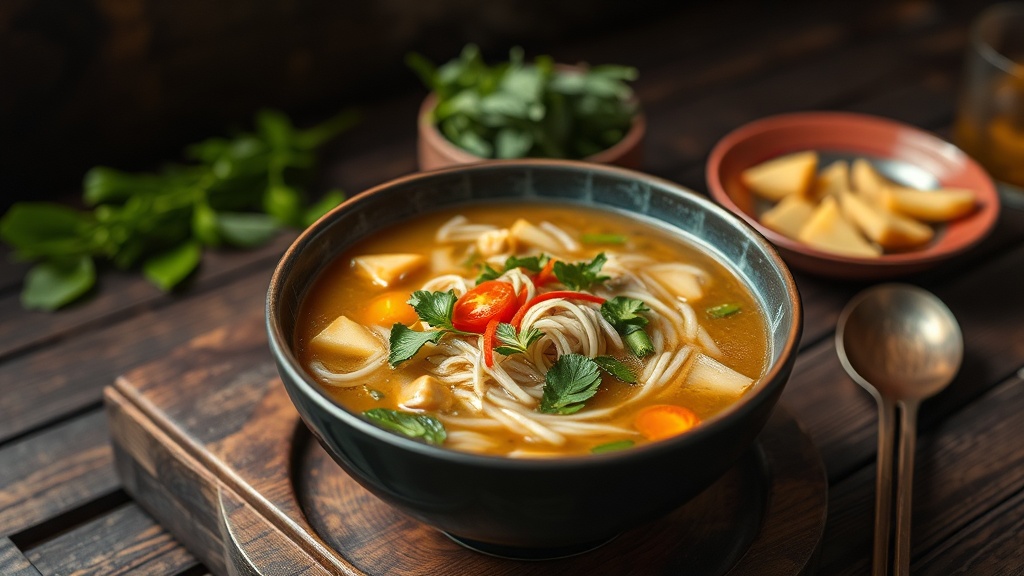
Cambodian breakfast noodle soup with pork and herbs. This recipe serves two.
Ingredients: 200g rice noodles, Pork bones for broth, 200g pork, sliced, Bean sprouts, Lime, chili, Fish sauce, Fried garlic.
Preparation: Simmer pork bones for broth hours. After that, cook noodles separately. Blanch pork slices in broth. Then assemble: noodles, pork, hot broth. Top with sprouts, herbs, lime. Finally, add condiments to taste.
💡 The condiment tray is essential—customize each bowl.
Lap Khmer
Lime-Cured Beef
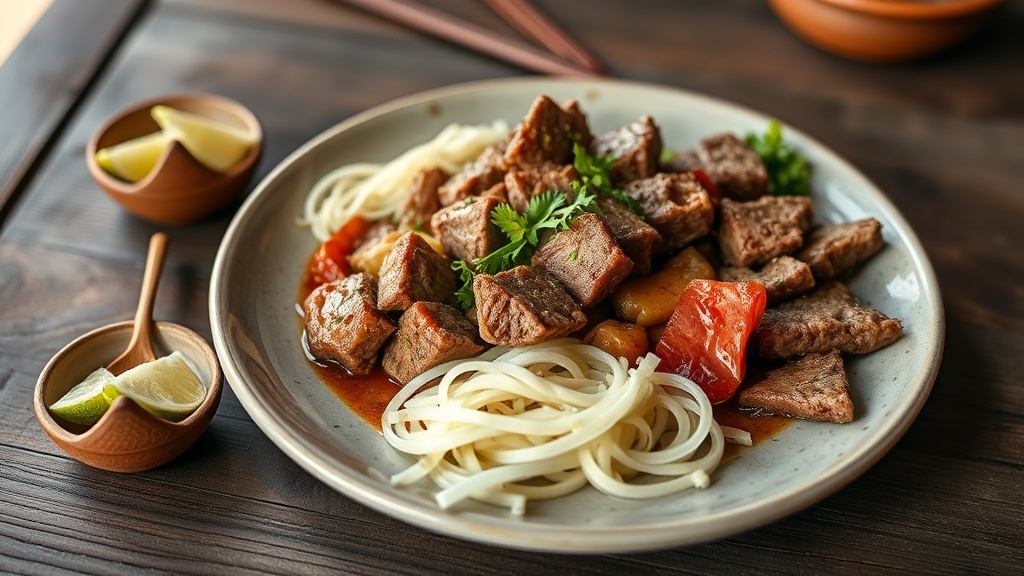
Thinly sliced beef 'cooked' in lime juice with lemongrass. This recipe serves two.
Ingredients: 200g beef tenderloin, sliced thin, 4 limes, juiced, 2 stalks lemongrass, minced, 2 shallots, sliced, Mint, basil, Fish sauce, palm sugar, Roasted rice powder.
Preparation: Marinate beef in lime juice 15 min. Then mix with lemongrass, shallots. Season with fish sauce, sugar. Add roasted rice powder. Then toss with fresh herbs. Last, serve immediately.
💡 Slice beef against grain while partially frozen for thin cuts.
Amok is the national dish — fish or chicken steamed in coconut curry with kroeung spice paste, served in a banana leaf. Lok lak (stir-fried beef with lime-pepper dip) and num banh chok (rice noodles with fish curry) are staples.
Fried insects — tarantulas, crickets, silkworms — are a Cambodian specialty, best tried at Skuon market.
🍷 Wine, Spirits & Drinking Culture
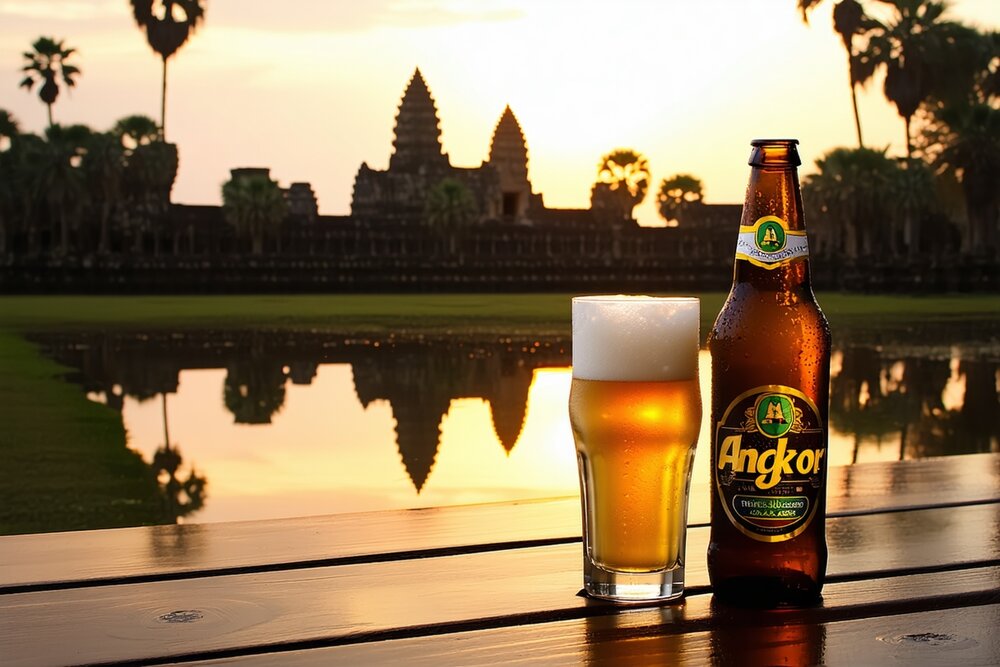
Cambodia's drinking culture is exuberant, uninhibited, and centred on one ritual: ice-cold beer with dinner, loud toasts of "Choul mouy!" (cheers!), and the clinking of glasses that fills every restaurant from Phnom Penh to Siem Reap. Cambodians drink beer like water — among the heaviest per-capita beer drinkers in Southeast Asia after Vietnam — and the competition between brands is fierce.
🍺 The Beer Wars
Angkor Beer (brewed by Cambrew at Sihanoukville — the brewery was inaugurated by Prince Sihanouk in 1965, destroyed under the Khmer Rouge, and relaunched the Angkor brand in 1992; Angkor Wat is on the label) is the patriotic choice. Cambodia Beer (Khmer Brewery) is the challenger. Both are light, crisp lagers designed for tropical heat, and the rivalry between them drives some of Asia's most aggressive beer marketing — Angkor girls and Cambodia Beer girls in matching outfits populate every restaurant, serving beer, pouring shots, and leading toasts. The spectacle is uniquely Cambodian.
🐍 Palm Wine, Rice Wine & Exotic Infusions
Tuk tnout chou (palm wine) — collected from sugar palms at dawn, mildly alcoholic by afternoon — is Cambodia's oldest drink, still common in rural areas. Sra sor (rice wine) is fermented at home, especially by Khmer Loeu (highland) communities in Ratanakiri and Mondulkiri provinces, where communal rice wine jars with bamboo straws are central to ceremonies. And then there are the infusion wines of Siem Reap's Pub Street: jars of rice whisky infused with snakes, scorpions, tarantulas, or seahorses, sold as traditional medicine and tourist spectacle in equal measure.
🏆 Kaufmann Wine Score — Cambodia
Rated on four criteria: Aroma (/25), Taste (/30), Finish (/20), Value (/25) — Total /100
| Wine | 🔴 Aroma | 🟡 Taste | 🟢 Finish | 🔵 Value | Total |
|---|---|---|---|---|---|
| Tuk Tnout Chou — fresh sugar-palm wine, tapped at dawn | 18 | 19 | 10 | 24 | 71 |
| Sra Sor — highland rice wine, Ratanakiri jar & straw | 15 | 16 | 11 | 22 | 64 |
| Banan Estate Brandy — the winery's "cognac", Battambang | 16 | 18 | 12 | 18 | 64 |
| Banan Estate Black Queen — red, Chan Thay Chhoeung | 14 | 15 | 10 | 15 | 54 |
| Banan Estate Shiraz — red, tropical-grown at 13°N | 13 | 14 | 9 | 14 | 50 |
| Banan Estate White — dry white, Sangker River vineyard | 12 | 13 | 8 | 14 | 47 |
Cambodia has exactly one commercial winery — Chan Thay Chhoeung (Banan Estate), started by an orange farmer turned oenophile on the Sangker River road to Phnom Banan, 14 km outside Battambang. It makes a few thousand bottles of red, white and brandy a year from vines that were never meant to grow this close to the equator. No Cambodian grape wine clears 75 points on this scale and pretending otherwise would be dishonest. Go for the tasting, the vineyard walk and the story; drink the brandy, buy the grape juice, and let the palm wine do the real work.
95–100 Legendary · 90–94 Outstanding · 85–89 Very Good · 80–84 Good · 75–79 Average · <75 Below Average
🍸 Cocktails & Mixed Drinks
Phnom Penh has a small but real craft-spirits scene to build a drinks list on: Samai, a rum distillery founded in 2014 and the first in Cambodia, whose Kampot Pepper Rum is the obvious souvenir; Seekers Independent Spirits, which has made Mekong Dry Gin from Cambodian botanicals since 2019; and, in Siem Reap, Sombai, a family workshop that infuses rice spirit with fruit and spice in hand-painted bottles. The recipes below are house recipes built around those three, using what a Cambodian market sells.
Kampot Pepper Gin & Tonic
The Phnom Penh sundowner
Ingredients: 50 ml Mekong Dry Gin (or any dry gin), 150 ml tonic, 6–8 green Kampot peppercorns (fresh, on the stem, if you can find them), 1 lime wedge, ice.
Preparation: Fill a large wine glass with ice. Crush half the peppercorns lightly in the bottom of the glass, add the gin, top with tonic and stir once. Squeeze the lime wedge over the drink and drop it in, then float the remaining peppercorns on top.
💡 Green Kampot pepper is floral and hot rather than bitter — do not substitute dried black pepper.
Tuk-Tuk Punch
Rum, palm sugar and passion fruit
Ingredients: 50 ml Samai Gold Rum (or aged rum), pulp of 1 passion fruit, 20 ml fresh lime juice, 15 ml palm-sugar syrup (palm sugar dissolved 1:1 in hot water), 2 dashes Angostura bitters, ice, mint sprig.
Preparation: Shake everything except the mint hard with ice. Strain over crushed ice in a short glass, spoon a little extra passion-fruit pulp on top and garnish with the mint.
💡 Cambodian palm sugar (skor tnout) tastes of caramel and smoke — worth carrying a block home.
Sombai Sour
Siem Reap's infused rice liqueur, shaken
Ingredients: 50 ml Sombai ginger & red chilli (or lemongrass) infused rice liqueur, 25 ml fresh lime juice, 15 ml honey syrup, 1 egg white (optional), ice, a thin slice of chilli.
Preparation: Dry-shake the liqueur, lime, honey and egg white without ice for 10 seconds, then add ice and shake again until frosty. Double-strain into a chilled coupe and lay the chilli slice on the foam.
💡 Without egg white it is still a fine drink — serve it on the rocks instead.
A word on the Pub Street "snake wine" and "scorpion shot" jars: they are rice spirit of unknown strength, bottled without any control. Cambodia has no methanol-testing regime for home spirits; after the November 2024 methanol deaths in Vang Vieng, Laos, treat unlabelled spirits anywhere in the region with caution.
🌤️ Climate & When to Go
Cambodia has a tropical monsoon climate — hot year-round with a wet season (May-October) and dry season (November-April). Temperatures rarely drop below 25°C.
Best time to visit: November-February offers cooler, dry weather and is peak season for Angkor. March-May is extremely hot (40°C+). The wet season brings afternoon storms but fewer crowds and green landscapes.
✈️ Getting There
By Air: Cambodia has two brand-new gateways and the old airport codes are obsolete. Techo International Airport (KTI), 20 km south of Phnom Penh, replaced the old Phnom Penh airport (PNH) on 9 September 2025. Siem Reap–Angkor International Airport (SAI), 40 km east of town, replaced the old Siem Reap airport (REP) in October 2023 — book with the new codes or you will not find the flight. Sihanoukville (KOS) handles regional traffic.
By Land: Crossings from Vietnam (Bavet–Moc Bai for Ho Chi Minh City, Kaam Samnor by Mekong boat) and Laos (Trapeang Kriel) operate normally. Every land crossing with Thailand — including Poipet–Aranyaprathet — has been closed since late June 2025 because of the border conflict, and remains closed as of September 2026 with no reopening date — Poipet was opened for a single three-hour window on 24 June 2026 purely to let stranded citizens go home. Overland Bangkok–Siem Reap is not possible; fly instead.
Visa: Most nationalities get a 30-day single-entry tourist visa on arrival (US$30) at Techo, Siem Reap–Angkor and Sihanoukville airports, or apply for the e-Visa in advance at evisa.gov.kh (US$30 tourist / US$35 business, plus a US$6 processing fee, issued in about three working days).
e-Arrival Card — mandatory since January 2025: every air arrival must submit the free Cambodia e-Arrival Card at arrival.gov.kh within seven days before landing. It is separate from the visa and is checked at immigration.
📋 Practical Information
Currency: US Dollar is the primary currency; Cambodian Riel (KHR) used for small change. ATMs dispense USD.
Language: Khmer. English widely spoken in tourist areas.
Safety: Petty crime — bag snatching from passing motorbikes, phone theft — is the everyday risk in Phnom Penh and Sihanoukville. Cambodia is still one of the world's most heavily mined countries: never leave marked paths in the northwest or near the Thai border. The Thai frontier is an active conflict zone (see Travel Advisory). Ignore unsolicited job and "investment" offers — the scam-compound industry recruits foreigners into forced labour.
Getting Around: Tuk-tuks everywhere. Buses connect major cities. Domestic flights save time.
🛡️ Travel Advisory
⚠️ US State Department: Level 2 — Exercise Increased Caution
Advisory issued 25 July 2025 (crime, landmines, unrest); country page last updated 4 June 2026. Verified against travel.state.gov on 14 September 2026.
Cambodia as a whole is rated Level 2 for crime and landmines. Two things inside the country carry a far higher Level 4 — Do Not Travel rating:
- Everything within 50 km of the Cambodia–Thailand border. Armed conflict has been active since May 2025, with rocket, artillery and small-arms fire and Thai airstrikes in Preah Vihear, Oddar Meanchey and Banteay Meanchey provinces in July and again in December 2025; Thai troops still hold several villages inside the zone. All land crossings with Thailand are closed, and the US government says it has limited ability to help citizens in these provinces. Preah Vihear temple and Ta Muen Thom are inaccessible.
- Unexploded ordnance and landmines. Cambodia remains among the most heavily mined countries on earth, with the densest contamination along the northwestern border belt. Never walk off marked paths, never enter a field to photograph a ruin, and treat any red-and-white marker as absolute.
Scam compounds and forced labour. Sihanoukville, Bavet, Poipet and several border special economic zones host large cyber-fraud operations that recruit foreigners with fake job adverts and then confiscate their passports. Never accept an unsolicited job, crypto or "investment" invitation in Cambodia, and do not travel to a meeting arranged online with someone you have not met.
What this means in practice. A conventional itinerary — fly into Techo or Siem Reap–Angkor, see Angkor, Phnom Penh, Battambang town, Kampot, Kep and the islands — is not in a Level 4 area and remains straightforward. The advisory bites if you planned to cross overland from Thailand, to reach Preah Vihear, or to wander the northwestern border districts. Check the current State Department advisory and your own government's guidance before booking, and register with your embassy if you are heading anywhere near the frontier.
💰 Cost of Living
| Item | Cost (USD) |
|---|---|
| Budget guesthouse | $8-15/night |
| Mid-range hotel | $30-60/night |
| Luxury resort | $100-300/night |
| Street food meal | $1-3 |
| Local restaurant | $5-10 |
| Western restaurant | $10-25 |
| Angkor Pass (1 day) | $37 |
| Angkor Pass (3 days) | $62 |
| Angkor Pass (7 days) | $72 |
| Beer (Angkor, draft) | $0.50-1 |
| Tuk-tuk (in town) | $2-5 |
| Tuk-tuk (full day Angkor) | $15-25 |
Cambodia is extremely affordable—budget travelers can manage on $25-35/day, mid-range travelers on $50-80/day. The USD is widely accepted alongside the Cambodian Riel.
🏨 Accommodation
Siem Reap
Budget: Pub Street area hostels ($5-15), guesthouses in Old French Quarter. Mid-range: Boutique hotels along Sivatha Blvd, charming French colonial conversions ($40-80). Luxury: Amansara, Sofitel Angkor, Park Hyatt — world-class properties with temple-view pools.
Phnom Penh
Budget: Riverside guesthouses, BKK1 backpacker hostels ($10-20). Mid-range: Boutique hotels in the Colonial Quarter, BKK1 apartments ($50-100). Luxury: Raffles Hotel Le Royal (historic), Rosewood Phnom Penh (modern skyline views).
Coast & Islands
Koh Rong and Koh Rong Samloem offer everything from $10 beach bungalows to $300+ eco-resorts. Kampot has charming riverside guesthouses. Sihanoukville itself is dominated by casinos now, but Otres Beach retains a backpacker vibe.
🎭 Festivals & Events
| Festival | When | Description |
|---|---|---|
| Khmer New Year | April 13-16 | Biggest celebration — water throwing, temple visits, family reunions |
| Pchum Ben | Sept/Oct | Festival of the Dead — 15 days honoring ancestors with temple offerings |
| Water Festival (Bon Om Touk) | November | Spectacular boat races on Tonle Sap, celebrates river reversal |
| Royal Ploughing Ceremony | May | Ancient ritual predicting harvest, held at Royal Palace |
| Angkor Sankranta | April | Traditional games and performances at Angkor Wat |
🗣️ Essential Phrases (Khmer)
| Khmer | Script | English |
|---|---|---|
| Sua sdei | សួស្តី | Hello |
| Aw kohn | អរគុណ | Thank you |
| Jom riap sua | ជម្រាបសួរ | Formal greeting |
| Sok sabay | សុខសប្បាយ | How are you? / I'm fine |
| Baat/Jaa | បាទ/ចា | Yes (male/female) |
| Ot teh | អត់ទេ | No |
| Sohm toh | សុំទោស | Sorry / Excuse me |
| T'lay pon maan? | ថ្លៃប៉ុន្មាន? | How much? |
Note: English is widely spoken in tourist areas. French is understood by older generations. Attempting Khmer earns big smiles!
🏛️ UNESCO World Heritage Sites (5)
Angkor
Over 1,000 temples including Angkor Wat, Angkor Thom, and Ta Prohm — remnants of the Khmer Empire's capital.
Temple of Preah Vihear
11th-century Hindu temple perched on a cliff in the Dângrêk Mountains, with spectacular views into Thailand. Inscribed 2008 — and the flashpoint of the 2025–26 border war. Closed to visitors; the surrounding zone is rated Do Not Travel.
Sambor Prei Kuk
Pre-Angkorian site with over 100 sandstone temples from the Chenla period (6th–7th century). Inscribed 2017.
Koh Ker
Archaeological site of ancient Lingapura, the Khmer capital 928–944 AD, dominated by the seven-tier pyramid of Prasat Thom. An 87.8 km² landscape of temples, Shiva-linga sanctuaries, reservoirs and ancient roads. Inscribed 17 September 2023 — Cambodia's fourth World Heritage Site.
Cambodian Memorial Sites: From Centres of Repression to Places of Peace and Reflection
Three Khmer Rouge sites — Tuol Sleng (S-21) and Choeung Ek in Phnom Penh, and the M-13 prison in Kampong Chhnang — inscribed on 11 July 2025 at the 47th Committee session in Paris, Cambodia's fifth site and the first World Heritage listing of a modern genocide's memorial landscape.
Six properties sit on Cambodia's Tentative List (all submitted 2020): Banteay Chhmar, Beng Mealea, Phnom Kulen (Mahendraparvata), Angkor Borei & Phnom Da, the ancient city of Oudong, and Preah Khan of Kampong Svay. Nothing Cambodian was inscribed at the 48th session in Busan (July 2026). Source: whc.unesco.org/en/statesparties/kh.
✨ Unique Experiences
🌅 Sunrise at Angkor Wat
Yes, it's crowded. Yes, it's touristy. But watching the sun rise over the world's largest religious monument, its towers reflected in the lotus-filled pools, remains transcendent. Arrive early, find your spot, and experience why millions make this pilgrimage.
💃 Apsara Dance
Classical Khmer dance, nearly lost during the Khmer Rouge period (90% of dancers were killed), has been painstakingly revived. The graceful, highly stylized movements tell Hindu epics and Buddhist stories. The most authentic performances are at the National Museum or Royal Palace in Phnom Penh.
🚣 Floating Villages
The Tonle Sap Lake supports communities who live entirely on water – houses, schools, and shops all floating. Kompong Phluk and Kompong Khleang, accessible from Siem Reap, offer boat tours through these remarkable villages. The experience reveals a way of life tied entirely to the lake's rhythms.
🍳 Cooking Classes
Cambodian cuisine is less famous than Thai or Vietnamese but equally rewarding – amok (fish in coconut curry), lok lak (beef stir-fry), and countless soups and salads. Cooking classes in Siem Reap and Phnom Penh include market visits and hands-on preparation.
🎒 Packing Tips
- Temple-appropriate clothing: Shoulders and knees must be covered at Angkor and pagodas — lightweight long pants and scarves work well
- Sturdy sandals: For temple climbing (uneven stones, steep stairs)
- Rain gear: Compact poncho for monsoon season (May-October)
- Sunscreen & hat: Angkor offers little shade; tropical sun is intense
- Mosquito repellent: Essential, especially near Tonle Sap and rural areas
- Flashlight/headlamp: For dark temple corridors and cave exploration
- Small bills: USD $1 and $5 notes are king — avoid $50 and $100 bills
- Reusable water bottle: Refill stations increasingly common; reduce plastic
🌐 Useful Resources
- Tourism Cambodia — Official tourism portal
- APSARA Authority — Angkor park management, ticket info
- Phnom Penh Post — English-language news
- Khmer Times — Local news and events
- Cambodia e-Visa — Official visa application
- PassApp — Local ride-hailing app (Cambodia's Uber)
📚 Recommended Reading
- "First They Killed My Father" by Loung Ung — Harrowing memoir of surviving the Khmer Rouge as a child
- "When the War Was Over" by Elizabeth Becker — Definitive history of Cambodia's tragedy
- "A History of Cambodia" by David Chandler — Scholarly but accessible overview
- "The Gate" by François Bizot — French ethnologist's captivity under the Khmer Rouge
- "Angkor and the Khmer Civilization" by Michael D. Coe — Archaeological deep-dive into the empire
- "In the Shadow of the Banyan" by Vaddey Ratner — Novelized memoir of a princess surviving genocide
🎬 Videos About Cambodia
🔬 Fascinating Facts
- World's largest religious monument: Angkor Wat covers 162.6 hectares (402 acres) — larger than Vatican City
- Reverse-flowing river: The Tonle Sap is one of few rivers that changes direction seasonally, expanding the lake 5x during monsoon
- No McDonald's: Cambodia is one of few countries with no McDonald's franchises
- Two New Years: Cambodia celebrates both Western New Year and Khmer New Year (April)
- Flag features a building: Cambodia's flag is one of very few national flags to depict a building — and the only one showing a temple (Angkor Wat)
- Temple count: The Angkor Archaeological Park contains over 1,000 temples across 400 km²
- Five World Heritage Sites: Angkor (1992), Preah Vihear (2008), Sambor Prei Kuk (2017), Koh Ker (2023) and the Khmer Rouge memorial sites Tuol Sleng, Choeung Ek and M-13 (2025)
- Youngest population: 65% of Cambodians were born after the Khmer Rouge period ended
- Dollar economy: USD is more commonly used than the local Riel in urban areas
⭐ Notable People
- King Norodom Sihamoni — Reigning since 2004 — a classical ballet dancer trained in Prague and Paris and a former UNESCO ambassador, who reigns but does not rule
- King Norodom Sihanouk (1922-2012) — "Father of Independence," filmmaker, six-time head of state
- Jayavarman VII (1181-1218) — Greatest Khmer king, builder of Angkor Thom and Bayon
- Rithy Panh — Oscar-nominated filmmaker documenting Khmer Rouge atrocities
- Somaly Mam — Anti-trafficking activist (though later controversial)
- Vann Nath (1946-2011) — Painter and Tuol Sleng survivor who documented S-21 horrors
- Angelina Jolie — While American, she adopted Cambodian son Maddox and filmed "Lara Croft: Tomb Raider" at Angkor
🏆 Sports
Football (soccer) is Cambodia's most popular sport, with the Cambodian Premier League drawing growing crowds — but the national team has never been close to a World Cup: in the 2026 qualifiers it went out in the very first round to Pakistan (0–0 in Phnom Penh, then 0–1 in Islamabad, October 2023). Cambodia has never won an Olympic medal in eleven Summer Games; at Paris 2024 it sent three athletes (800 m runner Chhun Bunthorn and swimmers Antoine Le Lapparent and Apsara Katarina Sakbun), none of whom advanced past the heats.
The big sporting story of the decade was hosting the 32nd SEA Games in May 2023 — the first time Cambodia had ever staged them, at the new Chinese-built Morodok Techo stadium in Phnom Penh. The home team won 81 golds, its best result by a distance, helped by the inclusion of Kun Khmer (kickboxing) and Kun Lbokator; the image of the Games was distance runner Bou Samnang finishing the women's 5,000 m alone, last, in a downpour. Two and a half years later the border war intervened: on 10 December 2025 Cambodia withdrew its entire delegation from the 33rd SEA Games in Bangkok, citing safety.
The traditional martial art Kun Lbokator — inscribed by UNESCO as Intangible Cultural Heritage in November 2022 — predates Angkor and features striking, grappling and weapons techniques. Pradal Serey / Kun Khmer is a fierce cousin of Muay Thai, fought in rings across the country. Boat racing in front of the Royal Palace during the Water Festival (Bon Om Touk, November) is the most spectacular national sporting event, with hundreds of long boats and crews of up to 80 paddlers; the Angkor Wat International Half Marathon (early December, since 1996) runs past the temples.
📰 Media & Press Freedom
Cambodia ranks near the bottom of global press freedom indices (RSF 2026: 151st of 180, score 33.28 — up ten places on 2025, still deep in the "very serious" band). Independent outlets have been shuttered or forced to self-censor since 2017, when the Cambodia Daily was closed and Radio Free Asia's local bureau ceased operations. State-aligned outlets dominate broadcast media. Voice of Democracy was revoked in 2023. Foreign journalists work largely without harassment but local reporters face legal risks under broad defamation and "incitement" laws — Mech Dara, the reporter who did most to expose the scam compounds, was arrested on incitement charges in 2024, and environmental journalist Chhoeung Chheng was shot dead while investigating illegal logging in December 2024. English-language coverage continues via the Phnom Penh Post and Khmer Times, both under owners aligned with the ruling party.
📊 Tourism Statistics (2024–2026)
| Metric | Value |
|---|---|
| International tourists 2025 | 5.57 million |
| Year-over-year change 2025 | −16.9% |
| December 2025 arrivals | −43.2% (border conflict) |
| International tourists 2024 (peak year) | 6.70 million (+22.9%) |
| Angkor foreign ticket holders 2025 | 955,131 (−6.7%), US$44.7 M revenue |
| Top source markets | Vietnam, China, Thailand, USA (pre-conflict ranking) |
| Tourism GDP contribution | ~18% |
| Direct tourism jobs | ~630,000 |
Cambodia entered 2025 targeting 7.5 million visitors. The July 2025 land-border closure with Thailand cut monthly arrivals by roughly 30%, and the December escalation — in peak season — triggered mass cancellations, ending the year at 5.57 million. Source: Ministry of Tourism, January 2026.
📸 Photo Gallery
✍️ Author's Note
Cambodia breaks your heart and puts it back together. The shadow of the Khmer Rouge hangs over everything—you cannot visit the Killing Fields or S-21 and remain unchanged. But what strikes you most is how Cambodians have chosen to face forward. The smiles are genuine, the hospitality overwhelming, the determination to build a better future palpable in every conversation.
Angkor Wat at sunrise lives up to every photograph and exceeds every expectation. But Cambodia is more than temples—it's the floating villages of Tonle Sap, the French colonial charm of Battambang, the beach towns emerging along the coast. Writing this in September 2026, with the Thai border shut and Preah Vihear out of reach, I keep thinking of the bamboo train at Battambang — a platform, a motorbike engine and a driver who lifted the whole thing off the rails to let another pass, laughing. Most of all, it's the people, whose resilience and grace make this one of Southeast Asia's most rewarding destinations.
"Kingdom of Wonder"
—Radim Kaufmann, 2026
Support This Project 🌍
This World Travel Factbook is a labor of love – free to use for all travelers. If you find it helpful, consider supporting its continued development.
