🌍 Cameroon at a Glance
🌏 Overview
There is a reason Cameroon has earned the title "Africa in Miniature," and you understand it the moment you begin to travel from south to north. Within the borders of a single country you encounter dense equatorial rainforest teeming with gorillas and forest elephants, volcanic highlands draped in cloud forest, golden savanna where lions stalk herds of giraffes, and the sun-scorched edges of the Sahel where Fulani herders drive their cattle through dust-hazed landscapes. No other African nation compresses so much geographic diversity into one territory.
But geography is only half the story. Cameroon's human landscape is equally staggering — over 250 distinct ethnic groups speaking some 280 languages, organized into kingdoms and chiefdoms that have thrived for centuries. The Bamoun sultanate in Foumban maintains a royal palace that rivals any in West Africa. The Bamileke of the western highlands build extraordinary thatched compounds and stage masquerade festivals of hypnotic power. In the far north, the Mandara Mountains shelter communities whose stone-built villages cling to volcanic peaks like something from a fantasy novel.
Cameroon is also a bilingual nation — the only country in Central Africa where both French and English serve as official languages, a legacy of its unique colonial history under Germany, France, and Britain. This dual heritage creates a cultural richness visible in everything from cuisine to music, from legal systems to football rivalries. The country that gave the world Roger Milla's corner-flag dance, Samuel Eto'o's clinical finishing, and Makossa music remains one of Africa's most underrated travel destinations — a place where authentic discovery awaits travelers willing to venture beyond the familiar.
The numbers. Cameroon covers 475,442 km² — slightly larger than Sweden, slightly smaller than California and Nevada combined — and its population is estimated at roughly 30.6 million in 2026, placing it around 50th among the world’s countries by population (UN 2026 mid-year estimate: 30.64 million). The political capital is Yaoundé; the larger and busier Douala is the economic capital and the main port. The currency is the Central African CFA franc (XAF), pegged to the euro. French and English are both official; Cameroon is the only country in Central Africa where that is true.
📜 Name & Identity
The name Cameroon traces back to 1472, when Portuguese navigators sailing along the West African coast entered the Wouri River estuary near present-day Douala. They found the waters swarming with ghost shrimp and named the waterway "Rio dos Camarões" — the River of Prawns. Over centuries of European mapmaking, the name migrated from river to mountain to the entire territory, evolving through German ("Kamerun"), French ("Cameroun"), and English ("Cameroon") spellings.
The country's official name — République du Cameroun — reflects the francophone majority, but the English-speaking Northwest and Southwest regions maintain a distinct identity forged during British colonial administration. This linguistic duality has shaped national politics and culture profoundly, creating a bilingual state where government business theoretically operates in both languages, though French predominates in practice.
Cameroonians often describe their country with the phrase "All of Africa in one country," a statement of national pride rooted in genuine geographic and cultural reality. The green, red, and yellow tricolor flag — adopted at independence in 1960 — symbolizes the southern forests, national unity and sovereignty, and the northern savannas respectively. The central yellow star represents unity between the Anglophone and Francophone populations.
🏔️ Geography
Cameroon straddles the hinge of West and Central Africa, bordered by Nigeria to the west, Chad to the northeast, the Central African Republic to the east, and Equatorial Guinea, Gabon, and the Republic of Congo to the south. The Atlantic coastline along the Gulf of Guinea stretches for 402 kilometers, anchored by the massive port city of Douala.
The country divides naturally into four geographic zones. The southern lowlands are covered by dense equatorial rainforest — part of the Congo Basin, the world's second-largest tropical forest. The western highlands rise dramatically from the coastal plain, reaching their apex at Mount Cameroon (4,095 meters), West and Central Africa's highest peak and one of the continent's most active volcanoes. The central Adamawa Plateau forms a transitional zone of rolling grasslands at around 1,000 meters elevation. Finally, the northern plains slope gradually toward Lake Chad, passing through savanna into the semi-arid Sahel.
Rivers define much of Cameroon's landscape. The Sanaga, the country's longest river at 920 kilometers, flows westward to the Atlantic. The Bénoué drains northward into the Niger system. The Wouri creates the vast estuary that gave the country its name. These waterways, combined with volcanic crater lakes like Lake Nyos — which catastrophically released carbon dioxide in 1986, killing over 1,700 people — create a hydrological landscape of both beauty and danger.
🗺️ Map
Key destinations marked. Red markers = inside a US State Department Level 4 “Do Not Travel” zone (Northwest, Southwest and Far North regions, and within 20 km of the Nigeria, Chad and CAR borders) as of September 2026.
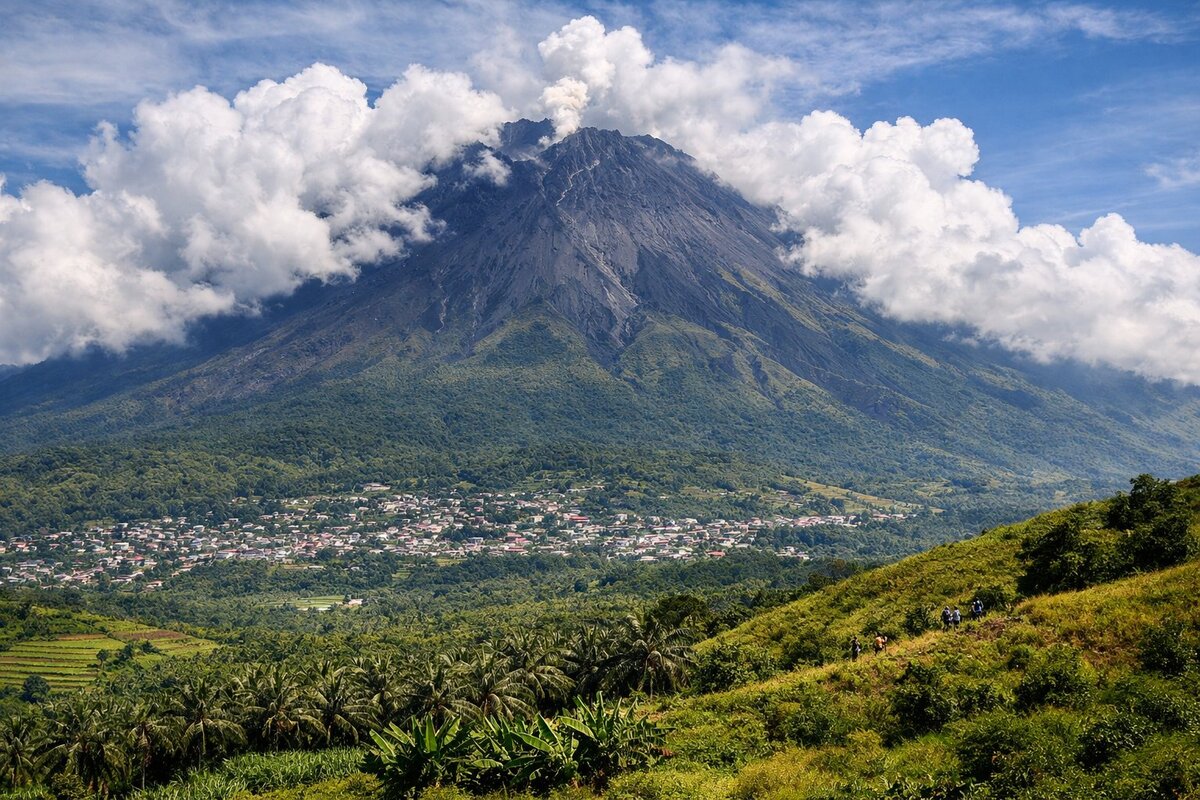
Mount Cameroon
West Africa's highest peak at 4,095 meters — an active volcano rising dramatically from the Gulf of Guinea coast
📖 History
Human habitation in Cameroon stretches back at least 50,000 years, with the Baka (Pygmy) peoples among the earliest known inhabitants of the southern forests. The Bantu expansion — one of the most significant migration events in human history — is believed to have originated in the Cameroon-Nigeria borderlands around 2000 BCE, spreading farming, iron-working, and related languages across most of sub-Saharan Africa.
By the medieval period, powerful kingdoms had emerged across the territory. The Bamoun Kingdom in the western highlands developed its own writing system — the Shu Mom script — under Sultan Njoya in the late 19th century. The Fulani jihad of the early 1800s established the Adamawa Emirate in the north, while coastal kingdoms controlled the lucrative trade with European merchants. When Germany declared a protectorate over "Kamerun" in 1884, they encountered not empty land but a complex patchwork of organized societies.
After Germany's defeat in World War I, the League of Nations divided Kamerun between France (which received the larger eastern portion) and Britain (which administered two narrow strips along the Nigerian border). This partition created the bilingual legacy that defines Cameroon today. French Cameroun gained independence on January 1, 1960, and the southern portion of British Cameroons voted to join in 1961, forming the Federal Republic of Cameroon. Ahmadou Ahidjo served as the first president until 1982, when Paul Biya assumed power — a position he continues to hold, making him one of Africa's longest-serving heads of state.
🏛️ Government & Politics
Cameroon is a unitary presidential republic with a strongly centralised executive. Paul Biya has been president since 6 November 1982 — a tenure now well past four decades. On 12 October 2025 he stood for an eighth term, and on 27 October the Constitutional Council declared him the winner with 53.66% of the vote against 35.19% for Issa Tchiroma Bakary, a former government spokesman and employment minister who had broken with the regime months earlier. Official turnout was 57.76%.
Tchiroma rejected the count, publishing his own tally claiming 54.8% for himself, and called supporters into the streets. Protests in Douala, Garoua and Maroua were met with force: data compiled by UN sources counted 48 civilians killed by security forces (opposition sources said 55), nearly half of them in the Littoral region around Douala, and Human Rights Watch documented mass arrests. Biya, aged 92, was sworn in on 6 November 2025 for a term running to 2032, confirming him as the world’s oldest serving head of state. Tchiroma fled the country and has lived in exile in Banjul, The Gambia, since late October 2025, from where he filed complaints against Biya in the Paris courts in 2026. His most prominent domestic ally, the veteran opposition leader Anicet Ekane (68), died in military detention in Yaoundé on 1 December 2025 after being held on insurrection charges — a death condemned by the UN and the African Union.
Structure: Joseph Dion Ngute has served as Prime Minister and head of government since January 2019. Parliament is bicameral — a 180-seat National Assembly and a 100-seat Senate, both dominated by Biya’s Cameroon People’s Democratic Movement (CPDM/RDPC). Both chambers changed hands on 17 March 2026: Aboubakary Abdoulaye, a 64-year-old traditional ruler from the North, replaced Marcel Niat Njifenji (Senate president since 2013), and Théodore Datouo replaced Cavaye Yeguié Djibril, who had presided over the National Assembly since 1992. The Senate president is constitutionally first in the line of succession — a technicality that carries unusual weight in a country whose president is in his nineties and whose succession has never been tested. Legislative and municipal elections due in 2025 were postponed twice; the National Assembly voted on 19 March 2026 to extend its own mandate to 20 December 2026, and no polling date had been fixed as of September 2026.
The Anglophone crisis: since 2016–17, armed separatists in the Northwest and Southwest regions — the English-speaking territories inherited from British Cameroons — have fought for an independent state they call Ambazonia. A decade of fighting has killed an estimated 6,500 people and displaced well over half a million. It is the single most important thing a visitor needs to understand about where in Cameroon it is currently sensible to travel. Separatist factions declared a pause in hostilities for Pope Leo XIV’s visit of 15–17 April 2026 (Yaoundé, a peace meeting in Bamenda’s St Joseph Cathedral on 16 April, and Douala), but in September 2026 they were again enforcing a week-long lockdown to disrupt the start of the school year. In the Far North, Boko Haram and ISWAP factions operating from the Lake Chad basin remain active.
⚠️ Travel Advisory & Safety
⚠️ U.S. State Department — Level 2: Exercise Increased Caution
Advisory renewed 15 May 2026 with no change to level or risk indicators. Risk indicators: crime, terrorism, civil unrest, health, kidnapping, and improvised explosive devices.
Level 4 — DO NOT TRAVEL applies to specific regions within the country:
- The Southwest, Northwest and Far North regions — for any reason.
- Anywhere within 20 km of the borders with the Central African Republic, Chad and Nigeria — for any reason.
There is a high risk of kidnapping by non-state armed groups in the Northwest and Southwest, and by terrorist groups in the Far North.
What this means for the destinations in this guide. Several of Cameroon’s best-known attractions sit inside the Level 4 zones, and this guide describes them because they are part of the country — not because they are currently visitable. Mount Cameroon and Limbe are in the Southwest region. Waza National Park and Rhumsiki in the Mandara Mountains are in the Far North, as is the newly inscribed Diy-Gid-Biy UNESCO landscape. Bamenda, the heart of the palm-wine country, is in the Northwest. All of these fall under a do-not-travel recommendation as of September 2026 (advisory page last updated 4 June 2026).
Where travel is currently sensible. The Centre, Littoral, West, South and East regions are covered by the Level 2 country-wide advisory rather than the regional Level 4. That includes Yaoundé, Douala, Kribi and the Lobé Falls, Foumban and the Bamoun highlands, and the Dja Faunal Reserve. Petty crime, and especially street robbery, is common in Yaoundé and Douala — avoid walking after dark, use pre-arranged transport rather than hailing taxis on the street, and keep valuables out of sight.
Practicalities: road checkpoints are frequent and routine; carry your passport, visa and vehicle papers at all times. Photography of government buildings, airports, bridges and anything military is prohibited and is enforced. Enrol in your embassy’s traveller programme before arrival, and confirm that any medical or evacuation insurance you hold does not void coverage in areas under a do-not-travel advisory — most policies do.
👥 People & Culture
With over 250 ethnic groups and 280 languages, Cameroon possesses one of the highest levels of cultural diversity on the planet. The major groupings include the Bamileke and Bamoun in the western highlands — renowned for their elaborate chieftaincy systems and spectacular mask traditions — the Fulani pastoralists of the north, the coastal Douala and Bakweri peoples, the Beti-Pahuin groups around Yaoundé, and the forest-dwelling Baka and Bakola communities in the south and east.
Music pulses through Cameroonian life with extraordinary variety. Makossa — born in Douala and popularized internationally by Manu Dibango's "Soul Makossa" (1972) — blends jazz, funk, and traditional rhythms. Bikutsi from the Beti homeland around Yaoundé features driving rhythms originally associated with women's dance ceremonies. In the west, Bottle Dance music uses empty bottles as percussion instruments. The north contributes its own traditions of Fulani flute music and Mandara drum ensembles.
Art and craftsmanship reach extraordinary heights, particularly in the western highlands where woodcarving, bronze-casting, and beadwork traditions serve both royal courts and spiritual practices. The Bamoun writing system, the elaborate Bamileke elephant masks, and the intricate Grassfields architecture all testify to creative traditions spanning centuries. For visitors, market days in highland towns offer opportunities to encounter these living artistic traditions firsthand.
🗣️ Useful Phrases
French (widely spoken):
- Bonjour — Hello
- Merci beaucoup — Thank you very much
- Oui / Non — Yes / No
- Combien ça coûte? — How much?
- Au revoir — Goodbye
Cameroonian Pidgin English:
- A di fine — I'm fine
- How fas? — How are you?
- Ashia — Sorry / Sympathy
- Waka fine — Safe travels
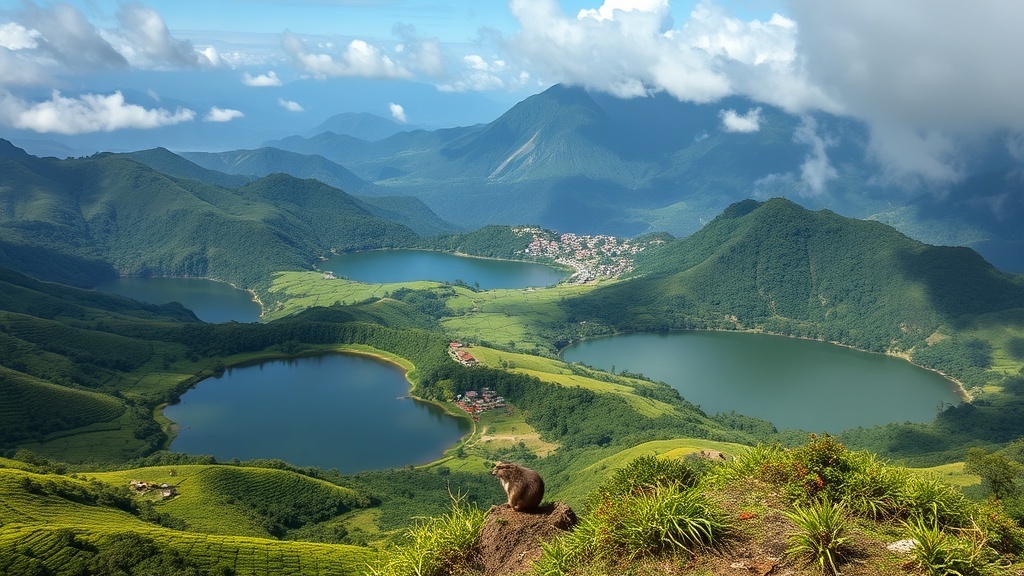
The Western Highlands
Rolling grasslands and volcanic peaks — home to the Bamileke and Bamoun kingdoms with their centuries-old traditions
🏛️ Yaoundé — The Capital
Yaoundé spreads across seven hills in the south-central part of the country, a city of nearly four million people that serves as Cameroon's political and administrative capital. Founded as a German colonial post in 1889, the city acquired its governmental role under French administration and has grown steadily since independence, though it remains more measured and less chaotic than the commercial powerhouse of Douala.
The city offers visitors a surprisingly green urban experience. The Benedictine Monastery of Mont Fébé crowns one of the surrounding hills, providing panoramic views over the city and housing an impressive collection of African art. The National Museum, installed in the former presidential palace, traces Cameroon's history from prehistoric times through colonialism to independence. The Mfoundi Market in the city center pulses with life — a sprawling labyrinth of stalls selling everything from dried fish and tropical fruits to traditional medicines and vibrant fabrics.
Yaoundé also serves as the gateway to the Mefou Primate Sanctuary, run by Ape Action Africa, where rescued gorillas, chimpanzees, and mandrills receive care and rehabilitation. The sanctuary, located just 45 minutes from the city center, provides an intimate wildlife experience that complements the more remote national parks in other regions of the country.
🏙️ Douala — The Economic Capital
Douala is Cameroon at full volume — a humid, energetic, traffic-choked metropolis of over four million people that serves as the country's economic engine and largest city. Situated on the banks of the Wouri River estuary (the very waterway that gave Cameroon its name), Douala handles the vast majority of the country's imports and exports through its busy port, and its international airport is the primary gateway for most visitors.
The city may lack the political grandeur of Yaoundé, but it compensates with raw commercial energy and cultural vitality. The Douala Art Center (Doual'Art) champions contemporary African art through exhibitions and urban installations. The Marché des Fleurs and Marché Central offer sensory overload — mountains of plantains, pungent dried crayfish, vivid textiles, and the constant soundtrack of Makossa music spilling from shop speakers. Along the Bonanjo waterfront, colonial-era German and French buildings hint at the city's layered past.
Nightlife in Douala rivals any West African city. The birthplace of Makossa music still pulses with live performances, and the restaurant scene showcases Cameroon's remarkable culinary diversity — from refined French-influenced dining to unforgettable street-side poisson braisé (grilled fish) and soya (spiced grilled meat) served well past midnight.
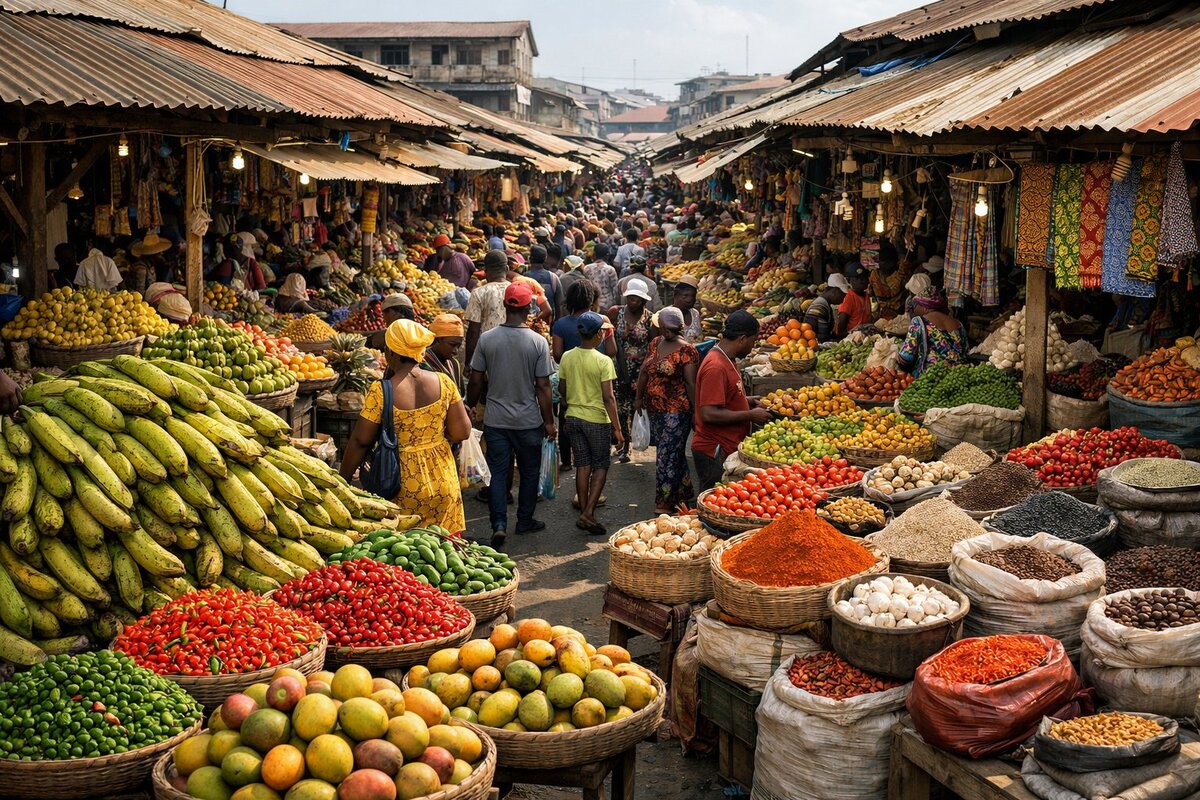
Douala Market Scene
The commercial heart of Cameroon — vibrant markets where Makossa rhythms mix with the aromas of grilled plantains and spices
🌋 Mount Cameroon — Chariot of the Gods
Mount Cameroon — known locally as "Mongo ma Ndemi" (Mountain of Greatness) and to the ancient Carthaginian explorer Hanno as "Chariot of the Gods" — rises 4,095 meters directly from the Gulf of Guinea coast, making it West and Central Africa's highest peak and one of the most dramatic volcanic rises on the continent. This active volcano last erupted in 2012, and its fertile black volcanic soil supports some of the richest agricultural land in the region.
The standard three-day trek from Buea passes through an extraordinary compression of ecosystems — tropical rainforest draped in epiphytes gives way to montane cloud forest, then alpine grassland, and finally barren volcanic moonscape near the summit. On clear days, the Atlantic Ocean stretches to the horizon below while the peaks of Bioko Island (Equatorial Guinea) shimmer in the distance. The annual Mount Cameroon Race of Hope, held each February, draws elite runners from across Africa for a grueling ascent and descent that the fastest complete in a little over four hours. The 31st edition went ahead in Buea in February 2026 despite the regional advisory, won by Hamadou Bih Ibrahim and Wirba Desty Grace.
The mountain's lower slopes shelter the Bakweri people, whose traditional beliefs center on the mountain as the dwelling place of spirits. The town of Buea, the old German colonial capital perched at 1,000 meters on the mountain's southeastern flank, serves as the launching point for treks and retains charming colonial-era architecture amid cool highland air that provides welcome relief from the coastal heat below.
🦁 Waza National Park
In Cameroon's far north, where the landscape flattens into Sahelian savanna and the air shimmers with heat, Waza National Park protects 1,700 square kilometers of grasslands, seasonal floodplains, and scattered acacia woodland. Established as a hunting reserve in 1934 and designated a UNESCO Biosphere Reserve, Waza offers the most accessible and rewarding wildlife viewing in Central Africa.
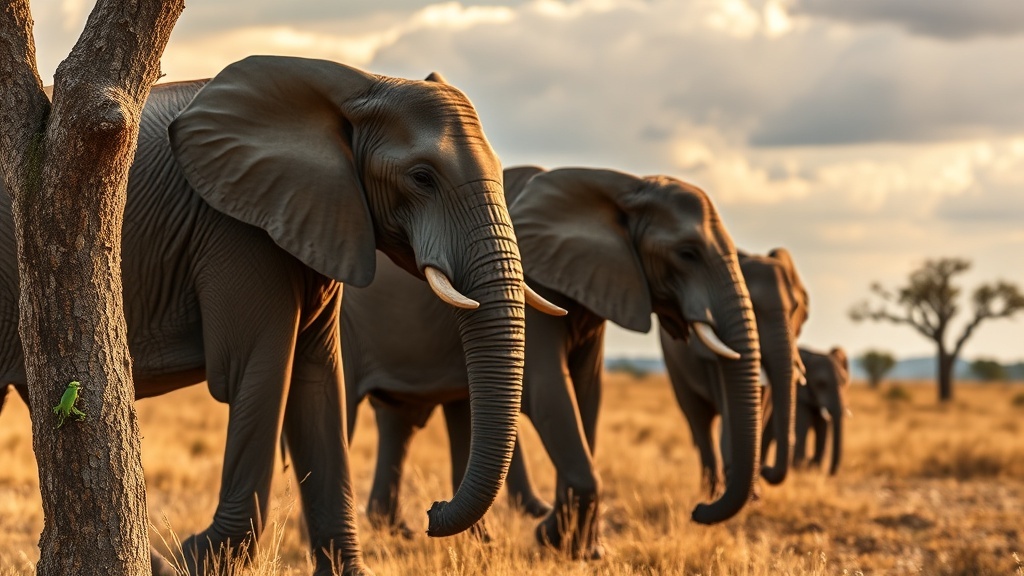
The park shelters elephants, lions, giraffes, hippopotamuses, and vast herds of kob antelopes whose migrations across the floodplains create some of Africa's most photogenic wildlife spectacles. Over 300 bird species have been recorded, including crowned cranes, marabou storks, and ostriches. The dry season (November to May) concentrates wildlife around remaining water sources, making sightings almost guaranteed — a stark contrast to the hit-or-miss encounters of many rainforest reserves.
Waza's relative inaccessibility — it lies over 1,000 kilometers from Douala — keeps visitor numbers remarkably low, offering an intimate safari experience far from the crowds of East African parks. For travelers willing to make the journey, whether by the scenic train to Ngaoundéré followed by overland travel, or by domestic flight to Maroua, Waza delivers genuine wilderness at a fraction of the cost and congestion of the Serengeti or Masai Mara.
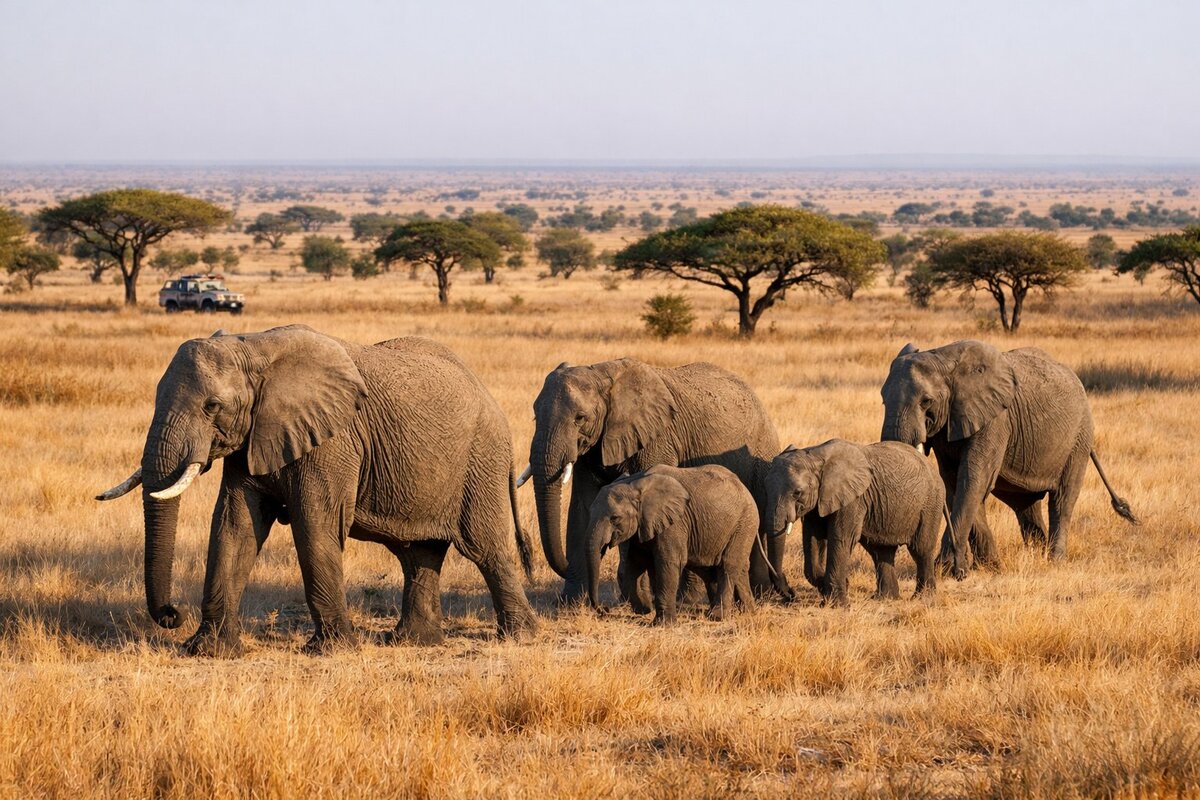
Waza National Park
UNESCO Biosphere Reserve — elephants, lions, and giraffes roam the Sahelian savanna of Cameroon's far north
🏖️ Kribi & Lobé Falls
Kribi is Cameroon's premier beach destination — a languid coastal town where palm-fringed golden sand meets the warm waters of the Gulf of Guinea. Located about 180 kilometers by road south of Douala, this fishing town has evolved into a weekend retreat for Cameroonians and a growing draw for international visitors attracted by its combination of beaches, fresh seafood, and natural wonders.
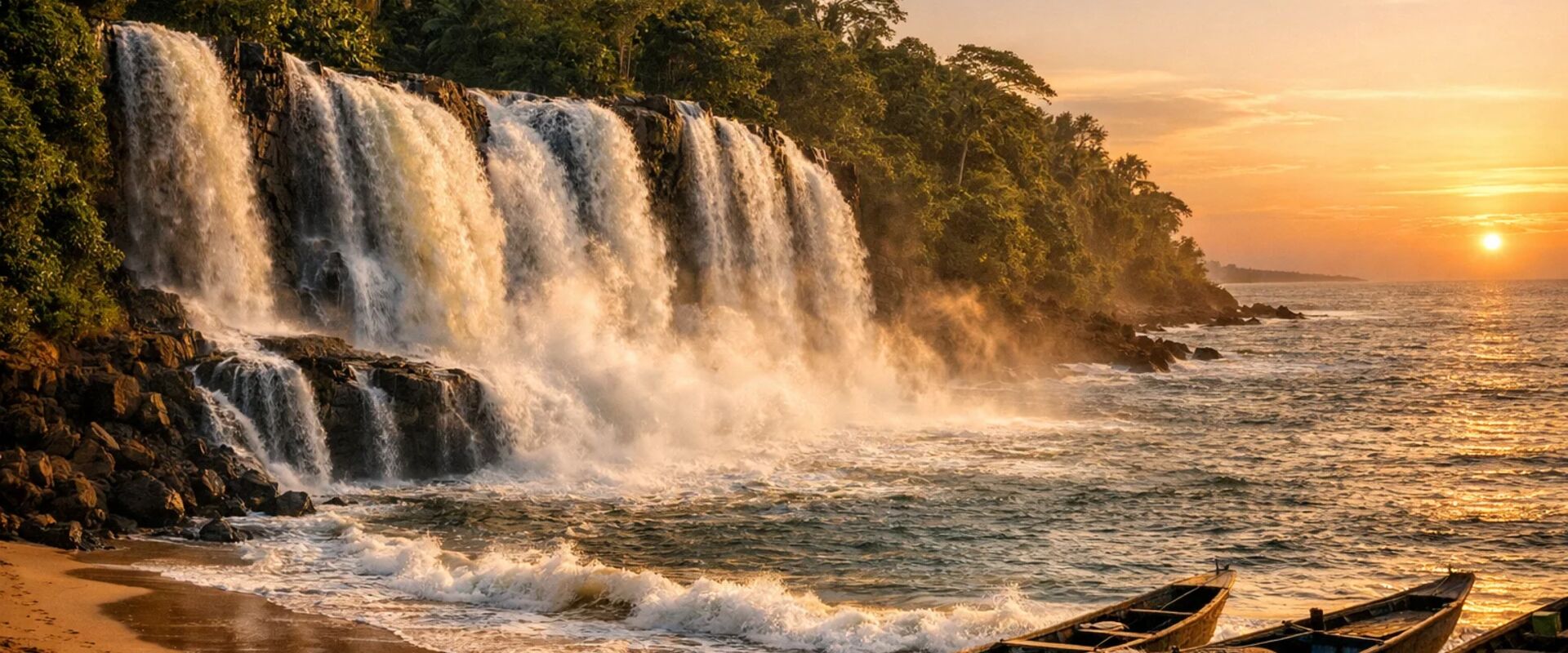
The town's greatest attraction lies eight kilometers south: the Chutes de la Lobé (Lobé Waterfalls), where a wide river cascades directly into the Atlantic Ocean — one of only a handful of places on Earth where waterfalls meet the sea. The sight of white water thundering over basalt rocks onto a sandy beach, with fishing pirogues bobbing in the spray, creates an image that encapsulates Cameroon's natural drama. Local Bagyeli (Pygmy) communities sometimes perform traditional dances for visitors near the falls.
The coastal stretch around Kribi also provides access to some of the finest seafood in Central Africa. Giant prawns (crevettes), grilled fish, and lobster prepared in simple beachfront restaurants represent the culinary highlight of any Cameroon journey. It was these very prawns, abundant in the local waters, that inspired Portuguese navigators to name the region over five centuries ago.
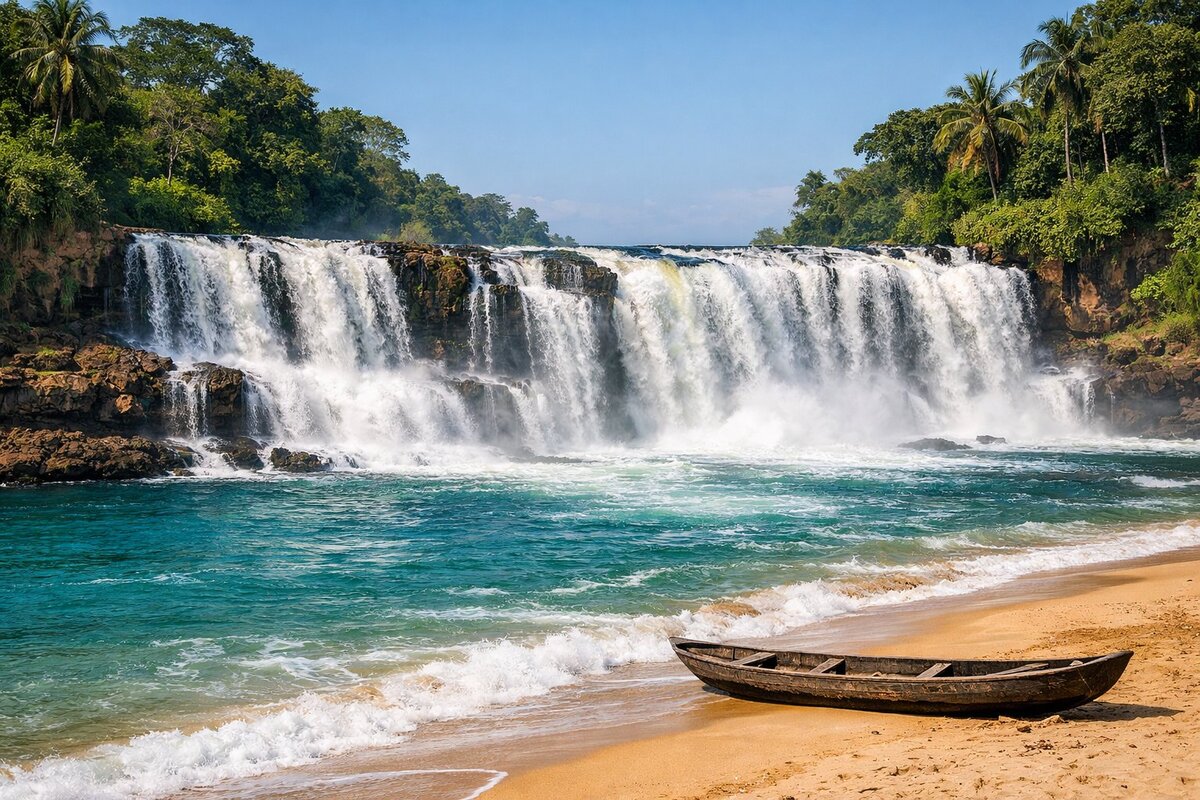
Lobé Falls at Kribi
One of the world's rarest natural phenomena — a river cascading directly into the Atlantic Ocean over ancient basalt rocks
👑 Foumban — The Bamoun Kingdom
Foumban is the cultural jewel of Cameroon's western highlands — seat of the Bamoun Kingdom, one of the most sophisticated pre-colonial states in sub-Saharan Africa. The imposing Royal Palace, built in 1917 and modeled on the German governor's residence, dominates the town center and houses a museum displaying centuries of royal art, weapons, musical instruments, and ceremonial regalia.
The Bamoun legacy is remarkable. Sultan Ibrahim Njoya (r. 1889–1933) independently invented the Shu Mom writing system — a rare example of indigenous African script development — and established a pharmacopeia, a legal code, and a map of his kingdom. His intellectual curiosity led him to study Islam, Christianity, and traditional religion before creating a syncretic faith called "Nwet." The palace museum preserves examples of his script and chronicles this extraordinary chapter of African intellectual history.
Foumban's Artisan Quarter ranks among the finest craft markets in Africa. Generations of artisans produce elaborate bronze sculptures using lost-wax casting, hand-embroidered robes, carved wooden masks, and intricate beadwork. The biennial Nguon Festival (held in December of even-numbered years) fills the city with masquerades, traditional dances, and ceremonies that celebrate the kingdom's living heritage; the Nguon rituals were inscribed on UNESCO's Representative List of Intangible Cultural Heritage on 6 December 2023, Cameroon's first element on that list.
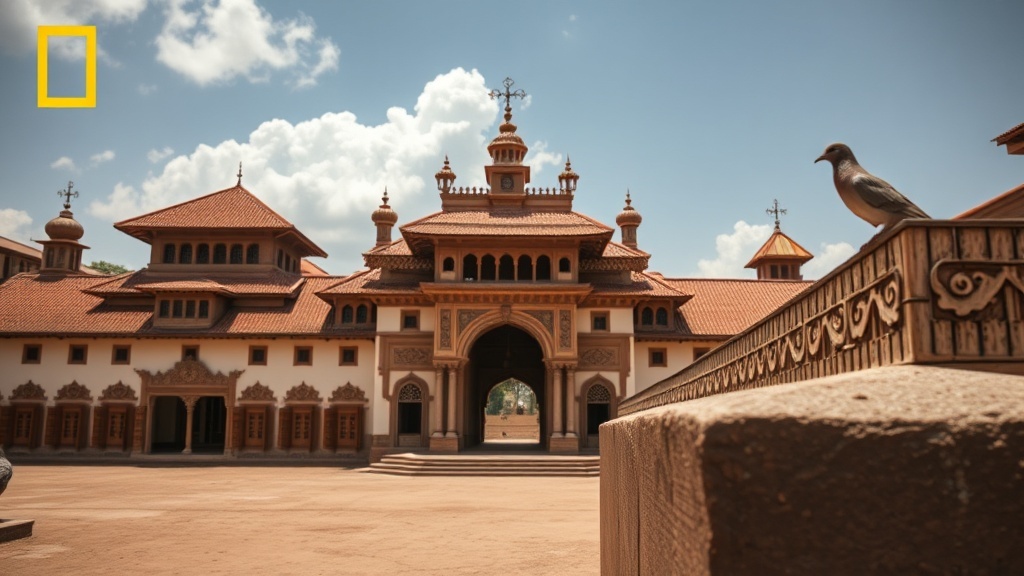
Foumban Royal Palace
Seat of the Bamoun Kingdom — where Sultan Njoya invented his own writing system and built one of Africa's great cultural centers
⛰️ Rhumsiki — Mandara Mountains
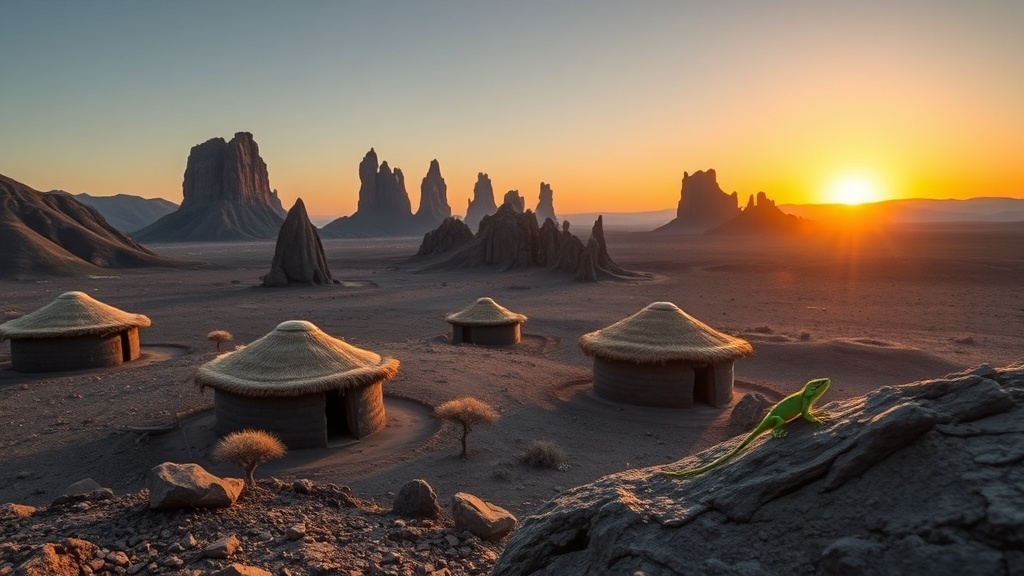
Rhumsiki is one of those places that seems to belong to a different world entirely. This small village in the Mandara Mountains of far northern Cameroon sits amid a landscape of volcanic plugs — dramatic spires of basalt that rise like giant stone teeth from the surrounding terrain. The most famous, the Kapsiki Peak, towers over the village in a formation so striking that it has been called one of Africa's most beautiful landscapes.
The Kapsiki people who inhabit this area maintain traditional lifestyles that have changed little over centuries. Their round thatched-roof compounds, built from local stone and earth, blend seamlessly into the volcanic landscape. A local "crab sorcerer" practices divination using freshwater crabs — placing them in an earthen pot, asking questions, and interpreting their movements as answers from the spirit world. Whether you believe in the practice or not, witnessing it provides a window into belief systems far removed from the modern world.
The surrounding Mandara Mountains offer exceptional hiking through terraced hillside villages where hospitality comes naturally and the views across the plains to Nigeria seem to stretch forever. Rhumsiki is best visited during the dry season (November–February) when the paths are passable and the volcanic peaks stand sharpest against clear blue skies.
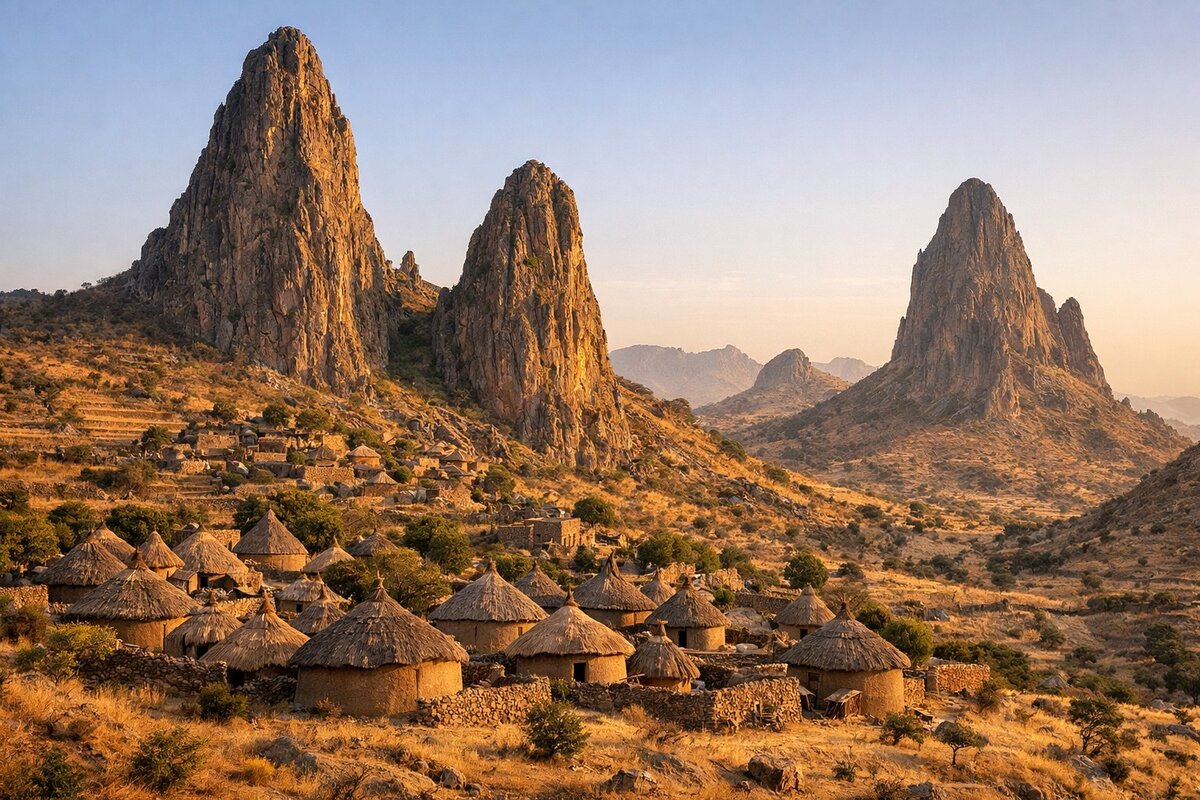
Rhumsiki Volcanic Peaks
The otherworldly Mandara Mountains — basalt spires rising from the landscape like something from a fantasy novel
🌿 Limbe — Where Volcano Meets Ocean
Limbe sits at the dramatic junction of Mount Cameroon and the Atlantic Ocean, a small coastal town whose black volcanic sand beaches provide a striking counterpoint to Kribi's golden shores further south. Originally called Victoria by its British colonial founders, Limbe offers visitors a compact package of natural attractions, colonial history, and accessible wildlife encounters.
The Limbe Botanic Garden, established in 1892 as a German colonial agricultural research station, contains one of Central Africa's finest collections of tropical plants, spread across 50 hectares at the foot of Mount Cameroon. The adjacent Limbe Wildlife Centre rescues and rehabilitates primates including chimpanzees, gorillas, and drills — one of Africa's most endangered primates — providing close encounters that are both educational and deeply moving.
The town also serves as a gateway for exploring Mount Cameroon's lower slopes, where ancient forests shelter rare birds and butterflies. The black sand beaches at Mile Six and Down Beach attract surfers during the right swells, while the fishing harbor provides daily catches that fuel the excellent seafood restaurants scattered along the waterfront. For travelers, Limbe represents one of Cameroon's most accessible and rewarding stops — manageable in size, rich in attractions, and blessed with a setting of genuine natural drama.
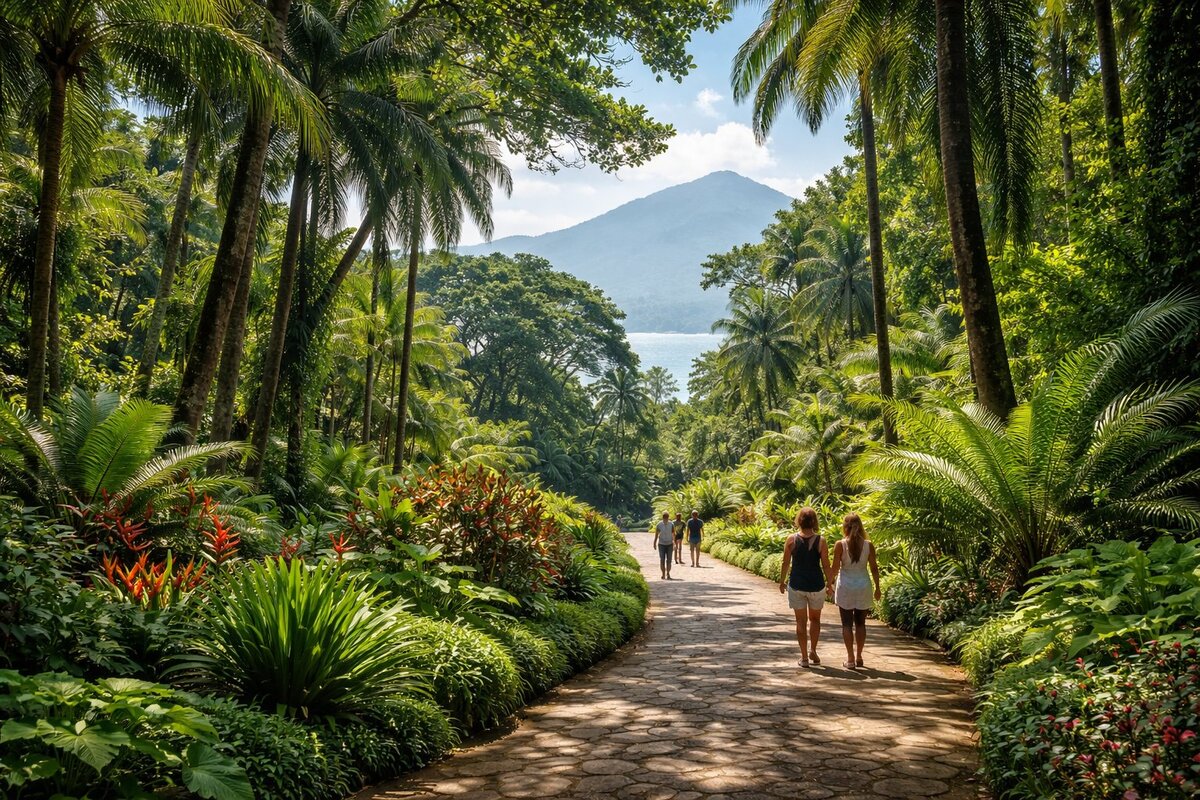
Limbe Botanic Garden
Established in 1892 — tropical plants flourish at the foot of Mount Cameroon where volcano meets the Atlantic
🌳 Dja Faunal Reserve
The Dja Faunal Reserve, a UNESCO World Heritage Site since 1987, protects over 5,260 square kilometers of some of the largest and best-preserved tropical rainforest in Africa. Nearly surrounded by the Dja River — which forms a natural boundary on three sides — the reserve shelters an extraordinary concentration of biodiversity including western lowland gorillas, chimpanzees, forest elephants, mandrills, and over 100 other mammal species.
The reserve is home to the Baka people, one of the oldest human populations in the Congo Basin, who continue to practice traditional hunting and gathering lifestyles within designated zones. Their intimate knowledge of the forest — identifying medicinal plants, tracking animals, and navigating without trails — represents an irreplaceable cultural heritage intertwined with the ecological health of the reserve itself.
Access is challenging, requiring several hours of travel on unpaved roads from Yaoundé, but the reward is genuine wilderness unmarred by mass tourism. Guided treks through the forest, accompanied by Baka trackers, offer chances to observe gorillas and chimpanzees in their natural habitat — experiences that rank among the most profound wildlife encounters available anywhere in Africa.
🍽️ Cuisine
Cameroonian cuisine mirrors the country's extraordinary diversity — each region, each ethnic group, contributes distinct flavors to one of Africa's richest food cultures. The southern forests provide cocoyam, plantains, and palm oil; the western highlands contribute beans, corn, and leafy greens; the north adds millet, sorghum, and the aromatic spice blends of the Sahel.
Signature Dishes: Ndolé — the national dish, a complex stew of bitter leaves cooked with groundnuts (peanuts) and fish or meat, typically served with plantains. Poulet DG ("Director General's Chicken") — fried chicken with ripe plantains in a rich tomato sauce, a status dish for celebrations. Achu — pounded cocoyam with yellow palm oil soup, a specialty of the western highlands. Fufu and Eru — pounded cassava served with waterleaf and spinach-like eru leaves, an Anglophone specialty. Poisson Braisé — grilled fish rubbed with spices, ubiquitous along the coast.
Street Food: Soya (suya) — spiced grilled meat on skewers, the essential night-time snack found at roadside braziers across the country. Beignets — deep-fried dough balls served with bean stew for breakfast. Crevettes de Kribi — giant grilled prawns from the coast, the dish that inspired the country's name. Fresh tropical fruits — mangoes, papayas, avocados, pineapples — are abundant and cheap year-round.
Ndolé
Bitter Leaf Stew — Cameroon's National Dish
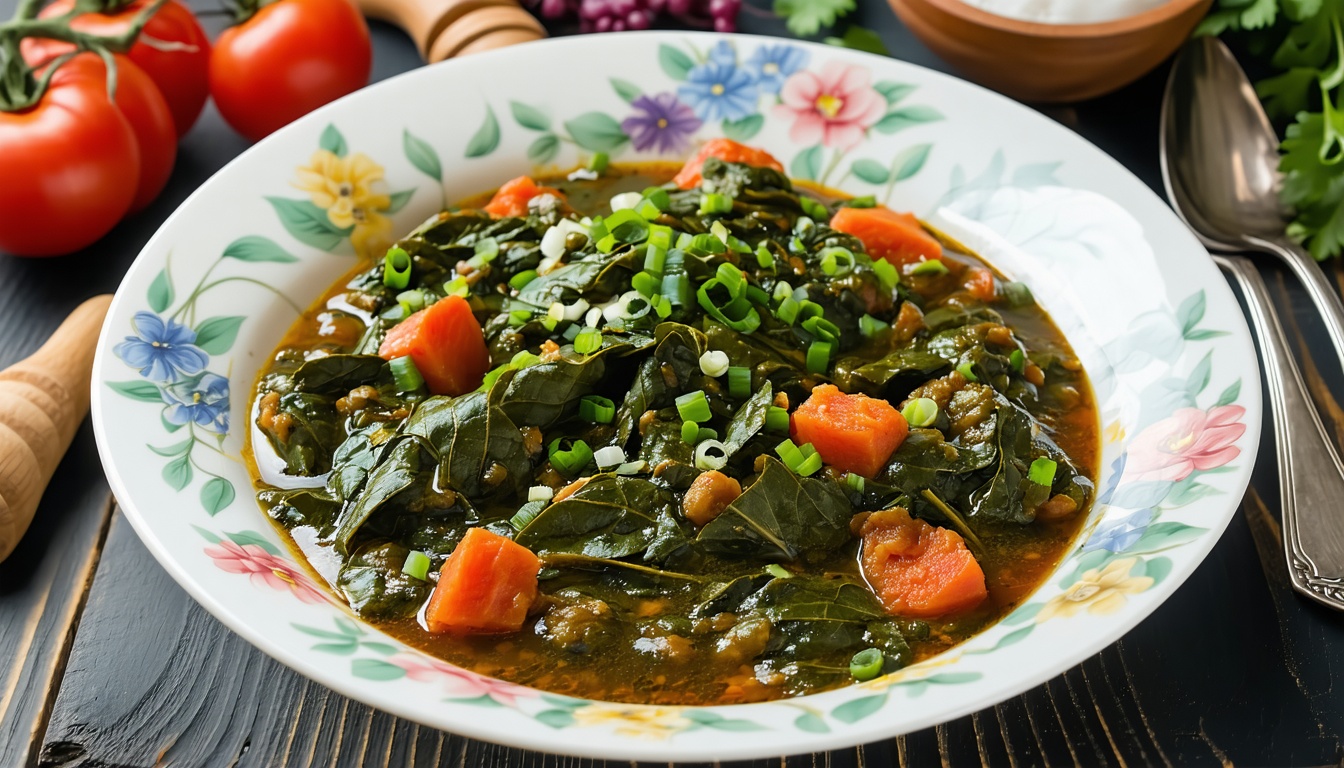
Cameroon's beloved national dish — bitter leaves with peanuts and meat or fish. This recipe serves two.
Ingredients: 200g bitter leaves (or spinach), 120ml ground peanuts, 200g beef or shrimp, 1 onion, crayfish powder, palm oil.
Preparation: Boil and wash bitter leaves repeatedly to reduce bitterness. Brown meat with onion. Add ground peanuts and water, cook down. Add leaves and crayfish powder. Stir in palm oil. Serve with plantains or bobolo (fermented cassava sticks).
💡 Bitter leaves need multiple washes — spinach is a milder substitute if unavailable.
Suya
Spiced Grilled Meat Skewers
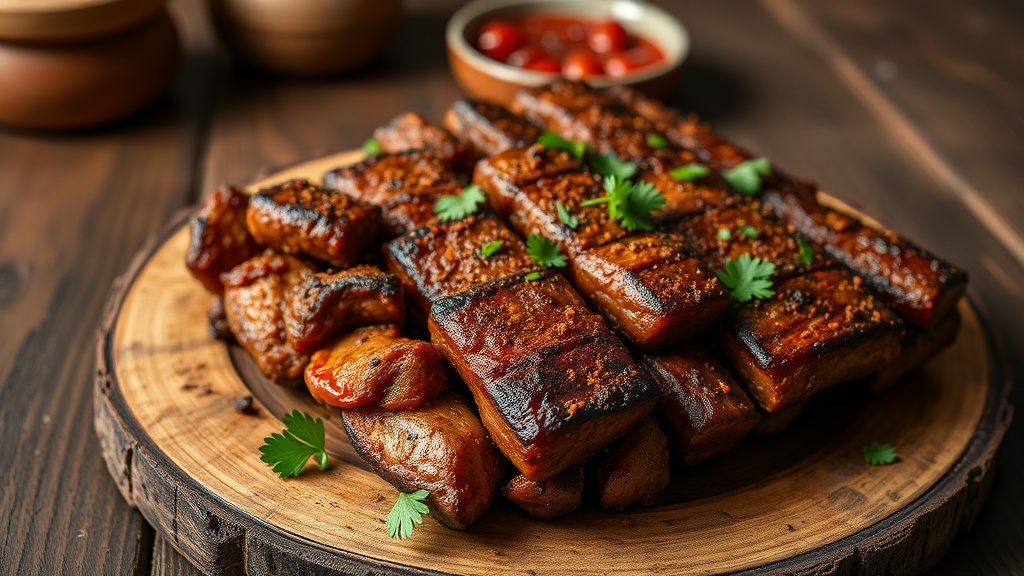
Skewered meat with fiery peanut spice — street food perfection found at every roadside brazier. This recipe serves two.
Ingredients: 300g beef, sliced thin, suya spice (ground peanuts, ginger, cayenne, onion powder), oil, raw onion, tomato.
Preparation: Coat meat generously in suya spice. Thread onto skewers. Grill over charcoal, basting with oil. Serve with extra spice and garnish with sliced onion and tomato.
💡 The spice should form a thick crust — don't be shy with it.
Poulet DG
"Director General's Chicken" — Chicken with Ripe Plantains
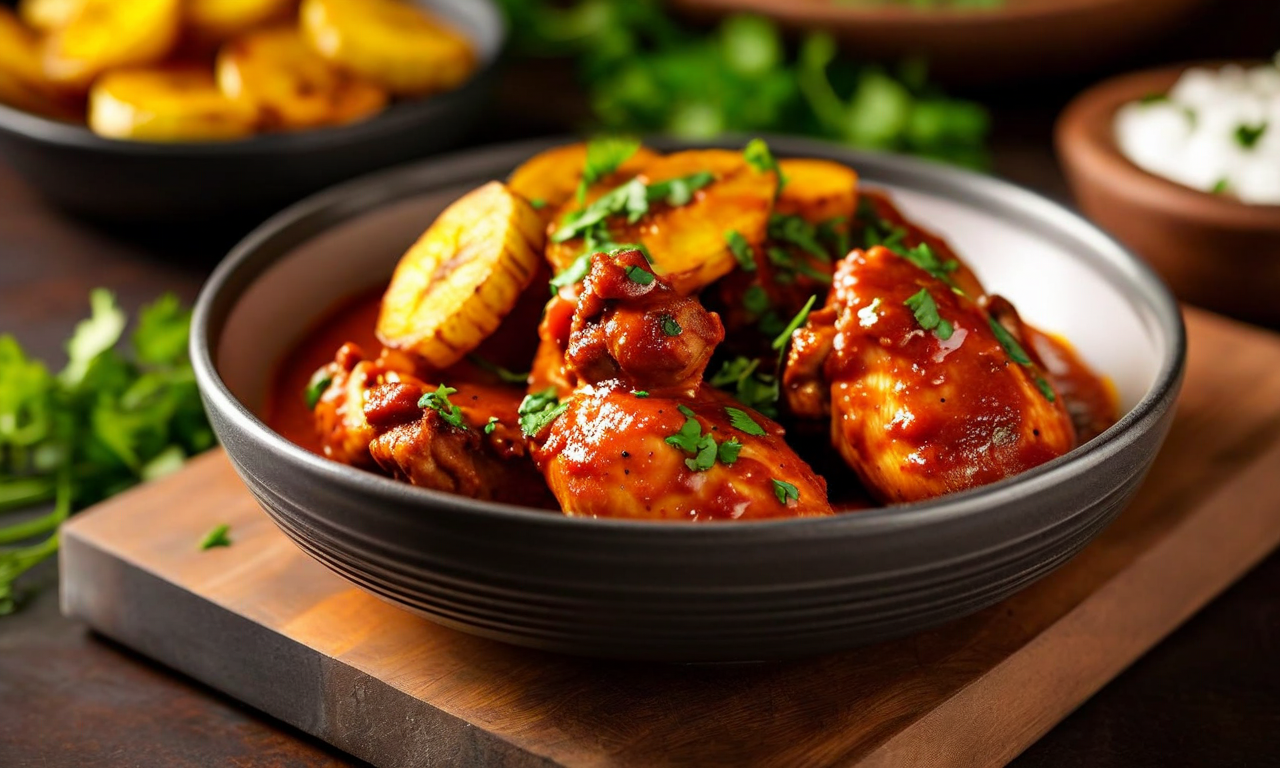
A Douala celebration dish from the 1980s — named for the company bosses who could afford a whole chicken. This recipe serves two.
Ingredients: 600g chicken pieces, 3 ripe plantains, 2 tomatoes, 1 onion, 1 carrot, 1 green pepper, 100g green beans, 3 cloves garlic, thumb of ginger, 1 stock cube, chili to taste, oil for frying.
Preparation: Marinate the chicken in crushed garlic, ginger, salt and stock cube for 30 minutes, then brown in hot oil and set aside. Slice the plantains diagonally and fry until golden; drain. In the same pan, soften onion, then add blended tomato, carrot rounds, pepper strips and beans; simmer 10 minutes. Return the chicken, cook covered 15 minutes, fold in the plantains for the last 5 minutes so they soak up the sauce without breaking. Serve hot.
💡 The plantains must be properly ripe — yellow with black spots — or the dish loses its sweet-savory balance.
Achu
Pounded Cocoyam with Yellow Soup — the Grassfields Classic
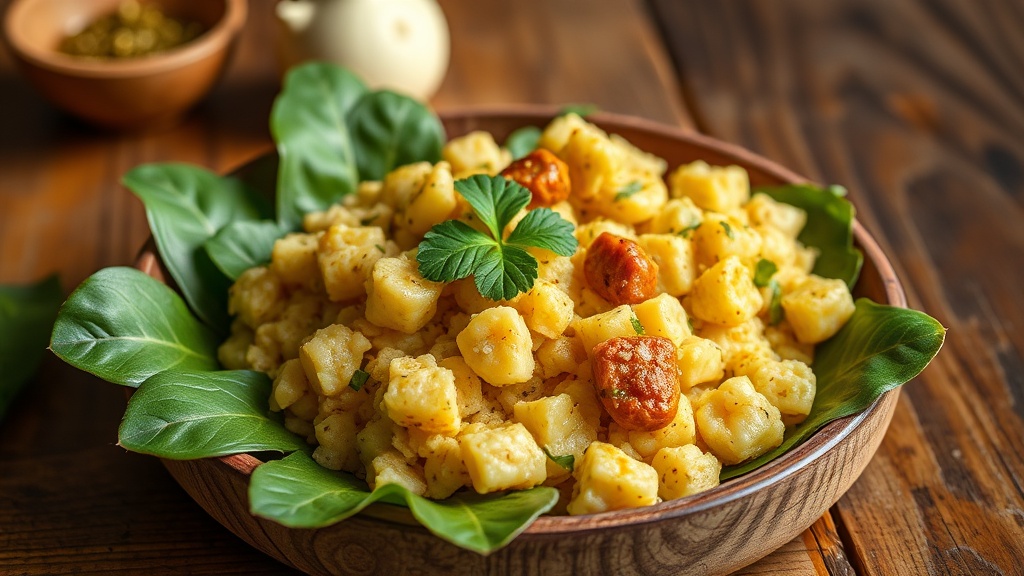
The ceremonial dish of the Northwest and West regions, eaten with the fingers from a well made in the mound of cocoyam. This recipe serves two.
Ingredients: 1kg cocoyams (taro), 150ml red palm oil, 1 tsp kanwa (limestone/potash) dissolved in 100ml warm water, 300g beef or tripe, 1 tbsp achu spice mix (country onion, njangsa, ground pepper), 1 stock cube, salt.
Preparation: Boil the unpeeled cocoyams 40 minutes until soft, peel, and pound in a mortar to a smooth, stretchy paste. Boil the meat with salt and stock cube and keep the broth. For the yellow soup, warm the palm oil gently, whisk in the kanwa water a little at a time until the oil turns opaque yellow and emulsifies, then stir in the spice mix and enough hot broth to make a pourable sauce; add the meat. Shape the achu into a mound, press a hollow in the top, fill it with soup and serve.
💡 Kanwa is what turns red palm oil yellow — without it the soup will split. West African grocers stock it.
🍷 Wine, Spirits & Drinking Culture
Cameroon has no wine production — the equatorial climate is unsuited to viticulture. However, the country has one of Africa's most vibrant drinking cultures. "33" Export, Castel Beer, Mützig and Beaufort — all brewed by the Castel group's SABC, which also took over Guinness Cameroun in 2022 — are the dominant commercial lagers, with Kadji Beer the main independent challenger. Mimbo (palm wine, tapped fresh from raffia palms) is culturally central, particularly in the Northwest and West regions, where palm wine bars serve as major social gathering places.
Bil-Bil (millet beer) and corn beer are traditional brews in the north, while odontol is a locally distilled spirit with a fearsome reputation. The Anglophone-Francophone cultural divide extends to drinking: English-speaking regions favor beer and palm wine, while French-speaking areas maintain a wine culture inherited from colonial times. Cameroon imports significant quantities of French wine, and a glass of Bordeaux is readily available in Douala and Yaoundé restaurants.
🍶 Tasting Note Radim Kaufmann
In a palm wine bar in Bamenda, the sweet, slightly fizzy mimbo — tapped fresh that morning — was as alive and local as any drink on Earth. The bartender poured from a calabash into recycled beer bottles, and the conversation was as warm as the climate. Cameroon is called "Africa in miniature" for good reason, and its drinking culture mirrors that diversity perfectly.
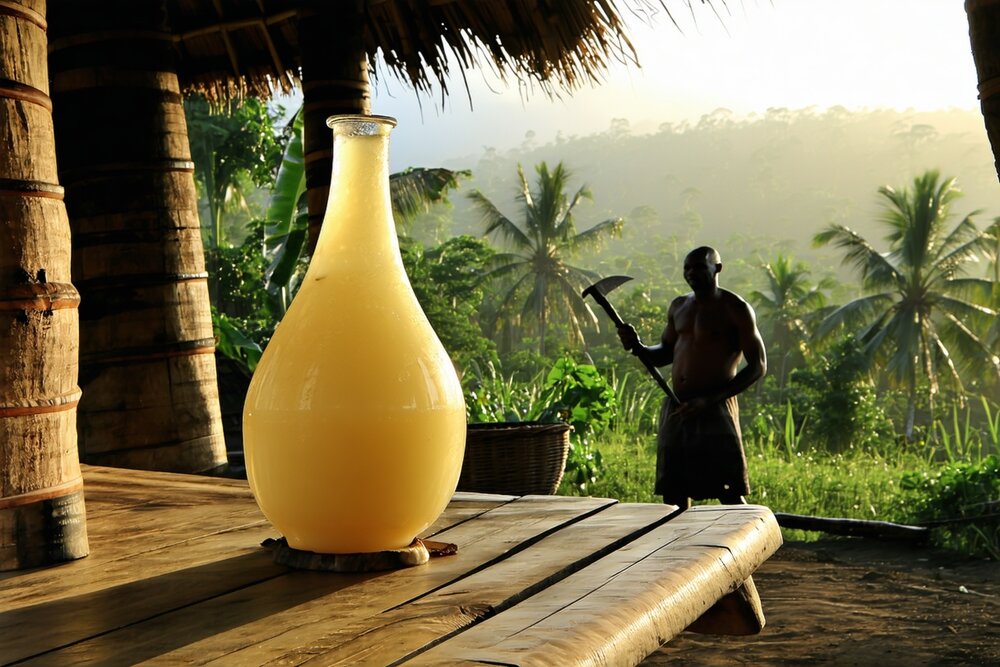
Palm Wine Culture
Mimbo — freshly tapped palm wine is central to social life across the western highlands and beyond
🍹 Cocktails & Mixed Drinks
Cameroon has no classic cocktail canon of its own — bar culture runs on cold lager, palm wine and imported spirits — but its juices are world-class: foléré (hibiscus), fresh gingembre (ginger), baobab and passion fruit are sold chilled in plastic bottles on every Douala street. The three drinks below are house recipes built on those local ingredients; the first two are staples of upmarket hotel bars in Yaoundé and Douala in one form or another.
Foléré Rum Punch
Hibiscus, dark rum, lime
Ingredients: 120ml chilled foléré (hibiscus) juice, 45ml dark rum, 15ml lime juice, 10ml ginger syrup, ice, mint sprig.
Preparation: Shake rum, lime and ginger syrup hard with ice, strain into a tall glass over fresh ice, top with foléré, stir once and garnish with mint.
Gingembre Gin Fizz
Fresh Cameroonian ginger juice, gin, soda
Ingredients: 50ml gin, 60ml fresh gingembre (ginger-pineapple juice), 15ml lemon juice, 10ml honey syrup, soda water, ice.
Preparation: Shake gin, gingembre, lemon and honey with ice, strain into a highball over ice, top with soda. Street gingembre is fiercely hot — start with less and add.
Kribi Sunset (alcohol-free)
Baobab, passion fruit, coconut water
Ingredients: 80ml baobab juice (bouye), 40ml passion fruit pulp, 60ml coconut water, 10ml grenadine, ice.
Preparation: Build over ice in a tall glass: coconut water, then baobab and passion fruit, and let the grenadine sink through for the sunset layers. A splash of white rum turns it into a beach cocktail.
🌡️ Climate & Best Time
Cameroon's climate varies as dramatically as its landscape. The south is equatorial — hot, humid, and rainy year-round, with up to 4,000mm of rainfall annually along the coast (the western slopes of Mount Cameroon receive over 10,000mm, making it one of the wettest places on Earth). The central plateau enjoys a more moderate tropical climate with distinct wet and dry seasons. The far north is semi-arid, with scorching temperatures often exceeding 40°C and a single short rainy season.
Best Time by Region: The south and west are best visited November to February, when rainfall decreases. The north is ideal October to April (dry and coolest). Mount Cameroon treks are best December to February for clear summit views. Waza National Park opens November to mid-June, with March and April offering peak wildlife viewing as animals congregate around dwindling water sources.
✈️ Getting There
By Air: Douala International Airport (DLA) is the primary gateway, receiving flights from Paris, Brussels, Istanbul, Addis Ababa, Nairobi, and other African capitals via Air France, Brussels Airlines, Turkish Airlines, Ethiopian Airlines, and Camair-Co (the national carrier, which in 2026 flew six domestic and six international routes and restarted long-haul charters with Umrah flights to Saudi Arabia from 17 February 2026). Yaoundé-Nsimalen Airport (NSI) also handles international flights but with fewer connections.
By Land: Border crossings operate with Nigeria (west), Chad (north), Central African Republic (east), Republic of Congo, Gabon, and Equatorial Guinea (south). Roads range from paved highways to challenging tracks, especially in the north during the rainy season. The Cameroon-Nigeria land border at Ekok/Ikom is the traditional overland crossing, but it lies in the Southwest region and within 20 km of the Nigerian border — doubly inside the Level 4 zone — so overland entry from Nigeria is not currently advisable; the Chad and CAR frontiers fall under the same 20 km exclusion. In practice, fly in.
Internal Transport: Camrail operates a scenic train service from Douala to Yaoundé (4 hours) and onward to Ngaoundéré in the north (12-15 hours) — the latter journey through increasingly dramatic landscapes is one of Africa's great rail experiences. Domestic flights connect major cities. Intercity buses are comfortable and frequent on major routes.
📋 Practical Information
Visa: almost all visitors, including U.S., UK, Canadian, Australian and EU nationals, need a visa. Since 2023 Cameroon has run a mandatory electronic visa system: you apply online, receive an Online Visa Authorization, and then collect the physical visa sticker and give biometrics on arrival at a designated airport (Douala or Yaoundé Nsimalen). There is no visa-free entry and no conventional visa-on-arrival — arriving without a pre-issued authorization means being refused boarding. Apply at least two to three weeks ahead. Your passport must be valid for at least six months beyond entry with one fully blank page. A yellow fever vaccination certificate is required of all travellers and is checked.
Money: Central African CFA Franc (XAF), pegged to the Euro at 655.957 XAF = €1. ATMs available in Douala and Yaoundé; cash essential elsewhere. Credit cards accepted only at upscale hotels. Budget: $30–60/day; mid-range: $80–150/day.
Language: French dominates (80% of the country); English is official in the Northwest and Southwest regions. Pidgin English serves as a lingua franca in many areas. Over 280 local languages are spoken — learning a few words of French goes a very long way.
Safety: Check current advisories — the Far North region (Boko Haram activity) and parts of the Anglophone regions (Northwest and Southwest) have experienced instability. The Centre, Littoral, West, South and East regions (away from the CAR border) are the practical travel area, with big-city precautions in Yaoundé and Douala — see Travel Advisory & Safety. Malaria prophylaxis is essential throughout the country.
Health: Yellow fever vaccination required. Recommended: hepatitis A and B, typhoid, meningitis, rabies. Malaria is endemic — take prophylaxis and use mosquito nets. Drink only bottled or treated water. Quality hospitals exist in Douala and Yaoundé; medical evacuation insurance recommended for remote areas.
💰 Cost of Living
Cameroon is affordable by international standards, though prices in Douala and Yaoundé are higher than in rural areas. A street food meal (soya, beignets, or grilled fish) costs $1–3. A restaurant meal runs $5–15. A decent hotel room ranges from $30–80 per night, while budget guesthouses start at $10–20. A domestic beer costs about $1–2; a bottle of imported wine $8–15.
Safari costs at Waza or Bénoué are significantly lower than East African equivalents, with guided day trips starting at $30–50 per person. Mount Cameroon treks with guide, porters, and camping typically cost $150–250 for a three-day expedition. Internal transport is cheap — a Douala-Yaoundé bus ticket costs around $5–8, and the scenic train to Ngaoundéré runs about $20–40 depending on class.
🏨 Accommodation
Douala and Yaoundé offer international-standard hotels including Hilton and Pullman properties, alongside a growing mid-range sector. In smaller cities and tourist areas, locally-owned guesthouses ("auberges") provide clean, basic accommodation at budget prices. Limbe and Kribi have beachfront hotels ranging from rustic to comfortable.
In the western highlands (Bamenda, Foumban, Dschang), charming small hotels and mission guesthouses offer atmospheric stays. For Waza National Park, the Campement de Waza provides basic but functional lodging near the park entrance. Mount Cameroon treks use designated mountain huts. In remote areas like Rhumsiki, community-run guesthouses offer simple rooms and genuine hospitality. Camping is possible in national parks with proper permits.
🎭 Festivals & Events
Nguon Festival (Foumban, December, even years; UNESCO Intangible Heritage since 2023): The Bamoun Kingdom's most important cultural celebration — weeks of masquerades, traditional dances, and royal ceremonies culminating in the Sultan's public audience. An unmissable window into one of Africa's most sophisticated court cultures.
Mount Cameroon Race of Hope (Buea, February): Elite athletes race up and down West Africa's highest peak, the men finishing in a little over four hours and the women in around five and a half. The 31st edition (February 2026) was won by Hamadou Bih Ibrahim and Wirba Desty Grace, while seven-time champion Sarah Etonge, the “Queen of the Mountain”, took the veterans’ title. The festival atmosphere includes cultural performances and food from across the region.
Ngondo Festival (Douala, December): The Sawa (coastal) peoples celebrate their relationship with the sea through water rituals, pirogue races, wrestling matches, and the dramatic "diving for the sacred vase" ceremony in the Wouri River.
National Day (May 20): Celebrations across the country mark Cameroon's unification, with the largest parades and performances in Yaoundé. Youth Day (February 11): School parades and cultural performances fill every town in the country.
🏛️ UNESCO Heritage
Cameroon has three inscribed UNESCO World Heritage Sites — two natural, one cultural — plus a tentative list of seventeen. Nothing was added for Cameroon at the 48th Committee session in Busan (July 2026), so three remains the count.
Dja Faunal Reserve (1987, natural): one of Africa’s largest and best-protected rainforests, with roughly 90% of its area undisturbed. Home to gorillas, chimpanzees, forest elephants and over 100 mammal species. It is nearly encircled by the Dja River, which forms a natural protective boundary. Located in the South and East regions, outside the do-not-travel zones.
Sangha Trinational (2012, natural): a transboundary site shared with the Republic of the Congo and the Central African Republic, covering contiguous protected areas at the junction of three countries. One of Africa’s most important tropical forest ecosystems, sheltering forest elephants, western lowland gorillas and the traditional BaAka communities. Note that the Cameroonian component (Lobeke) lies near the CAR border, part of which falls inside the 20 km border exclusion zone.
Diy-Gid-Biy Cultural Landscape of the Mandara Mountains (2025, cultural): Cameroon’s newest and first purely cultural inscription, added on 11 July 2025 at the 47th session of the World Heritage Committee in Paris. The site comprises sixteen dry-stone archaeological complexes spread across seven villages in the Far North region, built between roughly the 12th and 17th centuries. The name means “ruin of the chief’s residence” in Mafa, the language of the people who settled the area between the 15th and 17th centuries and still occupy it. Cameroon had earlier pursued inscription as an extension of Nigeria’s Sukur Cultural Landscape; that bid was withdrawn in 2023 and the site was ultimately listed in its own right. It sits inside the Far North Level 4 do-not-travel zone.
Tentative List (17 sites, submitted 2018–2020): Waza National Park, the cultural landscape of the Lobé Falls, Bimbia and its associated slave-trade sites (2020), the Cross River–Korup–Takamanda forest complex (2020), the Bafut chiefdom, the Grassfields “Grande Case” palaces, the Shum Laka rock shelter, the Bidzar rock engravings, the Rey-Bouba lamidate, the Goto Goulfey tower, the Djohong and Saa megaliths, the Njock railway tunnels, the Lake Chad cultural landscape, and the Campo-Ma’an, Bouba Ndjidda and Boumba Bek–Nki national parks. Neither the Foumban palace nor Mount Cameroon is on it.
Intangible heritage: the Nguon rituals of governance of the Bamoun community were inscribed on the Representative List on 6 December 2023 — Cameroon’s only element to date. Waza (1979), Dja (1981) and Bénoué (1981) are also UNESCO Biosphere Reserves.
🎒 Packing Tips
Essentials: Lightweight, breathable clothing in neutral colors. Long sleeves and trousers for evenings (mosquito protection). Sturdy hiking boots for mountain treks. Rain jacket — essential year-round in the south. Sunscreen, insect repellent with DEET, and a hat for the north. Water purification tablets or a filtered bottle.
Health: Anti-malarial medication. First aid kit with rehydration salts. Hand sanitizer. Photocopies of passport, yellow fever certificate, and visa (police regularly check documents). Headlamp for areas with unreliable electricity.
Photography: Ask permission before photographing people — Cameroonians are generally friendly about it but appreciate the courtesy. A zoom lens is essential for Waza wildlife; a wide-angle for Rhumsiki landscapes.
🔗 Resources
Official Tourism: Visit Cameroon — Ministry of Tourism official site.
Travel Advisories: US State Department · UK FCDO
Conservation: Ape Action Africa (Mefou Sanctuary) · WWF Cameroon · Wildlife Conservation Society Cameroon
Cultural: Embassy of Cameroon (USA)
📚 Recommended Reading
"The Poor Christ of Bomba" by Mongo Beti — A sharp satirical novel about French colonialism and missionary activity in Cameroon, considered a masterpiece of African literature.
"Houseboy" by Ferdinand Oyono — A devastating critique of colonial power dynamics told through the diary of a young Cameroonian servant in a French colonial household.
"The Innocent Anthropologist: Notes from a Mud Hut" by Nigel Barley (1983) — The funniest book ever written about fieldwork: a year among the Dowayo of northern Cameroon, with bureaucracy, bad roads and a broken jaw.
"Behold the Dreamers" by Imbolo Mbue (2016) — A Limbe-born novelist's PEN/Faulkner-winning story of a Cameroonian immigrant family in New York during the 2008 crash.
"Cameroon with Egbert" by Dervla Murphy — The legendary Irish travel writer treks through Cameroon with a horse named Egbert, producing one of the finest travel accounts of the country.
🎬 Videos
Search YouTube for "Cameroon travel documentary" to find excellent visual introductions. Key recommendations include documentaries on the Mount Cameroon Race of Hope, the Baka pygmy peoples of the southern forests, the Foumban Nguon Festival, and wildlife encounters in Waza National Park. Travel vloggers increasingly cover Cameroon's highlights, providing practical visual guides to getting around this diverse country.
🤯 Fascinating Facts
🦐 Named After Prawns
Cameroon is the only country in the world named after a crustacean. Portuguese sailors who entered the Wouri estuary in 1472 found it teeming with ghost shrimp and called it "Rio dos Camarões" — the River of Prawns — and the name spread from river to mountain to nation.
🌊 Bantu Homeland
The Bantu expansion — one of the largest migrations in human history, which spread farming and related languages across most of sub-Saharan Africa — is believed to have originated in the Cameroon-Nigeria borderlands around 2000 BCE.
💀 Killer Lake
Lake Nyos catastrophically released a cloud of carbon dioxide in 1986, silently suffocating 1,746 people and 3,500 livestock in surrounding villages — one of the deadliest natural disasters in African history. Scientists now continuously degas the lake to prevent recurrence.
🗣️ 280+ Languages
Cameroon has over 280 living languages — one of the highest concentrations of linguistic diversity in the world. The country is also one of only a handful in Africa where both French and English serve as official languages.
✍️ Invented Writing System
Sultan Njoya of the Bamoun Kingdom independently invented the Shu Mom writing system in the 1890s — one of the very few examples of an entirely indigenous African script developed without external influence.
🌧️ Wettest Place
The western slopes of Mount Cameroon receive over 10,000mm of rainfall annually, making it one of the wettest places on Earth — rivaling Mawsynram in India and Mount Waialeale in Hawaii.
⭐ Notable People
Samuel Eto'o (b. 1981) — One of the greatest African footballers ever, four-time African Player of the Year, winner of two Champions League titles with Barcelona and one with Inter Milan; president of the football federation FECAFOOT since December 2021, a tenure marked by a six-month FIFA ban (2024) and a four-match CAF suspension after the AFCON quarter-final in January 2026. Roger Milla (b. 1952) — Pioneer of African football, famous for his corner-flag dance at the 1990 World Cup, where he helped Cameroon become the first African team to reach the quarter-finals.
Manu Dibango (1933–2020) — Saxophonist and musician whose "Soul Makossa" (1972) became one of the first African pop hits worldwide and is widely credited as an influence on modern dance music. Francis Ngannou (b. 1986) — Former UFC Heavyweight Champion (2021–2023) who grew up in extreme poverty in Batié, fought Tyson Fury and Anthony Joshua in boxing in 2023–24, and now fights for the PFL.
Mongo Beti (1932–2001) — One of Africa's greatest novelists, whose works exposed the injustices of colonialism. Ferdinand Oyono (1929–2010) — Author and diplomat whose anti-colonialist novels are considered classics of 20th-century African literature. Joel Embiid (b. 1994) — 2023 NBA MVP and Philadelphia 76ers center, born in Yaoundé; won Olympic gold with the United States at Paris 2024. André Onana (b. 1996) — Cameroon's goalkeeper; a Manchester United player since 2023, on loan at Trabzonspor since September 2025 (Turkish Cup winner 2026) and again for 2026–27. Bryan Mbeumo (b. 1999) — Forward who joined Manchester United from Brentford in July 2025 for around €75 million. Imbolo Mbue (b. 1981) — Limbe-born novelist, PEN/Faulkner Award winner for Behold the Dreamers (2016).
⚽ Sports
The Indomitable Lions: Cameroon's national football team is one of Africa's most successful, having won the Africa Cup of Nations five times (1984, 1988, 2000, 2002, 2017) and reached the World Cup quarter-finals in 1990 — then the best-ever performance by an African nation. The team's green jerseys are among the most recognizable in world football.
Domestic League: The Elite One league features clubs like Canon Yaoundé, Cotonsport Garoua, and Union Douala. Football is not merely a sport in Cameroon — it is a national obsession that transcends ethnic, linguistic, and regional divides.
Other Sports: Cameroon has produced notable NBA players (Joel Embiid, Pascal Siakam), UFC fighters (Francis Ngannou), and Olympic athletes (Françoise Mbango Etone — double Olympic gold in triple jump). The Mount Cameroon Race of Hope, first run in 1973 and now in its 31st edition (February 2026), is one of Africa's most prestigious mountain running events.
Olympics: Cameroon has won six Olympic medals in total — three gold (the men's football team at Sydney 2000, and Françoise Mbango Etone's triple-jump titles at Athens 2004 and Beijing 2008), one silver and two bronze — but none since 2008, and its 2024 Paris delegation came home empty-handed. Cameroon last hosted a major event with the Africa Cup of Nations of January–February 2022 (the delayed “AFCON 2021”), where the Lions finished third.
2026 World Cup — the Lions miss out: Cameroon will not be at the 2026 tournament. After a group campaign that included a 4–1 win over Cape Verde but also dropped points away in Libya, the Indomitable Lions were held to a goalless draw by Angola on 13 October 2025 in their final Group D fixture and finished second behind Cape Verde. In the CAF play-off semi-final in Rabat on 13 November 2025 they lost 0–1 to DR Congo to a Chancel Mbemba header in stoppage time — a bitter outcome for the nation with eight World Cup appearances, the most of any African country.
AFCON 2025 (Morocco, Dec 2025–Jan 2026): the Lions drew with Gabon and Côte d’Ivoire and beat Mozambique to reach the knockouts, defeated South Africa 2–1 in the round of 16 in Rabat on 4 January 2026, and went out 0–2 to the hosts Morocco in the quarter-final on 9 January (Brahim Díaz, Ismaël Saibari). Federation president Samuel Eto’o received a four-match CAF suspension for his conduct after that match.
📰 Media & Press Freedom
Cameroon presents one of Africa’s sharpest contradictions in media: an extraordinarily crowded landscape operating under extraordinary pressure. The country supports more than 600 newspapers, roughly 200 radio stations and over 60 television channels — among the richest media ecologies on the continent — yet it is also one of the most dangerous places on it to be a journalist.
In the 2026 RSF World Press Freedom Index, Cameroon ranks 133rd of 180 countries with a score of 40.88, down from 131st and 42.75 the previous year, placing it in the “difficult” category. Its weakest showing is on the security indicator (157th), followed by the economic indicator (152nd) — a profile that describes an industry which is legally tolerated, commercially starved and physically unsafe.
The landscape: the state broadcaster CRTV (Cameroon Radio Television) and the government daily Cameroon Tribune anchor the official media. Independent titles include Mutations, Le Jour and Le Messager in French, and The Guardian Post and The Post in English. Reporting on the Anglophone conflict, on military operations in the Far North, or on the presidential succession carries genuine risk — journalists covering these subjects have faced military tribunals under anti-terrorism legislation. The 2023 abduction and murder of the radio journalist Martinez Zogo remains the reference point for how far the danger extends.
For visitors: internet access is generally open in the major cities, though connectivity outside them is patchy and the Anglophone regions have experienced prolonged government-ordered shutdowns in the past. Assume that photographing security forces, checkpoints or official buildings will be treated as a serious matter regardless of your intentions.
📸 Photo Gallery
Share your Cameroon photos! Send to photos@kaufmann.wtf to be featured.
✍️ Author's Note
The moment Cameroon made sense to me was on the night train out of Yaoundé. I had boarded at dusk in the humid green of the south, and when the couchette window turned grey again somewhere past the Adamawa escarpment the world outside had become dry, red and enormous — cattle, Fulani herders in indigo, a single baobab holding down the horizon. Twelve hours, one carriage, two continents. Nobody who has done that ride ever argues with the "Africa in Miniature" slogan again.
I have to be honest about what this page can and cannot promise in 2026. The Cameroon I fell for — Buea's cold mornings under the volcano, the black-sand beach at Limbe, a calabash of mimbo in a Bamenda bar — sits almost entirely inside the do-not-travel zones, and I have written those sections as a record rather than a recommendation. What remains open is still a proper country: Kribi's prawns eaten with your feet in the Atlantic, Foumban's palace with the Sultan's invented alphabet on its walls, the Dja forest where a Baka tracker can hear a gorilla before you can see anything at all. Go for those, read the advisory twice, and keep the rest for the year the guns finally go quiet.
—Radim Kaufmann, 2026
❤️ Support the Factbook
Help us keep this resource free and independent
