

🌍 Canada at a Glance
🌍 Overview
Canada is the world's second-largest country by area — a vast northern wilderness stretching from the Atlantic to the Pacific to the Arctic. Yet for all its size, Canada's identity is intimate: friendly cities, multicultural neighborhoods, pristine national parks, and a quality of life consistently ranked among the world's best.
For American travelers, Canada offers the familiar made exotic: English spoken with different rhythms, French adding European flair, First Nations culture reshaping how we understand history, and nature on a scale that humbles even the most seasoned adventurer.
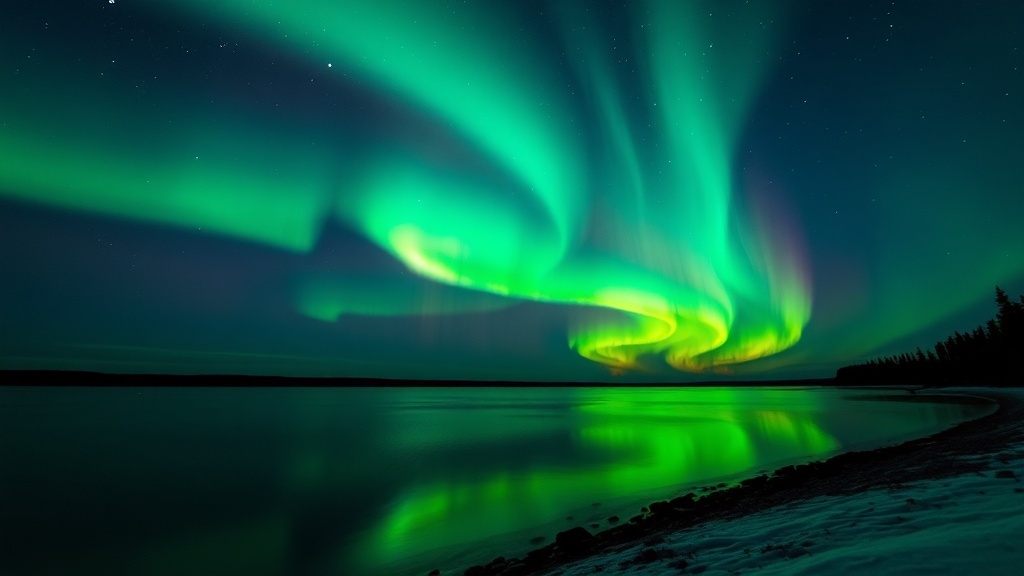
The Rocky Mountains rise like cathedrals from the Alberta plains. Niagara Falls thunders with primordial power. The Northern Lights dance across Arctic skies. Whales breach in coastal waters from BC to Newfoundland.
"Sorry" is indeed the national word, hockey the national obsession, and maple syrup the national treasure — but Canada's diversity defies easy summary.
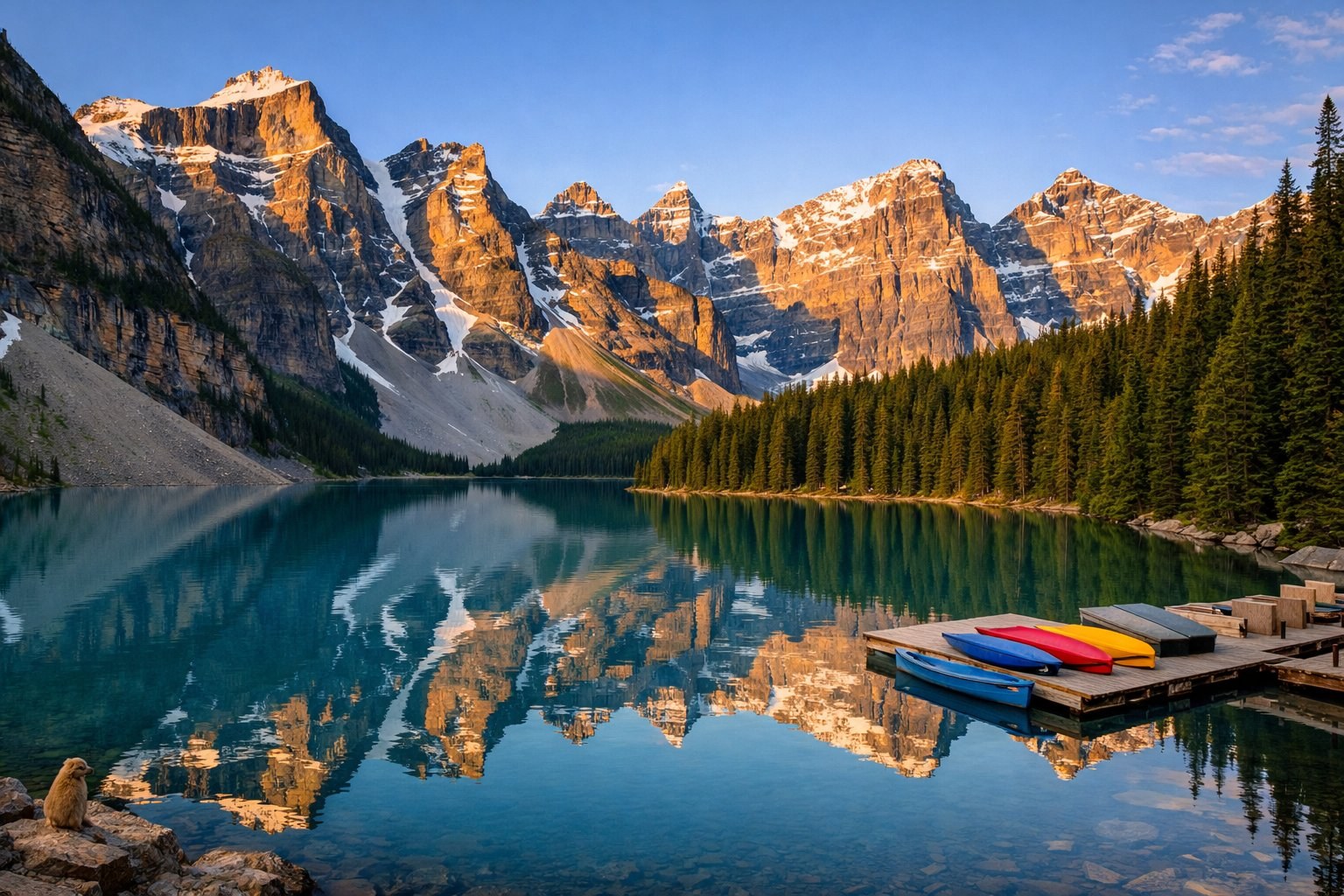
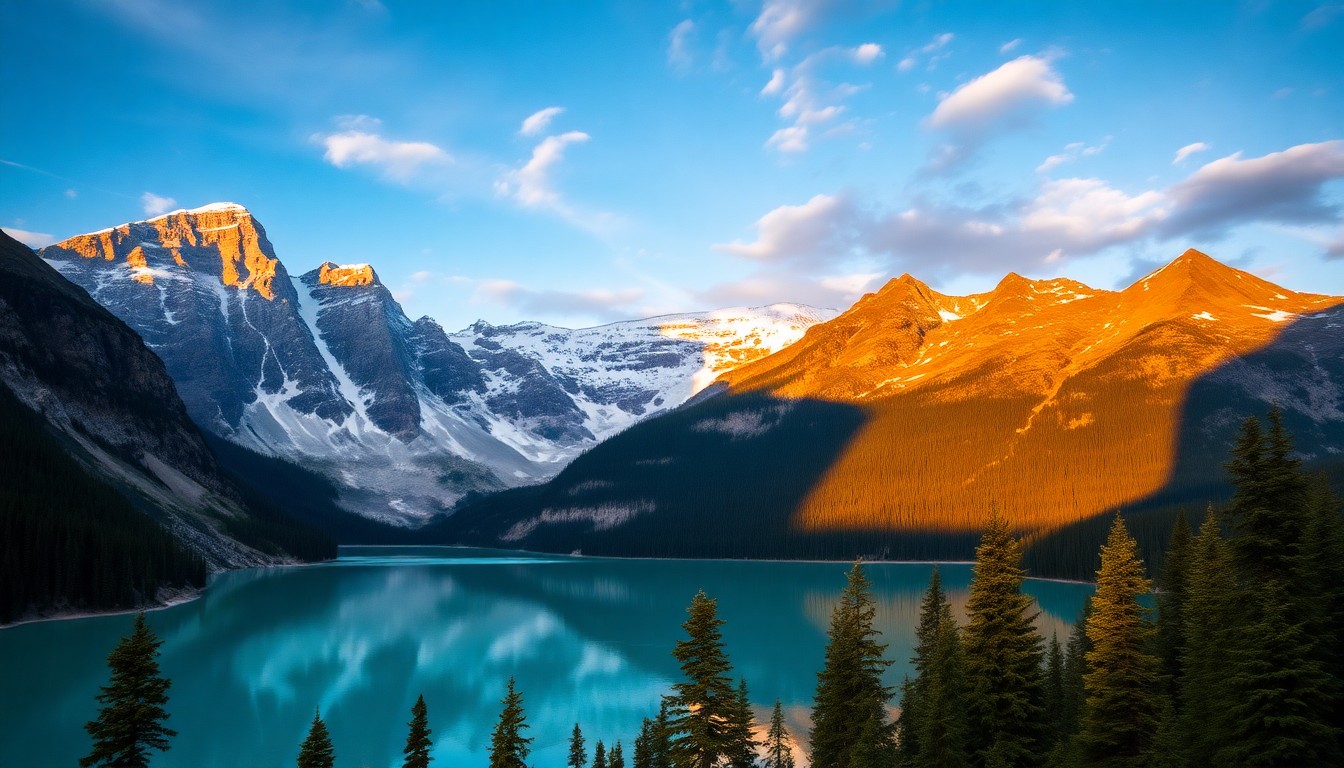
Moraine Lake at Sunrise
The Valley of Ten Peaks glows golden as dawn breaks over turquoise glacial waters — Banff National Park at its most magnificent
📜 History
Indigenous Peoples: For at least 15,000 years, diverse First Nations, Inuit, and Métis peoples inhabited this land — from the Pacific Northwest's totem-carving cultures to the Arctic's Inuit hunters.
European Contact: Vikings reached Newfoundland around 1000 CE. John Cabot claimed the east coast for England in 1497; Jacques Cartier explored the St. Lawrence for France in 1534.
New France & British Conquest: France established Québec City in 1608. The British conquered New France in 1760, creating the cultural duality that defines Canada today.
Confederation (1867): Four provinces united as the Dominion of Canada. The Canadian Pacific Railway connected the nation coast-to-coast by 1885.
Modern Canada: Today's Canada grapples with reconciliation with Indigenous peoples while building one of the world's most diverse societies.
🗺️ Geography
Canada spans six time zones. The landscape encompasses virtually every terrain: Atlantic fishing villages, the Canadian Shield's countless lakes, the prairies' endless wheat fields, the Rocky Mountain barrier, BC's coastal rainforests, and the Arctic tundra.
The country contains more lakes than the rest of the world combined — roughly 62% of the planet's lakes. The world's longest coastline (202,080 km) touches three oceans: Atlantic, Pacific and Arctic. Canada is a federation of 10 provinces and 3 territories; the highest point is Mount Logan (5,959 m) in the Yukon, and the population — estimated at 41,417,056 on 1 April 2026 by Statistics Canada — is concentrated in a thin ribbon within 160 km of the US border.
🗺️ Map
Key destinations marked below — the seven featured cities and regions plus the hidden gems from Section 24. Canada is a US State Department Level 1 country; no zone carries a heightened advisory.
🎭 People & Culture
Canada pioneered official multiculturalism in 1971. Toronto is one of the world's most diverse cities; Vancouver has one of the largest Chinatowns in North America; Montreal blends French sophistication with North American energy.
The country is officially bilingual. Hockey is the national passion. Canadians are stereotypically polite, and the stereotype holds.
🏙️ Toronto
Canada's largest city (6+ million metro) is North America's most multicultural metropolis. The CN Tower dominates the skyline; distinct neighborhoods offer the world's cuisines: Chinatown, Little Italy, Greektown, Koreatown, Little India.
The Distillery District, Kensington Market, and world-class museums make Toronto endlessly explorable.
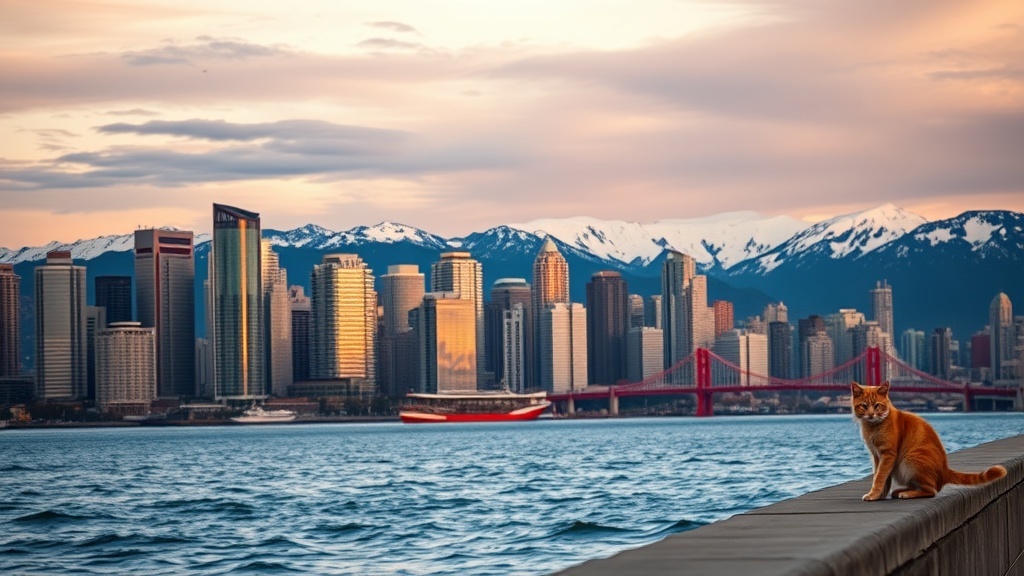
Vancouver from the Water
Glass towers, the North Shore mountains and Stanley Park's seawall — the only major city where you can ski before lunch and sail after it
🌲 Vancouver
Consistently ranked among the world's most livable cities, Vancouver combines ocean, mountains, and urban sophistication. You can ski in the morning and sail in the afternoon.
Stanley Park's 1,000 acres include the famous seawall and totem poles. Granville Island offers markets and galleries.
🗼 Montréal
Canada's French-speaking metropolis feels like Paris transported to North America. Old Montreal preserves 17th-century cobblestone atmosphere beneath the towering Notre-Dame Basilica.
The festival calendar is legendary: Jazz Festival, Just for Laughs, Osheaga.
🏔️ Banff & the Rockies
Banff National Park — Canada's first (1885) — showcases the Canadian Rockies at their most spectacular. Lake Louise and Moraine Lake are iconic turquoise jewels.
The Icefields Parkway is one of the world's most scenic drives. Wildlife includes grizzly bears, wolves, elk, and moose.
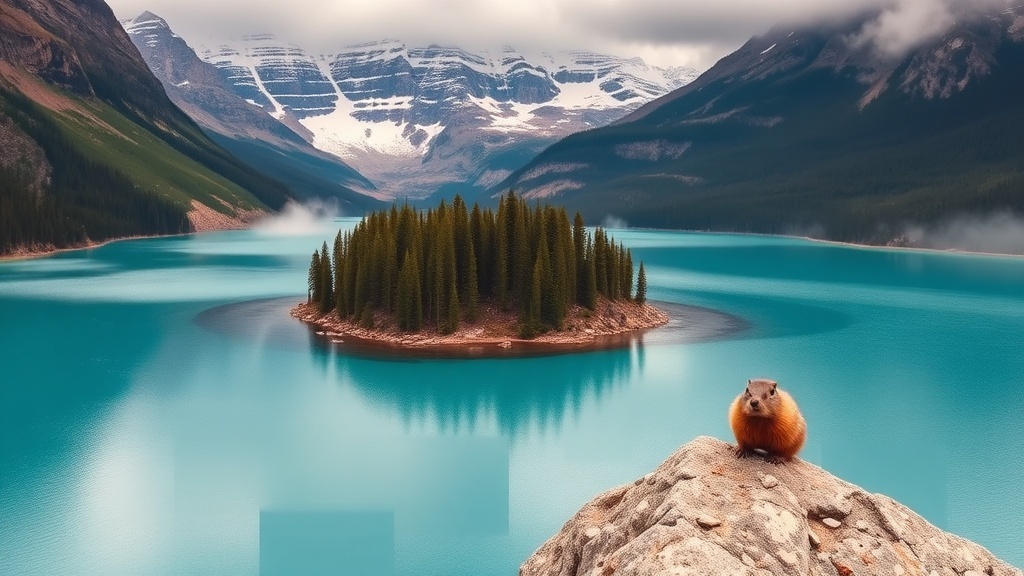
Spirit Island, Maligne Lake
Jasper National Park's most photographed view — a glacial islet reachable only by boat, sacred to the Stoney Nakoda
💦 Niagara Falls
The most powerful waterfall in North America — the Canadian side offers the best views. Horseshoe Falls drops 57 meters. The Niagara region has become Canada's premier wine country.
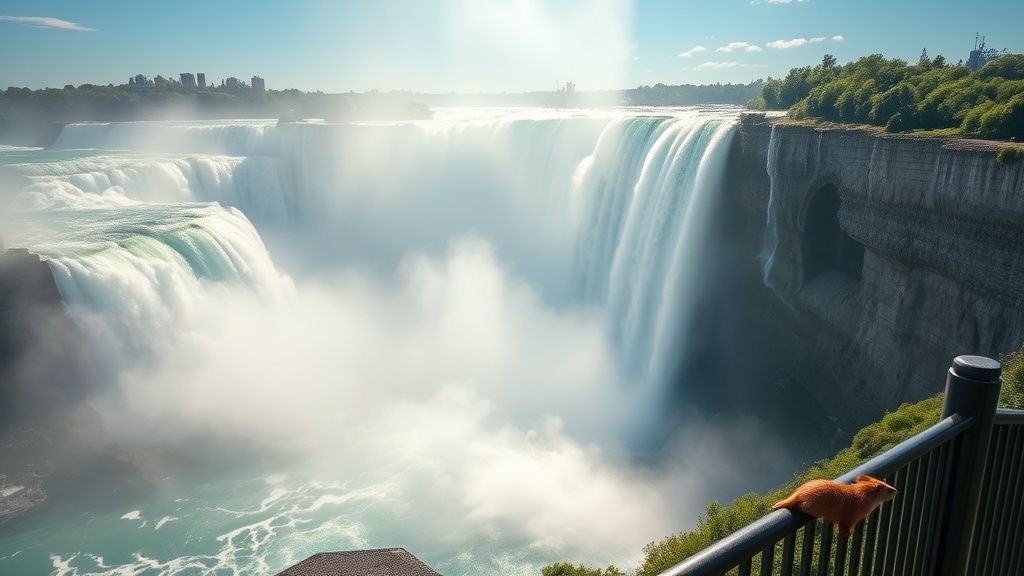
Horseshoe Falls
2,800 cubic metres of water per second drop 57 metres — the Canadian side gets the view, and always has
🏰 Québec City
North America's only walled city north of Mexico. The Château Frontenac dominates like a fairy-tale castle. A UNESCO World Heritage treasure.
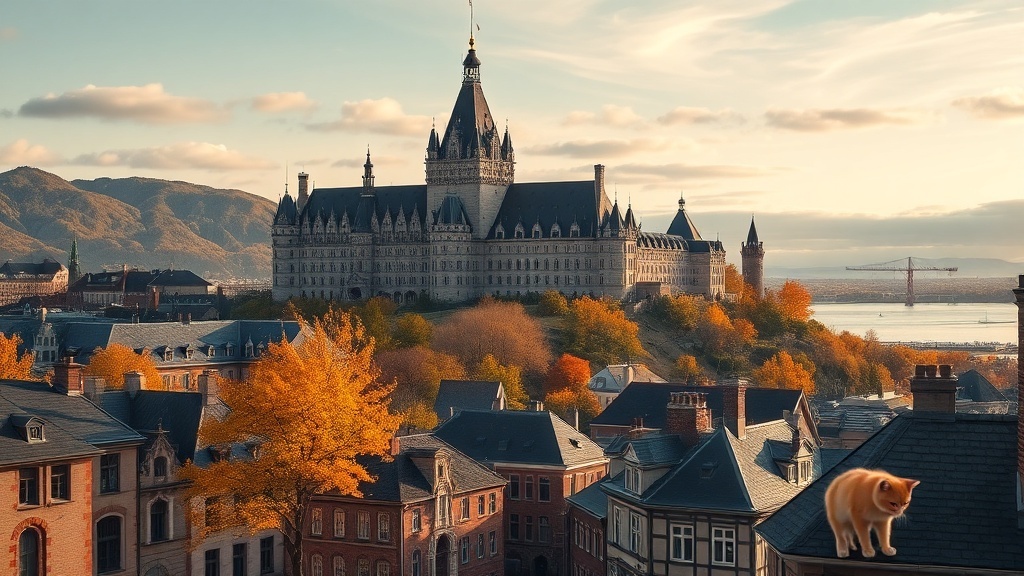
Old Québec in Winter
Château Frontenac above the frozen St. Lawrence — the only walled city north of Mexico, founded 1608 and UNESCO-listed since 1985
🏛️ Ottawa
Canada's capital features Parliament Hill's Gothic Revival buildings and the Rideau Canal — the world's largest skating rink in winter.
🥘 Cuisine
Poutine — fries, cheese curds, and gravy — is the national dish. Maple syrup is liquid gold. Montreal bagels and smoked meat are pilgrimage-worthy. Atlantic lobster rolls and West Coast wild salmon showcase regional excellence.
Poutine
Fries, Gravy, Cheese
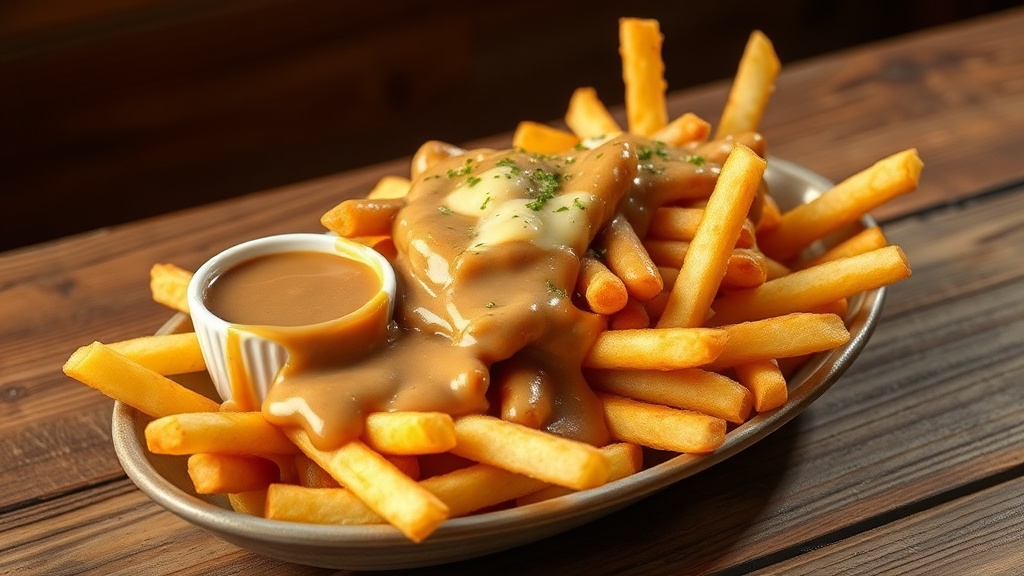
Quebec's gift to the world—fries smothered in gravy and cheese curds. This recipe serves two.
Ingredients: 3 potatoes for fries, 240ml (1 cup) beef gravy, 240ml (1 cup) cheese curds, Oil for frying, Salt.
Preparation: Cut potatoes, double fry. Then make rich beef gravy. Place hot fries in bowl. Add cheese curds. Then pour hot gravy over. Last, serve immediately.
💡 Cheese curds must squeak—use fresh ones.
Maple Pancakes
Canadian Breakfast
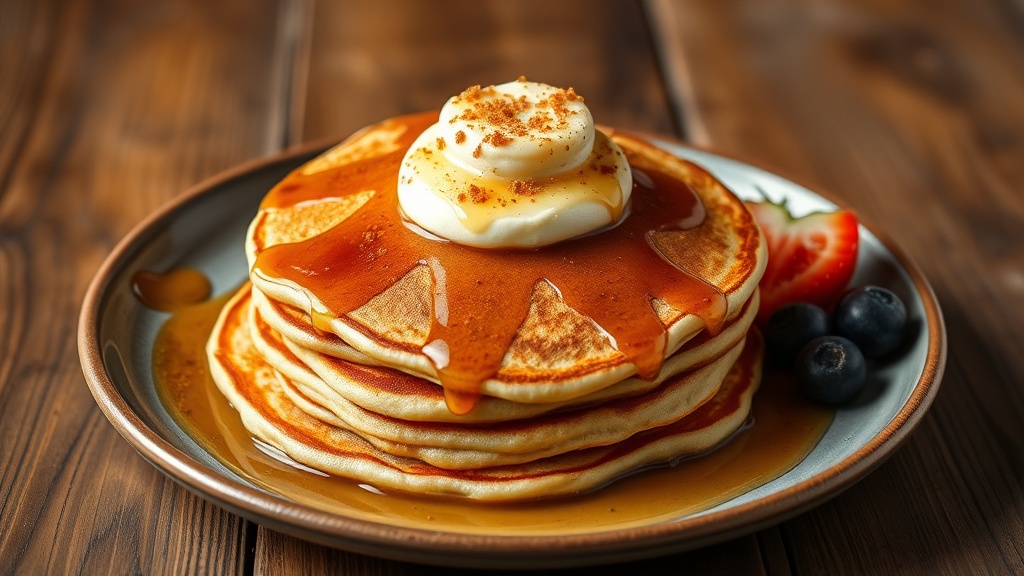
Fluffy buttermilk pancakes drowned in real maple syrup. This recipe serves two.
Ingredients: 240ml (1 cup) flour, 240ml (1 cup) buttermilk, 1 egg, 15ml (1 tbsp) sugar, 5ml (1 tsp) baking powder, Real maple syrup, Butter.
Preparation: Mix dry ingredients. After that, add buttermilk and egg. Don't overmix—lumps are fine. Then cook on buttered griddle. Flip when bubbles form. Stack and drench in maple syrup.
💡 Only real maple syrup—never imitation.
Butter Tarts
Canadian Sweet
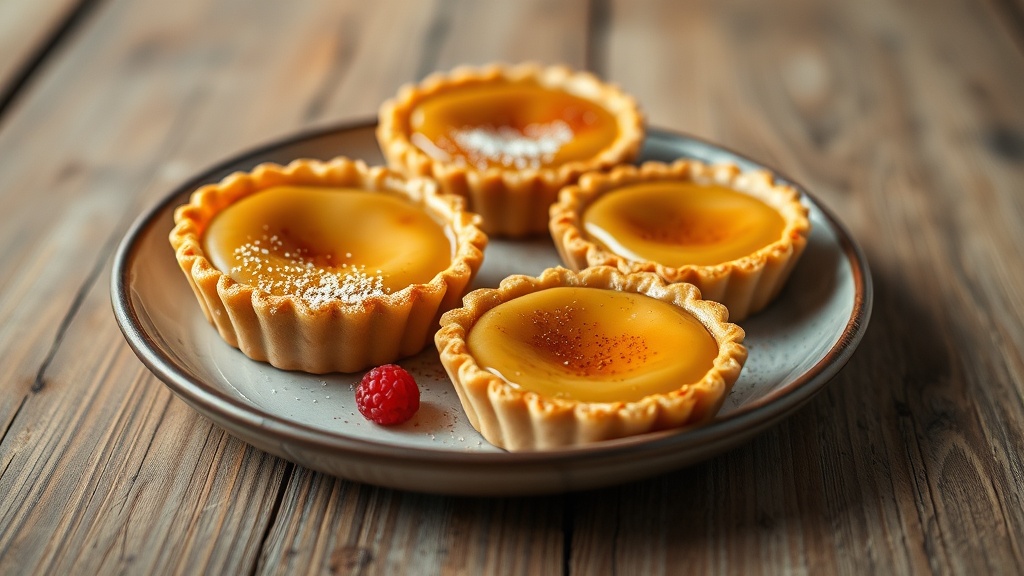
Gooey butter, sugar, and egg filling in flaky pastry. This recipe serves two.
Ingredients: Pastry for 12 tarts, 120ml (½ cup) butter, 240ml (1 cup) brown sugar, 2 eggs, 5ml (1 tsp) vanilla, Raisins or pecans (optional).
Preparation: Line tart tins with pastry. Cream butter and sugar. Add eggs, vanilla. Then add raisins if using. Fill tarts 2/3 full. To finish, bake 190°C (374°F) for 15 min.
💡 Center should still jiggle when done—it sets as it cools.
🏛️ UNESCO World Heritage Sites
Canada has 22 inscribed UNESCO World Heritage Sites — 10 cultural, 11 natural and 1 mixed — across seven provinces and two territories, plus 10 properties on the Tentative List. Canada ratified the Convention in 1976; the first two sites were inscribed in 1978 and the most recent, Anticosti and Trʼondëk-Klondike, in 2023.
L'Anse aux Meadows
1978 · NL
The only authenticated Norse settlement in North America — Leif Erikson's Vinland, c. 1000 CE.
Nahanni National Park Reserve
1978 · NT
South Nahanni River, Virginia Falls (twice the height of Niagara) and vast karst canyons.
Dinosaur Provincial Park
1979 · AB
Badlands that have yielded more than 50 dinosaur species from the Late Cretaceous.
Kluane / Wrangell–St. Elias / Glacier Bay / Tatshenshini-Alsek
1979 · YT/BC
The largest non-polar icefield on Earth, shared with Alaska.
Head-Smashed-In Buffalo Jump
1981 · AB
A 6,000-year-old Blackfoot bison-hunting cliff near Fort Macleod.
SG̱ang Gwaay
1981 · BC
Haida mortuary poles standing in the rainforest of Haida Gwaii.
Wood Buffalo National Park
1983 · AB/NT
Canada's largest park — wild wood bison and the only natural whooping crane nesting ground.
Canadian Rocky Mountain Parks
1984 · AB/BC
Banff, Jasper, Kootenay and Yoho plus Mount Robson, Mount Assiniboine and Hamber.
Historic District of Old Québec
1985 · QC
The only walled city north of Mexico, founded 1608.
Gros Morne National Park
1987 · NL
The Tablelands expose the Earth's mantle — field evidence for plate tectonics.
Waterton Glacier International Peace Park
1995 · AB
The world's first International Peace Park, shared with Montana.
Old Town Lunenburg
1995 · NS
The best surviving example of a planned British colonial settlement in North America.
Miguasha National Park
1999 · QC
Devonian fossil cliffs — the 'Age of Fishes' and the fish-to-tetrapod transition.
Rideau Canal
2007 · ON
202 km of 1832 military canal; the Ottawa stretch freezes into the world's largest skating rink.
Joggins Fossil Cliffs
2008 · NS
Bay of Fundy sea cliffs preserving a Carboniferous coal-age forest in situ.
Landscape of Grand Pré
2012 · NS
Acadian dyked farmland reclaimed from the world's highest tides.
Red Bay Basque Whaling Station
2013 · NL
A 16th-century Basque whaling port on the Strait of Belle Isle.
Mistaken Point
2016 · NL
The oldest known assemblage of large complex multicellular life, 580–560 million years old.
Pimachiowin Aki
2018 · MB/ON
'The Land That Gives Life' — Anishinaabe boreal forest; Canada's only mixed cultural-natural site.
Writing-on-Stone / Áísínaiʼpi
2019 · AB
The greatest concentration of Blackfoot rock art on the North American Great Plains.
Trʼondëk-Klondike
2023 · YT
Trʼondëk Hwëchʼin sites documenting the Klondike Gold Rush and its Indigenous impact.
Anticosti
2023 · QC
1,440 fossil species recording the Ordovician–Silurian mass extinction, 444 million years ago.
Deep dive: the dedicated Canada UNESCO guide.
🍷 Wine, Spirits & Drinking Culture
Canada is one of the world's most underrated wine countries — and the undisputed global champion of ice wine. The Okanagan Valley in British Columbia and the Niagara Peninsula in Ontario produce wines that regularly astonish international critics, while Canadian craft beer and whisky have exploded in quality and diversity. The country's drinking culture is shaped by its climate (long winters demand warming spirits), its immigration (every cuisine and drinking tradition on Earth is represented), and its sheer geographic scale.
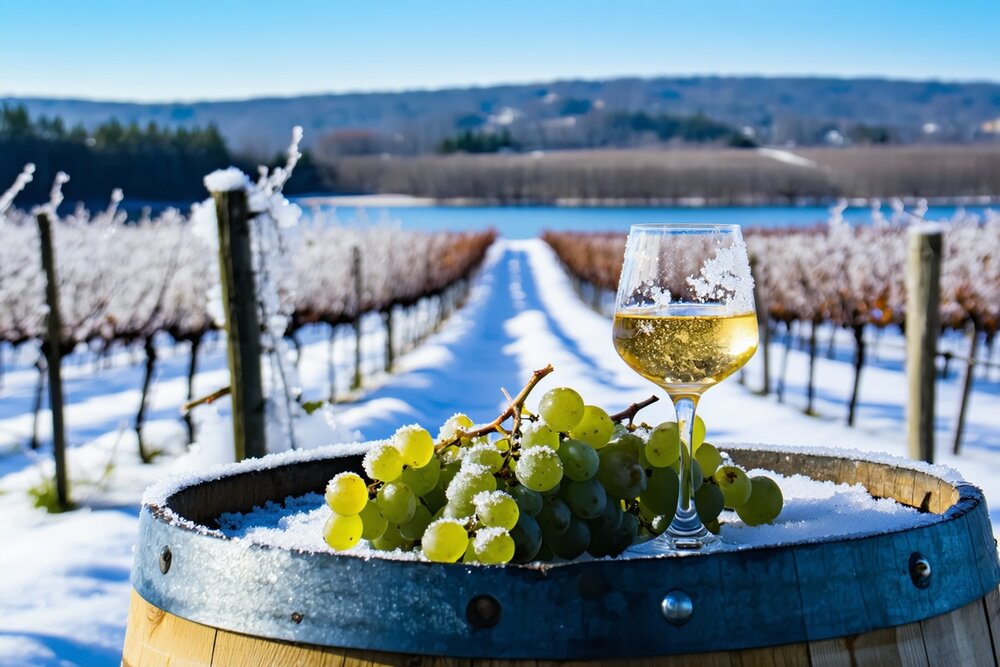
❄️ Ice Wine — Canada's Liquid Gold
Ice wine (Eiswein) is Canada's signature contribution to the wine world — made from grapes left on the vine until deep winter, when temperatures drop to -8°C or below, naturally freezing the water content and concentrating the sugars to extraordinary intensity. The grapes are hand-picked and pressed while still frozen, often at 3am in subzero conditions. The result is a viscous, amber nectar of extreme sweetness balanced by electric acidity — apricot, mango, honey, caramelised citrus. Inniskillin in Niagara-on-the-Lake launched the category when their 1989 Vidal Ice Wine won the Grand Prix d'Honneur at Vinexpo Bordeaux in 1991, stunning the French wine establishment. Today, Canada produces more ice wine than any other country — a half-bottle costs $40-80 and represents one of wine's most extraordinary experiences.
🍇 The Wine Regions
Niagara Peninsula (Ontario) — Canada's largest wine region, benefiting from the moderating influence of Lake Ontario. Riesling is king here: dry, steely, mineral, rivalling Mosel and Alsace. Tawse, Pearl Morissette, and Bachelder are producing low-intervention wines of genuine excitement, and neighbouring Prince Edward County has become Ontario's second serious Pinot Noir and Chardonnay region. Chardonnay and Pinot Noir for traditional-method sparkling are increasingly impressive.
Okanagan Valley (British Columbia) — a stunning desert lake valley producing Canada's boldest reds. Osoyoos Larose (founded as a Bordeaux joint venture and wholly owned by Groupe Taillan since 2013) makes Meritage blends that compare with mid-range Bordeaux. CheckMate, Painted Rock, and Mission Hill are benchmark producers. The Black Sage Bench and Golden Mile sub-regions are producing Syrah and Cabernet Franc of real distinction.
🥃 Canadian Whisky & Craft Beer
Canadian whisky has a reputation for blandness (Crown Royal, Canadian Club) that obscures a new generation of exceptional distillers. Lot No. 40 (100% rye, spicy and complex) and JP Wiser's 18 Year are revelations. The craft distilling explosion has produced gems like Shelter Point (BC) and Glenora (Nova Scotia — Canada's first single malt distillery, established 1990, using Cape Breton barley and Scottish techniques).
Canada's craft beer scene is world-class — Dieu du Ciel! in Montreal, Bellwoods in Toronto, Four Winds in BC, and hundreds more produce innovative ales that rival anything from the US or Belgium.
🏆 Kaufmann Wine Score — Canada
Rated on four criteria: Aroma (/25), Taste (/30), Finish (/20), Value (/25) — Total /100
| Wine | 🔴 Aroma | 🟡 Taste | 🟢 Finish | 🔵 Value | Total |
|---|---|---|---|---|---|
| 🥂 Ice Wine (Vidal/Riesling) | 24 | 28 | 18 | 22 | 92 |
| 🥂 Riesling (Niagara) | 22 | 25 | 16 | 24 | 87 |
| 🍷 Meritage (Okanagan) | 21 | 24 | 15 | 24 | 84 |
| 🥂 Chardonnay (Niagara, Tawse) | 22 | 26 | 17 | 21 | 86 |
| 🍷 Syrah (Black Sage Bench, Okanagan) | 21 | 25 | 16 | 22 | 84 |
| 🥂 Traditional-method sparkling (Benjamin Bridge, NS) | 22 | 25 | 16 | 22 | 85 |
95–100 Legendary · 90–94 Outstanding · 85–89 Very Good · 80–84 Good · 75–79 Average · <75 Below Average
🍷 Wine Note
Canadian ice wine at 92 is a statement of liquid perfection — Inniskillin Vidal or Riesling Ice Wine is one of the wine world's most extraordinary experiences, and the fact that it's made by hand-picking frozen grapes at 3am in -10°C Canadian winter adds a heroism to the production that no other wine can match. But what excites me most about Canada right now is the natural wine movement in Niagara — Pearl Morissette and Bachelder are making wines that would be celebrated in Burgundy or the Jura. And the Okanagan is Canada's Napa: dramatic lake scenery, bold reds, tasting rooms with views that make you forget you're not in California. At $20-30 for a serious bottle, Canadian wine is absurdly underpriced for its quality.
🍸 Cocktails & Mixed Drinks
Canada invented one of the world's great brunch cocktails and quietly supplies the rye that underpins half the classic American canon. Three to make at home:
🥫 The Caesar
Canada's national cocktail — invented by Walter Chell in Calgary, 1969
Ingredients: 45 ml vodka · 120 ml Clamato (clam-tomato juice) · 4 dashes Worcestershire · 3 dashes Tabasco · squeeze of lime · celery salt for the rim · pickled bean, celery stalk and lime wedge to garnish.
Method: Rim a highball with lime and celery salt. Fill with ice, add vodka, then Clamato, Worcestershire and Tabasco. Roll gently between two glasses rather than shaking. Garnish extravagantly — Canadians treat the garnish as a competitive sport.
💡 Clamato, not plain tomato juice. Substituting makes a Bloody Mary, and Canadians will notice.
🥃 The Toronto
A rye Old Fashioned with Fernet — first printed in the 1920s
Ingredients: 60 ml Canadian rye (Lot No. 40 is ideal) · 7 ml Fernet-Branca · 5 ml simple syrup · 2 dashes Angostura · orange twist.
Method: Stir all ingredients with ice for 30 seconds until properly chilled and diluted. Strain into a chilled coupe or over a single large rock. Express an orange twist over the surface and drop it in.
💡 The Fernet is a whisper, not a statement — measure it.
🍁 Maple Old Fashioned
Québec sugar-shack logic in a glass
Ingredients: 60 ml Canadian whisky · 10 ml pure dark maple syrup (Grade A, Very Dark) · 2 dashes Angostura · 1 dash orange bitters · orange peel.
Method: Combine whisky, maple syrup and both bitters in a mixing glass. Stir with ice until the syrup fully integrates — maple is thicker than sugar syrup and needs about 40 seconds. Strain over a large cube, garnish with orange peel.
💡 Dark amber syrup carries far more character than the pale breakfast grade. For a nightcap, swap in Sortilège, the Québec maple whisky liqueur, and skip the syrup.
More on Canadian drinking culture: the Canada wine & spirits guide.
🌡️ Climate & Best Time
Canada spans everything from BC's mild coastal rainforest to High Arctic desert. Vancouver rarely freezes and rarely exceeds 25 °C; Winnipeg and Ottawa routinely hit −30 °C in January; Toronto and Montréal are humid and genuinely hot in July. Interior summers are short, intense and increasingly smoky — wildfire season now runs May through September across the Prairies, BC and the boreal north, and air-quality alerts can reach as far east as the Maritimes.
Best time by purpose: late June–August for the Rockies, national parks and coastal Atlantic; mid-September–mid-October for New England-grade fall colour in Québec and Ontario; December–March for Whistler, Banff and Mont-Tremblant skiing and for the Rideau Canal skateway; February–March for Québec's sugar shacks; late August–April for northern lights in Yellowknife and Whitehorse.
What surprises visitors: Moraine Lake road is closed to private vehicles year-round (shuttle or bus only), and many Rockies lakes stay frozen until early June — the famous turquoise only appears once glacial melt begins.
✈️ Getting There
Main gateways: Toronto Pearson (YYZ), Vancouver (YVR), Montréal-Trudeau (YUL), Calgary (YYC), Ottawa (YOW), Halifax (YHZ), Edmonton (YEG). Air Canada and WestJet dominate; Porter has grown into a credible third national carrier.
Entry — US citizens: a valid US passport is all you need. Americans are exempt from the eTA whether arriving by air, land or sea, and may stay up to 180 days without a visa. At land and sea crossings a passport card, NEXUS card or enhanced driver's licence also works — a standard driver's licence alone does not.
Entry — everyone else: most visa-exempt nationals (EU, UK, Australia, Japan, and others) need an eTA — CAD $7, applied for online, valid five years, usually approved within minutes. Citizens of countries not on the visa-exempt list need a Temporary Resident Visa. Check your own status on the IRCC site before booking; the list changes.
Overland from the US: 119 land crossings. The busiest — Peace Arch (BC/WA), Windsor-Detroit, Buffalo-Niagara, Lacolle (QC/NY) — can queue for over an hour on summer weekends. Bring documentation for any prescription medication, declare all food, and be aware that a past DUI conviction can render an American inadmissible to Canada.
Getting around: Canada is enormous — Toronto to Vancouver is 4,400 km and a 4.5-hour flight. VIA Rail's Canadian covers that route in four days and is a destination in itself, not a transport option. Domestic flying is expensive; book early.
📋 Practical Information
Currency: Canadian dollar (CAD, $). Cards are accepted essentially everywhere including taxis, food trucks and parking meters; tap-to-pay is universal. Cash is close to optional. Canada eliminated the penny in 2013 — cash totals round to the nearest five cents.
Languages: English and French are both official. In Québec, French is not a courtesy but the working language — the province's language law (Bill 96) governs signage and public services. Outside Québec and New Brunswick (Canada's only officially bilingual province), English dominates. A greeting attempted in French will always be received well.
Health: Excellent care, but visitors are not covered by Canadian medicare — an uninsured ER visit can run into thousands of dollars. Travel insurance is essential. Pharmacies are widespread; no vaccinations required.
Tipping: 15–20% in restaurants and bars, $2–5 per bag for porters, 10–15% for taxis. Terminal prompts often default to 18–25%; the lower end is entirely normal.
Tax: Sales tax is added at the till, not shown on the shelf price — 5% GST federally, plus provincial tax bringing the total to 5% (AB) up to 15% (Maritimes).
Electricity: 120 V, 60 Hz, US-style plugs (Type A/B). Emergency: 911 nationwide. Cannabis: legal for adults nationally, but never take it across the border in either direction — that remains a federal crime.
Connectivity: Canadian mobile data is among the world's most expensive. A local eSIM or a US roaming add-on will nearly always beat a Canadian tourist SIM.
🏛️ Government & Politics
Canada is a federal parliamentary democracy and constitutional monarchy. King Charles III is head of state, represented in Canada by the Governor General — since 8 June 2026, Louise Arbour, the former Supreme Court justice and UN war-crimes prosecutor, who became the 31st governor general on the expiry of Mary Simon's term. Simon, appointed in 2021, was the first Indigenous person to hold the office.
Prime Minister Mark Carney (Liberal) has led the government since March 2025, when he won the Liberal leadership after Justin Trudeau's resignation, and confirmed the mandate at the general election weeks later. His minority became a majority in April 2026 when the Liberals swept three by-elections. Carney — former Governor of the Bank of Canada and of the Bank of England — is the first Canadian prime minister to arrive in office having never previously held elected office.
Parliament sits in Ottawa: an elected House of Commons and an appointed Senate. Power is genuinely decentralised — provinces control health, education, natural resources and, in Québec, immigration and language policy. Three territories (Yukon, Northwest Territories, Nunavut) hold devolved powers; Nunavut, created in 1999, is governed by consensus rather than party.
What dominates politics right now: the trade rupture with the United States. Washington imposed 50% tariffs on roughly $20 billion of Canadian goods on 22 August 2026 after talks collapsed; Carney announced retaliatory tariffs on US steel, dairy and electronics taking effect 8 September 2026, alongside a CAD $7.5 billion support package for affected workers. Economists estimate sustained 50% tariffs could cost around 90,000 Canadian jobs. Alongside this, Carney has pushed the largest clean-energy investment in North American history (announced 17 August 2026) and a broad "build Canadian" economic sovereignty agenda.
What this means for visitors: essentially nothing at the border — travel, entry rules and hospitality are unaffected. But the mood has shifted. A consumer boycott of American goods and travel has been running since 2025, "Buy Canadian" labels are everywhere, and Americans should expect the tariff dispute to come up in conversation. Canadians are, as ever, polite about it.
⚠️ Travel Advisory & Safety
🟢 US State Department: Level 1 — Exercise Normal Precautions
Reaffirmed 5 June 2026 with no change to level or risk indicators. Canada sits in the safest category the State Department issues, alongside Japan, Iceland and Switzerland. The UK FCDO and Australia's Smartraveller both advise normal precautions as well.
Canada is genuinely, boringly safe. Violent crime is rare and concentrated; the practical risks here are environmental, not criminal.
Wildlife. Grizzly and black bear country covers most of the west and north. Carry bear spray in the Rockies and know how to use it, make noise on trails, and never store food in a tent. Moose kill more people than bears do — almost always via vehicle collisions at dawn and dusk on northern highways.
Wildfire and smoke. Since 2023 wildfire seasons have repeatedly forced park closures and evacuations, including Jasper townsite in July 2024. Check Parks Canada alerts and provincial fire bans before any summer trip west or north, and expect air-quality advisories in July–August.
Cold. Prairie and northern winters reach −40 °C with wind chill, at which exposed skin freezes in under ten minutes. This is a real hazard, not a colourful statistic.
Remote driving. Cell coverage vanishes quickly outside the southern corridor. On the Dempster, Alaska and Trans-Labrador highways, carry a spare tyre, extra fuel and a satellite communicator.
Urban. Standard city sense in downtown Vancouver's Downtown Eastside, parts of Edmonton and Winnipeg. Vehicle break-ins at trailheads are the single most common crime affecting tourists — leave nothing visible in a parked car.
Emergency: 911. Search and rescue in the mountain parks is free; in some provinces backcountry rescue is not. Get travel medical insurance — visitors receive no coverage under Canadian medicare.
💰 Cost of Living & Budget
Canada is moderately expensive — cheaper than Switzerland or Norway, broadly comparable to the US once the exchange rate is applied, and noticeably better value for Americans and Europeans than for locals. All figures below are in Canadian dollars; as of mid-2026 the CAD has been trading weakly against the USD, which works in a visitor's favour.
| Item | Typical price (CAD) |
|---|---|
| Coffee (Tim Hortons / independent café) | $2.50 / $5 |
| Poutine, casse-croûte portion | $10–14 |
| Pub meal + pint | $30–40 |
| Mid-range dinner for two, with wine | $120–180 |
| City transit day pass | $11–14 |
| Petrol, per litre | $1.50–1.90 |
| Rental car, per day (summer, Calgary) | $80–140 |
| Parks Canada Discovery Pass (annual, adult) | $83.50 (2026) — admission free 19 Jun–7 Sep 2026 under the Canada Strong Pass |
| Half-bottle of Niagara ice wine | $40–80 |
| Hockey ticket (NHL, upper bowl) | $90–250 |
Daily budgets: backpacker $110–150 · mid-range $250–350 · comfortable $500+. Toronto and Vancouver run 25–35% above the national average; the Prairies and Atlantic Canada run below it.
Where the money actually goes: accommodation in Banff and Whistler in peak season, domestic flights, and alcohol — provincial liquor monopolies make wine and spirits markedly pricier than in the US. Groceries, national parks and public transit are all good value. Remember that sales tax is added at the till and tipping is expected: budget roughly 30% above menu prices.
🛏️ Accommodation
Cities. Toronto, Vancouver and Montréal have the full international range. Expect $250–400 for a good mid-range downtown room in summer, less in Montréal, less again in Ottawa, Halifax and Winnipeg. Montréal has the best boutique-hotel value in the country.
The Rockies. Banff and Lake Louise are the most expensive beds in Canada, and rooms for July and August genuinely sell out in January. The Fairmont properties — Banff Springs, Chateau Lake Louise, Jasper Park Lodge — are grand railway hotels worth a night for the architecture alone at $600–1,200. Canmore, twenty minutes outside the park gate, costs roughly half and has better restaurants. Parks Canada campgrounds ($30–45) open for reservation each January and the good ones vanish within minutes.
Historic hotels. The Château Frontenac in Québec City, the Empress in Victoria, the Château Laurier in Ottawa and Le Chantecler in the Laurentians are all Canadian Pacific-era landmarks. They are tourist attractions that happen to rent rooms.
Distinctively Canadian. Ontario and Québec chalets and lakeside cottages (the whole country decamps to "the cottage" in July); Québec's network of auberges; wilderness lodges in Haida Gwaii and the Yukon; Indigenous-owned tourism such as Talaysay in BC and the Wendake hotel-museum near Québec City; and yurts and oTENTiks in the national parks for soft camping.
Practical: hotel taxes add roughly 13–17% depending on province and municipal levy. Short-term rentals are tightly restricted in Vancouver, Toronto, Montréal and Québec City — book only registered listings.
Longer-stay and relocation detail: the Canada expat guide.
🎉 Festivals & Events
Carnaval de Québec · Jan–Feb
The world's largest winter carnival. Ice palace, night parades, canoe race across the frozen St. Lawrence, and Bonhomme presiding over all of it.
Sugar Shack season · Feb–Apr
Québec's cabanes à sucre open for maple-syrup harvest: communal meals of ham, beans, pea soup and tire sur la neige — hot syrup poured on snow and rolled onto a stick.
Calgary Stampede · July
Ten days of rodeo, chuckwagon racing and pancake breakfasts. "The Greatest Outdoor Show on Earth," and the entire city dresses the part.
Montréal International Jazz Festival · Jun–Jul
The largest jazz festival on earth — most of the downtown core closed to traffic, hundreds of free outdoor shows.
Just for Laughs · July
Montréal's comedy festival, the industry's most important showcase, running since 1983.
Osheaga & Festival d'été de Québec · Jul
Canada's two biggest music festivals — Parc Jean-Drapeau and the Plains of Abraham respectively.
Toronto International Film Festival · Sep
TIFF is one of the world's top-tier festivals and a reliable Oscar bellwether. The city becomes unrecognisable for ten days.
Niagara Icewine Festival · Jan
Three weekends of ice wine tastings across the Niagara Peninsula, outdoors, in the cold, as intended.
Canada Day · 1 July
Parliament Hill in Ottawa is the epicentre; every town holds something. Increasingly also a day of reflection on reconciliation.
National Indigenous Peoples Day · 21 June
Powwows, feasts and ceremony nationwide, on the summer solstice.
Celebration of Light · Jul–Aug
Vancouver's international fireworks competition over English Bay, watched by hundreds of thousands from the beaches.
Winterlude · Feb
Ottawa-Gatineau: ice sculpture, and skating the 7.8 km Rideau Canal Skateway when the ice cooperates — which, increasingly, it does not.
🎒 Packing Tips
Canada punishes people who pack for one climate. Even a single trip usually spans several.
Summer (Jun–Aug): layers, always. Rockies days hit 28 °C and drop below freezing at night. Bring a light down or synthetic jacket, a proper rain shell (the BC coast and Atlantic Canada are wet), hiking boots, and serious insect repellent with DEET or icaridin — blackflies and mosquitoes in June boreal forest are genuinely intolerable without it. Sunscreen: high-latitude sun plus snow or lake reflection burns faster than people expect. An N95 or KN95 mask is worth packing for wildfire smoke days.
Winter (Nov–Mar): this is the trip where inadequate gear ruins the holiday. Insulated waterproof boots rated to at least −25 °C, a proper parka (not a fashion coat), thermal base layers in merino or synthetic — never cotton — a hat that covers the ears, mittens rather than gloves, and hand warmers. Indoors is heated to 22 °C everywhere, so dress in removable layers or you will spend the day sweating.
Shoulder seasons: April and October are unpredictable in every province. Pack for two seasons and expect both.
Always: Type A/B plug adapter (120 V), reusable water bottle — tap water is excellent everywhere — a power bank for cold days (batteries drain fast below freezing), and polarised sunglasses. Bear spray cannot be flown in checked or carry-on baggage; buy it in Canmore, Banff or Canadian Tire on arrival.
Documents: passport, travel medical insurance, and printed prescriptions for any controlled medication. Leave cannabis at home — legal inside Canada, a federal offence to carry across the border in either direction.
🔗 Resources
🏛️ Official
travel.gc.ca — Canadian government travel advice
IRCC — eTA and visa requirements
CBSA — border and customs rules
🌲 Parks & Nature
Parks Canada — passes, campground reservations, alerts
Environment Canada — weather and air quality
Avalanche Canada — essential for winter backcountry
🧭 Tourism boards
Destination Canada · Travel Alberta · Destination BC · Bonjour Québec · Destination Ontario · Tourism Nova Scotia · Travel Yukon
🚆 Transport
VIA Rail — including The Canadian and The Ocean
Air Canada · WestJet · Porter · BC Ferries · Marine Atlantic
📰 News
CBC / Radio-Canada · The Globe and Mail · Toronto Star · La Presse · The Narwhal (environment) · APTN (Indigenous)
🍁 Indigenous tourism
Indigenous Tourism Association of Canada — the right starting point for Indigenous-owned and Indigenous-led experiences.
On this site: UNESCO guide · Wine & spirits · Food & drink · Business · Expats
📚 Recommended Reading
Fiction
Margaret Atwood — Surfacing, Alias Grace
Alice Munro — Dear Life (Nobel 2013, small-town Ontario)
Michael Ondaatje — In the Skin of a Lion (immigrant Toronto)
Thomas King — Green Grass, Running Water
Miriam Toews — A Complicated Kindness (Mennonite Manitoba)
Indigenous voices
Richard Wagamese — Indian Horse, Medicine Walk
Tanya Talaga — Seven Fallen Feathers
Michelle Good — Five Little Indians
Tomson Highway — Kiss of the Fur Queen
History & non-fiction
Pierre Berton — The National Dream & The Last Spike (the railway)
Charlotte Gray — Gold Diggers (the Klondike)
Ken McGoogan — Fatal Passage (Franklin and the Northwest Passage)
John Vaillant — The Golden Spruce and Fire Weather (Fort McMurray)
Québec
Gabrielle Roy — Bonheur d'occasion
Louise Penny — the Gamache novels, set in the Eastern Townships
Mordecai Richler — The Apprenticeship of Duddy Kravitz
🤓 Fascinating Facts
More lakes than everywhere else combined
Canada holds roughly 62% of the world's lakes — around two million of them, most unnamed.
Longest coastline on Earth
202,080 km, touching three oceans — more than four times that of the second-place country.
The world's longest border
8,891 km with the United States, undefended, and marked in places by nothing but a mown 6 m strip through the forest.
Basketball is Canadian
Invented in 1891 by James Naismith of Almonte, Ontario — at a YMCA in Springfield, Massachusetts, admittedly.
So is insulin, the pacemaker and IMAX
Plus the snowmobile, the Robertson screw, the Canadarm, standard time zones and the electric wheelchair.
Canada has a national UFO landing pad
Built in St. Paul, Alberta in 1967 as a centennial project. It remains officially open to visitors, terrestrial or otherwise.
The Hudson's Bay Company once ruled 15% of North America
Founded 1670 — older than Canada itself by 197 years. It finally collapsed in 2025.
Polar bear jail
Churchill, Manitoba operates a genuine holding facility for problem bears, which are later helicoptered north.
Canada has more doughnut shops per capita than any country
Tim Hortons alone runs over 4,000 locations and functions as national infrastructure.
The Trans-Canada Highway is 7,821 km long
One of the longest national highways on Earth, from St. John's to Victoria.
Canada produces 71% of the world's maple syrup
Almost all of it from Québec, which maintains a strategic reserve — genuinely called the Global Strategic Maple Syrup Reserve — that was robbed of $18 million of syrup in 2012.
Ice wine leadership
Canada makes more ice wine than any other country, including Germany and Austria, where the style originated.
🌟 Notable People
Terry Fox (1958–1981)
Ran 5,373 km across Canada on one leg during the Marathon of Hope before cancer stopped him at Thunder Bay. The most revered figure in the country by a wide margin.
Sir Frederick Banting (1891–1941)
Co-discovered insulin in Toronto in 1921 and sold the patent for one dollar so that no one would profit from it.
Margaret Atwood (b. 1939)
Twice Booker-winning novelist; The Handmaid's Tale and The Testaments.
Alice Munro (1931–2024)
Nobel laureate in Literature, 2013 — "master of the contemporary short story."
Leonard Cohen (1934–2016)
Montréal poet and songwriter. Hallelujah, Suzanne, Famous Blue Raincoat.
Glenn Gould (1932–1982)
The Toronto pianist whose 1955 Goldberg Variations changed how Bach is played.
Wayne Gretzky (b. 1961)
"The Great One." Holds 61 NHL records; scored more assists than anyone else has scored points.
Chris Hadfield (b. 1959)
Commander of the ISS, and the first person to record a music video in orbit.
Buffy Sainte-Marie (b. 1941)
Singer-songwriter and Oscar winner (1983) whose claimed Cree ancestry was disputed by a CBC investigation in 2023; her Order of Canada was terminated in January 2025.
Mark Carney (b. 1965)
Governor of the Bank of Canada, then of the Bank of England, then Prime Minister from March 2025.
Sandra Oh, Ryan Reynolds, Rachel McAdams, Keanu Reeves
A disproportionate share of Hollywood is quietly Canadian.
Drake, The Weeknd, Céline Dion, Joni Mitchell, Neil Young, Shania Twain
Toronto and Québec have exported an implausible amount of the last sixty years of popular music.
🏒 Sports
Hockey is not a sport in Canada so much as a shared civic language. Seven NHL franchises — Toronto, Montréal, Ottawa, Winnipeg, Calgary, Edmonton, Vancouver — and a national ache that no Canadian team has won the Stanley Cup since Montréal in 1993 (Edmonton lost the 2024 and 2025 finals to Florida; the 2026 Cup went to Carolina). Hockey Night in Canada has aired since 1952. Internationally, Canada won the 4 Nations Face-Off in February 2025 (3–2 in overtime over the USA, Connor McDavid scoring the winner), but at Milano Cortina 2026 both Olympic finals went the other way: the women lost 2–1 in overtime to the United States on 19 February and the men, with McDavid named tournament MVP, lost 2–1 in overtime to the same opponent on 22 February. Canada still left Italy with 21 medals (5 gold, 7 silver, 9 bronze). The women's national team and the USA share dominance of the world game, and the Professional Women's Hockey League, launched in 2024, has drawn crowds nobody predicted.
Football, the 2026 edition. Canada co-hosted the FIFA World Cup this summer with Mexico and the United States — Toronto's BMO Field and Vancouver's BC Place staged 13 matches between them, with Canada opening against Bosnia and Herzegovina in Toronto on 12 June. Under Jesse Marsch, Canada drew that opener 1–1 (Cyle Larin, 78th minute), then thrashed Qatar 6–0 in Vancouver on 18 June — Jonathan David hat-trick, the country's first World Cup win ever and the biggest by a Concacaf side — before losing 2–1 to Switzerland to finish second in Group B. In the round of 32 Stephen Eustáquio's stoppage-time goal beat South Africa 1–0, the first knockout victory in Canadian history; Morocco ended the run 3–0 in Houston on 4 July. For a nation that had never won a World Cup match before this summer (1986 and 2022: six defeats), it was transformative.
Curling is a genuine national obsession, the Brier and the Scotties drawing television audiences that baffle outsiders. Lacrosse is Canada's official national summer sport, hockey the winter one. Canadian football — the CFL, three downs, a wider field and the Grey Cup — predates the NFL. Basketball has surged since the Raptors' 2019 title, and Canada now produces more NBA players than any country outside the US.
Winter sport is where Canada punches hardest: Whistler, Banff, Mont-Tremblant and Le Massif for skiing; world-class Nordic and biathlon trails; and Canmore, Calgary and Whistler still running their Olympic legacy facilities from 1988 and 2010.
📰 Media & Press Freedom
Canada has a free and legally protected press, with expression guaranteed under section 2(b) of the Charter of Rights and Freedoms. Reporters Without Borders places Canada 20th of 180 countries in the 2026 World Press Freedom Index — up one place from 21st in 2025, though RSF has flagged the economic fragility of local journalism as the main driver.
The landscape. CBC/Radio-Canada is the public broadcaster in both official languages, and the only outlet with real reach into the North and into remote communities; its funding is perennially political. The Globe and Mail is the national paper of record, the Toronto Star the largest by circulation, La Presse the leading French-language title, and APTN — the Aboriginal Peoples Television Network — the world's first national Indigenous broadcaster.
The pressures. Local news has contracted severely: hundreds of community outlets have closed since 2008, creating documented news deserts across rural Canada. The Online News Act (2023) triggered Meta to block all news links on Facebook and Instagram for Canadian users — a block still in force — while Google negotiated a settlement instead. Ownership concentration is high by international standards, with Postmedia, Bell and Rogers controlling much of the private sector.
Worth reading: The Narwhal on environment and resource politics, The Walrus for long-form essays, Canadaland for media criticism, and The Tyee for British Columbia.
📸 Photo Gallery
Share your Canada photos! Send to photos@kaufmann.wtf to be featured.

✍️ Author's Note
I got to the Moraine Lake shuttle stop at 4:40 in the morning, in a queue of forty silent people in down jackets, and I remember thinking this was an absurd amount of effort for a photograph I had already seen ten thousand times. Then the sun came over the Wenkchemna Peaks and the water went that impossible mineral turquoise, and nobody in the queue said anything at all for about a minute. It is one of the few famous views on Earth that is not diminished by being famous.
What stays with me longer, though, is smaller. A casse-croûte in Trois-Rivières at eleven at night where the woman behind the counter switched to English for me, then switched back the moment she saw I was trying. The Dempster Highway, where the gravel goes on so long that the absence of other cars stops being unnerving and becomes the entire point. Standing on the granite at Peggy's Cove in horizontal Atlantic rain, thoroughly miserable, and understanding exactly why people live there. Canada is a country that does not perform for you. It simply continues, enormous and unbothered, and lets you decide how much of it you want. Come in winter at least once — the version of this country that most visitors never see is the one that made it.
"True North Strong and Free"
—Radim Kaufmann, 2026
Support This Project 🌍
This World Travel Factbook is a labor of love – free to use for all travelers. If you find it helpful, consider supporting its continued development.
