🇨🇩 Democratic Republic of the Congo at a Glance
🌏 Overview — Why Visit DR Congo
The Democratic Republic of the Congo is the second-largest country in Africa — roughly the size of Western Europe, or thirty times Czechia — and it contains more superlatives than almost anywhere on the continent. Over half of Africa's rainforest. The deepest river in the world. The world's largest lava lake. Around half the surviving mountain gorillas. Bonobos and okapi, which exist nowhere else. Five UNESCO World Heritage sites, all of them natural.
It is also, without any qualification, one of the hardest countries on Earth to travel in. Decades of conflict and misrule have left infrastructure in ruins, the east is at war — Goma and Bukavu have been held by the M23 rebel alliance since early 2025 — a Bundibugyo-strain Ebola epidemic declared a global health emergency in May 2026 is still running in Ituri, the bureaucracy is arduous, and costs for the few organised experiences are high. This page is not going to pretend otherwise, and no honest guide should.
What survives that reckoning is remarkable. Trekking mountain gorillas in Virunga — Africa's oldest national park — is done in smaller groups and at lower cost than in Rwanda, and the rangers who make it possible have paid for it in lives. Climbing Nyiragongo to sleep on the rim above a churning lake of lava is an experience with no equivalent anywhere. Kinshasa is the largest French-speaking city in the world and the beating heart of Congolese rumba, a music that reshaped a continent.
The practical advice is simple and non-negotiable: this is a country to visit through established operators and park authorities, with current security advice in hand, and with the flexibility to have plans change at short notice. Read the safety section before anything else on this page.
📛 Name & Identity — Congo, Zaire, DRC
This country has changed its name more often than almost any other. It has been the Congo Free State (1885–1908, the personal property of King Leopold II of Belgium), the Belgian Congo (1908–1960), the Republic of the Congo at independence, the Democratic Republic of the Congo from 1964, Zaire from 1971 to 1997 under Mobutu Sese Seko, and the Democratic Republic of the Congo again ever since.
It is not the same country as its neighbour across the river, the Republic of the Congo, whose capital is Brazzaville. Both are named for the Kongo Kingdom and for the river; the convention is to distinguish them by capital — Congo-Kinshasa (this country) and Congo-Brazzaville. In English, "the DRC" is the unambiguous shorthand.
Mobutu's authenticité campaign of the early 1970s renamed not just the country but the river (Zaire), the currency, the cities — Léopoldville became Kinshasa, Stanleyville became Kisangani, Elisabethville became Lubumbashi — and required citizens to drop Christian first names and abandon Western suits. Those city names stuck; the country's did not.
The demonym is Congolese, which is also the demonym for the country across the river — one more reason the capitals do the distinguishing work. The national motto is Justice, Paix, Travail.
🗺️ Geography & Regions
The DRC covers 2,345,409 km² and spans from a 37-kilometre sliver of Atlantic coastline in the far west to the Great Rift Valley in the east — roughly 2,000 kilometres across. It straddles the equator, which is why the seasons in the north and south of the country run opposite to each other.
The Congo Basin fills the centre: a vast, low, humid bowl of rainforest and swamp drained by the Congo and its tributaries, holding the second-largest tropical forest on Earth after the Amazon. It is one of the least densely populated large regions in the world and one of the most biologically important.
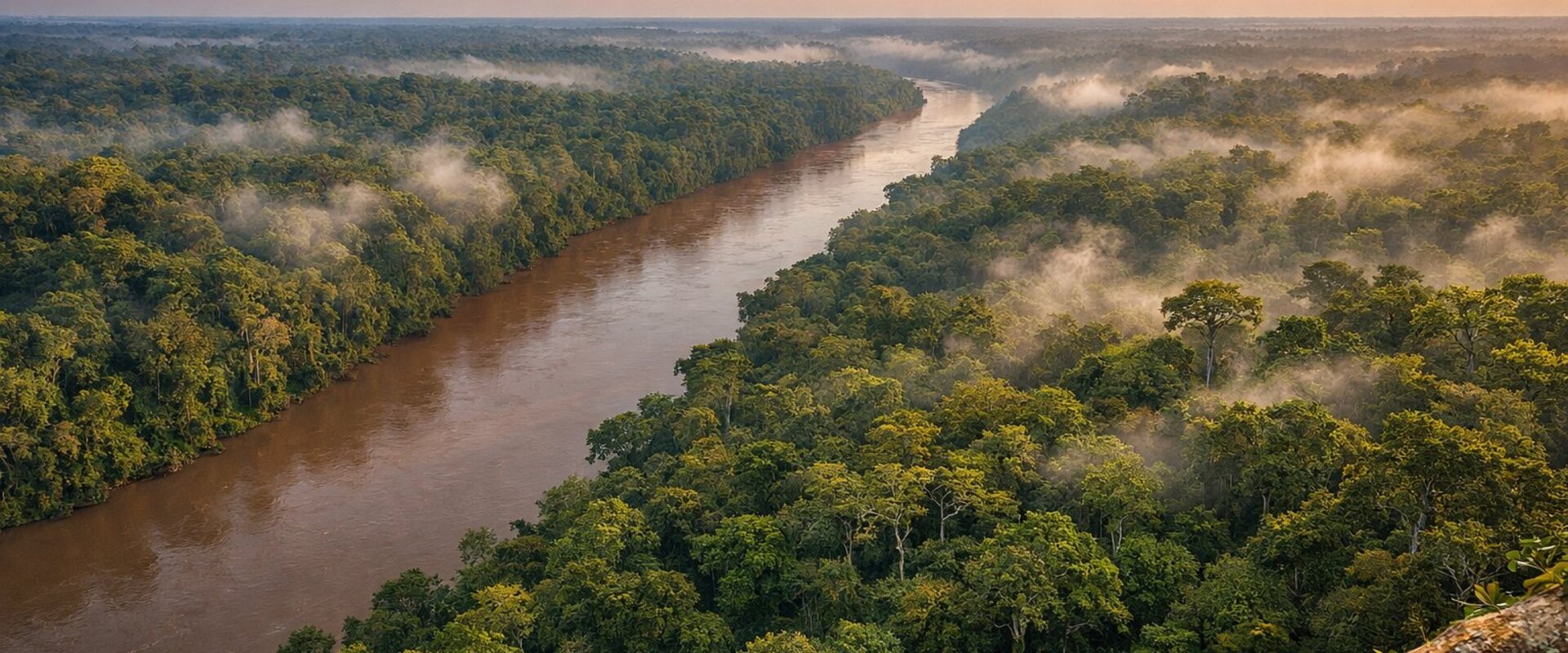
The eastern highlands along the Albertine Rift are a different country altogether: cool, mountainous, densely farmed and volcanic. The Virunga chain includes Nyiragongo (3,470 m) and Nyamuragira, two of Africa's most active volcanoes, and the Rwenzori Mountains — Ptolemy's "Mountains of the Moon" — reach 5,109 m at Margherita Peak, carrying glaciers directly on the equator, though those glaciers are now nearly gone.
The south-east, Katanga, is high savanna plateau and the mineral heartland: copper, cobalt, and the mining towns of Lubumbashi and Kolwezi. The Great Lakes — Tanganyika, Kivu, Albert, Edward — form much of the eastern border. Lake Tanganyika is the second-deepest lake in the world; Lake Kivu holds enormous dissolved volumes of methane and carbon dioxide, a hazard and a resource at once.
🗺️ Map of DR Congo
The DRC borders nine countries — more than any other African state: the Republic of the Congo, the Central African Republic, South Sudan, Uganda, Rwanda, Burundi, Tanzania (across Lake Tanganyika), Zambia and Angola.
There is no road network connecting the country to itself in any meaningful sense. Kinshasa in the west and Goma in the east are 1,600 km apart in a straight line and are, in practice, connected by air or by weeks on the river and then more. Visitors almost always treat the two halves as separate trips: Virunga and the east through Goma (usually via Kigali in Rwanda), Kinshasa and the river through N'djili airport.
📜 History
The kingdoms
Before Europeans arrived, the territory held sophisticated states: the Kingdom of Kongo on the lower river, the Luba and Lunda empires in the southern savanna, the Kuba kingdom famous for its textiles and sculpture, and the Mangbetu and Azande in the north-east. Copper, salt, ivory and raffia moved along trade networks that crossed the continent.
The Congo Free State (1885–1908)
The Berlin Conference of 1884–85 awarded the basin not to Belgium but to King Leopold II personally, as a private possession — a unique arrangement in colonial history. What followed was a rubber and ivory extraction regime enforced through hostage-taking, forced labour and mutilation, most infamously the severing of hands. Population loss is disputed and impossible to fix precisely; scholarly estimates of the decline over this period commonly range around several million and, at the higher end, up to ten million, from a combination of killing, starvation, exhaustion and introduced disease.
It became the first great international human-rights campaign. E. D. Morel and Roger Casement's documentation, along with the testimony of missionaries such as Alice Seeley Harris whose photographs circulated worldwide, forced Leopold to hand the territory to the Belgian state in 1908.
Belgian Congo and independence (1908–1965)
Belgian rule ended the worst of the atrocities and built railways, mines and mission schools, while maintaining rigid segregation and producing almost no Congolese graduates — at independence the country had a handful of university-educated citizens and no Congolese army officers. Independence came suddenly on 30 June 1960. Within weeks the army mutinied, Katanga seceded with Belgian backing, and Prime Minister Patrice Lumumba — the first democratically chosen leader — was deposed and, in January 1961, murdered with the complicity of Belgian officials and in a Cold War context in which the CIA had also sought his removal. A Belgian parliamentary commission formally acknowledged moral responsibility in 2002.
Mobutu and Zaire (1965–1997)
Mobutu Sese Seko seized power in 1965 and held it for thirty-two years, renaming the country Zaire and running it as a personal kleptocracy propped up by Western governments who valued his anti-communism. Infrastructure decayed, the currency collapsed, and an estimated several billion dollars left the country with him. His one gift to global memory is the "Rumble in the Jungle" — the Ali–Foreman fight staged in Kinshasa in October 1974, and the Zaire 74 music festival alongside it.
The Congo Wars and after
The Rwandan genocide of 1994 pushed perpetrators and refugees across the border and detonated the region. The First Congo War (1996–97) removed Mobutu and installed Laurent-Désiré Kabila; the Second Congo War (1998–2003) drew in nine African countries and dozens of armed groups and became the deadliest conflict since the Second World War, with excess deaths widely estimated in the millions, most from disease and hunger rather than combat. Laurent Kabila was assassinated in 2001 and succeeded by his son Joseph, who ruled until 2019, when Félix Tshisekedi took office in the country's first transfer of power between elected presidents. Tshisekedi was re-elected in December 2023 with around 73% of the vote in a poll the opposition rejected, and in April 2024 appointed Judith Suminwa Tuluka as the country's first woman prime minister. His second and constitutionally final term runs to 2028 — but a referendum law passed by parliament in June 2026 and upheld by the Constitutional Court in July 2026 opens a route to amending the constitution, and the opposition coalition C64 brought protesters onto the streets of Kinshasa, Lubumbashi and Uvira on 15 September 2026 against what it calls a third-term bid. Joseph Kabila, meanwhile, left the country, reappeared in rebel-held Goma in 2025, was tried in absentia and on 30 September 2025 was sentenced to death by a military court for treason and war crimes.
Much of the west and south has been broadly stable for years. The east — North and South Kivu and Ituri — has not. In January 2025 the Rwandan-backed AFC/M23 rebel alliance captured Goma, the capital of North Kivu, and in February 2025 took Bukavu; it has run a parallel administration over both cities and much of the Kivus ever since. A US-brokered DRC–Rwanda peace agreement was signed on 27 June 2025 and formalised as the Washington Accords at the White House on 4 December 2025, and a Doha Framework between Kinshasa and M23 followed on 15 November 2025 — but as of September 2026 M23 still holds Goma and Bukavu and is pushing further west into Masisi, some seven million Congolese are displaced, and key provisions of both deals are unimplemented. This is the single most important fact for any traveller to understand.
👥 People & Culture
Around 116 million people (UN mid-2026 estimate) live in the DRC, making it the most populous Francophone country in the world — there are more French speakers here than in France. The population is young: the median age is under twenty.
There are more than 200 ethnic groups and a comparable number of languages. The largest groupings are the Luba, Kongo, Mongo and the Mangbetu-Azande peoples of the north-east, alongside the Mbuti, Efe and Twa forest peoples of the Ituri and elsewhere, who face severe marginalisation. French is the language of state; four national languages divide the country regionally — Lingala in Kinshasa and along the river, Swahili in the east, Kikongo in the west and Tshiluba in the Kasai.
Congolese culture punches far above the country's circumstances, and does so deliberately. Music is the obvious case. So is fashion: the Sapeurs of Kinshasa, like their Brazzaville counterparts, treat impeccable tailoring as a discipline and a form of dignity. Congolese painting — from the Académie des Beaux-Arts and the popular painters of the Mobutu era such as Chéri Samba — has a substantial international presence, and Kinshasa's contemporary art and dance scene is one of Africa's strongest.
Religion is overwhelmingly Christian, Catholic and Protestant, with large independent churches — the Kimbanguist Church, founded here in 1921, has millions of members and is one of the largest African-initiated churches in the world. Family and church networks do a great deal of the work that the state does not, and the resulting hospitality towards strangers is genuine and often humbling.
🗣️ Language & Useful Phrases
French is the official language and works everywhere official — airports, hotels, park headquarters, police. English is genuinely useful only in Goma and around the eastern tourism operations, where proximity to Rwanda and Uganda has made it common. Everywhere else, French or nothing.
Day to day, the country runs on its four national languages. Lingala is Kinshasa's language and the language of rumba, so it carries far beyond its home region. Swahili is the language of the east, and if you are going to Virunga it is the more useful of the two.
Lingala (Kinshasa & the west)
Mbote — hello
Sango nini? — what's the news? · Sango te — all is well
Melesi / Matondi — thank you
Ntalo boni? — how much?
Kende malamu — go well
Swahili (the east)
Jambo / Habari — hello / how are you
Asante sana — thank you very much
Bei gani? — what price?
Pole pole — slowly, gently (the trekking word)
One word worth knowing in either language is ambiance — French, but thoroughly Congolese in use: the intangible quality of a good night out, and something Kinois take entirely seriously.
🦍 Virunga National Park & the Mountain Gorillas
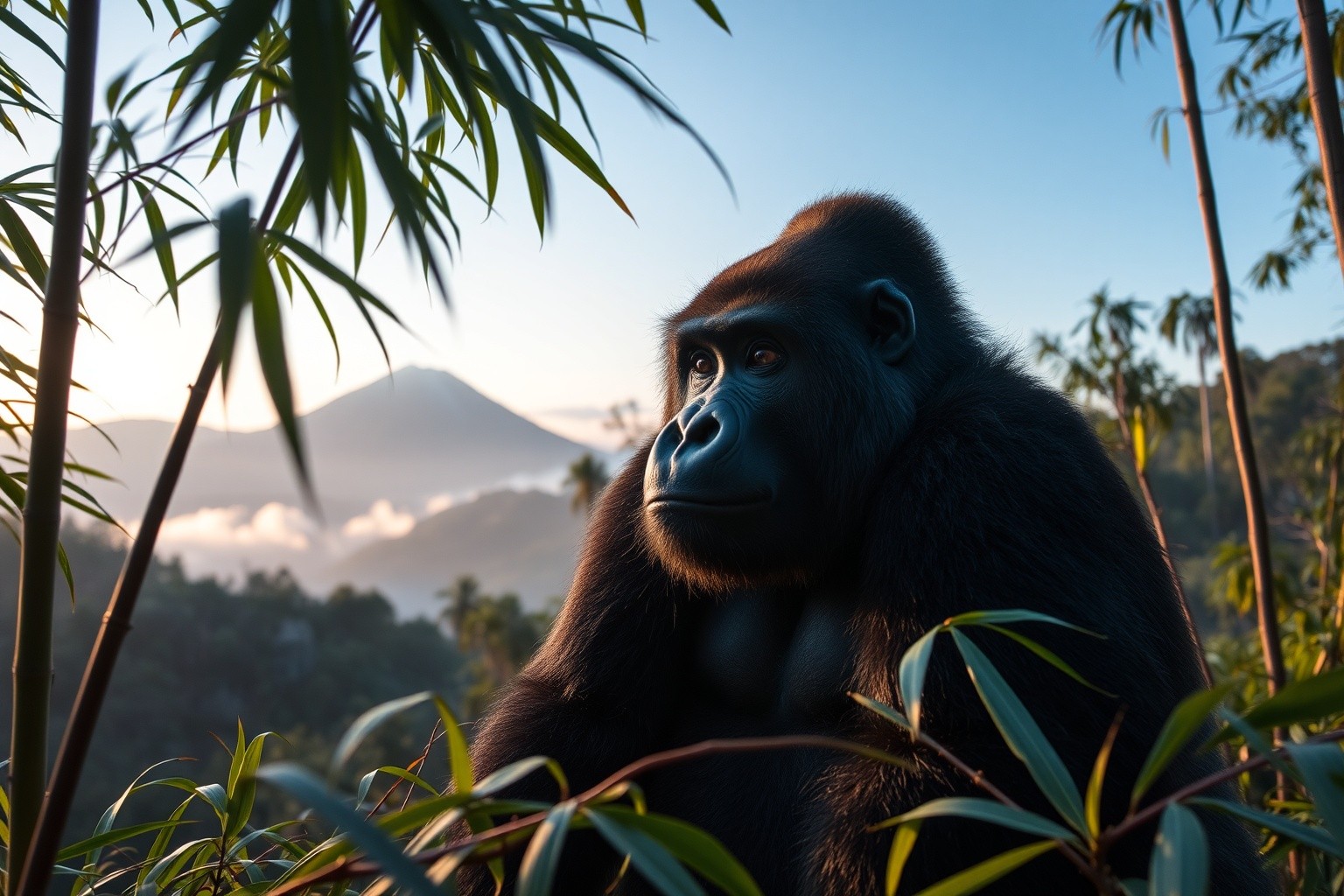
Virunga, founded in 1925 as Albert National Park, is the oldest national park in Africa and a UNESCO World Heritage Site. It runs 300 kilometres along the eastern border and packs in an absurd range: savanna, the Rwenzori glaciers, two active volcanoes, Lake Edward, lowland forest, and the bamboo slopes where the mountain gorillas live.
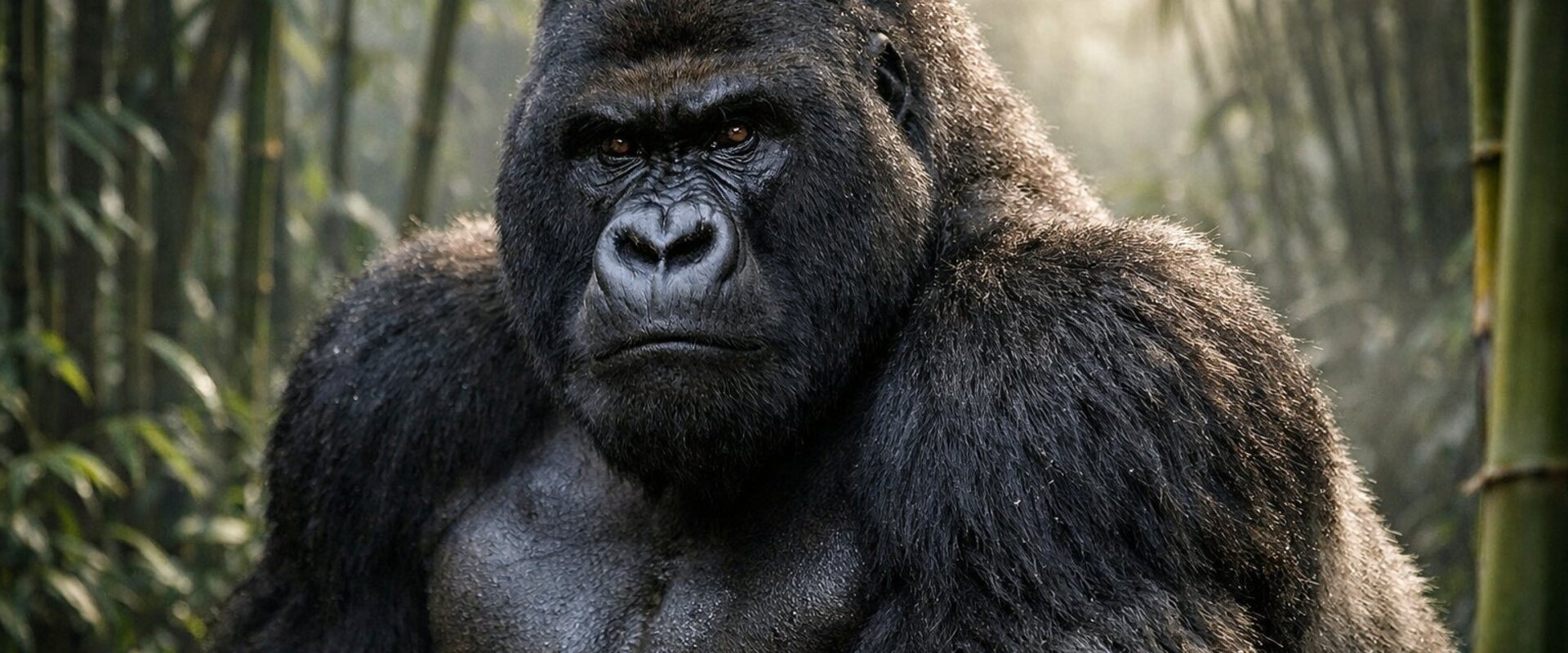
The mountain gorilla exists in only two places on Earth: the Virunga massif shared by the DRC, Rwanda and Uganda, and Uganda's Bwindi forest. The total population is now above 1,000 and rising — the only great ape whose numbers are increasing, and a genuine conservation success achieved under conditions that would have defeated most efforts. Roughly half of the Virunga massif's gorillas are on the Congolese side.
Trekking here differs from Rwanda in three ways: groups are smaller, permits have historically cost substantially less, and you are visibly part of the operation that keeps the park alive. A trek means a briefing at Bukima or Rumangabo, one to three hours of walking up through farmland and bamboo, and one hour with a habituated family — a silverback of 200 kilograms sitting a few metres away, entirely unbothered.
Virunga's rangers have paid an extraordinary price: more than 200 have been killed in the line of duty since the 1990s, including in mass attacks as recently as 2020. The park's Senkwekwe Centre at Rumangabo is the world's only sanctuary for orphaned mountain gorillas, and the park's hydroelectric and enterprise programmes are an explicit attempt to make conservation pay locally rather than compete with local livelihoods.
Critical caveat — the park is closed. Virunga suspended tourism in March 2020 and has never properly reopened; the 2021 eruption, kidnappings and the M23 advance kept it shut, and since the rebels took Goma in January 2025 the whole gorilla sector has sat inside rebel-held territory with Goma's airport closed to commercial flights. As of September 2026 no gorilla permits or Nyiragongo climbs are being sold and no reopening date has been announced. Everything above describes what the park is, not what you can book this year — check virunga.org and your government's advisory for North Kivu before believing anyone who says otherwise.
🔥 Nyiragongo — the Lava Lake
Mount Nyiragongo (3,470 m), twenty kilometres north of Goma, holds the largest and most persistent lava lake in the world. Its lava is unusually low in silica, which makes it exceptionally fluid — the flows can move at tens of kilometres an hour, far faster than a person can run, and this is what makes the volcano so dangerous to the city below.
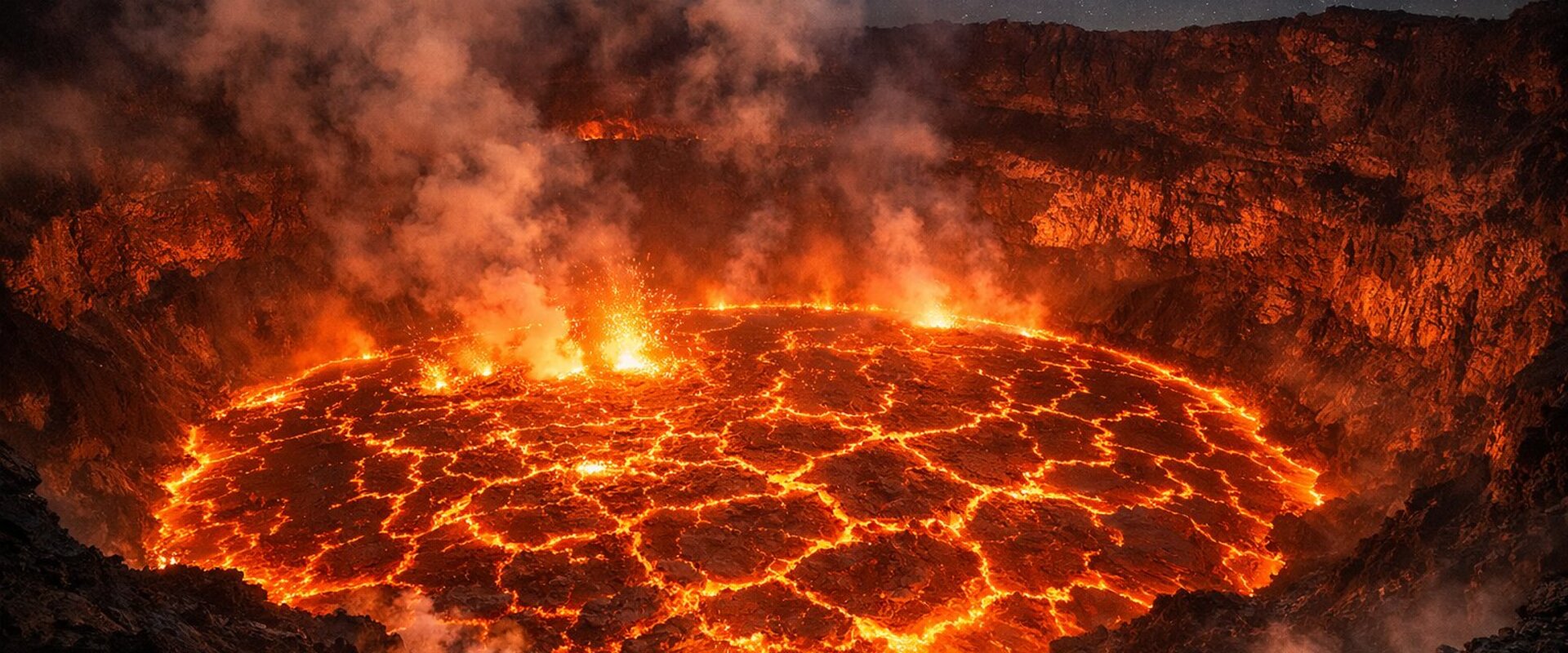
The climb — suspended since the May 2021 eruption and, since January 2025, inside M23-held territory — is, when it operates, one of Africa's great adventures: four to six hours up through lava fields and cloud forest, a night in basic shelters on the crater rim, and the sight of the lake below churning, spitting fountains and lighting the whole crater orange after dark. It requires reasonable fitness, warm clothing — it is genuinely cold at the top — and a head for altitude gained fast.
The volcano's danger is not theoretical. The 2002 eruption sent lava through the centre of Goma, destroyed much of the city and displaced hundreds of thousands. The May 2021 eruption killed dozens and displaced hundreds of thousands more, and revealed that the monitoring observatory had lost funding shortly beforehand. Nyiragongo is closely watched and access is suspended whenever activity or security dictates.
Its neighbour Nyamuragira, 25 km away, is the most frequently erupting volcano in Africa but rarely accessible. Both sit within Virunga National Park, so the same access rules and the same cautions apply.
🏙️ Kinshasa
Kinshasa is the largest French-speaking city in the world — larger than Paris — and one of the fastest-growing megacities anywhere, with an urban population now estimated around 17 million and projected to be among the world's largest cities by mid-century. It faces Brazzaville across the river, making these the closest pair of national capitals on Earth apart from Rome and the Vatican.
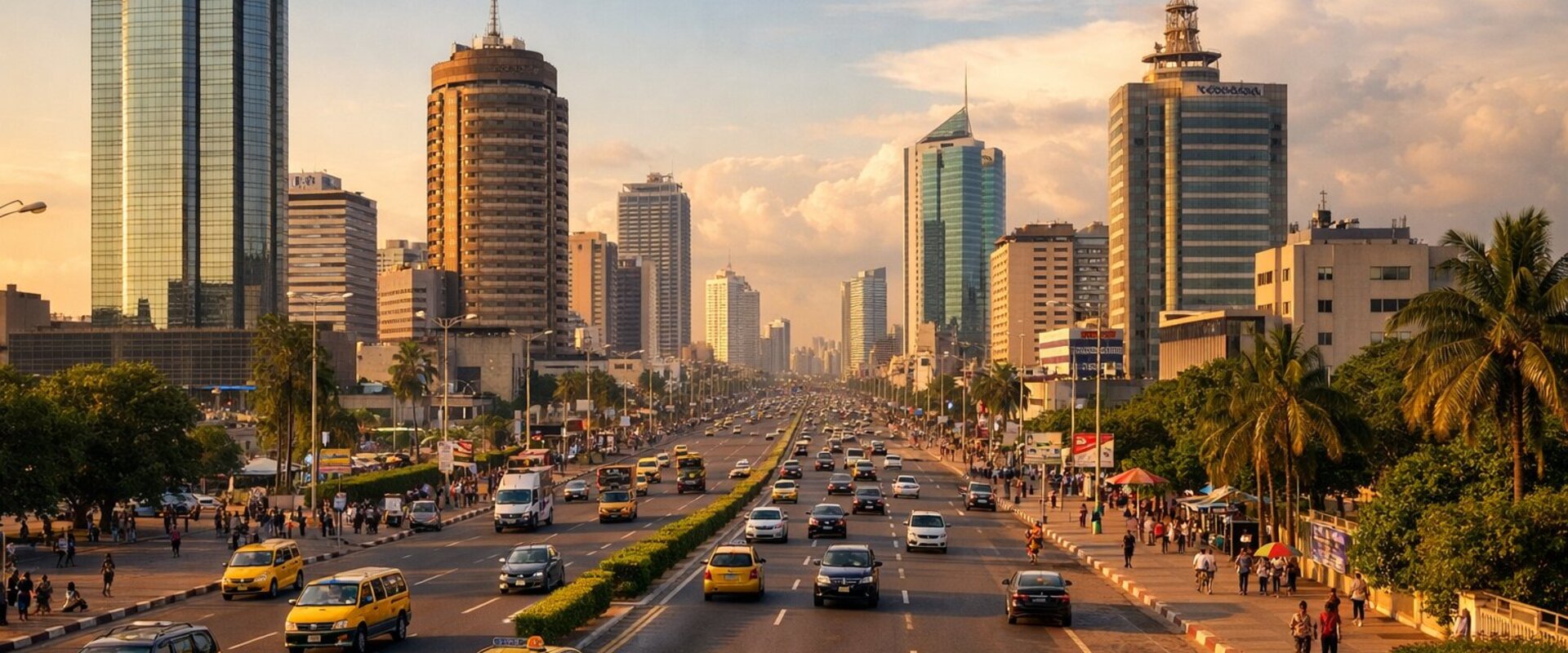
The city is overwhelming and, to visitors who give it time, exhilarating. Gombe is the administrative and business district along the river, with the ministries, embassies and the Boulevard du 30 Juin. Matonge is the legendary music quarter, where rumba was made and where bars still run live bands until sunrise. The Musée National, in a building opened in 2019 with Korean funding, holds a serious collection of Congolese art and masks. The Académie des Beaux-Arts has trained generations of painters and sculptors and is open to visitors.
The Kinsuka rapids at the western edge of the city are where the Congo begins its drop towards the Atlantic — a good half-day out with river views. The Marché Central and Marché de la Liberté are the commercial deep end, and best visited with someone who knows them.
Practicalities matter more here than in most capitals. Traffic is severe, and journeys should be planned around it. Use a driver arranged through your hotel rather than street taxis. Police and military checkpoints are routine, photography of anything official is a serious problem, and after dark movement should be by vehicle. None of this is a reason not to come — it is the price of one of the most creative cities in Africa.
🚣 The Congo River
The Congo is the deepest river on Earth — over 220 metres in the lower reaches, deep enough that separate populations of fish have evolved in isolation at different depths in the same stretch of water — the second longest in Africa, and second only to the Amazon in discharge. It crosses the equator twice, so it is fed by rains in one hemisphere or the other all year and never runs low.
For much of the country the river is the transport network. The classic journey runs Kinshasa to Kisangani, some 1,700 kilometres upstream, on barges that lash together into floating villages carrying hundreds of people, livestock, fuel and trade goods. It takes anywhere from two to six weeks depending on the boat, the water and the number of stops, and it is genuinely uncomfortable — but nothing else gives the same sense of the country's scale or of a way of life largely untouched by roads.
Below Kinshasa the river narrows into Livingstone Falls, 32 cataracts over 350 kilometres, which is why no ship ever reached the interior from the sea and why the colonial powers built railways instead. Above Kisangani lie the Boyoma Falls, where the Wagenia people still fish from wooden tripod structures set in the rapids — a technique documented for well over a century.
For most visitors, the realistic version is a day or half-day on the water near Kinshasa, or a stretch of river as part of an organised trip. The full barge journey requires time, tolerance and a serious grasp of the risks.
🐘 Wildlife — Bonobos, Okapi & the Rest
The DRC's endemism is extraordinary even by African standards, because the Congo River itself is a barrier that split populations for millions of years.
Bonobo
Found only in the DRC, south of the Congo River. Our closest living relative alongside the chimpanzee, and famously matriarchal and un-aggressive. Visitable at Lola ya Bonobo near Kinshasa.
Okapi
The forest giraffe of the Ituri — unknown to science until 1901, striped like a zebra, and the national symbol. The Okapi Wildlife Reserve is a UNESCO site.
Eastern lowland gorilla
Grauer's gorilla, the largest of all gorillas, found only in the eastern DRC. Kahuzi-Biéga protects them; numbers have fallen catastrophically since the 1990s.
Congo peafowl
The only true pheasant native to Africa, described in 1936 from two feathers in a museum hat. Endemic to the DRC's forests.
Forest elephant
Recognised as a separate species in 2021 and Critically Endangered; Garamba's population has been under sustained poaching pressure for decades.
Rwenzori's alpine flora
Giant lobelias and groundsels on equatorial glaciated mountains — the strangest vegetation in Africa.
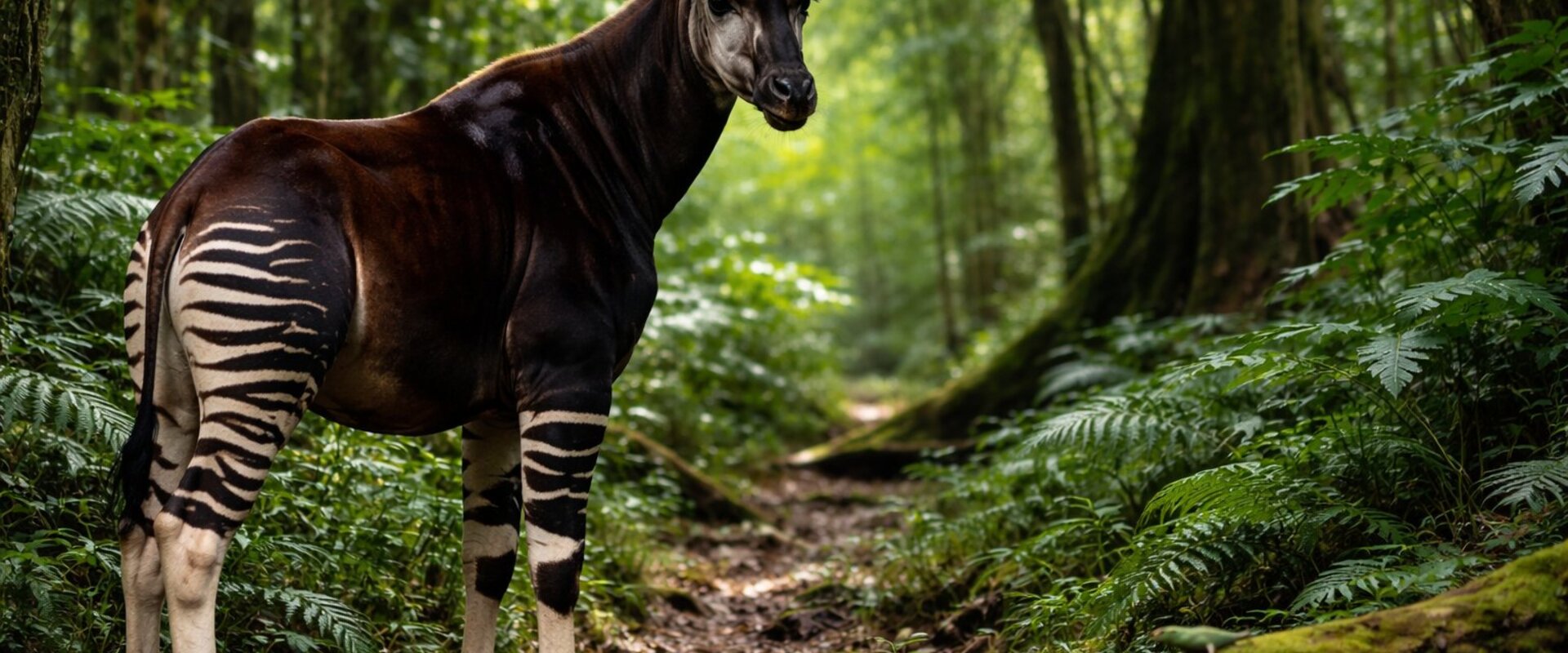
Five UNESCO natural World Heritage sites lie in this one country — Virunga, Garamba, Kahuzi-Biéga, Salonga and the Okapi Wildlife Reserve — and all five have spent time on the List of World Heritage in Danger, several of them continuously. Salonga is the largest protected tropical rainforest in Africa. The threats are poaching, armed groups occupying park territory, artisanal mining and, increasingly, oil and gas licensing over protected areas and peatlands.
For visitors, realistically accessible wildlife means Virunga in the east when it is open, Kahuzi-Biéga near Bukavu, and Lola ya Bonobo outside Kinshasa — a sanctuary for orphaned bonobos and the easiest meaningful wildlife experience in the country.
🥘 Cuisine
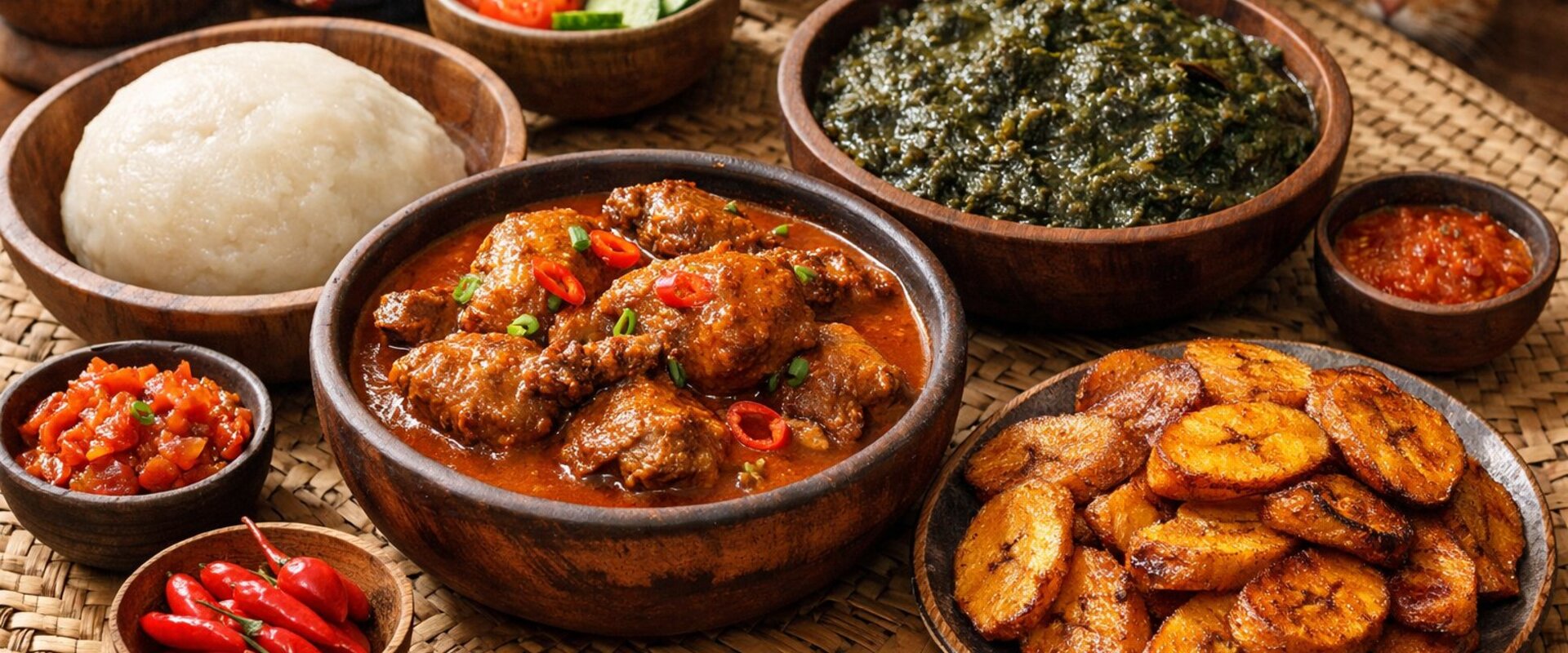
Congolese cooking is built on cassava, palm oil, river fish and long-cooked greens, and it is close kin to the food across the river in Brazzaville — the same dishes, sometimes under different names.
Pondu / saka-saka
Pounded cassava leaves stewed slowly with palm oil, onion and smoked fish. The everyday dish, and the one most Congolese abroad miss most.
Poulet à la moambe
Chicken in a thick palm-nut sauce, served with rice, fufu or plantain. The dish for guests and celebrations.
Fufu & kwanga
Fufu is cassava or maize dough; kwanga (chikwangue) is fermented cassava steamed in leaves, dense and sour. The starch that carries everything.
Liboke
Fish or meat wrapped in banana or marantaceae leaves with chilli and onion and cooked over embers. The best thing on most menus.
Capitaine
Nile perch from the river or the lakes, grilled whole with plantain. The default good meal in Kinshasa and Goma.
Makayabu & mikate
Salted dried fish, and the sweet fried dough balls sold on every street corner for breakfast.
Pili-pili — crushed hot chilli in oil — sits on the table. Groundnut paste thickens sauces. Fruit is abundant: mango, papaya, pineapple, safou. In the east, the food shifts towards the Great Lakes: more beans, more bananas, matoke, and Swahili-influenced grills.
Two notes. Bushmeat is widely sold and is both a major driver of wildlife loss and a documented disease route — an easy thing for a visitor to simply decline. And in Kinshasa the eating is often best at a terrasse or a nganda — an informal bar-restaurant — rather than at anything with a printed menu.
🍷 Beer, Lotoko & Drinking Culture
There is no wine here — the climate rules it out and imports are expensive. What the DRC has is one of the most socially serious drinking cultures in Africa, and it is inseparable from music.
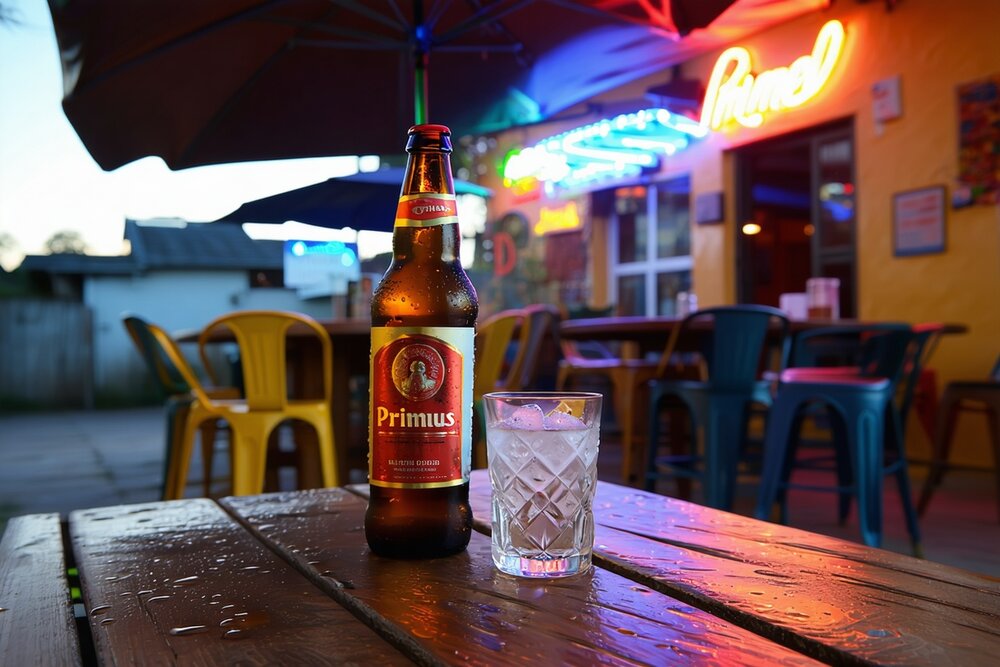
The beer rivalry is real and regional. Primus, brewed by Bralima, dominates Kinshasa and the west; Skol holds the east; Tembo has its loyalists in Katanga. Beer comes in large 72cl bottles meant for the table, served ice-cold, and a night out means a casier — a crate — rather than a round.
Lotoko is the country's traditional spirit: moonshine distilled from fermented maize or cassava in improvised stills, strength varying from roughly 30% to well over 50%, raw and earthy, and completely unregulated. It is present at funerals, weddings and market days across rural DRC. Contaminated batches are a genuine recurring hazard and health authorities warn about them periodically — this is one local specialty worth appreciating from a distance.
Palm wine (masanga ya mbila) is tapped at dawn and ferments within hours — sweet in the morning, sharp and strong by evening. In the south-east, kasiksi, a thick banana beer brewed by women in Luba and Bemba communities and drunk through reed straws from a shared gourd, carries real ceremonial weight.
The setting is the point. Kinshasa's terrasses — plastic chairs, cold bottles, enormous speakers — are where rumba was born and where it still lives. The word for what everyone is chasing is ambiance, and it is treated as something close to sacred.
🎵 Congolese Rumba
Congolese rumba is the most influential popular music Africa has produced, and Kinshasa is its capital. It began in the 1940s and 50s when Cuban son records — themselves carrying rhythms taken from this region across the Atlantic centuries earlier — came back up the river and were rebuilt with Lingala lyrics and electric guitars. UNESCO inscribed it as intangible cultural heritage in 2021, jointly for both Congos.
The lineage is a roll call: Wendo Kolosoy, the father of the form; Franco Luambo and his TPOK Jazz, whose guitar and social commentary defined two decades; Tabu Ley Rochereau and African Fiesta; Papa Wemba, who linked the music to the SAPE; then Koffi Olomide, Werrason, JB Mpiana, and today Fally Ipupa and a generation with global streaming numbers.
Musically, the signature is the sebene: after the sung section, the band drops into an accelerating instrumental passage driven by interlocking guitars, with the atalaku shouting rhythmic exhortations over the top. Rumba became soukous in the 1980s and ndombolo in the 1990s, and its guitar language spread to Kenya, Tanzania, Zambia and West Africa.
In 1974, Kinshasa hosted the Zaire 74 festival alongside the Ali–Foreman fight, putting James Brown, B.B. King, Miriam Makeba and Celia Cruz on stage with TPOK Jazz — a moment recorded in the films When We Were Kings and Soul Power. For a visitor, Matonge on a Friday night is the living version of all of it.
👔 Sapeurs, Painting & the Kinshasa Scene
The SAPE — Société des Ambianceurs et des Personnes Élégantes — is shared with Brazzaville and contested between them. Under Mobutu, Western suits were banned outright as part of the authenticité campaign, which turned wearing one into a political statement and gave the Kinshasa strand of the movement a sharper edge. Papa Wemba, its most famous figure, made it inseparable from the music.
Congolese painting has an unusually strong international standing. The popular painters of the 1970s and 80s — above all Chéri Samba, whose text-laden canvases hang in the Centre Pompidou and the Fondation Cartier — turned street signwriting into social commentary. Bodys Isek Kingelez's fantastical paper models of imagined cities were the subject of a MoMA retrospective in 2018.
Contemporary Kinshasa is a genuine creative centre: dance and performance collectives, the sculptors of the Académie des Beaux-Arts, and a striking movement of performance artists who work in costumes made from the city's waste. The Musée National de la RDC and the Académie are the two places a visitor can see this without an introduction.
One further Congolese export deserves naming: Kimbanguism, the church founded by Simon Kimbangu in 1921 and suppressed by the Belgians, which now claims millions of adherents and is one of the largest African-initiated churches anywhere — a reminder that the country generates institutions as well as art.
🌡️ Climate & Best Time to Visit
The DRC straddles the equator, so the country has no single season. North of the equator and south of it, the wet and dry periods run opposite to each other, and the central basin is simply hot and wet all year.
Kinshasa & the west
Dry season roughly June–September, when it is cooler and often overcast; rains October–May. Hot and humid throughout, 25–32 °C.
Central basin (Mbandaka, Kisangani)
Rain in every month, 24–32 °C, humidity 80–90%. No meaningfully dry period.
Eastern highlands (Goma, Bukavu)
Cool and pleasant at 1,500–2,000 m, 15–25 °C. Drier June–August and December–February — the trekking windows.
Katanga (Lubumbashi)
Southern-hemisphere pattern: dry and cool May–September, wet November–March. Nights can be genuinely cold in July.
Best overall: June to September, and secondarily December to February. Those windows give the driest trails for gorilla trekking and the Nyiragongo climb, the best chance of clear volcano views, and the least disrupted light-aircraft schedules. Gorilla trekking is possible year-round; the difference is mud, not access.
✈️ Getting There & Getting Around
There are two effectively separate entry strategies, and most visitors use only one of them.
For the east (Virunga, Nyiragongo, Kahuzi-Biéga)
The historic route — fly to Kigali in Rwanda, drive three to four hours to the Grande Barrière crossing at Gisenyi/Goma — now delivers you into a city run by the AFC/M23 rebel alliance, not the Congolese state. Goma (GOM) has been closed to commercial flights since January 2025 (a first MONUSCO aircraft landed in February 2026 for ceasefire monitoring only), Virunga is closed, and every Western government advises against all travel to North and South Kivu. Until that changes, the east is not a tourist destination.
For Kinshasa and the west
N'djili (FIH) has services from Brussels, Paris, Istanbul, Addis Ababa, Nairobi and Johannesburg. From Prague expect one connection and 12–17 hours.
Visas are required by essentially all Western nationalities and are not straightforward. Requirements and channels change frequently; some visitors have obtained visas on arrival at Kinshasa or Goma under specific conditions, others must apply in advance with an invitation letter. Virunga has historically issued its own tourist visa for park visitors arriving through Goma. Verify the current position with the embassy and with your operator — nothing about DRC visas should be taken from a guide, including this one. A yellow fever certificate is mandatory.
Internally: there is no functioning national road network. Domestic flights connect the main cities, but several Congolese carriers have historically appeared on the EU air safety list, so check what you are being booked onto. The river serves the basin. Overland travel between provinces is an expedition. In cities, use a driver arranged through your hotel or operator, never a street taxi at night.
Returning to the United States: because of the 2026 Ebola outbreak, US Homeland Security bars anyone who has been in the DRC in the previous 21 days from boarding a commercial flight to the US — travellers must sit out 21 days in a third country first. Other governments may follow; check before you fly.
Checkpoints are constant. Carry passport, visa and yellow fever certificate, keep copies separately, stay calm and polite, and expect delays.
🛡️ Safety — Read This First
⚠️ Travel Advisory — Level 4: Do Not Travel (US State Department, reissued 15 July 2026)
The United States advises against all travel to the entire DRC because of health, crime, unrest, terrorism and kidnapping — the Ebola epidemic in Ituri, M23's occupation of Goma and Bukavu, and the embassy's limited ability to help outside Kinshasa. The UK, EU states and Australia advise against all travel to the eastern provinces and against all but essential travel to most of the rest. The Czech Foreign Ministry (MZV) advises against travel to the east; check mzv.gov.cz for the current text. A "do not travel" advisory usually voids standard travel insurance — read the policy.
The DRC is not a country where general travel advice is enough. Security varies enormously by province and changes month to month. Check your own government's current advisory for the specific province you are going to, and confirm conditions with your operator, before booking anything.
The east — North Kivu, South Kivu and Ituri — has areas of active armed conflict. Dozens of armed groups operate there, offensives and mass displacement have continued for years, and foreign ministries typically advise against all travel to substantial parts of these provinces. Virunga National Park sits inside this region. The park has closed to visitors for extended periods, including a multi-year closure, following kidnappings of tourists and attacks in which rangers were killed. Whether it is open, and on what terms, is a question for the park and your government's advisory on the day — not for any guidebook.
Kinshasa and the west are a different risk profile: not armed conflict but urban crime — robbery, carjacking, and opportunistic theft — plus periodic political unrest and demonstrations that can turn violent quickly. Move by arranged vehicle, avoid crowds and political gatherings entirely, and do not walk at night.
Officialdom is its own category of risk. Police and military checkpoints are frequent, document checks are routine, and attempts to extract payment are common. Photographing government buildings, bridges, airports, ports, military or police can lead to detention. Always carry your passport, visa and yellow fever certificate; keep copies apart from the originals; stay calm and polite; and let an operator or fixer handle negotiations where possible.
Health is a major risk in its own right. Malaria is present nationwide year-round and prophylaxis is essential. The DRC has experienced repeated Ebola outbreaks, and one is running now: an epidemic of the Bundibugyo strain — for which there is no licensed vaccine or specific treatment — was confirmed in Ituri in May 2026, spread into Uganda, and was declared a Public Health Emergency of International Concern by the WHO on 17 May 2026; it was still expanding in September 2026. Mpox transmission is also ongoing. Check WHO and national health advisories close to departure. Cholera is endemic in places. Medical facilities are very limited outside Kinshasa, and travel insurance with medical evacuation cover is a genuine requirement, not a formality.
For Czech travellers: the Czech Republic has no embassy in Kinshasa. Check the current advisory and which embassy holds responsibility on mzv.gov.cz, register in the DROZD system before departure, and note that any EU member state's embassy can provide consular assistance in an emergency.
💰 Costs & Money
The currency is the Congolese franc (CDF), but the US dollar is used in parallel everywhere and is often preferred for anything substantial — hotels, permits, flights. Bring dollars in cash, in crisp, unmarked notes issued 2013 or later: worn, torn or older bills are routinely refused outright, and small denominations are needed for change.
Gorilla permit, Virunga
Historically US$400 — substantially below Rwanda's US$1,500 — but the park has been closed to tourism since 2020 and no permits are on sale in 2026.
Nyiragongo climb
A few hundred dollars including permit, porters and hut, when operating.
Kinshasa hotels
US$120–350/night for anything international-standard. Kinshasa is consistently ranked among the most expensive cities in Africa for expatriates.
Everyday
Street food and local restaurants are inexpensive; a Primus on a terrasse costs a couple of dollars. The gap between local and visitor economies is enormous.
Cash is essential. ATMs exist in Kinshasa, Goma and Lubumbashi and are unreliable with foreign cards; card acceptance is limited to major hotels. Budget on the assumption that you will pay for everything in cash you brought with you, and split it across more than one place on your person and in your luggage.
Mobile money (M-Pesa, Airtel Money, Orange Money) is widely used domestically and is how most Congolese transact, but generally requires a local SIM and registration.
📋 Practical Information
Electricity
220–240 V, 50 Hz, European type C/E sockets — the same plug as Czechia. Supply is unreliable everywhere; power banks and a torch are essential kit.
SIM & data
Vodacom, Airtel and Orange cover the cities and the main corridors. Registration on a passport is required. Coverage in the forest is minimal to none.
Water
Never drink tap water. Bottled or properly filtered only, including for brushing teeth. Cholera is endemic in parts of the country.
Vaccinations
Yellow fever mandatory (and checked). Typhoid, hepatitis A and B, meningitis and rabies all worth discussing with a travel clinic. Malaria prophylaxis non-negotiable.
Time zones
Two: UTC+1 in the west (Kinshasa) and UTC+2 in the east (Goma, Lubumbashi). No daylight saving.
Photography
Do not photograph officials, military, police, bridges, ports, airports or government buildings. This is enforced and leads to detention.
Insurance
Must include medical evacuation. Check that it does not exclude countries under a 'do not travel' advisory for your destination province.
Packing
Long sleeves and trousers, waterproof, gaiters and broken-in boots for trekking, warm layer for Nyiragongo's rim, strong repellent, water purification, and a printed copy of every document.
🏨 Accommodation
In Kinshasa, the international-standard hotels are in Gombe, near the ministries and the river, and they are expensive for what they offer — the city consistently ranks among Africa's costliest for expatriates. Smaller guesthouses exist and are considerably cheaper, but security and reliability vary; a recommendation from someone who has actually stayed there matters more than any listing.
In the east — rebel-held and off-limits under every current advisory — Goma has a cluster of hotels serving the humanitarian and NGO community, several of them on Lake Kivu with genuinely pleasant settings. Bukavu, further south on the lake, is similar. These are the bases for Virunga and Kahuzi-Biéga respectively.
Inside Virunga, when the park is open, accommodation is the park's own: Mikeno Lodge at Rumangabo, the Bukima tented camp for gorilla trekking, Tchegera Island on Lake Kivu, and the basic shelters on the Nyiragongo rim. All of it is booked through the park, as part of a package, and the revenue goes into park operations.
Everything should be booked in advance and in writing, and it is worth having the booking confirmation printed — it is frequently requested at checkpoints and sometimes for the visa itself.
🎭 Festivals & Events
Independence Day · 30 June
The anniversary of independence from Belgium in 1960. Parades and official ceremony, and a public holiday nationwide.
Amani Festival · Goma, February
Three days of music and dance in the east under the banner "Sing, Dance for Peace" — the region's most significant cultural gathering, running since 2014.
Journée des Martyrs · 4 January
Commemorates those killed in the 1959 Léopoldville riots that accelerated independence.
Lumumba Day · 17 January
Marks the assassination of Patrice Lumumba in 1961.
Christmas & Easter
Major occasions in an overwhelmingly Christian country; churches fill and cities slow considerably.
Kinshasa concert nights
Not scheduled festivals — the reliable cultural event in the capital is a Friday or Saturday night with a live band in Matonge.
The east — North Kivu, South Kivu and Ituri — is at war. Since January 2025 the Rwandan-backed AFC/M23 alliance has controlled Goma, and since February 2025 Bukavu, running its own administration, taxes and intelligence service over territory it is still expanding in 2026; the Congolese army, Wazalendo militias, the Islamist ADF in Ituri and dozens of other groups operate around it, and around seven million people are displaced. Foreign ministries advise against all travel to all three provinces. Virunga National Park sits inside this zone and is closed. Whether any of this changes is a question for the peace processes in Washington and Doha — not for any guidebook.
⭐ Notable Congolese
Patrice Lumumba (1925–1961)
First prime minister, assassinated within months of independence, and a lasting symbol of African decolonisation.
Dr Denis Mukwege (b. 1955)
Gynaecological surgeon in Bukavu who has treated tens of thousands of survivors of sexual violence. Nobel Peace Prize 2018.
Franco Luambo (1938–1989)
"Le Grand Maître" — bandleader of TPOK Jazz and the defining figure of Congolese rumba.
Papa Wemba (1949–2016)
Singer, style icon and the figure who fused the SAPE with the music.
Chéri Samba (b. 1956)
Painter whose text-carrying canvases made Congolese popular art internationally collected.
Bodys Isek Kingelez (1948–2015)
Sculptor of fantastical paper cities; MoMA retrospective in 2018.
Fally Ipupa (b. 1977)
The most globally streamed Congolese artist of the current generation.
Dikembe Mutombo (1966–2024)
NBA Hall of Fame centre and one of the most substantial philanthropists his country has produced.
Judith Suminwa Tuluka (b. 1967)
Economist and, since April 2024, the first woman to serve as prime minister of the DRC.
Brian Cipenga (b. 2003)
Scored the goal against England in Atlanta on 1 July 2026 — the DRC's first in a World Cup knockout match.
🔬 Fascinating Facts
The largest French-speaking city
Kinshasa has more French speakers than Paris — and the DRC has more than France.
The deepest river on Earth
Over 220 m in places, deep enough for fish species to have evolved in isolation at different depths.
Glaciers on the equator
The Rwenzori's ice fields sit almost exactly on the equator at 5,109 m — and have shrunk by over 80% in a century.
Bonobos live nowhere else
Only in the DRC, only south of the Congo River, which is the barrier that separated them from chimpanzees.
The okapi was a cryptid
Western science dismissed the "African unicorn" until specimens reached London in 1901.
Cobalt capital of the world
The DRC produces the large majority of the world's mined cobalt — the metal in almost every lithium-ion battery.
Nine neighbours
More bordering countries than any other African state.
The Rumble in the Jungle
Ali beat Foreman in Kinshasa on 30 October 1974, in front of 60,000 people, at four in the morning.
⚽ Sports
Football is the national obsession, and 2026 was the year it paid off. The Leopards qualified for the 2026 World Cup — their first since 1974, when they went as Zaire, the first sub-Saharan side ever at a finals — by beating Nigeria on penalties in the CAF play-off in November 2025 and then Jamaica 1–0 after extra time in the intercontinental play-off final on 1 April 2026. In North America they drew 1–1 with Portugal (17 June), lost 0–1 to Colombia (23 June) and beat Uzbekistan 3–1 (27 June) to go through as one of the best third-placed teams, then lost 2–1 to England in Atlanta in the round of 32 on 1 July, Brian Cipenga's early goal overturned by two late Harry Kane strikes. It was the country's best World Cup finish by a distance.
The DRC won the Africa Cup of Nations twice, in 1968 and 1974, reached the semi-finals in Côte d'Ivoire in 2024 and went out of the 2025 edition in Morocco in the round of 16 to Algeria after extra time. TP Mazembe of Lubumbashi is the continent's most decorated club outside North Africa, with five CAF Champions League titles (1967, 1968, 2009, 2010, 2015); its city rival AS Vita Club and Kinshasa's DC Motema Pembe complete the domestic big three. The country has never won an Olympic medal. Basketball's Congolese lineage runs from Dikembe Mutombo to Bismack Biyombo, and boxing's from the Rumble in the Jungle to a lively Kinshasa gym scene.
📰 Media & Press Freedom
Reporters Without Borders ranks the DRC 130th of 180 in its 2026 World Press Freedom Index (score 42.16), up three places from 2025 but with a security score among the worst dozen on Earth. The landscape is huge — more than 4,000 radio stations, 150 TV channels and 7,000 professional journalists — and largely captured: most outlets are owned or bankrolled by politicians, the state broadcaster RTNC lacks independence, and "coupage", payment for coverage, is routine. The UN's Radio Okapi and Top Congo FM are the national reference stations; Actualité.cd and 7sur7.cd lead online.
The war has made the east the most dangerous place in the country to report from. Since taking Goma in January 2025, M23 has shut or looted dozens of community radio stations, detained journalists — three were held in shipping containers in April 2026 and one forced to record propaganda before release — and turned at least one station near Goma into an intelligence office. A revised press law (April 2023) modernised the framework but kept prison for press offences, and the regulator CSAC has intensified threats against outlets covering the conflict.
📸 Photo Gallery
Have you been to the DRC? Send your photos to photos@kaufmann.wtf to be featured here with credit.
🌐 Useful Resources
Virunga National Park
Park status, permits, lodges and the only reliable word on whether it is open: visitvirunga.org
ICCN
The Congolese Institute for Nature Conservation, which manages the national parks: iccnrdc.cd
Lola ya Bonobo
The bonobo sanctuary outside Kinshasa: lolayabonobo.org
MZV ČR & DROZD
Czech advisory by region and voluntary pre-travel registration: mzv.gov.cz
📚 Recommended Reading & Watching
King Leopold's Ghost · Adam Hochschild
The book that returned the Free State's atrocities to public memory. Essential and hard going.
Congo: The Epic History of a People · David Van Reybrouck
The single best general history, built substantially on Congolese oral testimony. Available in Czech.
Dancing in the Glory of Monsters · Jason Stearns
The clearest account of the Congo Wars and why the east is still at war.
Heart of Darkness · Joseph Conrad
Worth reading as a document of the Free State era — and worth reading alongside Chinua Achebe's critique of it.
Virunga (2014)
Oscar-nominated documentary on the park's rangers, oil exploration and the war. The best introduction to what Virunga is.
When We Were Kings (1996)
The Rumble in the Jungle and Zaire 74, and a Kinshasa moment that has never been repeated.
Système K (2019)
Documentary on Kinshasa's performance-art scene — the counterweight to every war documentary.
Music
Franco & TPOK Jazz, Tabu Ley Rochereau, Papa Wemba, Konono N°1, Fally Ipupa, Jupiter & Okwess.
✍️ Author's Note
"No country on this site has been described so relentlessly by outsiders and so rarely allowed to describe itself. Conrad gave it a phrase that has followed it for a century, and it is worth remembering that the darkness in that book belonged to the Europeans."
"I will not pretend this is an easy place to travel, and I would not send anyone here casually. The east is at war. The paperwork is punishing. The costs are real. And yet the rangers of Virunga keep walking into that forest — more than two hundred of them have died doing it — so that a species that should have been gone by now is instead increasing in number. That is not a travel anecdote. It is one of the better things human beings are currently doing anywhere."
"What stays with me from Kinshasa is not the difficulty but the noise: a band in Matonge at two in the morning, three guitars locked together in a sebene that will not end, a crate of Primus on the table, and a room full of people who have every reason to be exhausted and have decided instead to dance. Ambiance is not a word about music. It is a position on how to live."
— Radim Kaufmann, September 2026
Support This Project 🌍
This World Travel Factbook is a labor of love – free to use for all travelers. If you find it helpful, consider supporting its continued development.
