The smallest country on the American mainland: twenty volcanoes, a world-class right-hand point break, a Maya village buried in ash — and the most contested security experiment in the hemisphere.
El Salvador is the smallest country on the American mainland — 21,041 km², about a quarter of Czechia — and the only one in Central America with no Caribbean coast. Into that it packs about twenty volcanoes, several crater lakes, 307 km of Pacific surf including a genuinely world-class point break, cloud forest on three borders, and a Maya farming village preserved under volcanic ash since the year 600.
For a long time nobody came here. Between the civil war of the 1980s and the gang violence that followed it, El Salvador spent four decades as the country travellers skipped between Guatemala and Nicaragua. That has changed, dramatically and controversially, and it is now the central fact about visiting: since the state of exception declared in March 2022, the homicide rate has fallen from among the highest in the world to among the lowest in the Americas — and more than 90,000 people have been detained, most without trial, in a suspension of due process that human rights organisations across the political spectrum have documented in detail.
That is genuinely both things at once, and this page says so in the safety section rather than picking the half that makes for a simpler story. For a visitor, the practical effect is that El Salvador is now easy and pleasant to travel in a way it has not been in living memory.
What it is good for: surfing, volcano hiking, coffee, colonial towns, and food. What it is not: beach resorts, big archaeology, or a country you need two weeks for. Five to seven days does it properly, and it combines naturally with Guatemala and Honduras — the land borders are an hour or two away.
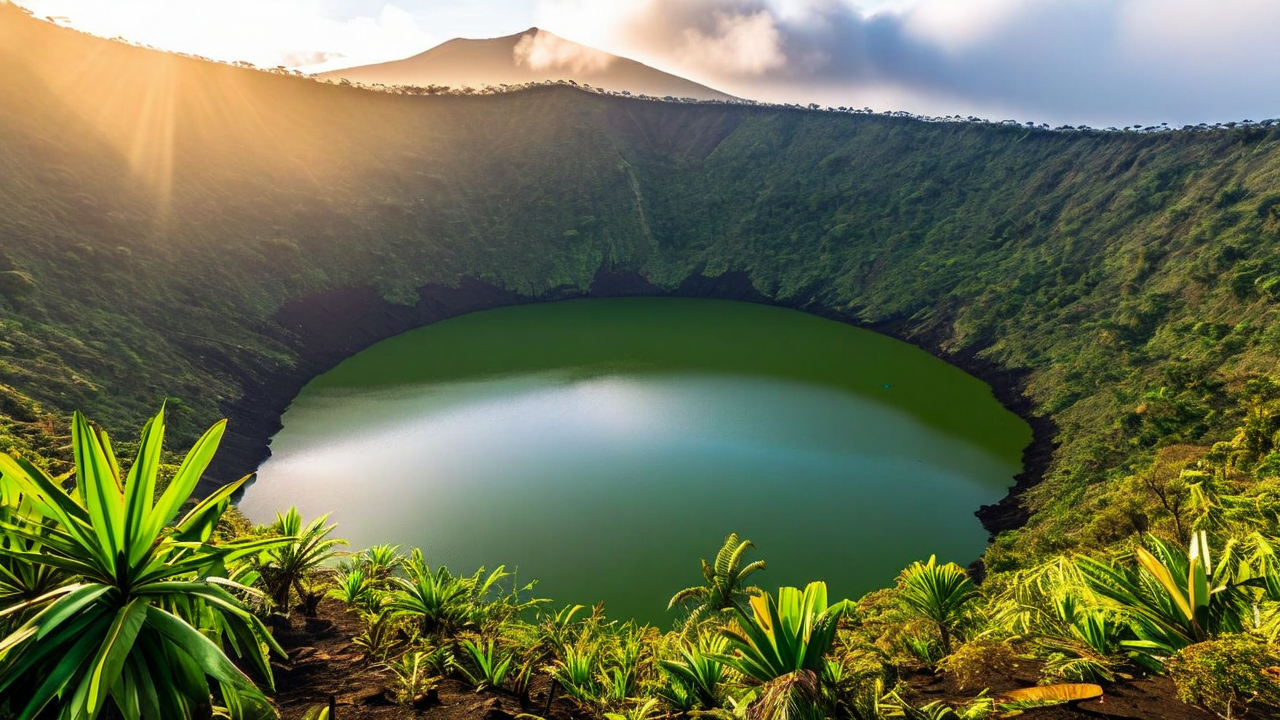
A volcanic crater lake. El Salvador calls itself the Land of Volcanoes, and the whole country is built on the arc of them. · JMRAFFi · CC BY 4.0Back to top ↑
02
🏷️ Name & Identity
The country is named for Jesus Christ: Pedro de Alvarado's 1525 settlement was called Villa de San Salvador, the Holy Saviour. The full name, República de El Salvador, keeps the article — it is El Salvador, not Salvador, and the distinction matters to Salvadorans.
Guanaco
What Salvadorans call themselves, informally and affectionately. The origin is disputed; the usage is universal.
Cuscatlán
The Nahua-Pipil name for the region — "land of precious things" — and the name Salvadorans reach for when they want a national symbol older than the conquest. It names the football stadium, a department and a great many businesses.
Independence
15 September 1821 from Spain, as part of the Captaincy General of Guatemala; then the Federal Republic of Central America until it dissolved in 1841.
The flag
Blue-white-blue, the colours of the old Central American federation, shared in variations with Nicaragua, Honduras and Guatemala.
Indigenous identity
Officially small, historically suppressed. The 1932 Matanza — the killing of somewhere between ten and forty thousand people after a peasant uprising — made speaking Nawat or wearing indigenous dress lethally dangerous, and a generation stopped. Recovery efforts are recent and real.
Diaspora
Around a fifth of all Salvadorans live abroad, overwhelmingly in the United States. This is not a footnote to national identity; it is a structural part of it.
Two mountain ranges run east-west across a country you can drive across in four hours. The southern one is the volcanic chain — the reason the soil is fertile, the reason the coffee is good, and the reason the country has been flattened repeatedly by earthquakes. Between the ranges lies the central plateau where most Salvadorans live; south of the volcanoes, a narrow coastal plain and the Pacific.
The volcanic arc
Around twenty volcanoes, several of them active. Santa Ana (Ilamatepec) at 2,381 m is the highest; San Miguel, San Salvador and Izalco are the others you will hear about.
Cerro El Pital
2,730 m on the Honduran border, the country's highest point and the only place in El Salvador that gets genuinely cold. Cloud forest, and frost some winter mornings.
The Lempa
The main river, rising in Guatemala and crossing the whole country to the Pacific. Dammed for hydroelectricity, which created Lago Suchitlán.
No Caribbean
The only Central American country without a Caribbean coastline — its whole 307 km of coast faces the Pacific, which is why the surf is what it is.
Gulf of Fonseca
In the east, shared with Honduras and Nicaragua — a shallow bay of mangrove and volcanic islands, and an unresolved three-way maritime dispute.
Earthquakes
Frequent and consequential. San Salvador has been destroyed or badly damaged repeatedly; the 1986 quake killed 1,500 and two in 2001 killed over a thousand more. Buildings here are built with this in mind.
San Salvador sits in the middle, an hour from the Pacific and 90 minutes from the Guatemalan border. Nothing in the country is more than about four hours from anything else, which makes a single base entirely viable.
San Salvador → El Tunco
45 km, about an hour on the coastal highway. The standard first move.
San Salvador → Santa Ana
65 km, an hour. The base for the volcano, Coatepeque and Tazumal.
San Salvador → Suchitoto
45 km, 90 minutes. The prettiest colonial town in the country.
San Salvador → Juayúa
85 km, two hours, and the start of the Ruta de las Flores.
San Salvador → El Cuco / Las Flores
170 km east, three hours. The quieter surf coast.
Borders
Guatemala at Las Chinamas or San Cristóbal (1.5–2 h from the capital); Honduras at El Amatillo or El Poy. CA-4 means no new stamp between El Salvador, Guatemala, Honduras and Nicaragua.
Getting around: the chicken buses — repainted American school buses — are cheap, frequent, slow and an experience. Shuttles between tourist towns cost more and save hours. Uber works in San Salvador and Santa Ana and is cheap. Renting a car is genuinely easy now and roads are in decent shape.
The land was Nahua-Pipil, Lenca and Maya at the conquest, organised around the polity of Cuscatlán. Pedro de Alvarado invaded in 1524, was wounded and driven back, and returned; Spanish control took years rather than weeks. Colonial El Salvador was poor and peripheral, producing indigo for export and not much else.
Independence in 1821 changed the owners, not the structure. What transformed the country was coffee: from the 1870s the state abolished communal indigenous landholding by decree, transferred the volcanic uplands to private hands, and built an export economy on a crop that needs land and cheap labour. The result was one of the most concentrated landholding patterns in the world, and the oligarchy that Salvadorans call las catorce familias — the fourteen families — whether or not the number was ever exact.
In January 1932, after a collapse in coffee prices, a peasant and indigenous uprising broke out in the west, led in part by the communist Farabundo Martí. It was suppressed within days. The reprisals — La Matanza — killed somewhere between ten thousand and forty thousand people, disproportionately indigenous, and effectively erased visible indigenous identity from the country. Martí was executed; forty-eight years later the guerrilla front that fought the civil war took his name.
Between 1980 and 1992 El Salvador fought a civil war that killed around 75,000 people in a country of five million. On one side the army and the state, heavily funded by the United States; on the other the FMLN, a coalition of five guerrilla organisations. Most of the dead were civilians, and the UN Truth Commission attributed the large majority of documented violations to state forces and allied death squads.
Óscar Romero
The Archbishop of San Salvador, who moved from cautious conservative to the country's loudest voice against state killing. On 24 March 1980 he was shot dead while saying mass, the day after publicly ordering soldiers to stop obeying orders to kill. Canonised in 2018.
El Mozote
In December 1981 the US-trained Atlacatl Battalion killed around a thousand villagers, roughly half of them children, in and around the hamlet of El Mozote in Morazán. Denied for a decade, confirmed by forensic excavation in 1992, and still without a completed prosecution.
The UCA murders
In November 1989 soldiers killed six Jesuit priests, their housekeeper and her daughter at the Central American University. The case is why the war ended: it made continued US funding politically impossible.
Chapultepec, 1992
The peace accords signed in Mexico City in January 1992 dissolved the old security forces, created a new civil police and turned the FMLN into a political party. It won the presidency in 2009 and 2014.
The gangs
Mara Salvatrucha and Barrio 18 were formed by Salvadoran refugees in Los Angeles and exported home by US deportations in the 1990s, into a post-war country with a million guns and no jobs. The violence that followed killed more people than the war did.
Visiting the history
The Museo de la Palabra y la Imagen in San Salvador, the chapel where Romero was shot, the Jesuit rose garden at the UCA, and the memorial and museum at El Mozote and nearby Perquín. All are open, all are worth the time, and all are recent enough that the guides remember it.
No account of El Salvador written after 2022 can avoid this, and most accounts pick a side. Here are the things that are not in dispute.
Nayib Bukele became president in 2019 at 37, having been mayor of San Salvador for a party he was expelled from. In March 2022, after a weekend in which 87 people were murdered, his government declared a state of exception suspending several constitutional protections — the right to be informed of the reason for arrest, access to a lawyer, and limits on pre-trial detention. It has been renewed monthly ever since.
What happened to the violence
El Salvador's homicide rate was around 103 per 100,000 in 2015, among the highest ever recorded anywhere. Official figures put it at 1.9 per 100,000 in 2024 and 1.3 in 2025 (82 homicides in the year) — below Canada. Independent analysts dispute the counting (deaths in custody and people killed in confrontations are excluded), but nobody disputes that the fall is enormous and real.
What it cost
More than 90,000 people have been arrested — well over 1% of the population, the highest incarceration rate in the world — on a standard of evidence that has included tattoos, neighbourhood and anonymous tip-offs. Human rights organisations have documented thousands of cases of people with no gang connection, and hundreds of deaths in custody.
CECOT
The Terrorism Confinement Centre, opened in 2023 with capacity for tens of thousands, with no visits, no recreation and no release programme by design. Its publicity images are deliberate, and they work.
Popularity
Bukele was re-elected in February 2024 with around 85% of the vote (sworn in for the second term on 1 June 2024), after a constitutional bar on consecutive re-election was set aside by a court his party had reconstituted. His approval ratings are among the highest of any elected leader anywhere, and they are not manufactured — Salvadorans who could not previously walk in their own neighbourhoods now can.
The 2025 rewrite of the rules
On 31 July 2025 the Assembly, with 57 votes, removed the bar on presidential re-election altogether, lengthened the term from five to six years, abolished the run-off, and brought the next presidential vote forward to 2027 to coincide with legislative and municipal elections. The IACHR called it a serious reversal for democracy and the rule of law. Bukele is expected to run again; the opposition party Vamos said in March 2026 it will not field a candidate.
The screws since 2025
A Foreign Agents Law (May 2025) taxes foreign-funded organisations at 30% and lets the state suspend them. Ruth López, anti-corruption director at the human-rights group Cristosal, was arrested on 18 May 2025 and named a prisoner of conscience by Amnesty; Cristosal moved out of the country in July 2025, and dozens of journalists have gone into exile. In March 2026 the constitution was amended to allow life sentences for murder, rape and terrorism, signed into law on 15 April 2026 and applicable from the age of twelve.
CECOT and the United States
From March 2025 CECOT held around 250 Venezuelans deported from the US under the Alien Enemies Act, plus the wrongly deported Salvadoran Kilmar Ábrego García, with Washington paying for their detention. The Venezuelans were flown home on 18 July 2025 in a swap for ten Americans held by Caracas. Amnesty said in July 2026 that the state of exception — by then past 90,000 detentions and at least 470 deaths in custody — could amount to crimes against humanity. The regime was renewed again on 26 August 2026, to 27 September.
The argument
Supporters say a state facing armed groups that controlled territory and taxed the population had no ordinary-law option. Critics say the emergency has become permanent, the courts have been captured, and a country that fought a war over exactly this is rebuilding the machinery. Both of these are serious positions.
For a visitor
The practical result is a country that is safe to travel in, in a way it was not five years ago. That is worth saying plainly, and so is the rest of it. Avoid photographing police, soldiers or prisons, and do not offer opinions on politics to strangers — this is normal advice anywhere, and slightly more load-bearing here.
A metropolitan area of about 1.8 million in a bowl beneath the San Salvador volcano, rebuilt repeatedly after earthquakes and consequently short on old buildings. It is not a beautiful city and it does not pretend to be, but it has the museums, the food and the history, and two days here anchor the trip.
Catedral Metropolitana
Romero's cathedral, with Fernando Llort's naïve-art facade — famously destroyed in 2011 by the archdiocese without warning, to national outrage. Romero's tomb is in the crypt and is a place of continuous pilgrimage.
Hospitalito de la Divina Providencia
The small chapel where Romero was shot at the altar in 1980, with his house preserved beside it exactly as he left it, bloodstained vestments included. The single most affecting place in the country.
UCA
The Jesuit university, with the rose garden where six priests were murdered in 1989 and a small, unflinching museum. Free and open.
Museo de la Palabra y la Imagen
An independent museum of the war, built from the archive of a former guerrilla radio station. The best-curated history in El Salvador.
MUNA & MARTE
The national anthropology museum and the modern art museum, next to each other in the Zona Rosa. MARTE's Salvadoran collection is genuinely good.
Where to stay and eat
Colonia Escalón and Zona Rosa for hotels and restaurants; Santa Tecla, twenty minutes west, for a walkable centre with a good food street. The historic centre has been extensively renovated and is now pleasant by day.
Ninety minutes north of the capital, on a hill above Lago Suchitlán, and the best-preserved colonial town in El Salvador — cobbles, single-storey adobe houses, a whitewashed church, and a large artistic and expatriate community that arrived after the war and stayed.
Santa Lucía church
1853, whitewashed, with wooden columns and a plain interior. The square in front is the centre of the town's life.
Lago Suchitlán
A reservoir created by damming the Lempa in the 1970s, and now a Ramsar wetland. Boat trips to Isla de los Pájaros, and thousands of migratory birds from November to February.
Los Tercios waterfall
A fall over a wall of hexagonal basalt columns, twenty minutes' walk from town. Spectacular in the wet season and a dry cliff in March.
The war here
Suchitoto was on the front line and was largely emptied. Several galleries and the town's own museum deal with it directly; guides who were here are easy to find.
Indigo
The colonial crop that built the town, revived as a craft. Workshops teach añil dyeing and the results are the best souvenir in the country.
Practical
One night minimum; two if you want the lake and the waterfall. February's arts festival fills every room in town.
A 36 km stretch of road through the western coffee highlands linking five small towns — Nahuizalco, Salcoatitán, Juayúa, Apaneca and Ataco — at around 1,200–1,500 m, cool, green, and named for the coffee blossom that covers the hills between October and February. It is the most straightforwardly enjoyable thing in El Salvador.
Juayúa
The feria gastronómica every Saturday and Sunday fills the square with grills — rabbit, iguana, frog, beef, seafood — and is the single best eating occasion in the country. Also the base for the seven-waterfall hike, Los Chorros de la Calera.
Concepción de Ataco
The prettiest of the five, with murals on nearly every wall, good coffee shops and a weekend craft market. Touristy in a way that has not yet spoiled it.
Apaneca
The highest town, with coffee estate tours, two crater lakes — Laguna Verde and Laguna Las Ninfas — and canopy tours.
Nahuizalco
The one with a living indigenous identity: a night market lit by candles, wickerwork, and one of the last places where Nawat is still spoken by elders.
Coffee
This is the heart of Salvadoran coffee country. Estate tours are cheap and unpretentious; the country's Pacamara variety was bred here in 1958 and is prized by specialty roasters worldwide.
Practical
Doable as a long day from San Salvador or Santa Ana, much better as two nights in Ataco or Juayúa. Go at the weekend for the Juayúa feria; go midweek for quiet.
El Salvador's only World Heritage site, inscribed in 1993, and one of the most important archaeological sites in the Americas — not because of what was built there, but because of what was left behind. Around 600 CE the Loma Caldera vent erupted and buried a small Maya farming village under fourteen layers of ash, sealing it within hours.
What survived
Not temples — houses, kitchens, a sweat bath, a workshop, storerooms, and the fields. Maize still standing in furrows. Beans in pots. Sleeping mats. A painted gourd. The plates from an interrupted meal.
Why it matters
Every other Maya site tells you about kings. This one tells you what ordinary Maya farmers ate, how they stored it, how their houses were arranged and what they owned. There is nothing else like it in the Maya world.
Nobody died
No human remains have been found. The villagers appear to have had enough warning — probably earth tremors — to leave, though they left everything behind.
Discovery
Found in 1976 by a bulldozer levelling ground for grain silos. The operator stopped; the site was excavated from 1978 by Payson Sheets and is still being worked.
Visiting
Half an hour from San Salvador, near the airport road. Small, well-explained, roofed, and quiet. Allow 90 minutes including the site museum, and take the guide.
San Andrés
Ten minutes away: a much larger ceremonial centre that was the regional capital, with pyramids and a colonial indigo works on the same ground. Combine the two.
El Salvador sits at the southern edge of the Maya world and its sites are modest by the standards of Tikal or Copán — but they are close together, almost empty, and cheap.
Tazumal
In Chalchuapa, near Santa Ana: a 24 m stepped pyramid restored in the 1950s in a way archaeologists now regret (a lot of concrete), with occupation running from about 100 to 1200 CE. The site museum is good.
Casa Blanca
Also at Chalchuapa, less restored and more informative, with an indigo workshop where you can dye something yourself.
San Andrés
In the Zapotitán valley, the regional capital that Joya de Cerén answered to. Large plaza, acropolis, and the ash layer from the Ilopango eruption visible in the excavation walls.
Cihuatán
North of the capital, the largest pre-Columbian site in the country — a post-Maya city of about 1000 CE, only partly excavated and almost never visited.
The Ilopango eruption
Around 431 CE the caldera that is now Lago de Ilopango produced one of the largest eruptions of the last two thousand years, depopulating central El Salvador for decades and depositing the white ash layer you see at every site.
Practical
Tazumal, Casa Blanca, San Andrés and Joya de Cerén can all be done in one long day from Santa Ana or San Salvador. Entry is a couple of dollars each.
El Salvador calls itself the Land of Volcanoes and puts one on the coat of arms. About twenty are considered volcanoes proper and the country has some 170 volcanic structures in total, in a chain running the length of the country parallel to the coast. Several are active; all of them are why anyone lives here, because the ash makes the soil.
Santa Ana (Ilamatepec) · 2,381 m
The highest and the best hike: two hours up through coffee and cloud forest to a crater holding a turquoise sulphur lake that steams. Departures are in a group at 11:00 from Cerro Verde with a park guide; the crater is genuinely spectacular. It erupted in 2005 and is monitored closely.
Izalco · 1,950 m
The "Lighthouse of the Pacific" — it appeared out of a field in 1770 and erupted almost continuously for 188 years, guiding ships, until it stopped in 1958. A hotel was built at Cerro Verde with a view of the eruptions; it opened just after they ended.
San Salvador (Quezaltepeque) · 1,893 m
Above the capital, with El Boquerón, a crater 1.5 km across and 500 m deep with a small cone in the bottom from the 1917 eruption. Twenty minutes from the city and there is a paved path.
San Miguel (Chaparrastique) · 2,130 m
In the east, one of the most active in Central America, with eruptions as recently as the 2010s. Climbable when the alert level allows.
Cerro Verde
The dormant cone between Santa Ana and Izalco, now a national park with cloud forest trails and the trailheads for both. The viewpoint alone justifies the drive.
Practical
Santa Ana needs boots, water, a warm layer and sun protection — it is cold and exposed at the top. The guided departure is fixed and there is only one a day, so arrive by 10:30. Check the volcanic alert level before you go.
The volcanic arc left a string of calderas, and most of them filled with water. They are the country's best swimming, and considerably more pleasant than the Pacific, which has strong surf and a serious rip.
Lago de Coatepeque
A caldera lake 25 km² in area, ringed by steep green slopes with Santa Ana volcano behind it. The water turns from deep blue to turquoise in a phenomenon that happens some years and not others. Swimming, kayaking and lakeside restaurants; the shore is largely privately owned, so use a restaurant or a hotel for access.
Lago de Ilopango
Larger and deeper, right beside the capital, and the caldera of the vast 431 CE eruption. Popular with Salvadorans at weekends and almost unvisited by foreigners.
Laguna de Alegría
A small sulphurous green crater lake at 1,500 m inside the Tecapa volcano, in the east. Reached from the town of Alegría, which is itself worth the detour.
Laguna Verde & Las Ninfas
Two small crater lakes above Apaneca on the Ruta de las Flores, reached on rough tracks or short hikes.
Lago Suchitlán
Not volcanic — a reservoir on the Lempa, and the country's largest body of water. Birds, boats and Suchitoto above it.
Practical
Coatepeque is the one to prioritise, and staying a night on its shore is one of the pleasanter things to do in El Salvador. Weekends are busy and loud; midweek it is nearly empty.
El Salvador's Pacific coast produces long, consistent right-hand point breaks over rock and cobble, working best on the southern hemisphere swell from March to October. It is one of the best surf coasts in the Americas and, until recently, one of the least crowded. The government has invested heavily under the Surf City banner, and the country hosted the ISA World Surfing Games in 2021, 2023 and again in September 2025 (a record 297 surfers from 61 nations at La Bocana and El Sunzal). Under a partnership running to 2027 it also staged the ISA World Junior Championship on 4–13 September 2026 — Australia took three of the four titles and the team crown — and hosts the World Longboard Championship on 16–22 October 2026.
Punta Roca · La Libertad
The famous one: a fast, hollow, world-class right that breaks over rock and holds size. Genuinely for experienced surfers only. Ranked among the best point breaks on the continent.
El Tunco
The traveller hub — a small beach village with hostels, bars and a rock formation offshore. Sunzal, next door, is a long mellow right and the best place in the country to learn.
El Zonte
Twenty minutes west, quieter, and internationally known as Bitcoin Beach after the 2019 project that put the country's cryptocurrency law on the map. Good intermediate right.
Las Flores & Punta Mango
In the east near El Cuco: longer, emptier, better, and reached by a longer drive or a boat. The east is where the coast is still uncrowded.
Season
March to October for size and consistency; November to February is smaller and cleaner and better for learners. Water 26–29 °C year-round — boardshorts, no wetsuit, ever.
Hazards
Rock and urchin bottoms at most points, strong rips, and very little lifeguarding. Booties are sensible. Beginners should stick to Sunzal and El Cuco's sand beaches.
El Salvador's beaches are volcanic — dark grey to black sand, warm water, big surf and dramatic sunsets. They are not Caribbean beaches and visitors expecting white sand and calm water will be disappointed. Taken on their own terms they are excellent.
Costa del Sol
The long sandy strip east of the airport, where San Salvador goes at weekends. Hotels, seafood, and the estuary of the Jaltepeque behind it.
Bahía de Jiquilisco
A vast Ramsar-listed mangrove estuary and biosphere reserve in the east, with sea turtle nesting — four species, including hawksbill — and boat trips through the channels. The best nature on the coast.
El Cuco & Playa Las Flores
Sand rather than rock, quiet, and increasingly where the good small hotels are opening. The nicest stretch for someone who is not a surfer.
Los Cóbanos
The country's only significant coral reef, west of Acajutla, with modest diving and snorkelling and a couple of wrecks.
Gulf of Fonseca
The far east: volcanic islands in a shallow bay shared with Honduras and Nicaragua, reached by boat from La Unión. Meanwhile Isla Meanguera has a couple of guesthouses and almost no visitors.
Safety in the water
Rip currents are the real hazard and drownings are not rare. Swim where locals swim, ask about the current, and do not swim alone at unpatrolled beaches.
In the far west, 38 km² of the country's last substantial tropical forest on the Apaneca-Ilamatepec range. Named for a gorge that killed muleteers carrying coffee. Over 500 butterfly species, 279 bird species, puma and ocelot. Guided entry only.
Montecristo Cloud Forest
At 2,418 m on the Trifinio point where El Salvador, Guatemala and Honduras meet — dripping oak and laurel forest with a closed canopy, orchids and quetzals. Closed to visitors during the nesting season, usually May to September.
Cerro El Pital
The highest point in the country at 2,730 m, on the Honduran border above San Ignacio. Cabins, pine forest, strawberries, and the only place Salvadorans go to be cold.
Parque Nacional Los Volcanes
Cerro Verde, Santa Ana and Izalco in one park, with cloud forest trails and the guided volcano ascents.
Walter Deininger
Close to the coast at La Libertad, dry tropical forest with caves and viewpoints, and easy to reach from El Tunco.
Deforestation
El Salvador is one of the most deforested countries in the Americas — the great majority of primary forest is gone, cleared for coffee and cattle. What survives is small, fragmented and protected precisely because there is so little of it.
Coffee built modern El Salvador, for better and considerably for worse: it created the export economy, the land concentration that caused the civil war, and — as a side effect — the country's finest agricultural product. Salvadoran coffee is grown high, mostly shade-grown, and heavily weighted towards heirloom varieties that most producing countries replaced decades ago.
Bourbon
Around two-thirds of El Salvador's crop is still Bourbon, a low-yielding heirloom variety that most of the world grubbed up in favour of hardier hybrids. It is why the cup quality is what it is, and it is a legacy of the war — nobody could afford to replant.
Pacamara
Bred in El Salvador in 1958 by crossing Pacas with Maragogipe: enormous beans, an unusual and divisive cup, and a fixture at the top of international competitions. The country's own contribution to world coffee.
Where it grows
The Apaneca-Ilamatepec range in the west (the Ruta de las Flores), the Chichontepec area in the centre, and Cacahuatique and Tecapa-Chinameca in the east.
Estate visits
Straightforward and cheap around Apaneca, Ataco and Santa Ana — picking, depulping, drying, cupping. Several estates have small hotels.
The decline
Production has fallen sharply since the 1970s peak — coffee leaf rust, low prices, emigration and land fragmentation. Much of the best remaining coffee goes to specialty roasters abroad.
Drinking it locally
Historically the good beans left and Salvadorans drank the rest. That has changed: San Salvador, Santa Ana and Ataco all have serious specialty cafés now.
Six and a bit million people in a country the size of a Czech region, which makes El Salvador the most densely populated country on the American mainland. Salvadorans are direct, funny and startlingly hospitable to visitors, partly because there have been so few of them for so long that a foreigner is still slightly interesting.
Warmth
Expect to be asked where you are from within a minute of any conversation and to be genuinely welcomed. Salvadorans are aware of their country's reputation and are visibly pleased that you came.
The war generation
Anyone over fifty lived through the war and most will talk about it if asked properly. Anyone under thirty grew up under the gangs. These are two different countries in one population.
Religion
Historically Catholic, now roughly half Catholic and a third evangelical, with the shift still under way. Both are visible and audible, particularly on Sundays.
Formality
Greet on entering — buenos días to a room, not just to a person. Usted until invited otherwise. Salvadorans dress more neatly than the climate suggests.
Football
The national religion after the actual religion. La Selecta's two World Cups — 1970 and 1982 — are recalled constantly, including the 10–1 defeat by Hungary in 1982 that remains the record World Cup loss.
Indigenous revival
After 1932, indigenous identity went underground. Nawat (Pipil) had fewer than 200 fluent speakers by the 2000s; it is now taught in some schools and there is an active revitalisation movement, centred on Santo Domingo de Guzmán and Nahuizalco.
Spanish, spoken in a Central American accent that uses vos rather than tú — ¿vos querés? rather than ¿tú quieres?. It is not slang and it is not incorrect; it is simply what people say, and learners who studied in Spain will need a day to adjust.
Vaya pues
The universal filler and sign-off: "all right then", "okay", "see you". You will hear it fifty times a day.
Cabal
Exactly, precisely, correct. The other filler.
Chivo
Cool, great. Also the name of the government's Bitcoin wallet, which was the joke.
Bicho / bicha
Kid, young person. Extremely common and entirely neutral here, unlike in some other Spanish-speaking countries.
Puchica
The all-purpose exclamation — surprise, dismay, admiration. A polite substitute for something ruder.
Nawat
The indigenous Pipil language, critically endangered, with revitalisation programmes running. Yultaketza — to speak, to live in language — is the movement's word.
English is spoken in the surf towns, in tourism and by returned migrants — of whom there are many, so the accent you hear may well be from Los Angeles. Outside those contexts, basic Spanish is close to essential.
Something like 1.5 to 2 million Salvadorans live in the United States — around a fifth of everyone who holds the nationality — and the money they send home is roughly a quarter of the national economy. Few countries in the world are as shaped by emigration.
How it started
The civil war. Hundreds of thousands fled between 1980 and 1992, largely to Los Angeles, Washington DC, Houston and New York. Most were not granted refugee status and lived undocumented for decades.
TPS
Temporary Protected Status, granted after the 2001 earthquakes, covered around 200,000 Salvadorans in the US for 25 years — renewed, litigated and repeatedly threatened. It ended on 9 September 2026, after the US Supreme Court (Mullin v. Doe, 25 June 2026) cleared the way for the Trump administration to terminate it: some 232,000 people lost work authorisation and deportation protection, among them the parents of more than 150,000 US-citizen children.
Remittances
Around US$8 billion a year, roughly 24% of GDP — among the highest ratios anywhere. It funds housing, education and consumption across the country and is why dollarisation was politically straightforward.
Hermanos lejanos
"Distant brothers" — the official term, and a monument in San Salvador. The relationship is affectionate, dependent and complicated.
The gangs, again
MS-13 and Barrio 18 both began among Salvadoran refugee kids in Los Angeles and were exported home by US deportation policy from 1996. The violence that defined El Salvador for twenty-five years was, in a real sense, made in California.
What you will notice
American brands, American accents, Salvadoran restaurants in the US that are better known than any in San Salvador, and a country where nearly everyone has a relative abroad.
El Salvador has one great dish and it is very great indeed. The pupusa — a thick hand-patted corn tortilla stuffed before cooking, griddled, and served with curtido and salsa — is the national food to a degree few countries manage, with its own national day on the second Sunday of November.
Pupusas Revueltas
The national dish · 40 minutes · makes 8
Ingredients: Masa harina, warm water, salt. Filling: refried beans, grated quesillo or mozzarella, and chicharrón ground to a paste with tomato and onion. To serve: curtido and tomato salsa.
Method: Mix the masa with warm water and salt to a soft, non-sticky dough. Take a golf-ball of dough, press a hollow into it, fill with a spoonful of the mixture, close it over and pat flat between wet palms to about 1 cm. Cook on a dry hot griddle for three to four minutes a side until blistered and the cheese leaks.
💡 Keep your hands wet or the dough sticks. Revueltas means "mixed" — beans, cheese and pork together — and is the default order.
Curtido
The pickled slaw that comes with everything · 20 minutes plus a day · makes a jar
Ingredients: White cabbage, carrot, onion, white vinegar, water, oregano, a little sugar and salt, and a chilli if you like.
Method: Shred the cabbage and carrot finely and slice the onion. Pour over boiling water and drain immediately. Pack into a jar with oregano, salt and sugar, cover with vinegar cut with a little water, and leave at least a day.
💡 Not optional. A pupusa without curtido is an unfinished sentence.
Pupusería etiquette
Order by filling and count. De queso, de frijol con queso, revueltas, de loroco (an edible flower bud, and the one to try). Eat with your hands. Two or three is a meal.
Yuca frita & panes con pollo
Fried cassava with curtido and pork rind; and the Salvadoran sandwich — chicken or turkey slow-cooked in a dark spiced sauce, in a bread roll with salad. The panes are what Salvadoran families make for celebrations.
Sopa de pata & sopa de gallina india
Cow's-foot soup with tripe, corn and plantain; and a slow-cooked free-range hen soup that is the Sunday lunch of the country.
Quesadilla salvadoreña
Not a quesadilla. A dense sweet cheese pound cake with sesame seeds, eaten with coffee. Confusing and excellent.
Horchata & atol
Salvadoran horchata is made from morro seed, not rice, and tastes nothing like the Mexican version. Atol de elote is a hot sweet corn drink sold from street pots.
Drinks
Pilsener and Suprema are the beers. There is no wine industry — the country is coffee and sugar cane, and the local spirit tradition runs to rum and to chaparro, a rough home-distilled cane spirit.
The capital's patron festival, for El Salvador del Mundo. Parades, funfairs, the Bajada procession in which an image of Christ passes through a globe, and a week in which the country largely stops.
Día del Divino Salvador · 6 August
The national feast day itself, and the climax of the above.
Semana Santa
Holy Week, with the alfombras — carpets of dyed sawdust and flowers laid on the streets of Sonsonate, Izalco and Texistepeque for processions to walk over and destroy.
Flores y Palmas · first Sunday of May
Panchimalco, half an hour south of the capital: palm fronds woven with wildflowers carried in procession for the Virgin of the Rosary, with dances and morro-and-cacao drinks, marking the start of the rains. Inscribed by UNESCO in December 2025 as the country's first intangible heritage.
Día Nacional de la Pupusa · second Sunday of November
Legislated in 2005. Exactly what it sounds like, taken entirely seriously.
Las Bolas de Fuego · 31 August
In Nejapa: two teams throw flaming petrol-soaked rags at each other in the street, commemorating a 1658 eruption. Genuinely on fire, genuinely dangerous, and utterly unmissable.
Independence · 15 September
Shared with the rest of Central America, marked with school bands, torch relays and parades.
La Selecta reached the World Cup in 1970 and 1982. The 1982 tournament produced a 10–1 defeat to Hungary that is still the biggest in World Cup history, a fact Salvadorans mention themselves, first, and with a certain style.
Mágico González
Jorge "Mágico" González, who played for Cádiz in the 1980s and turned down Barcelona and PSG because he preferred the nightlife. Maradona said he was better. The national stadium bears his name and the stories are a national genre.
The Football War
In July 1969 El Salvador and Honduras fought a hundred-hour war after a World Cup qualifying series. The football was the trigger; the causes were land, migration and the expulsion of Salvadoran settlers from Honduras. Around 3,000 died.
Surfing
The country's genuine international sport. El Salvador hosted the ISA World Surfing Games in 2021, 2023 and 2025, the World Juniors in September 2026 and the World Longboard Championship in October 2026, and has built national policy around it.
World Cup 2026 — not this time
La Selecta went out in the final Concacaf round in November 2025, finishing last in Group A behind Panama, Suriname and Guatemala with three points; a 4–0 loss in Paramaribo sealed it. The 1982 return still waits.
Santo Domingo 2026
At the centennial Central American and Caribbean Games (July–August 2026) El Salvador won 6 gold, 4 silver and 14 bronze — 24 medals, tenth overall. Skater Ivonne Nóchez took two golds and two silvers, Marina Spadoni won the 50 m butterfly in a Games record, and César Cruz and Diego Durán won the country's first CAC tennis doubles gold. In March 2026 El Salvador also made its Winter Paralympic debut at Milano-Cortina.
Boxing
A long tradition and a steady supply of professionals, most of whom fight out of the United States.
Bicycle racing
The Vuelta a El Salvador has run since the 1960s and the country's cycling scene is disproportionately strong. Sunday morning group rides fill the coast road.
Tropical, with two seasons and no meaningful temperature variation through the year — what changes is the rain and the altitude you happen to be standing at. The coast runs 28–33 °C all year; the Ruta de las Flores at 1,300 m runs 18–25 °C and is pleasant every single day.
Nov–Apr — dry season
The verano. Sunny, dusty by March, and the best time for volcanoes, hiking and clear views. November and December are the sweet spot — still green from the rains, no rain.
May–Oct — wet season
The invierno. Rain in heavy afternoon bursts rather than all day, mornings usually clear, everything green. Cheaper, quieter, and perfectly travellable if you plan mornings.
Sep–Oct
The wettest months and the peak of the Atlantic hurricane season — El Salvador is on the Pacific side but gets the rain from systems crossing the isthmus. Landslides close roads.
Surf season
March to October for the big southern swell; November to February for smaller, cleaner waves and beginners. The two seasons are opposites, so pick one.
Coffee blossom
The hills of the Ruta de las Flores flower white after the first rains, usually April or May, and the harvest runs roughly November to February.
Best overall
November to February: dry, green, comfortable in the highlands, and the coffee harvest is on.
One international airport: San Salvador (SAL), formally Monseñor Óscar Arnulfo Romero, about 45 minutes south-east of the capital and — conveniently — only 30 minutes from the surf coast. It is a hub for Avianca, which makes connections through it good.
Airlines
Avianca (hub), Copa via Panama, American via Miami and Dallas, United via Houston, Delta via Atlanta, Volaris and Aeroméxico via Mexico City, plus Iberia from Madrid in most seasons.
Airport transfer
Uber works at SAL and is far cheaper than the official taxis. Around US$25–35 to San Salvador, US$25–30 to El Tunco. Many surf hostels arrange pickups.
Aeropuerto del Pacífico
A second international airport is under construction at Conchagua, La Unión, in the east — US$386 million, a 2,400 m runway, and an opening pencilled in for the second half of 2027. When it opens, Las Flores and Punta Mango will be 45 minutes from a runway instead of three hours.
Chicken buses
Retired American school buses, repainted spectacularly, running everywhere for a dollar or two. Slow, crowded, and the way most Salvadorans travel. Perfectly safe now; keep bags on your lap.
Shuttles
Tourist shuttles link San Salvador, El Tunco, Santa Ana, Suchitoto and the Guatemalan border. Ten times the bus fare and half the time; worth it for longer hops.
Car hire
Easy, cheap and genuinely the best way to see the country given how compact it is. Roads are in reasonable shape. Avoid driving at night outside towns — unlit vehicles and livestock, not crime.
Overland
Guatemala City is 5 hours, Antigua about the same, and León in Nicaragua a long day. CA-4 means the four-country region is one immigration area with a shared 90 days.
There is no short way. El Salvador is a two-connection trip from Central Europe and a long day and a half door to door, which is one reason it is combined with Guatemala so often.
Via Madrid
Iberia has flown Madrid–San Salvador directly in most recent seasons, and Avianca connects through Bogotá or San José. Usually the cleanest routing from Prague on one ticket.
Via the US
Houston, Miami, Dallas or Atlanta, all with onward flights to SAL. Fast and often cheapest, but requires ESTA and a US security re-clearance in transit.
Via Panama
Copa from Amsterdam, Frankfurt, Paris or Madrid to Panama City and onward. Reliable, and good if you are combining several Central American countries.
From Prague
Reckon on 18–26 hours with two connections. Return fares typically CZK 25,000–42,000 depending on season and how far ahead you book.
Combine it
Fly into Guatemala City and out of San Salvador (or the reverse) — an open-jaw ticket costs little more and saves a full day of backtracking. Antigua to El Tunco is a comfortable day.
Best months from Europe
November to February aligns with El Salvador's dry season and with cheaper European winter fares.
For thirty years El Salvador was one of the most dangerous countries on Earth outside a war zone. It is not now, and most published advice has not caught up. The Bukele section above covers how and at what cost; this is what it means practically.
The numbers
El Salvador's official homicide rate is now among the lowest in the Americas — lower than the United States by the government's count. Even sceptical analysts who add back excluded categories arrive at a rate a fraction of what it was. Extortion of small businesses, which was universal, has largely stopped.
For visitors
Tourists were rarely targets even at the worst of it. Today, ordinary urban caution is enough: standard care with phones and bags in San Salvador, taxis or Uber rather than walking at night, and nothing valuable on the beach.
Police and soldiers
Very visible everywhere, including checkpoints on intercity roads. Carry your passport or a copy; be polite; expect to be waved through. Do not photograph police, military or prisons.
The state of exception
Still in force and renewed monthly. It does not target foreigners and there is no realistic risk to a visitor, but it does mean the ordinary legal protections you would expect are suspended for everyone in the country. Behave accordingly.
Real risks
Road traffic, rip currents at the beaches, and the sun. In that order, and all three are considerably more likely to hurt you than crime.
Natural hazards
Earthquakes, volcanic activity and, in the wet season, landslides and flash floods. Check the volcano alert level before hiking and the forecast before driving mountain roads in September.
Advice and registration
The US State Department now rates El Salvador Level 1 — Exercise Normal Precautions (reissued 25 June 2026), the same tier as France or Japan; other ministries have been slower and some still read as though nothing changed in 2022. Read the current version rather than an old one, and register your trip with your ministry's traveller system before you fly.
EU, UK, US, Canadian and most Latin American citizens enter visa-free for 90 days. Some nationalities pay a US$12 tourist card on arrival. The CA-4 agreement means those 90 days are shared across El Salvador, Guatemala, Honduras and Nicaragua combined.
Money
The US dollar has been the currency since 2001. No exchange, no conversion, no surprises — and prices that feel higher than in neighbouring countries because they are quoted in dollars.
Small notes
Bring ones and fives. Breaking a twenty at a pupusería or on a bus is a problem, and it is the single most common practical annoyance in the country.
Cards and ATMs
Widely accepted in cities and tourist towns, not at markets or on buses. ATMs are common; use ones inside banks or malls.
Bitcoin
Legal tender since 2021 and, since the 2025 legal changes, no longer mandatory for businesses to accept. Some places in El Zonte and El Tunco still take it enthusiastically. As a visitor you can ignore it entirely and pay in dollars.
Health
No vaccinations required from Europe; hepatitis A and typhoid usually recommended. Dengue is present — use repellent. Tap water is not reliably potable; drink bottled or filtered.
Electricity
115 V, 60 Hz, US-style type A/B sockets. European appliances need an adaptor and, unless dual-voltage, a converter.
Connectivity
Tigo and Claro cover the country well and sell cheap tourist SIMs. eSIMs work. Coverage is good almost everywhere.
Time zone
UTC−6 year-round, no daylight saving. Seven hours behind Prague in winter, eight in summer.
Tipping
10% is often added to restaurant bills; check before adding. Rounding up for taxis and small services is normal.
Emergency
911. Tourist police (POLITUR) operate in the main tourist areas including El Tunco, Suchitoto and the Ruta de las Flores.
Sun
13° north at altitude and on the water. Sunscreen, hat, and a rash vest if you are surfing all day.
Cheaper than Costa Rica or Panama, slightly more expensive than Guatemala or Nicaragua, and dollarised — so there is no exchange-rate game to play and prices are what they say. Figures are per person per day in US dollars.
Budget · US$30–45
Hostel or basic hotel, comedor and pupusería meals, chicken buses, entrance fees. Very comfortable.
Mid-range · US$70–120
Good hotel or boutique guesthouse, restaurant meals, hire car or shuttles, a guided day or two.
Higher end · US$180+
The small luxury hotels on the coast and at Coatepeque, private guiding and a driver. There is not much above this — El Salvador's top end is modest.
Typical prices
Pupusa US$0.50–1 · restaurant meal US$8–15 · chicken bus US$0.35–1.50 · Uber across San Salvador US$3–6 · Santa Ana volcano guided US$6 plus US$3 park entry · surf lesson US$25–35 · hire car US$35–55/day.
Where it costs more
Imported goods, alcohol, and anything on the beach at El Tunco, which is priced for surf tourism. A twenty-minute drive inland halves it.
A week
A comfortable week including car hire, decent hotels and eating well comes in around US$700–900 per person excluding flights. It is one of the better-value countries in the Americas.
Hostels and small hotels stacked along one street, from US$12 dorms to comfortable boutique places. Loud at weekends. El Zonte and El Sunzal next door are quieter versions of the same thing.
San Salvador
Colonia Escalón, Zona Rosa and Santa Tecla for hotels and safety. There is little reason to stay in the historic centre overnight.
Lago de Coatepeque
Several lakeside hotels and hostels with decks over the water. One of the nicest nights in the country and worth planning around.
Ruta de las Flores
Ataco and Juayúa both have good small hotels in restored houses, and several coffee estates around Apaneca rent rooms.
Suchitoto
Boutique hotels in colonial courtyards, priced above the national average and worth it.
The east
El Cuco and Las Flores have a small number of very good beach hotels and a lot of empty coast. This is where the country is heading.
The country's only World Heritage site, and inscribed precisely because it is not monumental: a Maya farming village sealed under ash around 600 CE, preserving the household objects, food and fields of ordinary people. Criterion (iii) and (iv), and unique in the Americas.
Why only one
El Salvador's monumental archaeology is modest and much of its colonial architecture was destroyed by earthquakes. What it has instead is one site of exceptional and unrepeatable scientific value.
Tentative list
Six entries, all dating from 1992 and none advanced since: the Gulf of Fonseca, Cara Sucia / El Imposible, Chalchuapa, Ciudad Vieja / La Bermuda (the abandoned first San Salvador), Lake Güija and Cacaopera.
Intangible heritage
One element, and a recent one: the Confraternity of Flowers and Palms of Panchimalco — a May procession of palms dressed in wildflowers that marks the start of the rains — was inscribed on the Representative List in December 2025, El Salvador's first. Pupusa-making, Nawat and the Semana Santa alfombras remain national-inventory candidates.
Biosphere reserves
El Salvador has three under UNESCO's Man and the Biosphere programme: Apaneca-Ilamatepec, Xiriualtique-Jiquilisco and Trifinio Fraternidad.
Practical
Joya de Cerén is 30 minutes from the capital and can be combined with San Andrés and the Chalchuapa sites in one day.
On 7 September 2021 El Salvador became the first country in the world to make Bitcoin legal tender alongside the US dollar. It was announced by video at a Miami conference, legislated in three days, and remains the most-discussed thing about the country after its security policy.
El Zonte
It started here. From 2019 an anonymous donation funded a circular Bitcoin economy in one surf village — wages, groceries, school fees — which became the proof of concept and gave the beach its international nickname.
Chivo
The state wallet, launched with a US$30 sign-up bonus that most Salvadorans took and then stopped using. Adoption for everyday payments stayed low throughout, in survey after survey.
The purchases
The state reserve stands at roughly 7,700 BTC. The IMF confirmed in September 2026 that no public money has gone into it since June 2025 — coins added since then came from private donors — so the widely publicised "one bitcoin a day" is no longer treasury buying. Whether the position is in profit depends on when you ask, which is the nature of the asset.
The 2025 change
Under a US$1.4 billion IMF programme agreed in December 2024, the Bitcoin Law was amended in January 2025: accepting Bitcoin became voluntary rather than mandatory, taxes are payable only in dollars, the word "currency" was struck from the law and the state wallet is being wound down. The government still calls Bitcoin legal tender; the IMF says it no longer is.
Volcano bonds and Bitcoin City
A geothermally powered mining operation at the Tecapa volcano does exist and does run. The bond issue and the tax-free "Bitcoin City" at the Gulf of Fonseca have not materialised as announced.
As a visitor
You do not need to think about any of this. Pay in dollars. If you want the experience, El Zonte and parts of El Tunco will happily take Lightning payments and the enthusiasm there is genuine.
At 21,041 km², El Salvador is the smallest country in continental America and the most densely populated. You can drive its full width in about two hours.
No Caribbean coast
The only Central American country without one. All 307 km of coastline face the Pacific.
A volcano that was a lighthouse
Izalco erupted almost continuously from 1770 to 1958 and was used for navigation by ships in the Pacific. A hotel was built to watch it and opened just after it stopped.
The eruption that changed the world's weather
The Ilopango caldera erupted around 431 CE in one of the largest events of the last two millennia, depositing ash across Central America and registering in ice cores on both poles.
A village frozen in an afternoon
Joya de Cerén preserves the plates from an interrupted meal, maize still standing in its furrows and a painted gourd on a shelf. Nowhere else in the Maya world shows ordinary life this way.
The first Bitcoin country
In 2021 El Salvador became the first state anywhere to adopt a cryptocurrency as legal tender. In 2025, under an IMF deal, it made accepting it optional.
A war over football that wasn't
The 1969 Football War with Honduras was triggered by World Cup qualifiers and caused by land and migration. It lasted about a hundred hours and killed roughly three thousand people.
10–1
El Salvador's 1982 defeat by Hungary remains the heaviest in World Cup history. Salvadorans will tell you before you can ask.
Flaming rags
Every 31 August the town of Nejapa holds a street battle with balls of burning petrol-soaked cloth, to commemorate a volcanic eruption in 1658. Injuries are routine and it goes ahead anyway.
Archbishop of San Salvador, murdered at the altar in 1980 for demanding that soldiers stop killing. Canonised in 2018 and the moral centre of the country's twentieth century.
Roque Dalton (1935–1975)
Poet, communist and the sharpest voice in Salvadoran literature, killed at 39 by his own guerrilla comrades in an internal purge. Poema de amor, about Salvadoran migrants, is quoted constantly.
Claribel Alegría (1924–2018)
Poet and novelist of exile and the war, and a central figure of the Central American literary generation that testified to it.
Salarrué (1899–1975)
Salvador Salazar Arrué, writer and painter, whose Cuentos de barro put rural Salvadoran speech into literature for the first time.
Fernando Llort (1949–2018)
The artist whose bright naïve style — from the mountain town of La Palma — became the country's visual signature. His cathedral facade was destroyed without notice in 2011.
Mágico González (b. 1958)
Jorge González, the greatest Salvadoran footballer, a Cádiz idol who reportedly turned down Barcelona. The national stadium is named for him.
Manlio Argueta (b. 1935)
Novelist, author of Un día en la vida, which tells the war from the point of view of a peasant woman and is the country's most translated book.
Christian Poveda (1955–2009)
Franco-Spanish photojournalist whose film La Vida Loca, about Barrio 18, cost him his life. Not Salvadoran, but inseparable from the country's story.
Nayib Bukele (b. 1981)
President since 2019 and re-elected in 2024 with about 85%, the most consequential and most contested figure in the country's post-war history.
El Salvador sits at 143rd of 180 in the 2026 RSF World Press Freedom Index, down eight places in a year and 74 since Bukele took office in 2019. The mechanism is not violence against journalists, which is rare, but law and money: the 2025 Foreign Agents Law taxes foreign-funded outlets and NGOs at 30% and allows the state to suspend them, and abusive lawsuits and arrest threats have pushed dozens of reporters abroad within months.
El Faro
Founded 1998 as Latin America's first digital-native newspaper, and the outlet whose reporting on the gang truce and on the Bukele family drew the government's attention. It moved its legal seat to Costa Rica in 2023 and in May 2025 much of its newsroom left the country after warnings of imminent arrest warrants.
What you will actually see
Television and the big dailies (La Prensa Gráfica, El Diario de Hoy) are cautious rather than censored; the government communicates mostly through the President's own social-media channels, which is where Salvadorans get their news. Independent journalism — El Faro, Revista Factum, GatoEncerrado, Alharaca — is largely produced from outside the country.
For visitors
Nothing here touches a traveller. Sites are not blocked, SIM cards are unrestricted, and nobody minds what you read. Just do not photograph police, soldiers or prisons.
El Salvador is the most interesting country in Central America to visit right now, and the hardest to write about honestly. Everything a traveller notices is good: the volcanoes are an hour from the capital, the surf is world-class and empty by international standards, the coffee is exceptional, the pupusas cost fifty cents, and Salvadorans are visibly delighted that anyone came at all.
And all of that sits on top of an argument the rest of the world is having about the country in the abstract while Salvadorans have it in their own homes. A great many people can walk their own streets for the first time in their adult lives. A great many other people have a relative in a cell without a trial date. Both of those sentences are true, and a guidebook that prints only one of them is doing propaganda in one direction or the other.
So: go. It is safe, it is cheap, it is beautiful and it is small enough to see properly in a week. Climb Santa Ana, spend two nights on the Ruta de las Flores, eat at the Juayúa feria on a Sunday, stand in the room where Romero was shot, and walk around Joya de Cerén thinking about the fact that someone left their dinner on the table 1,400 years ago and it is still there. Then talk to people, and listen to what they actually say rather than to what you expected.