

🇹🇫 French Southern and Antarctic Lands at a Glance
🌍 Overview — A Territory With No Population
The Terres australes et antarctiques françaises — the TAAF — is a French overseas territory with no permanent inhabitants, no towns, no roads between districts and no tourism industry. Between about 150 people in winter and 310 in summer live on it, all of them on posting: scientists, technicians, meteorologists, cooks, doctors and a handful of gendarmes.
It consists of five districts scattered across two oceans and 6,000 km of latitude: the subantarctic Crozet, Kerguelen and Saint-Paul & Amsterdam in the southern Indian Ocean; Adélie Land, a wedge of Antarctica claimed by France; and the Îles Éparses, five tropical specks around Madagascar. There is nothing else like it in the world's political geography.
You almost certainly cannot go. There are no flights, no ferries, no cruise calls at Kerguelen, and no route in except the supply ship Marion Dufresne, which sails from Réunion four times a year and carries a small number of paying passengers who never leave the ship's programme. Everything else is a scientific or military posting.
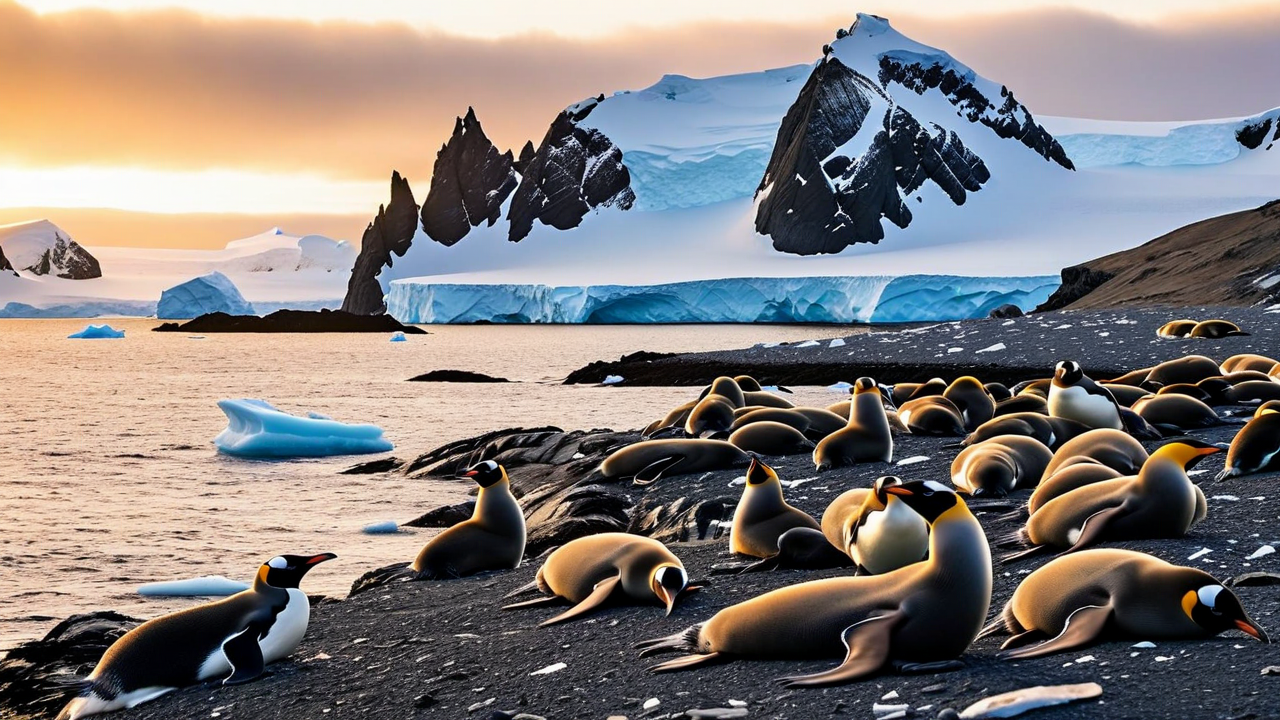
What is here instead is one of the great wildlife concentrations on Earth and, since 2019, a UNESCO World Heritage site covering 67,000 km² of land and sea. The surrounding marine reserve — expanded in 2022 — is around 1.6 million km², and it protects a third of the world's king penguins, the largest breeding population of wandering albatrosses anywhere, and southern elephant seals in the hundreds of thousands.
What this page is for
Not a trip plan — there is no trip to plan for most people. It is an account of a place that is administered like a country, protected like a park, and reachable like a research posting.
If you can go
The Marion Dufresne rotation from Réunion, roughly 28 days, around €9,000–12,000, applications open a year ahead and places are few. That is genuinely the only way.
Best for
Anyone whose interest is seabirds, marine mammals or polar logistics — and anyone who collects the last genuinely inaccessible places.
The realistic alternative
South Georgia and the Falklands are reachable by expedition cruise and hold much of the same wildlife. Kerguelen does not do that, by design.
🏷️ TAAF, and What It Governs
The territory was created in 1955, when France separated these lands from Madagascar's administration. The Îles Éparses were added in 2007 as a fifth district. It is governed by a préfet administrateur supérieur whose headquarters are not on the territory at all but in Saint-Pierre on Réunion, 3,400 km from Kerguelen.
Not a country
It has an ISO code (TF), an internet domain (.tf), a flag and stamps, but no citizens and no elections — there is nobody to elect anyone. It is an overseas territory (TOM) under direct state administration.
Nobody is born here
There is no maternity provision and no residency. Everyone present is on a fixed-term posting, typically four months to a year, and everyone leaves.
Not in the EU
Like French Polynesia, the TAAF is an Overseas Country and Territory associated with the EU rather than part of it — but it uses the euro anyway.
The flag
The French tricolour in the canton with the TAAF letters and a compass rose on blue — adopted in 2007, and one of the very few flags of a place with no population to fly it.
Adélie Land's odd status
France claims it, but the Antarctic Treaty of 1959 freezes all territorial claims south of 60°S. The claim exists, is not recognised or rejected, and cannot be acted on.
Why France keeps it
Three reasons, in order: a vast exclusive economic zone with a valuable fishery, scientific stations that give France a seat at the Antarctic table, and the strategic value of ocean and satellite tracking sites in the southern Indian Ocean.
🗺️ The Five Districts
There is no unifying geography here beyond isolation. The districts are separated by thousands of kilometres of the roughest ocean on the planet, and by more than 60 degrees of latitude between the tropical Éparses and Adélie Land.
Kerguelen · 7,215 km²
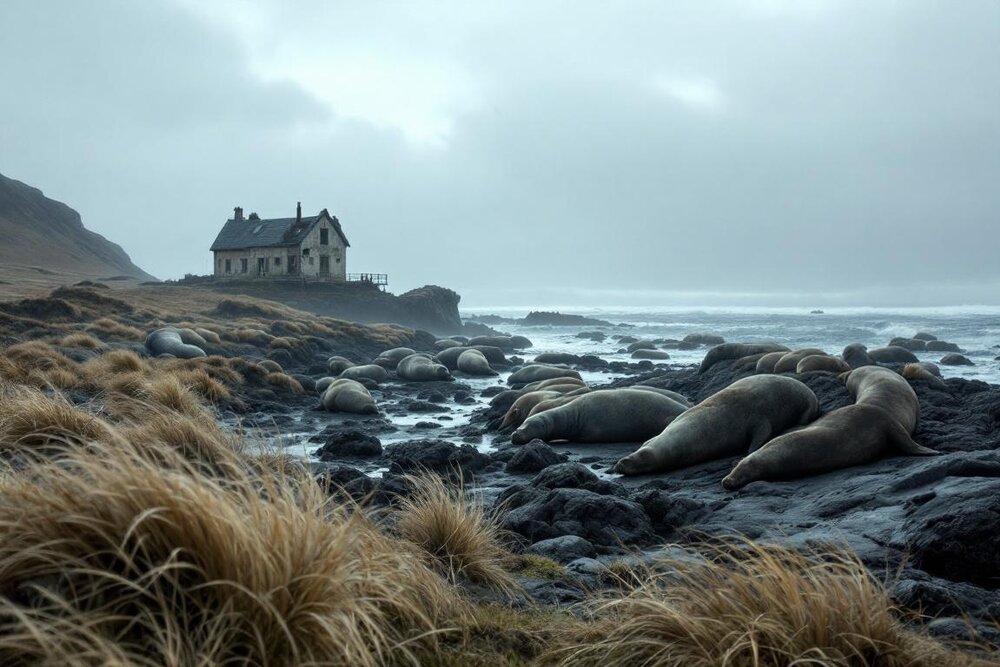
The largest by far — the size of Central Bohemia — with 300 satellite islets, deep fjords, the Cook Ice Cap and Mont Ross at 1,850 m. Base: Port-aux-Français, about 45–100 people.
Crozet · 352 km²
Five islands 1,400 km west of Kerguelen. Base Alfred Faure on Île de la Possession, about 20–30 people. Île aux Cochons holds what was once the largest king penguin colony on Earth.
Saint-Paul & Amsterdam · 61 km²
Two volcanic islands 1,300 km north of Kerguelen, and the mildest of the subantarctic districts. Base Martin-de-Viviès, about 20–30 people. Saint-Paul is a drowned crater you can sail into.
Adélie Land · 432,000 km² claimed
A wedge of East Antarctica between 136°E and 142°E. Station Dumont d'Urville on Île des Pétrels, plus the inland Concordia station shared with Italy. Where March of the Penguins was filmed.
Îles Éparses · 44 km²
Five tropical islands around Madagascar: Europa, Bassas da India, Juan de Nova, Glorioso and Tromelin. Uninhabited except for small military detachments and a weather station, and all of them claimed by Madagascar, Mauritius or the Comoros.
The ocean between
The Southern Ocean's Roaring Forties and Furious Fifties. Kerguelen sits at 49°S in a latitude band where the wind circles the planet unobstructed by any land — the reason the weather is what it is.
🗺️ Where These Places Are
Kerguelen is roughly equidistant from Africa, Australia and Antarctica, and there is no inhabited land within 3,000 km. It is one of the most remote inhabited points on the planet — the nearest permanently settled place is Réunion.
Réunion → Crozet
About 2,900 km, roughly six days by ship. The first stop on the Marion Dufresne rotation.
Crozet → Kerguelen
1,400 km, two to three days.
Kerguelen → Amsterdam
1,300 km north, and a noticeable change of climate — Amsterdam is fifteen degrees warmer.
Hobart → Dumont d'Urville
2,700 km south, by the icebreaker L'Astrolabe, roughly six days through the ice. Adélie Land is supplied from Australia, not Réunion.
📜 Discovery, Sealers and Shipwrecks
The subantarctic islands were found late, exploited immediately and abandoned repeatedly. Almost every attempt to settle them ended in death, bankruptcy or evacuation, and their history is a sequence of ruined stations and unmarked graves.
Yves de Kerguelen · 1772
Sighted the archipelago through fog, never landed, returned to France claiming he had found the fertile southern continent, and was court-martialled and imprisoned when a second expedition found the truth. Cook, arriving in 1776, renamed them the Islands of Desolation.
Crozet · 1772
Found by Marc-Joseph Marion du Fresne's expedition weeks earlier and named after his second-in-command, Julien Crozet. Marion du Fresne himself was killed in New Zealand later the same year.
The sealers · 1800–1900
British and American sealing gangs stripped the islands of fur seals and then elephant seals for oil, working from open boats and living in stone huts. Populations that had numbered in the millions were reduced to almost nothing; the remains of try-pots and huts are still on the beaches.
Saint-Paul's lobster catastrophe · 1930
A French company left a small crew on Saint-Paul to run a crayfish cannery over winter. Supply failed. Of the seven left behind, four died of scurvy and beriberi; a baby was born and died. The survivors were found in 1931. The ruins of the cannery are still there and the episode is called Les Oubliés de Saint-Paul — the forgotten of Saint-Paul.
Amsterdam's cattle
Cattle released in 1871 by a would-be settler bred into a feral herd of over 2,000 that stripped the island's vegetation for a century. Most were culled in the 1980s and 90s and the last were removed in 2010.
The Éparses
Guano workings, a lighthouse, and the 1761 wreck of the slave ship Utile on Tromelin, whose survivors — sixty enslaved Malagasy people abandoned by the French crew — lived on a sandbank for fifteen years before eight were rescued in 1776.
🕰️ Stations, Claims and Protection
The modern territory is a creation of the twentieth century's two great southern projects: national claims in Antarctica, and the scientific infrastructure built to support them.
Adélie Land · 1840
Jules Dumont d'Urville landed on an islet off the coast, claimed it for France and named it after his wife Adèle. The penguin, discovered on the same voyage, was named after her too.
Permanent occupation · 1949–56
France established Port-aux-Français on Kerguelen in 1950, Alfred Faure on Crozet in 1963, and Dumont d'Urville in Adélie Land in 1956 for the International Geophysical Year. The TAAF was constituted as a territory in 1955.
The Antarctic Treaty · 1959
France was an original signatory. The treaty suspends all territorial claims, bans military activity and mining, and reserves the continent for science. Adélie Land's claim is frozen in place — asserted, unrecognised, and unenforceable.
The rocket range
France launched sounding rockets from Kerguelen between 1962 and 1994 — over 150 of them — studying the upper atmosphere. The launch pads are still there.
Concordia · 2005
A French–Italian station at 3,233 m on the Antarctic plateau, one of the coldest inhabited places on Earth (−80 °C recorded), used for astronomy, ice cores and — because it is as isolated as a spacecraft — ESA research on long-duration human spaceflight.
Protection · 2006 to 2022
A nature reserve created in 2006, UNESCO World Heritage listing in 2019, and successive expansions of the marine protected area to around 1.6 million km² — one of the largest in the world.
🏔️ Kerguelen — The Desolation Islands
The largest district and the strangest: 7,215 km² of black basalt, glaciers, fjords and tussock, with a coastline so indented that a landmass the size of Central Bohemia has more shoreline than metropolitan France. Cook called them the Islands of Desolation after two days there and the name stuck.
Port-aux-Français
The main base on the Gulf of Morbihan: a scatter of prefabricated buildings, a chapel, a bar, a small hospital and a runway that is not used because nothing flies here. Between 45 and 100 people depending on season.
Mont Ross
1,850 m, first climbed in 1975, and one of the least-climbed significant peaks on Earth — fewer ascents than most 8,000 m Himalayan summits, because getting to the base of it is harder than the climb.
The Cook Ice Cap
About 400 km² of glacier on the western side, and shrinking fast — it has lost around a fifth of its area since the 1960s and is among the clearest signals of Southern Ocean warming.
Kerguelen cabbage
Pringlea antiscorbutica, endemic, rich in vitamin C, and the reason nineteenth-century sealers survived winters here. Cook's crew ate it deliberately. It is now protected.
The rabbits and the reindeer
Introduced species that transformed the islands: rabbits from 1874 that stripped vegetation across huge areas, plus feral cats, rats, mice, reindeer and mouflon. Eradication programmes have cleared several islets and the mainland problem remains.
Getting there
Only the Marion Dufresne, four rotations a year from Réunion. There is no airstrip in service, no harbour for large ships, and everything comes ashore by barge and helicopter.
🐧 Crozet — The Penguin Islands
Five islands in two groups, 1,400 km west of Kerguelen, and the single most important seabird site in the Indian Ocean. The base, Alfred Faure, sits above Baie du Marin on Île de la Possession with twenty to thirty people and a king penguin colony a walk away.
The Île aux Cochons colony
Once the largest king penguin colony in the world — an estimated two million birds in the 1980s. Satellite images in 2018 showed it had collapsed by nearly 90%, and nobody is certain why: probably a combination of a strong El Niño pushing food further south, disease, and invasive species. It is one of the most alarming wildlife findings of recent decades.
Baie du Marin
The accessible colony, a few hundred metres from the base, with tens of thousands of king penguins. Scientists have monitored individual birds here for decades using implanted transponders and buried antennas so that the colony is not disturbed.
Albatrosses
Crozet holds significant populations of wandering, sooty and grey-headed albatrosses, tracked by satellite tags since the 1980s — work that produced much of what is known about albatross foraging and about longline fishing mortality.
Île de l'Est and Île des Pingouins
Never permanently occupied, never invaded by rats or cats, and therefore among the least-disturbed islands on Earth. Landing is essentially prohibited.
The wrecks
The Tamaris was wrecked here in 1887; the crew tied a message to the leg of a giant petrel, which was shot in Western Australia seven months later. The message arrived; the men did not survive.
Weather
Rain or sleet on around 300 days a year, wind above 100 km/h routinely, and a mean temperature of about 5 °C. Nothing here is comfortable.
🌋 Amsterdam and Saint-Paul
The northern outliers, 1,300 km from Kerguelen and 3,000 km from anywhere else, at 37–38°S — subtropical rather than subantarctic, and the only district where it is genuinely mild.
Amsterdam Island
58 km², a volcano rising to 881 m, with a plateau of peat bog and the last remnants of a Phylica cloud forest that once covered it. Base Martin-de-Viviès, about 20–30 people.
The Amsterdam albatross
Diomedea amsterdamensis, found nowhere else on Earth, and one of the rarest birds in the world — around 50 breeding pairs, all on one plateau on one island. Every individual is known and monitored.
Saint-Paul
8 km² and 85 km south: a drowned volcanic crater whose seaward wall has collapsed, so ships can sail into the caldera itself. Uninhabited, visited rarely, and the site of the 1930 crayfish disaster.
The subantarctic fur seals
Amsterdam holds a large population, recovered from near-extermination by sealers, and a scientific programme that has run continuously for decades.
The atmospheric observatory
Amsterdam has one of the world's cleanest air-sampling sites — thousands of kilometres from any industry — and its CO₂ and methane records are a baseline reference in global climate science.
The cattle removal
Feral cattle stripped the island for a century; culling from the 1980s and full removal by 2010 has allowed the Phylica forest and the peat bog to begin recovering. It is one of the more successful island restorations anywhere.
🧊 Adélie Land
France's Antarctic claim: a wedge of the East Antarctic ice sheet between 136°E and 142°E, running from the coast to the South Pole. 432,000 km² of it, almost all under ice up to 4 km thick, and legally frozen by the Antarctic Treaty in every sense.
Dumont d'Urville
The coastal station on Île des Pétrels in the Pointe Géologie archipelago, occupied since 1956, with 25–30 people in summer and about 20 wintering. Supplied from Hobart by the icebreaker L'Astrolabe.
March of the Penguins
The 2005 film was shot at the emperor penguin colony beside the station. Emperors breed on the sea ice in winter darkness at −40 °C, the male incubating a single egg on his feet for two months without eating.
Concordia
1,100 km inland at 3,233 m, run jointly with Italy since 2005. Winter temperatures around −65 °C and a record of −84.6 °C; three months of total darkness; a wintering crew of thirteen who cannot be evacuated for nine months of the year.
The EPICA ice core
Drilled at Concordia, and it recovered a continuous climate record going back 800,000 years — eight glacial cycles, and the single most important dataset in palaeoclimate. A newer project is drilling for 1.5 million years.
ESA and spaceflight
Concordia's isolation, confinement and hypoxia make it the closest analogue on Earth to a long-duration space mission, and ESA runs human-factors research there for Mars planning.
The abandoned airstrip
France attempted to build a runway at Dumont d'Urville in the 1980s by dynamiting islets — destroying penguin colonies in the process. It caused an international outcry, was never completed, and a storm destroyed the works in 1994. Cousteau campaigned against it.
🏝️ The Scattered Islands
The fifth district, and the only warm one: five tiny tropical islands around Madagascar, holding a combined 44 km² of land and about 640,000 km² of exclusive economic zone. That ratio is the point of them.
Europa
The largest at 30 km², a coral island in the Mozambique Channel with intact mangroves, one of the western Indian Ocean's most important green turtle nesting sites, and huge seabird colonies. A detachment of French troops and a weather station.
Juan de Nova and Glorioso
Both with small military detachments, both former guano workings, and both surrounded by reefs in very good condition precisely because nobody is allowed near them.
Bassas da India
A submerged atoll that disappears entirely at high tide. Uninhabitable, ungarrisoned, and claimed anyway.
Tromelin
A sandbank 700 km east of Madagascar with a weather station — and the site of the Utile wreck of 1761, where sixty enslaved Malagasy people were abandoned and survived fifteen years before eight were rescued. Excavated by archaeologists in the 2000s and now a serious subject of French memory politics.
The disputes
Madagascar claims Europa, Bassas da India, Juan de Nova and Glorioso; the Comoros also claim Glorioso; Mauritius claims Tromelin. The UN General Assembly has called on France to negotiate. France has not.
Why they matter
Forty-four square kilometres of sand generate an EEZ larger than France itself, in fishing grounds and possible hydrocarbon basins. This is the clearest example anywhere of how small islands buy large oceans.
🔬 What the Bases Actually Do
Everyone on the territory is there to keep instruments running. The TAAF exists as a scientific platform, and the programmes are long — some datasets here are among the longest continuous records in their fields anywhere on Earth.
Seabird monitoring
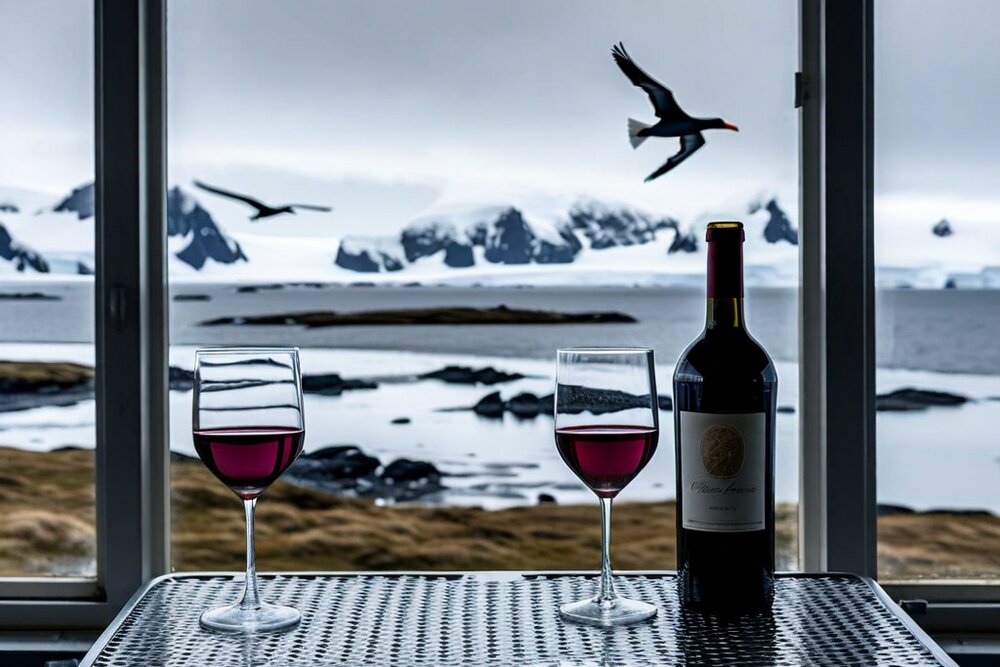
Continuous since the 1960s, with individually ringed birds followed for their whole lives — wandering albatrosses live over fifty years, so a single bird can span three generations of researchers. This work is the basis of most global knowledge on albatross demography.
Climate and atmosphere
The Amsterdam Island air-sampling station, the Kerguelen upper-atmosphere programme, and the Concordia ice cores. Together they supply baseline records that anchor global climate datasets.
Oceanography
Elephant seals fitted with sensors dive to 2,000 m and return temperature and salinity profiles from parts of the Southern Ocean that no ship reaches in winter. A significant share of what is known about that ocean was collected by seals.
Geophysics and seismology
Kerguelen sits on an enormous submarine plateau and hosts seismic and magnetic observatories that fill a huge gap in global coverage.
Who goes
Scientists on contract, plus VSC volunteers — young French graduates on twelve-month civic service postings who do much of the technical and logistical work. It is the standard way into a career in polar science in France.
The winterers
A hivernage is roughly a year, with no way off between rotations. Selection includes psychological assessment. People come back changed, and a fair number come back repeatedly.
🦭 Wildlife — The Reason It Is Protected
There are no land mammals native to any of the subantarctic districts, no trees, and almost no insects that can fly — the wind removes them. What there is instead is one of the densest concentrations of marine vertebrates anywhere on the planet, all of it living on the sea and coming ashore only to breed.
King penguins
The territory holds around a third of the world population. Colonies at Crozet and Kerguelen run to hundreds of thousands of birds. They do not build nests — the egg is carried on the feet — and the breeding cycle takes over a year, so a pair can raise at most two chicks in three years.
Southern elephant seals
Kerguelen holds one of the largest breeding populations on Earth. Bulls reach four tonnes and six metres, hold harems of dozens of females, and fight to serious injury. They dive to 2,000 m and spend eight months of the year at sea.
Wandering albatross
A 3.5 m wingspan, the largest of any living bird. Crozet and Kerguelen hold the world's most important populations. A single foraging trip can cover 10,000 km, and a bird may fly six million kilometres in a lifetime.
Fur seals
Subantarctic and Antarctic fur seals, both hunted to near-extinction in the nineteenth century and both recovered — Amsterdam and Crozet now hold large colonies.
Emperor penguins
In Adélie Land only, breeding on the sea ice through the Antarctic winter — the only bird that does. The colony at Pointe Géologie has been monitored since 1952 and is declining as the fast ice becomes less reliable.
Killer whales
Resident pods at Crozet and Kerguelen, some of which have learned to take Patagonian toothfish off longlines — a behaviour that costs the fishery real money and has produced an unusual research collaboration between scientists and fishermen.
🐀 The Invasive Species Problem
The single greatest threat to these islands is not fishing or climate but animals brought here deliberately or accidentally over two centuries. On islands where ground-nesting birds evolved with no predators at all, a rat is a catastrophe.
What was introduced
Rabbits (Kerguelen, 1874), rats, house mice, feral cats, reindeer, mouflon and sheep on Kerguelen; cattle and mice on Amsterdam; cats and rats on parts of Crozet. Nearly all were released on purpose, as food or for sport.
What they did
Rabbits stripped the vegetation from large parts of Kerguelen, changing soil and hydrology. Cats take an estimated large number of petrels annually. Mice on some subantarctic islands have learned to eat albatross chicks alive — a behaviour first documented on Gough Island and now a global concern.
Eradication
Several Kerguelen satellite islands have been cleared of rats and rabbits, and the Amsterdam cattle removal completed in 2010. These are among the more ambitious island restoration projects anywhere, and they are slow, expensive and largely invisible.
Biosecurity
Everyone landing anywhere in the reserve goes through equipment inspection, boot cleaning and bag checks. A single seed in a Velcro strap is a genuine risk. This is why access is restricted at all.
The reindeer question
Kerguelen's introduced reindeer are a European population living in the southern hemisphere, of some genetic interest, and ecologically damaging. What to do about them is an open argument.
Why it matters beyond here
These islands are the reference sites for what a Southern Ocean ecosystem looks like. Every invasive removed restores a control condition that science elsewhere depends on.
🏛️ UNESCO and the Marine Reserve
In 2019 UNESCO inscribed the French Austral Lands and Seas on the World Heritage list — Crozet, Kerguelen, Saint-Paul and Amsterdam and 60 small islands, covering 67,300 km² and described as one of the largest concentrations of birds and marine mammals in the world.
The nature reserve
Established in 2006 and successively extended. The whole terrestrial area of the subantarctic districts is reserve, with strict zoning: most islands cannot be landed on at all, and even scientists need permits by site.
The marine protected area
Extended in 2022 to around 1.6 million km² — the largest in France and among the largest anywhere. Roughly a third of it is fully no-take.
What it protects
The Kerguelen Plateau's productive waters, the foraging grounds of the albatrosses and penguins, and the toothfish stock that funds much of the administration.
Enforcement
By patrol vessel, satellite tracking of licensed vessels, and observers aboard every legal fishing boat. Illegal fishing in the 1990s was severe; sustained enforcement largely stopped it, which is a genuinely rare success story.
The Éparses reserves
Europa, Bassas da India, Glorioso and Juan de Nova are also reserves, with the Glorioso islands part of a marine national park since 2012.
Visiting a World Heritage site you cannot see
The listing has no visitor infrastructure and never will. It is protection by inaccessibility, and it is deliberate policy rather than an accident of remoteness.
🐟 The Toothfish Economy
The TAAF has essentially one industry, and it pays for almost everything: a tightly regulated fishery in the waters around Kerguelen and Crozet for Patagonian toothfish, sold worldwide as Chilean sea bass, and for icefish and lobster.
The value
Licence fees and taxes on the fishery fund a large share of the territory's budget. Seven French vessels hold licences, all with observers aboard and satellite monitoring, and the quota is set on scientific advice.
Why it works
Because the fishery is small, the licences are few, the enforcement is real and the stock assessments are independent. It is frequently cited as one of the better-managed deep-water fisheries in the world — a genuinely unusual claim.
The illegal fishing war
Through the 1990s and 2000s, pirate longliners from several flags plundered the zone. French naval patrols, ship seizures and eventually the sinking of a few reputations largely ended it. The chase of the Viarsa across the Southern Ocean in 2003 lasted 21 days and 7,200 km.
The lobster
Jasus paulensis, the Saint-Paul rock lobster, fished under a single licence around Amsterdam and Saint-Paul. It is the reason there was ever a cannery on Saint-Paul, and the reason people died there in 1930.
Killer whales as competitors
Orcas and sperm whales at Crozet strip toothfish from the lines as they are hauled — depredation that costs a substantial share of the catch and has driven both technical countermeasures and detailed behavioural research.
Stamps
Genuinely a revenue line. TAAF postage stamps are collected worldwide, the territory issues them in careful annual programmes, and philately is a real contributor to the budget of a place with no taxpayers.
🌦️ Climate
There are three climates here and one of them is uninhabitable. What links the subantarctic districts is not cold — Kerguelen is milder than Prague in winter — but wind, and its unrelenting constancy.
Kerguelen and Crozet
Mean annual temperature about 4–5 °C, ranging roughly from −1 to 12 °C. Rain, sleet or snow on some 300 days a year. Wind averages 35 km/h and exceeds 150 km/h in gusts regularly; the record is above 200.
Why the wind
At 46–50°S there is no land at all around the globe to slow the westerlies. The Roaring Forties and Furious Fifties circle the planet unobstructed, and Kerguelen sits directly in them.
Amsterdam
At 37°S it is oceanic and mild: 13–17 °C year-round, frequent fog and rain, and no frost. The pleasant district, relatively speaking.
Adélie Land
The coast averages around −11 °C with katabatic winds pouring off the ice sheet that make it among the windiest places on Earth. Concordia inland reaches −80 °C and has three months of continuous darkness.
The Éparses
Tropical, 25–30 °C, cyclone-prone from November to April.
What is changing
The Cook Ice Cap is retreating rapidly, sea temperatures around Kerguelen are rising, the emperor colony in Adélie Land is declining with the fast ice, and the Île aux Cochons king penguin collapse remains unexplained. These islands are instruments as much as places.
🚢 The Marion Dufresne
One ship holds the entire territory together. The Marion Dufresne II — 120 m, ice-strengthened, part supply vessel and part oceanographic research ship — sails from Le Port on Réunion four times a year on a rotation of about 28 days, and without it the bases could not exist.
The rotation
Réunion to Crozet, Kerguelen, Amsterdam and back, delivering fuel, food, vehicles, scientific equipment and the incoming personnel, and taking off the people finishing their postings. Everything comes ashore by barge and helicopter because there are no docks.
The relève
The handover. Departing winterers and arriving staff overlap for a few days; the ship is the only company from outside for months either side. It is the emotional structure of the whole territory's year.
The research role
Between rotations the ship works as a French oceanographic vessel, including deep sediment coring — it holds records for the longest sediment cores ever recovered.
Passengers
A limited number of paying passengers — usually around a dozen — travel on each rotation. They are accommodated as guests of the territory, follow the ship's programme, and go ashore only where and when permitted.
L'Astrolabe
The separate ice-going patrol and supply vessel that serves Adélie Land from Hobart, jointly operated by the French polar institute and the French Navy.
When it fails
Weather routinely delays landings; a rotation that cannot land at Crozet simply carries the cargo back. Bases are stocked for a year for exactly this reason.
🎫 Can You Actually Go?
For almost everyone the honest answer is no. There is no tourism to the TAAF in any ordinary sense — no flights, no ferries, no hotels, no cruise itineraries that call at Kerguelen. There is exactly one route, it is small, and it is oversubscribed.
The Marion Dufresne passage
Around a dozen paying passengers per rotation, four rotations a year. Roughly 28 days from Réunion, calling at Crozet, Kerguelen and Amsterdam. Applications go to the TAAF administration and open about a year ahead.
What it costs
In the region of €9,000 to €12,000 per person for the round trip, plus the flight to Réunion. You are a guest of the territory, not a customer of a cruise line, and the price reflects a berth on a working ship rather than a holiday.
What you actually see
Landings at bases and a small number of permitted sites, subject entirely to weather and to the ship's cargo priorities. You may spend a day at Crozet or you may not land there at all. Nobody is promised anything.
Yachts
A handful of private yachts reach Kerguelen each year with prior authorisation from the préfet — a serious Southern Ocean passage, and permission is not automatic. This is the only alternative route and it is for experienced high-latitude sailors only.
Adélie Land and the Éparses
Effectively closed. Adélie Land is reached only by L'Astrolabe from Hobart, for programme personnel; the Éparses are military sites with occasional scientific access. Neither takes visitors.
Working there instead
The realistic route in for most people who genuinely want to go: a scientific or technical contract, or for young French graduates the VSC civic-service scheme. It requires French, a relevant skill and a year of your life.
🏠 Life on a Base
Twenty to a hundred people, one building complex, no way out, and between four months and a year to get through. French station life has a distinct character, and a surprising amount of it is about food and ritual.
The routine
Work is instrument maintenance, data collection, cooking, generators, water, waste, construction. Everyone has a technical job and everyone also has a rota job. Weekends exist and are largely a formality.
The cantine
A proper kitchen with a professional cook, three courses, cheese and wine — French bases treat the table as morale infrastructure, and they are right. Food arrives once or twice a year and the menu evolves accordingly.
Ritual
Midwinter dinner in June, base traditions, initiation ceremonies for the first crossing of the fortieth parallel, and a bar run by the residents. Isolation without ritual goes badly and everyone knows it.
Communication
Satellite internet, limited and shared. Contact with home is possible and not casual. Many winterers describe the enforced narrowing of the world as the thing they most remember and most miss afterwards.
Medicine
One doctor per base, who is also the dentist, the surgeon and the psychologist. Serious cases at Kerguelen wait for the ship; in Adélie Land in winter, there is no evacuation at all for nine months.
What it does to people
A recognised syndrome of return: coming back to noise, choice and crowds after a year of twenty faces is harder than the winter. A significant proportion of winterers go back.
🍽️ Food at the End of the World
There is no local cuisine here because there is no local population. What there is instead is French institutional cooking under extreme constraints — everything shipped once or twice a year, nothing grown, and a cook whose job is to make the twelfth month taste different from the first.
What is local
The Saint-Paul rock lobster, and toothfish and icefish from the licensed vessels. Occasionally a fisheries observer brings something aboard. That is the entire list.
What is not
Everything else: frozen and dried goods for a year, tinned everything, long-life milk, and fresh fruit and vegetables that last about three weeks after each rotation and are then a memory.
The fresh window
The days after the ship arrives are the culinary high point of the year — salad, fruit, fresh bread with real yeast. Base cooks plan the entire year around the decline from that peak.
Kerguelen cabbage
Edible, endemic and rich in vitamin C. It saved sealers' lives in the nineteenth century and is now strictly protected — nobody eats it any more, which is the correct outcome.
Wine and cheese
Both arrive by the pallet and both are regarded as non-negotiable. A French Antarctic base without a cheese course would be a management failure.
Hunting and fishing
Prohibited across the reserve, with the narrow exception of introduced species control. You do not eat the wildlife here; that is the whole point of the place.
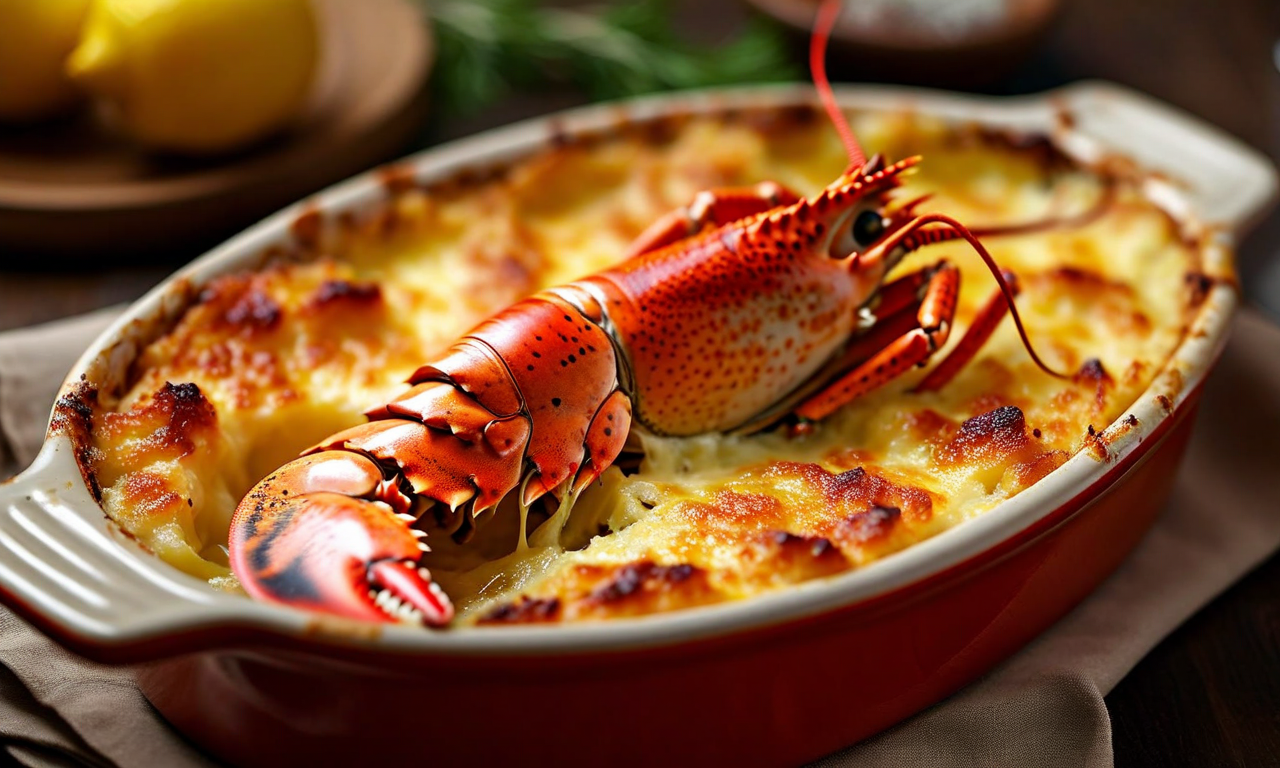
Gratin de langouste
Baked rock lobster · serves 4 · 50 minutes
Ingredients: 2 rock lobster tails (or 1 large lobster), cooked and the meat cut into chunks; 40 g butter; 40 g flour; 500 ml milk; 100 ml cream; 100 g grated Gruyère or Comté; 1 shallot; 50 ml dry white wine; a pinch of cayenne; nutmeg; breadcrumbs; salt and white pepper.
Method: Soften the shallot in half the butter, add the wine and reduce almost away. Make a béchamel with the remaining butter, the flour and the milk, cook it out for five minutes, then stir in the cream, half the cheese, the cayenne and a scrape of nutmeg. Fold in the lobster and the shallot, season carefully, spoon into a dish, top with the rest of the cheese and a little breadcrumb, and bake at 200 °C for 15–20 minutes until blistered.
💡 Do not cook the lobster twice — it goes to rubber. It should be poached lightly, cooled, and only warmed through under the grill.
Soupe de poisson australe
Southern fish soup · serves 6 · 1 hour
Ingredients: 1 kg firm white fish trimmings and bones (toothfish, icefish, cod or monkfish); 1 fennel bulb; 2 leeks; 1 onion; 3 tomatoes; 3 cloves garlic; a strip of orange zest; a pinch of saffron; 100 ml white wine; 2 tbsp olive oil; bay and thyme; salt. To serve: croutons, rouille, grated cheese.
Method: Sweat the sliced vegetables and garlic in oil without colouring, ten minutes. Add the fish, the wine, the tomatoes, orange zest, saffron and herbs, cover with water and simmer 35 minutes. Pass the whole lot through a food mill or blend and sieve hard, pushing everything through. Reheat, correct the salt, and serve very hot with croutons and rouille.
💡 The point is to press every scrap through the sieve — a thin, clear fish soup here is a failure. This is Marseille technique applied to whatever the Southern Ocean provides.
🍷 The Wine Question
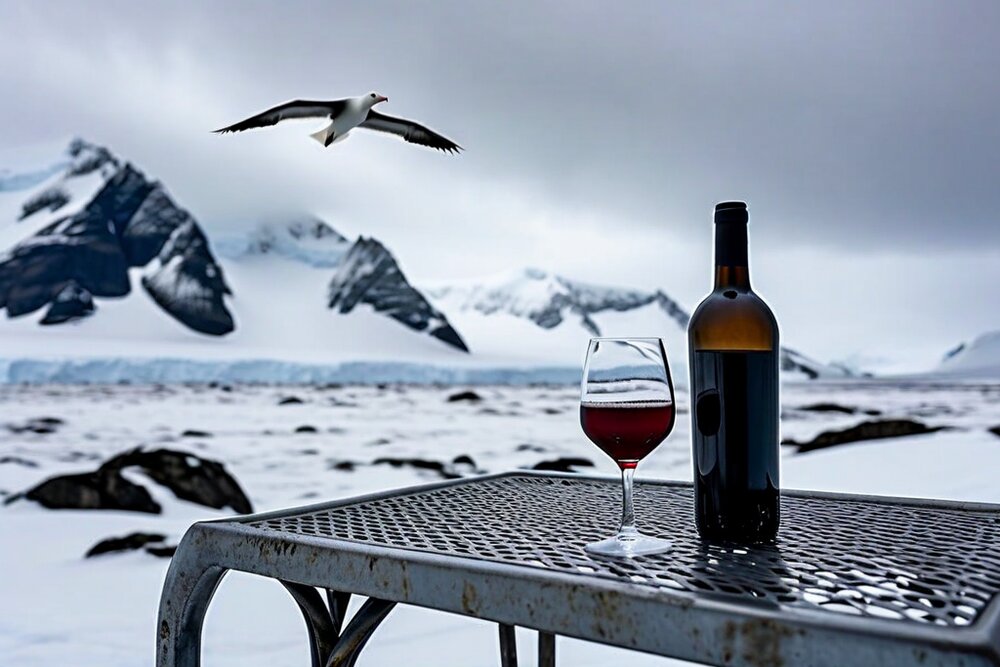
There is nothing to distil, nothing to brew and nothing to ferment on any of these islands. Everything drinkable arrives by ship — and a French base treats that supply chain with the seriousness it deserves.
The allocation
Wine, beer and spirits are shipped in with the annual resupply and issued through the base bar. Quantities are finite and the arithmetic of making them last a year is a well-practised skill.
The base bar
Every station has one, run by the residents themselves on a rota, and it is the main social space. Midwinter, birthdays and departures all happen there.
Water
From glacial melt and rainfall at Kerguelen and Crozet — the water is superb and there is a great deal of it. In Adélie Land, water is made by melting snow, which costs fuel and is therefore rationed.
Coffee
Instant for most of the year, and a matter of some feeling. A working espresso machine at a subantarctic base is a genuine institution.
Rules
French law. Alcohol on the bases is managed by the district head, and drinking is a recognised risk in confined overwintering populations — the subject is handled seriously rather than as a joke.
No local drink
This is the only entry in this factbook where the honest answer to "what do they drink here" is "whatever came on the last boat".
📮 Stamps, Passports and Symbols
For a territory with no citizens, the TAAF is unusually productive of the paraphernalia of statehood — and one of those artefacts genuinely pays the bills.
The stamps
The TAAF issues its own postage, carefully designed around wildlife, exploration history and stations, and sold to collectors worldwide. Philatelic revenue is a real and non-trivial line in the territory's budget.
The post offices
Port-aux-Français, Alfred Faure, Martin-de-Viviès and Dumont d'Urville all have one. Mail is stamped with the base cachet and travels out on the next rotation, which can take months — part of the appeal.
The passport stamp
Passengers and personnel can have their passport stamped at each district. It is the closest thing to a souvenir the territory offers and it is why some collectors go at all.
The .tf domain
The territory's internet suffix, sold commercially, and used far more by companies that like the letters than by anything connected to the islands.
The flag and the coat of arms
Adopted in 2007, with the tricolour, the TAAF letters and a compass rose. There is nobody to salute it, which does not stop it flying at every base.
Currency
The euro, though there is almost nothing to buy. The base shops sell essentials and souvenirs on account, and cash is largely pointless.
👤 Notable Figures
Yves-Joseph de Kerguelen-Trémarec (1734–1797)
Found the archipelago in 1772, reported it as a fertile continent without landing, was court-martialled and imprisoned for six years when the truth emerged, and had the islands named after him anyway.
Jules Dumont d'Urville (1790–1842)
Claimed Adélie Land in 1840, named it and the penguin after his wife, and died two years later in France's first major rail disaster. One of the great scientific navigators.
Marc-Joseph Marion du Fresne (1724–1772)
Discovered the Crozet islands and gave his name to the supply ship that now serves them. Killed in New Zealand months later.
Paul-Émile Victor (1907–1995)
Founder of the French polar expeditions and the architect of France's modern presence in Adélie Land. Ethnographer, explorer and administrator, and the reason the programme exists.
Alfred Faure (1922–1962)
The first head of the Crozet base, who died in post; the station carries his name.
Luc Jacquet (b. 1967)
Director of March of the Penguins, filmed at Dumont d'Urville. The film brought Adélie Land to an audience of tens of millions and won an Academy Award.
The winterers
There is no notable-people list that honestly represents this territory. Its history is made by several thousand largely anonymous people who spent a year each keeping instruments running, and whose names appear in dataset metadata rather than in books.
The albatross "Wisdom" analogue
Individual wandering albatrosses at Crozet have been followed since the 1960s and some ringed birds have been recorded for over forty years — a scale of individual biography no human on the territory can match.
🇨🇿 From the Czech Republic
There is no route from Prague to the TAAF in the sense of a journey you can book. What there is, if you have a berth on the Marion Dufresne, is a flight to Réunion and then four weeks at sea. Everything below assumes you have already been accepted.
Getting to Réunion
Prague to Saint-Denis de la Réunion via Paris on Air France, Air Austral or French Bee, about 15–18 hours with one connection. Returns typically 18,000–30,000 Kč. Réunion is a French department, so an ID card technically suffices, though a passport is essential for the onward voyage.
Time difference
Réunion is +3 hours on Czech winter time, +2 in summer. Kerguelen keeps the same time as Réunion despite being far to the south, which makes the light schedule strange for the first week.
Documents
A passport with plenty of validity, and the authorisation issued by the TAAF administration — which functions as your visa for a territory that has no border post.
Health
A full medical clearance is required before boarding. There is a doctor on the ship and one per base, and there is no evacuation from Crozet or Kerguelen except by the ship itself. Dental work should be finished before you go — genuinely.
Insurance
Standard travel insurance will not cover this. You need a policy that explicitly covers remote maritime travel and repatriation from the Southern Ocean, and you should read the exclusions rather than assume.
Czech consular cover
There is no Czech representation anywhere in the region; the accrediting mission for Réunion and the TAAF is the Czech Embassy in Paris. Register in DROZD before departure — if there is one destination in this factbook where that is not a formality, it is this one.
🧭 Practical Notes
What to bring
Proper foul-weather sailing kit, not ski clothing: waterproof shell and trousers, layers, gloves, hat, and rubber boots that come to the knee. Landings are wet, the wind is constant, and the ship supplies nothing personal.
Biosecurity
Every item of outer clothing, every boot and every bag is inspected and cleaned before landings. Velcro, boot treads and rucksack seams are the classic seed carriers. Bring gear that is new or scrupulously clean.
Seasickness
The route crosses the Roaring Forties both ways. The Marion Dufresne is stable for her size and it is still a rough passage. Take medication, take it early, and take enough for four weeks.
Money and communication
The euro, though there is almost nothing to spend it on. Satellite communication only, expensive and shared; assume you are largely offline for a month and tell people at home that.
Electricity
230 V, French sockets, so no adapter from Czechia. Bring spare batteries — cold flattens them and there is nowhere to buy any.
Photography
Salt spray, permanent damp and horizontal rain. Weather-sealed bodies, a rocket blower, and far more lens cloths than you think. There is no repair anywhere within 3,000 km.
💰 What It Costs
The voyage
Around €9,000–12,000 (roughly 225,000–300,000 Kč) for the 28-day rotation, full board on the ship. There is no cheaper tier and no shorter option.
Flights
Prague–Réunion return, 18,000–30,000 Kč, plus a few nights on Réunion either side of the sailing dates, which move.
Insurance
Specialist remote-travel cover, expect several thousand crowns and read the Southern Ocean exclusions carefully.
Kit
Serious foul-weather gear from scratch runs 15,000–30,000 Kč if you do not already sail or climb.
Total, realistically
Somewhere from 280,000 Kč upwards for one person, for a voyage on which you may not land at every district and cannot influence the itinerary.
The alternative
A South Georgia expedition cruise from Ushuaia costs roughly the same and delivers far more landings and far more wildlife time — with the difference that South Georgia is a destination and Kerguelen is a supply run you are permitted to join.
🛡️ Risk
There is no crime here in any meaningful sense — the population is small, vetted and known to each other. Every risk is environmental, and the defining feature of all of them is that help is days away at best.
The sea
The passage crosses some of the roughest water on the planet. Small-boat landings through surf onto rock are the most dangerous routine activity in the territory and are cancelled readily.
Weather
Wind above 150 km/h, horizontal sleet, and conditions that change within the hour. Hypothermia is a real risk even in summer because everything is wet and the wind never stops.
Wildlife
Elephant seal bulls are four tonnes, territorial and much faster over short distances than they look. Fur seals bite and will charge. Keep distance — the required distances are also there for the animals' sake.
Evacuation
There is none from Crozet or Kerguelen except the ship. Adélie Land has no evacuation at all for nine months of the year. This is the single most important fact about risk here and it changes how everything else is assessed.
Medical
A doctor at each base and on the ship, with telemedicine support from France. Serious trauma or a cardiac event in a bad week is a life-threatening situation regardless of competence.
Following instructions
On a base or aboard the ship you do what the district head or the master says, without discussion. This is not bureaucracy; it is how a place with no margin operates.
🧭 Visiting Responsibly
If you are among the very few who go, you are entering the largest protected area France has, in a place where a single mistake is disproportionately expensive because there is nothing else there to absorb it.
Biosecurity is the whole thing
One seed, one rat, one insect and decades of restoration work is undone. The inspection regime is strict for a reason and is not negotiable.
Distances from animals
Fixed by the reserve rules and enforced. Do not approach nesting albatrosses, do not walk through penguin colonies, and do not sit down among elephant seals for a photograph.
Nothing leaves
No stones, no bones, no feathers, no plants. Everything you bring, you take. Waste is shipped back to Réunion because there is no other option.
Stay on the route
Vegetation here grows at a rate you can measure in decades. A footpath cut across a cushion plant field will be visible for a very long time.
Respect the working ship
The rotation exists to supply bases and move people, not to show you things. Landings are cancelled for cargo or weather without discussion, and being unhappy about it publicly is the one social offence available to a passenger.
Consider not going
It is a legitimate position. The most useful thing most people can do for these islands is support the fisheries and seabird organisations that work on them, and leave the twelve berths to people whose presence adds something.
🗺️ What a Rotation Looks Like
Days 1–6 · Réunion to Crozet
Southbound across the Forties, the temperature dropping several degrees a day, the first albatrosses appearing behind the ship on about day three.
Days 6–8 · Crozet
Cargo and personnel to Alfred Faure by helicopter, and if weather allows a landing at Baie du Marin with its king penguin colony. This is the district most often missed entirely.
Days 8–16 · Kerguelen
The longest stop by far. Port-aux-Français, cargo operations lasting days, and if the schedule permits, boat excursions in the Gulf of Morbihan and a landing or two on outlying sites.
Days 16–20 · Amsterdam
North into warmer water, cargo at Martin-de-Viviès, and if conditions are exceptional a look at Saint-Paul's flooded crater — rarely landed.
Days 20–28 · Back to Réunion
Northbound, warming, and a decompression that everybody who has done it describes as strange.
What it depends on
Weather, cargo, medical needs and the ship's own schedule, in that order. Passengers are the last priority and are told so clearly in advance, which is the correct arrangement.
🤯 Fascinating Facts
A territory with no citizens
Nobody is born here, nobody lives here permanently, and there are no elections because there is nobody to vote. Between 150 and 310 people are present at any time, all on posting.
Forty-four square kilometres buy 640,000
The five Scattered Islands hold 44 km² of land and generate an exclusive economic zone larger than metropolitan France.
A third of the world's king penguins
The territory's colonies hold roughly a third of the global population — and one colony, on Île aux Cochons, collapsed by nearly 90% between the 1980s and 2018 for reasons still not fully established.
Cook named them Desolation
Kerguelen reported a fertile southern continent; Cook arrived four years later, found bare rock and wind, renamed them the Islands of Desolation, and Kerguelen went to prison.
Seals collect the oceanography
Elephant seals fitted with sensors dive to 2,000 m and return winter data from Southern Ocean regions no research vessel reaches. A large share of what is known about that ocean was gathered by animals.
Eight hundred thousand years of climate
The EPICA ice core drilled at Concordia recovered a continuous atmospheric record covering eight glacial cycles — the reference dataset for the whole field.
An albatross message that arrived
The crew of the wrecked Tamaris tied a note to a giant petrel at Crozet in 1887. The bird was shot in Australia seven months later and the message was read. The men were never found.
Stamps pay the bills
Philatelic sales are a genuine revenue line for a territory with no taxpayers, alongside fishing licences.
A UNESCO site you cannot visit
The 2019 World Heritage inscription covers 67,300 km² with no visitor facilities, no plans for any, and a permit regime designed to keep it that way.
📚 Reading and Watching
Kerguelen, by Jean-Paul Kauffmann
A French journalist's account of the islands and of Kerguelen the man — the best single book on the place, and as much about failure and obsession as about geography.
Les Oubliés de Saint-Paul
The 1930 crayfish-cannery disaster, documented in several French accounts. Four of seven people left for a winter died of scurvy and beriberi within months.
March of the Penguins (2005)
Luc Jacquet's film, shot at Dumont d'Urville over a full Antarctic year. However familiar it has become, the logistics behind it are extraordinary.
Tromelin, l'île des esclaves oubliés
The archaeology of the 1761 wreck and the fifteen-year survival of the abandoned Malagasy captives — excavated in the 2000s and now a substantial body of work.
The TAAF administration's own material
Annual reports, the reserve management plan and the stamp programme are all published and are unusually readable for official documents.
Sea shepherd and the toothfish chase
The 2003 pursuit of the Viarsa across 7,200 km of Southern Ocean and the wider illegal-fishing story is documented in several good long-form accounts.
❓ Common Misconceptions
"It's part of Antarctica"
Only one district is. Crozet, Kerguelen and Amsterdam are subantarctic islands well north of the Antarctic Convergence in places, and the Scattered Islands are tropical.
"It's extremely cold"
Kerguelen's winter is milder than Prague's. What makes it hostile is wind, damp and constancy, not temperature — mean annual about 4–5 °C, and it almost never freezes hard.
"You can take a cruise there"
No expedition cruise operator calls at Kerguelen or Crozet on a regular itinerary. The confusion is usually with South Georgia, which is British, similar-looking and genuinely visited.
"France owns part of Antarctica"
France claims Adélie Land. The Antarctic Treaty freezes the claim: it is neither recognised nor rejected, and no state may act on any claim while the treaty holds.
"Nobody lives there so nothing happens"
Some of the longest continuous scientific datasets on Earth come from these four bases, and the fishery is one of the better-managed in the world. The absence of a population is what makes both possible.
"The Éparses are uninhabited and uncontested"
Uninhabited yes, uncontested no — Madagascar, Mauritius and the Comoros all have claims, and the UN General Assembly has asked France to negotiate.
🐧 Watching Wildlife Here
If you land anywhere in the reserve, the rules are specific, they are enforced by the person leading the landing, and they exist because these animals have no evolved fear of people and therefore no defence against them.
Distances
Set by the reserve regulations and briefed before each landing. In practice: well back from nesting albatrosses, never between a seal and the sea, and never inside a penguin colony's edge.
Do not block the route to the water
Penguins and seals commuting to and from the sea will not go around you; they will stop, and a stopped bird is a bird not feeding a chick.
Sit down and wait
The reliable technique everywhere in the subantarctic: stop moving and stay low, and curious animals will approach on their own terms. That is the only acceptable version of a close encounter.
No drones
Prohibited across the reserve. They panic colonies, and there is a documented record of drone-caused stampedes in seabird sites elsewhere.
Disease
Avian influenza has reached the subantarctic and has killed seabirds and seals in South Georgia and elsewhere. Boot disinfection between landings is about this as much as about seeds.
Report what you see
Ringed birds, tagged seals and unusual mortality are all of interest to the base scientists, and passengers who report properly are genuinely useful.
✍️ Author's Note
This is the only entry in this factbook where the honest advice is that you will probably never go, and that this is the right outcome. There are twelve or so passenger berths four times a year to a territory the size of a small country, and the reason there are not more is that the place works precisely because almost nobody is in it.
I find that clarifying rather than disappointing. Nearly everywhere else in this collection is negotiating some version of the same problem — how many visitors is too many, what gets worn out, who benefits. The TAAF simply answered it. No hotels, no flights, no cruise calls, a permit for every landing and an inspection of your boot treads before you are allowed onto a beach. It is what protection looks like when it is not also a business.
What is there is worth knowing about even at a distance: a third of the world's king penguins, the largest wandering albatross populations anywhere, a fishery that is actually well run, and datasets from four small buildings that underpin a great deal of what we know about the ocean and the climate. Also a hundred and fifty people at any given moment, eating a proper dinner with a cheese course, nine months from the nearest road.
If the islands interest you, the useful things are not travel arrangements. Read Kauffmann. Look at what the seabird programmes publish. And when you buy fish, notice whether anyone can tell you where it came from — because the reason the toothfish around Kerguelen is still there is that somebody insisted on exactly that question, and enforced the answer.
— Radim Kaufmann
Support This Project 🌍
This World Travel Factbook is a labor of love – free to use for all travelers. If you find it helpful, consider supporting its continued development.