
🇮🇸 Iceland at a Glance
🌍 Overview
Iceland is 103,000 km² — about a third larger than Czechia — with roughly 390,000 people, which is fewer than live in Brno and Ostrava combined. Two thirds of them live in the capital region. Outside it, the country runs to about 3.7 people per square kilometre, and large parts of the interior have none at all.
It sits on the Mid-Atlantic Ridge — the only substantial place on Earth where that mid-ocean spreading ridge rises above sea level — with a mantle plume underneath it for good measure. The North American and Eurasian plates are pulling apart beneath the island at around two centimetres a year, and everything else about Iceland follows from that: thirty-odd active volcanic systems, an eruption on average every four or five years, hot water under almost every town, and a landscape that is geologically brand new.
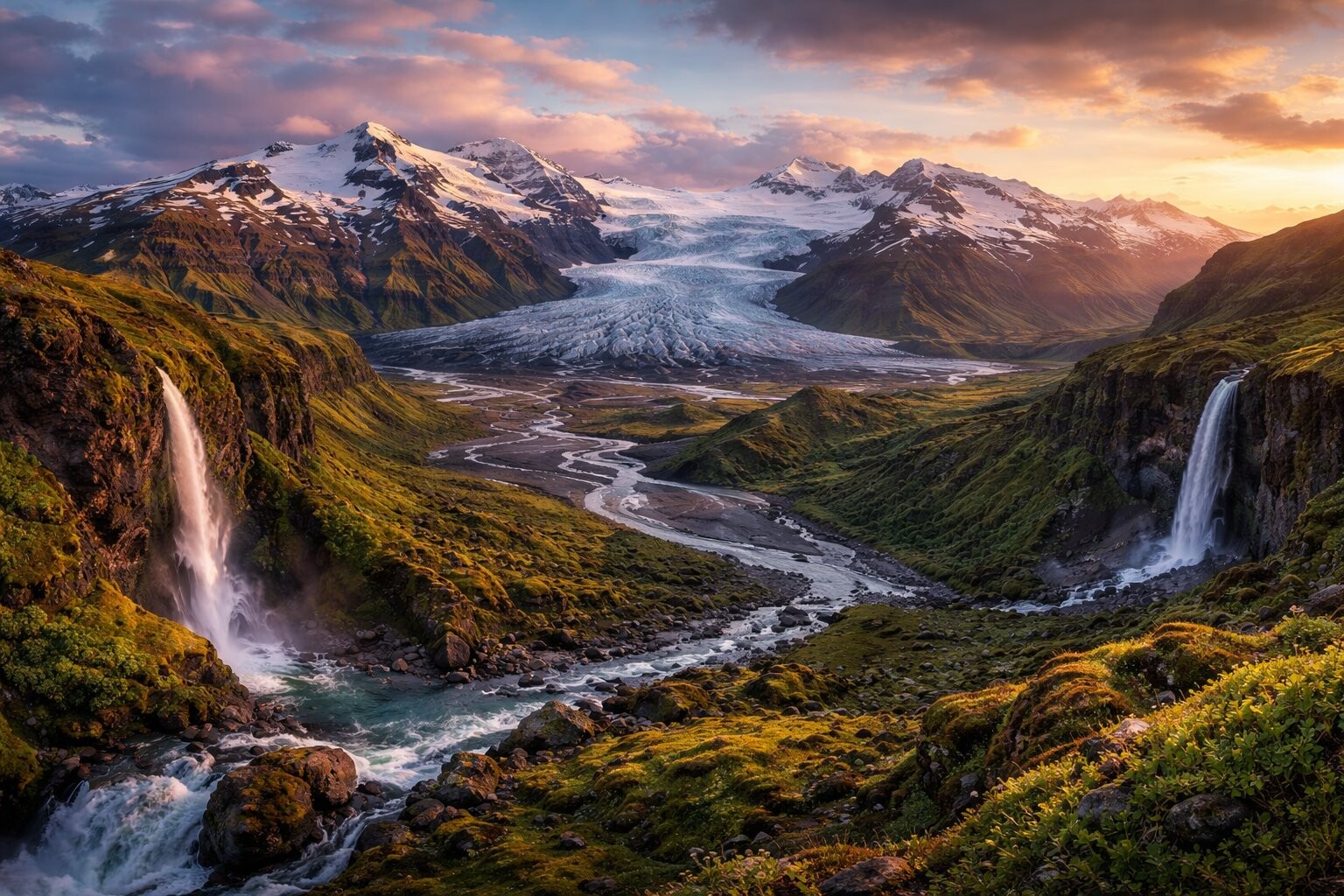
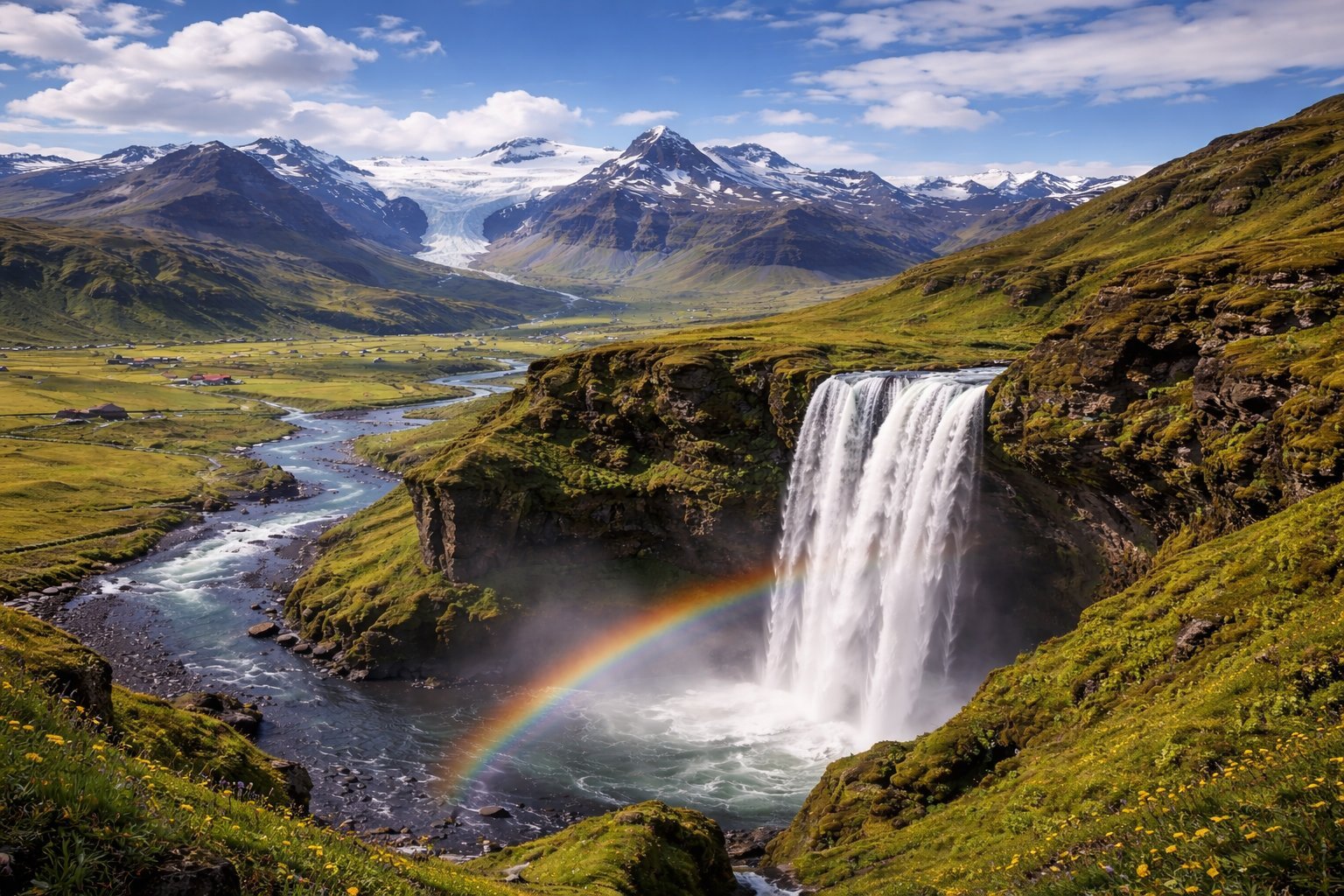
Around 11% of Iceland is under ice and a similar proportion is lava field. Only about a quarter of the country is vegetated at all, and there are almost no trees — the running joke is that if you get lost in an Icelandic forest, stand up. That is a consequence of the settlement: the island was perhaps a quarter to a third birch woodland in 874 and was almost entirely stripped within a few centuries.
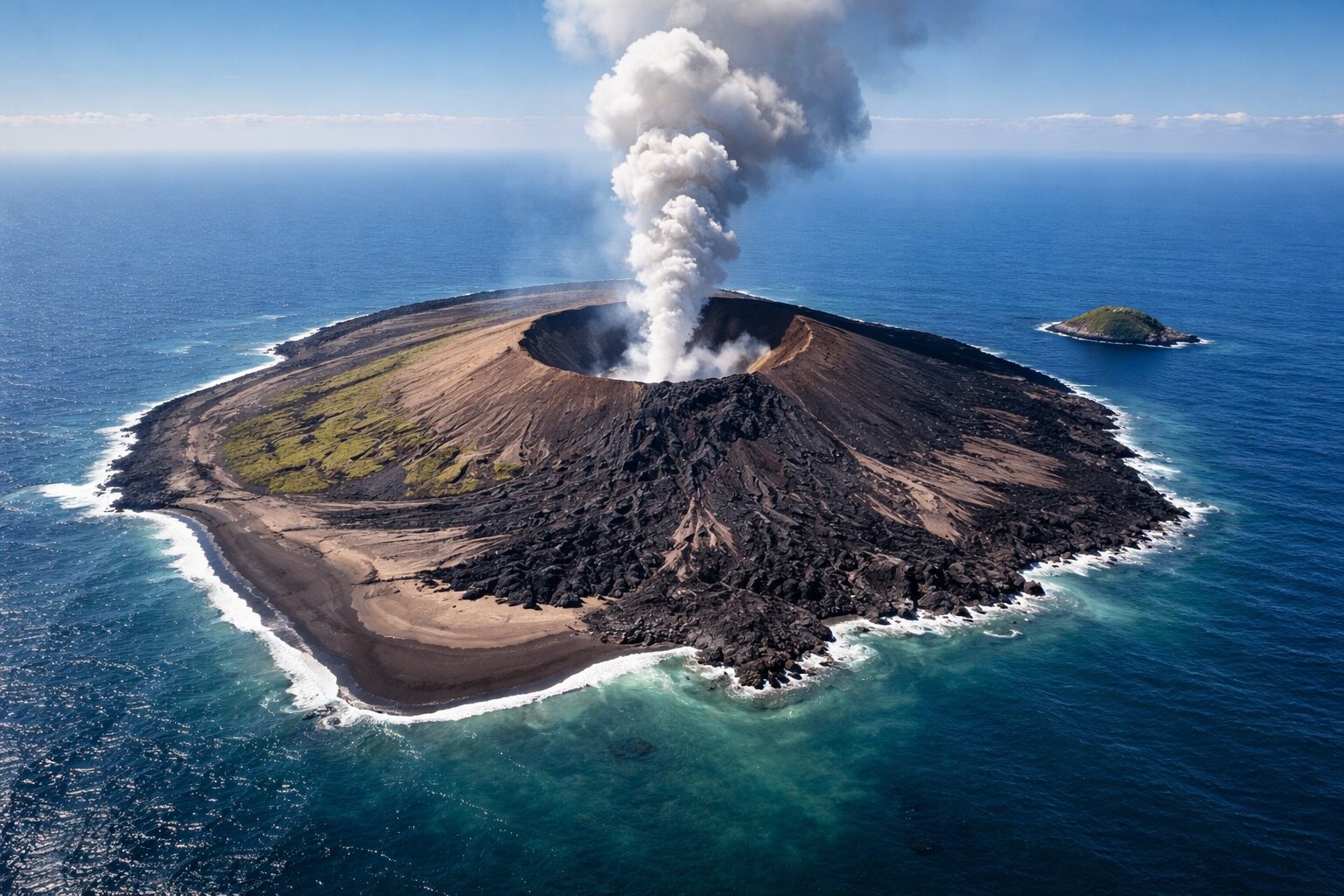
Three UNESCO World Heritage sites: Þingvellir, where the world's oldest surviving parliament met from 930; Surtsey, an island that did not exist before 1963; and Vatnajökull National Park. That range — a parliament older than most European states, an island younger than most of the people reading this — is a fair summary of the place.
🏷️ Ísland, and a Language That Refuses to Change
The name is what it says: Ísland, ice land, given by the Norse settler Hrafna-Flóki Vilgerðarson, who according to the Landnámabók spent a bad winter here, lost his livestock, climbed a mountain, saw a fjord full of drift ice and named the country after his worst day. Greenland's much friendlier name was given by Erik the Red as a piece of deliberate marketing. The two names have been the wrong way round ever since.
A language frozen in place
Icelandic is North Germanic and has changed remarkably little in a thousand years — a modern Icelander can read the thirteenth-century sagas with roughly the effort an English speaker needs for Shakespeare, and with far less help. The reasons are isolation, a strong written tradition and a deliberate purist policy since the nineteenth century. It has retained four cases, three genders and a full set of strong verbs that other Germanic languages shed centuries ago.
Making new words
Rather than borrow, Icelandic coins. A computer is a tölva, from tala (number) and völva (prophetess) — a number-prophetess. A telephone is a sími, an old word for thread. A helicopter is a þyrla, from the verb to whirl. There is a committee for this and the new words genuinely catch on, which is more than can be said for most language-planning efforts anywhere.
No surnames
Icelanders use patronymics. Jón Einarsson's son is Ólafur Jónsson and his daughter is Guðrún Jónsdóttir; a wife does not change her name and family members routinely have four different "surnames". The telephone directory is therefore alphabetised by first name, everyone from the president down is addressed by their given name, and a naming committee vets first names for compatibility with Icelandic grammar.
Þ and ð
Two letters English lost: þ (thorn), the th of "thing", and ð (eth), the th of "that". Place names are usually given in this guide with them intact — Þingvellir, Jökulsárlón, Eyjafjallajökull — because that is how you will see them on the road signs. English is spoken almost universally and to a very high standard, so you will not be stuck.
🌋 Standing on the Seam
Iceland exists because two things coincide in one place: a divergent plate boundary, where the Atlantic sea floor is being manufactured, and a mantle plume pumping extra magma into it. Elsewhere the ridge is two or three kilometres under water. Here it is above the waves, and you can walk along it.
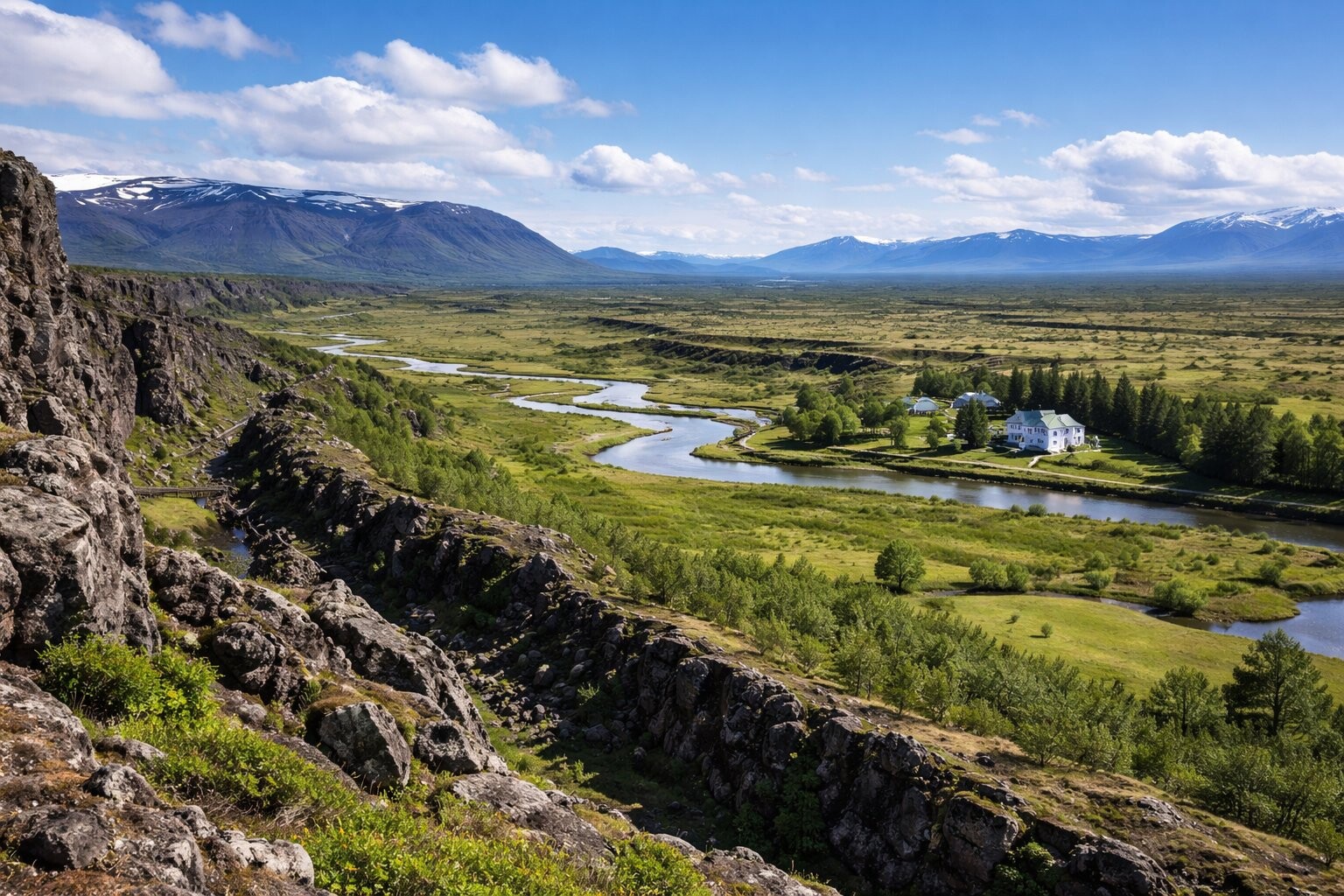
Two centimetres a year
The plates separate at roughly the rate your fingernails grow. It happens not smoothly but in rifting episodes — the ground in one segment stays still for centuries and then opens several metres in a few weeks, with earthquake swarms and usually an eruption. The Krafla Fires of 1975–84 and the Reykjanes sequence since 2021 are both examples that happened in front of instruments.
Reykjanes, since 2021
The peninsula that holds the international airport had been volcanically quiet for eight hundred years. It woke up in March 2021 at Fagradalsfjall and has erupted repeatedly since. In November 2023 the town of Grindavík was evacuated as the ground split beneath it and has been largely uninhabitable since; the Blue Lagoon a few kilometres away has closed and reopened repeatedly. Volcanologists expect the episode to continue for years or decades.
The hot water
Because the crust is thin and young, geothermal heat is everywhere. Around 85–90% of Icelandic homes are heated with geothermal water piped straight out of the ground, and essentially 100% of the electricity is renewable — roughly 70% hydro, 30% geothermal. Iceland has the cheapest electricity in Europe, which is why aluminium smelters came, and why they now use around 70% of all the power generated.
A country being built
The rock underfoot is young by any standard: most of Iceland is under 20 million years old and large areas are under 10,000. There are almost no sedimentary rocks, no old mountains, no fossils to speak of. What there is instead is basalt, in every stage from a lava field that is still warm to a plateau that has been carved into fjords.
🧊 Fire Under Ice
Iceland's defining hazard, and its defining scenery, is what happens when an active volcano sits under a glacier. Roughly a third of the country's eruptions since settlement have been subglacial, and they produce both ash clouds and floods.
Laki, 1783
The one that matters. A fissure 27 km long opened in the southern interior and poured out around 14 km³ of lava over eight months, along with an enormous volume of sulphur dioxide and fluorine. The resulting haze poisoned the grass; the livestock died; and in the Móðuharðindi, the Mist Hardships, roughly a fifth to a quarter of Iceland's population starved. The haze crossed Europe, killed thousands in Britain and wrecked harvests in France, and is argued by some historians to have contributed to the conditions behind the French Revolution.
Heimaey, 1973
A fissure opened without warning in the middle of the night inside a town of 5,000 people on the Westman Islands. The entire population was evacuated by fishing boat within hours — nobody died — and then, over five months, the islanders pumped seawater onto the advancing lava front to stop it closing the harbour. It worked. Around a third of the town was buried and the rest was saved.
Eyjafjallajökull, 2010
Not a big eruption by Icelandic standards, but the ash went into a jet stream aimed at Europe and closed most of European airspace for six days — around 100,000 flights cancelled. Its main global legacy is that a generation of newsreaders had to try to pronounce it. (Roughly: AY-uh-fyat-luh-YUE-kutl.)
Jökulhlaup
The subglacial-eruption flood. Meltwater builds under the ice and then releases all at once: the 1996 Gjálp eruption under Vatnajökull produced a flood peaking at around 50,000 cubic metres per second, which took out bridges and a stretch of the ring road. The enormous black sand plain of Skeiðarársandur in the south-east is entirely the product of these events.

🌡️ Climate, and the Light
Iceland is warmer than it has any right to be. Reykjavík sits at 64° north, level with Arctic Alaska and northern Siberia, and has an average January temperature of about 0 °C — milder than Prague. The Gulf Stream does that. What it does not do is make the weather pleasant: Iceland is windy, wet and violently changeable, and the local saying that if you don't like the weather you should wait five minutes is meant literally.
Summer (June–August)
The season, for almost everything. Around 10–15 °C, occasionally 20, with the interior roads and F-roads open from roughly mid-June to early September. Around the solstice the sun barely sets — in Reykjavík it dips below the horizon for about three hours in late June and never gets properly dark. Bring an eye mask; this is not a joke.
Winter (November–March)
Around −2 to +3 °C in Reykjavík and colder inland, but the problem is wind and storms rather than cold. Daylight in late December is about four hours, from a sunrise around 11:20 to a sunset around 15:30, and much of it is a long low golden hour. This is aurora season and glacier-ice-cave season, and it is also when roads close without notice.
Shoulder (April–May, September–October)
Genuinely good value. September in particular: the highland roads are still open at the start of the month, the aurora returns, the crowds have gone and prices drop. Late May has long light, migrating birds and puffins back on the cliffs, and prices below June's.
The wind
The thing visitors most underestimate. Gusts over 30 m/s are routine in winter and have blown car doors off their hinges — a specific, common and famously uninsured form of rental damage. Waterproof outer layers, not umbrellas: an umbrella in Iceland lasts about ninety seconds. Check vedur.is daily; wind warnings there are real.

🗺️ Map
Iceland sits in the North Atlantic between about 63.5° and 66.5° north — the Arctic Circle clips the island of Grímsey off the north coast and misses the mainland. It is 800 km from Scotland, 970 km from Norway, and 290 km from Greenland at the nearest point.
The Ring Road
Route 1 runs 1,322 km right around the island and is the spine of every Icelandic itinerary. It is paved the whole way, two lanes, often single-lane on bridges, and it can be driven in about 17 hours of pure motion — which nobody should attempt. A comfortable circuit is 8 to 10 days; seven is brisk; five is a mistake.
The interior
The highlands occupy the middle of the country and are essentially empty: black desert, ice caps and rhyolite mountains, crossed only by rough F-roads that are open roughly late June to mid-September and require a genuine four-wheel drive. Two routes cross it, the Kjölur and the Sprengisandur. No ordinary hire car is insured on them.
No railways
Iceland has no passenger railway of any kind and never has had one. Getting around means a car, a scheduled bus, a domestic flight (Reykjavík to Akureyri, Egilsstaðir, Ísafjörður) or a guided tour. That is the single most important planning fact about the country.
Distances
Reykjavík to Vík: 187 km, 2½ hours. To Jökulsárlón: 375 km, 5 hours. To Akureyri: 390 km, 5 hours. Around the whole Ring Road with stops: a week and a half. Keflavík airport to Reykjavík: 50 km, 45 minutes.
⛵ The Settlement, 874
Iceland is one of the very few countries whose settlement is a documented historical event rather than a prehistoric process. The Landnámabók — the Book of Settlements, compiled in the twelfth century — names around 430 original settlers, where they came from, where they landed and what land they claimed. Nothing comparable exists for anywhere else in Europe.
The traditional date is 874, when Ingólfur Arnarson is said to have thrown his high-seat pillars overboard and settled where they washed ashore, at a bay of steaming hot springs he called Reykjavík — smoky bay. Archaeology broadly supports the timing: a tephra layer from an eruption dated to 871±2 lies directly under the earliest occupation debris, which is about as clean a stratigraphic confirmation as history gets.
Who came
Mostly Norwegians, from a Norway being consolidated under Harald Fairhair. But genetics tell a more complicated story: studies of modern Icelanders find that the male line is largely Norse while roughly 60% of the female line is Gaelic — from Ireland and Scotland. Some of those women came as wives; many came as slaves. The founding population of Iceland was substantially Celtic and substantially unfree, which the sagas mention only in passing.
The papar
Irish monks appear to have been on the island before the Norse — Ari the Wise records that the settlers found papar here who left behind books, bells and croziers and departed rather than live among heathens. Place names like Papey preserve them. There is no archaeological confirmation, which does not make it untrue.
What they did to the land
Within about two centuries the woodland was largely gone — cut for building and charcoal, and then kept down by sheep. The soil, young volcanic ash held together only by the vegetation, began to blow away. Iceland's erosion is the oldest environmental catastrophe in the Nordic world, and reafforestation and soil reclamation have been state programmes for over a century.
The horse
The settlers brought a small tough Norse horse, and Iceland has kept the breed closed since about 982 — no horse may be imported, and an Icelandic horse that leaves the country may never return. A thousand years of that has produced an animal found nowhere else, with two gaits beyond the usual three: the tölt, a smooth four-beat running walk, and the flying pace.
⚖️ The Alþingi and the Commonwealth
In 930 the settlers established an assembly on the plain at Þingvellir: the Alþingi, generally described as the oldest surviving parliament in the world. It met for two weeks each summer, and for the next three centuries Iceland ran as a commonwealth with no king and no executive — a legislature and a court system, and no one whose job it was to enforce a verdict. Enforcement was the winner's problem, which is why the sagas are what they are.
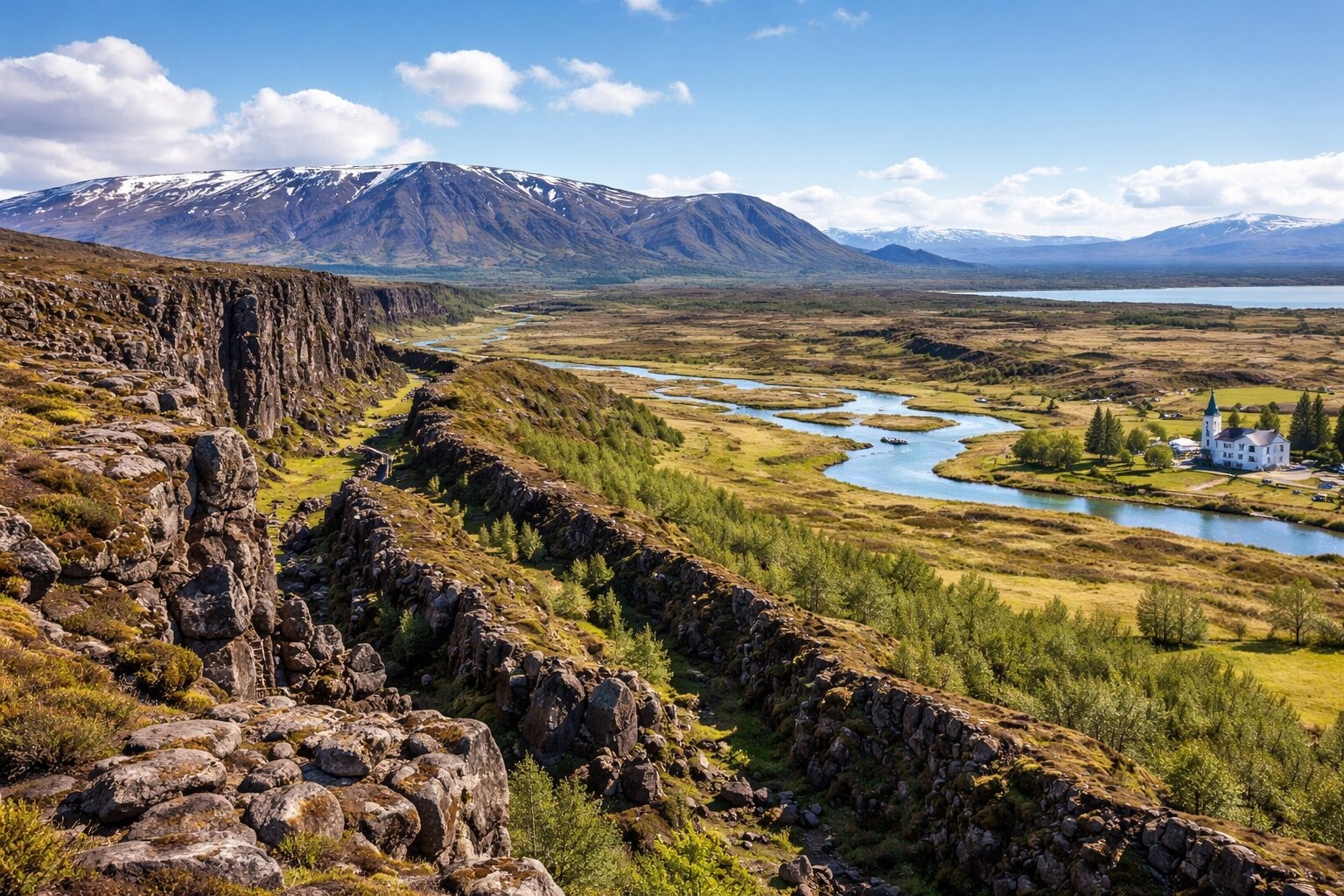
Christianity by committee, 1000
One of the strangest political decisions in European history. With the country splitting between Christians and heathens and civil war likely, both sides agreed to submit the question to the lawspeaker Þorgeir Ljósvetningagoði — himself a pagan priest. He lay down under a fur cloak for a day and a night, said nothing to anyone, then stood up and ruled that all Icelanders should be baptised, with private pagan worship, horse-eating and the exposure of infants tolerated for a time. Everyone accepted it. The country changed religion without a battle.
How the law worked
Thirty-six (later thirty-nine) chieftains, the goðar, held assembly seats that were property and could be bought and sold; free farmers chose which chieftain to follow rather than being bound by territory. Cases were argued at the Alþingi and penalties were fines or outlawry. Full outlawry meant anyone could kill you without penalty, which produces the plots of half the sagas.
The Sturlung Age
It fell apart in the thirteenth century, when the chieftaincies concentrated into a few warring families — the Sturlungs among them — and the country descended into forty years of feud that the constitution had no mechanism to stop. In 1262–64 the chieftains submitted to the king of Norway in the Old Covenant, in exchange for peace and reliable shipping. Independence had lasted 330 years.
Vinland
From Iceland the Norse reached Greenland with Erik the Red around 985, and from there Leif Eriksson reached North America around the year 1000 — five centuries before Columbus. The site at L'Anse aux Meadows in Newfoundland, excavated in the 1960s, confirmed it. The two Vinland sagas were written in Iceland and are the only written account.
📜 The Sagas
The Icelandic sagas are the country's largest contribution to world culture and are still under-read outside Scandinavia. Written mostly in the thirteenth century, in prose, in the vernacular, about events two or three hundred years earlier, they read astonishingly like modern novels: laconic, dialogue-driven, psychologically precise, with almost no authorial comment and a very dry sense of humour.
Njáls saga
The greatest of them, and the place to start. A hundred-year chain of feud, law and burning, built around a lawyer who cannot fight and a warrior who cannot argue, and a marriage that destroys both. It contains one of literature's most famous exchanges: with the house on fire around them, Njáll's wife Bergþóra is offered safe passage out and refuses, because she was given to Njáll young and they have shared everything.
Egils saga
The life of Egill Skallagrímsson: poet, mercenary, berserker, killer at the age of seven, and author of a poem of grief for his drowned son that is one of the most moving things written in any medieval European language. Probably composed by Snorri Sturluson.
Snorri Sturluson
Historian, poet, politician and the reason most of what is known about Norse mythology survives. His Prose Edda was written as a handbook for poets and preserved the whole mythological system; his Heimskringla is the history of the kings of Norway. He was murdered in the cellar of his house at Reykholt in 1241 — his reported last words, eigi skal höggva, "do not strike", were ignored. The hot pool where he bathed is still there.
Reading them
They are short, cheap and in print in good English and Czech translations. If you read one thing before an Iceland trip, read Njáls saga — a very large number of the place names you will drive past are in it, and the country's own sense of itself is built on these books to a degree that is difficult to overstate.
🕯️ Six Hundred Hard Years
From the Old Covenant of 1262 to independence, Iceland was a possession — of Norway, and from 1380, when the Norwegian crown passed to Denmark, of Copenhagen. The period is remembered as an almost unbroken sequence of disasters, and the record largely supports that.
Plague and cold
The Black Death arrived late but hard — 1402–04 — and killed perhaps half the population; a second epidemic in 1494 did nearly as much. The Little Ice Age then made a marginal agriculture worse for three centuries, with sea ice closing the northern harbours in bad years. The population fell from around 60,000 at its medieval peak to under 40,000.
The trade monopoly
From 1602 to 1787 all Icelandic trade was reserved by royal decree to a small group of Danish merchants, who were forbidden to trade elsewhere and Icelanders forbidden to trade with anyone else. Prices were set in Copenhagen, quality was whatever arrived, and Icelanders caught trading with English or Dutch fishermen were flogged. It is the single most resented fact in the national account of the Danish period, and economically it was ruinous.
The Reformation
Imposed from Denmark in the 1540s against real resistance. The last Catholic bishop, Jón Arason of Hólar — also a poet, and the man who brought the first printing press to Iceland — was beheaded with his two sons in 1550 without trial. Iceland has been Lutheran ever since, and the state church still is.
Laki and the near-end
The eruption of 1783–84 and the famine that followed killed around a fifth of the population and most of the livestock. The Danish government seriously discussed evacuating the survivors to the Jutland heath and abandoning the island. That it did not is the reason Iceland exists.
🇮🇸 Independence, 1944
The nineteenth-century independence movement was led by Jón Sigurðsson, a scholar in Copenhagen, and was almost entirely constitutional — petitions, pamphlets and the restored Alþingi rather than rebellion. His birthday, 17 June, was chosen as the national day. Iceland got a constitution in 1874, home rule in 1904, and in 1918 became a fully sovereign kingdom in personal union with Denmark, with a treaty reviewable after twenty-five years.
Those twenty-five years expired in 1943, in the middle of a war in which Denmark was occupied by Germany and Iceland was occupied by the Allies. Iceland held a referendum, voted overwhelmingly to end the union, and declared a republic at Þingvellir on 17 June 1944 — the assembly plain of 930, chosen deliberately. King Christian X of Denmark, unable to attend or object, sent a telegram of congratulation, which was rather generous in the circumstances.
The occupation
Britain invaded on 10 May 1940 — an unopposed landing of 750 marines at Reykjavík — to keep the island out of German hands after Denmark and Norway fell. The Icelandic government protested and then cooperated. The United States took over in July 1941, before it was formally at war. At its peak the foreign garrison was around 50,000 men against an Icelandic population of 120,000.
What the war did
It made Iceland rich. The garrison needed roads, an airfield, harbours and labour; unemployment vanished; and fish sold at wartime prices. The Icelandic economy moved from among the poorest in Europe to among the richest inside a generation, and the change is usually dated to those six years.
No army
Iceland is a founding member of NATO (1949) and has no armed forces at all — no army, navy or air force, only a coast guard, a police force and a small crisis-response unit. The NATO decision produced a genuine riot outside the parliament in 1949. The American base at Keflavík operated from 1951 until 2006, when the US left; NATO air policing rotates through it now.
Vigdís
In 1980 Iceland elected Vigdís Finnbogadóttir president — a divorced single mother and theatre director, and the first woman anywhere in the world to be democratically elected head of state. She served sixteen years. Five years earlier, on 24 October 1975, an estimated 90% of Icelandic women had refused to work, cook or look after children for a day; the country stopped, and the law on equal pay passed the following year.
🐟 The Cod Wars
Between 1958 and 1976 Iceland fought three confrontations with the United Kingdom over fishing limits, and won all three. It is the only case in modern history of a state with no military whatsoever repeatedly facing down the Royal Navy — and it worked because Iceland understood exactly which lever it held.
The three rounds
1958–61: Iceland extended its limit from 4 to 12 nautical miles; Britain sent frigates to escort trawlers inside it. 1972–73: the limit went to 50 miles. 1975–76: to 200. Each time the Royal Navy escorted, each time Iceland's handful of coast guard vessels harassed, and each time Britain eventually conceded.
The net cutter
Iceland's decisive weapon was a device called the klippur — a towed cutter that sliced the warps of a trawler's net, dumping the catch and the gear. It was cheap, it was not lethal, and it made fishing inside the limit economically pointless. There were rammings on both sides and a great deal of paint exchanged; across eighteen years the confrontations produced one death, an Icelandic engineer killed in an accident during a collision repair.
How Iceland won
The lever was Keflavík. In 1976 Iceland broke off diplomatic relations with the United Kingdom — a NATO member breaking with another for the first time — and made clear that continued NATO access to the North Atlantic gap could not be assumed. Washington leaned on London. Britain conceded within weeks.
Why it mattered
Fish was about 90% of Icelandic exports at the time; this was not a symbolic dispute but the whole economy. The 200-mile limit Iceland forced through also became the international norm — the exclusive economic zone written into the Law of the Sea. And Icelandic fisheries management, with individual transferable quotas from 1984, is now studied as one of the few large fisheries in the world that is not collapsing.
🏦 The Crash of 2008
Between 2003 and 2008 Iceland's three big banks — Kaupthing, Landsbanki and Glitnir — grew until their combined assets were around ten times the country's entire GDP, funded by wholesale borrowing and high-interest online deposit accounts sold across northern Europe. In the first week of October 2008 all three failed. It remains, relative to the size of the economy, the largest banking collapse in history.
The króna lost about half its value, inflation went past 18%, and unemployment went from near zero to 9%. Iceland took an IMF programme — the first Western European country to do so since Britain in 1976. What happened next is the part worth knowing.
Letting them fail
Iceland did not bail the banks out. It could not: the liabilities were far beyond the state's capacity. Instead emergency legislation split each bank in two, ring-fencing domestic deposits and operations into new banks and leaving foreign creditors with the wreck, and capital controls were imposed for eight years. It was the opposite of the Irish approach and it worked considerably better.
Icesave
Landsbanki's online "Icesave" accounts held British and Dutch savers' money. Those governments compensated their own depositors and demanded Iceland repay them — around €4 billion, roughly €12,000 per Icelander. Britain used anti-terrorism legislation to freeze Landsbanki's UK assets, listing Iceland alongside al-Qaeda on a Treasury webpage, which Icelanders have not forgotten and are not going to. Two referendums, in 2010 and 2011, rejected repayment by large margins. In 2013 the EFTA Court found for Iceland.
Bankers in prison
Around 25 senior bankers — including the chief executives and chairmen of all three banks — received prison sentences for market manipulation, fraud and breach of fiduciary duty. Globally this is close to unique: no other country's 2008 collapse produced comparable convictions.
The Pots and Pans
The protests that brought down the government in January 2009 are called the Búsáhaldabyltingin — the Kitchenware Revolution — because people banged saucepans outside the parliament until it became impossible to sit. It produced a left-led government, a constitutional convention whose crowd-sourced draft was never adopted, and a lasting collapse in trust in the traditional parties.
✈️ The Tourism Boom
The devalued króna made Iceland affordable at exactly the moment Eyjafjallajökull put it on every television in the world, and the government and airlines pushed hard on both. The result is one of the fastest tourism expansions ever recorded: from around 490,000 foreign visitors in 2010 to about 2.3 million by 2018, in a country of under 400,000 people.

What it did to the economy
Tourism overtook fishing and aluminium to become the largest export earner. It also pulled the country out of the crash faster than anyone predicted. It has since flattened out at somewhere around two to two and a quarter million visitors a year, which the infrastructure handles better than it did in 2017.
What it did to the country
Housing in Reykjavík went to short-term letting and prices followed. The most-photographed sites got car parks, boardwalks and entry charges. And a steady stream of visitors driving off marked roads onto moss — which takes decades to regrow — produced fines, fences and a genuine national irritation. Off-road driving is a criminal offence in Iceland and is prosecuted.
Where everyone goes
Roughly: Reykjavík, the Blue Lagoon, the Golden Circle and the south coast to Jökulsárlón. That corridor carries the overwhelming majority of visitors. The north, the east and the Westfjords are close to empty by comparison, and are not less good — the Westfjords in particular have a fraction of the traffic and arguably better scenery.
Behaving
Stay on the paths and off the moss. Do not fly a drone at busy sites — it is restricted in the national parks. Do not stop on the road to photograph; there are pull-ins. Do not climb on the icebergs at Jökulsárlón or walk out on the black sand at Reynisfjara, both of which have killed people. And close every gate you open.
👥 The People
Around 390,000 people, of whom about a fifth are now foreign-born — a very fast change, driven by tourism and construction, with Poles by far the largest group. Icelandic society is small enough that everyone is connected to everyone: there is a genealogy database, Íslendingabók, covering essentially the entire population back to settlement, and a companion app whose original selling point was checking that a prospective date is not a close cousin.

Gender equality
Iceland has ranked first in the World Economic Forum's global gender gap index every year since 2009 — fifteen consecutive years, which no other country approaches. Since 2018 companies with 25 or more staff must be certified as paying equally for equal work; the burden of proof is on the employer. Parental leave is split with a substantial non-transferable share for each parent. The gap is not closed, but the machinery for closing it is unusually serious.
How things get run
There is no army, the police are unarmed on ordinary duty, and the murder rate is so low that a year with zero homicides is not unusual. The prime minister is in the phone book. Institutional formality is minimal and first names are universal — using someone's patronymic as a surname marks you instantly as a foreigner.
Þetta reddast
The national phrase, and a real cultural fact: roughly "it'll work out". It describes an attitude of not planning too far ahead because the weather, the volcano and the sea will decide anyway — a rational response to the environment that visitors sometimes mistake for casualness. It coexists with a very high employment rate and long working hours.
Sport
The great modern story is football. At Euro 2016 Iceland — the smallest nation ever to qualify at that point — drew with Portugal and Hungary, beat England 2–1, and reached the quarter-finals, with a commentator's scream that became a national artefact. The team's supporters brought the thunderclap chant, which they had picked up from Motherwell fans in Scotland and which the world promptly relabelled Viking. Iceland has also produced an improbable number of world's-strongest-man winners.
🎭 Books, Music and Film
Iceland publishes more books per head than any other country and reads them. The jólabókaflóð — the Christmas book flood — is a genuine institution: almost the entire year's publishing output appears in the autumn, a catalogue is posted to every household, and books are the standard Christmas present, opened on the evening of the 24th and read that night.
Halldór Laxness
The Nobel laureate of 1955 and the writer who did most to define modern Icelandic self-understanding. Independent People — the story of a sheep farmer whose determination to owe nothing to anyone destroys his family — is the one to read, and it is as bleak and as funny as that suggests. His house at Gljúfrasteinn outside Reykjavík is a museum and is left exactly as it was.
Nordic noir
Arnaldur Indriðason and Yrsa Sigurðardóttir are the big sellers, and the local variety of the genre has a specific problem it turns into a strength: in a country with almost no murders, the crime novel has to be about something else — usually the past, the weather and the impossibility of anonymity.
Music
Wildly out of proportion to the population. Björk, first with the Sugarcubes and then alone, is the most internationally significant Icelandic artist of any kind. Sigur Rós exported a whole sonic idea of the country. Of Monsters and Men, Ólafur Arnalds, Ásgeir, and Hildur Guðnadóttir, who won the Oscar for Joker and an Emmy for Chernobyl in the same year.
Film and the landscape
Iceland doubles for space, for the far north and for fantasy in an enormous number of productions — Interstellar, Rogue One, Prometheus, the north of the wall in Game of Thrones, Batman Begins. The domestic industry is small and good: Rams, Of Horses and Men, Woman at War and Lamb are all worth finding, and all of them are funnier and stranger than their summaries suggest.
🧝 The Elf Question, Answered Properly
You will read that "over half of Icelanders believe in elves". It is the single most repeated claim about the country and it is a distortion of what the surveys actually found.
The best-known study, by Terry Gunnell and Erlendur Haraldsson, asked Icelanders whether the existence of huldufólk — hidden people — was impossible, unlikely, possible, likely or certain. A majority declined to say impossible. Outright affirmative belief was in the region of a tenth. That is a very different sentence, and Icelanders find the international version tiresome — one folklorist's standard reply is that the same survey in any country would find plenty of people unwilling to rule out ghosts.
What is actually going on
A tradition of not being casual with the landscape. Certain rocks are known as elf rocks, are marked on farm maps, and are not moved. Road projects have occasionally been rerouted around one — the case usually cited is at Gálgahraun in 2013 — and the practical effect is a mild, socially sanctioned brake on bulldozing things. Treating it as a quaint superstition misses that it functions rather like a heritage-protection rule.
The other folklore
Iceland's folklore is far darker than elves. Grýla is an ogress who comes down from the mountains at Christmas to eat badly behaved children, accompanied by the Jólaköttur, the Yule Cat, which eats anyone who has not been given a new item of clothing before Christmas Eve. Her thirteen sons, the Yule Lads, arrive one per night from 12 December, each with a specific and petty crime — Door-Slammer, Spoon-Licker, Sausage-Swiper, Window-Peeper.
The sagas' ghosts
Icelandic ghosts are physical. The draugr of the sagas is a corpse that gets up, is enormously strong, and has to be wrestled, decapitated and burnt — the fight with Glámr in Grettis saga is one of the great horror set-pieces of medieval literature. There is nothing wispy about any of it.
Where to see it
The Icelandic Wonders and folk museums do the tourist version. The better route is the National Museum in Reykjavík, the Árni Magnússon Institute where the saga manuscripts themselves are displayed, and the Museum of Sorcery and Witchcraft at Hólmavík in the Westfjords, which is genuinely unsettling and is about the seventeenth-century witch trials, in which the accused were overwhelmingly men.
🐦 Wildlife
Iceland's land fauna is famously thin — the only native land mammal is the Arctic fox, which walked in over sea ice before the settlement. Everything else with four legs arrived on a boat: sheep, horses, cattle, mice, and reindeer introduced in the eighteenth century that now run wild in the east. There are no mosquitoes anywhere in Iceland, which is genuinely unusual at this latitude and is a real quality-of-life feature.

Seabirds
The real spectacle. Látrabjarg is a 14 km cliff up to 440 m high and one of the largest bird cliffs in the world, with millions of guillemots, razorbills, fulmars and kittiwakes. The great auk, flightless and hunted out, was killed for the last confirmed time on the Icelandic islet of Eldey in 1844, which makes Iceland the site of one of history's better-documented extinctions.
Whales
Iceland is one of the best whale-watching countries in Europe: humpbacks, minke, white-beaked dolphins and, in the north, blue whales. Húsavík is the centre of it and has the best success rate. Iceland also still permits limited whaling, which is contested domestically as much as abroad and has become commercially marginal; the ethical question is a real one and worth deciding before you book anything.
The Arctic fox
Blue or white depending on the season and the colour morph, and the only mammal that got here on its own. The Hornstrandir reserve in the northern Westfjords, where they are protected and unhunted, is the place to see one — they are famously unbothered by people there.
What is not there
No snakes, no native reptiles or amphibians, no wild land predators larger than a fox, and no biting insects worth the name. Midges at Mývatn — whose name means midge lake — are the exception, and in June they are dense enough that a head net is a serious suggestion. They do not bite; they simply get in everything.
🍽️ Food: Preserving Things for a Very Long Winter
Icelandic cooking was, until about 1980, entirely a technology of preservation. Nothing grew; everything had to keep from autumn to spring. So things were smoked, salted, dried, pickled in whey, buried and fermented — and the results, which are now served as heritage food, are mostly not an attempt to be shocking. They are what a country with no salt mines, no spices and no fuel to spare had to do.
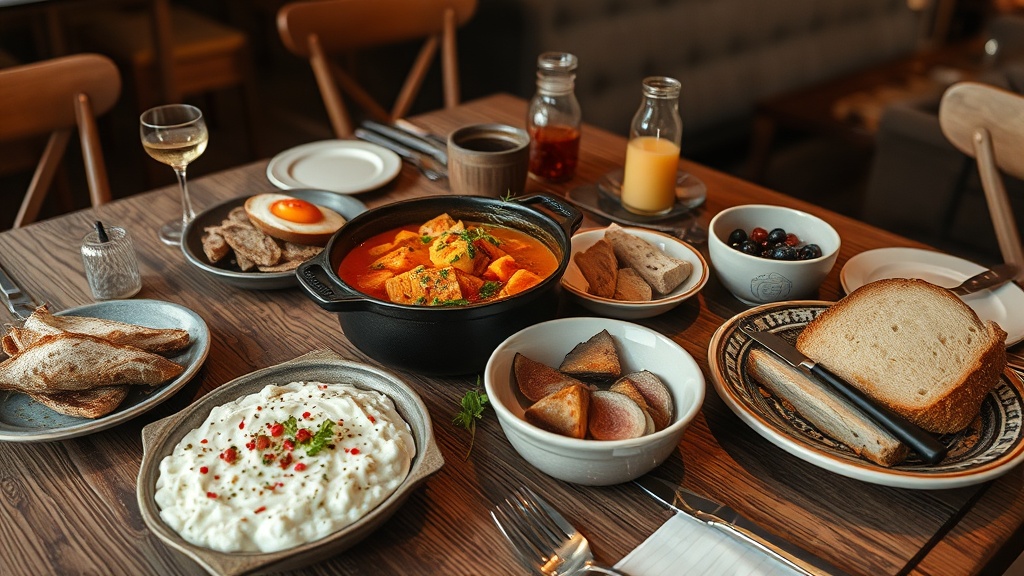
Lamb
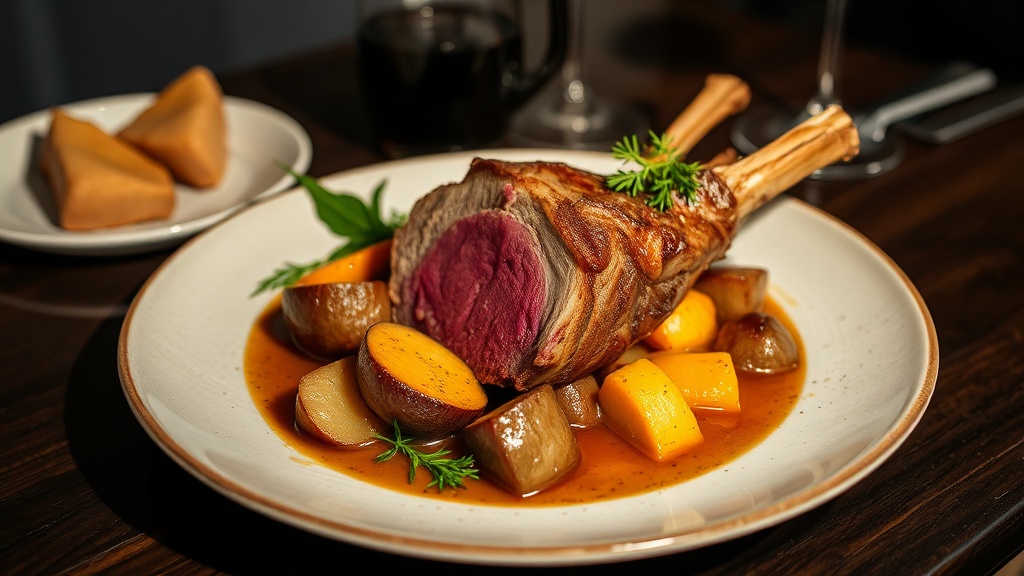
The headline product, and it deserves the reputation. Icelandic sheep are a closed breed descended from the settlers' stock, and they spend the summer free-ranging unaccompanied in the highlands eating wild grass, moss and thyme. In September the whole country turns out for the réttir, the round-up, in which the sheep are driven down and sorted by farm in a circular stone pen — a genuine national event that visitors can join in most districts.
Fish
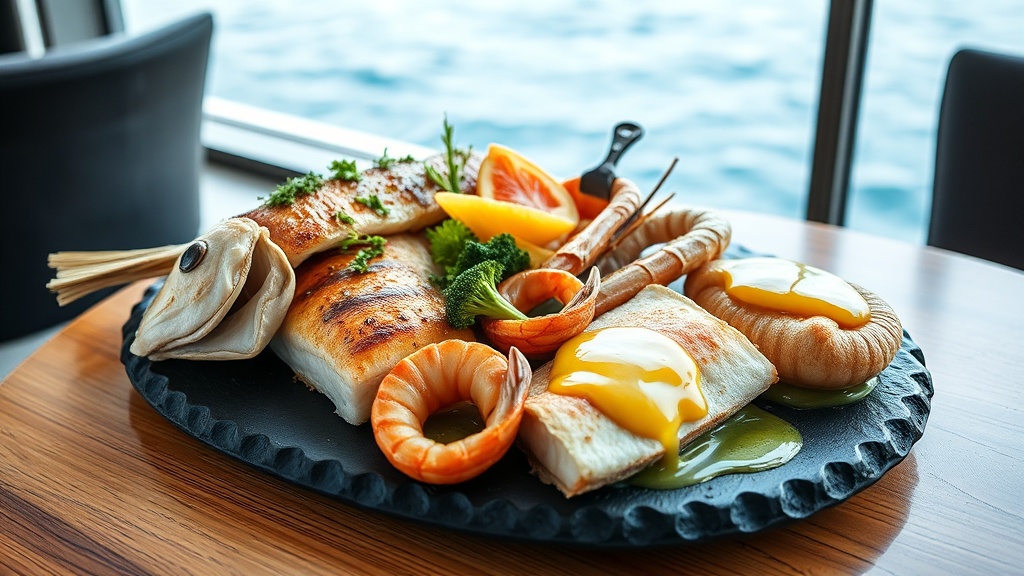
Cod, haddock, arctic char, salmon and humar — Icelandic langoustine, from Höfn, which is smaller and sweeter than the Mediterranean kind and is the country's best seafood argument. Harðfiskur, wind-dried haddock torn into strips and eaten with butter, is the national snack: pure protein, no salt, and it keeps for a year.
Skyr
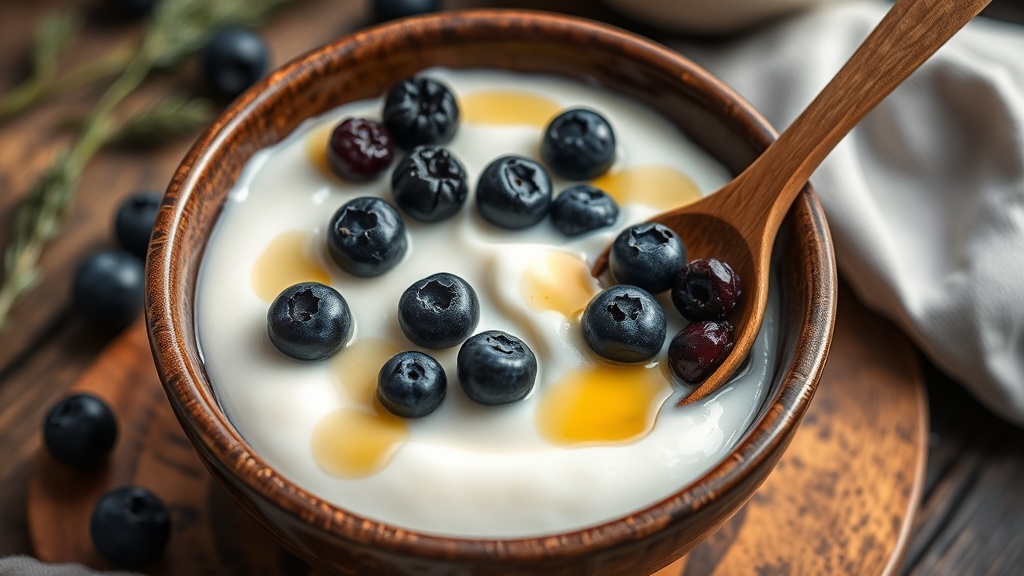
Not a yoghurt. Skyr is a fresh soured cheese — the curd is strained until it is very thick, with almost no fat and a great deal of protein, and it has been made in Iceland continuously for over a thousand years. It nearly disappeared in the twentieth century, was rescued, and is now an export product sold across Europe. Eaten with milk, cream, berries or nothing.
The notorious ones
Hákarl, Greenland shark, is the famous one. The shark's flesh contains enough trimethylamine oxide to be genuinely toxic fresh, so it is buried or pressed for weeks and then hung to dry for months until the compound breaks down. It is not "rotten" — it is a controlled fermentation solving a real chemical problem. It smells strongly of ammonia and tastes milder than it smells. Also on the list: svið (a singed sheep's head, halved), slátur (blood and liver sausage) and súrmatur, meat kept in whey, all eaten at the midwinter Þorrablót feast.
🌭 The Modern Kitchen, and the Hot Dog
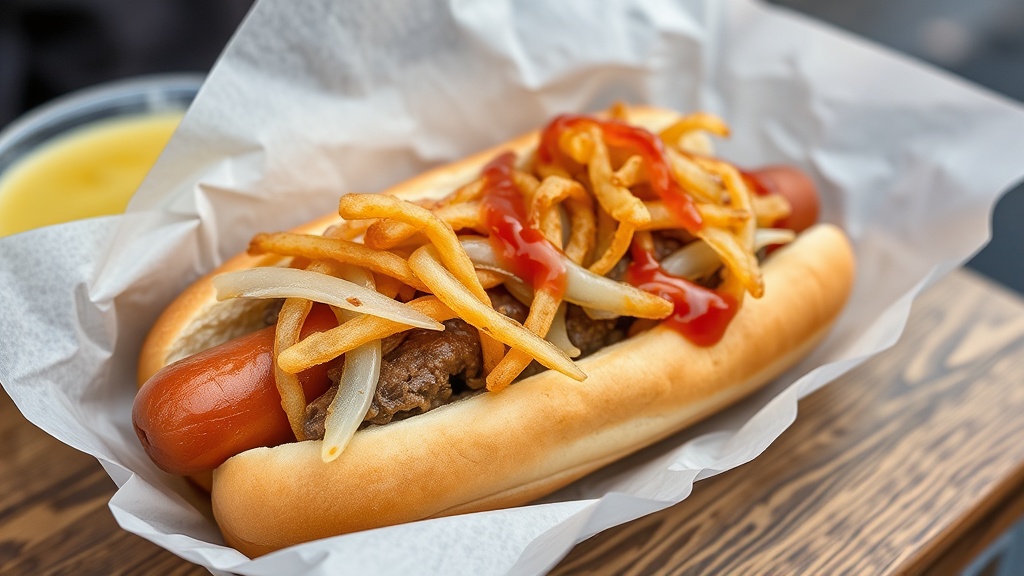
Since about 2000 Reykjavík has developed a serious restaurant scene built on the New Nordic principle of doing very good local ingredients simply, and it is expensive but not a rip-off. But the single most Icelandic thing to eat costs about a fifth as much and is sold from a hut.
The everyday dishes
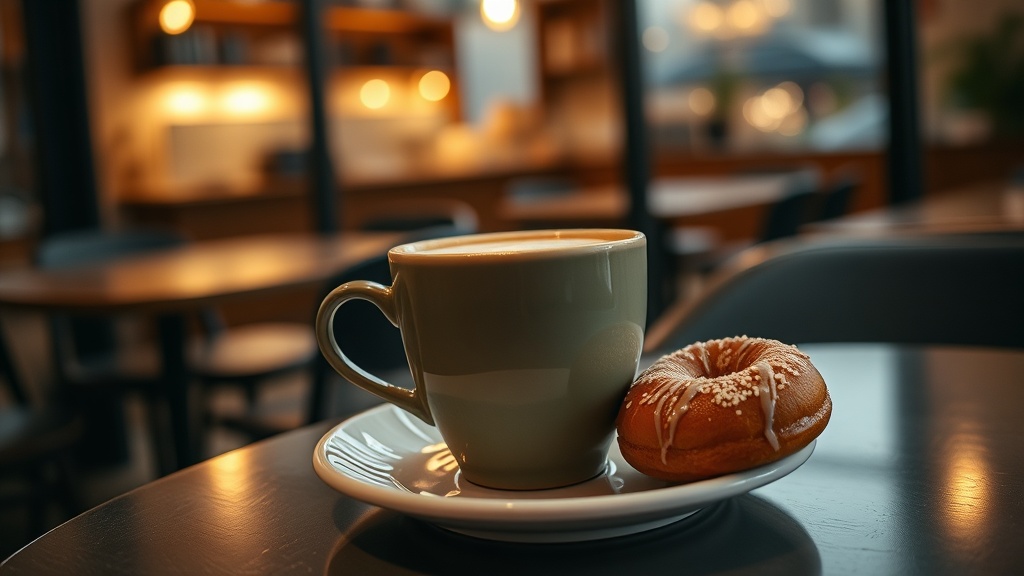
Plokkfiskur: fish and potato mashed together with onion and white sauce, the classic Icelandic leftovers dish and much better than it sounds. Kjötsúpa: lamb and root vegetable soup, clear, salty, restorative. Rúgbrauð: dense, dark, sweet steamed rye bread, traditionally baked in the ground by geothermal heat — at Laugarvatn you can watch it dug up. Kleinur and snúður, the twisted doughnut and the cinnamon roll, in every bakery.
Where to eat well
Reykjavík has the range: the New Nordic places, a very good soup-and-bread lunch tradition, excellent bakeries and — an underrated fact — the fish counters and hot food in the supermarkets, which are genuinely good and about a quarter of restaurant prices. Outside the capital the pattern is a harbour restaurant doing the local catch, and it is usually the best meal in town.
Self-catering
The single biggest money-saver in Iceland. Bónus — the pink pig logo — and Krónan are the cheap supermarkets; the 10-11 chain and petrol stations are two to three times the price. Buy at Bónus, cook in the guesthouse, and eat out once every couple of days rather than twice a day.
What is not there
There has been no McDonald's in Iceland since October 2009, when the franchisee closed the three branches because the collapsed króna had made imported ingredients unaffordable. The last cheeseburger sold is in a display case at a hostel in Þórlákshöfn, on a live webcam, and has not visibly changed since.
🐟 Recipe: Plokkfiskur
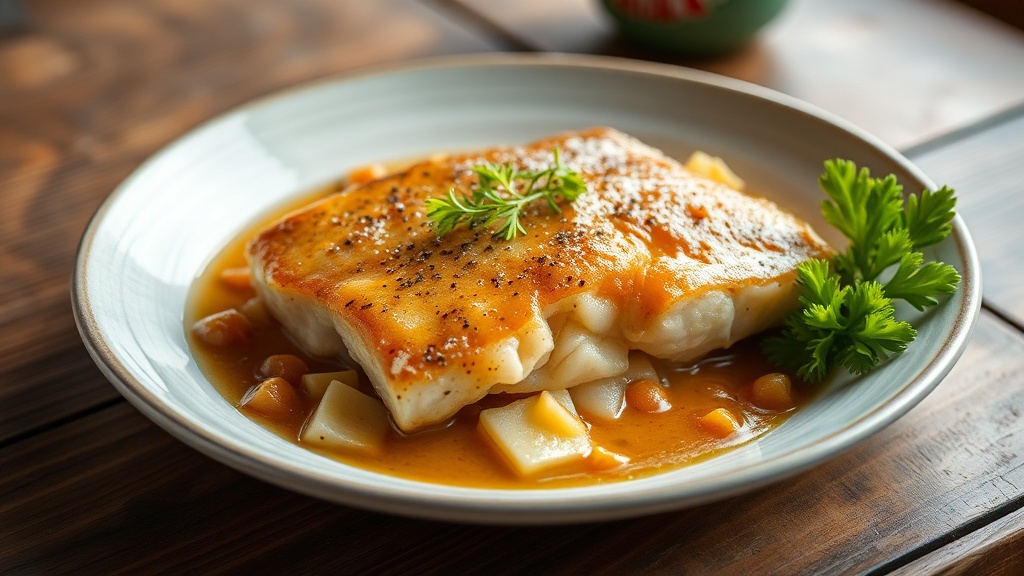
Plokkfiskur
Icelandic fish and potato mash · serves 4 · 40 min
Ingredients: 600 g cod or haddock fillet, skinned; 800 g floury potatoes; 1 large onion, finely chopped; 50 g butter; 40 g plain flour; about 500 ml milk; salt, white pepper; a little nutmeg. To serve: dark rye bread, butter, and a spoonful of berry jam if you want the traditional version.
Method: Boil the potatoes in their skins until soft, then peel and break them up roughly — do not put them through a ricer, the dish wants texture. Poach the fish in lightly salted water for 5–6 minutes until it just flakes, lift it out and flake it, discarding any bones. Meanwhile soften the onion in the butter without colouring it, stir in the flour and cook for a minute, then add the milk gradually to make a fairly loose white sauce; season well with salt, white pepper and a scrape of nutmeg. Fold in the potatoes and then the fish, keeping some flakes intact. It should be soft and spoonable, not stiff. Warm through and serve straight from the pan with rye bread and cold butter.
💡 This is a leftovers dish and it is better made with yesterday's boiled fish and potatoes than with anything cooked specially. Some households brown the top under a grill; some add curry powder, which sounds wrong and is a real and defended Icelandic variant.
🍖 Recipe: Hangikjöt
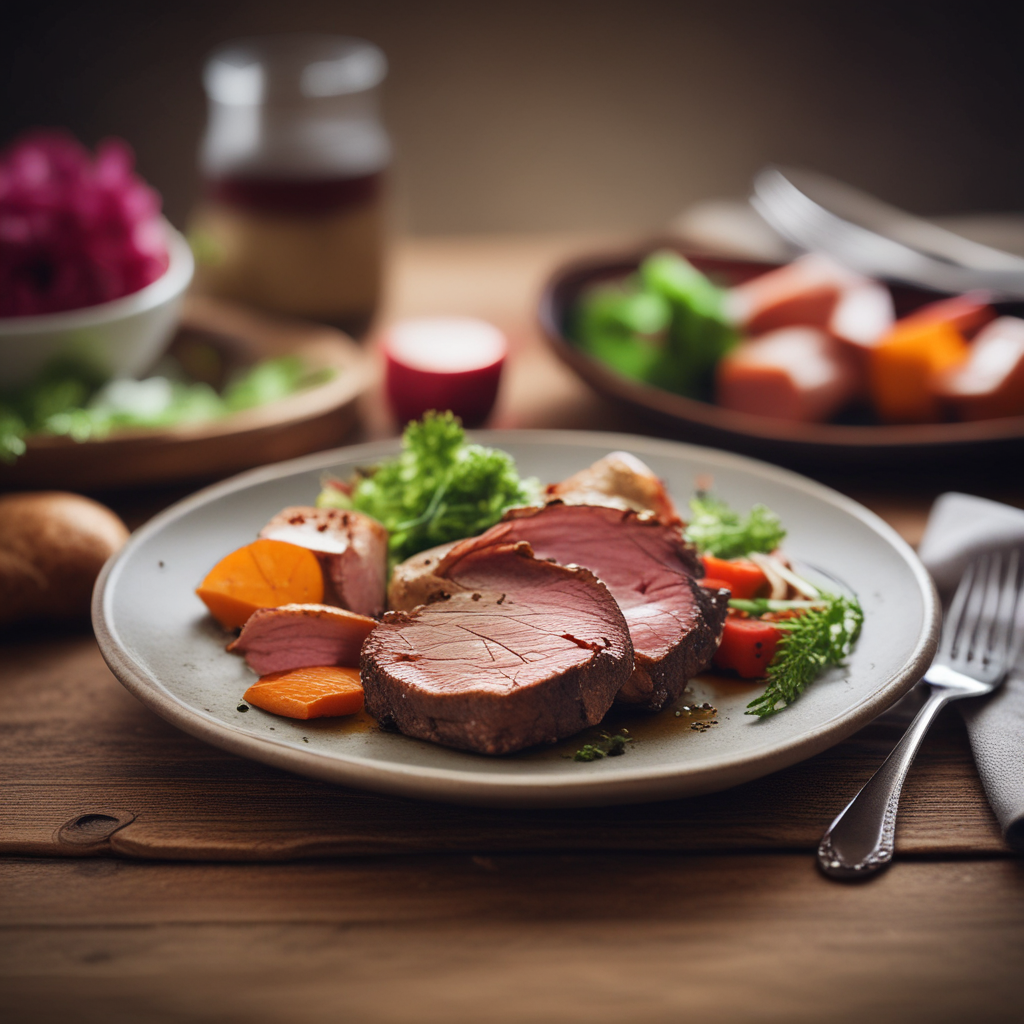
Hangikjöt with Uppstúf
Icelandic Christmas lamb · serves 6 · 2 h
Ingredients: 1.2 kg smoked lamb leg or shoulder (hangikjöt, from a Nordic deli, or substitute a lightly smoked gammon-style cured lamb); 1 kg potatoes; for the uppstúf (béchamel): 50 g butter, 50 g flour, 700 ml milk, salt, white pepper, a little sugar; 400 g green peas; pickled red cabbage; laufabrauð if you can find it.
Method: Put the meat in a large pot, cover with cold water, bring slowly to a bare simmer and cook — never boiling — for about 90 minutes, or roughly 50 minutes per kilo. Take it off the heat and let it cool in its own liquid; this is what keeps it moist and is the step people skip. Chill, then slice very thin across the grain. Boil the potatoes, peel them and cut into chunks. Make the uppstúf: melt the butter, stir in the flour, cook a minute, then add the milk gradually to a smooth pouring sauce, and season with salt, white pepper and a pinch of sugar. Fold the potatoes and peas into the sauce and serve the sliced lamb alongside, with red cabbage.
💡 It is also eaten cold on buttered flatkaka — thin dark rye flatbread — which is the everyday version and, for many Icelanders, the better one.
🥃 Drinks, and Seventy-Four Years Without Beer
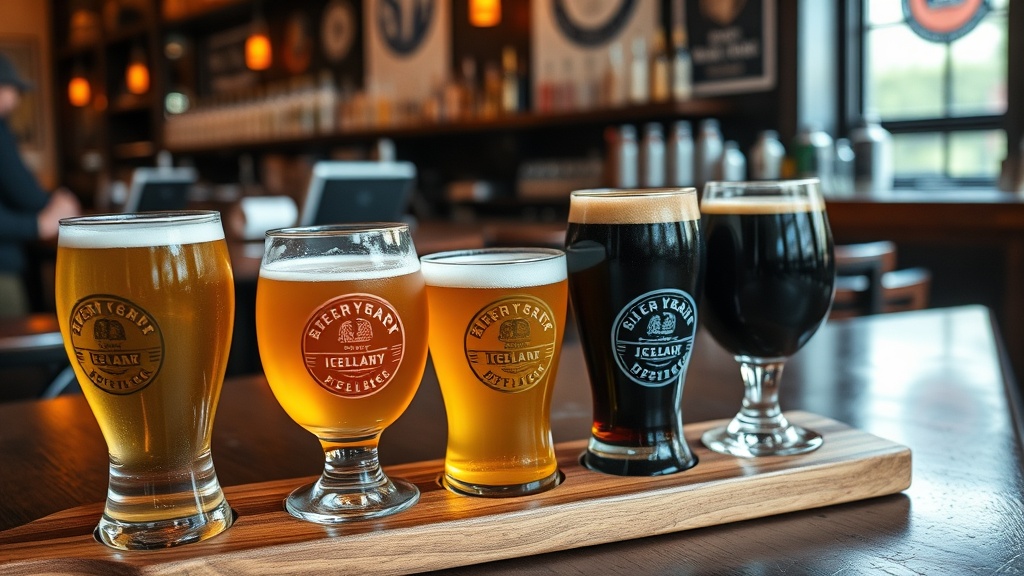
Iceland voted for full prohibition in 1908 and enacted it in 1915. Wine came back in 1922 — because Spain, Iceland's main saltfish customer, threatened the trade unless Icelanders bought Spanish wine, which is one of the more effective pieces of commercial diplomacy on record. Spirits came back in 1935. And beer, on the theory that it was cheap enough to encourage everyday drunkenness, stayed illegal until 1 March 1989.
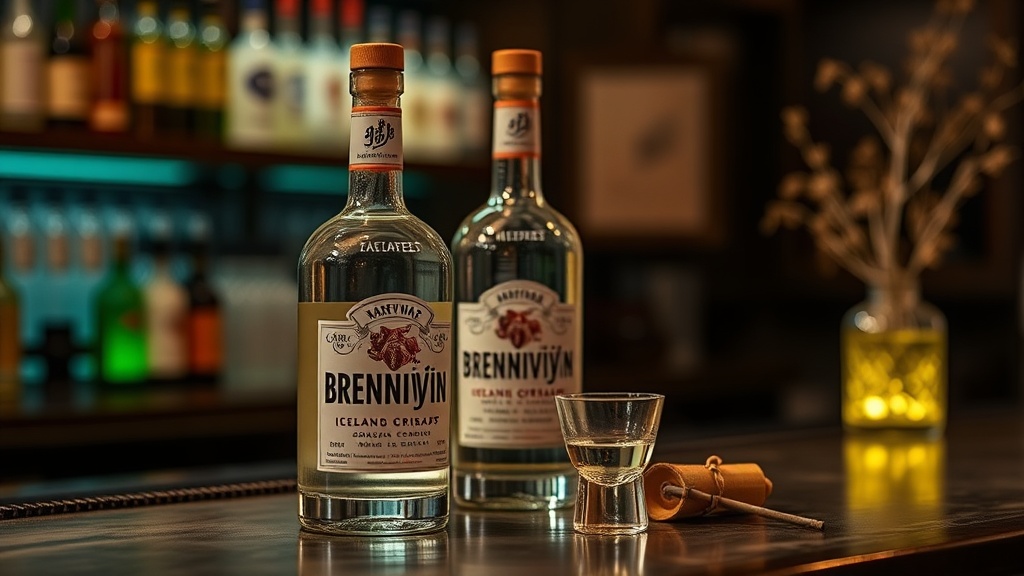
Brennivín
The national spirit: a clear grain aquavit flavoured with caraway, 37.5%, and the traditional chaser for hákarl. Its nickname, svarti dauði — Black Death — comes from the plain black label the state slapped on it during the temperance era specifically to make it look unappealing. The label stayed, the nickname stuck, and the marketing department eventually gave up and leaned into it. (In this page's photograph the bottles carry generated lettering and a pale label rather than the real black one.)
Vínbúðin
Alcohol above 2.25% is sold only in the state monopoly shops, called Vínbúðin, which are few, close early and do not open on Sundays. Supermarket "beer" is alcohol-free. The one sensible move every visitor should make is to buy duty-free on arrival at Keflavík, where the shop is in the arrivals hall precisely because everyone does — prices there are around half the Vínbúðin's and a third of a bar's.
Coffee
Icelanders drink among the most coffee per head in the world, it is taken seriously, and a refill is very often free. Reykjavík's café culture is genuinely good and is also the cheapest way to sit somewhere warm for an hour.
Water
The tap water is glacial and among the best on Earth, and buying bottled water in Iceland is both wasteful and slightly ridiculous — Icelanders will tell you so. The hot tap is geothermal and smells distinctly of sulphur; it is harmless, it fades in a few seconds, and it is why the showers smell like that.
🏙️ Reykjavík
The world's northernmost capital of a sovereign state, and by the standards of capitals a very small one: about 140,000 in the city and 250,000 in the wider region, which is two thirds of the entire country. It is low, colourful, walkable in an afternoon, and it is not the reason to come to Iceland — but it is a genuinely pleasant two days and much more interesting than its critics allow.

Hallgrímskirkja
The 74 m church on the hill, designed to echo basalt columns and taking 41 years to build. The tower lift gives the best view over the city and the bay, and Leifur Eiríksson stands outside it on a plinth given by the United States in 1930 for the Alþingi's thousandth anniversary. The organ is worth catching a recital for.
Harpa and the harbour
Harpa, the concert hall on the waterfront, is a glass honeycomb by Ólafur Elíasson that was half-built when the banks collapsed and was finished anyway as a statement of intent. Along the harbour: whale-watching and puffin boats, the flea market Kolaportið at weekends, the hot dog stand, and the Sun Voyager sculpture, which is not a Viking ship but a dream boat.
Museums worth the time
The National Museum for a coherent thousand-year story. Reykjavík 871±2, built around an excavated longhouse wall found under a hotel site. The Árni Magnússon Institute, where the actual saga manuscripts are displayed. The Perlan for its ice cave and planetarium. And the Phallological Museum, which is exactly what it sounds like and has a real collection.
Pools and nights out
Every neighbourhood has a geothermal sundlaug — outdoor, warm, open early and late, costing about the price of a coffee, and the single most authentically Icelandic thing a visitor can do. Laugardalslaug is the biggest, Vesturbæjarlaug the most local. The rule is absolute: shower naked and thoroughly before entering, and attendants will tell you. The bar scene on Laugavegur runs very late on Friday and Saturday and starts around midnight.
💫 The Golden Circle
Three sites within about 300 km of driving from Reykjavík, doable in a day and done by almost everyone: Þingvellir, Geysir and Gullfoss. It is the most crowded thing in Iceland and it is popular for a good reason — the three between them cover the rift, the geothermal field and the glacial river.

Þingvellir
Do this one first and slowly. Walk down through the Almannagjá rift from the upper car park, past the Lögberg, to the church and the pools — about an hour. The Silfra fissure here is filled with glacial meltwater filtered through lava for decades and has visibility over 100 m; snorkelling or diving between the continental plates in a drysuit is a real and heavily booked activity.
Gullfoss
The Golden Falls: the Hvítá drops 32 m in two stages into a canyon at an angle that makes it look, from the approach, as though the river vanishes into the ground. It was nearly dammed in the early twentieth century; the story that the farmer's daughter Sigríður Tómasdóttir walked to Reykjavík and threatened to throw herself in is the founding legend of Icelandic conservation, and if the details are romanticised the campaign was real.
The additions
Most operators add one or two: the Kerið crater lake, the tomato greenhouse at Friðheimar (heated and lit geothermally, and the tomato soup is genuinely good), the Secret Lagoon at Flúðir, which is Iceland's oldest pool and a far better bath than the Blue Lagoon at a third of the price, or the geothermal bread bakery at Laugarvatn.
Doing it well
Go anticlockwise — most coach tours run clockwise from Reykjavík and arrive at Þingvellir first, so reversing puts you an hour out of step with them. Or leave at seven. Self-driving beats the coach comfortably; the roads are good tarmac all the way and it is one of the few Icelandic drives that is genuinely easy in winter.
🌊 The South Coast
The stretch of Route 1 from Selfoss to Vík is the densest concentration of scenery in the country and the busiest road in Iceland after the airport run. Waterfalls off the old sea cliff on the left, black sand and Atlantic on the right, and glaciers behind both.

Seljalandsfoss and Skógafoss
Seljalandsfoss is the one you can walk behind, which is worth the soaking; take a waterproof and expect to get one. A few hundred metres north, up a narrow slot, is Gljúfrabúi, hidden inside a cleft and missed by most of the coaches. Skógafoss is 60 m and 25 m wide; climb the 527 steps beside it and keep walking, because the Fimmvörðuháls trail above passes another twenty-odd falls in the first hour.
Reynisfjara — and a warning
The black basalt beach at Vík, with its columnar cliff, cave and the Reynisdrangar sea stacks offshore, is spectacular and is genuinely dangerous. It gets sneaker waves: an ordinary swell followed without warning by one that runs far higher up the beach, in water at 5 °C with a strong undertow. People have died here, more than once, in the last decade. Stay well back from the waterline, never turn your back on the sea, and take the warning-light system seriously.
Dyrhólaey and the puffins
The headland west of Vík, with an arch big enough to fly a small plane through and one of the most accessible puffin colonies in the country from May to early August. It is closed during the peak nesting period each year, which is the correct decision and is not negotiable.
Sólheimajökull and Vík
Sólheimajökull is the standard glacier walk from the south coast — an outlet tongue you can drive to and step onto with a guide — and it has visibly retreated in a way that guides use as a teaching aid. Vík itself is a village of 300 with a red-roofed church on a hill, and it is the last real services for a while going east.

🧊 The South-East and the Glacier Lagoon
East of Vík the road crosses Skeiðarársandur, an enormous flat black desert built entirely from glacial flood debris, and then runs along the southern edge of Vatnajökull with ice tongues coming down to within a few kilometres of the road for a hundred kilometres. It is the most consistently astonishing stretch of the ring road.

Diamond Beach
Across the road from the lagoon, where the icebergs that make it out through the short river are thrown back onto black sand by the surf and lie there melting. Early morning, before the coaches, with low sun through the ice, is the reason to set an alarm.
Skaftafell
Now part of Vatnajökull National Park: the base for glacier walks, ice-cave tours in winter and the walk up to Svartifoss, a waterfall over a wall of hexagonal basalt columns whose shape inspired both Hallgrímskirkja and the National Theatre. Behind it stands Hvannadalshnúkur (2,110 m), Iceland's high point, on the rim of the Öræfajökull volcano.
Ice caves
Blue glacial caves form each winter under Vatnajökull and are accessible roughly November to March with a guide, never alone — they refreeze and collapse on their own schedule. There is also a year-round man-made ice tunnel at Langjökull, which is a different and lesser thing, honestly labelled.
Höfn and beyond
Höfn is the langoustine capital and the place to eat them. Past it the road turns north into the East Fjords, which are quiet, steep, dotted with tiny fishing villages, and skipped by most itineraries — Seyðisfjörður, with its rainbow street and its ferry to Denmark, is the one people have heard of and it deserves the stop.
🏔️ The North, the West and the Highlands
Past the east fjords the ring road reaches the north, which most visitors never get to and which contains a good share of the country's best things. Beyond that lie the Westfjords and the Snæfellsnes peninsula, and inland the empty highlands.

Mývatn and the north
Lake Mývatn is a geothermal wonderland: pseudocraters, the Dimmuborgir lava formations, the boiling mud of Hverir, the Krafla caldera, and the Mývatn Nature Baths, which are the north's Blue Lagoon at half the price and a third of the crowd. Nearby: Dettifoss, the most powerful waterfall in Europe by volume, and Ásbyrgi, a horseshoe canyon that Norse legend attributes to Odin's horse putting a hoof down.
Akureyri and Húsavík
Akureyri, population 20,000, is the capital of the north and by a distance Iceland's second real town — botanical gardens that grow things they should not at 65° north, a good food scene and a ski hill. Húsavík on the bay beyond it is the whale-watching capital of Europe and the setting of a Eurovision film that the town has embraced with total commitment.
Snæfellsnes
The peninsula two hours north of Reykjavík, marketed as "Iceland in miniature" and for once the marketing is fair: a glacier-capped volcano at the tip (the entrance to Jules Verne's journey to the centre of the Earth), black beaches, lava fields, bird cliffs, fishing villages and a mountain that has become a photographic cliché — with reason.
The Westfjords
The great empty north-west: a hand of long fjords connected by high passes, with about 7,000 people in an area the size of a small country. Látrabjarg bird cliff, Dynjandi waterfall falling in a 100 m bridal veil, the hot pots at Reykjafjörður and the Hornstrandir reserve, which has no roads and no residents and is reached by boat. Most roads here are open only in summer and some are gravel. Almost nobody goes, which is the point.

♨️ Pools and Hot Pots
If there is one habit worth stealing from Iceland it is this. Almost every settlement in the country, however small, has a geothermal swimming pool — outdoor, heated, open from early morning to late evening, year-round, and costing roughly the price of a coffee. This is where the country actually socialises, and it is a far better experience than any of the marketed lagoons.
How it works
A 25 m lane pool for swimming, and beside it a set of hot pots at graded temperatures — typically 38, 40 and 42 °C — plus usually a steam room and a cold tub. People sit in the hot pots and talk, for a long time. In small towns the same three men have been in the same pot at the same hour for thirty years and will happily include you.
The shower rule
Non-negotiable and strictly enforced. You undress completely, and wash with soap without a swimsuit, in a communal shower, before entering the pool — the diagram on the wall shows the five areas that must be washed. Icelandic pools use very little chlorine precisely because everyone does this, and an attendant will send you back. It is not prudish and it is not optional; treating it as either is the fastest way to annoy an Icelander.
The good ones
In Reykjavík: Vesturbæjarlaug, Sundhöllin (a 1937 Guðjón Samúelsson building) and Laugardalslaug. Outside: the cliff-edge pool at Hofsós looking out over the fjord, the Secret Lagoon at Flúðir, Mývatn Nature Baths, GeoSea at Húsavík, and the Sky Lagoon just outside Reykjavík if you want the expensive version done well.
Wild hot springs
There are natural pools all over the country — Reykjadalur above Hveragerði, where a whole river runs at bathing temperature and you walk 45 minutes up to it, is the accessible classic. Rules: never enter a hot spring you have not been told is safe, because some are at 100 °C; leave no trace; and if a pool is on someone's farm, ask.
🚗 Driving, and the Things That Kill Tourists
⚠️ Two websites to bookmark before you drive anywhere: road.is for road conditions and closures and vedur.is for weather and wind warnings, plus safetravel.is, where you can leave a travel plan. Icelandic conditions change within an hour and the closures are not advisory — a road marked closed is closed, and driving past the barrier is both illegal and how rescues start.
Iceland has no railways, so almost every independent visitor drives. The roads are good and the traffic is light, and the danger is entirely environmental: wind, ice, blowing sand, single-lane bridges and the fact that the scenery is more interesting than the road.
The wind
The specific Icelandic hazard. Gusts of 25–35 m/s are common and can exceed 50. Open your car door carelessly in one and it will be torn off its hinges — this is a frequent, expensive and almost never insured claim, so hold the door with both hands and open it downwind. In extreme wind, high-sided vehicles are simply blown over; when the forecast says orange, do not drive.
Insurance
Take gravel protection (GP) and sand and ash protection (SAAP), which are not gimmicks: gravel thrown by oncoming cars chips windscreens constantly, and a south-coast sandstorm can strip the paint off a car in minutes and produce a bill in the thousands of euros. No policy of any kind covers river crossings, water damage or undercarriage damage on F-roads.
F-roads and 4×4
Roads numbered with an F are mountain tracks, legally require a four-wheel drive, are open roughly late June to mid-September, and involve unbridged river fords. Driving a 2WD on one voids the rental contract entirely. If you have not forded a river before, do not learn on an Icelandic glacial river — depth and bed change daily and the water is 2 °C.
The rules
Headlights on always, day and night, by law. Speed: 50 in towns, 80 on gravel, 90 on tarmac, and there are fixed cameras. Off-road driving is a criminal offence with large fines — the moss takes decades to regrow. Blind rises are marked blindhæð and single-lane bridges einbreið brú: the vehicle nearer the bridge goes first. And there is no petrol for very long stretches in the east and the interior, so fill up at half a tank rather than a quarter.
The other hazards, briefly: sneaker waves at Reynisfjara and other south-coast beaches, which have killed several visitors; walking on a glacier without a guide, rope and crampons; approaching a crevasse or an ice cave alone; and hypothermia, which is the commonest search-and-rescue call and does not need a cold day, only wet and wind. Iceland's rescue service, ICE-SAR, is entirely volunteer and will come for you free of charge, which is a reason to be considerate rather than casual.
✈️ Getting There
Keflavík (KEF), 50 km south-west of Reykjavík, handles essentially all international traffic. Its whole business model is being the mid-point of the North Atlantic: Icelandair built the airline around free stopovers of up to a week between Europe and North America at no extra fare, which is the cheapest way anyone has ever visited Iceland.
From Prague
Direct seasonal flights operate in the summer months — Icelandair has flown Prague–Keflavík, and the low-cost carrier Play has served central European routes; both timetables change year to year, so check rather than assume. A direct flight is about 4 hours. Otherwise one stop via Copenhagen, Frankfurt, Amsterdam, London or Oslo, for 6–8 hours total.
Into town
The Flybus and Airport Direct coaches meet every arrival and take about 45 minutes to the BSÍ terminal, with hotel drop-offs for a supplement. Public bus 55 is cheaper and much slower. A taxi is roughly 3,500–4,500 Kč and is almost never worth it. If you are hiring a car, collect it at the airport — you do not want a car in central Reykjavík anyway.
The duty-free rule
Do the arrivals duty-free shop. It is placed after passport control, before the exit, for exactly this reason, and alcohol there costs roughly half what the state monopoly charges and a third of a bar. Everyone on your flight, including every Icelander, will be queueing in it.
By sea
The Norröna ferry runs from Hirtshals in Denmark via the Faroes to Seyðisfjörður in the east fjords, roughly weekly in summer. It takes around three days and it is the only way to bring your own car, which for a long trip with camping gear can work out sensibly. It is not a cheap alternative to flying.
💰 What It Costs
Iceland is expensive. It is consistently in the top three or four most expensive countries in the world, and pretending otherwise helps nobody. The causes are real — everything is imported, the population is tiny, wages are high and taxes are high — and there are genuine ways to cut it in half.
Money
The Icelandic króna (ISK), roughly 5.6 ISK to the Czech crown — so 1,000 ISK is about 180 Kč, and moving the decimal three places and multiplying by about 0.18 is close enough for a menu. Iceland is close to cashless: cards work everywhere including on remote petrol pumps and public toilets, and there is very little reason to carry banknotes. Bring a card with a PIN for unattended fuel pumps.
The numbers
Restaurant main course: 630–1,100 Kč. Beer in a bar: 215–320 Kč. Coffee: 120–160 Kč. A hot dog: about 100 Kč. Supermarket dinner for two from Bónus: 400–600 Kč. Hotel double in summer: 4,500–8,000 Kč; a guesthouse room 2,700–4,500; a hostel bed 1,200–1,800. Petrol runs around 60 Kč a litre, and a ring-road circuit will use 150–200 litres.
A realistic daily budget
Camping and self-catering: 2,000–3,000 Kč a day per person including a shared car. Guesthouses and cooking, eating out sometimes: 4,500–7,000. Hotels and restaurants: 9,000–15,000 and upwards. A two-week ring-road trip for two, done carefully, lands somewhere around 90,000–130,000 Kč all in including flights.
How to actually save it
Shop at Bónus and cook. Buy alcohol at arrivals duty-free. Drink the tap water and refill a bottle. Swim in municipal pools, not marketed lagoons. Travel in May or September rather than July. Share a car — the car is the single biggest line item and splits four ways. And note that all of Iceland's greatest hits are free: every waterfall, beach, glacier view and hot spring on this page costs nothing but a car park fee.
📋 Practical Information
Entry
Iceland is in the Schengen area but not in the EU — it is in the EEA, so free movement applies and Czech citizens need only an ID card, but customs limits are those of a non-EU country. That last point catches people: the alcohol and tobacco allowances are enforced and are the reason for the duty-free queue.
Health
The European Health Insurance Card works. Standards are high and there are hospitals in Reykjavík and Akureyri, but distances are long and evacuation from the interior is expensive — take commercial insurance covering hiking, glacier walking and any activity you plan, because the standard policies exclude several of them. Emergency number 112, and the 112 Iceland app can send your GPS position to rescue with one button.
Practicalities
Plugs are European type C/F, 230 V — no adapter needed from Czechia. Mobile coverage is good along the ring road and patchy in the highlands and Westfjords. Tipping is not customary and service is included; leaving 10% will simply confuse people. Tap water is superb; bottled water is a waste of money and Icelanders find buying it faintly comic.
Etiquette
Shower properly before swimming (see above; this is the one that matters). Take your shoes off indoors, including in many guesthouses. Do not camp outside campsites — wild camping in a vehicle has been illegal since 2015 and the fines are real. Close gates. And do not stop your car on the road to take a photograph, which is the single most complained-about tourist behaviour in the country and has caused fatal collisions.
For Czech travellers: the Czech Republic has no embassy in Reykjavík — Iceland is covered from the Czech Embassy in Oslo, with an honorary consul in Reykjavík. Note the contacts from mzv.cz before you go rather than looking for them from a lay-by. MZV ČR issues no travel warning for Iceland beyond ordinary caution, and registration in DROZD is free and genuinely useful in a country where a road can close behind you.
❓ Misconceptions
"Over half of Icelanders believe in elves."
The survey people cite asked whether hidden people were impossible, and a majority declined to say so. Outright belief was around a tenth. What is real is a tradition of not being casual with the landscape — which occasionally reroutes a road and functions rather like a heritage protection rule.
"Iceland is freezing."
Reykjavík's January average is about 0 °C — milder than Prague, Vienna or Berlin — because of the Gulf Stream. Iceland is not cold so much as wet, windy and changeable, and it is the wind that will actually ruin your day. Pack layers and a proper shell, not an Arctic parka.
"The Blue Lagoon is a natural hot spring."
It is the outflow of a geothermal power station, discovered by accident in the 1970s and commercialised from 1992. That does not make it unpleasant. It does mean that the municipal pool in any small town, at a twentieth of the price, is the more authentic experience — and the Secret Lagoon and Mývatn Nature Baths are better value.
"You can see the northern lights any time."
You need darkness, so roughly September to April — in June the sky never gets dark and no amount of solar activity will help. You also need clear sky, which in Iceland is the binding constraint far more often than the aurora forecast is. Budget several nights, not one.
"Hákarl is rotten shark."
It is fermented and dried shark, and the process exists for a chemical reason: Greenland shark flesh contains trimethylamine oxide in concentrations that are toxic when fresh, and months of fermentation and drying break it down. It is food-safety engineering, not decay, and calling it rotten irritates Icelanders for good reason.
"You can drive the Ring Road in three days."
You can put the kilometres behind you, and you will see almost nothing and be tired and unsafe doing it. Eight to ten days is a comfortable circuit with time to stop; a week is brisk. In winter, do not attempt the full circuit at all unless you are experienced — plan the south coast and back instead.
✍️ Author's Note
Iceland has a problem that most countries would envy and that is nonetheless real: it has become so photographed that people arrive with the pictures already in their heads and spend the trip collecting them. Kirkjufell, the Blue Lagoon, the black beach, the ice lagoon, all shot from the same three spots, all with a queue. Every one of those places is genuinely worth seeing. But the country is far bigger and far emptier than that corridor, and almost nobody goes to the other 90% of it.
So the honest advice is: do the famous things, early in the morning, and then get away from them. Give the north and the east fjords a proper share of the trip. Go to the Westfjords if you have ten days, because they have a fraction of the traffic and are arguably the best of it. Swim in the municipal pool in whatever town you are in rather than in a marketed lagoon; it costs a coffee, it is where the country actually is, and the shower rule is not personal.
Two practical things carry more weight than everything else on this page. Check road.is and vedur.is every single morning — this is not caution, it is how Icelanders live, and the closures are absolute. And budget properly rather than being shocked: the country is expensive, the savings are real if you cook and shop at Bónus and travel in the shoulder season, and every single one of the great sights is free.
On the images
The photographs here are illustrative reconstructions rather than documentary images, and this set is broadly accurate — Þingvellir's rift, Strokkur mid-eruption, Surtsey's crater, Jökulsárlón, Reynisfjara's stacks and the Icelandic horses are all recognisably themselves. Where an image diverges the caption says so: the Skógafoss picture puts the fall in a gorge that does not exist and pushes the moss to acid yellow, as does the Kirkjufell one; the aurora is more saturated than the naked eye sees; the lamb's interior is an impossible magenta; the plokkfiskur is a fillet where the dish is a mash; and the labels on the beer and Brennivín bottles are generated lettering rather than real text — the real Brennivín label is black. One supplied recipe image was left out entirely: it showed rúgbrauð as a pale, dry, crumbly loaf, and Icelandic rye bread is near-black, dense and sticky — wrong on the one feature that defines it.
Support This Project 🌍
This World Travel Factbook is a labor of love – free to use for all travelers. If you find it helpful, consider supporting its continued development.