


🇮🇩 Indonesia at a Glance
🌍 Overview
Indonesia is the largest archipelagic state on Earth: roughly 17,000 islands spread across 5,100 km of ocean — the same distance as London to Tehran and back — with about 285 million people, making it the fourth most populous country in the world after India, China and the United States. Its land area is around 1.9 million km², about twenty-four times Czechia.
Four superlatives are worth having straight before anything else. It has more active volcanoes than any country — around 130. It has the largest Muslim population of any nation, roughly 240 million, while being a secular republic rather than an Islamic state. It sits on the most seismically violent stretch of the Ring of Fire, which has produced the largest eruption and one of the deadliest tsunamis in recorded history. And it holds the greatest marine biodiversity on the planet, in the reefs of Raja Ampat.
The distribution of all those people is the fact that explains most of the rest. Java holds around 56% of the population on about 7% of the land — some 150 million people on an island roughly the size of England — which makes it one of the most densely populated large islands anywhere. Papua, at the other end, is nearly as large and holds under 2%.
And the country is currently doing something no other large state is doing: moving its capital. Jakarta is sinking — parts of the north by as much as 25 cm a year, with about 40% of the city already below sea level — so a new capital called Nusantara is being built in the forest of East Kalimantan on Borneo. The first phase was inaugurated in 2024. Whether it will actually work is one of the more interesting open questions in world urbanism.
🏷️ A Language Chosen Because It Belonged to Nobody
The name Indonesia is a nineteenth-century European coinage — Greek Indos plus nesos, island, so "Indian islands" — invented by an English ethnographer in the 1850s and adopted by nationalist students in the 1920s precisely because it was not the Dutch "Netherlands Indies". A country named itself with a word made up by outsiders, and made it mean something else.
The language decision was more remarkable. When the nationalist movement met at the Youth Pledge of 1928, it needed one language for a territory speaking around 700. The obvious choice was Javanese, the mother tongue of the largest group by far, with a great literature and a thousand-year history. They chose instead Malay — the trade lingua franca of the archipelago's ports, the first language of only a small minority — renamed it Bahasa Indonesia, and made it the national language.
Why it worked
Because it belonged to nobody, it could belong to everybody. Javanese carries elaborate speech levels that encode social rank in every sentence; Malay does not, which made it usable between equals from different islands. Almost every Indonesian now speaks it, most as a second language after their regional one, and it has become one of the great success stories of deliberate language planning anywhere in the world.
How hard is it
By the standards of world languages, remarkably easy for a European. No tones. No grammatical gender. No verb conjugation. No plurals in the usual sense — you repeat the word (buku book, buku-buku books) or just leave it to context. No definite article. The tenses are handled with a few particles: sudah (already), akan (will), sedang (in the middle of). It is written in the Latin alphabet and pronounced as spelled.
A few words
Selamat pagi (good morning), terima kasih (thank you), sama-sama (you're welcome), permisi (excuse me), berapa? (how much?), tidak (no), enak (delicious — you will use this constantly), bagus (good), tidak apa-apa (no problem, and a whole worldview). Effort with these is noticed and rewarded far out of proportion to the effort.
Bhinneka Tunggal Ika
The national motto, in Old Javanese, from a fourteenth-century poem: "Unity in Diversity" — more literally, "many, yet one". It was written to reconcile Hindus and Buddhists in the Majapahit empire and was picked up six hundred years later to hold together a country of 700 languages and six official religions. It is on the coat of arms, in the claws of the mythical bird Garuda.
🗺️ Seventeen Thousand Islands
The exact number is genuinely disputed and the reason is instructive: it depends on what counts as an island, and on the tide. The figure of 17,508 was the long-standing official one; a national survey using satellite mapping produced a rather lower verified count, and Indonesia has been formally registering names with the United Nations to lock the number down. Somewhere around 17,000 is the honest answer, of which perhaps 6,000 are inhabited.
The big five
Java: the political and demographic core, 150 million people, volcanoes down the spine. Sumatra: sixth largest island in the world, rainforest, coffee, Lake Toba. Kalimantan: the Indonesian two thirds of Borneo, shared with Malaysia and Brunei, and the site of the new capital. Sulawesi: the extraordinary four-armed island, a biological world of its own. Papua: the western half of New Guinea, and the least-known large territory on Earth.
The chains
The Lesser Sundas run east from Bali — Lombok, Sumbawa, Flores, Sumba, Timor — getting progressively drier as they approach Australia. The Maluku islands, the original Spice Islands, sit between Sulawesi and Papua. And there are hundreds of small groups that most maps do not name, from the Riau archipelago near Singapore to the Aru Islands off Papua.
Three time zones
WIB (UTC+7) covers Java and Sumatra, WITA (UTC+8) Bali, Kalimantan and Sulawesi, and WIT (UTC+9) Maluku and Papua. A domestic flight can cost you two hours of clock. Note that Bali is one hour ahead of Jakarta, which catches out a great many people connecting between them.
The high point
Puncak Jaya (Carstensz Pyramid) in Papua, 4,884 m — the highest mountain between the Himalaya and the Andes, and one of the Seven Summits. It carried equatorial glaciers that were mapped in the twentieth century and are now all but gone; they are expected to disappear entirely within a few years, which will end tropical glaciation in Asia.
🌋 The Ring of Fire
Indonesia sits where the Indo-Australian plate dives under the Eurasian, and the result is a 7,000 km volcanic arc with around 130 active volcanoes — more than any other country, and roughly a sixth of the world's total. It also means the country has produced two of the largest eruptions in human history and remains one of the most seismically dangerous places to live anywhere.
Tambora, 1815
The largest volcanic eruption in recorded history — around VEI 7, ten times Krakatau. It killed perhaps 70,000 to 100,000 people directly and by famine, and it threw enough sulphate into the stratosphere to cool the entire planet: 1816 is remembered in Europe and North America as the Year Without a Summer, with snow in June in New England, crop failure across Europe, and a wet Swiss holiday during which Mary Shelley wrote Frankenstein.
Krakatau, 1883
Smaller but far more famous, because it happened in the age of the telegraph. The explosion on 27 August was heard 4,800 km away in Australia and on Rodrigues in the Indian Ocean — the loudest sound in recorded history — and the tsunamis it generated killed something over 36,000 people. The barometric wave circled the globe several times. A new cone, Anak Krakatau ("child of Krakatau"), rose from the sea in 1927 and collapsed in 2018, causing another deadly tsunami.
Toba, 74,000 years ago
In northern Sumatra, and on a different scale entirely: the largest eruption anywhere in the last two million years, which left a caldera 100 km long that is now Lake Toba, the biggest volcanic lake on Earth. The hypothesis that it caused a human population bottleneck is genuinely contested and increasingly doubted — but the hole in the ground is real and you can swim in it.
The ones you can visit
Bromo, a small cone in a sea of volcanic sand inside a much larger caldera, reached before dawn and one of the great sights in Asia. Ijen, whose crater lake is the largest body of acid on Earth and where a blue flame of burning sulphurous gas is visible at night — and where miners carry 70–90 kg loads of sulphur out on their shoulders for very little money, which is worth thinking about before treating it as a photo opportunity. Merapi, above Yogyakarta, one of the most active and most dangerous in the world.
The other consequence is tsunami. On 26 December 2004 a magnitude 9.1 earthquake off Sumatra — the third largest ever recorded — generated waves that killed around 230,000 people across fourteen countries, of whom roughly 170,000 died in Aceh alone. It is the deadliest tsunami in history. It also, unexpectedly, ended a thirty-year separatist war: the devastation forced the Free Aceh Movement and the government into the Helsinki peace agreement of 2005, which has held.
🦎 The Wallace Line
Sail east from Bali to Lombok — a strait about 35 km wide — and the animals change. On the Bali side you find tigers (historically), monkeys, woodpeckers, barbets: Asian fauna. On the Lombok side you find cockatoos, honeyeaters, marsupials: Australasian fauna. The strait is deep and stayed open even at the lowest ice-age sea levels, so the two faunas never mixed.
This is the Wallace Line, identified by Alfred Russel Wallace during eight years of collecting across the archipelago from 1854. It is one of biogeography's foundational observations. And while on the island of Ternate in the Maluku in 1858, feverish with malaria, Wallace worked out the mechanism of evolution by natural selection independently, wrote it up, and posted it to Charles Darwin — who had been sitting on the same idea for twenty years and was prompted into finally publishing. The joint paper of 1858 and On the Origin of Species the following year both come out of a letter sent from Indonesia.
Wallacea
The islands between the Wallace Line and the Australian shelf — Sulawesi, the Lesser Sundas, Maluku — form a transition zone called Wallacea, colonised by whatever could cross open water. The result is extraordinary endemism: Sulawesi alone has around 60% endemic mammals, including the babirusa, the anoa (a dwarf buffalo) and several macaques found nowhere else.
The Coral Triangle
Indonesia sits at the centre of it — the marine equivalent of the Amazon. Raja Ampat, off western Papua, has the highest recorded reef-fish and coral diversity anywhere on Earth: something like three quarters of all known coral species occur within it, in an area smaller than Slovakia. A single dive site there routinely records more fish species than the entire Caribbean.
Komodo dragons
The world's largest lizard, up to 3 m and 90 kg, found only on Komodo, Rinca, Flores and two smaller islands. The long-repeated story that their bite kills through septic bacteria was disproved in 2009: they have genuine venom glands in the lower jaw producing an anticoagulant and hypotensive cocktail. It is not the mouth bacteria; it is venom, and the correction is now well established.
Orangutans
Three species, all critically endangered, all Indonesian (the Bornean one shared with Malaysia): the Bornean, the Sumatran, and the Tapanuli, which was only described as a separate species in 2017 and numbers around 800 individuals — making it the rarest great ape in the world. Its entire habitat is one forest block in North Sumatra.
🗺️ Map
Indonesia straddles the equator between roughly 6° north and 11° south, and runs from 95° to 141° east — from just off the tip of Malaysia to the border with Papua New Guinea. It borders three countries by land (Malaysia on Borneo, Papua New Guinea, and Timor-Leste) and shares maritime boundaries with ten more.
The scale problem
The single most common planning error is underestimating distances. Jakarta to Jayapura in Papua is 3,800 km — further than Prague to Tehran — and takes six hours by air with a stop. Even Jakarta to Bali is 1,150 km. You cannot see Indonesia on one trip. Pick two islands, or one island and one neighbour, and go properly.
Realistic combinations
Java + Bali is the classic two-week pairing and works well by train and short flight. Bali + Lombok/Gilis or Bali + Flores/Komodo for a fortnight. Sumatra on its own — Bukit Lawang, Toba, Padang — needs ten days minimum. Raja Ampat is a trip in itself and is not something you add to the end of another one.
Getting between islands
Domestic flying is cheap, frequent and the default: Garuda (full service), Citilink, Lion Air and Batik. Ferries — including the long-haul Pelni passenger ships — connect almost everything but are slow and, on the smaller routes, of variable safety. Java has a genuinely good railway, including the Jakarta–Bandung high-speed line opened in 2023, and it is the pleasant way to move around that island.
Neighbours
Singapore and Kuala Lumpur are the standard air gateways and are an hour or two from Jakarta and Bali; a great many Europeans arrive through one of them. Timor-Leste can be reached overland from West Timor. Papua New Guinea's land border is open in principle and difficult in practice.
🛕 Srivijaya and Majapahit
Long before there was an Indonesia there were two great archipelagic states, and modern Indonesian nationalism treats both as ancestors. Neither was a country in the modern sense: they were mandalas, networks of ports and vassals held by trade, marriage and prestige rather than by borders.
Srivijaya, c. 650–1300
A Buddhist maritime empire based at Palembang in southern Sumatra, controlling the Strait of Malacca — the chokepoint between the Indian Ocean and the South China Sea, and therefore between India and China. It was a centre of Buddhist scholarship substantial enough that the Chinese monk Yijing stopped there in 671 to learn Sanskrit before going on to India. It left almost no monumental architecture, because it was built of wood on a river, and was largely forgotten until French scholarship reconstructed it in the 1910s.
Majapahit, 1293–c. 1520
The Hindu-Buddhist empire of eastern Java, and the one that Indonesian schoolbooks treat as the direct precursor of the republic. Under the prime minister Gajah Mada it claimed authority over much of the archipelago; how much was real control and how much was a list in a court poem is a live scholarly argument. Its language, its motto and a good deal of its symbolism were taken up by the twentieth-century state.
Borobudur
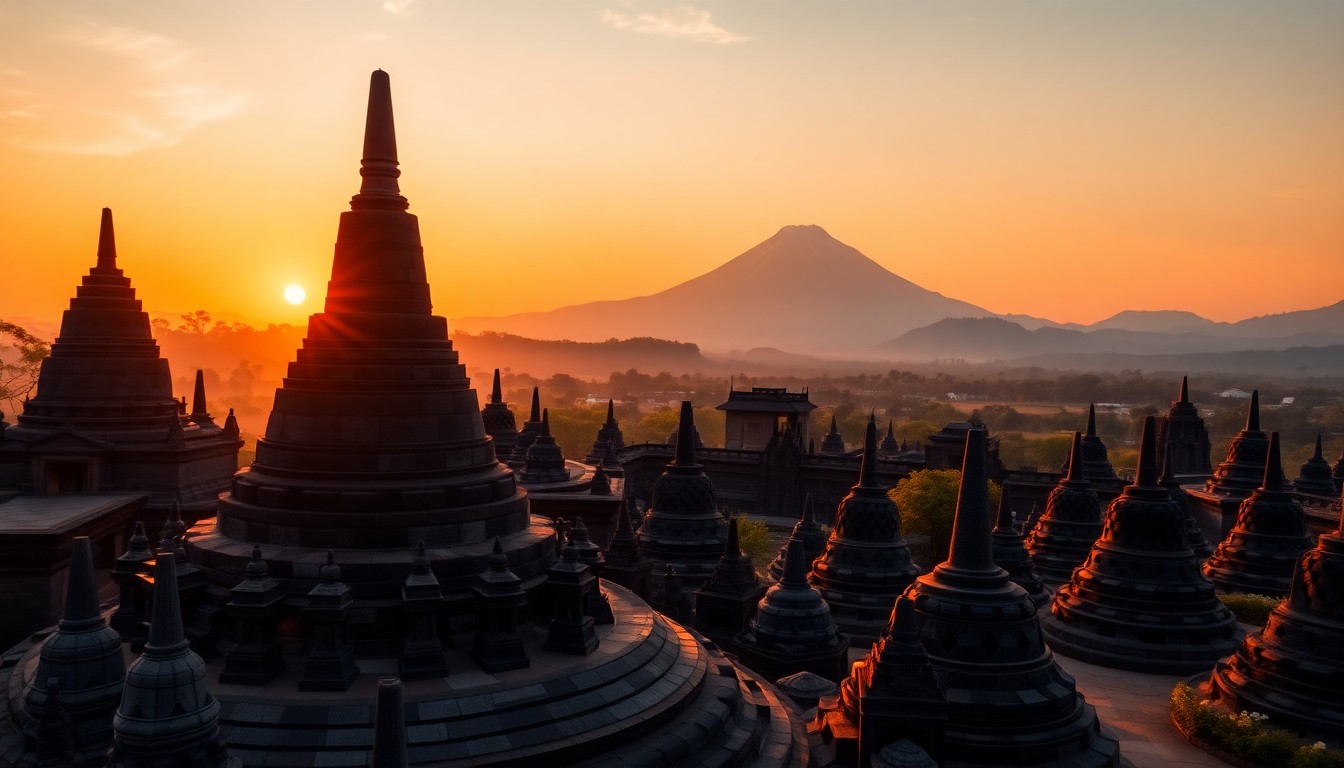
Built around 800 CE by the Sailendra dynasty and the largest Buddhist monument in the world: nine stacked platforms, 2,672 relief panels, 504 Buddha statues, and no interior at all — it is a solid stone mandala meant to be walked, clockwise, upward, through the levels of Buddhist cosmology. It was abandoned within about 150 years, buried under ash and jungle, and cleared under Stamford Raffles in 1814.
Prambanan
Fifty years later and a few kilometres away: a Hindu temple complex of soaring narrow towers dedicated to Shiva, Vishnu and Brahma, with the Ramayana carved along its galleries. That two of the greatest religious monuments in Asia, of two different religions, were built within half a century of each other and within sight of the same volcano is the single best illustration of what Java was.
☪️ How Islam Arrived
Indonesia has the largest Muslim population of any country on Earth, and — unusually — it was not conquered into it. There was no invading Muslim army. Islam arrived along the same trade routes as everything else, carried by Gujarati, Persian and Arab merchants from around the thirteenth century, and spread over three hundred years through ports, marriages, courts and Sufi teaching.
The Wali Songo
Javanese tradition credits the conversion of Java to the Wali Songo, the Nine Saints — Sufi teachers of the fifteenth and sixteenth centuries who are remembered for having taught through existing forms rather than against them. Sunan Kalijaga is said to have used wayang shadow puppetry and gamelan music to teach Islam, adapting Hindu epics rather than banning them. Their tombs are pilgrimage sites and the practice of visiting them is itself a distinctively Javanese form of Islam.
Layered, not replaced
The result is a religious landscape with visible strata. Javanese Islam absorbed rather than erased what came before, and the syncretic tradition sometimes called kejawen is still a real presence. This is why Java's greatest Buddhist and Hindu monuments survive in a Muslim-majority country, and why a Javanese Muslim wedding can include elements that predate Islam by a thousand years.
Where it didn't reach
Bali stayed Hindu — the Majapahit aristocracy and priesthood are said to have withdrawn there as Java converted, and the island has been Hindu ever since. Parts of eastern Indonesia — Flores, Timor, Maluku, Papua, the Batak and Toraja highlands — became substantially Christian, mostly through Portuguese and later Dutch missions, and remain so.
What it means today
Indonesia is not an Islamic state. Its constitutional basis is Pancasila, the five principles, of which the first requires belief in one God without specifying which — a formula designed in 1945 precisely to avoid an Islamic state and to keep the Christian east inside the republic. Aceh is the single exception, having been granted the right to apply sharia bylaws as part of the 2005 peace settlement.
🌰 The Spice Wars
For most of recorded history, nutmeg, mace and cloves grew in exactly one place on Earth: a handful of tiny volcanic islands in the Maluku, of which the nutmeg group — the Banda Islands — amounts to about 60 km² in total. In medieval Europe those spices sold for many times their weight in gold, and nobody in Europe knew where they came from. Finding out was, quite literally, the point of the age of exploration.
The Portuguese got there in 1512. The Dutch arrived at the end of the century, and in 1602 merged their competing companies into the Vereenigde Oostindische Compagnie — the VOC — which was the first company in history to issue tradeable shares to the public, and which was granted by the Dutch state the right to raise armies, wage war, execute prisoners and sign treaties. It was less a business than a privatised empire.
Banda, 1621
The founding atrocity. To secure a total monopoly on nutmeg, the VOC governor-general Jan Pieterszoon Coen destroyed the population of the Banda Islands: of an estimated 15,000 Bandanese, the great majority were killed, starved or deported into slavery, and the islands were repopulated with enslaved labour working plantations parcelled out to Dutch perkeniers. It is one of the more complete acts of colonial extermination on record, and Coen's statue stood in his home town until well into this century.
Manhattan for Run
The English held one nutmeg island, Run, and would not give it up. In the Treaty of Breda, 1667, the two sides settled: the Dutch kept Run and the English kept a North American trading post they had taken called New Amsterdam. It is now Manhattan. At the time the Dutch were widely thought to have got much the better of the deal, and on the numbers of 1667 they had.
The monopoly method
The VOC maintained prices by destroying supply: clove and nutmeg trees outside its controlled islands were systematically cut down in annual expeditions, and spices were burned in Amsterdam when stocks ran high. It worked for a century and a half, until a French agent smuggled seedlings out in 1770 and the plants were established in Mauritius and Zanzibar, at which point the whole edifice collapsed.
The end of the VOC
It went bankrupt in 1799, hollowed out by corruption, war and the loss of the monopoly, and its possessions passed to the Dutch state. The company's initials are still stamped on cannon and gravestones across the archipelago. Its shares, incidentally, are the reason Amsterdam had the world's first stock exchange.
⛓️ The Netherlands Indies
What followed the VOC was a colonial state, and it was extractive in a very specific and well-documented way. The Cultuurstelsel — the Cultivation System, imposed from 1830 — required Javanese peasants to give up a fifth of their land and a fifth of their labour to grow export crops for the government: coffee, sugar, indigo, tea.
It was enormously profitable. At its height the colony supplied something in the region of a third of the Dutch state's revenue, paid off the Netherlands' national debt and financed its railways. It also produced famines in Java in the 1840s, because land and labour that had grown rice were growing indigo instead. The system was described from the inside in the 1860 novel Max Havelaar, written under the pen name Multatuli by a former colonial official, which caused a genuine scandal in the Netherlands and is one of the few colonial-era books still worth reading whole.
The Java War
1825–30: a five-year rebellion led by the Javanese prince Diponegoro, which cost the Dutch enormous sums and cost Java perhaps 200,000 lives. It ended when Diponegoro was invited to negotiate under a flag of truce and arrested. He is a national hero, his image is everywhere, and the Cultivation System was introduced immediately afterwards to pay for the war.
The Aceh War
The longest colonial war the Dutch ever fought — 1873 to about 1914, with resistance continuing into the 1930s — and the most brutal, with tens of thousands of Acehnese and thousands of Dutch dead. Aceh's reputation for religious independence and its later separatism both start here.
The Ethical Policy
From 1901 the Netherlands announced a moral obligation to the colony: schools, irrigation, and limited local administration. It was genuinely meant, it was badly underfunded, and its most important consequence was entirely unintended — it produced a small Western-educated Indonesian elite who read Dutch political theory and drew the obvious conclusions. Sukarno, Hatta and Sjahrir are all products of it.
Sangiran and Java Man
A side note with global consequence: in 1891 the Dutch doctor Eugène Dubois found at Trinil in Java the fossil he called Pithecanthropus erectus — Java Man, now Homo erectus. It was the first hominin fossil ever found outside Europe and the first deliberate search for a human ancestor that succeeded. The nearby Sangiran site is a World Heritage property and has produced half the world's known Homo erectus remains.
🇮🇩 17 August 1945
Japan invaded in 1942 and the Dutch colonial army collapsed in under three months — a humiliation that permanently destroyed the myth of European invincibility in Asia. The occupation was harsh: forced labour (romusha) killed hundreds of thousands, and famine in Java killed more. But the Japanese also, for their own purposes, promoted Indonesian nationalists, trained Indonesian militias and banned Dutch — all of which turned out to matter enormously.
Japan surrendered on 15 August 1945. On 17 August, two days later and before the Allies could return, Sukarno read a proclamation of independence three sentences long from the front steps of his house in Jakarta, with Mohammad Hatta beside him. The republic dates itself from that morning.
The war for it
The Dutch did not accept it and came back. The Indonesian National Revolution ran from 1945 to 1949 and cost perhaps 100,000 Indonesian and 5,000 Dutch lives, with two large Dutch offensives euphemistically called "police actions". The Battle of Surabaya in November 1945, in which poorly armed Indonesians fought a British division for three weeks, is the founding military legend and the reason 10 November is Heroes' Day.
How it ended
Not on the battlefield but at the United Nations and in Washington. The United States, alarmed that the war was strengthening the Indonesian communists and unwilling to fund a colonial reconquest with Marshall Plan money, threatened to cut off aid to the Netherlands. The Dutch transferred sovereignty in December 1949. They did not formally acknowledge 1945 as the date of independence until 2005, and only apologised for the violence of the period in 2022.
Sukarno
The first president, an orator of extraordinary power, the author of Pancasila and one of the defining figures of the postcolonial world. In 1955 he hosted the Bandung Conference — twenty-nine newly independent African and Asian states meeting without their former rulers, out of which came the Non-Aligned Movement. It is arguably the most consequential thing Indonesia has done internationally.
And then
His domestic record was worse. "Guided Democracy" from 1957 dismantled the parliamentary system, the economy collapsed into hyperinflation, and a confrontation with newly formed Malaysia went nowhere. By 1965 Indonesia had left the United Nations, was drifting towards the largest communist party outside the bloc, and was close to breakdown.
🕯️ 1965 and the New Order
On the night of 30 September 1965 a group of officers killed six generals in Jakarta in what was presented as a pre-emptive coup. Within hours General Suharto, who was not on the list, had taken control of the army's response. Within weeks the Indonesian Communist Party — the PKI, then the third largest in the world with perhaps three million members — was blamed, banned and destroyed.
What followed was one of the largest mass killings of the twentieth century. Between late 1965 and mid-1966, somewhere between 500,000 and over a million people were killed across Java, Bali, Sumatra and elsewhere — party members, suspected sympathisers, trade unionists, teachers, ethnic Chinese, and a great many people denounced in local disputes that had nothing to do with politics. It was organised by the army and carried out substantially by civilian militias, including religious youth organisations. Around a million more were imprisoned without trial, some for over a decade.
Why it is not settled
Because the state that carried it out governed for another thirty-two years and taught its own version in schools. There has been no truth commission and no prosecution. Declassified American and British documents released since 2017 have confirmed detailed Western knowledge and encouragement at the time. Joshua Oppenheimer's documentaries The Act of Killing (2012) and The Look of Silence (2014) — in which perpetrators re-enact what they did, cheerfully — are the most widely seen treatment and are extremely hard to watch.
The New Order
Suharto ruled from 1967 to 1998 as an authoritarian developmentalist. The record is genuinely mixed: rice self-sufficiency, mass primary education, family planning, a fall in absolute poverty from around 60% to under 15%, and sustained growth — set against no free press, no real elections, the invasion of East Timor, and corruption on a scale that Transparency International once estimated as the largest embezzlement by any head of state in modern history.
East Timor
Invaded in December 1975, days after Portugal's withdrawal and with a green light from Washington and Canberra, and occupied until 1999. Estimates of deaths from violence, famine and disease run from about 100,000 to 180,000 out of a population of 650,000. A UN-run referendum in 1999 voted overwhelmingly for independence; Indonesian-backed militias then destroyed most of the territory's infrastructure before international forces arrived. Timor-Leste became independent in 2002.
The fall
The Asian financial crisis of 1997 destroyed the rupiah, the banks and the growth story within months. Student protests, the shooting of four demonstrators at Trisakti University, and days of rioting in Jakarta — during which the ethnic Chinese-Indonesian community was subjected to widespread arson, looting and rape — brought the system down. Suharto resigned on 21 May 1998. He was never tried, and died in 2008.
🗳️ Reformasi, and Where Indonesia Is Now
The transition after 1998 — Reformasi — is one of the more successful democratisations anywhere, and it is under-reported because it was undramatic. Within six years Indonesia had a free press, competitive elections, term limits, an elected upper house, the army out of parliament, and a radical decentralisation that pushed money and authority down to nearly 500 districts. It is now the world's third-largest democracy by electorate, and it runs the largest single-day election on Earth — over 200 million voters, all voting on one day, counted by hand.
Jokowi
Joko Widodo, president 2014–2024, was the first Indonesian leader from outside the political-military-dynastic elite: a furniture exporter who became mayor of Solo, then governor of Jakarta, then president. His record is infrastructure — roads, ports, the Jakarta MRT, the Whoosh high-speed line to Bandung (Southeast Asia's first, opened 2023) — a universal health scheme covering most of the population, and the decision to move the capital. His later years drew serious criticism over the weakening of the anti-corruption commission and a constitutional-court ruling that allowed his son to stand as vice-president.
Prabowo
Prabowo Subianto took office in October 2024 with Jokowi's son Gibran as vice-president. He is a former special forces general, Suharto's former son-in-law, and was discharged from the army in 1998 over the abduction of pro-democracy activists — a history he has never fully accounted for and which he lost two previous elections partly because of. That he won the third handily, with strong support among young voters reached through a deliberately soft social-media rebrand, says something about how far 1998 now feels.
Nusantara
The new capital in East Kalimantan, legislated in 2022 and named after the Old Javanese word for the archipelago. The arguments for it are real: Jakarta is sinking, unbearably congested and seismically exposed, and Java's dominance is a genuine political problem. The arguments against are also real: it is being built in rainforest on Borneo, private investment has been slow to appear, and the timetable has slipped repeatedly. The first government offices moved in 2024 and the project continues under Prabowo with less visible urgency.
Papua
The unresolved one. Western New Guinea was incorporated in 1969 through the so-called Act of Free Choice, in which the Indonesian military selected 1,025 men to vote unanimously on behalf of about 800,000 people — a process the UN noted and accepted. A low-level insurgency has continued ever since; foreign journalists and researchers face heavy restrictions; and the human rights record on both sides is poor and difficult to verify precisely because of those restrictions.
👥 The People
Around 285 million people and something like 1,300 recognised ethnic groups. The Javanese are about 40%, the Sundanese of West Java about 15%, and then a very long tail: Batak, Minangkabau, Betawi, Bugis, Balinese, Madurese, Acehnese, Dayak, Papuan peoples, and hundreds more. Around 700 living languages are spoken — second only to Papua New Guinea — and most Indonesians are bilingual in their regional language and Indonesian from childhood.
Religion, officially
The state recognises six religions: Islam, Protestantism, Catholicism, Hinduism, Buddhism and Confucianism, and until recently your religion had to be one of them and appeared on your identity card. Indigenous belief systems were long excluded and won partial recognition only in a 2017 court ruling. The population is roughly 87% Muslim, 7% Protestant, 3% Catholic, 1.7% Hindu — the Hindus being almost entirely Balinese.
How Islam is practised
Overwhelmingly Sunni and, by regional standards, moderate — the two largest Muslim organisations, Nahdlatul Ulama (perhaps the largest Islamic organisation in the world, with tens of millions of members) and Muhammadiyah, are both explicitly committed to Pancasila and to the republic. Conservatism has grown since 2000 and the politics of it are contested, but the country is a long way from the picture a visitor might arrive with.
Chinese Indonesians
Around 2–3% of the population, present for centuries, disproportionately important in commerce, and the target of recurrent violence — in 1740, in 1965–66, and most recently in the May 1998 riots. Under Suharto, Chinese names, script and public celebration of Chinese New Year were banned. All of that was reversed after 1998; Imlek is now a public holiday and Chinese Indonesian identity is openly expressed, which is one of Reformasi's quieter achievements.
Transmigrasi
From the Dutch period and massively expanded under Suharto, the state moved millions of people from crowded Java and Bali to the outer islands, with land grants. It relieved Java a little, it drove deforestation, and it created lasting ethnic and land-tenure tensions in Kalimantan, Sulawesi, Maluku and Papua — several of which erupted into serious communal violence in the years after 1998.
🌺 Why Bali Is Different
Bali is one island out of seventeen thousand, holds about 1.5% of Indonesia's population, and accounts for the overwhelming majority of what foreigners know about the country. It is also genuinely unlike the rest of it, and the reason is that it is Hindu — the last redoubt of the Javanese Hindu-Buddhist world that Islam otherwise absorbed.
Balinese Hinduism
Not quite Indian Hinduism. Agama Hindu Dharma combines Shaivism with Buddhist elements and a deep layer of indigenous ancestor and spirit worship. There are no castes in the Indian operational sense but there is a four-fold status system; there are temples everywhere — an estimated 20,000 or more, with every village holding at least three and every household compound its own shrine; and offerings, the little palm-leaf canang sari trays, are laid out on pavements, dashboards and shop steps several times a day, everywhere, by everyone.
Nyepi
The Balinese Day of Silence, and the single most extraordinary thing on the Indonesian calendar. For 24 hours at the Saka new year (March or April) the entire island stops: no traffic, no work, no fires or lights, no going outside — and the airport closes completely, the only airport in the world that shuts annually for a religious observance. Tourists must stay inside their hotels. The night before, enormous demonic ogoh-ogoh effigies are paraded and burned. If you are on Bali that day you have no choice but to take part.
Subak
The thousand-year-old irrigation system, on the UNESCO list since 2012, and the reason the rice terraces look the way they do. Water is distributed among farmers by democratic subak associations attached to water temples, using a cooperative scheduling system that also functions as pest control. It is a religious institution and an agricultural one at once, and computer modelling in the 1980s found that the temple-scheduled pattern outperformed the technocratic Green Revolution scheme that briefly replaced it.
The other arts
Gamelan — the bronze percussion orchestra, and Balinese gamelan is faster and more explosive than Javanese. Legong and Barong dance. The kecak, a chanting circle of a hundred men, which is genuinely thrilling and was largely devised in the 1930s by a German painter working with Balinese performers — a fact worth knowing before anyone tells you it is ancient.
🎭 Batik, Gamelan and Shadows
Batik
Wax-resist dyeing, on UNESCO's intangible heritage list since 2009, and a genuine national institution rather than a souvenir: Indonesians wear batik to weddings, to work on Fridays and to formal occasions, and 2 October is National Batik Day. The distinction that matters when buying: batik tulis is drawn by hand with a canting pen and takes weeks; batik cap is stamped with copper blocks; and batik print is just printed cloth and is not batik at all. Prices differ by a factor of fifty and shops will tell you which is which if you ask.
Gamelan
The bronze orchestra of Java and Bali — gongs, metallophones, drums, tuned to scales that do not correspond to Western ones and in which no two orchestras are tuned alike, because instruments are made as a set and belong together. Debussy heard a Javanese gamelan at the 1889 Paris exposition and it changed his harmony permanently; the influence runs through Ravel, Britten, Cage and the American minimalists.
Wayang kulit
Shadow puppetry, UNESCO-listed in 2003. Flat perforated leather puppets manipulated against a lit screen by a single dalang who voices every character, directs the gamelan, improvises political jokes and performs the Mahabharata or Ramayana from dusk until dawn, for eight or nine hours, without a break. It is the central art form of Java and worth staying up for once.
Writing and film
Pramoedya Ananta Toer is the major novelist: his Buru Quartet was composed orally while he was imprisoned without trial on Buru island under Suharto, and recited to fellow prisoners because he was denied writing materials. It is one of the great works of anticolonial literature. In cinema, Garin Nugroho and Joko Anwar are the names to know, and The Raid (2011) put Indonesian action film on the world map.
🌴 Forests, Palm Oil and Haze
Indonesia holds the third-largest area of tropical rainforest in the world after Brazil and the Congo basin, and for two decades it was destroying it faster than almost anywhere. That is the reputation. The current picture is more complicated and — unusually for environmental news — partly better.
Palm oil
Indonesia produces around 60% of the world's palm oil and it is by far the country's largest agricultural export. The crop is genuinely the most land-efficient vegetable oil there is, and it employs millions of smallholders; it also drove enormous conversion of lowland and peat forest, which is where the carbon problem lies. Peat, when drained and burned, releases stored carbon on a scale that dwarfs the trees above it.
The 2015 fires
The worst year. Fires set to clear land, burning in drained peat during an El Niño drought, produced a haze that covered Indonesia, Singapore and Malaysia for weeks; on some days Indonesia's daily emissions exceeded those of the entire United States economy. A widely cited study estimated on the order of 100,000 excess deaths regionally from the smoke. It changed policy: a peatland moratorium, a restoration agency, and much tougher enforcement.
It has actually improved
This is the part that gets left out. Indonesia's primary forest loss has fallen substantially since 2016 — by more than half from the peak, according to the standard satellite datasets — driven by the moratorium, corporate no-deforestation commitments, low palm prices in some years, and better fire suppression. It has not stopped, deforestation for nickel and pulp has picked up in places, and the trend is not guaranteed to hold. But "Indonesia is chopping everything down" is a 2015 sentence, not a 2026 one.
Nickel
The new resource story. Indonesia holds the world's largest nickel reserves, and in 2020 it banned the export of raw nickel ore to force smelting and battery manufacture onshore. It worked spectacularly in industrial terms — Indonesia now dominates global nickel supply — and the environmental cost, in forest clearance on Sulawesi and Halmahera and in coal-fired smelter power, is the live argument. The EU challenged the ban at the WTO and largely lost.
🐒 What Lives There
Indonesia is one of the world's seventeen megadiverse countries and probably the richest of them: it has around 12% of the world's mammal species, 16% of its reptiles and amphibians, and 17% of its birds, on 1.3% of its land area. It also has more threatened species than almost anywhere, for the same reasons.
The great apes
Three orangutan species, all critically endangered: Bornean (roughly 100,000 left and falling), Sumatran (about 14,000), and the Tapanuli, described only in 2017 and down to around 800 animals in a single forest block — the most endangered great ape on Earth. The place to see wild ones reasonably reliably is Bukit Lawang in North Sumatra, at the edge of Gunung Leuser.
Big cats
The Sumatran tiger is the last Indonesian tiger — perhaps 400 remain — the Bali and Javan subspecies having been hunted to extinction in the 1940s and 1970s respectively. Also the Javan rhinoceros, of which around 75 individuals survive, all of them in Ujung Kulon national park at the western tip of Java, making it one of the rarest large mammals in the world.
The reefs
Raja Ampat is the headline: the highest recorded coral and reef-fish diversity anywhere. But the whole eastern archipelago is exceptional — Komodo's currents and manta stations, the Banda Sea's hammerheads, Bunaken and the muck diving at Lembeh Strait in North Sulawesi, which is the world capital of very small very strange animals. Indonesia is, by a wide margin, the best diving country in the world.
Birds
Around 1,700 species and the highest number of endemics of any country — over 500. The birds-of-paradise of Papua, some of which display on Raja Ampat's islands and are the reason serious birders go there; the maleo of Sulawesi, which buries its eggs in volcanically heated sand and abandons them; and the Bali myna, down to a handful of wild birds, whose decline was driven entirely by the cage-bird trade.
🍚 Food: Rice, Sambal and a Lot of Regions
There is no such thing as "Indonesian food" in the way there is Italian or Japanese food. There are several dozen distinct regional cuisines that happen to share a country, a staple and a chilli habit. What they have in common is rice — nasi, which in Indonesian is close to a synonym for "a meal" — and sambal, of which there are hundreds of local varieties and which is not optional.
The dishes everyone knows
Nasi goreng, fried rice with kecap manis, topped with a fried egg and prawn crackers, eaten at any hour. Mie goreng, the noodle version. Sate, skewers grilled over coconut husk with peanut sauce. Gado-gado, blanched vegetables, tofu, tempeh and egg under a peanut dressing — the standard vegetarian answer. Soto, a turmeric-yellow chicken soup that exists in dozens of regional versions. Bakso, meatball soup, sold from carts by a distinctive bell.
Nasi padang
The most impressive eating format anywhere. In a Minangkabau restaurant from West Sumatra, you sit down and they bring you a dozen or more small dishes without being asked, stacked in a tower on the arms of one waiter. You eat what you want, you touch nothing else, and you pay only for what you touched. Rendang, gulai, sambal ijo, jengkol, fried chicken, cassava leaves. It is fast, cheap, extremely spicy and it is everywhere in Indonesia, because Minangkabau men traditionally leave home to seek their fortune and a very large number of them open restaurants.
Tempeh
An Indonesian invention and a genuinely important one: whole soybeans fermented with a Rhizopus mould into a firm cake, developed in Java probably several centuries ago. Unlike tofu it uses the whole bean, it is a fermented food with the nutritional advantages that implies, and in Java it is cheap everyday protein rather than a health-shop item. Fried in a thin batter as tempe goreng or braised as tempe orek, it is better than any version served in Europe.
Sambal, and how hot
Ranging from sambal terasi (with fermented shrimp paste — pungent and essential) through sambal matah (raw Balinese shallot and lemongrass) to sambal ijo (green, Padang). The useful phrase is tidak pedas — not spicy — which will be interpreted generously, and pedas sekali, very spicy, which you should not say unless you mean it.
Two further things worth ordering: babi guling, Balinese spit-roast suckling pig with a spice paste rubbed into the cavity — Bali being one of the few places in Indonesia where pork is on the menu — and martabak, either the savoury folded egg-and-mince pancake or the astonishing sweet version, a thick pancake split and filled with chocolate, cheese, condensed milk and peanuts, sold from carts after dark.
🍳 Recipe: Nasi Goreng
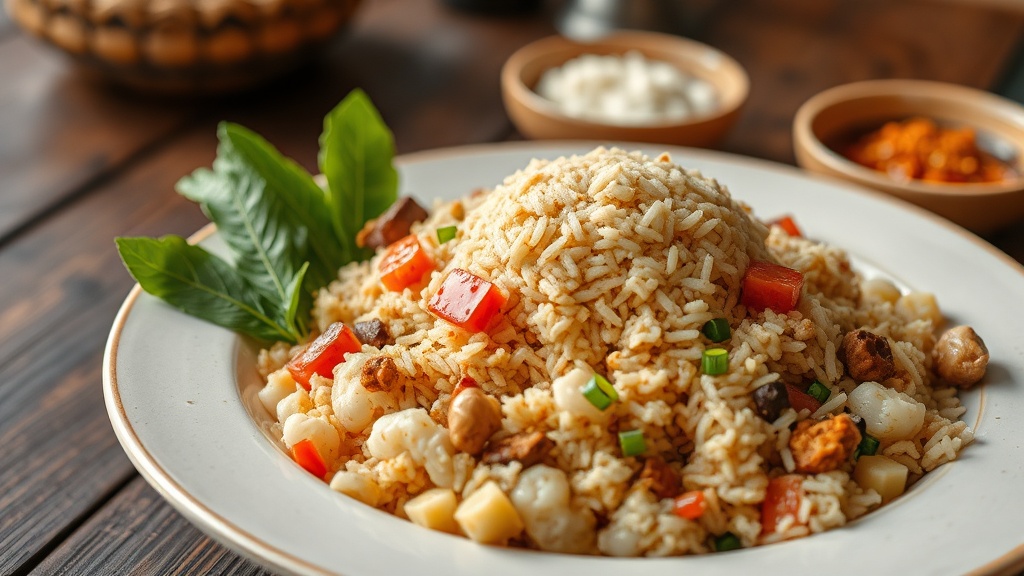
Nasi Goreng
Indonesian fried rice · serves 2 · 20 min (plus overnight rice)
Ingredients: 400 g cooked rice, cooled — from the day before, this matters more than anything else; 2 eggs plus 2 more for frying on top; 3 shallots and 3 garlic cloves; 2 red chillies (more if you like); 1 tsp shrimp paste (terasi), toasted; 200 g chicken thigh or prawns, diced; 2 tbsp kecap manis (sweet soy); 1 tbsp light soy sauce; oil; spring onion, cucumber, tomato and krupuk to serve.
Method: Rice must be cold and dry; freshly cooked rice steams and turns to porridge in the wok. Pound the shallots, garlic, chilli and toasted shrimp paste into a rough paste in a mortar — a blender does it but a mortar does it better. Heat oil in a wok until it just smokes, fry the paste for a minute until it smells sweet rather than raw, then add the chicken or prawns and cook through. Push aside, scramble the two eggs in the space, then add the rice and break it up with the back of the spatula. Add the kecap manis and soy and toss hard over the highest heat you have for two or three minutes — you want some grains to catch and caramelise. Serve mounded, with a fried egg on top with a crisp lacy edge, sliced cucumber and tomato, and krupuk.
💡 Kecap manis is the one ingredient with no real substitute — it is soy sauce reduced with palm sugar to something like a thin molasses. Any Asian grocery has it. At a pinch, dark soy plus a teaspoon of palm or brown sugar gets you most of the way.
🥘 Recipe: Rendang
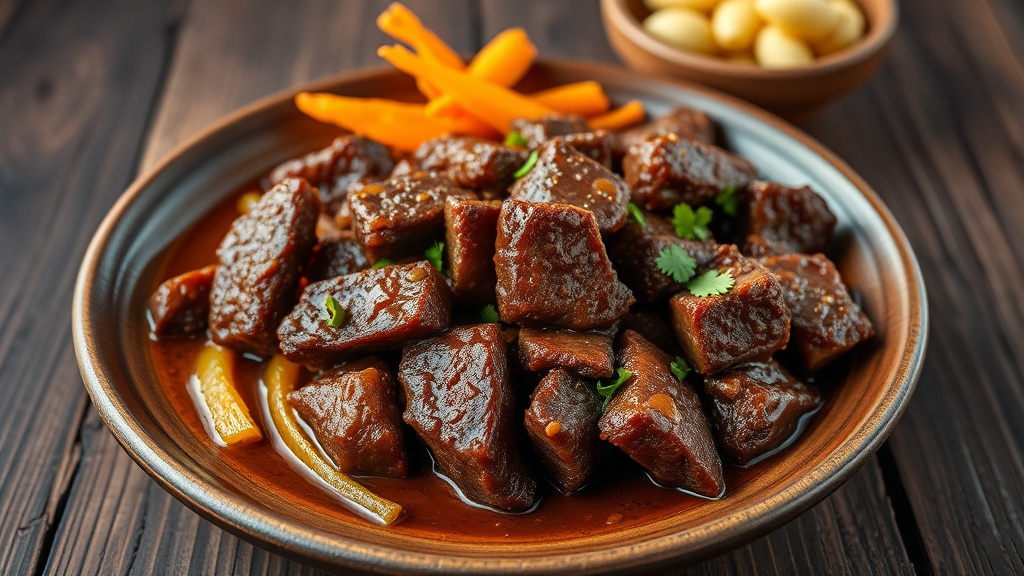
Rendang Daging
Minangkabau dry beef curry · serves 6 · 30 min prep + 3–4 h
Ingredients: 1 kg beef shin or chuck, in 4 cm cubes; 1.5 litres thick coconut milk (from 2 tins plus 400 ml water, or fresh); 2 kaffir lime leaves; 2 turmeric leaves if you can get them; 1 stalk lemongrass, bruised; 1 piece of asam kandis or 1 tbsp tamarind. For the paste: 12 shallots; 8 garlic cloves; 8–15 dried red chillies, soaked; 5 cm ginger; 5 cm galangal; 3 cm fresh turmeric; 1 tsp coriander seed; salt.
Method: Grind everything for the paste to a smooth wet paste. Put the paste, the coconut milk, the lemongrass and the leaves into a wide heavy pan — wide matters, because this is an evaporation dish — bring to a simmer and add the beef. Now cook uncovered, stirring every ten or fifteen minutes at first and more often as it thickens, for three to four hours. It passes through three stages: a soupy curry (gulai), a thick clinging sauce (kalio), and finally the point where the milk breaks, the oil separates out, and the meat starts to fry in its own coconut oil and darken. Keep going, stirring constantly now so it does not catch, until the pieces are almost black and dry. Season and rest.
💡 Rendang was developed as a preservation method: cooked to that final stage it will keep for weeks without refrigeration, which is why it travelled. It is also better on the second and third day. A 2011 CNN readers' poll voted it the world's most delicious food, which Indonesians have not stopped mentioning since.
🍢 Recipe: Sate Ayam
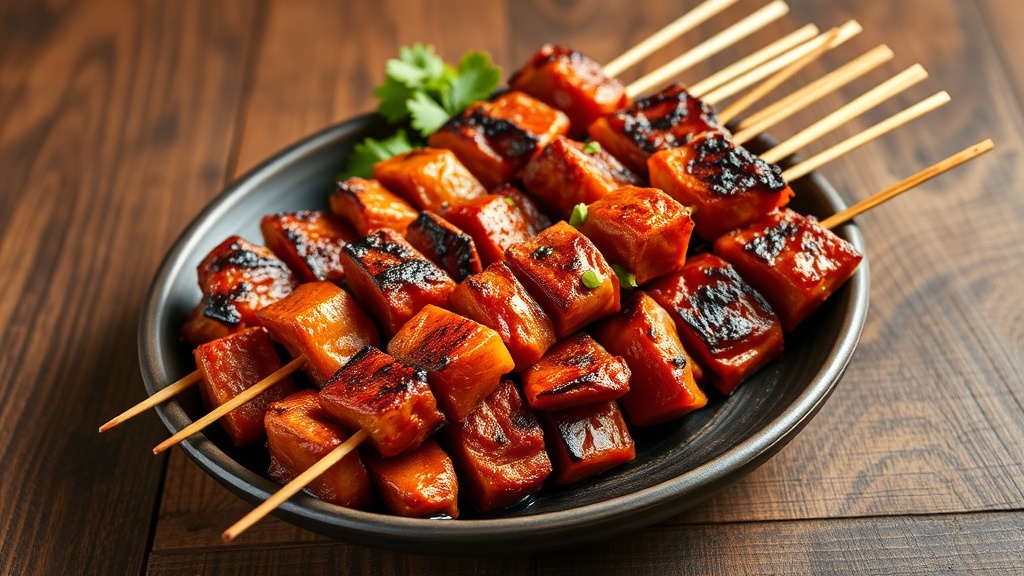
Sate Ayam with Peanut Sauce
Indonesian chicken satay · serves 4 · 30 min prep + 2 h marinating + 15 min grilling
Ingredients: 700 g chicken thigh, in 2 cm cubes; bamboo skewers, soaked. Marinade: 3 tbsp kecap manis; 2 garlic cloves crushed; 1 tsp ground coriander; ½ tsp turmeric; 1 tbsp oil; salt. Peanut sauce: 200 g roasted peanuts (or 150 g crunchy peanut butter); 4 shallots; 3 garlic cloves; 3 red chillies; 1 tsp shrimp paste; 2 tbsp kecap manis; 1 tbsp palm sugar; 1 tbsp tamarind paste; about 300 ml water; oil, salt. To serve: lontong or steamed rice, sliced shallot, lime, fried shallots.
Method: Marinate the chicken at least 2 hours. For the sauce, fry the shallots, garlic, chilli and shrimp paste in oil until fragrant, then blend with the peanuts and water to a thick pourable sauce; return to the pan with the kecap manis, palm sugar and tamarind and simmer 10 minutes until it darkens and thickens, adding water as needed. Thread the chicken tightly — four or five small pieces per skewer, packed close, not spaced out — and grill over the hottest charcoal you have, turning often and basting with the remaining marinade, for about 8–10 minutes. You want real char on the edges. Pile onto a plate, pour the sauce generously over, and scatter with fried shallots, raw shallot and lime.
💡 Charcoal is not optional if you want the real thing — the smoke is half the flavour, and a grill pan gives you a decent but different dish. Indonesian sate sellers fan the coals constantly with a woven bamboo fan, which is worth copying with a piece of cardboard.
☕ Coffee, Tea, Jamu — and a Serious Warning About Spirits
⚠️ Methanol. Indonesia — Bali and Lombok especially — has a recurring and lethal problem with adulterated spirits. Cheap local arak and counterfeit branded bottles have been found cut with methanol, which causes blindness, organ failure and death, and which has killed dozens of people including foreign tourists over the last decade. Do not drink arak or spirits from unsealed bottles, free-pour cocktails at cheap bars, or anything offered at an unusually low price. Beer and wine from sealed bottles are not affected. This is the single most under-warned risk in Indonesian travel.
Coffee
Indonesia is the world's fourth-largest producer, and the good stuff is very good: Gayo from Aceh, Mandheling from North Sumatra, Toraja from Sulawesi, Kintamani from Bali, Java from the estates that gave English the word. Sumatran coffee is usually wet-hulled (giling basah), a processing method used almost nowhere else, which is what gives it that heavy, earthy, low-acid character. Ordered locally, kopi tubruk is coffee grounds with boiling water and sugar poured straight into the glass — let it settle and don't drink the last centimetre.
Kopi luwak
The famous one, and it deserves an honest note. It is coffee from beans eaten and excreted by the civet. Originally these were gathered wild and rare. The overwhelming majority sold today comes from caged civets force-fed cherries in poor conditions, the quality is generally mediocre, and the price is a tourist markup. Wild-collected certified production exists and is tiny. The straightforward advice: skip it, and drink a good Toraja instead.
Tea and jamu
Teh botol — sweet jasmine tea in a bottle — is close to a national soft drink, and tea in Java is served sweet unless you say tawar. Jamu is the traditional herbal tonic tradition, sold from carts and by women carrying bottles in a basket on their back: turmeric and tamarind (kunyit asam), ginger, and the famously bitter beras kencur. It went on the UNESCO intangible list in 2023 and is having a fashionable revival in Jakarta cafés.
Alcohol, in general
Legal but heavily taxed and, in a Muslim-majority country, not universally available. Bintang is the national lager and is fine; local wine exists on Bali and is not. Prices are high by regional standards — a bottle of imported spirits costs several times what it does in Singapore. Aceh prohibits alcohol entirely and enforces it with caning. Bali and the tourist areas are the exception rather than the rule.
🛕 Java
Java is where Indonesia's history, politics and 150 million of its people are. It is also, for a visitor, the most rewarding island in the country and the one most often skipped in favour of Bali. Two weeks on Java with a train pass is one of the better trips available in Asia.
Yogyakarta
The cultural capital, still a sultanate — the only part of Indonesia governed by a hereditary monarch, whose special status was granted for backing the republic in 1945 when the revolutionary government sheltered here. It is a student city, cheap, walkable, with the kraton palace, the water castle, silversmiths at Kotagede, and batik workshops that are genuinely working rather than performing. It is also the base for Borobudur and Prambanan, both about an hour away.
Borobudur and Prambanan
See both, on separate days. Borobudur at sunrise is the famous experience and requires a ticket bought well ahead; access to the upper terraces is now limited and guided, which is correct — the stone was being worn away. Prambanan is quieter, and its Ramayana ballet performed against the lit towers on summer evenings is worth arranging. Both were damaged in the 2006 Yogyakarta earthquake and repaired.
Bromo and Ijen
Eastern Java's two great volcanic set-pieces. Bromo: a smoking cone standing in a sea of grey sand inside a vast caldera, seen at dawn from a viewpoint on the rim — the most photographed landscape in Indonesia and, unusually, better in reality. Ijen: a night climb to see the blue flames of burning sulphurous gas at the crater edge, then dawn over a turquoise acid lake. Both need a very early start and a guide; Ijen requires a gas mask, which is provided and which you should actually wear.
Jakarta
Enormous, congested, hot, and much better than its reputation once you stop expecting it to be pretty. The Old Town (Kota Tua) with its Dutch buildings and the excellent Jakarta History Museum; the National Museum, which is the best in the country; Istiqlal, the largest mosque in Southeast Asia, standing directly across the road from the Catholic cathedral and sharing its car park with it — an arrangement the city is rightly proud of; and a food and bar scene that is the most sophisticated in the archipelago. The MRT since 2019 makes it navigable in a way it was not before.
🌺 Bali
Bali receives something like six million foreign visitors a year on an island of 5,800 km² — roughly the area of the Central Bohemian Region — and the strain shows in the south. It is also still, away from that strip, one of the most beautiful and culturally intact places in Asia. Both statements are true and the trick is knowing which part you are in.
The south, honestly
Kuta, Legian, Seminyak, Canggu: heavy traffic, construction, beach clubs, and an expatriate scene that has grown enormously since 2020. Some of it is genuinely good. A lot of it could be anywhere. If your image of Bali is rice terraces and temples, do not book here. Uluwatu on the southern cliffs is busy but has the surf and the sunset kecak at the clifftop temple; Sanur is quiet, older and much more pleasant than its dull reputation.
Ubud and the middle
Ubud is the cultural centre and is itself now very busy in the middle — but ten minutes out in any direction it is still rice terraces, river gorges, temples and villages. The Tegallalang terraces are the photographed ones and are crowded; Jatiluwih, an hour north-west, is far larger, is the actual UNESCO-listed subak landscape, and has a fraction of the people. Also here: Goa Gajah, Tirta Empul's purification springs, and the Neka and ARMA museums, which are genuinely good.
North and east
The half that most visitors never see. Sidemen — rice terraces and a valley below Mount Agung, the way Ubud was thirty years ago. Amed and Tulamben on the north-east coast for black sand, quiet, and the USAT Liberty wreck, which lies in shallow water a few metres from the beach and is one of the world's most accessible wreck dives. Munduk and the crater lakes in the north for cool air and waterfalls. Pemuteran in the far north-west for reefs and Menjangan island.
How to be a decent visitor
Wear a sarong and sash at temples (they are lent at the entrance). Do not enter a temple during menstruation — this is a genuine religious prohibition and is asked at the gate. Do not step on the canang sari offerings on the pavement, and if you do, it is not a disaster but apologise. Cover up away from the beach. Do not climb the sacred mountains without a guide and permission — a series of foreigners photographing themselves naked on them caused real anger and led to a formal tourist code of conduct in 2023. And the tourist levy of 150,000 IDR is payable online before arrival.
🌋 Sumatra
The sixth largest island in the world, wilder than Java, less visited than Bali, and the place to go for rainforest and volcanoes rather than temples and beaches. It is also large — 1,700 km end to end — and the overland journey is slow, so pick a region.
Bukit Lawang and Gunung Leuser
The standard first stop: a village on the edge of the Leuser ecosystem, the last place on Earth where orangutans, tigers, rhinos and elephants still share a habitat. Guided treks of one to three days give a genuinely good chance of seeing wild orangutans. Choose an operator that does not feed the animals and does not promise a sighting; the ones that guarantee it are the ones causing the problem.
Lake Toba
The caldera of the supervolcano — 100 km long, 500 m deep, the largest volcanic lake in the world — with the island of Samosir in the middle, itself the size of Singapore. It is the homeland of the Batak, a Christian people with a distinctive boat-shaped architecture, a strong choral tradition and a history of resisting both Islam and the Dutch. Cool, quiet, cheap and one of the more restful places in Indonesia.
Padang and the Minangkabau
West Sumatra: the source of the food that feeds the whole country, and a society that is matrilineal — property and clan name pass through the mother's line — while being devoutly Muslim, a combination anthropologists have been writing about for a century. The Harau Valley and the highlands around Bukittinggi are beautiful and almost empty of foreigners.
Aceh and the Mentawai
Aceh at the northern tip is the one province applying sharia law, was the epicentre of the 2004 tsunami, and has a museum and a boat sitting on top of a house that are extremely difficult to walk out of. Off the west coast, the Mentawai islands have world-class surf and an indigenous culture that survived largely intact into the twentieth century.
🐉 Komodo, Flores and the Lesser Sundas
East of Bali the islands get drier, poorer, more Christian and far less visited, and the diving gets better. Flores and Komodo are the accessible end of this and are the standard second stop after Bali.
Komodo National Park
Three main islands — Komodo, Rinca and Padar — reached from Labuan Bajo on Flores. The dragons are on Komodo and Rinca, seen on short guided walks with a ranger carrying a forked stick; they are genuinely dangerous and the rules are not theatre. The park is also a world-class dive destination: strong currents, manta stations at Karang Makassar, and reefs in excellent condition. Entry fees have risen steeply and there have been repeated policy changes — check current pricing before booking.
Flores
A long mountainous Catholic island whose name the Portuguese gave it. The Kelimutu crater lakes near Moni change colour independently of one another — turquoise, black, red — as their mineral chemistry shifts, and are best at dawn. Inland are the traditional villages of Bena and Wae Rebo, the latter a cluster of conical thatched houses in a mountain bowl reached by a three-hour walk, and worth every step.
Homo floresiensis
In 2003, in Liang Bua cave on Flores, archaeologists found the remains of a hominin about a metre tall with a chimpanzee-sized brain that had lived on the island until perhaps 50,000 years ago — overlapping with modern humans. Homo floresiensis, nicknamed the hobbit, is one of the most startling palaeoanthropological finds of the century, and the cave can be visited.
Lombok and the Gilis
Directly east of Bali: quieter, Muslim, with Mount Rinjani (3,726 m) and its crater lake as one of Southeast Asia's great treks — a hard two or three days. The Gili Islands off the north-west coast are three small car-free sand islands with good snorkelling and turtles, of which Gili Air is the sensible middle option. Lombok was badly hit by earthquakes in 2018 and has largely rebuilt.
🐠 Sulawesi, Maluku and Papua
The eastern half of the country holds most of its strangeness and almost none of its visitors. Getting around takes longer, costs more and requires more planning, and it is where Indonesia stops feeling like anywhere else.
Tana Toraja
In the highlands of South Sulawesi, and one of the most extraordinary living cultures in Asia. The Toraja conduct funerals as multi-day festivals held sometimes years after death — the deceased is kept at home and referred to as sick until the family can afford the ceremony — with buffalo sacrifice, effigies, and burial in cliff faces and hanging graves. Visitors are genuinely welcomed at funerals and are expected to bring a gift of cigarettes or sugar. It is not a show and should not be treated as one.
Sulawesi's diving
Bunaken off Manado for wall diving, and the Lembeh Strait for what divers call muck diving — black volcanic sand and, in it, the highest concentration of bizarre small animals anywhere: mimic octopus, hairy frogfish, blue-ringed octopus, flamboyant cuttlefish. Underwater photographers travel from all over the world specifically for that one channel.
Maluku
The original Spice Islands: Ternate and Tidore, two volcanic cones facing each other that once ran the world clove trade and fought each other for centuries; and the Banda Islands, still nutmeg-scented, with Dutch forts, colonial houses and a history described earlier on this page. Banda is hard to reach — a flight to Ambon then a fast boat or a Pelni ship — and is one of the most atmospheric places in the country.
Raja Ampat
Four large islands and 1,500 small ones off the western tip of Papua, and by measurement the most biodiverse marine environment on Earth. Diving here is the reason most visitors come and it lives up to it; the karst seascapes from a viewpoint at Piaynemo are the other reason. It is expensive by Indonesian standards, requires an entry permit, and is reached via Sorong. Access to the rest of Papua is more restricted, and independent travel in the highlands requires research and, in places, permits.
🚉 Getting Around
There is no way to see Indonesia by land. The country is 5,100 km wide, most of it is water, and the internal logistics are the single biggest constraint on any itinerary.
Flying
The default, and cheap. Garuda Indonesia is the full-service flag carrier and is good; Citilink, Lion Air, Batik Air and Super Air Jet cover everything else. Safety has improved a great deal — Indonesia was removed from the EU airline blacklist in 2018 — but punctuality on the budget carriers is poor and you should not book a tight connection. Book domestic flights on Indonesian sites or apps, where they are cheaper.
Trains
Only really on Java, plus a short network in Sumatra — and Java's is genuinely good. Executive class is comfortable, punctual and inexpensive, the scenery between Jakarta, Yogyakarta and Surabaya is excellent, and booking on the KAI app is straightforward. The Whoosh high-speed line does Jakarta–Bandung in 45 minutes. Sleeper trains across Java are a pleasant way to cover distance.
Boats
Pelni operates long-distance passenger ships to almost every inhabited island, which is slow, cheap and a genuine experience if you have days rather than hours. Local ferries and fast boats connect the shorter hops — Bali to Lombok, Bali to the Gilis, Flores to Komodo. Safety varies: overloading is common on small operators, life jackets are sometimes decorative, and there have been fatal sinkings. Use the larger operators and skip a crossing in bad weather.
On the ground
Grab and Gojek — ride-hailing apps that also deliver food and parcels — work in every city and are the single most useful thing to install before arriving. Ojek, the motorcycle taxi, is how Jakarta actually moves. Long-distance buses exist and are slow. Renting a car with a driver for a day, at around 850–1,150 Kč, is normal, cheap and much less stressful than driving yourself.
✈️ Getting There
There is no direct flight from Prague to Indonesia and there never has been. Everyone connects, and the sensible question is only which hub and how many hours in it.
The two gateways
Jakarta Soekarno–Hatta (CGK) for Java and everything west, and Bali Ngurah Rai (DPS) for Bali, Lombok, Flores and the east. They are 1 h 50 min apart by air and both are served from every major hub. Choose by where you actually start; flying into DPS and out of CGK, or the reverse, is usually the same price as a return and saves a full day of backtracking.
Routings from Prague
Via Doha (Qatar), Dubai (Emirates), Abu Dhabi (Etihad), Istanbul (Turkish), Singapore, Kuala Lumpur or Amsterdam (KLM/Garuda). Total journey 17–22 hours depending on the layover; the Gulf carriers are usually the fastest and the Southeast Asian hubs the cheapest. Fares run roughly 16,000–28,000 Kč return, with July–August and Christmas at the top of that range.
Time and jet lag
Indonesia spans three time zones: WIB (UTC+7, Java and Sumatra), WITA (UTC+8, Bali, Sulawesi, Nusa Tenggara) and WIT (UTC+9, Maluku and Papua). Bali is +7 hours ahead of Czech winter time, +6 in summer. Eastbound jet lag of that size is real — give yourself a slow first day and do not book a sunrise volcano climb for the morning after landing.
Onward and internal
Most itineraries continue by domestic flight the same day. Do not book a domestic connection under three hours from an international arrival: you clear immigration, collect bags, re-check at a different terminal, and the budget carriers do not wait. At CGK the international and domestic terminals are a shuttle ride apart.
💰 What It Costs
Indonesia is cheap — genuinely cheap outside the resort strip of southern Bali, where prices in some places now match southern Europe. The gap between what a trip costs in Ubud and what the same trip costs in Sumatra is larger than most first-time visitors expect.
Money
The rupiah (IDR), at roughly 700 rupiah to the Czech crown — so 100,000 IDR is about 142 Kč, and dividing a rupiah price by seven and dropping two zeros gets you close enough. Notes run to 100,000 and the number of zeros is disorientating for the first two days. Cards work in cities and tourist areas; carry cash everywhere else. Use ATMs attached to bank branches, and expect a withdrawal fee of 25,000–50,000 IDR.
The numbers
A plate at a warung: 20,000–40,000 IDR (30–55 Kč). A tourist-restaurant main in Bali: 90,000–180,000 (130–255 Kč). Large Bintang: 35,000–60,000 in a shop, double in a bar. A guesthouse double: 250,000–500,000 IDR (350–700 Kč); a decent hotel 700,000–1,500,000. Scooter hire: 70,000–100,000 a day. A car with driver for a full day: 600,000–800,000 IDR (850–1,150 Kč). Domestic flight: 500,000–1,500,000.
A realistic daily budget
Backpacking, warungs and guesthouses: 400,000–600,000 IDR a day (570–850 Kč). Comfortable, mid-range hotels, some tourist restaurants, drivers and entry fees: 1,000,000–1,600,000 (1,400–2,300 Kč). Bali villa and spa territory: from 3,000,000 upwards, with no ceiling. Diving, Komodo park fees and Raja Ampat permits sit outside all of this and add up fast.
The fees people forget
Bali tourist levy 150,000 IDR per person, payable online before arrival. Komodo National Park entry has risen repeatedly and can exceed 250,000 per person per day plus boat and ranger charges. Raja Ampat requires an environmental permit of 1,000,000 IDR. Borobudur charges a much higher foreigner rate, and climbing to the upper terraces is a separate, limited ticket. Budget these in advance; they are the line items that break a budget.
🚨 Safety — Read This Properly
⚠️ Three things account for almost every serious incident involving a foreign visitor to Indonesia: a scooter, a drink, and a drug. None of them is the volcano, the shark or the terrorist that people worry about. Read the three cards below before you read anything else on this page.
Scooters — the number one killer
A rented scooter is by a wide margin the leading cause of injury and death among tourists in Bali. Hospitals in Denpasar treat a continuous stream of foreigners with road rash, broken collarbones and head injuries, and there are fatalities every month. Three specific traps: most travel insurance is void unless you hold a motorcycle licence valid at home and an International Driving Permit with the A category; renters hand over a bike without checking either; and a helmet is legally required and the ones supplied are often worthless. If you have never ridden a motorcycle, Indonesia is the worst possible place to learn. Use Grab and Gojek instead — they cost almost nothing.
Methanol
As set out in the drinks section: adulterated spirits containing methanol have killed dozens of people in Indonesia over the past decade, tourists among them, concentrated in Bali and Lombok. Blindness and death follow hours later, often after the drinker has sobered up and gone to bed. Avoid arak, free-pour cocktails at cheap bars, spirits from unsealed bottles and anything priced implausibly low. Sealed beer and wine are not affected. If a companion has vision disturbance or unexplained deep breathing after drinking, get to a hospital immediately and say the word methanol.
Drugs — the death penalty is real
Indonesia executes people for drug trafficking. This is not a formality inherited from a colonial statute book: foreigners have been shot by firing squad in the modern era, including members of the Bali Nine in 2015, and possession of small quantities routinely brings years in prison in conditions that are genuinely dangerous. There is no diplomatic protection worth relying on. Do not carry, buy, accept or be near drugs anywhere in Indonesia, and be aware that entrapment at Bali nightclubs is an established practice.
The natural hazards, in proportion. Volcanic eruptions are frequent and the exclusion zones set by PVMBG (the volcanology agency) are enforced and correct — several tourists have died ignoring them, most notably on Marapi in 2023. Earthquakes are constant and mostly harmless; the serious ones bring tsunamis, and the rule on any Indonesian coast is that if the ground shakes hard enough that standing is difficult, walk inland and uphill immediately without waiting for a warning. Rip currents on the south-facing beaches of Bali and Java are strong and drown swimmers every year — swim between the flags where there are lifeguards, and nowhere else.
Health
Dengue is present year-round and there is no useful prophylaxis — use repellent, day and night, since the mosquito bites in daylight. Malaria is not a risk in Bali, Java's cities or Jakarta, but is in Papua, parts of Maluku, Sumbawa and rural Kalimantan; check current advice for your route. Rabies is endemic in Bali — the dogs and the monkeys at Ubud and Uluwatu both bite, and any bite or scratch means immediate washing and a same-day clinic. Hepatitis A and typhoid vaccinations are standard advice.
Crime and scams
Violent crime against tourists is rare. Bag-snatching from moving scooters happens in Bali and Jakarta; carry a bag on the wall side. The classic scams are money-changers with sleight of hand (use a bank or an authorised booth with a permit number displayed, never a shopfront advertising an unusually good rate), rental damage claims against a scooter you did not damage (photograph everything before you ride away), and inflated 'fines' at unofficial roadside stops.
Where care is needed
Papua and West Papua have an ongoing low-level insurgency, with occasional attacks on outsiders; the highlands in particular require research and, in places, permits. Aceh applies sharia law, including caning, and public affection, alcohol and dress are all matters of local law. Poso and parts of central Sulawesi have a history of sectarian violence. None of this affects Java, Bali or the standard tourist routes.
LGBT travellers
Same-sex activity is legal nationally but criminalised in Aceh, and the 2022 criminal code — in force from 2026 — bans extramarital sex generally, in a form requiring a complaint from a spouse or parent, so it is unlikely to touch tourists but is real law. Social attitudes have hardened over the last decade, raids on venues have occurred, and public displays of affection between anyone are frowned on. Bali is by far the most relaxed part of the country.
📋 Practical Information
Entry
Czech citizens can obtain a visa on arrival for 30 days, cost 500,000 IDR, extendable once by a further 30 days — do the extension through an agent or the e-VOA portal, and start it a week before expiry, because overstaying costs 1,000,000 IDR per day and is taken seriously. Buying the e-VOA online before departure saves the airport queue. A passport valid six months beyond arrival and proof of onward travel are both actually checked. Everyone also files the customs declaration (e-CD) online, and Bali arrivals pay the tourist levy.
Health cover
There is no reciprocal healthcare agreement and the European card is worthless here. Commercial travel insurance is essential, and read the exclusions: motorcycling without the right licence, diving below a stated depth, volcano trekking and alcohol-related incidents are all commonly excluded, and each of them is a thing people do in Indonesia. Serious cases are evacuated to Singapore, which costs tens of thousands of euros without cover. Good private hospitals exist in Jakarta, Denpasar and Surabaya; standards elsewhere fall off sharply.
Practicalities
Plugs are European type C/F, 230 V — no adapter needed from Czechia. A local SIM (Telkomsel has the best coverage) costs little and requires passport registration. Do not drink the tap water anywhere; refill stations are common and better than buying bottles. Mosque loudspeakers start before dawn and are part of the deal. Ramadan changes opening hours and eating in public outside Bali; check the dates against your trip.
Etiquette
Use the right hand for giving, receiving and eating; the left is unclean. Do not touch anyone's head, including a child's. Point with the thumb, not the index finger. Dress modestly away from beaches, and cover shoulders and knees at temples and mosques — a sarong and sash are required at Balinese temples and are lent at the gate. Remove shoes before entering a home or a mosque. Losing your temper in public is a serious loss of face for everyone present and will not get you what you want.
For Czech travellers: the Czech Embassy in Jakarta (Jalan Gereja Theresia 20, Menteng) covers the whole country, with honorary consuls including one in Denpasar, Bali. Note the contacts from mzv.cz before you go — from Flores or Sulawesi the embassy is a long way away, and a lost passport means a flight to Jakarta. MZV ČR maintains standing advice for Papua and Aceh; registration in DROZD is free and genuinely useful in a country with this much seismic and volcanic activity.
❓ Misconceptions
"Indonesia is basically Bali."
Bali is one island out of about 17,000, holds 1.5% of the population, and is the one Hindu province in the world's largest Muslim-majority country. It is the least representative place in Indonesia, which is exactly why so many people leave believing they have seen the country. Java alone has 150 million people and more history than most continents.
"Indonesia is an Islamic state."
It is a secular republic founded on Pancasila, whose first principle is belief in one God rather than allegiance to one religion, and it recognises six faiths officially. Sharia law applies in one province, Aceh, by special autonomy agreement. The constitution has survived every attempt to Islamise it since 1945, including the deliberate deletion of the sharia clause from the founding charter on the day after independence.
"Bahasa is the language."
Bahasa simply means language. The language is Bahasa Indonesia — Indonesian — and calling it 'Bahasa' is like calling English 'Language'. It is a standardised form of Malay, chosen in 1928 precisely because it was a trade lingua franca that belonged to no dominant group: Javanese speakers outnumber Malay speakers many times over, and picking Javanese would have looked like conquest.
"Komodo dragons kill with septic bacteria."
The dirty-mouth theory was disproved. Komodo dragons have venom glands in the lower jaw producing an anticoagulant and hypotensive cocktail, described by Bryan Fry's team in 2009; the prey bleeds out and goes into shock. Their mouths are no dirtier than any other carnivore's. They remain extremely dangerous, and the ranger with the forked stick is not a prop.
"Krakatoa was the biggest eruption in history."
Krakatoa in 1883 was enormous and it was the first global media disaster, which is why everyone knows it. But Tambora in 1815, also in Indonesia, was several times larger — VEI 7 — killed perhaps 100,000 people and caused the year without a summer in Europe and North America in 1816. And Toba, 74,000 years ago in Sumatra, was larger still by orders of magnitude.
"You can see the whole country in two weeks."
Indonesia is 5,100 km wide — the distance from Ireland to Kazakhstan — and almost all of it is water. Two weeks buys you Java, or Bali plus Flores, or Sumatra, and doing more than one of those means spending the trip in airports. Pick a region. The people who enjoy Indonesia most are the ones who went to fewer places.
✍️ Author's Note
Indonesia is the largest country most people cannot describe. It has the fourth largest population on Earth, an economy in the world's top twenty, the largest Muslim population of any nation, and a functioning democracy built out of a dictatorship within living memory — and in the European imagination it is a beach in Bali and possibly a dragon. That gap is not the country's fault, and closing it is genuinely rewarding, because almost everything on the other side of it is more interesting than the beach.
The single best decision a first-time visitor can make is to go somewhere other than southern Bali first. Land in Yogyakarta and take the trains across Java. Fly to Medan and go to Lake Toba. Go to Tana Toraja, or to the Bandas, and understand that the reason nobody around you is a tourist is that the tourists are all on one island 2,000 km away. Bali is worth seeing — the subak landscape and the temple culture are extraordinary and the north and east of the island are still quiet — but it is a much better second week than a first.
Two things on this page matter more than anything else and are worth repeating in plain terms. Do not rent a scooter unless you already ride one at home and hold the licence; it is the thing that actually injures and kills visitors, and your insurance will not pay. And do not drink spirits of unknown provenance, because methanol poisoning is a recurring, lethal and entirely avoidable Indonesian problem that the brochures do not mention.
On the images
This page is nearly imageless, and that is a storage problem rather than an editorial choice: the site's image store holds exactly one Indonesia photograph — the hero — where a country of this size would normally have fifteen or twenty. That one is a good one, and accurate: Borobudur's terraced stupas at dawn with a volcano behind, which is genuinely what the place looks like from the upper level at sunrise. The rest of the set was never generated or has been lost, and rather than pad the page with images of somewhere else, it goes out short. It will be filled in when the pictures exist.
The three recipe images come from a shared folder and each of them is wrong in a specific way, noted in the captions and repeated here. The nasi goreng is pale gold, where the dish is brown-red because of the kecap manis that defines it, and it is missing the fried egg that belongs on top. The rendang is sitting in sauce — that is kalio, the halfway stage; true rendang is cooked until the coconut milk has gone and the meat is dark and nearly dry. The satay has no peanut sauce poured over it and no lontong beside it, which is most of what makes it a meal rather than a skewer.
Support This Project 🌍
This World Travel Factbook is a labor of love – free to use for all travelers. If you find it helpful, consider supporting its continued development.