

🇰🇪 Kenya at a Glance
🌍 Overview
Kenya is a country of 580,367 km² — about seven times the Czech Republic — with roughly 58.6 million people, sitting astride the equator on the Indian Ocean and split down the middle by the Great Rift Valley. It is the economic and logistical hub of East Africa, the place where the modern safari industry was invented, and the country with the longest and richest record of human evolution anywhere on Earth.
It is also badly served by the single image most visitors arrive with. Kenya is not one landscape but at least six: coral coast and mangrove, thorn desert in the north, snow and glaciers on the equator, dense highland farmland, Rift Valley lakes both fresh and caustic, and the short-grass plains that everyone comes for. A country this varied cannot be seen in a week, and most people try anyway.
The state
A presidential republic under the 2010 constitution, one of the most ambitious rewrites attempted anywhere in Africa: it devolved substantial power to 47 counties, created a bill of rights and a supreme court that has since annulled a presidential election. William Ruto has been president since September 2022. The next general election is due on 10 August 2027 and the campaign is already running. See the politics section.
The people
Around 58.6 million, across more than forty language communities. The largest are the Kikuyu, Luhya, Kalenjin, Luo and Kamba; the Maasai, who dominate the outside world's image of Kenya, are a small minority of roughly two per cent. It is a very young country — the median age is around twenty — which is the single most important fact behind the politics of the last three years.
The economy
The largest in East Africa and the most diversified: tea, horticulture and coffee for export, tourism, a big services sector, and a financial-technology industry built on M-PESA, the mobile money system that Kenya invented in 2007 and that much of the world has since copied. Growth was around 5% in early 2026. The chronic problems are public debt at roughly 67% of GDP, youth unemployment, and the tax rises that triggered the protests of 2024 and 2025.
What visiting is like
Easier than most of the continent and more expensive than most of it too. The tourism infrastructure is genuinely mature, English is universal, and the roads and flights between the main parks work. What surprises people is the cost — a serious safari is a serious expense — and the gap between the polished lodge circuit and the country outside it, which is worth crossing.
🏷️ The Name, the Mountain and the Identity
The country is named after its mountain, and the mountain's name is a European mishearing. Mount Kenya is Kĩrĩnyaga in Kikuyu — roughly "the place of brightness" — and Kirinyaa or Kiinyaa in Kamba. The German missionary Johann Ludwig Krapf, the first European to report the mountain in 1849, wrote down what he heard as Kenia, and the colony took the name from the map.
The pronunciation that changed
For most of the colonial period the English pronunciation was "Keen-ya". After independence the pronunciation shifted deliberately to "Ken-ya", closer to the African original and away from the settler usage — Jomo Kenyatta's own name reinforced it. Older British sources and a few very old maps still carry the other one, and Kenyans notice which you use.
The flag
Black, red and green horizontal bands separated by white fimbriations, with a Maasai shield and two crossed spears in the centre. Black is the people, red the blood shed for independence, green the land, white peace. The shield is defence of all of it. It was adopted at independence in 1963 from the flag of KANU, the independence party, and it is one of the few African flags whose symbolism the government has never had to explain twice.
Harambee
The national motto, Swahili for "all pull together", taken from a call used by railway porters lifting a load. Kenyatta made it the organising slogan of the new state, and it became a real institution: harambee fundraising meetings still pay for school fees, hospital bills and funerals across the country. It has also been abused as a vehicle for political patronage, which Kenyans discuss with some weariness.
The forty-plus nations
Kenya's borders were drawn in Berlin and London and enclose peoples with nothing much in common: Bantu farmers in the highlands and on the coast, Nilotic herders in the Rift, Cushitic pastoralists in the north, plus long-established South Asian and Arab communities on the coast. Ethnicity remains the organising axis of electoral politics, which is a fact every Kenyan will tell you and every Kenyan wishes were not true.
🗺️ Geography — Six Countries in One
Kenya runs from sea level on the Indian Ocean to 5,199 m on Mount Kenya, and from equatorial coast to true desert, in a country you can cross by road in two long days. The equator passes just north of Nairobi and is marked by a signpost at Nanyuki where a man will demonstrate the Coriolis effect with a bucket, which is a trick and not physics.
The Rift Valley
The Great Rift Valley — properly the Gregory Rift, the eastern branch of the East African Rift System — cuts north to south through the country as a trough 50 to 100 km wide with escarpments up to a kilometre high. It is the surface expression of the African plate splitting apart, at about 6 mm a year, and in a few tens of millions of years it will be an ocean. The viewpoint on the old Nairobi–Naivasha road is one of the great free sights in Africa.
The Rift lakes
A chain of very different waters on the valley floor. Naivasha and Baringo are fresh; Nakuru, Elementaita, Bogoria and Magadi are alkaline and soda-rich, which is why they turn pink with flamingos feeding on cyanobacteria. Bogoria has geysers and hot springs. Since around 2010 the freshwater lakes have risen dramatically, flooding farms, lodges and roads, for reasons still argued over — rainfall, tectonics, land use, or all three.
The highlands
The volcanic uplands either side of the Rift, at 1,500–3,000 m: cool, wet, extraordinarily fertile, and consequently the most densely populated farmland in the country and the place the British settlers took. This is where the tea and coffee grow, where Nairobi sits at 1,795 m, and where the running comes from — the athletics section covers that.
The mountains
Mount Kenya, an eroded stratovolcano and Africa's second-highest peak, whose summits Batian (5,199 m) and Nelion (5,188 m) are technical rock climbs; trekkers go to Point Lenana (4,985 m). It carries glaciers on the equator, though they have lost most of their area in a century and are projected to be gone within decades. Also the Aberdares, Mount Elgon on the Ugandan border and the Cherangani Hills.
The dry north and the coast
Well over half the country is arid or semi-arid: the Chalbi desert, the lava fields around Lake Turkana — the largest desert lake in the world and the largest alkaline lake — and the thorn scrub of Samburu, Isiolo and Marsabit. In the other direction, 536 km of Indian Ocean coastline with coral reef, mangrove, and the Swahili towns strung along it from Lamu down to Shimoni.
Climate
Equatorial but altitude-governed: Nairobi at 1,795 m is mild year-round and can be genuinely cold at night, while Mombasa at sea level is hot and humid all year. Two rainy seasons — the long rains roughly March to May and the short rains in November — with dry spells between them that shape both the wildlife viewing and the migration. Droughts are severe and increasingly frequent; the 2020–23 drought was the worst in forty years.
🦴 The Cradle — Turkana and the Fossil Record
No country on Earth has produced a longer, denser or better-dated record of human origins than Kenya. The sediments of the Turkana Basin and the Rift Valley have yielded fossils spanning roughly seven million years, and much of what is taught about human evolution anywhere was excavated within a day's drive of a lake most visitors never see.
Turkana Boy
Found at Nariokotome on the west side of Lake Turkana in 1984 by Kamoya Kimeu: an almost complete skeleton of a Homo erectus boy who died about 1.5 million years ago, aged somewhere between eight and twelve. It is the most complete early-human skeleton ever found and it is why we know what our ancestors' bodies actually looked like rather than inferring it from teeth and jaw fragments. He is in Nairobi.
The Leakeys, and Kamoya Kimeu
Three generations of one family — Louis and Mary, then Richard and Meave, then Louise — turned the Rift into the centre of palaeoanthropology. But the finds were overwhelmingly made by Kenyan field crews, and Kamoya Kimeu, who found Turkana Boy and much else and became one of the great fossil hunters in the history of the discipline, was for decades credited far less than he was owed. That is now being corrected, slowly.
The deep record
Orrorin tugenensis from the Tugen Hills, around 6 million years old and arguably close to the split from chimpanzees. Kenyanthropus platyops, 3.5 million. Homo rudolfensis, the famous skull KNM-ER 1470. Homo erectus, Homo habilis and Paranthropus boisei all in the same basin. And at Lomekwi, stone tools dated to 3.3 million years — older than the genus Homo itself, which upended the assumption that toolmaking made us human.
Nataruk
A site west of Lake Turkana where twenty-seven people were found in 2012, dated to about 10,000 years ago, several with arrow wounds, blunt-force skull fractures and bound hands. It is presented as the earliest evidence of inter-group warfare among hunter-gatherers, and it is contested — but it is one of the more haunting things the Kenyan record has produced.
Where to see it
The Nairobi National Museum holds the originals, including Turkana Boy, in a hall that is one of the best of its kind anywhere and which almost no safari itinerary includes. The Turkana Basin Institute at Ileret and Turkwel works with local communities and takes some visitors. Koobi Fora, the main fossil area on the east shore, is part of the Lake Turkana National Parks UNESCO site and is a genuine expedition to reach.
Why here
Because the Rift does three things at once: it exposes deep sediments through faulting, it buries and preserves bone under volcanic ash, and it gives that ash datable potassium-argon signatures. Kenya's fossil wealth is a geological accident, not evidence that humanity started in Kenya specifically — but it is the accident that made the story legible.
⛵ The Swahili Coast and the Indian Ocean
A thousand years of trade
Long before anything resembling Kenya existed, the coast was part of a maritime world that ran on the monsoon: the kaskazi blowing ships down from Arabia and India from November, the kusi carrying them home from April. Gold, ivory, mangrove poles, rhino horn and slaves went out; cloth, beads, porcelain and Islam came in. Chinese Ming porcelain is embedded in the coral walls of Kenyan tombs, which is not a metaphor.
Swahili is a coastal civilisation
The Swahili — from Arabic sawāhil, coasts — are an African people speaking an African (Bantu) language enriched with Arabic loanwords, who built stone towns, wrote poetry in Arabic script and traded across an ocean. The old colonial framing of them as an Arab implant on an African shore is wrong and is now well and truly buried by archaeology. Gedi, abandoned in the seventeenth century and swallowed by forest, is the most atmospheric of the ruined towns.
Lamu
A UNESCO World Heritage site and the oldest continuously inhabited Swahili settlement, founded around the fourteenth century. Carved doors, coral-rag houses, narrow lanes, and almost no cars — transport is on foot, by donkey and by dhow. The annual Maulidi festival draws pilgrims from across the region. It is also fragile, both physically and economically, and the security situation on the mainland near the Somali border has periodically damaged its tourism.
The Portuguese
Vasco da Gama reached Malindi in 1498 and picked up a pilot who took him to India, which is why there is a Portuguese pillar on the Malindi seafront. What followed was a century of raiding and conquest and the building of Fort Jesus at Mombasa in 1593, now a UNESCO site. The fort changed hands at least nine times; the Omani siege of 1696–98 lasted 33 months and ended with a handful of survivors.
Oman and Zanzibar
The Portuguese were pushed out by the Omanis, and from the early nineteenth century the coast was governed from Zanzibar by the Busaidi sultans, who moved their capital there and built the clove and slave economies that reached deep into the interior. The caravan routes into what is now Kenya and Tanzania were the vector by which Swahili spread inland — the reason it is now the lingua franca of East Africa.
What is left to see
Fort Jesus and Mombasa Old Town. Lamu. The ruins at Gedi, Jumba la Mtwana and Takwa. Mnarani at Kilifi. The Swahili doors, the food, and the language itself, which is the coast's largest single export to the rest of the continent.
🚂 The Lunatic Line and the Settler Colony
The scramble
Britain and Germany divided East Africa between them at Berlin in 1884–85 and by treaty afterwards, drawing the Kenya–Tanzania border as a straight line that famously kinks around Kilimanjaro — the story that Queen Victoria gave the mountain to her German grandson as a birthday present is a myth, but the kink is real and the reasoning was not much better. The Imperial British East Africa Company ran the territory first; the Crown took over in 1895.
The Uganda Railway
Built from Mombasa to Lake Victoria between 1896 and 1901 to secure the Nile headwaters, derided in Parliament as the "Lunatic Line", and constructed largely by 32,000 indentured labourers brought from British India, of whom around 2,500 died. Some stayed, founding Kenya's South Asian community. The railway created Nairobi, which began as a supply depot in a swamp at the point where the line met the highlands.
The man-eaters of Tsavo
In 1898 two maneless male lions killed railway workers at the Tsavo river crossing over about nine months, halting construction. The contemporary claim was 135 dead; modern isotope analysis of the lions' remains suggests something closer to 35. The lions were eventually shot by Lt Col John Henry Patterson and their skins are in the Field Museum in Chicago, which is a long way from Tsavo.
The White Highlands
From 1902 the colonial government promoted European settlement in the cool, fertile highlands, and reserved that land for whites by law. Kikuyu, Maasai and Nandi were pushed into "native reserves", required to carry the kipande identity pass and to work for wages to pay a hut tax. The Happy Valley set of the 1920s and 30s — drink, adultery and the unsolved murder of Lord Erroll — is the version that got the films; the land expropriation is the version that produced the war.
Kenya's other twentieth century
Kenyans fought in both world wars, largely as carriers and in the King's African Rifles, and the Carrier Corps of the First World War killed tens of thousands of them in a campaign that is still barely commemorated — Nairobi's Kariokor district takes its name from it. Veterans came back with a different view of the empire, and the political associations of the 1920s and 40s, in which Harry Thuku and later Jomo Kenyatta came to prominence, grew directly out of that.
The Indian question
Kenya's South Asian community — traders, clerks, railway workers and their descendants — was central to the colonial economy and was legally squeezed between white settlers above and Africans below. After independence many left under Africanisation policies; those who stayed remain a visible and economically significant minority, and in 2017 Kenya formally recognised Kenyan Asians as the country's 44th tribe.
⚔️ Mau Mau and Independence
The war that ended settler Kenya was fought mostly in the forests of the Aberdares and Mount Kenya between 1952 and 1960, and for fifty years the British state denied what it had done in it. The archive that finally came out in 2011 changed the historical record and produced a formal apology and compensation.
What it was
An armed revolt, overwhelmingly Kikuyu, against land alienation and colonial rule. Fighters called themselves the Kenya Land and Freedom Army; "Mau Mau" was the colonial name and its origin is genuinely unknown. Britain declared a State of Emergency in October 1952 and it ran until 1960. Dedan Kimathi, the best-known field commander, was captured in 1956 and hanged in 1957; his statue now stands on a Nairobi street named after him.
The scale of the response
Around 1.5 million Kikuyu were moved into fortified "protected villages". Tens of thousands passed through a network of detention camps — the "Pipeline" — where torture was systematic. The Hola camp massacre of 1959, in which eleven detainees were beaten to death and the government's cover story collapsed in Parliament, was a decisive moment in British opinion. Official figures put the African dead at about 11,000; historians' estimates run far higher, and the great majority of the dead were Kenyan, not European.
The hidden archive
In 2011, during a compensation case brought by elderly Kenyan survivors, the Foreign Office admitted it held some 1,500 files removed from Kenya at independence and never disclosed — part of a much larger cache of colonial records from across the empire, the "migrated archives". In 2013 Britain agreed to pay £19.9 million to 5,228 claimants and expressed regret, and a memorial was built in Nairobi's Uhuru Park with British funding.
Independence
Kenya became independent on 12 December 1963 and a republic exactly a year later. Jomo Kenyatta, detained for nine years as an alleged Mau Mau leader on evidence that was almost certainly fabricated, became prime minister and then president. He then pointedly declined to make the Mau Mau the founding myth of the new state — the organisation remained formally banned until 2003 — because the new republic needed Kikuyu loyalists and settlers as much as it needed fighters.
The land question
The fundamental grievance was never fully resolved. Settler farms were bought out with British loans and redistributed, but much of the best land ended up with the politically connected rather than the dispossessed, and the resulting pattern of ownership underlies land conflicts — in the Rift Valley especially — that have flared at almost every election since. It is not a historical topic in Kenya; it is a current one.
🕰️ One Party, and the Long Road Back
Kenyatta's Kenya
Independence under KANU quickly became a de facto one-party state. The vice-president Jaramogi Oginga Odinga broke away on the left in 1966 and was detained; the trade unionist Tom Mboya was assassinated in Nairobi in 1969 and the Kikuyu–Luo antagonism that still shapes Kenyan politics hardened around it; J. M. Kariuki, a populist critic, was murdered in 1975. Kenyatta died in office in 1978.
Moi
Daniel arap Moi ruled for 24 years. A failed air force coup in 1982 was followed by the formal criminalisation of opposition parties, the Nyayo House torture chambers, and a period of detention without trial for writers, academics and lawyers — Ngũgĩ wa Thiong'o among them. Economically it was a long decline, with looting on a scale documented by the Goldenberg scandal, in which the state paid export subsidies on gold and diamonds Kenya does not produce.
The return of multiparty politics
Pressure from the churches, lawyers, the Saba Saba demonstrations of 7 July 1990 and finally from donors forced the repeal of the one-party clause in 1991. Moi nonetheless won the 1992 and 1997 elections against an opposition that could not unite. He stepped down in 2002 and his chosen successor was beaten in a landslide by Mwai Kibaki — a genuine, peaceful transfer of power that Kenyans still remember as one of the happiest days in the country's history.
2007–08
The disputed re-election of Kibaki in December 2007 triggered the worst violence since independence: roughly 1,100 people killed and 600,000 displaced in about two months, much of it organised along ethnic lines in the Rift Valley and the Nairobi settlements. Kofi Annan mediated a power-sharing deal. The International Criminal Court later charged six Kenyans including Uhuru Kenyatta and William Ruto; all the cases collapsed amid witness withdrawal and non-cooperation, and both men subsequently ran together and won.
The 2010 constitution
The direct product of 2007–08, approved by 67% in a referendum in August 2010. It devolved money and power to 47 counties, created a strong bill of rights, a Senate, an independent judiciary and a two-term presidential limit with a 50%-plus-one threshold. It is genuinely one of the more progressive constitutions in the world on paper, and the gap between the text and the practice is the central subject of Kenyan public life.
2013–2022
Uhuru Kenyatta won in 2013 and again in 2017 — an election the Supreme Court annulled, the first time anywhere in Africa a court had voided a presidential result, before a boycotted re-run. The handshake between Kenyatta and Raila Odinga in 2018 ended the crisis and reshaped politics. In 2022 Kenyatta backed Odinga; his own deputy William Ruto ran against them both on a "hustler versus dynasty" platform and won narrowly, and the Supreme Court upheld it unanimously.
✊ 2024–2025 — the Gen Z Protests
The defining event of Ruto's presidency, and the moment Kenyan politics stopped running on ethnicity and started running on age. It began as a protest about a tax bill and became the largest sustained challenge to a Kenyan government since 1990.
The Finance Bill
In June 2024 the government proposed a finance bill raising taxes on bread, cooking oil, mobile money transfers, sanitary towels and vehicles, in order to meet IMF-linked revenue targets and service a debt burden that was consuming a large share of receipts. The reaction was immediate, leaderless, organised on X and TikTok, and overwhelmingly composed of people under thirty with no party affiliation — a genuine novelty in Kenyan protest.
25 June 2024
Protesters breached the perimeter and entered Parliament in Nairobi as MPs voted the bill through; part of the building burned. Police opened fire. At least 39 people were killed that day by most counts, and the toll across the whole protest wave was put by the state human rights commission at around 60. Ruto withdrew the bill the following day and later dismissed almost his entire cabinet.
The abductions
The uglier and longer-running part. Dozens of young Kenyans — bloggers, cartoonists, organisers — were seized by unmarked vehicles in the months that followed; some reappeared after weeks, some did not. The courts, the churches and the Law Society pushed hard on it, and the police leadership denied everything. A blogger, Albert Ojwang, died in police custody in June 2025, which restarted the whole cycle.
2025 and 2026
The anniversary protests of 25 June 2025 and the Saba Saba demonstrations of 7 July 2025 were again met with lethal force, with rights groups counting several dozen dead across the two days. In 2026 the pattern repeated at a lower intensity: on 7 July 2026 activists marched from Jeevanjee Gardens towards Parliament with a petition on extrajudicial killings and enforced disappearances, and a very heavy police deployment kept the numbers down. Foreign ministries, the Czech one included, issue advisories around these dates.
Why it matters
Kenya's median age is around twenty. A generation that is educated, online, unemployed and unattached to any of the ethnic blocs that have decided every previous election is now the largest political force in the country, and neither the government nor the traditional opposition has worked out how to speak to it. Every projection about 2027 runs into this, and nobody credible claims to know how it resolves.
🏛️ Politics Now — 6 September 2026
📅 Checked 6 September 2026. Kenya is eleven months from a general election and the campaign is fully under way. Treat this section as a snapshot, not a forecast.
The election
The next general election is set for 10 August 2027. William Ruto is seeking a second and final term. Kenyan campaigns start absurdly early and this one started earlier than most: Ruto has spent 2026 touring counties on a development-and-campaign circuit, working particularly hard on the Mount Kenya vote that drifted away from him after the impeachment of his deputy.
Gachagua's impeachment
Rigathi Gachagua, Ruto's own deputy president and the political voice of the populous Mount Kenya region, was impeached and removed in October 2024 — the first holder of the office ever removed this way — after a spectacular public falling-out. He was replaced by Kithure Kindiki. Gachagua promptly founded his own party, the DCP, and is now one of the loudest voices against the president who chose him.
The death of Raila Odinga
Raila Odinga — five times a presidential candidate, the central figure of Kenyan opposition politics for a generation — died on 15 October 2025 in India. His absence is the single largest change in the landscape. His party, ODM, is led by his brother Oburu Oginga and is split over whether to keep the cooperation pact with Ruto that produced the "broad-based government", and no successor has inherited his coalition-building authority.
The opposition
A grouping calling itself the United Opposition — Kalonzo Musyoka (Wiper), Rigathi Gachagua (DCP), Martha Karua (PLP) and others — has promised a single challenger to Ruto. It said it would name one by March 2026; as of early September it has not, and the delay is itself the story. Kalonzo is the most widely tipped, Gachagua argues for waiting until the IEBC deadline, and the alliance's cohesion is openly questioned.
The issues
Cost of living and taxation. Public debt at roughly 67% of GDP and the terms of the next IMF arrangement. Police conduct, extrajudicial killings and the abductions. Corruption cases. Youth unemployment. And the credibility of the IEBC, the electoral commission, which was reconstituted in 2025 after years without a full quorum and is already the subject of accusations from both sides.
Foreign policy
Kenya is the diplomatic hub of the region: the only UN headquarters city in the global south (UNON in Gigiri), host of major mediation efforts on Sudan, South Sudan and the DRC, and in 2024 designated a major non-NATO ally of the United States. It led the Multinational Security Support mission in Haiti from 2024; the last Kenyan contingent left on 27 April 2026 as the mission handed over to the UN-backed Gang Suppression Force. Relations with Uganda and Tanzania are close and periodically prickly; the Somali border is a security problem rather than a diplomatic one.
💰 The Economy
The shape of it
East Africa's largest and most diversified economy, with GDP around KSh 17.6 trillion and growth of roughly 5% in early 2026. Services dominate — finance, telecoms, transport, tourism — with agriculture still employing the largest share of the workforce. Inflation has bounced within the Central Bank's 2.5–7.5% band, running around 6–7% in mid-2026, and the shilling has been unusually stable near KSh 129 to the dollar through the year.
Tea, coffee and flowers
Kenya is the world's largest exporter of black tea, grown at 1,500–2,700 m in the highlands and mostly processed by the CTC method for blending — which is why Kenyan tea is everywhere and almost never named. Coffee is smaller but famous: high-grown, washed Arabica from Nyeri, Kirinyaga and Kiambu that sells at the top of the specialty market. And cut flowers from Naivasha — roses in particular — reach European supermarkets within thirty-six hours, an industry that is both a major employer and a heavy user of lake water.
M-PESA
Launched by Safaricom in 2007 as a way to repay microloans by text message, M-PESA became the most successful mobile money system in the world and put banking in the hands of tens of millions of people who had never had an account. A very large share of Kenyan GDP moves across it. It is why Kenya is close to cashless in daily life, why "Nairobi is the Silicon Savannah" is only partly hype, and why the government's attempt to tax mobile transfers in 2024 was politically explosive.
Debt and the IMF
The bind that shapes everything else. Public debt is around 67% of GDP and debt service consumes a large fraction of revenue. A borrowing spree in the 2010s — Chinese loans for the standard-gauge railway, eurobonds — met a currency slide and higher global rates. The 2024 Finance Bill that triggered the protests existed to hit revenue targets. Kenya bought back part of its 2024 eurobond and is negotiating a new IMF programme, and every option on the table is politically costly.
Infrastructure
The Standard Gauge Railway from Mombasa to Nairobi and on to Naivasha, opened 2017–19, financed by China at a cost that remains contested, and pleasant to ride. The Nairobi Expressway. The port of Mombasa, which serves Uganda, Rwanda, South Sudan and eastern DRC and is the reason Kenya matters logistically. And LAPSSET, the Lamu port and corridor scheme, which is years behind schedule and environmentally contested.
The other economy
Most Kenyans work informally — the jua kali sector, literally "fierce sun", meaning anyone working outdoors with their hands. It is the majority of employment and a large share of output, it is not taxed effectively, and it is the constituency the 2024 protests came from. Any account of the Kenyan economy that only describes tea, tech and tourism is describing a minority of it.
🏙️ Nairobi
A city of roughly 5 million people at 1,795 m, founded in 1899 as a railway depot in a swamp — the Maasai name Enkare Nyirobi means "place of cool waters" — and now the commercial, diplomatic and technological capital of East Africa. It is also the only city in the world with a national park on its doorstep, where you can photograph a rhino with office towers in the background.
Nairobi National Park
117 km² of open plain immediately south of the centre, fenced on three sides and open to the south so that wildlife can still move. Lion, buffalo, giraffe, zebra and one of Kenya's densest black rhino populations, half an hour from a boardroom. It is under permanent pressure from the city — the SGR railway was driven through it — and it is the most extraordinary thing about Nairobi.
What else to see
The Nairobi National Museum, which holds the hominin originals and is far better than its visitor numbers suggest. The Karen Blixen Museum in the farmhouse of Out of Africa. The Giraffe Centre at Langata, where endangered Rothschild's giraffes take pellets from your hand. The Sheldrick elephant orphanage, open for one hour a day, which is exactly as affecting as advertised. The Railway Museum, dusty and wonderful, with the carriage from which a superintendent was taken by a lion in 1900.
The city itself
Westlands and Kilimani for restaurants and nightlife; Karen and Lavington leafy and expensive; the CBD busy and worth walking by day with sense; Gikomba and the markets for the real thing. Kibera, one of the largest informal settlements in Africa, is a real neighbourhood of real people and not a tourist attraction — if you go, go with a resident-run organisation and not a bus.
The food and music scene
Genuinely good and underrated. Nyama choma joints, Ethiopian in Kilimani, Swahili on Biashara Street, excellent Indian, and a specialty coffee scene that roasts Kenyan beans that used to be exported green. The live music — benga, gengetone, Afro-fusion — is worth arranging an evening around.
The reputation
"Nairobbery" is a name from the 1990s that Kenyans are tired of. The city has ordinary big-city crime and some serious spots, and it also has an enormous professional middle class going about its life. Standard precautions apply: do not walk at night, use ride apps, do not display phones in traffic, keep car doors locked in jams. Terrorism risk exists — Westgate 2013, Dusit D2 2019 — and the security response at malls and hotels is visible and effective.
Practical
Jomo Kenyatta International (NBO) is East Africa's main hub, about 30–60 minutes from the centre depending entirely on traffic, which is among the worst in Africa. Wilson Airport handles the small planes to the parks. The commuter rail to the SGR terminus works. Give yourself a Nairobi day at each end of a safari rather than treating the city as an airport.
🦁 The Parks — Where and Why
Safari is simply the Swahili word for journey, and the whole global industry took its name and its shape from Kenya. There are more than fifty national parks and reserves plus a fast-growing network of community conservancies, and the difference between them matters more than most brochures admit.
Maasai Mara
The northern extension of the Serengeti ecosystem, 1,510 km² of short-grass plain with the highest large-predator density in Kenya and the reason most people come. The wildebeest migration crosses the Mara river from the Serengeti roughly July to October, with the crossings themselves unpredictable and dependent on rain. The Mara is superb and it is also busy: the reserve proper can put thirty vehicles on one leopard. The surrounding conservancies — Naboisho, Olare Motorogi, Mara North — cap vehicle numbers, allow night drives and walking, pay Maasai landowners directly, and are the better experience if you can afford them.
Amboseli
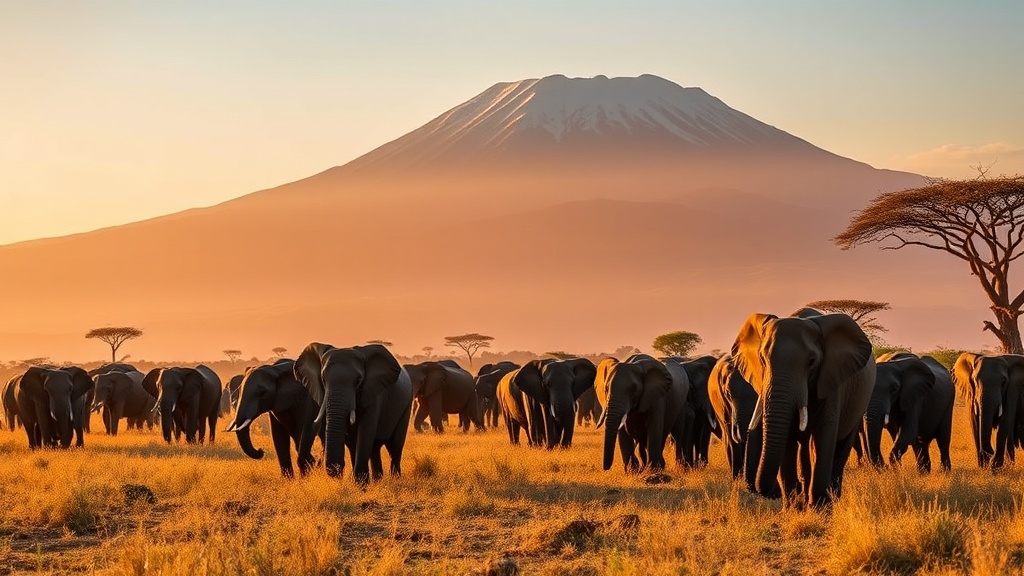
Small, dry, and famous for two things: the enormous Kilimanjaro backdrop — the mountain is in Tanzania, seen from Kenya — and its elephants, which are the most intensively studied population in the world thanks to Cynthia Moss's project running since 1972. This is where you see big tuskers and family groups that researchers know by name. Best light is early morning, when the cloud is off the mountain.
Tsavo East and West
Together with Chyulu, one of the largest protected areas on Earth, about 22,000 km² of red-dust bush between Nairobi and Mombasa. Tsavo's elephants are famously red from dust bathing. Mzima Springs in Tsavo West has an underwater hippo hide fed by water filtered through Chyulu lava. It is wilder, emptier and harder work than the Mara — the bush is thick and sightings take patience — and it is the antidote to a crowded circuit.
Samburu and the north
Across the Ewaso Ng'iro river in the arid north, and the place to see the "Samburu Special Five" — Grevy's zebra, reticulated giraffe, Beisa oryx, gerenuk and the Somali ostrich — none of which occur in the southern parks. Combined with Buffalo Springs and Shaba, and adjacent to the community conservancies of the Northern Rangelands Trust, it is the most distinctive safari in the country.
Laikipia and the conservancies
The plateau north-west of Mount Kenya, where former cattle ranches have become wildlife conservancies. Ol Pejeta holds the last two northern white rhinos on Earth, both female, under 24-hour guard, and a chimpanzee sanctuary. Lewa is a UNESCO site and a black rhino stronghold. Solio has an extraordinary rhino density. This is Kenya's most successful conservation model and its most expensive accommodation.
The Rift lakes and the rest
Lake Nakuru — flamingos in variable numbers depending on water level, plus rhino and Rothschild's giraffe. Lake Naivasha, freshwater, hippos, and walking safaris on Crescent Island. Hell's Gate, where you can cycle and walk among zebra and where the geothermal steam comes out of the ground. Aberdare and Mount Kenya for forest species and tree lodges. Meru, remote and lovely, where Born Free happened.
🐘 The Wildlife Itself
The migration, honestly
About 1.3 million wildebeest plus several hundred thousand zebra and gazelle move in a rough annual circle through the Serengeti–Mara ecosystem, following rain and grass. They are in the Kenyan Mara roughly July to October. What the documentaries do not convey: the crossings are erratic, herds may mill at a bank for days, and you may sit for eight hours and see nothing. The migration is spectacular and it is not a scheduled performance.
Elephants
Kenya holds around 36,000 elephants and the number has been rising: the national wildlife census reported roughly 4% growth in elephants and black rhino in its most recent count, and the Mara ecosystem's population went from 1,448 in 2014 to about 2,493. That recovery is the result of hard anti-poaching work, stiffer penalties and the collapse of the ivory market after the Chinese ban. The pressure now is not poaching but land: fenced farms across ancient corridors.
Rhino
Kenya's black rhino population, down to about 380 animals in the late 1980s from perhaps 20,000 two decades earlier, has been rebuilt past 1,000 in guarded sanctuaries — one of the great conservation recoveries. Southern white rhino are also present. The northern white rhino is functionally extinct: the last two, Najin and Fatu, live at Ol Pejeta, and the species' only future is an IVF programme using stored sperm and harvested eggs.
The predators
Lion — the Mara conservancies hold one of the densest populations anywhere. Leopard, common but nocturnal and hard. Cheetah, which the Mara's short grass suits and which suffers badly from tourist vehicles crowding hunts. African wild dog, endangered and best looked for in Laikipia and Samburu. Spotted hyena, far more interesting than their reputation and the most successful large predator in the ecosystem.
Birds
Kenya is one of the great birding countries — around 1,100 recorded species in an area smaller than Turkey, and dedicated tours regularly log 500 in three weeks. The Rift lakes for flamingo, pelican and waders; Kakamega Forest for west African forest species found nowhere else in Kenya; the coast for migrants. Even a general safari will produce lilac-breasted rollers, secretary birds and superb starlings by the dozen.
The animals nobody photographs
The sitatunga in the swamps, the aardvark that almost nobody sees, the pangolin that is the most trafficked mammal on Earth, the hirola antelope with perhaps 500 individuals left and the unhappy distinction of being the most endangered antelope in the world. Ask a good guide about these rather than about the Big Five, and the quality of the answer will tell you what kind of guide you have.
🏝️ The Coast
536 km of Indian Ocean: white sand, a near-continuous coral reef that keeps the water flat and warm inside it, mangrove creeks, and a string of Swahili towns that are older than anything inland. The coast is culturally a different country from the highlands, and Kenyans from Mombasa will tell you so.
Mombasa
Kenya's second city and its port, on an island connected by causeway and the Likoni ferry. Fort Jesus, built by the Portuguese in 1593 and a UNESCO site, is the anchor; the Old Town behind it is carved doors, Omani balconies and narrow lanes. The city is hot, loud, Muslim-majority and much more interesting than the beach resorts that surround it, which most visitors never leave.
Diani and the south
Diani Beach is the best-known stretch of sand in Kenya and deservedly so — wide, white, backed by coastal forest with colobus monkeys crossing on rope bridges over the road. Wasini and Shimoni further south for dhow trips and the Kisite-Mpunguti marine park, which has the best snorkelling and reliable dolphins. Kite surfing from June to September and December to March.
Watamu and Malindi
Watamu has a marine national park established in 1968, among the oldest in Africa, with coral gardens in shallow water and turtle nesting beaches monitored by a long-running local trust. Malindi has a heavily Italian tourist history, the Vasco da Gama pillar, and the Gedi ruins in the forest behind it. The Mida Creek mangrove boardwalk at sunset is one of the quiet pleasures of the coast.
Lamu
Two hours' flight or a very long drive north, and worth both. A UNESCO World Heritage town of coral-rag houses and carved doors with donkeys instead of cars, plus Shela village and its dunes, and dhow sailing that is transport rather than entertainment. Check current advisories: Lamu county's mainland areas near the Somali border carry security warnings from most foreign ministries, while Lamu and Manda islands themselves are generally treated differently. Verify before booking.
The reef and what threatens it
Kenya's fringing reef is in trouble: the 1998 El Niño bleaching killed a large share of the coral and subsequent events have added to it, alongside sedimentation and overfishing. The marine parks — Kisite-Mpunguti, Watamu, Malindi, Mombasa — are the healthiest sections and the reason they exist. Do not stand on coral, do not buy shells, and use reef-safe sunscreen; the boat operators will not tell you any of this.
Coast practical
The SGR train from Nairobi to Mombasa takes about five hours and is comfortable and cheap; flights take one hour. Mombasa is hot and humid year-round; the coolest months are June to September. Ramadan is observed and the coast is conservative — cover up away from the beach, especially in Lamu and Mombasa Old Town. The coast is malarial, more so than the highlands.
🏛️ UNESCO
Lake Turkana National Parks (1997/2001)
Sibiloi, Central Island and South Island: the largest desert lake in the world, active volcanic islands, huge Nile crocodile populations, and the Koobi Fora fossil beds that produced much of the hominin record. It has been on the List of World Heritage in Danger since 2018 because of Ethiopia's Gibe III dam and irrigation upstream on the Omo river, which supplies about 90% of the lake's inflow.
Mount Kenya (1997)
Africa's second-highest mountain and its afro-alpine ecosystem: giant lobelias and groundsels, twelve remnant glaciers that have lost the great majority of their area since 1900, and forest belts holding elephant and bongo. Extended in 2013 to include the Lewa conservancy and the Ngare Ndare forest, recognising the wildlife corridor between them.
Lamu Old Town (2001)
The oldest and best-preserved Swahili settlement in East Africa, inhabited continuously for over 700 years, inscribed for its coral-and-mangrove architecture, its street plan and its living culture rather than as a ruin. The proposed Lamu port has been a standing concern for the site's integrity.
Sacred Mijikenda Kaya Forests (2008)
Eleven forested sites along the coast containing the remains of fortified villages, the kaya, of the Mijikenda peoples. They are sacred groves protected by councils of elders rather than by fences, and that protection is precisely what preserved patches of coastal forest that have been cleared everywhere else.
Fort Jesus (2011)
The Portuguese fort at Mombasa, built 1593–96 to a design by the Italian architect Giovanni Battista Cairati, and inscribed as one of the best-preserved examples of sixteenth-century Portuguese military architecture anywhere. Its layout is deliberately shaped like a human figure seen from above.
Kenya Lake System and Thimlich Ohinga
The Kenya Lake System in the Great Rift Valley (2011) covers Bogoria, Nakuru and Elementaita — soda lakes with vast bird populations and geothermal features. Thimlich Ohinga (2018) is a complex of dry-stone walled enclosures near Lake Victoria, built from the sixteenth century without mortar, and the best surviving example of a building tradition that once covered the region.
🍲 Food
Kenyan food is starch, greens, grilled meat and tea, and it varies far more by region than the safari-lodge buffet suggests. The highlands eat maize and beans; the coast eats coconut, rice, tamarind and spice and is a different cuisine entirely; the pastoralist north eats meat and milk.
Ugali
The national staple: white maize meal cooked with water into a stiff, smooth, sliceable cake, turned out and eaten with the hands. It has almost no flavour of its own and that is the point — it is the vehicle for stew and greens. Two rules Kenyans are firm about: it should be white, because yellow maize means famine relief or animal feed, and it should be stiff enough to hold its shape.
Nyama choma
Roast meat, and the national social institution rather than a dish. Usually goat, sometimes beef, grilled slowly over charcoal, weighed raw, then chopped into cubes on a wooden board, salted, and eaten with the fingers alongside kachumbari — a raw salad of tomato, red onion, chilli and coriander — and ugali. It happens at weekends, in groups, over hours, with beer, and it is the closest thing Kenya has to a national ritual.
Sukuma wiki and the greens
Collard greens or kale, shredded and fried with onion and tomato. The name means "push the week" — the cheap vegetable that stretches the food to payday — and it is on more Kenyan tables more often than any other dish. Also terere (amaranth), managu (African nightshade) and kunde (cowpea leaves), all of which are better than kale and increasingly fashionable in Nairobi restaurants.
The rest of the highlands
Githeri, boiled maize and beans, the Kikuyu staple and the food of every boarding school. Mukimo, mashed potato with greens, maize and pumpkin leaves, coloured green and served at celebrations. Irio, its close relative. Mutura, a grilled blood-and-offal sausage sold on the street that is much better than a description of it. Chapati and samosa, both Indian by descent and completely naturalised.
The coast
A separate and, many would argue, better cuisine. Pilau, rice with meat and whole spices. Biryani. Wali wa nazi, coconut rice. Mahamri, cardamom doughnuts eaten at breakfast with mbaazi, pigeon peas in coconut. Fish and prawns in coconut and tamarind. Viazi karai and mishkaki from the street stalls, and the night market on Mombasa's Mackinnon Road for all of it.
Practical
Eat where it is busy. Street food is generally fine if it is hot and freshly cooked; the risk is salads, ice and tap water. Vegetarians do well by Kenyan standards — githeri, sukuma wiki, beans, chapati and the Indian food are everywhere. Vegans should say hakuna nyama, hakuna maziwa and check about ghee. And do not skip the nyama choma experience on principle: it is where you meet people.
👨🍳 Two Recipes
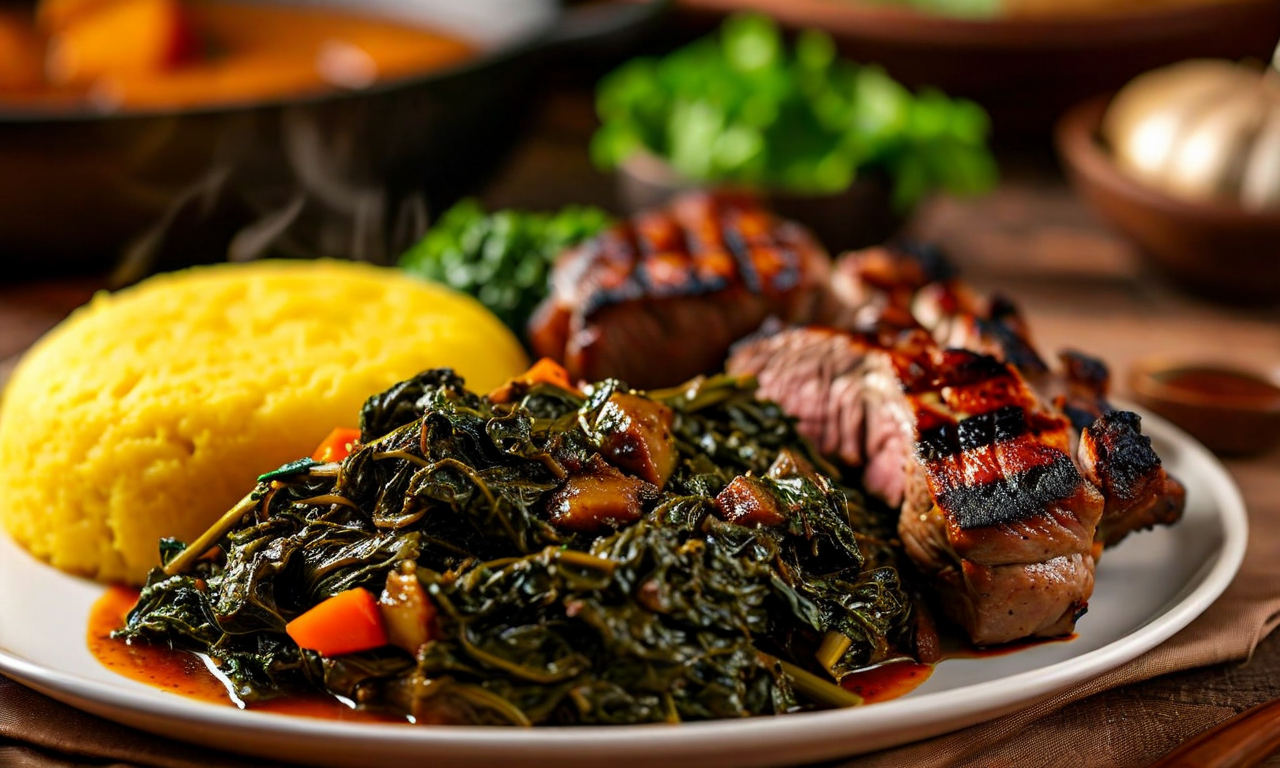
Sukuma Wiki
Kenya · serves 4 as a side · 25 minutes · one large frying pan or sufuria
Ingredients: 1 large bunch collard greens or kale (about 500 g), thick stems removed · 2 tbsp oil · 1 large onion, sliced · 2 tomatoes, chopped · 2 cloves garlic, chopped · 1 tsp ground coriander (optional) · salt · a squeeze of lemon · water.
Method: Stack the leaves, roll them into a cigar and shred across into ribbons about 5 mm wide — the cut matters and a rough chop gives the wrong texture. Heat the oil and fry the onion until soft and just colouring, 5–6 minutes. Add the garlic, then the tomatoes, and cook down for 5 minutes until they collapse into a sauce. Add the greens with a good pinch of salt and about 100 ml of water, stir, cover and cook 8–10 minutes, stirring once or twice, until tender but still green. Uncover and let any remaining liquid cook off. Finish with lemon.
💡 The two failure modes are drowning it and overcooking it. It should be moist, not soupy, and still green rather than olive. Serve with ugali and, if you have it, grilled meat — the greens, the starch and the meat are one dish in three parts, and Kenyans eat all of it with their right hand.
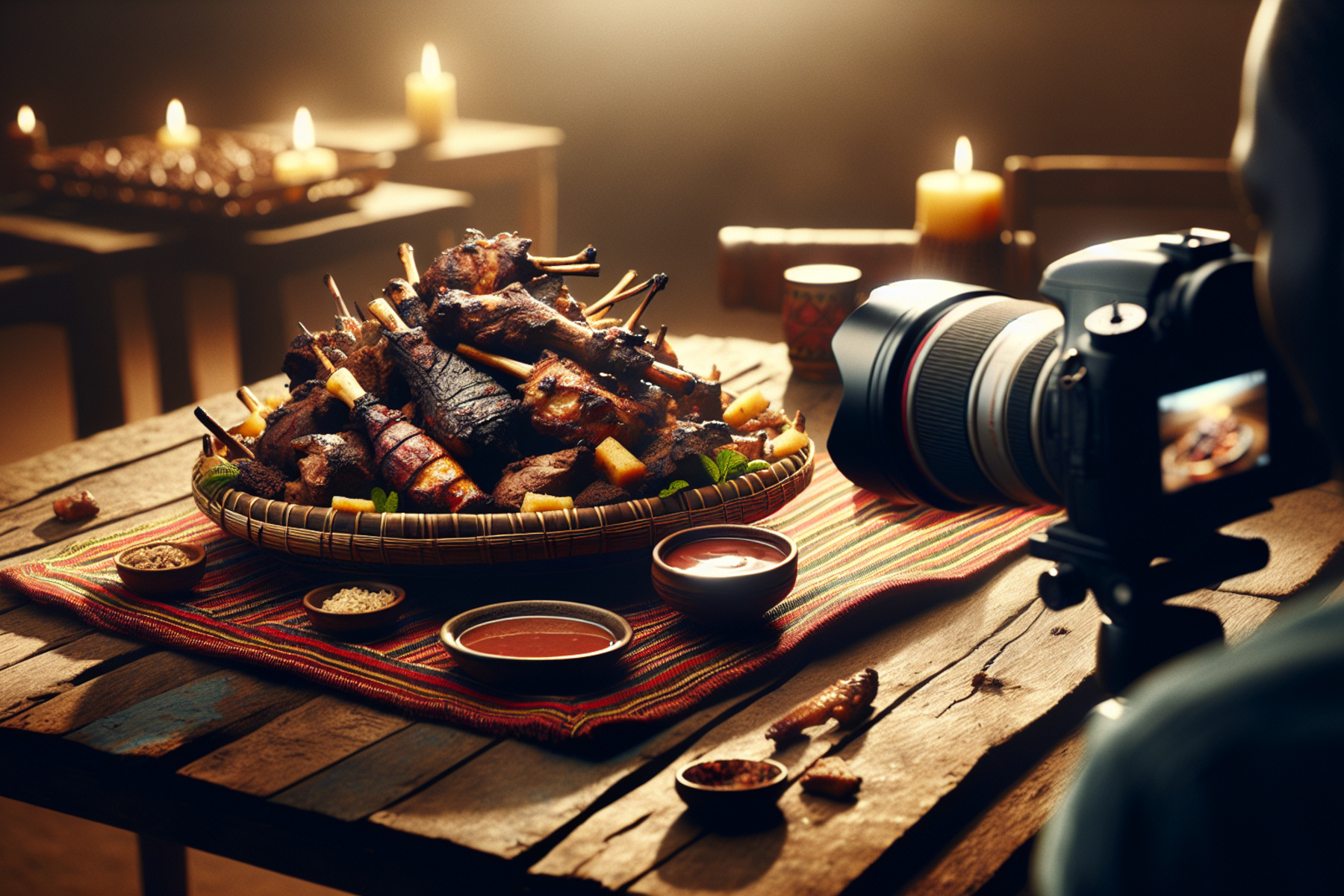
Nyama Choma with Kachumbari
Kenya · serves 4 · 1½–2 hours over charcoal · a kettle barbecue or open grill
Ingredients: Meat: 1.5 kg goat — leg, ribs or shoulder, bone in, in large pieces (lamb or beef short rib also work) · coarse salt · 1 lemon. That is the entire marinade, and adding to it is the most common mistake. Kachumbari: 3 firm tomatoes, deseeded and diced · 1 red onion, sliced paper-thin · 1 green chilli, finely chopped · a large handful of coriander · juice of 1 lime · salt. To serve: ugali, and a very cold beer.
Method: Light the charcoal and let it burn down to grey ash with no flame — this is slow cooking over indirect heat, not searing. Salt the meat generously and put it on the cool side of the grill, turning every 10–15 minutes and moving it closer to the coals only at the end. Depending on the cut it takes 1½ to 2 hours; it is done when the meat pulls easily from the bone and the outside is crisp and blackened in places. Rest 10 minutes, then chop it into bite-sized cubes on a board, bone and all where it falls, and salt again. For the kachumbari, soak the sliced onion in cold water for 10 minutes to take the harshness out, drain, then mix everything and dress at the last moment.
💡 Do not marinate, do not sauce, do not rush the fire. The whole thing is meat, smoke, salt and time, and the kachumbari exists to cut through the fat. If you are eating properly there are no plates and no cutlery: the board goes in the middle and everyone takes from it with a toothpick or their fingers.
☕ Chai, Tusker and What Is Drunk

Chai
Not a drink so much as a rhythm of the day. Black tea leaves boiled together with milk — often entirely milk, no water — and a great deal of sugar, sometimes with ginger or cardamom. It is served at breakfast, at ten, at four, to every visitor, and refusing it is genuinely awkward. Given that Kenya is the world's largest black tea exporter and drinks a fair amount of what it grows, this is one national habit with a solid economic base.
Coffee, and the strange thing about it
Kenya grows some of the best Arabica in the world — the SL28 and SL34 varieties, washed, from Nyeri, Kirinyaga and Kiambu, with the blackcurrant acidity that specialty buyers pay a premium for. For decades almost none of it was drunk in Kenya, because the good stuff was all exported and the coffee served locally was instant. That has changed fast: Nairobi now has a serious roasting and café scene, and drinking Kenyan coffee in Kenya is finally a reasonable proposition.
Tusker
The national beer, brewed by East African Breweries since 1922 and named in memory of one of the founders, who was killed by an elephant — which is why the logo is an elephant head and the slogan is "Bia Yangu, Nchi Yangu", my beer, my country. Also White Cap, Pilsner and a growing craft scene in Nairobi. The sundowner — a beer at the exact moment the sun goes down over the plain — is a genuine institution and not a marketing invention.
Spirits and the danger
Kenya Cane and Kenya Gold at the cheap end; a decent gin scene in Nairobi. The serious warning is about informal spirits: changaa, a distilled home brew, is sometimes adulterated with methanol and has killed and blinded people in batches, repeatedly. Never drink unlabelled spirits, and be wary of very cheap bottled spirits, since counterfeiting is a real and periodically lethal problem.
The traditional drinks
Muratina, a Kikuyu honey-and-sausage-tree brew used ceremonially. Busaa and mursik — the latter a Kalenjin fermented milk kept in a gourd smoked with charcoal from a specific tree, poured for returning marathon champions at the airport, and an acquired taste that most visitors do not acquire. Madafu, coconut water drunk straight from the nut, on every coast beach.
Practical
Do not drink the tap water anywhere; bottled is universal and cheap, and good lodges filter. Ice in reputable places is made from treated water and is usually fine. Kenya has a drink-driving limit and roadside breath testing, and the traffic police enforce it. And be aware that alcohol licensing hours are restricted in some counties, which surprises people on a Monday afternoon.
💡 Culture and Etiquette
Greetings are not optional
Kenya is a country where you greet before you transact. Walking up to a counter and stating your business without a habari or a "good morning, how are you" reads as rude in a way that is easy to avoid and hard to repair. Handshakes are frequent and can be long; a younger person may support their right forearm with their left hand as a mark of respect. Elders are greeted first.
Pole pole
"Slowly, slowly", and also the name of a whole attitude to time. Appointments are approximate, buses leave when full, and "just now" can mean anything up to a day. Foreigners who fight this have a bad time; foreigners who build slack into the schedule find that things generally work out. The corollary is that relationships come before transactions, and time spent talking is not time wasted.
The Maasai, and the photograph problem
The Maasai are about 2% of Kenya's population and roughly 100% of its tourist imagery, which is a distortion with consequences. Do not photograph people — Maasai or anyone else — without asking; expect to pay if you are photographing someone in traditional dress at a cultural boma, and agree the amount first. Village visits vary enormously: some are community-owned and genuinely informative, others are staged and extractive. Ask your operator who owns the boma and where the money goes.
Practical etiquette
Use the right hand for giving, receiving and eating. Dress modestly away from beach resorts, especially on the coast and in mosques; shorts on men are read as beachwear. Public displays of affection are frowned on. Do not photograph government buildings, airports, police or military. And be careful with jokes about politics or ethnicity — Kenyans make them constantly among themselves and it lands very differently from a visitor.
LGBT travellers
Consensual same-sex acts remain criminalised under colonial-era sections of the penal code, with long theoretical sentences; prosecutions are rare but arrests and harassment occur, and a 2019 High Court challenge to the law failed. Public attitudes are largely hostile and politicians periodically campaign on it. Discretion is the practical advice, and same-sex couples should expect questions about room bookings outside the international hotels.
Music, writing, film
Benga, the guitar-driven Luo style that is Kenya's great musical export, plus gengetone, Afro-pop and a large gospel industry. In writing: Ngũgĩ wa Thiong'o, who abandoned English for Gikuyu and wrote a novel on toilet paper in a Moi prison; Binyavanga Wainaina, whose essay How to Write About Africa is required reading before any travel article; Yvonne Adhiambo Owuor and Okwiri Oduor. And a film and television industry that is now producing work good enough to be exported rather than only used as a location.
🗣️ Swahili, English and Sheng
Kenya has two official languages, Swahili and English, and more than forty others spoken at home. In practice the mix depends on the setting: English for business, law and secondary education; Swahili as the national language and the one that crosses ethnic lines; and a mother tongue at home.
Swahili
A Bantu language, structurally African, with a large layer of Arabic loanwords from a thousand years of Indian Ocean trade and later borrowings from Portuguese, German and English. It spread inland along the caravan routes and is now the lingua franca of East Africa with well over a hundred million speakers, the first African language to be adopted as a working language of the African Union. It is also unusually easy for a European to start: phonetic spelling, no tones, regular structure.
English
Universal in education, government and commerce, and spoken to a high standard by most people you will deal with as a visitor. Kenyan English has its own idiom — you are asked to "alight" from a bus, told something will happen "just now", and invited to "add" rather than to give more. Signage, menus and official forms are in English throughout.
Sheng
The Nairobi street language: a fluid mix of Swahili grammar with English, Gikuyu, Dholuo and Kamba vocabulary, generational, constantly changing, and originally a marker of the young urban poor. It is now the language of Kenyan pop music and advertising and is impenetrable to outsiders — including to Kenyans over fifty, which is much of the point.
The mother tongues
Around forty-plus languages in three families: Bantu (Kikuyu, Luhya, Kamba, Kisii, Meru, Mijikenda, Swahili), Nilotic (Luo, Kalenjin, Maasai, Turkana, Samburu) and Cushitic (Somali, Borana, Rendille). Asking which language someone speaks at home is a normal question; assuming from appearance is not.
Fifteen words
Jambo — hello (to tourists; Kenyans say habari). Habari? — how are things? Nzuri — good. Asante (sana) — thank you (very much). Karibu — welcome. Tafadhali — please. Ndiyo / hapana — yes / no. Pole — sorry (for a mishap). Pole pole — slowly. Bei gani? — how much? Ghali sana — very expensive. Hakuna matata — no problem, and yes, it is real. Rafiki — friend. Maji — water. Kwaheri — goodbye.
Why it is worth trying
Because almost no visitor does. English gets you everything you need, and precisely because of that, a greeting in Swahili is noticed instantly and changes the temperature of an interaction. Ten words are enough. The one to get right is asante sana, and the one to be careful with is jambo, which marks you as a tourist — habari yako? marks you as someone who has bothered.
📅 When to Visit
The short version
The two dry seasons are the high seasons: late June to October and January to February. The first coincides with the migration in the Mara and is the peak of everything including prices; the second is hot, very dry, excellent for wildlife and slightly cheaper. The rains are March to May (long) and November (short).
July–October
Migration season. Wildebeest are in the Mara, grass is short, animals concentrate at water, and the weather is dry and pleasantly cool in the highlands. It is also the most crowded and most expensive time of year, lodges book out a year ahead, and the Mara reserve can feel like a car park at a good sighting. Book conservancies rather than the reserve if the budget allows.
January–February
The other dry window and arguably the better value. Hot, very good game viewing as water concentrates, calving on the plains, superb birding with the Palearctic migrants in, and clear mountain views. No migration river crossings. The coast is hot and at its best, and this is the peak season there rather than in the parks.
March–May
The long rains: the emerald season. Landscapes are green, prices drop sharply, and lodges that cost a fortune in August are affordable. The costs are real — some camps close, black-cotton roads in the Mara become impassable, sightings are harder in long grass, and mosquitoes are worse. If you have been on safari before and are going back for the light and the emptiness, this is the time.
November–December
The short rains in November are usually brief afternoon storms rather than a washout, and it is a genuinely good-value month with green landscapes and few people. December fills up sharply from about the 20th, when Kenyan and European holiday traffic hits the coast and the parks simultaneously and prices go through the roof for two weeks.
Dates to plan around
Madaraka Day 1 June, Mashujaa Day 20 October, Jamhuri Day 12 December — all public holidays. Ramadan changes the rhythm of the coast substantially. And the protest anniversaries of 25 June and 7 July have brought demonstrations and heavy police deployments in Nairobi and other towns every year since 2024; parks and the coast are unaffected, but plan not to be in a city centre on those dates.
🚐 Getting Around
Flying
The practical answer for the parks. Wilson Airport in Nairobi is the hub for the light aircraft — Safarilink, AirKenya — that serve the Mara, Amboseli, Samburu, Lamu and the coast on scheduled bush flights with tiny luggage allowances (usually 15 kg in a soft bag, strictly enforced). It is expensive and it converts a seven-hour drive into a forty-minute flight over the Rift, which is itself worth the money.
The SGR
The Standard Gauge Railway runs Nairobi–Mombasa in about five hours, and Nairobi–Naivasha. It is modern, clean, punctual, cheap and the best way to reach the coast; book ahead through the official channel, since third-party resellers charge a large markup. It passes through Tsavo, and you may well see elephant from the window.
Matatus
The privately owned minibuses that carry most Kenyans, decorated at enormous expense with airbrushed portraits, LED strips and sound systems, and driven with commitment. They are cheap, ubiquitous, an experience, and statistically the most dangerous thing you can do in Kenya. For short urban hops with a Kenyan companion they are fine; for long intercity journeys take a proper coach — Modern Coast, Easy Coach and similar operate scheduled services.
Driving and safari vehicles
Kenya drives on the left. Main highways are decent, secondary roads vary from acceptable to appalling, and unfenced livestock, potholes and night-time trucks make driving after dark genuinely dangerous — do not do it. Self-drive safari is possible in Tsavo, Nakuru and Amboseli with a high-clearance 4×4 but is not recommended for a first visit; almost everyone uses a vehicle with a driver-guide, and the guide is most of what you are paying for. An International Driving Permit is required.
City transport
Uber, Bolt and the local Little work well in Nairobi and Mombasa and are the sensible default. Boda-bodas, the motorcycle taxis, are fast, everywhere and account for a very large share of Kenya's trauma admissions; if you use one, insist on a helmet. Nairobi traffic is severe and unpredictable — a 12 km journey can take ninety minutes.
Choosing an operator
This matters more in Kenya than the choice of park. Look for KATO membership (the Kenya Association of Tour Operators), a named guide with a KPSGA silver or gold certification if you care about wildlife knowledge, and a clear written statement of what is and is not included — park fees, conservancy fees, drinks and tips add up fast. Cheap safaris are cheap because they cut vehicle quality, guide quality and park time.
📋 Practical Information
Entry: the eTA
Kenya abolished visas on 1 January 2024 and replaced them with an Electronic Travel Authorisation. Every visitor including children needs one, applied for at etakenya.go.ke — the official site, and there are many expensive imitations — at least three days before travel. The official fee is around USD 32.50 for a single entry; check the current figure, as it has moved. Most African nationalities were exempted in May 2025; European travellers are not. Passport valid six months, and expect to give biometrics on arrival.
Health
Yellow fever vaccination is required if you are arriving from a country with risk of transmission, and is recommended generally. Malaria prophylaxis is strongly advised for the coast, the Rift lakes, the western lowlands and the parks; Nairobi and the high highlands above roughly 2,500 m are low risk. Also typhoid, hepatitis A and B, tetanus, and rabies for longer or rural stays. Bilharzia is present in Lake Victoria and some rivers — do not swim. Emergency number: 999 or 112.
Insurance
Not optional. The EHIC does not apply and there is no Czech–Kenyan healthcare agreement, so treatment is paid for privately and the good Nairobi hospitals are expensive. Your policy must cover medical evacuation, because a serious problem in the Mara or Samburu means a flight to Nairobi. Many operators include AMREF Flying Doctors temporary membership, which is inexpensive and worth having; confirm rather than assume.
Money
The Kenyan shilling (KES), around 129 to the US dollar and roughly 6.3 KES to 1 Kč through 2026 — verify before travelling. Cards work in hotels, lodges and city restaurants. M-PESA runs everything else and is worth setting up on a local SIM if you are staying more than a few days: markets, matatus, small shops and many parks take it. Park fees are increasingly cashless and some gates will not take notes at all. Carry small shilling notes for tips and the informal economy.
Safety
Kenya is a country where sensible visitors have no trouble and careless ones do. Petty theft and phone-snatching in Nairobi and Mombasa; do not walk at night, do not display valuables in traffic. Foreign ministries advise against travel to the counties bordering Somalia — Mandera, Wajir, Garissa and parts of Lamu and Tana River — because of al-Shabaab, and to parts of Turkana and West Pokot for banditry. Check mzv.gov.cz for the current Czech advisory, which is more specific than most summaries. Demonstrations in Nairobi around 25 June and 7 July have turned violent every year since 2024.
Park fees and rules
Park entry is charged per person per day and is a substantial part of the cost: Maasai Mara is around USD 100–200 per adult per day depending on season and whether you stay inside, the Kenya Wildlife Service parks somewhat less, and conservancies charge their own fee on top. The rules exist for reasons: stay in the vehicle unless your guide says otherwise, no off-road driving in the reserve, no crowding cats, no drones without a permit, and do not ask the driver to get closer.
💵 What It Costs
Kenya is inexpensive to live in and expensive to safari in, and those two facts confuse a lot of budgeting. Food, transport and city accommodation are cheap; park fees, bush flights and lodges are priced in dollars for an international market.
Sleeping
Nairobi hostel dorm from about KSh 1,500, a decent city hotel KSh 6,000–15,000, a good one more. On safari the range is enormous: a basic camp outside the Mara USD 80–150 per person per night, a mid-range tented camp USD 200–400, and a conservancy lodge USD 600–1,500 or well beyond, generally all-inclusive with game drives. Coast hotels run KSh 5,000–25,000 outside the Christmas peak.
Eating
A plate of ugali, sukuma wiki and stew in a local place KSh 200–400. A good Nairobi restaurant meal KSh 1,500–4,000 a head. Nyama choma by weight, roughly KSh 800–1,200 per kilo of goat. Tusker KSh 250–400 in a bar, more in a hotel. Coffee in a Nairobi speciality café KSh 300–500. Lodge meals are almost always included in the room rate.
Getting about
SGR Nairobi–Mombasa KSh 1,500 economy, KSh 4,500 first class. Long-distance coach Nairobi–Mombasa KSh 1,500–2,500. Uber across Nairobi KSh 400–1,200. A bush flight Nairobi–Mara USD 200–300 return. A day's 4×4 with driver-guide USD 200–350 plus park fees.
A realistic safari budget
Per person per day, all in, for a Mara-and-Nairobi trip: budget camping safari USD 200–300, mid-range USD 400–600, conservancy or high-end USD 900–2,000+. A week's mid-range safari for two with flights, park fees and a few coast days lands somewhere around 90,000–160,000 Kč per person — verify the rate, which moves. The single biggest saving is going in the long rains.
Tipping
Expected and a meaningful part of income. Rough guidance: USD 10–20 per guest per day for a safari guide, USD 5–10 a day into the camp staff box, 10% in restaurants where service is not included, and small notes for porters. Ask your operator what is normal for their staff rather than guessing; over-tipping distorts local economies as reliably as under-tipping shortchanges people.
Where the money goes
Worth knowing: the conservancy model pays lease fees directly to Maasai landowning families every month, which is why those areas still have wildlife rather than fences and wheat. Park fees fund the Kenya Wildlife Service. A cheap safari booked through an aggregator may deliver very little to either. If you care about that, ask, and pick the operator accordingly.
🇨🇿 Getting There, and Notes for Czech Travellers
Flights from Prague
There is no direct flight. The standard routings to Nairobi (NBO) are Turkish via Istanbul, Qatar via Doha, Emirates via Dubai, Ethiopian via Addis Ababa, KLM via Amsterdam, Lufthansa/Swiss via Frankfurt or Zurich, and Kenya Airways from Amsterdam, Paris or London. Total journey time is typically 10–14 hours. Addis is usually the shortest connection and Istanbul often the cheapest. Charter and package flights to Mombasa (MBA) appear in the winter season from several Central European airports.
The eTA, step by step
Czech citizens need an eTA, not a visa. Apply only at etakenya.go.ke; the search results are full of agencies charging three times the price for the same form. You need a passport scan, a photo, your first night's accommodation and a return ticket. Apply at least three days ahead, though it often comes back within 24 hours. The fee is around USD 32.50 single entry — confirm the current amount, it has changed more than once.
Money in Czech terms
At roughly 6.3 KES to 1 Kč — check before you go — a local meal is around 40–65 Kč, a Nairobi restaurant dinner 240–640 Kč, a Tusker 40–65 Kč, and the SGR to Mombasa about 240 Kč in economy. Against that, one day's Maasai Mara park fee alone is 2,000–4,000 Kč per person. Bring US dollars in notes printed 2009 or later — older ones are refused — for park fees, tips and visas, and use cards and M-PESA for everything else.
MZV ČR, DROZD and the embassy
The Czech Embassy is in Nairobi and covers Kenya plus several neighbouring countries, which makes it one of the more important Czech missions in Africa. Register in DROZD before you travel — for a country with regional security advisories and a protest calendar, this is a real recommendation rather than a formality. Read the current mzv.gov.cz advisory, which distinguishes carefully between the safe majority of the country and the specific border counties it advises against. The EHIC does not apply.
Czech traces
Thinner than in some countries but real. Czechoslovakia had close relations with Kenyatta-era and Moi-era Kenya, trained Kenyan students at Czech universities on scholarships through the 1960s–80s, and exported machinery, Tatra trucks and Zetor tractors, some of which are still working. The Czech Republic runs development and scholarship programmes here, Czech expedition and mountaineering interest in Mount Kenya goes back decades, and Kenyan tea and roses are on Czech supermarket shelves all year.
What surprises Czechs most
The altitude — Nairobi is higher than Sněžka and you feel it on the first day. The cold: highland nights and early game drives in July need a fleece and a hat, which nobody packs. The cost of the parks relative to the cost of everything else. How completely English works. And the fact that a Kenyan will ask where you are from, listen to the answer, and then ask a second question, which is a rhythm of conversation Czech visitors consistently mention.
🔬 Curiosities
The word safari is just "journey"
Safari is Swahili for a trip — from Arabic safar — and in Kenya it still means exactly that. A Kenyan going to visit their mother is on safari. The industry sense was exported by Victorian hunters, most influentially by Theodore Roosevelt's 1909–10 expedition, which shipped over 11,000 specimens back to the Smithsonian and effectively invented the safari as a genre.
Glaciers on the equator
Mount Kenya sits almost exactly on the equator and carries permanent ice. It had eighteen named glaciers in 1900 and has lost the great majority of that ice; the Lewis Glacier, the largest, is a fraction of its former size and the mountain is projected to be ice-free within decades. The Ruwenzori and Kilimanjaro are in the same position. Standing in snow on the equator is a thing that will not be possible much longer.
A national park you can see from an office window
Nairobi National Park is the only national park inside a capital city's boundary anywhere in the world with a full complement of large mammals. Lions are occasionally reported on the ring road. The park is bounded by the city on three sides and the pressure of infrastructure through it is a live political argument.
The last two
Najin and Fatu, a mother and daughter at Ol Pejeta Conservancy in Laikipia, are the only northern white rhinos left alive. Both are female; the last male, Sudan, died in 2018. Neither can carry a pregnancy. The species' only remaining chance is embryos created from harvested eggs and frozen sperm, implanted into southern white rhino surrogates — a programme that has produced viable embryos and no calf yet.
The flamingos move
Lake Nakuru's million-flamingo photograph is real and it is also out of date: rising water levels since about 2010 diluted the alkalinity, cut the cyanobacteria the birds feed on, and pushed the flocks to Bogoria and across the border to Natron. Flamingo numbers on any given Rift lake are a function of water chemistry that month, which is why guides hedge.
Two rivers with a shared problem
Kenya's borders enclose almost none of its own water. Lake Turkana takes about 90% of its inflow from Ethiopia's Omo river, now dammed and diverted for irrigation, which is why the lake is a UNESCO site in danger. Lake Victoria is shared three ways. And the Rift lakes' unexplained rise since 2010 has displaced tens of thousands of people from land that was dry for a century.
🌿 Conservation — What Works and What Does Not
Kenya is one of the few countries in the world where several large mammal populations are going up rather than down, and it is also a country where the underlying pressure — human population, fenced land, water — is getting worse rather than better. Both things are true at once and the honest account has to hold them together.
The wins
Elephants at around 36,000 and rising roughly 4% in the most recent national census; black rhino rebuilt from about 380 animals in the late 1980s past a thousand; the Mara's elephant population up 72% since 2014. Kenya banned hunting in 1977, burned its ivory stockpiles publicly in 1989 and 2016, and hardened poaching penalties in 2013. The Kenya Wildlife Service and the conservancy movement between them turned the trend around.
The conservancy model
Community and private conservancies now cover a substantial area outside the formal parks. Landowners — mostly Maasai families in the Mara, pastoralist communities in the north through the Northern Rangelands Trust — lease their land to a tourism operator for a monthly payment, cap the number of beds and vehicles, and keep grazing rights under a managed plan. It gives wildlife space that no government could afford to buy and gives families an income that beats subdividing for wheat. It is not uncomplicated: critics raise questions about consent, governance and security in some northern conservancies, and those debates are worth reading before you romanticise the model.
The corridors problem
The real threat to Kenyan wildlife is not the rifle but the fence. Population growth, land subdivision and the conversion of Rift Valley grassland to cropland have severed migration corridors that animals used for millennia — the Athi-Kaputiei plains south of Nairobi have lost most of their wildlife to fencing in thirty years. Underpasses on the Nairobi–Mombasa SGR and highway were built for elephants and do get used, which shows the problem is solvable and expensive.
Human–wildlife conflict
An elephant that eats a smallholder's entire harvest in one night has destroyed a family's year. Lions kill livestock; people kill lions. Kenya operates a compensation scheme that is chronically slow to pay, and the schemes that work best — predator-proof bomas, the Lion Guardians programme that employs Maasai warriors to track and protect the lions they once speared — work because they pay the people bearing the cost. Anything that treats rural Kenyans as the problem rather than as the partners fails.
Drought and water
The 2020–23 drought was the worst in forty years and killed elephants, Grevy's zebra and enormous numbers of livestock outright. Water is the binding constraint on everything: the Rift lakes rising, the Ewaso Ng'iro drying up before it reaches Samburu because of upstream abstraction, Turkana starved by the Omo dams, Naivasha drawn down by the flower farms. Kenyan conservation is increasingly a water-management argument.
What a visitor can actually do
Pick operators and camps that pay conservancy leases and employ locally, and ask them to show you the numbers. Go in the low season, when the money matters more. Pay the park fees rather than looking for the trip that avoids them. Do not buy ivory, shells, coral or anything made from a reptile. And put a day of the trip into something that is not a game drive — the museum, a community project, a walk with a Maasai guide — because that is where the money reaches people who are not in the tourism supply chain.
🏃 Why Kenyans Win
Kenya has won more Olympic and World Championship medals in middle- and long-distance running than any other nation, from a population of under 60 million, and a disproportionate share of those athletes come from one region and one language group. The explanation is genuinely interesting and it is not a single gene.
The Kalenjin
The Kalenjin, about 12% of Kenya's population and concentrated around Eldoret and the Rift Valley highlands, have produced the overwhelming majority of Kenya's distance champions — and within them, the Nandi sub-group even more so. A single district has produced more sub-2:10 marathoners than most continents. This is the most striking concentration of elite sporting talent in any sport anywhere.
The plausible reasons
Altitude — Iten and Eldoret sit at 2,400 m, and a childhood at that altitude builds oxygen-carrying capacity. Body morphology: long thin lower legs, which reduce the energy cost of each stride. A culture of running to school over long distances on soft dirt. Diet high in carbohydrate. But mostly: an unmatched training ecosystem — hundreds of camps, thousands of serious runners, and a competitive intensity in ordinary training that few outsiders survive. And the fact that running is a plausible route out of poverty, which sharpens motivation enormously.
The names
Kipchoge Keino, who won the 1968 Olympic 1500 m with a gallstone infection after jogging to the stadium through a traffic jam. Paul Tergat, Catherine Ndereba, David Rudisha and his still-standing 800 m world record from London 2012. Eliud Kipchoge, twice Olympic marathon champion, who ran 1:59:40 in Vienna in 2019 in a paced exhibition — not a record, but the first human under two hours. And Faith Kipyegon, the most dominant middle-distance runner of her generation.
Iten
A small town on the edge of the Elgeyo escarpment with a sign reading "Welcome to Iten, Home of Champions", and one of the most extraordinary sporting places on Earth: hundreds of world-class athletes training on red dirt roads at dawn, in groups, most of them unknown. Foreign runners come to train there and are welcomed; the High Altitude Training Centre founded by Lornah Kiplagat is the usual base. You will be dropped instantly and it is still worth doing.
The doping problem
It has to be said plainly: Kenya has a serious doping crisis. Well over a hundred Kenyan athletes have been banned in recent years, mostly for EPO and steroids, largely among second-tier road runners chasing prize money with no medical support and plenty of unscrupulous agents. Athletics Kenya and the Anti-Doping Agency of Kenya, under pressure from World Athletics, committed substantial funding to testing from 2023. The problem is real and it does not explain the sixty-year record of the very best.
Beyond running
Kenya is also formidable at rugby sevens — the national team is a fixture on the world circuit and the Safari Sevens is a serious tournament. Cricket had a remarkable moment when Kenya reached the 2003 World Cup semi-final and has declined since. And the Safari Rally, one of the toughest events in world motorsport, returned to the WRC calendar in 2021 after a nineteen-year absence and is run around Naivasha.
⛪ Religion and Society
Kenya is roughly 85% Christian and 11% Muslim, with small Hindu, Sikh and traditionalist communities, and it is a country where religion is a loud and central part of public life rather than a private matter.
Christianity
Divided roughly between Protestant denominations, the Catholic Church, and a very large and fast-growing Pentecostal and evangelical sector. Church attendance is high, services are long and musical, and Sunday genuinely reorganises the week. The mainstream churches — Anglican, Catholic, Presbyterian — played a decisive role in forcing multiparty politics on Moi in the early 1990s and remain a real political voice, most recently on police conduct and the abductions.
Islam
Concentrated on the coast, where it has been established for over a thousand years and is Sunni of the Shafi'i school, and in the north-east among ethnic Somalis. Mombasa, Lamu and Malindi are Muslim-majority cities with a Swahili Islamic culture that is one of the oldest in the world outside Arabia. Kenyan Muslims have complained for decades about collective suspicion in counter-terrorism policing, and that grievance is a real factor in the country's security politics.
The security problem, plainly
Al-Shabaab, based in Somalia, has carried out major attacks in Kenya since Kenyan troops entered Somalia in 2011 — Westgate mall in 2013 (67 dead), Garissa University in 2015 (148 dead, students separated by religion before being shot), Dusit D2 in Nairobi in 2019. Attacks now fall mainly on the north-eastern counties and on security forces. The practical effect for a visitor is the border-county travel advisories and the visible security screening at malls and hotels, both of which are proportionate responses rather than theatre.
The Asian communities
Kenya's Hindu, Sikh, Jain and Ismaili communities descend largely from the railway workers and traders of the colonial period, are concentrated in Nairobi and Mombasa, and were formally recognised as Kenya's 44th tribe in 2017. Their temples and gurdwaras are among the finest buildings in both cities, and their food has been thoroughly absorbed into what Kenyans eat.
Traditional belief
Officially a very small percentage, in practice woven through much of the rest. Ngai or Enkai, the god of the Kikuyu and Maasai, is associated with Mount Kenya, which is why Kikuyu homes were traditionally built facing it. Ancestral practice, sacred groves like the Mijikenda kaya forests, and the role of elders in dispute resolution all persist alongside Christianity without most people seeing a contradiction.
A hard subject
Kenya has had recurrent trouble with predatory churches. The Shakahola forest case in 2023, in which the followers of a pastor in Kilifi county starved themselves and their children on his instruction and more than 400 bodies were exhumed, forced a national reckoning with the regulation of religious organisations that is still under way. It is discussed openly in Kenya and it belongs in an honest account of the country.
⚖️ Tourism, Honestly
Kenya invented the safari as a commercial product and has been living with the consequences for a century. Tourism is a major employer and one of the largest sources of foreign exchange, it pays for a great deal of the conservation that works, and it also produces some of the worst experiences on offer anywhere.
What is genuinely good
The guiding. A Kenyan silver- or gold-certified guide is a professional naturalist and the difference between a game drive and a wildlife education is entirely down to them. The conservancy model. The logistics, which work: bush flights run to schedule, camps are competent, and the whole system has had sixty years to sort itself out. And the sheer density of what there is to see within a few hundred kilometres.
What is not
The seven-day minibus circuit that does Mara–Nakuru–Amboseli in a rush, with eight strangers in a van, four hours of driving a day, a cultural boma stop that is pure extraction, and a curio shop where the driver takes a commission. It is the cheapest way to see Kenya and it produces the crowded-vehicle photographs that give the Mara its reputation. Paying 30% more for a smaller group and fewer parks transforms the trip.
Vehicle pressure
At a good sighting in the Maasai Mara National Reserve in August there can be thirty vehicles around one cheetah. This is not just unpleasant, it is measurable: cheetah in particular abandon hunts and lose kills when crowded, and the reserve's carrying capacity has been debated for years without resolution. The conservancies cap vehicles at a sighting — usually five — which is precisely why they cost more.
Cultural tourism
Handled well, a visit to a Maasai or Samburu community is genuinely interesting and puts money directly into a village. Handled badly, it is a staged jumping dance, an aggressive bead sale and a fee that vanishes. The questions to ask: is the boma community-owned, who sets the price, is the guide from the community, and can you talk to people rather than watch them perform. Good operators will answer immediately.
Beyond the parks
Kenya's most under-visited assets are its museums, its coast towns, its highlands and its cities. The Nairobi National Museum holds the human fossil record and gets a fraction of the visitors of the giraffe centre. Kakamega Forest, the last remnant of the equatorial rainforest that once ran to the Congo, is superb and empty. The Kerio Valley, Marsabit, Kisumu and Lake Victoria: all of them are Kenya and almost none of them are on an itinerary.
The honest recommendation
Two weeks, not one. Two or three parks, not five. Prioritise the conservancies over the reserve if the budget stretches, and the long rains over August if it does not. Put three days on the coast and one in Nairobi. And build the trip around a good operator and a good guide rather than around a list of animals, because in Kenya the guide is the product.
📸 The Pictures on This Page — and What Was Rejected
A note in the interest of honesty. The image folder for Kenya holds four files and the shared recipe folder holds four more. Half of them are unusable, and two of the four rejections are for the same reason, which is worth setting out.
Rejected: two fake beers
kenya-drink.jpg and tusker-safari.jpg both show a bottle or can of what is meant to be Tusker, Kenya's national beer. In one the brand reads "Tisker" and the logo is a seated human figure; in the other the lettering is closer but the logo animal is a horned bovid. Tusker is a real product of a real company, it has been brewed since 1922, and its logo is an elephant head — the beer is named for the elephant that killed one of the founders. Putting a fabricated version of an identifiable company's packaging on this page would be misinformation about a real business, so neither file is used. The sundowner scenes behind them are, for what it is worth, accurate.
Rejected: the wine-regions map
kenya-wine-regions-map.jpg is decorative and cartographically wrong. The country outline does not match Kenya. Mount Kenya is drawn far to the east, near the Somali border, rather than in the centre of the country where it is. The Indian Ocean coast is absent and so is Mombasa, in a country whose second city is a port. The scale bar reads to 100 km for a country roughly 1,000 km across, and is labelled "Stale". Kenya does make a little wine, mostly around Naivasha, but nothing on this map would help anyone find it.
Rejected: the "ugali"
kenya-ugali.jpg shows a granular, crumbly, pale-yellow mound that is couscous. Ugali is white maize meal cooked into a dense, smooth cake that holds a shape, can be sliced with a knife, and is torn off with the fingers. It is the daily staple of tens of millions of people and it looks nothing like this. The country's most-eaten food deserves better than a North African substitute.
Used with a correction: the plate
kenya-sukuma-wiki.jpg is a good Kenyan plate — greens, starch, grilled meat — and is used in the recipes section with one correction: the ugali on it is yellow, and Kenyan ugali is white. Yellow maize meal in Kenya carries a specific meaning — relief food, or animal feed — and putting it on a dinner plate is a thing people notice.
Used with a correction: the other two
kenya-nyama-choma.jpg shows correctly grilled meat presented entirely wrong — whole on a woven tray with dipping sauces, with the photographer's camera visible in the frame — where the real thing is chopped on a board with kachumbari and ugali. kenya-kenyan-chai.jpg is recognisably Kenyan tea with a mint sprig and a cinnamon dusting added by a stylist. Both are used, both are captioned with what is wrong.
What ought to be here
The hero image — elephants under Kilimanjaro at Amboseli — is the one file in this folder that does its job, and it is doing the work of about twelve. There is no photograph in this archive of Nairobi, the Rift Valley, Mount Kenya, the migration, a rhino, Lamu, Fort Jesus, a tea estate, Lake Turkana, a flamingo, or a single Kenyan person. For a country whose entire international image is visual, that is a striking gap, and this page says so rather than filling it with something invented.
Support This Project 🌍
This World Travel Factbook is a labor of love – free to use for all travelers. If you find it helpful, consider supporting its continued development.