

🇳🇦 Namibia at a Glance
🌍 Overview — Three People per Square Kilometre
Namibia is 825,615 km² — bigger than France and Germany together — with about 3.1 million people in it. That works out at roughly three people per square kilometre, which makes it the second least densely populated country on earth after Mongolia. The practical consequence is the one every visitor remembers: you can drive for two hours on a good gravel road and meet four vehicles, two of them going the other way.
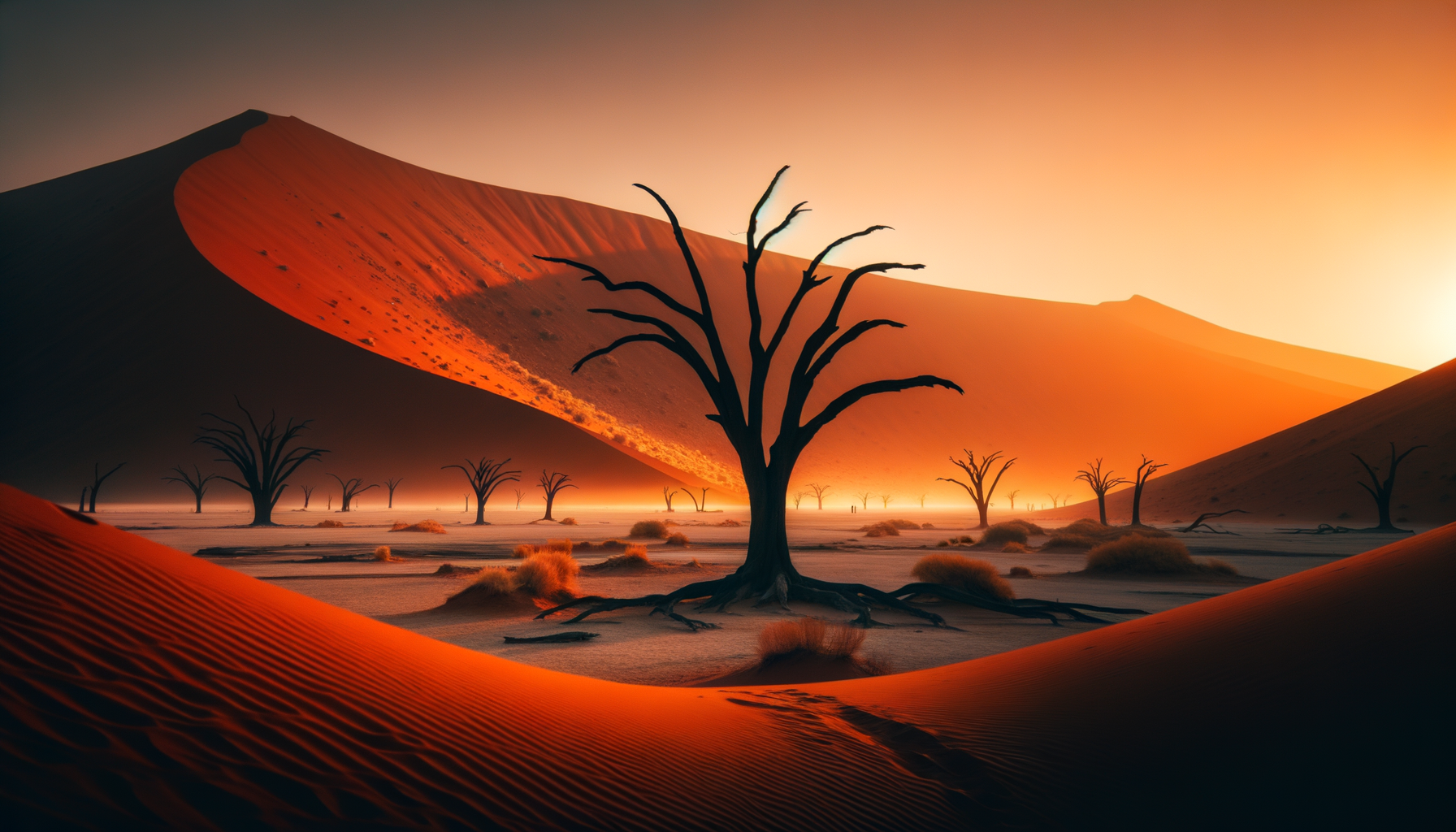
The country is essentially a coastal desert with a highland spine and a wet corner. The Namib runs the full 1,570 km of the Atlantic coast and is, at somewhere between 55 and 80 million years old, the oldest desert on the planet. Inland the ground rises to a central plateau around 1,000–1,700 m where almost everybody lives, and falls again eastward into the Kalahari. Only the far north-east — the Zambezi Region, the old Caprivi Strip — is properly green, with real rivers and real floods.
Where it is
The south-west corner of Africa. Angola to the north across the Kunene and the Okavango, Zambia and Botswana to the east, South Africa to the south across the Orange River, and the cold Atlantic down the entire west side. The Zambezi Region's eastern tip comes within a few hundred metres of Zimbabwe, making it very nearly a four-country meeting point.
How it is governed
A presidential republic, independent since 21 March 1990, governed by SWAPO continuously ever since — one of the longest unbroken single-party runs in Africa, achieved entirely through elections that observers have consistently called credible. Netumbo Nandi-Ndaitwah was inaugurated on 21 March 2025 as the country's first woman president.
Who lives there
Around half the population is Ovambo, concentrated in the wet northern belt where the farmland is. Then Kavango, Herero, Damara, Nama, Caprivian, San, Himba, Tswana, Baster, plus roughly 20,000 German speakers and a substantial Afrikaans-speaking population. Eleven main language groups; English is the official language and almost nobody's first.
The economy
GDP around $13 billion, upper-middle-income on paper and one of the most unequal countries in the world in practice. Diamonds (increasingly mined offshore from ships), uranium (third-largest producer globally), zinc, gold, beef and tourism. Broad unemployment sits around 36% and youth unemployment far above that.
What is coming
Two things that could change the country completely and neither has arrived yet: offshore oil in the Orange Basin, where TotalEnergies' Venus discovery is the largest in sub-Saharan Africa in a decade, and green hydrogen, where the Hyphen project in the old diamond Sperrgebiet is costed at around $10 billion — comparable to the entire current GDP.
Why people come
Landscape first, wildlife second, and — unusually for Africa — the fact that you can do all of it yourself, in a hired vehicle, without a guide. Namibia has the safest roads, the lowest crime and the best signposting on the continent, and that combination is the real product.
🏷️ The Name — South West Africa, and the Desert That Replaced It
Namibia named itself. The word was coined in the 1960s from the Namib desert — namib in Khoekhoegowab meaning roughly "vast place" or "open ground" — and was adopted deliberately because it belonged to no single ethnic group and to no coloniser.
What it was called before
German South West Africa (Deutsch-Südwestafrika) from 1884 to 1915, then simply South West Africa under South African administration until independence. Older Namibians of every background still say "South West" or just "Suidwes", usually without any political charge — it is the name they grew up with.
Who coined Namibia
The name was proposed by the nationalist movement and formalised by the UN General Assembly in 1968, which renamed the territory Namibia by resolution after revoking South Africa's mandate two years earlier. For twenty-two years the country had a UN-recognised name and a South African government simultaneously.
SWAPO
The South West Africa People's Organisation, founded in 1960 out of the Ovamboland People's Organisation. It kept the old territorial name in its own initials and still does, which is why a party that governs Namibia is called after South West Africa.
Windhoek
Afrikaans/Dutch for "windy corner", probably after the Winterhoek mountains in the Cape where the Oorlam leader Jonker Afrikaner came from; the Herero name is Otjomuise, "place of steam", after the hot springs, and the Nama name /Ai//Gams means the same. Three languages, one set of hot springs, no argument.
Walvis Bay
"Whale bay" in Afrikaans, the only deep-water port on the coast, and for four years after independence still South African territory — an enclave inside a sovereign country. It was handed over on 1 March 1994, which is why Namibian independence has two anniversaries.
The Caprivi Strip
The 450 km panhandle reaching east to the Zambezi, named after Leo von Caprivi, the German chancellor who negotiated it in 1890 to give German South West Africa access to the Zambezi and thence, he believed, to the Indian Ocean. Nobody had told him about the Victoria Falls. Namibia renamed it the Zambezi Region in 2013.
🗺️ Geography — Coast, Escarpment, Plateau, Kalahari
Namibia has a simple structure that explains almost everything about where people live and why. A cold sea, a strip of desert, a steep escarpment, a high central plateau, and then a slow fall into sand.
The Benguela Current
The engine of the whole system. A cold northward current off the Atlantic coast chills the air above it, which means the moisture condenses as fog rather than rain — up to 200 foggy days a year at the coast and often under 15 mm of actual rainfall. That fog is why the Namib is a desert, why it has a unique fog-drinking ecology, and why Swakopmund is cold and grey in January while Windhoek is 32 °C.
The Namib
A gravel-and-sand strip 100–160 km wide running the entire coast, between 55 and 80 million years old and therefore the oldest desert on earth. Its southern half is the Namib Sand Sea, a UNESCO World Heritage site since 2013 and the only coastal fog desert with extensive dune fields anywhere.
The escarpment
A near-continuous wall rising from the desert to the plateau, cut by dry river courses — the Kuiseb, Swakop, Ugab, Huab, Hoanib, Hoarusib. These ephemeral rivers flow above ground perhaps a few days a year and underground the rest of the time, and they are the corridors along which desert elephant, lion and rhino move.
The central plateau
1,000–1,700 m, running north–south through Windhoek. Cooler, with 250–400 mm of rain, and the location of nearly all the commercial farmland, all the cities and essentially all the infrastructure. Königstein on the Brandberg massif, at 2,573 m, is the highest point in the country.
The Kalahari
Not a true desert but a vast semi-arid sand basin spilling east into Botswana — red dunes fixed by grass, camelthorn trees, and surprisingly good grazing after rain. The Etosha Pan, a 4,760 km² salt flat that was a lake until the Kunene changed course, sits on its north-western edge.
The wet corner
The Zambezi Region and Kavango in the far north-east get 600–700 mm of rain and have permanent rivers — Okavango, Kwando, Chobe, Zambezi. It is riverine woodland and floodplain, it looks and feels like Botswana or Zambia, and it contains almost everything in Namibia that is green.
🏜️ The Oldest Desert on Earth — How the Namib Works
It is worth understanding the Namib as a system rather than a backdrop, because almost every strange thing in Namibia — the fog beetles, the dune-diving lizards, the shipwrecks, the lichen fields you must not drive on, the elephants that walk 70 km between meals — follows from the same two facts: the sea is cold and the wind comes from the south-west.
Where the sand comes from
Not from the Namib. The sand is Kalahari sand carried to the Atlantic by the Orange River, pushed north up the coast by the Benguela Current and longshore drift, blown inland by the south-westerly, and piled against the escarpment. The dunes are red because the grains have been oxidising for millions of years — the older the sand, the redder it is, which is why the oldest dunes inland are the deepest colour.
The dunes
Star dunes where winds come from several directions, linear dunes where one wind dominates, barchans marching north along the coast at up to 20 m a year. Big Daddy at Sossusvlei is around 325 m, and the tallest in the sand sea are close to 380 m — among the highest dunes anywhere.
Fog as rainfall
The fog beetle (Onymacris unguicularis) climbs a dune crest at dawn, stands on its head, and drinks the water that condenses on its own back. Welwitschia, lichens, geckos, sidewinders and the dune ecosystem generally run on condensation rather than precipitation. This is the only large desert on earth that works this way.
Welwitschia mirabilis
A plant with exactly two leaves, which it grows for its entire life — up to 1,500 years — while the wind shreds them into ribbons. It is a gymnosperm with no close living relatives, a survivor of a plant lineage otherwise gone. The big specimens on the Welwitschia Drive outside Swakopmund were seedlings when the Normans landed in England.
Lichen fields
The gravel plains north of Swakopmund carry lichen communities that take a century to establish and are destroyed instantly by a tyre. Tracks made by military vehicles in the 1970s are still visible from the air. This is the single most-broken rule in Namibia and the reason so many signs say, flatly, do not leave the road.
The Kalahari, for contrast
Sand, but with 250–500 mm of rain, grass, camelthorn and full-size game. Namibians distinguish the two sharply: the Namib is where nothing lives unless it has evolved a trick, the Kalahari is where everything lives but has to walk a long way between drinks.
📜 Before 1884 — San, Bantu Migration, and the Oorlam Wars
Namibia's deep history is long, sparsely documented, and largely written on rock. The written record starts late and starts, characteristically, with a shipwreck.
The San
The San — Ju/'hoansi, !Kung, Hai//om and others — are the oldest continuous population, present for tens of thousands of years. Their genetic lineages are among the deepest in all humanity. The rock art at Twyfelfontein and the White Lady panel on the Brandberg are theirs, some of it more than 6,000 years old.
Khoekhoe and Damara
Nama (Khoekhoe) pastoralists came south with fat-tailed sheep and cattle. The Damara are an anomaly nobody has fully explained — they speak Khoekhoegowab, a click language, but are physically and historically distinct from both San and Nama, and their origin remains genuinely open.
The Bantu arrival
Ovambo and Herero cattle-keeping peoples moved in from the north across the sixteenth and seventeenth centuries — the Ovambo into the well-watered northern floodplain, the Herero onto the central highland grazing. The Himba of Kunene are a Herero group that stayed in the north-west and kept the older way of living.
The Portuguese
Diogo Cão planted a stone cross at Cape Cross in 1486 and Bartolomeu Dias reached Walvis Bay in 1487. Both looked at the coast, concluded there was nothing there, and sailed on. They were, in terms of harbours and fresh water, entirely right, and the coast was left alone for another three hundred years.
The Oorlam and Jonker Afrikaner
In the early nineteenth century Oorlam groups — Khoekhoe-speaking, partly Dutch-speaking, with horses and guns — came north over the Orange River from the Cape. Jonker Afrikaner settled at the hot springs that became Windhoek around 1840 and dominated the centre of the country for two decades through a long war with the Herero over cattle and grazing.
Missionaries and traders
The Rhenish Mission arrived in the 1840s and the Finnish Mission in Ovamboland in 1870. Britain annexed Walvis Bay in 1878 and then declined to take the rest, on the grounds that it was worthless. That decision left the door open, and in 1884 Germany walked through it.
⚱️ 1904–1908 — The First Genocide of the Twentieth Century
This is the part of Namibian history that everything else in the country still refers back to, and it needs to be stated plainly. Between 1904 and 1908 the German colonial army killed something like 80% of the Herero and 50% of the Nama population. It is very widely identified by historians as the first genocide of the twentieth century, and the methods — an explicit extermination order, sealed borders, concentration camps, forced labour, medical experimentation on prisoners, skulls shipped to German universities — prefigure what followed in Europe forty years later with a directness that German historiography spent most of a century avoiding.
How it started
Land and cattle. German settlers took grazing, a credit-and-seizure system stripped Herero herds, and a rinderpest epidemic in 1897 broke what was left. In January 1904 the Herero under Samuel Maharero rose; the Nama under Hendrik Witbooi joined in October.
Waterberg and the order
At the Battle of Waterberg on 11 August 1904, Lothar von Trotha deliberately left the eastern side open and drove the Herero — fighters, women, children and cattle together — into the Omaheke, the waterless Kalahari sandveld. Wells were poisoned or guarded. On 2 October 1904 he issued the Vernichtungsbefehl, the extermination order: every Herero within the German border, armed or not, with or without cattle, would be shot.
Shark Island
Survivors and captured Nama were sent to concentration camps, of which the worst was Shark Island at Lüderitz — a rock in the Atlantic with no shelter from the wind. Mortality ran somewhere between 60% and 80%. Hendrik Witbooi died fighting in 1905; the Nama leader Cornelius Fredericks died on Shark Island. Prisoners' skulls were cleaned, by other prisoners, and shipped to German institutions for racial research.
The numbers
Estimates cluster around 65,000 Herero from a population of roughly 80,000, and 10,000 Nama from around 20,000. Survivors lost their land and cattle by decree, were forbidden to own livestock, and were required to carry passes and work for settlers — the legal architecture that South Africa later inherited and extended.
Germany's long silence
Germany lost the colony in 1915 and the subject with it. A first official apology came from a minister in 2004, a century on. The word "genocide" was not used by the German government until 2015, and the formal acknowledgement came in the Joint Declaration of 2021, with €1.1 billion pledged over 30 years in development projects.
Why it is still not settled
The 2021 declaration is disputed inside Namibia. It was negotiated state-to-state, and many OvaHerero and Nama traditional authorities say they were not properly represented, that development aid is not reparations, and that the sum — roughly €37 million a year, spread across a country of 3 million — is not commensurate. The Namibian parliament has not ratified it, a revised text has been under negotiation for years, and Namibia declared 28 May a national Genocide Remembrance Day, first observed in 2025. It is a live argument, not a closed chapter.
🇿🇦 1915–1988 — South Africa, Apartheid and a War Nobody Watched
South African troops took German South West Africa in 1915 and never really left. What followed was a seventy-five-year occupation conducted under a League of Nations mandate that South Africa refused to give up, an apartheid system imported wholesale, and a bush war that ran for twenty-three years and barely registered outside the region.
The mandate
The League of Nations gave South Africa a Class C mandate in 1920 — administer the territory as an integral part of your own. South Africa took that literally. When the League became the UN, Pretoria simply declined to convert the mandate into a trusteeship, and spent the next forty years in litigation about it.
Apartheid arrives
From 1948 South African racial law was applied in full: pass laws, job reservation, and the Odendaal Plan of 1964, which carved the territory into ten ethnic "homelands" covering about 40% of the land for roughly 90% of the people, with the best farmland and all the mineral wealth in the white "Police Zone".
SWAPO and the armed struggle
SWAPO was founded in 1960. Its armed wing, the People's Liberation Army of Namibia (PLAN), opened fire at Omugulugwombashe on 26 August 1966 — still marked as Heroes' Day. The UN revoked the mandate that same year, renamed the territory Namibia in 1968, and the International Court of Justice declared the occupation illegal in 1971. South Africa stayed.
The Border War
From the mid-1970s the conflict merged into the Angolan civil war: South African forces operating deep into Angola against PLAN and the Angolan army, with Cuban troops on the other side and both Cold War blocs supplying. The Cassinga raid of 4 May 1978 on a camp in Angola killed over 600 people; South Africa called it a PLAN base, SWAPO a refugee camp. It is commemorated annually.
Resolution 435
The UN Security Council adopted Resolution 435 in 1978, setting out a ceasefire, withdrawal and UN-supervised elections. It then sat unimplemented for eleven years while South Africa tied it to Cuban withdrawal from Angola.
Cuito Cuanavale
The 1987–88 battles around Cuito Cuanavale in south-east Angola — the largest conventional engagement in Africa since the Second World War — ended in a stalemate that both sides claim as a victory and that in practice broke the deadlock. The Tripartite Accord of December 1988 traded Cuban withdrawal for Namibian independence.
🕊️ 21 March 1990 — Independence and the Long SWAPO Era
Namibia's transition is one of the genuinely successful decolonisations, and it is worth saying why: the constitution was written before the handover rather than after, it was written by a constituent assembly in which SWAPO did not have a two-thirds majority, and it has not been amended in any way that concentrates power. Thirty-six years later it still holds.
UNTAG and the 1989 election
UNTAG, the UN Transition Assistance Group, supervised the ceasefire, the return of about 43,000 exiles and the election of November 1989. SWAPO took 57% — a clear win, but short of the two thirds needed to write the constitution alone. That shortfall is the reason the constitution is as good as it is.
The constitution
Adopted 9 February 1990, in force at independence. It entrenches a bill of rights, an independent judiciary, a two-term presidential limit, the abolition of the death penalty, and — in Article 95(l) — the maintenance of ecosystems and biological diversity. Namibia was the first country in the world to write environmental protection into its constitution, and that clause is the legal root of the conservancy system.
Sam Nujoma
First president, 1990–2005, three terms after a one-off constitutional amendment made specifically for him — the single significant blemish on the record. Founding father, reconciliation politician, and to the end a large and combative public presence. He died on 8 February 2025, aged 95, and the funeral was a national event on a scale the country had not seen.
Walvis Bay
South Africa kept the only deep-water port, as an enclave, for four more years. It was transferred to Namibia on 1 March 1994. Until that date an independent country's main harbour was foreign territory.
The presidents since
Hifikepunye Pohamba (2005–2015), who won the Mo Ibrahim Prize for African leadership and stepped down on time; Hage Geingob (2015–2024), who died in office on 4 February 2024; Nangolo Mbumba as caretaker; and Netumbo Nandi-Ndaitwah from 21 March 2025.
The 1999 Caprivi secession
The one armed challenge since independence: a small separatist attempt in the Caprivi Strip in August 1999, put down within days, followed by a mass treason trial that ground on for more than a decade and drew sustained criticism over detention conditions and its sheer length.
🗳️ Politics in 2026 — A First Woman President and a Shrinking Majority
SWAPO has won every national election since 1989, but the trend line matters more than the streak. The party took 87% in 2014, 56% in 2019 and 57% in 2024, and its parliamentary majority has come down with it. Namibian politics is now competitive in a way it was not a decade ago.
The 2024 election
Netumbo Nandi-Ndaitwah won the presidency with about 57% against Panduleni Itula of the Independent Patriots for Change on about 26%. Voting was extended by three days in some constituencies after ballot-paper shortages and hours-long queues; the opposition went to court over it and lost. Observers called the result credible while criticising the administration of the poll.
The president
Inaugurated on 21 March 2025, the 35th anniversary of independence, as Namibia's first woman president. A liberation-era figure who spent decades in SWAPO's structures, served as foreign minister and then vice-president, and is widely described as a continuity choice with a reformist manner rather than a reformist programme.
The opposition
IPC, founded by Itula in 2020, is the main force and draws heavily on urban and younger voters. The historic parties — the Popular Democratic Movement (the old DTA) and others — have been squeezed. The generational split is the clearest line in Namibian politics: the liberation credential still works north of about fifty and works less and less below it.
The real issue
Jobs and land. Broad unemployment near 36%, youth unemployment far higher, and one of the world's most unequal income distributions in a country where the commercial farmland remains overwhelmingly in the hands of a small minority. Land reform has proceeded on a willing-buyer, willing-seller basis and has been slow enough to be a permanent political grievance.
Corruption and Fishrot
The Fishrot scandal, broken in 2019 by a WikiLeaks release of documents from the Icelandic fishing firm Samherji, brought down two cabinet ministers over the allocation of horse-mackerel quotas. The trial has been slow. It remains the reference point for every argument about governance, and Namibia's relatively strong showing on press freedom and rule-of-law indices is precisely why it came out at all.
Foreign policy
Non-aligned and consistent about it. Close historical ties to Angola, Cuba, Russia and China from the liberation years; deep economic integration with South Africa (the dollar is pegged 1:1 to the rand and both circulate); growing European interest driven entirely by green hydrogen and critical minerals. Namibia has been notably unwilling to take sides on Ukraine, which its partners find frustrating and which is entirely in character.
👥 Peoples and Languages — Eleven Groups, One Official Language Nobody Grew Up Speaking
Namibia chose English as its sole official language in 1990, at a point when it was the first language of perhaps 3% of the population. The choice was deliberate: Afrikaans was the language of the occupation, German of the colony, and picking any African language would have privileged one group over ten others. The country accepted a generation of awkwardness in exchange for not having that fight.
Ovambo
About half the population, in the well-watered north — Oshiwambo is the most spoken language in the country by a wide margin, in several closely related dialects (Oshindonga, Oshikwanyama). Politically dominant since independence, which is itself a recurring theme in opposition rhetoric.
Herero and Himba
The Herero are cattle people of the central highlands, and their women's dress is one of the most striking sights in Africa: the ohorokova, a full Victorian gown adapted from missionary dress, with the otjikaiva, a horn-shaped headdress representing cattle. It was imposed and then claimed. The Himba of Kunene are a Herero group who kept the older pastoral life, and whose women coat skin and hair in otjize, a paste of butterfat and red ochre.
Damara and Nama
Both speak Khoekhoegowab, a click language, and both are among the oldest populations in the country. The Damara origin question — a click-speaking people who are neither San nor Nama — is one of the genuinely unresolved problems in southern African prehistory.
San
Perhaps 30,000–35,000 people, principally Ju/'hoansi around Tsumkwe in the Nyae Nyae Conservancy, plus Hai//om and !Kung. The most marginalised population in the country by every measure. Nyae Nyae is the one place where a San community holds legal rights over its own land and wildlife, and it is the benchmark against which everything else is judged.
Afrikaans, German and the rest
Afrikaans is the practical lingua franca across the centre and south and the first language of the Baster community of Rehoboth and much of the Coloured population. German survives with around 20,000 speakers, its own newspaper (Allgemeine Zeitung, the oldest in the country) and its own schools. Then Kavango, Lozi in the Zambezi, Tswana, and Portuguese along the Angolan border.
What this means in practice
Almost everyone you deal with speaks three or four languages and will switch mid-sentence. English is universal in tourism, government and signage. A German greeting in Swakopmund or Lüderitz is normal and unremarkable. Afrikaans is what two Namibians who do not share a first language will most often default to outside the north.
💰 The Economy — Diamonds from Ships, Uranium, and Two Enormous Maybes
Namibia is an upper-middle-income country by GDP per head and a deeply poor one for most of the people in it. That gap — one of the widest Gini coefficients recorded anywhere — is the single most important economic fact about the place, and it is a direct inheritance of the land and mineral settlement of the colonial and apartheid periods.
Diamonds at sea
Namibia's diamonds were washed down the Orange River and deposited along the coast and, increasingly, on the seabed. Debmarine Namibia now recovers the majority of national production from ships — the Benguela Gem, commissioned in 2022 at around $470 million, is the most advanced diamond recovery vessel ever built. Namibian stones are unusually high quality because the river journey destroyed the flawed ones.
Uranium
Namibia is consistently among the world's top three uranium producers. Rössing, open since 1976 and now Chinese-controlled, and Husab, one of the largest uranium mines on earth, both sit in the desert east of Swakopmund. Uranium prices drive the entire coastal economy, and the towns visibly boom and empty with them.
Beef
Namibian beef is the quiet success story: strict traceability, foot-and-mouth-free zones fenced off from the north, a duty-free EU quota, and in 2020 Namibia became the first African country cleared to export beef to the United States. The Veterinary Cordon Fence that makes this possible also cuts the country in two and is a long-running grievance in the north, where farmers are on the wrong side of it.
Tourism
Roughly a tenth of the economy and the largest private employer outside agriculture. It collapsed in 2020, took until about 2024 to recover, and is structurally dependent on German, South African and increasingly Czech and Polish self-drive visitors.
Maybe one: oil
TotalEnergies' Venus discovery in the Orange Basin (2022) is the biggest in sub-Saharan Africa in a decade, with Shell's Graff alongside it — though Shell wrote down its stake in January 2025 after concluding its find was not commercially viable, which was a cold shower. First oil, if it comes, is a 2029–2030 proposition. The question everyone in Windhoek asks is whether a country of 3 million can absorb that without becoming a different and worse country.
Maybe two: green hydrogen
Namibia has close to the best combined solar and wind resource on earth and a very long empty coast. The Hyphen Hydrogen Energy project in the former diamond Sperrgebiet is costed around $10 billion — roughly the entire current GDP — and is one of several. It is real money and real memoranda; as of 2026 it is not yet real hydrogen.
🏙️ Windhoek — The Capital in the Middle of Nothing
Windhoek sits at 1,700 m in a bowl of hills in the dead centre of the country, about 450,000 people, and it is where almost every Namibian journey starts and ends. It is clean, orderly, green by Namibian standards, and it will not detain you for more than a day — which is fine, because it does not pretend otherwise.
What to actually see
The Independence Memorial Museum, a North Korean-built tower whose exterior is widely disliked and whose top-floor view and exhibition are both genuinely worth the climb. The Christuskirche (1907), the Lutheran church that appears on every postcard. The Alte Feste, the old German fort. The Namibia Craft Centre in the Old Breweries building, which is the best single place in the country to buy anything.
Independence Avenue
The main street, running the length of the centre, with the colonial-era buildings on one side and the shopping on the other. Walkable in the daytime, busy, and — unusually for an African capital — not chaotic. Post Street Mall has the Gibeon meteorite display: thirty-three iron fragments from the largest known meteorite shower on earth, mounted on poles.
Katutura
The township north-west of the centre, created by the forced removals of 1959–61 when the residents of the Old Location were moved out at gunpoint; eleven people were shot dead resisting on 10 December 1959. The name means, in Otjiherero, "the place where we do not want to live". It is where most of Windhoek actually lives, and a guided visit — to the Single Quarters market in particular, for grilled meat and mopane worms — is worth far more than another colonial facade.
Eating and drinking
Joe's Beerhouse is the famous one — an enormous, chaotic, junk-decorated beer hall serving game in quantity; it is a tourist institution and it is also good. Stellenbosch Wine Bar for South African lists, The Stellenbosch Tasting Room and Leo's at the Castle for something quieter, and any bakery at all for the German pastry, which is genuinely excellent everywhere in this country.
Where it sits logistically
Hosea Kutako International (WDH) is 45 km east of town, a 40-minute drive — budget for it. Eros (ERS), in the suburbs, handles light aircraft and charters. All the major car-hire firms and all the 4x4 rental specialists are here, and this is where you should sort out everything before heading out, because the next real town is a long way away.
Safety
Windhoek is safe by the standards of southern African cities and unsafe by European ones. Normal precautions: don't walk the centre after dark, don't leave anything visible in a parked car, use secure parking. Violent crime against tourists is rare; opportunistic theft is not.
🌊 The Coast — Swakopmund, Walvis Bay and the Skeleton Coast
The Namibian coast is one of the strangest inhabited places on earth: cold, foggy, fishless-looking but actually teeming, with a Bavarian seaside town sitting in the middle of it for no reason anyone can now defend. You will be cold in January. Bring a jacket to the desert.
Swakopmund
A German colonial resort town of about 75,000, founded in 1892 because Walvis Bay was British and Germany needed its own port. Palm-lined streets, a jetty, Jugendstil facades, bakeries, and a permanently grey sky. It is the country's adventure-sport capital — quad biking, sandboarding, skydiving over the dunes, scenic flights — and the place every self-drive itinerary uses to draw breath.
Walvis Bay
30 km south, the working port, and far more interesting naturally than Swakopmund. The lagoon is a Ramsar wetland holding tens of thousands of flamingos. Boat trips out to Pelican Point deliver Cape fur seals, dolphins, occasionally whales, and a pelican that has been trained to land on the boat. Sandwich Harbour, 50 km south, is where the highest dunes meet the sea, reachable only by 4x4 with a guide and tide tables.
Cape Cross
120 km north of Swakopmund: a breeding colony of up to 200,000 Cape fur seals, and a replica of the stone cross Diogo Cão planted in 1486. The smell is genuinely, memorably overwhelming — people who have seen a lot of the world still talk about the Cape Cross smell. Go anyway.
The Skeleton Coast
The northern coast, named for the whale bones and the shipwrecks. The southern section (Ugab to Torra Bay) is open with a permit and drivable; the northern section above the Hoanib is concession-only, fly-in, and expensive. Wrecks you can actually reach include the Zeila near Henties Bay and the Shawnee; the famous Eduard Bohlen, now 400 m inland, sits in the restricted Sperrgebiet south of Walvis Bay.
Lüderitz and Kolmanskop
Far south, and worth the long detour. Lüderitz is a wind-scoured German town of Jugendstil houses on bare rock. Kolmanskop, 10 km inland, is a diamond boom town abandoned in 1956 and now half-buried — sand drifted waist-deep through the ballroom and the hospital. It is the most photographed ghost town in Africa and it earns it. Permit from the Shark Island office or your operator; morning light is the light.
The Sperrgebiet
The Forbidden Zone, closed to the public since 1908 when diamonds were found in the sand, and therefore one of the least-disturbed landscapes on earth. Most of it is now Tsau //Khaeb National Park, still largely inaccessible, and it is where the Hyphen green hydrogen project is proposed — a collision between the best-preserved desert in the country and its biggest industrial plan.
🏜️ Sossusvlei — The Dunes, and How to Do Them Properly
Sossusvlei is the reason most people come to Namibia, and it is the one place in the country where exactly how you organise the day makes the difference between a great morning and a mediocre one. The whole thing turns on the gate times.
The geography
A clay pan at the end of the Tsauchab, which flows perhaps once a decade and has been blocked from the sea by dunes for millennia. Deadvlei, the white pan with the dead camelthorns, is a 1.1 km walk over a dune saddle from the 2x4 car park. Big Daddy (≈325 m) and Dune 45 (≈80 m, at the 45 km mark) are the two most-climbed dunes. Hiddenvlei and Nara Vlei are the ones with nobody on them.
⏰ The gate rule
This is the whole trick. The Sesriem outer gate opens at sunrise and closes at sunset. The inner gate, for people camping or staying inside the park at Sesriem Campsite, Sossus Dune Lodge or the NWR properties, opens one hour earlier. That hour is the difference between being on Dune 45 for the sunrise and arriving after it. Stay inside the gate if you possibly can.
The drive
60 km of tar from Sesriem to the 2x4 car park, then 5 km of deep soft sand to Sossusvlei itself. Do not attempt that last 5 km in a 2x4 — people get stuck every single day, and the recovery costs more than the shuttle. A 4x4 shuttle runs from the car park for a small fee, and taking it is not a defeat.
Climbing
Big Daddy takes 1–1.5 hours up the ridge in soft sand and about four minutes to run down the face into Deadvlei, which is the single best thing you will do in Namibia. Do it before 9 a.m. — after that the sand is too hot and the wind picks up. Carry two litres of water per person, minimum, and mean it.
Sesriem Canyon
A 30 m deep, 1 km long slot the Tsauchab has cut through conglomerate, 4 km from the gate. Named for the six (ses) ox-hide thongs (riem) early travellers needed to tie together to lower a bucket to the water. It takes an hour and it is the perfect thing to do in the flat light of the middle of the day.
Where to stay
Inside the gate: Sesriem Campsite and Sossus Dune Lodge — book months ahead. Outside: a whole range from the very grand (Little Kulala, &Beyond Sossusvlei) through the middle (Desert Quiver Camp, Sossusvlei Lodge) to campsites at Solitaire and Betta. Solitaire, an hour north, is a petrol pump, a bakery and a field of wrecked cars, and its apple pie is a national institution.
🐘 Etosha — Wildlife Around a Salt Pan the Size of a Country
Etosha National Park is 22,270 km² built around a 4,760 km² salt pan so large and so flat that it is visible from space and, in a good year, fills with just enough water to draw flamingos out of nowhere. It is one of the easiest big parks in Africa to self-drive and one of the most reliable for sightings, for a specific reason: in the dry season the animals have to come to the waterholes, and the waterholes have car parks.
The pan
A relic of a lake fed by the Kunene before the river changed course perhaps 16,000 years ago. Now a white, cracked, shimmering nothing for most of the year, then briefly a shallow lake after heavy rain — which is when the flamingos and pelicans appear, in tens of thousands, having flown from who knows where. Etosha means roughly "great white place" in Oshindonga.
What is in it
Elephant, lion, leopard, black and white rhino, giraffe, zebra, springbok, oryx, kudu, eland, wildebeest, cheetah, spotted and brown hyena, and the endemic black-faced impala and Damara dik-dik. No buffalo and no hippo — the veterinary fence and the absence of permanent water rule them out. So Etosha gives you four of the big five and is honest about it.
🔎 The floodlit waterholes
The thing that makes Etosha special. Okaukuejo, Halali and Namutoni each have a waterhole floodlit all night, with seating, a few metres from your room. Okaukuejo's is the most famous in Africa for black rhino, which come in after dark, often several at a time, often with lion and elephant waiting their turn. Sitting there at 11 p.m. in silence is worth the whole trip.
The camps
West to east: Dolomite (remote, western section), Olifantsrus (camping only, superb hide), Okaukuejo (the rhino waterhole, busiest), Halali (quietest of the three, good leopard), Namutoni (a white German fort of 1903), Onkoshi (on the pan edge, upmarket). All state-run by NWR and all requiring booking well ahead in high season.
Gates and rules
Gates are Anderson (Okaukuejo, south), Von Lindequist (Namutoni, east), King Nehale (north) and Galton (west). Sunrise to sunset only; being outside camp after the gate closes brings a fine and, deservedly, a lecture. Never get out of the vehicle except at marked points. Roads are gravel and fine for a 2x4 sedan in the dry season, which is part of why Etosha is so accessible.
When
Dry season, roughly June to October, and specifically August–October, when the last natural water has gone and everything is forced to the pumped waterholes. The wet season, January to March, is green and beautiful with newborn animals everywhere and much harder game viewing, because the animals no longer need you or your waterhole.
🗿 Damaraland — Rock Art, Desert Elephant and the Brandberg
The north-west — Damaraland, officially now part of the Kunene Region — is the most visually extraordinary part of the country and the part where the conservancy model is most visible on the ground. Red rock, black basalt, white river sand, almost no fences, and animals that live here without a national park to do it in.
Twyfelfontein
Namibia's first UNESCO World Heritage site (2007): more than 2,000 rock engravings on sandstone slabs, some over 6,000 years old, made by San hunter-gatherers. The famous panels are the Lion Man and the Dancing Kudu. Guided visit only, an hour on foot, and the guides — drawn from the local conservancy — are generally excellent. The name is Afrikaans for "doubtful spring".
The Brandberg
A granite massif rising abruptly off the plain to Königstein, 2,573 m, the highest point in Namibia. In the Tsisab Ravine is the White Lady panel, painted perhaps 2,000 years ago — identified in 1918 by Reinhard Maack, then famously misread by Abbé Breuil as a Mediterranean woman, which it is not: the consensus now is that it is a male San shaman. A three-hour return hike in serious heat with a compulsory guide.
Desert-adapted elephant
Elephants that are not a separate species but have learned to live in a landscape that should not support them — walking up to 70 km between water, digging wells in dry riverbeds, eating less destructively than their savanna cousins, and moving along the Huab, Ugab, Hoanib and Hoarusib. Perhaps 150–200 of them. Seeing one is not guaranteed and is entirely the point.
Black rhino
The Kunene holds the largest free-roaming black rhino population in the world — not in a fenced park, just living out there. Save the Rhino Trust and the conservancy rhino rangers are the reason. Tracking on foot with them, from Desert Rhino Camp or a conservancy operator, is one of the great wildlife experiences anywhere and the money goes exactly where it should.
The other rocks
Spitzkoppe, the "Matterhorn of Namibia", a 1,728 m granite inselberg with a natural rock arch and world-class bouldering, with a community campsite at its foot and some of the darkest night skies on earth. The Petrified Forest near Khorixas: fossilised trunks up to 280 million years old, washed down in a glacial flood. The Organ Pipes and Burnt Mountain nearby, both quick stops and both odd.
The Himba
Kunene is Himba country. Village visits are a real and significant part of the local economy, and they range from genuinely reciprocal to straightforwardly extractive. Go through a conservancy or a lodge that names the community it works with, ask before photographing, pay the agreed fee rather than handing out sweets, and accept that a visit arranged in five minutes at the roadside is the bad kind.
🐊 The Zambezi Region — The Green Corner
The Zambezi Region — the old Caprivi Strip, 450 km of panhandle reaching east between Angola, Botswana, Zambia and very nearly Zimbabwe — is a completely different country. Rivers, floodplain, papyrus, mopane woodland, 600–700 mm of rain, and hippos. It confuses people who arrive expecting more desert.
Why it exists
Leo von Caprivi traded Zanzibar and Heligoland with Britain in 1890 for a corridor to the Zambezi, intending German South West Africa to reach the Indian Ocean by river. Nobody in Berlin had accounted for the Victoria Falls, 65 km downstream, which make the route useless. It is the most consequential geographical mistake in African colonial history and it is still on the map.
Bwabwata
A 6,100 km² national park along the strip, unusual in that people live inside it — around 5,500 residents with recognised rights, managed jointly with the park. The Kwando and Horseshoe areas hold elephant in large numbers, plus buffalo, hippo, crocodile, sable and roan. It is a key link in the KAZA transfrontier conservation area, the largest in the world at 520,000 km².
Mudumu and Nkasa Rupara
Mudumu on the Kwando, and Nkasa Rupara (Mamili) — Namibia's largest wetland park, which in a big flood becomes an island system reachable only by 4x4 and sometimes not at all. Nkasa Rupara is the closest thing Namibia has to the Okavango Delta, and it is almost empty of visitors.
Where it goes
The Zambezi Region is the natural land route to Victoria Falls, Chobe and the Okavango. Katima Mulilo to Victoria Falls is a few hours; Ngoma bridge puts you into Chobe. A great many Namibian itineraries end here and fly home from Livingstone or Kasane, and that is a sensible plan.
Malaria
This is the one part of Namibia where malaria is a serious, year-round-in-the-wet-season risk. The whole northern belt — Zambezi, Kavango, northern Kunene, Ovamboland — is a transmission area, worst November to May. Prophylaxis is the norm here and is not needed at all in the centre and south. See Practical.
Getting there
The B8 from Rundu to Katima Mulilo is tarred the whole way and easy. The distances are the issue: Windhoek to Katima Mulilo is about 1,200 km. Most people either fly to Katima or build the Zambezi into a longer loop that exits into Botswana or Zambia rather than doubling back.
🐯 Wildlife — What Actually Lives in a Country This Dry
Namibia's wildlife story is not "lots of animals" — it is "animals doing things they should not be able to do". Almost everything interesting here is about adaptation to an absence of water, and almost all of it happens outside the national parks.
Cheetah
Namibia holds the largest cheetah population in the world, somewhere around 1,500 animals, and the great majority of them live on commercial farmland, not in parks. The Cheetah Conservation Fund at Otjiwarongo is the reason there are still that many: its Anatolian shepherd livestock guarding dog programme cut farmer killings dramatically by removing the reason to shoot them. It is one of the genuinely great conservation stories and the centre is open to visitors.
Black rhino
The Kunene population is the largest free-roaming, unfenced black rhino population anywhere on earth. Poaching pressure is real and the numbers are not published precisely, for obvious reasons. Tracking them on foot with Save the Rhino Trust rangers is possible and expensive and the cost is the conservation model working as designed.
Desert lion
Perhaps 150–200 lions living along the Skeleton Coast and the Kunene riverbeds, hunting oryx, giraffe and — famously — Cape fur seals on the beach, which no other lions on earth do. The population crashed to about 20 animals in the 1990s and recovered. Conflict with livestock farmers is the permanent constraint on how many there can be.
Oryx
The gemsbok is the national animal and on the coat of arms, and it is a genuinely remarkable machine: it can let its body temperature rise to 45 °C while cooling the blood to its brain through a nasal heat exchanger, and it can go effectively without drinking, extracting what it needs from tsamma melons and night-moistened grass. You will see them standing on dune crests looking like they own the place, which they do.
Seals, and the Atlantic
Cape fur seals in vast numbers at Cape Cross and Pelican Point — the Benguela upwelling makes this one of the most productive fisheries on earth. Heaviside's dolphin is endemic to this coast. Whales pass through, and the Walvis Bay lagoon holds tens of thousands of lesser and greater flamingos.
The small strange things
Peringuey's adder, which sidewinders across dune faces and buries itself with only its eyes out. The Namaqua chameleon, which turns black in the morning to warm up and white at midday to survive. The web-footed gecko, which licks the dew off its own eyeballs. The golden mole, which swims through sand. None of these are in the brochures and all of them are better than the brochures.
🤝 The Conservancies — Namibia's Real Export
If Namibia has given the world one idea, it is this one. The constitution put conservation into law in 1990; the 1996 Nature Conservation Amendment Act then did the thing that actually mattered — it gave rural communities legal rights over the wildlife on their land, including the right to earn from it. Before that, wildlife belonged to the state and was therefore, to a farmer, purely a cost.
The scale
There are now around 86 registered communal conservancies covering roughly 20% of Namibia — an area larger than many European countries — involving something like 230,000 people. Combined with national parks and freehold conservancies, well over 40% of the country is under some form of conservation management. Very few countries anywhere come close.
What changed
Game numbers went up, in some cases dramatically, across exactly the period when they were falling almost everywhere else in Africa. Desert elephant, black rhino, lion and oryx all recovered in the north-west. The mechanism is unsentimental: an animal that generates income from a lodge lease or a photographic concession is an asset, and assets get protected by the people living next to them.
How the money works
Conservancies earn from joint-venture lodges (a community-owned concession leased to an operator), campsites, craft sales, tourism employment and — the uncomfortable part — trophy hunting concessions. Hunting revenue is a minority of the total but is disproportionately important in the conservancies too remote for tourism, and it is meat as well as money.
The uncomfortable part, stated plainly
Many visitors object to hunting on principle. The Namibian counter-argument is specific and worth hearing: a conservancy that cannot earn from wildlife will convert to livestock, the wildlife will go, and the argument will be over. Whether a photographic-only model could replace that income everywhere is a genuinely open question and the honest answer, in the driest and remotest conservancies, is probably not yet.
Where it has struggled
Drought — the 2019 and 2024 droughts were brutal — plus human-wildlife conflict (an elephant in a maize field is not an asset to the person whose maize it is), Covid, which removed tourism income overnight and exposed how dependent the model is on it, and governance quality that varies enormously from one conservancy to the next.
How to support it as a visitor
Stay in community joint-venture lodges — Damaraland Camp, Grootberg Lodge, Doro !Nawas, Hoanib Valley and others all run on conservancy leases. Use conservancy campsites. Pay conservancy entry fees without arguing about them. Hire local guides. The system is not charity; it is a functioning market, and your booking is the demand side of it.
🍽️ Cuisine — German Bakeries, Braai Smoke and Mahangu Porridge
Namibian food is three cuisines that have never fully merged. There is the German colonial layer — bread, sausage, cake, beer, and a level of butchery competence that is genuinely surprising in a country this size. There is the Afrikaans–southern African layer — braai, biltong, potjiekos, boerewors. And there is the indigenous layer — mahangu porridge, wild spinach, sour milk, mopane worms — which most visitors never eat because it is not on the lodge menu.
🍖 Game
Oryx, kudu, springbok, eland, zebra, warthog and ostrich are on every menu and are cheap, lean and excellent. Oryx is the benchmark — firm, mildly gamey, best rare. Namibian game is genuinely farmed and hunted at scale rather than imported, which is why a kudu fillet in Windhoek costs less than a beef one in Prague.
🔥 Braai
Not barbecue, and Namibians will correct you. Wood (not charcoal), boerewors in a coil, lamb chops, steak, and a potjie on the side. It is the default social event of the entire country across every community, and being invited to one is the single best thing that can happen to you here.
🍞 German bread
The colonial legacy that everyone quietly benefits from. Real rye, real Brötchen, Schwarzbrot, and Apfelstrudel and Bienenstich in every bakery from Windhoek to a petrol station in the middle of the Namib. The Solitaire apple pie, at a fuel stop on the C14 with a field of rusting cars outside, is a genuine national institution.
🌾 Oshifima and the north
Oshifima (also oshithima, or pap more broadly) is stiff mahangu — pearl millet — porridge, cooked until it pulls away from the pot, shaped into a dome, and eaten with the right hand by pinching off a piece and using it to scoop stew or ombidi (wild spinach). This is the actual staple food of half the population and almost no tourist eats it. Ask in Katutura.
🐛 Mopane worms and kapana
Omagungu — mopane caterpillars, dried or fried, high in protein and genuinely good — and kapana, thin strips of beef grilled over open fire at the market and served with chilli, salt and a piece of bread, bought by the handful. The Single Quarters market in Katutura is the place, it costs almost nothing, and it is far more interesting than any lodge buffet.
🐟 From the Atlantic
The Benguela makes this one of the richest fisheries on earth. Walvis Bay oysters grow fast in the cold nutrient-rich water and are excellent and cheap. Kingklip, kabeljou, snoek and hake; and on the rocks near Lüderitz, rock lobster. A dozen oysters and a Windhoek Lager on the Swakopmund jetty is the correct lunch.
🍳 Three Namibian Recipes
🍲 Potjiekos
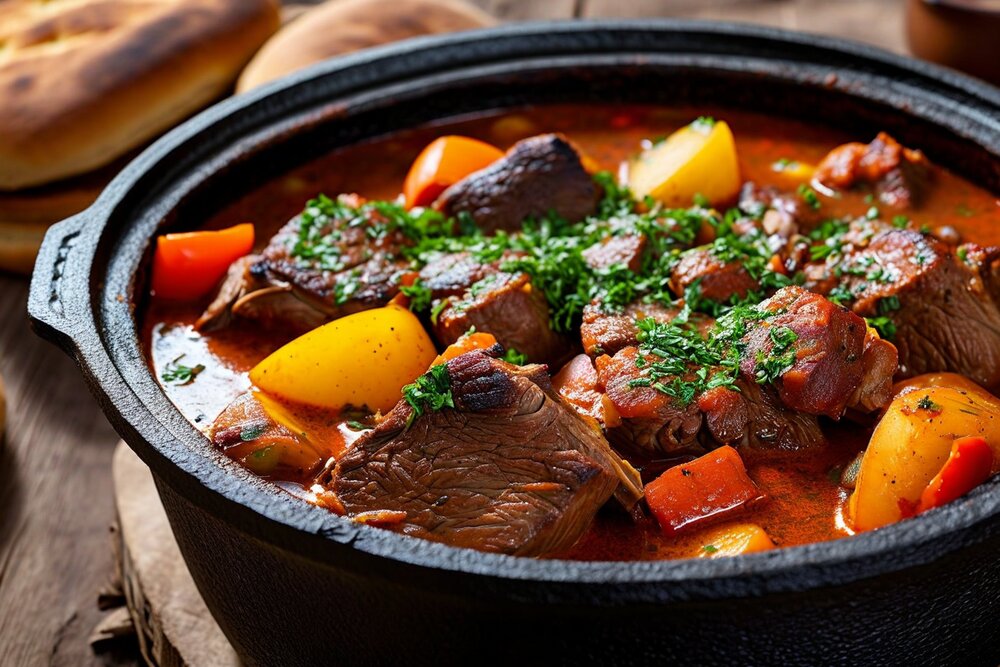
Layered three-legged-pot stew · serves 4 · 3 hours, almost all of it unattended
Ingredients: 400 g lamb or beef, cubed · 2 tbsp vegetable oil · 1 large onion, sliced · 2 cloves garlic, minced · 2 medium potatoes, cubed · 2 carrots, chunked · 1 cup butternut squash, cubed · 100 g green beans · 250 ml beef stock · 125 ml red wine (optional) · 1 tsp salt · ½ tsp black pepper · fresh thyme and rosemary · crusty bread to serve.
Method: Heat the oil in a heavy pot — ideally a cast-iron potjie over coals — over medium-high heat. Season the meat and brown it in batches, then remove. Soften the onion and garlic, then return the meat to the bottom of the pot. Now layer the vegetables on top and do not mix them: potatoes first, then carrots, then squash, beans last. Pour the stock and wine down the side of the pot so the layers are not disturbed. Herbs on top. Cover tightly and cook over low coals, or in a 160 °C oven, for 2–3 hours. Do not stir. Do not lift the lid. It is done when the meat falls apart and the vegetables are tender; the layers will have melded at the edges and stayed distinct in the middle. Serve straight from the pot with bread for the sauce.
💡 The cardinal rule of potjiekos is never to stir. The steam does the work, so the lid must fit tightly — and every time you lift it to look, you add twenty minutes.
🥩 Oryx Steaks with Red Wine Sauce
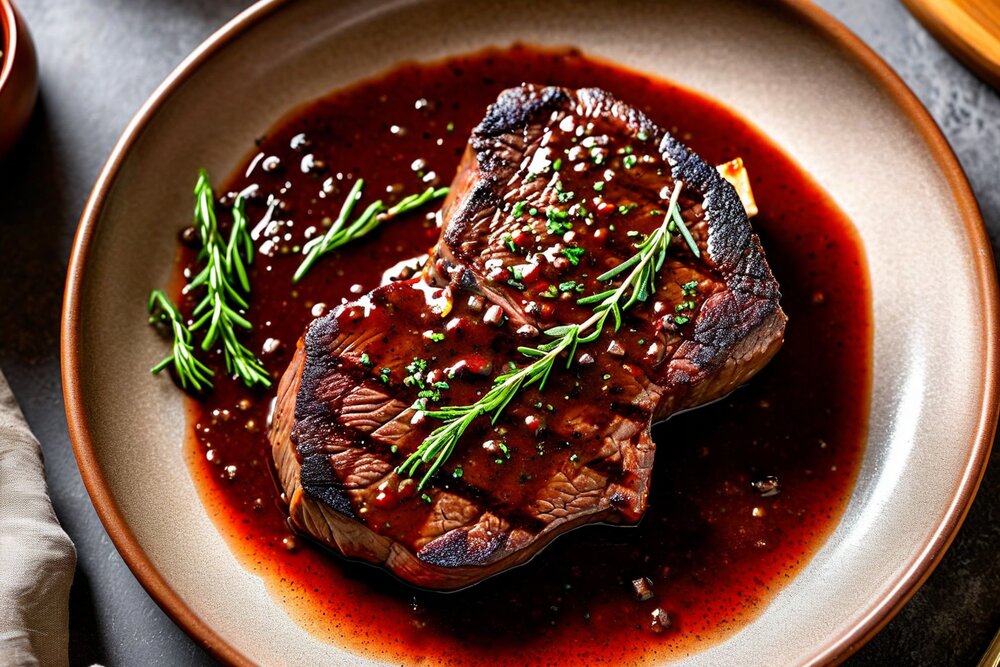
Namibian game, pan-seared · serves 2 · 30 minutes plus resting
Ingredients: 400 g oryx steaks (any lean venison works) · 2 tbsp olive oil · 30 g butter · 2 shallots, minced · 200 ml red wine · 100 ml beef stock · 1 tsp salt · ½ tsp black pepper · fresh rosemary and thyme · 2 cloves garlic, crushed.
Method: Bring the steaks to room temperature for 30 minutes and season generously on both sides. Heat the oil in a heavy skillet over high heat until it is genuinely smoking. Sear the steaks 2–3 minutes a side for medium-rare. Add half the butter with the garlic and herbs and baste the steaks in the foaming butter for a minute, then move them to a warm plate and rest for 5 minutes. Drop the heat to medium, soften the shallots in the same pan, pour in the wine and scrape up everything stuck to the base. Reduce by half, add the stock, and simmer until the sauce coats a spoon. Whisk in the rest of the butter off the heat. Slice the meat against the grain and spoon the sauce over.
💡 Game is very lean and has almost no fat to protect it, so it goes from rare to ruined in about ninety seconds. Rare to medium-rare, and always rest it.
🌾 Oshifima with Oshikundu
Mahangu porridge with fermented millet drink · serves 4 · 30 minutes, plus 1–2 days for the drink
Ingredients: Oshifima: 200 g mahangu (pearl millet) flour · 500 ml water · ½ tsp salt. Oshikundu: 100 g millet flour · 1 litre water · 50 g sugar (optional). To serve: a meat or vegetable stew, or ombidi wild spinach.
Method: Oshikundu first, because it needs time. Mix the millet flour into warm water and leave it somewhere warm for 1–2 days until it smells sour and works up a few bubbles. Strain, sweeten if you like, and chill. For the oshifima: bring the water to a boil with the salt. Slake 50 g of the flour in 100 ml cold water and stir that paste into the boiling water. Now add the rest of the flour gradually, stirring hard with a wooden spoon throughout — this is 15–20 minutes of real work and there is no shortcut. It is ready when it is very stiff and pulls cleanly away from the side of the pot. Wet your hands and form it into a smooth dome on a plate. Eat with the right hand, pinching off pieces and using them to scoop up the stew, and drink cold oshikundu with it.
💡 Mahangu has a distinct nutty, slightly bitter flavour that ordinary millet flour only approximates — it is worth finding at an African grocer. And if your porridge is soft enough to eat with a spoon, you have not stirred it long enough.
🍺 Beer, and Why There Is Almost No Wine
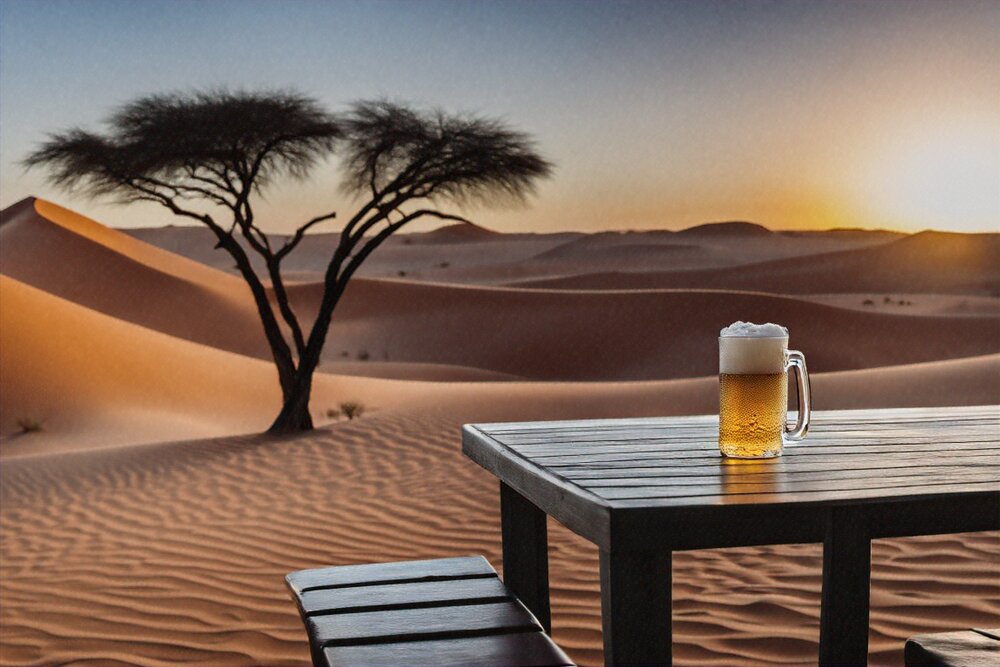
Namibia has no significant wine industry, and there is no mystery about why: it is too hot and far too dry almost everywhere, and where it is cool enough there is no water. What it has instead is one of the best lagers in Africa, made to a German purity law in a desert, and that turns out to be the right answer.
Windhoek Lager
Brewed by Namibia Breweries since 1920 to the German Reinheitsgebot — water, malted barley, hops, yeast, nothing else. It is a clean, dry, properly bitter lager and it is a real source of national pride, sold across southern Africa and into Europe. Tafel and Hansa Draught complete the range; Windhoek Draught is what most Namibians actually order.
The wine, such as it is
Kristall Kellerei near Omaruru, at about 1,200 m, runs a small experimental vineyard producing tiny quantities of wine and, more successfully, grape and prickly-pear schnapps. Output is negligible and essentially for visitors. It is a curiosity, not an industry, and the estate is honest about that.
What you actually drink
South African wine, and very good it is too — Stellenbosch is a thousand kilometres south, which by Namibian standards is next door, and lodge wine lists are consistently better than the price suggests. Expect Chenin, Pinotage, Cape Bordeaux blends and excellent Méthode Cap Classique sparkling.
Oshikundu
The northern staple drink: fermented mahangu, lightly sour, barely alcoholic, cloudy, and drunk by the litre in Ovamboland. It is a food as much as a drink. Tombo and omalodu are the stronger home-brewed relatives, and ombike is the distilled one, made from marula, palm or berries — potent, informal and variable.
Amarula and the rest
Amarula, the cream liqueur from marula fruit, is South African but marula trees are everywhere here and the elephants get to the windfalls first. Also universal: rooibos, which is caffeine-free and drunk all day, and Rock Shandy (soda water, lemonade, Angostura), which is what you order at two in the afternoon when it is 38 °C and you are driving.
🚫 Drinking and driving
Namibia's roads are the single biggest risk to a visitor, and alcohol is a large part of why. The limit is 0.05%, enforcement is patchy, and rural driving after dark is already dangerous without it. The sundowner is at sunset, at camp, with the car parked for the night. That is not a rule invented by a guidebook; it is how Namibians organise their own evenings, for good reason.
🌡️ Climate & When to Go
Namibia is in the southern hemisphere, so the seasons are inverted, and it is arid almost everywhere, so "rainy season" means something much milder than it does in the tropics. The practical calendar has two halves and the choice between them is a real trade-off rather than a right answer.
✅ May–October — the dry season
The main season and the one most people should take. Clear skies, effectively no rain, cool nights, and — the point — game concentrated at waterholes because there is nothing else to drink. August to October is the peak for Etosha. Days 25–30 °C on the plateau, and it is the only window in which the Fish River Canyon hike is open at all.
❄️ The cold nobody expects
June and July nights in the desert go to freezing and below. Sesriem, Sossusvlei, the Kalahari and the Fish River Canyon regularly drop to −5 °C before dawn. People arrive for "Africa" with a fleece and spend the night in the car with the heater on. If you are camping in midwinter, bring a proper sleeping bag.
November–April — the green season
Hot: 35–40 °C inland, with thunderstorms in the afternoon rather than all-day rain. The country turns green, the Etosha pan can flood and fill with flamingos, the antelope drop their young and the predators follow. Game viewing is much harder because the animals have water everywhere. Prices drop, lodges empty out, and photographers who want dramatic skies come now on purpose.
The coast, always
Swakopmund and Walvis Bay are cold and foggy nearly year round, because of the Benguela Current. Fifteen degrees and grey in January, while Windhoek four hours inland is 33 °C and cloudless. Every visitor packs wrong for this exactly once. Bring a warm jacket to the desert.
Drought
Namibia's real climate story. The 2019 and 2024 droughts were the worst in a century; in 2024 an El Niño failure of the rains put well over a million people on food relief and the government controversially culled game, including elephant and hippo, to distribute meat. If you travel in a drought year the landscape is harsher, the game is more concentrated and the conversations are different.
The flood side
The other half of the same variability: the northern rivers flood, the Zambezi and Kavango regions go partly under water between March and May, Nkasa Rupara can become unreachable, and the Etosha pan can hold water into June. A Zambezi itinerary needs checking against the current flood state in a way a Sossusvlei one never does.
✈️ Getting There
Hosea Kutako (WDH)
The international airport, 45 km east of Windhoek — allow 40 minutes and note that the road has warthogs on it. It is small, calm and efficient. Walvis Bay (WVB) takes some regional traffic and is a sensible entry if you are starting on the coast.
From Europe
The one long-standing direct link is Frankfurt–Windhoek, operated by Lufthansa's Discover Airlines, around 10 hours overnight. Otherwise you connect: Johannesburg (Airlink and South African, many daily, the busiest route by far), Addis Ababa (Ethiopian), Doha or Dubai to Johannesburg and on, or Cape Town (Airlink, Westair).
From within Africa
Johannesburg and Cape Town are the workhorses. Airlink also flies to Maun and Victoria Falls, which is what makes a one-way Namibia–Botswana–Zimbabwe itinerary practical. FlyNamibia and Westair run the domestic network — Ondangwa, Katima Mulilo, Lüderitz, Oranjemund.
🛂 Visas — read this, it changed
Namibia was visa-free for most of Europe for decades. Since 1 April 2025 that has ended for countries that do not offer Namibians reciprocal visa-free entry — which includes most EU states, the UK and others. Those nationals now get a visa on arrival, payable at the airport, currently around N$1,200 per person. It is a formality rather than an obstacle, but it is cash or card at a desk and it surprises people who checked an old guidebook.
Overland
Border posts are straightforward and mostly quiet. Noordoewer and Ariamsvlei to South Africa, Buitepos to Botswana on the Trans-Kalahari, Ngoma and Mohembo to Botswana in the north-east, Katima Mulilo/Wenela to Zambia, Oshikango to Angola. A hire car needs a written cross-border letter from the rental company plus the cross-border charge — arrange this when you book, not at the barrier.
The Desert Express
Namibia's passenger rail is essentially a heritage and freight operation and is not a practical way to travel. Long-distance Intercape coaches connect Windhoek to Cape Town, Johannesburg and Victoria Falls, and combis run everywhere locally. But this is a country built for driving yourself, and almost everyone does.
🚗 Self-Drive — The Most Important Section on This Page
Namibia is the best self-drive country in Africa, and the thing most likely to hurt you in Namibia is the driving. Those two statements are not in tension: the roads are empty, well signed and easy, which is exactly why people drive them too fast. Single-vehicle rollovers on gravel are the leading cause of tourist death and serious injury in this country, by a wide margin, and almost every one of them is avoidable.
🚨 The gravel rule
80 km/h. Not 100. Not "just this straight bit". Gravel behaves like a fluid: the tyres float on a loose top layer, and a steering correction at 100 that would be nothing on tar puts you into a slide you cannot recover in a high-sided 4x4. The legal limit is 120 on open road and it is far too high for C and D roads. Locals drive 80. Drive 80.
Road classes
B roads are tarred and excellent. C roads are the main gravel network — wide, graded, generally good. D roads are minor gravel and vary from fine to genuinely rough. The salt roads on the coast (C34 to Henties Bay) are compacted salt and are treacherously slippery in fog or drizzle, which is most mornings.
Tyres
You will get a puncture. Not might. Two spares is the standard local recommendation for gravel routes and every rental company will quote for it. Check the pressures, carry a compressor and a plug kit, know how to use the jack before you need it, and drop the pressure a little on soft sand. Tyre damage is the single most common claim on a Namibian rental.
🦌 Never drive at night
Between dusk and dawn, kudu, oryx, warthog and cattle come onto warm gravel roads, and a full-grown kudu through a windscreen at speed is fatal. The roads are unlit and unfenced. Plan every day to arrive before sunset — this is the single constraint that should shape your entire itinerary.
Fuel, water, distance
Fill up at every station, not when you are low — the gap between pumps can be 250 km or more, and remote ones run dry. Carry 5 litres of water per person minimum. Mobile coverage is nonexistent over large areas; a satellite messenger or a rented sat phone is a sensible buy for remote routes. If you break down, stay with the vehicle — it is shade, it is visible from the air, and someone will come along.
2x4 or 4x4?
An ordinary sedan handles Etosha, Windhoek, Swakopmund, the B roads and most C roads in the dry season perfectly well and costs far less. You need a high-clearance 4x4 for the last 5 km into Sossusvlei, for Sandwich Harbour, for Kaokoland and Van Zyl's Pass (which is expedition territory, not tourism), and for the Zambezi in the wet. A 4x4 with a roof tent is the classic way to do this country and is worth every cent if you are camping.
Everything else: drive on the left (a British/South African inheritance), carry your licence and an international permit, seatbelts are compulsory, and the police roadblocks you will meet are routine, polite and interested in your licence and your plate, not your money.
📋 Practical Information
💰 Money
The Namibian dollar (NAD), pegged 1:1 to the South African rand. The rand is legal tender everywhere in Namibia; the Namibian dollar is not accepted in South Africa, so spend or change it before you leave. Cards work in towns, lodges and fuel stations; carry cash for conservancy fees, roadside stalls, campsites and tips. ATMs in every town of any size and none at all between them.
📱 Connectivity
MTC and TN Mobile cover the towns and the main roads with 4G. Coverage disappears entirely across large parts of the Namib, Kaokoland and the Kalahari — not patchy, absent. Buy a local SIM at the airport, download offline maps before you leave Windhoek, and consider a satellite messenger for remote routes.
⚕️ Health
Malaria in the north only — Zambezi, Kavango, Ovamboland, northern Kunene and northern Etosha — worst November to May; prophylaxis recommended there, unnecessary in the centre and south. No yellow fever requirement unless you are arriving from an endemic country. Tap water is safe in towns. The sun is the real hazard: high altitude, no cloud, and dehydration creeps up on you in a vehicle. Medical care is good in Windhoek and Swakopmund and thin everywhere else — insurance with air evacuation is not optional here.
🛡️ Safety
Namibia is among the safest countries in Africa for visitors. Violent crime against tourists is rare; opportunistic theft in Windhoek and Swakopmund is the realistic risk. Standard precautions: nothing visible in the car, secure parking, no walking city centres after dark. The genuine dangers here are the road, the sun and the water you did not bring, in that order.
🔌 Practicalities
220–240 V, and the plug is the large three-round-pin South African Type M — a European adapter will not fit and lodges do not always have one to lend. Buy the adapter before you come. Time is UTC+2 year round (the winter-time experiment was abandoned in 2017). Tipping: 10% in restaurants, N$50–100 a day for a guide, and something for the car guards who watch your vehicle in town.
📸 Etiquette
Ask before photographing people, always, and especially Himba and Herero women — they are photographed constantly and often without a word. Pay the agreed village fee rather than handing out sweets or money to children, which entrenches begging. Do not leave the road on the gravel plains: the lichen you drive over takes a century to come back and your tracks will outlive you.
💵 What It Actually Costs
Namibia is mid-priced by African safari standards and genuinely good value if you drive and camp — and eye-watering if you fly between lodges. The gap between the two ends is larger here than almost anywhere. Figures are approximate for 2026 at roughly N$18 to the euro.
| Item | NAD | EUR |
|---|---|---|
| Windhoek Lager, 500 ml, bar | 30–50 | €1.70–2.80 |
| Kapana at the market, a handful | 20–40 | €1–2 |
| Oryx steak, good restaurant | 180–300 | €10–17 |
| Campsite, per pitch per night | 250–500 | €14–28 |
| Guesthouse / mid-range lodge, double | 1 200–2 500 | €65–140 |
| High-end lodge, per person all-in | 6 000–16 000 | €330–900 |
| 2x4 sedan hire, per day | 600–900 | €33–50 |
| 4x4 with roof tent + kit, per day | 1 500–2 800 | €85–155 |
| Diesel, per litre | 21–24 | €1.15–1.35 |
| Park entry, per person per day | 150 | €8 |
| Visa on arrival (most EU nationals) | 1 200 | €67 |
Camping self-drive
€90–130 per person per day all in, with a shared 4x4, camping, self-catering and park fees. This is the classic Namibian trip and it is outstanding value for what you see.
Mid-range lodges
€150–250 per person per day — guesthouses and lodges, hire car, eating out. The most common way visitors actually do it and the sweet spot for most people.
Fly-in luxury
€600–1,200 per person per day for the concession camps in Kaokoland, the Skeleton Coast and private Sossusvlei reserves, with light-aircraft transfers. Extraordinary, and a different holiday entirely.
The hidden costs that catch people out: the cross-border letter and fee if you are leaving the country in a hire car; tyre and windscreen excess waivers, which on gravel are worth buying; the one-way drop fee if you fly out from somewhere other than Windhoek; and conservancy entry fees, which are small, cash-only and numerous.
🏨 Where to Stay
Campsites
The backbone of Namibian travel and far better than the word suggests. Most have power, hot water, braai facilities and often a private ablution block per pitch. NWR runs the national-park sites (Sesriem, Okaukuejo, Halali, Namutoni, Sossus Oshana); Gondwana, Namibia Wildlife Resorts and a long list of private farms do the rest. Book park sites months ahead in high season.
Guest farms
A Namibian speciality: working cattle or game farms, mostly German- or Afrikaans-owned, with a handful of rooms, a dinner table everyone sits at, and a farmer who will drive you round the property at dusk. Frequently the best value and the best conversation in the country.
Community joint ventures
Lodges built on conservancy land, leased to an operator, with revenue and jobs flowing to the community — Grootberg Lodge, Damaraland Camp, Doro !Nawas, Hoanib Valley Camp and others. Staying here is the most direct way a visitor supports the conservancy system.
Lodges in and around the parks
For Etosha, inside the park means floodlit waterholes at your door, which is the entire argument; outside means better rooms and food at Mokuti, Onguma, Ongava and others. For Sossusvlei, inside the Sesriem gate means the extra sunrise hour. In both cases inside beats better.
The top end
Wilderness, &Beyond, Natural Selection and the Sossusvlei private reserves operate some of the most remarkable camps in Africa — Hoanib Skeleton Coast, Little Kulala, Serra Cafema on the Kunene. Fly-in, all-inclusive, and priced accordingly.
Booking rhythm
High season is July to October and it genuinely sells out — park camps and the Sesriem inner-gate properties go six to nine months ahead. Green season you can improvise. If you are camping in July, book before you book your flights.
🎭 Festivals & Public Days
🇳🇦 Independence Day — 21 March
The national day, marked across the country, and since 2025 doubly loaded: it is the date of independence in 1990 and the date presidents are inaugurated.
⚱️ Genocide Remembrance Day — 28 May
Declared a national day of remembrance for the victims of the 1904–1908 genocide and first observed in 2025. Its creation, and the choice of date, is part of the ongoing argument with Germany rather than a conclusion to it.
🎖️ Cassinga Day — 4 May and Heroes' Day — 26 August
Cassinga commemorates the 1978 raid on the camp in Angola; Heroes' Day marks the first shots of the liberation war at Omugulugwombashe in 1966. Both are solemn, both are heavily SWAPO-framed, and both are national holidays.
🍺 Oktoberfest, Windhoek
Late October, and entirely in earnest — a full German beer festival with brass bands and Lederhosen, run since the 1950s, in a southern African capital. Küska (Karnival) in Swakopmund and WIKA in Windhoek are the German-community carnivals, in August and April respectively.
🎪 Windhoek Show and the Ongwediva Trade Fair
The agricultural and trade shows, September and August — livestock, machinery, food stalls and the entire commercial life of the country in a field. The Ongwediva fair in the north is the biggest event in Ovamboland.
🐮 Herero Day — late August
The OvaHerero commemoration at Okahandja, at the graves of the chiefs: a procession in full ohorokova dress and paramilitary uniform, deeply serious, and the most striking public event in Namibia. It is a memorial, not a spectacle; go respectfully or not at all.
🏛️ UNESCO & Heritage
Twyfelfontein / |Ui-//aes
Inscribed 2007, Namibia's first. More than 2,000 rock engravings across sandstone slabs in the Huab valley, one of the largest concentrations of petroglyphs in Africa, made by San hunter-gatherers over at least 6,000 years. The engravings of animals and spoor are read as part of shamanic ritual practice rather than as a record of the hunt.
Namib Sand Sea
Inscribed 2013. Just over 30,000 km² of dune field, and the only coastal fog desert on earth with extensive dune systems — the criterion on which it was listed is the ecosystem, not the scenery. Sossusvlei sits inside it.
The tentative list
Namibia has put forward Brandberg, the Fish River Canyon, Etosha Pan, the Welwitschia Plains and others. None has advanced to inscription, which is partly capacity and partly the sheer cost of preparing a dossier for a country of three million people.
Intangible heritage
Namibia has relatively few inscriptions, which is a documentation gap rather than an absence of tradition. The oshiwambo, otjiherero and khoekhoegowab oral, musical and craft traditions are extensively recorded nationally and thinly represented internationally.
What is protected without a listing
Far more than the two sites suggest. Namibia's national park system covers around 17% of the country, and the communal and freehold conservancies push total conservation-managed land well past 40%. Tsau //Khaeb (the old Sperrgebiet) alone is 26,000 km² of near-untouched desert.
The colonial architecture question
The German buildings — Christuskirche, the Swakopmund Bahnhof, the Lüderitz Jugendstil houses, the Namutoni fort — are protected as national monuments and are also monuments to the administration that carried out the genocide. Namibia has broadly chosen to keep and reinterpret rather than remove, while relocating the most pointed statues — the Reiterdenkmal equestrian monument was moved off its plinth in Windhoek in 2013 and now stands in the Alte Feste courtyard.
🔬 Fascinating Facts
Second emptiest on earth
About 3 people per km² — only Mongolia is less densely populated. Namibia is bigger than France and Germany combined and has fewer people than Berlin.
Conservation in the constitution
Namibia was the first country in the world to write environmental protection into its constitution, in Article 95(l) in 1990. Over 40% of the country is now under conservation management.
The oldest desert
The Namib has been arid for somewhere between 55 and 80 million years, which makes it the oldest desert on the planet and older than most of the mountain ranges people find impressive.
Two leaves, 1,500 years
Welwitschia mirabilis grows exactly two leaves in its entire life and can live 1,500 years. It has no close living relatives anywhere.
The most cheetahs anywhere
Around 1,500, the largest population in the world, and most of them live on farmland rather than in parks.
Lions that eat seals
The Skeleton Coast lions hunt Cape fur seals on the beach — the only lions on earth that do.
The chancellor's mistake
The Caprivi Strip exists because Germany traded Zanzibar and Heligoland for river access to the Indian Ocean in 1890, having failed to notice the Victoria Falls in the way.
Beer, by law, in the desert
Windhoek Lager has been brewed to the German Reinheitsgebot since 1920, and Namibia holds an Oktoberfest every October in earnest.
Diamonds mined from ships
Most Namibian diamonds now come off the seabed, recovered by vessels like the Benguela Gem. The Orange River destroyed the flawed stones on the way down, so what is left is unusually high quality.
A country its port did not belong to
Walvis Bay, the only deep-water harbour, remained South African territory for four years after independence, and was handed over on 1 March 1994.
⭐ Notable Namibians
Sam Nujoma (1929–2025)
Founding president, SWAPO leader from 1960, in office 1990–2005. Died on 8 February 2025 aged 95. Remembered for the reconciliation policy that kept the white farming population in place after independence — and criticised for the third-term amendment and a combative late-career public manner.
Hendrik Witbooi (c.1830–1905)
Nama kaptein, guerrilla commander against the Germans, and a literate, prolific diarist whose letters survive and are extraordinary. On the Namibian dollar. His remains and those of his people are part of the ongoing repatriation of human remains from German collections.
Samuel Maharero (1856–1923)
Paramount chief who led the Herero rising of 1904, survived the flight across the Omaheke into Bechuanaland, and was buried at Okahandja, where Herero Day is held at his grave each August.
Netumbo Nandi-Ndaitwah (b. 1952)
Namibia's first woman president, inaugurated 21 March 2025. Joined SWAPO as a teenager, spent the war years in exile, and rose through foreign affairs to the vice-presidency before the 2024 election.
Frankie Fredericks (b. 1967)
Namibia's greatest athlete and the only Namibian to win Olympic medals — four silvers in the 100 m and 200 m at Barcelona 1992 and Atlanta 1996. He remains the reference point for Namibian sport.
Christian Epaphras and the new generation
Namibian football's profile has risen with the Brave Warriors reaching the Africa Cup of Nations knockout stage for the first time in 2024, and with a stream of players into South African and European clubs. The other name everyone knows is Collin Benjamin, long of Hamburger SV and later national coach.
📰 Media, Sport & Press Freedom
Namibia is consistently ranked the freest press in Africa by Reporters Without Borders — usually first on the continent and frequently ahead of several EU member states. That is not a decoration: it is why the Fishrot corruption scandal surfaced at all, and it is the most underrated fact about the country.
The newspapers
The Namibian, founded in 1985 by Gwen Lister as an anti-apartheid paper under constant legal attack, is still the paper of record and still the one that breaks things. Namibian Sun, Republikein (Afrikaans) and the Allgemeine Zeitung (German, the oldest daily in the country) complete the picture. New Era is state-owned.
Broadcast
NBC is the public broadcaster, in English and nine other languages, and is the one institution regularly accused of favouring the governing party. Independent commercial radio is strong and multilingual, and is how most Namibians outside the towns get their news.
The Fishrot test
The 2019 fishing-quota scandal that brought down two ministers came out of a WikiLeaks release of Icelandic documents and was then driven relentlessly by Namibian journalists. It is the clearest evidence that the press-freedom ranking reflects something real.
⚽ Football
The Brave Warriors reached the Africa Cup of Nations round of 16 for the first time in 2024, which was a national event. Domestic football has been repeatedly disrupted by funding and governance problems, and the best players go to South Africa.
🏉 Rugby and the rest
Namibia has qualified for every Rugby World Cup since 1999 and has yet to win a match at one, which Namibians discuss with a very particular kind of humour. Cricket is the surprise: the national side beat Sri Lanka at the 2021 T20 World Cup and has qualified repeatedly since. Add Frankie Fredericks' four Olympic silvers and boxing, and that is the honour roll of a country of three million.
What to read before you come
Mama Namibia by Mari Serebrov and The Scorching Wind for the genocide in fiction; David Olusoga and Casper Erichsen, The Kaiser's Holocaust for the history; Henno Martin, The Sheltering Desert — two German geologists who spent two and a half years hiding in the Kuiseb canyon to avoid internment in the Second World War, and one of the great books about living in a desert.
🇨🇿 For Czech Readers
Namibia has become one of the most popular long-haul self-drive destinations for Czech travellers, and with good reason — it is safe, it is English-speaking, and a hire car and a roof tent put the whole country within reach without a tour operator. Two things have changed recently and both cost money.
Getting there from Prague
No direct flights. The cleanest routing is Prague–Frankfurt–Windhoek with Lufthansa and Discover Airlines — one stop, overnight, around 14 hours door to door. Alternatives: via Johannesburg (Emirates/Qatar/Turkish plus Airlink), or via Addis Ababa with Ethiopian. Return fares from Prague typically 22,000–38,000 Kč, cheapest in the green season.
⚠️ The visa changed in 2025
Czech citizens were visa-free for Namibia for decades. Since 1 April 2025 that has ended — Namibia now requires a visa on arrival from nationals of countries that do not reciprocate, which includes Czechia. It costs about N$1,200, roughly 1,600 Kč, paid at the airport. It is a desk and a queue, not a refusal risk, but budget for it and do not rely on an older guidebook.
MZV ČR and DROZD
The Czech Ministry of Foreign Affairs issues no travel warning for Namibia — it is one of the safest countries on the continent. Standard advice applies. Register in DROZD (drozd.mzv.gov.cz) before you go: it is free, takes five minutes, and in a country where you will spend days out of mobile coverage it is genuinely the right call.
Consular cover
There is no Czech embassy in Windhoek. Namibia is covered by the Czech Embassy in Pretoria, South Africa. Check mzv.gov.cz for the current honorary consul in Windhoek before you travel and save the number — in an emergency the difference between a local contact and a phone call to Pretoria is a day.
Money and budget
1 NAD ≈ 1.2–1.3 Kč and the South African rand is interchangeable. Realistic daily budgets: 2,000–3,000 Kč per person camping with a shared 4x4; 3,500–6,000 Kč for lodges and a hire car; well over 15,000 Kč for fly-in camps. A two-week self-drive for two, flights included, lands around 120,000–160,000 Kč for the pair.
Practical Czech notes
Driving is on the left — take an international driving permit alongside your Czech licence. The plug is the big three-round-pin South African Type M: a Czech adapter will not fit and you must buy the right one at home. Insurance must include air evacuation — standard Czech policies (Allianz, ČSOB, Generáli) usually do, but check the gravel-road and rental-excess exclusions specifically, because the realistic claim here is a rollover 300 km from a hospital.
One more thing worth knowing: Czech and Slovak visitors have a real history here. Namibia sent several hundred children of SWAPO exiles to Czechoslovakia in the 1980s — the "Czechoslovak children of Namibia", schooled at Baréčnice and Prachatice, most of whom returned around independence. Many of them still speak Czech, and if you meet a Namibian in their forties or fifties who greets you in it, this is why.
📸 Photo Gallery — and What Is Missing From It
An authoritative listing of the image store on 14 September 2026 found eight files associated with this entry. Four are used on this page. Four are not, and it is worth saying why, because an image archive that nobody audits slowly fills up with things that are not what they claim to be.
✅ What is used
The Deadvlei hero, the sundowner, and two recipe images — a potjie and a game steak — both captioned with what they do and do not prove. The steak in particular: you cannot tell oryx from beef on a plate and the caption says so.
❌ The naan
A file named for Namibian flatbread shows a tandoor naan in a basket beside a Central Asian clay pot. Nothing in it is Namibian. Namibian bread is German (Brötchen, Schwarzbrot), Afrikaans (vetkoek) or Ovambo millet. Not used.
❌ The oshifima
A file named for oshifima shows a loose, milky millet gruel. Oshifima is a stiff mahangu dough, cooked until it pulls away from the pot, shaped into a dome and eaten by hand. The image is closer to oshikundu than to oshifima, and using it would have taught readers the wrong thing about the staple food of half the country. Not used.
⚠️ A format problem
The hero file is named 01-hero.jpg and served with Content-Type image/jpeg, but the bytes are a PNG — 1792×1024, 2.3 MB. Browsers render it anyway; it is still the wrong extension, the wrong stored type and a very heavy hero. Logged for repair.
If you have been to Namibia and have your own photographs — particularly of anything in the north, of oshifima as it actually looks, or of the conservancies — this project would be glad to have them, at photos@kaufmann.wtf.
✍️ Author's Note
There is a moment on the C14, somewhere past Solitaire, where you have not seen another vehicle for an hour and you stop the car for no reason and get out and turn the engine off. What you notice first is that there is no sound at all. Not quiet — nothing. No insects, no wind in anything, because there is nothing for wind to be in. Just a very large amount of air with you standing in the middle of it.
I have been cold in Namibia far more often than I have been hot, which nobody believes until they have stood on Swakopmund's jetty in January in a fleece. At a lodge above the Sossusvlei dunes a Windhoek Lager felt more appropriate than any wine, and I have thought since that the German colonial obsession with beer, which looks absurd on paper, is the most sensible thing they brought: in a desert, cold lager is not a luxury, it is a piece of equipment.
The harder thing to write about is the history. Namibia is a country where you can spend two weeks having an extraordinary time and never once be made to think about what happened here between 1904 and 1908, because the lodges will not raise it and the landscape does not show it. The Omaheke is just sandveld you drive past on the way to Botswana. Shark Island is a campsite. That ease is available and I do not think it should be taken. The genocide is not a footnote to Namibian history; it is the event around which the modern country is organised, and Germany — my continent, my century's inheritance — took a hundred and seventeen years to say the word and has still not settled with the people it was done to.
And then, against that, the thing Namibia has actually built. In 1990 a newly independent country with almost nothing wrote conservation into its constitution, and six years later it did the harder thing and handed the wildlife to the people who lived with it. Twenty per cent of the country is now community-managed, the black rhino out in the Kunene are not behind a fence, and the elephants walk seventy kilometres between drinks across land that belongs to the conservancy they are walking through. No other country has done this at this scale. It deserves to be as famous as the dunes.
Go in August. Drive at eighty. Stop for the apple pie at Solitaire. And in Etosha, sit at the Okaukuejo waterhole at eleven at night and wait, in the dark, in silence, with thirty other people all pretending they are not holding their breath, until a black rhino walks out of the desert and into the floodlight. I have been to a lot of places. That one is near the top.
— Radim Kaufmann, 2026
Support This Project 🌍
This World Travel Factbook is a labor of love – free to use for all travelers. If you find it helpful, consider supporting its continued development.