

🇳🇴 Norway at a Glance
🌍 Overview — a Long Thin Country With a Very Large Fund
Norway runs 1 750 km from the Skagerrak to the Barents Sea, holds about 5,6 million people on 385 207 km² including Svalbard and Jan Mayen, and has a coastline that — counted around every fjord and every one of its roughly 240 000 islands — comes to something near 100 000 km. Laid out straight, that is two and a half times round the equator, for a country you can drive across in six hours at its waist.
It is also, per head, about as rich as a country gets. Oil found off its coast in 1969 was turned into the Government Pension Fund Global, now worth over US$2,2 trillion — roughly 1,5 % of every listed company on earth. What that means for a visitor is straightforward and not always welcome: Norway is beautiful, extremely well run, and expensive in a way that European travellers consistently underestimate.
👑 ⚠️ Read this first
King Harald V died on 28 August 2026, aged 89. His son acceded the same day as King Haakon VIII; the state funeral was at Oslo Cathedral on 9 September 2026. Norway is in the last weeks of national mourning as this page is written. See the monarchy.
⚡ And this
Two rules changed in 2026. From 1 January the five World Heritage fjords admit only zero-emission ships under 10 000 GT — see the fjord rules. From the 2026 season municipalities may levy a visitor contribution of up to 3 % — see the levy.
What people come for
The fjords, which are genuinely among the finest landscapes on earth. The northern lights, from roughly September to March. The midnight sun, from roughly late May to late July above the Arctic Circle. And a set of day hikes — Preikestolen, Trolltunga, Besseggen — that are on every list for good reason.
⭐ The thing nobody tells you
Allemannsretten, the right to roam. You may walk, ski, cycle and camp on uncultivated land anywhere in the country, including private land, for free, without asking. It is written into law and it is the single best thing about travelling in Norway. See the right to roam.
🗺️ The Shape of It
Norway is essentially a mountain range with a drowned western edge. The Scandinavian Mountains run the length of the country; everything west of them falls into the Atlantic in a chaos of fjords, and everything east of them slopes gently into Sweden.
The numbers
Galdhøpiggen, 2 469 m, in Jotunheimen, is the highest point in northern Europe. Jostedalsbreen is the largest glacier on the European mainland at around 470 km². The mainland is 323 808 km²; add Svalbard and Jan Mayen and it is 385 207 km².
⭐ How long is it
Longer than you think. From Lindesnes in the south to Nordkapp is about the same as from Lindesnes to Rome. Oslo to Kirkenes is further than Oslo to Madrid. Do not plan a week that includes both the fjords and Tromsø unless you are flying between them.
Four zones
Østlandet, the eastern lowlands around Oslo — forest, farmland, most of the population. Vestlandet, the fjord coast from Stavanger to Kristiansund. Trøndelag and the central belt around Trondheim. Nord-Norge — Nordland, Troms and Finnmark, a third of the country holding under a tenth of its people.
The Arctic Circle
Crosses the country at 66° 33′ N, just south of Mo i Rana. Everything north of it — about a third of Norway — gets a period of midnight sun in summer and of polar night in winter. Tromsø, at 69,6° N, has no sun at all from roughly 27 November to 15 January.
Neighbours
Sweden along most of the eastern border, Finland and — for 196 km in the far north-east — Russia. The Storskog crossing near Kirkenes is the only Norwegian–Russian land border post, and it matters more strategically now than it has since 1991.
Svalbard
The archipelago at 74°–81° N, 1 000 km north of the mainland, Norwegian under the 1920 Svalbard Treaty but on unusual terms. Roughly 2 500 people live at Longyearbyen and a few hundred Russians at Barentsburg.
🏔️ How the Fjords Were Made
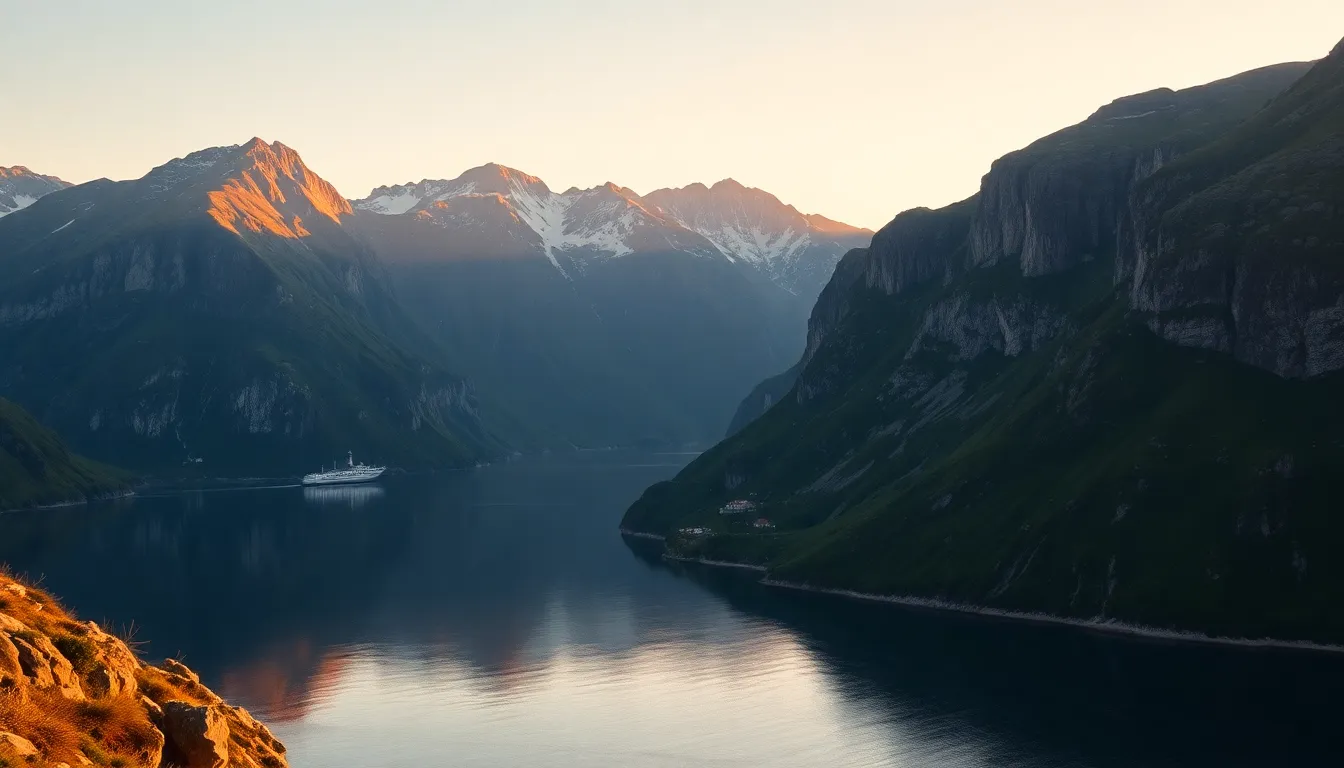
A fjord is a glacial valley the sea has flooded. During the ice ages, glaciers flowing off the Scandinavian ice sheet ground down through existing river valleys, cutting them far below sea level because ice, unlike water, can excavate uphill. When the ice retreated the Atlantic came in behind it.
That is why fjords have their two distinguishing features: walls that are vertical, because a glacier cuts a U and a river cuts a V; and a shallow sill at the mouth where the glacier's terminal moraine sits, so a fjord is often deeper in the middle than it is at the sea entrance.
The superlatives
Sognefjord — 205 km long and 1 308 m deep, the longest and deepest in Norway and the second in the world after Scoresby Sund. Hardangerfjord — 179 km, the orchard fjord, spectacular in May blossom. Geirangerfjord and Nærøyfjord — the two on the World Heritage list, and the narrowest and most dramatic.
⭐ Nærøyfjord
A branch of Sognefjord, 250 m wide at its narrowest with walls rising 1 700 m. It is the fjord on the postcards and the reason the Norway in a Nutshell route exists. It is also now inside the zero-emission zone.
Geirangerfjord
15 km long, with the Seven Sisters and Bridal Veil waterfalls falling straight into it, abandoned clifftop farms on ledges above, and the road down from Dalsnibba. It has also been one of the most cruise-congested places in Europe, which is precisely why the rules changed.
The others worth the detour
Lysefjord for Preikestolen and Kjerag. Trollfjord in Lofoten, 100 m wide, which the coastal ships enter and turn round inside. Hjørundfjord in the Sunnmøre Alps, which has the drama of Geiranger and almost none of the traffic.
⚠️ Getting the scale right
Photographs flatten fjords completely. A wall that looks like a hill in an image is a kilometre and a half of rock. The only way to feel it is from the water, which is why the ferries — not the cruise ships — are the point.
Waterfalls
Vøringsfossen (182 m, Hardanger, with a new footbridge over the gorge), Låtefossen, Steinsdalsfossen which you walk behind, and hundreds that have no name and appear only when the snow melts. Late May to early July is the volume.
🌦️ Weather, and the Gulf Stream Argument
Norway is far further north than its climate suggests. Tromsø sits at the same latitude as northern Alaska and northern Siberia and has January averages around −4 °C; the comparable places in Siberia are at −30 °C. The usual explanation is the Gulf Stream, and the usual explanation is half right: it is the North Atlantic Current plus the prevailing westerly winds that carry that ocean heat onto the land. Without the wind, the water alone would not do it.
Bergen
The rain. Around 2 250 mm a year and rain on roughly 230 days — one of the wettest cities in Europe. It is a standing joke in Norway and it is not exaggerated. Bring proper waterproofs, not a fashion jacket, and do not let it put you off: Bergen in rain is still Bergen.
Oslo
Continental by comparison — colder winters (January around −4 °C), warmer and drier summers, and genuinely hot days in July. The inland east has the extremes; Norway's record high is 35,6 °C and its record low −51,4 °C, both inland.
Summer
June to August. Long days everywhere, midnight sun in the north, mountain passes open, ferries running full schedules. It is also when everything is booked and everything costs the most. July is the Norwegian holiday month.
Winter
November to March. Northern lights, dog sledding, skiing, and in the north a darkness that is genuinely beautiful rather than grim — the blue hour lasts for hours. Many mountain roads close. Coastal Norway is milder and wetter than visitors expect.
⭐ Shoulder seasons
May — waterfalls at full volume, orchards in blossom in Hardanger, snow still on the tops, and a fraction of the crowds. September — autumn colour, first aurora, still-open roads. These are the best weeks of the year and almost nobody uses them.
⚠️ Mountain weather
Changes fast and kills people every year, including in July. A summer day at sea level in Bergen is a winter day at 1 400 m in Jotunheimen. Check yr.no, which is run by the Norwegian Meteorological Institute and NRK, is free, and is the best weather service in Europe.
🦌 Wildlife and the Land
⭐ Reindeer
Around 200 000 semi-domesticated reindeer in Norway, herded almost entirely by Sámi families under a right reserved to them by law. Wild reindeer survive in the southern mountains — the Hardangervidda herd is the largest wild population in Europe. They are not scenery; they are somebody's livelihood, and disturbing a herd has real consequences.
Elk (moose)
Elg, Alces alces, perhaps 120 000 of them. You will most likely meet one at dusk on a forest road, which is why the warning signs are not decorative — a collision with a 600 kg animal whose body mass sits at windscreen height is frequently fatal. Slow down at dawn and dusk.
Predators
Brown bear, wolf, lynx and wolverine all survive in small, tightly managed and politically explosive numbers. The wolf population in particular — a few dozen animals — generates more parliamentary argument than almost anything else. You will not see any of them.
⚠️ Polar bears
Only on Svalbard, where there are more of them than people and where anyone leaving the settlements is legally required to carry a firearm and know how to use it. Nobody on the mainland has seen a wild polar bear. See Svalbard.
Birds and sea
Seabird cliffs at Runde, Værøy and Gjesvær — puffins, gannets, kittiwakes, white-tailed eagles, which have recovered spectacularly and are now common along the whole coast. Orcas and humpbacks follow the herring into the fjords around Tromsø and Skjervøy from roughly November to January.
The forest floor
Cloudberries (multer), blueberries and lingonberries in quantity, and the right to pick them anywhere — with one exception: cloudberries in Nordland, Troms and Finnmark may only be picked by locals unless eaten on the spot. It is the one berry rule that catches people out.
🥾 Allemannsretten — the Right to Roam
This is the most important practical thing on this page and it has no equivalent in Czech or most European law. Allemannsretten — every man's right — is codified in the Friluftsloven of 1957 and it means that you may cross, walk, ski, ride, cycle and camp on uncultivated land anywhere in Norway, including land in private ownership, without asking and without paying.
The actual rules
✅ You may
Walk and ski on utmark — uncultivated land, which is most of Norway. Camp for up to two nights in one place. Swim, canoe and land a boat. Pick berries, mushrooms and wildflowers. Ride a bike on paths and tracks. Make a fire, with the season restriction below.
⚠️ You must
Pitch at least 150 m from any inhabited house or cabin. Move on after two nights, unless you are in the high mountains or far from habitation. Close gates. Take every scrap of rubbish out with you. Leave the site exactly as you found it — this is the entire bargain.
❌ You may not
Cross innmark — cultivated land, gardens, farmyards, plantations — in the growing season. Drive off-road; motorised access is very tightly restricted. Light an open fire between 15 April and 15 September in or near woodland, unless it is obviously safe. Camp in a motorhome wherever you like: allemannsretten covers tents and people, not vehicles.
⭐ Why it works
Because the obligation is taken as seriously as the right. Norwegians leave no trace and expect visitors to do the same, and the only real threat to allemannsretten is people abusing it. If you take nothing else from this page, take that.
The classic hikes
Preikestolen
The Pulpit Rock, a flat 25 × 25 m shelf 604 m above Lysefjord. About 8 km return, 2 hours up, well-built path, and roughly 300 000 people a year. No railing, and there does not need to be one — but stand back from the edge in wind and do not do it in ice.
Trolltunga
The Troll's Tongue, a rock ledge 700 m above Ringedalsvatnet. 28 km return with 800 m of ascent — 10 to 12 hours. This is a serious mountain day, not a photo stop, and people are rescued off it every season because they treated it as one. Season roughly mid-June to mid-September without a guide.
Besseggen
The ridge in Jotunheimen between the green Gjende and the blue Bessvatn, 14 km point to point, with a boat at one end. Norway's most-walked mountain hike and deservedly so. Book the boat.
Kjeragbolten
The boulder wedged in a chasm 984 m above Lysefjord. 12 km return, steep, chains on three ascents. Standing on the boulder is optional and a great many sensible people decline.
🛖 DNT cabins
The Norwegian Trekking Association maintains around 550 cabins across the country, from staffed lodges to unstaffed huts you let yourself into with a standard key and pay for on trust. Membership pays for itself in three nights. It is one of the great institutions of European outdoor life.
⚠️ Safety
File a plan with somebody. Carry map and compass and know how to use them — phone signal fails. Fjellvettreglene, the mountain code, is worth reading before you go. And turn back: the Norwegian rule is that there is no shame in it, and the people who die are the ones who pressed on.
🛡️ The Viking Age, 793–1066
The conventional start date is 8 June 793, the raid on the monastery at Lindisfarne, and the conventional end is 1066. Neither is really true — Scandinavians had been trading and travelling for centuries before and did not stop after — but the period in between genuinely reshaped northern Europe, and a large share of the ships came from what is now Norway.
What they actually did
Raided, yes. Also traded on a continental scale, settled Iceland, Greenland and the Faroes, founded Dublin, took the Orkneys, Shetlands, Hebrides and Isle of Man, served as the Byzantine emperor's Varangian Guard, and reached L'Anse aux Meadows in Newfoundland around 1000 — confirmed archaeologically, and a full five centuries before Columbus.
⭐ The ships
The technology that made all of it possible. A clinker-built hull with a shallow draught, a single square sail and oars, flexible enough to ride an Atlantic swell and shallow enough to run up a river. The Oseberg and Gokstad ships, both excavated from Norwegian burial mounds, are the finest survivors anywhere.
Harald Fairhair
Harald Hårfagre, traditionally the first king of a unified Norway after the Battle of Hafrsfjord, conventionally dated to 872. The unification was slower and messier than the saga version, and Norway was a patchwork of petty kingdoms for a long time after — but the date is the national origin story and the monument at Hafrsfjord is worth the stop from Stavanger.
⚠️ What they were not
Horned helmets are a nineteenth-century opera costume. There is no archaeological evidence for them whatsoever. “Viking” is also a job, not a people — å dra i viking, to go raiding — so “the Vikings” as an ethnic group is a modern invention. And the Norse were not uniquely violent for their century; they were unusually mobile, which is a different thing.
Where to see it
⚠️ Note that the Viking Ship Museum at Bygdøy in Oslo has been closed for its rebuild as the Museum of the Viking Age — check its opening status before you plan a day around it. Lofotr Viking Museum at Borg in Lofoten, built over the largest Viking longhouse ever found, is open and excellent. Avaldsnes near Haugesund is the old royal seat.
The language trace
English took several hundred words from Norse, including some of its most ordinary: sky, egg, knife, husband, window, law, they, them, their. If you speak English you already speak a little Old Norse.
⛪ Christianity, Stave Churches and the Black Death
Christianity arrived through kings rather than missionaries — Olav Tryggvason and then Olav Haraldsson, who was killed at the Battle of Stiklestad in 1030, was canonised almost immediately as St Olav, and became the eternal king of Norway whose shrine at Nidaros in Trondheim drew pilgrims from across Europe.
⭐ Stave churches
Norway's unique contribution to European architecture: timber churches built on raised sills with load-bearing corner posts (stav), carved with a vocabulary that is half Christian and half unmistakably Norse — dragon heads on the gables, interlace on the portals. There were perhaps 1 000. 28 survive.
Urnes
The oldest, around 1130, above Lustrafjord, and a UNESCO World Heritage Site. Its north portal carries carving so distinctive it gave its name to a whole style of Norse art — the Urnes style. Small, remote, and worth the ferry.
Heddal and Borgund
Heddal in Telemark is the largest. Borgund in Lærdal, around 1180, is the most complete and the one on every poster — six tiers of shingled roof stacked up with dragon heads at the peaks. Both are easy to reach.
⚠️ The Black Death
Arrived at Bergen in 1349 and killed perhaps half to two thirds of Norway's population — proportionally among the worst tolls anywhere in Europe. The aristocracy was effectively wiped out, the church lost its administration, farms were abandoned for generations, and the kingdom was left too weak to stand alone. Everything in the next section follows from it.
Nidaros Cathedral
Trondheim. Begun over St Olav's burial place in 1070, the northernmost medieval cathedral in Europe and the place Norwegian monarchs are still consecrated. The west front is a nineteenth- and twentieth-century reconstruction and is none the worse for it.
St Olav's Way
The medieval pilgrim route to Nidaros, roughly 640 km from Oslo, revived since the 1990s and now walked by thousands a year. A quieter Camino with better mountains and worse weather.
🇩🇰 The Danish Centuries, 1380–1814
Weakened by plague and dynastic accident, Norway entered union with Denmark in 1380 and stayed for 434 years. Norwegian historians of the nineteenth century called it firehundreårsnatten — the four-hundred-year night — which is polemical and not entirely wrong.
What it meant
Copenhagen governed. The Norwegian council of the realm was abolished in 1536 and Norway was formally reduced to a Danish province. The written language became Danish. The nobility became Danish or disappeared. Norwegian history, for four centuries, is largely a chapter in Danish history.
The Reformation
Imposed from Copenhagen in 1536–37, with no Norwegian debate and considerable Norwegian resistance. The last Catholic archbishop of Nidaros fled with the treasury. Church property went to the crown, which is a large part of why the Reformation happened at all, here as everywhere.
What survived
The farms, the dialects, and a peasantry that — unusually for Europe — largely owned its own land and was never reduced to serfdom. That self-owning farmer class is the root of an enormous amount of modern Norwegian self-understanding, including its egalitarianism and its suspicion of Oslo.
Bergen and the Hansa
For four hundred years Bergen was the biggest town in Scandinavia and a Hanseatic League Kontor, run by German merchants who controlled the trade in dried cod from Lofoten and lived in the wooden warehouses at Bryggen — now a World Heritage Site and the most-photographed row of buildings in Norway.
⚠️ 1814
Denmark backed Napoleon and lost. Under the Treaty of Kiel, 14 January 1814, Norway was ceded to Sweden as compensation to a victor — a country handed over between monarchs without being asked. What happened next was not in the treaty.
🇸🇪 Eidsvoll, Sweden and the Long Argument, 1814–1905
Told that they had been transferred to Sweden, the Norwegians did something nobody expected: they held an assembly at Eidsvoll, wrote a constitution, and declared independence.
The Constitution of 17 May 1814 was, for its moment, among the most democratic in Europe — a limited monarchy, an elected parliament, freedom of the press, and a franchise far wider than Britain's. Sweden invaded, won the short war that followed, and forced a compromise: Norway would enter a personal union under the Swedish king, but would keep its constitution and its parliament. That trade is the founding fact of the modern country and 17 May remains the national day.
⭐ Syttende mai
17 May is unlike any other national day in Europe. No military parade. Instead, children's processions in every town, brass bands, bunad — the regional folk costume, worn seriously and expensively by adults — flags, ice cream and hot dogs. If you are in Norway on 17 May, drop everything and go and watch.
⚠️ One stain on it
The 1814 constitution's paragraph 2 barred Jews from the kingdom — the so-called Jødeparagrafen. It was repealed in 1851 after a long campaign led by the poet Henrik Wergeland, who did not live to see it pass. It is taught in Norwegian schools and it should be mentioned wherever the constitution is praised.
The national romantic century
A conscious project to build a Norwegian culture distinct from Danish and Swedish: Asbjørnsen and Moe collecting folk tales, Ivar Aasen constructing a written language from rural dialects (see language), Edvard Grieg in music, Henrik Ibsen in theatre, Edvard Munch shortly after.
Emigration
Between 1825 and 1925 roughly 800 000 Norwegians left, overwhelmingly for the United States — proportionally the second-heaviest emigration in Europe after Ireland. Minnesota, Wisconsin and the Dakotas are full of their descendants, and the connection is still live.
⭐ 1905
The union ended over the trivial-sounding question of whether Norway could have its own consular service. A Norwegian referendum returned 368 208 to 184 for dissolution. Sweden, to its lasting credit, let it go without a war. Norway then offered its throne to a Danish prince, who insisted on a second referendum before accepting and became King Haakon VII.
👑 The New Kingdom, 1905–1940
Haakon VII
Born Prince Carl of Denmark, elected in effect by referendum, and the founder of the present dynasty. He took the Old Norse regnal name Haakon and gave his son the name Olav, deliberately reaching past four centuries of Danish rule to the medieval kingdom. His motto, Alt for Norge — everything for Norway — has been used by every king since, including the one who acceded in August 2026.
A poor country
This is the part people forget. In 1905 Norway was one of the poorest countries in western Europe — a fishing and farming economy that exported its young people. Everything about modern Norwegian wealth is younger than living memory.
What it did have
Hydropower. Norway industrialised on waterfalls — Rjukan and Notodden, where Norsk Hydro used cheap electricity to fix nitrogen from the air and make fertiliser, is now a World Heritage Site for exactly that. The country still gets the overwhelming majority of its electricity from hydro.
⭐ The polar years
Fridtjof Nansen crossed Greenland on skis in 1888 and let his ship Fram freeze into the Arctic ice to drift towards the Pole. Roald Amundsen sailed the Northwest Passage and reached the South Pole on 14 December 1911, beating Scott. The Fram herself is in a museum at Bygdøy in Oslo and you can walk her decks.
Nansen afterwards
Became the League of Nations' High Commissioner for Refugees, invented the Nansen passport for the stateless, organised famine relief in Russia, and won the Nobel Peace Prize in 1922. The Nobel Peace Prize itself is awarded in Oslo — alone among the Nobels — by a committee appointed by the Norwegian parliament, on Alfred Nobel's own instruction.
Neutrality
Norway stayed out of the First World War, though it lost around half its merchant fleet and some 2 000 sailors to submarines. It intended to stay out of the second one too.
⚔️ Occupation, 1940–1945
Germany invaded on 9 April 1940, principally to secure the shipment of Swedish iron ore through Narvik and to get naval bases on the Atlantic. Norway fought for two months — longer than any other invaded country in western Europe that year except the Soviet Union later — and the king and government escaped to London with the gold reserves and the merchant fleet.
⭐ The Blücher
On the first morning, the German heavy cruiser Blücher, carrying the troops and administrators meant to seize Oslo and capture the king, was sunk in the narrows of Drøbak by the guns and torpedoes of the obsolete Oscarsborg fortress. The delay of a few hours let the royal family, the government and the gold get out of Oslo. It is arguably the most consequential single action in Norwegian military history.
Quisling
Vidkun Quisling proclaimed himself head of government on the day of the invasion, was installed by the Germans in 1942, and was executed for treason in 1945. His name entered English, and several other languages, as the common noun for a traitor who governs for an occupier. There is no other Norwegian who has managed that.
The merchant fleet
Nortraship, formed in London from the Norwegian merchant marine that was at sea on 9 April, was the largest shipping company in the world and carried a substantial share of Allied oil across the Atlantic. Around 3 700 Norwegian sailors died. Churchill said the fleet was worth a million soldiers. Their treatment after the war was a national scandal that took decades to settle.
⭐ Heavy water
The Vemork plant at Rjukan produced heavy water for the German nuclear programme. The Gunnerside team — Norwegians, trained in Britain, dropped onto the Hardangervidda — destroyed the production cells in February 1943 without firing a shot, then escaped on skis. The survivors' ferry sabotage at Tinnsjø finished the programme's stock. It is one of the genuinely decisive commando operations of the war.
⚠️ Finnmark
In late 1944, retreating before the Red Army, German forces carried out a scorched-earth destruction of Finnmark and north Troms: towns, farms, boats, piers, everything. Around 50 000 people were forcibly evacuated and many others hid through the winter in caves and turf huts. It is why almost nothing in Finnmark is older than 1945, and it is remembered very differently in the north than in Oslo.
The Jews of Norway
Around 770 Norwegian Jews were deported, most on the Donau in November 1942, with Norwegian police carrying out the arrests. Roughly 35 survived. Around 1 000 were smuggled to Sweden by the resistance. Norway's own part in the deportations was acknowledged officially and apologised for only in the 2010s, and the stumbling stones in Oslo pavements date from then.
🛢️ Oil, and the Decision That Made Modern Norway
On 23 December 1969 Phillips Petroleum confirmed a commercial find at Ekofisk in the Norwegian North Sea. Production started in 1971. Within a generation one of the poorer countries in western Europe had become one of the richest on earth.
The interesting part is not the oil. Plenty of countries have found oil and been ruined by it. The interesting part is what Norway decided to do in the years immediately after the find, before any of the money had arrived.
⭐ The ten oil commandments
In 1971 the Storting adopted ten principles for the petroleum sector. The substance of them: the resources belong to the whole society; national control and a national oil company; development at a pace the country can absorb; the industry must build Norwegian competence rather than import it wholesale; and the revenue must benefit the population generally, not the coastal counties that happened to be nearest.
Statoil, now Equinor
Founded 1972 as a state oil company and now a listed multinational with the state as majority shareholder. The state also takes a direct share of every field through the SDFI, and the tax rate on petroleum profit is around 78 %. The result is that the overwhelming majority of the value stayed public.
What it built
Not a spending spree. Roads, universities, a health service, a pension system, an offshore engineering industry with genuine exportable expertise — and, above all, restraint. The money was consciously kept out of the domestic economy to avoid destroying everything else in it.
⚠️ The contradiction
Norway is a climate-forward country — electric cars past 90 % of new sales, a grid that is almost entirely hydro, a self-image built on nature — that is also western Europe's largest petroleum exporter, and one that has expanded Arctic licensing while doing it. Norwegians argue about this constantly and honestly, and any page that skips it is selling you a brochure.
The gas pivot
After 2022, Norwegian gas replaced a large share of Russian supply to Europe and Norway became the continent's single biggest gas supplier. That has been extremely lucrative and has made the contradiction louder rather than quieter.
💰 The Fund
The Government Pension Fund Global — the oljefondet, the oil fund — was established in 1990 and received its first deposit in 1996. As of July 2026 it held over US$2,2 trillion, which is around 1,5 % of the value of every listed company on earth and roughly US$400 000 for every Norwegian. It is the largest sovereign wealth fund in the world.
⭐ The fiscal rule
The mechanism that makes it work. All petroleum revenue goes into the fund; the government may spend, in an ordinary year, only the expected real return — a guideline set at 3 % since 2017, down from 4 %. The principal is never touched. So the country lives on the interest on its oil, not the oil.
Where it is invested
Entirely outside Norway — deliberately, to avoid inflating the domestic economy and to diversify away from the thing that filled it. Roughly 70 % equities, the rest bonds and some unlisted real estate and renewable infrastructure. It owns small slices of around 9 000 companies.
The ethics council
The fund excludes companies on ethical grounds under guidelines set by parliament — tobacco, certain weapons, severe environmental damage, systematic human rights violations, thermal coal above thresholds. The exclusion list is public and the decisions are argued about publicly. Divestment from companies linked to Israeli settlements and to the war in Gaza was a live issue in the 2025 election.
⚠️ What it is not
It is not a rainy-day pot Norwegians can draw on. It is not spent on citizens directly and there is no dividend. Norwegians pay high taxes and get public services; the fund is a buffer against the day the oil stops and against an ageing population, and it is treated with something close to reverence.
The thing to notice
Norway did the hard part before the money arrived. The rules were written in 1971 and 1990 by people who could not spend what they were legislating about. Almost every other petro-state wrote its rules afterwards, and almost every other petro-state is poorer for it.
For a visitor
It explains the roads, the tunnels through mountains that serve four hundred people, the ferries that run on time to islands with nobody on them, and the prices. A country that can afford to build like this is a country where your coffee costs what it costs.
🤝 How Norwegians Live
⭐ Janteloven
The Law of Jante — a satirical set of rules from a 1933 novel by the Dano-Norwegian Aksel Sandemose, whose first commandment is you shall not believe you are anything special. Norwegians quote it constantly, half in complaint and half in earnest. It is the key to a great deal of social behaviour: understatement, discomfort with conspicuous display, and a genuine, deep egalitarianism.
Dugnad
Communal voluntary work — the whole building, street, sports club or village turning out to clean, paint, clear or build, with coffee and waffles afterwards. Non-optional in practice and entirely unpaid. It was voted Norway's national word in 2004.
Friluftsliv
Open-air life. Not a hobby — an assumed default. People go out in bad weather as a matter of course, small children sleep outdoors in prams in winter, and the phrase det finnes ikke dårlig vær, bare dårlige klær — there is no bad weather, only bad clothing — is said sincerely.
Hytte
The cabin. There are around 450 000 of them for 5,6 million people. Traditionally simple, increasingly not, and the mass weekend exodus to them is a real feature of the calendar. Easter in particular empties the cities entirely.
The welfare model
Universal healthcare, free university, up to 49 weeks of parental leave at full pay with a portion reserved for the father, heavily subsidised childcare, and one of the smallest income gaps in the world. Funded by high taxes that Norwegians grumble about and pay.
⚠️ Social manners
Norwegians are reserved with strangers and very warm once past that, and the transition is slow. Nobody talks on public transport. Personal questions come late. Punctuality is expected. Queueing is absolute. Small talk is thin — this is not coldness and it takes visitors from talkative cultures a few days to stop reading it as one.
👑 The Monarchy — a New King, August 2026
King Harald V died on 28 August 2026 at Rikshospitalet in Oslo, aged 89. He had been admitted on 17 August with fluid retention arising from treatment for haemolytic anaemia, and his son had served as regent from that day. He lay in state in the palace chapel from 31 August to 8 September; the state funeral was at Oslo Cathedral on 9 September 2026, followed by a procession to Akershus Fortress and private interment in the royal mausoleum.
His son acceded the same day as King Haakon VIII, and kept the motto his father, grandfather and great-grandfather had used: Alt for Norge — everything for Norway.
⚠️ If you are travelling now
This page is written barely a week after the funeral. Expect flags at half mast, memorial books in town halls, subdued public events and some closures or postponements. Behave accordingly — this is a country that is genuinely fond of its royal family and is genuinely grieving.
Harald V
Reigned from 1991. Born in Norway in 1937, taken to safety in the United States as a child during the occupation, and the first Norwegian-born monarch in 567 years. He married Sonja Haraldsen, a commoner, in 1968 after a nine-year wait for his father's consent — a small constitutional drama at the time and a large part of why he was liked. A competitive Olympic sailor, and the king who said, in a much-quoted 2016 garden-party speech, that Norwegians are also those who believe in God and Allah and in nothing at all, and that Norway is you. Norway is us.
Queen Mette-Marit
Queen consort since August 2026. She has lived with pulmonary fibrosis since a 2018 diagnosis and underwent a lung transplant at Rikshospitalet in June 2026, two months before becoming queen. Her health is a matter of open and sympathetic public discussion.
⭐ Crown Princess Ingrid Alexandra
Now heir apparent, and — under the absolute primogeniture Norway adopted in 1990 — set to become Norway's first reigning queen since Margaret in the fourteenth century. She completed military service with the Engineer Battalion in 2025 and reads social sciences at the University of Sydney, spending the autumn 2026 semester at the University of Oslo.
What the king actually does
Very little, formally, and it is deliberate. Norway is a constitutional monarchy in which executive power is exercised by the government; the monarch opens parliament, presides at the weekly Council of State, signs, receives ambassadors and represents. Support for the institution has run consistently high, though it is lower among the young than it was.
Where to see it
The Royal Palace at the top of Karl Johans gate in Oslo — guard change at 13:30 daily, palace interiors open only in summer and by timed ticket. The palace park is a public park and always open.
🗳️ Politics After 2025
Norway is a parliamentary democracy with a 169-seat Storting elected by proportional representation every four years, with no possibility of an early election. Coalitions and minority governments are the norm; single-party majorities essentially do not happen.
The 2025 election
In September 2025, Jonas Gahr Støre's Labour Party (Arbeiderpartiet) returned to power. The red-green bloc took 87 of 169 seats, two above the 85 needed. Støre depends on smaller left parties to pass budgets, which makes every finance bill a negotiation.
⚠️ The other result
The Progress Party (FrP) — right-populist, anti-immigration, anti-tax — roughly doubled its share to about 24 %, its best result ever, and is now a very large presence in Norwegian politics. The headline was Labour's win; the structural story was FrP's.
What the election was about
The wealth tax, which Norway still levies and which has driven a visible stream of wealthy Norwegians to relocate to Switzerland; the future of oil exploration, especially in the Arctic; electricity prices, which have been a running political wound since 2021; and divestment by the sovereign fund from companies linked to Israel.
The party landscape
Labour (Ap), Conservative (Høyre), Progress (FrP), Centre (Sp — the farmers' and districts' party, and a much bigger force than its European equivalents), Socialist Left (SV), Liberal (Venstre), Christian Democrats (KrF), Greens (MDG), Red (Rødt). Nine parties in parliament is normal here.
⭐ 22 July 2011
A right-wing extremist bombed the government quarter in Oslo, killing eight, then shot dead 69 people, most of them teenagers, at a Labour youth camp on the island of Utøya. Norway's response — more openness, not less — became internationally famous, and the domestic argument about whether that response also allowed the ideology behind it to go unexamined has been going on ever since. The memorial in the government quarter and on Utøya are both visitable and both handled with great care.
Trust
Norway consistently scores at or near the top of every international index of institutional trust, press freedom and low corruption. This is not a small thing and it is felt daily as a visitor — in how much is simply left unlocked, unattended and assumed.
🇪🇺 In Europe, Not in the EU
Norway has applied to join the European Community or Union twice, negotiated successful terms twice, and been told no by its own electorate twice — in 1972 (53,5 % against) and in 1994 (52,2 % against). Both referendums split the country the same way: cities and the establishment for, districts, farmers and fishers against.
What it joined instead
⭐ The EEA
Through the European Economic Area agreement, in force since 1994, Norway is inside the single market for goods, services, capital and people. It adopts the overwhelming majority of relevant EU legislation, pays substantial contributions, and has no vote on any of it. Norwegian critics across the political spectrum call this fax democracy.
Schengen
Norway is a full Schengen member. There is no passport check arriving from Prague, and your Schengen days count here. It is also in the Nordic Passport Union, which predates Schengen by decades.
What is outside
Fisheries and agriculture — the two sectors that defeated both referendums. Norway keeps sovereign control of its fishing grounds, which for a country with the coastline it has is not a small matter, and maintains agricultural protection that keeps farming alive in places where it economically should not be.
NATO
Founding member since 1949, and the alliance's northern flank. With Finland and Sweden joining in 2023 and 2024, the Nordic region is now entirely inside NATO for the first time, which has changed Norwegian defence planning considerably. Norway shares a 196 km land border with Russia.
For a traveller
Practically: Schengen entry, EHIC/EU health card valid, EU roaming rules do apply through the EEA — but confirm with your operator, because they are not identical. And customs limits apply coming in, because Norway is outside the EU customs union. That last one catches people with alcohol.
🧡 The Sámi
The Sámi are the indigenous people of the European Arctic, whose homeland Sápmi spans northern Norway, Sweden, Finland and the Kola Peninsula in Russia. Estimates put the Sámi population of Norway somewhere between 40 000 and 60 000; nobody counts precisely, partly because of what was done to make people stop identifying as Sámi.
⚠️ Fornorsking
From roughly 1850 to the 1960s the Norwegian state pursued a deliberate policy of Norwegianisation. Sámi and Kven children were sent to boarding schools where their languages were forbidden. Land purchase was conditional on Norwegian language and a Norwegian name. Sámi languages were driven out of public life and, in many families, out of the home. Racial biology institutes measured skulls. A great many people stopped telling their children what they were.
A Truth and Reconciliation Commission reported to the Storting in 2023 on the treatment of the Sámi, Kven/Norwegian Finns and Forest Finns. Its findings are not contested by the state; what follows from them is still being argued.
⭐ Alta
The turning point. In 1979–81 the planned damming of the Alta river produced the largest civil disobedience campaign in modern Norwegian history — chained protesters, hunger strikes outside the Storting, a police operation of a size not seen before or since. The dam was built. The Sámi won everything else: a recognition of rights that led to the Sámi Act of 1987, a constitutional amendment in 1988, and the opening of the Sámediggi, the Sámi Parliament, at Karasjok in 1989.
⚠️ Fosen
The live case. In October 2021 Norway's Supreme Court ruled unanimously that the wind farm licences at Fosen in Trøndelag were invalid because the turbines violated South Sámi reindeer herders' rights to cultural practice under Article 27 of the ICCPR. The turbines kept turning. In February 2023, on the judgment's 500th day, Sámi activists and allies blockaded government ministries in Oslo; the government apologised for an ongoing human rights violation; mediated settlements followed in late 2023. It is the sharpest available illustration of green energy colliding with indigenous rights, and it happened in the country with the best reputation for both.
Languages
There are several, and they are not mutually intelligible. North Sámi has the most speakers by far; Lule and South Sámi are far smaller and endangered. All are official alongside Norwegian in designated municipalities, where signage is bilingual.
Reindeer herding
A right reserved in Norway to people of Sámi descent. It is a modern occupation with snowmobiles, helicopters and GPS collars, not a pageant, and it requires enormous areas of land — which is why it collides with wind farms, mines, cabins, power lines and roads more or less continuously.
Where to engage with it properly
The Sámediggi building at Karasjok, architecturally remarkable and open to visitors. RiddoDuottarMuseat at Karasjok and Kautokeino. Easter in Kautokeino — the Sámi Easter festival, with reindeer racing, joik and the Sámi Grand Prix, is the real thing and visitors are welcome.
⚠️ How not to
Avoid the packaged “Sámi experience” bolted onto a Tromsø aurora tour and run by people with no connection to it. Seek out Sámi-owned operators — there are many, they say so, and the difference is obvious. Joik is not folk singing; it is a way of evoking a person, animal or place, it was banned by the church, and it should not be requested as entertainment.
🗣️ Two Written Norwegians (and No Spoken Standard)
Norwegian has two official written forms and this confuses every visitor who notices it.
Bokmål
“Book tongue”. Descended from the written Danish of the union centuries, gradually Norwegianised. Used by roughly 85–90 % of the population, dominant in Oslo, in national media and in publishing.
Nynorsk
“New Norwegian”. Constructed in the 1850s by Ivar Aasen, a self-taught linguist who walked across the country collecting rural dialects and built a written standard from them, explicitly to give Norway a written language that was not Danish. Used by 10–15 %, strongest in the western fjord counties. Both are taught in every school and both are legally equal.
⭐ And no spoken standard
This is the genuinely unusual bit. Norway has no prestige spoken form. Politicians, newsreaders and professors speak their own dialects on national television without apology, and dialect diversity is protected rather than ironed out. There is no Norwegian equivalent of Received Pronunciation, and asking someone to “speak properly” would be socially bizarre.
Sámi and Kven
Sámi languages are official in designated municipalities. Kven, a Finnic language of the far north, is recognised as a minority language. Signage in Finnmark is often trilingual.
English
Near-universal and very good, taught from the first years of school and reinforced by subtitled rather than dubbed television. You will not need Norwegian anywhere. You will still be thanked for trying.
A few words
Hei — hi. Takk — thanks. Tusen takk — a thousand thanks. Vær så snill — please. Unnskyld — excuse me. Skål — cheers. Ha det — bye. Toalett is what you want to ask for. And kos / koselig, which means roughly what hygge means in Danish and which Norwegians will tell you is the better word.
🎭 Culture Worth Knowing About
⭐ Ibsen
Henrik Ibsen is, after Shakespeare, the most performed dramatist in the world. A Doll's House, Hedda Gabler, Ghosts, An Enemy of the People, Peer Gynt. He invented modern realist theatre more or less single-handedly, and he did it while living in self-imposed exile in Italy and Germany for 27 years because Norway annoyed him. The Ibsen Museum in Oslo is his last flat.
Munch
Edvard Munch left his entire remaining output — around 1 100 paintings and tens of thousands of works on paper — to the city of Oslo. It is now in MUNCH, the leaning tower on the waterfront, opened in 2021. The Scream exists in several versions; the National Museum has one, MUNCH has others, and they rotate for conservation.
Grieg
Edvard Grieg, and Troldhaugen, his house outside Bergen, which has a small concert hall built so that the stage window frames the lake behind the pianist. Lunchtime recitals in summer. The Peer Gynt suites were written for Ibsen's play and both men found the collaboration difficult.
Vigeland
Gustav Vigeland spent two decades filling Frogner Park in Oslo with 212 sculptures in bronze and granite, all of naked human figures at every age, culminating in the Monolitten — 121 intertwined bodies carved from a single block of stone. Free, open always, and unlike anything else in Europe.
Modern
Karl Ove Knausgård's six-volume My Struggle, which caused a national argument about privacy. Jo Nesbø and the Nordic noir export industry. A-ha, whose Take On Me refuses to die. Kygo and the tropical house wave. And a black metal scene from the early 1990s whose church burnings and killings are a real and grim part of the record, not a marketing story.
⭐ Skiing
Not a sport here so much as a national self-definition — the word ski is Norse. Norway leads the all-time Winter Olympic medal table by a wide margin. Holmenkollen above Oslo has a ski museum inside the hill and a viewing platform on the jump tower, open year round, and the March ski festival there is a genuine national event.
🚢 Too Many People in Too Few Places
Norway does not have a tourism problem. Norway has a concentration problem: an enormous, largely empty country in which almost every visitor goes to the same dozen places in the same ten weeks.
The pinch points
Geiranger, a village of a few hundred people receiving cruise passengers by the hundred thousand. Flåm, same story. Preikestolen and Trolltunga, where the queue for the photograph can run to hours. Lofoten, where a handful of villages and one road absorb a volume they were never built for. Tromsø in aurora season.
⚠️ What it actually damages
Not the scenery. The infrastructure and the residents: sewage systems sized for a village, single-lane roads with passing places used by coaches, wild camping and human waste on fragile ground, rescue services stretched by unprepared walkers, and housing bought up for short-term letting in villages where people are trying to live.
What Norway is doing
The visitor levy from 2026. The zero-emission fjord rules. Parking charges at trailheads. Seasonal restrictions and, at Trolltunga, staffed checkpoints turning back people who set off too late or too badly equipped. Not bans — management.
⭐ What you can do, and it is easy
Go in May or September. Go to Hjørundfjord instead of Geiranger, Senja instead of Lofoten, Vesterålen, Helgeland, the Sunnmøre Alps, Rondane, Femundsmarka. Norway has a hundred places as good as the famous ones and no queue at any of them. This is genuinely the single best piece of advice on this page.
Use the ferries
The scheduled car ferries and the Hurtigruten and Havila coastal routes are public transport that happens to have the best views in Europe. They cost a fraction of a cruise, they call at places cruise ships cannot, and the money stays local.
⚠️ Motorhomes
A specific and growing friction. Allemannsretten does not cover vehicles. Parking a camper overnight at a viewpoint, emptying a chemical toilet into a stream or a field, or blocking a passing place is not the right to roam — it is the thing that will eventually get the right to roam restricted. Use the campsites; there are plenty and they are good.
💸 The Visitor Levy, From 2026
Norway has introduced a visitor contribution — a local tourist tax — under new national legislation, with the first municipalities expected to start charging during the 2026 season. Here is what is actually in it, because a great deal of what has been written about it is wrong.
⭐ It is not national
The law is national; the tax is local and opt-in. A municipality must apply for government authorisation and demonstrate that visitor numbers are straining its services. Only approved municipalities may charge. Most of Norway will not have it.
The rate
Up to 3 %, set by each approved municipality, levied on the price of overnight accommodation and on cruise passengers coming ashore.
Who is expected to charge first
The places under most pressure — Lofoten, Tromsø and Bergen are the names that come up, along with the fjord municipalities. Check locally rather than assuming.
⚠️ Who pays
Guests in hotels, guesthouses and short-term rentals, and cruise passengers landing. Exempt: campsites, marinas, tents, and people in their own campervans or boats. Which means, oddly, that the visitors generating the most friction are the ones outside the tax.
Where it goes
Legally ring-fenced for tourism infrastructure — paths, toilets, parking, signage, waste, sustainable transport — and not available for general municipal spending. That ring-fencing is what got it through parliament.
What it means for your budget
Almost nothing. On a 2 000 NOK hotel night, 3 % is 60 NOK — around 130 Kč. It is not a reason to change plans. It is worth knowing so it does not surprise you on the bill, and worth understanding as the mildest possible response to a real problem.
⚡ Zero-Emission Fjords, From 1 January 2026
This one genuinely changes what you will see. The Storting decided in 2018 that the five World Heritage fjords would require zero-emission shipping by 2026, and the requirement took effect on 1 January 2026.
The rule
Where
The West Norwegian Fjords World Heritage area: Geirangerfjord, Sunnylvsfjord, Tafjord, Nærøyfjord and Aurlandsfjord.
What, and when
From 1 January 2026, passenger vessels carrying more than 12 people and under 10 000 gross tonnes must operate inside those fjords on energy sources producing no direct CO₂ or methane emissions. From 2032, the requirement extends to passenger ships over 10 000 GT — which is to say, to the large cruise ships.
⭐ What it looks like in practice
The small fjord ferries and sightseeing boats that carry most visitors are now battery-electric or hydrogen. The operator on Nærøyfjord had already been running electric vessels for years. The experience is remarkable: a 250-metre-wide fjord under 1 700-metre walls, in near silence, with no diesel smell. It is better than what it replaced, not worse.
⚠️ The large ships
Big cruise ships have until 2032, and getting a 100 000-tonne vessel to zero direct emissions is a genuinely hard engineering problem — shore power at berth is not the same as zero emissions under way. Expect argument, lobbying and possibly adjustment between now and then.
Why it matters beyond Norway
It is the first time anywhere that a state has simply told shipping that a specific stretch of water is closed to combustion. Whatever happens next, it was tried here first, and the small-vessel half of it is working.
For your trip
Book the electric fjord cruise on Nærøyfjord or the Geiranger sightseeing boat and treat the silence as part of the point. And if you are choosing between a big cruise ship and a ferry, this is one more reason for the ferry.
🏙️ Oslo
A capital of around 720 000 at the head of a fjord, surrounded by forest, and for a long time the least fashionable Nordic capital. That has changed. The waterfront rebuild of the last fifteen years — Bjørvika, the opera house, the new library, MUNCH, the relocated National Museum — has given Oslo a centre it did not previously have.
⭐ Operahuset
The opera house, 2008, whose defining feature is that you walk up the roof. A slab of white Carrara marble rising straight out of the fjord, free and open at all hours, and the best thing in the city before you have paid for anything. Go at dusk.
Nasjonalmuseet
Reopened in 2022 as the largest art museum in the Nordics. Norwegian romantic landscape painting — Dahl, Tidemand, Gude — which is the visual language the whole country still sees itself in, plus one version of The Scream.
MUNCH
Thirteen leaning storeys on the waterfront holding the bequest Munch left the city. Divisive architecture, unarguable collection.
Vigelandsparken
Frogner Park: 212 Vigeland sculptures, the Monolith, always open, always free, and full of Oslo residents using it as a park rather than a monument. Allow two hours.
Bygdøy
The museum peninsula, reached by ferry in summer. The Fram Museum — Nansen's and Amundsen's polar ship, which you board. The Kon-Tiki Museum. The Norsk Folkemuseum, an open-air collection of moved buildings including a stave church. ⚠️ The Viking ships are in the rebuild to the Museum of the Viking Age — check before you go.
Holmenkollen
Twenty minutes on the metro and 400 m up. The ski jump, the ski museum inside the hill, and a view down the whole fjord. The metro line itself, the T-bane line 1, is one of the best cheap rides in Europe.
Practical: the Oslo Pass covers transport and most museums and pays for itself in a day if you are moving. The city is walkable, the T-bane is excellent, and in summer the island ferries from Aker brygge to Hovedøya and Langøyene run on an ordinary transport ticket — a free fjord cruise with swimming at the end.
🌧️ Bergen
The second city, the old Hanseatic capital, and the gateway to the fjords. Around 290 000 people wedged between seven mountains and a harbour, and — as the whole country will remind you — rain on roughly 230 days a year.
⭐ Bryggen
The Hanseatic wharf: a row of wooden gabled warehouses on the north side of the harbour, UNESCO World Heritage, burnt and rebuilt on the same medieval foundations repeatedly since the twelfth century. Go into the alleys behind the façade, where the buildings lean at angles that should not be structural, and into the Hanseatic Museum and Bryggens Museum.
Fløibanen
The funicular up Fløyen, eight minutes from the centre to 320 m and a view over the city and the islands. At the top you are immediately in forest with marked trails — and you can walk down, which most people do not think to do.
Ulriken
The highest of the seven at 643 m, by cable car. The ridge walk from Ulriken to Fløyen — Vidden, about 13 km, 4–6 hours — is exposed high moorland with no shelter and is a proper mountain route in bad weather. In good weather it is superb.
Fish market and Torgallmenningen
The Fisketorget is touristy and priced accordingly; the indoor hall is better than the outdoor stalls. For eating, go one street back. Bergen has a serious restaurant scene that has nothing to do with the market.
Troldhaugen
Grieg's house on the lake outside town, with the composer's hut at the water's edge and a small concert hall whose stage window looks out over both. Summer lunchtime recitals. Take the Bybanen tram.
⚠️ The rain
It is not a joke and it is not avoidable. Bring a proper hardshell and waterproof footwear, not an umbrella — the wind takes umbrellas. Bergen in rain, with low cloud sitting on the seven mountains, is arguably better-looking than Bergen in sun.
🚢 Doing the Fjords
⭐ Norway in a Nutshell
The standard route, and standard for good reason: Bergen Railway from Oslo or Bergen to Myrdal, the Flåm Railway down 866 m in 20 km on one of the steepest adhesion railways in the world, a fjord boat through Nærøyfjord and Aurlandsfjord to Gudvangen, then a bus up the hairpins and back to the train. It can be done in a long day from either end and it is genuinely spectacular.
It is also, in July, extremely busy. Do it in May or September and it is a different experience entirely. And note that the fjord leg is now on electric vessels, which improves it.
The Bergen Railway
Oslo–Bergen in about seven hours across the Hardangervidda at up to 1 222 m — snow-fenced, treeless, and in winter genuinely Arctic. Regularly called one of the world's great train journeys and the claim holds up. Book early for the cheap fares.
Geiranger
The famous one: the Seven Sisters, the abandoned clifftop farms, the Dalsnibba road to 1 500 m, and the Trollstigen hairpins nearby. ⚠️ Trollstigen has been closed for rockfall safety work in recent seasons — check before you drive. Geiranger is also the most crowded point in the fjords; consider Hjørundfjord instead.
Hardanger
The orchard fjord. Apple and cherry blossom in May is one of the best weeks in the Norwegian year. Vøringsfossen with its new footbridge, the Folgefonna glacier, and Trolltunga at the far end.
Lysefjord and Preikestolen
From Stavanger. The fjord boat passes directly under the Pulpit Rock, which is the best way to understand what 604 m means. Stavanger itself has the excellent Norwegian Petroleum Museum, which is far more interesting than it sounds and is honest about the contradiction.
The Atlantic Road
Eight bridges hopping across islets between Kristiansund and Molde, 8 km long, and best in a storm — which is when people go. Part of the National Tourist Routes, a set of 18 designated scenic roads with purpose-built architecture at the viewpoints, and one of the most quietly impressive public projects in Europe.
⚠️ Ferries and tunnels
Fjord driving means ferries, and ferries mean timetables. Download the Ferjelanes or operator app, note that most now bill by number plate via AutoPASS, and add an hour to every estimate. Also: some tunnels are very long — the Lærdal Tunnel is 24,5 km, the longest road tunnel in the world, with coloured caverns to keep drivers awake.
⛪ Trondheim and the Middle
Nidaros Cathedral
The northernmost medieval cathedral in Europe, built over St Olav's grave, and the place Norwegian monarchs are consecrated. The west front is dense with statuary and the nave is the finest Gothic interior in Scandinavia. Climb the tower.
Bakklandet
The old wooden quarter across the Nidelva — painted houses, cobbles, cafés and the Gamle Bybro, the old town bridge. There is also a bicycle lift, the Trampe, which pushes cyclists up a steep hill by the foot and is the only one in the world.
Student city
NTNU makes Trondheim young and cheap by Norwegian standards. It is a good place to eat and drink without the Oslo prices, and the student culture — including a biennial student festival that is the largest in the world — is a real part of the city.
⭐ Røros
Two hours south-east and entirely worth it. A World Heritage copper-mining town of black tarred wooden houses on the open mountain plateau at 630 m, essentially unchanged since the eighteenth century, with a functioning town rather than a museum inside it. In winter it is very cold — Røros regularly records the lowest temperatures in southern Norway — and it is at its best then.
The Atlantic and Helgeland
North of Trondheim the coast breaks into the Helgeland archipelago: thousands of islands, the Seven Sisters mountains, Torghatten with the hole straight through it, and Vega, a World Heritage site for a thousand years of eiderdown farming. The Kystriksveien coastal road through it, with six ferries, is one of Europe's great drives and almost nobody does it.
Jotunheimen and Rondane
Inland and south: the highest mountains in northern Europe, the Besseggen ridge, Galdhøpiggen, glacier walking, and a network of DNT cabins that makes multi-day walking straightforward. Rondane was Norway's first national park, in 1962.
🏔️ Lofoten and Vesterålen
A chain of islands above the Arctic Circle where mountains rise straight out of the sea to 1 000 m with white beaches at their feet. It is the most photographed part of Norway after the fjords and it deserves it.
The villages
Reine, Hamnøy, Nusfjord, Å — the last of which is genuinely called Å, one letter, at the end of the road. Red rorbuer, the fishermen's cabins on stilts, many now let to visitors.
⭐ Skrei
The reason the villages exist. Every winter, from roughly January to April, Arctic cod migrate from the Barents Sea to spawn off Lofoten. That fishery has run continuously for over a thousand years, it is what the Hansa traded in Bergen, and the wooden drying racks (hjell) hung with split cod are the landscape's other signature. The smell in spring is considerable and entirely authentic.
Beaches
Haukland, Uttakleiv, Kvalvika — white sand, turquoise water, Arctic latitude and water at about 8 °C. They look Caribbean in photographs and they are not, and people swim anyway.
Walks
Reinebringen, up Sherpa-built stone steps to a view over Reine that is on every Norway poster — steep, popular and now properly constructed. Ryten above Kvalvika. Offersøykammen for a short one.
⚠️ The pressure
Lofoten is the sharpest overtourism case in Norway: one road, a few thousand residents, hundreds of thousands of visitors, and a real problem with wild camping and waste. It is a strong candidate for the first visitor levy. Book accommodation, use campsites, and consider Vesterålen or Senja — adjacent, comparable, far quieter.
Getting there
Fly to Bodø then ferry or fly on to Leknes or Svolvær; or take the Hurtigruten coastal ship, which threads Trollfjord. The ferry from Bodø to Moskenes is the classic approach and puts you at the beautiful end.
🌌 Tromsø and the Northern Lights
At 69,6° N, Tromsø is a city of around 78 000 with a university, a brewery, a cathedral of concrete triangles and a position directly under the auroral oval. It is the northern lights capital of Europe and it knows it.
⭐ The aurora
Season roughly late September to late March, when it is dark enough. You need three things: solar activity, a clear sky, and patience. Tromsø's advantage is that it sits under the oval, so even modest activity shows — and its disadvantage is coastal cloud, which is why good operators drive, sometimes for hours, sometimes into Finland, to find a gap. Book a tour that promises to chase, not one that promises the lights.
⚠️ Managing expectations
To the naked eye the aurora is often pale grey-green, not the saturated violet of the photographs — long-exposure cameras collect light your eye cannot. A strong display is unmistakable and unforgettable; a weak one looks like a thin cloud that moves wrong. Both are real. Go for three nights, not one.
Polar night and midnight sun
No sun above the horizon from roughly 27 November to 15 January — which is not darkness but a long blue twilight, and genuinely beautiful. Midnight sun from roughly 20 May to 22 July, when the city simply does not sleep.
What else is there
The Arctic Cathedral, the Fjellheisen cable car to 421 m, the Polaria aquarium, the Polar Museum, and Mack, for a long time the world's northernmost brewery. Tromsø also has an unreasonable number of good restaurants for its size.
Whales
From roughly November to January, orcas and humpbacks follow the herring into the fjords around Tromsø and Skjervøy. Choose an operator with a silent electric or hybrid boat and a no-approach policy — the difference in animal behaviour is obvious and it is the difference between watching whales and harassing them.
Nordkapp
The North Cape, 71° 10′ N, reached by a long drive from Alta or Honningsvåg, with a visitor centre and a steep entrance fee. It is neither the northernmost point of Europe nor even of its own island — Knivskjellodden, an hour's walk away, is further north and free. Go anyway if you want the cliff; go to Knivskjellodden if you want the point.
🐻❄️ Svalbard
An archipelago between 74° and 81° N, 1 000 km north of the mainland, closer to the North Pole than to Oslo, with around 2 500 people at Longyearbyen and a legal status that exists nowhere else on earth.
⭐ The Svalbard Treaty
Signed in 1920, in force from 1925. It gives Norway full sovereignty — and it gives every signatory state's citizens and companies equal rights of access and of commercial activity, requires the islands to be used only for peaceful purposes, and caps taxation at what is needed to run the archipelago. There are now over forty parties, including the Czech Republic, Russia and China.
The practical consequence is startling: you do not need a visa or a residence permit to live and work on Svalbard, whatever your nationality. You do need to be able to support yourself — there is no welfare safety net, and people who cannot sustain themselves can be required to leave.
⚠️ But you do need one to get there
Almost everyone flies via mainland Norway, which means passing through Schengen. So a Schengen entry is required for the journey even though Svalbard itself is outside it. Czech citizens have no problem; travellers from elsewhere are frequently caught by this.
Longyearbyen
A company coal town turned research and tourism settlement: a university centre (UNIS), a hotel or two, a supermarket, a surprising amount of good food, and a rule that you take your shoes off indoors everywhere, including in public buildings — a coal-dust habit that never went away.
Barentsburg
A Russian mining settlement of a few hundred people, reachable by boat or snowmobile, with a Lenin bust, a hotel and a very strange atmosphere. Its existence is a direct consequence of the treaty's equal-access clause and it has become considerably more politically loaded since 2022.
🐻 ⚠️ Polar bears
There are more polar bears than people. Anyone leaving the settlements is legally required to carry a firearm and know how to use it, and in practice that means going with a guide. This is not theatre; people have been killed. Do not walk out of Longyearbyen on your own.
⚠️ The dying myth
You will read that it is illegal to die on Svalbard. It is not. What is true is that burials in the Longyearbyen cemetery have been effectively closed since around 1950, because bodies in permafrost do not decompose — influenza virus from the 1918 pandemic was recovered from graves there in 1998. Terminally ill people and women in late pregnancy are generally moved to the mainland, because the hospital is small. Nobody is prosecuted for dying.
The seed vault
The Svalbard Global Seed Vault, cut into a mountainside above the airport, holding duplicate samples of over a million crop seed varieties against global catastrophe. You cannot go in. You can stand outside and look at the illuminated entrance wedge, which is what everybody does.
🍽️ Norwegian Food
Norwegian cooking is what a cold country with a long coast and a short growing season produces: fish, potatoes, dairy, mutton, and an enormous inherited vocabulary of preservation — drying, salting, smoking, fermenting. It has a reputation for being dull. That reputation was earned in about 1975 and is now badly out of date.
⭐ Fårikål
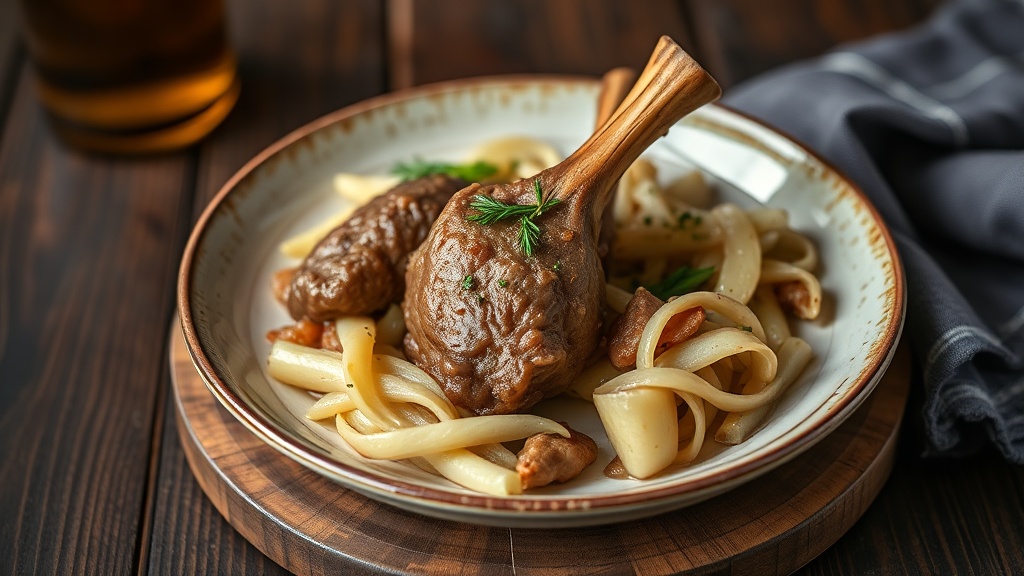
The national dish, decided by a public vote and celebrated on its own day — Fårikålens festdag, the last Thursday in September. Bone-in mutton and cabbage in wedges, layered in a pot with whole black peppercorns, barely covered with water and simmered for two to three hours. Served wet, in a bowl, with boiled potatoes. Recipe below.
Skrei
The Arctic cod that comes to Lofoten to spawn, January to April, and the best white fish in the world during those months — firm, flaking in thick leaves, nothing like ordinary cod. Poached, with its liver and roe (mølje) if you are being traditional. If you are in Norway in February, eat this.
Brunost
Brown cheese, and not really cheese: whey boiled down until the milk sugars caramelise, then set. Sweet, fudgy, faintly goaty in the Gudbrandsdalsost version. Sliced paper-thin with an ostehøvel — the cheese slicer, a Norwegian invention of 1925 — onto bread or waffles. Divisive and essential.
Kjøttkaker and raspeballer
The everyday food. Kjøttkaker are large meat patties in brown gravy with mashed swede — the Norwegian Thursday. Raspeballer / komle / klubb are potato dumplings boiled with salted meat, which have a different name in almost every valley and about which people are extremely particular.
Pinnekjøtt and lutefisk
Christmas. Pinnekjøtt is salted and dried lamb ribs steamed over birch sticks — genuinely excellent. Lutefisk is dried cod rehydrated in lye until it becomes translucent and gelatinous; it is eaten with bacon, pea purée and a great deal of aquavit, and honesty requires saying that plenty of Norwegians will not touch it.
⚠️ Rakfisk and smalahove
The two that test you. Rakfisk is trout fermented in brine for months and eaten raw — powerful, and there is an annual festival at Fagernes. Smalahove is a whole salted and smoked sheep's head, served with the eye and the ear, a Voss speciality, eaten from the ear inwards. Both are entirely serious food and neither is a dare.
What has changed
New Nordic cooking landed here properly. Norway has Michelin-starred restaurants in Oslo, Stavanger and Trondheim working almost entirely with Norwegian ingredients — scallops from Frøya, king crab from Finnmark, reindeer, sea urchin, wild herbs, Arctic berries. Maaemo in Oslo has held three stars. The other end of it is good too: a bakeri in any town will do a kanelbolle (cinnamon bun) or skolebrød that justifies the trip on its own.
👨🍳 Three Recipes You Can Actually Cook
Fårikål
Serves 4 · Prep 15 min · Cook 2–3 hours · The national dish, and it is four ingredients
Ingredients: 1,5 kg mutton or lamb on the bone, cut into large pieces (shoulder, neck, breast — fatty cuts, not lean); 1,5 kg white cabbage, cut into thick wedges through the root so they hold together; 3–4 tbsp whole black peppercorns; 2 tsp salt; 2 tbsp plain flour (optional); about 500 ml water.
Method: Layer it. Meat fat-side down on the bottom of a heavy pot, then a layer of cabbage wedges, then a scattering of peppercorns and salt and a dusting of flour if using; repeat until everything is in, finishing with cabbage. Pour in water to come about a third of the way up — not to cover; the cabbage releases a great deal. Bring to the boil, then cover and simmer very gently for two to three hours, until the meat comes off the bone and the cabbage is translucent and soft. Do not stir. Serve in deep bowls with plenty of the liquid and boiled potatoes.
💡 The peppercorns are whole and they stay in — you eat around them, and biting one is part of it. Some cooks tie them in muslin; purists regard that as cowardice. It is better on the second day, which is the other thing everyone will tell you. Mutton rather than lamb if you can get it: the flavour is the point.
Fiskesuppe — Norwegian Fish Soup
Serves 4 · Prep 20 min · Cook 25 min · What you will actually miss
Ingredients: 600 g firm white fish (cod, haddock, pollock), skinned and cubed; 200 g salmon, cubed; 200 g raw prawns (optional); 1 l fish stock; 300 ml double cream; 1 leek, sliced; 2 carrots, in thin batons; 1 small celeriac or 2 celery sticks, diced; 1 tbsp butter; 2 tbsp white wine vinegar or the juice of half a lemon; 1 tsp sugar; salt, white pepper; a large handful of dill and chives, chopped.
Method: Sweat the leek, carrot and celeriac in the butter for five minutes without colouring. Add the stock, bring to a simmer and cook 10 minutes until the vegetables are just tender. Add the cream and bring back to a bare simmer. Season with the vinegar and sugar together — this sweet-sour balance is what makes it Norwegian rather than generic chowder — then salt and white pepper. Add the white fish, simmer 3 minutes, add the salmon and prawns, simmer 2 minutes more, and take it off the heat. Stir in the herbs and serve at once with good bread.
💡 The fish goes in at the end and barely cooks. Overcooked fish is the only way to ruin this. The vinegar-and-sugar seasoning feels wrong when you add it and is right when you taste it — start with half and build up.
Brunost Sauce for Game (Viltgryte-saus)
Serves 4 · 15 minutes · The most Norwegian thing in this list
Ingredients: 300 ml good beef or game stock; 150 ml double cream; 60–80 g brunost (Gudbrandsdalsost or similar brown cheese), coarsely grated; 1 tbsp butter; 1 tbsp plain flour; 1 tsp redcurrant or lingonberry jelly; a splash of sour cream; salt, black pepper; juniper berries, crushed (optional).
Method: Make a pale roux with the butter and flour, whisk in the stock gradually and let it thicken. Add the cream and the juniper and simmer five minutes. Take it off the heat, add the grated brunost and whisk until it dissolves — it will not melt smoothly if the sauce is boiling. Return to a very low heat, add the jelly and the sour cream, season and do not let it boil again. Serve with venison, reindeer, elk or good beef, with potatoes and lingonberries.
💡 Brunost is sold in Czech supermarkets that carry Nordic goods and online — look for Gudbrandsdalsost, the red-and-yellow brick. It is sweet and caramelised, so the sauce wants the acid from the jelly and the sour cream to balance it. Do not boil it after the cheese goes in; it splits.
🥃 Drinks, and Vinmonopolet
Norway has one of Europe's strictest alcohol regimes and it is worth understanding before you arrive thirsty on a Sunday.
⚠️ Vinmonopolet
The state alcohol monopoly. Anything above 4,7 % ABV — wine, spirits, strong beer — can only be bought from a Vinmonopolet shop. They are well run, the staff know their stock, the selection is excellent, and they keep office hours: roughly 10:00–18:00 on weekdays, shorter on Saturdays, and closed all day Sunday and on public holidays.
⚠️ And the supermarket rule
Beer up to 4,7 % is sold in ordinary shops — but sales stop at 20:00 on weekdays and 18:00 on Saturdays, and none at all on Sundays. At those times a barrier physically comes down over the shelves. Plan ahead; this catches almost every visitor once.
⭐ Akevitt
Aquavit: potato spirit flavoured with caraway or dill and, in the Norwegian style, aged in oak sherry casks. Linie aquavit is shipped across the equator and back — genuinely, in barrels on deck, and each bottle's label records the ship and the voyage — on the theory that the motion and temperature swing improve it. Drunk cold with fatty food, especially at Christmas.
Beer
A serious craft scene: Nøgne Ø, Lervig, Ægir at Flåm in a building shaped like a stave church, Mack in Tromsø. Also juleøl, the Christmas beers, which are a genuine tradition and much stronger than they taste.
⭐ Coffee
Norwegians are among the heaviest coffee drinkers on earth — consistently top three per capita. Traditionally it is filter, black, and endless. The Oslo third-wave scene (Tim Wendelboe and the rest) is internationally influential. Coffee will be offered constantly and it is impolite to make a fuss about it.
What to expect to pay
A beer in an Oslo bar runs roughly 100–140 NOK — around 220–300 Kč. This is the single biggest shock for Czech visitors, and it is why Norwegians pre-drink at home (vorspiel) and go out late. Do as they do.
💰 Costs — the Part Everyone Gets Wrong
Norway is expensive. Not “western European expensive” — materially more, and Czech visitors in particular consistently under-budget. Figures below are indicative for 2026, converted at roughly 1 NOK ≈ 2,2 Kč. Check the rate; it moves.
🥗 Eating out
Café lunch or a dagens: 350–550 Kč. Mid-range restaurant main: 600–1 000 Kč. Pizza for two: 900–1 300 Kč. Beer in a bar: 220–300 Kč. Coffee: 90–130 Kč. A hot dog from a petrol station — genuinely a national institution — 90–130 Kč.
🛒 Self-catering
This is where you save real money. Supermarket food is expensive but nothing like restaurant prices. REMA 1000, KIWI and Coop Extra are the discounters. A week of cooking for yourself instead of eating out can halve the cost of a trip, and with a cabin or campsite kitchen it is easy.
🛏️ Sleeping
Hostel dorm: 700–1 200 Kč. Budget hotel double: 2 200–3 500 Kč. Mid-range: 3 500–5 500 Kč. Campsite cabin (hytte): 1 200–2 500 Kč and excellent value. Wild camping: free, under allemannsretten.
🚗 Transport
Petrol: 50–60 Kč/l. Car hire: 1 500–3 000 Kč/day. Ferries: 150–500 Kč per crossing with a car. Toll roads are everywhere and billed automatically by number plate — a hire car will pass them on to you weeks later, so budget for it. Trains booked early can be very cheap; booked late, very not.
🏛️ Sights
Museums: 250–450 Kč. Flåm Railway: around 1 500 Kč. Fjord cruise: 1 000–2 000 Kč. Aurora tour from Tromsø: 2 500–4 000 Kč. But: hiking is free, the fjords are free to look at, and Vigeland Park and the opera house roof cost nothing. A lot of the best of Norway is outdoors and unpriced.
⭐ Realistic budgets
Per person per day, excluding flights. Camping and cooking: 900–1 500 Kč. Cabins, some meals out, a hire car shared: 2 500–3 500 Kč. Hotels and restaurants: 4 500–7 000 Kč. The gap between the first and the last is the widest of any country in this atlas, and it is entirely under your control.
Cards work everywhere — Norway is close to cashless and many places no longer take notes at all. Contactless is universal, including on buses and in mountain huts. Tipping is not expected; rounding up for good service is enough and nobody will chase you.
📋 Practical
🛂 Entry
Norway is in Schengen but not the EU. Czech citizens enter on an ID card or passport with no border check from within Schengen, and days here count against your Schengen allowance. ⚠️ Norway is outside the EU customs union, so customs allowances apply — and the alcohol limits are low and are enforced.
🏥 Health
The EHIC / European health insurance card works through the EEA agreement and gives you access to the public system on the same terms as Norwegians — which includes their patient charges. It does not cover repatriation or mountain rescue costs, so take commercial travel insurance as well. Pharmacies are apotek.
📶 Phone
EU roaming rules apply through the EEA — but confirm with your Czech operator before you travel, because the implementation is not identical and a few tariffs treat Norway differently. Coverage is very good on roads and in towns and unreliable in the mountains, which matters if you are walking.
🚗 Driving
Right-hand side. Dipped headlights are mandatory at all times, day and night, year round. Speed limits are low and enforcement is severe — fines are among the highest in Europe and are income-linked. Winter tyres are required in winter conditions. Alcohol limit is 0,2 ‰, which effectively means zero.
🚆 Public transport
Excellent and expensive. Vy for trains, with cheap advance minipris fares that sell out. Long-distance buses (Nor-way, Vy buss) are cheaper and slower. Hurtigruten and Havila run the Bergen–Kirkenes coastal route, which can be used port-to-port as transport rather than booked as a cruise — much cheaper, and the same views.
🛑 Emergencies
112 police, 113 ambulance, 110 fire. Mountain rescue is coordinated through 112. Norway is extremely safe; the real risks are weather, water and roads, in that order.
⚠️ Three things people get wrong
Distances. Oslo to Tromsø is a two-hour flight or a twenty-hour drive. Norway on a map looks like one country; in practice the south and the north are separate trips.
Weather at altitude. People set off for Trolltunga in trainers on a warm morning. Rescue services pull them off it every summer. Carry layers, waterproofs, food, water, a map and a headtorch on any mountain day.
The Sunday problem. Most shops close, Vinmonopolet closes, and in small places so do the restaurants. Buy your Sunday food on Saturday.
🇨🇿 For Czech Readers
Norway is one of the easier long-haul-feeling destinations from Prague: you can be in Oslo in two hours, on the same ID card you use for Germany, with your health card valid.
✈️ Flights
Prague–Oslo is served directly and reliably — Norwegian and SAS are the usual carriers. Return fares typically 3 000–8 000 Kč, and Norwegian's early-booking fares can go well below that. Direct services to Bergen, Stavanger or Torp appear seasonally — check, because they come and go. Otherwise connect via Copenhagen, Oslo or Amsterdam.
🛂 Documents
Občanský průkaz is enough — Schengen, no border check. A passport is still worth carrying for hire cars, ferries and the Svalbard flight. No visa, no ESTA, nothing to apply for.
🏥 EHIC / EPZP
Your Czech European health card works in Norway through the EEA. It gives you the public system at Norwegian patient rates. It does not cover repatriation, a rescue helicopter off a mountain, or a private clinic — so take a commercial policy as well, and if you plan on via ferrata, glacier walking or ski touring, check that the policy covers them by name.
📋 MZV ČR
The Czech embassy is in Oslo and there is honorary consular representation elsewhere. Read the ministry's Norway page at mzv.gov.cz before you go — it is short, because Norway is safe, and the parts worth reading are about weather, mountains and driving.
📝 DROZD
Register at drozd.mzv.gov.cz, particularly if you are going to walk, ski or drive in the north. Free, five minutes. Norway is not a dangerous country, but it is a country where people get into trouble in the mountains, and this is the cheapest insurance there is.
💰 The money conversation
1 NOK is roughly 2,2 Kč. A beer at 130 NOK is 285 Kč. Czech visitors routinely plan a Norwegian trip on a Croatian budget and come home startled. The way to do Norway cheaply is genuinely available — camp under allemannsretten, shop at REMA 1000, cook, walk, use the ferries as transport — and it is a better trip than the expensive version.
A Czech reader's plan that works
Fly Prague–Oslo. Take the Bergen Railway across the Hardangervidda — book the minipris fare weeks ahead and it costs less than the bus. Do Norway in a Nutshell from Bergen or as a break in the rail journey, in May or September. Hire a car for the fjords for three or four days rather than the whole trip. Sleep in campsite cabins. Buy food in supermarkets and eat one restaurant meal you actually chose. That is a Norway trip for 20 000–30 000 Kč a head for ten days, and it is the good version.
And if you are going this autumn: the country is in mourning for King Harald V, who died on 28 August 2026. Nothing will be closed to you, but flags are at half mast and the mood is subdued. It is worth knowing why.
✍️ Author's Note
Three things about this page.
It was written in a week when Norway changed
King Harald V died on 28 August 2026 and was buried on 9 September. His son is King Haakon VIII. I checked that rather than writing it from memory, and I am glad I did, because from memory I would have had a living Harald V on this page and that is the kind of error that tells a reader nothing else here can be trusted either. The same applies to the zero-emission fjord rules that took effect on 1 January 2026 and the visitor levy arriving this season. Anything on this page with a 2026 date in it came from checking, not from recall.
The pictures, again
Two files exist for the whole of Norway. The page it replaces also had a “📸 Photo Gallery” heading with nothing under it — second country running.
The hero is one of the best images this project has audited: a fjord at golden hour that gets the light, the scale and the ship right. The one thing wrong is the ochre foreground rock with dry grass, which belongs to a drier country than this one, and I have said so in the caption rather than hoping nobody notices. The food photograph is filed as fårikål and is not fårikål — no peppercorns, cabbage that reads as pasta, no broth, and a bone shaped like a wooden handle. I used it anyway, with all of that named, because one photograph on a page about Norway is not a page about Norway. Reasonable people would have deleted it instead.
And the thing Norway is actually about
Not the fjords, which are only geology, and not the fund, which is only money. It is allemannsretten — a country that decided, and wrote into law in 1957, that the land is walkable by anyone, including land somebody owns, for free, without asking. And that the obligation on the walker is to leave it exactly as found.
That bargain is why Norway is the best country in Europe to travel through on foot, and it is under quiet pressure from the sheer number of people now doing it. If this page persuades one reader to go in September instead of July, to Senja instead of Lofoten, and to carry their rubbish out, it has done more good than the recipes will.
Corrections welcome, as always, and will be made.
Support This Project 🌍
This World Travel Factbook is a labor of love – free to use for all travelers. If you find it helpful, consider supporting its continued development.
