Afghanistan is a land where ancient empires collided, where the Silk Road once carried merchants laden with silk and spices, and where towering mountains guard secrets spanning millennia. This landlocked nation at the heart of Asia has served as a crossroads between East and West for over 5,000 years, leaving behind a cultural tapestry unlike anywhere else on Earth.
The majestic Hindu Kush mountain range stretches across Afghanistan
For the intrepid traveler, Afghanistan offers experiences that cannot be found elsewhere: the haunting emptiness where the world's largest Buddha statues once stood, a 65-meter minaret rising impossibly from a remote mountain valley, and lakes of such intense blue they seem painted by the gods themselves. This is not easy travel—it is transformative travel.
The country sits at the intersection of Central Asia, South Asia, and the Middle East, bounded by Pakistan, Iran, Turkmenistan, Uzbekistan, Tajikistan, and a tiny finger of China. Its landscapes range from the soaring peaks of the Hindu Kush (reaching over 7,000 meters) to vast deserts and fertile river valleys that have sustained civilizations for millennia.
"Here is Afghanistan: the noble country of princes and beggars, of saints and murderers, of mystics and bandits. A land so harsh it has devoured armies, yet so beautiful that Alexander himself wept when he had to leave."
— Afghan Proverb
The name "Afghanistan" derives from "Afghan," a term historically used to describe the Pashtun people, combined with the Persian suffix "-stan" meaning "land of." Thus, Afghanistan literally translates to "Land of the Afghans."
Traditional Afghan culture reflects centuries of diverse influences
However, the identity of this nation extends far beyond any single ethnic group. Afghanistan is home to Pashtuns, Tajiks, Hazaras, Uzbeks, Turkmens, Balochs, and dozens of smaller groups—each contributing threads to the national fabric.
The Hazara people of the central highlands, with their distinctive Mongolian features, trace their ancestry to the armies of Genghis Khan. The Tajiks of the northeast speak Dari, a form of Persian, while the southern Pashtuns follow ancient tribal codes of honor and hospitality known as Pashtunwali.
This diversity has shaped Afghanistan's complex history: a land too vast and mountainous to be easily conquered, yet too strategically located to be ignored by empires.
Afghanistan sprawls across 652,230 square kilometers—roughly the size of Texas—of some of the most dramatic terrain on Earth. The Hindu Kush mountain range cuts through the country like a mighty spine, with peaks permanently cloaked in snow. This is where the Himalayas, Karakoram, and Pamirs converge in a geological knot of staggering complexity.
The Hindu Kush - where three great mountain ranges meet
The Central Highlands (Hazarajat)
The heart of Afghanistan belongs to the Hazara people. Here, at elevations exceeding 2,500 meters, lies the Bamiyan Valley—once the western terminus of Buddhist civilization and now a UNESCO World Heritage Site. The landscape is lunar in its starkness: ochre cliffs, wind-carved valleys, and skies of crystalline blue.
The Northern Plains
Stretching toward the Amu Darya river (the ancient Oxus), these fertile lowlands produce cotton, wheat, and the famous Afghan melons. Cities like Mazar-i-Sharif and Kunduz have long served as trading centers linking Central Asia to the subcontinent.
The Eastern Mountains
Along the Pakistani border, peaks rise sharply from the Kabul River valley. This is the traditional homeland of the Pashtun tribes, where ancient fortresses guard narrow passes that have witnessed the march of Alexander the Great, Genghis Khan, and countless other conquerors.
The Southern Deserts
The Registan ("Land of Sand") and Dasht-i-Margo ("Desert of Death") dominate the south—vast expanses of sand dunes and gravel plains that have defeated armies throughout history.
Afghanistan's history reads like an epic novel spanning five millennia, filled with empires rising and falling, religions spreading and transforming, and cultures blending in ways both beautiful and violent.
The Ancient Crossroads (3000 BCE - 500 CE)
Long before Afghanistan existed as a nation, this region served as a corridor for humanity's greatest migrations and trade routes. The ancient civilization of Bactria flourished here, leaving behind the legendary Bactrian gold—treasures of such stunning beauty they remain hidden in Kabul's vaults today.
When Alexander the Great swept through in 330 BCE, he found not a wilderness but sophisticated cities. He married Roxana, a Bactrian princess, and founded cities that would become centers of Greco-Buddhist culture. The fusion of Greek and Buddhist art that emerged—known as Gandharan art—produced some of history's most remarkable sculptures.
The empty niche where the 55-meter Buddha once stood in Bamiyan
The Buddhist Era (1st - 8th centuries CE)
For nearly a thousand years, Afghanistan was a center of Buddhist learning and pilgrimage. The Bamiyan Valley housed the world's largest standing Buddha statues: the 55-meter Salsal and the 37-meter Shahmama, carved into sandstone cliffs in the 6th century. Thousands of monks lived in caves honeycombing the cliffs, creating elaborate murals that influenced art across Asia.
The Chinese pilgrim Xuanzang, visiting in 630 CE, described Bamiyan as home to ten monasteries and over a thousand monks. He marveled at the giant Buddhas, noting they were adorned with gold and precious jewels.
The Islamic Transformation (7th - 12th centuries)
Islam arrived in the 7th century, gradually transforming Afghan society. The Ghaznavid Empire (977-1186) made Ghazni their capital, adorning it with palaces and minarets that attracted scholars from across the Islamic world. The poet Ferdowsi presented his epic Shahnameh to Sultan Mahmud here.
The Ghurid Dynasty (1148-1215) that followed left behind the most spectacular Islamic monument in Afghanistan: the Minaret of Jam. Rising 65 meters from a narrow mountain valley, entirely covered in intricate brickwork and Quranic calligraphy, it marks the site of the lost city of Firuzkuh—the "Turquoise Mountain."
The Mongol Storm and Beyond (13th - 18th centuries)
Genghis Khan's armies devastated Afghanistan in the 1220s. Cities were razed, irrigation systems destroyed, and populations massacred. Bamiyan fell after the Khan's grandson was killed by an arrow from its walls—in revenge, the entire population was slaughtered and the city forbidden to be rebuilt.
Yet Afghanistan recovered. Herat became a center of Timurid culture in the 15th century, its Friday Mosque adorned with magnificent tilework. Babur, the founder of the Mughal Empire, was born in Uzbekistan but made Kabul his beloved home, requesting to be buried in its gardens.
The Modern Era (1747 - Present)
Modern Afghanistan was founded in 1747 when Ahmad Shah Durrani united the Pashtun tribes. The country subsequently became a battleground for the "Great Game" between British India and Tsarist Russia. The British invaded three times (1839-42, 1878-80, 1919) and were repelled each time—Afghanistan earning its reputation as the "Graveyard of Empires."
The Soviet invasion (1979-1989), subsequent civil war, Taliban rule (1996-2001), and international intervention (2001-2021) have left deep scars. Yet through it all, Afghans have maintained their fierce independence and remarkable hospitality.
Afghanistan's population of approximately 40 million is among the youngest in the world, with a median age of just 20 years. The society is profoundly traditional, organized around family, tribe, and faith. Hospitality is not merely custom but sacred duty—a guest is protected and honored, even at great personal cost.
Traditional Afghan village life reflects centuries of cultural heritage
Languages
| Language | Speakers | Notes |
| Dari (Afghan Persian) | ~50% | Language of government, literature, urban areas |
| Pashto | ~35% | Spoken primarily in south and east |
| Uzbeki, Turkmeni | ~10% | Northern regions |
| Balochi, Pashaie, Nuristani | ~5% | Regional languages |
Useful Phrases
- Salaam aleikumPeace be upon you (universal greeting)
- MananaThank you (Pashto)
- TashakorThank you (Dari)
- Khoda hafizGoodbye (both languages)
- Che hal darid?How are you? (Dari)
Religion & Spiritual Life
Islam is the state religion, with approximately 99% of the population Muslim (80-85% Sunni, 15-20% Shia). Religious practice permeates daily life—the call to prayer echoing from minarets, Friday prayers bringing communities together, and Islamic holidays marking the rhythm of the year.
Yet Afghanistan's spiritual history runs deeper. The country was a Buddhist heartland for nearly a millennium, and traces of Zoroastrian fire worship survive in certain customs. Sufi mysticism has deep roots, with shrines to saints (ziyarats) dotting the landscape.
Afghan cuisine reflects the country's position at the crossroads of civilizations—Persian sophistication, Central Asian heartiness, and Indian spices combine in dishes of remarkable depth. Meals are traditionally eaten seated on cushions around a cloth spread on the floor (dastarkhan). Bread is broken by hand, and dishes are shared communally. Green tea flows freely throughout the day.
🍚
Kabuli Pulao
The national dish—long-grain rice with lamb, carrots, raisins, and almonds, perfumed with cardamom.
🥟
Mantu
Delicate dumplings filled with spiced lamb and onions, topped with tomato sauce and yogurt.
🥬
Ashak
Leek-filled dumplings served with meat sauce and mint yogurt.
🍢
Kebab
Skewered lamb or chicken, grilled over charcoal, served with fresh naan bread.
🫓
Bolani
Stuffed flatbread, often filled with potato, leeks, or pumpkin.
🍵
Sheer Chai
Pink tea made with milk, cardamom, and bicarbonate—a unique Afghan specialty.
Traditional Afghan craftsmanship — carpets and textiles are prized worldwide
📜 Traditional Afghanistan Recipes
Bring the authentic flavors of Afghanistan cuisine to your kitchen with these traditional recipes.
🍲 Traditional Afghanistan Stew — Hearty Local Comfort Food
A warming stew featuring local ingredients and traditional Afghanistan spices
Ingredients:
- 500g meat or protein of choice
- Assorted local vegetables
- Traditional spices and herbs
- Onions, garlic
- Stock or water
- Salt and pepper
Instructions:
- Brown the meat in oil
- Sauté onions and garlic
- Add vegetables and spices
- Cover with stock, simmer until tender
- Adjust seasoning to taste
- Serve with local bread or rice
💡 Tip: This dish tastes even better the next day after the flavors have melded together.
🫓 Afghanistan Flatbread — Traditional Bread
Simple flatbread made the traditional way — perfect for scooping up stews and dips
Ingredients:
- 500g flour
- 1 tsp salt
- Water as needed
- Oil or butter
- Optional: herbs or seeds
Instructions:
- Mix flour and salt
- Add water gradually to form dough
- Knead until smooth
- Rest for 30 minutes
- Divide and roll thin
- Cook on hot pan until spotted
💡 Tip: Best served warm, straight from the pan. Wrap in a towel to keep soft.
🍮 Afghanistan Sweet Treat — Traditional Dessert
A beloved local dessert enjoyed at celebrations and family gatherings
Ingredients:
- Basic ingredients vary by region
- Sugar or honey
- Local nuts or dried fruits
- Butter or oil
- Flour or semolina
Instructions:
- Combine dry ingredients
- Add wet ingredients gradually
- Cook or bake according to tradition
- Let cool if needed
- Garnish with nuts
- Serve with tea or coffee
💡 Tip: Traditional recipes vary by family — feel free to adjust sweetness to your taste.
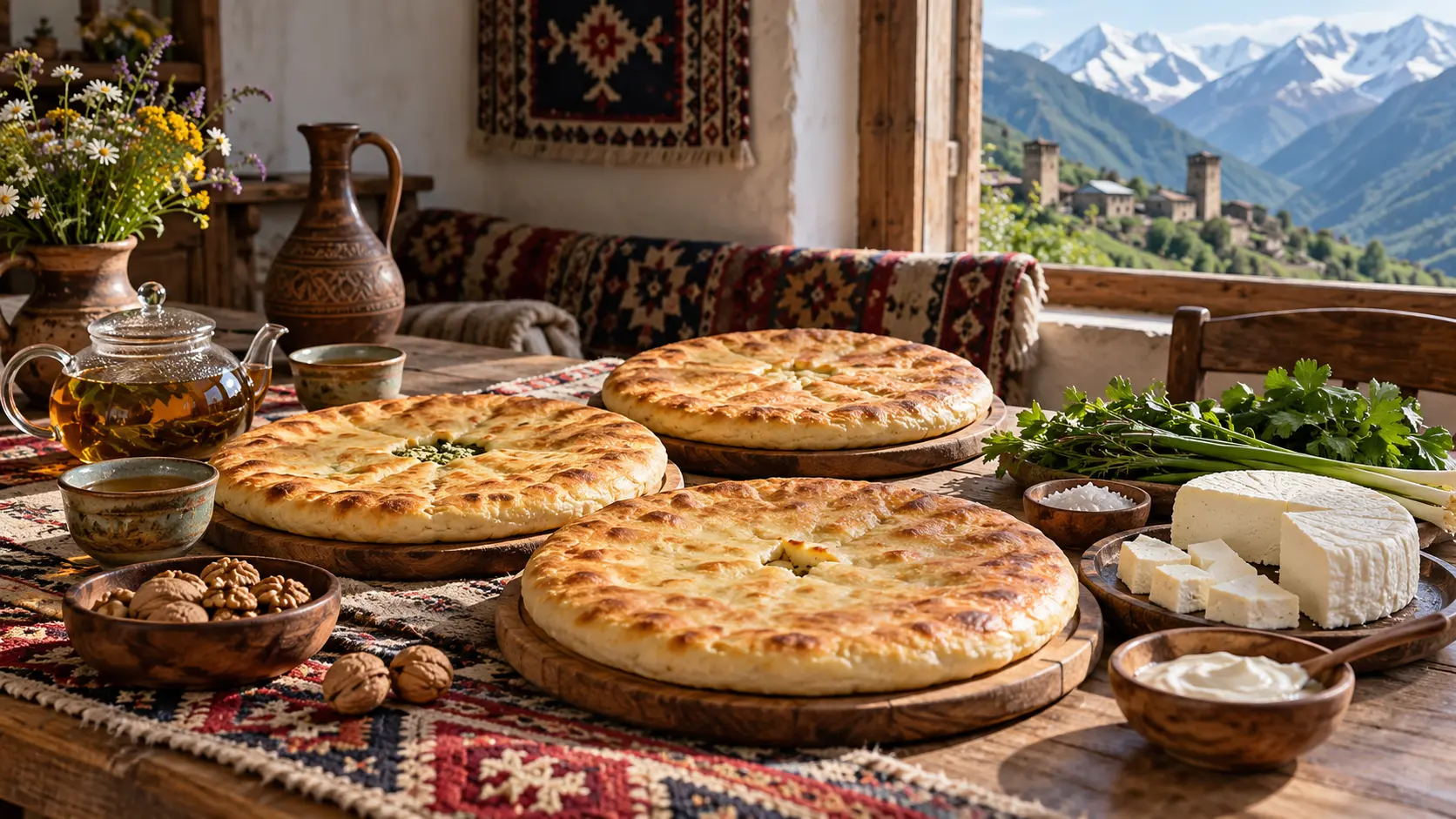
Ossetian Pie
Traditional Three-Filling Pie
The iconic Ossetian pie with thin dough and abundant cheese filling — a sacred dish served at all important gatherings.
Ingredients: 500g flour, 250ml warm milk, 7g dry yeast, 5ml sugar, Salt, 400g fresh Ossetian or feta cheese, 100g butter, 1 egg.
Preparation: Dissolve yeast and sugar in warm milk, let stand 10 minutes. Mix flour and salt, add milk mixture, knead into soft dough. Rest covered for 1 hour. Crumble cheese and mix with softened butter. Divide dough into three portions. Roll each thin, place cheese in center, gather edges and seal, then carefully flatten to 2cm thickness. Cut small hole in center for steam. Bake at 220°C (428°F) for 15-20 minutes until golden. Brush with butter immediately.
💡 The art is in stretching the dough thin while keeping generous filling. Traditional pies are served in odd numbers — three for the living, two for the departed.
Fydzhin
Meat Pie
The beloved meat-filled version of Ossetian pie — juicy seasoned beef encased in tender dough.
Ingredients: 500g flour, 250ml kefir, 5ml baking soda, Salt, 600g ground beef, 2 onions, 4 cloves garlic, Black pepper, Beef broth, Butter.
Preparation: Mix flour, salt, and soda. Add kefir, knead soft dough, rest 30 minutes. Combine meat with finely chopped onions, minced garlic, salt, pepper, and enough broth to make filling juicy but not wet. Divide dough in three, roll thin, fill generously, seal and flatten gently. Cut steam hole. Bake at 220°C (428°F) for 20-25 minutes. Brush liberally with melted butter before serving.
💡 The filling should be very juicy — add broth generously. When you cut the pie, liquid should pool slightly.
Walnut Halva
Mountain Nut Confection
A dense, sweet confection of walnuts and honey — the traditional celebration sweet of the Caucasus.
Ingredients: 400g walnuts, 200g honey, 100g sugar, 50g butter, 5ml vanilla, Pinch of salt.
Preparation: Toast walnuts lightly and chop coarsely. Combine honey, sugar, and butter in a heavy pan. Cook over medium heat, stirring constantly, until mixture reaches soft-ball stage (115°C (239°F)). Remove from heat, add vanilla and salt. Fold in walnuts quickly. Press into buttered pan, smooth top. Cool completely before cutting into diamonds or squares.
💡 Work quickly once you add nuts — the mixture sets fast. Store in airtight container; it keeps for weeks.
🏛️ UNESCO World Heritage Sites
Afghanistan possesses two UNESCO World Heritage Sites, both inscribed on the List of World Heritage in Danger—testimony to both their exceptional value and the challenges of preservation.
Cultural · 2002
Minaret and Archaeological Remains of Jam
Rising 65 meters from a narrow valley where the Hari and Jam rivers meet, the Minaret of Jam is one of the most remarkable structures in the Islamic world. Built around 1190 by Sultan Ghiyas ud-Din of the Ghurid Dynasty, it likely commemorated his victory at Delhi and marked the site of Firuzkuh—the legendary summer capital.
The minaret's surface is entirely covered with intricate geometric patterns, floral designs, and Quranic inscriptions. Getting there remains an adventure—13 hours from Herat over brutal mountain roads.
📍 Ghor Province · ⚠️ In Danger · World's 2nd tallest brick minaret
Cultural · 2003
Cultural Landscape and Archaeological Remains of the Bamiyan Valley
The valley tells the story of Buddhism's westernmost expansion along the Silk Road. The two giant Buddha statues—the 55-meter Salsal and 37-meter Shahmama—were destroyed by the Taliban in March 2001, despite international pleas.
The empty niches remain today, along with thousands of caves containing fragments of Buddhist murals. UNESCO continues preservation efforts at this haunting site. The nearby ruins of Shahr-i-Gholghola ("City of Screams") mark where Genghis Khan's vengeance fell.
📍 Bamiyan Province · ⚠️ In Danger · Former home of world's largest Buddhas
Band-e-Amir National Park
The stunning blue lakes of Band-e-Amir — Afghanistan's first national park
Afghanistan's first national park (established 2009) protects a series of six deep blue lakes separated by natural travertine dams. Often called "Afghanistan's Grand Canyon," the intensity of the blue defies description—turquoise, cobalt, and sapphire shifting with the light.
Local legend attributes the lakes to Imam Ali, who created them by miraculous intervention. Science explains the color as a product of high mineral content and extraordinary water clarity at 2,900 meters elevation. Either way, the sight silences visitors.
The Wakhan Corridor
The remote Wakhan Corridor — where Afghanistan touches China
This narrow finger of land extending to China was created in the 19th century as a buffer between British India and Tsarist Russia. Today, it offers some of the most spectacular mountain scenery on Earth—the Pamirs rising to the north, the Hindu Kush to the south, and traditional Wakhi culture surviving in isolated villages.
The corridor is home to the rare Marco Polo sheep with their magnificent spiraling horns, and Kyrgyz nomads who have maintained their traditional way of life at extreme altitudes.
Nuristan — Land of Light
The forested valleys of Nuristan — "Land of Light"
Hidden in the eastern mountains, Nuristan ("Land of Light") was the last region of Afghanistan to convert to Islam, only in 1896. Its people, with their distinctive features and unique wooden architecture, have preserved traditions found nowhere else. The forested valleys contrast sharply with the barren landscapes elsewhere.
🏛️ Kabul
The capital city sits at 1,800 meters elevation in a valley surrounded by the Hindu Kush. With over 4 million residents, it's a city of contrasts: ancient bazaars beside modern buildings, traditional hospitality amid urban chaos. The Gardens of Babur, final resting place of the Mughal founder, offer respite from the city's intensity. The National Museum houses treasures spanning 50,000 years, including the famous Bactrian gold.
🕌 Mazar-i-Sharif
The "Noble Shrine" takes its name from the Blue Mosque (Shrine of Hazrat Ali), believed to hold the tomb of Imam Ali, cousin and son-in-law of the Prophet Muhammad. The mosque's turquoise domes and intricate tilework make it one of Afghanistan's most beautiful sites. Each spring, during Nowruz (Persian New Year), hundreds of thousands gather to raise the Janda—a sacred flag—in ceremonies dating back centuries.
🎨 Herat
The cultural heart of western Afghanistan, Herat was once the most sophisticated city between Baghdad and Delhi. The Friday Mosque (Masjid-i Jami), with its stunning tilework and soaring minarets, ranks among the finest examples of Islamic architecture anywhere. The Citadel of Herat (Qala Iktyaruddin) dates back to Alexander the Great and offers panoramic views of the city.
🗿 Bamiyan
The small town at the base of the Buddha cliffs has become a symbol of both destruction and hope. Though the giant statues were destroyed in 2001, the empty niches remain, along with thousands of caves containing fragments of Buddhist murals. Band-e-Amir, just two hours away, offers natural beauty of stunning power. The valley is also home to the Dragon Valley (Dara-i-Ajdahar), a canyon with dramatic red and gold cliffs.
Afghanistan has an arid to semi-arid continental climate with extreme seasonal variation. Temperatures can range from -20°C in winter mountain passes to over 45°C in summer desert lowlands.
| Season | Conditions | Recommended? |
| Spring (Mar-May) | Mild temperatures, wildflowers bloom, occasional rain | ✅ Excellent |
| Summer (Jun-Aug) | Hot in lowlands (35-40°C), pleasant in mountains | ⚠️ Mountains only |
| Autumn (Sep-Nov) | Dry, comfortable temperatures, clear skies | ✅ Excellent |
| Winter (Dec-Feb) | Cold, heavy snow in mountains, many roads closed | ❌ Challenging |
Best Time: April-May and September-October offer ideal conditions. Bamiyan can be visited from May to October; the Minaret of Jam only from May to September when roads are passable.
🗓️ 5-7 Days: Essential Afghanistan
- Days 1-2: Kabul — Gardens of Babur, National Museum, old city bazaars
- Days 3-4: Bamiyan Valley — Buddha niches, caves, Shahr-i-Gholghola ruins
- Day 5: Band-e-Amir National Park — blue lakes, hiking
- Days 6-7: Return to Kabul, departure
🗓️ 10-14 Days: Deeper Exploration
- Days 1-3: Kabul — as above, plus day trip to Panjshir Valley
- Days 4-6: Bamiyan & Band-e-Amir
- Days 7-9: Mazar-i-Sharif — Blue Mosque, Nowruz festival (if timing allows)
- Days 10-12: Herat — Friday Mosque, citadel, minarets complex
- Days 13-14: Return to Kabul, departure
🗓️ 14+ Days: The Complete Experience
- All of the above, plus:
- +2-3 days: Minaret of Jam expedition from Herat (challenging but rewarding)
- +5-7 days: Wakhan Corridor — remote trekking, Marco Polo sheep, Kyrgyz nomads
- +2-3 days: Nuristan — forested valleys, unique culture (security permitting)
🔌
Electricity
220V / C, F plugs
Visa Information
Most nationalities require a visa. The process varies depending on current political circumstances. Check with the de facto authorities for latest requirements. Some tour operators can facilitate visa-on-arrival arrangements.
Money & Payment
US dollars are widely accepted; bring clean, recent bills. ATMs are non-functional for international cards. Credit cards are not accepted—bring sufficient cash for your entire trip.
Health & Safety
⚠️ Warning: Most governments advise against all travel to Afghanistan. The security situation varies by region and changes rapidly. Travel only with reputable local operators who understand current conditions. Comprehensive travel insurance is essential (verify Afghanistan coverage). Medical facilities are limited; serious issues may require evacuation.
Getting Around
Domestic flights are limited and unreliable. Road travel is the primary method—hire vehicles with experienced drivers through local operators. Road conditions are often poor; some routes require 4WD. Travel times are much longer than distances suggest.
Prepare for your journey with these essential books about Afghanistan:
-
"The Places in Between"
by Rory Stewart — Walking across Afghanistan in 2002, an extraordinary journey on foot through a war-torn land
-
"An Unexpected Light: Travels in Afghanistan"
by Jason Elliot — Lyrical account of travels during the civil war, capturing Afghanistan's beauty and tragedy
-
"The Kite Runner"
by Khaled Hosseini — Novel capturing Afghan culture, family bonds, and the impact of war on ordinary lives
-
"Afghanistan: A Short History of Its People and Politics"
by Martin Ewans — Essential historical overview for understanding the country's complex past
-
"Caravans"
by James Michener — Classic novel of Afghanistan in the 1940s, following a young American diplomat
There is no McDonald's in Afghanistan, so here's what typical costs look like:
Budget tip: Street food like bolani (stuffed flatbread) and kebab with naan is both delicious and affordable. Bargaining is expected in bazaars.
📸 Photo Gallery

Blue Mosque, Mazar-i-Sharif

Bamiyan Valley Panorama

Minaret of Jam

Bamiyan Valley

Kabul - The Capital

Herat Friday Mosque

Buzkashi - National Sport

Lapis Lazuli Mines
"To visit Afghanistan is to be humbled—by the scale of the mountains, the depth of the history, and the resilience of the people. It is to understand why empires sought to control this crossroads and why they all eventually failed. And it is to carry home something that no photograph can capture: the knowledge that you have touched one of the world's most remarkable places."
— Radim Kaufmann, 2026
Support This Project 🌍
This World Travel Factbook is a labor of love – free to use for all travelers. Consider supporting its development.
📬 Stay Updated