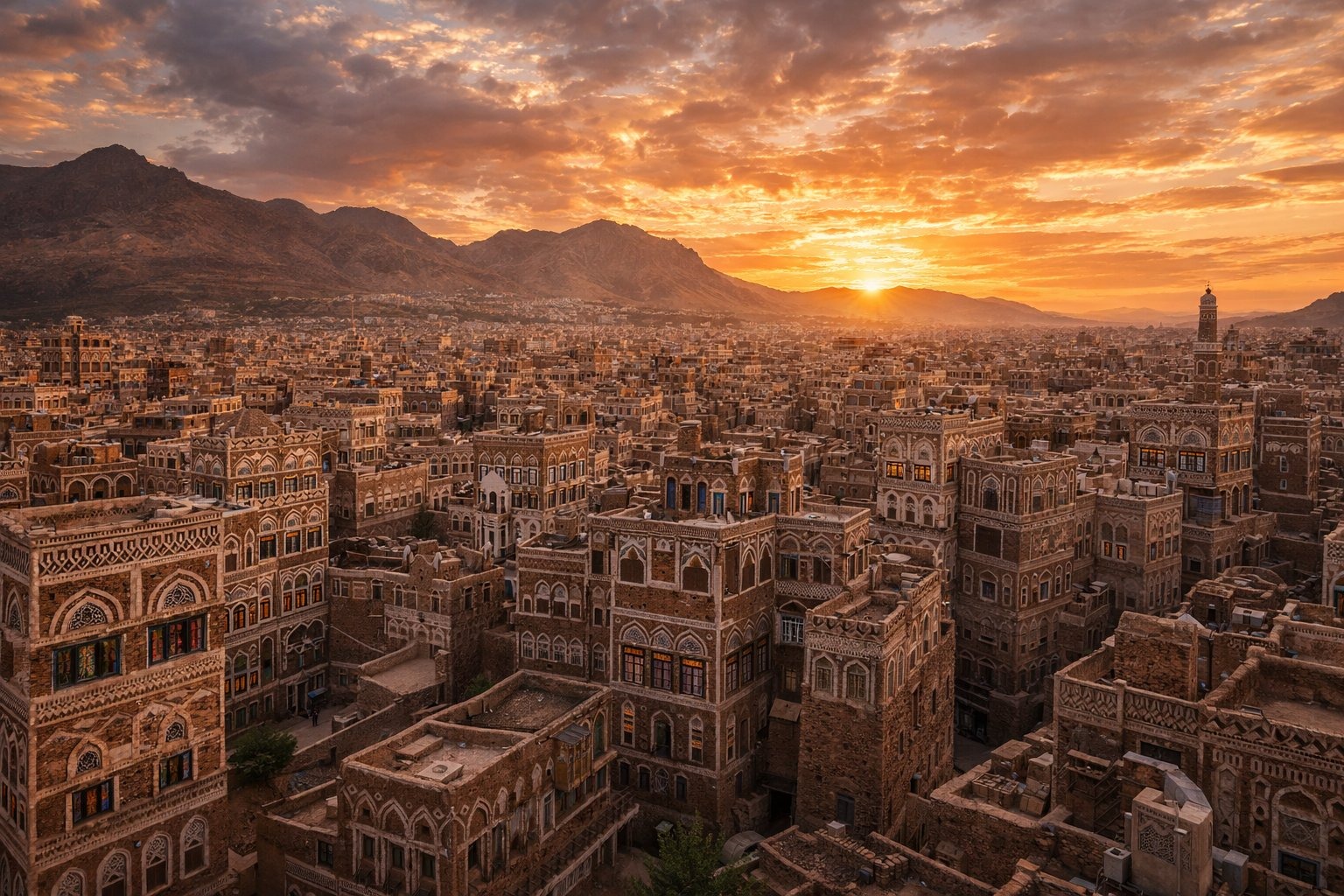
Sana’aConstitutional capital
ArabicPrincipal language
YERCurrency
5UNESCO properties
Contents
01
Arabia Felix, beyond the name
Yemen occupies the south-western corner of the Arabian Peninsula, where high mountains descend toward the Red Sea and the Gulf of Aden. Ancient writers called this fertile trading region Arabia Felix, yet modern Yemen cannot be reduced either to that romantic name or to the war headlines that now dominate its image.
02
Name and identity
The name Yemen is often connected with the idea of the south or the right-hand side when facing east. Identity is layered: local, tribal, regional, Arab and Yemeni loyalties coexist, while the experiences of Sana’a, Aden, Hadramawt, Tihama and Socotra are profoundly different.
03
Mountains, deserts and two seas
Yemen combines volcanic highlands, deep wadis, the arid Rub al-Khali margin, the hot Tihama plain and more than two thousand kilometres of coast and islands. Elevation creates striking climatic contrasts within short distances.
04
Reading Yemen on the map
Saudi Arabia lies to the north and Oman to the east; the Bab al-Mandab narrows the route between the Red Sea and the Gulf of Aden. This location made Yemen central to trade, migration and strategic competition for millennia.
05
The kingdom of Saba
From the first millennium BCE, Saba became one of southern Arabia’s great kingdoms. Monumental temples, inscriptions and irrigation works around Marib reveal a society whose wealth depended on organised agriculture and caravan trade.
06
The Great Dam of Marib
The ancient dam transformed seasonal floods into reliable irrigation and supported a large oasis. Its successive rebuilding became a symbol of engineering, collective labour and the vulnerability of settled life in an arid land.
07
Himyar and late antiquity
Himyar unified much of southern Arabia and connected Red Sea commerce with inland power. The kingdom’s Jewish and Christian chapters show that pre-Islamic Yemen belonged to a wider religious and political world.
08
Islam and medieval Yemen
Yemen entered the Islamic world in the seventh century. Competing dynasties, ports and highland centres produced scholarship, architecture and trade networks, while Zaydi rule became especially influential in the north.
09
Ottoman eras
The Ottoman Empire governed parts of Yemen in two separate periods, never without resistance or negotiation. Mountain geography and strong local authority limited the reach of administration from the coast and from Istanbul.
10
British Aden
Britain occupied Aden in 1839 and developed its harbour as a coaling and trading station. The port became cosmopolitan, drawing communities from Arabia, India, East Africa and beyond.
11
Two Yemens
The north became a republic after the 1962 revolution; the south achieved independence from Britain in 1967 and later formed a Marxist state. Their institutions, alliances and political cultures evolved separately for more than two decades.
12
Unification in 1990
The Yemen Arab Republic and the People’s Democratic Republic of Yemen united in 1990. Unification carried genuine hope, but unresolved power, military and resource questions contributed to the 1994 civil war and later crises.
13
Conflict and divided authority
Since 2014 Yemen has endured a devastating conflict and fragmented authority. Control, alliances and front lines can change; any current political description should be treated as dated information rather than a permanent map.
14
The humanitarian emergency
Conflict, economic collapse, damaged infrastructure and disrupted services have created severe humanitarian need. Behind every statistic are families managing food prices, displacement, illness and interrupted education.
15
People, family and tribe
Family and local networks provide belonging, mediation and practical support. ‘Tribe’ is not a single fixed institution: its meaning varies by region and can involve ancestry, territory, protection, politics and customary law.
16
Arabic and its Yemeni voices
Arabic is the principal language, spoken in several distinctive regional varieties. Mehri, Soqotri and other Modern South Arabian languages preserve separate linguistic traditions, especially in the east and on Socotra.
17
Religious traditions
Most Yemenis are Muslim. Zaydi Shia communities are concentrated in the northern highlands, while Shafi‘i Sunni traditions predominate in many southern and coastal regions; lived practice is more varied than simple labels suggest.
18
Qat and the afternoon
Chewing qat is a widespread social ritual built around conversation and hospitality. It also consumes household income, working time and scarce groundwater, making it both a cultural institution and a difficult policy question.
19
Architecture made for climate
Thick earth walls, stone foundations, shaded lanes and compact settlements respond intelligently to heat, cold nights and limited land. Yemeni buildings are not isolated monuments but parts of living urban systems.
20
Old City of Sana’a
Sana’a’s multi-storey houses combine dark stone, fired brick, white gypsum patterns and luminous qamariyya windows. The UNESCO-listed old city is extraordinary as a complete inhabited landscape, not merely as a collection of façades.
21
Shibam, the desert Manhattan
Inside Shibam’s walls, tall mud-brick houses rise from a compact plan that protects farmland from construction. Maintenance is continual: earthen architecture survives because knowledge and repair are passed between generations.
22
Zabid and the Tihama
Zabid was an important centre of Islamic learning and retains a dense pattern of houses, mosques and lanes. Inappropriate new building and deterioration placed the historic town on UNESCO’s List of World Heritage in Danger.
23
Aden and its crater harbour
Aden grew around an ancient volcanic landscape and one of the region’s great natural harbours. Water tanks, colonial districts and port infrastructure reveal successive attempts to make a difficult site support a global city.
24
Taiz, city beneath Sabir
Taiz lies below Jabal Sabir in a productive highland basin. Known for education, trade and culture, the city has also suffered siege, shelling and fragmentation during the present conflict.
25
Hadramawt
Hadramawt stretches from a broad inland wadi to the Arabian Sea. Its towns, religious centres and merchant families created far-reaching connections with East Africa, India and Southeast Asia.
26
Wadi Dawan
Villages in Wadi Dawan appear to grow directly from cliffs and valley floors. Mud architecture, date cultivation and the vertical scale of the canyon form one of Yemen’s most recognisable cultural landscapes.
27
The Tihama plain
The Red Sea plain is hot, humid and culturally distinct from the highlands. Traditional settlements, fishing, sorghum and market towns reflect an environment shaped by seasonal water and coastal exchange.
28
Haraz mountains
West of Sana’a, fortified villages crown ridges above terraced fields. Haraz is also part of Yemen’s coffee heartland, where altitude and careful cultivation once fed the port trade through Mocha.
29
Socotra archipelago
Socotra lies far offshore where the Arabian Sea meets the Indian Ocean. Long isolation, varied terrain and monsoon winds produced an exceptional concentration of endemic plants and animals.
30
Dragon’s blood trees
The umbrella-shaped dragon’s blood tree is Socotra’s emblem. Its red resin was traded as medicine and pigment, while the tree itself depends on fragile moisture patterns and slow natural regeneration.
31
Biodiversity under pressure
Socotra’s ecological value rests on entire habitats, not one photogenic tree. Grazing, invasive species, development and climate change require conservation led with local communities and long-term monitoring.
32
Coffee and Mocha
Yemen helped transform coffee into a global drink. Beans grown on mountain terraces moved through the port of al-Makha—Mocha—and the port’s name entered the vocabulary of cafés around the world.
33
Saltah, mandi and shared bread
Yemeni food is built for sharing: saltah bubbles in a stone bowl, mandi pairs rice with slow-cooked meat, and breads scoop stews and sauces. Regional kitchens differ, and hospitality matters as much as any recipe.
34
Music and sung poetry
Poetry remains a public art used for celebration, argument and memory. Sana’ani song, Hadrami rhythms and regional dance traditions reveal a musical landscape as varied as the country itself.
35
Craft, silver and the jambiya
Metalwork, woven textiles, basketry and carved wood carry regional styles. The curved jambiya is ceremonial and symbolic; treating it only as a souvenir erases its social meaning and raises legal and ethical questions.
36
Climate and monsoon
Highland summers can be mild and nights cold, while the Tihama is intensely hot and humid. Socotra’s monsoon can isolate communities for months, and rainfall variability shapes agriculture everywhere.
37
Water scarcity
Yemen is among the world’s most water-stressed countries. Falling groundwater, inefficient irrigation, urban growth and conflict interact; restoring local water management is as important as building new infrastructure.
38
World Heritage
Yemen has five UNESCO World Heritage properties: Sana’a, Shibam, Zabid, Socotra and the Landmarks of the Ancient Kingdom of Saba in Marib. Four cultural properties are on the List of World Heritage in Danger.
39
Media and freedom of expression
Journalists and independent voices work under extreme pressure, including detention, intimidation and fragmented control. Reliable reporting requires comparing sources and recognising the risks borne by local reporters.
40
Travel advisory — do not travel
As reviewed on 28 September 2026, the United States and United Kingdom advise against all travel to Yemen. Risks include armed conflict, terrorism, kidnapping, arbitrary detention, landmines and severely limited consular support; this page is cultural education, not a travel recommendation.
41
Access, borders and permits
Flights, sea routes, borders and permissions may change with little notice. Do not treat social-media itineraries or a tour seller’s assurance as proof of safety or legality; consult current official advice and qualified specialist organisations.
42
Responsible interest from afar
Learning about Yemen does not require entering a conflict zone. Support Yemeni writers, researchers, conservation teams and humanitarian organisations, and avoid content that turns suffering or endangered heritage into spectacle.
43
Further reading
Begin with UNESCO’s Yemen country page for heritage, official government advisories for security, and UN agencies for humanitarian context. Then seek Yemeni authors and scholars whose work restores local voices to the centre of the story.
44
Yemen in photographs
The gallery moves from Sana’a and Shibam to Socotra, coffee terraces, Aden and Marib. Every image is part of the project’s licensed visual record and is reused consistently across all language versions.
45
Author’s Note
Yemen asks us to hold beauty and catastrophe in the same frame without allowing either to erase the other. Its tower cities, coffee terraces and island ecosystems deserve attention, but so do the lives continuing behind the headlines. This guide is an invitation to learn carefully, to verify what changes quickly, and to keep Yemeni voices at the centre.
— Radim Kaufmann
Share Your Photo
Have a Yemen photograph you own? Send the location and the name you want credited.
Keep exploring
Read another country, send a correction or support the project.
Back to top ↑