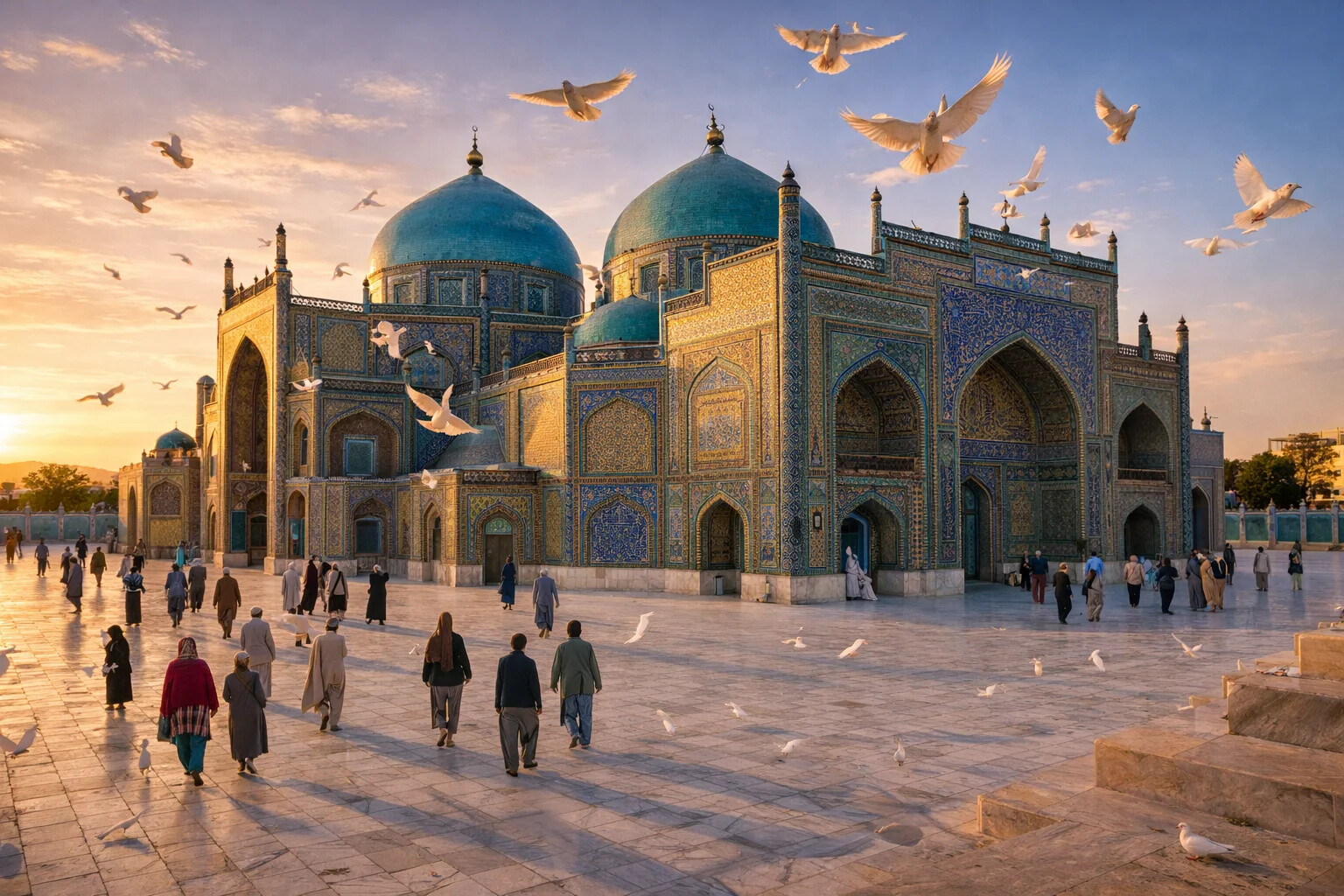
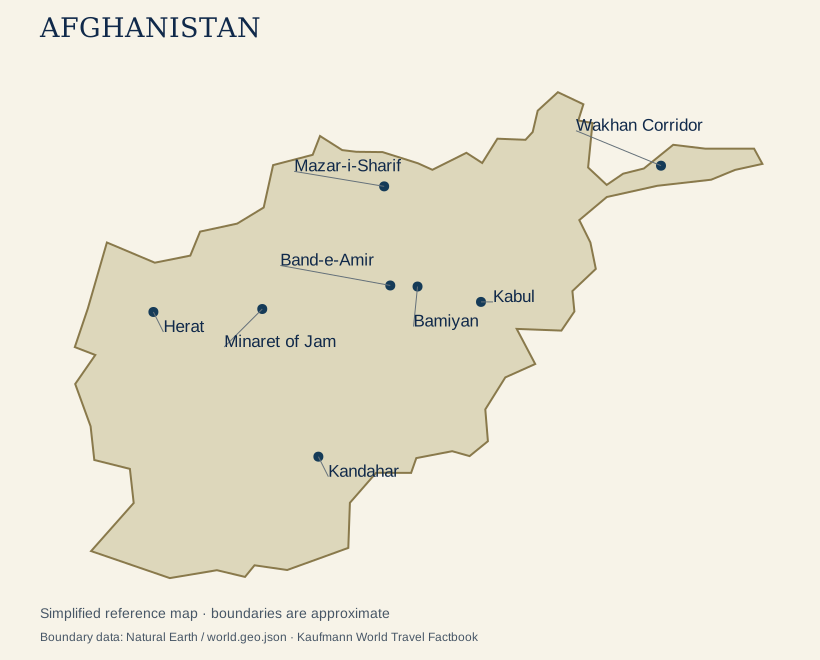
The Crossroads of Central Asia — the turquoise domes of the Blue Mosque at Mazar-i-Sharif, the Hindu Kush's snow-bound passes, and three thousand years of empires passing through.
Afghanistan occupies a position at the very heart of Asia, where the Hindu Kush mountains rise like a spine connecting the Iranian plateau to the peaks of the Himalayas. This landlocked nation of roughly 43.8 million people in the World Bank's 2025 estimate has served for millennia as the crossroads of civilizations—the point where the ancient Silk Road routes converged, where Alexander the Great marched his armies, where Buddhist monks carved colossal statues into cliffsides, and where empires from the Persians to the Mughals to the British contended for influence over the "Graveyard of Empires."
For the adventurous traveler willing to navigate significant challenges, Afghanistan offers experiences found nowhere else on Earth. The haunting empty niches of the Bamiyan Buddhas, once home to the world's tallest standing Buddha statues before their destruction in 2001, remain a powerful testament to both human artistry and human folly. The turquoise lakes of Band-e-Amir, Afghanistan's first national park, shimmer like jewels set in a lunar landscape of travertine dams and desert plateaus. The Blue Mosque of Mazar-i-Sharif was long the site of Afghanistan's largest Nowruz celebrations, a tradition the Taliban have restricted since 2021.
Beyond the famous sites, Afghanistan captivates with its legendary hospitality. Within Pashtunwali, the Pashtun code of conduct, the principle of "melmastia" places a strong obligation on hosts to welcome and protect guests with an intensity that can humble even the most seasoned traveler. Poetry flows through Afghan culture like the rivers through its valleys; this is the region traditionally linked to the poet Rumi, among the most widely read poets in the world. The national sport of buzkashi, a thundering contest on horseback, offers spectacle unlike anything in the Western imagination. And in the remote Wakhan Corridor, Wakhi and Kyrgyz communities maintain distinctive high-altitude pastoral traditions even as new roads, migration and mobile connectivity increasingly link the corridor to the rest of Afghanistan.
2026 Update: Conventional battlefield warfare between Taliban and government forces ended with the 2021 takeover, and many roads see less day-to-day fighting than before — but less conventional warfare is not the same as low risk. ISIS-K attacks, arbitrary detention, kidnapping risk, and sudden Pakistan border closures remain active concerns, and every Western government continues to advise against travel. Those who do visit typically arrange organized tours with experienced local operators, obtain the required permits, and exercise extreme caution throughout their journey.
The name "Afghanistan" derives from "Afghān," a term historically used to refer to the Pashtun people, combined with the Persian suffix "-stān" meaning "land of." Some scholars trace "Afghān" to the Sanskrit "Aśvakan," meaning "horsemen" or "horse breeders"—a fitting etymology for a land where horses have shaped culture from buzkashi fields to mountain warfare for thousands of years.
The country's official name under Taliban governance is the Islamic Emirate of Afghanistan (Dari: امارت اسلامی افغانستان). Before the 2021 takeover, it was known as the Islamic Republic of Afghanistan. This contested identity—between emirate and republic, between tradition and modernity—reflects tensions that have defined Afghan politics for over a century.
Afghanistan hosts remarkable ethnic diversity within its borders. Widely cited estimates suggest Pashtuns form the largest group at around 42% of the population, followed by Tajiks (27%), Hazaras (9%), Uzbeks (9%), and numerous smaller communities including Aimaq, Turkmen, Baloch, and Nuristani peoples — but no reliable modern nationwide census by ethnicity exists, and the figures are politically sensitive as well as imprecise. Each group maintains distinct languages, traditions, and regional concentrations, contributing to a cultural tapestry of extraordinary complexity.
Two languages share official status: Dari (Afghan Persian) serves as the lingua franca and language of government, commerce, and education, understood throughout the country. Pashto, spoken primarily by Pashtuns in the south and east, carries immense cultural significance and is the language of the Taliban leadership. Uzbeki and Turkmeni serve as official languages in their respective regions, while dozens of smaller languages survive in isolated mountain communities.
Afghanistan sprawls across 652,230 square kilometers of some of Asia's most dramatic terrain—roughly the size of France or Texas. The Hindu Kush mountain range dominates the country's geography, running northeast to southwest like a massive stone wall and reaching its apex at Noshaq (7,492 meters), Afghanistan's highest peak and the second-highest in the Hindu Kush after Pakistan's Tirich Mir. This mountain spine divides the country into distinct northern and southern regions and has shaped military strategy from Alexander to the present day.
The country divides roughly into four geographic zones. The Northern Plains stretch along the Amu Darya (Oxus River), forming the border with Turkmenistan, Uzbekistan, and Tajikistan—relatively fertile lands that supported ancient Bactrian civilization and today produce wheat, cotton, and the prized Karakul sheep. The Central Highlands encompass the Hindu Kush and its subsidiary ranges, home to the Hazara people and the spectacular Bamiyan Valley. The Southwestern Plateau contains the deserts of Registan and Margo, harsh lands where temperatures soar above 45°C in summer. The Eastern Mountains, including the Safed Koh range and the famous Khyber Pass, form the contested borderlands with Pakistan.
Afghanistan shares borders with six nations: Pakistan (2,670 km—the longest and most contentious, marked by the disputed Durand Line), Tajikistan (1,357 km), Iran (921 km), Turkmenistan (804 km), Uzbekistan (144 km), and China (91 km via the narrow Wakhan Corridor). This strategic position has made Afghanistan the cockpit of great power competition for centuries—the original "Great Game" between British India and Tsarist Russia played out across these mountains and passes.
The climate varies dramatically with altitude and region. Kabul at 1,800 meters experiences cold winters with regular snow and pleasant summers. The lowlands of Jalalabad and Kandahar bake in summer heat exceeding 40°C. The high Hindu Kush remains frozen much of the year, with some passes closing entirely from November through April. Spring (April-May) and autumn (September-October) offer the most comfortable conditions for travel across most of the country.
Human presence in Afghanistan stretches back at least 50,000 years, with Stone Age artifacts discovered in caves throughout the Hindu Kush. The region emerged into recorded history as part of the Achaemenid Persian Empire under Cyrus the Great around 550 BCE. Alexander the Great conquered the territory in 330 BCE, founding cities including Alexandria Arachosia (modern Kandahar) and Alexandria ad Caucasum (near modern Bagram), and famously marrying the Bactrian princess Roxana—a union that briefly united Greek and Central Asian worlds.
Buddhism flourished in Afghanistan from the 1st to 9th centuries CE, leaving extraordinary monuments including the colossal Buddhas of Bamiyan—the 55-meter Salsal and 38-meter Shamama—carved into cliffsides around 600 CE. The caves of Bamiyan also yielded what may be the world's oldest oil paintings, created by Buddhist monks centuries before the technique appeared in Europe. Islamic armies arrived in the 7th century, beginning a gradual transformation that would make Afghanistan an important center of Islamic civilization.
The modern Afghan state traces its origins to 1747, when Ahmad Shah Durrani united the Pashtun tribes and established the Durrani Empire, stretching from eastern Iran to northern India. His mausoleum in Kandahar remains a pilgrimage site. The 19th century brought the "Great Game" — Anglo-Russian competition for regional influence that produced three Anglo-Afghan Wars (1839–1842, 1878–1880, 1919). Britain secured decisive control over Afghan foreign policy after the second of these wars, a grip Afghanistan did not fully throw off until the third war concluded in 1919. The retreat from Kabul in January 1842 became the era's most infamous disaster: a retreating column of roughly 16,000 people — about 4,500 soldiers and some 12,000 camp followers — was cut down in the mountain passes. The popular tale that army surgeon William Brydon was the retreat's sole survivor overstates the case; he was the only one to reach Jalalabad unassisted, though a number of others were taken captive and later released. Episodes like this cemented Afghanistan's modern reputation as the "Graveyard of Empires" — a durable slogan, though not quite a historical law, since the Achaemenids, Kushans, Ghaznavids, Ghurids and Durranis all ruled successfully from Afghan soil for generations. The territory was less a place where empires simply failed than one that was difficult for distant capitals to control permanently.
The 20th century brought modernization under King Amanullah (1919-1929), followed by relative stability until the 1978 Saur Revolution brought communist rule. Soviet invasion in 1979 triggered a decade of devastating war that killed over a million Afghans and displaced millions more. The Soviet withdrawal in 1989 led to civil war, Taliban rule (1996-2001), the U.S.-led invasion after 9/11, twenty years of continued conflict, and the Taliban's return to power in August 2021. This tumultuous history has left deep scars but also forged a population of remarkable resilience.
The country is governed today by the Taliban, who call their administration the Islamic Emirate of Afghanistan. International recognition has come slowly: Russia became the first and, as of 2026, only country to formally recognize the government, doing so in July 2025. Short of full recognition, more than forty countries — including China, Pakistan, the United Arab Emirates, and Uzbekistan — maintain embassies, consulates, or working diplomatic contact with Kabul. Most Western governments, including the United States and the United Kingdom, have not reopened embassies in Kabul and continue to withhold recognition, citing the Taliban's restrictions on women's education and employment among their concerns.
06
👥 People & Culture
Kabuli Pulao
Afghanistan's beloved national dish — rice, lamb, carrots, and spices
Afghanistan's population — estimated at somewhere between 45 and 49 million in 2026 depending on methodology, with no reliable nationwide census held since 1979 — represents one of the world's youngest populations, with a median age under 18. Decades of conflict have created a demographic pyramid weighted heavily toward youth, presenting both challenges and opportunities as the country attempts to build stability. Family remains the fundamental social unit, with extended family networks providing social safety nets in a country where government services remain limited.
The concept of "Pashtunwali"—the traditional code of the Pashtun people—influences behavior throughout southern and eastern Afghanistan, though its principles resonate across ethnic lines. Key elements include "melmastia" (hospitality to guests), "nanawatai" (asylum and protection), "badal" (revenge/justice), and "namus" (protection of women's honor). These codes create obligations that visitors often experience as overwhelming generosity—refusal of hospitality can cause genuine offense.
Poetry holds sacred status in Afghan culture. The classical Persian poets Rumi — traditionally associated with Balkh, though some modern scholarship places his birth in Vakhsh, in present-day Tajikistan — and Hafez are revered; their verses appear in everyday conversation, business negotiations, and political speeches. Contemporary poetry remains vital, with "landay"—two-line folk poems, often composed by women—offering windows into emotions rarely expressed publicly. Music similarly permeates Afghan life, from the classical traditions of Kabul Radio to the pop music of Ahmad Zahir, "the Afghan Elvis," whose songs from the 1970s still dominate celebrations.
Islam shapes daily rhythms—the five daily prayers, Friday gatherings at mosques, the month of Ramadan fasting. While approximately 85% follow Sunni Islam (predominantly the Hanafi school), significant Shia communities exist, particularly among the Hazara people. Pre-Islamic traditions survive in folklore, wedding customs, and the celebration of Nowruz (Persian New Year), which marks the spring equinox with gatherings, special foods, and the famous raising of the "janda" flag at Mazar-i-Sharif.
🗣️ Useful Phrases
Dari (most widely understood):
Salaam (سلام) — Hello/Peace
Tashakor (تشکر) — Thank you
Khub astam (خوب هستم) — I'm fine
Lotfan (لطفاً) — Please
Bale/Na (بله/نه) — Yes/No
Pashto (south & east):
Assalamu Alaikum — Peace be upon you
Manana (مننه) — Thank you
Za khah yam — I am fine
Sta numa tse da? — What is your name?
07
🏛️ Afghanistan Under the Taliban — 2021–2026
When the Taliban swept into Kabul on 15 August 2021 as the last U.S. troops withdrew, they did not restore a constitution or hold elections — they declared an Islamic Emirate governed by decree. Five years on, the country has no legislature, no political parties, and no judiciary independent of the movement's own clerical hierarchy; courts apply the Taliban's interpretation of Hanafi Sharia law, and an acting cabinet under Prime Minister Hasan Akhund runs day-to-day administration from Kabul while ultimate authority rests with the Supreme Leader, or amir al-mu'minin ("commander of the faithful").
That Supreme Leader, Haibatullah Akhundzada, governs from Kandahar rather than the capital — a choice with real consequences. He rarely appears in public, communicates largely through clerics, and has issued hundreds of decrees since 2021 covering everything from public administration to the restrictions on women described below, often with little consultation of his own Kabul-based ministers. Reporting through 2025 and into 2026 has described real friction between Akhundzada's circle in Kandahar and more pragmatic figures in the Kabul cabinet, including Interior Minister Sirajuddin Haqqani and Defense Minister Mohammad Yaqoob — tension that broke into the open in late 2025 when Kabul ministers moved to reverse an Akhundzada-ordered nationwide internet shutdown within days. On 8 July 2025 — acting on an application the Prosecutor had filed that January — the International Criminal Court issued arrest warrants for Akhundzada and the Taliban's chief justice over the persecution of women and girls, a step the Taliban rejected as outside the Court's jurisdiction.
Externally, relations with Pakistan — once the Taliban's chief patron — have deteriorated into open conflict. Long-simmering disputes over the Durand Line and Pakistan's demand that Kabul rein in the Tehrik-i-Taliban Pakistan (TTP) militant group erupted into cross-border airstrikes and ground fighting in October 2025 and again, more severely, in February–March 2026, when Pakistani strikes reached Kabul and Kandahar province; each round has been followed by a ceasefire that has since been violated and renewed, with skirmishes still reported into the summer of 2026. Domestically, the Taliban have all but ended the conventional front-line warfare that defined 2001–2021, but Islamic State–Khorasan Province (ISIS-K) has emerged as the country's main insurgent threat, striking Taliban officials and, as at Bamiyan in 2024, foreign tourists.
None of this has stopped the Taliban government from actively courting tourism as a source of revenue and international standing — official figures point to several thousand foreign visitors a year and rising, promoted through state media even as the same authorities restrict half the population from parks, universities and most paid work. It's a genuinely difficult country to summarize in a sentence: a state that ended one kind of war while fighting others, calmer on the roads than it has been in decades and, for its own citizens, less free than at almost any point in living memory.
08
👩 Women in Afghanistan — Life Behind the Restrictions
Afghanistan is, by the assessment of the United Nations and most major human rights organizations, the only country in the world that systematically excludes women and girls from secondary and higher education — a status some UN officials and rights groups now describe as "gender apartheid." The restrictions arrived in stages after August 2021: girls barred from school beyond sixth grade in 2021–22, women excluded from universities in December 2022, then barred in sequence from most paid employment, from parks and gyms, from beauty salons, and — since 2023 — from Band-e-Amir National Park (see above). More than 70 decrees affecting women's rights have been issued since 2021, the Ministry of Women's Affairs was dismantled and replaced by a Ministry for the Propagation of Virtue and Prevention of Vice that now deploys thousands of enforcement personnel nationwide, and travel beyond a certain distance generally requires a mahram, or male chaperone.
The scale is stark: UNICEF estimated in August 2026 that more than 2.6 million girls had been denied a secondary education in the five years since 2021, and projects the country could lose up to 20,000 women teachers and 5,400 female health workers by 2030 as trained professionals age out of the workforce with no one trained to replace them — women's representation in the civil service fell from 21% to under 18% between 2023 and 2025 alone. On 8 July 2025, the International Criminal Court issued arrest warrants for the Taliban's Supreme Leader and chief justice specifically over the persecution of women and girls; the Prosecutor had filed the applications that January.
None of this has stopped Afghan women from working around it. A network of underground schools, organized quietly out of private homes since 2021, was reaching more than 15,000 students across 40-plus locations by late 2025, taught largely by women who lost their own teaching jobs when the ban began. UN Women reported supporting more than 5,000 Afghan women entrepreneurs in 2025 alone, from home-based food businesses to online ventures that route around restrictions on women's movement and workplace presence. Afghan women doctors continue to practice, since the Taliban's own rules require women to be treated by female medical staff; women's rights activists, in the country and in exile, continue to document and publicize each new decree as it's issued. It amounts to a daily, unglamorous persistence rather than open confrontation — about the only form of resistance the current environment leaves much room for.
Kabul sprawls across a high mountain valley at 1,800 meters elevation, home to an estimated 4.5 million people—making it one of the fastest-growing cities in the world despite decades of conflict. The city's history stretches back at least 3,500 years; it served as a center of Zoroastrian and later Buddhist civilization before the Arab conquests brought Islam in the 7th century. The Mughal Emperor Babur loved Kabul above all other cities in his empire, and his gardens remain a treasured green space in the heart of the modern city.
The Gardens of Babur (Bagh-e Babur) offer the city's most pleasant retreat—terraced Persian gardens restored to their 16th-century glory, containing the tomb of Babur himself. The National Museum of Afghanistan, though devastated by civil war and looting, has slowly recovered treasures spanning from Bronze Age Bactrian gold to Buddhist sculptures to Islamic calligraphy. The ruined Darul Aman Palace, once a symbol of Afghan modernization, stands as a haunting monument to dreams interrupted by war.
Modern Kabul presents a study in contrasts: armored vehicles share streets with donkey carts; five-star hotels operate blocks from shattered buildings; burqa-clad women pass billboards featuring cosmetics. The city center clusters around Chicken Street (once famous for hippie-era antique shopping) and the Shar-e-Naw neighborhood, where most hotels serving foreign visitors are located. The old city around the river contains bustling bazaars selling everything from carpets to caged birds.
Kabul experiences a continental climate with cold, snowy winters (temperatures can drop below -20°C) and warm, dry summers. Spring brings the spectacular blooming of fruit orchards that once made the Kabul Valley famous throughout Asia. The city remains the hub for all travel within Afghanistan—obtaining permits, arranging guides, and organizing transportation typically requires at least a day or two here before venturing into the provinces.
10
☸️ Mes Aynak — A Buddhist City Above a Copper Mine
Mes Aynak
Buddhist wall painting from a monastery built directly above a copper deposit
Forty kilometers south of Kabul, in Logar Province, a fortified Buddhist monastic city sits directly on top of one of the world's largest untapped copper deposits — an estimated 5.5 million tonnes of high-grade ore. Mes Aynak ("little copper source" in Pashto) grew as a mining and metalworking settlement from at least the 1st century BCE, and by the 1st century CE had become a major Buddhist religious center: at least seven fortified monastery complexes, nearly a hundred stupas, chapels, watchtowers and residential quarters spread across some 40 hectares, with an even older Bronze Age settlement layered beneath. The site flourished until roughly the 7th century CE, when both mining and monastic life came to an end.
French and Afghan archaeologists — working under DAFA, the French Archaeological Delegation, alongside the Afghan Institute of Archaeology — have spent years in "salvage archaeology" here, racing to document double-life-size Buddha statues still bearing traces of painted robes, gilded reliquaries, manuscript fragments and frescoed walls before mining activity can reach them. Philippe Marquis, who has led much of the French mission's work, has called it one of the most important points on the entire Silk Road.
A 2007 agreement handed the mining rights to China's state-owned Metallurgical Corporation of China (MCC), and for over a decade the site's fate swung between competing pressures — heritage preservation against a resource Afghanistan badly needs to develop. The most recent public plan, announced by the Taliban government's Ministry of Mines and Petroleum in 2024, calls for underground rather than open-pit extraction specifically so the archaeological complex above can survive, under a 30-year agreement that also commits MCC to local infrastructure and jobs. Given how often the timeline has shifted, treat any description of the site's current physical state as provisional and reconfirm before planning a visit — access in any case requires permits and a trusted local operator, as Logar has also seen periodic security incidents.
11
🕌 Ghazni — Capital of an Empire
Ghazni Minaret
Intricate 12th-century brickwork on the Mas'ud III tower
Roughly midway between Kabul and Kandahar on the old Ring Road, Ghazni was once the capital of an empire that stretched from central Iran to the Punjab. Sultan Mahmud of Ghazni, who ruled from 998 to 1030, was the son of Sabuktigin, a former Turkic slave-soldier who had seized the throne in 977; under Mahmud's more than twenty campaigns the Ghaznavid state became the dominant power of its age, and its capital grew into a Persianate cultural center that contemporaries compared to Baghdad — despite the dynasty's Turkic military origins.
Mahmud's court drew some of the era's greatest minds: the polymath Al-Biruni, and the poet Ferdowsi, who completed and expanded the Shahnameh — the Persian national epic — partly under Ghaznavid patronage, even as later legend holds the two men fell out over payment. The empire is remembered above all in South Asia for Mahmud's repeated campaigns into India, including a notorious raid on the Somnath temple whose sandalwood doors were later carried off by British forces in 1843 and displayed at Agra Fort.
Little of Ghaznavid Ghazni survives above ground. What remains are two star-shaped brick minarets — "Towers of Victory" raised by later sultans Mas'ud III (r. 1099–1115) and Bahram Shah (r. 1118–1157) — along with an excavated palace and Mahmud's own modest mausoleum, its original sandalwood doors long since replaced by later copies. The Ghaznavid dynasty itself outlived Mahmud by over a century before Ghurid conquerors — the same dynasty behind the Minaret of Jam — overran Ghazni and pushed the Ghaznavid court to Lahore. For the traveler, Ghazni is a reminder that the borders of today's Afghanistan, Iran and India are a modern accident layered on top of empires that ignored them entirely.
12
🏛️ Kandahar — Birthplace of the Modern Afghan State
Long before it was Kandahar, this was Arachosia, a satrapy of the Achaemenid Persian Empire and later, after Alexander the Great's conquest in 330 BCE, the site of Alexandria Arachosia — one of dozens of cities the Macedonian king founded and named after himself across his empire. The location mattered because it still does: Kandahar sits astride the historic route linking Persia to India, which is exactly why Ahmad Shah Durrani chose it in 1747 as the capital from which he united Pashtun tribal confederations into what's usually counted as the first Afghan state. His mausoleum, a blue-tiled shrine near the Shrine of the Cloak — which holds a garment traditionally attributed to the Prophet Muhammad — remains a pilgrimage site and the closest thing Afghanistan has to a founding-father monument.
Kandahar's more recent history explains why it still matters more than its size suggests. The Taliban movement itself formed here in the early 1990s under Mullah Omar, and Kandahar — not Kabul — has functioned as the movement's spiritual and political center of gravity ever since: Supreme Leader Haibatullah Akhundzada, born in Kandahar province, governs the country from here rather than from the capital, ruling largely by decree through a small circle of Kandahar-based clerics while an administrative cabinet runs day-to-day government from Kabul. The dynamic — hardline authority radiating out from Kandahar, more pragmatic administration concentrated in Kabul — is one of the more consequential facts about how Afghanistan is actually governed in 2026, even though it rarely appears in most descriptions of the country.
The city itself sits in a fertile agricultural belt famous for pomegranates, grapes and historically some of the finest fruit in Central Asia, irrigated by the karez underground channel systems that have watered this desert region for centuries. It has also, in 2025 and 2026, been a literal front line: Spin Boldak, the Kandahar province border crossing with Pakistan, has repeatedly been a flashpoint in the cross-border fighting between Taliban and Pakistani forces that flared in October 2025 and again in early 2026, with the crossing periodically closed to the trade and travel that normally passes through it. For a visitor, Kandahar remains far more restricted and far less visited than Kabul, Herat or Mazar-i-Sharif — but understanding modern Afghanistan without it is a bit like trying to understand modern Iran without Qom.
13
🏔️ Bamiyan Valley — Where Buddhas Once Stood
Bamiyan Buddha Niches
The haunting empty spaces where Buddhas stood for 1,500 years
The Bamiyan Valley cuts through the Hindu Kush mountains 230 kilometers northwest of Kabul, a green oasis surrounded by rust-colored cliffs that once hosted one of the greatest Buddhist monuments ever created. The two colossal Buddha statues—the 55-meter Salsal and 38-meter Shamama—were carved into the sandstone cliffs around 600 CE during the height of Buddhist civilization along the Silk Road. Their destruction by the Taliban in March 2001 shocked the world and brought global attention to Afghanistan's cultural heritage.
Today, the empty niches where the Buddhas stood remain profoundly moving—perhaps more powerful in their absence than they ever were in their presence. The surrounding caves, numbering in the hundreds, still contain fragments of the world's oldest known oil paintings, created by Buddhist monks centuries before European artists developed the technique. UNESCO has designated the site a World Heritage property, and international efforts continue to preserve what remains while debating whether reconstruction might be possible or appropriate.
Beyond the Buddha site, Bamiyan Province contains some of Afghanistan's most spectacular natural scenery. Band-e-Amir, approximately 75 kilometers west, is a series of six deep blue lakes separated by natural travertine dams—Afghanistan's first national park and a destination of almost surreal beauty. The lakes' intense turquoise color, set against a barren landscape of red and brown cliffs, creates scenes that seem to belong to another planet.
The Hazara people who inhabit the valley maintain a distinct culture, speaking Hazaragi (a Dari dialect with Mongol and Turkic influences) and practicing predominantly Shia Islam — a heritage shaped by layered Central Asian, Iranian and Mongolic history rather than any single origin, and marked by a hard record of persecution, including massacres and enslavement under Amir Abdur Rahman Khan in the 1890s and, in recent years, targeted attacks by Islamic State–Khorasan Province (ISIS-K). Bamiyan has often experienced less front-line conflict than other parts of Afghanistan, but it should not be described as safe: in May 2024, gunmen claimed by ISIS-K killed six people, including three Spanish tourists, in an attack on Bamiyan's central bazaar.
14
🕌 Mazar-i-Sharif — The Noble Shrine
Blue Mosque Golden Hour
White doves and pilgrims at the Shrine of Hazrat Ali
Mazar-i-Sharif—literally "Tomb of the Exalted"—centers on the stunning Shrine of Hazrat Ali, known locally as the Blue Mosque for its soaring domes covered in brilliant turquoise tiles. Many Afghans believe this shrine marks the true burial place of Ali ibn Abi Talib, cousin and son-in-law of the Prophet Muhammad and the fourth caliph of Islam. While most scholars place Ali's tomb in Najaf, Iraq, the faith of pilgrims who visit Mazar needs no archaeological validation.
The shrine as it stands today dates primarily from the 15th century, though the tradition claims much earlier origins. Its exterior dazzles with geometric tilework in shades of blue, white, and yellow; the interior contains the green-draped cenotaph that pilgrims circle in prayer. The surrounding plaza fills with white doves—considered sacred and fed by visitors—creating an atmosphere of remarkable peace that seems to transcend Afghanistan's troubles.
Nowruz, the Persian New Year celebrated on the spring equinox (March 20–21), long transformed Mazar into the center of Afghan celebration: the "raising of the janda" — the ceremonial flag — at the shrine drew hundreds of thousands of pilgrims for festivities that could last a week, one of the few celebrations observed by Sunni and Shia, Pashtun and Tajik alike. The Taliban removed Nowruz from the official calendar after 2021 and have restricted or blocked large public gatherings at the shrine since; the flag-raising has continued in some recent years in a reduced, more tightly controlled form, but it should be treated as a historical tradition rather than a reliable current tourist event.
As a city, Mazar-i-Sharif serves as the commercial hub of northern Afghanistan, with a population approaching one million. The ancient city of Balkh—long linked to the poet Rumi's family and early life, and once known as the "Mother of Cities"—lies just 20 kilometers to the west, its ruined walls and remaining shrines testifying to millennia of habitation. The relatively flat terrain and developed infrastructure make Mazar more accessible than many Afghan destinations, and its proximity to the Uzbekistan border (Hairatan crossing) offers an alternative entry point to the country.
15
🏺 Balkh — Mother of Cities
Balkh's Green Mosque
15th-century mosque beside the ruins of the ancient "Mother of Cities"
Twenty kilometers from Mazar-i-Sharif's modern shrine and bazaars lies a low ring of eroded mud-brick walls that was, for much of ancient history, one of the great cities of Asia — old enough that medieval Arab geographers called it Umm al-Bilad, "Mother of Cities." As Bactra, it was a satrapal capital under the Achaemenid Persian empire and a center of Zoroastrian tradition; Alexander the Great passed through and married Roxana nearby; under his Greco-Bactrian successors and later the Kushan empire, Balkh sat at the meeting point of Persian, Hellenistic, Indian and Central Asian civilizations, and Buddhism flourished here alongside older Iranian religious traditions.
Islamic Balkh, from the 7th century onward, became one of the great cities of the Persianate world — a center of scholarship whose intellectual reputation drew students from across the Islamic east. Local tradition places the birth of the poet and mystic Jalal ad-Din Muhammad, known to the world as Rumi, in or near the wider Balkh region around 1207, before his family's westward migration; the exact site and even the century of his family's departure remain debated by historians, so this is best understood as a claim of cultural inheritance rather than a settled fact. Balkh's medieval prosperity ended catastrophically in 1220–21, when Genghis Khan's armies destroyed the city so thoroughly that it never fully recovered its former primacy — that role passed to nearby Mazar-i-Sharif in the centuries that followed.
Today's Balkh is a quiet market town built beside the ruins, with the restored 15th-century Green Mosque, sections of ancient rampart walls, and archaeological mounds still only partially explored. It sits on Afghanistan's UNESCO Tentative List, and for the traveler already visiting Mazar-i-Sharif, the short detour is a chance to stand inside the outline of a city that predates Rome and outlasted a dozen empires.
16
🏛️ Ai-Khanoum — A Greek City at the Edge of the World
Ai-Khanoum
A Heracles relief from the Greek city at the edge of the world
At the confluence of the Kokcha River and the Amu Darya in remote Takhar Province stand the ruins of Ai-Khanoum — proof that the Hellenistic world Alexander the Great set in motion reached far beyond Anatolia and the Mediterranean. Founded around 300–285 BCE, probably under the Seleucid rulers who inherited this corner of Alexander's conquests, the city grew into a fully Greek urban center some 3,000 miles from the Aegean: a theater, a gymnasium, a colonnaded royal palace, an arsenal, and a heroön — a shrine to a Greek founder-hero — inscribed with philosophical maxims copied, according to the dedication, from the oracle at Delphi itself.
The city (its ancient name is still unknown — Ai-Khanoum, "Lady Moon," is simply the modern Uzbek name for the site) was rediscovered by accident in 1961, when the Afghan king Mohammad Zahir Shah, out hunting, noticed a fragment of Corinthian-style column in the ground. French archaeologists led by Paul Bernard excavated it between 1964 and 1978, uncovering coins, Greek inscriptions and everyday objects that show a genuinely mixed population — Greek, Macedonian and Bactrian — living under a Greek civic order for roughly a century and a half, until nomadic Saka invaders overran the city around 145 BCE as the Greco-Bactrian kingdom collapsed.
War reached Ai-Khanoum long after antiquity: the site was looted extensively during Afghanistan's civil conflicts of the 1980s and 1990s, and only limited archaeological work has resumed since the mid-2000s. What survives is nonetheless one of the most important Hellenistic sites east of Mesopotamia — tangible evidence, not metaphor, for how far Greek civilization actually traveled.
17
👑 Tillya Tepe — The Gold That Survived Afghanistan's Wars
Tillya Tepe Gold
A gold figurine from the Bactrian Gold hoard, hidden for a decade to survive Afghanistan's wars
Near Sheberghan in Jowzjan Province, Soviet archaeologist Viktor Sarianidi and an Afghan-Soviet team opened six nomadic burial mounds in 1978 — five women and one man, dated to roughly the 1st century BCE to 1st century CE — and found more than 20,000 gold objects inside: necklaces, belts, a folding crown designed for travel, medallions stamped with Dionysus and with the Buddha side by side, rings carrying Greco-Roman deities, and ornaments echoing Chinese dragon motifs and Siberian steppe art. Tillya Tepe means "Hill of Gold," and the hoard found there — the Bactrian Gold — is now understood not as looted treasure from elsewhere but as the product of local workshops fusing Greek, Roman, Indian, Iranian and nomadic steppe styles into something genuinely new.
Sarianidi's team had to abandon the site in early 1979 as Afghanistan slid toward war, leaving one grave unexcavated; it was later stripped by looters. The recovered treasure fared better, but only through deliberate secrecy: in 1988, with Soviet troops withdrawing and the government of Mohammad Najibullah bracing for chaos, a small team moved the gold from the National Museum in Kabul to a hidden vault, and swore not to reveal its location. For more than a decade — through civil war, the Taliban's first period in power, and the looting that gutted the National Museum after a 1993 rocket strike — the guardians kept their secret. The vault was reopened in 2003, after the Taliban's fall, and the Bactrian Gold turned out to have survived completely intact.
The Tillya Tepe treasure has since toured museums worldwide as a display of Afghanistan's depth as a cultural crossroads — proof, in gold, that "crossroads of civilizations" is not just a slogan.
Herat occupies a fertile valley in western Afghanistan near the Iranian border, its history stretching back over 3,000 years to the time when it served as a capital of the ancient Aria kingdom. Alexander the Great built fortifications here; the city later flourished under various Persian, Arabic, and Turkic empires before reaching its zenith under the Timurids in the 15th century, when it rivaled Samarkand as a center of Islamic art, architecture, and learning.
The Friday Mosque (Masjid-i Jami) stands as Herat's architectural masterpiece, its construction spanning from the 12th to 15th centuries. The massive courtyard can accommodate thousands of worshippers; the tilework and calligraphy represent some of the finest Islamic decorative arts anywhere. Remarkably, the mosque operates an on-site tile workshop where craftsmen continue producing replacements for damaged pieces using traditional techniques—a living link to medieval artisans.
Qala Ikhtiyaruddin (Arg-e-Herat) dominates the old city from its commanding hilltop — traditionally associated with a fortress Alexander the Great's forces are said to have founded, though the surviving fabric reflects many later building periods, particularly under the Kartid and Timurid dynasties. Recent restoration efforts have returned portions to their former glory, and the citadel now houses a museum with artifacts spanning Herat's many civilizations. The surrounding old city retains much of its traditional character, with covered bazaars, caravanserais, and neighborhoods of mud-brick houses that have changed little in centuries.
Herat's distinct culture reflects its position at the crossroads of Persian and Central Asian civilization. The city is famous throughout Afghanistan for its music, poetry, and refined arts—particularly the tradition of miniature painting that flourished under Timurid patronage. Modern Herati music, blending classical Persian modes with Afghan folk traditions, remains popular nationwide. The city's relative stability and connection to Iran (Islam Qala border crossing) make it one of the more accessible Afghan destinations for cautious travelers.
19
🗼 Minaret of Jam — The Lost Monument of the Ghurids
Minaret of Jam
UNESCO World Heritage Site rising 65 meters in the Hari River valley
Afghanistan has only two UNESCO World Heritage Sites, and the Minaret of Jam — not the far better-known Bamiyan — was inscribed first, in 2002. It stands alone in a steep, uninhabited river gorge in Ghor Province, at the point where the Jam River meets the Hari Rud, reachable only by a rough multi-day track from Herat or Chaghcharan. There is no town here, no bazaar, nothing but the tower itself: a soaring, tapering minaret of fired brick, roughly 65 meters tall, covered top to bottom in geometric brickwork and bands of turquoise-glazed tile and Kufic inscription, including the entire 19th chapter of the Quran.
Built around 1190 under Sultan Ghiyath al-Din, the minaret is essentially the only substantial structure left from the Ghurid Empire, a Persianate dynasty that briefly ruled from eastern Iran to northern India and laid the groundwork for the Delhi Sultanate before it splintered. Historians believe Jam marks the site of Firuzkoh, the Ghurids' summer capital, otherwise erased so completely that its exact identification is still debated. The tower went unrecorded by the outside world until a French-Afghan survey team, following rumors of "a minaret in the mountains," located it in 1957.
Jam has been on UNESCO's List of World Heritage in Danger since its inscription: the riverbank beneath it erodes further with every flood season, the structure leans, and its remoteness makes both monitoring and conservation work difficult and expensive. Visiting requires real logistical commitment and a good operator — this is not a roadside stop — but for travelers who make it, Jam offers something Bamiyan no longer can: an ancient monument still standing exactly where it was built, with no crowds and no gift shop, in one of the most isolated valleys in Afghanistan.
20
🗻 Wakhan Corridor — The Roof of the World
Wakhan Corridor
Remote valleys touching China at the roof of the world
The Wakhan Corridor stretches like a narrow finger between Tajikistan to the north and Pakistan to the south, extending 350 kilometers to touch China at its eastern tip—a geographical anomaly created by 19th-century diplomats seeking to keep Russian and British empires from sharing a border. This remote strip of high-altitude valleys and glaciated peaks offers some of Asia's most spectacular and least-visited mountain scenery.
The corridor rises from its western entrance at around 2,800 meters to the 4,923-meter Wakhjir Pass on the Chinese border—the only point where Afghanistan and China meet. The Hindu Kush and Pamir ranges converge here, creating a landscape of 7,000-meter peaks, massive glaciers, and valleys so remote that Marco Polo sheep (Ovis ammon polii) still roam wild. These magnificent animals, with horns spanning over 140 centimeters, were named for the Venetian explorer who crossed this region in the 13th century.
The Wakhi and Kyrgyz peoples who inhabit the corridor have retained distinctive high-altitude pastoral traditions despite growing contact with the wider Afghan economy, migration and modern infrastructure. The Wakhi live in stone houses in the lower valleys, growing wheat and barley in the brief summer season. The Kyrgyz, numbering perhaps 2,000 in the most remote eastern reaches, remain semi-nomadic herders, living in yurts and moving with their flocks of yaks, sheep, and horses. Road construction has pushed considerably farther into the corridor in recent years, including toward the Chinese frontier, but the terrain remains extraordinarily remote and logistically difficult — this isolation has preserved cultural practices that have vanished elsewhere.
Reaching the Wakhan requires serious planning and physical conditioning. The journey begins with a rough drive from Faizabad to Ishkashim, then continues by 4x4, horseback, and foot into the interior. Most visitors arrange treks lasting 10-20 days to reach the more remote areas. Despite the challenges, the corridor has attracted growing numbers of adventurous trekkers, drawn by scenery that rivals the more famous Himalayan routes without the crowds.
Buzkashi—literally "goat grabbing"—is Afghanistan's national sport, a thundering contest of horsemanship that has been played across Central Asia for centuries, possibly originating with the Mongol conquests. The game pits skilled riders (chapandaz) against each other in a contest to grab a headless goat or calf carcass from the ground, carry it around a post, and deposit it in a scoring circle, all while opponents attempt to wrest it away.
The spectacle must be witnessed to be understood. Dozens of riders converge in a churning mass of horses and dust, whips cracking, men shouting, animals straining. The carcass—weighing 30-40 kilograms and soaked in water to toughen it—can change hands dozens of times in a single play. Riders grip reins with their teeth while leaning precariously from saddles to grab the prize. Injuries are common; deaths not unknown. There is no sport in the world quite like it.
Professional buzkashi follows two main formats: Tudabarai, a simpler free-for-all where riders need only carry the carcass clear of the group, and Qarajai, a more formal version with defined goals and boundaries. The season runs primarily through winter and early spring (November–March), when cooler weather keeps both horses and carcasses in better condition. Major matches draw crowds in the thousands and can feature more than a hundred mounted players.
The best chapandaz achieve celebrity status throughout Afghanistan. They maintain strings of specially trained horses, some worth more than a family's annual income. Wealthy sponsors compete to attract top riders to their teams, and major victories bring substantial prizes. The sport serves social functions beyond entertainment: it reinforces traditional values of courage, horsemanship, and male honor that have defined Afghan culture for generations.
22
📋 Practical Information
Visas & Entry
The official Afghan Ministry of Foreign Affairs tourist-visa page lists a three-month visa validity, a one-month permitted stay, an US$80 fee, and supporting documents including a valid passport and hotel booking. Application channels, acceptance and entry procedures can change without notice: confirm them directly with the responsible Afghan diplomatic mission immediately before any journey. A visa does not make travel safe; the UK FCDO advises against all travel.
Money
The Afghani (AFN) is the official currency; the rate strengthened substantially over 2025-2026 and stood at roughly 65-66 AFN per USD in early September 2026 (check current rates, as it moves). ATMs do not work with foreign cards—bring sufficient cash in USD ($100 bills preferred, crisp, recent, with no tears or stamps). Money changers operate in all major cities, typically offering better rates than banks. Credit cards are essentially useless except at a handful of Kabul establishments. Local food and lodging are cheap, but budget more once a guide, driver, permits and secure transport are factored in — independent foreign travel is not necessarily a budget trip.
Getting There & Around
Kabul International Airport (KBL) receives flights from Dubai, Istanbul, Delhi, and regional capitals. Overland crossings include Torkham (from Pakistan's Peshawar), Islam Qala (from Iran's Mashhad), and Hairatan (from Uzbekistan's Termez). Internal travel relies on shared taxis, private vehicles with drivers, and limited domestic flights. Road conditions range from reasonable to atrocious; journey times can double during bad weather or at checkpoints.
Accommodation
Kabul offers the widest range, from basic guesthouses ($15-30/night) to international-standard hotels ($150-250/night). Provincial cities have more limited options—typically simple guesthouses or government-run accommodations. Expect basic amenities: intermittent electricity, limited hot water, simple furnishings. Booking ahead is essential as capacity is limited and properties close with little notice.
Best Time to Visit
Spring (April-May) and autumn (September-October) offer the most comfortable conditions across most of the country. Summer (June-August) brings extreme heat to lowland areas but opens high mountain passes. Winter (November-March) brings cold and snow that can close many routes but offers the best buzkashi viewing season. Ramadan dates vary annually and can affect services and travel.
The caves of Bamiyan contain murals with oil-based paint dating to approximately 650 CE — among the earliest known examples of oil-based painting anywhere, predating the technique's documented use in Europe by centuries. Japanese and European scientists discovered these using synchrotron analysis in 2008.
📜 Rumi's Birthplace
Jalal ad-Din Muhammad Rumi, one of the most widely read and translated poets in the world today, is traditionally said to have been born in the Balkh region in 1207 before his family fled west ahead of the Mongol invasions, eventually settling in Konya. He's claimed as a cultural touchstone across the whole Persianate world, not only Afghanistan.
🐑 Marco Polo Sheep
The Wakhan Corridor hosts the Marco Polo sheep, a spectacular Pamir subspecies of argali — the species that includes the world's largest wild sheep — named after the explorer who described them in the 13th century. Their magnificent curving horns can reach 140 cm.
💎 Lapis Lazuli
Afghanistan's Sar-e-Sang mines in Badakhshan have been worked for more than 6,000 years and are widely regarded as one of the principal ancient sources of the lapis lazuli that reached Mesopotamia and Egypt, and, centuries later, European painters seeking ultramarine pigment.
25
🌡️ Climate & Best Time to Visit
Afghanistan's climate varies dramatically with elevation and region. The lowlands experience scorching summers (45°C+) while the Hindu Kush brings harsh winters with heavy snow blocking mountain passes from December through March. The country has a continental climate with extreme temperature variations between seasons and between day and night.
Drought — the dominant climate story
The headline climate fact in Afghanistan is no longer temperature but water. UNDP reporting released in May 2026 found that drought conditions covered roughly 64% of the country during 2025, up from about 34% the year before — close to a doubling in a single year, and described as the dominant environmental stressor across nearly every region. Successive weak snowpacks in the Hindu Kush have thinned the spring melt that feeds the Kabul, Helmand and Hari rivers, and Kabul’s aquifer in particular is being drawn down faster than it recharges. For a visitor this is mostly an indirect concern — water shortages in guesthouses, dust, and reduced river flow at sites like Band-e-Amir late in the season — but it shapes almost everything about rural travel, and it is a reason spring visits are increasingly preferred over late summer.
⚠️ Earthquakes — a real and current hazard
Afghanistan sits where the Indian plate grinds into the Eurasian plate, and the Hindu Kush is one of the most seismically active regions on Earth. This is not a background statistic: on 31 August 2025 a magnitude 6.0 earthquake struck Nurgal District in Kunar Province; early reports put the toll above 2,200 dead, while the later UN-led Joint Rapid Recovery Needs Assessment documented 1,992 deaths and 3,631 injuries — the deadliest earthquake in Afghanistan since 1998, with over 8,300 homes destroyed or damaged and impact concentrated in five districts of Kunar. A magnitude 6.2 quake followed on 3 November 2025 in Balkh and Samangan provinces, killing around 31 people and injuring more than 1,100. Further damaging tremors were recorded in eastern and northern Afghanistan in January 2026 and again in April 2026.
The practical implication is that most Afghan building stock is unreinforced mud-brick and stone, which performs very badly in a shake, and that rural medical evacuation is slow to non-existent. If you are travelling in the eastern provinces or the mountains, know how to get out of a building, keep shoes and a torch within reach at night, and treat any guesthouse without a clear exit as a reason to sleep elsewhere.
🌸
Spring (Apr-May)
Best time — pleasant 15-25°C, wildflowers bloom in valleys, roads clear after winter.
☀️
Summer (Jun-Aug)
Hot 35-45°C in lowlands, pleasant in mountains. Good for high-altitude trekking in Wakhan.
🍂
Autumn (Sep-Oct)
Excellent — mild 15-25°C, harvest season, clear skies, fruit abundance. Last window before winter.
❄️
Winter (Nov-Mar)
Cold -10 to 10°C, snow blocks passes. Best buzkashi season! Limited travel outside cities.
✅ Recommended: April-May or September-October
These shoulder seasons offer the best combination of comfortable temperatures, accessible roads, and cultural events. Spring historically brought Afghanistan's largest Nowruz gatherings to Mazar-i-Sharif, though public observance has been restricted under Taliban rule since 2021; autumn brings harvest festivals and perfect trekking weather.
Reaching Afghanistan requires careful planning and flexibility. International flights to Kabul operate from a limited number of hubs, while land borders offer alternative routes for experienced overland travelers. All entry points require valid visa documentation, and travelers should expect to register with provincial authorities and, in practice, arrange a local guide for at least the permit process — enforcement varies by province and has tightened over time, so confirm current requirements immediately before travel.
✈️ By Air
Kabul International Airport (KBL)
Dubai (FlyDubai) — Most frequent, 2h flight
Istanbul (Turkish Airlines) — Connections worldwide
Delhi (Kam Air) — Via India
Islamabad (PIA) — 1h flight when operating
💡 Book flexible tickets — schedules change frequently
🚗 By Land
Border Crossings (e-visa holders must still enter via Kabul airport — these are for exit, or entry on other visa types):
Torkham (Pakistan) — Khyber Pass; repeatedly closed by Afghanistan–Pakistan armed clashes since 2025, do not plan around it without same-day confirmation
Spin Boldak (Pakistan) — Southern route via Kandahar; same volatility as Torkham
Afghanistan remains one of the most affordable destinations for travelers, though costs have risen since 2021 due to economic instability. The Afghan Afghani (AFN) fluctuates significantly — always carry fresh US dollars ($100 bills) as the de facto backup currency. Credit cards are essentially useless outside Kabul's few international hotels.
Item
AFN
USD
🍛 Local meal (restaurant)
150-300
$2-4
🍽️ Mid-range restaurant
500-1,000
$6-12
🛏️ Budget guesthouse
1,200-2,500
$15-30
🏨 Mid-range hotel
4,000-8,000
$50-100
🚕 Taxi (city ride)
100-300
$1-4
⛽ Petrol (1 liter)
65-80
$0.80
📱 SIM card + 5GB
400-600
$5-7
📋 Province permit
1,000
$12
🎒
Budget$30-50/day
🧳
Mid-Range$50-100/day
💎
Comfort$100-200/day
28
🏨 Accommodation
Accommodation options in Afghanistan are limited compared to most destinations, with quality and availability varying dramatically between Kabul and provincial cities. International hotels that operated before 2021 have either closed or significantly reduced services. Most travelers stay in local guesthouses arranged through tour operators.
🏢 Kabul
🏨 Serena Hotel — $150-250, best international standard
🏠 Kabul Star — $60-100, reliable mid-range
🛏️ Local guesthouses — $15-30, basic but functional
🏔️ Provinces
🏨 Mazar: Aros-e-Shahr — $40-80
🏠 Herat: Park Hotel — $30-60
🏕️ Bamiyan: Local guesthouses — $15-25
⛺ Wakhan: Homestays/tents — $10-20
💡 Booking Tips
Book through your tour operator — they know which places are safe and operational
Don't expect online booking systems to work reliably
Bring your own sleeping bag for provincial travel
Hot water and electricity may be intermittent outside Kabul
29
🎭 Festivals & Events
Despite decades of conflict, Afghanistan's festivals endure, offering windows into the country's rich cultural heritage. The most significant celebrations blend ancient Persian traditions with Islamic observances, creating unique experiences found nowhere else in the region.
Before the Taliban's return to power, the Shrine of Hazrat Ali in Mazar-i-Sharif hosted Afghanistan's largest public Nowruz celebrations — the "Gul-e Surkh" (Red Flower Festival) and the raising of the Janda (holy flag), drawing hundreds of thousands. The Taliban removed Nowruz from the official holiday calendar and have restricted or blocked major public celebrations since 2021; travelers should not plan a visit around Nowruz festivities actually taking place.
📍 Historically centered on: Mazar-i-Sharif
🏇 Buzkashi Season (Nov-Mar)
The national sport reaches its peak during winter months, with major tournaments drawing thousands of spectators. Friday matches in northern provinces offer the most authentic experience of this ancient horseback game.
📍 Best locations: Kunduz, Mazar, Kabul
🕌 Eid al-Fitr & Eid al-Adha
The two most important Islamic holidays bring family gatherings, special foods, and public celebrations. Dates follow the lunar calendar. Public services shut down for several days.
Beyond the famous sites lie Afghanistan's true treasures—places known only to locals and the most dedicated travelers. These hidden gems require extra effort to reach but reward visitors with authentic experiences and landscapes unmarred by tourism.
🏔️ Panjshir Valley
Emerald-green valley and enduring symbol of resistance — against the Soviets under Ahmad Shah Massoud, and again after 2021. Home to Massoud's tomb and Afghanistan's main emerald mines. Historically and politically loaded rather than a simple scenic day trip; check current conditions before visiting.
Among the oldest and most enduring lapis lazuli sources on Earth, worked for 6,000+ years and long regarded as a principal ancient supplier to Mesopotamia and Egypt. Still mined from these remote Badakhshan mountains today.
🌲 Nuristan
"Land of Light" — formerly Kafiristan, forcibly Islamized following Amir Abdur Rahman Khan's 1895–96 conquest. Distinct Nuristani languages, wooden architecture, and pre-Islamic heritage survive in these forested valleys. Extremely remote and rarely visited.
31
🏞️ Band-e-Amir — Afghanistan's First National Park
Band-e-Amir Golden Hour
Cascading turquoise pools beneath the Hindu Kush mountains
High in the Hazarajat plateau of Bamyan Province, roughly 75 km from Bamiyan city, a chain of six lakes cascades across the landscape in impossible shades of turquoise and sapphire. Band-e-Amir formed as mineral-rich water seeping from cracks in the limestone deposited layer upon layer of travertine, building natural dams tall enough to hold back entire lakes — one of only a handful of travertine lake systems anywhere on Earth. Local legend attributes the dams to Hazrat Ali, the fourth Caliph, said to have struck the rock and dammed the river with a single blow; the name itself means roughly "Dam of the Commander" in Dari. At nearly 2,900 metres elevation, the lakes stay startlingly clear and cold even as summer temperatures on the surrounding plateau climb past 30°C.
Band-e-Amir became Afghanistan's first national park in 2009, established with support from the United States and the Wildlife Conservation Society after surveys found the area sheltering ibex, urial wild sheep, and the Afghan snow finch — a small bird found nowhere else on Earth. The lakes had drawn pilgrims and picnickers for generations before tourism was interrupted during the Taliban's first period of rule in the 1990s; visitor numbers climbed past 100,000 a year by the early 2020s, the overwhelming majority Afghan families rather than foreign travellers. The park sits on Afghanistan's UNESCO tentative list, and walking the cliff paths between lakes remains one of the least complicated pleasures the country has to offer — for male visitors. Since August 2023, the Taliban's Ministry for the Propagation of Virtue and the Prevention of Vice has barred Afghan women from entering the park, citing improper hijab observance; the ban drew condemnation from the UN Special Rapporteur on human rights in Afghanistan and rights groups, and remains in force as of 2026. Rules for foreign women visiting are inconsistently enforced and should be confirmed locally before travel.
32
⭐ Notable People
Afghanistan has produced warriors, poets, and scholars whose influence extends far beyond its borders. From ancient emperors to modern artists, these figures represent the extraordinary talent that has emerged from this crossroads of civilizations.
📜
Jalal ad-Din Rumi
1207-1273
One of the world's most widely read and translated poets, traditionally said to have been born near Balkh. Revered across the whole Persianate world, not Afghanistan alone; he spent most of his life in Konya.
⚔️
Ahmad Shah Durrani
1722-1772
Founder of modern Afghanistan and the Durrani Empire. Known as "Ahmad Shah Baba" (Father), he united Pashtun tribes into a nation.
🦁
Ahmad Shah Massoud
1953-2001
"Lion of Panjshir" — legendary resistance leader who fought the Soviets and Taliban. Assassinated two days before 9/11.
📚
Khaled Hosseini
b. 1965
Author of "The Kite Runner" and "A Thousand Splendid Suns." His novels introduced millions to Afghan culture and history.
33
⚽ Sports
While buzkashi remains the soul of Afghan sports culture, modern athletics have gained tremendous popularity. Cricket, in particular, has emerged as a unifying force, giving Afghans rare moments of international triumph and national pride.
🏏
Cricket
National team achieved Test status in 2017. Rashid Khan is a global T20 star. Matches unite the diaspora worldwide.
⚽
Football
The Afghanistan Champions League, running since 2021, is today's top men's competition — it replaced the original Afghan Premier League, which folded in 2020. Passionate following despite limited infrastructure. National team competes in AFC.
🤼
Wrestling
Traditional Pahlwani style remains popular. Afghanistan has produced Olympic wrestlers. Village tournaments draw crowds.
🥊
Boxing/MMA
Growing popularity, especially in Kabul. Limited facilities but dedicated athletes train for international competition.
34
🎒 Packing Tips
Packing for Afghanistan requires balancing practical needs with cultural sensitivity. Conservative dress is mandatory for all visitors, and the challenging infrastructure means you'll need to be self-sufficient in many situations.
👔 Clothing Essentials
Women: Long loose clothing, headscarf (always), full body coverage
Men: Long trousers, long sleeves, modest colors
Layers for extreme temperature swings
Sturdy walking shoes/boots
Warm jacket (even in summer for mountains)
Sunglasses and sun hat
🧳 Practical Items
Cash in USD ($100 bills, crisp and recent)
Photocopies of all documents
Basic medical kit + prescription meds
Water purification tablets/bottle
Headlamp/flashlight (power outages common)
Universal power adapter (Type C/F)
Sleeping bag (for provincial travel)
Toilet paper and hand sanitizer
📱 Electronics
Unlocked phone for local SIM
Power bank (high capacity)
Offline maps (Google Maps, Maps.me)
VPN app (pre-installed)
Camera (be discreet at checkpoints)
Backup chargers
⚠️ Do NOT Bring
Alcohol, pork products, religious materials other than personal use, drone (will be confiscated), provocative clothing, anything with Israeli symbols, large amounts of Afghani currency (bring USD instead).
35
🌐 Useful Resources
Planning travel to Afghanistan requires extensive research and up-to-date information. These resources provide essential guidance for understanding the current situation and planning logistics.
🚨 Government Travel Advisories
As of 2026, the US State Department rates Afghanistan Level 4 — Do Not Travel, its highest risk category, citing civil unrest, crime, terrorism, and wrongful detention risk. The US Embassy in Kabul has been suspended since 2021 and cannot provide consular services; limited Afghanistan-related affairs are handled by a unit at the US Embassy in Doha, Qatar, which cannot offer routine in-country assistance. The UK, Canada, and most Western governments maintain comparably severe warnings and have no consular presence on the ground. Activities that seem ordinary elsewhere — photography, research, journalism, or contact with politically sensitive individuals — have led to questioning or detention of foreigners, and the reasons are not always made clear. Same-sex sexual activity is illegal and can carry extremely severe punishment under the Taliban's interpretation of Islamic law; LGBTQ+ travelers face exceptional legal and personal-safety risk here.
Response times and availability cannot be assumed to match Western standards, especially outside Kabul and other major cities.
36
📰 Media & Press Freedom
Afghanistan's media landscape has undergone dramatic changes since the Taliban's return to power in 2021. Once considered one of the freest press environments in the region, the country now faces severe restrictions on journalism, particularly affecting women reporters and content critical of the government.
📊 Press Freedom Status (2026)
Afghanistan ranked 175th out of 180 countries in RSF's 2026 World Press Freedom Index, scoring 19.51 — among the worst conditions for journalism anywhere in the world. Since August 2021, over 200 media outlets have closed, and thousands of journalists have fled the country. Women journalists face severe restrictions, and in some provinces have been barred from appearing on air or working in certain broadcasting roles. Foreign journalists require special permits and government minders.
📺 Major Media Outlets
Tolo TV — Largest private broadcaster (restricted)
RTA — State television
Ariana Television — Private network
Shamshad TV — Pashto-language
Radio Azadi — RFE/RL Afghan service
🌐 Internet & Social Media
Internet penetration: ~18% of population
Social media widely used (Facebook, WhatsApp)
Some content filtering in place
VPN usage common among educated classes
Mobile internet dominant over fixed broadband
37
🎬 Videos About Afghanistan
Explore Afghanistan through carefully curated documentaries and travel content. These videos offer glimpses into a country rarely seen by outsiders.
Understanding Afghanistan requires more than guidebooks. These works — fiction and non-fiction — offer insights into a complex nation that defies simple narratives.
📕
The Kite Runner — Khaled Hosseini
The novel that introduced millions to Afghanistan. A story of friendship, betrayal, and redemption spanning pre-war Kabul to the Taliban era.
📗
An Unexpected Light — Jason Elliot
Lyrical account of travels through Afghanistan during the 1990s civil war. One of the finest modern travel books about the region.
📘
Ghost Wars — Steve Coll
Pulitzer Prize-winning history of CIA involvement in Afghanistan from 1979-2001. Essential for understanding modern geopolitics.
📙
The Places In Between — Rory Stewart
Remarkable account of walking across Afghanistan in 2002, shortly after the Taliban's fall. A meditation on history, culture, and survival.
39
🔴 2026 Updates
⚠️ Earthquakes — Kunar 2025 and After
The magnitude 6.0 earthquake that struck Kunar Province on 31 August 2025 killed 1,992 people and injured 3,631, per the UN-led Joint Rapid Recovery Needs Assessment (early reports had put the toll above 2,200) — Afghanistan’s deadliest since 1998. A magnitude 6.2 followed in Balkh and Samangan on 3 November 2025 (about 31 dead, 1,100+ injured), with further damaging tremors in January and April 2026. Recovery in Kunar is slow and underfunded, and several eastern districts still have large displaced populations living in temporary shelter. Check current conditions before routing through Kunar, Nangarhar or Nuristan.
💧 Drought Nearly Doubled
UN Development Programme figures published in May 2026 put drought coverage at about 64% of Afghanistan during 2025, against roughly 34% in 2024. Water, not security, is now the constraint most likely to affect a rural itinerary — and Kabul’s groundwater decline is among the most serious facing any capital city in Asia.
📊 How Many Afghans? The Estimates Disagree
Afghanistan has not held a full population census in decades, so estimates vary. The World Bank reports 43,844,111 people for 2025. Other agencies use different demographic models; totals and every per-capita figure should therefore be read as estimates rather than a precise headcount.
💻 New E-Visa System (2026)
The official Afghan Ministry of Foreign Affairs tourist-visa page lists a three-month visa validity, a one-month permitted stay, an US$80 fee, and supporting documents including a valid passport and hotel booking. Application channels, acceptance and entry procedures can change without notice: confirm them directly with the responsible Afghan diplomatic mission immediately before any journey. A visa does not make travel safe; the UK FCDO advises against all travel.
📈 Tourism Growth
Organized tourism keeps climbing despite the advisories: officials reported over 9,500 foreign tourists in the first eleven months of the Afghan solar year 1404 alone. Visitors increasingly arrive from Russia, China, and the Gulf, alongside a small but steady stream of European operators running regular group tours.
📋 Provincial Permit System
Since 2025, travelers coordinate provincial travel through the Tourism Directorate in Kabul, presenting an official coordination letter to provincial Information and Culture authorities — arranging a local guide, at minimum for the permit process, is standard practice and increasingly enforced, though exact procedures and any fees vary by province and change without much notice. Reconfirm the current procedure immediately before travel rather than relying on this page alone.
✈️ Infrastructure Improvements
Domestic flights have resumed between Kabul and major cities including Herat, Mazar-i-Sharif, and Kandahar. Sections of the Ring Road and major intercity routes have improved, but conditions, checkpoints, weather, security incidents and border tensions can still change travel times dramatically — do not assume year-round passability on any specific route without a current check.
👔 Cultural Restrictions
Strict dress codes are enforced for all visitors. Women must cover head and body; men should wear long trousers. Photography restrictions exist at checkpoints and sensitive locations. Music and dancing restrictions affect public spaces.
40
✍️ Author's Note
"Afghanistan remains one of the most challenging destinations on Earth to recommend. The security situation demands extreme caution, government advisories unanimously counsel against travel, and the risks are real and serious. Yet I cannot pretend this extraordinary land doesn't exist, or that its history, culture, and landscapes aren't among the world's most remarkable.
This guide exists not to encourage tourism to Afghanistan, but to document a country that deserves understanding. Whether you're planning an organized trip with experienced operators, researching Afghan history and culture, or simply curious about a place so often reduced to headlines, I hope these pages offer something of value.
The Afghan voices and stories I have encountered — through travelers' accounts, through literature, through history — reflect a hospitality and dignity that transcends their circumstances. May the day come when Afghanistan's treasures can be shared safely with all who wish to discover them."
— Radim Kaufmann, January 2026
Share Your Photo
Have an Afghanistan photograph you own? Attach it to your email and include the location and the name you want credited.