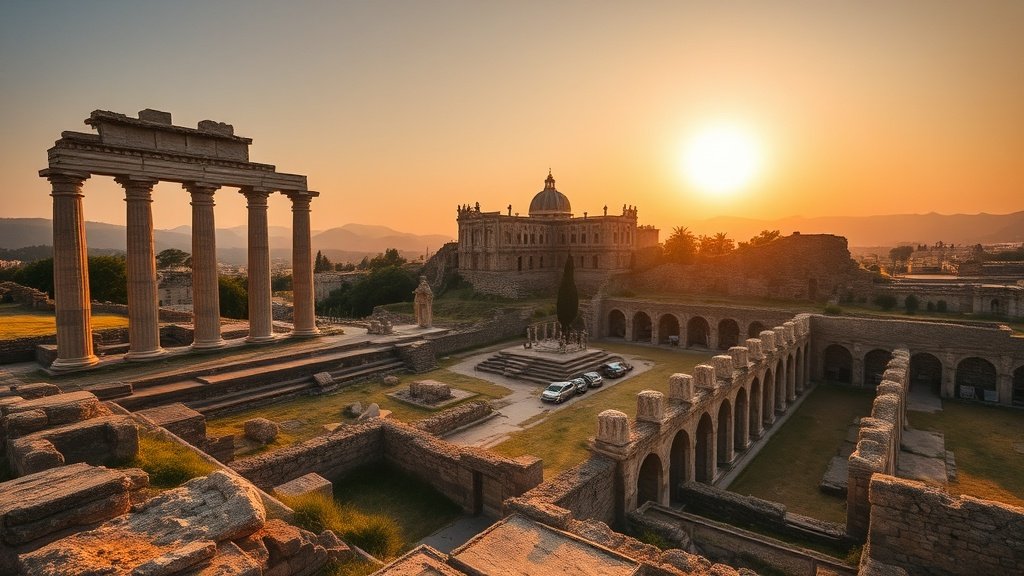
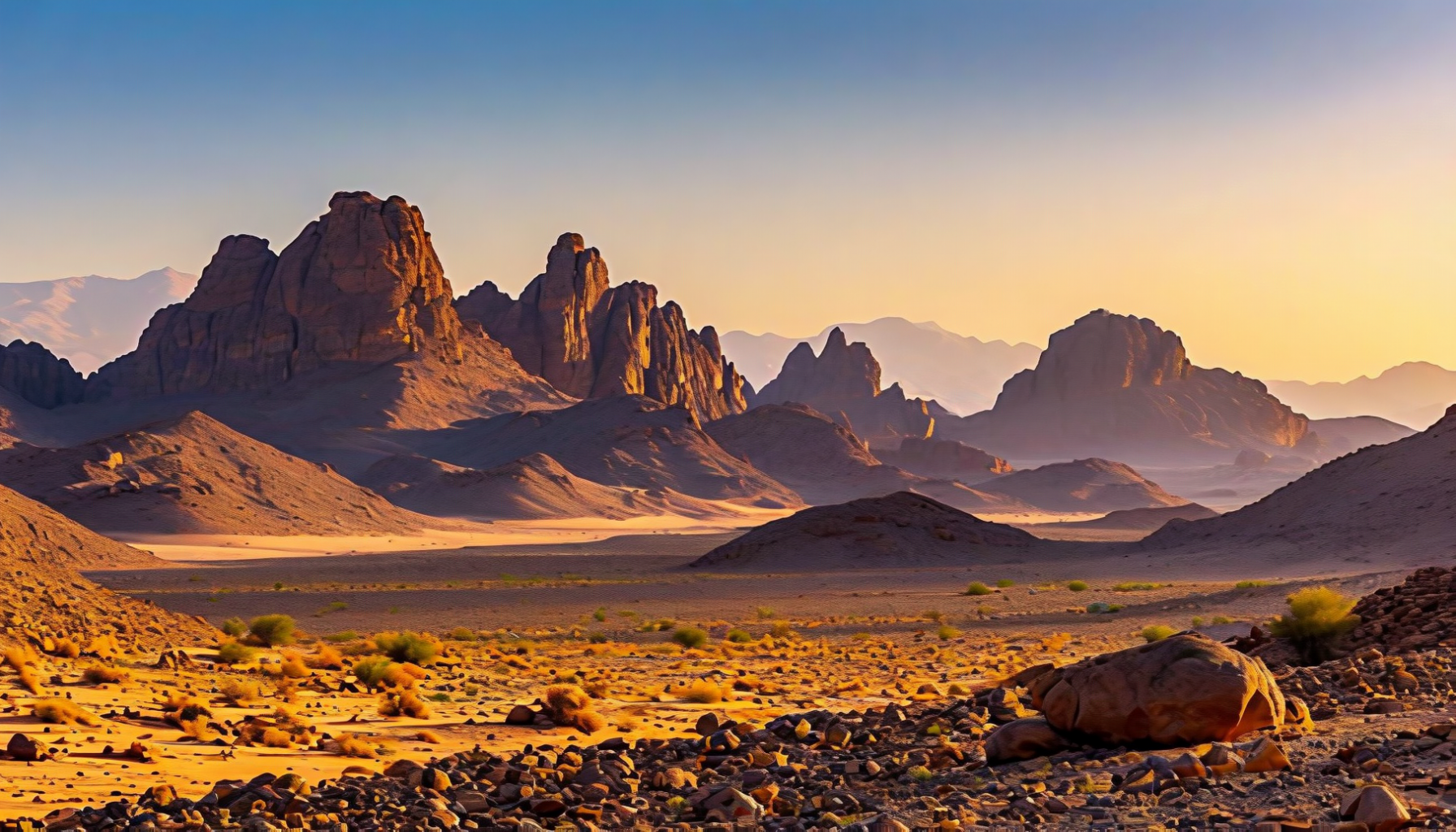
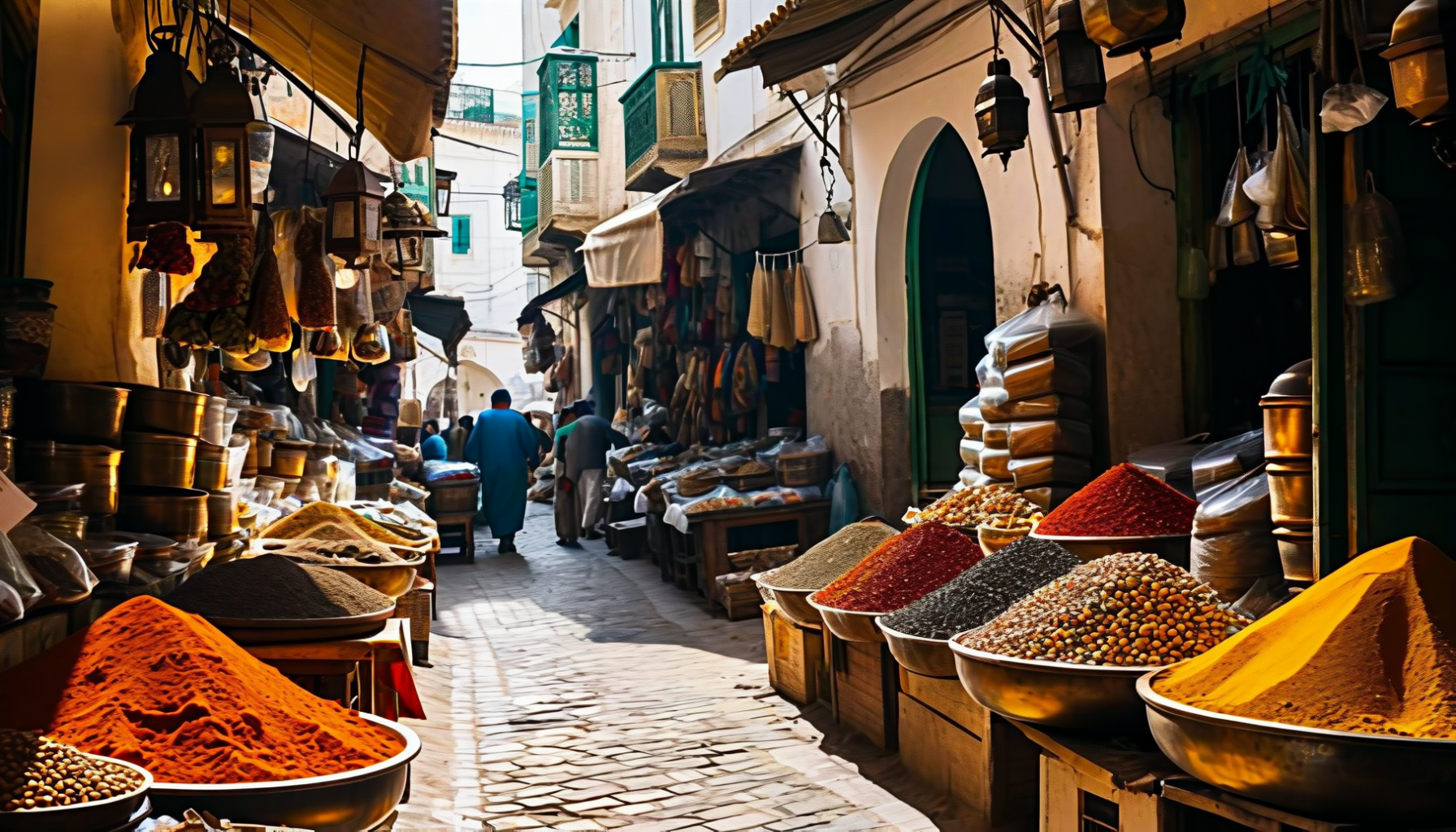
Algeria is Africa's largest country and one of its most underexplored—a vast land stretching from Mediterranean beaches to the heart of the Sahara, containing Roman cities rivaling any in the Empire, prehistoric cave art older than Egypt's pyramids, and living desert towns that function as they have for a thousand years.
For too long closed to casual tourism, Algeria is now experiencing its biggest tourism surge in two decades. The country welcomed 3.5 million visitors in 2024—a 10% increase from the previous year—and the government set a target of 4 million for 2025 and an ambitious 12 million foreign arrivals by 2030. Whether the 2025 target was met is not yet clear — the ministry had not published a consolidated national figure by September 2026 — but the Saharan numbers it has released are telling: about 750,000 visitors to the southern provinces in calendar 2025, of whom only ~65,000 were foreigners, and roughly 470,000 (47,000 foreign) in the October 2025–April 2026 desert season. In other words, the boom is overwhelmingly domestic and diaspora; foreign leisure tourism is growing from a very small base.
Here are Roman ruins without the crowds of Tunisia or Morocco, Saharan landscapes that dwarf anything in the Middle East, and a unique Berber-Arab-French culture that defies simple categorization. The recently inaugurated Great Mosque of Algiers (Djamaa El-Djazair)—the largest mosque in Africa and third-largest in the world—has added another compelling reason to visit.
This is not easy travel—bureaucracy remains formidable, infrastructure outside major cities is limited, and independent tourism requires patience. But for those who make the effort, Algeria offers experiences available nowhere else: dining in the shadow of Rome's grandest African monuments, trekking through sandstone forests containing 12,000-year-old paintings, and sleeping in whitewashed desert towns where time has stood still for centuries.
2024-2025 Tourism Highlights:
3.5 million total tourists in 2024 (2.45 million foreign nationals, 1.09 million diaspora)
Saharan tourism experiencing renaissance: 186,000 visitors to southern provinces in first trimester 2024-25 season alone
47 new hotels opened in 2024, adding 4,687 beds
571 new travel agencies licensed in 2024 (total now 5,570)
Visa-on-arrival introduced for organized Saharan tours (since 2023)
Great Mosque of Algiers officially inaugurated February 2024
The name Algeria derives from "Al-Jazair," Arabic for "The Islands"—a reference to the small islands that once dotted the bay of Algiers before the French colonial period connected them to the mainland. The capital city gave its name to the country, rather than the reverse.
Algerian identity is complex and layered. The indigenous Berber (Amazigh) people have inhabited this land for at least 10,000 years, leaving behind the extraordinary rock art of the Sahara. Phoenicians and Romans colonized the coast, followed by Arab conquest in the 7th century that brought Islam and the Arabic language. Ottoman rule from the 16th century and brutal French colonization from 1830 to 1962 added further layers to the national character.
Modern Algeria emerged from one of the 20th century's bloodiest independence struggles—the Algerian War of Independence (1954-1962) killed hundreds of thousands of Algerians — 1.5 million in the official Algerian count, 300,000–400,000 in most French historians' estimates — and traumatized France. This history shapes Algerian consciousness; the war and its martyrs remain central to national identity.
03
🗺️ Geography & Regions
Algeria sprawls across 2.38 million square kilometers—larger than all of Western Europe combined. The landscape divides into three distinct zones, each with its own character and attractions.
The Tell (Mediterranean Coast)
A narrow strip along the Mediterranean contains most of Algeria's population and agriculture. Fertile plains backed by the Tell Atlas mountains produce wine, olives, and citrus. Here you'll find Algiers, the Roman cities, and a coastline with beaches rivaling anywhere in the Mediterranean.
The High Plateaus
South of the Tell Atlas, vast steppes extend toward the Saharan Atlas. This semi-arid zone supports grazing and dry farming. Winters are cold, summers scorching. The M'Zab Valley, with its remarkable Ibadite towns, lies at the southern edge.
The Sahara
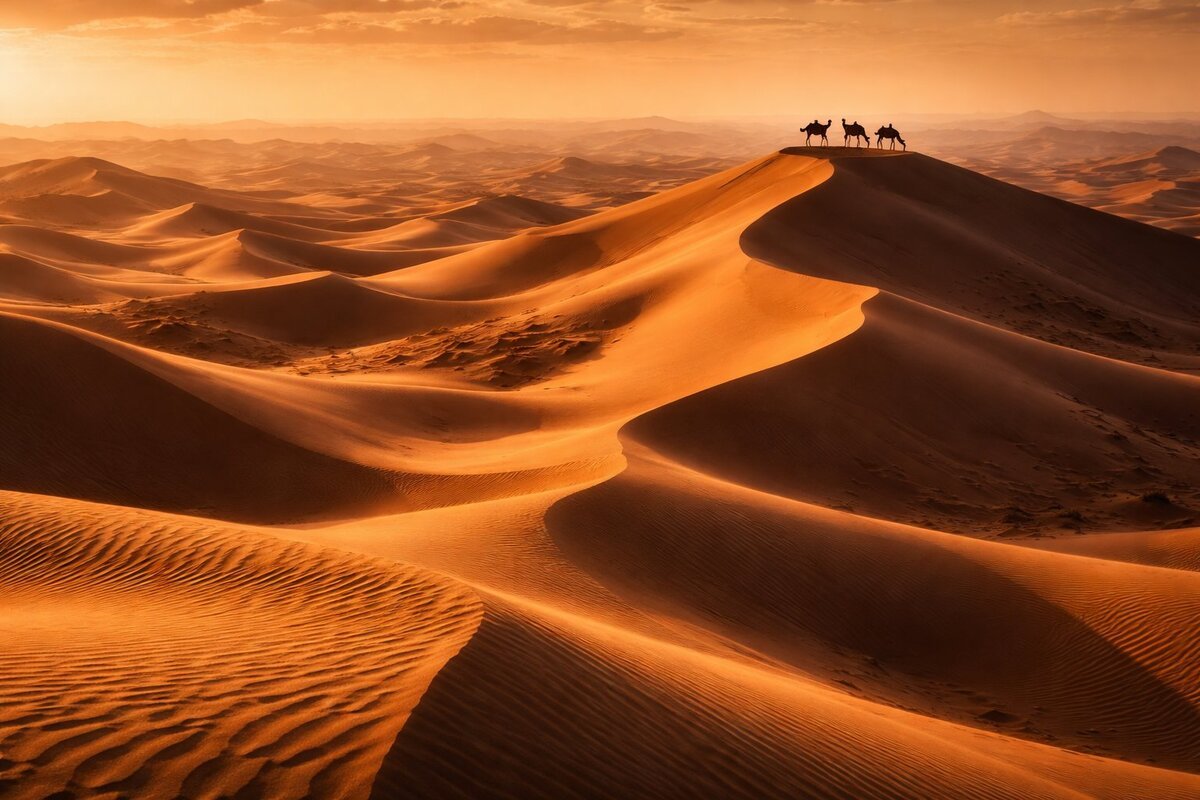
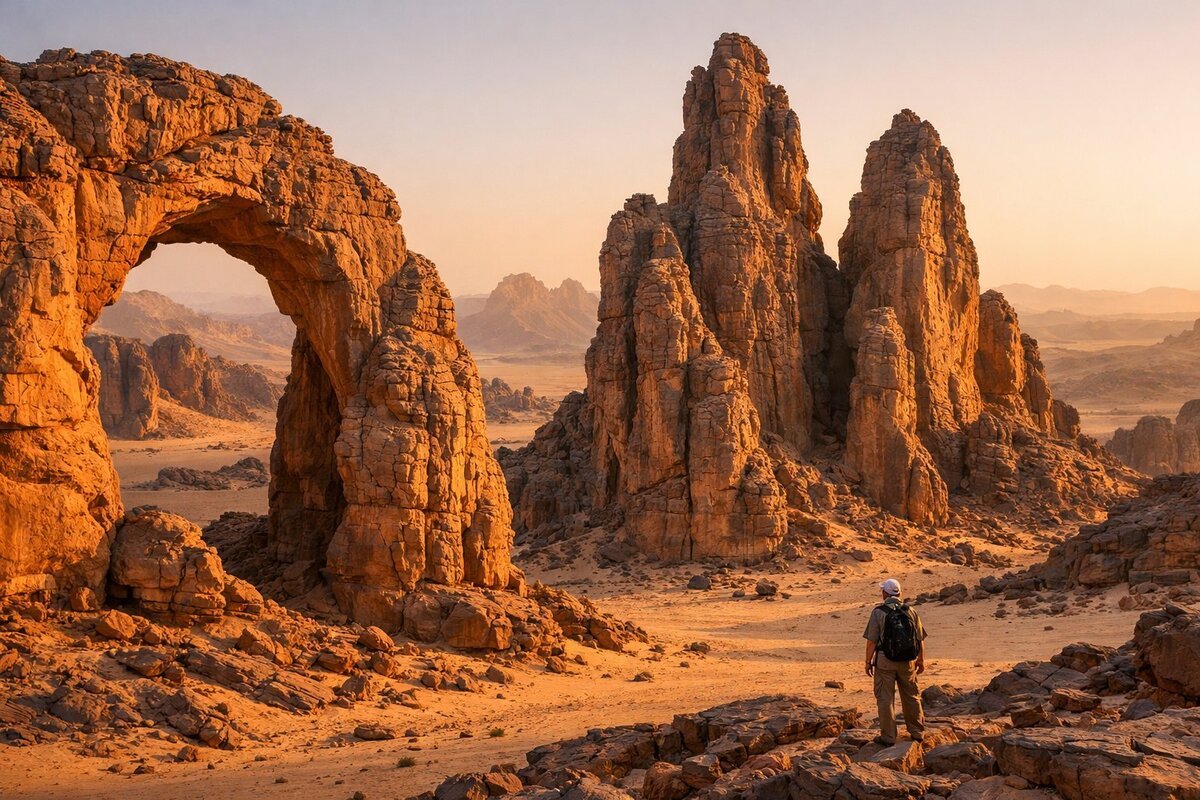
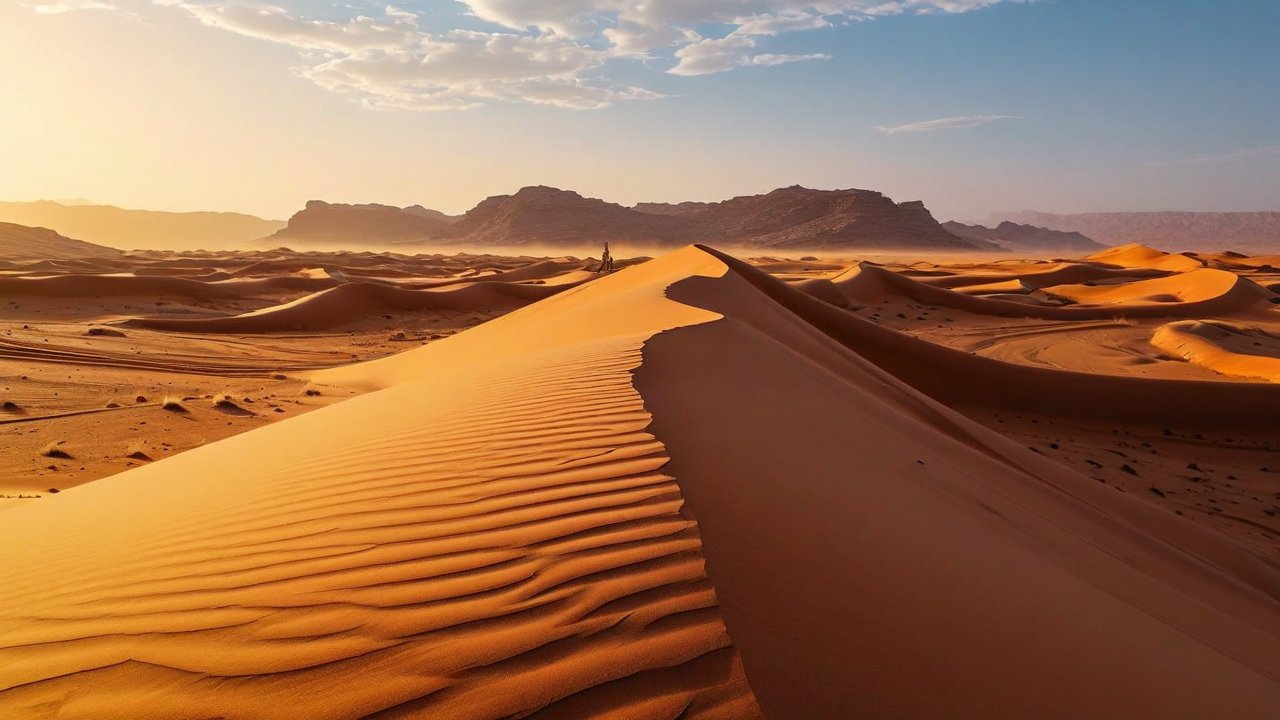
Beyond the Saharan Atlas, the world's largest desert begins. Algeria's Sahara is not one landscape but many: rocky plateaus (hamada), gravel plains (reg), massive sand seas (erg), and the extraordinary Tassili n'Ajjer—a sandstone labyrinth containing prehistoric art galleries that rival Lascaux.
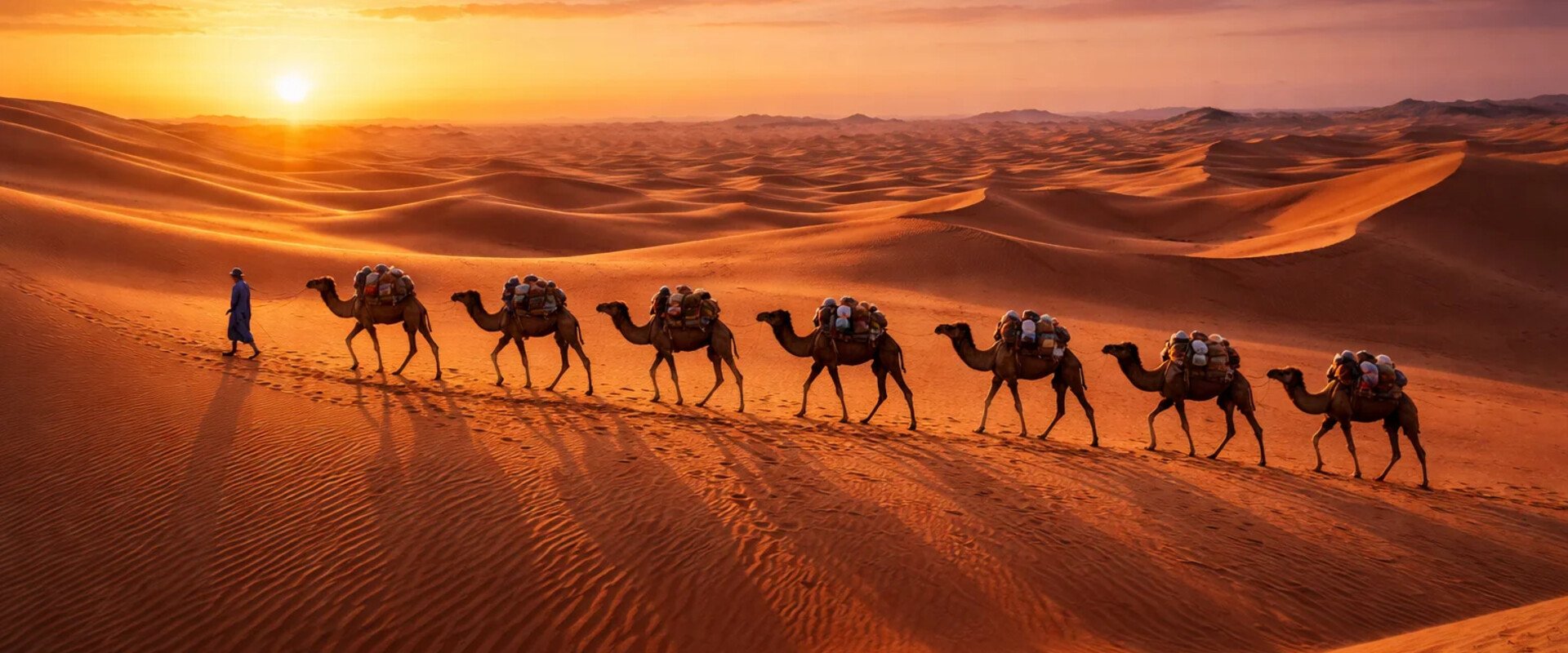
The Algerian Sahara is larger than Egypt and Libya combined, containing oases that have sustained caravan traffic for millennia.
The Sahara
Ninety per cent of the country — erg, reg, hamada and oases.
Feature
Details
Total Area
2,381,741 km² (largest in Africa)
Coastline
998 km (Mediterranean)
Highest Point
Mount Tahat, 2,908m (Hoggar Mountains)
Borders
Tunisia, Libya, Niger, Mali, Mauritania, Western Sahara, Morocco
Gold markers: the seven UNESCO sites. Blue: cities and Saharan gateways. Drag to pan; scroll-zoom is off so the page scrolls normally.
05
📜 History
Algeria's history spans from the earliest human artistic expression to one of the 20th century's most influential anti-colonial struggles.
Prehistoric Era
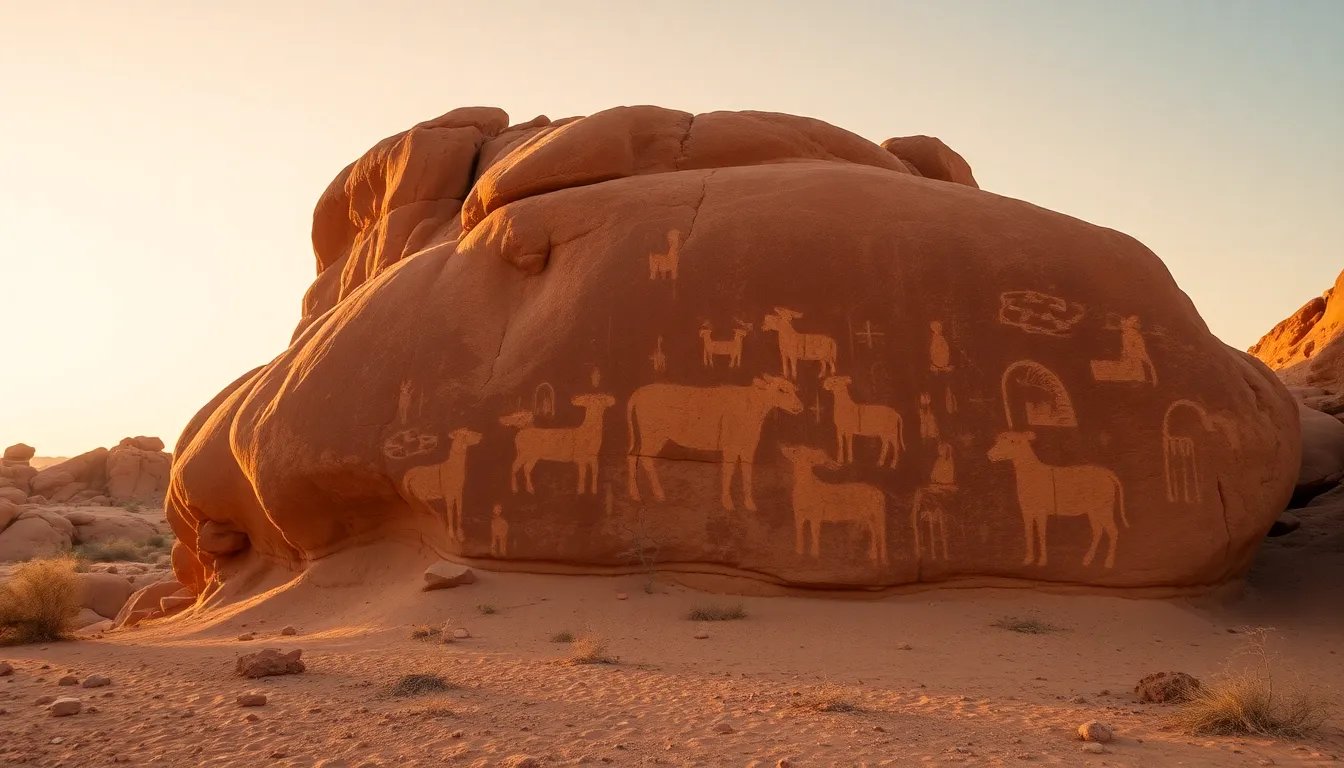
The Tassili n'Ajjer rock art provides an unparalleled record of life in the "Green Sahara," when these now-barren lands supported lakes, rivers, and abundant wildlife. Images of cattle herders, hunters, and rituals date from approximately 10,000 BCE to the first centuries CE, documenting the gradual desiccation that transformed paradise into desert.
Phoenician and Roman Algeria (1000 BCE - 430 CE)
Phoenicians established trading posts along the coast, while indigenous Berber kingdoms controlled the interior. The most powerful, Numidia, briefly unified under King Massinissa before falling under Roman influence.
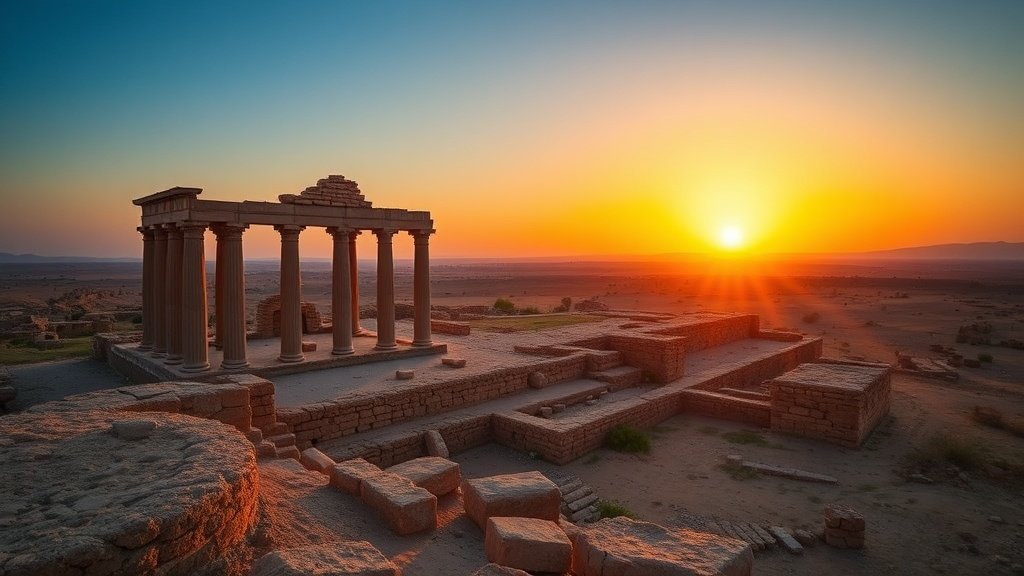
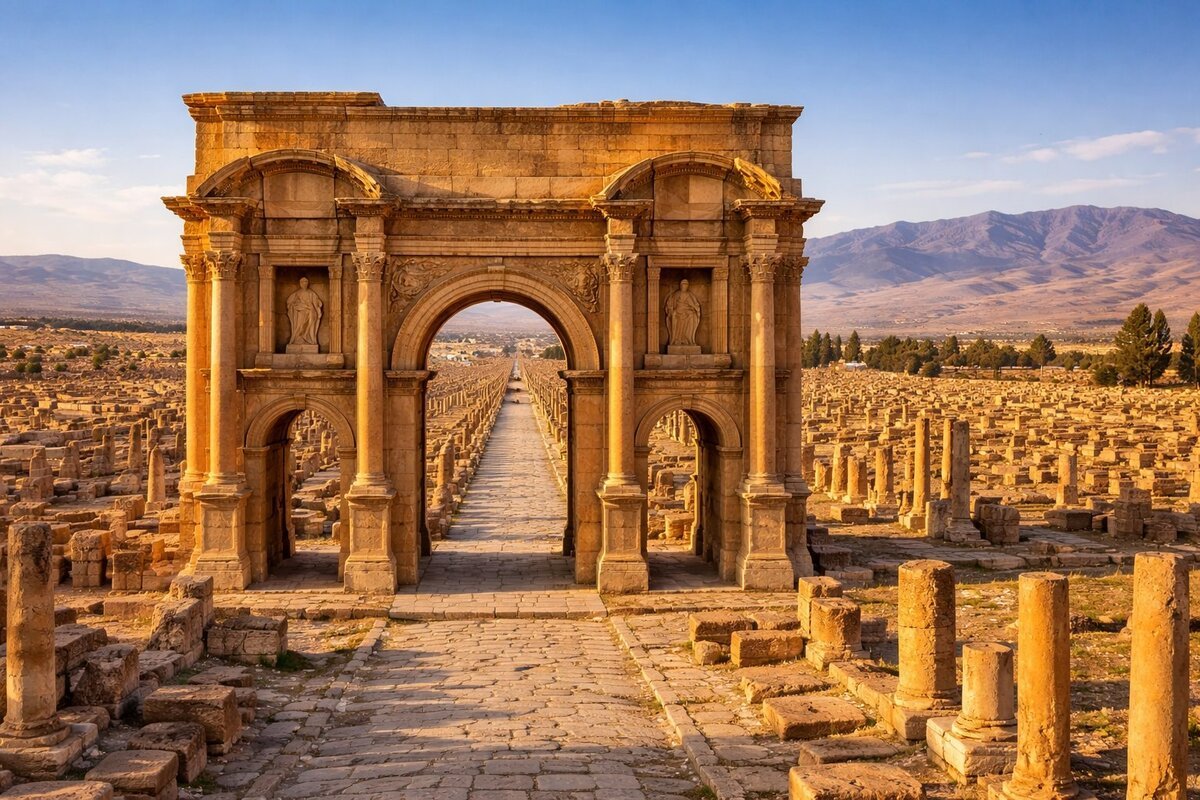
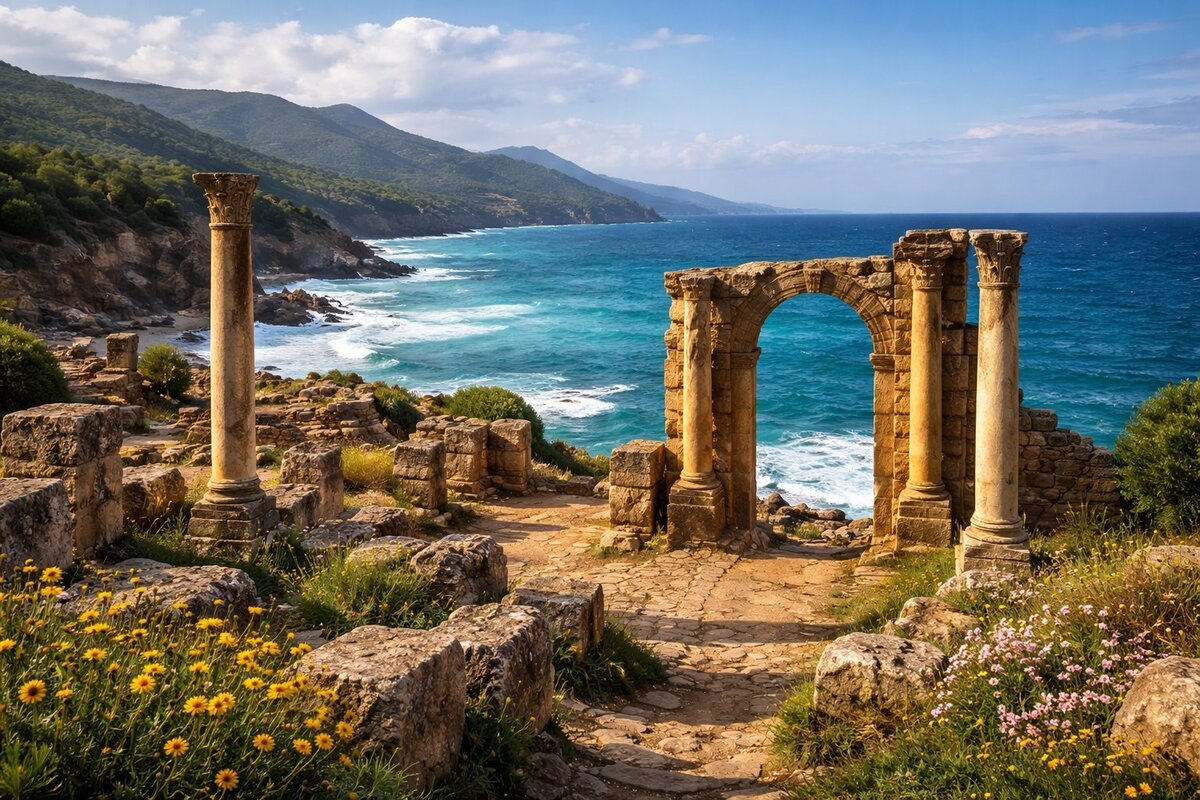
Rome made Algeria one of its most prosperous provinces. Cities like Timgad, Djemila, and Tipasa rivaled any in the Empire for sophistication. The region exported grain, olive oil, and wild animals for the Colosseum. Christian North Africa produced theologians like Augustine of Hippo, whose thought shaped Western civilization.
Vandal invasion in 430 CE ended Roman rule, followed by Byzantine reconquest—but the old prosperity never fully returned.
Roman Africa
Timgad, Djémila, Tipasa, Hippo — the empire’s grain basket.
Islamic Period (7th - 16th centuries)
Arab armies brought Islam in the 7th century, though Berber resistance continued for generations. The indigenous Ibadite sect established remarkable communities in the M'Zab Valley that survive today. Various Arab and Berber dynasties ruled, including the Hammadids whose capital at Beni Hammad is now a UNESCO site.
Ottoman Rule (1516-1830)
Ottoman corsairs made Algiers a wealthy base for Mediterranean raiding—European powers paid tribute to avoid capture. The Kasbah of Algiers, with its labyrinthine alleys and Ottoman palaces, dates from this era. The infamous Barbary pirates operating from Algerian ports influenced early American foreign policy.
French Colonial Period (1830-1962)
France invaded in 1830 and waged brutal campaigns of conquest over the following decades. Settlers confiscated Algerian land; French became the language of administration and education; Islam was suppressed. Algeria was considered not a colony but an integral part of France itself—a fiction that would make independence all the more traumatic.
War of Independence and Modern Era
The Algerian War of Independence (1954-1962) was one of the 20th century's most savage conflicts. The FLN (National Liberation Front) waged guerrilla warfare; France responded with torture, forced relocations, and massive military operations. Death-toll estimates remain disputed; 1.5 million is the official Algerian remembrance figure, not an uncontested historical total.
Independence in 1962 brought one-party socialist rule, oil-funded development, and suppression of political opposition. A brutal civil war in the 1990s killed perhaps 200,000 people. Modern Algeria, under President Abdelmadjid Tebboune since December 2019 (re-elected 7 September 2024 with an official 84.3%), has achieved stability while struggling with economic diversification beyond oil and gas.
Algeria in 2025–2026
The prime minister is Sifi Ghrieb, a chemist and former industry minister named interim premier on 28 August 2025 after Nadir Larbaoui's dismissal and confirmed on 14 September 2025; his 38-member government (FLN, RND and independents) took office the next day. Foreign policy has been turbulent: relations with France collapsed after Paris endorsed Morocco's autonomy plan for Western Sahara in July 2024, and the 2024–25 imprisonment of the Franco-Algerian novelist Boualem Sansal (pardoned on 12 November 2025 and flown to Germany) deepened the rupture — the worst since 1962. The French ambassador only returned to Algiers in May 2026. A separate 14-month crisis with Mali (Algeria shot down a Malian drone in April 2025; both sides closed their airspace) ended in July 2026 when ambassadors were reinstated. The land border with Morocco has been closed since 1994 and diplomatic relations severed since August 2021.
06
🎭 People & Culture
Algeria's roughly 48 million people (UN 2026 estimate) are predominantly Arab-Berber, with significant Tuareg populations in the Sahara. The tension and synthesis between Arab and Berber identities remains central to Algerian culture.
Languages
Arabic: Official language, though Algerian Arabic (Darja) differs significantly from Modern Standard Arabic
Berber (Tamazight): Recognised as a national language in 2002 and an official language in the 2016 constitution; spoken by approximately 30% of the population in various regional forms
French: Widely spoken, used in business and higher education; Algeria is one of the world's largest French-speaking countries
Useful Phrases
·
Phrase
Meaning
👋
Salam / Salaam alaikum
Hello / Peace be upon you
🙏
Shukran
Thank you
❌
La
No
✅
Nam / Ayih
Yes
👋
Bslama
Goodbye
❓
Wesh rak?
How are you? (Algerian Arabic)
💬
Labas?
Are you well?
🤲
Insha'Allah
God willing
☪️
Hamdullah
Thanks be to God
💯
Bezzaf
A lot / Very much
Religion
Islam (Sunni Maliki school) is the state religion. Algeria’s constitution names Islam as the religion of the state; daily practice varies across communities. The Ibadite communities of the M'Zab represent a distinct Islamic tradition dating back to early schisms. The inauguration of Africa's largest mosque in 2024 represents the government's effort to promote moderate Islam.
Music
Raï music, born in Oran in the early 20th century, blends Bedouin poetry with Western instruments and rhythms. Artists like Cheb Khaled, Cheb Mami, and Rachid Taha brought raï to world attention in the 1980s and 1990s. The annual Festival du Raï in Oran (August) is the premier celebration of this uniquely Algerian genre.
Chaabi is another popular folk music style, originating in the Kasbah of Algiers, combining Andalusian melodies with Algerian rhythms.
07
🍜 Cuisine & Drinks
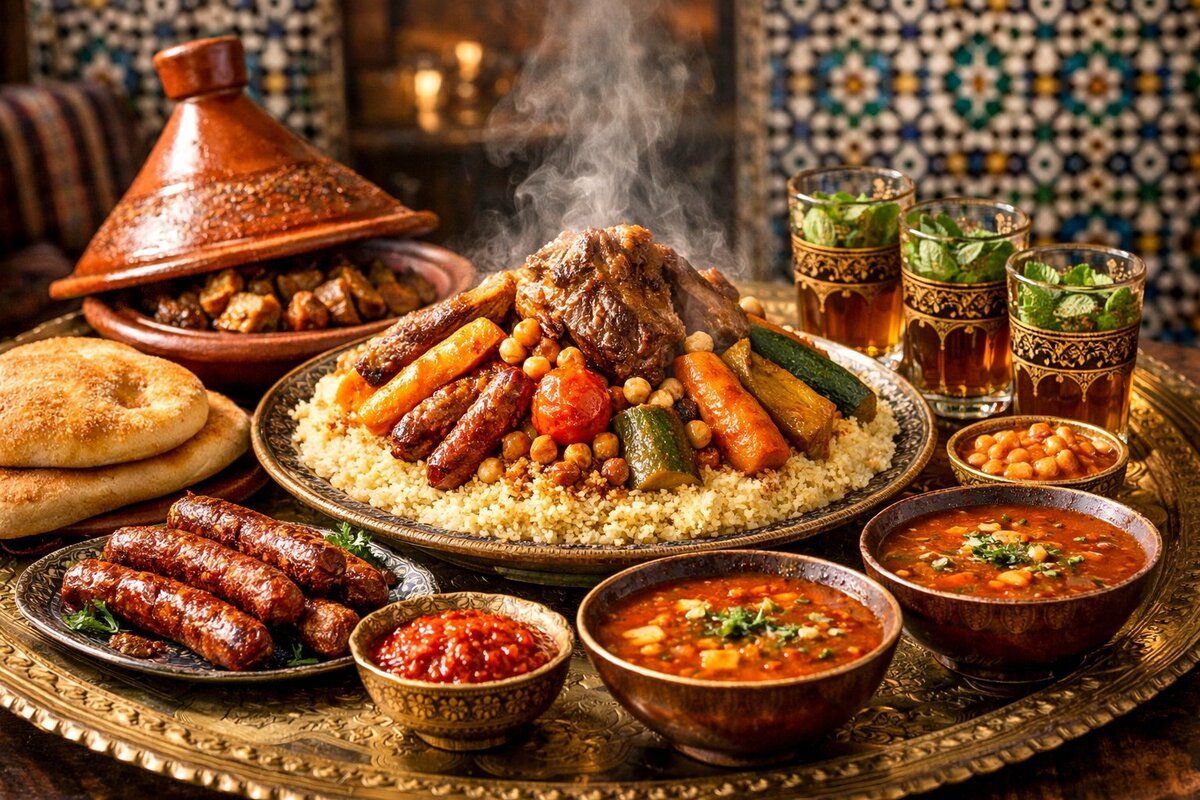
Couscous royal, chorba to break the Ramadan fast, makroud pastries, and mint tea as a daily ritual — Algerian cuisine sits at the crossroads of Berber, Arab, Ottoman, and French tables. Read the full Food & Drink guide, with recipes →
Algerian table
Couscous, chorba, chakhchoukha — the full recipes are on the Food & Drink page.
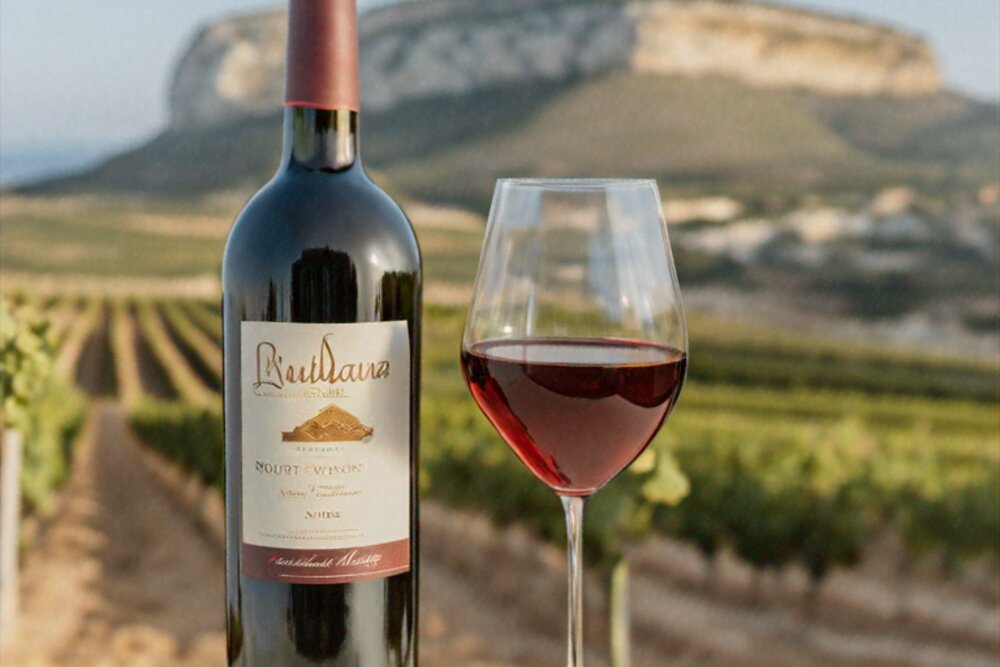
Algeria was once the world's fourth-largest wine exporter under French colonial rule — a near-vanished industry today, surviving in a handful of valleys, alongside the boukha and mahia spirits that outlasted it. Read the full Wine guide, with the Kaufmann Wine Score →
09
🍸 Cocktails & Mixed Drinks
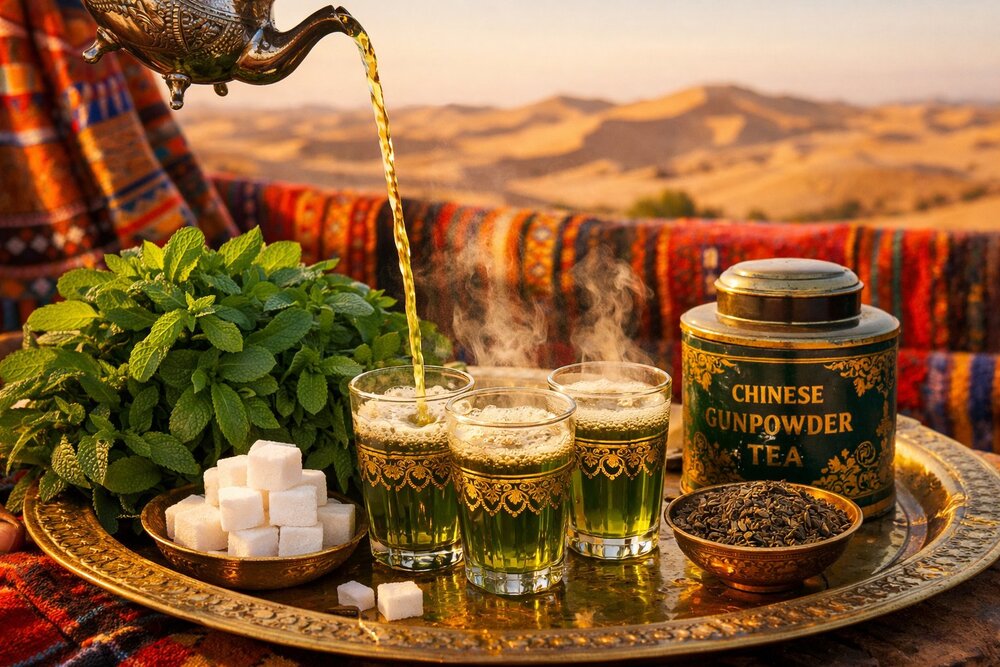
Mazagran (iced coffee born during an Algerian siege) and citronnade algéroise share the spotlight with the country's real national drink — mint tea, poured from a height into small glasses. See the full Food & Drink guide for the recipes →
Mint tea
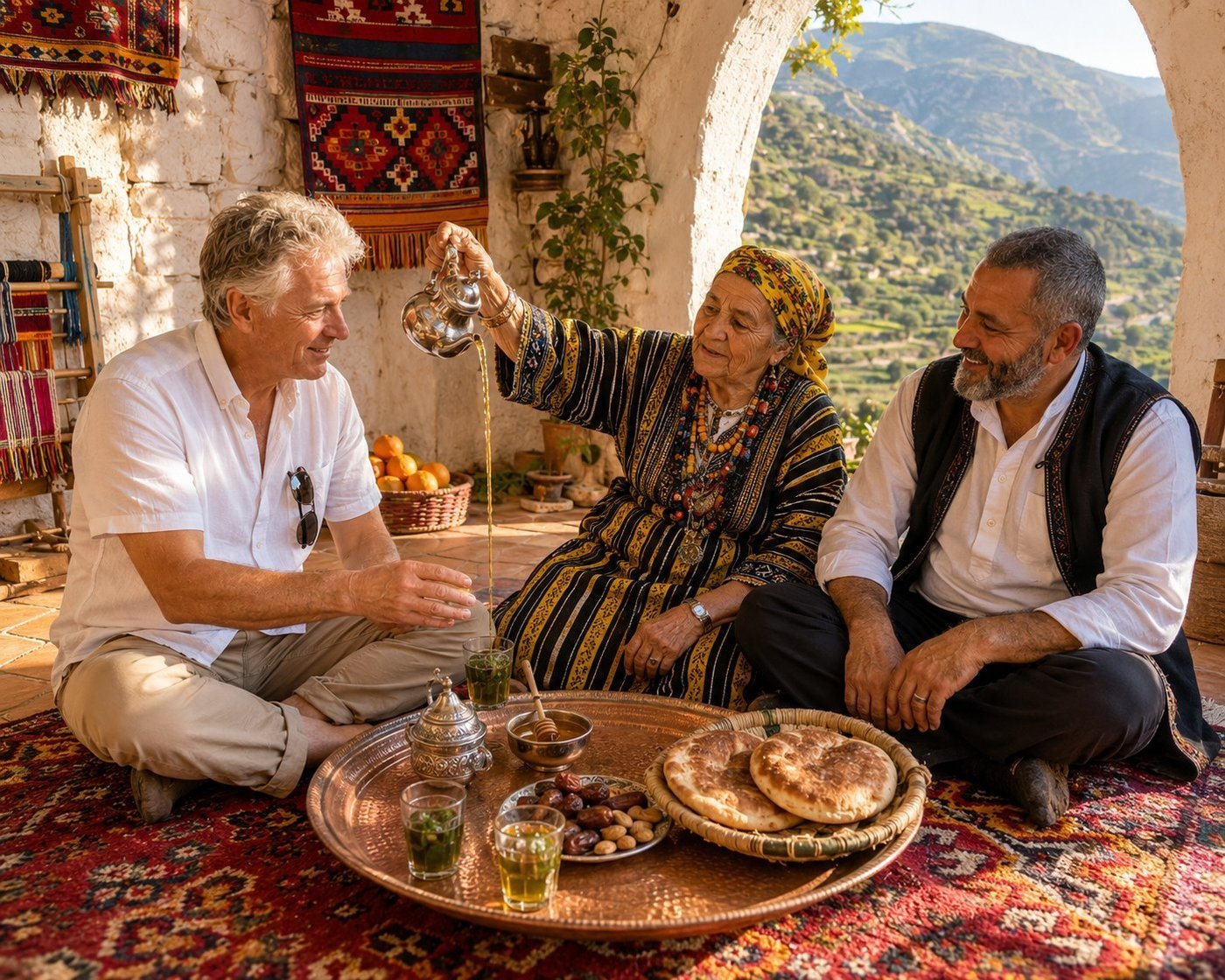
Poured from a height for the foam — the real national drink.
10
🎉 Festivals & Events
Algeria's festival calendar reflects its diverse cultural heritage, from ancient Berber celebrations to international music events.
Festival
When
Where
Description
Yennayer (Berber New Year)
January 12
Nationwide
Ancient Amazigh celebration with traditional food, music, and ceremonies
National Amazigh Film Festival
January
Tizi Ouzou
Celebrates Berber cinema and culture
Fête du Tapis (Carpet Festival)
March–April
Ghardaïa
Mozabite carpet fair and parade in the M'Zab Valley's pentapolis
Timimoun Date Festival
April
Timimoun
Celebrates the oasis harvest with markets and performances
Dimajazz Festival
May
Constantine
International jazz in the ancient city of bridges
Timgad International Music Festival
July
Timgad
World music amid Roman ruins—rock, raï, classical, jazz
Festival du Raï
August
Oran
Celebration of Algeria's signature musical genre
Sebiba Festival
Ashura (10 Muharram)
Djanet
Tuareg celebration commemorating ancient peace treaty
Sboue of Timimoun
Mawlid (Prophet's birthday week)
Timimoun (Gourara)
Week-long pilgrimage-festival of the Gourara oases, with the Ahellil polyphonic chant (UNESCO intangible heritage, 2008)
International Saharan Tourism Fair (SITS)
November
El Oued
The Sahara tourism trade fair where the ministry announces the winter desert season
11
🏛️ UNESCO World Heritage Sites (7)
Algeria holds seven UNESCO World Heritage Sites — spanning Roman ruins at Timgad and Djemila, prehistoric Saharan rock art at Tassili n'Ajjer, the Kasbah of Algiers, the fortified M'Zab Valley, Al Qal'a of Beni Hammad, and Roman/Punic Tipasa. Explore all seven sites in depth, with circuit planning →
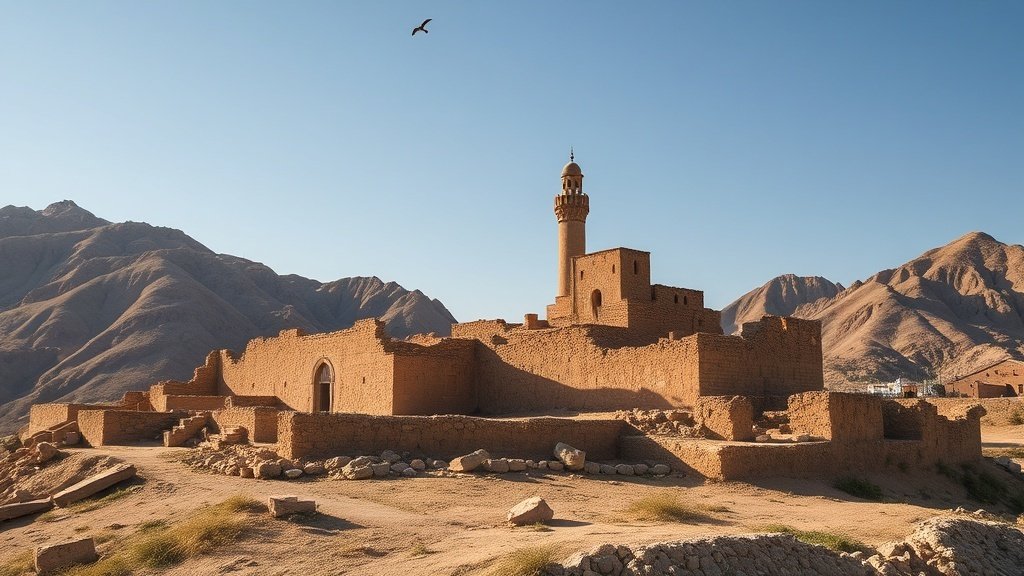
Al Qal'a of Beni Hammad
Hammadid capital, 1007–1152; Algeria’s first World Heritage inscription (1980).
12
🏙️ Cities & Destinations
Algiers (El-Bahdja, "The White City")
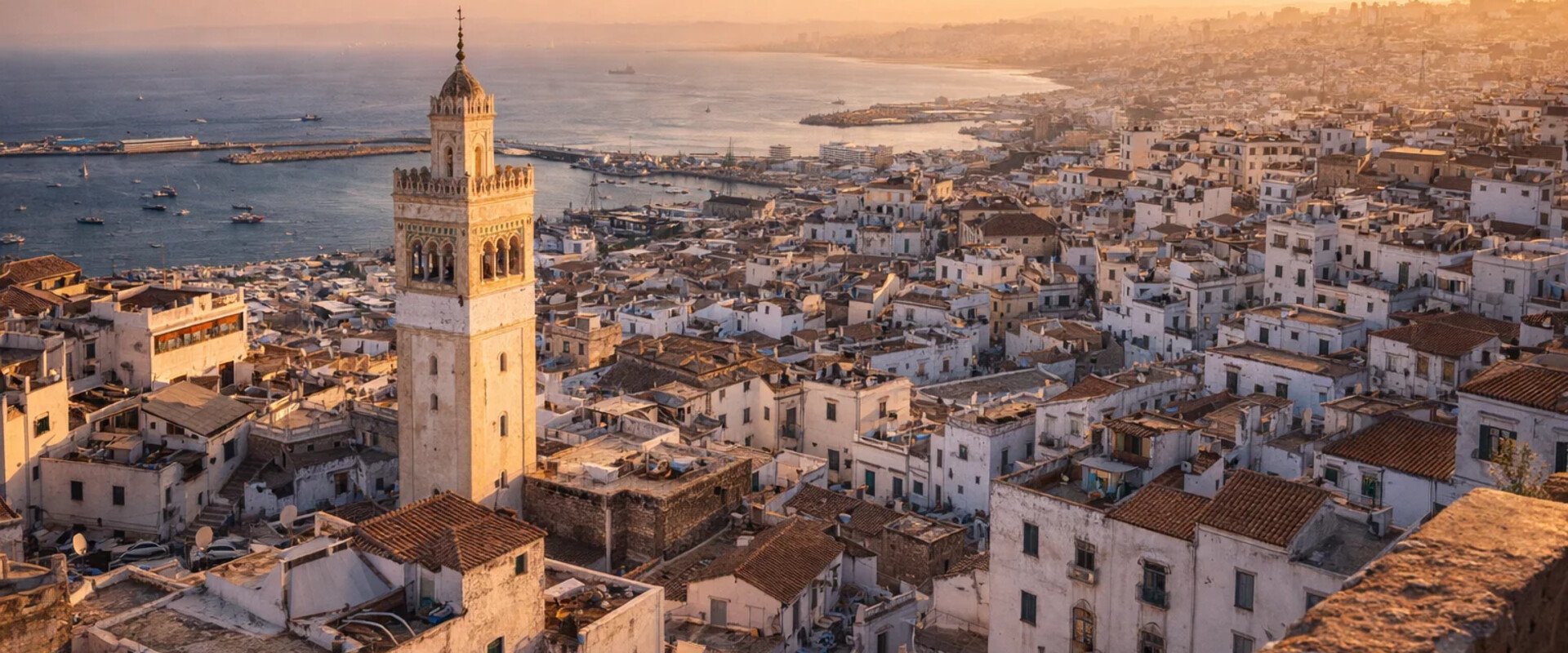
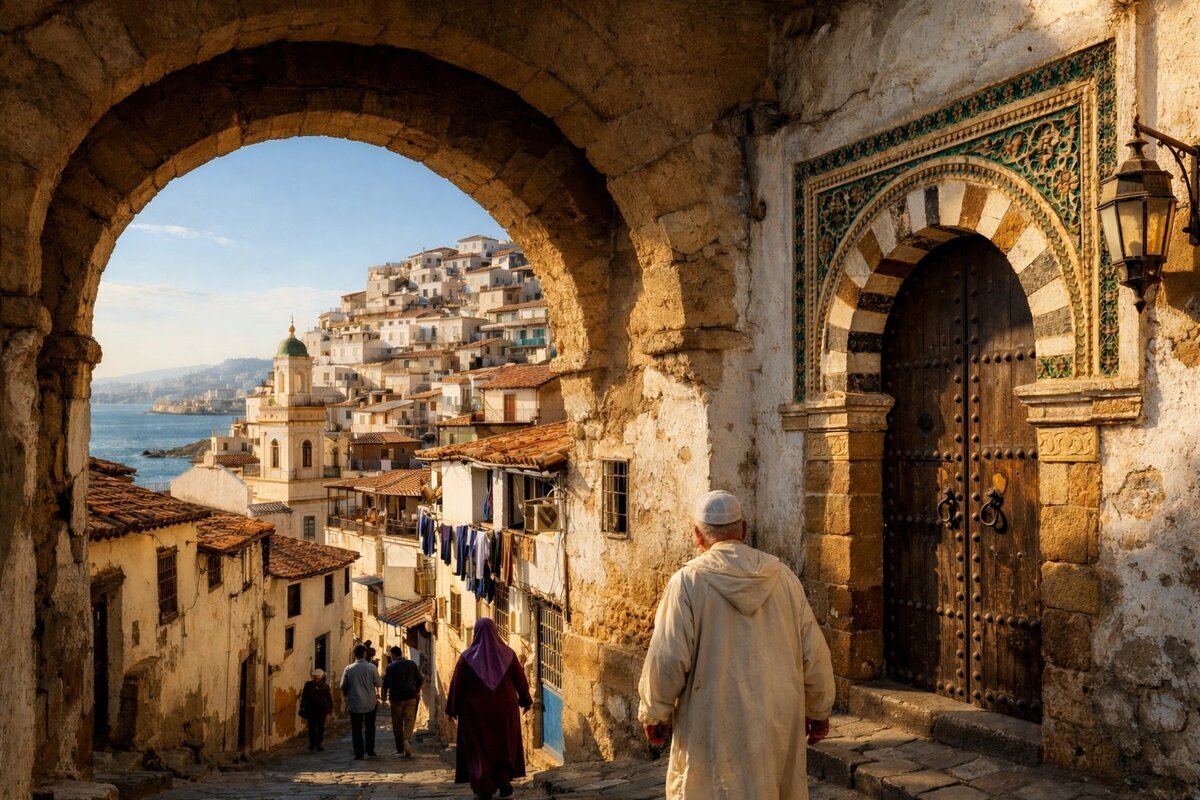
The capital rises dramatically from the Mediterranean, its white buildings climbing steeply from the port to the heights of the Kasbah. Colonial French architecture dominates the lower city, while the UNESCO-listed Kasbah preserves Ottoman and pre-colonial layers. The city combines grandeur with decay—peeling Belle Époque facades, bustling markets, and Mediterranean light that inspired Albert Camus.
Algiers · The Casbah
White city, Ottoman alleys, Mediterranean light — UNESCO-listed since 1992.
New in 2024: The Great Mosque of Algiers (Djamaa El-Djazair) was officially inaugurated in February 2024, becoming Africa's largest mosque and the third-largest in the world. Its 265-meter minaret is the world's tallest, featuring observation decks with panoramic views of the Mediterranean. The prayer hall accommodates 120,000 worshippers, and the complex includes a museum of Islamic art, a library for one million books, and a Quranic school.
Oran
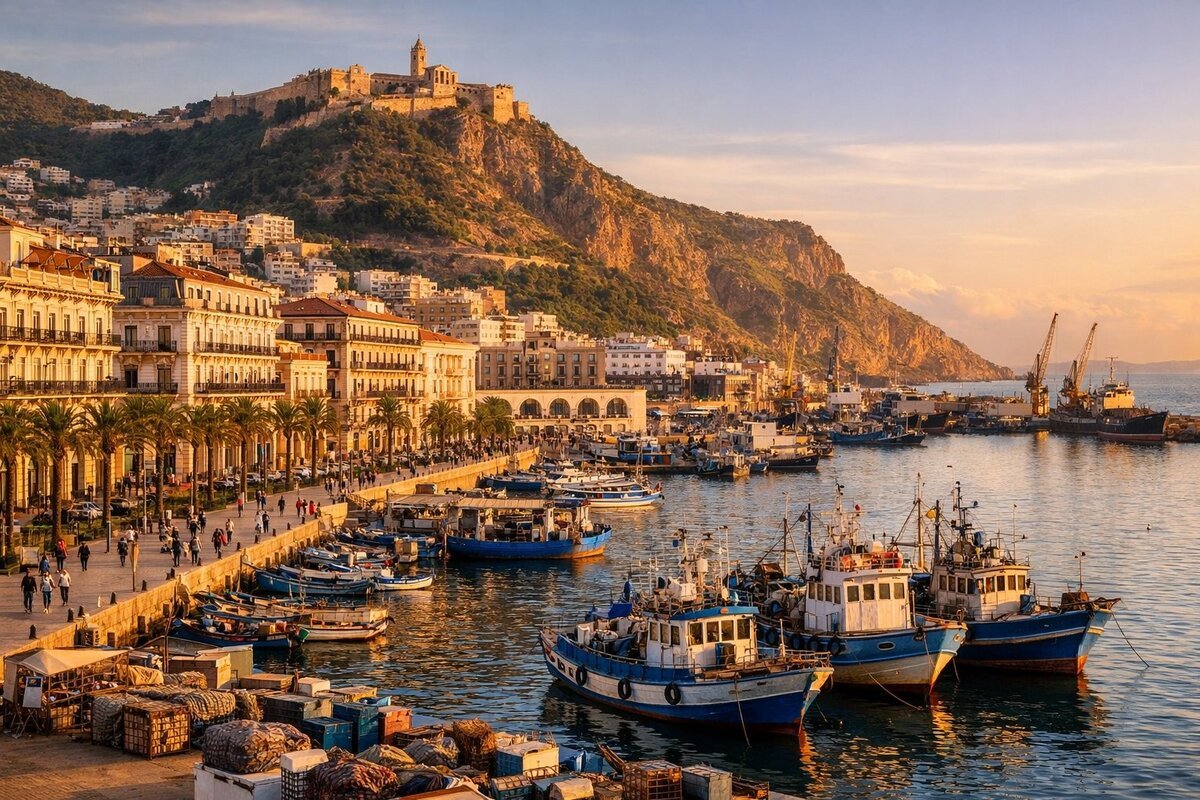
Algeria's second city is the country's musical capital, birthplace of raï music. More Spanish than French in feel, Oran's colonial architecture and seaside promenade make it a relaxed alternative to Algiers. The annual Festival du Raï (August) draws thousands of music fans.
Oran
Seafront of the raï capital, more Spanish than French in feel.
Constantine
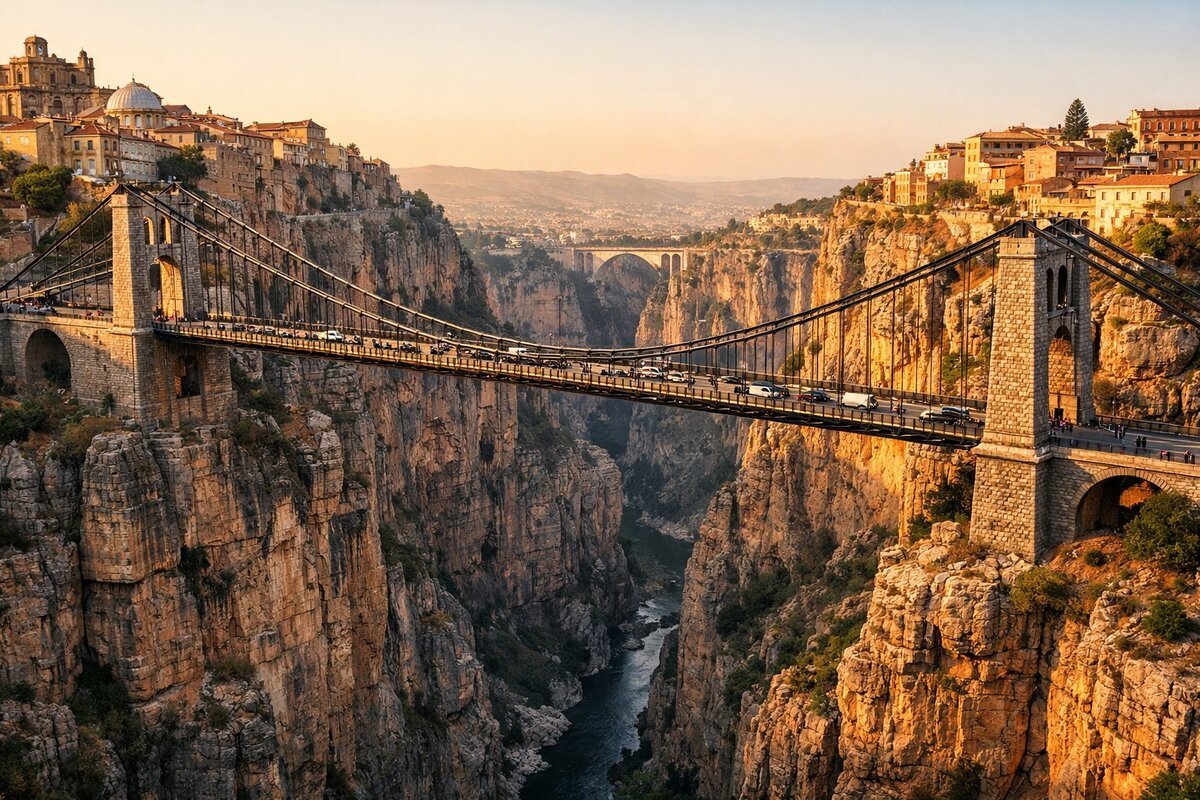
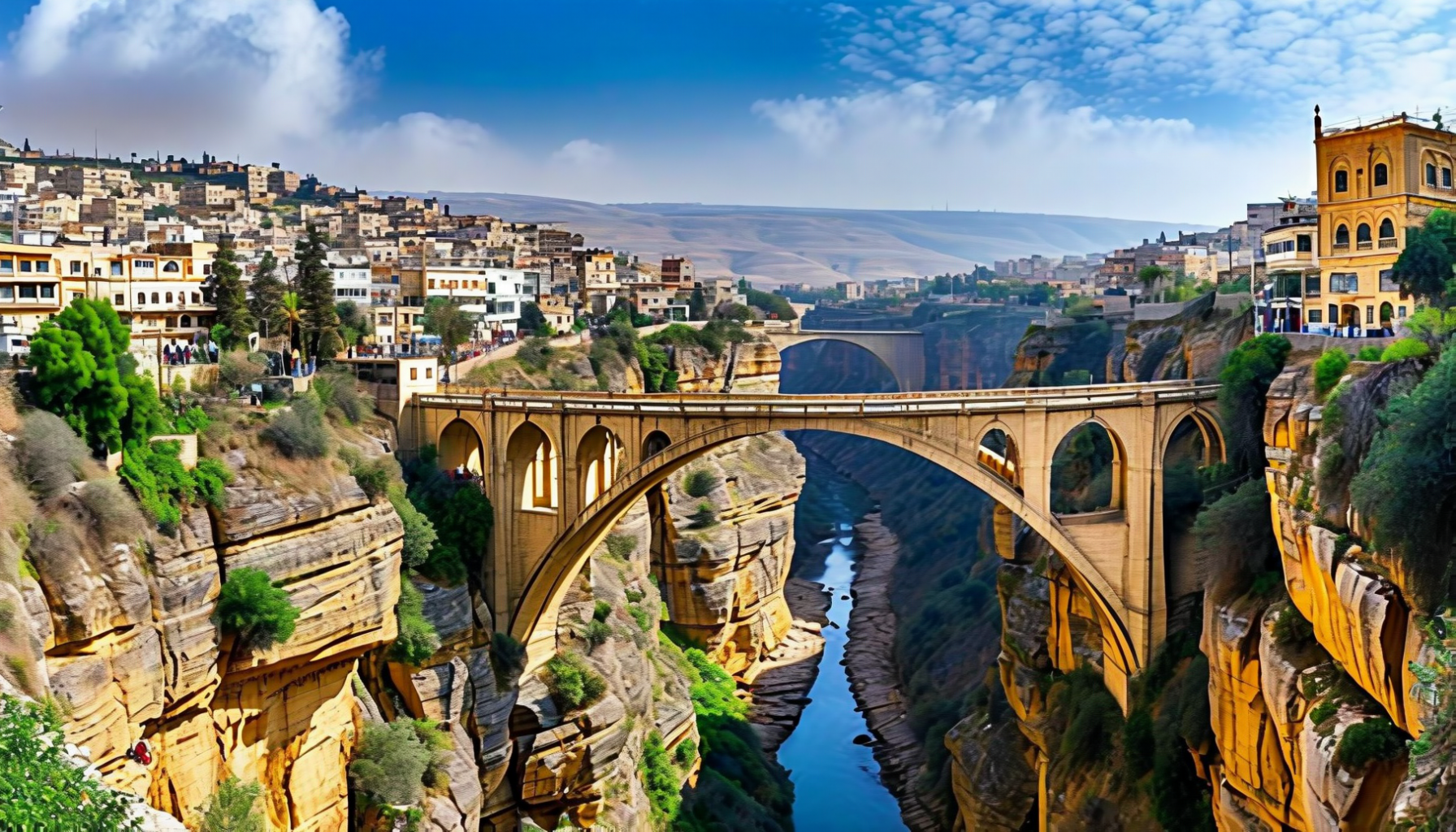
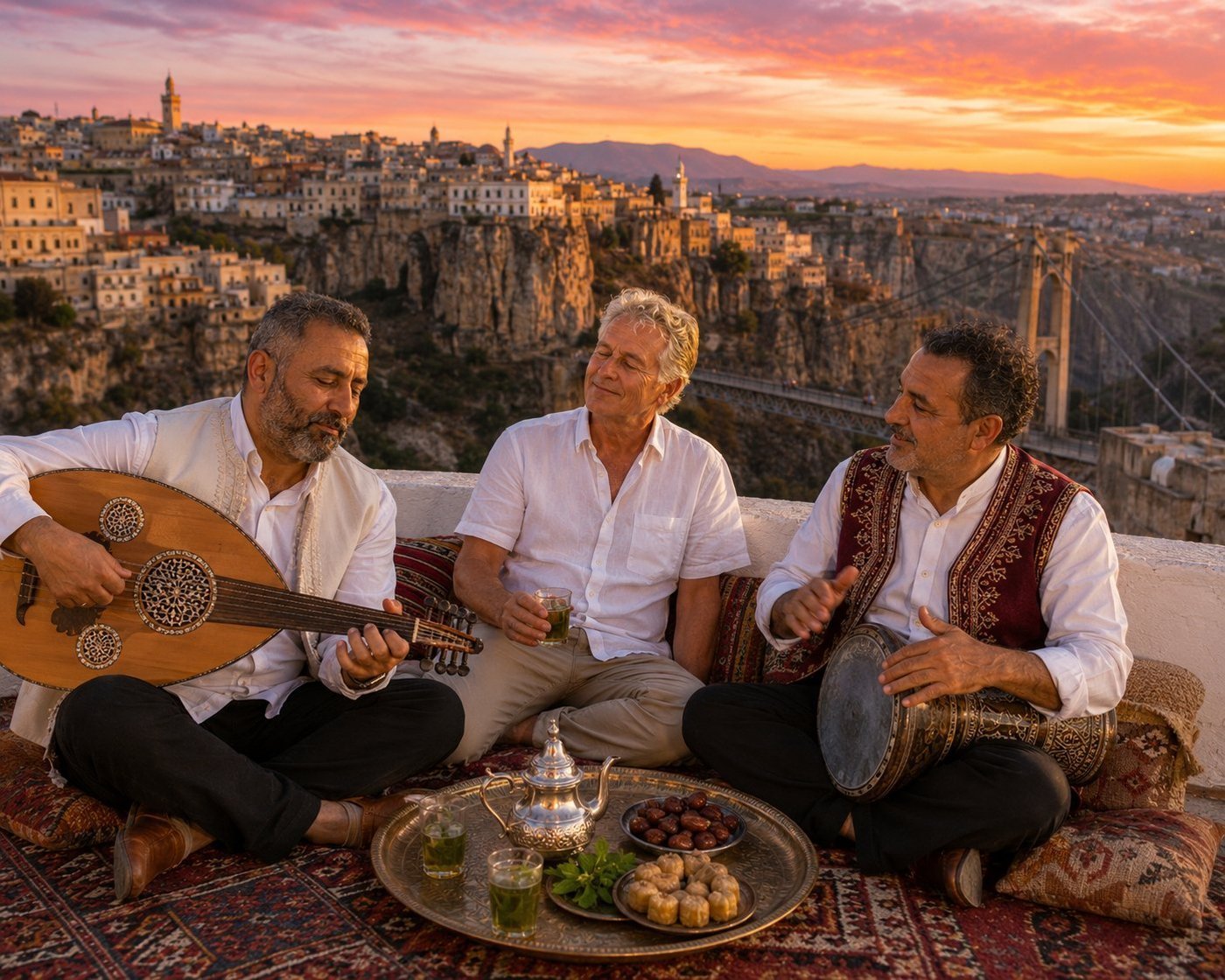
Algeria's third city sits on a rock plateau sliced by the Rhumel gorge, stitched together by seven bridges — the 1912 Sidi M'Cid suspension bridge hangs 175 m above the river, and the 2014 Salah Bey cable-stayed bridge is the newest. Cirta was the capital of Numidia under Massinissa; today the city is the home of malouf, the Andalusian classical music of the east, and of the Emir Abdelkader Mosque, the country's largest before the Djamaa El-Djazair.
Constantine
Seven bridges over the Rhumel — Sidi M’Cid is the vertigo classic.
Ghardaïa and the M'Zab Valley
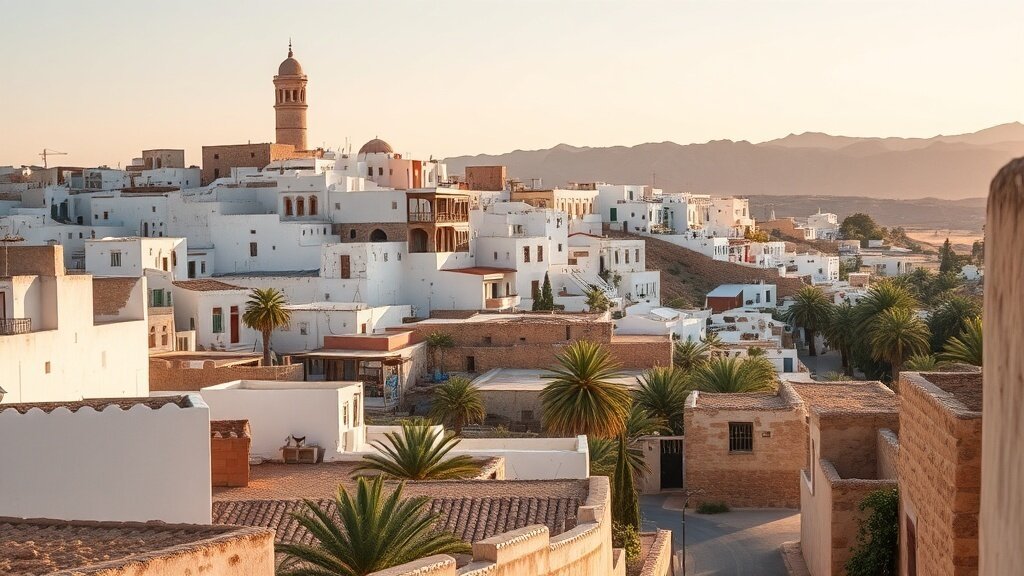
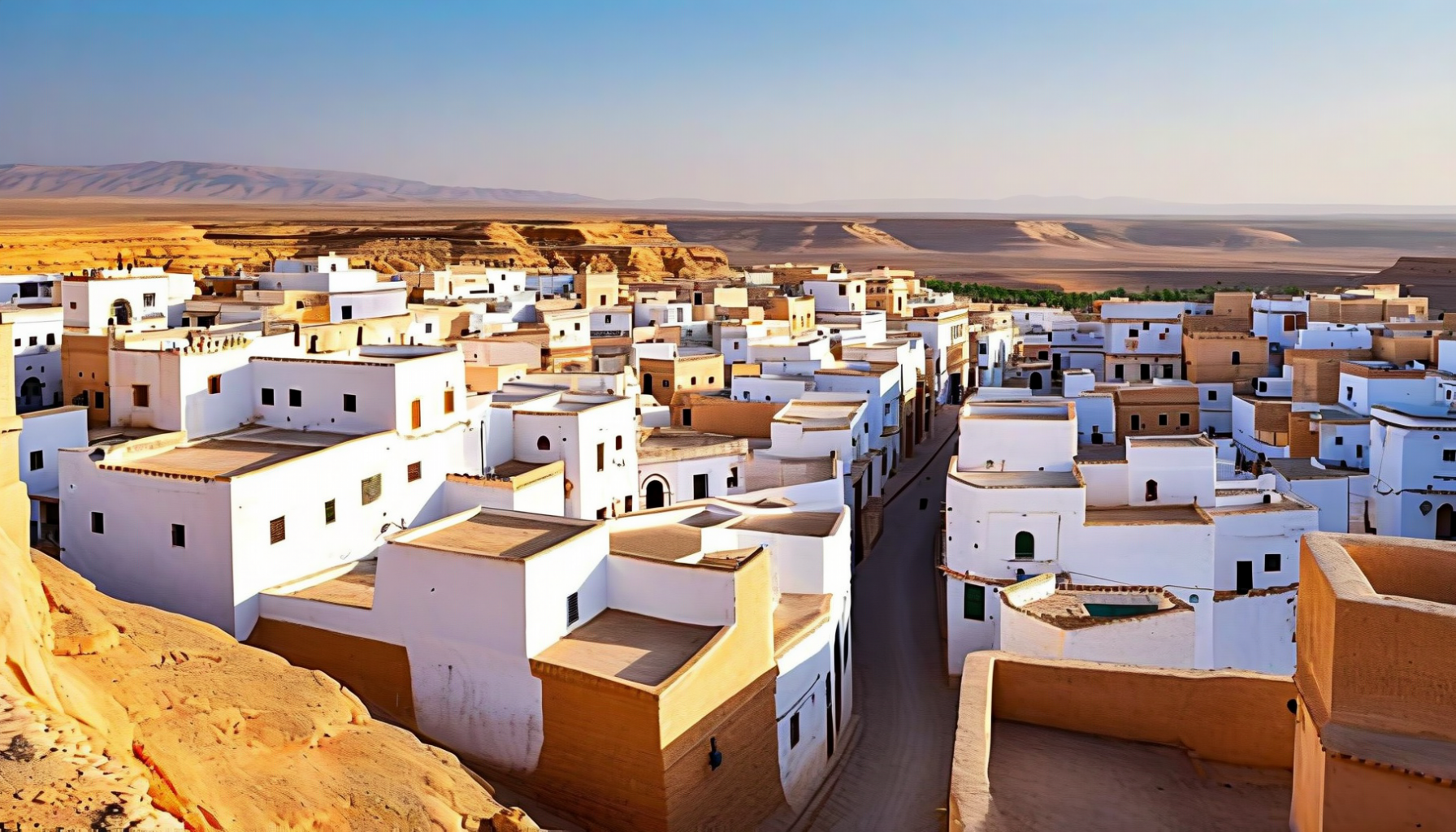
Five fortified Ibadi towns (Ghardaïa, Beni Isguen, Melika, Bou Noura, El Atteuf) founded in the 11th century on a wadi 600 km south of Algiers, each a cone of cubic ochre houses climbing to a mosque-minaret; Le Corbusier came here and left with ideas. Beni Isguen still closes its gates at dusk and requires a local guide; the daily auction market is the best window on Mozabite life. UNESCO-listed since 1982.
Ghardaïa · M'Zab Valley
The pentapolis that inspired Le Corbusier.
Djanet and Tassili n'Ajjer
The oasis town of Djanet, 2,300 km from Algiers by road, is the base for the Tassili plateau — a 72,000 km² sandstone maze of rock arches, cypress trees and some 15,000 rock paintings and engravings. Access is by registered agency only (guide, cook, 4x4 or camels); the classic circuit climbs on foot to the Sefar and Jabbaren galleries over four to six days, and the Tadrart Rouge to the south-east is the sand-sea alternative. Most foreign visitors come on the visa-on-arrival packages between October and April.
Tassili n'Ajjer
Sandstone forests and the Sahara’s largest open-air art gallery.
13
🕌 The Great Mosque of Algiers
265 mWorld’s tallest minaret
120,000Worshippers across the complex
2024Official inauguration
Inaugurated in February 2024, Africa's largest mosque has become Algeria's newest landmark and a must-visit for travelers. The Djamaa El-Djazair (Great Mosque of Algiers) is the third-largest mosque in the world after those in Mecca and Medina.
📊 Key Facts
27.75 ha
Total Complex Size (70 acres)
265 m
Minaret Height (World's Tallest)
120,000
Worshipper Capacity
$898M
Construction Cost
Architecture & Features: The mosque's prayer hall covers 22,000 m² with a magnificent dome spanning 50 meters in diameter and rising 70 meters high. The complex includes:
Observation decks on the 265-meter minaret with panoramic Mediterranean views
Museum of Islamic Art with rotating exhibitions
Library designed to house one million books
Quranic school and research center
Underground parking for 6,000 vehicles
Visitor Information: The mosque is open to non-Muslim visitors outside prayer times. Women must cover their hair; modest dress required for all. The observation deck offers the best panoramic views in Algiers. Photography is permitted in most areas but check signs for restrictions.
Construction: Built between 2012-2019 by China State Construction Engineering Corporation, the mosque was designed by German architecture firm KSP Jürgen Engel Architekten. Construction began nearly a decade after the 2003 Boumerdès earthquake, and the building was engineered in its wake to withstand seismic activity of magnitude 9. The mosque opened for prayers in October 2020; the official state inauguration by President Tebboune followed on 25 February 2024.
14
🌡️ Climate & Best Time to Visit
Algeria's size creates dramatic climate variation from Mediterranean coast to deep Sahara.
·
Season
Months
Temperature
Conditions
Visit?
🌸
Spring
Mar–May
Mild · 18–25°C
Pleasant coast, mild desert
✅ Excellent
☀️
Summer
Jun–Aug
Hot · 30–45°C
Brutal in Sahara, hot coast
❌ Avoid Sahara
🍂
Autumn
Sep–Nov
Mild · 20–28°C
Harvest time, similar to spring
✅ Excellent
❄️
Winter
Dec–Feb
Cool · 8–17°C
Mild coast, cold desert nights
⚠️ Coast only
Best Time: March–May and September–November. The Sahara is best October–March (avoiding summer heat), while coastal sites are pleasant most of the year except high summer.
15
✈️ Suggested Itineraries
🗓️ 5 Days: Algiers & the Roman North
Day 1: Algiers — the Casbah's white-washed lanes, the Ketchaoua Mosque, and sunset from the Notre-Dame d'Afrique overlook
Day 2: Tipasa — Roman and Punic ruins scattered along Mediterranean cliffs, an easy day trip west of the capital
Day 3: Travel to Constantine, the "City of Bridges," suspended dramatically over the Rhumel gorge
Day 4: Djemila — one of North Africa's best-preserved Roman cities, mosaics still in situ
Day 5: Timgad, the "Pompeii of North Africa," before returning to Algiers
🗓️ 10+ Days: North to the Sahara
Days 1-3: Algiers, Tipasa, and Constantine as above
Days 4-5: Ghardaia and the M'Zab Valley — the fortified Mozabite oasis towns, UNESCO-listed and startlingly different from the coast
Days 6-8: Fly or drive south to Djanet, gateway to Tassili n'Ajjer — multi-day 4x4 or camel treks to see the prehistoric rock art
Days 9-10+: The Hoggar Mountains around Tamanrasset, volcanic peaks and Tuareg territory deep in the Sahara — this leg requires serious planning, a registered guide, and current security guidance (see Practical Information)
Timgad
Trajan’s grid-plan colony of 100 CE — the “Pompeii of North Africa”.
16
✈️ Getting There
ALGMain air gateway
ORNWestern gateway
CZLEastern gateway
By air: Houari Boumediene Airport (ALG), 17 km east of Algiers, is the main gateway; Oran (ORN) and Constantine (CZL) also take European flights. Air Algérie flies a dense network from France (Paris, Marseille, Lyon and a dozen regional cities) plus Rome, Madrid, Barcelona, Istanbul, Frankfurt and the Gulf; Air France, Transavia, Lufthansa, Turkish Airlines, Qatar Airways and Emirates all serve Algiers. The 2024–26 diplomatic rupture with France never stopped the flights. For the Sahara, Air Algérie and Tassili Airlines fly Algiers to Djanet, Tamanrasset, Timimoun, Béchar and Ghardaïa — and for visa-on-arrival tours the international arrival must be at Algiers or directly at the southern airport.
By sea: Algérie Ferries and Corsica Linea sail from Marseille to Algiers, Oran, Béjaïa and Skikda (roughly 20 hours), and Algérie Ferries also links Alicante with Oran and Algiers. Ferries are the diaspora's summer route and sell out in July–August; cars can be brought.
Overland: The only practical land border is Tunisia (crossings at Oum Teboul/Melloula near El Kala and at Bou Chebka), open to foreigners with a visa. The Moroccan border has been closed since 1994 — there is no legal way across, and Algeria also closed its airspace to Moroccan aircraft in September 2021. Borders with Libya, Mali, Niger and Mauritania fall inside the 250-km zone both the US and UK advise against, and overland Sahara crossings are off the table for tourists.
17
📋 Practical Information
DZDAlgerian dinar
230 VType C / F plugs
UTC+1Time zone
💰
Currency
DZD (Dinar)
🔌
Electricity
230V · Type C, F
📞
Dial Code
+213
🛂
Visa
Required (VoA for Sahara tours)
🚗
Driving
Right side
⏰
Time Zone
UTC+1 (CET)
Visa Information
Most nationalities require a visa. The traditional application process is bureaucratic—apply at least 2-3 months in advance.
Visa-on-Arrival (since January 2023; €100 in cash since October 2024): Available for organized Saharan tours through Algerian travel agencies recognized by the Ministry of Tourism. Valid for visits to Timimoun, Ghardaïa, Illizi, Djanet, or Tamanrasset. Maximum 30 days. Requirements:
Return/onward ticket
Hotel reservation confirmation
Issued at Algiers International Airport or Djanet Airport
Note: Israeli passport holders are refused entry. Israeli stamps may cause difficulties.
Money & Payment
Currency: Algerian Dinar (DZD)
Exchange Rate: ~133 DZD = $1 USD (official, September 2026)
Exchange: Official banks offer poor rates; informal exchange is common but technically illegal
Cards: Very limited acceptance even in cities; bring sufficient cash (Euros or USD)
ATMs: Available in major cities but often unreliable
Health & Safety
⚠️ Travel Advisory — US State Department Level 2: Exercise Increased Caution
The advisory cites terrorism and kidnapping. It tells US citizens to avoid rural areas within 50 km of the Tunisian border and within 250 km of the borders with Libya, Niger, Mali and Mauritania, and not to travel overland in the Sahara — fly to Djanet or Tamanrasset instead, inform local police of trips outside major cities, and stay on major highways. The UK FCDO likewise advises against all travel to the border zones with Libya, Mali, Niger and Mauritania. In practice the cities, the Roman sites and the guided Saharan circuits out of Djanet, Tamanrasset and Timimoun are visited without incident every season; the mandatory-guide rule for the deep south exists for exactly this reason.
Algeria has recovered from the civil war years and the populated north is generally safe; the risk is concentrated in remote border and desert regions. Note that the 250-km border buffer covers most of the far south on paper, which is why Saharan trips are done with registered agencies, by air, on fixed itineraries.
Health Considerations:
No mandatory vaccinations, but hepatitis A/B, typhoid, and routine vaccinations recommended
Tap water not safe to drink in most areas
Comprehensive travel insurance essential
Limited medical facilities outside major cities
Getting Around
Air: Air Algérie connects major cities; domestic flights to Saharan destinations
Train: Coastal line Algiers-Oran-Constantine; some interior routes; generally safe and reliable
Road: Long distances, variable road quality; police checkpoints common
Guided tours: Highly recommended for Saharan regions; mandatory for Tassili n'Ajjer
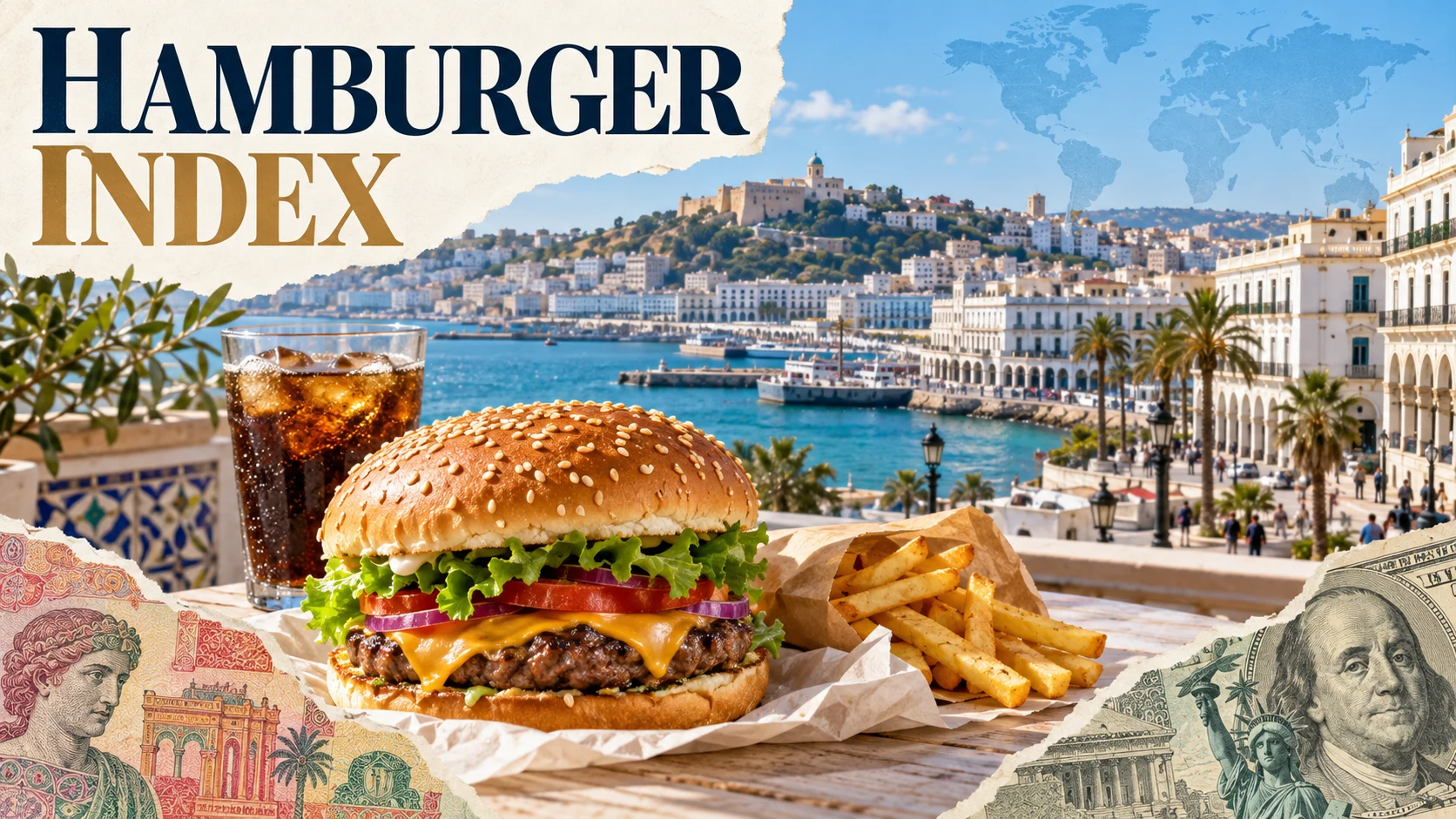
A quick meal offers a useful way to compare everyday travel costs. This chapter compares the same Numbeo category in both countries: a fast-food combo meal, including a local equivalent. It does not price a single hamburger.[1–2]
Algeria is absent from McDonald’s published market list. We therefore use a local fast-food equivalent, not an Algerian Big Mac price. The Economist’s Big Mac Index uses a standardized product and a different methodology.[3–4]
$3.82Equivalent combo meal · Algeria
$12.00USA baseline
32 / 100USA = 100
Price of an equivalent fast-food meal · USD
Algeria
$3.82
United States
$12.00
Equivalent combo meal
Reported range · USD
Data updated
Algeria
$3.36–5.04
September 28, 2026
United States
$10.00–15.00
October 11, 2026
Calculation: 3.82 ÷ 12.00 × 100 = 31.8. Rounded to 32, the Algeria meal indicator is about 68% below the US reference price. This comparison describes reported prices, not currency undervaluation or affordability for local residents.
19
Travel Costs & Budget
$35–50Independent daily budget
$150–300Guided Sahara day
CashEssential outside hotels
Algeria remains one of North Africa's better travel values, in part because tourism infrastructure is still catching up to the country's opening — prices haven't yet caught up to Morocco or Tunisia's more developed tourist circuits. Budget travelers can manage on roughly $35-50/day outside the Sahara; a Tassili n'Ajjer or Hoggar expedition (guide, 4x4, camping gear, permits) runs considerably higher, typically $150-300/day all-in given the mandatory guide requirement and remote logistics.
Where costs surprise visitors: the mandatory local guide/agency requirement for most Saharan travel adds real expense that a simple hotel-and-meals budget doesn't capture, while everyday costs in Algiers and the northern cities — taxis, restaurant meals, museum entry — run noticeably cheaper than equivalent experiences in Marrakech or Tunis.
20
📚 Recommended Reading
CamusColonial Algiers
DjebarMemory and women
DaoudModern reply
Essential: Albert Camus's The Stranger (L'Étranger), set on an Algiers beach and one of the 20th century's most famous novels, remains the starting point for most readers — even though Camus wrote as a French-Algerian (pied-noir) rather than an Algerian voice. For the direct, deliberate answer to it, read Kamel Daoud's The Meursault Investigation, narrated by the brother of the unnamed Arab man Camus's narrator kills — a genuinely essential companion piece written by an Algerian author six decades later.
Further reading: Assia Djebar's Fantasia: An Algerian Cavalcade weaves colonial history with women's voices largely absent from the standard record. Yasmina Khadra's What the Day Owes the Night is the great novel of colonial-era Oran, and Kamel Daoud's Goncourt-winning Houris (2024) confronts the 1990s civil conflict that Algerian law still forbids writers at home to depict. For non-fiction, Alistair Horne's A Savage War of Peace remains the standard English-language history of the Algerian War of Independence (1954-1962).
21
🏨 Accommodation
€20–40Budget
€50–100Mid-range
€150+Luxury
Algeria's accommodation options have expanded significantly with the tourism boom. Algiers offers international chains like Marriott, Sheraton, and Sofitel alongside boutique riads in the Casbah. Coastal cities provide beach resorts, while Saharan destinations feature desert camps and eco-lodges that offer authentic experiences under the stars.
Budget: €20-40/night – Basic hotels, hostels in major cities
Luxury: €150-300+/night – International brands, desert glamping
Booking in advance is essential during peak Saharan season (October-March) when desert camps fill quickly.
22
💎 Hidden Gems
Béni Abbès — The "Pearl of the Saoura," this oasis town features stunning kasbahs and the hermitage of Charles de Foucauld (canonised in May 2022), surrounded by dramatic red dunes.
Tipasa — UNESCO-listed Phoenician and Roman ruins overlooking the Mediterranean, immortalized in Camus' essay "Nuptials at Tipasa."
El Oued — The "City of a Thousand Domes," where unique cupola architecture creates an otherworldly skyline.
Tlemcen — The "Pearl of the Maghreb," with stunning Islamic architecture rivaling Granada's Alhambra.
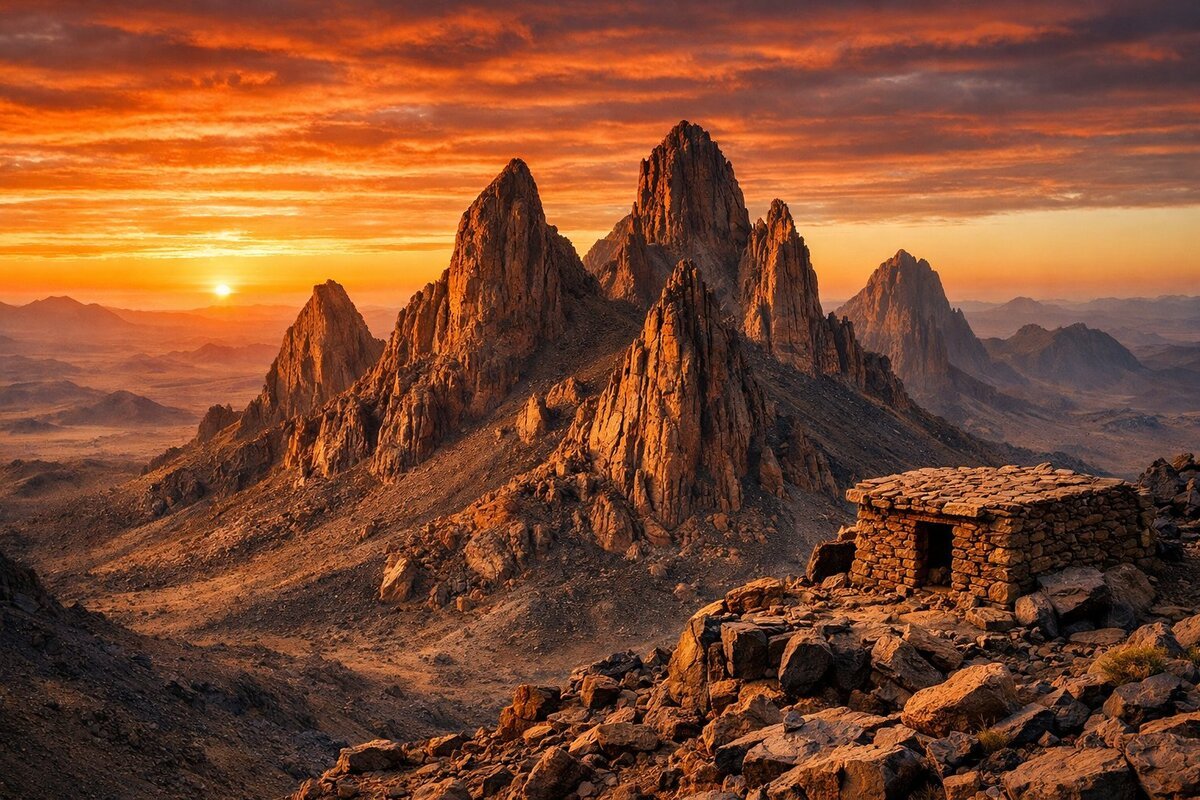
Assekrem — The spiritual heart of the Hoggar Mountains, where Father Charles de Foucauld built his hermitage with some of the world's most spectacular sunrises.
Assekrem · Hoggar
Volcanic spires at dawn from de Foucauld’s hermitage, 2,780 m.
Essentials: Modest clothing covering shoulders and knees, comfortable walking shoes, sun protection (hat, sunglasses, SPF 50+), headscarf for women visiting mosques.
Sahara specific: Light layers for temperature swings (40°C days to near-freezing nights), dust-proof bags for electronics, sturdy sandals, warm fleece for evenings.
Practical items: Copies of all documents, euros or dollars for exchange, universal adapter (Type C/F plugs), basic first aid kit, water purification tablets.
Don't forget: Torch/headlamp for power cuts and desert camps, toilet paper, hand sanitizer, patience for bureaucracy.
🌍 Largest African Country: At 2.38 million km², Algeria is Africa's largest nation—and 90% is Sahara Desert.
🏛️ Roman Treasures: Algeria has more Roman ruins than any country outside Italy, including the best-preserved Roman city in existence (Timgad).
🎨 World's Oldest Art: The Tassili n'Ajjer rock paintings date back 12,000 years, depicting a green Sahara with hippos, elephants, and cattle.
🕌 Africa's Tallest Minaret: The Great Mosque of Algiers (2024) has a 265-metre minaret — the tallest minaret in the world, though Cairo's 394 m Iconic Tower has been Africa's tallest building since 2023.
🏆 Football Obsession: Algeria's 2019 Africa Cup of Nations victory sparked celebrations across the diaspora in France that rivaled any local victory — and in July 2026 the Fennecs reached a World Cup knockout round for the first time since 2014.
🎵 Raï Revolution: This Algerian music genre influenced global pop—Sting's "Desert Rose" featured raï legend Cheb Mami.
27
⭐ Notable People
LiteratureDjebar · Daoud
MusicKhaled · Mami
SportNemour · Zidane
Albert Camus (1913-1960) — Nobel Prize-winning author born in Algeria, whose works like "The Stranger" and "The Plague" defined existentialist literature.
Cheb Khaled (1960-) — "The King of Raï," whose hit "Aïcha" became a global phenomenon, bringing Algerian music to world audiences.
Zinedine Zidane (1972-) — Though born in France, Zidane's parents emigrated from Algeria; widely considered one of football's greatest players.
Frantz Fanon (1925-1961) — Revolutionary psychiatrist and philosopher who supported Algerian independence and wrote "The Wretched of the Earth."
Djamila Bouhired (1935-) — Iconic freedom fighter of the Algerian Revolution, whose story inspired the film "The Battle of Algiers."
Kamel Daoud (1970-) — Oran-born novelist and columnist; his Houris, about the 1990s civil war, won the 2024 Prix Goncourt — the first for an Algerian author — and is banned in Algeria under the law forbidding depiction of that conflict.
Kaylia Nemour (2006-) — Gymnast who won uneven-bars gold at Paris 2024, the first Olympic gymnastics medal in African history.
28
⚽ Sports
2×AFCON champions
7Olympic golds
FootballNational passion
Football: The undisputed national obsession. Les Fennecs (The Desert Foxes) won the Africa Cup of Nations in 1990 and 2019. At the 2025 AFCON in Morocco they went out in the quarter-finals, 0–2 to Nigeria in Marrakech on 11 January 2026 — their fifth quarter-final exit in seven knockout appearances. At the 2026 World Cup, their fifth finals, Algeria lost 0–3 to Argentina, beat Jordan 2–1 and drew 3–3 with Austria to reach the knockout rounds for the first time since 2014, then lost 0–2 to Switzerland in the round of 32 on 2 July 2026. Domestically, MC Alger won the 2025–26 Ligue 1 title and USM Alger the 2026 Algerian Cup (2–1 over CR Belouizdad, 30 April 2026); JS Kabylie remains the most decorated club.
Athletics: Algeria has produced notable middle-distance runners, including Noureddine Morceli (multiple world records) and Hassiba Boulmerka (Olympic 1,500 m gold, 1992), Taoufik Makhloufi (1,500 m gold, 2012) and Djamel Sedjati (800 m bronze, Paris 2024).
Paris 2024: Algeria's joint-best Games — two golds and a bronze, matching Atlanta 1996. Kaylia Nemour, 17, won the uneven bars, the first Olympic gymnastics medal for Algeria or any African nation; Imane Khelif won the women's 66 kg boxing title. Algeria's all-time Olympic tally stands at 20 medals (7 gold).
Boxing: A traditional strength: Hocine Soltani won lightweight gold at Atlanta 1996, Mohamed Allalou bronze at Sydney 2000, and Imane Khelif gold at Paris 2024.
Desert Sports: Off-road rallies, dune trekking and camel racing in the Sahara attract international participants (the Marathon des Sables, often misattributed to Algeria, is run in Morocco).
29
📰 Media & Press
145 / 1802026 RSF ranking
70%Internet use
3Working media languages
Algeria's media landscape has diversified since the 1990s, though state influence remains significant. ENTV is the public broadcaster, while private channels like Echorouk and Ennahar offer alternatives. The French-language daily El Watan survives as the main independent title; its rival Liberté was shut down by its owner in April 2022, a loss the sector has not recovered from.
Internet penetration has reached 70%, with social media increasingly important for news and public discourse. Press freedom deteriorated sharply after the 2019–2021 Hirak protest movement rather than improving: Algeria fell to 145th of 180 in the 2026 RSF World Press Freedom Index (down 19 places in a year), with RSF citing detentions, censorship and online harassment of independent newsrooms. Radio M founder Ihsane El Kadi was jailed in 2022 and pardoned in November 2024; French sports journalist Christophe Gleizes, arrested in May 2024 while reporting on JS Kabylie, was sentenced in June 2025 to seven years for "glorifying terrorism" and, after the sentence was upheld in December 2025, was still in prison awaiting a hoped-for pardon as of mid-2026.
30
🏛️ Government & Public Life
58Wilayas
RepublicPresidential system
AlgiersNational institutions
Algeria is a presidential republic divided into 58 provinces, or wilayas. Public life is shaped by the institutions created after independence, a large civil service, municipal administration and an active—though closely regulated—political sphere. Visitors will notice that national history, sovereignty and social stability are treated with particular seriousness.
31
🗣️ Population & Languages
48MPopulation estimate
ArabicOfficial
TamazightOfficial
Most Algerians live in the northern coastal belt, while the immense Sahara is sparsely populated. Arabic and Tamazight are official languages; Algerian Arabic is the everyday language for many people, and French remains widespread in business, education and the media. English is increasingly visible among younger Algerians and in tourism.
32
☪️ Religion & Daily Rhythm
SunniMaliki tradition
IbadiM’Zab communities
RamadanDaily rhythm changes
Islam is central to Algeria’s calendar and daily rhythm. Prayer times, Ramadan and the two Eid festivals influence opening hours, meals and family life. Religious practice varies by family and region, but modest dress and respectful conduct around mosques are sensible throughout the country.
Algeria’s Amazigh heritage is not a footnote but one of the foundations of the country’s identity. Kabyle, Chaoui, Mozabite and Tuareg communities preserve distinct languages, music, textiles, architecture and social traditions. The Amazigh New Year, Yennayer, is celebrated nationally and connects contemporary Algeria with its deep North African past.
The Algerian Sahara is home to communities adapted to vast distances and severe climates. Tuareg culture is especially associated with the far south around Tamanrasset and Djanet, while the M’Zab Valley has a distinctive Mozabite society and urban tradition. Travel here is best approached through experienced local guides and with respect for community rules.
Algeria’s built landscape ranges from Roman grids and Ottoman lanes to French boulevards, white modernist apartment blocks and earthen Saharan settlements. The Casbah of Algiers rewards slow exploration, while Ghardaïa demonstrates how compact towns, shaded passages and communal planning respond intelligently to desert conditions.
Raï, born in western Algeria and internationally associated with Oran, is only one part of a rich musical landscape. Chaabi gives Algiers a distinctive urban voice, Kabyle song carries Amazigh poetry, and Constantine is renowned for malouf, the city’s refined Andalusian tradition. Weddings and festivals remain important places for live performance.
37
📖 Literature, Art & Cinema
3Main literary languages
1966The Battle of Algiers
2024Goncourt for Houris
Algerian writers and filmmakers have explored colonialism, revolution, migration, memory and the tension between private life and public history. Works by Kateb Yacine, Assia Djebar, Mohammed Dib and Tahar Djaout offer very different doors into the country. Contemporary galleries and cinema continue that conversation in Arabic, Tamazight and French.
Long before modern Algeria, this land connected Saharan, Numidian, Phoenician, Roman, Vandal, Byzantine and Islamic worlds. Timgad and Djémila preserve remarkable Roman urban fabric, Tipasa faces the Mediterranean, and Tassili n’Ajjer contains rock art recording environments and ways of life from a greener Sahara.
Beyond the dunes, Algeria includes cedar forests, wetlands, salt lakes, Mediterranean scrub and the peaks of the Tell and Saharan Atlas. Barbary macaques survive in northern forests, migratory birds use coastal and inland wetlands, and desert ecosystems support highly specialized reptiles and mammals. Protected areas can be remote and require careful planning.
40
🚆 Getting Around
AirLong Saharan distances
RailNorthern corridor
4×4Remote desert
Domestic flights bridge the enormous distances between the north and the Sahara. Trains and intercity buses link many northern cities, while shared taxis are common on regional routes. In remote desert areas, distances, road conditions, permits and fuel availability make a reputable local operator far safer than improvisation.
41
🤝 Safety, Etiquette & Photography
50 kmTunisian border caution
250 kmSouthern border caution
Ask firstPeople and photography
Hospitality is generous, but courtesy matters: greet people before asking questions, dress with awareness of local norms and request permission before photographing individuals. Government buildings, police, military sites and some infrastructure should not be photographed. Conditions and access rules can change, especially near borders and in remote desert zones.
Good purchases include Kabyle pottery, woven rugs, leatherwork, engraved metal, traditional jewellery, dates and locally produced foodstuffs. Quality varies, so take time to compare workmanship and ask about origin. Bargaining is common in some markets, but it should remain friendly rather than confrontational.
43
📱 Connectivity & Digital Travel
MobilisNational network
DjezzyUrban coverage
OfflineMaps for the Sahara
Mobile data is widely available in populated areas, although coverage weakens rapidly in the Sahara. A local SIM can be useful for maps, translation and transport coordination; registration normally requires identification. Download offline maps and essential documents before long desert journeys and do not rely on continuous coverage.
44
⚡ Economy, Energy & Modern Algeria
GasMajor export
OilState revenue
SolarLong-term potential
Oil and natural gas have long shaped Algeria’s economy, state revenue and international relationships. At the same time, agriculture, construction, services, manufacturing and renewable-energy ambitions are increasingly visible. For travellers, this contrast appears in rapidly modernizing cities set beside regions where livelihoods remain closely tied to land, craft and seasonal rhythms.
45
📸 Photo Gallery
Algiers · Casbah with a Historian · 📸 Radim Kaufmann
Radim Kaufmann on a viewpoint above the Casbah of Algiers with a local Algerian historian in charcoal blazer gesturing across the cascade of white Casbah houses and the curved Bay of Algiers below, French colonial buildings on the waterfront, the port and Mediterranean visible
Radim Kaufmann at the Roman ruins of Tipasa on the Algerian Mediterranean coast with a local Algerian female archaeologist pointing down to an intricate Roman dolphin mosaic medallion preserved in situ, the marble Albert Camus memorial stele inscribed 'J'AI ÉTÉ À TIPASA' visible behind them, broken Corinthian columns of the basilica of Saint Salsa rising against the deep blue Mediterranean Sea beyond
Algeria demands effort — paperwork, patience, and a willingness to accept uncertainty — and it pays you back in a currency no other Mediterranean country has left: solitude in front of the best things. I had Timgad's forum to myself for an hour on an April morning, the grid of Trajan's colony laid out under a sky so clean it hurt, and the only sound was a caretaker sweeping. In the Casbah a retired historian walked me down through the Ottoman alleys and stopped, unprompted, at the house where Ali La Pointe died in 1957; he did not need to say anything about the film.
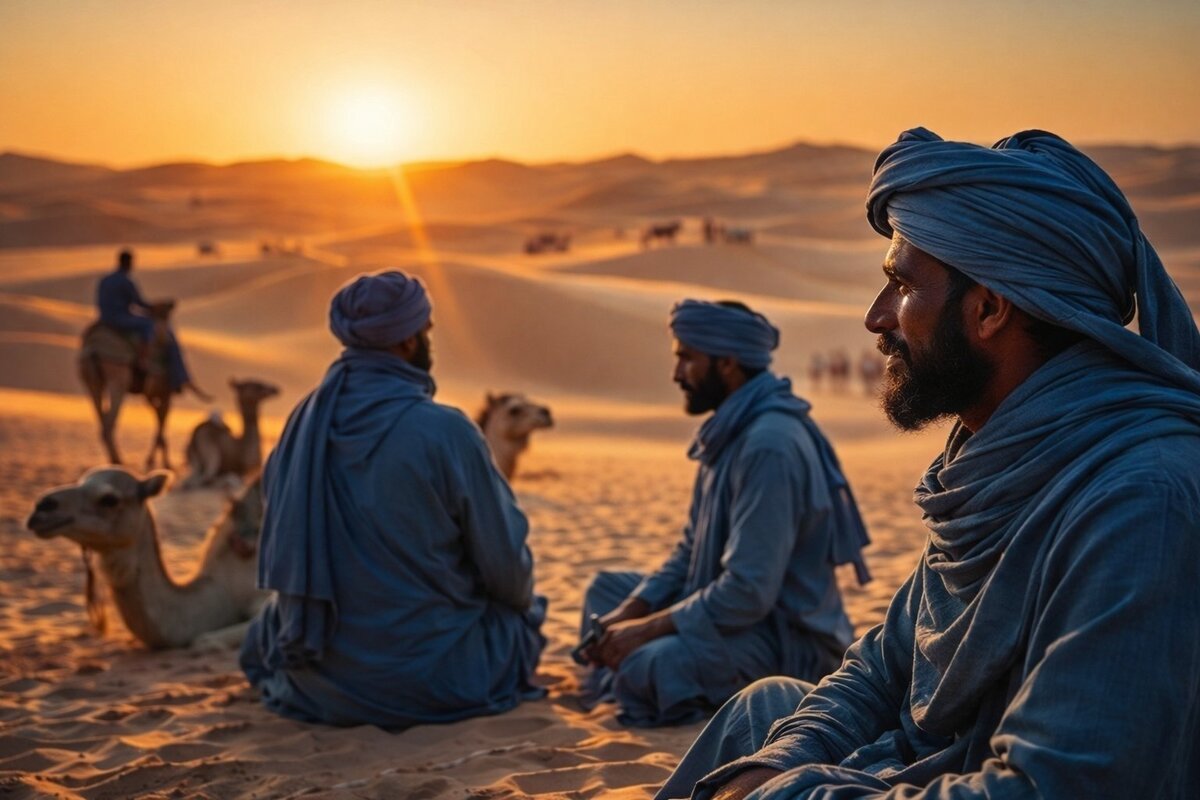
The night that stays with me was on the Tassili plateau. Our Tuareg guide poured the tea three times — bitter, then sweeter, then sweet — from a height that would have been showing off anywhere else, and told me the sandstone arches behind us were older than the paintings inside them, which were older than the pyramids. I believed all three claims at once. Then Kabylie, where Tassadit put a fourth glass in front of me and would not take it back, and Constantine at sunset, malouf drifting out of a café above the gorge while the Sidi M'Cid bridge swung very slightly under a bus.
Go now, while the visa is still a small ordeal and the Roman cities are still empty. The government wants twelve million visitors by 2030; the country I saw was not built for that, and is better for it.
— Radim Kaufmann, 2026
Share Your Photo
Have an Algeria photograph you own? Attach it to your email and include the location and the name you want credited.