From coral reef to red desert to snow-capped alps — a continent-sized country where the world's oldest continuous culture meets some of its youngest, boldest cities.
Australia occupies an entire continent, the world's sixth-largest country spanning 7.7 million square kilometers of staggering diversity. From the coral wonderlands of the Great Barrier Reef to the ancient red monolith of Uluru, from cosmopolitan Sydney and Melbourne to the vast emptiness of the Outback, Australia offers experiences found nowhere else on Earth. This is the land of kangaroos and koalas, of Aboriginal culture stretching back over 65,000 years — the oldest continuous culture on the planet.
For travelers, Australia delivers a rare combination: world-class cities with sophisticated dining and arts scenes, pristine natural environments teeming with unique wildlife, and a laid-back culture where "no worries" is more than a catchphrase — it's a way of life. The country's approximately 34,000 (mainland coastline, 1:100,000 scale) kilometers of coastline include some of the world's finest beaches, from the golden sands of Bondi to the turquoise waters of the Whitsundays.
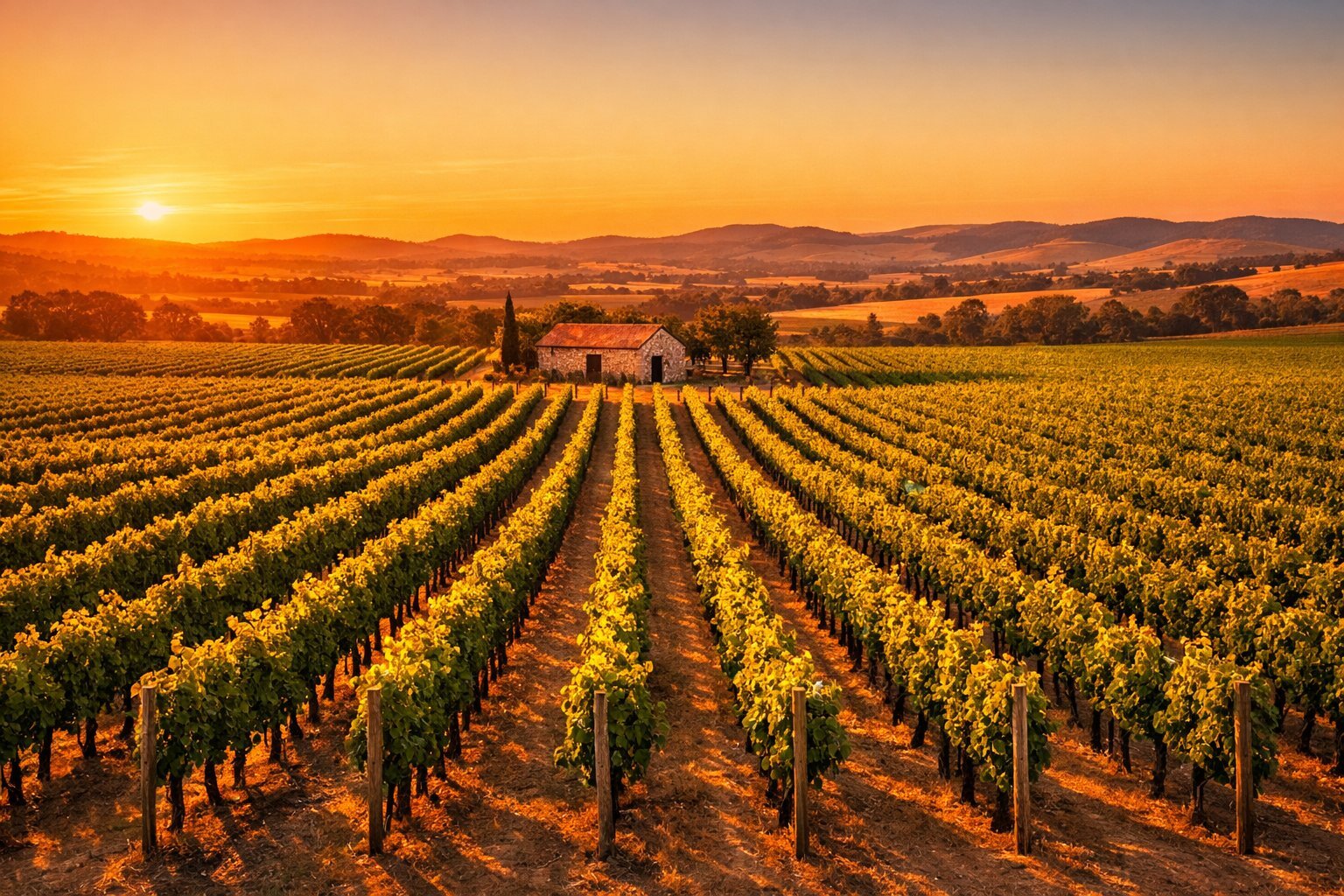
Beyond the famous icons lie surprises at every turn: the ancient Daintree Rainforest, the wine regions of Barossa Valley and Margaret River, the otherworldly landscapes of the Kimberley, and the wildlife encounters of Kangaroo Island. Australians themselves are famously friendly and informal, making visitors feel welcome whether in a five-star restaurant or a dusty Outback pub. And it's worth sitting with one number the whole time you're here: Aboriginal and Torres Strait Islander peoples have lived on this continent for over 65,000 years, while the European city skylines that now define its postcards are barely two centuries old.
The name "Australia" derives from the Latin "Terra Australis," meaning "Southern Land." For centuries, European cartographers hypothesized a great southern continent to balance the landmasses of the Northern Hemisphere. When British navigator Matthew Flinders circumnavigated the continent in 1802–1803, he advocated for the name "Australia" over the then-common "New Holland," and it was officially adopted in 1824.
The Commonwealth of Australia, established on January 1, 1901, through the federation of six British colonies, is a constitutional monarchy and parliamentary democracy. The country comprises six states (New South Wales, Victoria, Queensland, South Australia, Western Australia, Tasmania) and two mainland territories (Australian Capital Territory, Northern Territory), each with its own distinct character and identity.
Indigenous Australians — Aboriginal and Torres Strait Islander peoples — have inhabited the continent for over 65,000 years, making theirs the world's oldest continuous culture. Their connection to Country (land and sea) is fundamental to Australian identity, and acknowledgment of Traditional Owners has become an increasingly prominent part of Australian public life, from "Welcome to Country" ceremonies at official events to growing recognition of Aboriginal place names alongside colonial ones.
Australia spans 7,688,287 square kilometers — roughly the size of the contiguous United States, or 35 times the size of the United Kingdom. As the world's flattest and driest inhabited continent, its geography defies expectations. The Great Dividing Range runs along the east coast for 3,500 kilometers, separating the fertile coastal strip from the vast interior. Mount Kosciuszko, at 2,228 meters, is the highest peak on the Australian mainland.
The Outback — Australia's vast, arid interior — covers roughly 70% of the continent: a landscape of red earth, spinifex grasslands, salt lakes, and ancient geological formations. Lake Eyre (Kati Thanda), the country's lowest point at 15 meters below sea level, fills with water only a few times per century, briefly becoming Australia's largest lake. The ancient Pilbara region of Western Australia contains some of the oldest rocks on Earth, dating back 3.6 billion years.
Australia's coastline stretches approximately 34,000 (mainland coastline, 1:100,000 scale) kilometers, encompassing tropical reefs in the north, dramatic sea cliffs in the south, and endless white sand beaches everywhere in between. The island state of Tasmania, separated from the mainland by the 240-kilometer Bass Strait, harbors temperate rainforests of extraordinary beauty. External territories include Christmas Island, the Cocos (Keeling) Islands, Norfolk Island, and a claim to roughly 42% of Antarctica.
🏙️ The Edge and the Empty Center
Nearly 90% of Australians live within 50 kilometers of the coast — a country the size of the mainland United States with the population density of a small nation, almost entirely hugging its rim. Step even a short way inland from Sydney or Perth and the crowds vanish; step far enough and you reach country where the nearest town might be hours away by road. This single fact — an entire continent, mostly empty, wrapped around a thin, densely populated coastal ribbon — shapes almost everything about how Australians travel their own country.
Canberra sits at 35.28° S, 149.13° E. Sydney is 250 km north-east, Melbourne 470 km south-west, Uluru 1,960 km north-west by air and Cairns 2,060 km north — the markers show the destinations covered on this page. Scroll-zoom is disabled; use the +/− buttons.
Map unavailable? Open Australia in OpenStreetMap. Destinations: Canberra · Sydney · Melbourne · Cairns · Uluru · Perth · Hobart.
05
📜 History
Aboriginal and Torres Strait Islander peoples have lived on this continent for at least 65,000 years — evidence from sites like Madjedbebe in Arnhem Land pushes the date back further with every new excavation — making theirs the oldest continuous culture on Earth. Before 1788, an estimated 250–750 distinct language groups and nations occupied the continent, each with deep, specific knowledge of their Country: sophisticated land management through fire ("fire-stick farming"), complex kinship and law systems, and songlines — oral maps encoding navigation, history, and law across vast distances, passed down for thousands of years.
European contact began with Dutch navigator Willem Janszoon's landing in 1606, followed by more than a century of sporadic Dutch, French, and British exploration along the coasts. Captain James Cook charted the east coast in 1770 and claimed it for Britain under the legal fiction of "terra nullius" — land belonging to no one — despite the continent's existing inhabitants. The First Fleet arrived at Sydney Cove in January 1788, establishing a penal colony; convict transportation from Britain continued until 1868, ultimately bringing around 162,000 convicts to Australian shores.
Colonization was catastrophic for Aboriginal Australians. Introduced diseases, frontier violence and massacres, and displacement from traditional land devastated the Indigenous population over the following century — from an estimated 750,000–1 million people in 1788 to under 100,000 by the early 1900s. Gold rushes from the 1850s transformed the colonies' population and wealth, and the six colonies federated into the Commonwealth of Australia on January 1, 1901. The new nation's first major law, the Immigration Restriction Act, formalized the "White Australia Policy," which was not fully dismantled until 1973.
The 20th century brought Gallipoli (1915), whose catastrophic Anzac campaign became a defining national story despite — or because of — its failure, and direct attack in World War II, when Japanese forces bombed Darwin in 1942. Post-war immigration transformed Australia into one of the world's most multicultural societies. Aboriginal rights advanced slowly and unevenly: the 1967 referendum saw over 90% of Australians vote to amend the Constitution to allow Commonwealth legislation concerning Aboriginal people and remove their exclusion from constitutional population counts; the 1992 Mabo decision legally overturned terra nullius and recognized native title; and the 2008 National Apology, delivered by Prime Minister Kevin Rudd, formally acknowledged the Stolen Generations — the forced removal of Aboriginal children from their families that continued for much of the 20th century. Most recently, a 2023 national referendum on enshrining an Indigenous Voice to Parliament in the constitution was defeated at the ballot box, leaving the path toward further reconciliation an actively contested question in Australian public life today.
Modern Australia is one of the world's most successful multicultural societies: nearly a third of residents were born overseas, and Sydney and Melbourne rank among the most linguistically diverse cities on Earth. Waves of postwar immigration — first from Britain and Southern Europe, later from across Asia, the Middle East, and Africa — reshaped a society that began as a British penal colony into something genuinely cosmopolitan, without losing the laconic, egalitarian self-image ("mateship," a suspicion of pretension, the "fair go") that Australians still describe as core to their national character.
Aboriginal and Torres Strait Islander culture, once pushed to the margins of public life, is increasingly visible and celebrated: art centres across the country sell dot paintings and bark art whose techniques stretch back millennia, "Welcome to Country" ceremonies open major public events, and the Torres Strait Islands maintain a distinct Melanesian culture within the federation, with their own flag, languages, and traditions of seafaring and dance.
Sport verges on civic religion — cricket, Australian Rules football (AFL), rugby league and union, and surfing all command fierce, often region-specific loyalty. Coffee culture is taken with startling seriousness (Melbourne in particular considers itself a genuine rival to Rome), and the backyard barbecue remains close to a national ritual. Beneath the sunny reputation, Australians can be direct to the point of bluntness, deeply informal across class lines by international standards, and quick with self-deprecating humor — a culture more understated than its beaches-and-sunshine marketing might suggest.
Australia is a federal parliamentary constitutional monarchy. King Charles III is head of state, represented domestically by the Governor-General, Sam Mostyn, who became Australia's 28th Governor-General when she was sworn in on 1 July 2024 — the second woman to hold the office. Real executive power sits with the Prime Minister, Anthony Albanese (Australian Labor Party), who took office in May 2022 and was returned at the federal election of 3 May 2025 with a substantially increased majority.
The Federal Parliament in Canberra is bicameral: a 150-seat House of Representatives elected by preferential (ranked-choice) voting, and a 76-seat Senate elected by proportional representation, with equal representation for each of the six states regardless of population. Voting is compulsory for citizens aged 18 and over — turnout consistently exceeds 90%, one of the highest rates in the democratic world — and elections are held on Saturdays, which is why polling places double as fundraising barbecues and the "democracy sausage" has become a genuine national institution.
Power is genuinely federal: the six states and two mainland territories run their own parliaments, and health, education, policing, and transport are largely state responsibilities, which is why rules on everything from speed limits to alcohol licensing shift as you cross a border. The most significant constitutional question of recent years was the 2023 referendum on an Aboriginal and Torres Strait Islander Voice to Parliament, which was defeated with roughly 60% voting No — a result that did not end the national conversation about treaty and recognition so much as reset where it starts.
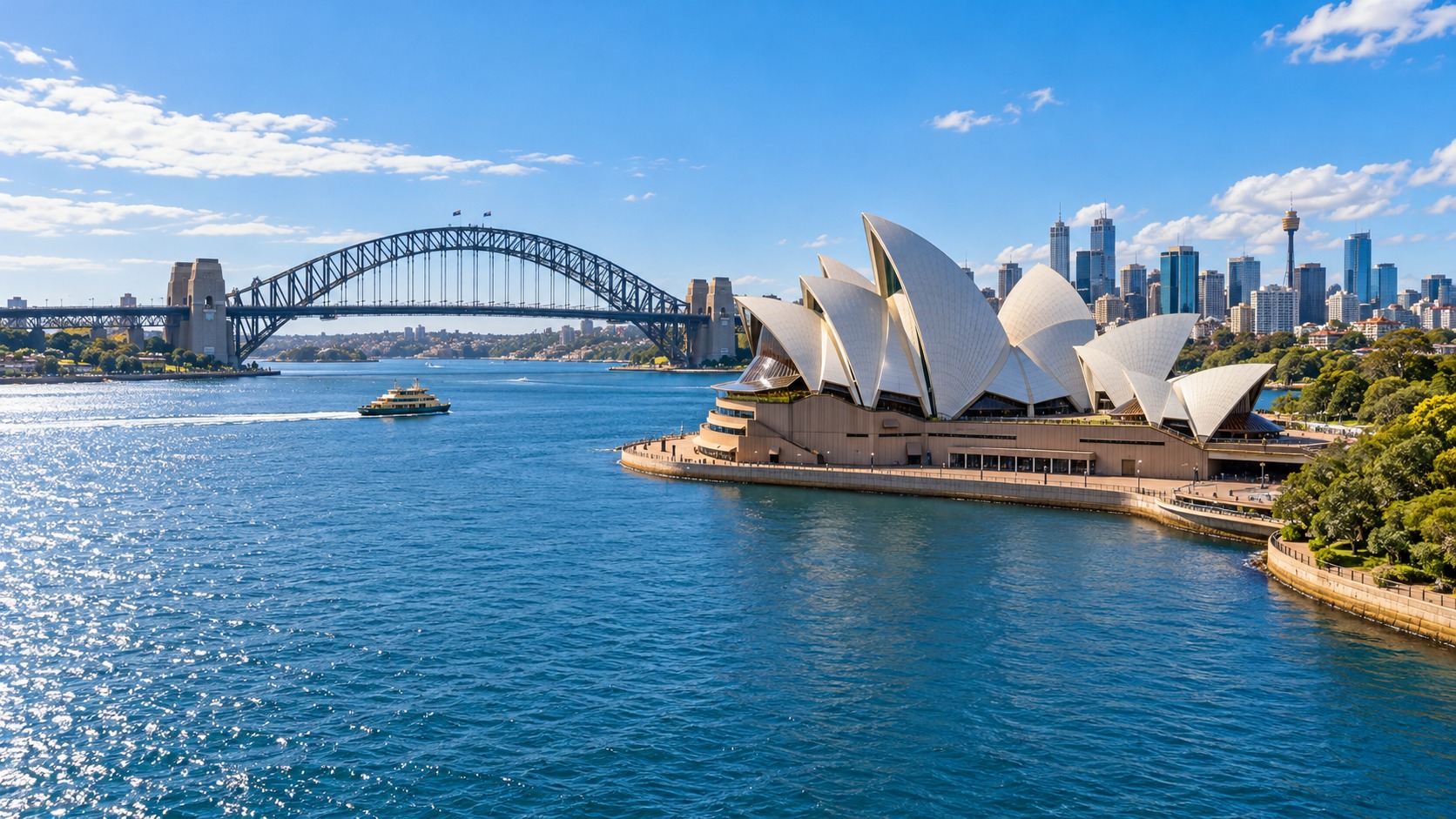
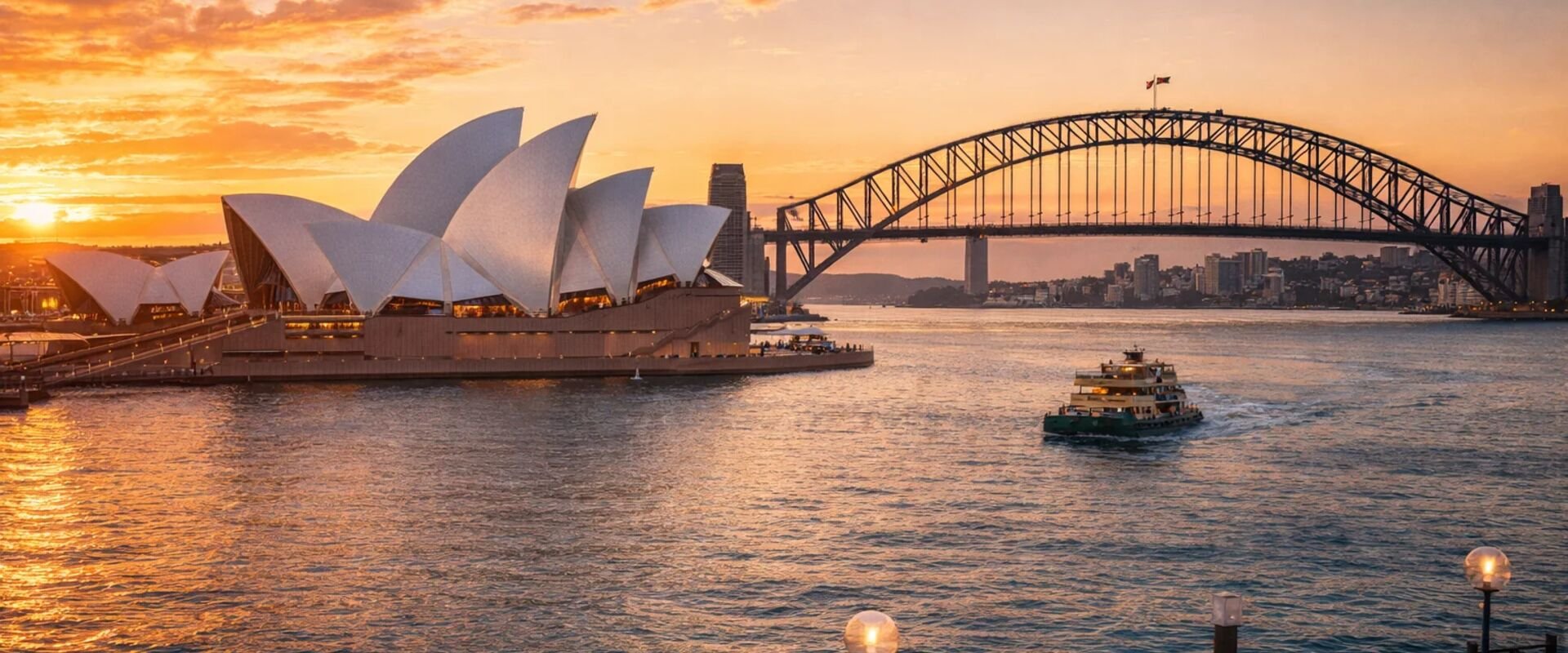
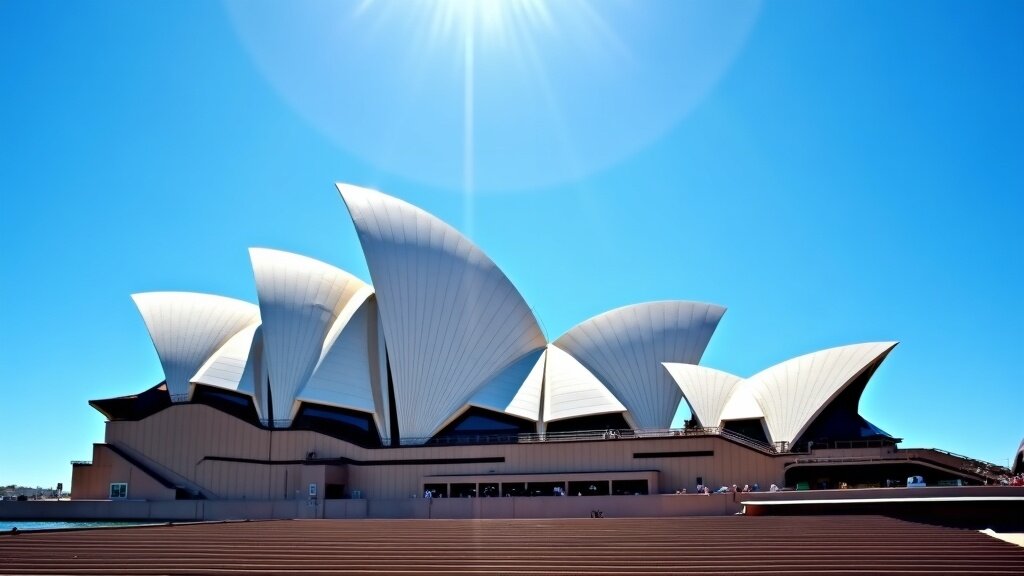
Sydney announces itself immediately — the white sails of the Opera House and the steel arch of the Harbour Bridge framing what is, by wide consensus, one of the most beautiful natural harbours on Earth. Jørn Utzon's Opera House, completed in 1973 after a construction saga that outlasted his own involvement with the project, remains Australia's most photographed building and a genuine architectural landmark rather than just a postcard cliché — the acoustics and engineering inside are as remarkable as the silhouette outside.
Beyond the harbour icons, Sydney rewards wandering. The Rocks preserves the city's convict-era streetscape in sandstone laneways now filled with galleries and weekend markets. Bondi Beach anchors the eastern suburbs' surf culture, and the clifftop Bondi to Coogee coastal walk is one of the world's great urban strolls, passing beach after beach with barely a break in the view. Darling Harbour and the revitalized Barangaroo precinct offer waterfront dining and nightlife, while Newtown and the Inner West carry Sydney's bohemian, multicultural, food-obsessed alter ego.
Sydney's harbour itself is best experienced on the water: a Manly ferry ride past the Opera House at sunset costs little more than a bus fare and delivers one of the best views in the world. The climb up the Harbour Bridge — via the commercial BridgeClimb or simply on foot across the pedestrian walkway for free — offers a different, dizzying perspective on the same skyline that greets every arriving ferry.
Legacy website image · original source and rights record pending verification.
Sydney Harbour
Utzon’s sails and the 1932 Harbour Bridge — the view every arriving Manly ferry gets for the price of a bus fare.
09
☕ Melbourne & the Great Ocean Road
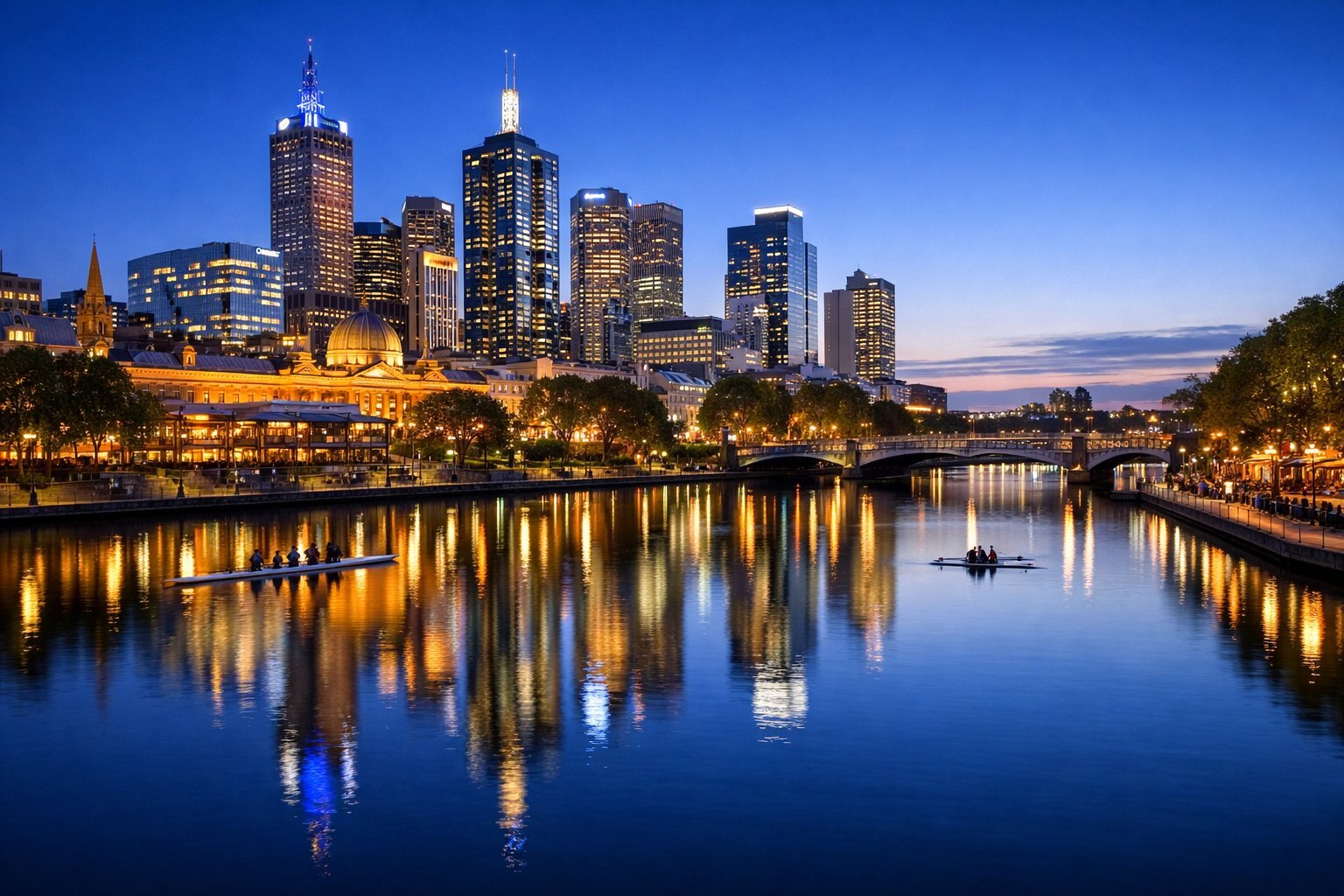
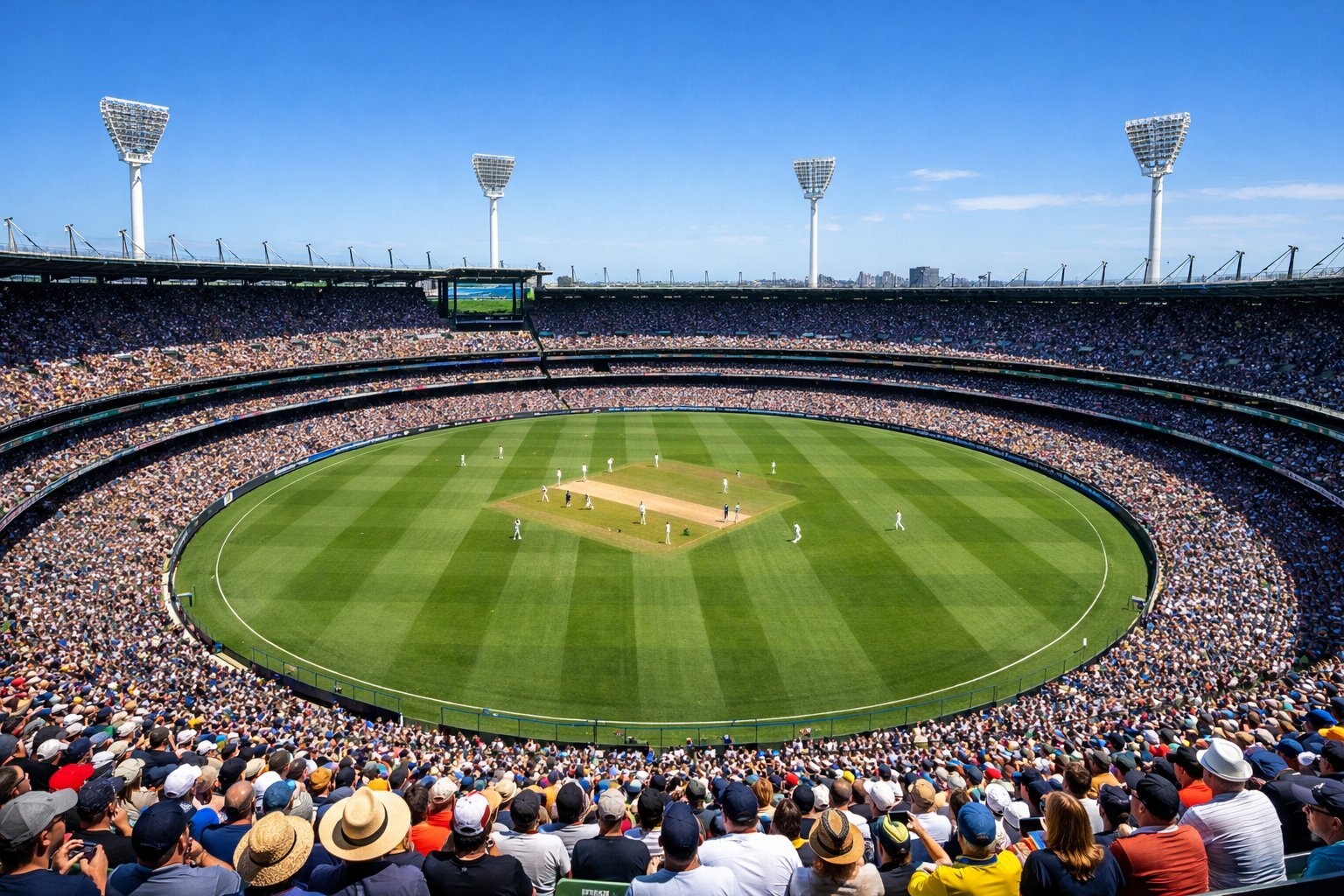
Melbourne and Sydney maintain a friendly, decades-long rivalry, and Melbourne's case for superiority rests on culture rather than scenery: laneway cafés and bars hidden behind unmarked doors, a fiercely serious coffee scene that considers itself a match for Europe's best, and a claim to being Australia's sporting and cultural capital, anchored by the Melbourne Cricket Ground (the MCG) and the Australian Open. The city's trams, Victorian-era arcades, and street art-covered laneways like Hosier Lane give it a texture unlike anywhere else in the country.
Federation Square and the Southbank arts precinct concentrate Melbourne's gallery and performance scene, while inner suburbs like Fitzroy, Collingwood, and St Kilda each carry their own distinct character — from grungy live-music venues to Victorian terrace houses and beachfront promenades. The city's food scene, shaped heavily by postwar Italian and Greek immigration and more recent waves from across Asia, is arguably Australia's most sophisticated and most genuinely diverse.
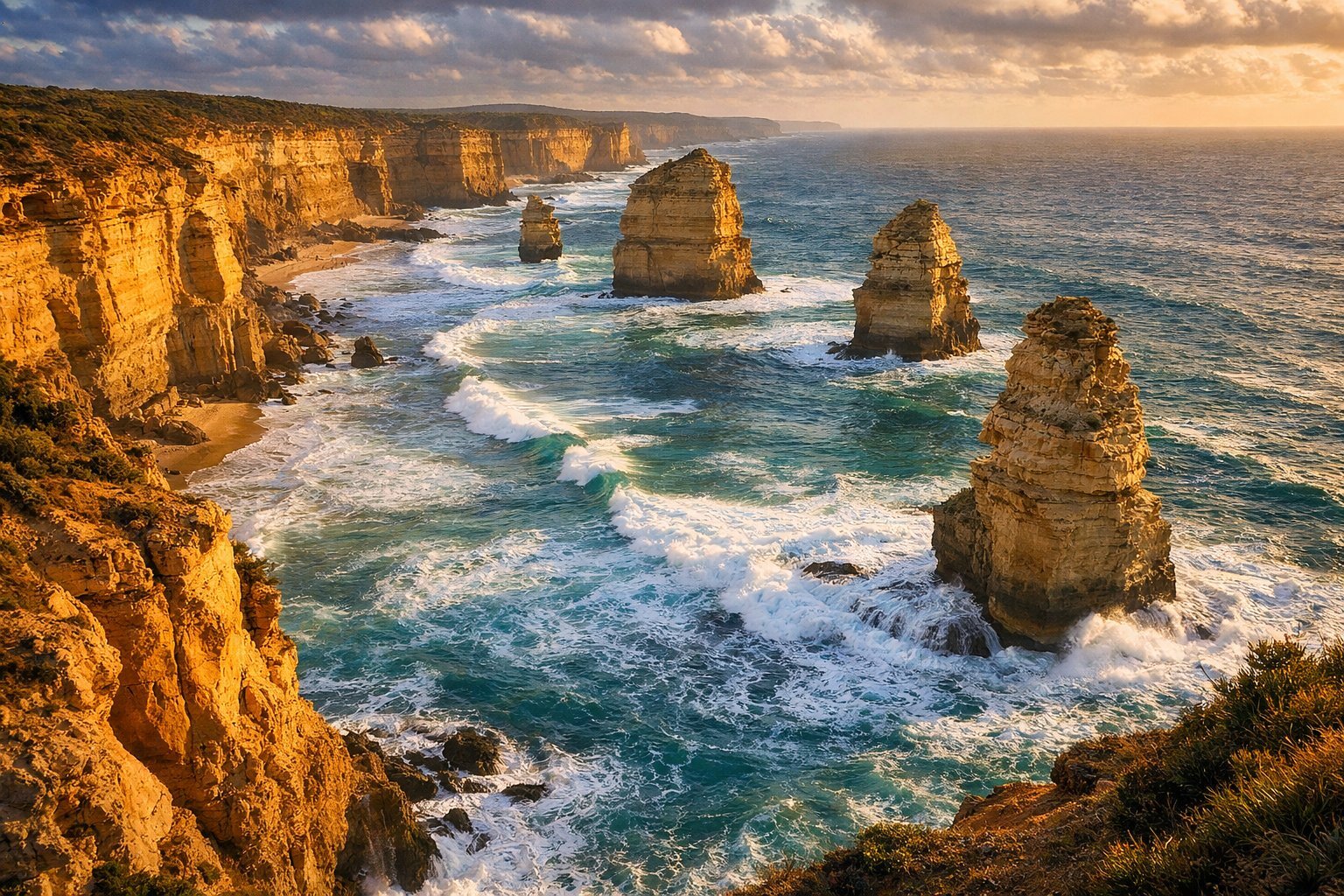
Just outside the city, the Great Ocean Road ranks among the world's great coastal drives — 243 kilometers of dramatic coastline running southwest from Torquay, culminating in the Twelve Apostles, limestone sea stacks rising from the Southern Ocean (despite the name, fewer than a dozen remain standing; erosion has claimed several since they were named, and will claim more). The drive passes surf towns, rainforest pockets sheltering wild koalas, and some of the most photographed coastal scenery in the country.
Legacy website image · original source and rights record pending verification.
Twelve Apostles, Great Ocean Road
Fewer than a dozen stacks remain standing; the Southern Ocean is still working on the rest.
10
🐠 The Great Barrier Reef
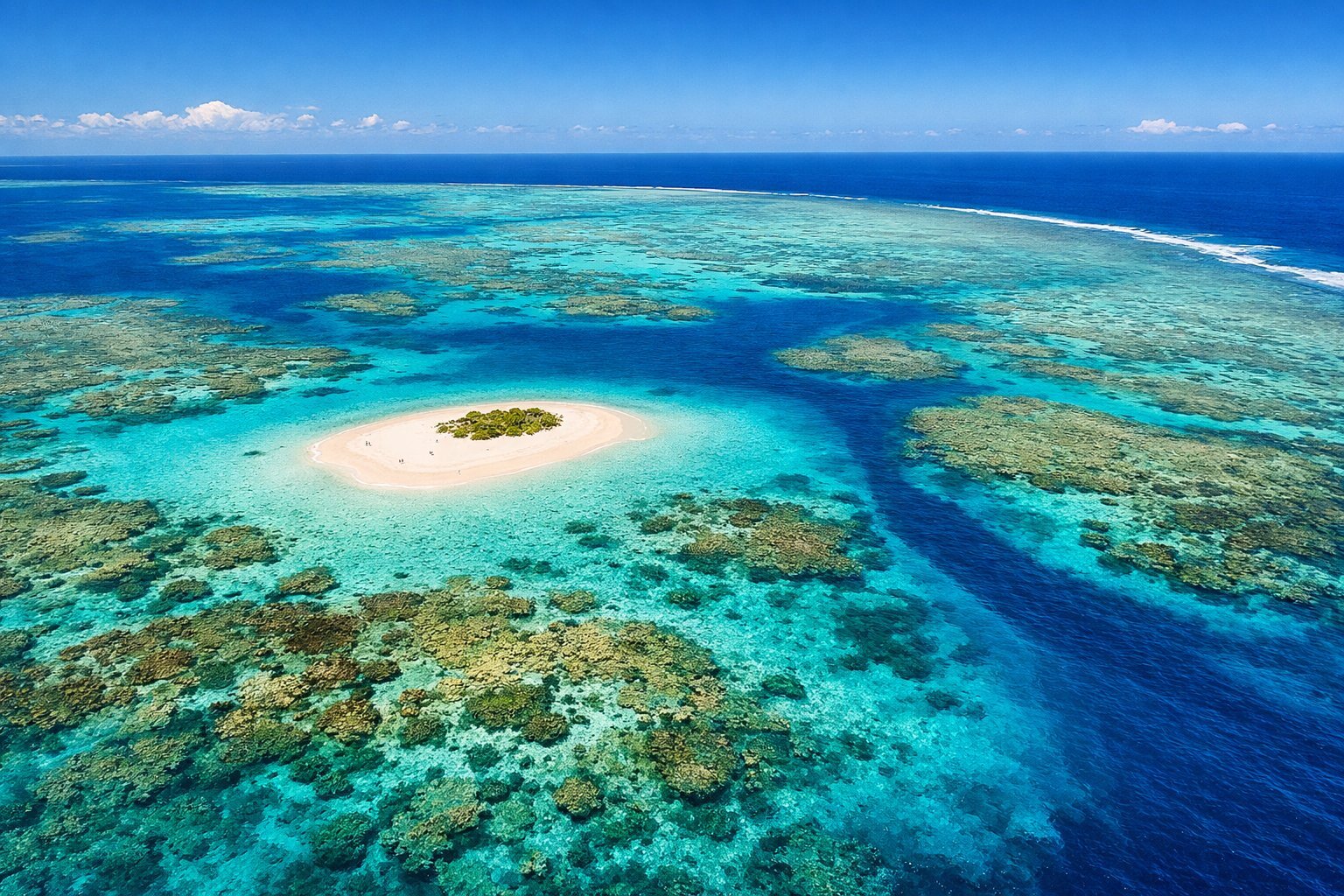
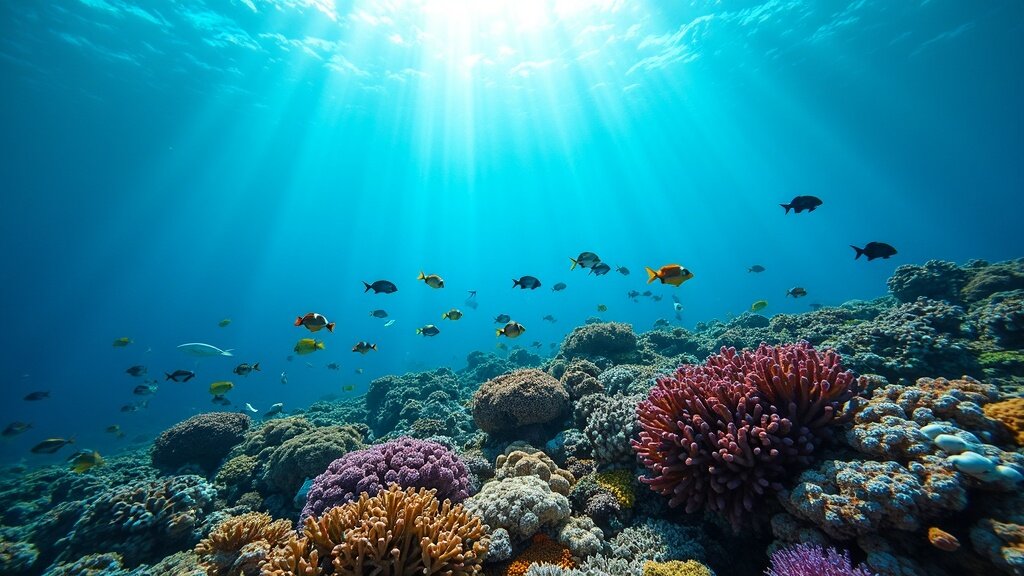
The Great Barrier Reef is the largest living structure on Earth — a 2,300-kilometer chain of over 2,900 individual reefs and 900 islands stretching along the Queensland coast, visible from space and home to roughly 1,500 fish species, 400 types of coral, and six of the world's seven marine turtle species. It has been a UNESCO World Heritage Site since 1981 and remains, despite well-documented bleaching events linked to warming ocean temperatures, one of the most extraordinary marine environments left on the planet. The bleaching record is stark — 2024 brought the fifth mass-bleaching event since 2016 and 2025 a sixth — but the Australian Institute of Marine Science's 2025–26 summer report (August 2026) found a reprieve: a late monsoon cooled the water, heat stress was lower than the previous two summers, and hard-coral cover held or rose in all three regions (35% in the north, up from 30%). A fifth wave of crown-of-thorns starfish outbreaks is the next worry.
Cairns and Port Douglas are the main gateway towns, offering day trips to outer reef pontoons where snorkelers and divers of any experience level can access genuinely spectacular coral gardens. The Whitsunday Islands, further south near Airlie Beach, combine reef access with some of Australia's most beautiful beaches — Whitehaven Beach's brilliantly white silica sand is a highlight in its own right, quite apart from the reef itself. For a quieter, more intimate experience, small outer islands like Lady Elliot and Heron offer accommodation literally on the reef, with reliable reef access straight off the beach.
Responsible operators matter here more than almost anywhere: reputable tour companies follow strict guidelines on reef contact, contribute to conservation research, and can explain what's actually happening to the reef's health rather than simply selling the postcard version. The reef's condition varies significantly by location and season, and current advice on the healthiest sites to visit is worth checking before booking rather than assuming any stretch is representative of the whole system.
Legacy website image · original source and rights record pending verification.
Great Barrier Reef
2,300 km of reef along the Queensland coast — World Heritage since 1981, and still recovering from the 2024 and 2025 bleaching summers.
11
🏜️ Uluru & the Outback
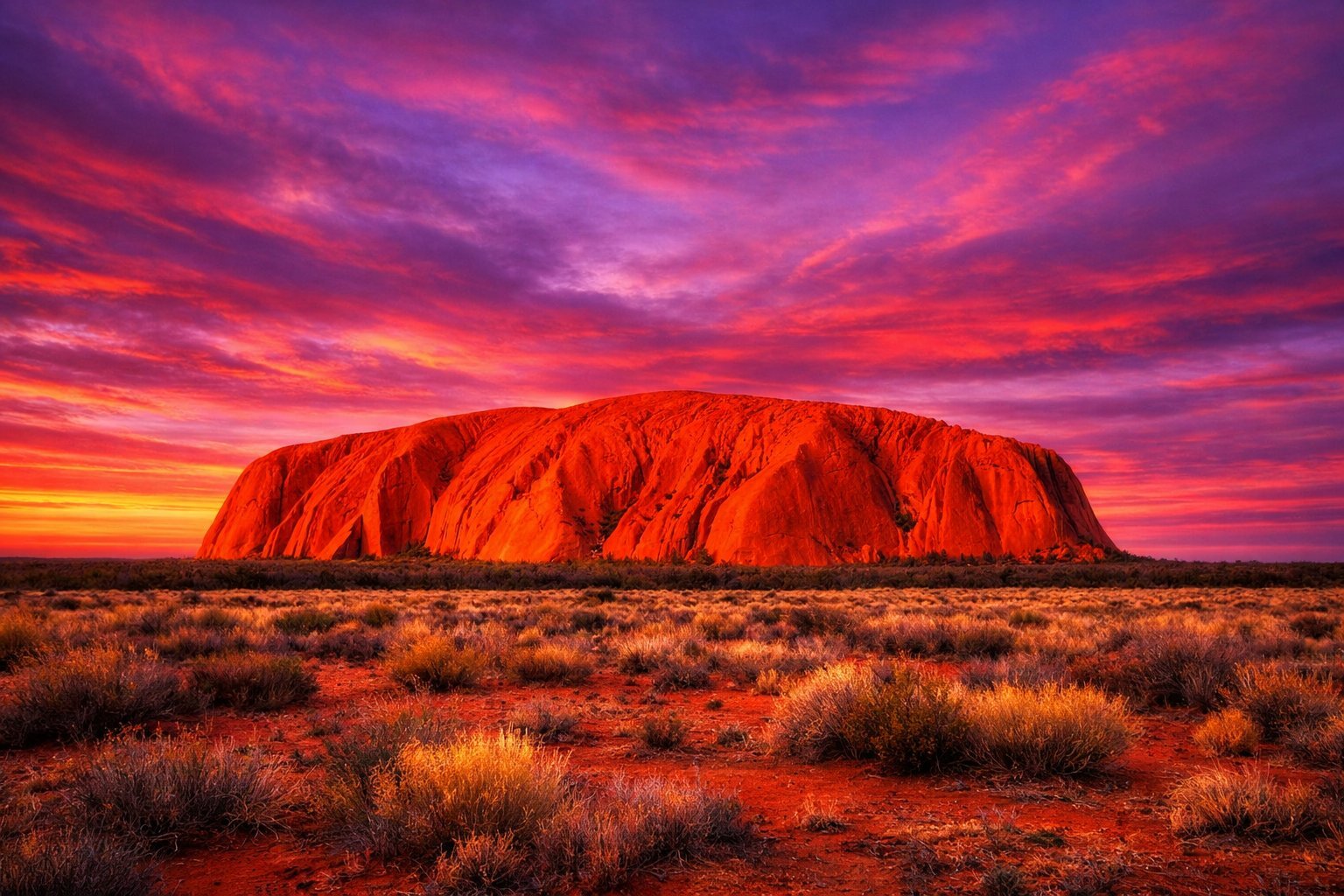
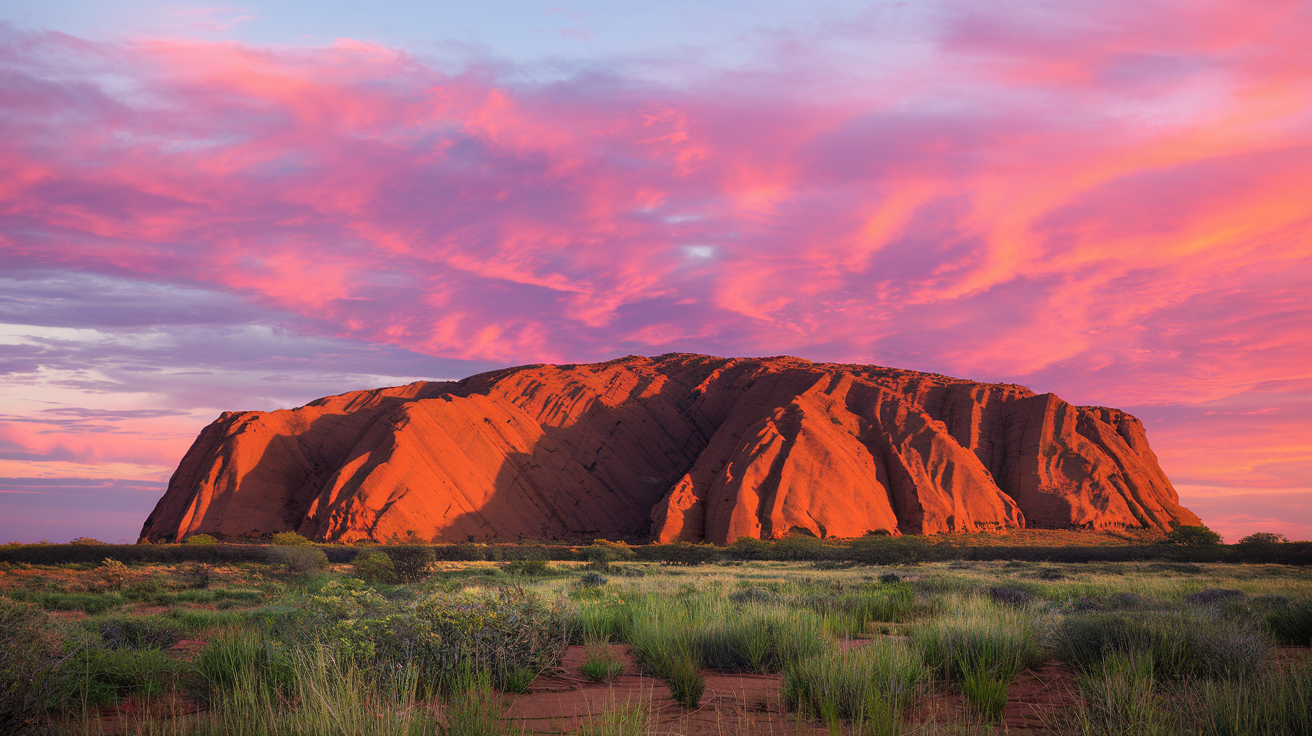
Uluru rises 348 meters from the flat red desert of Central Australia, a single sandstone monolith that changes color dramatically through the day — burning red-orange at sunrise and sunset, deep rust-brown under midday sun. It is sacred to the Anangu, the Traditional Owners of the land, for whom it holds deep significance in Tjukurpa (law and creation stories); climbing the rock was permanently banned in 2019 after decades of Anangu requests, and the walking track that circles its base — passing waterholes, rock art, and caves — is now the respectful, and genuinely more rewarding, way to experience it.
Nearby Kata Tjuta (the Olgas), 36 domed rock formations rising higher than Uluru itself, offers equally dramatic and far less crowded walking trails through the Valley of the Winds. Both sites sit within Uluru-Kata Tjuta National Park, a UNESCO World Heritage Site recognized for both natural and cultural significance — a dual listing that reflects how inseparable the landscape and the Anangu culture attached to it actually are.
Beyond Uluru, the wider Outback rewards travelers willing to cover serious distance: the Kimberley in Western Australia's far north, one of the last truly wild frontiers on Earth; the MacDonnell Ranges outside Alice Springs, riddled with gorges and waterholes; and the Stuart Highway itself, the 2,834-kilometer sealed road connecting Adelaide to Darwin through the continent's dead center. Distances here are genuinely vast — driving from Uluru to Alice Springs alone takes over four hours — and the emptiness is precisely the point.
Legacy website image · original source and rights record pending verification.
Uluru at Sunset
348 m of sandstone, sacred to the Anangu; the climb closed for good in October 2019.
12
🌲 Tasmania
Separated from the mainland by the notoriously rough Bass Strait, Tasmania feels like a different country entirely — cooler, wilder, and dramatically less crowded than anywhere else in Australia. Roughly 20% of the island falls within the Tasmanian Wilderness World Heritage Area, one of the last expanses of temperate rainforest on Earth, sheltering ancient Gondwanan flora and the last strongholds of species like the Tasmanian devil, now conservation-managed on the island after being wiped out on the mainland some 3,000 years ago.
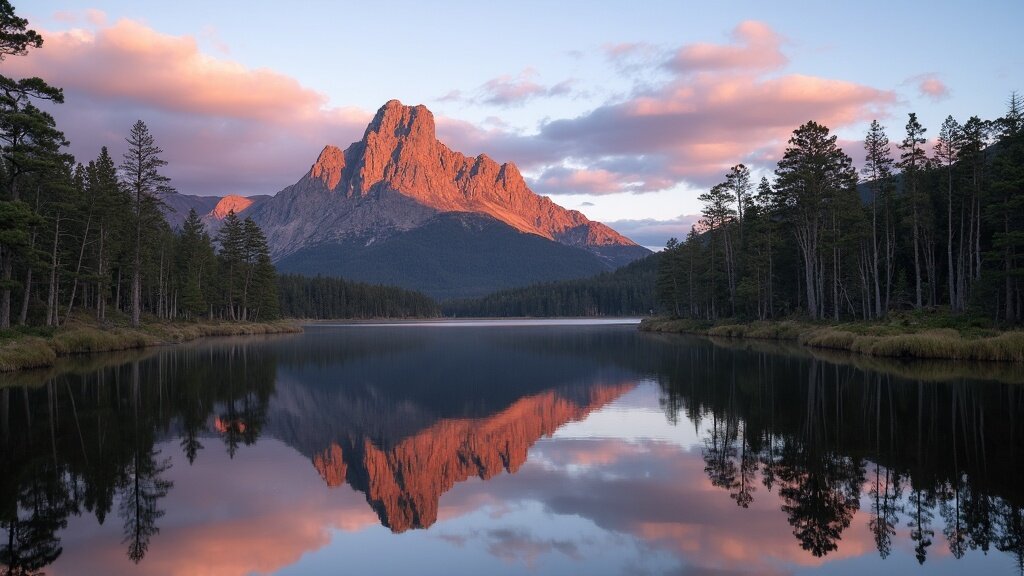
Cradle Mountain–Lake St Clair National Park anchors Tasmania's hiking reputation, with the multi-day Overland Track ranking among the world's great wilderness walks and the shorter Dove Lake circuit offering a taste of the same dolerite-peak scenery in a two-hour loop. Hobart, the compact and increasingly design-conscious capital, has been transformed over the past decade by MONA (the Museum of Old and New Art), a provocative private museum that turned an unglamorous Tasmanian city into a genuine cultural pilgrimage site.
Tasmania's cool climate has also made it Australia's premium destination for sparkling wine and Pinot Noir, covered in depth on our Australia wine page, and its clean waters and cooler growing conditions produce some of the country's best oysters, salmon, and cheese. The island rewards slow travel — narrow winding roads, small-scale producers, and distances that look short on a map but take real time on Tasmania's hillier, more circuitous roads.
Legacy website image · original source and rights record pending verification.
Cradle Mountain, Tasmania
About a fifth of the island is World Heritage wilderness — temperate rainforest, dolerite peaks and the last wild devils.
13
Explore More About Australia
Five deep-dive guides live on their own pages so this one doesn't turn into a wall of text.
Australian cooking is better understood as a meeting of regional produce and migration than as a single national menu. Seafood, lamb, beef and market vegetables share restaurant tables with Italian, Greek, Lebanese, Vietnamese, Chinese and many other culinary traditions. Sydney and Melbourne reward neighborhood exploration: a suburban bakery or family-run noodle shop can be as revealing as a celebrated waterfront restaurant.
Look for barramundi on northern menus, oysters from cooler coastal waters, meat pies at bakeries and fish and chips near the beach. Pavlova and lamingtons appear in many accounts of Australian food, while the flat white belongs to a sophisticated café culture. Indigenous ingredients such as wattleseed and finger lime deserve context: seek businesses that explain provenance and work with Aboriginal producers rather than presenting living food cultures as a novelty.
Australian wine is regional. South Australia includes the Barossa Valley, Clare Valley, McLaren Vale and the Adelaide Hills; Western Australia includes Margaret River; Victoria has the Yarra Valley and Mornington Peninsula; New South Wales has the Hunter Valley. Tasmania is associated with cooler-climate styles and sparkling wine. These names make a more useful starting point than assuming that every Australian wine tastes alike.
For a cellar-door visit, check opening hours, tasting charges and transport in advance. Arrange a designated driver or an organized excursion when drinking; distances between vineyards can be substantial. In cities, specialty coffee and craft breweries offer another route into local produce and neighborhood life. Any Kaufmann Wine Score should identify its tasting source and date; no numerical score is assigned here without a documented tasting.
The hamburger index is a practical way to compare an everyday meal across destinations. Record the same defined item in each country: a standard burger, its outlet, whether tax is included, the local-currency price and the observation date. A restaurant burger and a fast-food burger should not be treated as interchangeable observations.
For Australia, an auditable price has not yet been recorded on this page. No numerical index is published until a dated menu or receipt supports it. For a traveler’s budget, compare the complete meal including sides and drink, distinguish airport prices from ordinary city prices, and convert currencies using a dated exchange rate. This is an editorial travel-budget comparison, not an official purchasing-power statistic.
Aboriginal and Torres Strait Islander peoples belong to many distinct communities, languages and lands. An acknowledgement of Country does not replace permission: follow signs, local advice and restrictions on photography, access and ceremony. Choose Indigenous-owned or Indigenous-led experiences where available, and ask how the visit benefits the local community.
At culturally significant places, the landscape is more than a scenic backdrop. Learn the place name and the explanation offered by its Traditional Owners. Never enter closed areas or assume a path on an online map means public access. A slower visit with a knowledgeable guide often adds more than another long drive between landmarks.
Perth and Fremantle provide an urban base for Western Australia, while the southwest leads toward Margaret River’s vineyards, forest and surf coast. Farther north, the coastline reaches the Shark Bay and Ningaloo regions. These belong to very different itineraries: the state’s scale makes it unwise to treat every famous destination as a day trip from Perth.
Plan around distances, seasonal conditions and available accommodation. Remote coastal journeys require particular attention to fuel, water, road access and park advice. Marine encounters should follow operator and conservation rules; seeing an animal is never guaranteed. For a shorter stay, concentrate on one region and leave time for weather and rest.
For a first visit, combine a city with one contrasting region instead of trying to circle the continent. Sydney and a nearby coastal or mountain trip, Melbourne and the Great Ocean Road, or Cairns and reef-and-rainforest excursions each offer a coherent starting point. A separate flight may link another region, but airport time should count as part of the journey.
An Outback drive needs a different plan from a city break. Confirm road conditions, vehicle permissions, accommodation and communication arrangements before departure. Avoid scheduling long driving days after an overnight flight. Keep a spare day when a boat excursion or scenic road depends on weather.
Accessibility varies by attraction, vehicle and accommodation even within major cities. Ask for the exact room and bathroom layout, step-free route, lift access and transport arrangements before booking. A statement that a property is accessible may not answer a particular mobility, sensory or medical requirement.
For reef boats, national parks and remote tours, discuss boarding, terrain, assistance and emergency arrangements directly with the operator. Visitor centers and official attraction websites are useful starting points. Keep written confirmation of arrangements and allow extra time for transfers.
Families benefit from choosing a compact base and mixing large attractions with beaches, gardens and time to rest. City ferries, museums and wildlife experiences can provide variety without a new hotel every night. Check age limits, child-restraint requirements and supervision arrangements directly with transport and tour providers.
Take sun protection and hydration seriously, and swim at patrolled beaches within the flags. Follow current lifeguard instructions rather than judging safety from how calm the water looks. Remote drives require realistic breaks and enough supplies for delays; a shorter itinerary can leave more room for discovery.
Stay on designated tracks, observe wildlife from a distance and follow park rules about food, waste and biosecurity. Australia’s environments differ sharply: reef, rainforest, alpine country and desert each require their own care. Leave shells, rocks and archaeological material where they belong.
Choose operators that explain their conservation practice, carry a reusable water bottle where safe refilling is available, and respect local restrictions. When visiting a small community, spend locally and ask before photographing people. Responsible travel also includes accepting a closure when a place needs protection.
Remember — Australia is in the Southern Hemisphere, so seasons are reversed from Europe and North America. Summer (December–February) brings heat and beach weather; winter (June–August) is mild in the north but cool in the south. The tropical north has a wet season (November–April) and dry season (May–October). Australia's vast size means you can find good weather somewhere on the continent year-round.
Summer (Dec–Feb)
25–40°C. Beach season, cricket, festivals. Hot inland. Best for: Sydney, Melbourne, Tasmania.
Autumn (Mar–May)
15–25°C. Mild weather, fewer crowds. Ideal for the Red Centre and wine regions.
Winter (Jun–Aug)
8–20°C south, 25°C+ north. Best for: Great Barrier Reef, tropical Queensland, the Kimberley.
Spring (Sep–Nov)
15–25°C. Wildflowers in WA, whale watching, Spring Racing Carnival in Melbourne.
✅ Recommended: September–November or March–May
Shoulder seasons offer the best combination of pleasant weather, fewer crowds, and lower prices across most of the country.
Australia's major international gateways are Sydney (SYD), Melbourne (MEL), Brisbane (BNE), Perth (PER), and Adelaide (ADL). Qantas, the national carrier, operates extensive domestic and international networks. Direct flights from the US West Coast take 14–16 hours; from Europe via the Middle East or Asia, 20–24 hours. Budget carriers Jetstar and Virgin Australia serve domestic routes.
Domestic travel across Australia's vast distances typically requires flying — Sydney to Perth is about 5 hours by air, roughly equivalent to London to Baghdad. The Indian Pacific train (Sydney–Perth, 4,352 km, 4 days/3 nights) and The Ghan (Adelaide–Darwin, 2,979 km, 3 days/2 nights) are iconic rail journeys for travelers with time to spare. Road trips are popular: the Pacific Highway, Great Ocean Road, and Stuart Highway (Adelaide to Darwin) offer legendary driving experiences, though "legendary" often means very long and very empty — plan fuel stops carefully outside the major coastal corridors.
Project Sunrise is a planned Qantas service rather than an operating route at the time of this review. Check the current airline timetable and booking pages for launch dates and existing nonstop options, including services from Perth to Europe. A proposed route should not be treated as a flight that can already be booked. Qantas · Project Sunrise
Visa: US, Canadian, Japanese, Singaporean and several other passport holders apply for an ETA (Electronic Travel Authority, subclass 601) through the official AustralianETA mobile app, which scans the passport chip and takes a live photo — the service charge is AUD 20 and approval usually lands within hours. EU, UK and Norwegian citizens instead use the free eVisitor (subclass 651) online. Both grant 12 months of multiple entries with stays of up to three months per visit, and neither permits paid work. Beware unofficial "visa service" sites charging many times the real fee. Currency: Australian Dollar (AUD); cards, including contactless, are accepted almost everywhere — cash is increasingly optional even at small shops and markets.
Electricity: 230V, Type I plugs (a distinctive angled two- or three-pin design shared with New Zealand and a handful of other countries — bring an adapter, as this type is uncommon elsewhere). Time Zones: Australia spans three time zones (Eastern, Central, Western), and several states observe daylight saving while others (Queensland, Western Australia, Northern Territory) do not — always double-check the time difference between states before booking connecting flights or calls.
Safety: Australia is very safe for travelers, with excellent healthcare. The wildlife reputation is mostly overblown for city and coastal visitors — you are extremely unlikely to encounter a dangerous snake or spider on a standard itinerary — but sun exposure is a genuine daily risk: the UV index is intense even on cool or overcast days, and "slip, slop, slap" (shirt, sunscreen, hat) is more than a slogan here.
The US Department of State places Australia at Level 1, its lowest advisory tier — the advisory was reissued unchanged on 18 August 2026, after periodic review. The UK FCDO and Canada's Global Affairs carry comparably relaxed guidance. Australia is, by any international measure, a low-risk destination — the genuine hazards here are environmental, not criminal.
Sun and UV. This is the real risk, and it is not a joke: Australia has among the highest rates of skin cancer in the world, and the UV index regularly hits "extreme" even on cool, overcast days. SPF 50+, a hat, and sunglasses are daily equipment between roughly September and April, and reapplication matters more than the initial application.
Water. Rip currents drown more visitors than every dangerous animal combined. Swim between the red-and-yellow flags on patrolled beaches; if caught in a rip, do not swim against it — float, raise an arm, and let the surf lifesavers come to you. Marine stingers (Irukandji and box jellyfish) make northern Queensland waters unsafe for unprotected swimming roughly November to May; use the stinger nets and wear a suit.
Wildlife. Snakes and spiders dominate the country's international reputation and almost never trouble travelers on standard itineraries — antivenom is widely available and deaths are in the low single digits per year nationally. Saltwater crocodiles in the Top End and Kimberley are a different matter entirely: obey every warning sign, and never swim, wade, or camp at the water's edge in croc country.
Bushfire and heat. The southern fire season runs roughly November to March. Check the relevant state fire service app before driving into national parks or rural areas, and take total fire ban days seriously. Outback travel demands water, a full tank, and someone who knows your route — mobile coverage disappears fast outside the coastal corridors. The risk is not theoretical: the 2019–20 "Black Summer" fires burned roughly 24 million hectares and killed 33 people, and the 2025–26 season brought Victoria a declared State of Disaster on 10 January 2026, with more than 400,000 hectares burned, at least five deaths and over 130 homes lost while a cyclone bore down on Queensland the same week.
Terrorism. Australia's threat level is "probable", and the country suffered its deadliest terrorist attack on 14 December 2025, when two gunmen opened fire on a Hanukkah gathering at Bondi Beach, killing 15 people and wounding around 40 — the worst mass shooting since Port Arthur in 1996. The US advisory level did not change. Expect visible security at large public and religious events, and follow police instructions without argument.
Health care. Standards are excellent and hospitals are world-class. Australia has Reciprocal Health Care Agreements with the UK, Ireland, New Zealand, Sweden, the Netherlands, Belgium, Norway, Finland, Slovenia, Malta, and Italy, giving those visitors limited access to Medicare for medically necessary treatment. The United States and Canada are not covered — comprehensive travel insurance is essential, and should specifically include ambulance transport, which is not free in most states and can run into thousands of dollars. No vaccinations are required for entry from most countries. Emergency number: 000.
Australia is not a budget destination — prices are comparable to Western Europe or the US East Coast. However, the quality of food, accommodation, and experiences is consistently high, and the Australian Dollar's periodic weakness against other major currencies can make the country better value than headline prices suggest.
Item
Approximate Cost (AUD)
Coffee (flat white)
$4.50–6
Restaurant meal (mid-range)
$25–40
Pint of beer
$10–14
Hostel dorm bed
$35–50/night
Mid-range hotel
$150–250/night
Domestic flight (SYD–MEL)
$80–200
Public transport day pass
$10–16
Budget
AUD $80–120/day — hostels, supermarket meals, public transport
Mid-range
AUD $150–300/day — hotels, restaurants, some tours
Luxury
AUD $400+/day — boutique hotels, fine dining, private tours
Australia offers the full range of accommodation. Major international hotel chains operate in all capital cities, and boutique hotels and eco-lodges are popular, particularly in wine regions and coastal towns. YHA hostels provide excellent budget options nationwide. For a uniquely Australian experience, try a station stay on a working cattle or sheep farm in the Outback — a genuinely different way to see rural Australia beyond the coastal cities.
Holiday parks with cabins and powered sites dot the country, ideal for road trips, and Airbnb has strong penetration, particularly in beach towns and regional areas. Camping in national parks ranges from basic bush camping to well-equipped sites with amenities. In the Top End and Kimberley, glamping options offer genuine wilderness settings with real comfort attached.
Sydney Gay and Lesbian Mardi Gras (February–March): one of the world's great LGBTQ+ celebrations, culminating in a massive parade down Oxford Street. Vivid Sydney (May–June): the Opera House and harbour skyline transformed nightly by large-scale light installations and projections. Melbourne Cup (first Tuesday of November): "the race that stops a nation" — genuinely so, with a public holiday in metropolitan Melbourne (several regional shires trade it for their own local race day) and watch parties nationwide.
Adelaide Fringe (February–March): the largest arts festival in the Southern Hemisphere and second only to Edinburgh worldwide. Australia Day (January 26): the official national day, commemorating the 1788 First Fleet landing — an increasingly contested date, with many Aboriginal Australians and a growing number of others marking it as "Invasion Day" instead, and a genuine, ongoing national conversation about whether the date should change. NAIDOC Week (July): a nationwide celebration of Aboriginal and Torres Strait Islander history, culture, and achievements, with events in every major city.
Kangaroo Island, SA — often called "Australia's Galápagos," with sea lions, koalas, echidnas, and dramatic coastal scenery in a fraction of the crowds of better-known wildlife destinations. Ningaloo Reef, WA — a lesser-visited coral reef on the opposite side of the continent from the Great Barrier Reef, famous for swimming with whale sharks and accessible directly from shore, unlike most Great Barrier Reef sites.
Lord Howe Island — a UNESCO-listed volcanic remnant midway between Australia and New Zealand, capped at just 400 visitors at any time and reachable only by small plane, protecting one of the most pristine island ecosystems left on Earth. The Kimberley, WA — one of the last true wilderness frontiers anywhere, accessible mainly by 4WD or small expedition cruise, with gorges, waterfalls, and Aboriginal rock art far older and far less visited than Uluru's. Nitmiluk (Katherine Gorge), NT — a series of thirteen sandstone gorges carved by the Katherine River, best explored by canoe at dawn before the heat and the tour buses arrive.
Essential: high-SPF, broad-spectrum sunscreen and a wide-brimmed hat — the Australian sun is genuinely more intense than most visitors expect, thanks to a thinner ozone layer over the Southern Hemisphere and generally clear skies. A reusable water bottle, since tap water is safe virtually everywhere. A lightweight rain jacket for the tropical north's wet season and for Tasmania, where weather can shift fast regardless of the forecast.
Clothing: layers matter more than raw warmth — even summer evenings can turn cool, especially inland and in the south. Reef-safe sunscreen specifically if you're snorkeling or diving, since standard sunscreen chemicals damage coral. For the Outback: sturdy closed shoes, a proper hat (not a baseball cap — ears and neck need cover too), and more water than instinct suggests, since dehydration in dry heat sneaks up fast. Insect repellent covers most of the country; only remote tropical areas need serious precautions beyond the basics.
Official: australia.com (Tourism Australia) for trip planning; each state also runs its own dedicated tourism site with deeper regional detail. Transport: individual state transport apps (Opal in NSW, myki in Victoria) for public transit; Webjet and Skyscanner for domestic flight comparisons given how flight-dependent long-distance Australian travel usually is. Emergency: 000 for police, fire, or ambulance nationwide. Weather & Safety: the Bureau of Meteorology (bom.gov.au) for genuinely reliable forecasts and bushfire warnings, essential reading during summer in bushfire-prone regions.
"The Songlines" by Bruce Chatwin — a genre-blurring travel classic exploring Aboriginal songlines and the deep relationship between story, land, and navigation. "Dark Emu" by Bruce Pascoe — a widely read and widely debated reassessment of pre-colonial Aboriginal land management and agriculture, essential for understanding a still-live historical argument. "True History of the Kelly Gang" by Peter Carey — a Booker Prize-winning novel voicing Australia's most famous outlaw, Ned Kelly, in his own imagined words.
"The Fatal Shore" by Robert Hughes — the standard, sweeping account of Australia's convict founding. "Cloudstreet" by Tim Winton — a beloved novel of two working-class Perth families that captures ordinary Australian life across decades better than almost anything else in the national literature.
Australia's reputation for deadly wildlife is one of the most exaggerated travel myths going. Yes, the continent has an enormous share of the world's most venomous snakes and spiders — but fatalities are genuinely rare, generally in the low single digits per year nationally, thanks to excellent antivenom access and the simple fact that most dangerous species actively avoid humans. Far more travelers are injured by sunburn, rip currents, and road accidents on unfamiliar rural highways than by anything with fangs.
The animal that actually causes the most harm to Australians most years isn't a shark or a snake — it's the humble horse, followed by cattle and bees. Respect local advice, don't swim at unpatrolled beaches or during stinger season in the tropical north without protection, and the wildlife danger largely resolves into a very manageable, very overhyped footnote.
🦘 140+ Marsupial Species
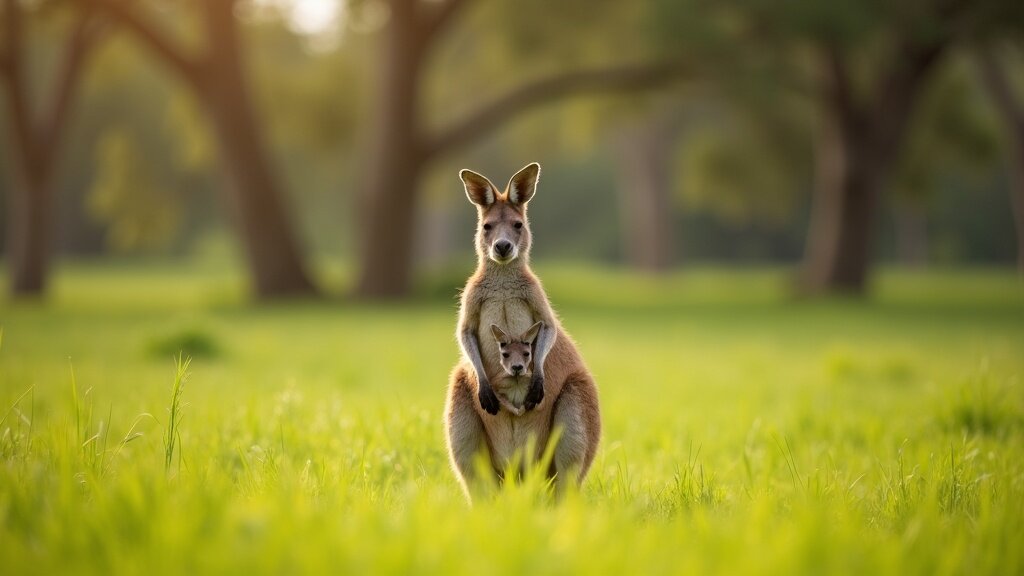
Australia is home to more than 140 species of marsupials, including kangaroos, koalas, and wombats — a legacy of the continent's long isolation from other landmasses.
🐠 Visible From Space
The Great Barrier Reef is the largest living structure on Earth, and one of the very few living structures visible from orbit.
🎭 The Opera House Almost Wasn't Finished
Sydney Opera House was originally budgeted at $7 million and expected to take four years; it ended up costing over $100 million and taking fourteen — and architect Jørn Utzon resigned before it was completed, never seeing the finished building in person.
🌏 A Continent, Not Just a Country
Australia is commonly described as a country occupying a continent; in conventional geography, continents are distinguished from islands.
Cathy Freeman (b. 1973) — Aboriginal Olympic gold medalist whose 400m victory at the 2000 Sydney Olympics, run in front of a home crowd, remains one of the most emotionally charged moments in Australian sporting history. Nicole Kidman and Cate Blanchett — two of Hollywood's most acclaimed actresses, both Academy Award winners who maintain strong ties to the Australian film industry.
Sidney Nolan (1917–1992) — painter best known for his Ned Kelly series, reinterpreting the outlaw as a modern Australian folk icon. Eddie Mabo (1936–1992) — Torres Strait Islander land rights activist whose Mabo v Queensland case led the High Court to overturn terra nullius in 1992, fundamentally reshaping Australian land law. Steve Irwin (1962–2006) — the "Crocodile Hunter," whose global fame did more than any single figure to shape international perceptions (accurate and otherwise) of Australian wildlife.
Cricket holds a special cultural place, with the Boxing Day Test at the MCG drawing enormous crowds every year and the Ashes rivalry with England carrying more than a century of history. Australian Rules Football (AFL) is Victoria's dominant winter sport and increasingly national, a fast, physical, uniquely Australian game with no direct international equivalent — the AFL Grand Final is one of the best-attended single sporting events on Earth.
Rugby league dominates in Queensland and New South Wales, with the State of Origin series between the two states generating some of the most passionate sporting rivalry in the country. Rugby union, tennis (the Australian Open each January), and surfing round out a sporting culture that borders on civic religion — Australia also punches enormously above its population weight at the Olympics, particularly in swimming. Paris 2024 was Australia's best Games ever by gold medals — 18 gold, 53 medals in total, fourth on the table — and Brisbane hosts the 2032 Olympics, the third Australian Games after Melbourne 1956 and Sydney 2000. On the cricket field Australia retained the Ashes 4–1 at home in 2025–26 (Mitchell Starc's 31 wickets earned him player of the series), and at the 2026 Australian Open Carlos Alcaraz completed the career Grand Slam by beating Novak Djokovic in the final, with Elena Rybakina taking the women's title over Aryna Sabalenka.
Australia has a free press with a diverse media landscape, though ownership concentration — particularly News Corp's outsized market share — is a recurring subject of public debate. The ABC (Australian Broadcasting Corporation) operates as the public broadcaster, similar in role to the BBC, alongside major commercial networks and a robust digital media scene. Major newspapers include The Sydney Morning Herald, The Age (Melbourne), and The Australian, spanning the country's political spectrum. Reporters Without Borders ranks Australia 33rd of 180 in its 2026 World Press Freedom Index, down four places, citing ownership concentration and the closeness of media owners to political leaders. The country also became the first in the world to bar under-16s from holding social-media accounts: the Online Safety Amendment (Social Media Minimum Age) Act passed on 29 November 2024 and took effect on 10 December 2025, covering TikTok, Instagram, Facebook, Snapchat, YouTube, X, Reddit, Threads, Twitch and Kick, with fines of up to AUD 49.5 million for non-compliant platforms.
Legacy website image · original source and rights record pending verification.
Kangaroo
Legacy website image · original source and rights record pending verification.
Opera House
Legacy website image · original source and rights record pending verification.
Reef Coral
Legacy website image · original source and rights record pending verification.
Uluru
Legacy website image · original source and rights record pending verification.
Melbourne
Legacy website image · original source and rights record pending verification.
Cricket at the MCG
Legacy website image · original source and rights record pending verification.
Barossa Valley
40
✍️ Author's Note
Australia is one of those rare destinations that consistently exceeds expectations. The natural beauty is staggering — from the Great Barrier Reef to the vast red heart of the continent — but what truly stays with you is the warmth and humor of its people.
The distances are enormous and the prices can sting, but every dollar and every hour in transit rewards you with experiences that simply cannot be found elsewhere on Earth. The wildlife alone would justify the journey — where else can you watch platypus at dawn, snorkel with manta rays at noon, and spot wild kangaroos at sunset? And nothing quite prepares you for standing at Uluru understanding, properly understanding for the first time, that this rock has been sacred to the same people for longer than most of the rest of the world has had writing.
My advice: give Australia more time than you think you need. It's the kind of place where the best moments are unplanned — a detour to a hidden beach, a conversation with a local at a country pub, a sunset over the Outback that changes how you think about color.