
Contents
🌏 Overview
Benin stretches from the Gulf of Guinea northward into the West African interior, bringing together coastal lagoons, central plateaus and the drier landscapes of the Atakora. Its cultural importance is exceptional: the country is one of the historic centers of Vodun, home to the former Kingdom of Dahomey and a major place of memory for the Atlantic slave trade.
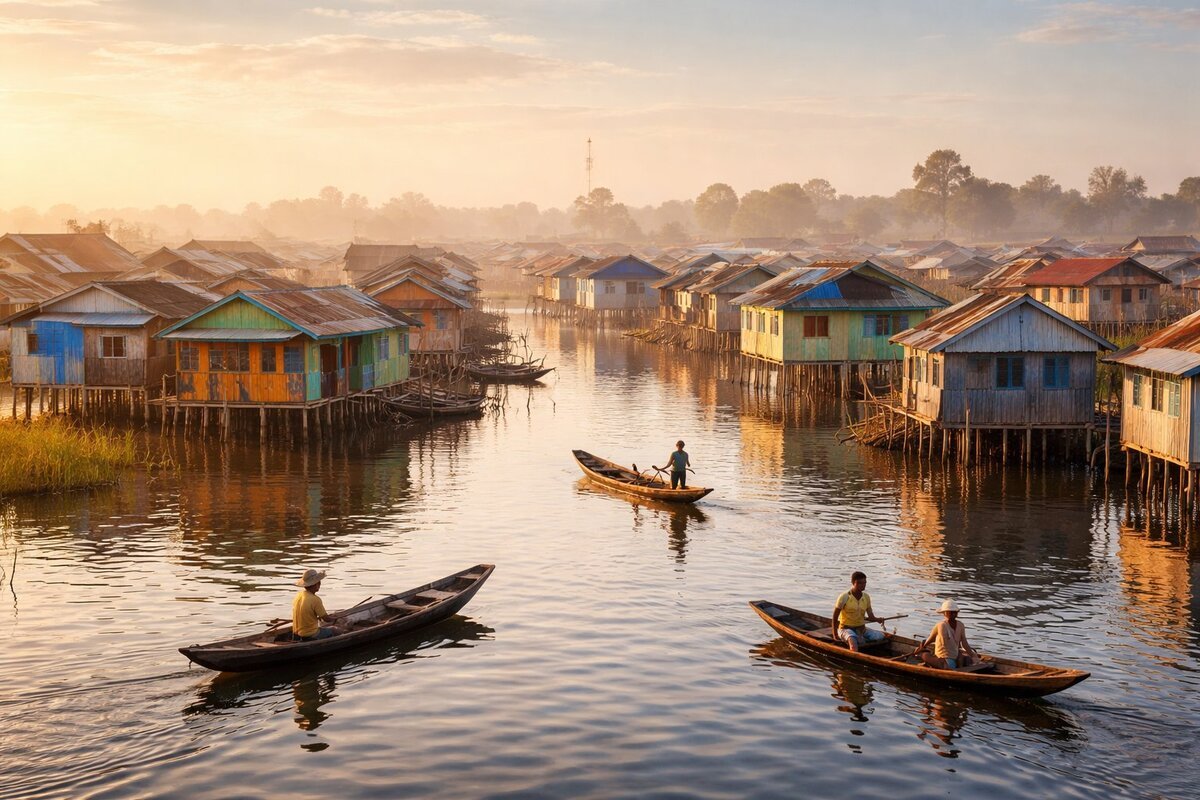
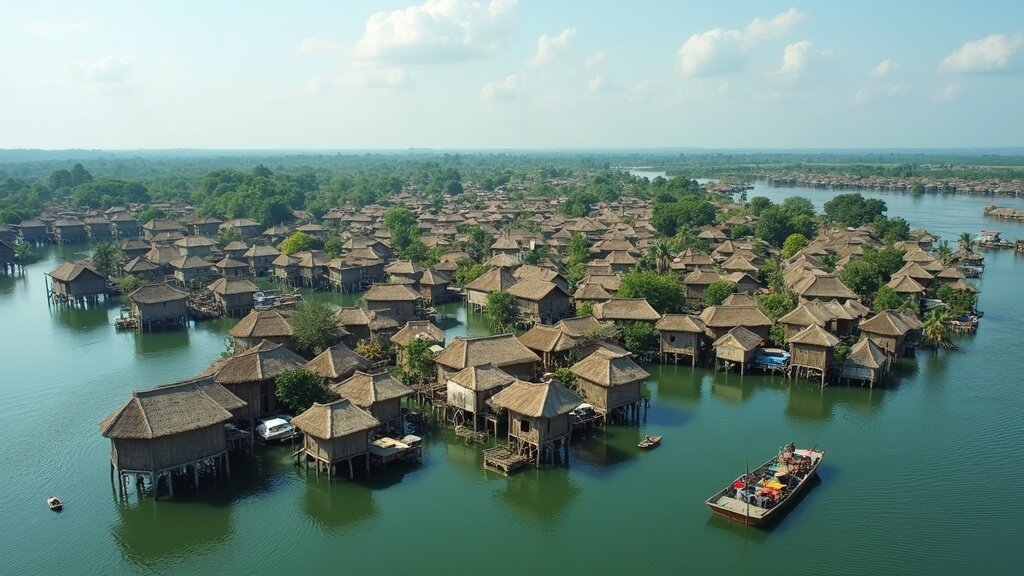
For most visitors, the strongest route runs through Cotonou, Porto-Novo, Ganvié, Ouidah and Abomey. Ganvié rises on stilts above Lake Nokoué; Ouidah preserves sites connected with both Vodun and the slave-trade era; and the Royal Palaces of Abomey form the country’s best-known UNESCO World Heritage site.
Northern Benin contains important savanna ecosystems and wildlife reserves, including Pendjari and W. However, official travel advisories in force on 18 September 2026 warn against travel to these parks and several northern border areas because of terrorism and kidnapping risks. They should not be treated as ordinary tourist destinations while those warnings remain in place.
Benin rewards travelers interested in history, architecture, religion, markets, music and food. French remains the principal language for administration and tourism, while Fon, Yoruba, Bariba, Dendi and other languages shape everyday life across the country.
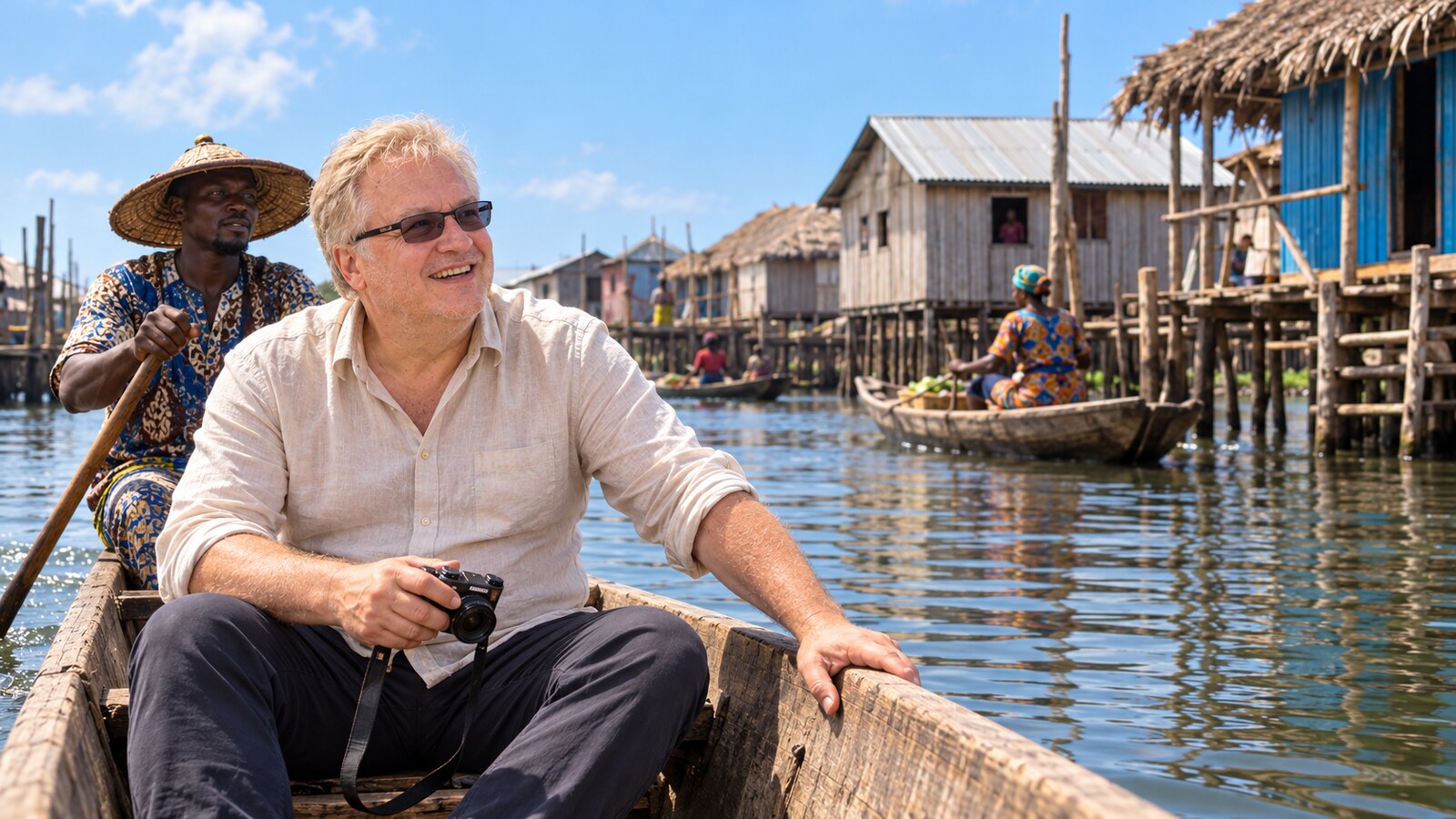
Radim Kaufmann travelling by pirogue through Ganvié on Lake Nokoué · Kaufmann Creative AI Studio© · AI-created editorial image; not a documentary record of an actual visit.
🏷️ Name & Identity
The country takes its name from the Bight of Benin, adopted in 1975 to replace "Dahomey" (which referred to only one of several pre-colonial kingdoms). The historic Kingdom of Benin (famous for its bronzes) was actually in modern Nigeria, not present-day Benin — a source of occasional confusion.
Beninese identity draws from multiple ethnic traditions: the Fon of the south, the Yoruba of the southeast, the Bariba of the north, and dozens of smaller groups. French is the official language — a colonial legacy — but Fon and Yoruba dominate daily life in the south, while Bariba, Dendi, and Fulfulde are spoken in the north.
🗺️ Geography
Benin is just 120 kilometers wide at its southern coast but stretches 700 kilometers northward, encompassing four distinct zones: the narrow sandy coastline with lagoons, the flat clay-rich southern plateau, the central granite hills, and the semi-arid Atakora Mountains in the northwest rising to 658 meters. The Niger River forms part of the northern border, and seasonal flooding creates rich farmland.
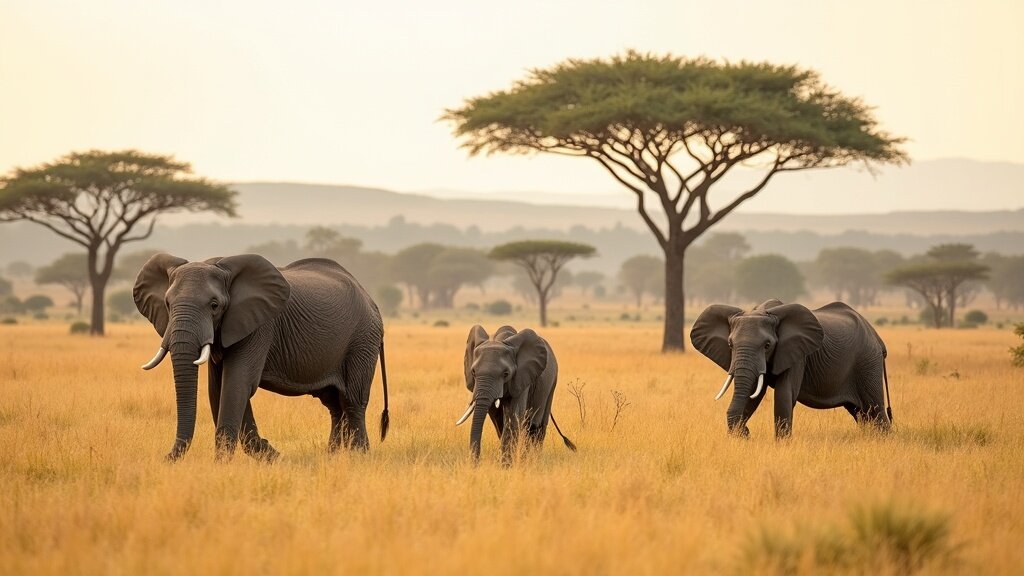
The south is densely populated and tropical, while the north transitions to savanna with baobab trees and seasonal rivers. Pendjari and W National Parks in the far north protect some of West Africa's last significant populations of elephants, lions, cheetahs, and hippos.
🗺️ Map
Cotonou, Porto-Novo, Ouidah and Grand-Popo along the 120 km coast; Ganvié on Lake Nokoué; Abomey and Dassa-Zoumé on the central plateau; Parakou, Nikki, Natitingou, Boukoumbé and Koutammakou in the north; Pendjari and W parks on the Burkina Faso–Niger border (inside the Level 4 zone); Malanville on the Niger river, the crossing closed since 2023. Scroll-zoom is off — use the +/− buttons.
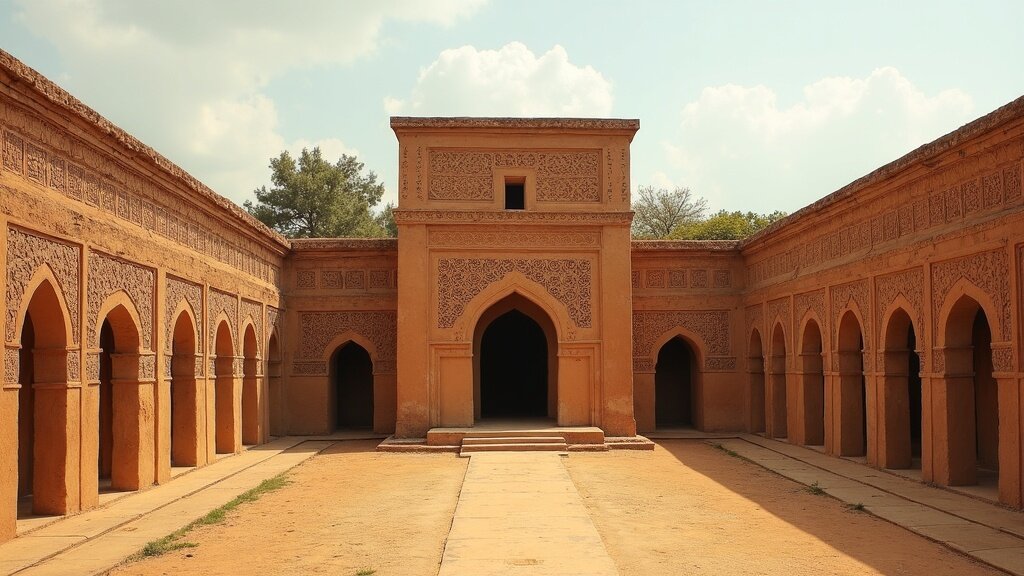
The Royal Palaces of Abomey — UNESCO World Heritage seat of the powerful Dahomey Kingdom (1625-1900)
📜 History
The Kingdom of Dahomey (1625-1900) dominated the region, ruled from Abomey by a succession of powerful kings. The kingdom became wealthy through the Atlantic slave trade, selling war captives to European traders at Ouidah's port. Dahomey was also famous for its Mino (Agojie) — an all-female military regiment of 1,000-6,000 warriors who fought with extraordinary ferocity and inspired the 2022 film "The Woman King."
France conquered Dahomey in 1894 after fierce resistance. Independence came in 1960 under President Hubert Maga. A turbulent period followed, including a Marxist-Leninist regime (1972-1989) under Mathieu Kérékou that renamed the country the People's Republic of Benin. The 1990 National Conference — a model for democratic transition across Africa — peacefully ended single-party rule. Kérékou himself later won democratic elections, completing a remarkable political journey.
🏛️ Government & Politics
Benin is a presidential republic. Porto-Novo is the constitutional capital and seat of the National Assembly, while the presidency and most central government ministries are based in Cotonou.
Romuald Wadagni became president on 24 May 2026, succeeding Patrice Talon after Talon completed two constitutional terms. Benin’s Constitutional Court confirmed Wadagni’s victory in the 12 April 2026 presidential election; the final result gave him 94.27% of the vote against Paul Hounkpè’s 5.73%.
The 2026 election took place under electoral rules that required parliamentary sponsorship for presidential candidates. The main opposition party’s preferred candidate did not appear on the final presidential ballot after failing to satisfy those sponsorship requirements. International reporting and domestic opposition figures criticized the competitiveness of the process, while the authorities maintained that the election followed the legal framework in force.
For travelers, political demonstrations and sensitive government or security sites are best avoided. Do not photograph military facilities, checkpoints, the presidential complex, ports or airport security areas without permission.
👥 People & Culture
Benin's 15.1 million people belong to over 40 ethnic groups. The Fon (39%) and Yoruba (15%) dominate the south, while the Bariba, Fulani, and Somba populate the north. Vodun (Voodoo) — originating here and carried to Haiti, Brazil, and Louisiana by enslaved people — remains a living religion practiced by an estimated 17% of the population alongside Christianity and Islam.
Vodun is far from the Hollywood stereotype. It's a complex spiritual system centered on intermediary spirits (Vodun) who communicate between humans and a supreme creator. Ceremonies involve drumming, dance, animal sacrifice, and trance possession. The annual National Voodoo Day (January 10) in Ouidah draws thousands of practitioners and curious visitors for elaborate public ceremonies on the beach.
Music and dance are inseparable from Beninese life. Angélique Kidjo, the Grammy-winning singer from Ouidah, is arguably Africa's most celebrated female musician. Traditional rhythms vary by region — the agbadja and tchinkoumé of the south, the traditional wrestling songs of the Bariba north.
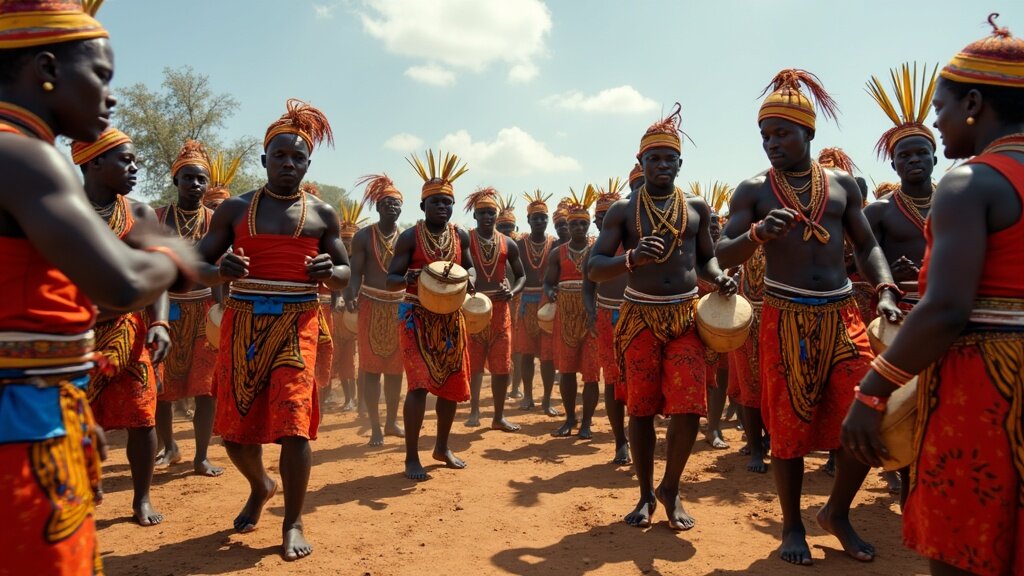
A Vodun ceremony — Benin is the birthplace of Voodoo, a living religion practiced by millions worldwide
⛓️ Ouidah & the Route des Esclaves
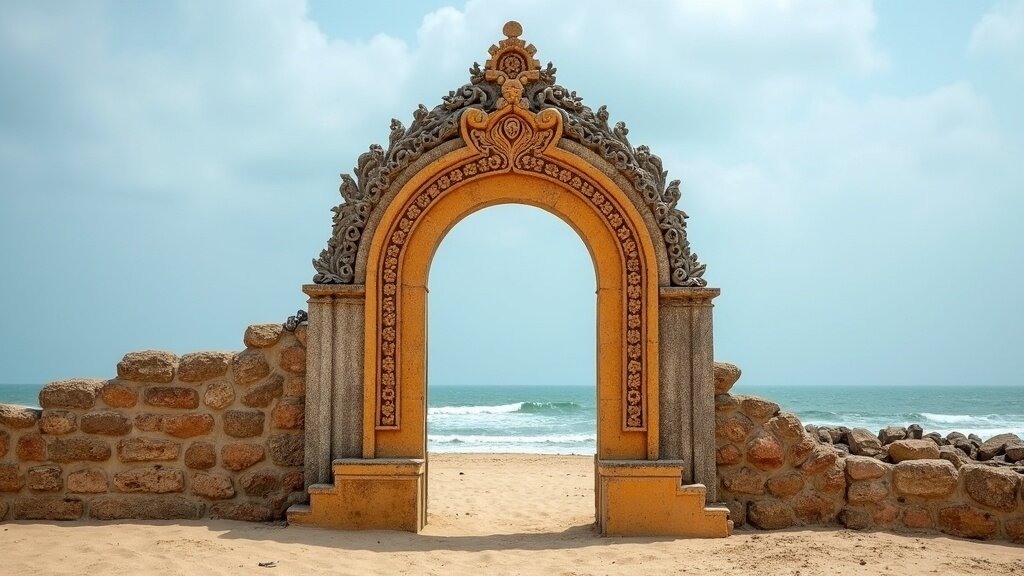
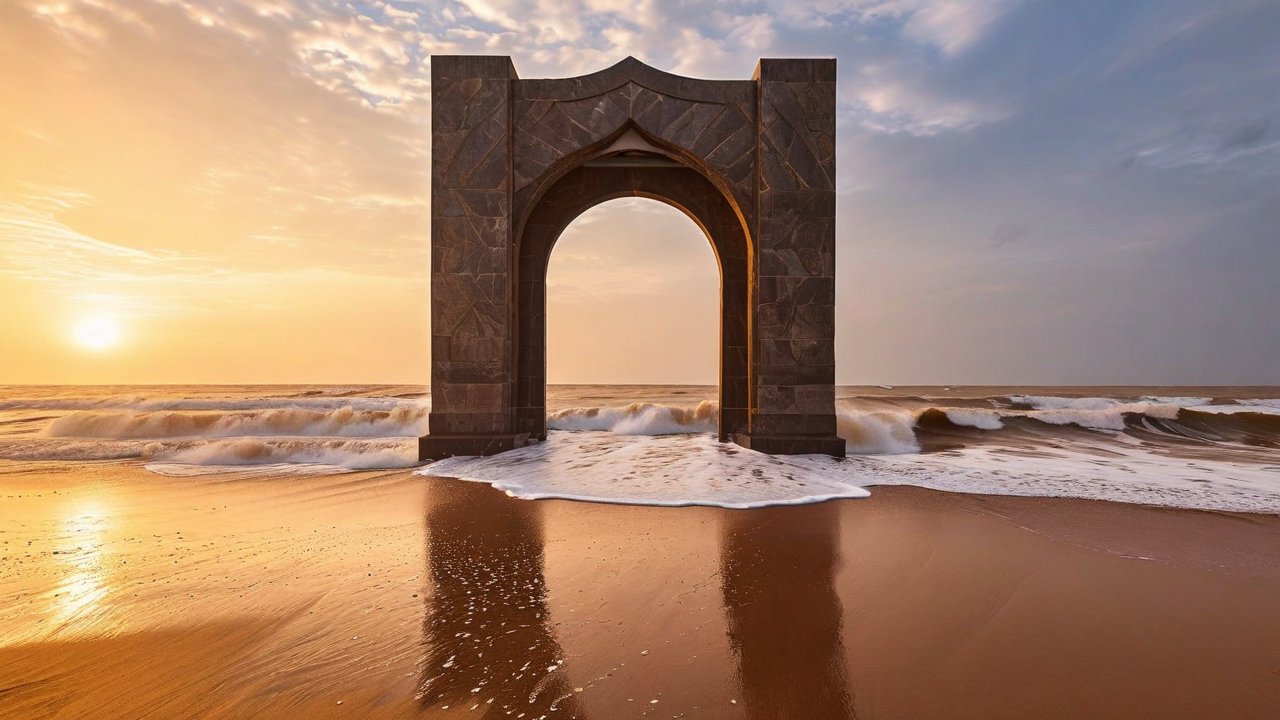
Ouidah is Benin's most historically significant town — both the spiritual capital of Vodun and the site of one of West Africa's most important slave trading ports. The Route des Esclaves (Slave Route) traces the 4-kilometer path enslaved people walked from the auction square to the beach, passing symbolic monuments: the Tree of Forgetfulness (where captives were forced to circle to "forget" their homeland), the Tree of Return (where they were told their spirits would return after death), and culminating at the Door of No Return — a haunting memorial arch on the beach.
The Sacred Forest of Kpassè, in the center of town, contains shrines to dozens of Vodun deities amid ancient iroko trees. The Python Temple houses sacred royal pythons that locals handle freely. Ouidah's annual Voodoo Festival (January 10) transforms the town into a celebration of African spirituality that draws diaspora practitioners from Haiti, Brazil, and beyond.
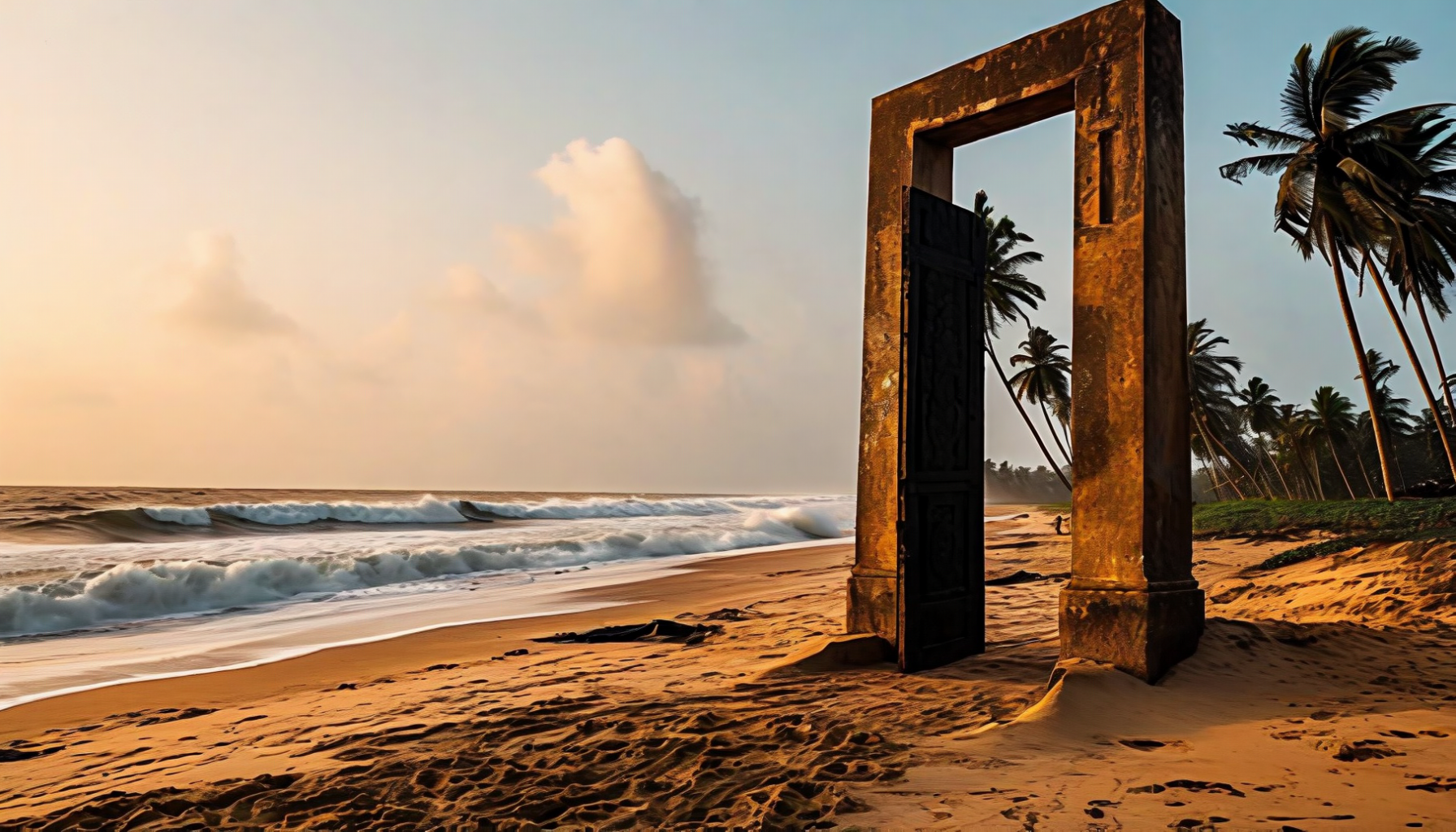
The Door of No Return on the beach at Ouidah — final point of the Route des Esclaves where millions were forced onto slave ships bound for the Americas
🏛️ Cotonou, Porto-Novo & Abomey
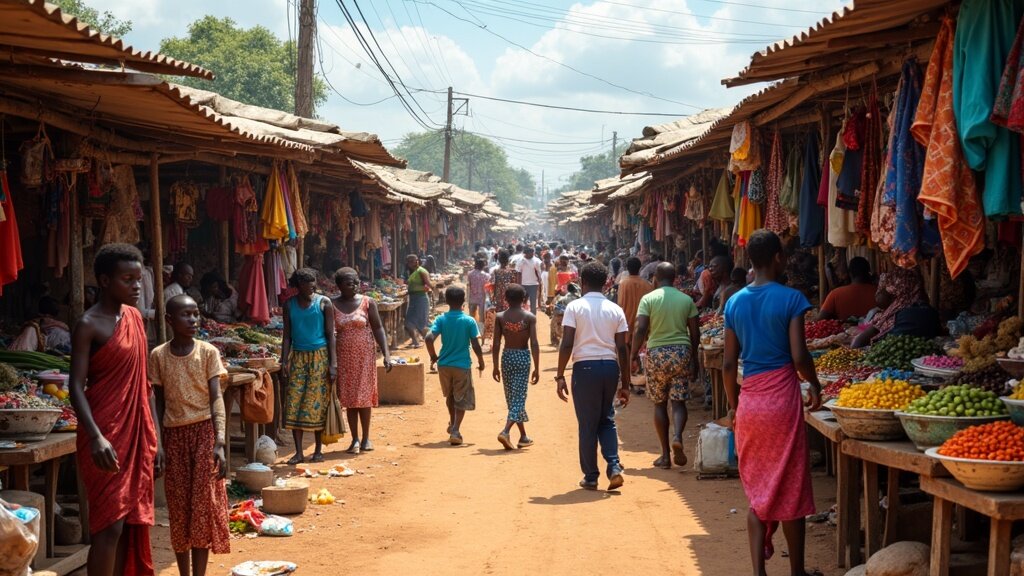
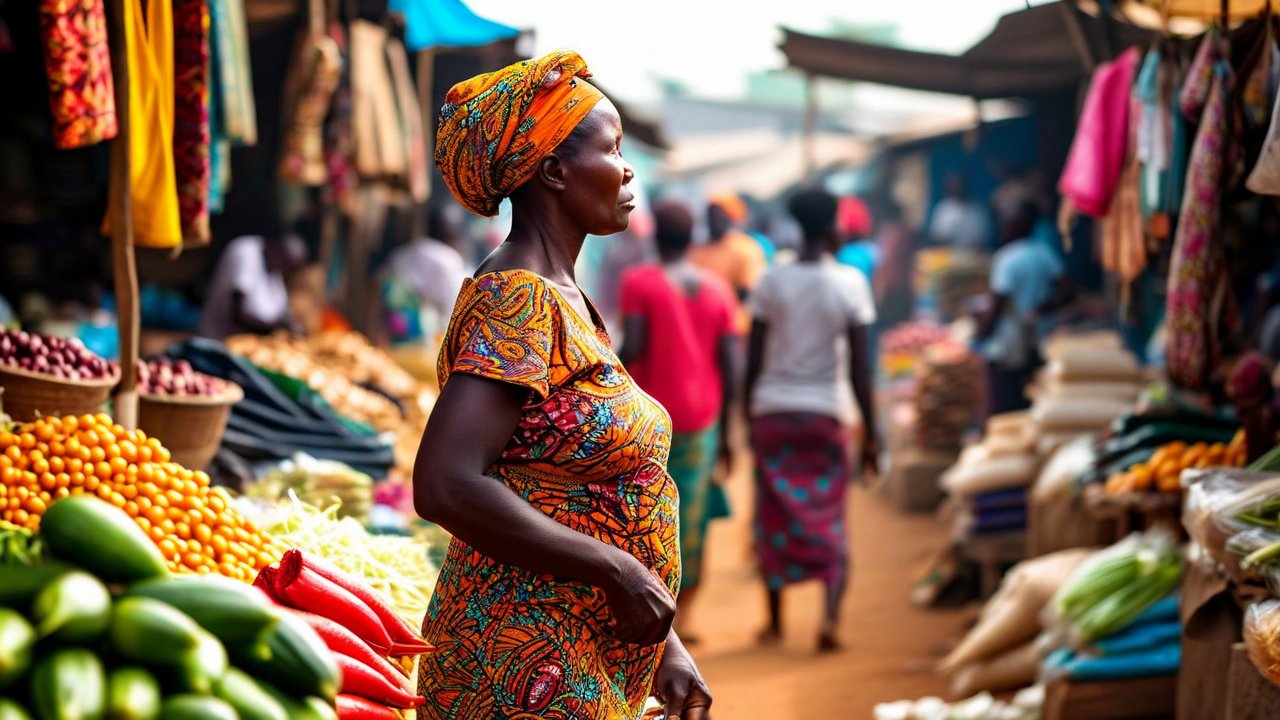
Cotonou — the de facto economic capital — is a chaotic, vibrant port city dominated by the enormous Dantokpa Market, one of the largest open-air markets in West Africa. Thousands of stalls sell everything from Vodun fetishes to Dutch wax fabrics, bush meat to mobile phones. Porto-Novo, the official capital, is quieter and more colonial, with the excellent Musée Honmé and the ornate Grande Mosquée built in Brazilian-influenced Afro-Brazilian style.
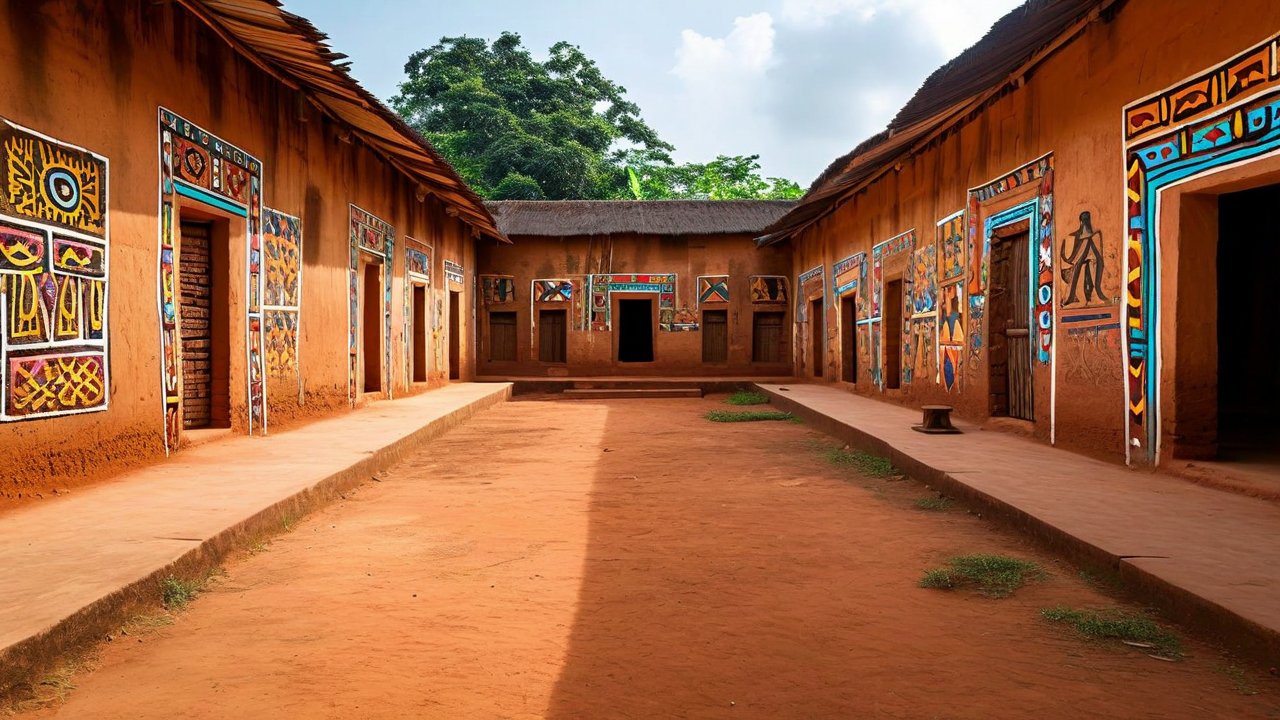
Abomey, 135 kilometers north, was the seat of the Dahomey Kingdom. The UNESCO-listed Royal Palaces complex — built by twelve successive kings from the 17th to 19th centuries — features bas-relief murals depicting the history and military conquests of each ruler. The museum displays thrones, tapestries, and artifacts documenting one of Africa's most powerful pre-colonial states.
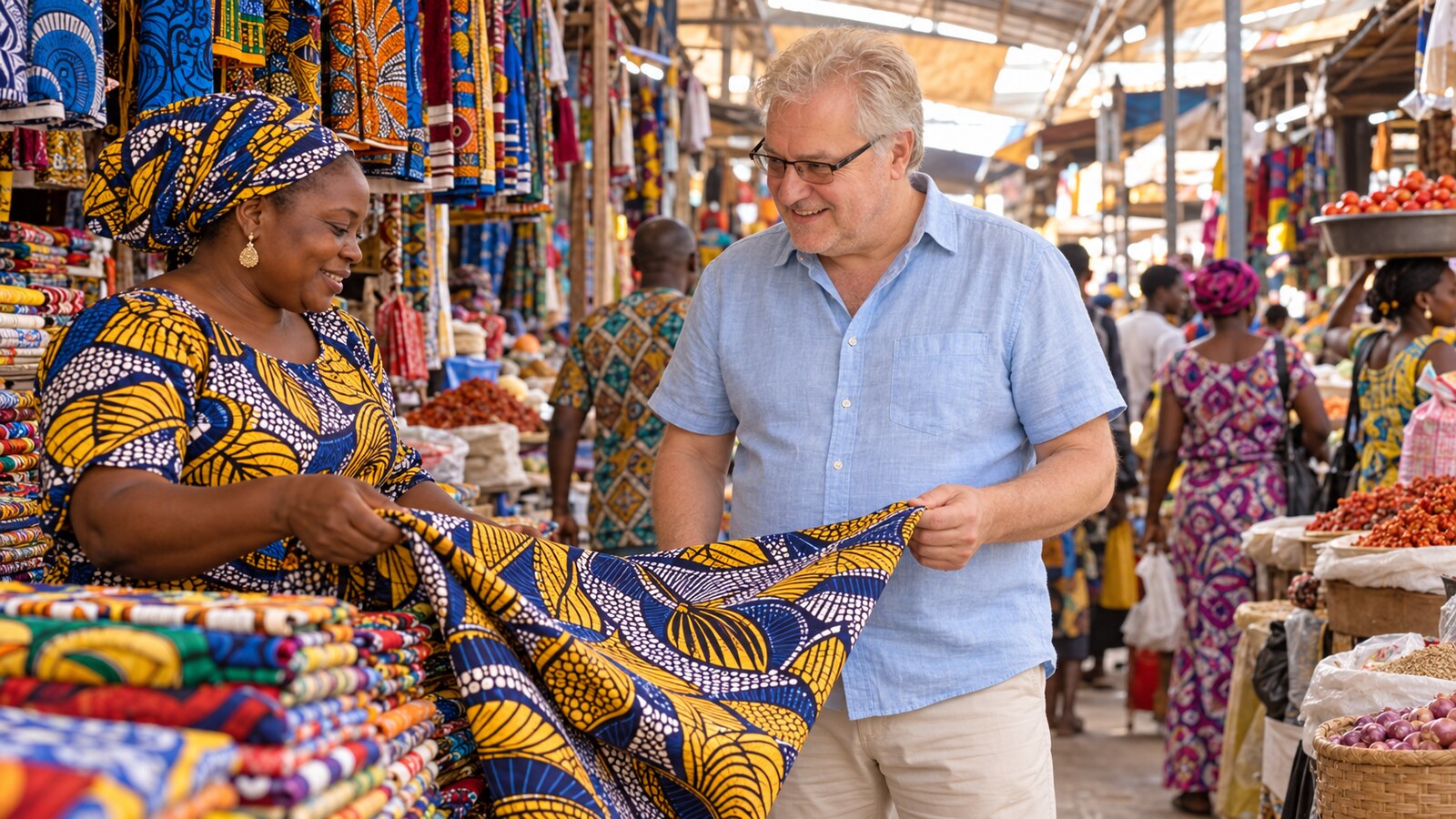
Radim Kaufmann viewing wax-print textiles at Dantokpa Market in Cotonou · Kaufmann Creative AI Studio© · AI-created editorial image; not a documentary record of an actual visit.
🍽️ Cuisine
Beninese cuisine centers on starchy staples with richly spiced sauces. Pâte — a thick dough made from corn, cassava, or yam flour — accompanies nearly every meal, scooped by hand to eat with sauce. Popular sauces include sauce d'arachide (groundnut), sauce tomate, and the beloved sauce gombo (okra). Akassa (fermented corn dough) wrapped in banana leaves is a southern specialty.
Street food thrives: fried plantains (alloco), grilled chicken and guinea fowl, and tchoukoutou (traditional millet beer) fuel daily life. The south favors seafood — grilled tilapia, crab, and shrimp from the lagoons. In the north, kilishi (spiced dried meat similar to jerky) and wagashi (Fulani fresh cheese grilled and served with chili) are staples. La Béninoise and Beaufort are the local beers, and sodabi (palm wine distillate) is the traditional spirit.
COOKBOOK NOTE -- Radim Kaufmann
Benin sits at the crossroads of West African culinary traditions, where Yoruba, Fon, and Bariba cooking styles overlap and intertwine. The food here is honest, elemental, and deeply rooted in the land — peanuts ground by hand, corn fermented for days, palm oil pressed from local palms, and fish smoked over charcoal until it shatters like glass. In Cotonou's Dantokpa market, one of West Africa's largest, I watched women sell mountains of dried shrimp, fiery chili paste, and kuli kuli stacked in pyramids. Every dish in Benin tells you something about patience and the alchemy of simple ingredients.
Kuli Kuli KCS 74
Peanut Snacks
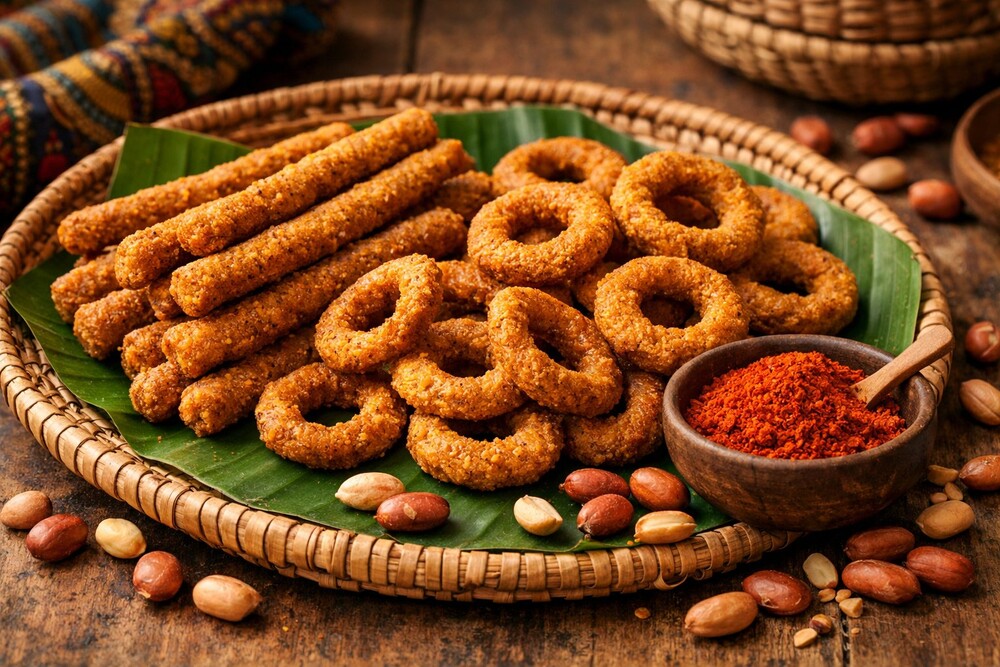
Ingredients: 500 g raw skin-on peanuts, 1 tsp salt, ½ tsp ground ginger, a pinch of cayenne, vegetable oil for deep-frying, ground chili for serving.
Preparation: Start with 500g of raw, skin-on peanuts. Dry-roast them in a heavy skillet over medium heat, stirring constantly for about 10 minutes until the skins darken and the nuts become fragrant. Allow to cool slightly, then rub the peanuts between your palms or in a clean cloth to remove as much of the papery skin as possible — this step prevents bitterness in the final product. Grind the roasted, skinned peanuts in a food processor or, traditionally, pound them in a large wooden mortar with a pestle. Process until the peanuts break down past the crumbly stage and release their natural oil, forming a thick, oily paste — this takes several minutes of continuous grinding. The paste should be smooth and hold together when pressed. Transfer the paste to a large bowl and begin kneading it vigorously with your hands, exactly as you would bread dough. Add a teaspoon of salt, half a teaspoon of ground ginger, and a pinch of cayenne pepper. As you knead, the peanut oil will separate and pool around the edges. Continue kneading for 10 to 15 minutes, periodically squeezing and pressing the paste to extract as much oil as possible. Pour off the expressed oil into a separate container — this is pure peanut oil and can be used for cooking. Once the paste feels drier and holds its shape firmly, begin shaping the kuli kuli. In Benin, the traditional shapes are small rings (formed by rolling a piece into a thin rope and joining the ends) and straight sticks about eight centimetres long. You can also press small balls flat into discs. The shapes should be compact and tight — any air pockets will cause them to crumble during frying. Heat vegetable oil in a deep pan to about 160 degrees — a moderate temperature is essential, as peanuts burn easily. Fry the shaped kuli kuli in batches for four to five minutes, turning occasionally, until they are deep golden brown and completely crisp throughout. The temperature must stay moderate; too hot and the outside burns while the centre remains soft. Drain on paper towels and allow to cool completely — they will become even crunchier as they cool. Serve kuli kuli as a snack with a small bowl of ground chili pepper for dipping, crumble them over salads, or eat them alongside atassi. In Benin, kuli kuli vendors are found at every market and bus station, their wares stacked in neat pyramids on woven trays. They keep for weeks in an airtight container, making them the perfect West African travel snack.
TIP: Squeezing out oil is crucial for crispy texture.
Atassi KCS 72
Rice and Beans
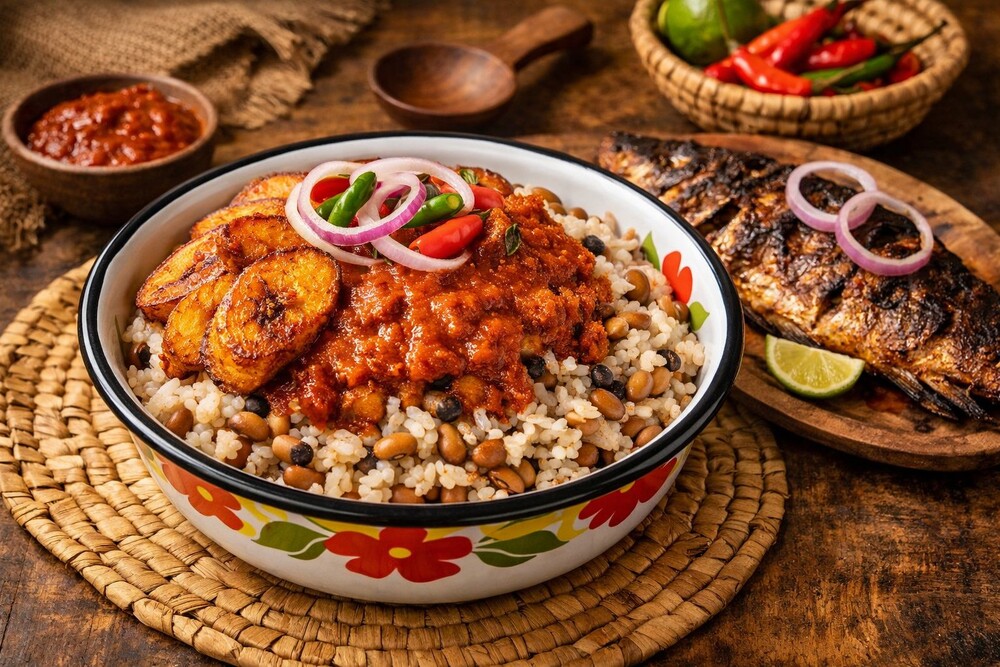
Ingredients: 300 g long-grain rice, 250 g dried black-eyed peas, 5 tbsp red palm oil, 2 onions, 4 large ripe tomatoes, 1 scotch bonnet, 2 ripe plantains, 1 tsp ground crayfish (optional), 1 bouillon cube, salt.
Preparation: Soak 250g of dried black-eyed peas in cold water overnight. The next day, drain and place in a pot with fresh water. Bring to a boil, then reduce heat and simmer for 40 to 50 minutes until the beans are tender but still hold their shape — do not overcook them to mush. Drain and set aside. Rinse 300g of long-grain rice until the water runs clear. In a heavy pot, heat two tablespoons of palm oil (or vegetable oil) over medium heat. Add one diced onion and cook for five minutes until softened. Add the rice and stir to coat each grain in the oil. Pour in 500ml of water, add a teaspoon of salt, bring to a boil, then cover tightly and reduce to the lowest heat. Cook for 18 to 20 minutes until the rice is fluffy and all liquid is absorbed. Gently fold the cooked black-eyed peas into the hot rice, being careful not to crush the beans. Cover and let the mixture steam together for five minutes so the flavours meld. While the rice cooks, prepare the tomato sauce: blend four large ripe tomatoes, one scotch bonnet pepper, and one small onion into a smooth puree. Heat three tablespoons of red palm oil in a pan until shimmering — the palm oil is essential and gives the sauce its characteristic deep orange colour and nutty flavour. Fry the tomato puree in the palm oil over medium-high heat for 15 to 20 minutes, stirring frequently, until the sauce darkens, thickens, and the oil separates and floats on top. Season with salt, a teaspoon of ground crayfish (if available), and a cube of bouillon. Separately, slice two ripe plantains on the diagonal about one centimetre thick. Fry in hot oil for two to three minutes per side until golden brown with caramelised edges. Drain on paper towels. To serve, mound the rice and beans in a deep bowl, spoon the red palm oil tomato sauce generously over the top, arrange the fried plantains around the edge, and garnish with sliced raw onion rings and fresh chili. In Benin, atassi is the everyday comfort food — served from enormous pots at roadside stalls, always with grilled or fried fish alongside. It is simple food done with soul.
TIP: Palm oil gives authentic color and flavor.
Pâté KCS 70
Fermented Corn Porridge
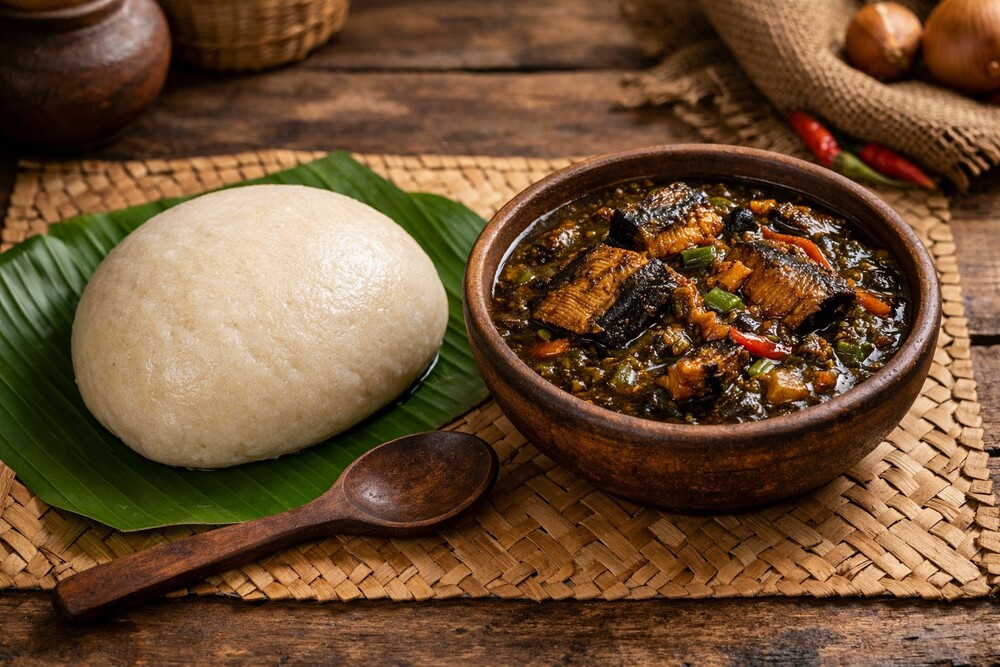
Ingredients: 500 g dried white corn (or fine white cornmeal + 1 tbsp cornstarch + a splash of lemon juice), 500 ml water, salt; for the sauce: 3 tbsp palm oil, 200 g okra, tomatoes, onion, scotch bonnet, 200 g smoked fish, a handful of dried shrimp, 1 bouillon cube.
Preparation: The traditional Beninese pate begins with fermentation. Soak 500g of dried white corn kernels in water for two to three days, changing the water daily. The corn will soften and develop a slightly sour, tangy aroma — this fermentation is what gives pate its distinctive flavour, quite different from plain cornmeal porridge. If you cannot find whole corn, you can approximate the flavour by mixing fine white cornmeal with a tablespoon of corn starch and a splash of lemon juice. Drain the fermented corn and grind it to a smooth paste using a food processor or blender, adding just enough water to facilitate grinding. The paste should be very smooth with no gritty bits — in Benin, women use a large stone mill for this step, producing an incredibly fine texture. Strain the paste through a fine sieve or cheesecloth to remove any remaining husks, pressing firmly to extract all the starchy liquid. Pour the strained corn liquid into a heavy-bottomed pot and add 500ml of water. Set over medium heat and begin stirring with a sturdy wooden spoon. As the mixture heats, it will gradually thicken — stir constantly and vigorously to prevent lumps from forming. This is the critical stage: the stirring must be continuous and forceful for 15 to 20 minutes as the pate transforms from a thin liquid to a very thick, smooth, elastic dough. The pate is ready when it pulls cleanly away from the sides of the pot, has a glossy surface, and holds its shape when a spoonful is dropped back into the pot. If it becomes too thick, add small splashes of hot water. Remove from heat. To shape, wet your hands and a banana leaf (or a plate). Take a portion of the hot pate and roll it between your wet palms into a smooth ball or dome shape. Place on the banana leaf. Alternatively, press it into a wet bowl and unmould. Prepare the accompanying sauce: heat three tablespoons of palm oil in a pot. Fry 200g of sliced okra for five minutes, then add a blend of tomatoes, onion, and scotch bonnet pepper. Add 200g of smoked fish (broken into chunks), a handful of dried shrimp, salt, and a bouillon cube. Simmer for 20 minutes until thick and rich. Serve the pate on its banana leaf with the sauce in a clay bowl alongside. Tear off pieces of the smooth, slightly sour dough and dip into the sauce — this is how Benin eats, with hands and with pleasure.
TIP: Constant stirring prevents lumps.
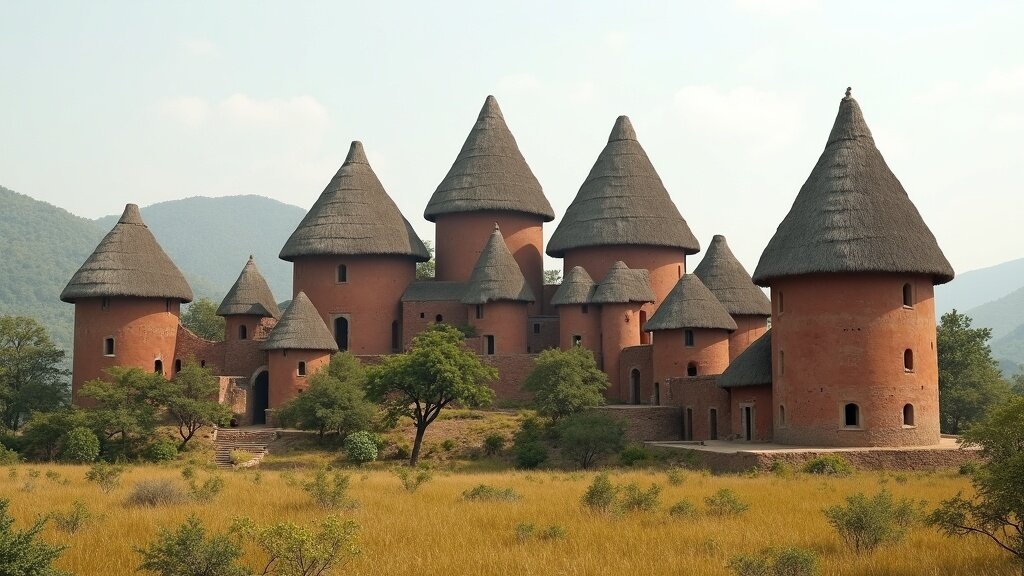
Tata Somba — the fortress-like clay tower houses of the Somba people, unique architectural marvels in the Atakora Mountains
🍷 Wine, Spirits & Drinking Culture
Benin has no wine production. The West African nation has a tropical climate unsuited to grape cultivation. Sodabi (distilled palm wine, Benin's most important spirit — clear, potent, and deeply embedded in Vodun spiritual practices) is central to both social and ceremonial life. Tchoukoutou (sorghum beer) and palm wine are the traditional beverages. La Béninoise beer is the national lager. Benin's unique position as the birthplace of Vodun (the original Voodoo tradition) means that sodabi plays a sacred role in religious ceremonies and ancestral offerings.
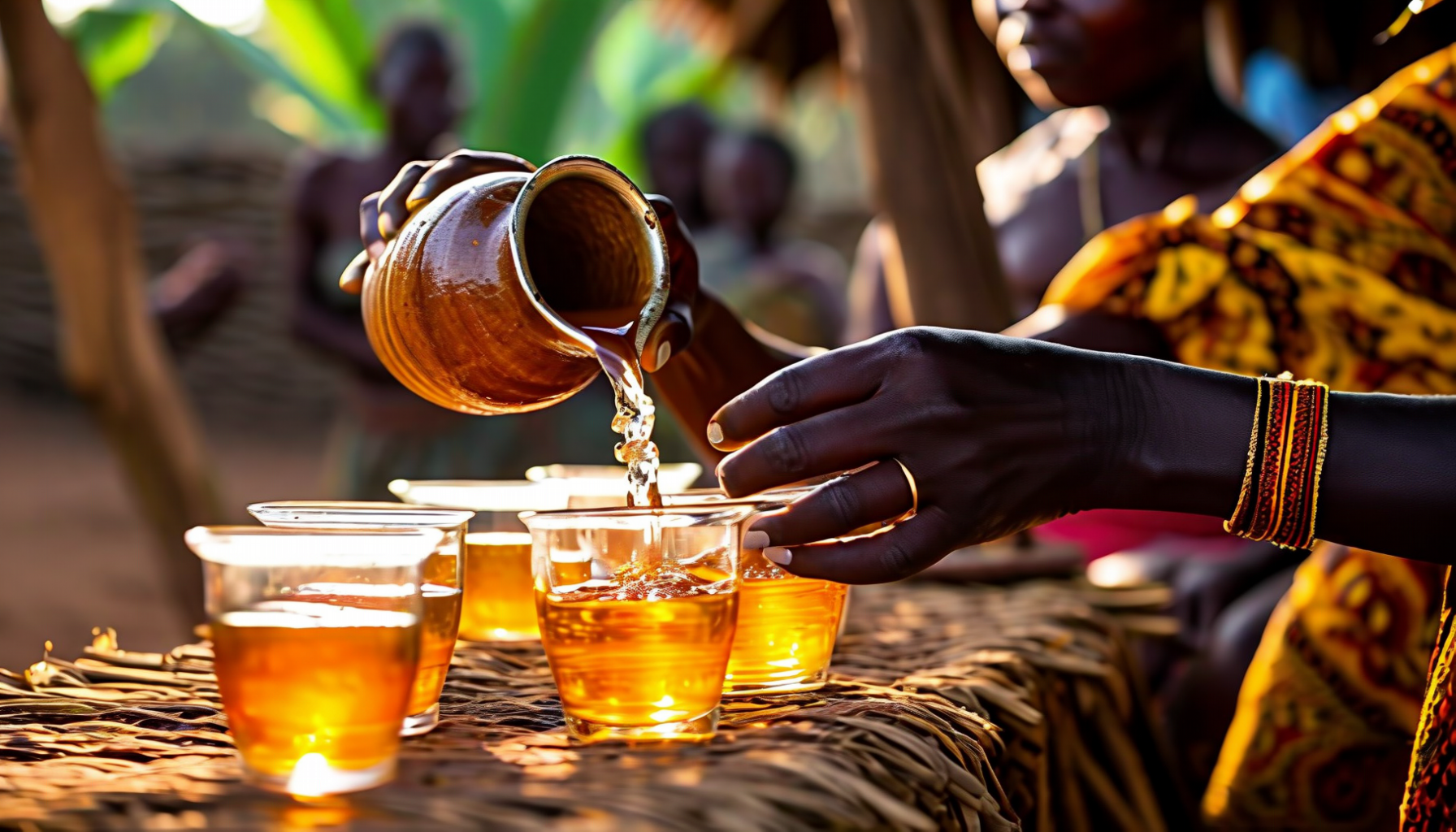
Sodabi — Benin's traditional distilled palm wine, poured at Vodun ceremonies and shared at every gathering
🍸 Cocktails & Mixed Drinks
Benin has no cocktail culture in the Havana or New Orleans sense — but it has sodabi, and sodabi is one of the great undiscovered base spirits of the world. Clear, hot, faintly smoky and anywhere between 40% and a frankly reckless 60% ABV, it behaves in a glass somewhere between an unaged rhum agricole and a young mezcal. The drinks below are what you actually get poured in Grand-Popo beach bars and Cotonou maquis, cleaned up just enough to make at home.
Sodabi Citron
The Beninese house pour
Build: 60 ml sodabi (or a young unaged cane rhum), 25 ml fresh lime juice, 15 ml cane syrup, 2 dashes of bitters if you have them. Shake hard over ice, strain into a small tumbler over one large cube, and drop in a wide strip of lime peel. In Ouidah this is served in a jam jar, unshaken, at room temperature, and it is still excellent.
Bissap Punch
Hibiscus, ginger, sodabi
Build: Steep 40 g dried hibiscus flowers and a thumb of bruised ginger in 1 litre of just-boiled water for 20 minutes, sweeten to taste with cane sugar while warm, then chill hard. To serve: 90 ml bissap, 45 ml sodabi, 15 ml lime, over crushed ice with a mint sprig. Deep magenta, tart, and dangerously easy on a 34-degree afternoon. Made without the sodabi it is the standard soft drink of every West African wedding.
Ganvié Cooler
Pineapple, palm wine, chilli
Build: 80 ml fresh pineapple juice, 60 ml fresh palm wine (substitute a dry cider or a lightly sparkling white if you cannot get it), 30 ml sodabi, a single thin slice of scotch bonnet dropped in the glass and fished out after two minutes. Serve very cold in a tall glass. Benin grows some of the sweetest pineapples in West Africa — the smooth cayenne from the Allada plateau — and the chilli heat behind the fruit is exactly the flavour logic of Beninese cooking.
Tchoukoutou Shandy
Northern sorghum beer, softened
Build: Equal parts tchoukoutou (cloudy, sour, live sorghum beer, drunk from calabashes in the Bariba north) and cold ginger beer, with a squeeze of lime. Tchoukoutou is a genuinely acquired taste — sour, yeasty, still fermenting in the gourd — and the ginger is the training-wheels version. In Nikki and Parakou it is sold by women brewers whose compounds double as the neighbourhood bar.
A word of caution: artisanal sodabi is unregulated and methanol poisoning from badly distilled batches is a real and periodically fatal problem in West Africa. Drink the bottled, labelled brands (Tolli, Sodabi Distillery, Éclat) or sodabi poured in an established bar or hotel; be much more careful with the unlabelled plastic jerrycan at a roadside stall, however good the story attached to it.
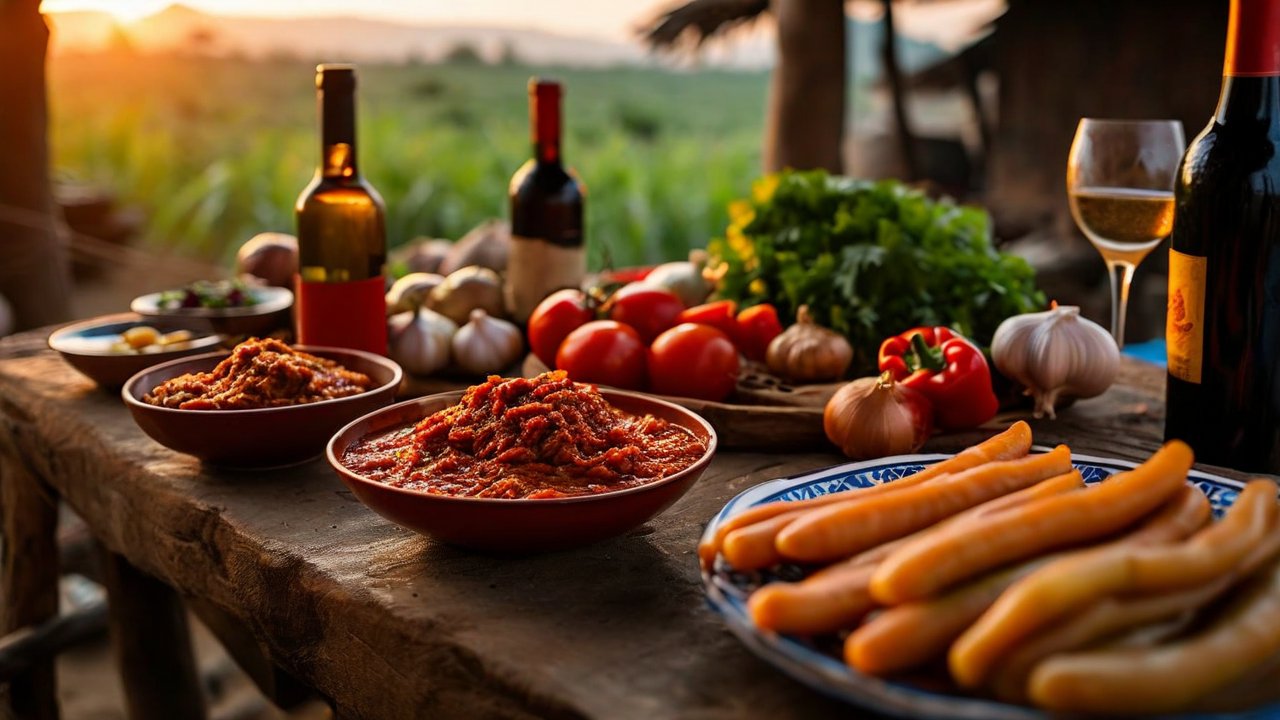
The Beninese table — pate, groundnut and okra sauces, grilled tilapia and a cold Beninoise: the meal that repeats, joyfully, from Cotonou to Natitingou
🌦️ Climate & When to Go
Benin is narrow but long, and it straddles two entirely different climate regimes. The south — Cotonou, Porto-Novo, Ouidah, Abomey — is subequatorial with two rainy seasons: a long one from April to mid-July and a short, sharper one in late September and October, separated by a curious cool-ish dry spell in August that locals call the little dry season. The north — Parakou, Natitingou, Kandi, Malanville — is Sudanian, with a single rainy season from May to September and a long, hard dry season the rest of the year.
Temperatures barely move: 25–33 °C in the south year-round, with humidity that makes 31 °C feel considerably worse. The north swings much harder — nights near 18 °C in December, afternoons above 42 °C in the pre-monsoon furnace of March and April.
From roughly mid-December to mid-February the harmattan blows south out of the Sahara: a dry, dusty haze that drops the temperature a few degrees, greys out the sky, cracks your lips, and ruins long-lens photography. It is also, perversely, the most comfortable time to travel.
| Period | Conditions | Verdict |
|---|---|---|
| Nov – Feb | Dry, hazy harmattan, cooler nights | Best overall. Vodun Days falls in January |
| Mar – Apr | Brutal pre-rain heat, especially in the north | Avoid if you can |
| May – Jul | Main rains in the south, roads deteriorate | Green, cheap, awkward |
| Aug | Southern short dry season | Surprisingly good window |
| Sep – Oct | Second southern rains, humid | Mixed |
Two calendar notes that override the weather entirely: 10 January (National Vodun Day and the Vodun Days festival in Ouidah) is the single best date to be in Benin, and the northern parks are only ever open in the dry season — historically January to May — though see the security warning below before planning anything around them.
✈️ Getting There & Around
By air. Everything funnels through Cadjehoun International Airport (COO) in Cotonou, a small single-terminal airport ten minutes from the city centre — one of the few African capitals where the airport is genuinely in town. There are no direct flights from North America. The workable routings are Air France from Paris CDG, Brussels Airlines from Brussels, Royal Air Maroc via Casablanca, Turkish Airlines via Istanbul, Ethiopian Airlines via Addis Ababa, and Kenya Airways via Nairobi. Regionally, ASKY (via Lomé), Air Côte d'Ivoire, Air Sénégal and Nigerian carriers connect Cotonou to most West African capitals. A replacement international airport at Glo-Djigbé, north of Cotonou, has been announced repeatedly and is not yet flying passengers — check before you assume otherwise.
By land. The Togo border at Hillacondji (90 minutes from Lomé) is the easiest crossing in the region and the standard way in for anyone doing a Togo–Benin loop. The Nigerian border at Sèmè-Kraké is 35 km east of Cotonou and is chaotic, slow and shakedown-prone; go early, keep small notes accessible, and expect the process to take hours. The Niger crossing at Malanville has been closed by Niamey since July 2023; Cotonou and Niamey agreed a reopening roadmap in June 2026 but as of late summer 2026 it had not reopened, and it sits inside the Level 4 do-not-travel zone anyway — do not plan an overland route into Niger. ECOWAS nationals move visa-free across all of them.
Getting around. The lifeblood of Beninese transport is the zémidjan — the yellow-shirted motorcycle taxi, universal, cheap, and the leading cause of tourist injury in the country. Agree the fare first (a few hundred CFA within Cotonou), bring your own helmet if you can, and do not use them at night. For longer distances, the Confort Lines and Baobab Express coaches run scheduled, air-conditioned services from Cotonou to Parakou and Natitingou and are far safer than the shared bush taxis. A hired 4x4 with a driver — roughly €70–110 per day — is the realistic way to reach Koutammakou, the Atakora and anywhere off the paved spine road.
The one paved artery runs south to north from Cotonou through Bohicon, Dassa, Parakou and Kandi to Malanville on the Niger border; it is in decent shape and carries the entire landlocked trade of Niger on it, which means trucks, and lots of them. Everything off it becomes laterite quickly, and impassable in the rains.
📋 Practical Info
Visa. Benin runs a genuine, functioning e-visa through the official government portal evisa.bj — and only that portal; the top of the search results is full of agencies charging two and three times the real price. Citizens of around 50 countries, including the United States, Canada, the United Kingdom and the EU, are eligible. A single-entry 30-day tourist visa costs roughly US$55 (multiple entry about US$75) and is typically issued in two working days. You will need a passport valid six months beyond arrival, a white-background photo, proof of onward travel and a hotel booking or invitation. Nationals of every African country enter Benin visa-free — a policy Benin adopted unilaterally in 2020 and still maintains.
Health. A yellow fever vaccination certificate is compulsory and genuinely checked on arrival. Malaria is year-round and holoendemic across the whole country — prophylaxis is not optional here, and the falciparum strain is the dangerous one. Typhoid, hepatitis A and meningococcal vaccines are all sensibly recommended, and rabies pre-exposure is worth considering if you are going anywhere rural. Tap water is not drinkable; the sachet water sold everywhere is fine if the seal is intact. Medical facilities outside Cotonou are extremely limited — take evacuation insurance seriously.
Money. The West African CFA franc (XOF) is pegged to the euro at the fixed rate of 655.957 XOF = €1, so a euro-holder always knows the price and a dollar-holder is at the mercy of EUR/USD. ATMs work reasonably in Cotonou, Porto-Novo, Parakou and Natitingou (Ecobank, Bank of Africa, UBA) and essentially nowhere else — draw cash before heading north. Cards are accepted only in top-end hotels. Mobile money (MTN MoMo, Moov) is universal among locals and increasingly usable by visitors with a local SIM.
Language. French is the official language and, outside hotel reception desks, is the only language that will get you anywhere. English is rare. Fon dominates the south, Yoruba the southeast, Bariba, Dendi and Fulfulde the north. Learning six words of Fon — a fon ganjí (good morning), awanou (thank you) — buys more goodwill per syllable than anywhere else I have travelled.
Connectivity & electricity. MTN and Moov SIMs are cheap and sold with passport registration at the airport; 4G is solid in the south and patchy in the north. Power is 220 V, French type C/E sockets. Outages are frequent enough that any hotel above budget level has a generator, and you should ask whether it runs all night.
Etiquette. Greet before you transact — walking up and stating your business without a bonjour, ça va? reads as genuinely rude. Use the right hand for giving and eating. Dress modestly, particularly in the Muslim north. And never photograph a Vodun shrine, ceremony, fetish market stall or Egungun masquerader without asking and, usually, paying a small negotiated fee — the objection is spiritual, not commercial, and ignoring it will end badly.
⚠️ Travel Advisory & Safety
Checked 18 September 2026. The U.S. State Department lists Benin at Level 2 — Exercise Increased Caution — because of unrest, crime, terrorism and kidnapping. It advises against travel to northern and northeastern border areas adjoining Burkina Faso, Niger and the Nigerian states of Kebbi, Niger and Kwara.
The UK Foreign, Commonwealth & Development Office advises against all travel to W National Park, Pendjari National Park, their associated hunting zones and several northern border areas. It advises against all but essential travel to additional parts of Alibori and Atacora and to an eastern corridor near the Nigeria border. These restrictions are important for itinerary planning: the northern wildlife parks should not be treated as ordinary tourist destinations while the warnings remain in force.
Elsewhere in Benin, use normal urban precautions: protect phones and bags in crowded markets, avoid isolated areas after dark, use reputable transport and take particular care on roads and motorcycle taxis. Security conditions can change quickly, so check official advice immediately before travel and verify that your insurance remains valid for every part of your route.
💵 Cost of Living & Travel Budget
Benin is inexpensive by any standard except its West African neighbours, where it sits mid-pack — cheaper than Senegal or Côte d'Ivoire, dearer than Togo. The CFA peg means prices are stable and there is no currency-crash bargain to be had. Costs below are per person, per day, in a country where a plate of excellent street food costs less than a bottle of imported beer.
| Item | XOF | ≈ EUR |
|---|---|---|
| Street plate — pâte with sauce, or riz-poisson | 700 – 1,500 | €1 – 2.30 |
| Meal in a mid-range Cotonou restaurant | 7,000 – 15,000 | €11 – 23 |
| Large La Béninoise beer | 700 – 1,200 | €1 – 1.80 |
| Zémidjan ride across Cotonou | 300 – 700 | €0.50 – 1.10 |
| Coach, Cotonou → Natitingou (10 h) | 10,000 – 14,000 | €15 – 21 |
| Pirogue tour of Ganvié (per boat, negotiable) | 12,000 – 20,000 | €18 – 30 |
| Guide, half day, French-speaking | 10,000 – 20,000 | €15 – 30 |
| 4x4 with driver and fuel, per day | 45,000 – 72,000 | €70 – 110 |
| Museum entry (Abomey, Ouidah) | 2,000 – 5,000 | €3 – 7.60 |
Daily totals. Backpacking on local transport and street food: €22–35. Comfortable mid-range — decent air-conditioned hotel, restaurant meals, occasional taxi: €55–95. With a private 4x4, driver and guide, which is how most people actually see the interior: €140–200. Tipping is not obligatory but 10% in restaurants and a few thousand CFA to a guide or driver is normal and appreciated.
🛏️ Accommodation
Benin is not a hotel country. There is no international chain presence to speak of outside Cotonou, no boutique scene, and in much of the interior the choice is between a functional government-era hotel and nothing. What it does have is a handful of genuinely charming places, mostly French- or Beninese-owned, and a lot of clean, unglamorous, air-conditioned rooms for €25.
Cotonou holds the top end: the Golden Tulip Le Diplomate and Azalaï Hôtel de la Plage are the reliable business-class options, the Novotel Orisha the newest, and a scatter of mid-range guesthouses in Haie Vive — the expat quarter — offer better value and better food. Budget travelers head for Auberge de Cotonou territory around €20–30.
Ouidah is where you should actually sleep if you have come for the history: Casa del Papa on the lagoon spit and the beach hotels along the Route des Pêches let you walk the Route des Esclaves in the early morning before the heat and the tour groups arrive. Grand-Popo, 80 km west, is Benin's one genuine beach retreat — Awalé Plage and Lion Bar are institutions, and the Mono river estuary is beautiful at dawn.
Abomey has a modest cluster near the palaces; Possotomé on Lake Ahémé has thermal springs and a small eco-lodge scene that is the closest thing Benin has to a wellness offering. In the far north, Natitingou is the base for Koutammakou and the Atakora, with a few simple auberges; the lodges inside Pendjari have operated only intermittently since the security deterioration and should be verified as open before you travel — see the advisory above.
Two practical notes. Air conditioning is the single variable that determines price, and in the harmattan season you frequently do not need it. And the ocean along Benin's coast has a fierce undertow and a steeply shelving beach — hotels are honest about this, and you should believe them. People drown here every year.
🎉 Festivals & Events
Vodun Days / National Vodun Day — 9–10 January, Ouidah. The reason to come. 10 January has been a public holiday since 1996, and since 2024 the state has wrapped it in a full two-day festival — Vodun Days — that has turned a solemn religious observance into the biggest cultural event in West Africa, drawing well over 100,000 people including large diaspora contingents from Haiti, Brazil, Cuba and the American South. Egungun masqueraders spin through the streets in towering appliqué costumes, Zangbeto night-watchmen whirl like haystacks, drum orchestras play until dawn, and the ceremonies culminate on the beach at the Door of No Return. It is loud, crowded, sincere and unlike anything else on the continent. Book accommodation months ahead.
Gaani — Nikki, dates follow the Islamic calendar. The great festival of the Bariba kingdom in the north: mounted horsemen in full regalia, royal drums, and a procession of the Sinaboko (king) that has run for centuries. Far less visited than Ouidah and, for many travelers, more memorable.
Quintessence International Film Festival — Ouidah, January. Benin's principal film festival, timed to coincide with the Vodun celebrations, screening African and diaspora cinema.
Nonvitcha — Grand-Popo, Pentecost weekend (May/June). The annual reunion of the Xwla and Xwéda peoples of the coast, part cultural festival, part enormous beach party, and the busiest weekend of the year in Grand-Popo.
Independence Day — 1 August. Military parade and civic ceremonies, rotated between cities; Benin became independent from France on 1 August 1960.
Fête de l'Igname (Yam Festival) — August/September, northern and central Benin. The new-yam harvest is marked with ceremonies at which the first tubers are offered to the ancestors before anyone may eat them.
Alongside these run the ordinary rhythms of a country that is roughly 50% Christian, 27% Muslim and — by any honest reckoning that counts dual practice — overwhelmingly Vodun as well: Easter and Christmas are major, Eid al-Fitr and Eid al-Adha (Tabaski) are public holidays, and family Vodun ceremonies happen constantly and are not scheduled for tourists.
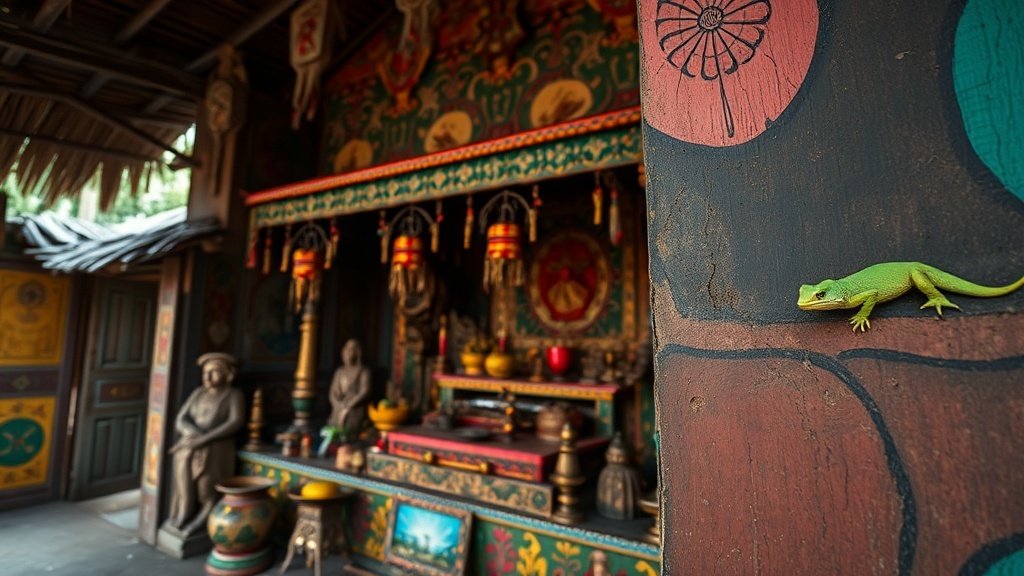
A Vodun temple in Ouidah — on 10 January the town becomes the spiritual capital of a religion practised from Haiti to Bahia
🏛️ UNESCO World Heritage
Royal Palaces of Abomey (1985)
From 1625 until 1900, twelve successive kings of the Dahomey Kingdom ruled from Abomey, each adding his own palace to a sprawling 47-hectare royal complex protected by a 10-kilometer-long earthen wall. Built almost entirely of banco (sun-dried earth) and roofed with thatch, the palaces are most famous for their extraordinary polychrome bas-reliefs — pictographic murals carved into the walls that recount the military victories, totems, and proverbs of each king. The reliefs functioned as a visual chronicle for an oral society: a leopard for King Ghezo, a pineapple struck by lightning for King Behanzin, a buffalo wearing a tunic for Glele.
Inside the surviving palaces of King Ghezo and King Glele — now the Historical Museum of Abomey — visitors see royal thrones (one mounted on the skulls of defeated enemies), the famous appliqué tapestries of the Yemadje family, ceremonial weapons of the all-female Mino regiment (the so-called "Dahomey Amazons"), and altars where annual customs ceremonies once involved human sacrifice. A devastating fire in 1984 and ongoing erosion of the earthen walls placed the site on UNESCO's List of World Heritage in Danger from 1985 until 2007; today restoration is led by Beninese conservators trained in traditional banco techniques. The site is the spiritual and historical heart of southern Benin and the single most important monument to the West African kingdoms that shaped — and were shattered by — the Atlantic slave trade.
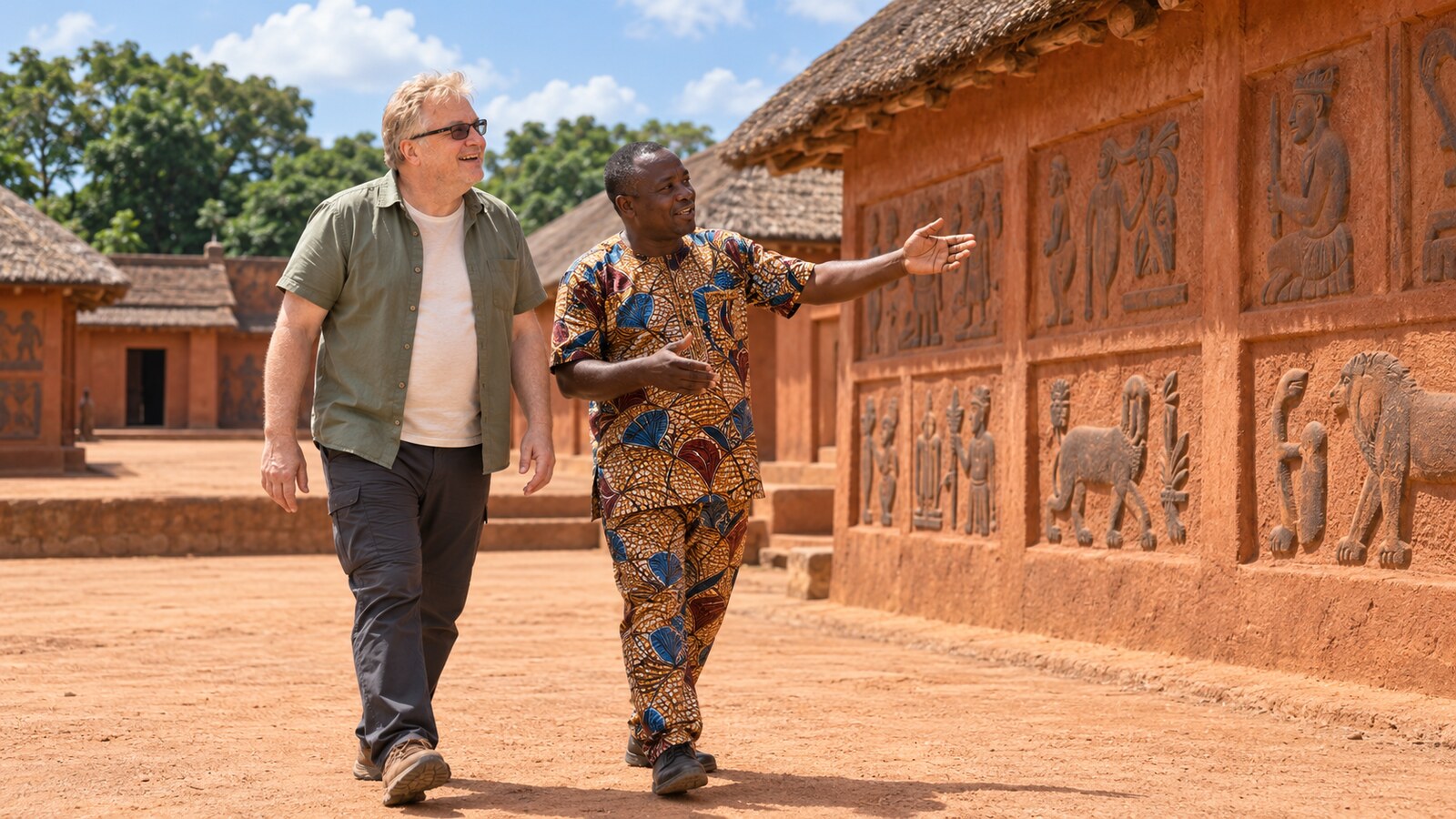
Radim Kaufmann with a heritage guide at the Royal Palaces of Abomey · Kaufmann Creative AI Studio© · AI-created editorial image; not a documentary record of an actual visit.
Koutammakou, the Land of the Batammariba (inscribed 2004 in Togo; extended into Benin in 2023)
In the wooded savanna of Benin's far northwest — straddling the border with Togo — the Batammariba people ("those who shape the earth") build the most architecturally astonishing dwellings in West Africa: the takienta, multi-story fortified tower-houses sculpted entirely from mud, wood, and straw. Each takienta is a self-contained village in miniature: a ground floor for livestock and grain storage, an upper terrace for sleeping and cooking, conical thatched turrets that double as granaries, and a flat rooftop where ancestors are honored. The cylindrical towers, the symbolic doorways oriented to the rising sun, and the small earthen altars at the entrance all encode the Batammariba cosmology — a single takienta is at once a house, a fortress, a temple, and a model of the universe.
UNESCO inscribed Koutammakou not only for its architecture but for the living relationship between landscape, ritual, and daily life: sacred forests, initiation sites, ceremonial dance grounds, and farmland are all considered part of the heritage. Reaching the site requires a long drive north from Natitingou; the nearest village clusters are around Boukoumbé. Visitors should hire a local guide from the Natitingou museum, dress modestly, and ask permission before photographing the takienta or their inhabitants — these are private homes, not monuments.
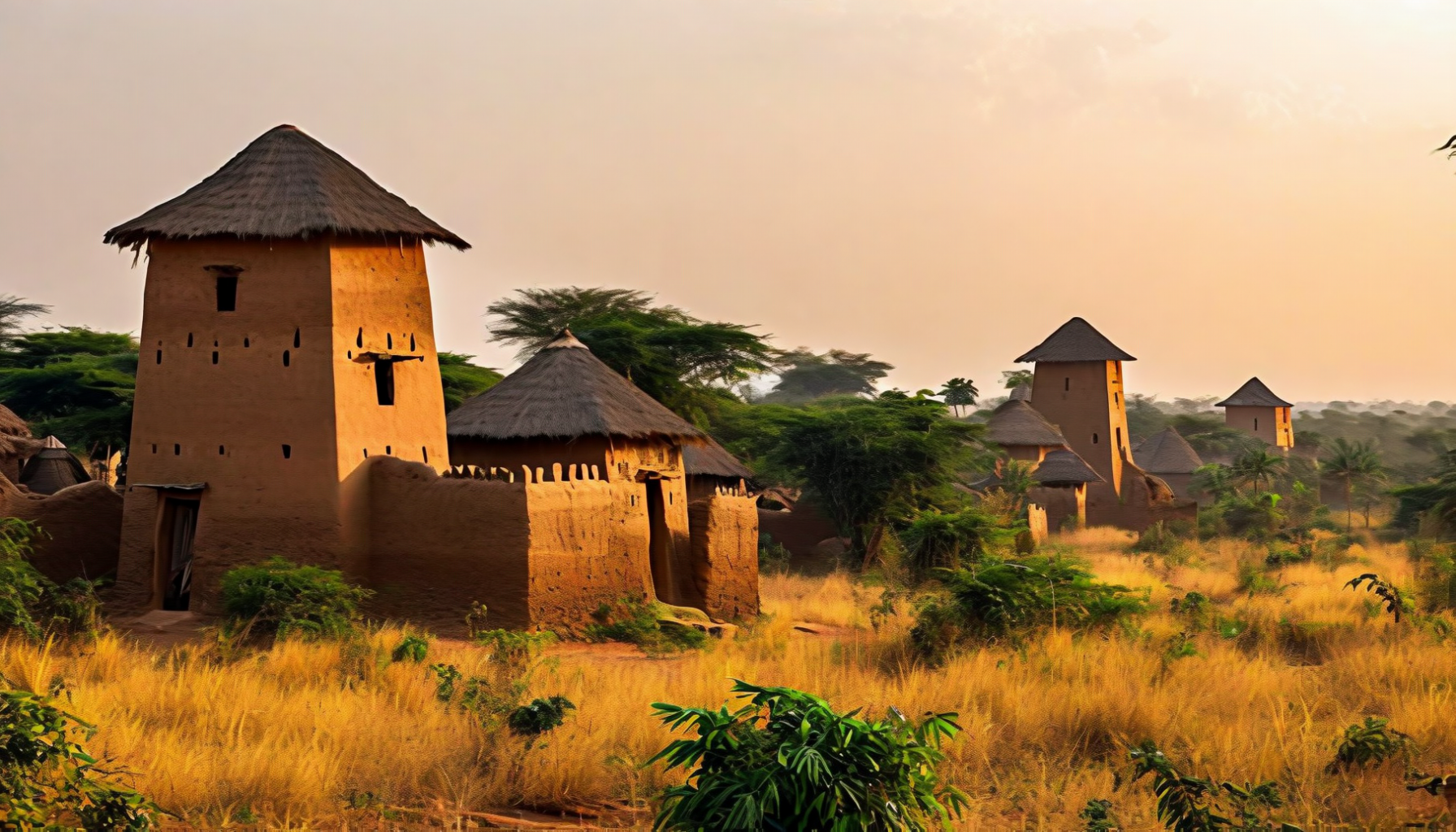
Koutammakou — the fortified earthen tower-houses (takienta) of the Batammariba, simultaneously home, granary, fortress, and shrine to the ancestors
Benin also shares the transboundary W-Arly-Pendjari Complex (inscribed 1996, extended 2017 with Burkina Faso and Niger) — a vast savanna-and-wetland reserve that protects West Africa's last viable populations of elephant, lion, cheetah, and West African manatee. The Beninese portion centers on Pendjari National Park, covered in the Geography and Hidden Gems sections. That makes three inscribed properties in all (UNESCO, checked September 2026), with five more on the Tentative List — among them old Porto-Novo and its royal palace, the underground village of Agongointo-Zoungoudo near Bohicon, the lower Ouémé valley and the landmarks of the Slave Route in Benin (added 2021).
💼 Business & Economy
Benin’s economy is anchored by the Port of Cotonou, regional trade, agriculture and services, with cotton remaining an important export. Industrial policy increasingly emphasizes local processing, logistics and investment around the Glo-Djigbé Industrial Zone. The currency is the West African CFA franc (XOF), used across the WAEMU monetary union and fixed to the euro.
Cotonou is the country’s commercial center. French is the principal language of administration and business; cards are accepted in major hotels and larger establishments, but cash and mobile money remain important in everyday transactions.
🎒 Packing Tips
- 💉 Yellow fever certificate — compulsory, checked at the airport, and no substitute for it exists. Carry the yellow card, not a photo of it.
- 💊 Malaria prophylaxis for the entire stay, plus a course of standby treatment if you are going north. A DEET repellent and a permethrin-treated long-sleeve shirt for dusk.
- 🪖 Your own motorcycle helmet if you intend to use zémidjans regularly. Nobody will offer you one.
- 👕 Light cotton and linen, long sleeves and long skirts or trousers for the Muslim north and for any Vodun ceremony. Shorts on a man are acceptable in Cotonou and read as slightly odd anywhere else.
- 🔦 Head torch and a power bank — grid outages are routine outside the main hotels.
- 💶 Euros in cash, in small denominations. The CFA peg means euros change cleanly everywhere; dollars attract a worse rate and more argument. Bring more cash than feels sensible if going north of Parakou.
- 🧻 Toilet paper, hand sanitiser, and rehydration salts. Non-negotiable.
- 😷 A buff or scarf for harmattan dust between December and February, plus lip balm and eye drops — the dryness is genuinely punishing.
- 🔌 Type C/E plugs, 220 V. A French adapter, not a UK one.
- 📷 A camera you are willing to put away. In the fetish markets and around any shrine, ask first — the answer is often no, and it is not negotiable with money.
📖 Recommended Reading & Viewing
- The Viceroy of Ouidah — Bruce Chatwin (1980). The novel of the Brazilian slave-trader Francisco Félix de Souza, later filmed by Werner Herzog as Cobra Verde. Uncomfortable, brilliant, and still the best-known book set in Benin.
- Amazons of Black Sparta: The Women Warriors of Dahomey — Stanley B. Alpern (1998). The standard scholarly account of the Mino, and the corrective to the Hollywood version.
- Dahomey — Mati Diop (2024). The documentary that won the Golden Bear at Berlin, following the 26 royal treasures looted in 1892 as they are returned from Paris to Cotonou — narrated, astonishingly, by one of the statues. Essential viewing before Abomey.
- The Woman King — Gina Prince-Bythewood (2022). Fiction, and heavily sanitised about Dahomey's role in the slave trade, but it is why most visitors have heard of the Agojie at all.
- Spirit Rising: My Life, My Music — Angélique Kidjo (2014). The memoir of Benin's most famous daughter, from Ouidah to the Grammys.
- Un piège sans fin — Olympe Bhêly-Quénum (1960). The foundational Beninese novel, by one of francophone Africa's major writers.
- African Philosophy: Myth and Reality — Paulin Hountondji (1976). The most influential book of philosophy to come out of Benin, by the Porto-Novo-born critic of ethnophilosophy.
- Vodun: Secrecy and the Search for Divine Power — Dana Rush / Divine Utterances — Katherine Hagedorn. Serious anthropology on Vodun, worth reading precisely because so much popular writing on it is nonsense.
📺 Watch Before You Go
Benin is thinly covered on YouTube compared with its neighbours, and the algorithm buries the good material under thumbnail-shouting travel vlogs. These searches will get you to the useful things rather than to a specific video that may have been taken down by the time you read this.
🤯 Fascinating Facts
- 🐍 Ouidah's Temple of Pythons houses sacred snakes that roam freely — handling them is believed to bring good fortune
- ⚔️ The Dahomey Amazons (Mino) were one of history's few all-female military units, fighting until 1894
- 🏠 Ganvié, the "Venice of Africa," has existed on stilts in Lake Nokoué since the 17th century — founded by people fleeing slave raiders
- 🎵 Angélique Kidjo from Ouidah has won five Grammy Awards and on 18 August 2026 became the first African musician ever given a star on the Hollywood Walk of Fame
- 📅 January 10 is National Voodoo Day — an official public holiday since 1996
- 🏛️ Benin's 1990 National Conference became the template for democratic transitions across Africa — Congo, Niger, Mali and Togo all copied it
- 🎬 Mati Diop's documentary Dahomey, about the return of 26 looted royal treasures from Paris to Cotonou in 2021, won the Golden Bear at the 2024 Berlin Film Festival
- 💶 Benin is spending roughly €1 billion on museums and heritage sites — the largest cultural-infrastructure programme anywhere in West Africa
⭐ Notable People
- Angélique Kidjo (b. 1960, Ouidah) — five-time Grammy winner, eighteen albums, and on 18 August 2026 the first African musician — and first Black African — to receive a star on the Hollywood Walk of Fame, unveiled with Djimon Hounsou in attendance. The most internationally recognised Beninese of any era.
- King Ghezo (r. 1818–1858) and King Béhanzin (r. 1889–1894) — the greatest and the last independent rulers of Dahomey. Béhanzin fought the French to a standstill for two years before exile to Martinique; his statue stands in Abomey.
- Djimon Hounsou (b. 1964, Cotonou) — twice Oscar-nominated actor (In America, Blood Diamond), who left Benin for Paris at thirteen.
- Mathieu Kérékou (1933–2015) — the Marxist-Leninist colonel who ruled from 1972, renamed the country Benin, presided over the National Conference that removed him, lost the 1991 election, then won it back democratically in 1996. One of Africa's strangest political arcs.
- Romuald Hazoumè (b. 1962, Porto-Novo) — internationally exhibited artist whose masks made from jerrycans, and the installation La Bouche du Roi in the British Museum, made the petrol-smuggling economy of the Nigerian border into art.
- Paulin Hountondji (1942–2024) — philosopher, author of African Philosophy: Myth and Reality, and one of the most cited African thinkers of the twentieth century.
- Wally Badarou (b. 1955) — Franco-Beninese keyboardist and producer, house musician at Compass Point, and the sound behind records by Grace Jones, Level 42 and Talking Heads.
- Nel Oliver and the Orchestre Poly-Rythmo de Cotonou — the 1970s Afro-funk powerhouse whose reissued catalogue turned Benin into a crate-digger's pilgrimage.
- Steve Mounié (b. 1994) and Jodel Dossou — the strikers who carried the Cheetahs to within one match of a first World Cup.
⚽ Sports
Football is the national obsession, and the national team — Les Guépards, the Cheetahs, a name adopted in 2022 when the federation retired the sixty-year-old "Squirrels" (Écureuils) as too small an animal for its ambitions — spent 2025 giving Benin the closest thing to a sporting heartbreak it has ever had. Drawn in a 2026 World Cup qualifying group with Nigeria, South Africa, Rwanda, Lesotho and Zimbabwe, Benin led it going into the final matchday, needing only a result in Uyo. Nigeria beat them 4–0, Victor Osimhen scoring a hat-trick; South Africa took the group and Nigeria the play-off place. Benin finished third and missed out on a first World Cup by ninety minutes.
Benin have qualified for the Africa Cup of Nations five times (2004, 2008, 2010, 2019 and the 2025 edition, played in Morocco in December 2025–January 2026). Their high-water mark remains 2019, when they knocked out Morocco on penalties to reach the quarter-finals without winning a match; at AFCON 2025 they finally recorded their first-ever win at the finals — 1–0 over Botswana in Rabat on 28 December 2025 — then lost 3–0 to Senegal and went out in the round of 16 to Egypt, 3–1 after extra time (5 January 2026). Domestically the Championnat National is semi-professional and thinly attended; ambitious players leave for France, Belgium and North Africa early.
Beyond football, Benin has never won an Olympic medal — one of the larger nations still on that list. Taekwondo and athletics carry the best hopes; Odile Ahouanwanou has been the country's most consistent international performer in the heptathlon. Traditional wrestling remains genuinely popular in the Bariba north, where village champions draw crowds that dwarf league football, and the fishing communities of the lagoons hold pirogue races that are less a sport than a village-level civil war conducted with paddles.
📰 Media & Press Freedom
Benin's press was, for two decades after 1990, among the freest in Africa — a genuinely plural landscape of small newspapers and community radio stations that emerged from the National Conference. That reputation has been dismantled with remarkable speed.
In the 2026 RSF World Press Freedom Index Benin ranks 113th of 180, having fallen 21 places in a single year, with its score dropping from 54.60 to 47.39. RSF attributes the collapse to the 2018 Digital Code — under which journalists have been jailed for online publication — to press-freedom violations tied to the deteriorating security situation in the north, including the detention and deportation of reporters, and to the pursuit of critical journalists abroad. The case that defined the year was that of Hugues Comlan Sossoukpè, founder of the online outlet Olofofo, seized in Côte d'Ivoire, extradited to Benin and detained in July 2025.
The state broadcaster SRTB relays government communication with an editorial committee that vets the evening bulletin in advance. The regulator HAAC has suspended outlets and withdrawn accreditations. The private press survives, but a chilling effect is obvious to anyone who reads it: economic coverage is detailed and fearless, political coverage is careful.
For visitors this rarely intrudes, with two exceptions. Do not attempt journalism on a tourist visa — accreditation is required and its absence has been treated as an offence. And be aware that WhatsApp and social media posts by foreigners about Beninese politics have attracted official attention; the Digital Code applies to you as well.
📚 Resources
📸 Gallery

✍️ Author's Note
"Walking the Route des Esclaves in Ouidah is one of the most emotionally powerful experiences in all of Africa. The symbolic monuments along the path — the Tree of Forgetfulness, the Door of No Return — force a reckoning with history that no textbook can deliver. And then, that same evening, witnessing a Vodun ceremony under the stars, you realize that the spiritual traditions enslaved people carried across the ocean are still alive here at their source."
"Benin doesn't make it easy — infrastructure is basic, French is essential, and the heat is relentless. But for anyone interested in African history, spirituality, and culture unvarnished by tourism, this is the real thing."
— Radim Kaufmann, 2026
Ganvie & Lake Nokoue
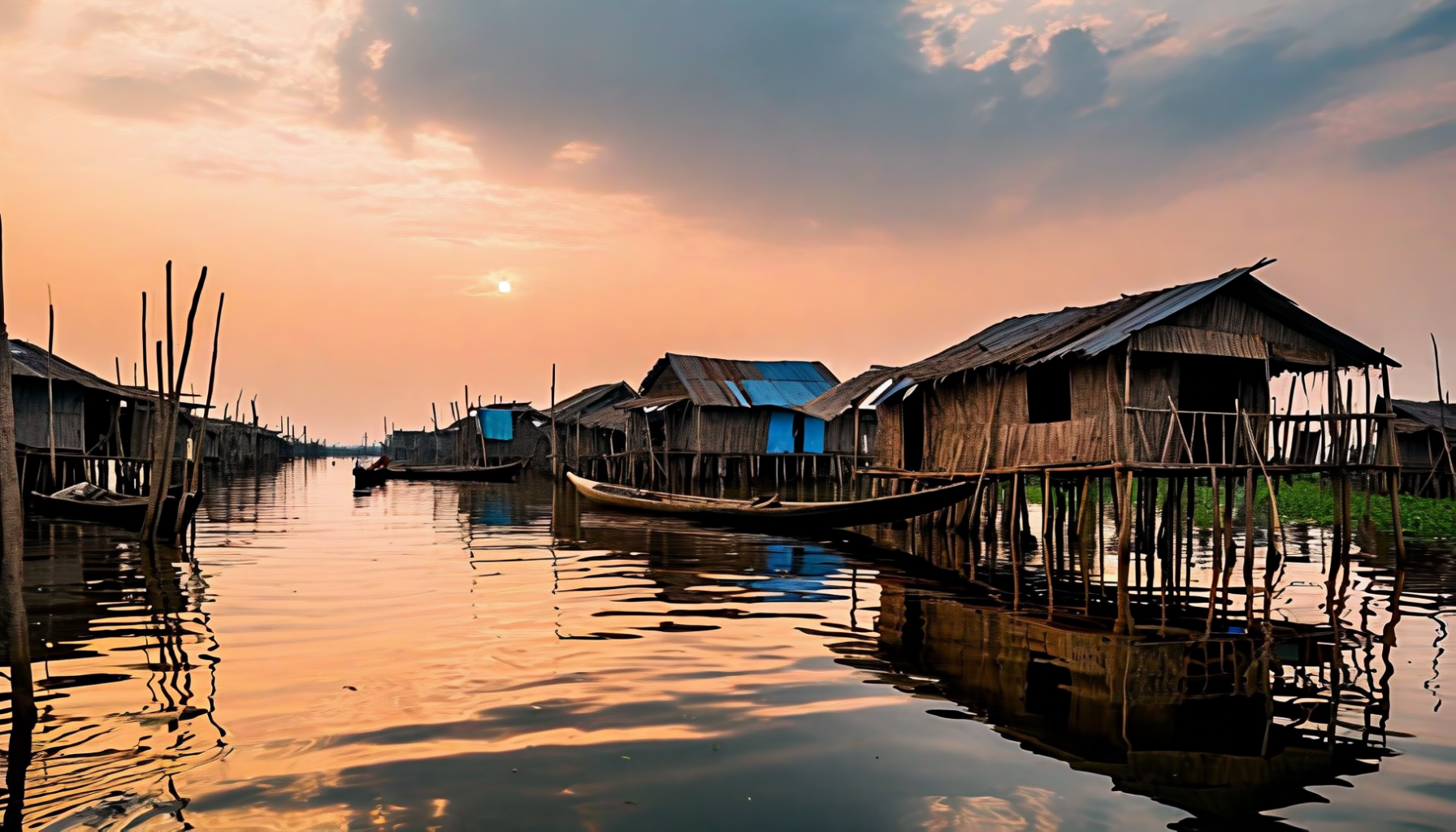
Ganvie is often described as the Venice of Africa, but the comparison hides the deeper story. The Tofinu people built the settlement on Lake Nokoue in the 17th century, using water as protection from slave raiders whose religious rules prevented attacks on the lake. Today its houses, schools, churches, markets and workshops rise on timber piles above the lagoon.
A responsible visit is slow: arrive early, use a licensed local boat, avoid treating private homes as scenery and remember that Ganvie is a living town rather than a staged attraction.
Porto-Novo — The Official Capital
Porto-Novo carries Benin’s official capital status with a quieter rhythm than Cotonou. Its Afro-Brazilian houses, colonial-era streets, old mosque, royal palace museum and shaded compounds preserve a layered urban memory shaped by Yoruba, Goun, Brazilian returnee and French influences.
The city is useful for understanding Benin beyond the port economy: politics, museums, architecture and religious pluralism are all visible at walking speed.
Cotonou — Port, Markets & Daily Energy
Cotonou is not the constitutional capital, but it is the country’s commercial engine: airport, seaport, government ministries, banks, universities, nightlife and the immense Dantokpa Market all concentrate here.
Its best travel value is practical rather than picturesque. Use it as the base for Ouidah, Ganvie, Porto-Novo and Abomey, but leave time for market life, beach evenings and contemporary art spaces.
Dantokpa Market
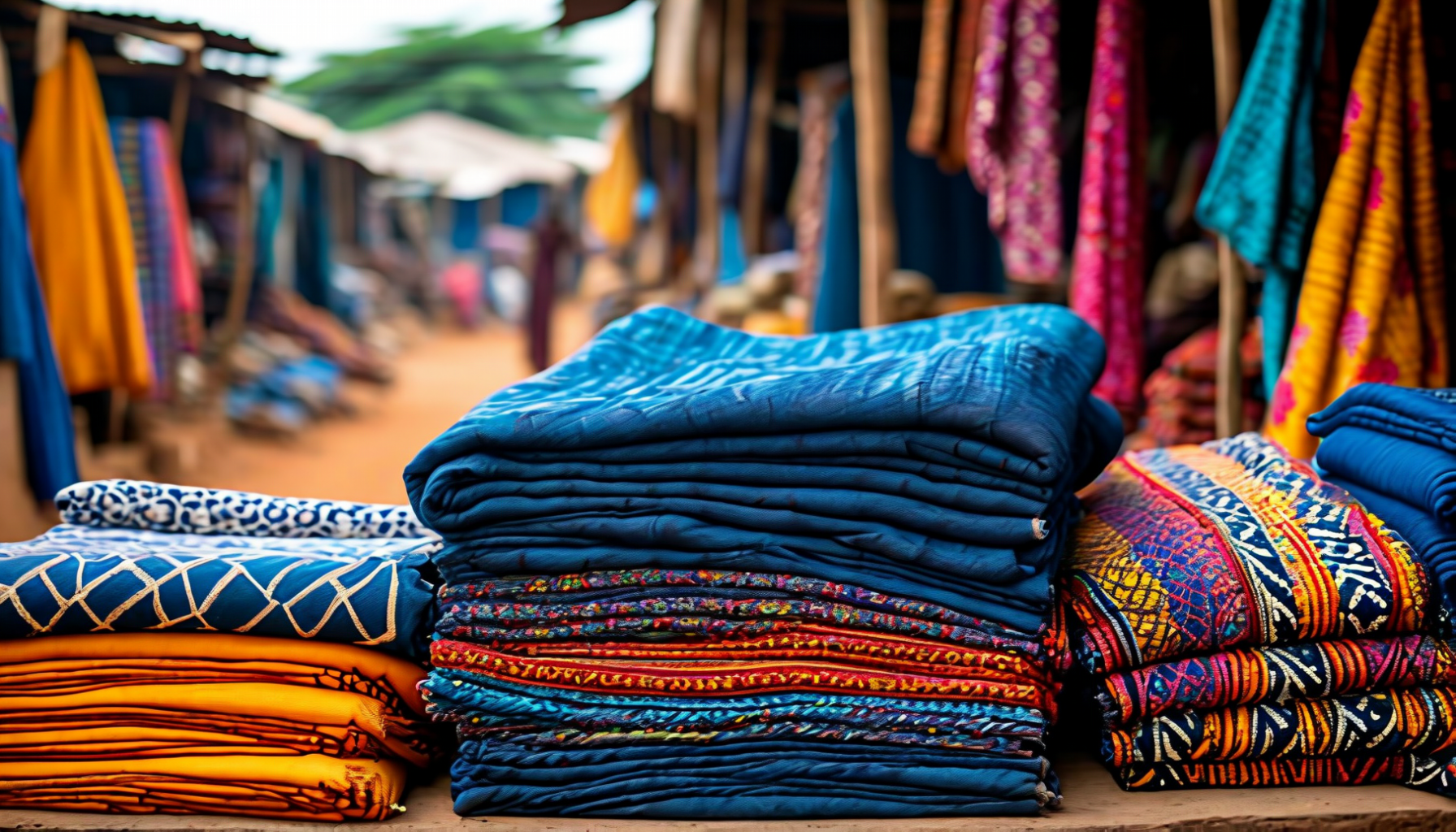
Dantokpa is one of West Africa’s great markets, a city within the city where textiles, food, cosmetics, hardware, imported goods and Vodun ritual objects circulate through narrow lanes and loud negotiation.
Photography should be discreet and permission-based. The market is also a reminder that Benin’s economy is deeply tied to regional trade with Nigeria, Togo and the wider CFA-franc zone.
Royal Palaces of Abomey
The Royal Palaces of Abomey are the architectural heart of the Dahomey kingdom. Their earthen compounds, bas-reliefs and ceremonial spaces encode royal history through symbols of kingship, conquest, ritual and statecraft.
The site is not simply a monument to power. It also forces a direct encounter with the kingdom’s role in warfare and the Atlantic slave trade, which must be described without romanticising.
Dahomey Mino — The Women Warriors
The Mino, often called the Dahomey Amazons in European accounts, were an elite female military corps serving the kings of Dahomey. Their discipline, status and battlefield reputation made them one of the most remarkable military institutions of pre-colonial Africa.
Modern retellings sometimes simplify them into cinematic icons. The historical reality is more complex: courage, royal service, violence, state power and the slave-trade economy all belong to the same story.
Vodun Deities & Ritual Life
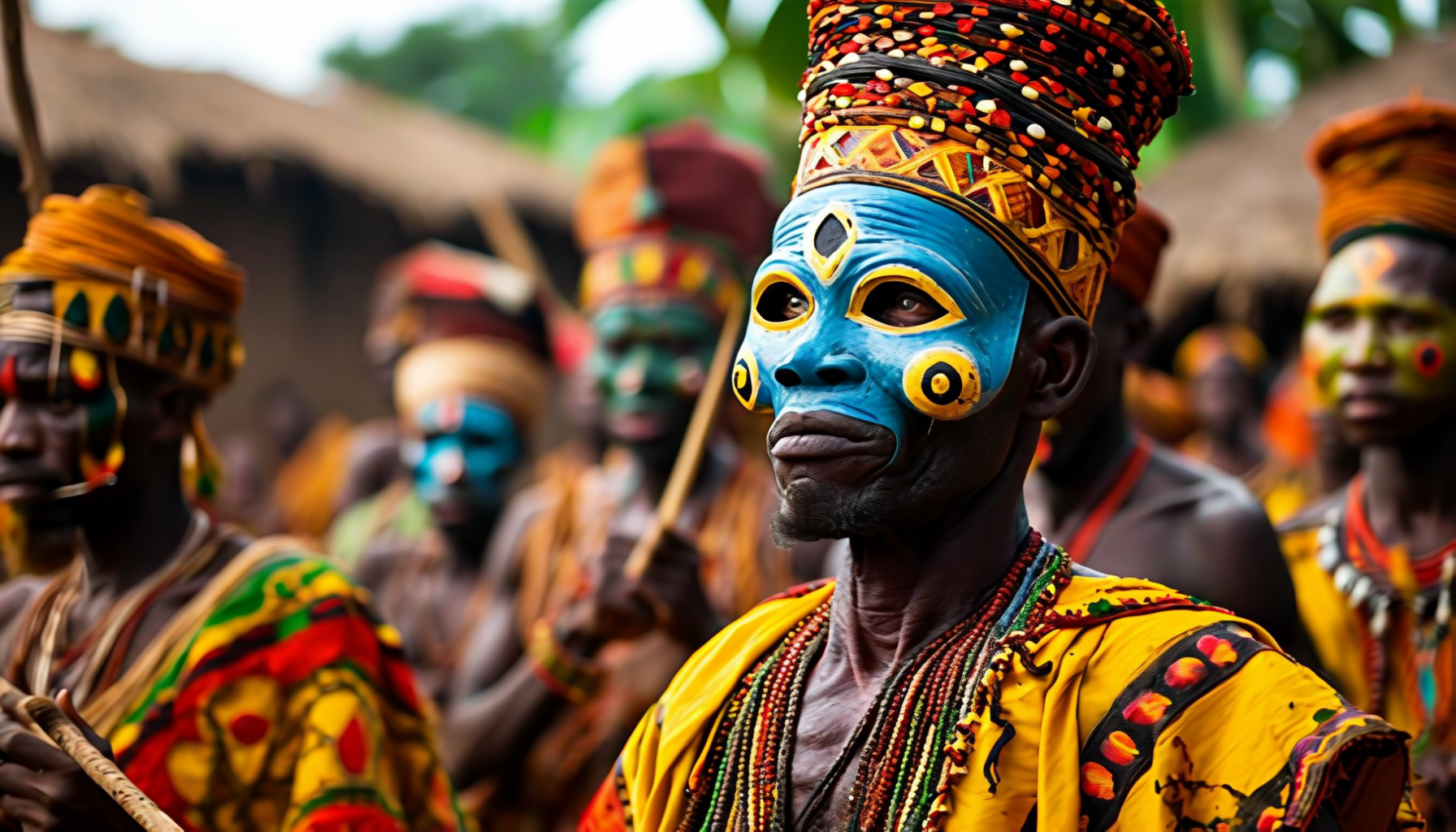
Vodun is a living religious system, not a costume or horror-film vocabulary. It works through relationships with spirits, ancestors, places, rhythms, offerings and ritual specialists who mediate between visible and invisible worlds.
For visitors, the first rule is respect. Public ceremonies may be open, but sacred knowledge is not tourist property. Ask before filming, dress modestly and accept that some moments are not for cameras.
Python Temple & Sacred Forest
Ouidah’s Python Temple and the Sacred Forest of Kpasse are two of the most accessible Vodun sites for travelers, but accessibility does not make them simple. Pythons are sacred royal animals, and the forest preserves shrines, sculpture and ritual memory under old trees.
A good guide can explain what is public, what is symbolic and what should be approached silently.
Grand-Popo & the Mono Estuary
Grand-Popo is Benin’s softer coastal edge: beach, fishing canoes, lagoon channels, old colonial traces and the Mono River landscape near the Togolese border.
It works best as a decompression stop after Cotonou and Ouidah, with boat trips into mangrove country and evenings when the Atlantic turns the whole shore into sound.
Koutammakou & Tata Somba Architecture
In the northwest, Koutammakou and the surrounding Batammariba landscape are defined by takienta, fortified earthen tower-houses that combine architecture, cosmology, storage, family life and defense.
The Beninese extension of this UNESCO cultural landscape makes the country’s heritage more than coastal history. Visits require local guidance and careful photography etiquette because these structures are homes.
Northern Benin & Atakora
Northern Benin changes the country’s texture: drier air, savanna, Atakora hills, Bariba history, Fulani pastoral routes and long distances between towns. Natitingou, Nikki and Parakou anchor different parts of that northern story.
Security warnings mean planning must be conservative. The north is culturally important, but not every road or park belongs in a casual itinerary in 2026.
Pendjari and W — Wildlife Under Warning
Pendjari and W are among West Africa’s most important protected ecosystems, with elephants, lions, antelope, birds and rare savanna habitats. Their conservation value is enormous.
At the same time, current official advisories place these parks and nearby border zones under severe travel warnings because of terrorism and kidnapping risk. They should be treated as heritage and conservation chapters, not ordinary recommendations.
Music, Dance & Afro-Funk
Benin’s musical identity runs from Vodun drumming and ceremonial dance to the Afro-funk brilliance of Orchestre Poly-Rythmo de Cotonou and the global career of Angelique Kidjo.
Rhythm here is not decoration. It carries social memory, religious energy and modern urban style in the same pulse.
Textiles, Crafts & Markets
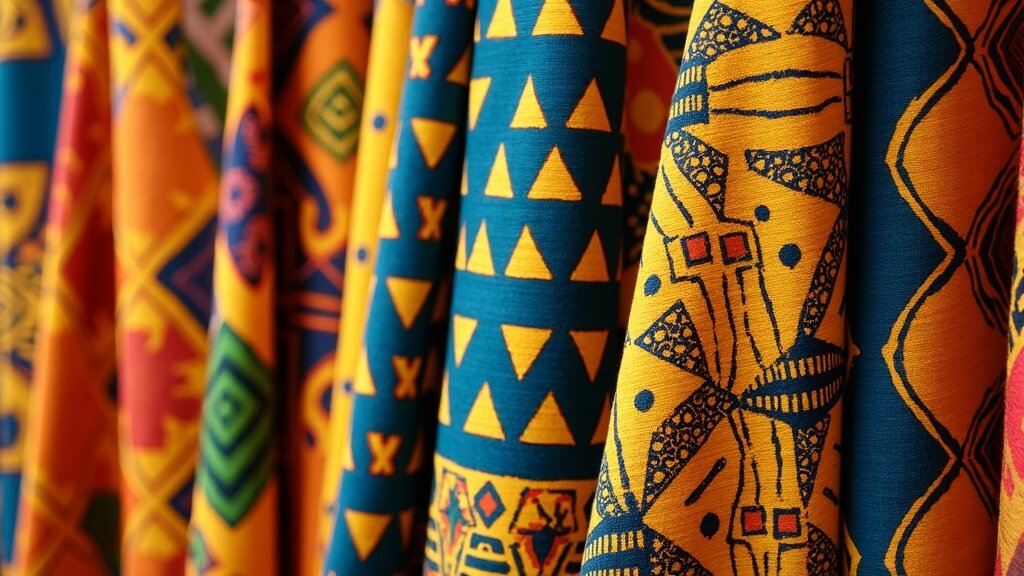
Wax prints, appliqué, carved objects, beadwork, metalwork and ritual craft all circulate through Benin’s markets. Some pieces are everyday fashion, others are religious objects, and the distinction matters.
Buy from known artisans when possible, avoid sacred objects whose provenance is unclear, and treat export rules seriously for antiques or ritual material.
Useful Phrases
French will solve most practical travel situations, but even a few local words change the tone of an encounter. In the south, Fon greetings and thanks are especially appreciated; Yoruba is important near the Nigerian border.
Practical starter set: Bonjour, Bonsoir, Merci, S’il vous plait, Combien ca coute, Ou est la gare, and in Fon, A fon ganji for good morning and Awanou for thank you.
Suggested Itineraries
A short first route can stay south: Cotonou, Ganvie, Porto-Novo, Ouidah, Grand-Popo and Abomey in seven to nine days. It gives the strongest cultural core without pushing into areas affected by northern security warnings.
With more time, add Dassa-Zoume, Parakou or Natitingou only after checking current advisories and transport conditions.
Responsible Travel
Benin’s strongest sites involve living communities, sacred traditions and painful history. Responsible travel means paying guides fairly, asking before photographing people or rituals, using official museums and local operators, and resisting the urge to turn Vodun into spectacle.
The same rule applies at Ouidah: the slave-route memorials deserve quiet, not performance.
Photography Notes
The page’s image rule is simple: every major chapter should help the reader see the place. In Benin, that means water settlements, earthen palaces, markets, ritual spaces, coastal landscapes, textiles and maps rather than generic tropical stock.
Where faces, ceremonies or sacred objects are involved, permission and captions matter more than visual drama.
Benin Travel Guide
Protected book workspace and future country guide card for the Benin edition.
Travel GuideKeep exploring
Read another country, send a correction or support the project.
