🇫🇷 Clipperton Island at a Glance
🌏 Overview
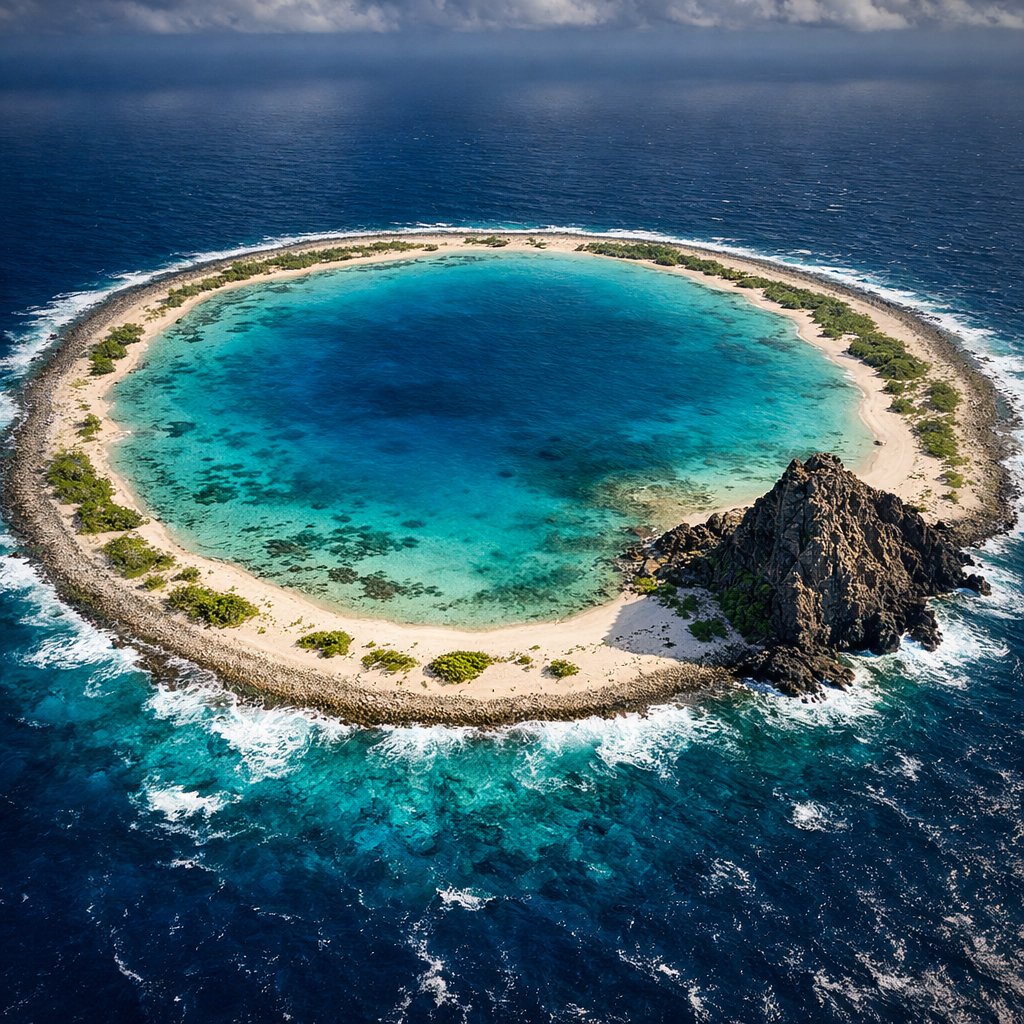
Clipperton Island is a place this guide can describe but not, in any real sense, recommend visiting — and that's precisely what makes it worth understanding. A ring of coral enclosing a sealed, stagnant lagoon — under two square kilometres of dry land in the middle of the Eastern Pacific, uninhabited, harbourless, France's only territory in the North Pacific, and state property that France itself visits only a few times a year. No one lives here. No one has lived here permanently since the last colonists were taken off in 1917. And yet it carries one of the most harrowing survival stories in Pacific history, hosts the world's largest masked booby colony, and anchors an exclusive economic zone of 431,273 km² — larger than Germany. Since 2022 its official French name has been La Passion-Clipperton.
This page exists for the same reason the rest of this factbook does — because Clipperton is real, fascinating, and almost nobody knows anything about it beyond, at most, a vague sense that "France has some islands out there." It just isn't a travel destination in any conventional sense: there's no tourism industry, no accommodation, no way to simply book a trip. What follows is the honest picture of a place defined by isolation, tragedy, and an ecosystem that's been left almost entirely to itself.
🚫 Access requires authorization
Clipperton is not an ordinary tourist destination. Under French Decree No. 2023-1182, anchoring, landing, aircraft landing and stays on La Passion–Clipperton are subject to prior authorization. Any expedition should verify current requirements with the French authorities before departure.
📜 Name & History
The island takes its name from John Clipperton, an English pirate and privateer who reportedly used the atoll as a hideout in the early 18th century. French captains Michel Dubocage and Martin de Chassiron charted it on Good Friday, 3 April 1711, and named it Île de la Passion. Napoleon III formally annexed it on 17 November 1858; Mexico, citing Spanish sightings from the 1520s, contested that claim, and even wrote "la isla de la Pasión" into its 1917 constitution. Both countries agreed in 1909 to binding arbitration by King Victor Emmanuel III of Italy, who ruled for France in 1931. Mexico accepted, amended its constitution on 18 January 1934, and France formally took possession on 26 January 1935. The Clipperton Island Case is still taught in international-law courses as the classic test of what "effective occupation" of an uninhabited island means. A 2007 France–Mexico treaty, renewed in 2017, lets Mexican vessels fish the zone under French authorisation.
The Guano Colony and Its Collapse
The guano came first, and it was not Mexican. The American Oceanic Phosphate Company began digging seabird droppings — a valuable fertiliser before synthetic nitrogen — in 1895; a French cruiser ordered the American flag hauled down in November 1897, and a few weeks later Mexican marines landed from the gunboat La Demócrata and raised their own. A British firm, the Pacific Islands Company, then worked the deposits under Mexican concession, and in 1906 President Porfirio Díaz posted a military garrison, built a lighthouse and appointed Captain Ramón Arnaud as governor. By 1914 about 100 men, women and children lived on the atoll, resupplied every two months from Acapulco. Then the Mexican Revolution swallowed the government's attention, the supply ship stopped coming, and the colony was cut off — Arnaud even turned down an evacuation offered by the visiting USS Cleveland in 1914, convinced relief was imminent.
Scurvy, Madness, and Murder
Without fresh supplies, colonists began dying of scurvy. The men died first — of scurvy, or, like Arnaud in 1915, in a doomed attempt to row after a passing ship — leaving fifteen women and children with the lighthouse keeper, Victoriano Álvarez, the last adult male. Álvarez declared himself "King of Clipperton" and began a reign of rape and murder that lasted almost two years, until Tirza Rendón, his most frequent victim, killed him with a hammer, with the governor's widow Alicia Rovira Arnaud at her side. Hours later, on 18 July 1917, the US Navy gunboat USS Yorktown arrived and took off the last eleven survivors — four women and seven children — after more than three years of isolation, starvation and horror. The Yorktown's officers kept the full story quiet for years.
Presidents, Weather Sailors and Rocket Radar
The atoll's afterlife is a string of odd cameos. Franklin D. Roosevelt fished for sharks off the reef from the cruiser USS Houston in July 1938; a Smithsonian party went ashore and later named an endemic sponge Callyspongia roosevelti after him. From December 1944 to October 1945 the US Navy ran a 24-man weather station here without asking Paris first, provoking a furious French protest. France floated Clipperton as a nuclear test site after losing the Sahara in 1962 (rejected as too remote even for that), ran the "Bougainville" military missions of 1966–69, installed an automatic weather station in 1980, and in 1994 hosted NASA radar that watched the first Ariane 5 disintegrate 37 seconds after launch. Plans for a fishing port, an airstrip and even Polynesian settlers were all drawn up in the 1980s and all abandoned.
The 2020s: Sentinel Island
Today the island remains uninhabited, with no infrastructure beyond a few sovereignty markers and a ruined lighthouse — but the visits are getting more frequent and more purposeful. The 3DS law of 21 February 2022 gave it the official name La Passion-Clipperton and tidied up its legal status; a ministerial advisory council was set up, and the French Navy now sails a "Passion" sovereignty mission most years — Passion 23 (April 2023, frigate Germinal) collected over 200 kg of beach plastic and a bale of cocaine, and Passion 25 sent an overseas patrol vessel across the Pacific to renew the markers, chart the reef and clear ordnance. In November 2025 a navy ship found 39 washed-up bales — nearly 50 kg of cocaine — on the shore, while explorer Jean-Louis Étienne returned twenty years after his 2005 inventory aboard the research schooner Persévérance (28 Oct–24 Nov 2025) to lobby for extending the marine protected area from the territorial sea to the full 200-nautical-mile EEZ, and the bird-protection league LPO tested the feasibility of eradicating the rats.
🗺️ Geography & Environment
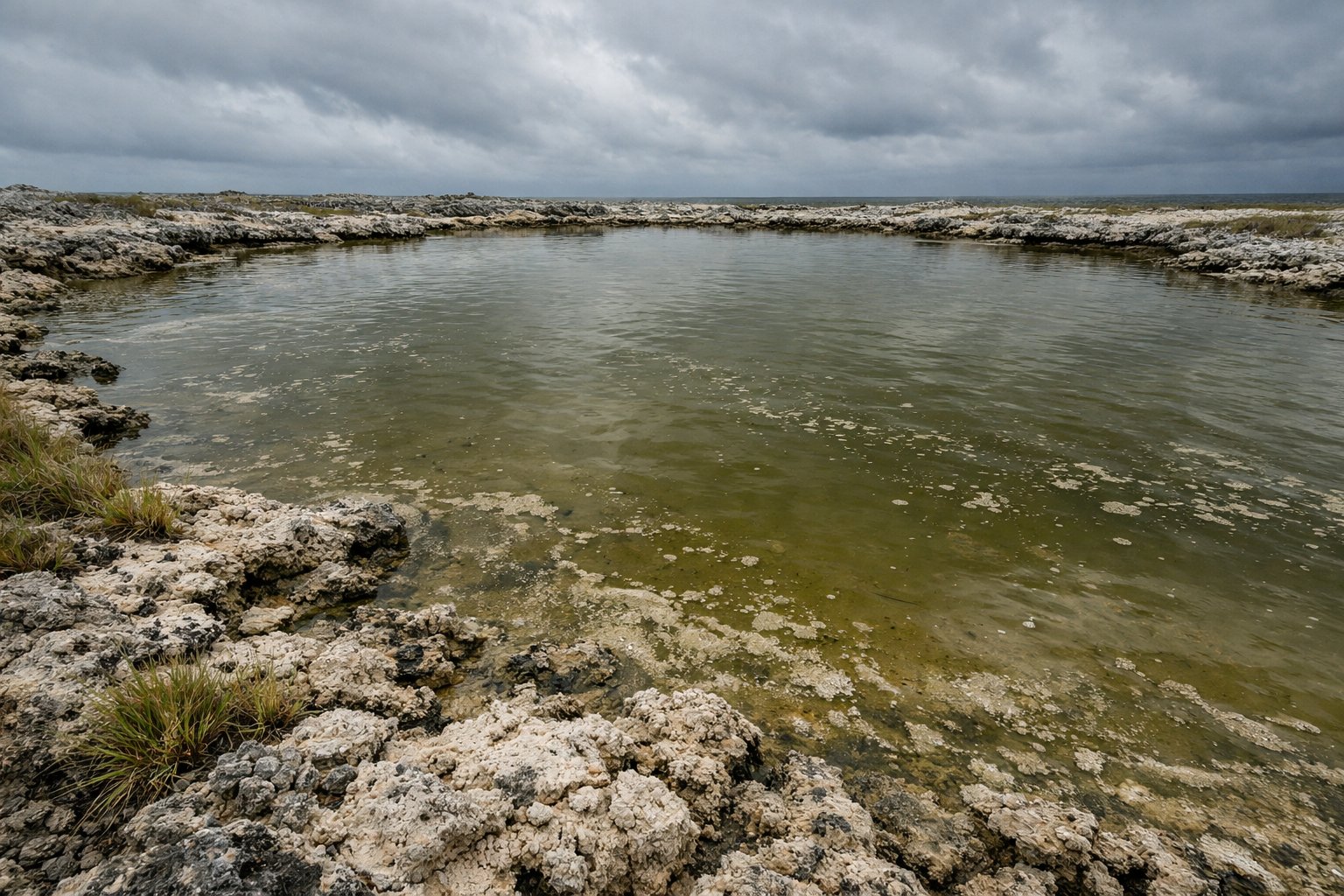
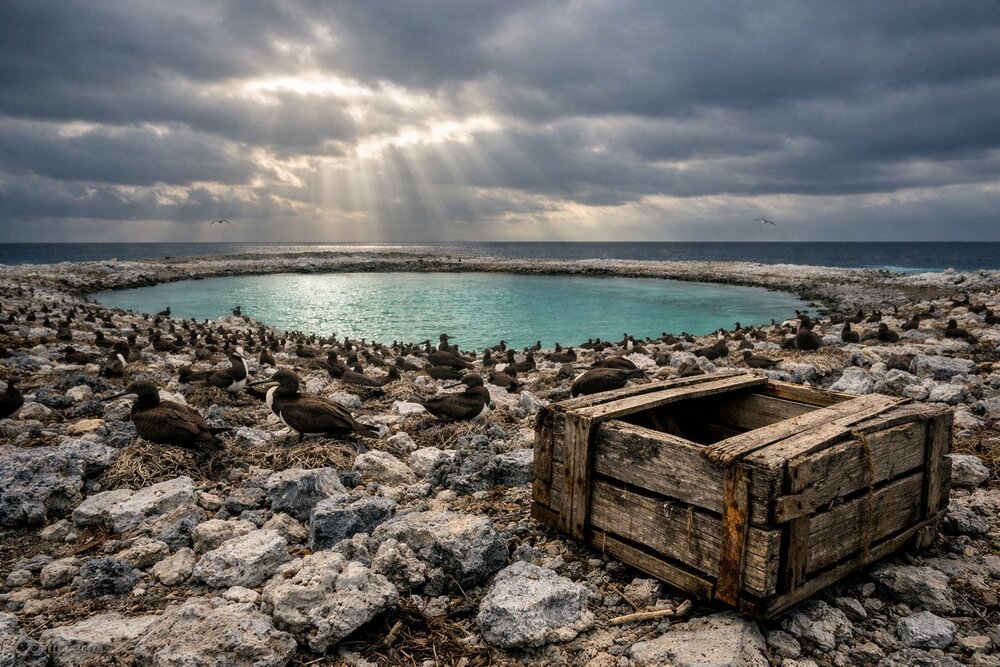
Clipperton is a closed ring about 12 km around and 8.9 km² in total area, of which the dry land — a coral rim averaging 150 m wide and 2 m high — is only about 1.7 km²; the enclosed lagoon covers 7.2 km² and the surrounding reef flat another 3.7 km² (older references that quote "6 km²" are counting the reef). It lies at 10°18′N 109°13′W, about 1,080 km southwest of the Mexican coast, 945 km from the nearest land (Socorro Island), 3,300 km from the nearest French land (Hiva Oa in the Marquesas) and 5,400 km from Papeete, whose High Commission handles it by delegation. It is the only coral island in the eastern Pacific and the only emerged point on the East Pacific Rise. The lagoon has been sealed from the sea since around the 1850s and has become a meromictic lake: an almost-fresh, oxygen-rich brackish layer floats on a saline, anoxic, hydrogen-sulphide-rich deep layer, with pits down to 72 m and acidic water at the very bottom of the "Trou Sans Fond". It holds no fish, but millions of biting isopods. Vegetation is sparse grass and low scrub, plus scattered coconut groves planted by the guano miners — 674 palms at the 2001 count, the largest stand being the Bois de Bougainville in the southwest. There is no fresh water except rain and the lagoon's surface layer, which stranded fishermen in 1962 found drinkable if foul.
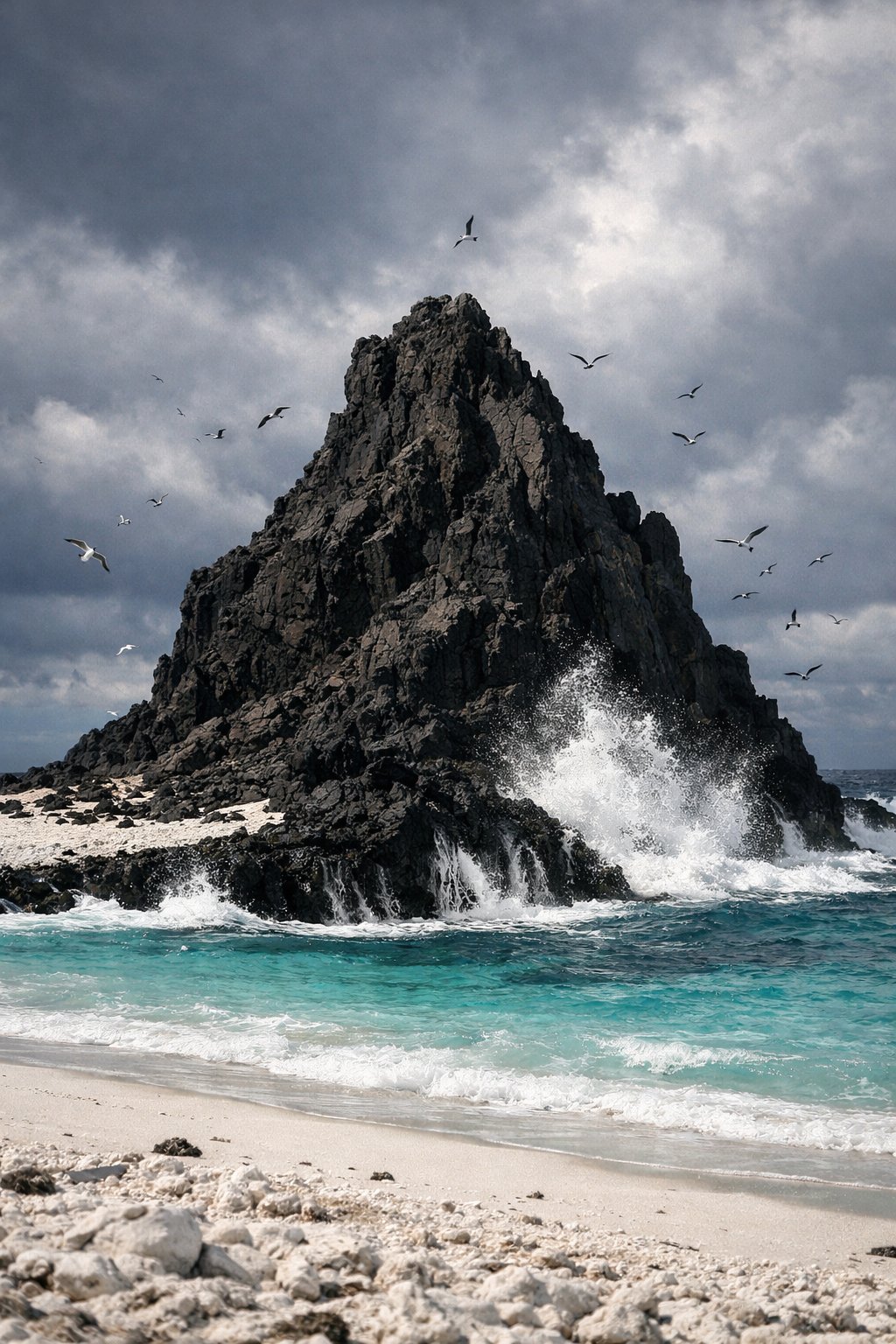
Clipperton Rock, a volcanic outcrop on the atoll's southeast corner, is the island's only real elevation at 29 meters — and the only spot offering a view across the entire atoll. Everywhere else, you're standing at or barely above sea level, with the full exposure to Pacific swell that implies.
🗺️ Map
The atoll itself is a 12 km ring; zoom out to see how alone it is — Socorro Island 945 km to the northwest is the nearest land, Acapulco is roughly 1,280 km away. Markers show Clipperton Rock, the lighthouse ruin, the Bois de Bougainville coconut grove and the northeast beach where flotsam (and cocaine bales) pile up.
🐦 Wildlife
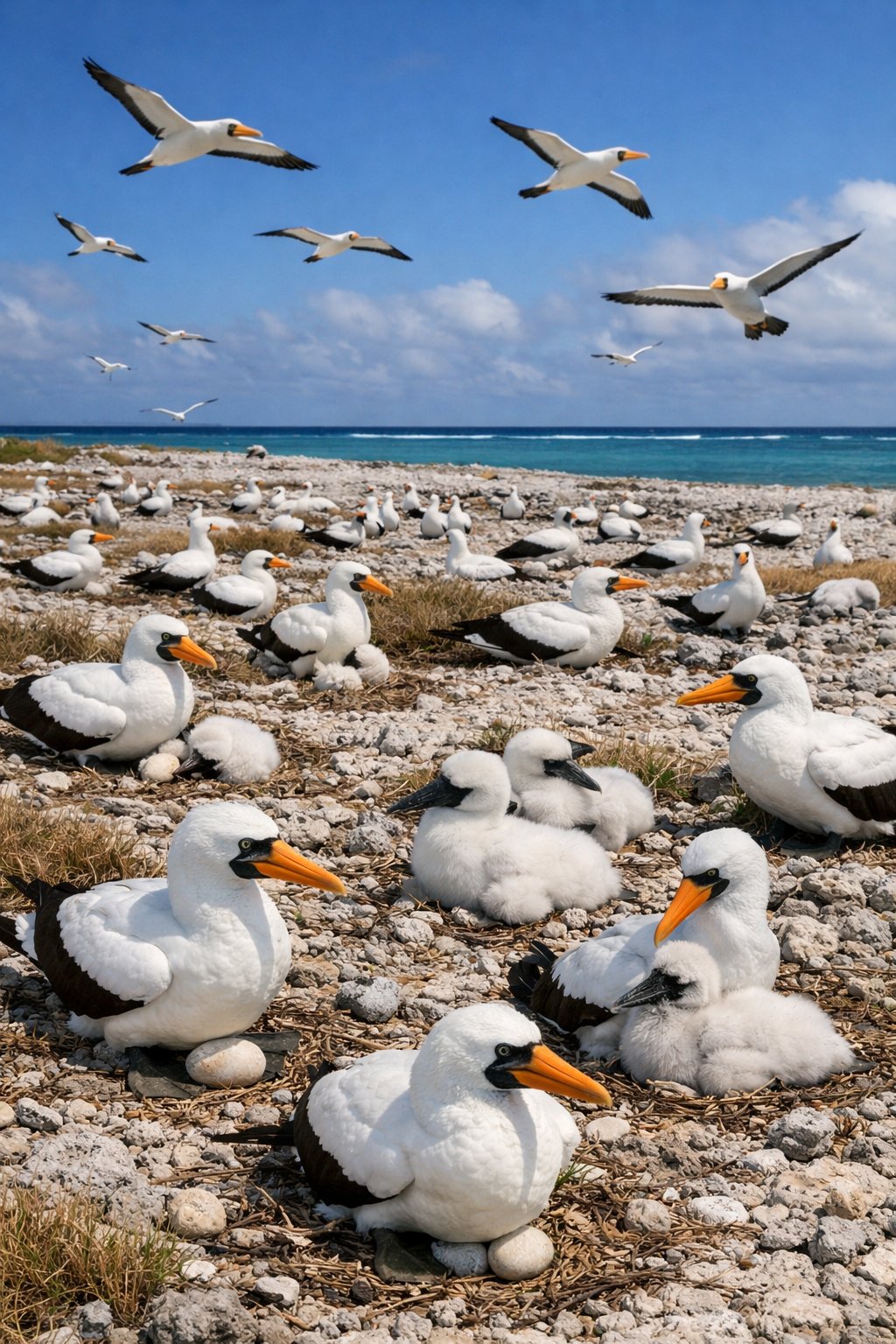
This is where Clipperton actually earns its scientific significance. The island hosts the world's largest masked booby colony — some 112,000 birds at the 2003 aerial count, which the LPO puts at roughly 70% of the global population — plus about 25,000 brown boobies, the second-largest colony of that species on record, red-footed boobies, frigatebirds, noddies and sooty and white terns; thirteen species breed here and BirdLife lists the atoll as an Important Bird Area. The reef, not the fishless lagoon, holds the endemics: the Clipperton angelfish (Holacanthus limbaughi), Clipperton grouper, Clipperton damselfish and Robertson's wrasse, all found nowhere else, among the highest concentrations of endemic reef species anywhere, together with a nursery for oceanic whitetip sharks and visiting Galápagos and hammerhead sharks, whale sharks and mantas. In 2009 a Californian dealer smuggled 52 angelfish out, mislabelled as king angelfish for a planned $10,000 sale, and drew a 45-day sentence. The only land vertebrates besides birds are two lizards, a gecko and a skink — and the rats.
On land, enormous numbers of bright-orange Clipperton crabs (Johngarthia oceanica, split from J. planata in 2019) cover the ground densely enough to make walking difficult — a smaller-scale echo of the red crab migration on Christmas Island, though without the seasonal spectacle. The crabs are the atoll's gardeners: they graze the vegetation down to bare coral sand. The guano miners' pigs ate the crabs, grass spread over 80% of the island, and the booby colonies collapsed to 150 masked and 500 brown birds — until 1958, when Los Angeles ornithologist Ken Stager, appalled at what he found, borrowed a shotgun and killed all 58 pigs himself. The crabs and the boobies came back; his one-man eradication later inspired the founding of the NGO Island Conservation. The current villain is the black rat, which arrived with two fishing-boat wrecks in 1999–2000 and preys on eggs, chicks and crabs; a 2005 NOAA report urged eradication, and in November 2025 the LPO finally ran the feasibility study on site, so a rat-free Clipperton is now a live plan rather than a wish. Green turtles, fur seals and elephant seals reported in 1825 have never been seen again.
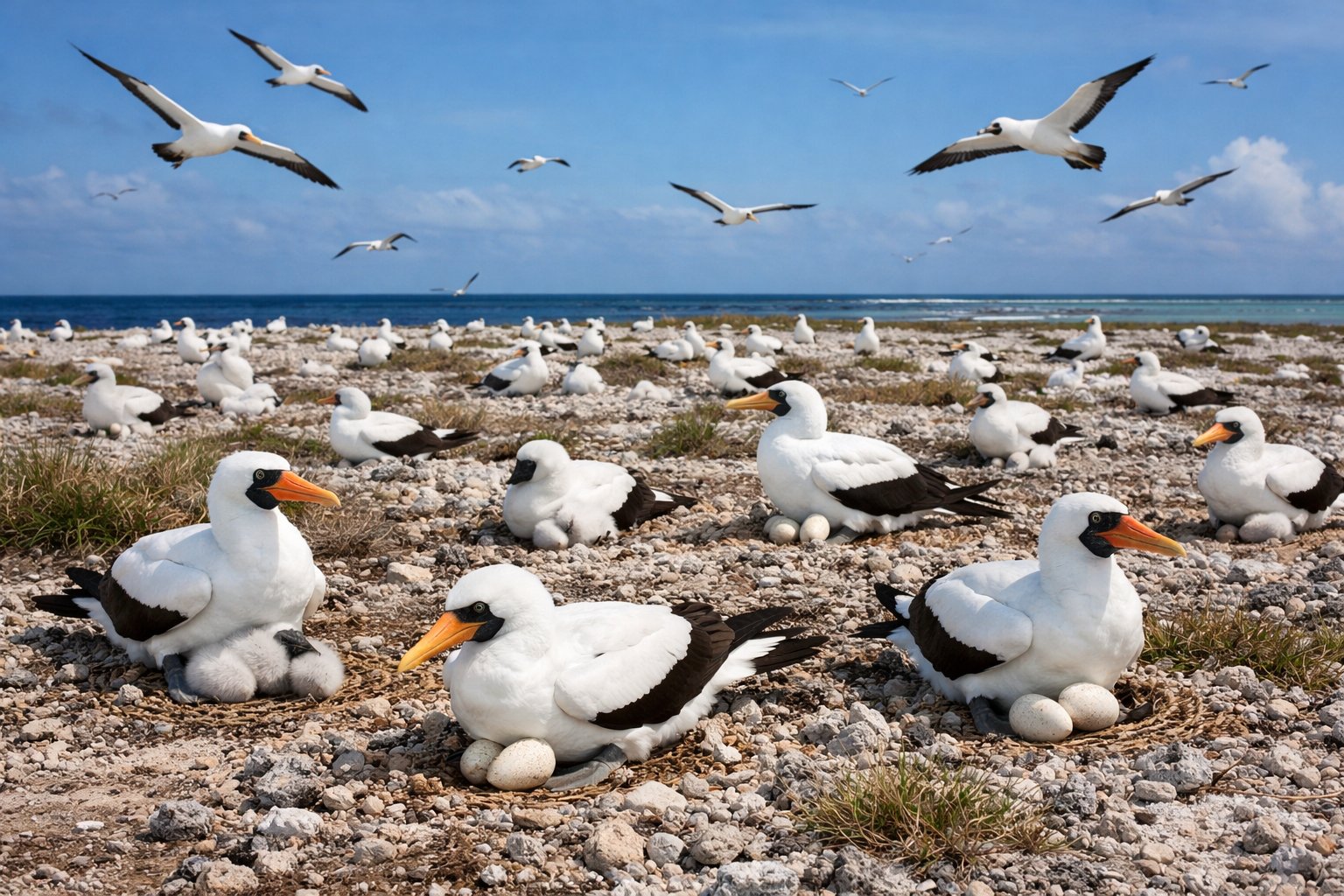
The World's Largest Masked Booby Colony
Tens of thousands of breeding pairs make Clipperton one of the Pacific's most significant seabird sites.
⛔ Access & Restrictions
Access to Clipperton Island is strictly restricted — this isn't a place you can plan a trip to. The island is French state property, unauthorized landing is prohibited, there's no harbor, and the surrounding reef makes any landing genuinely dangerous even for authorized visitors, who typically arrive by rubber dinghy from an anchored research vessel and time it around favorable swell. There are no tourist facilities, no regular transportation, and no accommodation of any kind.
Administratively the atoll answers to nobody local, because there is nobody local: since 21 February 2007 it has been under the direct authority of the Minister for Overseas France — currently Naïma Moutchou, in office since 12 October 2025 — with day-to-day matters and landing permits handled by delegation from Papeete by the High Commissioner of the Republic in French Polynesia, Alexandre Rochatte (since 1 September 2025). Permits go to scientific missions, the navy's annual "Passion" sovereignty patrols, and one very specific hobby: Clipperton is a separate "entity" for amateur radio's DXCC award, and licensed DXpeditions land every few years — FO0XB in 1978, TX5K in March 2014 (114,000 contacts, a record at the time) and most recently TX5S, sixteen operators who camped on the atoll from 17 to 27 January 2024 and logged 113,738 contacts before the swell forced them off. Before TX5S it ranked 38th on the "most wanted" list; by February 2024 it had dropped out of the top 50. That, and the odd tuna boat sheltering in its lee, is the entire human traffic the island sees.
🌊 The Real Reason France Keeps It
Clipperton has no economy in any conventional sense — no residents, no companies, no industry, no reason to build a Business page the way this factbook does for inhabited countries. What it has instead is genuinely significant: an Exclusive Economic Zone of 431,273 km² (fixed by a 2018 decree; declared in 1976), larger than Germany, granting France fishing and potential seabed mineral rights across a vast stretch of the eastern Pacific that would otherwise be international waters. The Sea Around Us project estimates some 50,000 tonnes of fish a year are taken from it — much of it illegally, because a French warship passes perhaps once a year — and the Passion 2015 expedition confirmed polymetallic nodules inside the zone, on the edge of the Clarion–Clipperton belt where deep-sea mining contracts are already being issued. That EEZ — not the couple of square kilometres of coral and crabs — is the entire strategic reason Clipperton remains worth a French claim at all, which is why the 2025 push to turn the whole zone into a marine protected area matters: it would make the island France's largest sanctuary as well as its loneliest possession.
🐟 What the Sea Provided
There's no cuisine here in any living sense — no restaurants, no residents, no ongoing food culture. But the waters around Clipperton fed the people who did briefly live and work here, and the handful of scientific and ham-radio expeditions that visit today still rely on tuna, fresh fish, and whatever they bring by boat. The dishes below aren't a claim that Clipperton has a food scene — it's a nod to the kind of resourceful, Pacific-French cooking that sustained the guano-era colonists and still applies to anyone who ends up on that reef today.
Poisson Cru Pacifique
Pacific Raw Fish Salad
Fresh tuna cubed and marinated in lime until opaque, tossed with diced cucumber, tomato, and onion, then finished with coconut milk and fresh coconut shavings — the classic preparation of Pacific island fishermen, requiring nothing but a fresh catch and a few limes.
Grilled Reef Crab
Simple Garlic-Butter Preparation
Any large crab, split and grilled shell-side down over coals, basted with melted butter, garlic, parsley, and lime — the kind of simple preparation that needs nothing more than what a remote atoll and a passing supply boat can provide.
📋 Key Information
💡 Fascinating Facts
🌊 Larger Than Germany
Clipperton's 431,273 km² exclusive economic zone is larger than the land area of Germany — generated by 1.7 km² of dry coral.
📻 A Radio "Entity" in Its Own Right
The TX5S DXpedition of January 2024 logged 113,738 radio contacts in ten days from a tent camp on the reef — and knocked Clipperton out of the top 50 "most wanted" list for the first time.
🧪 A Lake Sealed Inside a Reef
Closed off from the sea since the 1850s, the lagoon is a meromictic lake: nearly fresh on top, sulphurous and oxygen-free below 15 m, with a 72 m pit called the Trou Sans Fond. No fish live in it — only millions of isopods that bite.
🏴☠️ Named for a Pirate
John Clipperton, the island's namesake, reportedly used the atoll as a hideout in the early 1700s.
🔫 One Man, 58 Pigs
In 1958 ornithologist Ken Stager shot every feral pig on the atoll himself. The masked booby colony went from 150 birds to 112,000 — the story that inspired the NGO Island Conservation.
📦 What Washes Up
The northeast beach is a trap for Pacific flotsam: navy crews hauled off 200 kg of plastic in 2023, and in November 2025 found 39 bales of cocaine — nearly 50 kg — dumped at sea and delivered by the current.
👤 Notable People
John Clipperton — the English pirate and privateer whose name the island carries, said to have used it as a hideout in the early 18th century. Victoriano Álvarez — the lighthouse keeper who declared himself "King of Clipperton" during the 1914–1917 tragedy and terrorized the stranded colonists until his death. Tirza Rendón — the survivor who killed Álvarez in 1917, ending his reign and helping the last colonists survive to rescue. Ramón Arnaud — the colony's governor, who died in 1915 attempting to row after a passing ship. Alicia Rovira Arnaud — his widow, who led the survivors and later dictated the story that became Laura Restrepo's novel. Ken Stager (1915–2009) — the Los Angeles County Museum ornithologist whose 1958 pig cull saved the booby colonies. Jean-Louis Étienne (b. 1946) — polar explorer who led the four-month 2005 scientific inventory and returned in late 2025 to campaign for a full-EEZ marine reserve. Philippe Folliot — the Tarn senator who in 2015 became the first French elected official ever to set foot on the atoll and has championed its status in Parliament since.
📚 Resources & Further Reading
Jimmy M. Skaggs, Clipperton: A History of the Island the World Forgot (1989) is the standard English account of the whole saga; Laura Restrepo's novel La Isla de la Pasión (1989, English: Isle of Passion) retells the 1914–1917 colony through Alicia Arnaud's eyes; Jacques-Yves Cousteau's 1978 film Clipperton: The Island that Time Forgot brought a 1917 survivor back to the atoll. For the ecology, Christian Jost's Passion 2001 papers, the 2005 Étienne mission inventory and the 2005 NOAA Southwest Fisheries report on the rats remain the core references; the LPO's "mission Clipperton" pages and the French Navy's "Passion" mission releases (defense.gouv.fr) cover 2023–2025. Amateur-radio history is best followed on the TX5S team site (clip.pdxg.net).
📸 Photo Gallery
✍️ Author's Note
I have never set foot on Clipperton, and almost certainly never will. France does not issue tourist permits to its lone North Pacific possession, and the surrounding reef has no harbour — even the scientific expeditions that occasionally go there arrive by rubber dinghy from anchored research vessels, praying the swell stays kind. But I have studied this atoll for years, pulled toward its grim gravity the way one is pulled toward a campfire story told too well.
What stays with me is not the numbers — the 1.7 km² of coral, the 431,273 km² of exclusive economic zone, the world's largest masked booby colony — but the quiet. I imagine standing on the 29-metre bump of Clipperton Rock at dawn, hundreds of thousands of seabirds wheeling overhead, orange land crabs moving through the scrub like a slow tide, and the acidic lagoon glinting behind me. And underneath all of that, the ghosts of 1914–1917: the Mexican families left behind by a revolution, the lighthouse keeper who crowned himself king, the women who survived him. Few places on Earth carry their history so lightly and so heavily at once.
Clipperton is a reminder that the planet still holds places humans cannot comfortably inhabit, and probably should not. It belongs to the birds, the crabs, and the endemic angelfish in its lagoon. The best I can do is write it down honestly — and leave it alone.
—Radim Kaufmann, 2026
Support This Project 🌍
This World Travel Factbook is a labor of love – free to use for all travelers. If you find it helpful, consider supporting its continued development.
