

🇫🇴 Faroe Islands at a Glance
🌏 Overview — Why Visit the Faroe Islands
Eighteen basalt islands in the middle of the North Atlantic, halfway between Norway, Scotland and Iceland: 1,399 km², 54,000 people, around 80,000 sheep and not a single native tree. The Faroes are one of the most dramatic landscapes in Europe and, for now, one of the least crowded.
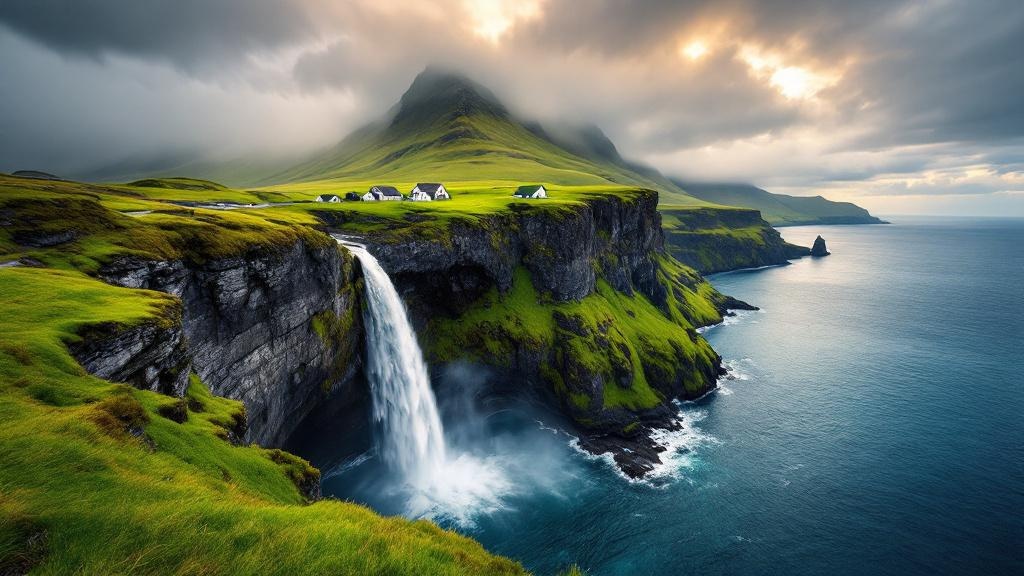
What makes it extraordinary is the geometry. Every island is a stack of lava layers tilted and cut by ice into sheer cliffs, hanging valleys and knife-edge ridges, with grass growing right up to a 700 m drop and the sea in every direction. Villages of black tarred timber with turf roofs sit in the few places flat enough to build. The weather changes every twenty minutes, which is either the problem or the point depending on your temperament.
It is also remarkably easy. Flights from Copenhagen take two hours, the roads are excellent, a network of sub-sea tunnels connects the main islands — including the world's only undersea roundabout — and you can drive from the airport to almost anywhere in ninety minutes. English is universal. You need a hire car and a waterproof, and that is essentially the whole logistical problem.
The honest complications are two. It is expensive — Scandinavian prices with island freight on top. And there is the grindadráp, the pilot whale hunt, which is legal, traditional, and the single most controversial thing about the Faroes. This page addresses it directly rather than leaving you to be ambushed by it in a pub conversation.
🏷️ Name & Status
Føroyar means "sheep islands" — from the Old Norse fær, sheep — and the sheep came first. Anglicised as "Faroe Islands", which is technically a tautology since oy already means island, but the usage is settled.
Constitutional status
A self-governing nation within the Kingdom of Denmark, with home rule since 1948 and a wide devolution of powers since 2005. The Faroes run their own economy, fisheries, education, culture and even some foreign relations; Denmark retains defence, the currency, the courts and citizenship.
Not in the EU
Crucially, the Faroes are outside the European Union even though Denmark is in it, because the islands opted out over fisheries. They are also outside Schengen. This has practical consequences for customs and, in some cases, for phone roaming.
The Løgting
The Faroese parliament traces itself to a Viking-age assembly at Tinganes in Tórshavn and claims to be among the oldest parliaments in the world. It has 33 members and full legislative competence in devolved areas.
Independence
A live and normal political question rather than a crisis. Roughly half the electorate favours eventual independence, the parties split on it, and a 1946 referendum narrowly voted for it before being annulled by Denmark. It is discussed calmly and often.
The flag
Merkið — a red Nordic cross with a blue border on white — was designed by Faroese students in 1919 and recognised by Britain in 1940 during the wartime occupation, which is why 25 April is Flag Day.
Currency
The Danish krone, issued locally as the Faroese króna with its own beautiful banknotes. Same value, same code (DKK), and Danish notes circulate freely — but Faroese notes are not accepted in Denmark.
🗺️ Geography
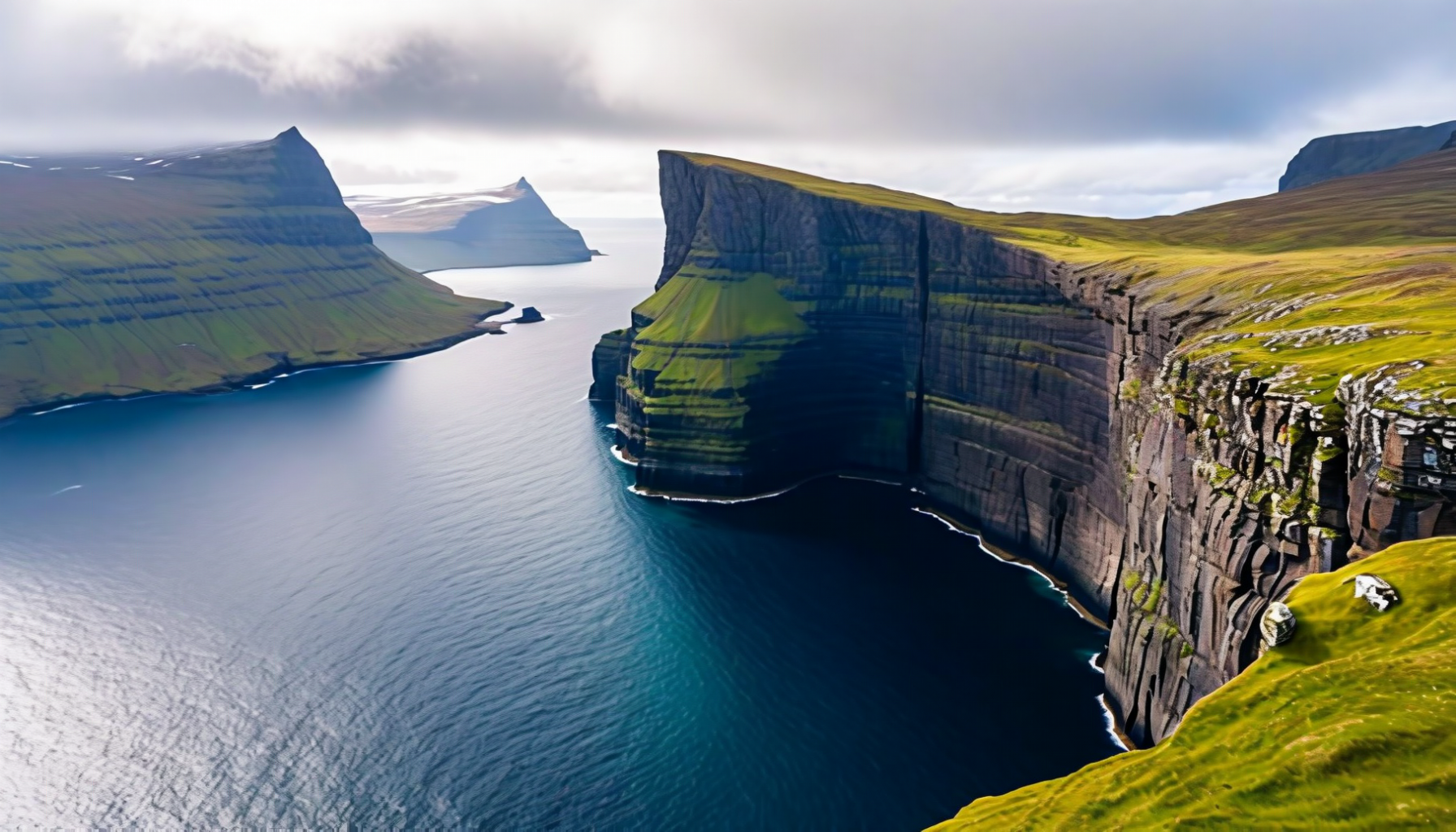
A stack of basalt lava flows from the opening of the North Atlantic around 55 million years ago, tilted, then carved by ice. The result is 18 islands, of which 17 are inhabited, none more than 5 km from the sea, with a coastline of 1,100 km for a land area smaller than Prague and its surroundings.
The islands
Streymoy (the largest, with Tórshavn), Eysturoy, Vágar (the airport), Suðuroy in the south, Sandoy, Borðoy and the northern isles, Kalsoy, Mykines in the west and several smaller ones. Only Lítla Dímun is uninhabited.
Slættaratindur · 882 m
The highest point, on Eysturoy — a broad flat-topped summit that on a clear day gives you a view of every island in the archipelago. The name means "flat peak".
Sørvágsvatn
The largest lake, on Vágar, famous for an optical illusion: seen from the Trælanípa cliff it appears to hover hundreds of metres above the ocean. It is one of the most photographed viewpoints in the North Atlantic.
No trees
There are no native trees. Wind, salt and sheep between them prevent it. The few plantations in Tórshavn and Kunoy were planted deliberately and are treated as minor attractions.
The Gulf Stream
The reason a place at 62° North — the latitude of Anchorage — has a mean January temperature above freezing. Sea temperature barely varies through the year and snow rarely lies long at sea level.
Bird cliffs
Vestmanna, Mykines and the western cliffs of Suðuroy hold enormous seabird colonies. The Faroes are one of the most important seabird sites in the North Atlantic.
📍 Map of the Faroe Islands
Everything is close, and the tunnels make it closer. The airport is on Vágar in the west; Tórshavn is on Streymoy, 45 minutes away through a sub-sea tunnel. From Tórshavn almost every road destination is under two hours.
Airport (Vágar) → Tórshavn
About 50 km and 45 minutes, through the Vágatunnilin sub-sea tunnel. A bus also runs and meets most flights.
Tórshavn → Gásadalur
About 65 km, an hour and a quarter, via the airport and the Gásadalstunnilin. The Múlafossur viewpoint is minutes from the car park.
Tórshavn → Saksun and Tjørnuvík
Both on northern Streymoy, roughly an hour each on a single spectacular road. Easily combined in one day.
Tórshavn → Gjógv
About 65 km, an hour and a quarter across Eysturoy, past Slættaratindur.
Tórshavn → Klaksvík
About 70 km through the Eysturoyartunnilin, which contains the world's only undersea roundabout, lit as a jellyfish sculpture. Worth the drive for that alone.
Ferries
To Mykines from Sørvágur (seasonal), to Suðuroy from Tórshavn (two hours), to Sandoy, Kalsoy and Nólsoy. Ferries are cheap, run on time and are cancelled by weather without much notice.
📜 History
Irish monks may have reached the islands first — the Navigatio Sancti Brendani describes an "island of sheep" and an "island of birds", and pollen evidence suggests grain growing before the Norse arrival. Then, around 825, came the Vikings, and the Faroese have been a Norse-speaking people ever since.
The Løgting assembly at Tinganes dates from that period, making it one of the oldest parliamentary sites in the world. The Færeyinga saga tells the story of the conversion and of Sigmundur Brestisson and Tróndur í Gøtu, and it remains the founding national text. The islands came under Norway around 1035 and passed with Norway to Denmark in 1380.
For centuries the Faroes were a poor dependency under a Danish trade monopoly that lasted until 1856. Its abolition let Faroese merchants buy their own boats, and the islands went from subsistence farming to a deep-sea fishing economy within a generation. That is the origin of everything modern about the country.
In 1940 Britain occupied the islands to keep them out of German hands after Denmark fell — a peaceable occupation that Faroese remember warmly, that made them fly their own flag, and that left behind fish exports to Britain, a taste for tea, and a strong sense of separateness. A 1946 independence referendum passed narrowly and was annulled; home rule followed in 1948.
🏛️ The Modern Faroes
A very small, very rich, very connected country. GDP per head is comparable with Denmark's, unemployment is close to zero, and the population is growing — unusual for a North Atlantic island community and a reversal of a long history of emigration.
Fish
Around 90% of exports. Wild-caught cod, haddock, saithe and mackerel plus a large farmed salmon industry that has become the single biggest earner. When the fish price moves, the country moves with it.
The 1990s crash
In 1992 the fisheries and the banks collapsed together, GDP fell by around a third and roughly 10% of the population emigrated. Denmark bailed the islands out. The recovery since is the reason for the current confidence — and for a certain caution.
The tunnels
Sub-sea tunnels to Vágar (2002), Klaksvík (2006), Eysturoy (2020) and Sandoy (2023) have transformed the country from an archipelago of ferry timetables into something you can drive across. Sub-sea tunnels are tolled; land tunnels are free.
Population growth
From about 43,000 in the mid-1990s to over 54,000 now, with immigration from Denmark, Eastern Europe, Thailand and the Philippines. Roughly one Faroese in twenty was born abroad.
Tourism
Growing fast from a small base, and managed deliberately — the "Closed for Maintenance, Open for Voluntourism" scheme has volunteers repair paths, and many hiking routes now cross private land and charge a fee.
Green power
Wind and hydro already supply a large share of electricity, with a target of 100% renewable by 2030, including tidal turbines in the sounds where the currents are ferocious.
🏘️ Tórshavn
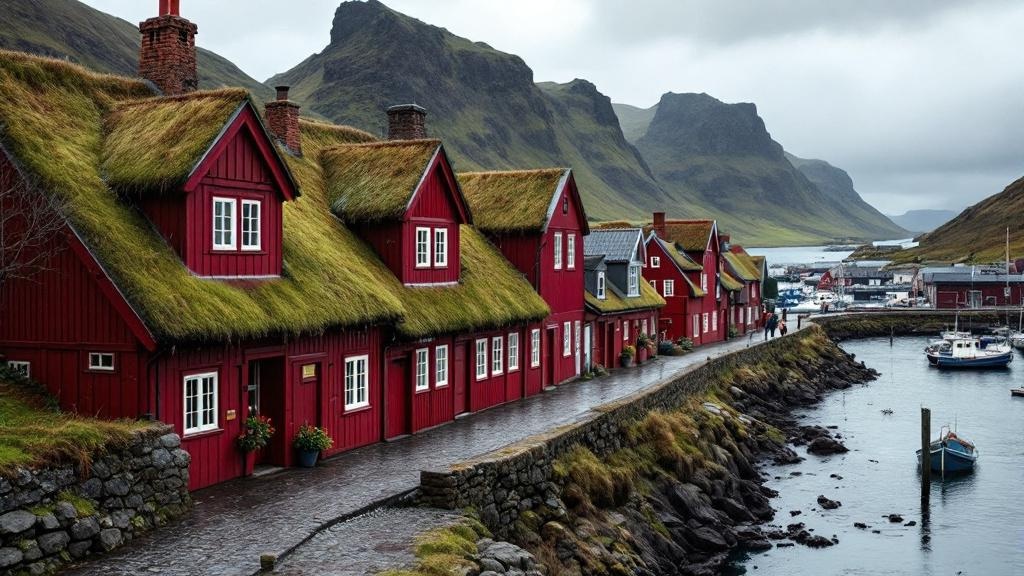
"Thor's harbour", a capital of about 23,000 people — a third of the country — and one of the smallest and most likeable capitals in Europe. It has a Michelin-starred restaurant, a proper music scene, container cranes, and a government quarter of red turf-roofed houses on a rock in the middle of the harbour.
Tinganes
The old town on the promontory between the two harbours: narrow lanes, black and red tarred timber, turf roofs, and the prime minister's office among them. Entirely open to walk through, and best in rain.
Reyn and Undir Ryggi
The oldest lanes above Tinganes, with houses from the seventeenth and eighteenth centuries. Ten minutes and worth them.
The National Museum and Listasavn
Føroya Fornminnissavn for the Viking material and the Kirkjubøur church pews; the national art gallery for the extraordinary Faroese landscape painting tradition — Mykines, Ingálvur av Reyni, Ruth Smith.
Nordic House
A turf-roofed cultural centre by Norwegian architects, host to concerts and the G! and Summartónar festivals. Good café.
Eating
KOKS put Faroese cooking on the world map with two Michelin stars; ROKS, Barbara Fish House, Ræst and Katrina Christiansen cover the rest of the range. Book weeks ahead for anything at the top.
Getting around
City buses are free. The centre is small enough to walk end to end in twenty minutes. Parking in town uses a cardboard clock disc you set on the dashboard — hire cars have one.
💧 Vágar, Gásadalur & Sørvágsvatn
The western island, where you land, and where two of the country's three most photographed places are. It is small enough to do in a day and most people do it on the first or last one.
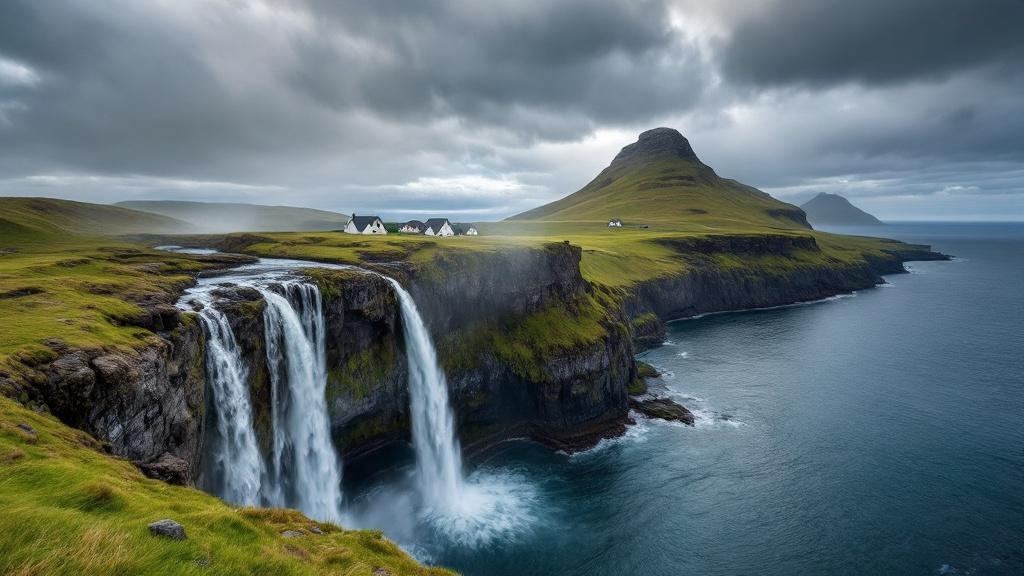
Múlafossur
The waterfall at Gásadalur, falling roughly 30 m off the cliff into the sea with the village and Mykines behind it. There is a car park, a short path and a small fee. It takes fifteen minutes and it is worth flying here for.
Gásadalur
Cut off by mountains until the tunnel was bored in 2004. The old postal path over the ridge is still walkable and is a good two-hour route with the whole village view.
Sørvágsvatn / Leitisvatn
The lake that appears to float above the ocean. The illusion is seen from Trælanípa, a 142 m cliff about 45 minutes' walk from the trailhead at Miðvágur. There is a landowner fee and the path is exposed — stay well back from the edge.
Bøsdalafossur
At the end of the same walk, where the lake spills over the cliff into the Atlantic. Combine it with Trælanípa in one two-and-a-half-hour loop.
Sandavágur and Miðvágur
Two pleasant villages; Sandavágur's church holds a runestone from around 1200 and won a national prize for being the tidiest village in the country, which tells you something about the Faroes.
The airport
Vágar (FAE), built by the British in 1942–43, and the country's only one. The runway was extended in 2011 and the terminal is small, calm and has good wool for sale.
🐦 Mykines & the Birds
The westernmost island, with a population in single figures in winter and one of the most accessible large puffin colonies in the North Atlantic. Getting there is the whole adventure: a ferry that is cancelled whenever the swell says so, or a helicopter on the state subsidised service.
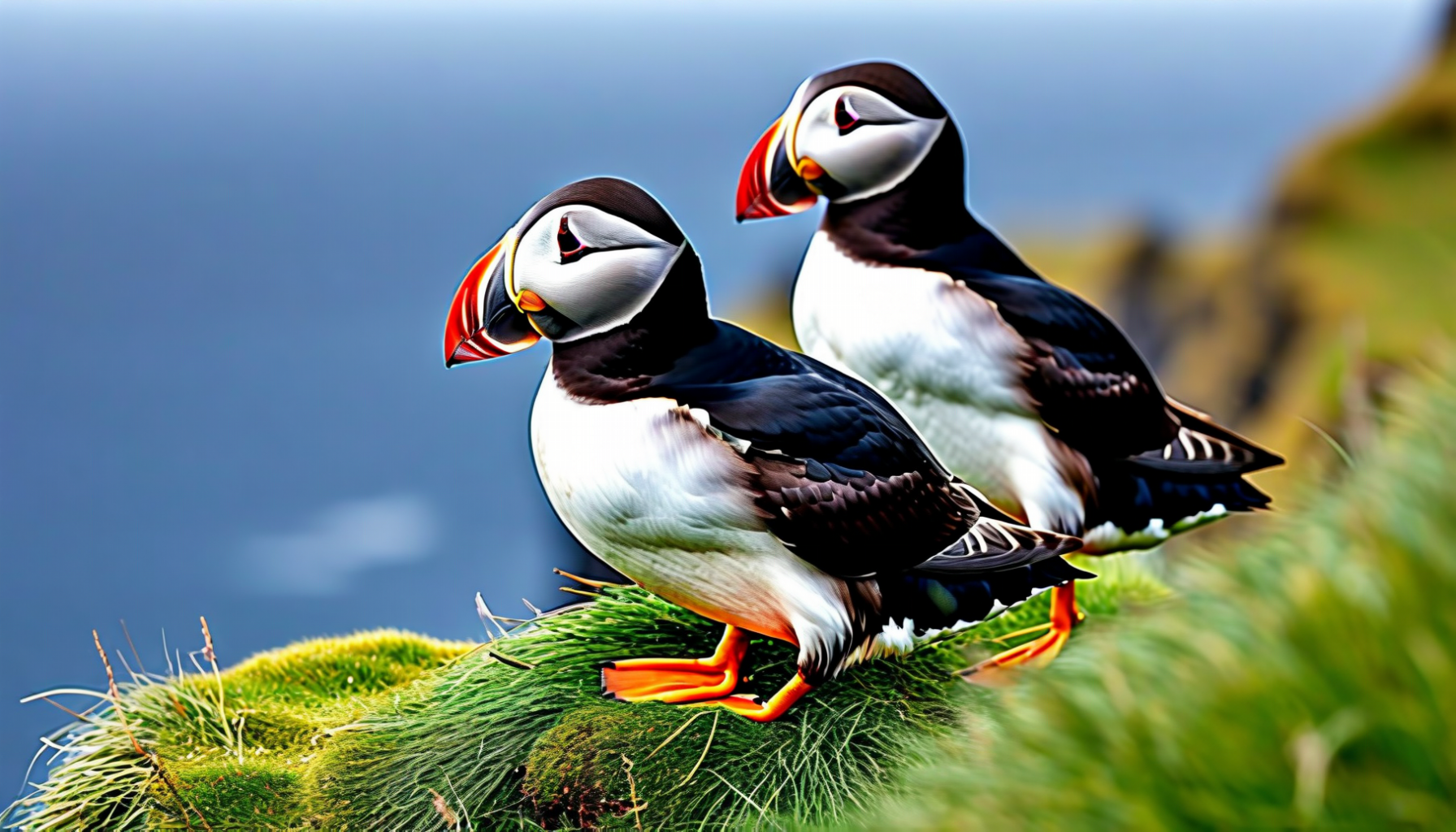
The season
The island is open to visitors roughly 1 May to 31 August, with the puffins ashore for most of it. Outside that window there is no ferry and no reason to go.
The walk
From the village across a footbridge to the islet of Mykineshólmur and its lighthouse — about 3 km each way, through the puffin colony, along cliffs with gannets below. A hiking fee and a guide requirement apply in season; check the current rules before you go.
Getting there
Ferry from Sørvágur (45 minutes, twice daily in season, and frequently cancelled) or the Atlantic Airways helicopter, which is heavily subsidised, absurdly cheap and almost impossible to book. Never plan a same-day onward flight.
Gannets
Mykineshólmur holds the only northern gannet colony in the Faroes — around 2,000 pairs on the stacks below the lighthouse.
Vestmanna bird cliffs
The alternative if Mykines is closed or cancelled: boat trips from Vestmanna on Streymoy into sea caves and under 700 m cliffs full of guillemots, razorbills and kittiwakes.
Bird decline
Faroese seabird numbers have fallen sharply, with puffin breeding failures over many recent years attributed to sand eel collapse and warming seas. Traditional fowling has been restricted in response. Treat the colonies gently.
⛰️ Saksun, Tjørnuvík & Northern Streymoy
The northern end of the main island holds two of the most photographed villages in the country, at the ends of two dead-end roads about an hour from Tórshavn. Do both in a day.
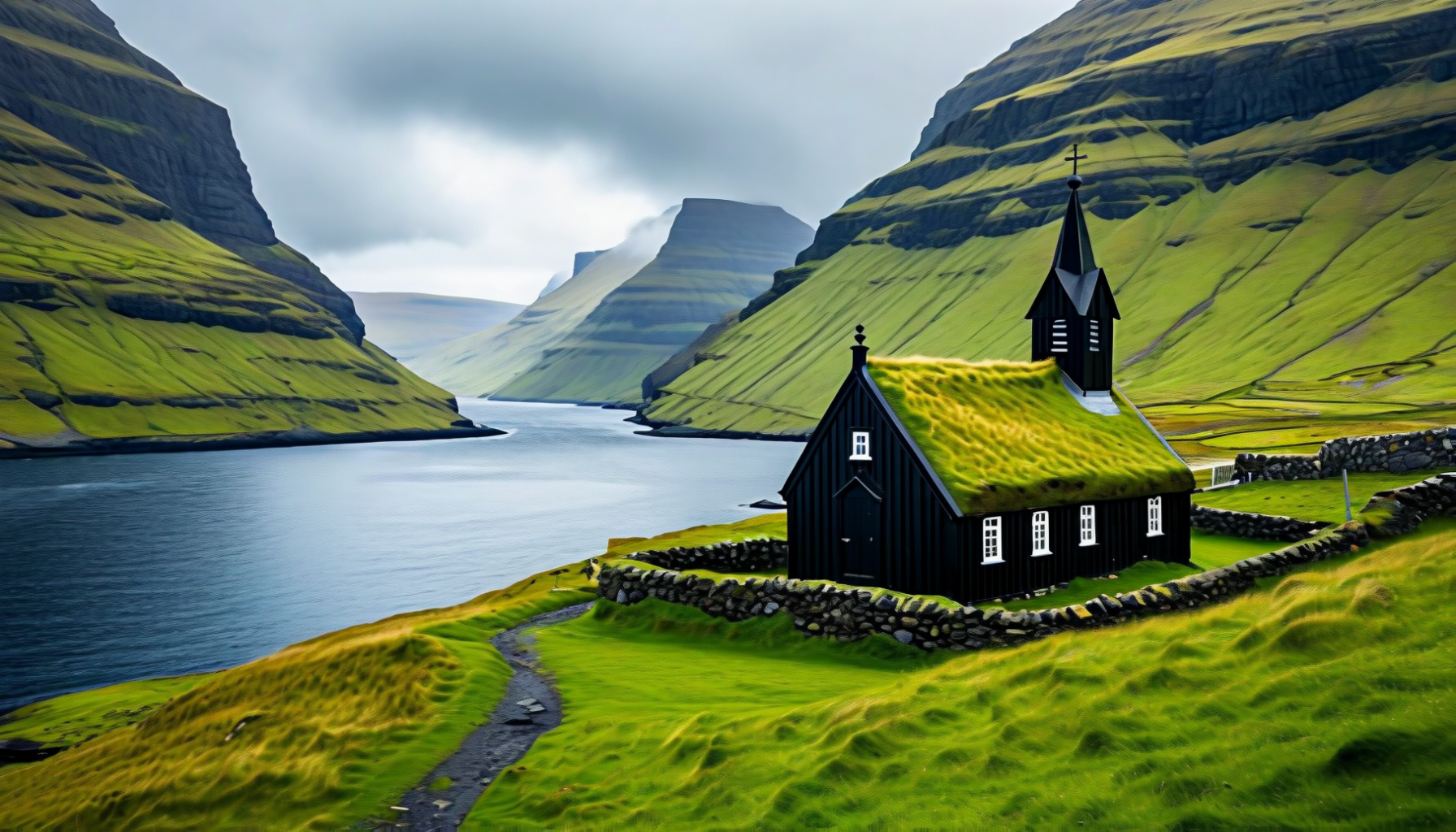
Saksun
A handful of turf-roofed farms and a church in an amphitheatre of hills above a tidal lagoon. At low tide you can walk out across the sand to the sea. The land is private, access is regulated and there have been genuine disputes with visitors — read the signs and respect them.
Dúvugarðar
The old farmhouse at Saksun, open as a museum, showing how a Faroese farm actually worked. Small, dark and excellent.
Tjørnuvík
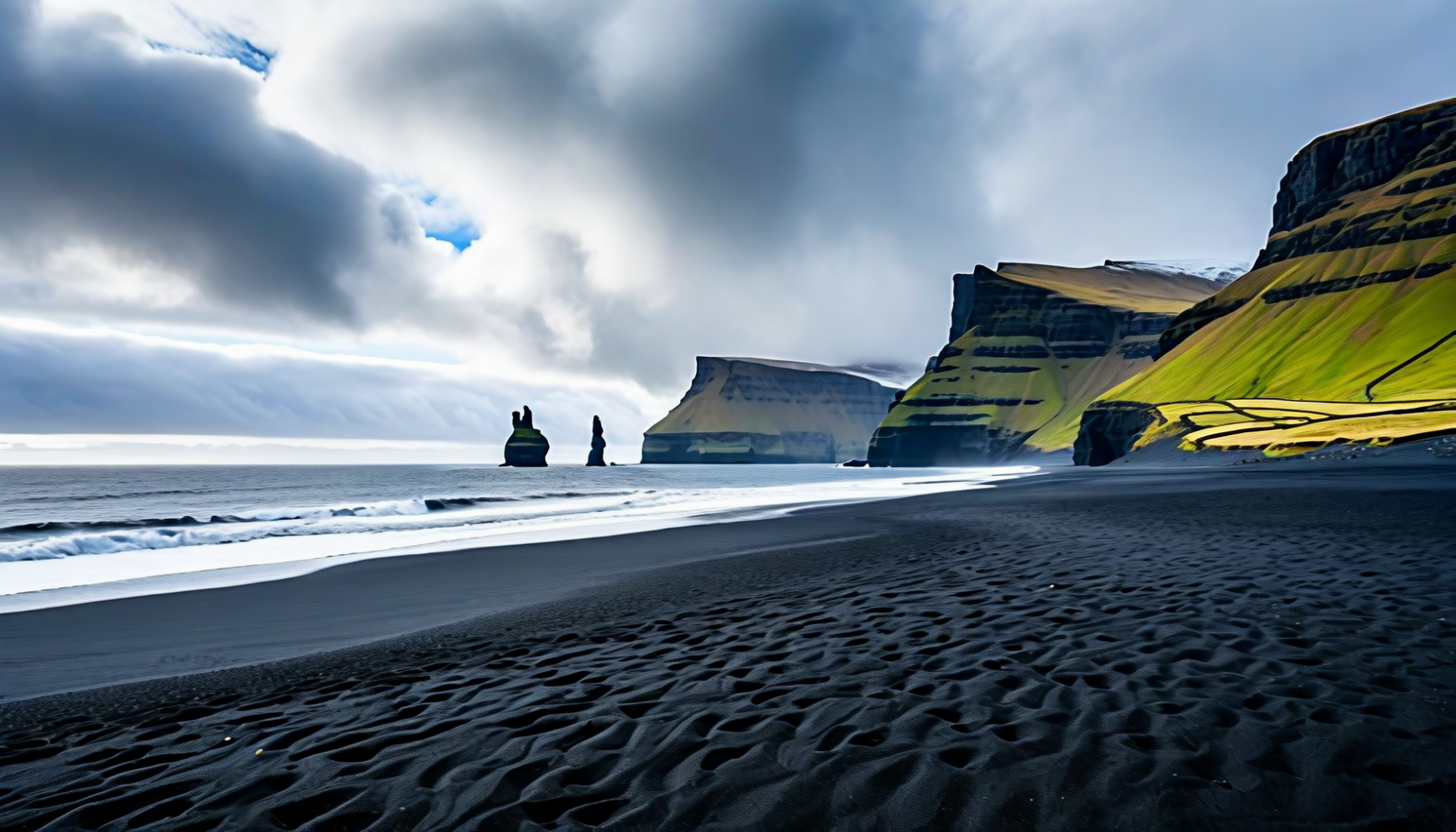
A black sand beach at the head of a bay, with the two sea stacks Risin og Kellingin — the Giant and the Witch — offshore. Surfers use the beach; everyone else photographs the stacks.
Risin og Kellingin
In the legend, an Icelandic giant and witch came to drag the Faroes back to Iceland and were caught by sunrise and turned to stone. The geology says the same erosion that made every other Faroese stack.
Vestmanna
On the west coast, the departure point for the bird cliff boat trips and the site of the country's main hydroelectric scheme.
Kirkjubøur
Fifteen minutes from Tórshavn: the ruined Magnus Cathedral begun around 1300 and never finished, the twelfth-century St Olav's church still in use, and Kirkjubøargarður — a farmhouse said to be among the oldest continuously inhabited wooden houses in the world, lived in by the same family for seventeen generations.
🏔️ Eysturoy, Gjógv & Slættaratindur
The second island, joined to Streymoy by a bridge over the narrow sound — the Faroese call it "the only bridge over the Atlantic" — and holding the highest mountain and one of the most striking villages.
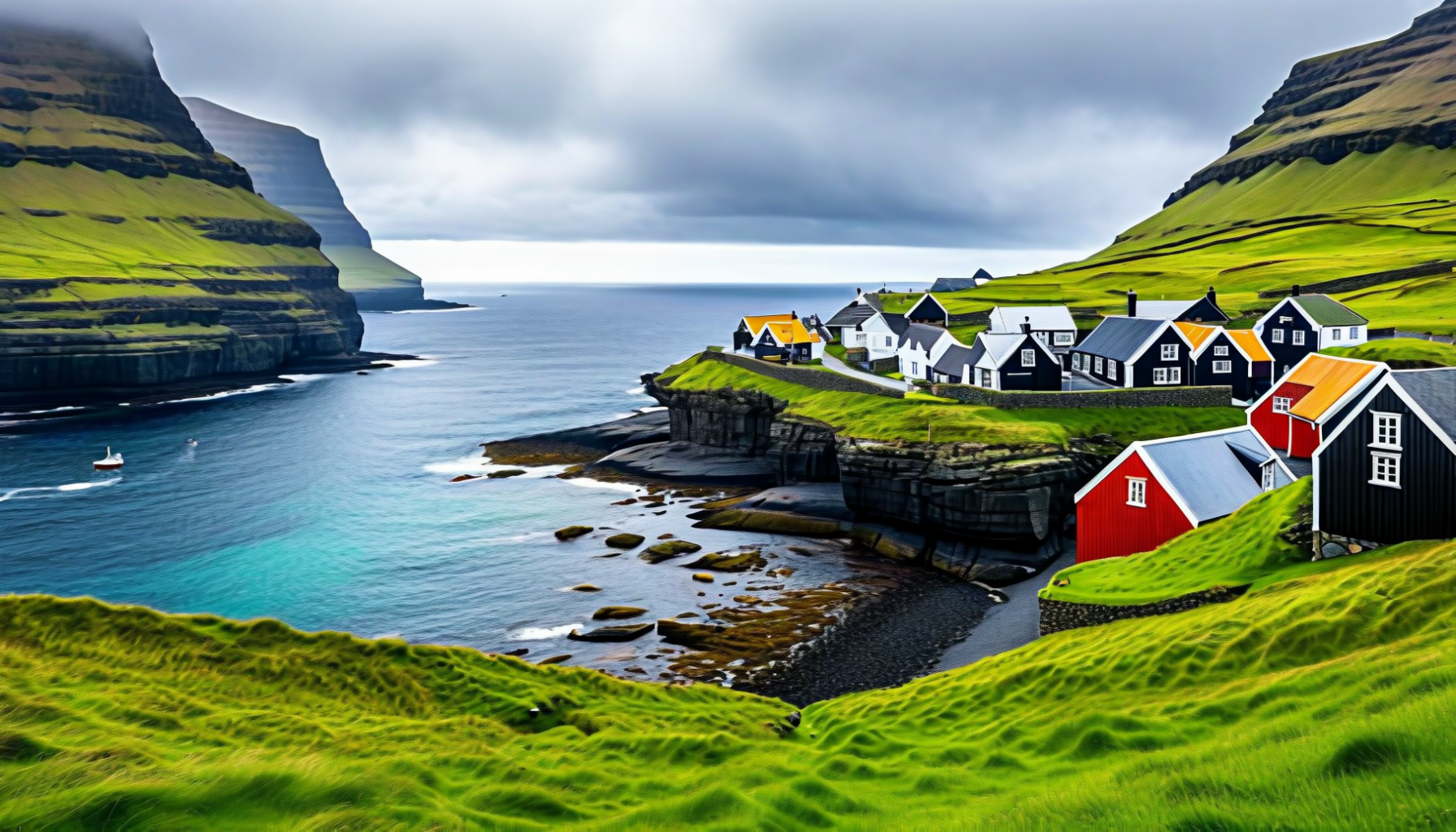
Gjógv
The village takes its name from a 200 m natural gorge running inland from the sea, which was the harbour — boats were winched up it. There is a good guesthouse, a green above the gorge and a path along the cliffs.
Slættaratindur · 882 m
The highest point in the Faroes, climbed from the Eiðisskarð pass in about two hours return. It is steep, pathless in places and frequently in cloud, but on a clear day you can see every island.
Funningur and Elduvík
Two more villages on the same road, both spectacular and both largely ignored by visitors heading to Gjógv.
Eysturoyartunnilin
The 11 km sub-sea tunnel to Runavík, containing the world's only undersea roundabout — lit as a jellyfish, with a steel sculpture of dancers and a piece of music composed for it. Genuinely worth the toll as an experience.
Rituvík and the east coast
Quieter villages along the fjords, and the ferry link toward the northern isles before the tunnels.
Hvítanes
A cove near Tórshavn where grey seals haul out, easy to reach and reliable.
🗼 Klaksvík, Kalsoy & the North
The Norðoyar — the six northern islands — are the wildest part of the country, with the second city, the most dramatic single hike, and a Bond connection that has quadrupled visitor numbers to one village.
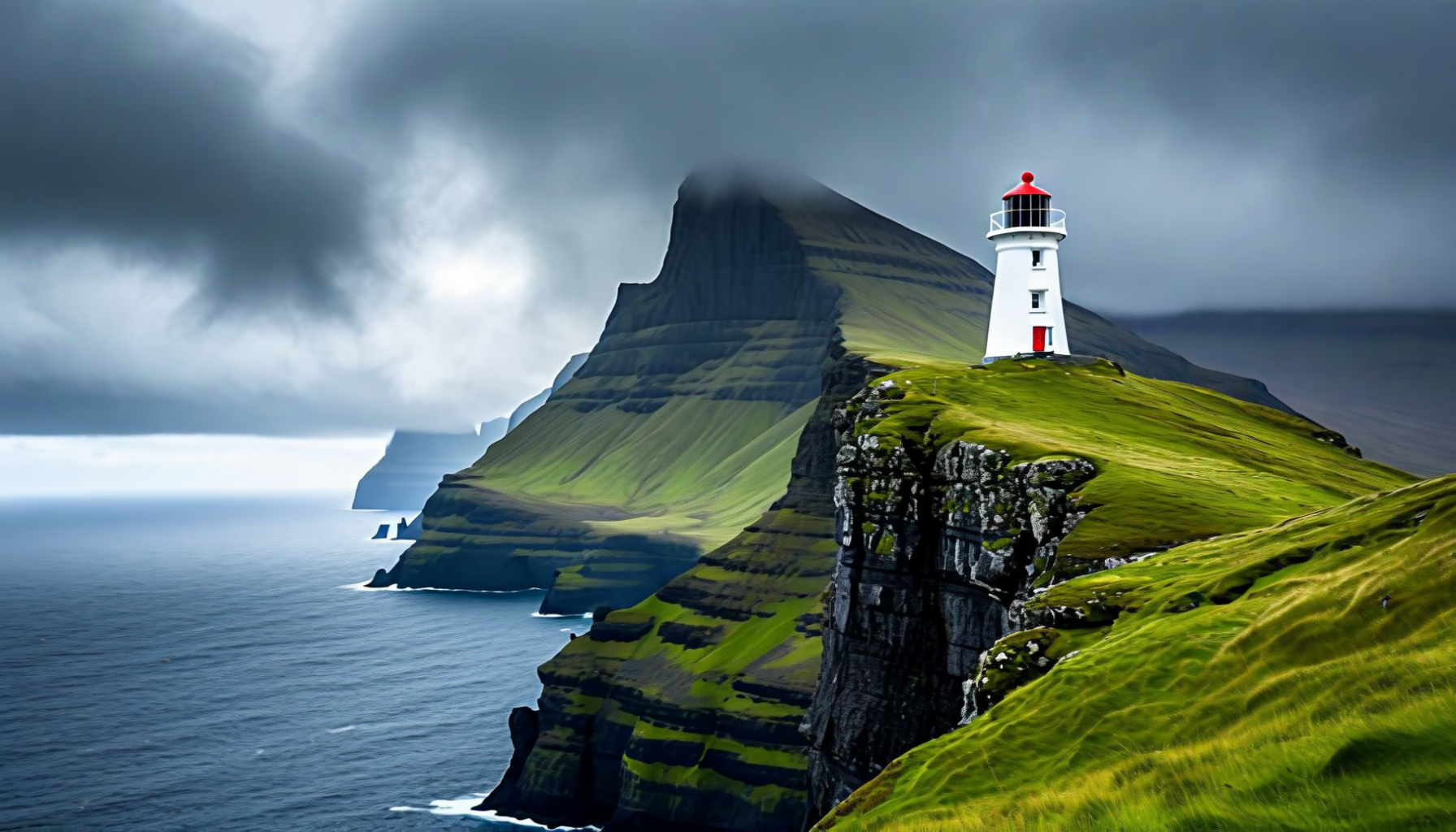
Klaksvík
The second town, about 5,000 people, wrapped around a deep fjord — a serious fishing port with the country's brewery and the striking turf-roofed Christianskirkjan, which holds an eight-metre fishing boat hanging from the ceiling.
Kalsoy
A long thin island reached by ferry from Klaksvík, with four villages linked by single-lane tunnels and no passing places to speak of. The island of the seal-woman legend, whose statue stands at Mikladalur.
Kallur lighthouse
About 45 minutes' walk from Trøllanes across sheep pasture to a knife-edge headland with the lighthouse on it and cliffs on both sides. A landowner fee applies. In wind or wet it is genuinely dangerous — turn back.
The Bond grave
The final scene of No Time to Die was filmed on Kalsoy, and the production left a headstone that the island has kept. It is now, absurdly, a pilgrimage site.
Viðoy and Viðareiði
The northernmost village in the country, under Cape Enniberg — at 754 m one of the highest sea cliffs in Europe, and a guided hike for the experienced only.
Kunoy and Borðoy
Quiet valleys, a planted forest at Kunoy that counts as a national curiosity, and tunnels bored through mountains to villages of forty people.
⛴️ Sandoy, Suðuroy & the South
The southern islands get a fraction of the visitors and are, for that reason, where several Faroese will tell you to go. Sandoy is now connected by tunnel; Suðuroy is still a two-hour ferry and feels like a different country.
Suðuroy
The southernmost island, with the country's most spectacular west coast — the cliffs at Beinisvørð rise over 460 m straight out of the sea — plus the Hvannhagi valley, the abandoned village of Víkarbyrgin and a strong separate identity.
Getting to Suðuroy
The Smyril ferry from Tórshavn, two hours, carrying cars. Go for at least two nights; a day trip wastes it.
Sandoy
Connected to Streymoy since 2023 by the 10.8 km Sandoyartunnilin. Sandy beaches — a rarity here — dunes at Sandur, a lake full of birds and far fewer people than the north.
Skúvoy and Stóra Dímun
Tiny islands with a handful of residents. Stóra Dímun has one farming family, is reached by helicopter, and its sheep are famous. Skúvoy is where Sigmundur Brestisson of the saga is buried.
Nólsoy
Twenty minutes by ferry from Tórshavn, with a lighthouse walk, the world's largest colony of European storm petrels, and a good pub. The easiest island day trip there is.
Lítla Dímun
The only uninhabited island, a perfect green dome usually wearing a lenticular cloud. Its wild sheep were exterminated in the nineteenth century. You cannot land; you photograph it from the ferry.
🥾 Hiking
The best reason to come. The Faroes are laced with old postal and church paths between villages, marked with cairns, that predate the roads — and the modern hiking network is built on them. Distances are short, the ascent is not, and the exposure is real.
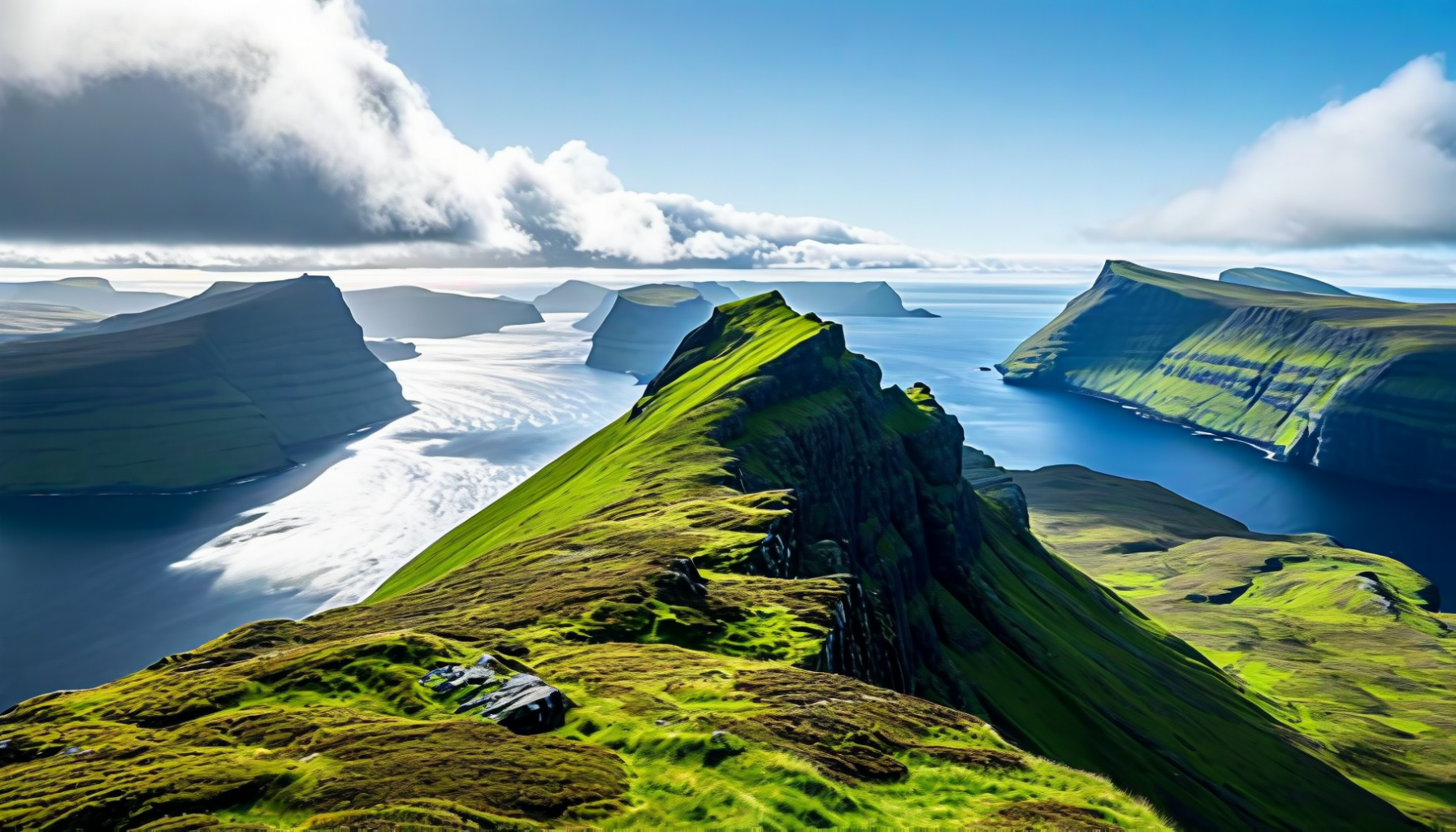
Kallur lighthouse, Kalsoy
45 minutes each way, and the single most spectacular short walk in the country. Exposed, steep and not for wind or wet.
Trælanípa and Bøsdalafossur, Vágar
Two and a half hours return for the floating-lake illusion and the waterfall into the sea. Easy underfoot, and busy.
Slættaratindur
Two hours return from the Eiðisskarð pass. Steep, loose in places, often in cloud, no marked path near the top. Do not attempt in poor visibility.
Villingadalsfjall and Enniberg
The northern cliffs of Viðoy, including one of Europe's highest sea cliffs. Enniberg itself requires a local guide and is a serious undertaking.
Old postal routes
Gásadalur over the mountain, Saksun to Tjørnuvík, Selatrað to Gjógv — historic routes between villages, cairned, and a completely different experience from a viewpoint car park.
Access and fees
Most land is privately owned and many popular routes now charge a landowner fee and some require a guide. This is a response to genuine damage and to sheep losses; pay it without complaint. Check hiking.fo for current rules before every walk.
🐑 Sheep, Wool & Turf
"Ull er Føroya gull" — wool is Faroese gold — is an old saying that stopped being a joke when Faroese knitwear became a global fashion item. There are more sheep than people, they roam free on the outfield, and the entire visual character of the landscape is a product of their grazing.
The sheep
Around 80,000 of a small, hardy, multi-coloured local breed, grazing unfenced on the hagi outfield all year. They are the reason there are no trees and the reason the hills are green to the summit. Give way to them on roads.
Wool
Faroese wool is coarse, warm and weather-resistant. The Sarah Lund jumper from The Killing was Faroese, made by Guðrun & Guðrun in Tórshavn, and the resulting boom is still visible in every shop.
Turf roofs
Not decoration: turf over birch bark was the insulation and the waterproofing before tar and corrugated iron. Many are still maintained, and yes, the grass gets cut.
Black tar
The black timber of Faroese buildings is tarred, which preserves the wood in salt wind. Red, white and yellow are the traditional accent colours.
The hagi system
Outfield grazing rights are divided in an old and complicated system of shares, which is why fields are unfenced and why land access is a real legal question rather than a formality.
Sheepview
When Google Street View had not covered the islands, a Faroese woman strapped 360° cameras to sheep and made her own. Google noticed and sent a proper car. It is the most Faroese story there is.
🚇 Tunnels, Ferries & Helicopters
A country of 54,000 people has built four sub-sea tunnels and around twenty land tunnels, and runs a subsidised helicopter service to islands with fewer than ten residents. The transport network is the most remarkable piece of public infrastructure per head anywhere in Europe.
Sub-sea tunnels
Vágatunnilin to the airport island (2002), Norðoyatunnilin to Klaksvík (2006), Eysturoyartunnilin with its roundabout (2020) and Sandoyartunnilin (2023). All are tolled — registered automatically to your hire car and billed to you later.
The undersea roundabout
In the Eysturoy tunnel, 187 m below the fjord: a lit roundabout with a jellyfish light installation and a steel sculpture of a Faroese chain dance. There is nothing else like it.
Single-lane tunnels
Older tunnels on Kalsoy, Suðuroy and elsewhere are one lane with passing bays (M signs). The rule is that the driver with the bay on their side pulls in. Unlit, dripping and narrow — go slowly.
Ferries
Strandfaraskip Landsins runs to Suðuroy, Mykines, Nólsoy, Hestur and Skúvoy. Cheap, punctual, and cancelled without ceremony in swell. Check ssl.fo the evening before.
Helicopter
The Atlantic Airways helicopter serves the small islands at a heavily subsidised fare — a flight to Mykines or Stóra Dímun costs a fraction of what it should. Booking opens shortly in advance, seats go instantly, and tourists may not book both legs on the same route.
Buses
The blue Bygdaleiðir buses reach most villages, are inexpensive, and are a viable way to travel if you have time. Tórshavn's own red city buses are free.
🌫️ Weather, Light & the Photograph Problem
The Faroes have around 300 days of rain a year and a saying that you can experience all four seasons in a single day. The photographs that brought you here were taken in perhaps 5% of the available weather, and managing that expectation is the difference between a great trip and a disappointing one.
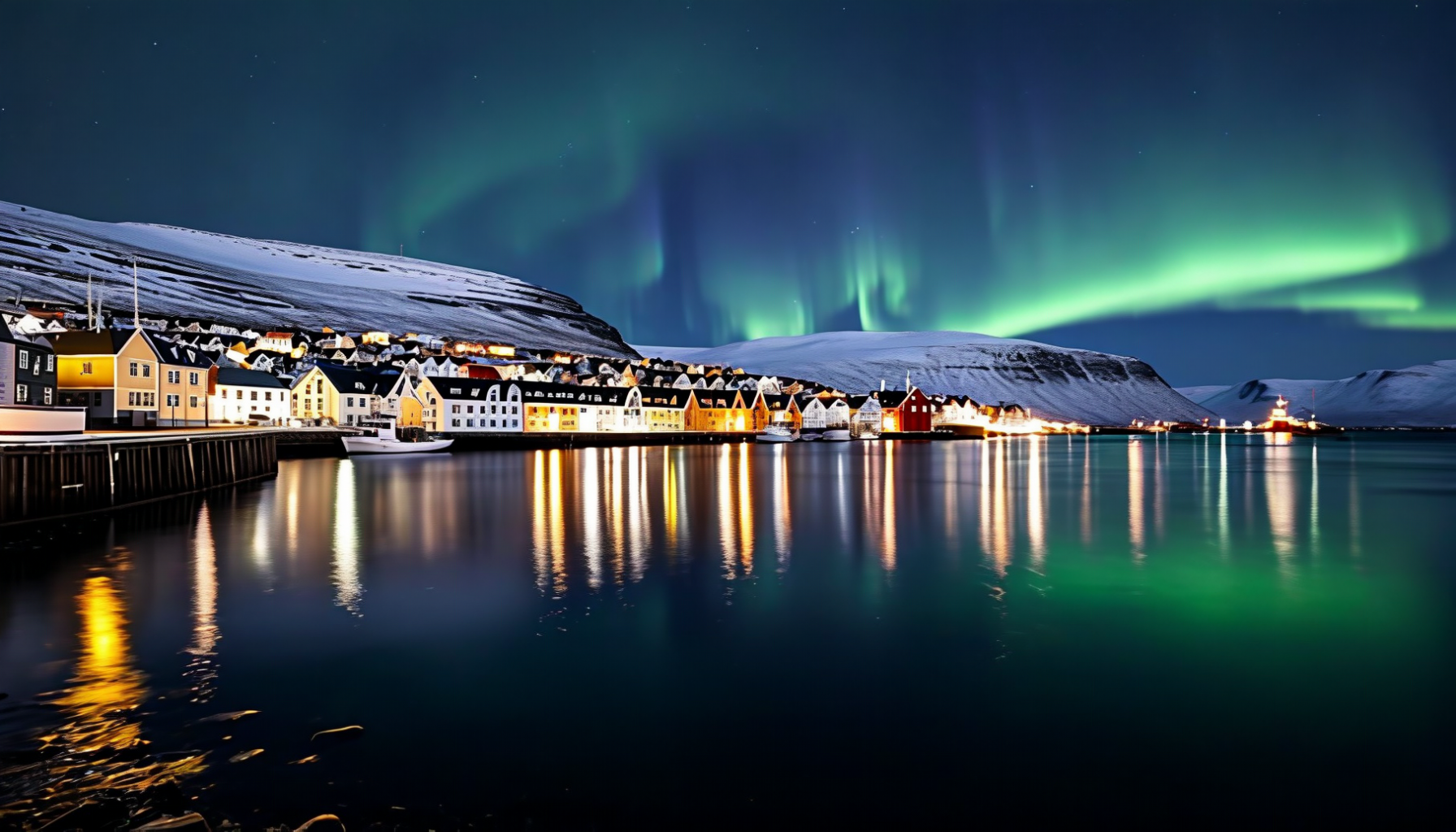
The fog
Sea fog can sit on a headland for days while a valley 5 km away is in sun. If a viewpoint is socked in, drive twenty minutes and try somewhere else — this works more often than it has any right to.
Wind
The real hazard. Gusts on exposed ground can knock you over, car doors are regularly torn off by it (check your insurance for this specific exclusion), and hikes become dangerous well before they become unpleasant.
Summer light
Around 19 hours of usable light in June, with long golden evenings and a dusk that never fully darkens. This is the single best reason to come in summer.
Winter light
About five hours in December, often grey. The compensation is empty roads, storms against the cliffs and cheap accommodation.
Planning for it
Build a flexible itinerary, keep two or three options for each day, and treat any clear hour as an emergency to be acted on. Do not save the best viewpoint for the last day.
What to wear
Full waterproof shell and trousers, warm layers, a hat, gloves and proper boots — in July as much as in January. An umbrella is useless and marks you out immediately.
🐋 The Grindadráp
The pilot whale drive hunt is the most controversial thing about the Faroe Islands, you will be asked about it, and it is better to understand it before you arrive than to be blindsided in a bar. This section sets out what it is and what both sides say, without pretending the argument does not exist.
What it is
When a pod of long-finned pilot whales is sighted, boats drive it into one of about twenty authorised bays and the animals are killed on the beach with a spinal lance. The meat and blubber are then distributed free among the community by an old formula. It is not commercial and the meat is not sold.
How old
Documented since at least 1584 and probably far older. For centuries it was a genuine subsistence necessity on islands with no grain and little livestock, and it remains embedded in law, custom and communal identity.
The numbers
Long-term average is roughly 600–800 pilot whales a year from a North Atlantic population estimated in the hundreds of thousands. Faroese authorities and NAMMCO regard the take as sustainable; that is the strongest part of the Faroese case.
The criticism
Animal welfare organisations argue the drive and kill cause prolonged distress regardless of method, that no subsistence necessity remains in a wealthy country, and that the practice is indefensible on those grounds. The images are genuinely shocking and are widely circulated.
2021
A single drive at Skálabotnur killed 1,428 Atlantic white-sided dolphins — far outside normal practice and widely condemned within the Faroes as well as outside. It prompted a government review and a subsequent annual catch limit on that species.
The health issue
Faroese medical officers have advised for years that pilot whale meat is unsafe to eat regularly because of mercury and PCB levels, and in 2008 recommended it not be eaten at all. This is the argument that carries most weight domestically, and consumption has fallen.
If you encounter one
Drives are unannounced and can happen anywhere on the coast. Do not attempt to interfere — it is illegal and dangerous. Photographing is not prohibited, but consider what you are doing and why. Most visitors never see one.
Talking about it
Faroese are used to being lectured about this by people who eat industrially farmed meat, and the conversation goes badly when it starts as an accusation. Ask questions, listen, and form your own view. You are allowed to disagree; you are not obliged to perform outrage.
👥 People & Culture
Fifty-four thousand people who mostly know each other, in a country where the phone book is organised by first name and everyone is related to everyone. It is one of the safest, most literate and most socially cohesive societies in Europe, and it is not quite like Denmark.
The chain dance
The føroyskur dansur is a medieval ring dance with no instruments, driven by a lead singer performing a kvæði ballad of hundreds of verses while everyone else joins the refrain. It survived here after dying out everywhere else in Europe, and it is still danced at Ólavsøka.
Village and town
About 60% of the population lives in the Tórshavn area, but the village remains the emotional unit — people identify with where their family is from, and everyone goes back for the summer festivals.
Religion
Strongly Lutheran, with an unusually large Plymouth Brethren minority — around 10%, one of the highest proportions anywhere. This has practical effects: some villages are dry, some businesses close on Sundays.
Social attitudes
Conservative by Nordic standards but changing fast. Same-sex marriage was legalised in 2017 and abortion law was liberalised in 2024, both after long debates that were much closer than they would have been in Copenhagen.
Names
Faroese naming is patronymic in origin and the phone book lists people by first name. Say hello to everybody; in a village, not doing so is noticed.
Heimablídni
"Home hospitality" — dinner in a private Faroese home, arranged in advance and paid for. It is the single best cultural thing a visitor can do here, and several families across the islands offer it.
🗣️ Language
Faroese is a West Nordic language descended from Old Norse, closest to Icelandic and to the extinct Norn of Orkney and Shetland. It has around 70,000 speakers worldwide and survived a period when Danish was the only written language, largely thanks to the oral ballad tradition.
Written Faroese
Standardised by V. U. Hammershaimb in 1854 on etymological principles, which makes it look much more like Icelandic than it sounds. Spelling and pronunciation diverge wildly — ð is usually silent, and Eysturoy sounds roughly like "ESS-tu-roy".
Danish
Compulsory in school and universally understood, but Faroese is the language of daily life and of parliament. Speaking Danish to a Faroese person is fine and slightly beside the point.
English
Excellent, essentially universal under sixty, and the language of all tourism. You will have no difficulty whatsoever.
Useful Faroese
Góðan dag — good day. Takk fyri — thank you. Ja / nei — yes / no. Hvussu gongur? — how's it going? Skál! — cheers. Farvæl — goodbye.
The ballads
The kvæði — narrative ballads, some running to hundreds of stanzas, preserving Norse legend — were the vehicle that carried the language through the centuries when nothing was printed in it. Around 70,000 stanzas have been collected.
Place names
Almost every place name is descriptive Old Norse: vík a bay, fjørður a fjord, oy an island, dalur a valley, tindur a peak, gjógv a gorge. Once you know six words the map explains itself.
🍽️ Faroese Food
Traditional Faroese cooking is built on one problem: how to keep food through a winter on treeless islands where you cannot smoke or reliably salt anything. The answer was ræst — wind-drying to a controlled ferment in an open shed — and it produces flavours that are genuinely challenging and completely unlike anywhere else.
Skerpikjøt
Mutton hung in a slatted drying shed (hjallur) for five to nine months until it is dark, dry and intensely flavoured. Sliced thin on rye bread with butter. This is the national delicacy and it tastes like nothing else — sharp, deep, faintly blue-cheesy.
Ræst kjøt and ræstur fiskur
The half-fermented stage: mutton or fish hung for a few weeks and then boiled. Much stronger-smelling than skerpikjøt and served at family meals. The restaurant Ræst in Tórshavn exists to serve exactly this to people who want to understand it.
Fish
Superb and everywhere: cod, haddock, halibut, salmon from the fjords, and langoustines. Faroese salmon is a major export and the quality is very high.
Lamb
Faroese lamb grazes wild on herb-rich outfield all summer and tastes of it. Roast, or as seyðahøvd — boiled sheep's head, which is exactly what it sounds like and is eaten with relish.
Rhubarb and potatoes
Almost the only things that grow. Rhubarb appears in everything sweet; potatoes are grown in tiny stone-walled patches all over the islands.
Bread and cake
Rye bread with everything, and a serious coffee-and-cake culture. Ask for drýlur, the dense Faroese loaf.
Ræst-style mutton with potatoes
Faroese boiled mutton · serves 4 · 2 hours
Ingredients: 1.2 kg mutton leg or shoulder on the bone (traditionally ræst — wind-fermented; use well-hung mutton if you cannot get it); 12 small potatoes; salt; water. To serve: butter and rye bread.
Method: Put the mutton in a large pot, cover with cold water, bring slowly to the boil and skim thoroughly. Salt lightly — ræst meat is already strong — and simmer, covered, for about 90 minutes until the meat pulls from the bone. Add the potatoes for the last 25 minutes and cook in the same broth. Serve the meat and potatoes on one plate with plenty of butter.
💡 Faroese kitchens do this without herbs, stock or wine, and the point is the meat. If you are using ræst mutton, open a window — the smell is the whole argument and it is not subtle.
Skerpikjøt on rye
The national snack · serves 4 · 10 minutes
Ingredients: 150 g skerpikjøt (wind-dried mutton — from a Faroese or Icelandic supplier; a well-aged bresaola or coppa is the nearest available substitute); dense dark rye bread; good salted butter.
Method: Slice the skerpikjøt as thinly as you possibly can, across the grain — a sharp knife and patience, or a slicer. Butter the rye bread generously and lay the slices over it. That is the entire recipe.
💡 Do not cook it, do not add anything, and do not slice it thick. Served with a beer from Föroya Bjór it is the most Faroese thing you can eat sitting down.
Rhubarb and cream
Faroese rhubarb pudding · serves 4 · 30 minutes
Ingredients: 600 g rhubarb, cut into 2 cm pieces; 120 g sugar; 100 ml water; 1 tbsp cornflour slaked in a little cold water; whipped cream; a handful of oats toasted in butter and sugar.
Method: Simmer the rhubarb with the sugar and water for about 10 minutes until it collapses. Stir in the slaked cornflour and cook two minutes more until it thickens. Cool completely. Layer in glasses with whipped cream and the toasted oats.
💡 Rhubarb is one of very few things that grows well in the Faroes, and it turns up in every domestic dessert. The toasted oats are the northern shortcut to a crumble without an oven.
⭐ The New Faroese Kitchen
In the space of about fifteen years the Faroes went from having essentially no restaurant culture to holding Michelin stars and appearing on every serious food traveller's list. The movement built itself on ræst, seabirds, seaweed, angelica and lamb — the exact ingredients that had been embarrassing a generation earlier.
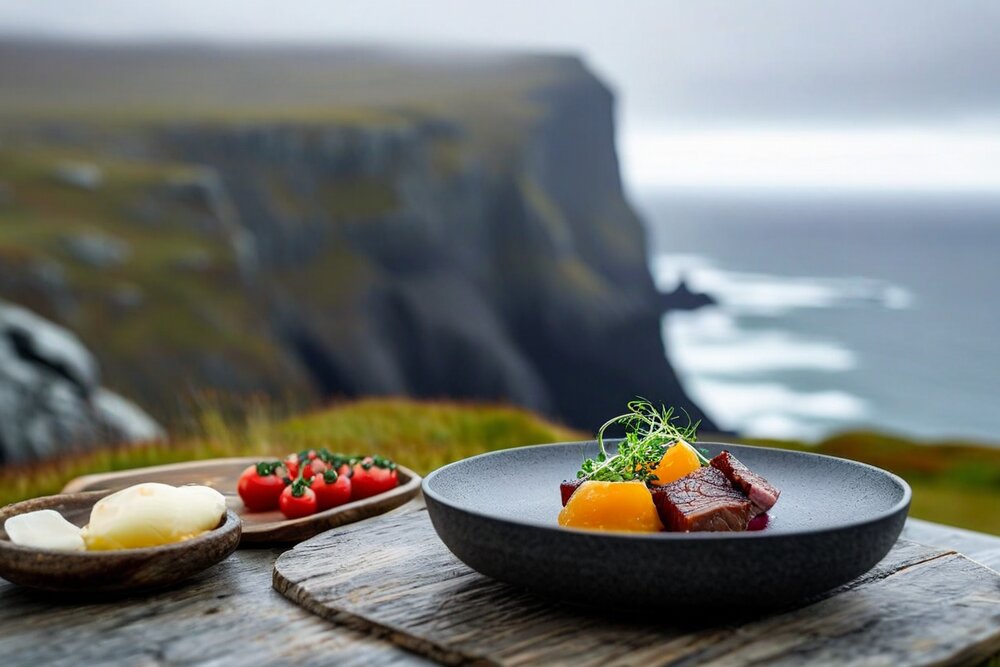
KOKS
The restaurant that started it, holding two Michelin stars, in a turf-roofed farmhouse by a lake and later relocated. Tasting menus built on fermented lamb, seabird, dried fish and langoustine. Booked months ahead and worth it if that is your kind of trip.
Ræst
A Tórshavn restaurant devoted entirely to fermented food — ræst fish, ræst mutton, skerpikjøt — presented and explained. If you want to understand the tradition rather than admire the plating, go here.
ROKS and Barbara
Seafood at the top of the range in Tórshavn; Barbara Fish House in an old timber building on Tinganes is the reliable favourite.
Heimablídni
Dinner in a family home, booked in advance — often the best meal of a trip, and the only way to eat genuinely domestic Faroese food. Several households across the islands offer it and Visit Faroe Islands lists them.
Local produce
Faroese salmon, lamb, langoustine, sea urchin and an increasing amount of greenhouse and seaweed produce. There is one commercial farm growing vegetables in volume.
Prices
Very high. A tasting menu at the top runs to Nordic capital-city levels; a good mid-range dinner is 250–450 DKK. This is the single biggest budget item after accommodation.
🍺 What Faroese Drink
Beer that has been brewed here since 1888, spirits flavoured with angelica, and until surprisingly recently a near-prohibition regime whose traces are still visible in how alcohol is sold.
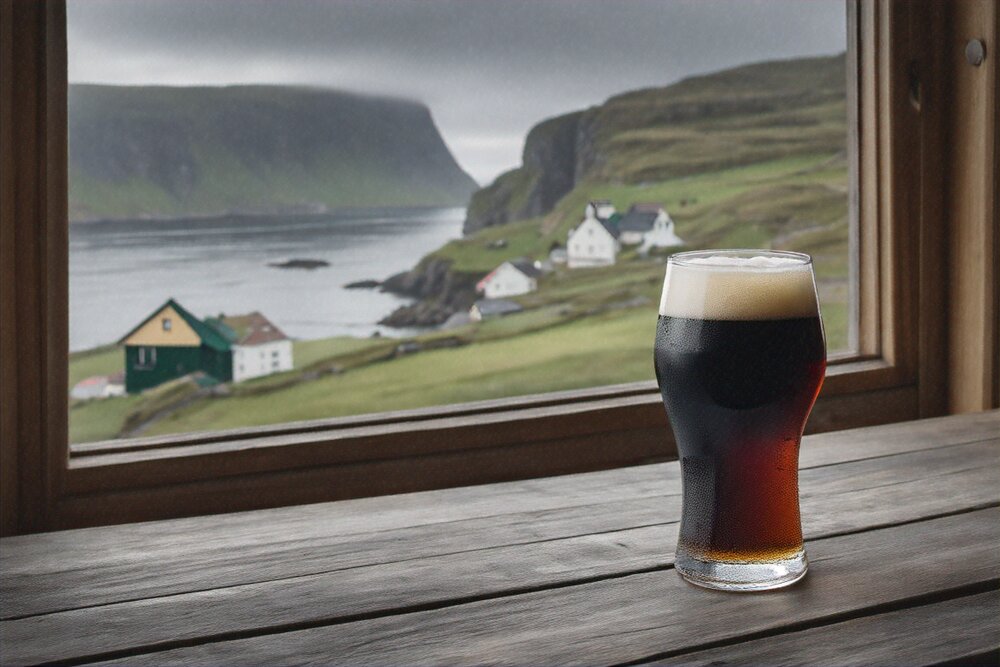
Föroya Bjór
The Klaksvík brewery, founded 1888, and the national beer. Its Black Sheep porter and Gull lager are everywhere, and its seasonal Jólabrúgv is a national event.
Okkara
The younger brewery, in Velbastaður, doing more experimental work including beers aged in sherry casks and one brewed with seaweed.
Prohibition's shadow
Alcohol was effectively banned from 1907 and only fully liberalised in 1992. Beer above 5.8% and spirits are sold only through the state monopoly Rúsdrekkasøla Landsins, in a handful of shops with restricted hours. Supermarkets sell only light beer.
Practical
Buy what you want early in the day and not on Sunday. Bars in Tórshavn are well stocked and open late at weekends; some villages are dry by local custom.
Spirits
Faroese producers make aquavit and gin flavoured with angelica, crowberry and seaweed. Angelica is the characteristic Faroese botanical and is worth trying.
Coffee
Taken seriously and drunk constantly, usually with cake. Tórshavn has several genuinely good roasteries and cafés.
🎉 Festivals & Music
For 54,000 people the Faroes produce an implausible amount of music, and the festival calendar is the spine of the summer. If your dates can flex, aim for one.
Ólavsøka · 28–29 July
The national festival and the biggest date of the year: the opening of parliament, a rowing regatta between village boats, processions, and the whole country in Tórshavn. It ends with everyone in the square at midnight singing the midnátssangur, then the chain dance. Book accommodation a year ahead.
G! Festival · July
Music on the beach at Gøta, with the stage on the sand and the campsite on the hillside. The best-known Faroese festival internationally.
Summartónar
A summer-long contemporary and classical music festival across the islands, often in churches and unusual spaces.
Flag Day · 25 April
Marking British recognition of the Faroese flag in 1940. Flags on every house.
Village rowing regattas
Through the summer, in traditional Faroese wooden boats, and taken extremely seriously. The Ólavsøka final is the national sporting climax.
The music
Eivør Pálsdóttir is the best-known Faroese artist internationally; Týr play Faroese-language folk metal; Teitur, Konni Kass and ORKA cover everything else. For a country this size the output is remarkable.
🌦️ Climate & When to Go
Oceanic, cool and astonishingly stable in temperature: the mean is about 3 °C in January and 11 °C in July, and it rarely goes far outside that in either direction. What varies is wind, cloud and daylight, not warmth.
June–August
The season: long light, all ferries and the Mykines route running, festivals, and every hiking path open. Also the wettest-feeling because of fog, the most expensive, and the only time you must book ahead.
May and September
The best value. Puffins arrive in May and are gone by early September; the light is still good, prices drop and the roads are quiet. September has the most settled weather of the year in some accounts.
October–April
Storms, short days, closed ferries to Mykines, many guesthouses shut. Also empty, cheap, dramatic, and the only time you might catch aurora. For photographers who like weather, it is arguably better than summer.
Rain
Roughly 1,300 mm a year at Tórshavn spread over about 300 days — so frequent rather than heavy. Full waterproofs, not an umbrella.
Snow
Falls on the tops most winters and rarely lies long at sea level. Mountain roads can close; the tunnels do not.
Daylight
About 19 hours in late June and roughly 5 in late December. Plan your itinerary around this more than around temperature.
✈️ Getting There
Vágar Airport (FAE) is the only one, on the western island, 45 minutes from Tórshavn through a sub-sea tunnel. The national carrier Atlantic Airways and SAS between them serve a modest but growing European network.
Flights
Copenhagen year-round and most frequently (about 2 hours), plus Billund, Bergen, Oslo, Reykjavík, Edinburgh, Barcelona, Paris, Mallorca and others seasonally. Atlantic Airways is the main operator; SAS also flies from Copenhagen.
Landing at Vágar
The approach is short, over water, into wind, and frequently diverted or delayed by fog. Pilots are trained for it and Atlantic Airways pioneered a satellite-guided curved approach specifically for this runway. Do not book a tight onward connection.
The ferry
Smyril Line's Norröna sails from Hirtshals in Denmark to Tórshavn, roughly 36 hours, continuing to Seyðisfjörður in Iceland. It carries cars, which makes it the way to bring your own vehicle and to combine the Faroes with Iceland.
Arriving
No Schengen — the Faroes are outside both the EU and Schengen — so there is a passport check. Customs limits on alcohol and tobacco are enforced and worth reading, since bringing your own drink is a real saving.
Hire car
Book before you arrive; the fleet is small and sells out in summer. Pick up at the airport. Check the insurance specifically for wind damage to doors, which is a real and commonly excluded risk here.
Without a car
Entirely possible: the blue Bygdaleiðir buses and the ferries reach almost everywhere cheaply, and a Travel Card covers both. It is slower and needs planning, and it works.
🇨🇿 From the Czech Republic
No direct flight, but a short and simple connection: Prague to Copenhagen, then Copenhagen to Vágar. Total travel time is 6 to 9 hours depending on the layover, and the time difference is two hours behind Czech time in summer, one in winter.
The routing
Prague–Copenhagen with SAS, Norwegian or Ryanair, then Atlantic Airways or SAS to Vágar. Book the Faroese leg first — it has far fewer frequencies than the Prague–Copenhagen hop.
Other options
Billund, Oslo, Bergen, Edinburgh and Reykjavík all have seasonal services and can be cheaper. From Prague, Copenhagen is almost always simplest.
Documents
A Czech ID card or passport is accepted for entry, but note the Faroes are outside Schengen, so there is a border check and a passport is the safer document. No visa is needed for Czech citizens.
Health cover
The European Health Insurance Card does not cover the Faroe Islands — this catches people out. Czech citizens are covered under a Nordic arrangement in practice for emergencies, but take proper travel insurance with repatriation and do not rely on the EHIC.
Czech consular cover
There is no Czech representation in the Faroes. The accrediting mission is the Czech Embassy in Copenhagen. Register with DROZD before travelling.
MZV advice and money
The Czech Ministry of Foreign Affairs treats the Faroes as a safe destination without restrictions; check mzv.cz before departure. The currency is the Danish krone — at roughly 3.5 Kč to the DKK, a 150 DKK restaurant main is about 525 Kč and a 1,200 DKK hotel night about 4,200 Kč.
🧭 Practical Faroes
One of the easiest countries in Europe to travel in, once you accept that the weather runs the schedule. Excellent roads, universal English, near-zero crime and very good mobile coverage — with a couple of specific local quirks worth knowing.
Money
Danish krone (DKK), issued locally as Faroese króna notes. Cards are accepted absolutely everywhere including tunnels, buses and remote guesthouses — the Faroes are close to cashless. Faroese notes are not accepted in Denmark, so spend or exchange them.
Roaming
Because the Faroes are outside the EU, EU roam-like-at-home does not apply and Czech operators may charge substantially. Check before you land, and consider a local SIM or an eSIM. This is the most common expensive surprise.
Driving
Right-hand side, headlights on at all times, excellent tarmac. Tunnel tolls are billed automatically to hire cars. Watch for sheep on every road, and for single-lane tunnels with passing bays.
Land access
Most land is privately owned and there is no Nordic right to roam here. Many popular routes charge a landowner fee, some require a guide, and walking off marked paths across the outfield is trespass. Check hiking.fo.
Electricity
230 V, European two-pin — the same as Czech plugs, so no adapter needed.
Shops and Sundays
Small supermarkets everywhere, limited Sunday opening, and alcohol above 5.8% only from the state monopoly shops with short hours. Plan Saturday.
💰 Costs
Expensive — Nordic prices plus island freight. The landscape is free and the hiking fees are small; everything else costs what it costs in Copenhagen or a bit more.
Accommodation
Hostel or guesthouse room 600–900 DKK (2,100–3,200 Kč). Mid-range hotel in Tórshavn 1,100–1,800 DKK (3,800–6,300 Kč). Airbnb and village guesthouses are often the better value and the better experience.
Food
Restaurant main 180–300 DKK. A very good dinner 400–600 DKK. KOKS-level tasting menus 2,000 DKK and up. Supermarket self-catering roughly halves the daily food cost and is what most visitors do.
Car hire
500–900 DKK a day in summer, plus fuel at around 13–15 DKK a litre, plus tunnel tolls of 75–175 DKK per sub-sea passage. Budget the tolls; they add up quickly.
Transport alternative
A four-day Travel Card for buses and ferries costs a fraction of car hire and covers most of the country. Slower, and genuinely viable.
Hiking fees
Typically 200–300 DKK per person for the popular routes — Trælanípa, Kallur, Saksun. Small individually, noticeable across a week, and they go to the landowners maintaining the paths.
Realistic budget
Backpacking with buses and self-catering 700–900 DKK a day (2,500–3,200 Kč). Mid-range with a car and eating out once a day 1,600–2,200 DKK. It is not a cheap trip and there is no way to make it one.
🛡️ Safety
Among the safest places in the world by any crime measure — the Faroes have had a handful of murders in living memory and people leave cars running outside shops. Every real risk here is landscape and weather.
Cliffs
The single biggest danger. Grass grows right to the edge of 400 m drops, the turf can be undercut, and the wind gusts hard enough to move you. Stay several metres back, always, and especially for photographs.
Wind
Gusts over 100 km/h are routine in winter and happen in summer. It knocks people over on ridges, tears car doors from hinges, and turns a walk into a serious situation quickly. Check the forecast every morning at us.fo.
Fog
Rolls in within minutes on the tops and makes pathless mountains like Slættaratindur genuinely dangerous. Carry a map, a compass you can use, and a phone with offline maps — and be willing to turn back.
Water
Swimming in the sounds is dangerous — the tidal currents between islands are ferocious and there are no lifeguards. Waves on black-sand beaches can reach much further up than you expect.
Driving
Sheep on unlit roads at night, single-lane tunnels, and side wind on exposed causeways. Slow down; there is nowhere you need to be that urgently.
Emergency
112. The hospital in Tórshavn is good, with smaller ones in Klaksvík and Suðuroy; serious cases go to Denmark. Mobile coverage is excellent even on most hiking routes.
🏨 Where to Stay
Tórshavn
Hotel Føroyar on the hill above town with a turf roof and the best view; Hotel Hafnia and Hotel Brandan in the centre; Havgrím Seaside as the small luxury option. Plus apartments, which are often better value.
Basing yourself
With the tunnels, you can stay in Tórshavn and day-trip to nearly everything. That is what most first-time visitors do and it is a reasonable plan.
Village guesthouses
The better experience: Gjáargarður in Gjógv, guesthouses in Saksun, Funningur, Vestmanna, Klaksvík and Sørvágur. Small, family-run, and where the trip becomes memorable.
Suðuroy and the outer islands
Hotel Bakkin in Vágur, guesthouses in Tvøroyri, and simple rooms on Mykines, Nólsoy and Kalsoy. Book far ahead — capacity is tiny.
Camping
Permitted only at designated campsites, of which there are about a dozen. Wild camping is not allowed — the land is private and this is enforced.
Booking
For June to August, book three to six months ahead, and a year for Ólavsøka. There are only a few thousand beds in the whole country.
🗺️ Suggested Itineraries
The Faroes reward a slow week far more than a fast three days, because so much depends on catching the weather. Build alternatives into every day.
Three days
Day one Vágar — Múlafossur and Trælanípa. Day two Tórshavn, Tinganes, Kirkjubøur. Day three northern Streymoy — Saksun and Tjørnuvík. Tight, and enough to see whether you want to come back.
Five days
Add Eysturoy — Gjógv, Slættaratindur and the tunnel roundabout — and Klaksvík with Kalsoy and the Kallur lighthouse. This is the standard trip and it works.
Seven to ten days
Add Mykines (with a spare day for the ferry being cancelled) and either Suðuroy for two nights or Sandoy and Nólsoy. This is the version to aim for.
The photographer's version
Base in two places rather than one, go out at 5 a.m. and again at 9 p.m. in summer, and treat every clear hour as the day's plan. Do not save anything for later in the week.
Combining with Iceland
The Norröna ferry links Denmark, the Faroes and Iceland, and Atlantic Airways flies Vágar–Reykjavík. A two-week Faroes-and-Iceland trip is an excellent use of the airfare.
With children
Very manageable — short drives, safe villages, boat trips, puffins and the tunnel roundabout. The cliffs are the thing to be strict about.
📸 Gallery
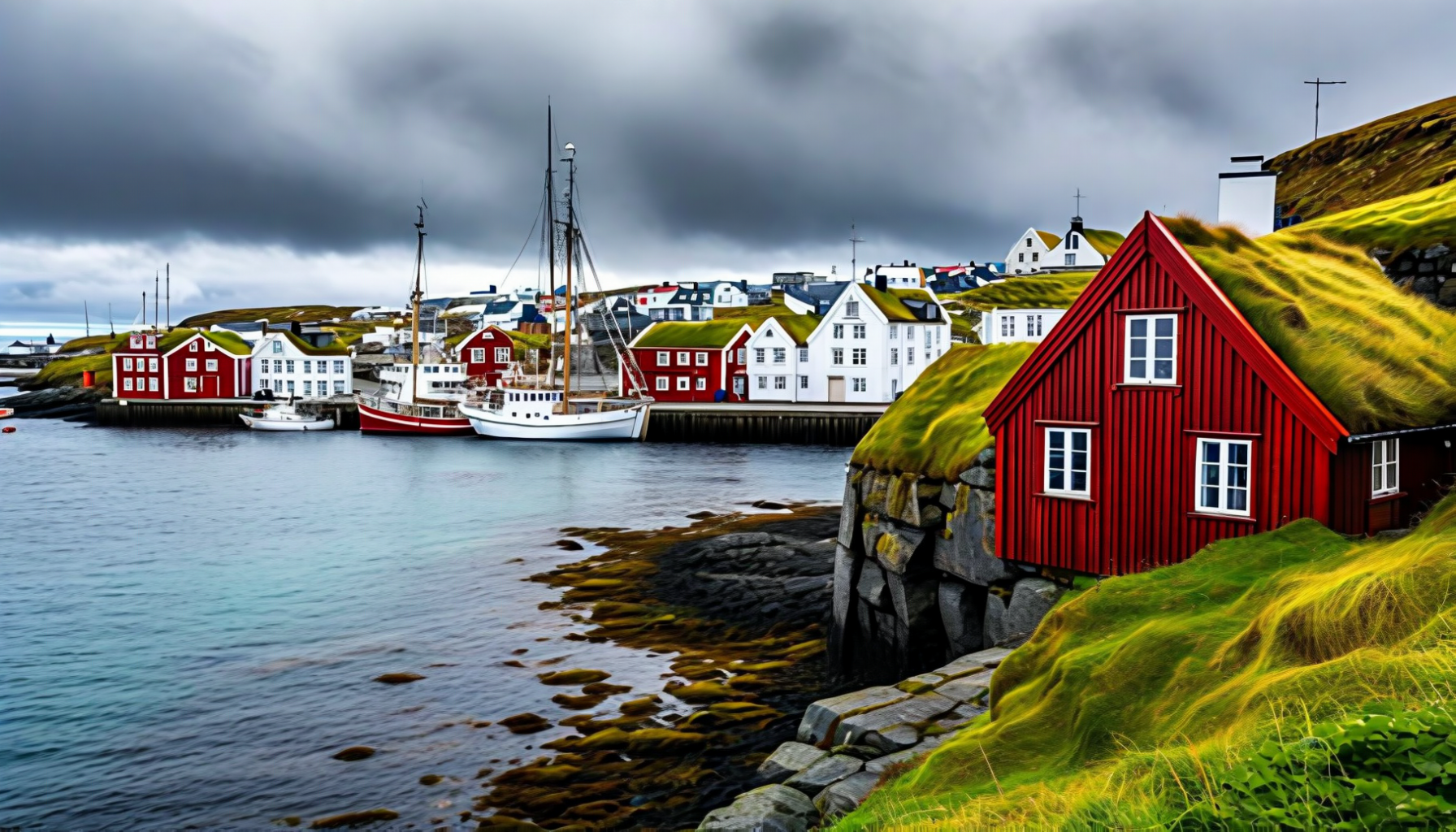
The Faroes in ten frames — waterfalls into the sea, turf roofs, sea stacks, lighthouses and a great deal of weather.
🤯 Fascinating Facts
An undersea roundabout
The Eysturoy tunnel contains the world's only roundabout under the sea, 187 m down, lit as a jellyfish with a steel sculpture of a Faroese chain dance.
Sheep before people
Føroyar means "sheep islands". There are around 80,000 sheep and 54,000 people, and the sheep are the reason there are no trees.
Sheep View 360
When Google had not mapped the islands, a Faroese woman strapped 360° cameras to sheep and crowdsourced her own Street View. Google gave in and sent a car.
One of the oldest parliaments
The Løgting traces itself to a Viking-age assembly at Tinganes, making it one of the oldest parliamentary sites still in use anywhere.
Not in the EU
Denmark is a member; the Faroes opted out over fisheries and are outside both the EU and Schengen. Your phone bill will notice.
The chain dance survived here
A medieval European ring dance with no instruments, extinct everywhere else, still danced at Ólavsøka to ballads of hundreds of verses.
A national football result
In 1990, in their first competitive match, the Faroes beat Austria 1–0. The goalkeeper wore a bobble hat. It remains one of football's great upsets.
Closed for maintenance
The islands close their main sites for a weekend each year and invite volunteers to come and repair the paths in exchange for food and lodging. Applications outnumber places many times over.
The grass gets cut
Turf roofs are functional insulation, not decoration — and yes, people mow them, sometimes with a strimmer and sometimes with a sheep.
👤 Notable Faroese
William Heinesen (1900–1991)
The great Faroese novelist, who wrote in Danish and reportedly asked the Nobel committee not to consider him so the prize could go to a writer working in Faroese. The Lost Musicians is the place to start.
Heðin Brú (1901–1987)
Wrote in Faroese, and The Old Man and His Sons — about the collision between the old subsistence world and the new money — is generally called the national novel.
V. U. Hammershaimb (1819–1909)
The clergyman who standardised written Faroese in 1854 on etymological principles, which is why the language survived and why the spelling is the way it is.
Eivør Pálsdóttir (b. 1983)
The best-known Faroese musician internationally, whose voice moves between folk ballad, rock and film score. She sings in Faroese, English and Icelandic.
Sámal Joensen-Mikines (1906–1979)
The defining Faroese painter, from Mykines, whose dark landscapes and funeral scenes shaped how the islands see themselves.
Guðrun & Guðrun
The knitwear label that put Faroese wool on international television via The Killing, and turned a domestic craft into an export.
Poul Andrias Ziska (b. 1988)
Head chef at KOKS, who took a restaurant on an island of 54,000 people to two Michelin stars using fermented mutton and seabird.
Gunnar Nielsen (b. 1986)
Goalkeeper, and the first Faroese player to appear in the English Premier League, for Manchester City.
Tróndur Patursson (b. 1944)
Artist, sailor and glass-maker from Kirkjubøur, who crossed the Atlantic in a leather boat with Tim Severin and whose glasswork is in churches and the airport.
✍️ Author's Note
The Faroes are the easiest recommendation in this book for anyone who likes weather. Two hours from Copenhagen, no jet lag, excellent roads, everyone speaks English, and a landscape that looks like someone took the Scottish Highlands, tilted them, and dropped them into the middle of the North Atlantic. I have never seen anything like the light there when a storm clears.
The thing to accept before you go is that you are not in charge of the itinerary — the weather is. Come with a list of ten things and an expectation of doing six of them, and treat any clear hour as an emergency. The people who leave disappointed are the ones who booked three days, saved Múlafossur for the last afternoon, and got fog. The people who love it are the ones who gave it a week and let it decide the order.
Two specific pieces of advice. Stay at least two nights in a village rather than only in Tórshavn — Gjógv, Saksun, Funningur, anywhere — because that is where the country actually is. And book a heimablídni, dinner in a Faroese home. It costs about what a restaurant does, and you will remember it long after you have forgotten the tasting menu.
On the grindadráp: read about it before you arrive, because you will be asked what you think. It is entirely reasonable to disagree with it. It is not reasonable to arrive with a lecture prepared for people who have heard it many times from visitors who have not thought about their own food chain. Ask, listen, decide — and notice that a good many Faroese are having the same argument among themselves.
— Radim Kaufmann
Support This Project 🌍
This World Travel Factbook is a labor of love – free to use for all travelers. If you find it helpful, consider supporting its continued development.