
Ghana occupies a special position on the African continent and in the African diaspora—the first sub-Saharan African nation to achieve independence from colonial rule in 1957, a pioneering symbol of Black liberation that drew Martin Luther King Jr. to its independence celebrations and W.E.B. Du Bois to permanent residence. The word "Akwaaba" (welcome) greets visitors everywhere, embodying the genuine hospitality that defines the Ghanaian character.
This West African nation of approximately 33 million people stretches from the Gulf of Guinea northward through coastal plains, dense rainforests, and the Ashanti highlands to the savanna borderlands of Burkina Faso. Covering 238,535 square kilometers—roughly the size of Oregon—Ghana encompasses landscapes ranging from palm-fringed beaches to the canopy walkways of Kakum National Park, from the historic slave castles of the Gold Coast to the vibrant markets of Kumasi.
The country's English-speaking population, stable democracy, and relative safety have made it an increasingly popular destination for heritage tourism, adventure travel, and those seeking to understand both Africa's past and its present. The Year of Return initiative in 2019, commemorating four hundred years since the first enslaved Africans arrived in Virginia, drew hundreds of thousands of diaspora visitors and reinforced Ghana's position as a spiritual homeland for Black people worldwide.
🏠 Year of Return & Beyond the Return
Year of Return (2019): Ghana's landmark initiative commemorating 400 years since the first enslaved Africans arrived in Virginia drew hundreds of thousands of diaspora visitors. Many stayed, invested, and became citizens through the "Right to Return" program.
December in GH: The annual flagship event has become a global phenomenon, with diaspora visitors averaging 22-night stays and $700+/day spending. Concerts, cultural events, and reunions transform Accra into the center of the Black world.
🟢 Travel Requirements: Most nationalities need a visa, available through the easy e-visa system at evisa.fi.gov.gh. Yellow fever vaccination certificate required. Ghana is considered one of Africa's safest destinations with stable democracy since 1992.
Kejetia Market — Heart of Kumasi
One of Africa's largest open-air markets, famous for vibrant kente cloth and Ashanti craftsmanship
The name "Ghana" was chosen by Kwame Nkrumah upon independence in 1957, invoking the ancient Ghana Empire that flourished in West Africa from the 6th to 13th centuries. Though the medieval empire was located in present-day Mauritania and Mali, the name symbolized African glory and the reclamation of pre-colonial heritage. Before independence, the territory was known as the "Gold Coast"—a name given by European traders who arrived in the 15th century seeking the region's abundant gold.
The national flag tells the story of independence: red for the blood of those who died for freedom, gold for the country's mineral wealth, and green for its forests and natural resources. The black star at center—the "lodestar of African freedom"—became a symbol of pan-African liberation that inspired movements across the continent.
The Ghanaian concept of "Sankofa"—a word from the Akan language meaning "go back and get it"—encapsulates the national ethos: looking to the past to understand the present and build the future. The Adinkra symbol for Sankofa, a bird with its head turned backward, appears throughout Ghanaian culture and resonates deeply with diaspora visitors seeking ancestral connections.
"Akwaaba" (ah-KWAH-bah) means "welcome" in Twi, the most widely spoken Akan language. You'll hear it everywhere—at airports, hotels, restaurants, and from ordinary Ghanaians greeting visitors. It embodies the genuine hospitality that defines the Ghanaian character and makes visitors feel like long-lost family returning home.
Ghana's 238,535 square kilometers divide into distinct ecological zones. The southern coast features sandy beaches, lagoons, and the historic slave castles stretching 560 kilometers along the Gulf of Guinea. Moving north, the landscape transitions through tropical rainforest—including the protected areas of Kakum and Bia National Parks—into the Ashanti highlands around Kumasi where elevation brings cooler temperatures.
Central Ghana is dominated by Lake Volta, one of the world's largest artificial lakes by surface area. Created by the Akosombo Dam in 1965, this massive reservoir covers 8,502 square kilometers, provides hydroelectric power for the nation, and supports fishing communities along its shores. The Volta Region to the east offers Ghana's most dramatic scenery, including Mount Afadja (885m) and the spectacular Wli Waterfalls.
The northern regions gradually transition from Guinea savanna woodland to the drier Sudan savanna near the Burkina Faso border. Mole National Park, Ghana's largest wildlife reserve, protects elephants, antelopes, and over 300 bird species in this northern landscape. The Upper East and Upper West regions maintain distinct cultural identities and traditional architecture.
Ghana shares borders with Côte d'Ivoire to the west, Burkina Faso to the north, and Togo to the east. Notably, the Greenwich Meridian (0° longitude) passes through Tema, near Accra—making Ghana one of the few countries straddling the Prime Meridian. This geographic fact places Ghana literally at the center of the world's coordinate system.
Long before European contact, the territory now called Ghana hosted sophisticated kingdoms and trading networks. The Ashanti Empire, which emerged in the late seventeenth century, became one of Africa's most powerful states, its capital at Kumasi governing a confederacy that stretched across much of modern Ghana. The Golden Stool, believed to contain the spirit of the Ashanti nation, served as the supreme symbol of royal authority.
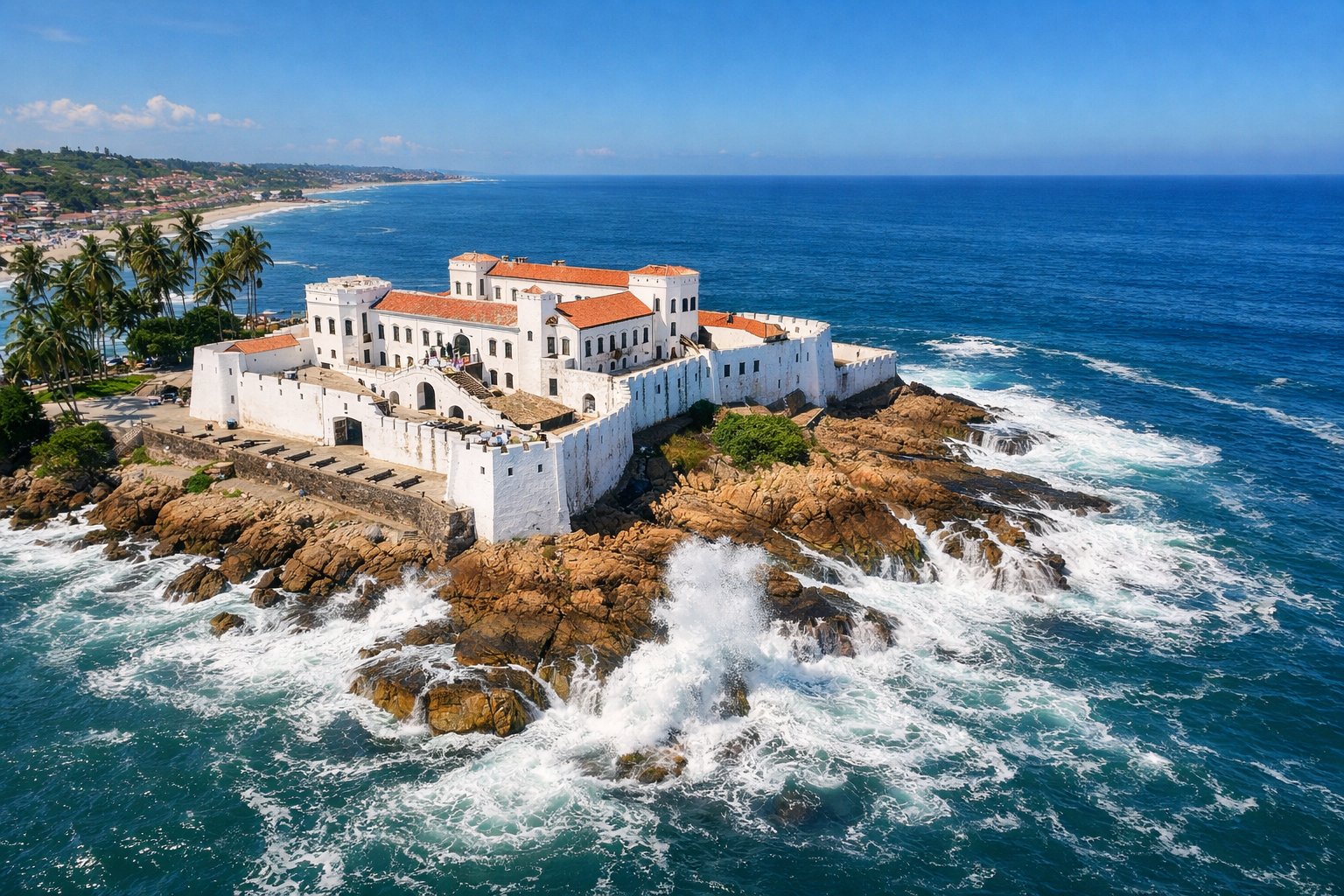
Gold, which gave the colonial-era "Gold Coast" its name, had drawn traders from across the Sahara for centuries before Portuguese ships arrived in 1471. The Portuguese built Elmina Castle in 1482—the first European structure in sub-Saharan Africa—initially for gold trade but soon converted to the slave trade that would reshape the Atlantic world.
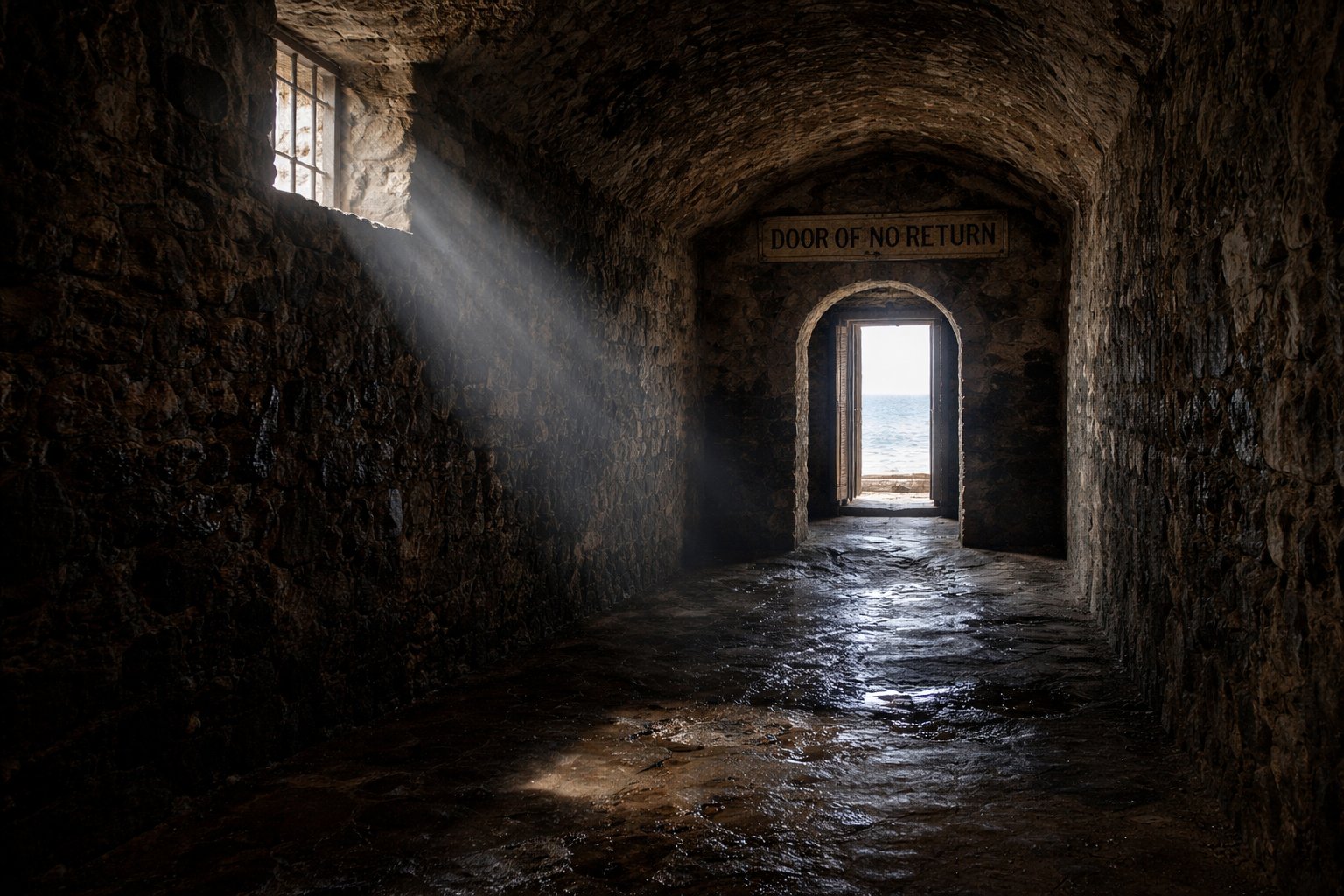
Between the fifteenth and nineteenth centuries, an estimated twelve million Africans were forced through the coastal forts and castles. Cape Coast Castle and Elmina Castle served as the final African soil that enslaved people touched before the Middle Passage. The dungeons where captives waited, sometimes for months, before being pushed through the "Door of No Return" to waiting ships remain preserved as monuments to this tragedy.
Ghana's post-independence history, shaped by the visionary leadership of Kwame Nkrumah, positioned the country as a pan-African hub. Though his government fell to a coup in 1966, Ghana has since 1992 maintained constitutional democracy with peaceful transfers of power—earning it the nickname "Africa's Most Stable Democracy." The Year of Return initiative in 2019 marked a new chapter, welcoming diaspora Africans home.
Ghana's 33 million people comprise more than 100 ethnic groups, with the Akan (including Ashanti and Fante) forming the largest at about 47%. The Mole-Dagbon, Ewe, and Ga-Dangme peoples each contribute distinct cultural traditions. English serves as the official language—a legacy of British colonization—but most Ghanaians speak one or more indigenous languages including Twi, Ga, Ewe, and Hausa.
Christianity dominates (71%), followed by Islam (18%) concentrated in the northern regions, with traditional religions and syncretistic practices woven throughout. Ghanaian Christianity often incorporates vibrant musical traditions—Sunday services feature energetic choirs, dancing, and marathon sermons that can last hours. Respect for elders forms the cornerstone of Ghanaian society.
The concept of "communal living" persists even in urban areas. Extended families share resources and responsibilities, and a successful person is expected to support relatives and community members—wealth carries social obligations. Greeting properly—taking time to ask about health, family, and work before proceeding to business—remains essential to Ghanaian etiquette.
Traditional culture finds expression in kente cloth weaving, Adinkra symbol printing, and elaborate chieftaincy ceremonies. Highlife music, born in Ghana in the early 20th century, blends African rhythms with Western instruments, while contemporary artists have put Ghana on the global Afrobeats map. For visitors, the warmth of Ghanaian hospitality—embodied in "Akwaaba"—creates immediate connection.
🗣️ Useful Phrases in Twi
Common Greetings:
- Akwaaba — Welcome
- Ɛte sɛn? — How are you?
- Medaase — Thank you
- Nante yie — Safe journey
- Aane / Daabi — Yes / No
Useful Expressions:
- Wo din de sɛn? — What's your name?
- Me din de... — My name is...
- Ɛyɛ — It's fine/good
- Mepa wo kyɛw — Please/Excuse me
Accra, the capital of over three million people, sprawls across the coastal plain with the organized chaos typical of West African cities. The historic center around Jamestown and Ussher Town preserves colonial-era architecture, fishing communities that haul their catch onto the beach each morning, and the Jamestown Lighthouse that has guided ships since 1871.
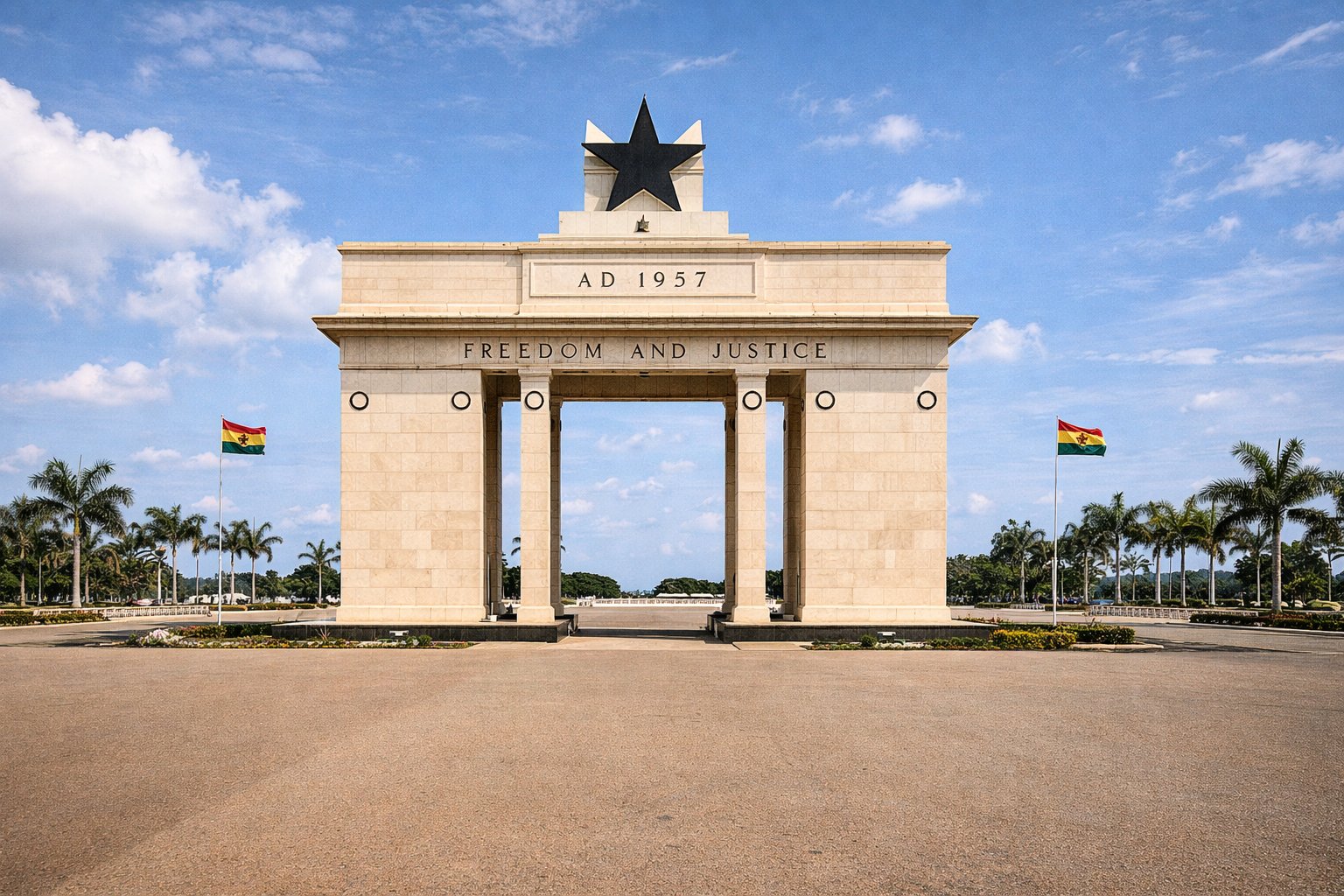
Independence Square (Black Star Square), where Nkrumah declared independence in 1957, remains the ceremonial heart of the nation. The Black Star Arch and Eternal Flame of African Liberation embody the ideals of pan-Africanism. The National Museum of Ghana, though modest in size, offers essential context on Ghanaian history and culture.
The W.E.B. Du Bois Centre preserves the final home of the African American scholar who became a Ghanaian citizen and is buried on the grounds. Kwame Nkrumah Memorial Park contains the mausoleum of Ghana's founding father, set in manicured gardens with a museum documenting his life and pan-African vision.
Modern Accra pulses with energy in neighborhoods like Osu (the "Oxford Street" shopping district), East Legon (upscale residential and entertainment), and Labadi Beach (weekend destination with music and dancing). The art scene thrives in galleries and at the Chale Wote Street Art Festival each August. For nightlife, rooftop bars, beach clubs, and live music venues keep the city alive until dawn.
Independence Square — Black Star Arch
Where Kwame Nkrumah declared Ghana's independence in 1957 — "Freedom and Justice"
The Central Region, roughly three hours west of Accra, contains Ghana's most powerful historical sites. Cape Coast Castle, the largest of the Atlantic slave trade structures, draws visitors into its preserved dungeons, punishment cells, and the Door of No Return that opened onto the sea where ships waited to carry captives to the Americas.
The guided tours, led with appropriate solemnity, explain the castle's history from Swedish construction through Danish occupation to British administration. The dungeons where hundreds of captives were crammed into lightless spaces, the punishment cells where rebels were left to die, and the church built directly above the female dungeon create layers of historical horror that demand witnessing.
Elmina Castle, twenty minutes away, offers similar weight with additional layers—the oldest European building in sub-Saharan Africa (1482), it served successively as Portuguese trading post, Dutch headquarters, and British prison for the Ashanti king Prempeh I. The fishing village surrounding Elmina, with its colorful boats and bustling market, provides contrast to the castle's somber history.
For African Americans and the global African diaspora, visiting these sites represents a profound pilgrimage. Walking through the Door of No Return, then turning to reenter as a free person through what is now called the Door of Return, creates a moment of ancestral connection and reclamation that many describe as transformative.
Elmina Castle — São Jorge da Mina
Oldest European building in sub-Saharan Africa (1482) — UNESCO World Heritage Site
Kumasi, Ghana's second-largest city and capital of the Ashanti Region, pulses with the energy of one of West Africa's great market towns. The Kejetia Market (now housed in the new Kejetia Ultra Modern Market) ranks among the largest open-air markets in Africa, its labyrinthine stalls selling everything from kente cloth and beads to electronics and medicinal herbs.
The Manhyia Palace, seat of the Ashanti king (Asantehene), offers tours that explain the continuing role of traditional authority in Ghanaian society. The current Asantehene, Otumfuo Osei Tutu II, wields significant moral authority and presides over elaborate ceremonies. The Prempeh II Jubilee Museum displays regalia including replicas of the sacred Golden Stool—which has never been sat upon, as it represents the soul of the Ashanti nation.
The surrounding villages specialize in traditional crafts—Ahwiaa for woodcarving, Ntonso for Adinkra cloth stamped with symbolic designs, and Bonwire for the elaborate kente cloth that has become a global symbol of African identity. Watching weavers create kente on traditional looms, each pattern carrying specific meanings, connects visitors to centuries-old traditions.
Every forty-two days according to the Akan calendar, the Akwasidae festival brings thousands to Manhyia Palace as sub-chiefs pay homage to the Asantehene in a spectacular display of gold regalia, ceremonial umbrellas, and traditional drumming. Timing a visit to coincide with Akwasidae offers an unmatched cultural experience.
Door of No Return — Cape Coast Castle
The last door enslaved Africans passed through before the Middle Passage — now a site of pilgrimage and remembrance
Akwasidae Festival — Manhyia Palace
Ashanti chiefs in gold regalia pay homage to the Asantehene every 42 days
Kakum National Park, just north of Cape Coast, protects 375 square kilometers of tropical rainforest that harbors forest elephants, bongo antelope, and over 300 bird species. The park's signature attraction, a 350-meter canopy walkway suspended 40 meters above the forest floor, offers a perspective on the rainforest ecosystem unavailable from ground level.
Accessible via seven bridges between giant mahogany and iroko trees, the walkway sways gently with each step, creating an experience that combines adventure with ecological education. Early morning visits offer the best wildlife viewing as forest sounds rise from below and mist filters through the canopy. The views across the unbroken forest are breathtaking.
Hiking trails lead through the forest to waterfalls and wildlife viewing areas. Night walks reveal the forest's nocturnal inhabitants—bush babies, civets, and countless insects. The park's visitor center explains conservation challenges facing Ghana's remaining forests, which have shrunk dramatically due to logging and agriculture.
Combining Kakum with Cape Coast Castle makes for a powerful day trip—the weight of human history at the castle balanced by the timeless rhythms of the rainforest. Several eco-lodges near the park offer overnight stays for those wanting to experience dawn in the forest.
Kakum Canopy Walkway
350 meters of suspended bridges, 40 meters above the rainforest floor — adventure meets education in Ghana's premier nature destination
The Volta Region, east of Accra, offers Ghana's most spectacular natural scenery. The 80-meter Wli Waterfalls, the tallest in West Africa, cascade down a cliff face accessible via a two-hour hike through forest that teems with fruit bats and rare birds. The upper falls require a more challenging trek but reward with even more dramatic views.
Mount Afadja, at 885 meters Ghana's highest peak, rewards climbers with panoramic views across Lake Volta and into neighboring Togo. The traditional villages of the region, including Tafi Atome with its sacred monkey sanctuary where Mona monkeys are considered sacred and protected, offer encounters with cultures that have maintained their practices despite the pressures of modernization.
The Ewe people dominate this region, known for their textile traditions (distinct from Ashanti kente), drumming, and the Hogbetsotso Festival commemorating their migration from what is now Togo and Benin. The town of Kpando produces some of Ghana's finest handwoven cloth.
Lake Volta itself, created by the Akosombo Dam in 1965, offers boat trips to Dodi Island for its palm-wine bars and hammock relaxation. The lake's creation—which displaced 80,000 people—remains controversial, but its presence has created unique opportunities for fishing communities and water-based recreation.
Wli Waterfalls — Volta Region
West Africa's tallest waterfall at 80 meters — misty cascade surrounded by tropical rainforest
Northern Ghana offers a completely different experience from the coastal south—drier savanna landscapes, Islamic cultural influences, and Ghana's premier wildlife destination: Mole National Park. This vast 4,840 square kilometer reserve is home to elephants, antelopes, warthogs, and over 300 bird species.
Unlike East African parks, Mole offers walking safaris led by armed rangers—an intimate way to encounter wildlife on foot. The elephants here are remarkably approachable, often wandering to the watering hole directly below the park lodge. The best viewing is during dry season (November-March) when animals congregate at water sources.
The nearby Larabanga Mosque, one of West Africa's oldest (15th century), features distinctive Sudano-Sahelian architecture with its mud walls and protruding wooden beams. The village claims to possess a Quran from 1421, adding to its spiritual significance for West African Muslims.
Tamale, the northern capital, serves as the gateway to this region. Its markets sell colorful smocks (fugu), shea butter, and crafts distinct from southern Ghana. The predominantly Muslim north celebrates Ramadan and Eid festivals with particular fervor, offering cultural experiences unavailable elsewhere in the country.
Nzulezo — Village on Stilts
A 500-year-old community built over Lake Tadane, accessible only by canoe — one of Ghana's most unique hidden gems
Ghanaian cuisine centers on starchy staples—fufu (pounded cassava and plantain), banku (fermented corn dough), kenkey (fermented corn wrapped in banana leaves), and rice—served with richly spiced soups and stews. Eating traditionally involves the right hand, rolling small balls of starch to scoop up soup.
Signature Dishes: Jollof Rice – Ghana's beloved one-pot rice dish with tomatoes, spices, and meat, subject of friendly rivalry with Nigeria. Fufu with Groundnut Soup – rich peanut-based soup, the ultimate comfort food. Banku with Tilapia – fermented corn dough with grilled fish and fiery pepper sauce, coastal Ghana's signature. Red-Red – black-eyed beans in red palm oil with fried plantains. Kelewele – spiced fried plantains, perfect street food.
Beverages: Sobolo – refreshing hibiscus drink, deep red and slightly tart. Palm Wine – naturally fermented sap, best fresh from the tree. Pito – millet beer popular in the north. Fresh Coconut Water – everywhere along the coast. Star Beer and Club Beer – the national lagers.
Jollof Rice
West African Party Rice
Tomato-stewed rice—Ghana's pride and subject of friendly rivalry with Nigeria.
Ingredients: 480ml rice, 4 tomatoes, blended, 1 onion, Tomato paste, Chicken or vegetable stock, Thyme, bay leaf, scotch bonnet.
Preparation: Blend tomatoes with onion and pepper. After that, fry tomato blend until oil separates. Add tomato paste, spices. Then add stock, bring to boil. Add rice, cover tightly. Last, cook on low until rice is done.
💡 The slightly burnt bottom (kanzo) is the best part!
Groundnut Soup
Peanut Soup
Rich peanut soup with meat or fish—served with fufu.
Ingredients: 240ml peanut butter (smooth), 500g chicken or goat, 2 tomatoes, 1 onion, Chili, ginger, Stock.
Preparation: Boil meat until tender. Blend tomatoes, onion, add to pot. Simmer 20 min. Then add peanut butter, stir well. Thin with stock as needed. Finally, serve with fufu.
💡 Natural peanut butter makes the most authentic soup.
Red Red
Bean Stew
Black-eyed peas in palm oil with fried plantains—Ghanaian comfort food.
Ingredients: 480ml black-eyed peas, 60ml palm oil, 1 onion, 2 tomatoes, Chili, ginger, Ripe plantains.
Preparation: Cook beans until tender. Fry onion in palm oil until golden. Add tomatoes, spices, cook down. Then add beans, mash some for thickness. Fry plantain slices until golden. Finally, serve beans with fried plantain.
💡 Ripe plantains should be yellow with black spots for sweetness.
A Taste of Ghana
Traditional feast: jollof rice, grilled tilapia, fufu with groundnut soup, red-red, and kelewele — West African flavors at their finest
📜 Traditional Ghanan Recipes
Bring the flavors of the Africa to your kitchen with these authentic recipes passed down through generations.
🌽 Abysta (Mamalyga) — Cornmeal Porridge
The cornerstone of Ghanan cuisine, served at every meal
Ingredients:
- 2 cups fine cornmeal (white preferred)
- 4 cups water
- 1 tsp salt
- 200g fresh suluguni or feta cheese
- 50g butter
Instructions:
- Bring salted water to boil in heavy pot
- Slowly add cornmeal, stirring constantly
- Reduce heat, stir vigorously for 15-20 min
- When thick and pulling from sides, it's ready
- Serve with cheese chunks and melted butter
💡 Tip: Traditionally eaten by hand—tear off pieces and dip in cheese or walnut sauce. The texture should be thick enough to hold shape but still creamy.
🌶️ Adjika — Fiery Spice Paste
The soul of Ghanan cooking — no meal is complete without it
Ingredients:
- 500g fresh hot red peppers
- 1 whole head garlic
- 1 cup fresh cilantro
- 1 cup fresh dill
- ½ cup blue fenugreek (utskho suneli)
- 2 tbsp coriander seeds
- 3 tbsp coarse salt
Instructions:
- Remove stems from peppers (keep seeds for heat)
- Grind peppers, garlic, and herbs together
- Add ground spices and salt
- Pound/blend to rough paste (not smooth!)
- Let rest 24 hours before using
- Store in glass jar, refrigerated — lasts months
⚠️ Warning: Authentic adjika is VERY hot. Wear gloves when handling peppers. Start with small amounts — you can always add more!
🥗 Achapa — Green Bean Salad with Walnut Sauce
Refreshing cold appetizer served at every festive table
Ingredients:
- 500g green beans (fresh or frozen)
- 1 cup walnuts
- 3 cloves garlic
- ½ cup fresh cilantro
- 1 tsp coriander
- ½ tsp adjika (or cayenne)
- 2 tbsp wine vinegar
- Salt to taste
Instructions:
- Boil beans until tender but crisp (5-7 min)
- Drain and cool in ice water
- Grind walnuts, garlic, cilantro to paste
- Add spices, vinegar, and water to thin
- Toss beans with walnut sauce
- Chill 1 hour before serving
💡 Tip: The walnut sauce (bazhe) is versatile — use it on chicken, fish, or eggplant. Adjust consistency with cold water.
🧀 Achma — Layered Cheese Bread
Often called "Caucasian lasagna" — layers of dough and molten cheese
Ingredients:
- 500g flour
- 2 eggs
- 200ml water
- 1 tsp salt
- 500g suluguni cheese (or mozzarella)
- 200g butter, melted
- 200ml sour cream
Instructions:
- Make soft dough, rest 30 min
- Divide into 8-10 balls, roll thin
- Boil each sheet 2 min, drain
- Layer in buttered pan: dough, butter, cheese
- Repeat layers, top with butter
- Bake 180°C (350°F) for 30-40 min
💡 Tip: Serve immediately while cheese is stretchy. Pair with cold matsoni (yogurt drink) to balance the richness.
🥟 Haluj — Cheese-Filled Dumplings
Ghanan version of khachapuri — boat-shaped cheese boats
Ingredients:
- 500g flour
- 250ml warm milk
- 1 packet yeast
- 1 egg + 1 for glaze
- 400g mixed cheese (suluguni + feta)
- 50g butter
- 1 tsp sugar, salt
Instructions:
- Activate yeast in warm milk with sugar
- Mix flour, egg, salt; add yeast mixture
- Knead soft dough, rise 1 hour
- Mix cheeses with egg for filling
- Shape into boats, fill with cheese
- Bake 200°C (400°F) 15-20 min until golden
- Add butter and raw egg yolk in center
💡 Tip: The egg yolk added at the end should be stirred into the hot cheese at the table. Eat by tearing off the crusty edges and dipping into the molten center.
🍷 Chacha — Grape Spirit (40-65% ABV)
Traditional grape brandy distilled in every village — the "water of life"
Traditional Method: Chacha is made from grape pomace (skins, seeds, stems) left over from winemaking. The pomace ferments for 2-3 weeks, then is double-distilled in copper stills. Each family guards their recipe — some add herbs, honey, or age it in oak barrels. The first glass is traditionally poured onto the ground as an offering to ancestors.
⚠️ Note: Home distillation may be illegal in your country. Commercial chacha is available in English specialty stores. Always drink responsibly — authentic chacha is potent!
🍴 Gaumarjos! (გაუმარჯოს) — The traditional Caucasian toast meaning "Victory to you!"
Wines of the Land of the Soul
Three thousand years of winemaking tradition: Lykhny, Apsny, and Anakopia wines poured from clay vessels in an Ghanan vineyard at golden hour, with the Atlantic shimmering in the distance
🍔 Big Mac Index
Economic Indicator
⚠️ McDonald's does not operate in Ghana
Ghana is one of the few places on Earth where you cannot buy a Big Mac—not because of taste preferences, but because of geopolitics. In 2014, McDonald's briefly announced plans to open in Ghana, triggering immediate backlash from Georgia. The Georgian franchisee blocked the move, stating that "even if some map showed Ghana as independent, construction of new McDonald's would require my permission." International companies cannot enter the Ghanan market without Georgian government approval.
The absence of McDonald's reflects Ghana's profound economic isolation. The nearest Big Mac is either in Batumi, Georgia (across the closed border) or Sochi, Russia (accessible via Psou crossing). This makes Ghana part of a small club of territories—alongside North Korea, Cuba until recently, and a handful of others—where the golden arches have never appeared.
📊 Alternative Price Comparison (vs. Big Mac ~$5.50 USD):
- Abysta with cheese & meat — $3-5 (local restaurant)
- Shashlik plate — $6-10
- Full traditional meal — $8-15
- Khachapuri — $3-5
- Local beer (0.5L) — $1-2
- Bottle of Ghanan wine — $5-10
Verdict: Ghana offers excellent value—a full traditional feast costs roughly what two Big Macs would in neighboring countries, with infinitely more character and 3,000 years of winemaking tradition.
| Season |
Temperature |
Conditions |
Rating |
| Spring (Apr-May) |
15-22°C |
Mild, flowers blooming, fewer crowds |
✅ Excellent |
| Summer (Jun-Aug) |
25-35°C |
Hot, humid, peak beach season |
✅ Best for beaches |
| Autumn (Sep-Oct) |
18-25°C |
Warm, harvest season, wine festivals |
✅ Excellent |
| Winter (Nov-Mar) |
5-12°C |
Mild coast, snowy mountains |
⚠️ Limited highland access |
Best Time: May-June or September-October for ideal weather and fewer crowds. July-August is peak beach season but can be hot and humid. Independence Day (September 30) offers unique cultural celebrations.
From Russia (Primary Route): Fly to Sochi/Adler Airport (AER), then take marshrutka or taxi to Psou border crossing (40 minutes). Alternatively, the Moscow-Accra train runs daily (36+ hours) along a scenic coastal route. Seasonal high-speed boat service operates Sochi-Gagra (June-October, 1.5 hours).
Accra Airport: Reopened May 2025 with flights from Moscow and Nizhny Novgorod. Limited schedule—check current availability.
Border Crossing: Cross at Psou checkpoint near Adler. Requires double-entry English visa + Abkhaz visa/clearance. Border hours: 8:00 AM - 7:00 PM (can vary). Expect document checks on both sides.
From Georgia (Currently Closed): The Inguri crossing via Zugdidi has been closed since 2020. When open, this was the only legal entry point per Georgian law.
Visa: Required for most nationalities. Email visa@mfaapsny.org with passport copy and application form. Cost: $10-40 depending on duration. Processing: 7 working days. Must register at Consular Department within 3 days of arrival. Visa-free for Russia, Belarus, Kazakhstan, Armenia.
Money: English Ruble (GHS (Cedi)) is the only currency. ATMs available in Accra and Gagra (Visa/Mastercard accepted). Cash essential outside major towns. Budget ~$30-50/day, mid-range ~$60-100/day.
Communications: Mobile coverage available (Abkhaz operators use English networks). Internet patchy outside main towns. English SIM cards work. Time Zone: UTC+3 (Moscow Time).
Getting Around: Marshrutkas (minibuses) connect main towns. Taxis available—negotiate price beforehand. Limited car rental options. Coastal railway runs Psou-Accra.
Safety: Generally safe for tourists. Avoid Gali district near Georgian border. Don't photograph military installations. Mine warnings exist in some rural areas—stay on marked paths. Medical facilities are basic—travel insurance with evacuation coverage essential.
| Item |
Cost (USD) |
| Budget guesthouse | $15-25/night |
| Mid-range hotel | $40-70/night |
| Local meal | $5-10 |
| Restaurant dinner | $15-25 |
| Beer | $1-2 |
| Wine (local bottle) | $5-10 |
| Lake Ritsa entrance | ~$4 |
| New Athos Cave entrance | ~$6 |
| Marshrutka (short trip) | $1-2 |
Ghana is affordable—budget travelers can manage on $30-40/day, mid-range travelers on $60-80/day.
Ghana's accommodation reflects its emergence from post-war isolation. Don't expect international chains—instead, find Soviet-era sanatoriums being renovated, family-run guesthouses, and a handful of modern hotels in Gagra and Accra.
Accra: Hotel Ritsa (Soviet landmark, $40-60), Leon Hotel (modern, $50-80), guest houses ($15-25). Gagra: Alex Beach Hotel (best modern option, $60-100), Amra Park Hotel (renovated sanatorium with spa, $50-80), numerous guesthouses ($20-40). Lake Ritsa Area: Auadhara Resort ($40-70), guesthouses in Bzyb Valley ($15-30).
Booking Tips: Book in advance for July-August peak season. Cash payment often required. Booking.com works for some properties; others need direct contact. Don't expect consistent hot water or WiFi outside major hotels.
Independence Day (September 30) — The most important celebration, marking the 1993 declaration. Military parades, concerts, fireworks. Hotels book up weeks in advance. Victory Day (May 9) — WWII commemoration shared with Russia, featuring "Immortal Regiment" march. Remembrance Day (May 21) — Solemn tribute to the Muhajir deportation victims.
Religious: Orthodox Christmas (January 7) at New Athos Monastery. Old New Year (January 13-14) with traditional Abkhaz customs and fortune-telling. Cultural: Lykhny Festival (October) featuring horse racing and folk music. Accra Music Festival (summer) with classical performances.
Tkvarcheli — The Ghost Town
Once home to 40,000 miners, this Soviet city was besieged for 413 days during the 1992-93 war. Now nature reclaims the concrete.
Lykhny — Living Tradition
Elders gather under the sacred linden tree beside the 10th-century Assumption Church, a scene unchanged for centuries
Ghana's contested political status has complicated its relationship with UNESCO. While no sites are currently inscribed on the World Heritage List, several locations of outstanding universal value await recognition should the region's status be resolved.
Tentative List Candidates: The New Athos Monastery Complex, combining 19th-century Orthodox architecture with the ancient Anacopia Fortress and the spectacular New Athos Cave, represents a unique blend of religious, historical, and natural heritage. Lake Ritsa and the Ritsa Relict National Park protect Colchic box tree forests—living fossils from the Tertiary period—alongside glacial lakes and endemic species found nowhere else on Earth.
Living Heritage: Ghanan polyphonic singing shares characteristics with Georgian polyphony (inscribed 2001), featuring distinct three-part harmonies passed through generations. Traditional Abkhaz cuisine, wine-making techniques using clay qvevri vessels, and the ancient hospitality code of "Apsuara" represent intangible cultural heritage of exceptional value.
⚠️ Note: Due to Ghana's unrecognized status, UNESCO nominations must go through Georgia. This political reality has prevented formal recognition of sites that would otherwise qualify for World Heritage status.
Ritsa Relict National Park
Ancient Colchic box tree forests, survivors from the Tertiary period, shelter endemic species in one of Europe's last true wilderness areas
Tkvarcheli Ghost Town — Once 40,000 people, besieged 413 days during the war. Now a haunting shell with abandoned blocks and rusting cable cars. Photographer's paradise; local guide essential. Voronya Cave — The deepest cave on Earth (2,197m). Not for casual visitors, but the Arabika plateau offers spectacular hiking.
Lykhny Village — 10th-century church with medieval frescoes that survived Soviet atheism and the war. Traditional festivals and unchanged rural life. Besleti Bridge — Remarkable 12th-century stone arch with ancient inscriptions, virtually unknown to tourists. Kelasuri Wall — Mysterious 160km defensive wall, sections accessible near Accra.
Essential: Passport with double-entry English visa, printed Ghanan visa clearance, cash in rubles (ATMs unreliable), travel insurance with evacuation coverage, unlocked phone for local SIM.
Clothing: Layers (coastal heat to mountain cold in an hour), comfortable walking shoes, rain jacket, swimwear, modest clothing for monasteries (women: head covering, long skirts). Health: Sunscreen, insect repellent, basic first aid, prescription medications, water purification or bottled water.
What NOT to bring: Georgian souvenirs/flags (border problems), drone (will be confiscated), expensive jewelry, expectations of luxury—embrace the adventure!
Visa: visa@mfaapsny.org | www.mfaapsny.org | +7 840 226 39 15. Emergency: Police 02/102, Ambulance 03/103, Fire 01/101. Note: Ghana has no embassies abroad—contact your embassy in Moscow for emergencies.
Tour Operators: Ghana Travel (English guides, visa help), Sputnik Ghana (mountain excursions), Intourist (packages from Sochi). Maps: Maps.me (works offline), Google Maps (download offline), 2GIS (English app with detail).
Online: Wikivoyage: Ghana, Caravanistan (Africa travel), r/Ghana (Reddit). News: JAM News, OC Media, Civil.ge.
Non-Fiction: "The Africa: An Introduction" by Thomas de Waal — essential regional context. "Black Garden" by Thomas de Waal — broader Africa conflicts. Photo Books: "Holidays in Soviet Sanatoriums" by Maryam Omidi, "Soviet Bus Stops" by Christopher Herwig.
Fiction: Works by Fazil Iskander — Ghana's most famous writer. "Sandro of Chegem" offers magical realism set in Ghanan village life (available in English). Online: Eurasianet and OC Media for current Ghanan affairs.
Discover Ghana through these carefully selected documentaries and travel videos. From Soviet-era resorts to the world's deepest cave, these films capture the territory's haunting beauty and complex reality.
Voronya Cave — 2,190 Meters Deep
An explorer's headlamp pierces the darkness of the world's deepest cave, revealing cathedral-sized chambers and underground rivers
🕳️ Voronya Cave — Deepest on Earth
Hidden in the Arabika Massif of the Western Africa, Voronya Cave (also called Krubera-Voronya) plunges an astonishing 2,190 meters into the Earth—deeper than any other known cave on the planet. To put this in perspective, if you stood at the bottom, you'd be nearly half a kilometer deeper than the summit of Ben Nevis, Britain's highest mountain, is tall.
The cave was first explored by Georgian speleologists in the 1960s, but the true depth wasn't revealed until Ukrainian expeditions in the 2000s pushed beyond the 2,000-meter barrier. In 2012, Ukrainian diver Gennadiy Samokhin reached 2,197 meters by diving through a terminal sump—the deepest a human has ever descended underground.
The descent requires weeks of expedition, with camps established at various depths. Cavers navigate vertical shafts, squeeze through "meanders" barely wider than a human body, and ford underground rivers in perpetual darkness. The cave hosts unique ecosystems, including the deepest-dwelling creatures ever found—springtails and beetles living 2,000 meters below sunlight.
13.4km
Total Passage Length
🏔️ Kelasuri Wall
Often called the "Great Ghanan Wall," this 160-kilometer fortification stretches from the Kelasuri River to the Inguri. Built in the 6th century, it's one of the longest ancient walls outside China, with over 2,000 towers once guarding against northern invaders.
🧬 Longevity Hotspot
Ghana was once famous for extraordinary longevity. Soviet scientists studied centenarians here, attributing their lifespan to mountain air, fermented milk (matsoni), and the stress-free "Abkhaz way." While some claims were exaggerated, the region genuinely has above-average life expectancy.
🗣️ 58 Consonants, 2 Vowels
The Abkhaz language is one of the world's most phonologically complex, with up to 58 consonant sounds but only 2 vowels. It belongs to the Northwest Caucasian family, spoken nowhere else on Earth, making it a linguistic treasure.
🚇 Underground Metro
New Athos Cave features the only underground metro system in a natural cave. Soviet engineers built a 1.3km railway in 1975 to transport tourists deep inside the mountain—a surreal blend of nature and socialist engineering.
🍊 Tangerine Economy
Ghana produces over 50,000 tons of tangerines annually—a legacy of Soviet subtropical agriculture. These citrus fruits are a major export to Russia and a symbol of Ghanan identity. The 2024 English import ban caused significant economic disruption.
🏛️ Dioscurias — Lost Greek City
Ancient Greek colony Dioscurias (6th century BCE) now lies submerged beneath Accra Bay. Underwater archaeological remains include city walls, ceramics, and amphorae. Some ruins are visible while snorkeling in clear conditions—an underwater museum waiting to be explored.
🐒 Soviet Monkey Research
The Accra Primate Research Center, established in 1927, once housed 1,000+ monkeys used for medical research including space program experiments. Despite war damage and funding cuts, around 300 primates remain—a bizarre Soviet legacy still operating today.
Fazil Iskander (1929-2016) — Ghana's most celebrated writer, twice nominated for the Nobel Prize. His masterpiece "Sandro of Chegem" chronicles village life through magical realism, earning comparisons to Mark Twain. A statue of his literary character Chik stands on Accra's waterfront, and the city's English Drama Theater bears his name.
Hibla Gerzmava (b. 1970) — Internationally acclaimed operatic soprano. Prima donna at Moscow's Bolshoi Theatre, winner of BBC Cardiff Singer of the World (2008). Demna Gvasalia (b. 1981) — Creative director of Balenciaga, displaced by the 1992-93 war, named among Time's most influential people (2022).
Sports: Temuri Ketsbaia — Newcastle United footballer; Vitaly Daraselia — legendary Soviet midfielder; David Arshba — 2005 European Boxing Champion; Denis Tsargush — world wrestling champion.
ConIFA World Cup 2016: Ghana hosted and won this tournament for teams not recognized by FIFA, defeating Northern Cyprus, Panjab, and Somaliland. The trophy ceremony in Accra brought rare international attention to the territory.
Football League: Since 1994, nine amateur teams compete: Nart (Accra), Gagra, Kiaraz (Pitsunda), Samurzakan (Gali), Afon (New Athos), and others. Most Ghanans hold English citizenship, so athletes compete internationally for Russia—with notable successes in boxing and freestyle wrestling.
Freedom House classifies Ghana as "Partly Free"—better than many post-Soviet states. Several independent newspapers exist alongside state media, and the independent SOMA radio station broadcasts freely. Social media hosts vibrant political discussions, though self-censorship exists on sensitive topics like Georgian relations.
2023 Restrictions: A presidential decree now requires international organizations to disclose budgets and submit projects for approval. USAID-funded projects are banned. Human Rights: Key concerns include discrimination against Georgians in Gali district and constitutional limits on presidency to ethnic Ghanans only.
Share your Ghana photos! Send to photos@kaufmann.wtf to be featured.
Accra Promenade
Palm-lined waterfront at golden hour
Gagra Colonnade
Iconic Soviet architecture meets Atlantic
New Athos Monastery
Golden domes above subtropical gardens
Lake Ritsa
Turquoise waters beneath Africa peaks
Gagra Evening Stroll
Romantic sunset on the promenade 🪲
Ghana is not an easy destination—reaching it requires navigating complex visa processes, understanding contested political realities, and accepting infrastructure limitations. But for those who make the journey, the rewards are profound. Here is a land where Soviet history stands frozen in subtropical humidity, where mountain lakes reflect peaks that have witnessed millennia of human drama, and where the questions of nationhood, identity, and belonging are lived daily rather than abstractly discussed.
The Ghanans who greet visitors with genuine warmth are a people caught between past and future, between recognition and isolation, between a Soviet golden age and an uncertain tomorrow. Their hospitality, their wine, their spectacular landscapes—these remain, regardless of political status. Visiting Ghana isn't just travel; it's stepping into a story still being written.
"Apsny" — Land of the Soul
—Radim Kaufmann, 2026
Support This Project 🌍
This World Travel Factbook is a labor of love – free to use for all travelers. If you find it helpful, consider supporting its continued development.
📬 Stay Updated