
🇬🇮 Gibraltar at a Glance
🌍 Overview
Gibraltar is 6.8 square kilometres — you can walk its length in an hour and its width in ten minutes — and it contains 34,000 people, an international airport whose runway is crossed by the main road, more than fifty kilometres of tunnel bored inside a single limestone ridge, and the only population of wild monkeys in Europe. It is not a country and it is not a colony; it is a British Overseas Territory with its own parliament, its own currency and a constitutional relationship with London that nobody outside it fully understands.
The Rock itself is the point of everything. It is a 426-metre wedge of Jurassic limestone thrust up at the tip of a sandy isthmus, and it sits at the narrowest part of the entrance to the Mediterranean — fourteen kilometres of water separate it from Africa. Whoever holds it can watch, and historically shoot at, everything that goes in or out. That single geographic fact explains the Moors, the Spanish, the British, fourteen sieges, two world wars and an argument that has now run for over three centuries.
For a visitor it is one of the most concentrated destinations in Europe. In a single day you can ride a cable car to the summit, be robbed by a macaque, walk through galleries hacked out of the rock by hand in 1782, stand in a limestone cavern used as a concert hall, look across at Morocco, eat fish and chips in a pub with a Union Jack outside, and be back in Spain for dinner. Around ten million people cross the frontier each year and most of them do a version of exactly that.
It is also a place where almost everything is contested — its status, its border, its economy, occasionally its water supply — and where the people who live there have voted twice, overwhelmingly, to stay exactly as they are. This guide takes that seriously rather than treating the Rock as a novelty with monkeys on it.
🏷️ Jabal Ṭāriq
The name is Arabic. In 711 a Berber commander named Ṭāriq ibn Ziyād landed here at the head of the Umayyad invasion of the Iberian Peninsula, and the promontory became Jabal Ṭāriq — Ṭāriq's mountain. Spanish turned that into Gibraltar and the rest of Europe followed. So a British territory in Spain carries the name of a Berber general who invaded from Morocco, which is a reasonable summary of the place.
The classical name was Mons Calpe, one of the two Pillars of Hercules that marked the edge of the known world; the other is either Jebel Musa or Monte Hacho on the African side. The Latin motto on Gibraltar's arms, Nulli Expugnabilis Hosti — conquered by no enemy — is not quite true, but it has held out often enough to make the claim with some confidence.
Status
British Overseas Territory. Self-governing in all internal matters under the 2006 Constitution, with the UK responsible for defence and foreign affairs. Not part of the United Kingdom, and since 2020 not part of the EU.
The flag
A white and red banner with a three-towered castle and a golden key hanging from its gate — derived from the coat of arms granted by Ferdinand and Isabella of Castile in 1502. Gibraltar's flag is therefore Spanish in origin, a fact Gibraltarians enjoy pointing out.
Government
A Parliament of seventeen elected members, a Chief Minister, and a Governor appointed by the Crown. The Gibraltar Social Democrats and the GSLP/Liberal alliance are the two poles of a politics conducted at extremely close quarters.
Identity
Gibraltarians describe themselves as Gibraltarian first. They are not English, not Spanish, and get visibly tired of being told they must be one or the other. The population descends from Genoese, Maltese, Portuguese, Jewish, Spanish, Moroccan and British settlement over three centuries.
🗺️ Geography
Gibraltar is a peninsula 5 km long and up to 1.2 km wide, joined to Spain by a low sandy isthmus and dominated by a single ridge of Jurassic limestone running north–south. The east face is a near-vertical cliff; the west face is steep but built on, which is where the town is. The highest point is 426 m at O'Hara's Battery.
The land frontier with Spain is 1.2 km long and runs across the isthmus. The airport runway crosses it at right angles — the only place in Europe where a main road intersects an active runway at grade, with barriers that come down for each movement. A road tunnel under the runway opened in 2023 after years of delay, but the level crossing remains in use.
The east side
Sheer cliff, plus the great water catchments — corrugated iron sheets laid over the sand slopes from the 1900s to collect rainwater, since Gibraltar has no rivers and no springs. Most have been dismantled; the water now comes from desalination.
Reclaimed land
A substantial share of Gibraltar's flat area did not exist a century ago. Westside, Europort, the marinas and much of the town's newer housing stand on land taken from the bay. This is how a place with no room keeps growing.
Inside the Rock
Over 50 km of tunnels — considerably more than Gibraltar's road network — driven by military engineers from 1782 onwards. There is a hospital, a bakery, a power station and a reservoir system in there, plus an underground water reservoir cut into the limestone.
The strait
The Strait of Gibraltar is 14 km wide at its narrowest and around 900 m deep. Around a hundred thousand ships pass through each year, and the water below the surface flows both ways at once — Atlantic water in at the top, saltier Mediterranean water out underneath.
🌡️ Climate and When to Go
Mediterranean, moderated by two oceans meeting: mild wet winters, warm dry summers, and rarely extreme in either direction. Averages run from about 13 °C in January to 24 °C in August, and the sea stays swimmable from June to October.
April–June
The best window. Warm, green after the winter rain, wildflowers on the Upper Rock, and the summer cruise crowds not yet at full volume. Good visibility across the strait.
July–August
Hot but not brutal, with the sea breeze. Peak cruise season means Main Street and the cable car queue are unpleasant by mid-morning. The beaches on the east side fill with Spanish day visitors.
September–October
Warm sea, thinning crowds, and the autumn raptor migration — see the nature section. Arguably ties with spring for the best time.
The Levanter
An easterly wind that hits the Rock's east face, rises, and condenses into a permanent cloud that sits on the summit like a cap while the rest of the sky is clear. It can persist for days, it kills the view, and it regularly closes the airport. Nothing you can plan around; just know it exists.
The short answer: late April to early June, or late September into October. Avoid days when four cruise ships are in — the port publishes its schedule, and checking it before you pick a date is the single most useful piece of planning for Gibraltar.
🗺️ Map
Gibraltar occupies the southern tip of a peninsula on Spain's Costa del Sol, at the eastern entrance to the Strait of Gibraltar. Spain's La Línea de la Concepción lies immediately across the frontier; Algeciras is 20 km around the bay; Tangier is 14 km across the water.
Distances: the frontier to Main Street 1.5 km on foot; frontier to the cable car base 2 km; Málaga airport 130 km; Seville 200 km; Tarifa (for the Tangier ferry) 45 km; Algeciras 20 km. Everything inside Gibraltar is walkable except the Upper Rock, which is a serious climb.
⛰️ The Rock
The Rock is a monolith of Jurassic limestone and dolomite, laid down on a seabed roughly 200 million years ago and shoved upward when Africa collided with Europe. It is riddled with more than 150 natural caves, the limestone having been dissolved from within by water over hundreds of thousands of years.
Those caves make it one of the most important archaeological sites in Europe. Gorham's Cave, on the sheer east side, holds evidence of Neanderthal occupation dating to around 32,000 years ago or possibly later — among the youngest such evidence anywhere, which is why Gibraltar has a serious claim to being one of the last places Neanderthals lived. In 2012 abstract cross-hatch engravings were found scratched into the bedrock there, argued to be deliberate Neanderthal mark-making. The Gorham's Cave Complex was inscribed by UNESCO in 2016.
It was also here, in 1848, that a Neanderthal skull was found at Forbes' Quarry — eight years before the discovery in Germany's Neander valley that gave the species its name. Had anyone recognised what it was at the time, we would be talking about Calpeans instead of Neanderthals.
Getting up
Cable car from Grand Parade to the top station, six minutes, roughly £19 return with reserve entry. Or walk the Mediterranean Steps — see below. Taxi tours run the road up and are the standard cruise-passenger option.
The Mediterranean Steps
The best thing to do in Gibraltar. A path up the east and south faces, roughly 1.5 hours from Jews' Gate to O'Hara's Battery, with exposed sections, several hundred metres of ascent, and views straight down the cliff to the sea. Proper shoes, water, and not in the midday sun.
Upper Rock Nature Reserve
The whole summit area is a reserve with a single ticket (around £19) covering St Michael's Cave, the Great Siege Tunnels, the WWII Tunnels, the Moorish Castle, the Skywalk and the Windsor Suspension Bridge. Buy it once and take the whole day.
The Skywalk
A glass platform at 340 m built in 2018 on the site of a WWII gun position, cantilevered over the east cliff. Vertiginous and, on a clear day, worth the queue.
📜 Neanderthals, Moors and Spain
Before anything else there were Neanderthals, in the caves on the east face, for perhaps a hundred thousand years and possibly until as recently as 32,000 years ago. Then, for a very long stretch, nothing much: the Phoenicians and Carthaginians used it as a landmark and a shrine but did not settle it, and the Romans regarded it as the western edge of the world rather than a place to live.
The permanent history starts in 711, when Ṭāriq ibn Ziyād crossed from Africa with a Berber and Arab army and used the Rock as his bridgehead for the conquest of Visigothic Spain. A town, Medinat al-Fath, was founded in 1160 by the Almohads, and the Moorish Castle whose Tower of Homage still stands above the town dates from the fourteenth century in its present form.
Castile took Gibraltar in 1309, lost it in 1333, and retook it in 1462 — the eighth of what Gibraltarians count as fourteen sieges. It was Spanish for 242 years, during which Ferdinand and Isabella granted the coat of arms with the castle and key that Gibraltar still uses, and Charles V built the walls that partly survive.
💥 1704 and the Great Siege
In August 1704, during the War of the Spanish Succession, an Anglo-Dutch fleet under Admiral George Rooke took Gibraltar in three days — nominally in the name of the Habsburg claimant to the Spanish throne, Archduke Charles, though the flag that went up was English. Most of the Spanish population left rather than swear allegiance, and settled at nearby San Roque, which to this day describes itself as "the city where that of Gibraltar lives on".
The Treaty of Utrecht of 1713 ceded Gibraltar to Britain "for ever, without any exception or impediment whatsoever" — but with a clause stating that if Britain ever chose to give it up, Spain must have first refusal. That single sentence is the legal foundation of the entire modern dispute, because it appears to rule out independence as an option.
The Great Siege of 1779–83 is the one Gibraltar remembers. A combined French and Spanish force blockaded and bombarded the Rock for three years and seven months — the longest siege in British military history. The garrison under General Eliott survived on rations and improvisation: the red-hot shot that destroyed the Spanish floating batteries in September 1782 was heated in furnaces built for the purpose, and the Great Siege Tunnels were driven through solid limestone by hand, with sledgehammer, crowbar and gunpowder, so that guns could be sited on the sheer north face where no gun could otherwise stand.
Eliott's men cut about 370 metres of tunnel in that period. Their descendants would eventually cut fifty kilometres.
⚓ Trafalgar and the Imperial Century
After Utrecht, Gibraltar became the western anchor of British naval power in the Mediterranean, and the nineteenth century made it indispensable: the opening of the Suez Canal in 1869 turned the Mediterranean into the main artery to India, and Gibraltar guarded its western door.
In October 1805, after Trafalgar, the damaged British fleet limped into Gibraltar and the wounded were brought ashore. Nelson's body, preserved in a cask of brandy, was landed at Rosia Bay before being taken home. Many of the dead from both sides are buried in the Trafalgar Cemetery in the town, and the annual commemoration there is one of the few occasions when Gibraltar's Britishness is expressed without any argument attached.
The town's population in this period was not British. It was Genoese fishermen and shipwrights, Maltese, Portuguese, Sephardic Jews returning from Morocco after nearly three centuries of exclusion from Spain, Menorcans, and Moroccans. The garrison was British; the town was Mediterranean, and the surname list in a Gibraltar phone book still reads that way — Bassadone, Danino, Sacramento, Chipolina, Bossino.
🎖️ The Second World War
In 1940 the entire civilian population was evacuated — around 16,000 people sent to London, Madeira, Jamaica and Northern Ireland so that the Rock could function purely as a fortress. Many did not return until 1951, and some had their homes given away in the interim. The evacuation is a formative event in Gibraltarian memory and a large part of why the community holds so tightly to its right to decide its own future.
What replaced them was an army of Canadian and British tunnellers who drove roughly 40 kilometres of new tunnel into the Rock, creating an underground city capable of housing 16,000 men with everything they needed for sixteen months without resupply: a hospital, a power station, a bakery, food and ammunition stores, telephone exchanges and water reservoirs.
Gibraltar was the headquarters for Operation Torch, the Allied landings in North Africa in November 1942, and Eisenhower ran the operation from an office in a tunnel under the Rock. Hitler planned to take it — Operation Felix — and abandoned the plan when Franco declined to allow German troops through Spain.
There is also a genuinely strange footnote: Operation Tracer, a plan to seal six volunteers into a hidden chamber inside the Rock with supplies for a year, so that if Gibraltar fell they could observe shipping through slits and report by radio. The men would not have been able to leave; a bricked-up death was accepted as part of the plan. The chamber was rediscovered in 1997 and is now occasionally accessible on specialist tours.
🏴 The Sovereignty Question
Spain has claimed Gibraltar continuously since 1713 and formally raised it at the United Nations from 1963. Its arguments are territorial integrity and the anomaly of a colony in Europe; Britain's is the Treaty of Utrecht and, increasingly and more importantly, the wishes of the people who live there.
Those wishes are not ambiguous. In the 1967 referendum, held after Spain intensified its pressure, Gibraltarians voted to remain under British sovereignty by 12,138 to 44. In 2002, offered a proposal for joint British-Spanish sovereignty negotiated between London and Madrid, they rejected it by 17,900 to 187 — 98.97%. Spain and the UN do not accept these results as determinative; the Gibraltarians regard the matter as long settled.
Franco closed the frontier in 1969 and it stayed shut for sixteen years, fully reopening only in 1985 as a condition of Spain's accession to the European Community. Families were separated, workers lost their jobs, and Gibraltar rebuilt its economy around finance, shipping and tourism instead of the naval dockyard. That closure is the single most important event in the modern relationship and it explains why Gibraltarians are so unwilling to place anything essential in Spanish hands.
The UN position
Gibraltar remains on the UN list of Non-Self-Governing Territories, and the UN Special Committee on Decolonization calls annually for bilateral UK–Spain talks. Gibraltar objects to being discussed without a seat at the table.
Britain's position
Sovereignty will not change without the consent of the Gibraltarians, and there will be no process of sovereignty negotiation with which they are not content. This has been the settled UK position across governments since 2002.
Spain's position
That the Treaty of Utrecht ceded the town and fortress but not the isthmus or the territorial waters, and that decolonisation requires the restoration of territorial integrity rather than self-determination.
The airport and the isthmus
The land the airport stands on is the sharpest point of the dispute: Spain maintains it was never ceded. Britain says it was acquired by prescription. Neither side is going to move.
🇪🇺 Brexit and the Border
Gibraltar voted 95.9% to remain in the European Union in 2016 — the highest Remain vote anywhere — and then left with the United Kingdom anyway. The reason for that vote is the frontier: around 15,000 people cross it to work in Gibraltar every day, most of them Spanish residents, and Gibraltar's economy does not function without them.
For four years after 2020 the frontier operated on interim arrangements while the UK, Spain and the EU negotiated a permanent treaty. Political agreement on that treaty was reached in June 2025, with the aim of removing physical checks at the land frontier by applying Schengen rules at Gibraltar's port and airport, with Spanish officers conducting Schengen entry checks alongside Gibraltar's own. The detail is complex, the ratification process is not finished at the time of writing, and both governments describe the sovereignty question as untouched by it.
What this means for a visitor: check the current position before you travel, because this is the one aspect of Gibraltar that may genuinely have changed since any guidebook was printed. Under the interim arrangements a passport is required to cross and queues can be long; under the treaty as agreed, the land crossing would become far more like an internal EU border. Neither the Gibraltar government's website nor the Spanish border authority is hard to check.
It is worth understanding what is at stake for the people involved. A hard frontier is not an inconvenience here; it is the mechanism by which the territory was strangled between 1969 and 1985, and everyone over fifty remembers it.
🐒 The Macaques
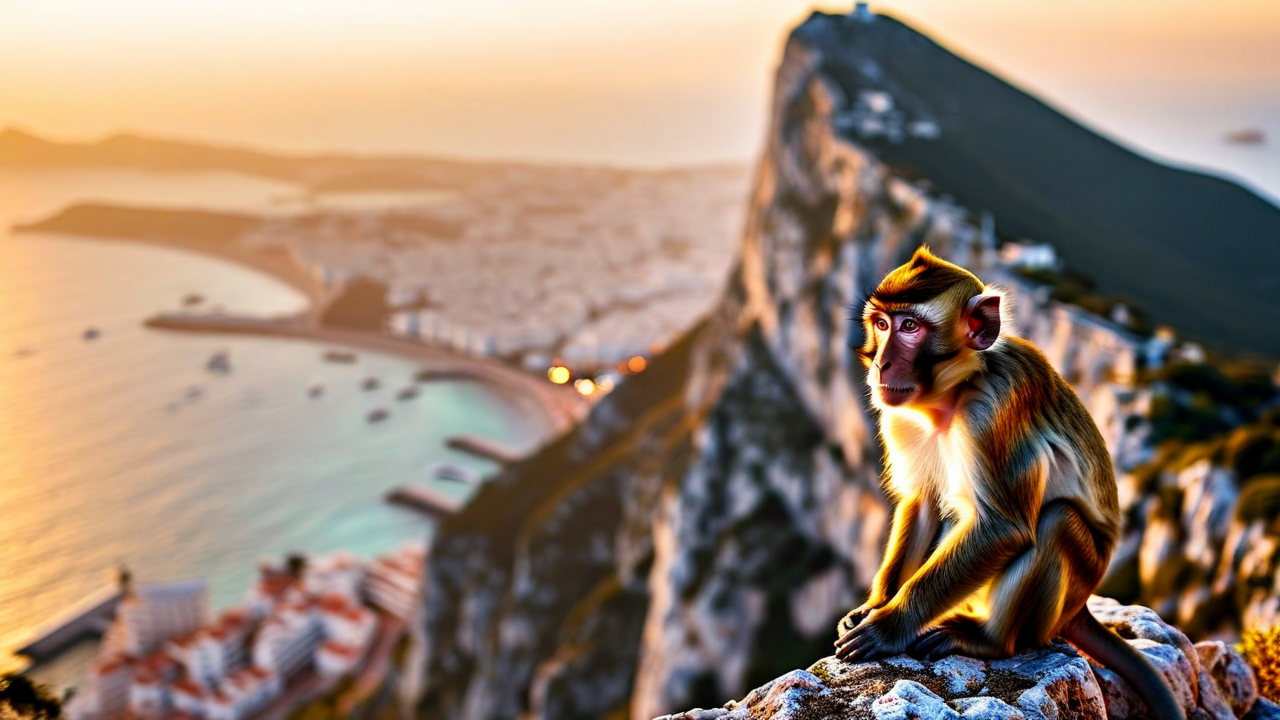
There are around 300 Barbary macaques living wild on the Upper Rock in several troops, and they are the only free-living monkey population in Europe. They are also, and this is the detail everybody gets wrong, tailless — the Barbary macaque is the only macaque without a tail, which is why they are so often mislabelled "Barbary apes". If you see a photograph of a Gibraltar monkey with a long tail, it is not a Barbary macaque.
How they got here is unresolved. They are native to the Middle Atlas and Rif mountains of Morocco and Algeria, where the species is now endangered, and the Gibraltar population may descend from animals present before the Rock was cut off from Africa, or from animals brought over by the Moors, or by the British. Genetic work points to Moroccan and Algerian origins with more than one introduction.
The British garrison adopted them, and there is a well-known tradition that if the macaques ever leave Gibraltar, British rule ends with them. When numbers fell to a handful in 1942, Churchill ordered them replenished from North Africa — a genuine wartime signal, made at a moment when morale mattered.
They are wild animals
Not tame, not pets, and quite capable of biting. Bites are treated at St Bernard's Hospital and happen most weeks in summer. They are also fast, strong, and much smarter about bags than you are.
Feeding is illegal
Fines run to £4,000. Human food damages their health, and hand-fed animals become aggressive and end up being culled. This is not a technicality — the government has removed troops that became a problem.
Do not carry visible food
Plastic bags, ice creams, and open rucksacks are all read as containers of food. Keep bags closed and in front of you, and never hold food up or try to take it back.
Do not touch, and do not stare
A direct stare is a threat display among macaques. Do not put an arm round one for a photograph — this is how most bites happen — and do not touch the infants under any circumstances.
Where they are
Apes' Den near the middle cable-car station, the top station, and around the Great Siege Tunnels. The troops move; a guide or taxi driver will know where they are that morning.
Conservation
The species is Endangered in its native range, with perhaps 8,000 left in Morocco and Algeria, largely because of habitat loss and the illegal pet trade. The Gibraltar population is genetically important and is managed, vaccinated and individually identified.
🕳️ Inside the Rock
There is more tunnel inside Gibraltar than road on top of it — over fifty kilometres against roughly thirty. Two eras of excavation are open to visitors, and one enormous natural cavern that nobody had to dig at all.
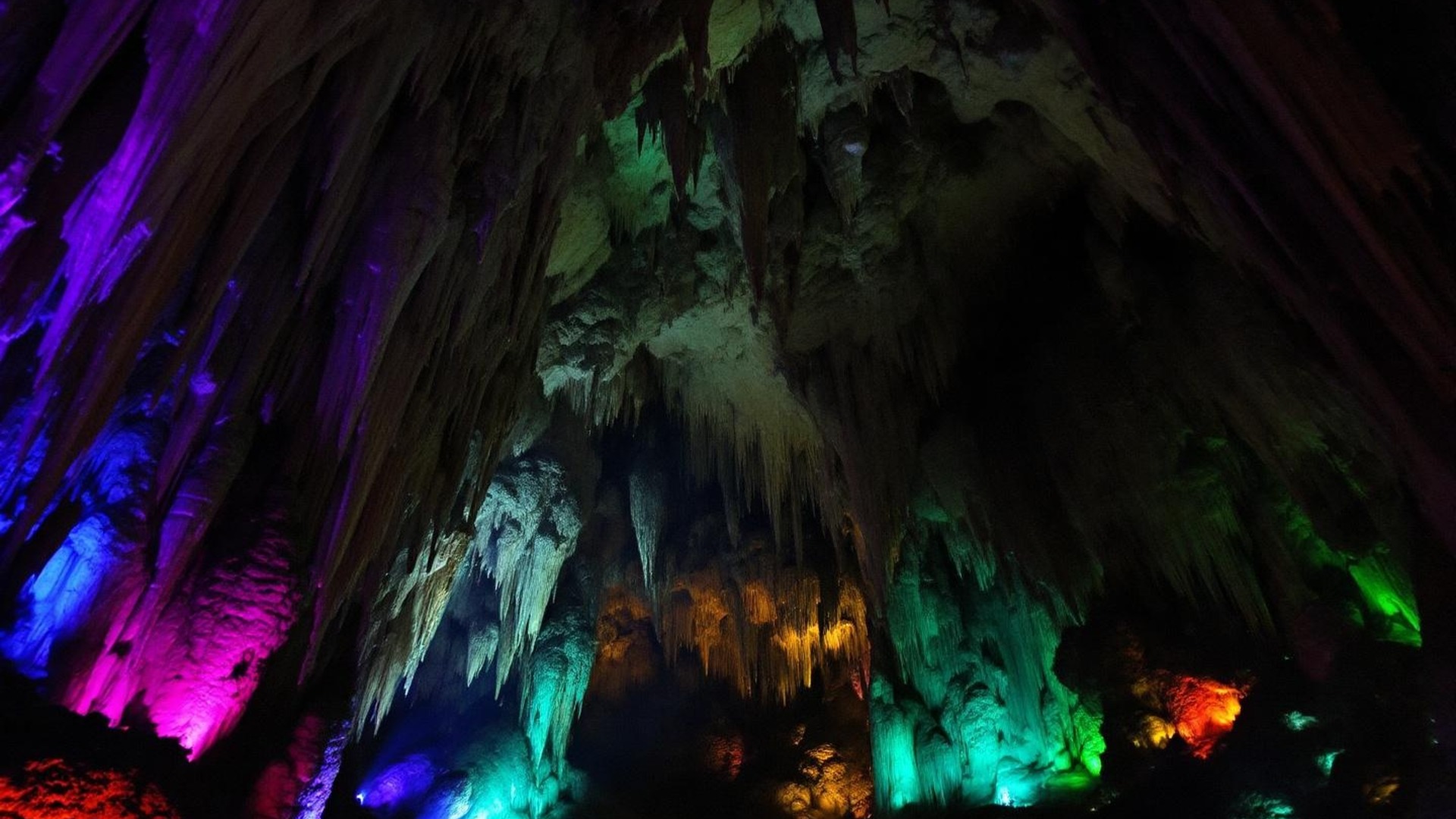
St Michael's Cave is the largest of the Rock's 150-odd caves and has been a tourist attraction since Roman times; ancient visitors believed it was bottomless and connected under the strait to Africa, which is where the story about the macaques walking here comes from. The main chamber is now an auditorium with seating for around 400 and is used for concerts and, memorably, for the Miss Gibraltar final. The lighting scheme is more nightclub than natural history, and opinions differ on it.
Great Siege Tunnels
Hacked out by hand between 1782 and 1783 so that guns could fire down on the Spanish lines from the sheer north face. The galleries are rough-cut limestone with embrasures blasted through to the outside, and the working conditions — hammer, crowbar, black powder, no ventilation — are not hard to imagine once you are inside.
WWII Tunnels
Around 40 km driven by Canadian and British tunnelling companies from 1939, creating an underground barracks city. The section open to visitors is a guided walk and is the more atmospheric of the two systems.
Lower St Michael's Cave
A wild lower cave, reached only on a booked adventure tour involving ropes, helmets and an underground lake. Around three hours. The best thing on the Rock for anyone who is not claustrophobic.
Gorham's Cave
The UNESCO Neanderthal site on the east face. Access is restricted and normally only by arranged visit or boat view; the interpretation centre in the town covers it well.
The Tower of Homage
The keep of the fourteenth-century Moorish Castle, standing above the town with the pockmarks of repeated sieges still visible in its walls. Included in the Nature Reserve ticket.
The 100-ton gun
At Napier of Magdala Battery: one of only two surviving Armstrong 100-ton rifled muzzle-loaders, built in 1870 to fire a one-ton shell through a foot of iron armour. It was fired rarely and never in anger.
🌿 The Upper Rock
The whole summit ridge is a nature reserve of about 400 hectares, and the wildlife is more interesting than the monkeys suggest. Gibraltar sits at the narrowest crossing point between Europe and Africa, which makes it one of the great bottlenecks of bird migration.
Raptor migration
In late summer and autumn, and again in spring, tens of thousands of honey buzzards, black kites, short-toed eagles, booted eagles, griffon vultures and storks funnel across the strait. On a good September day with the right wind you can watch thousands of birds go over from the top of the Rock. The Gibraltar Ornithological and Natural History Society runs counts and can advise.
The plants
Around 600 species on 6.8 km², including the Gibraltar candytuft, which grows nowhere else and is the national plant. Olive, wild lavender, dwarf fan palm and a scrub flora that survives on almost no soil.
Barbary partridge
Gibraltar holds the only European population of this North African bird — self-introduced or ancient, nobody is sure. Along with the macaques it makes the Rock an outlier of African fauna on the European side.
The Windsor Bridge
A 71-metre suspension footbridge across a gorge on the Royal Anglian Way, opened in 2016. Short, bouncy and worth walking.
Walking routes
The Mediterranean Steps is the big one. The Royal Anglian Way runs the ridge; Charles V Wall climbs from the town centre in a punishing straight line of steps. All are free; the reserve ticket covers the attractions along them.
Practicalities
Take water — there is nothing to buy above the cable car station except at the top. Sun exposure on the ridge is total. And the reserve closes in the early evening; check the season's times before starting a walk.
🛍️ The Town
Gibraltar town runs along the west side of the Rock in a narrow strip, and its spine is Main Street — pedestrianised, about a kilometre long, and lined with duty-free shops, chain stores, pubs, and the occasional building that reminds you the place is three hundred years old.
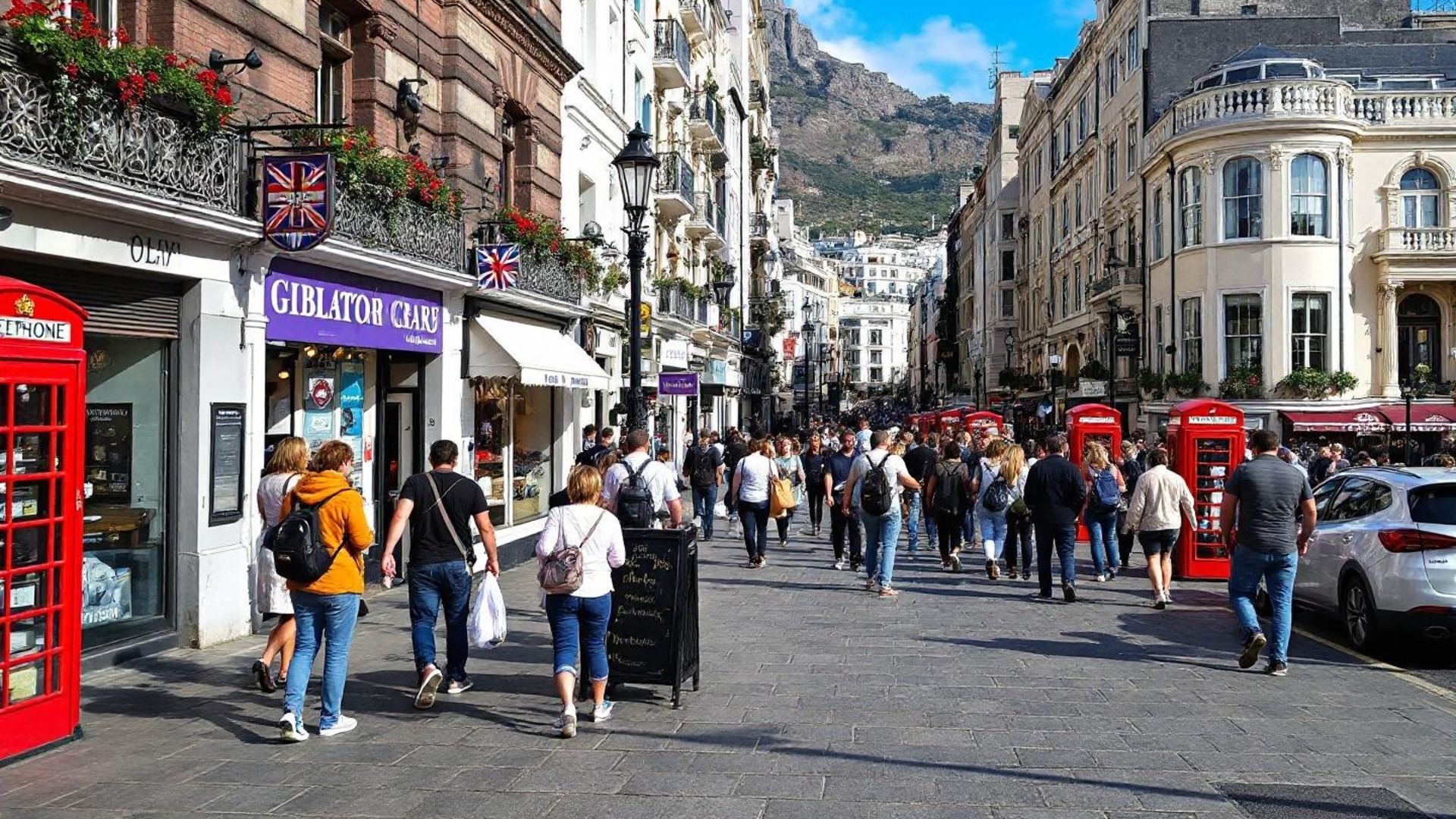
The shopping is the reason many people come — no VAT, so alcohol, tobacco, perfume and electronics are cheap by Spanish or British standards — and it is also why Main Street on a four-cruise-ship day is close to unbearable. Step one street either side and the crowds vanish.
Casemates Square
The main square at the north end, inside the old walls, ringed with bars and restaurants. Formerly a barracks and before that the site of public executions. The Gibraltar National Day gathering happens here.
The Gibraltar Museum
In Bomb House Lane, and much better than a town this size has any right to have. Its centrepiece is the excavated fourteenth-century Moorish bathhouse beneath the building, plus the Neanderthal material and a scale model of the Rock made in 1865.
The Cathedral of St Mary the Crowned
Built on the site of the principal mosque, which became a Spanish church, which became the Catholic cathedral. The layered history of the territory in one building.
The Great Synagogue
Nefusot Yehudah, founded 1724, one of the oldest on the Iberian peninsula. Gibraltar's Jewish community, which came largely from Morocco, has been continuously present since the early eighteenth century and has produced several Chief Ministers and mayors.
The Ibrahim-al-Ibrahim Mosque
At Europa Point, funded by King Fahd and opened in 1997, serving a Moroccan Muslim community of a few thousand. Four faiths within a few hundred metres of each other is one of the things Gibraltar is quietly proud of.
Trafalgar Cemetery
Just outside Southport Gates. Two of the dead from Trafalgar itself are buried here; the rest are mostly from the yellow fever epidemics that killed far more of the garrison than any battle.
🌊 Europa Point and the South
Europa Point is the southern tip: a flat, windy headland where you stand at the mouth of the Mediterranean with Africa across the water and the shipping lanes in front of you. It is free, it is the best view in Gibraltar, and it is almost always less crowded than the summit.
The lighthouse
The Trinity House lighthouse of 1841 — squat, banded red and white, and the only Trinity House lighthouse outside the United Kingdom. Not usually open, but the point of the visit is the setting.
Looking at Africa
On a clear day the Moroccan coast and Jebel Musa are plainly visible 14 km away, and at night you can see the lights of Ceuta and the Rif. This is the only place in Europe where the other continent is this close and this obvious.
The Shrine of Our Lady of Europe
A chapel converted from a mosque in 1462 and a pilgrimage site for Mediterranean sailors for centuries. Small, old and usually empty.
Harding's Battery and Nun's Well
A restored Victorian gun battery you can walk into, and a medieval Moorish underground cistern nearby — both free and both routinely walked past.
Rosia Bay
Where Nelson's fleet brought its wounded ashore after Trafalgar, and the only natural harbour on the west side. Quiet, historic, and with the enormous Victorian Rosia water tanks above it.
Getting there
Bus route 2 from the town, or a 45-minute walk along the west side past Rosia. Do it late in the afternoon for the light on Africa.
🏖️ The East Side
The east face of the Rock drops almost sheer into the sea, and at its foot are Gibraltar's beaches and its two strangest settlements. Getting there means going through the Rock — the Dudley Ward tunnel — or round the north end.
Catalan Bay
A tiny fishing village of a few hundred people squeezed between the cliff and a sand beach, founded by Genoese and later Catalan fishermen. It has its own identity, its own patron saint's day, and a completely different feel from the town. La Caleta, in Llanito.
Sandy Bay
The other main beach, rebuilt with imported sand and breakwaters after erosion took most of it away. Family-oriented, and busier with Spanish visitors than with tourists.
Eastern Beach
The largest, right below the airport runway, so planes land more or less overhead. Popular with locals and reached in ten minutes from the frontier.
Camp Bay and Little Bay
On the west side south of the town: not sand but concrete lidos cut into the rocks, with pools and terraces. Where Gibraltarians actually swim.
The water catchments
The great corrugated-iron sheets that once covered the east sand slopes to harvest rainwater — an extraordinary piece of Victorian engineering, mostly dismantled since the 1990s. Traces remain visible from the Mediterranean Steps.
Swimming
The water is clean and the beaches are Blue Flag, but the strait has serious currents and there is heavy shipping offshore. Swim between the flags where there are flags.
🗣️ Gibraltarians and Llanito
Thirty-four thousand people on 6.8 km² makes Gibraltar one of the most densely populated places in the world, and the population is a three-hundred-year Mediterranean composite: Genoese, Maltese, Portuguese, Menorcan, Sephardic Jewish, Moroccan, Spanish and British, mixed over generations into something that is none of them.
The everyday language is Llanito — Andalusian Spanish and British English switched between mid-sentence, with vocabulary from Genoese, Hebrew, Maltese and Arabic mixed in. A Llanito speaker will start a sentence in Spanish, take a technical or official term in English, and finish in Spanish, without noticing they have done it. Words like chachi, liquirba (liquorice, from English) and cuécaro (porridge, from Quaker Oats) are pure Gibraltar.
English is the official language and the language of schooling, government and courts. Spanish is universally understood. But Llanito is the marker of belonging, and it is the thing that makes Gibraltarians unambiguously not British and unambiguously not Spanish.
National Day
10 September, the anniversary of the 1967 referendum. Everyone wears red and white, 30,000 red and white balloons are released, and the whole territory turns out in Casemates Square. It is a political event as much as a party.
Religion
Roughly 72% Roman Catholic, 8% Church of England, 4% Muslim, 2% Hindu, plus a Jewish community of around 600 with four synagogues. The Hindu community, largely of Sindhi origin, has been in the import trade here since the nineteenth century.
Names
Bassadone, Chipolina, Danino, Sacramento, Sanguinetti, Bossino, Serfaty, Benyunes. The phone book is a migration history.
The Britishness
Real, and heightened. Red phone boxes, bobbies' helmets, fish and chips, and Marks & Spencer are all genuine — and they are also displayed with a certain deliberateness, because the identity is contested and symbols matter when someone is arguing you should not exist.
🍽️ Food
Gibraltarian food is what happens when Genoese, Andalusian, Maltese, Moroccan, Portuguese and British cooking share a kitchen for three hundred years in a place with no farmland. It is not a famous cuisine and it is genuinely distinctive.
Calentita is the national dish and the emblem: a baked batter of chickpea flour, olive oil, water and pepper, poured thin into a tray and baked until set with a browned top. It is cut into squares, eaten hot in the hand, often from a paper wrapper, and it is street food rather than restaurant food. The name is Genoese in origin — the same thing as Ligurian farinata and Nice's socca — and Gibraltar holds an annual food festival named after it.
Rosto is pasta in a slow-cooked beef and tomato sauce, a direct Genoese inheritance. Rolitos are beef olives — thin beef rolled around bacon, egg and breadcrumbs and braised. Torta de acelga is a Swiss chard pie. Panissa is another chickpea-flour preparation, cut into strips and fried. Japonesa is a doughnut filled with custard and rolled in sugar, sold in bakeries and named for reasons nobody can satisfactorily explain.
Alongside all that: full English breakfasts, Sunday roasts, fish and chips and pub pies, all served without irony; excellent Moroccan and Indian food; and Spanish tapas at prices lower than in the town but higher than across the border.
Calentita — Gibraltar's Chickpea Bread
Serves 6 as street food · 20 min plus 2 h resting · the national dish
Ingredients: 250 g chickpea (gram) flour · 750 ml water · 60 ml olive oil, plus more for the tin · 1 tsp salt · plenty of coarsely ground black pepper
Method: Whisk the chickpea flour into the water gradually, breaking up every lump — a stick blender is legitimate here. Stir in the salt and the olive oil and leave the batter to stand for at least two hours, or overnight in the fridge; this is what stops it tasting raw and bitter. Skim any foam off the top. Heat the oven as hot as it goes, around 250 °C, with a shallow metal tray inside. Pour a film of olive oil into the hot tray, then the batter to a depth of about a centimetre — no more. Bake 25–35 minutes until set through, with a blistered brown top and the edges pulling away. Grind over a great deal of black pepper. Cut into squares and eat hot with your hands.
💡 The batter must be thin and the tray must be hot before the batter goes in. A thick, gently baked calentita is a chickpea cake, which is a different and much worse thing.
Rolitos — Gibraltarian Beef Olives
Serves 4 · about 2 hours · the Sunday dish
Ingredients: 8 thin slices of beef topside, beaten flat · 8 rashers of streaky bacon · 3 hard-boiled eggs, quartered lengthways · 100 g breadcrumbs · 2 garlic cloves and a handful of parsley, chopped · 1 onion, 1 carrot, sliced · 400 g tinned tomatoes · 250 ml red wine · olive oil · salt, pepper
Method: Lay a rasher of bacon on each slice of beef, scatter with breadcrumbs, garlic and parsley, lay a piece of egg along one end and roll up tightly; tie with string or fix with a cocktail stick. Brown the rolls all over in olive oil and set aside. Soften the onion and carrot in the same pan, add the wine and let it reduce by half, then the tomatoes. Return the rolls, cover, and simmer very gently for 1½ hours, turning once, until the beef gives to a fork. Rest, remove the string, and serve with the sauce and boiled potatoes.
💡 Tie them properly. A rolito that unrolls in the pan becomes a stew, and a good deal of the pleasure is in the spiral when you cut it.
🍺 Pubs, Duty and What to Drink
Gibraltar has no wine production, no brewery of any scale, and a drinking culture assembled from the British pub and the Andalusian bar with the tax removed. There is no VAT and duty is low, which is the entire economic basis of Main Street.
The pubs
The Angry Friar opposite the Convent, the Star Bar (which claims to be the oldest, from 1840), the Lord Nelson in Casemates. Real ale, Sunday roasts, football on the screens and prices below the UK. They are genuine pubs, not theme bars.
Sherry and Spanish wine
You are 20 km from Jerez. Fino and manzanilla by the glass in the Spanish-leaning bars, and Spanish wine at duty-free prices, are the smart order.
Gin
Gibraltar has a small distillery scene — Spirit of the Rock among others — and the Spanish-style gin and tonic in a balloon glass with far too much ice is the local default.
Duty free
Alcohol, tobacco, perfume and electronics are noticeably cheaper than in Spain or the UK. Note the allowances when leaving into Spain: they are enforced, and the Guardia Civil at the frontier do check.
Water
Tap water is desalinated and perfectly safe, though some find it flat-tasting. Gibraltar has no natural fresh water at all — the historic supply was rainwater off those east-side catchments into underground reservoirs.
Coffee
Order it Spanish — cortado, café con leche — and you will do much better than ordering it English.
💼 How the Rock Makes a Living
When the Royal Navy dockyard ran down in the 1980s Gibraltar lost the industry that had employed it for two centuries, and rebuilt around four things: financial services, online gaming, bunkering and tourism. GDP per head is now among the highest in the world, which is not something the 1984 dockyard closure suggested was coming.
Online gambling
A large share of the world's online betting industry is licensed here — Bet365, Entain, William Hill and others have or have had substantial operations. Low corporate tax plus a UK-recognised regulatory regime plus English law is the formula.
Financial services
Insurance in particular: a significant portion of UK motor insurance is written by Gibraltar-domiciled companies. Also funds, private client work, and a growing crypto-licensing regime introduced in 2018.
Bunkering
Gibraltar is one of the busiest ship-refuelling ports in the Mediterranean, with tankers working in the bay day and night. It is also the reason for the occasional environmental incident — the 2022 grounding of the OS 35 being the most recent serious one.
Tourism
Around ten million frontier crossings a year, plus cruise calls. Most visitors are day-trippers from the Costa del Sol, which is why the town empties completely by six in the evening.
Cross-frontier workers
About 15,000 people cross from Spain daily to work — roughly half the workforce. La Línea, immediately across the frontier, has some of the highest unemployment in Spain and depends heavily on Gibraltar jobs. The relationship at ground level is far warmer than the diplomatic one.
Tax
No VAT, no capital gains tax, no wealth tax, and income tax capped in effect. Gibraltar was removed from the EU's list of non-cooperative tax jurisdictions and from the FATF grey list in 2024, but the reputational argument is ongoing.
🐬 The Bay and the Strait
The Bay of Gibraltar holds resident populations of common, striped and bottlenose dolphins, and boat trips out of Marina Bay and Ocean Village see them on the large majority of sailings — this is one of the more reliable dolphin-watching spots in Europe, and it takes about ninety minutes.
Dolphins
Resident year-round. Trips run several times daily from around £30. Choose an operator that keeps its distance and does not chase; the bay is busy and the animals are habituated but not tame.
Whales in the strait
Out in the strait proper — better reached from Tarifa in Spain — there are pilot whales, sperm whales year-round, and orcas from May to August, which have become well known for interacting with sailing boats' rudders.
Migration
Twice a year the strait is a bird highway. See the Upper Rock section: autumn for raptors going south, spring for the return.
Diving
A number of wrecks in the bay, some deliberately sunk as artificial reefs, plus the remains of the Rosia Bay area. Visibility is variable and the shipping traffic means you dive with an operator, not independently.
The Levanter cloud
Worth watching from the bay rather than the summit: the wind rises over the east face, the moisture condenses at the top, and a cloud forms and streams off the ridge like smoke while the sky either side stays clear.
Conservation
Gibraltar's British Waters extend three nautical miles and are a Marine Protected Area, which is also a point of friction — Spain disputes the waters, and Spanish fishing incursions have caused repeated incidents.
⚽ A Nation of Thirty-Four Thousand
Gibraltar joined UEFA in 2013 and FIFA in 2016 after a legal battle lasting more than a decade, opposed throughout by Spain. It is one of the smallest football associations in the world, its national team is drawn from a population smaller than a mid-sized town, and its results are what you would expect — with occasional glorious exceptions, including a first competitive win over Armenia in 2019.
It matters more than the results suggest. Playing under your own flag in a UEFA qualifier, with your own anthem, in front of a stadium of your own people, is a statement about existing as a distinct nation — which is precisely why it was resisted.
Where they play
Home matches were played at the Estádio Algarve in Portugal for years because Victoria Stadium did not meet UEFA criteria. A new national stadium at Europa Point has been a long-running project.
Other sports
Cricket has been played here since the eighteenth century — the Gibraltar Cricket Club claims to be one of the oldest outside England. Also a serious sailing and rowing scene, and the annual Rock Run up the hill.
Culture
The Gibraltar International Literary Festival, the Gibraltar Music Festival, and the Miss Gibraltar final held in St Michael's Cave. For a town of 34,000 the calendar is remarkably full.
Media
The Gibraltar Chronicle, founded 1801, is one of the oldest continuously published English-language newspapers in the world and was the first paper anywhere to report the victory at Trafalgar.
📋 Practical Information
Entry
Gibraltar sets its own immigration rules. EU, UK, US, Canadian, Australian and many other nationals enter without a visa. A passport is required even coming from Spain — an EU national identity card is accepted for EU citizens, but a passport avoids all argument. Gibraltar is not in the Schengen area and never has been.
Money
The Gibraltar pound, pegged one-to-one with sterling. Sterling notes circulate freely and are accepted everywhere; Gibraltar notes are not legal tender in the UK, so spend or change them before you leave. Euros are widely accepted at a poor rate. Cards everywhere.
Language
English is official and universal. Spanish is understood by everyone. Llanito is what you will overhear.
Getting there by air
Gibraltar International (GIB) has direct flights from London (Heathrow, Gatwick, Luton) and Manchester with British Airways and easyJet. The runway crosses the main road and landings in a Levanter can be dramatic. Málaga (AGP), 130 km away, has far more connections and a direct bus.
Getting there by land
Bus or car to La Línea de la Concepción, then walk across the frontier — about 15 minutes from the La Línea bus station to Main Street. Buses run to La Línea from Málaga, Algeciras, Tarifa and Seville.
Health and safety
EHIC/GHIC does not cover Gibraltar for most visitors — this catches people out. St Bernard's Hospital handles emergencies but non-emergency care is charged. Take travel insurance. Emergency numbers 190 (police), 199 (fire and ambulance), 112 also works.
🇨🇿 Getting There from the Czech Republic
There are no flights from Prague to Gibraltar, and there will not be — the runway is short, the airline market is tiny, and the traffic is almost entirely British. Every Czech visitor arrives through Spain.
Via Málaga
The standard route. Direct flights Prague–Málaga with Ryanair, Wizz Air and Smartwings, seasonal to year-round, typically 2 500–6 000 CZK return. From Málaga airport, a direct bus to La Línea takes about 2h45, or hire a car and drive 130 km down the coast.
Via Seville or Jerez
Seville has Prague connections via a European hub and is 200 km away; Jerez is closer at 130 km but with fewer flights. Both work if the Málaga fares are bad.
Via London
Prague to Gatwick or Heathrow, then a direct BA or easyJet flight to Gibraltar. Two flights and usually more expensive, but it puts you on the Rock without touching Spain — worth knowing if the frontier queue is a concern.
Where to base yourself
Most Czech visitors stay in Spain — La Línea, Algeciras or on the Costa del Sol — and cross for a day or two. It is much cheaper and the frontier is a fifteen-minute walk from the town centre.
Documents. Czech citizens need no visa for Gibraltar. Bring a passport rather than only an občanský průkaz: the ID card is legally sufficient for an EU citizen, but a passport removes every possible question at a frontier where the rules are being renegotiated. If you are hiring a car in Spain, check the rental contract — many Spanish rental agreements exclude Gibraltar or require prior notification and an extra insurance document.
Before you go. Check the current advisory from the Czech Ministry of Foreign Affairs (MZV ČR) at mzv.cz and register in the DROZD system at drozd.mzv.cz. Consular matters for Gibraltar are handled by the Czech Embassy in London, not by the embassy in Madrid — which is exactly the sort of thing worth knowing before rather than after you lose a passport.
Health cover. This is the one that catches Czech travellers out: your European Health Insurance Card does not cover Gibraltar. It is not in the EU and the UK's reciprocal arrangements do not extend to visitors from other countries. Commercial travel insurance is not optional here, even for a day trip.
💰 Costs
Gibraltar prices sit between Spanish and British levels: restaurants and hotels are closer to the UK, while alcohol, tobacco, perfume and electronics are cheaper than either because there is no VAT.
Currency
Gibraltar pound (GIP), pegged to sterling. Roughly 28–30 CZK to the pound. Sterling accepted everywhere; euros accepted at a rate that costs you 5–10%. Change your Gibraltar notes before leaving.
Accommodation
There is very little of it — the territory has a few thousand beds. Mid-range hotel £120–200 (3 500–6 000 Kč) a double; the Rock Hotel or Sunborn £200–350. A room in La Línea across the frontier costs €50–80 and is fifteen minutes' walk from Main Street.
Eating
Pub main £14–20 · fish and chips £13–16 · restaurant dinner £30–45 a head · a slice of calentita £2–3 · coffee £2.50. Crossing to La Línea for dinner saves roughly a third.
The Rock
Upper Rock Nature Reserve ticket around £19 (covers the caves, tunnels, castle and Skywalk) · cable car return around £19, or a combined ticket · dolphin trip £30 · a taxi tour of the Rock £30–40 per person.
Transport
Local buses £2.50 or so, or free for some routes with a local card. A taxi from the frontier to the town £8–12. Everything in the town is walkable; the Upper Rock is not.
Daily budget
A day trip from Spain with the Rock ticket, cable car and lunch: 1 800–2 500 Kč. Staying in Gibraltar with a hotel: from 5 500 Kč a day. Staying in La Línea and crossing: 2 500–3 500 Kč.
🚧 Crossing the Frontier
The land frontier is the single most practically important thing to plan for, and the one most likely to have changed since anything you read was written. At the time of writing the post-Brexit treaty agreed in June 2025 has not completed ratification, so the interim arrangements still apply.
On foot
The normal way. Park in La Línea (the multi-storey by the frontier, around €10–15 a day) and walk. Passport control both ways, then straight across the airport runway — with barriers if a flight is due — and fifteen minutes into town.
By car
Possible but usually a mistake. Queues to leave Gibraltar can run to two hours at peak times, parking inside is scarce and expensive, and the streets are narrow. Park in Spain and walk unless you have a specific reason.
Queues
Worst southbound (into Gibraltar) on weekday mornings with the cross-frontier workers, and worst northbound (out) on weekday evenings and Sunday afternoons. Midday and mid-afternoon are the calm windows. Live queue times are published online.
Customs
Gibraltar is outside the EU customs union, so duty-free allowances apply going into Spain and the Guardia Civil enforce them. One litre of spirits, 200 cigarettes and €430 of goods per adult is the usual limit. Cars are searched routinely.
The runway crossing
You genuinely walk or drive across an active international runway. Barriers close for around ten minutes per movement. There is now a road tunnel underneath for vehicles, but the surface crossing is still used and is still the photograph everyone takes.
Check before you go
The treaty, when it enters force, is intended to remove routine checks at the land frontier. Until then, assume passport control both ways. The Gibraltar government's site and the Spanish border authority both publish current requirements.
🛡️ Safety and Etiquette
Gibraltar is very safe. Crime is low, the police are approachable, and the territory is small enough that anonymity is difficult. The genuine hazards are the monkeys, the heat on the Upper Rock, and the traffic on roads never designed for it.
The macaques
The main cause of injury to visitors. Do not feed, touch, stare at or photograph yourself with them, and keep bags shut. A bite means a hospital visit and possibly a course of injections.
Heat and exposure
The Upper Rock has no shade and no water above the cable car station. People are helped off the Mediterranean Steps every summer. Carry more water than you think and do not start a walk after ten in the morning in July.
Traffic
Narrow streets, blind corners, and drivers on the right — Gibraltar switched from left-hand driving in 1929 to match Spain, which surprises British visitors. Look both ways.
Politics
Gibraltarians will discuss the sovereignty question readily and are not touchy about it, but assuming they are or should be Spanish, or joking about handing the Rock over, lands badly. Ask; do not tell.
Photography
Do not photograph military installations, the naval base, or border control at the frontier. This is enforced and there is no discretion about it.
What is genuinely annoying
Nothing dangerous — just the four-cruise-ships problem. Check the port schedule and pick a light day, and Gibraltar goes from a scrum to a very pleasant small town.
🏨 Where to Stay
Gibraltar has a few thousand hotel beds in total, which is not many, and prices reflect it. Many visitors do not stay at all — they come for a day from the Costa del Sol — and that is a defensible plan, though it means missing the Rock in the evening when the day-trippers have gone and the town is at its best.
The Rock Hotel
The grand one, opened 1932 on the slope above the town, with a terrace looking over the bay to Africa. Churchill, Sean Connery and most visiting dignitaries have stayed. £180–300.
Sunborn
A permanently moored 'yacht hotel' in Ocean Village — a converted superyacht with 189 rooms and a casino. Odd and comfortable. £180–320.
Mid-range
The Caleta Hotel at Catalan Bay on the east side is the quiet choice, right on the beach under the cliff. The Eliott and Bristol are central. £120–200.
Budget
There is essentially none inside Gibraltar. The realistic budget option is La Línea, where a decent hotel or apartment is €50–80 and you are a fifteen-minute walk from Casemates Square.
Self-catering
A growing number of apartments in Ocean Village and Marina Bay, often better value than the hotels for two or more nights.
Timing
Book well ahead around National Day (10 September), the Music Festival and the Literary Festival. Otherwise the constraint is simply how few rooms exist.
🗓️ Itineraries
Half a day · the cruise-ship version
Cable car up, macaques, St Michael's Cave, Great Siege Tunnels, cable car down, Main Street, back to the ship. Everyone does it, it works, and you will see none of the town.
One full day · the good version
Walk in from La Línea early. Taxi or cable car to the top, then walk down through the reserve — Skywalk, O'Hara's Battery, the tunnels, the cave, the Moorish Castle — arriving in the town by early afternoon. Lunch in Casemates, the Gibraltar Museum, then bus 2 to Europa Point for the light on Africa.
One day · the walker's version
Bus to Jews' Gate, up the Mediterranean Steps to O'Hara's Battery (1.5–2 hours, serious), along the ridge, down through the reserve. Start at eight, carry two litres of water, and skip the cable car entirely.
Two days
Day one as above. Day two: a dolphin trip in the morning, Lower St Michael's Cave in the afternoon (book ahead), Catalan Bay for a swim, and dinner in the town after the day-trippers have gone. This is the trip that shows you the place rather than the attraction.
With children
Cable car, macaques (with the rules explained firmly beforehand), the cave, the dolphin trip and Eastern Beach with the planes overhead. Skip the tunnels if they are small — the WWII tunnel tour is long and dark.
As part of Andalusia
Two nights on the Costa del Sol or in Tarifa, one day on the Rock, and a day trip to Tangier by fast ferry from Tarifa. Three continents' worth of history in a week without moving far.
🧭 Beyond the Frontier
Gibraltar is small enough that most visitors combine it with something, and the something is unusually good — this corner of Andalusia and the Moroccan coast are both within easy reach.
Tangier
Fast ferry from Tarifa, 45 km away, takes about an hour to Tangier Ville. A genuine day trip to Africa, and the medina is a different world from the Costa del Sol. Passport required, and check Moroccan entry rules.
Tarifa
The southernmost point of continental Europe, a kitesurfing capital because the wind never stops, and the departure point for whale-watching in the strait. Forty-five minutes by road.
Ronda
One of the great Andalusian towns: a white town split by a 100-metre gorge with the Puente Nuevo across it, and the oldest bullring in Spain. Ninety minutes inland.
The pueblos blancos
Casares, Gaucín, Jimena de la Frontera — white villages in the hills behind the coast, most with a Moorish castle on top and a view back to the Rock.
Los Alcornocales
One of the largest cork oak forests in the world, immediately inland, with deep humid gorges (canutos) holding relict laurel-forest vegetation. Almost unvisited and excellent walking.
Baelo Claudia
A Roman town on the beach near Bolonia, with a forum, theatre, temples and the fish-salting works that made it rich — plus a huge sand dune next door. One of the best Roman sites in Spain and rarely busy.
❓ Common Misconceptions
"They're Barbary apes"
They are macaques — monkeys, not apes. The "ape" name comes from their taillessness, which is the one thing that actually distinguishes them: the Barbary macaque is the only macaque in the world without a tail.
"It's part of the UK"
It is a British Overseas Territory: British sovereign territory, but not part of the United Kingdom. It has its own parliament, laws, currency and football team, and it was in the EU on different terms from the UK before 2020.
"Gibraltarians are British settlers"
The population descends mainly from Genoese, Maltese, Portuguese, Menorcan, Sephardic Jewish and Moroccan settlement over three centuries. British-descended Gibraltarians are a minority of a thoroughly Mediterranean population.
"The Spanish population was expelled"
Most left voluntarily in 1704 rather than swear allegiance to a new sovereign, expecting to return within months. They founded San Roque nearby and never came back. It was not a deportation, and it was also not a free choice in any comfortable sense.
"There's nothing to do but shop and see monkeys"
There is a UNESCO Neanderthal site, fifty kilometres of hand-cut military tunnel, one of Europe's great raptor migration points, a Moorish castle, and a walk up a cliff face that is among the best short hikes on the continent.
"You can see Africa on any day"
The Levanter cloud and summer haze both hide it regularly. Clear, dry days with a westerly wind give the best visibility, and winter mornings are often better than summer ones.
🌟 Names Attached to the Rock
Ṭāriq ibn Ziyād (d. c. 720)
The Berber commander who landed in 711 and gave the Rock its name. The story that he burned his ships to remove the option of retreat is almost certainly a later invention, and it has outlasted the facts.
General George Eliott (1717–1790)
Governor through the Great Siege, credited with the red-hot shot that destroyed the floating batteries and with holding out for three years and seven months. Made Lord Heathfield afterwards; his name is on a hotel, a street and a battery.
Sergeant Major Henry Ince (18th c.)
The Company of Soldier Artificers NCO who proposed and led the driving of the Great Siege Tunnels through solid rock. Ince's Farm on the Upper Rock is named for the land he was granted for it.
John Mackintosh (1865–1940)
A Gibraltarian businessman who left his fortune to a charitable trust that still funds the territory's cultural life — the Mackintosh Hall, the square, the Ince's Hall theatre. A small place's philanthropy shapes it visibly.
Sir Joshua Hassan (1915–1997)
Gibraltar's first Chief Minister and the dominant political figure of the twentieth century, in office for most of the period from 1964 to 1987 — through the referendum, the frontier closure and the reopening. Jewish, Gibraltarian, and the architect of self-government.
John Lennon and Yoko Ono
Married at the British Consulate in Gibraltar on 20 March 1969, chosen because it was quick, quiet and British. "The Ballad of John and Yoko" records it. It remains the most-cited fact about the territory in the English-speaking world.
📚 Reading and Watching
The Rock of the Gibraltarians · William Jackson
A former Governor's history of the territory, and the standard single-volume account. Sympathetic to Gibraltar's own view, which is worth knowing when you read it.
Gibraltar: The Greatest Siege in British History · Roy and Lesley Adkins
A vivid narrative of 1779–83 built from diaries and letters, and the best entry point to why the tunnels exist.
Ulysses · James Joyce
Molly Bloom grew up in Gibraltar, and the final chapter of the novel is soaked in it — the Rock, the Alameda gardens, the Levanter, the soldiers. Joyce never went; he worked it up from guidebooks, and it shows in a way that is itself interesting.
The Fortress · Ernle Bradford
An older popular history of the Rock as a strategic object, useful for the naval and imperial century.
Films
The Living Daylights (1987) opens with a Bond sequence shot on the Rock. Rather better: the archive footage of the 1969 frontier closure and the 1985 reopening, which is the emotional core of modern Gibraltar and is easy to find online.
The Gibraltar Chronicle
Published since 1801 and reading it for a week before you go tells you more about how the place actually works — the border, the treaty, the politics, the planning rows — than any guidebook chapter.
✍️ Author's Note
Gibraltar is treated by almost everyone as a novelty: the place with the monkeys, the runway you drive across, the improbable bit of Britain glued to Spain. You come over from the Costa del Sol on a coach, you queue for the cable car, a macaque takes your sandwich, you buy cheap gin, and you leave.
That version is not wrong, exactly. It is just a very small fraction of what is there. Under your feet is a limestone ridge with fifty kilometres of tunnel in it, cut by hand and by machine across two centuries by people who genuinely believed the fate of empires ran through this rock. In the caves on the far side, Neanderthals may have made the last marks their species ever made. Twice a year, tens of thousands of raptors funnel over the summit on their way between continents. And in the town, thirty-four thousand people speak a language that exists nowhere else and have twice voted, by margins that do not occur in real elections, to go on being exactly what they are.
Two pieces of advice. First: check the cruise schedule and stay the night. Gibraltar at six in the evening, when the last coach has gone and the residents come out, is a completely different and much better place than Gibraltar at eleven in the morning. Second: walk the Mediterranean Steps. Ninety minutes up a cliff face with the Mediterranean directly below you is the single best thing on the Rock and almost nobody does it, because there is a cable car.
And take the politics seriously. It is easy to find the sovereignty argument quaint — a three-century quarrel over six square kilometres — until you talk to someone who was a child during the sixteen years the frontier was shut, and whose grandmother lived on the other side of it. Ask them about it. They will tell you, and it will be the most interesting conversation you have all trip.
— Radim Kaufmann
Support This Project 🌍
This World Travel Factbook is a labor of love – free to use for all travelers. If you find it helpful, consider supporting its continued development.