

🇬🇾 Guyana at a Glance
🌍 Overview
Guyana is 214,969 km² — nearly three times Czechia — with about 830,000 people, which gives it one of the lowest population densities on Earth. It sits on the north-east shoulder of South America between Venezuela, Brazil and Suriname, and it is the only country on the continent whose official language is English.
That is the first thing to understand: Guyana is geographically South American and culturally Caribbean. It is a founding member of CARICOM, whose secretariat is in Georgetown; it plays cricket for the West Indies; its food, music, politics and creole all belong to the Anglophone Caribbean. Spanish is a foreign language here, and Brazil, 1,000 km of forest away, is further from most Guyanese lives than Trinidad is.
The country divides sharply in two. About 90% of the population lives on a coastal strip a few kilometres wide, much of it below sea level at high tide and kept dry by a 280-kilometre sea wall and a Dutch drainage system of dams, canals and sluices that has been maintained for three hundred years. Behind that strip lies the other Guyana: eighty-five per cent forest cover, one of the highest in the world, plus savanna, tepui-topped highlands and rivers on a scale that has to be seen.
And since 2015 there has been a third Guyana. ExxonMobil's Stabroek Block discoveries — now more than eleven billion recoverable barrels — turned a country with a GDP per head of around six thousand dollars into, for several years running, the fastest-growing economy in the world. Georgetown is a building site, the traffic is impossible, prices have jumped, and the argument about what to do with the money is the only conversation anyone is really having.
🏷️ Land of Many Waters, Land of Six Peoples
The name is Amerindian and is usually glossed as "land of many waters" — a description that survives contact with the place better than most etymologies. Guyana has more than a thousand kilometres of navigable river, three of them (the Essequibo, Demerara and Berbice) large enough to have given their names to the colony's three counties and, through them, to a sugar and a rum.
The country's own description of itself is the "Land of Six Peoples", and the national motto is One People, One Nation, One Destiny — both of them aspirations as much as descriptions, since Guyanese politics has run along ethnic lines for seventy years. The six are Amerindian, African, Indian, Portuguese, Chinese and European, and every one of them arrived, or was brought, in a distinct historical episode that the country can date precisely.
The demography
Roughly 40% Indo-Guyanese, descendants of indentured labourers brought between 1838 and 1917; 29% Afro-Guyanese, descendants of enslaved Africans; about 20% mixed; and about 10.5% Amerindian, in nine nations. Small Chinese and Portuguese-Madeiran communities complete the six. Guyana is one of very few countries where the indigenous population is growing as a share of the whole.
The nine nations
Lokono (Arawak), Kalina (Carib), Warrau, Wapishana, Macushi, Patamona, Akawaio, Arekuna (Pemon) and Wai Wai. They hold title to a substantial share of the interior under the Amerindian Act, elect their own toshaos (village captains), and are the reason the forest is still standing across much of the country.
The money
The Guyanese dollar (GYD) runs at about 209 to the US dollar, which puts roughly 9 GYD to the Czech crown. It has been remarkably stable. US dollars are accepted for hotels and tours; everything else is in local cash, and prices are usually quoted in thousands.
The flag
The Golden Arrowhead, designed by the American vexillologist Whitney Smith and adopted at independence in 1966: green for forest and agriculture, a gold arrowhead for mineral wealth and the country's forward drive, white for the rivers, black for endurance and red for the zeal of nation-building. It is one of the best-designed flags in the world and Guyanese know it.
🗺️ Geography: Below the Sea
Guyana runs in bands from the Atlantic inland. First a coastal plain 15 to 60 km wide, alluvial, extremely fertile, and much of it one to one and a half metres below the level of the sea at high tide. Then a belt of white sand and clay. Then the forested highlands and the Guiana Shield — some of the oldest exposed rock on the planet, two billion years and more. Then, in the south-west, the Rupununi savanna.
The coastal situation is the fact everything else depends on. The Dutch built the defences in the 17th and 18th centuries and Guyanese have maintained them since: a 280 km sea wall, an intricate system of front dams and back dams, canals, and the sluice gates that everyone here calls kokers — a Dutch word still in daily use. When a koker fails or a spring tide overtops the wall, Georgetown floods, and the great flood of January 2005 put much of the coast under water and did damage worth around 60% of GDP.
The rivers
The Essequibo is the giant — around 1,000 km, with an estuary more than 20 km wide holding islands larger than Barbados. The Demerara and Berbice are the other two great rivers, and the three counties, the sugar and the rum all take their names from them. All three are brown with sediment and tannin, and all are full of rapids upstream.
The high ground
The tepuis — flat-topped sandstone mountains — rise on the Venezuelan and Brazilian borders. Mount Roraima at 2,810 m stands on the tripoint and is the highest ground Guyana touches; Mount Ayanganna at 2,042 m is the highest peak entirely inside the country. Roraima is the mountain that gave Conan Doyle The Lost World.
Forest
About 85% of the country is forest — roughly 18 million hectares — with one of the lowest deforestation rates on Earth, well under 0.1% a year. Guyana holds a meaningful share of the Guiana Shield, which is the largest intact block of tropical forest left in the world after the Amazon and Congo.
The Rupununi
In the south-west, an area of savanna the size of Slovakia, seasonally flooded, split into northern and southern halves by the Kanuku Mountains, and one of the very few places where a visitor can watch giant anteaters and giant otters in open country. Cattle ranching, Macushi and Wapishana villages, and no tarmac at all.
💦 Kaieteur Falls
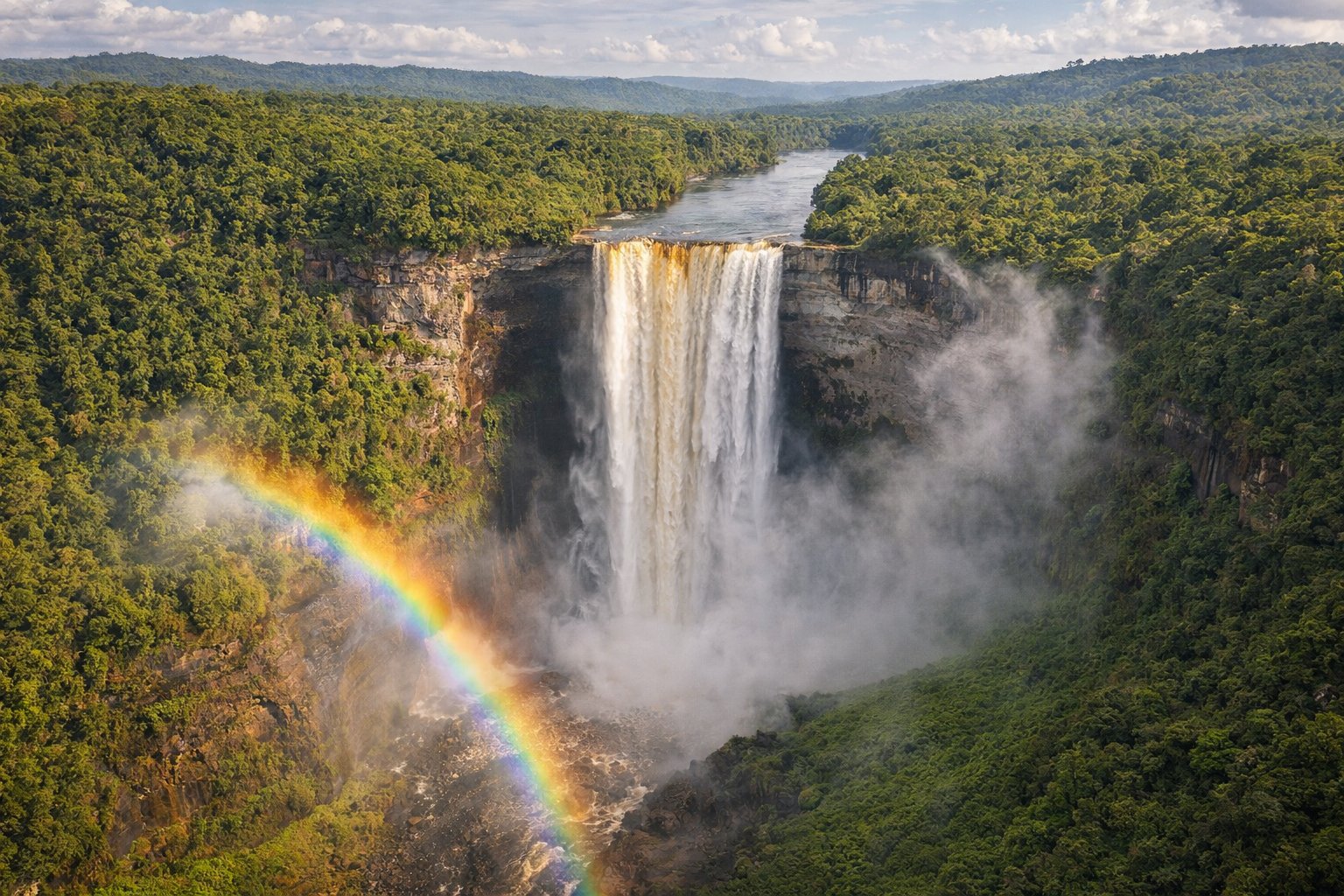
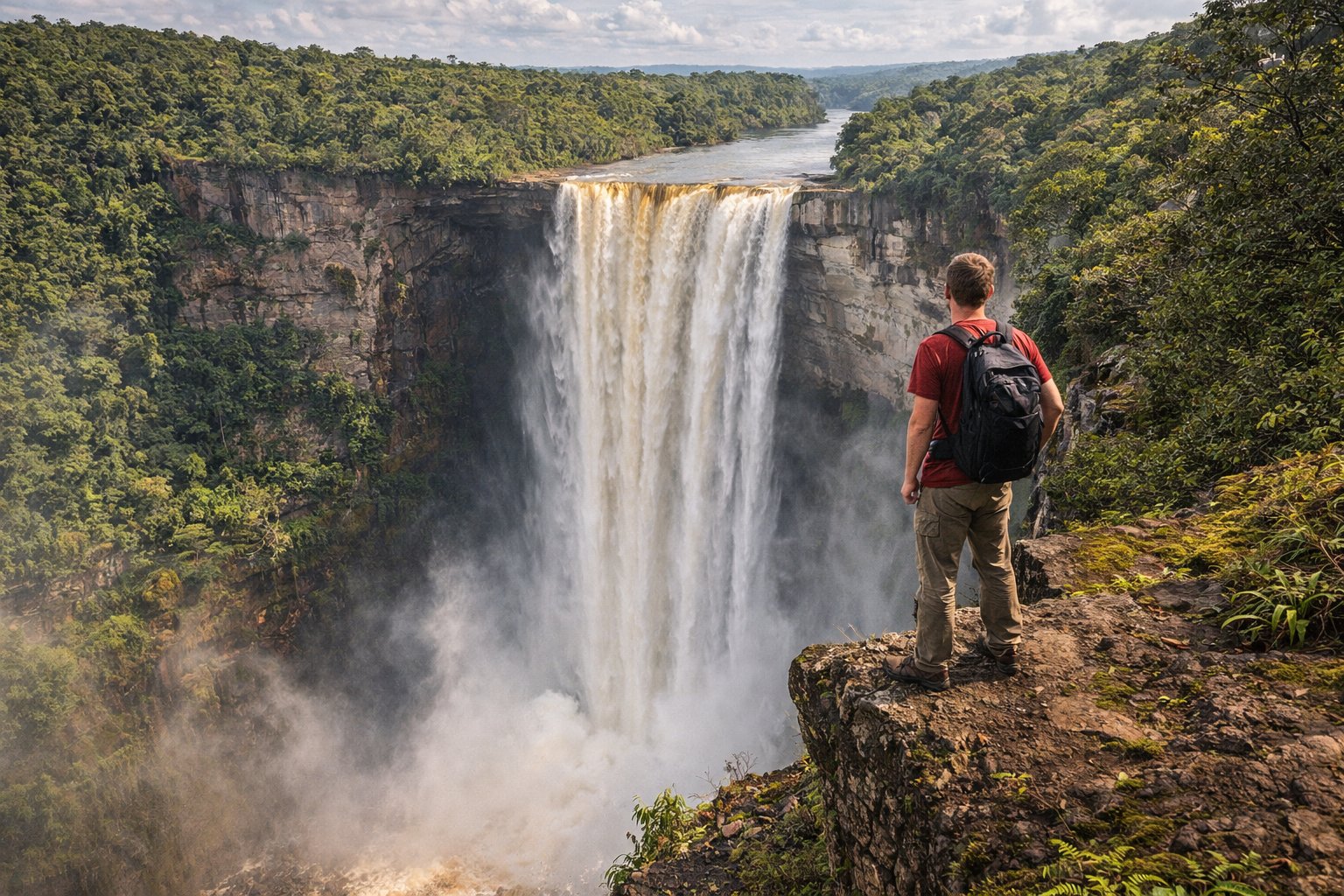
Kaieteur is the reason a lot of people come to Guyana, and it does not disappoint. The Potaro river drops 226 metres in a single unbroken fall over the edge of a sandstone plateau, and then another 25 m through a cascade below. That single drop is about five times Niagara and roughly twice Victoria Falls, and because the Potaro carries a large volume even in the dry season, Kaieteur is usually described as the most powerful waterfall in the world of its height.
What makes it extraordinary is not the numbers but the emptiness. Kaieteur National Park was created in 1929 — among the earliest protected areas anywhere in South America — and there is no fence, no railing, no viewing platform in the Niagara sense and no crowd. A day flight brings twenty or thirty people from Georgetown; you walk to three viewpoints along the rim, stand at the edge if you have the nerve, and fly home.
Kaie
The name comes from the Patamona story of Kaie, an old chief who paddled his canoe over the falls as a self-sacrifice to the great spirit Makonaima, to save his people. Kaieteur is usually rendered as "Kaie's fall." The Patamona are still the people of that country.
The golden rocket frog
Giant tank bromeliads (Brocchinia micrantha) grow along the gorge rim, some of them two metres across, and hold pools of water in their leaf bases. The tiny golden rocket frog lives its entire life inside a single one of these plants — tadpoles included — and is found nowhere else on Earth. Look into the bromeliads; guides will point them out.
The swifts
At dusk, thousands of Kaieteur (white-collared) swifts fly straight into the falls and roost on the rock face behind the water. The evening flight is one of the great wildlife spectacles in South America — and almost nobody sees it, because the day flights leave in the early afternoon.
Getting there
In practice, a day flight from Ogle airport in Georgetown, roughly an hour each way in a small aircraft, with an hour or two at the falls, for around US$250–350. Flights go when they fill and are cancelled for weather. The alternative is a five-day overland-and-river trip from Mahdia via Amatuk and Waratuk, which is a genuine expedition and worth it if you have the time.
🌡️ Climate and When to Go
Equatorial, hot and humid all year, with temperatures on the coast between about 24 and 31 °C every month and very little seasonal variation in heat. What varies is rain, and Guyana has an unusual pattern: two wet seasons and two dry ones.
The dry seasons
Mid-February to end of April and mid-September to mid-November. These are the months to travel: interior roads and airstrips usable, river levels manageable, wildlife concentrated at shrinking water, and Kaieteur flights more likely to go. The September–November window is generally the best for the Rupununi.
The wet seasons
May to August and December to January. The rain is heavy and the interior becomes difficult — the Rupununi floods, the Lethem road turns to mud, and Georgetown's drains struggle. Waterfalls are at maximum, which is the compensation, and birding on the coast is excellent.
The trade-off
Kaieteur is most spectacular in the wet and most reliably reached in the dry, and you cannot have both. The usual compromise is late September to early November, when the rains have eased, the river is still high and the flights are running.
Practicalities
Humidity is high year-round and the sun is directly overhead — Guyana straddles latitudes 2° to 8° north. Take light long sleeves rather than sunscreen alone, expect afternoon downpours in any month, and treat the wet-season rain as a fact of the day rather than an interruption to it.
🗺️ Map
Guyana sits between about 1° and 8° north, on the Atlantic between Venezuela's Orinoco delta and Suriname. Georgetown is at the mouth of the Demerara on the coast; Kaieteur is about 250 km inland by air; Lethem, on the Brazilian border in the Rupununi, is 450 km south and reached by air or by a long dirt road.
Almost all the roads are on the coast. Inland there is essentially one route — the Georgetown–Linden–Lethem trail, some 500 km of which the southern half is dirt — plus rivers and a network of small airstrips. For most interior destinations the honest answer is that you fly, and if the weather is bad you do not go at all.
🏹 The First Peoples and El Dorado
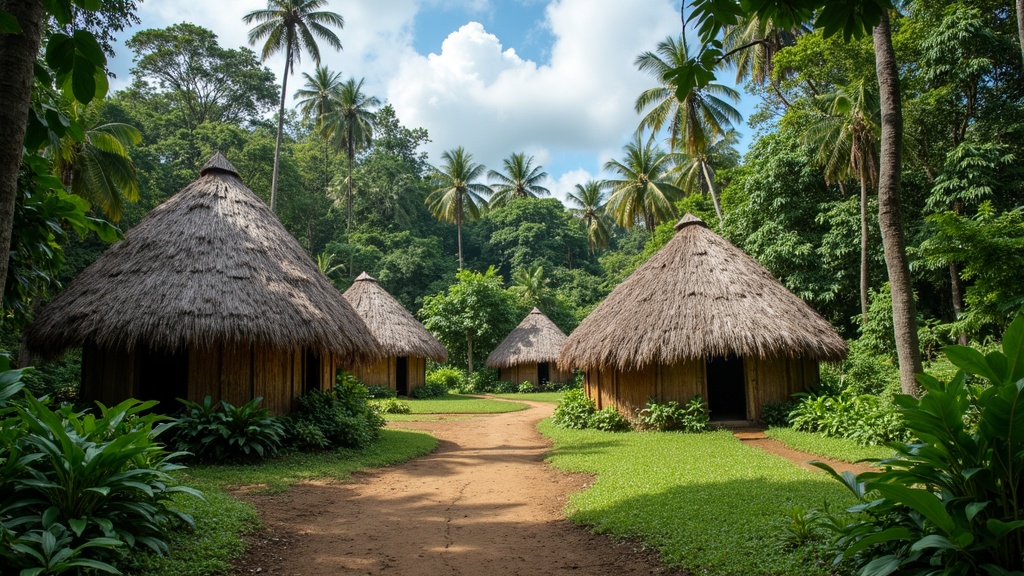
People have lived on the Guiana Shield for at least eleven thousand years. When Europeans arrived, the coast and rivers held Lokono (Arawak) and Kalina (Carib) peoples, the delta swamps the Warrau, and the interior the Macushi, Wapishana, Patamona, Akawaio, Arekuna and Wai Wai. All nine nations are still here, and Guyana is unusual in the Americas in that its indigenous population is growing rather than shrinking.
What brought Europeans up these rivers was El Dorado. The legend began with a real Muisca ritual in Colombia — a chief gilded with gold dust who bathed in a lake — and by the 1590s had migrated in European imaginations to a golden city called Manoa on the shores of a fictional lake, Parime, somewhere in the Guiana interior. Sir Walter Raleigh came looking for it in 1595, wrote The Discoverie of the Large, Rich and Bewtiful Empyre of Guiana, and returned in 1617 on a second, disastrous expedition for which James I had him beheaded.
Lake Parime
The lake appeared on European maps for two centuries and was gradually deleted in the 19th. One plausible explanation is that it was a real, seasonal phenomenon: the Rupununi savanna floods every wet season into an enormous shallow sheet of water that connects the Amazon and Essequibo basins. Guyanese guides will tell you Raleigh's lake exists — for four months a year.
The Amerindian Act
Guyana's 2006 Amerindian Act gives titled villages collective ownership of their land, the right to elect a toshao, and a say over mining and logging within their boundaries. Roughly 14% of the country is titled Amerindian land, with more claimed. Enforcement against gold miners is the perpetual weak point.
What survives
Cassava technology — the grater, the woven matapee squeezer, farine, cassava bread and cassareep — is the base of the national cuisine and is entirely Amerindian. So are the hammock, the benab, the woodskin canoe, and a large share of the country's place names, starting with Kaieteur.
The gold and the mercury
The El Dorado story was never entirely wrong: Guyana does have gold, and small-scale mining is a major part of the interior economy today. It is also the largest single environmental problem in the country — mercury contamination of rivers and forest clearance in areas where the state's writ is thin.
🇳🇱 The Dutch, the Polders and the Kokers
The first permanent European settlements here were Dutch, not British: Essequibo from about 1616, Berbice from 1627 and Demerara from 1741 — three separate colonies run by the Dutch West India Company and its rivals, trading with Amerindians and then planting sugar.
Their lasting achievement is the coast itself. The Dutch took a strip of tidal swamp below sea level and turned it into farmland using the technology they had at home: empoldering. They built a front dam against the sea, a back dam against the interior swamp, drainage and irrigation canals down each side of every estate, and sluice gates — kokers — to let water out at low tide and keep the sea out at high. Every one of those elements is still there and still in use, and the Dutch word is still the everyday Guyanese word.
It is worth being clear about who built it. The surveying was Dutch; the digging was done by enslaved Africans, by hand, with shovel and basket. Estimates of the volume of earth moved to make the Guyanese coastal plain run to figures comparable with the great pyramids, and it is arguably the largest earthwork in the Americas. Guyanese historians make this point often and it deserves repeating.
Fort Zeelandia
On Fort Island in the Essequibo, built in the 1740s, with the Dutch Court of Policy building beside it — the best-preserved Dutch colonial structures in the country and reachable as a day trip by boat from Parika. On Guyana's UNESCO tentative list.
The transfer
Britain took the three colonies during the Napoleonic wars, held them from 1803 and got them formally in the 1814 settlement; they were amalgamated as British Guiana in 1831. The Dutch legal system survived far longer than Dutch rule — Roman-Dutch law governed Guyanese property until well into the 20th century, and traces remain.
Why it matters now
A coastal plain below sea level, protected by three-hundred-year-old hydraulic engineering, is a serious problem in a warming world. Guyana's climate exposure is among the highest in the Americas, the sea wall needs constant work, and the plan to shift population and government functions inland — talked about since Burnham's day — has new urgency and, now, oil money behind it.
Georgetown's grid
The city's canals down the middle of its avenues are Dutch drainage, not decoration. Main Street, Church Street and the rest were laid out as polder canals and some were filled in later. When people say Georgetown is the Garden City, the gardens are growing in a drainage scheme.
⛓️ Slavery, Cuffy and 1763
The sugar economy of the Guianas ran on enslaved African labour on a brutal scale, and the plantations here had a reputation for mortality even by the standards of the Caribbean. The response was resistance, and Guyana's national story is built on one episode of it.
On 23 February 1763, enslaved people on Plantation Magdalenenburg in Berbice rose, and the revolt spread across the colony within weeks. Under Cuffy (Kofi), a house slave of Akan origin who took the title Governor of Berbice, the rebels held most of the colony for nearly a year, negotiated with the Dutch governor for a partition of the territory, and were defeated only after Dutch reinforcements arrived from Europe and neighbouring colonies. It was one of the largest slave revolts in the history of the Americas, and it happened eighteen years before Yorktown.
Cuffy is Guyana's national hero. The 1763 Monument in Georgetown's Square of the Revolution — a huge, deliberately unclassical bronze by the Guyanese sculptor Philip Moore, unveiled in 1976 — is the country's central public memorial. And 23 February is Republic Day, celebrated as Mashramani: Guyana chose the anniversary of a slave rebellion as its national day, which is a choice worth noticing.
Emancipation and the villages
Slavery was abolished in 1834 with a four-year "apprenticeship" that ended in 1838. What happened next is remarkable: freed people pooled their wages and bought abandoned plantations outright, collectively. Victoria, on the East Coast Demerara, was bought by 83 people for 30,000 guilders in 1839, and dozens of villages followed. It is one of the earliest and largest acts of collective land purchase by formerly enslaved people anywhere.
The drainage problem
The village movement was then slowly strangled. Planters and the colonial government refused to maintain drainage for village land, imposed rates, and let the polders that the villagers had bought silt up — a deliberate policy of making independent smallholding unviable. Understanding that is essential to understanding Guyanese politics.
Emancipation Day
1 August, a public holiday, marked with African dress, drumming and food. Together with Mashramani, Diwali, Phagwah and Eid it makes Guyana's public calendar one of the most plural in the world for a country of under a million people.
The other risings
The Demerara rebellion of 1823, involving perhaps 10,000 enslaved people and led by the deacon Quamina, was crushed with extreme violence; the execution of the English missionary John Smith, who was blamed for it and died in prison, caused an outcry in Britain that materially strengthened the abolitionist campaign.
🚢 Indenture and the Making of Modern Guyana
With emancipation the planters lost their labour force, and they replaced it with indentured immigration. Between 1838 and 1917 roughly 239,000 people from India were shipped to British Guiana on five-year contracts, along with about 32,000 Madeiran Portuguese and around 14,000 Chinese. It is the single event that made modern Guyanese society.
Indenture was not slavery and it was not free labour either. Recruitment was often deceptive, the voyage from Calcutta took three months, the contracts bound workers to a named estate, breach of contract was a criminal rather than civil matter, and wages were set low enough that most could not save the return passage. Many stayed — offered land instead of a ticket home — and by 1917, when the system was abolished under pressure from Indian nationalists, the Indo-Guyanese were the largest population group.
The Ganges, the last indenture ship, arrived in 1917. Guyana marks Indian Arrival Day on 5 May, the anniversary of the first ship, the Whitby, in 1838.
What it produced
A country with an Indian-descended plurality, Hindu temples and mosques along the coast road, Diwali and Phagwah as national holidays, curry and roti as everyday food, and chutney music. Guyana together with Trinidad and Suriname forms an Indo-Caribbean world that most people outside it have never heard of.
The division
It also produced the fault line. Indo-Guyanese became the rural sugar and rice population; Afro-Guyanese moved into towns, the civil service and the police. Colonial administration reinforced the separation, and from the 1950s political parties formed along it. Almost every Guyanese election since has been, in effect, a census.
The Portuguese and Chinese
Madeiran Portuguese arrived from 1835, mostly left the fields quickly for shopkeeping, and were counted separately from "Europeans" in the colonial census — which is why Portuguese is one of the six peoples. Chinese labourers came from 1853; the community is small but produced Guyana's first president, Arthur Chung.
Sugar's end
The industry that caused all of this is now nearly gone. GuySuCo has closed most of its estates since 2017; sugar employs a fraction of what it did and survives on subsidy. The estates' closure gutted whole villages and is one of the sharpest political grievances in the country.
✊ Jagan, Burnham and Independence
Guyanese nationalism produced two extraordinary men who began as allies and ended as the country's permanent division. Cheddi Jagan — Indo-Guyanese, a dentist trained in the United States, a Marxist — and Forbes Burnham — Afro-Guyanese, a barrister trained in London — founded the People's Progressive Party together in 1950 and won the colony's first universal-suffrage election in 1953.
Britain suspended the constitution after 133 days, sent troops and warships, and removed the government on the grounds that it was communist. The party then split in 1955, with Burnham taking most Afro-Guyanese support into what became the PNC. Through the early 1960s Britain and the United States worked, through covert funding of trade unions and opposition parties, to keep Jagan from leading the country to independence — a campaign since documented from declassified American and British files. Racial violence in 1962–64 killed hundreds and hardened the division permanently.
Burnham took power in 1964 under a proportional system introduced for that purpose, and led the country to independence on 26 May 1966 and to a republic on 23 February 1970. He then ruled until his death in 1985 through elections that international observers judged fraudulent, nationalised bauxite and sugar under the banner of "co-operative socialism," banned imports of wheat flour, split with the West and then with the Soviets, and presided over an economic collapse and an emigration so large that the Guyanese diaspora is now comparable in size to the population at home.
The ban on flour
Burnham's 1970s import bans — no wheat flour, no split peas, no potatoes — were meant to force self-sufficiency. What they produced was a black market, a generation of smuggling across the Corentyne, and a genuine revival of cassava and plantain flour that Guyanese cooks still use. It is remembered with a mixture of anger and dark humour.
1992
Under heavy international pressure, and with Jimmy Carter's centre observing, Guyana held its first credibly free election since 1964. Cheddi Jagan won and became president at the age of 74, twenty-eight years after being removed. He died in office in 1997. Power has alternated between the PPP/C and PNC-led coalitions since, still largely along ethnic lines.
2020
The March 2020 election produced a five-month constitutional crisis when the returning officer for the largest region declared figures that did not match the tally sheets. A national recount, observed by CARICOM, confirmed a narrow PPP/C win and Irfaan Ali became president in August. Several officials were later charged. It was ugly, and it was resolved without violence.
The diaspora
Something like 400,000 to 800,000 people of Guyanese origin live in the United States, Canada and Britain — comparable to the population of Guyana itself. Remittances have been a major part of the economy for decades, Guyanese New York is a place in its own right, and "who is coming back now the oil has come" is a live question in every family.
🕯️ 1978 and 1980
Two events from the end of the Burnham years still shape how Guyana is seen from outside, and the first of them is the only thing many foreigners know about the country.
On 18 November 1978, at an agricultural settlement in the north-west forest, 918 people died — most of them Americans, a third of them children — in a mass murder-suicide by cyanide-laced drink ordered by Jim Jones, leader of the American Peoples Temple. Hours earlier his men had shot dead the visiting US congressman Leo Ryan and four others at the Port Kaituma airstrip. Until 11 September 2001 it was the largest single loss of American civilian life in a deliberate act.
Two things about it are worth stating plainly. It was an American event that happened on leased Guyanese land: the Temple was an American organisation, the victims were overwhelmingly American, and Guyanese were not members. And the site is gone — the settlement was abandoned and the forest has taken it. "Jonestown" as a shorthand for Guyana is both inaccurate and, to Guyanese, extremely tiresome; the country has had a great deal of other history in the fifty years since.
On 13 June 1980, the historian Walter Rodney was killed in Georgetown when a walkie-talkie given to him by a sergeant of the Guyana Defence Force exploded in his car. Rodney — author of How Europe Underdeveloped Africa, one of the most influential works of 20th-century historiography, and a leader of the multiracial Working People's Alliance that threatened Burnham precisely by crossing the ethnic divide — was 38. A 2016 commission of inquiry concluded that the state was responsible and that the killing was a state-organised assassination.
⚖️ The Essequibo Dispute
Venezuela claims everything west of the Essequibo river — around 159,500 km², roughly two-thirds of Guyana's territory — as Guayana Esequiba. It is the largest territorial dispute in the Americas, it is live, and it is the single most important thing to understand about Guyana's international position.
The history in brief. The boundary was fixed by an arbitral award in Paris in 1899, by a tribunal of British, American and Russian jurists, which gave almost all of the disputed area to British Guiana. Venezuela accepted and demarcated it, and lived with it for sixty years. In 1962, as British Guiana approached independence, Venezuela declared the award null and void, citing a posthumously published memorandum by one of its own American lawyers alleging that the tribunal had done a political deal. The 1966 Geneva Agreement, signed weeks before Guyanese independence, committed both sides to seek a practical settlement.
Sixty years of that produced nothing, and in 2018 Guyana took the case to the International Court of Justice, asking it to confirm the 1899 award as valid and binding. The ICJ found it had jurisdiction in 2020 and again in 2023; Venezuela initially refused to participate and later did. The case on the merits is still before the Court.
Why now
Because of oil. Venezuela's claim was largely dormant until ExxonMobil's 2015 Stabroek Block discovery, which sits in waters off the disputed coast. Interest revived immediately and has escalated with every new find.
December 2023
Venezuela held a referendum on annexing the territory and creating a "state of Guayana Esequiba," appointed officials for it, and issued a map. The ICJ ordered Venezuela to refrain from altering the situation on the ground. Days later, at St Vincent, the two presidents signed the Argyle Declaration, committing not to use force and to keep talking. Tension has flared repeatedly since.
What it means on the ground
Very little, for now. The disputed region contains most of Guyana's forest, its Amerindian titled lands, Kaieteur, the Rupununi and about 125,000 Guyanese citizens, all administered normally by Guyana. Travel there is unaffected. Guyanese take the claim extremely seriously and are notably united across the ethnic divide about it — this is the one issue on which the country does not split.
The other border
Suriname claims the New River Triangle in the far south-east. A 2007 UN arbitral tribunal settled the maritime boundary between the two — largely in Guyana's favour — but the land triangle remains formally disputed and entirely quiet.
🛢️ The Oil
In May 2015 an ExxonMobil-led consortium announced a discovery at the Liza-1 well, 190 km off the Guyanese coast in the Stabroek Block. Over the following decade the block yielded more than thirty discoveries and a recoverable resource estimate that has risen past eleven billion barrels of oil equivalent — one of the largest and fastest-developed offshore provinces of the century.
Production began in December 2019. A succession of floating production vessels — Liza Destiny, Liza Unity, Prosperity, Errea Wittu — took output past 600,000 barrels a day, with projects approved to carry it well beyond a million by the end of the decade. For a country of 830,000 people that is, per head, one of the largest oil positions on Earth.
The economic effect has no modern parallel. Guyana recorded real GDP growth of 43% in 2020, 62% in 2022 and around 43% in 2024 — repeatedly the fastest-growing economy in the world — and GDP per head went from roughly six thousand US dollars to well over twenty thousand in five years. A Natural Resource Fund holds the revenue under legislation modelled loosely on Norway's.
The argument
The 2016 production sharing agreement gives Guyana a 2% royalty and a 50/50 profit split after full cost recovery, with no ring-fencing between projects — terms widely described by outside analysts as unusually favourable to the contractor. Renegotiating it is the central political controversy in the country; the government says a signed contract is a signed contract, and critics say the arithmetic speaks for itself.
What it looks like
Georgetown is a construction site. New hotels, a new Demerara river crossing, road widening, a housing programme, and traffic that has gone from bad to genuinely dreadful. Rents in Georgetown have multiplied. Prices for visitors have risen sharply — Guyana is no longer a cheap country — and the gap between the coast and the interior is widening.
The contradiction
Guyana simultaneously sells forest carbon. In 2022 it sold 37.5 million ART-TREES carbon credits to Hess for at least US$750 million — the first such jurisdictional sale anywhere — while ramping up oil production. The government argues that a country with 85% forest cover and 0.02% of global emissions has earned the right to develop its oil; critics call it having it both ways. Guyanese debate this openly and it is a good conversation to have here.
Resource curse
Everyone in Guyana knows the phrase and most people use it. The country has a Natural Resource Fund, a fiscal rule, and an unusually loud press and civil society — and it also has a small state, contested politics along ethnic lines, and a history of what happened to bauxite and sugar money. Which way it goes is genuinely unresolved.
🌳 Eighty-Five Per Cent Forest
Guyana's forest cover is around 18 million hectares, about 85% of the country, and its deforestation rate has been among the lowest in the world — generally well under 0.1% a year. That is not an accident of poverty alone: it is also the result of low population, secure Amerindian tenure over large areas, and a deliberate policy choice.
In 2009 Guyana signed a Low Carbon Development Strategy agreement with Norway worth US$250 million for keeping the forest standing, one of the first bilateral deals of its kind and a template for what became REDD+. In 2022 it went further and sold jurisdictional carbon credits on the voluntary market. A meaningful share of that money is constitutionally directed to Amerindian villages, which is unusual and is the part conservationists point to.
What the forest holds
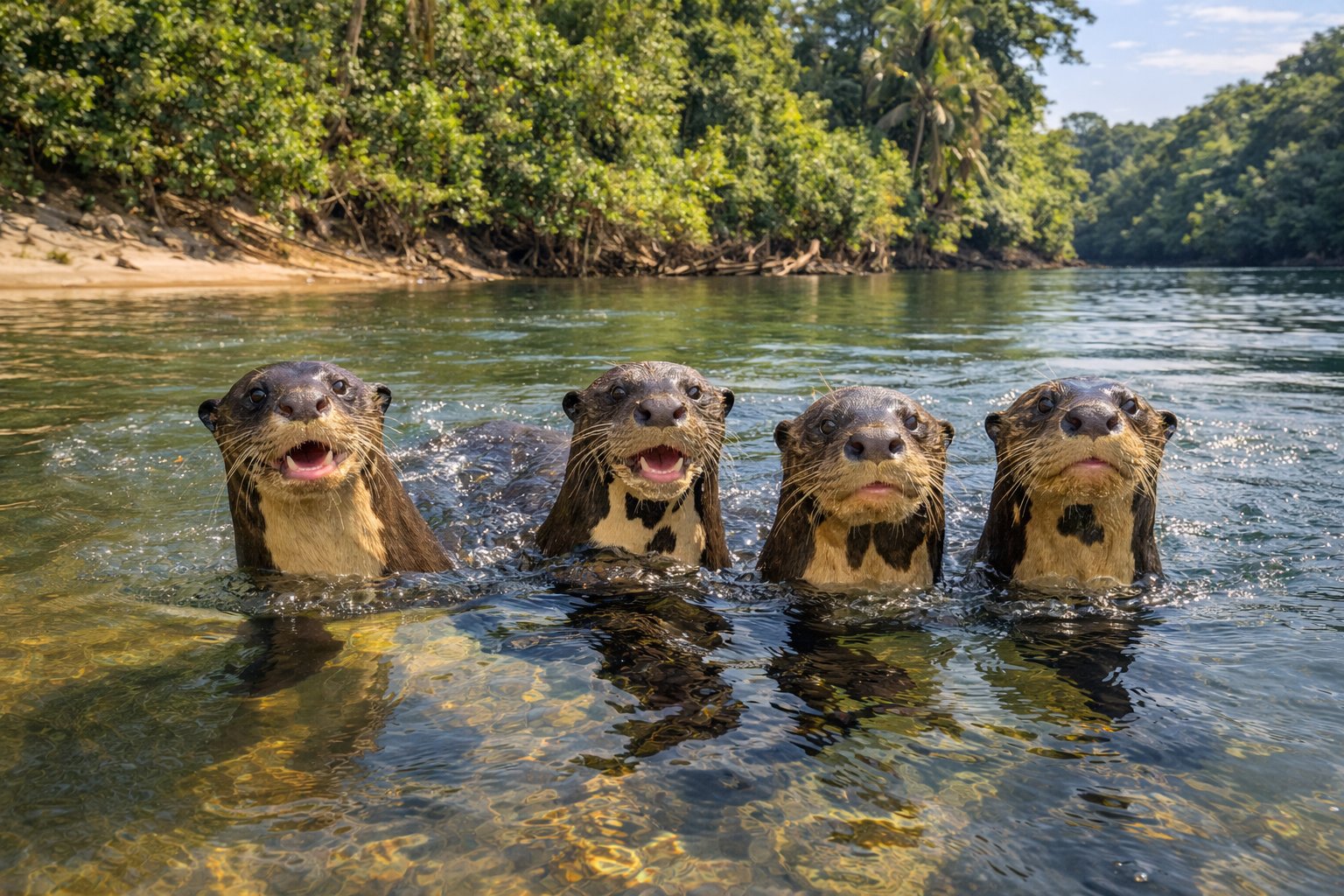
The Guiana Shield is the largest intact tropical forest block on Earth after the Amazon and Congo, and Guyana's share is largely unlogged. Jaguar, harpy eagle, giant armadillo, giant anteater, giant otter, black caiman, tapir, bush dog, and around 815 bird species in a country the size of Britain.
The threats
Gold mining, overwhelmingly. Small and medium-scale dredging clears forest, silts rivers and puts mercury into the food chain, and it operates in areas where enforcement is minimal. Logging is comparatively well controlled. Road-building — including the paving of the Lethem road — will change the arithmetic significantly.
Iwokrama
In 1989 Guyana gave 3,700 km² of pristine forest to the Commonwealth as an international laboratory for sustainable rainforest management — an act with no real precedent. The Iwokrama International Centre still runs it, in partnership with the sixteen surrounding North Rupununi communities, and it is where most visitors actually enter the Guyanese forest.
Kanuku and Kaieteur
The Kanuku Mountains Protected Area in the Rupununi holds around 60% of Guyana's bird species and 80% of its mammals in a fraction of its area. Kaieteur National Park, from 1929, protects the falls and the plateau. Guyana's protected-area system now covers something over 8% of the country and is growing.
🗣️ Six Peoples, One Calendar
English is the official language and the language of everything written. What people actually speak is Guyanese Creole — "Creolese" — an English-lexified creole with West African, Indic, Dutch and Amerindian elements, and with a range from something a British visitor follows easily to something they do not follow at all. Guyanese switch registers constantly and are very good-humoured about a foreigner's attempts.
Religion divides differently from ethnicity and just as neatly: roughly 64% Christian (Anglican, Catholic, Pentecostal, Hindu-influenced denominations and a large evangelical presence), 25% Hindu and 7% Muslim. Guyana has the largest Hindu share of any country in the Americas and one of the largest Muslim shares in the hemisphere.
The public holidays
Christmas, Easter, Phagwah (Holi), Diwali, Eid al-Adha (Youman Nabi and Eid), Emancipation Day, Indian Arrival Day, Mashramani and Independence Day. For a country of 830,000 that is an extraordinarily plural calendar, and the point is that everyone turns up to everyone else's.
Creolese
Try: wah gwan (what's going on), me deh yah (I'm here / I'm alright), lil bit (a little), tek yuh time (slow down), bess (excellent), liming (hanging around), eh-eh (surprise or disagreement, tone does the work). Reading Martin Carter or Wilson Harris will not prepare you; listening to two people at a bus park will.
The ethnic politics
It has to be said plainly: Guyanese electoral politics has run along Indo- and Afro-Guyanese lines since 1955, and most elections are close, contested and followed by a period of tension. Ordinary social life is far more mixed than the voting patterns suggest, and Guyanese are wearily self-aware about the gap between the two.
Emigration
Guyana has one of the highest emigration rates in the world for skilled people — figures above 80% of tertiary graduates have been cited for decades. Every extended family has a New York, Toronto or London branch. The oil boom has begun, tentatively, to reverse some of it, and that reversal is one of the most closely watched things in the country.
🏏 Cricket
The national sport is cricket, and Guyana does not have a national team — it plays as part of the West Indies, alongside Barbados, Jamaica, Trinidad and the rest. This is the clearest single piece of evidence that Guyana is a Caribbean country attached to South America rather than a South American country that happens to speak English.
For a population of under a million, the contribution is startling. Clive Lloyd captained the West Indies side of the 1970s and early 1980s that was, by most measures, the greatest team in the history of the game, winning the first two World Cups and going fifteen years without losing a Test series. Rohan Kanhai, Lance Gibbs — the first spinner to take 300 Test wickets — Alvin Kallicharran, Roy Fredericks, Carl Hooper and Shivnarine Chanderpaul, who batted for two decades in an unorthodox crab-like stance and scored over 11,000 Test runs, are all Guyanese.
Providence
The Guyana National Stadium at Providence, just outside Georgetown, was built for the 2007 World Cup and hosts internationals and the Caribbean Premier League. The Guyana Amazon Warriors are the CPL franchise and the atmosphere at a Providence night game — music, food, an entire country in the stands — is one of the best sporting experiences in the Caribbean.
Bourda
The old Georgetown Cricket Club ground at Bourda hosted Test cricket from 1930 and is famous for two things: being below sea level, and for the rum garden. It has not held internationals since Providence opened, but the club is still there and a Sunday match at Bourda is a very Guyanese afternoon.
Football and the rest
Football (the Golden Jaguars) is growing, and Guyana reached the Gold Cup for the first time in 2019. Basketball, boxing and dominoes all have followings. But if you want to talk to a Guyanese stranger, the topic is cricket.
Watching
Test cricket in the West Indies is a five-day social event rather than a sporting fixture, and visitors are welcome and generally adopted. Take a hat, take cash, and do not expect anything to happen quickly. The CPL in August–September is shorter, louder and easier to get into.
🎉 Mashramani, Diwali and Phagwah
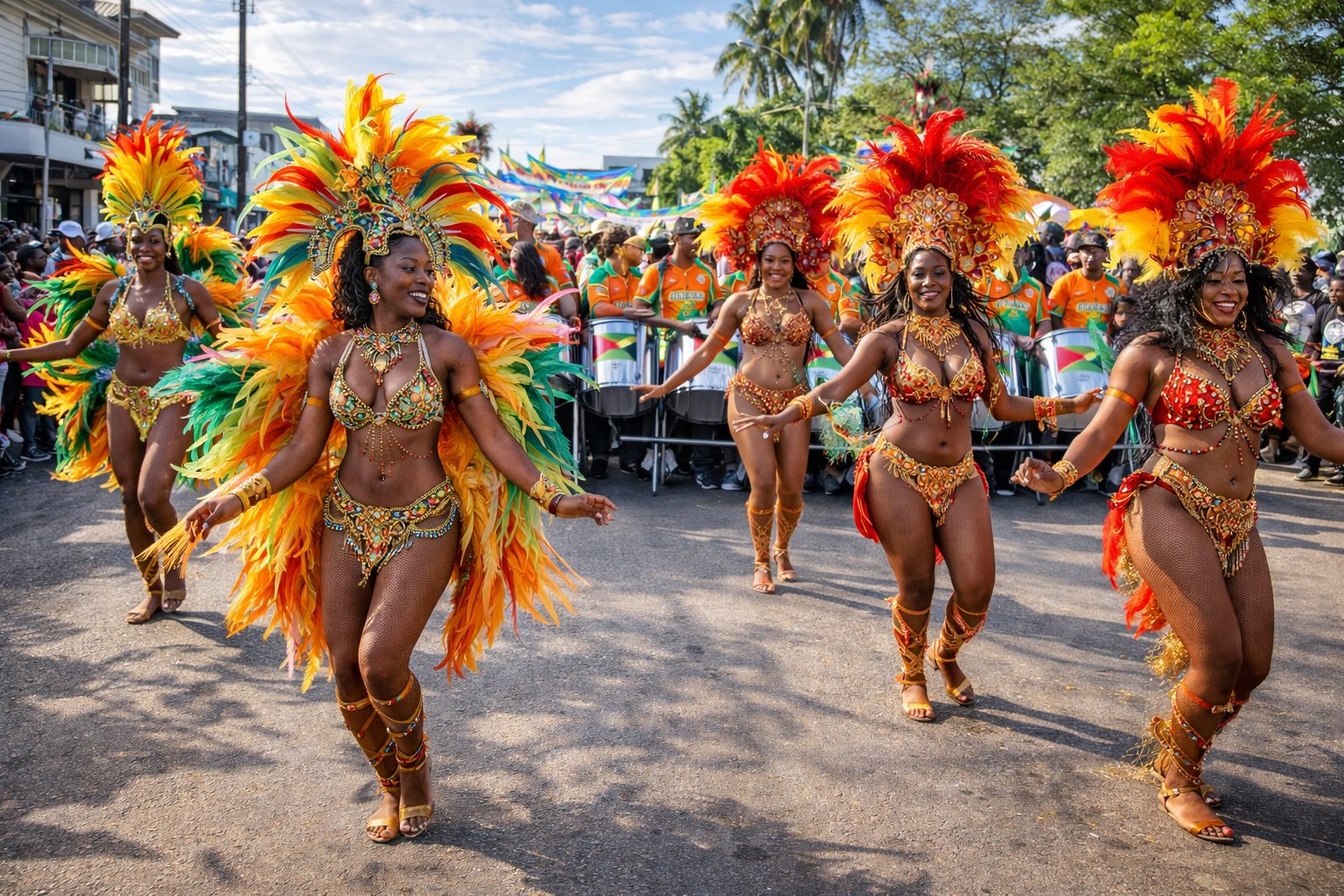
Mashramani — universally "Mash" — is Guyana's national festival, held on 23 February, Republic Day, which is also the anniversary of the 1763 Berbice rebellion. The name is said to be an Amerindian word for the celebration after a piece of cooperative work is finished, which is either exactly right or a very good story.
Diwali
Guyana's Diwali is one of the most spectacular in the western hemisphere. Alongside the diyas outside every Hindu home, there is a motorcade of illuminated floats — enormous, elaborate, built by temples over months — that processes through Georgetown and the coastal villages. It is a public holiday and everyone attends.
Phagwah
Holi, in March: powdered abeer and coloured water, everywhere, on everyone, with no exemption for visitors. Wear clothes you will throw away, accept what happens, and do not bring a camera you care about. It is joyful and it is completely non-sectarian in practice.
Rupununi Rodeo
Easter weekend at Lethem: vaqueros from both sides of the Brazilian border, bull riding, wild-cow milking, a great deal of dust and beer, and a genuine working-ranch culture rather than a show. Getting there means a flight or the road, and accommodation books out months ahead.
Music
Soca and chutney-soca dominate, the latter being the Indo-Caribbean fusion of Hindi-derived song with soca rhythm that Guyana and Trinidad share. Add reggae, dancehall, gospel and steel pan. Guyana's biggest musical export remains Eddy Grant, born in Plaisance, who wrote "Electric Avenue" and "Gimme Hope Jo'anna".
🍽️ Food
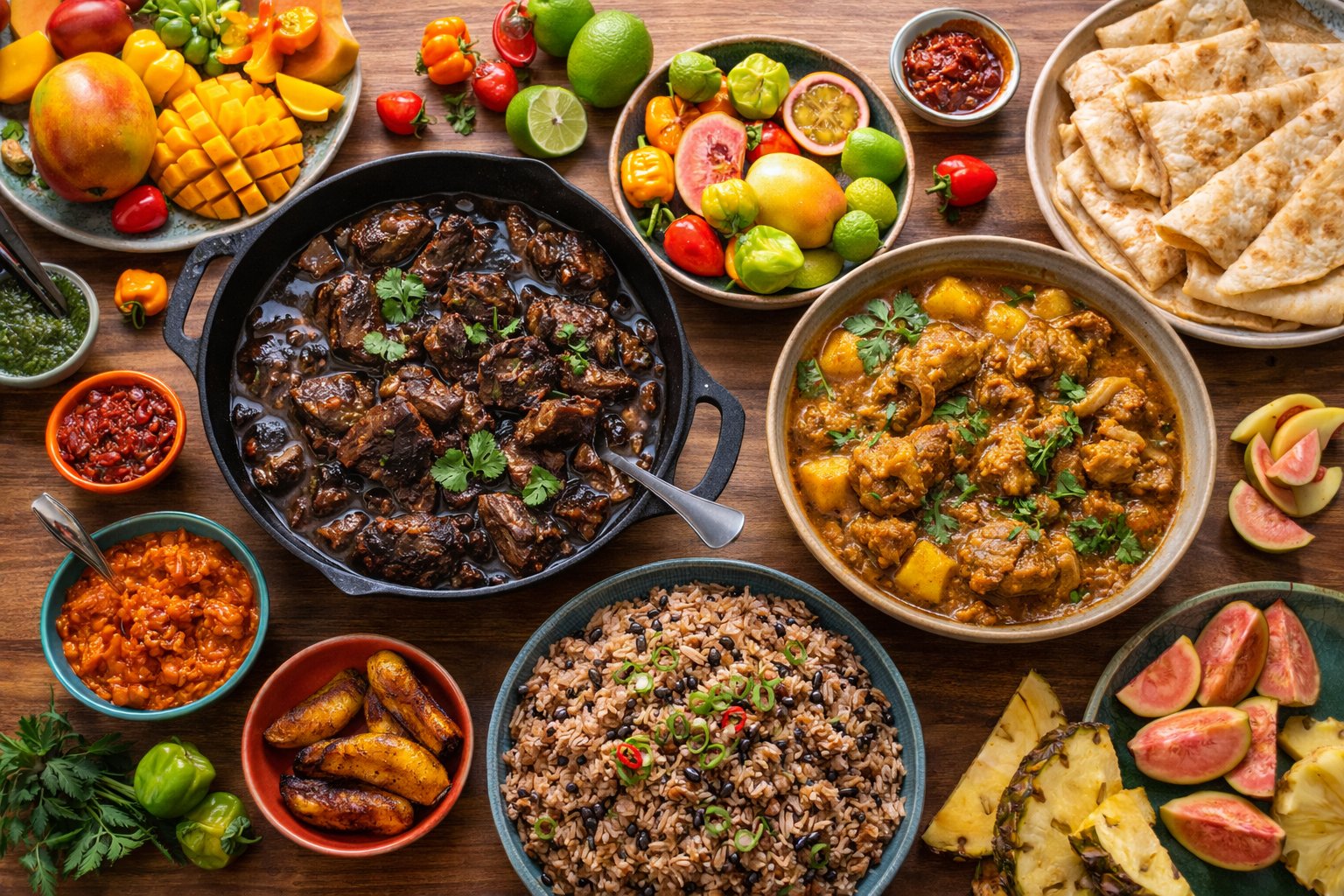
Guyanese food is what happens when Amerindian, African, Indian, Portuguese, Chinese and British cooking share one small coastal strip for two hundred years and then stop distinguishing between themselves. It is the most interesting cuisine in South America and almost nobody outside the Guyanese diaspora has heard of it.
Pepperpot
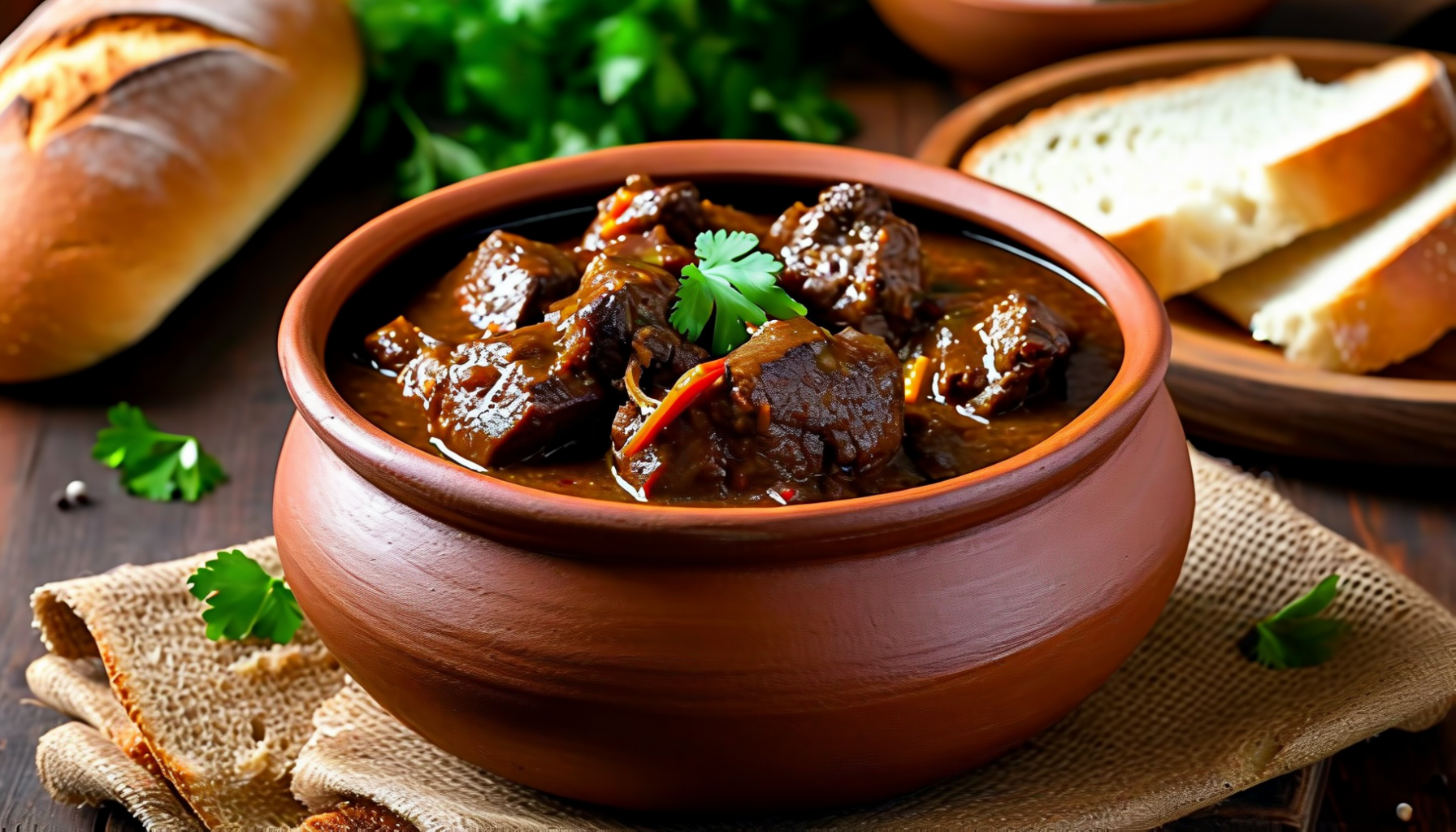
The national dish and the Christmas breakfast: beef, pork or mutton stewed for hours in cassareep — reduced bitter-cassava juice — with cinnamon, clove, thyme and hot pepper, until it is almost black. Cassareep is a preservative, so the pot is kept on the stove and re-boiled daily; family pepperpots have been running for weeks and, in legend, for years. Eaten with plait bread.
Cook-up rice
Rice cooked in coconut milk with black-eye or red peas and whatever meat is in the house, all in one pot. It is the Saturday dish, the after-a-funeral dish and the emptying-the-fridge dish, and every family's is slightly different and definitively correct.
Curry and roti
Chicken, duck, goat or shrimp curry with dhal puri (a roti layered with ground split peas) or paratha, torn and slapped by hand to separate the layers — hence "buss-up-shut," burst-up-shirt. At Hindu religious functions you get seven curry, seven vegetarian curries served on a lotus leaf and eaten with the fingers.
Metemgee and garlic pork
Metemgee is ground provisions — cassava, eddo, plantain, yam — simmered in coconut milk with dumplings called duff, an African-derived one-pot. Garlic pork, pork cured in vinegar, garlic and thyme and then fried, is the Portuguese contribution and appears at Christmas alongside black cake, a fruit cake with fruit that has been soaking in rum since last year.
Street and snack food is a genre of its own: pholourie (split-pea fritters with mango sour), egg balls (a boiled egg wrapped in cassava and fried), plantain chips, salara (a coconut roll dyed bright red), pine tart, cheese roll and bake and saltfish for breakfast. Fish is excellent — hassar, gilbaka, banga mary — and the interior serves arapaima, the world's largest scaled freshwater fish, from community-managed fisheries in the Rupununi.
🍲 Pepperpot
The one indispensable ingredient is cassareep, and there is no substitute for it. It is the juice of grated bitter cassava, boiled down with spices until it is a thick black syrup — the boiling destroys the cyanogenic compounds that make bitter cassava poisonous raw, and what is left is a preservative and a flavour that exists nowhere else. Bottled Guyanese cassareep is sold in Caribbean and West Indian grocers and online; buy that rather than trying to improvise.
Guyanese Pepperpot
Serves 6–8 · 30 minutes' work · 3–4 hours' cooking, best the next day
Ingredients: 1.5 kg stewing beef and/or pork on the bone, in large chunks — oxtail, shin, cow heel and pig trotter are all traditional and all improve it; 350 ml cassareep; 1 cinnamon stick; 6 cloves; 4 sprigs thyme; 2 large onions, sliced; 1 head of garlic, crushed; 2 whole hot peppers (wiri wiri, Scotch bonnet or habanero); 2 tbsp brown sugar; 1 strip orange peel; salt and plenty of black pepper.
Method: Wash the meat with lime or vinegar and water, the Guyanese way, and drain it. Put everything into a heavy pot — meat, cassareep, spices, onion, garlic, whole peppers, sugar and orange peel — and add water just to cover. Bring to the boil, then reduce to the barest simmer, cover, and cook for three to four hours, until the meat is falling apart and the liquid has reduced to a dark, glossy syrup that coats it. Do not let it dry out; add a little hot water if it does. Do not burst the peppers unless you want it fierce. Season at the end, not the start. Cool it, leave it overnight, and reheat it to a full rolling boil the next day before eating — that boil is both the tradition and the reason it keeps.
💡 Cassareep is a preservative, and a properly made pepperpot left in a covered pot and boiled up daily keeps for days without refrigeration. That is not a folk claim; it is why the dish exists in a tropical country that had no fridges.
🌿 Cassava and Cassareep
Underneath Guyanese cooking sits an Amerindian technology that most visitors never think about. Bitter cassava (Manihot esculenta) contains cyanogenic glycosides in quantities that will kill you, and the Amerindian peoples of the Guianas worked out, thousands of years ago, a complete processing chain that removes them and yields four separate products.
The root is peeled and grated on a board studded with stone or metal. The pulp goes into a matapee — a long woven tube that is hung from a beam, loaded, and then stretched by a person sitting on a lever at the bottom, squeezing the juice out. The dry pulp becomes cassava bread, baked flat on a griddle, or is toasted into farine. The poisonous juice is boiled hard, which drives off the cyanide, and reduced with spices into cassareep. The starch that settles out is tapioca.
Piwari
The fermented cassava drink of Amerindian Guyana, made for celebrations, traditionally started by chewing some of the bread and spitting it back in so that salivary enzymes convert the starch. It is genuinely alcoholic, genuinely traditional, and offered at village festivals. Whether to accept is your business.
Farine
Coarse toasted cassava meal, the staple carbohydrate of the interior, eaten with everything and sprinkled on soup. It keeps indefinitely without refrigeration, which in a country where the interior has no cold chain is the whole point.
Why it matters
Every Guyanese Christmas breakfast contains a preservative developed by Amerindian people before European contact, made from a poisonous root by a process that has to be followed exactly. It is one of the clearest cases anywhere of indigenous food technology surviving intact into a national cuisine, and Guyanese are proud of it.
Where to see it
Any Amerindian village in the Rupununi or on the Essequibo — Surama, Rewa, Yupukari, Fair View — will show you the whole chain if you ask, and most community tourism programmes include it. Buy cassava bread and farine on the spot; both travel well and neither will be confiscated at Prague.
🥃 Demerara Rum and the Wooden Stills
Demerara rum is a legally protected style and one of the world's great spirits categories, and the reason connoisseurs care about it is a set of pieces of eighteenth- and nineteenth-century equipment that exist nowhere else on Earth.
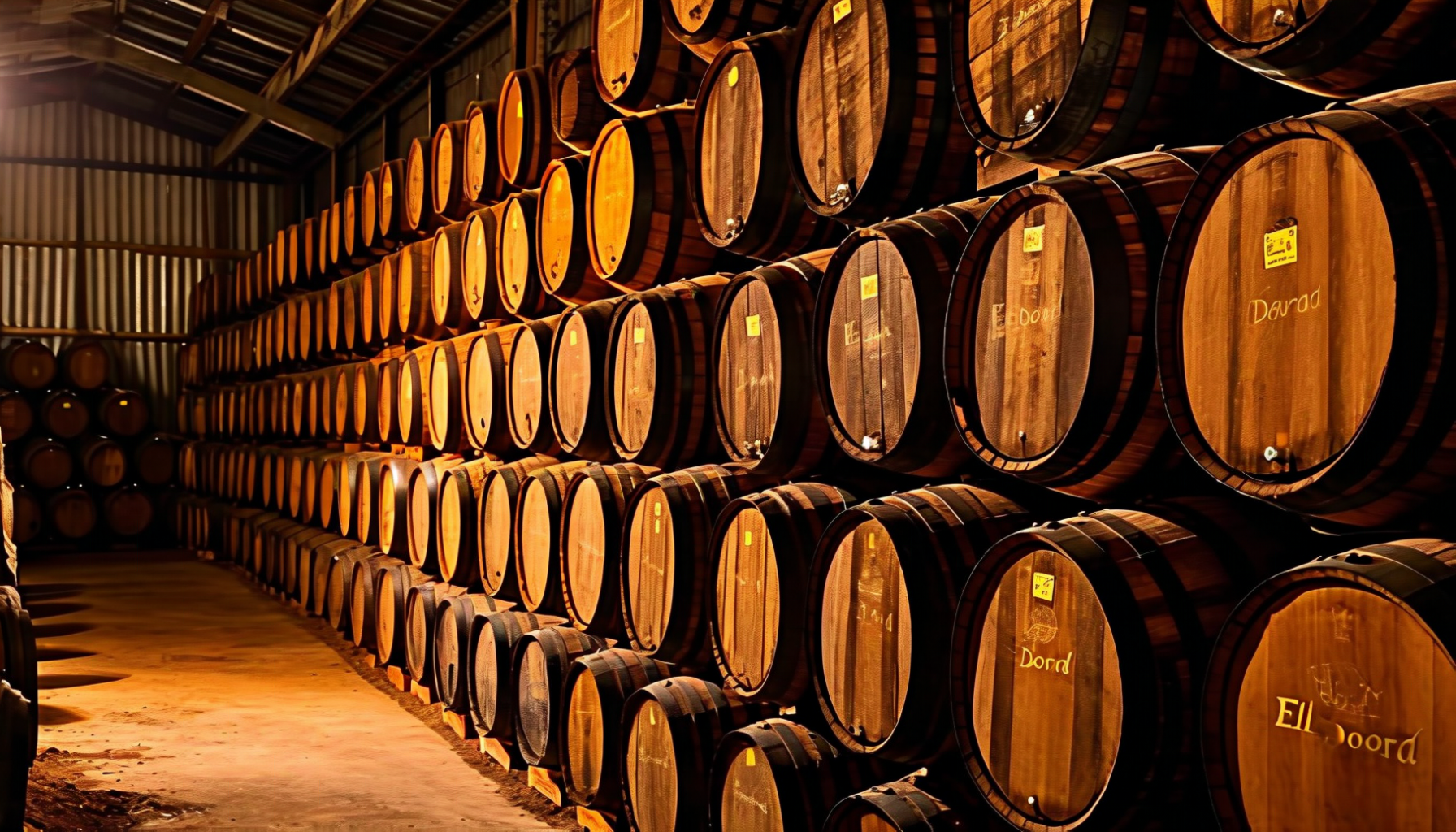
Everything is now made at one distillery, Diamond, run by Demerara Distillers, which inherited the stills of the colony's closed estates. Among them: the double wooden pot still from Port Mourant, dating in design to the 1730s; the wooden Coffey still from Enmore, a continuous still with a wooden column, built in 1880; and the single wooden pot still from Versailles. These are the only operating wooden stills of their kind anywhere, they are irreplaceable, and they give Demerara rum its particular heavy, sooty, dried-fruit character.
El Dorado
The flagship brand. El Dorado 15 Year Old won a long run of international awards in the 2000s and is the one to start with; the 12 is the everyday bottle and the 21 and 25 are the serious ones. In Guyana they cost a fraction of the European price, and a bottle of 15 is the single best thing to bring home.
Marks
Demerara rums are identified by estate marks — PM (Port Mourant), EHP (Enmore), VSG (Versailles), DHE, SVW, ICBU — which independent bottlers in Europe use on labels. If you have ever bought a Velier or Cadenhead Demerara, this is where it came from.
Beer and the rest
Banks DIH brews Banks Beer, which is the national lager and is drunk cold and in quantity; it also makes the soft drinks. Rum shops — small, everywhere, usually a counter and a few chairs — are the basic social institution of the country, and a bottle is bought for the table rather than by the glass.
Non-alcoholic
Mauby (a bitter bark infusion, an acquired taste and worth acquiring), sorrel (hibiscus, at Christmas, usually with rum in it), ginger beer, peanut punch, and juices of five-finger (carambola), soursop, passion fruit and tamarind. Coconut water is sold from the nut on every corner.
🌟 Guyanese Worth Knowing
Walter Rodney (1942–1980)
Historian and activist whose How Europe Underdeveloped Africa (1972) is one of the most widely read works of history written in the twentieth century, and whose A History of the Guyanese Working People is a masterpiece. He built a multiracial opposition that crossed Guyana's ethnic divide, which is precisely why he was dangerous. Killed by a bomb in Georgetown at 38; a 2016 inquiry found the state responsible.
Wilson Harris (1921–2018)
Novelist, and by some distance the most ambitious writer the Caribbean has produced. He worked for years as a government surveyor in the Guyanese interior before writing Palace of the Peacock (1960), a short, dense, hallucinatory novel about a crew going upriver that is unlike anything else in English. Difficult, and worth the difficulty.
Martin Carter (1927–1997)
Poet, jailed by the British in 1953, and the author of Poems of Resistance from British Guiana — including the lines every Guyanese schoolchild knows: "I do not sleep to dream, but dream to change the world." He later broke with the government he had helped bring to power. The finest political poet in the anglophone Caribbean.
Clive Lloyd (b. 1944)
Captain of the West Indies cricket team from 1974 to 1985 — the side that won the first two World Cups and did not lose a Test series for fifteen years, and which is generally reckoned the greatest team the game has produced. A tall, bespectacled left-hander from Georgetown who changed how cricket was played.
Eddy Grant (b. 1948)
Born in Plaisance, raised in London, and the writer of "Electric Avenue," "Gimme Hope Jo'anna" and "Baby Come Back" — the last with The Equals, one of Britain's first racially mixed pop groups. He now lives in Barbados and owns the Ice Records catalogue of classic Caribbean recordings.
Shivnarine Chanderpaul (b. 1974)
One of the most productive Test batsmen in history — over 11,800 runs across two decades — from Unity Village on the East Coast Demerara, with a crab-like open stance that every coaching manual said was wrong and which nobody ever managed to get past. His son Tagenarine now opens for the West Indies.
🏙️ Georgetown
Georgetown is a low wooden city of about 200,000 people at the mouth of the Demerara, laid out by the Dutch as a drainage scheme and built by the British in timber. It was once called the Garden City of the Caribbean; decades of neglect took most of the shine off, and the oil money is now putting some of it back, unevenly and very fast.
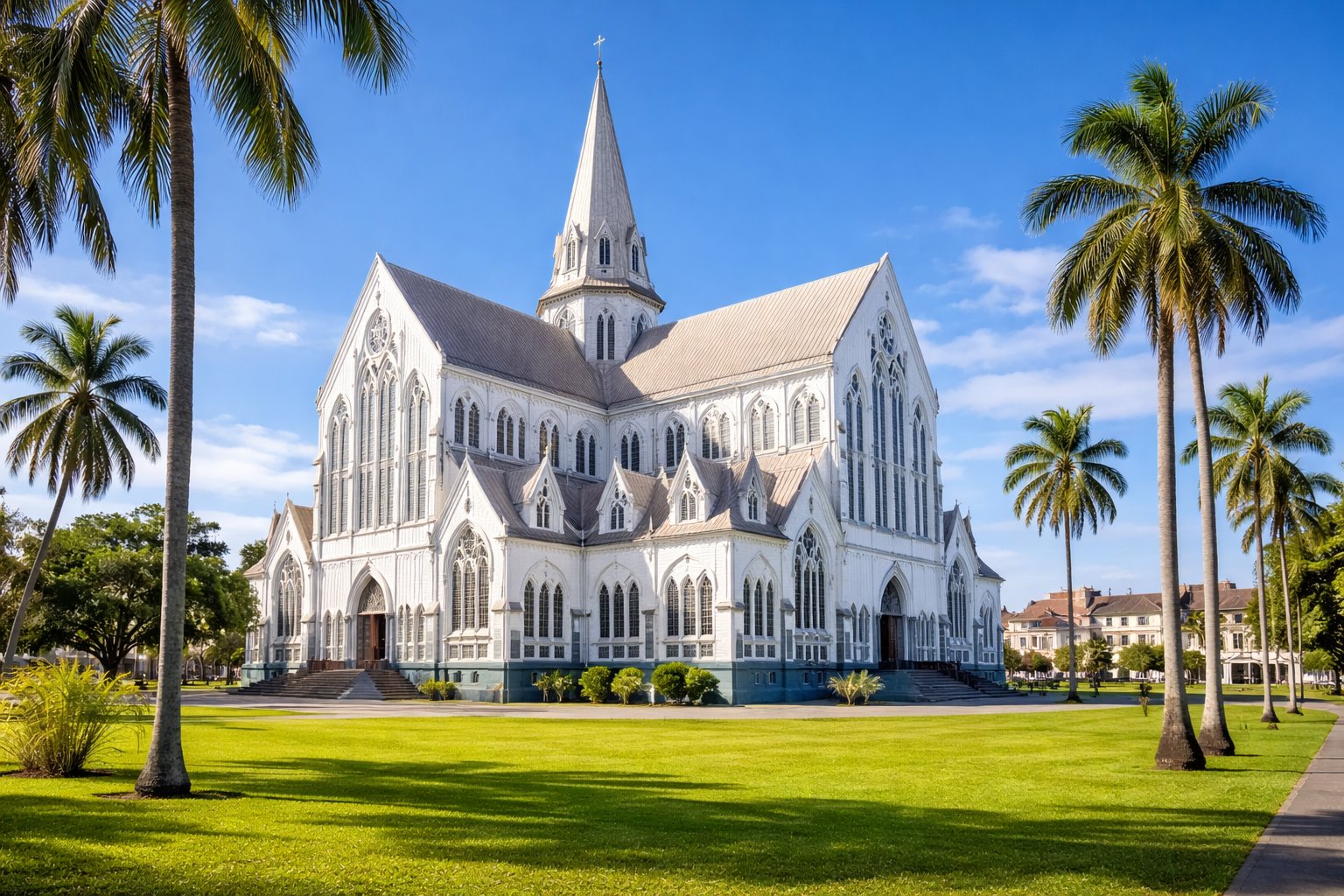
The wooden architecture is the reason to walk here. Nineteenth-century Georgetown was built in greenheart and pine, on brick or concrete stilts against flooding, with Demerara windows — louvred, hinged at the top, propped open, with a shelf for a block of ice to cool the air coming through. City Hall (1889), a wildly ornate Gothic Revival timber pile, has been near-derelict for years and is finally under restoration; Red House, State House and the Walter Roth Museum of Anthropology are all in the same tradition.
What to see
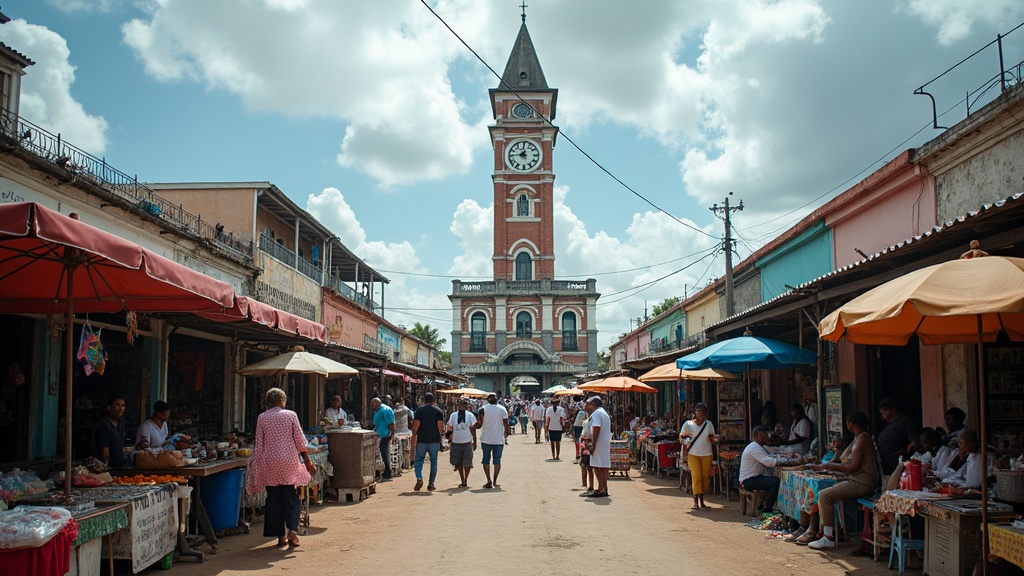
Stabroek Market and the Water Street stelling; St George's Cathedral; the 1763 Monument in the Square of the Revolution; the Botanical Gardens with the manatees in the ponds and the Kissing Bridge; the Walter Roth Museum for Amerindian material culture; the seawall at Kitty on a Sunday evening, which is where the whole city goes.
The manatees
There really are West Indian manatees living in the Botanical Gardens ponds and in the canals near the National Park, and you can feed them grass through the railings. It is entirely unadvertised, completely free and the single most surprising thing in the city.
Eating
Everything in one place: Indian, Chinese, Creole, Brazilian and Portuguese, in restaurants and from carts. Backyard Café (booked ahead, a chef cooking in his own yard) is the famous one; Bourda and Stabroek markets are where the eating actually happens; the Georgetown Chinese restaurants do a thoroughly Guyanese chow mein.
Safety
Georgetown has real street crime and it is the one place in Guyana where a visitor needs to pay attention. Do not walk at night, particularly around Stabroek, Tiger Bay and the seawall after dark; use a taxi arranged by your hotel; do not display phones and cameras in the market. In daylight, in the main streets, with normal precautions, it is fine.
🐆 Wildlife
Guyana is one of the great wildlife destinations that almost nobody uses. Around 815 bird species, 225 mammals and a nearly intact large-predator and large-herbivore fauna, in a country the size of Britain with 830,000 people and no mass tourism at all. What it lacks is infrastructure; what it offers in exchange is that you will usually be the only people there.
The big five
Guyana's own list: jaguar, giant river otter, giant anteater, black caiman (up to five metres, and the Rupununi has one of the world's most studied populations) and harpy eagle. All five are genuinely findable here, and Guyana is probably the best country in South America for the last three.
Birds
Cock-of-the-rock leks at Iwokrama, harpy eagle nests at Surama and Rewa, the endemic rufous-winged ground cuckoo, sun parakeet in the Karasabai area, hoatzin — the ridiculous prehistoric-looking bird that is Guyana's national bird, locally the canje pheasant — plus the whole Guiana Shield endemic list. Serious birders come here specifically.
Arapaima
The world's largest scaled freshwater fish, up to three metres, an air-breather that surfaces with an audible gulp. It was fished nearly out of the Rupununi and has recovered under a community-managed catch-and-release sport fishery at Rewa and Apoteri — one of the genuine conservation success stories in the Amazon basin.
How to see it
Community-run lodges: Surama, Rewa, Karanambu, Caiman House at Yupukari, Iwokrama River Lodge, Atta. All are owned or co-managed by the villages, all are basic-to-comfortable rather than luxurious, and the guides are local people who grew up in the forest. Book through a Georgetown operator; independent arrival mostly does not work.
🌲 Iwokrama and the Canopy
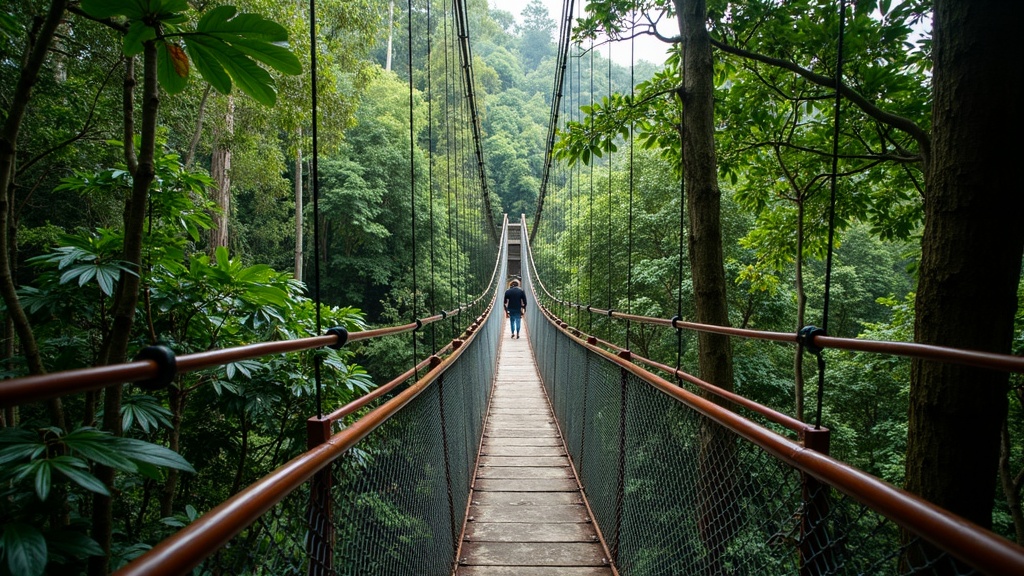
In 1989 Guyana did something no country had done before: it gave 3,700 km² of untouched rainforest to the international community, offering it to the Commonwealth as a laboratory for showing that a tropical forest can be used without being destroyed. The Iwokrama International Centre has run it ever since, in partnership with the sixteen North Rupununi communities, and it is where most visitors actually meet the Guyanese forest.
Getting there
Iwokrama straddles the Georgetown–Lethem road at the Kurupukari crossing, about 300 km inland — a day's hard drive from Georgetown, or a flight to Annai. Most people arrive as part of an overland trip between the coast and the Rupununi, which is the sensible way to do it.
Where to stay
The Iwokrama River Lodge on the Essequibo at Kurupukari and Atta Rainforest Lodge beside the walkway. Both are modest, both are excellent, and both put you in the forest before dawn, which is the entire point.
Turtle Mountain
A steep 300 m climb through forest from the river to a rock summit with a view over unbroken canopy in every direction to the horizon. It takes about ninety minutes up, it is hot and hard, and it is the best view in Guyana that does not involve an aircraft.
What it proves
Iwokrama is a working experiment: a zone that is sustainably logged, a zone that is fully protected, timber certified and sold, tourism run with the villages, and research going on throughout. It has not made anybody rich. It has kept 3,700 km² of forest standing for thirty-five years while providing local income, which was the question being asked.
🐎 The Rupununi
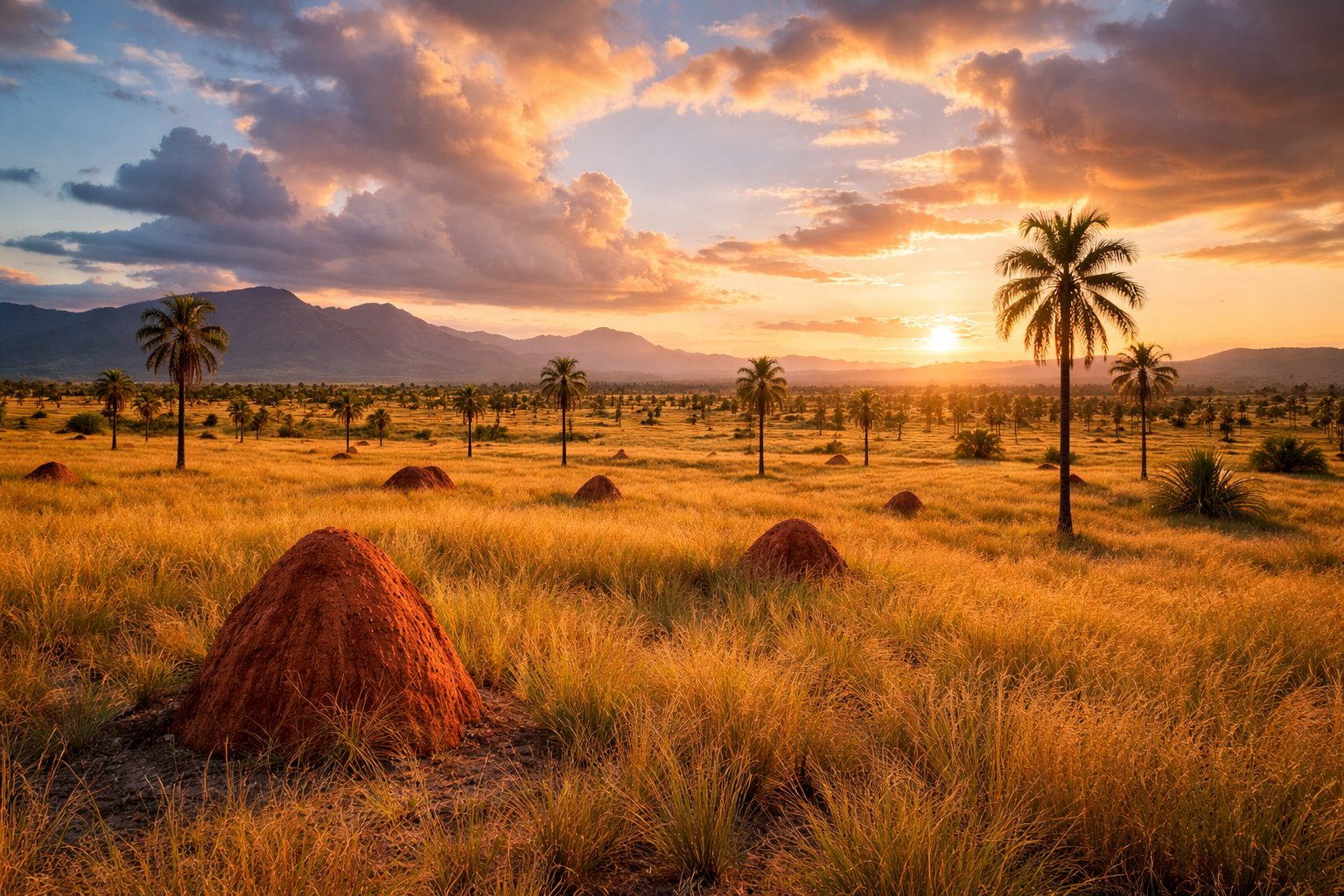
The Rupununi is Guyana's south-west: an area of savanna roughly the size of Slovakia, seasonally flooded, dotted with termite mounds and ité palm islands, split by the Kanuku Mountains, and worked by cattle ranches and Macushi and Wapishana villages. It is the most extraordinary landscape in the country and one of the last places on the continent where you can watch giant anteaters in open ground.
Karanambu
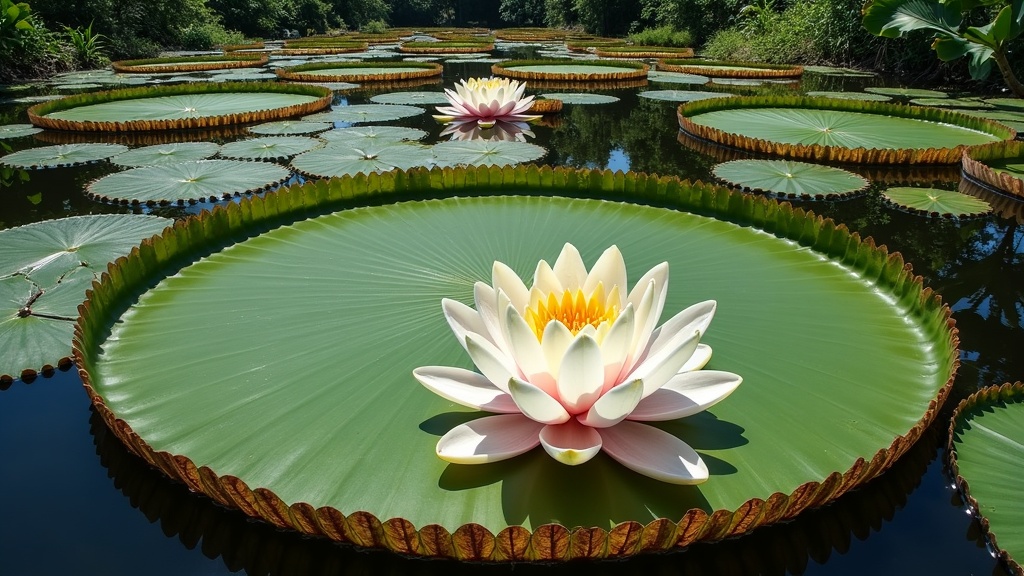
The former ranch of Diane McTurk, who spent decades rehabilitating orphaned giant river otters and became internationally known for it. Now a trust-run lodge on the Rupununi river: otters, black caiman spotlighting at night, and the Victoria amazonica ponds where the lilies open at dusk while you sit in a boat with a rum in your hand.
Surama and Rewa
Surama is a Macushi village on the forest–savanna edge that runs its own eco-lodge, guiding and a climb up Surama Mountain. Rewa, further into the forest, is the arapaima village — catch-and-release fishing, and some of the best guiding in the country. Both are village-owned, and the money stays in the village.
Yupukari and the caimans
Caiman House at Yupukari runs a long-term black caiman research programme and takes guests out at night on the river to help capture, measure and release them. Handling a two-metre caiman in the dark on a wooden boat is not for everyone and is one of the more memorable things available anywhere.
Lethem and the rodeo
The border town with Bonfim in Brazil, and the country's back door — Brazilian goods, Brazilian Portuguese, and a very different atmosphere from the coast. The Rupununi Rodeo at Easter is the region's great event. Getting to Lethem means a flight from Ogle (about ninety minutes) or the road, which is 500 km and takes 14 to 20 hours in the dry season.
🐢 Shell Beach and the North-West
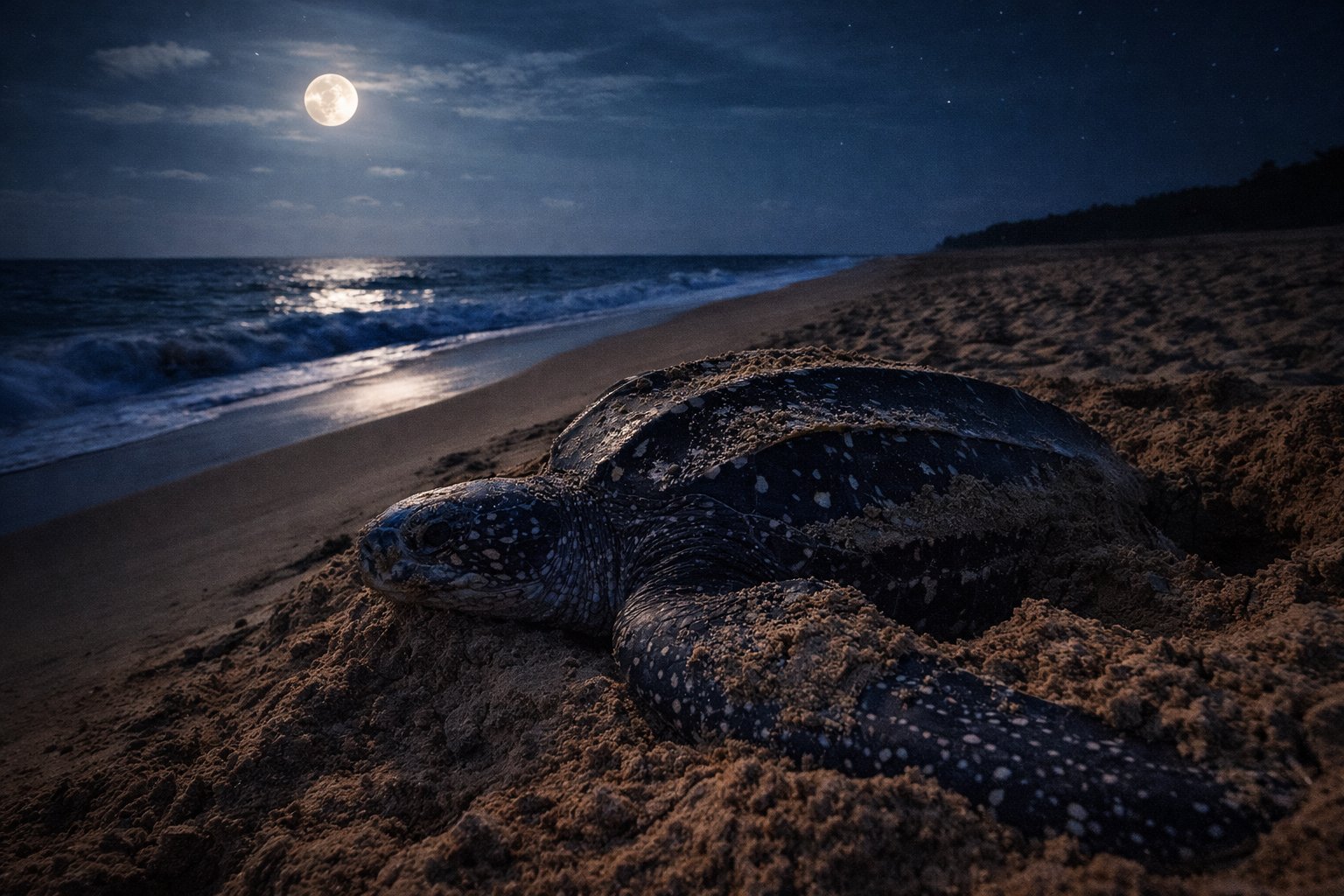
Shell Beach is about 120 km of remote sand, shell and mangrove on the Atlantic in Region One, near the Venezuelan border, and it is one of the most important sea turtle nesting sites on the northern coast of South America. Four species come ashore here: leatherback, green, hawksbill and olive ridley.
The protection effort is a genuinely good story. Turtle meat and eggs were harvested here for generations, and from the 1980s the conservationist Audley James and later the Guyana Marine Conservation Society turned the same coastal communities into the monitoring and protection programme — former hunters became rangers. The area was formally designated the Shell Beach Protected Area in 2011, at over 120,000 hectares.
Getting there
Not easy, which is the point. From Georgetown by road and boat to Charity on the Pomeroon, then several hours by open boat along the coast, or by light aircraft to Mabaruma. Accommodation is a basic camp. Trips run in the nesting season and are arranged through Georgetown operators well in advance.
The north-west generally
Region One is mangrove, creek, Warrau and Arawak villages, and gold and timber camps — the least visited part of an already unvisited country. Mabaruma is the regional town. Somewhere in this forest, unmarked, is the site of the Jonestown settlement, which is not a destination and is not visited.
Turtle etiquette
No white light, no flash, stay behind the animal, keep back until she has started laying and is in a trance, and follow the ranger exactly. A disturbed female will turn round and go back to sea without nesting, and that costs her a whole cycle.
The Pomeroon
The river route to Charity passes through the Pomeroon, a beautiful stretch of coconut and coffee smallholdings on a brown river, with the country's best coconut water and a way of life that has changed slowly. Worth a day in itself and easily added on.
🛶 The Essequibo and the Islands
The Essequibo is the largest river between the Orinoco and the Amazon: about a thousand kilometres long, and with an estuary more than twenty kilometres across that contains islands bigger than several Caribbean countries. Leguan and Wakenaam are farmed and inhabited, and Hogg Island alone is larger than Barbados.
The river is also the practical dividing line of the country and, not coincidentally, the line Venezuela's claim runs along. It is crossed by ferry from Parika, an hour west of Georgetown, and the crossing to Supenaam and on to the Pomeroon is one of the easiest and best day trips available from the capital.
Fort Island
In the estuary, reachable from Parika: Fort Zeelandia (1740s) and the Dutch Court of Policy building, the best-preserved Dutch colonial remains in Guyana and on the country's UNESCO tentative list. Quiet, unrestored, atmospheric and almost unvisited.
Bartica and the rapids
Bartica, at the confluence of the Essequibo, Mazaruni and Cuyuni, is the gateway to the goldfields — a raw, cheerful river town full of miners and boat traffic. Upstream are the Marshall Falls and a series of rapids, and the ruins of the Dutch Kyk-Over-Al fort on its island. Boats from Parika take a couple of hours.
Baganara and the resorts
A handful of river-island resorts near Bartica — Baganara, Sloth Island, Hurakabra — are where Georgetown goes for the weekend: white sand on a black-water river, swimming, and nothing else to do. It is not wilderness, it is very pleasant, and it is easy.
The other rivers
The Demerara is Georgetown's river and now has a new high-span crossing beside the old floating pontoon bridge that was for decades the longest of its kind in the world. The Berbice and the Corentyne are the east — New Amsterdam, the ferry to Suriname, and a countryside of rice and mosques that most visitors never see.
✈️ Getting There
Guyana's international gateway is Cheddi Jagan International Airport (GEO) at Timehri, about 40 km south of Georgetown; domestic and charter flights use Eugene F. Correia (Ogle), much closer to the city. There are no direct flights from Prague and one or two connections are the minimum. Total journey time runs from about sixteen hours to a full day and a half.
Via Amsterdam
The cleanest European routing: KLM flies Amsterdam–Georgetown, and Prague–Amsterdam connects onto it. One stop, and the only single-connection option from Central Europe. Check the current schedule — the frequency has changed several times since the oil boom and the route is in demand.
Via the Caribbean
Caribbean Airlines serves Georgetown heavily from Port of Spain, and Trinidad connects to Europe via London and Miami. This is the classic route and gives you the option of a stop in Trinidad, which is worth taking.
Via North America
American Airlines from Miami and New York JFK, and connections from Toronto — the busiest routes, because that is where the diaspora is. Prague–London or Prague–Frankfurt then a US carrier works, though it means US transit clearance and ESTA even if you never leave the terminal.
Via Panama
Copa from Panama City connects Georgetown to the whole of Latin America and to Europe via Amsterdam or Madrid. Useful if you are combining Guyana with anywhere else on the continent, which is otherwise surprisingly hard.
Expect 22,000–38,000 CZK for a return from Prague, and more in December, at Mashramani and around Diwali when the diaspora flies home. Book well ahead: seat capacity into Georgetown is limited, oil-industry traffic has taken up much of it, and last-minute fares are punishing.
Overland, the only practical crossings are the ferry across the Corentyne to Suriname from Moleson Creek, and the road and bridge at Lethem to Bonfim in Brazil, which connects to Boa Vista and the BR-174. Both are used and both are slow. The Venezuelan border is not a route for visitors.
🚐 Getting Around
The coast has roads; the interior does not. That single fact organises every itinerary in Guyana. Driving is on the left, a British inheritance shared with almost nowhere else in South America.
Minibuses
The coastal public transport: numbered routes, cheap (a few hundred dollars a trip), frequent, extremely loud and driven with more enthusiasm than caution. Route 44 runs Georgetown–Timehri airport; Route 42 goes to Parika. They leave when full, they stop anywhere, and they are how the country moves.
Taxis and hire cars
Taxis are plentiful in Georgetown and are not metered — agree the fare first, and use a car your hotel calls rather than one flagged on the street, especially at night. Hire cars are available and driving the coast road is manageable; driving to Lethem is a serious 4×4 undertaking and not something to attempt alone.
Domestic flights
The real answer for the interior. Small aircraft from Ogle to Lethem, Annai, Kaieteur, Mahdia, Mabaruma, Port Kaituma and a network of village strips, run by Trans Guyana, Air Services and others. They fly to weight and weather, luggage limits are strict and real (often 20 kg), and cancellations are normal. Build a spare day around every flight.
Boats and the Lethem road
River transport is everywhere: the Parika ferries, speedboats to Bartica, the Kurupukari crossing. The Georgetown–Lethem road is 500 km, roughly half of it laterite through the forest, and takes 14–20 hours by overnight minibus in the dry season. It is an experience, it is cheap, and it is not comfortable.
A workable two-week trip: Georgetown and the coast for three days, a day flight to Kaieteur, then overland or by air into the interior for Iwokrama, the canopy walkway, Surama and the Rupununi, coming out through Lethem. Add Shell Beach in season, or the Essequibo islands and Bartica if you have less time.
💰 What It Costs
Guyana used to be cheap. It is not any more — the oil boom has pushed Georgetown hotel rates and restaurant prices to levels that surprise people who last came in 2015 — and the interior was never cheap in the first place, because everything there arrives by aircraft.
Accommodation
A basic Georgetown guesthouse 8,000–15,000 GYD a night (900–1,700 CZK); a decent mid-range hotel 20,000–40,000 GYD (2,300–4,500 CZK); the business hotels catering to the oil industry considerably more and often full. Interior lodges are usually quoted in US dollars at US$100–250 per person per night, full board, because there is no alternative.
Eating
A roti and curry or a plate of cook-up from a stall 500–1,500 GYD (55–170 CZK); a proper restaurant meal in Georgetown 3,000–8,000 GYD (350–900 CZK); a Banks beer 400–700 GYD. Eating from markets and stalls is excellent and cheap; eating in the hotels the oil industry uses is European-priced.
The big-ticket items
Kaieteur day flight: US$250–350. Domestic flight Ogle–Lethem: around US$130–160 each way. A guided interior trip with lodges, guides and transfers: US$150–300 per person per day all-in. These are the numbers that determine a Guyana budget, and there is very little way around them.
Money
Guyanese dollars in cash for everything local; US dollars are widely accepted for hotels, tours and flights and are worth bringing. ATMs work in Georgetown and the larger coastal towns and are unreliable elsewhere; cards work in hotels and larger restaurants in the capital and essentially nowhere in the interior. Take more USD cash than you expect to need.
Realistic figures for a Czech traveller: 2,000–3,500 CZK a day staying on the coast with guesthouses, minibuses and local food; 4,000–8,000 CZK a day once you are in the interior on lodges and light aircraft, which is where the trip's value actually is. Flights from Prague 22,000–38,000 CZK return. A two-week trip doing Guyana properly is not a budget holiday, and pretending otherwise would be dishonest.
📋 Practical Information, Health and Safety
Entry
Guyana has generally admitted Czech and other EU citizens without a visa for tourist stays, with a stamp on arrival for an initial period that can be extended at the immigration office in Georgetown. Rules of this kind change without much publicity — verify the current position with the Guyanese immigration authorities or a Guyanese mission before booking. You will need a passport valid six months beyond arrival and an onward ticket.
Yellow fever
Guyana is a yellow fever risk country. A certificate is required if you arrive from an endemic country, and vaccination is recommended for everyone travelling into the interior. You will also need the certificate if you continue to Brazil or several other neighbours. Get it at a Czech travel clinic at least ten days ahead; it is valid for life.
Malaria — interior only
This is the useful distinction: malaria risk is essentially confined to the interior regions (1, 7, 8 and 9) — the forest, the mining areas and the Rupununi — and is very low on the coast and in Georgetown. Prophylaxis is recommended for interior travel; discuss atovaquone/proguanil or doxycycline with a Czech travel clinic. Dengue, chikungunya and Zika are present on the coast and there is no prophylaxis for them, so repellent matters everywhere.
Other health
Hepatitis A and B, typhoid, tetanus-diphtheria-polio; rabies pre-exposure for long or remote stays. Georgetown Public Hospital and the private Woodlands and Balwant Singh's handle most things; anything serious means evacuation to Trinidad, Barbados or Miami, so insurance with medical evacuation cover is essential — the interior lodges are hours from any road.
Consular cover for Czechs
The Czech Republic has no embassy in Georgetown; Guyana is covered from a Czech mission elsewhere in the region — check the current covering post on mzv.cz before you travel and save its details. Several EU states are represented in Georgetown and, as an EU citizen, you may seek help from any of them under Article 20 TFEU. Register the trip in DROZD, which matters more than usual in a country where you may be four hours' flight from a road.
Safety
Georgetown has genuine street crime — armed robbery and snatch theft — concentrated after dark and around Stabroek Market, Tiger Bay and the seawall. Take taxis at night, do not display valuables, and be alert in the markets. Outside Georgetown, and especially in the interior, Guyana is very safe; the risks there are road accidents, boats and the forest itself. Check the current MZV advisory before you go.
Practicalities
Driving is on the left. Electricity is a mixture of 120 V and 240 V with American type A/B and British type G sockets in use — bring a universal adapter and check the voltage before plugging anything in. Time is GMT−4 with no daylight saving, so five or six hours behind Prague. Tap water is not reliably drinkable; buy bottled or filtered.
Etiquette
Guyanese are direct, funny and extremely hospitable, and will talk to a foreigner about politics, cricket and oil within about four minutes. Greet before you ask anything. Dress modestly at temples and mosques. Ask before photographing people, and in Amerindian villages ask the toshao before photographing anything at all — visits should be arranged through the village, not turned up to.
❓ Common Misconceptions
"Guyana is a Latin American country"
Geographically South American, culturally Caribbean. English is the official language — the only English-speaking country on the continent — the sport is cricket, the food is Caribbean, and CARICOM's headquarters is in Georgetown. Spanish will get you nowhere.
"Guyana, Ghana, Guinea, French Guiana"
Four different places on two continents. Guyana is the former British Guiana; French Guiana is a French overseas department next door; Suriname between them was Dutch. Ghana and Guinea are in West Africa. The confusion is constant and Guyanese have stopped being surprised by it.
"Jonestown"
An American cult that leased land in the Guyanese forest in 1977 and killed 918 of its own members, almost all of them Americans, in 1978. Guyanese were not involved, the site is gone, and it is not something anyone visits. It is the one thing many foreigners know about the country and it tells them nothing about it.
"There must be a UNESCO World Heritage Site"
There is not one. Kaieteur, Shell Beach, Georgetown's historic district and Fort Zeelandia are all on Guyana's tentative list, and none has been inscribed. That is a genuine gap and Guyanese conservationists say so.
"Kaieteur is the world's highest waterfall"
It is not — Angel Falls in Venezuela, on the same Guiana Shield, is nearly four times higher. Kaieteur's claim is different and better: at 226 m of unbroken drop with a very large volume behind it, it is generally reckoned the most powerful single-drop waterfall in the world.
"The demerara sugar in my kitchen comes from there"
The name does. Demerara is one of Guyana's three counties, and the sugar style is named for it — but most "demerara sugar" sold in Europe today is made elsewhere, and Guyana's own sugar industry has closed most of its estates since 2017. The rum, however, is genuinely and legally Guyanese.
"It's poor"
It was, and by lived experience much of it still is — but GDP per head has gone from around US$6,000 to over US$20,000 since oil production began in 2019, and Guyana has repeatedly been the fastest-growing economy in the world. Whether that reaches people is the open question and everyone here is watching it.
"Venezuela's claim is a curiosity"
It covers two-thirds of the country's territory, it is currently before the International Court of Justice, and Venezuela held a referendum on annexation in December 2023. It is the most serious territorial dispute in the Americas. Guyanese of every background are united on it, which is otherwise almost unheard of here.
✍️ Author's Note
Guyana is the least visited country in South America and one of the most rewarding, and the reason is straightforward: there is very little infrastructure, so nothing has been arranged for you. There is no gringo trail, no hostel circuit, no beach resort strip. You fly to a village airstrip, a local guide meets you, and you are the only visitors there.
The interior is what to come for. Standing on the Iwokrama canopy walkway at first light with mist below and macaws crossing beneath your feet; watching a giant anteater work through Rupununi grass while a vaquero rides past on the skyline; sitting in a boat at dusk on the Rupununi river while Victoria amazonica flowers open around you — none of this requires competing with anyone. It does require a lot of money on light aircraft, and Guyana is no longer cheap.
Georgetown is a harder sell and worth persisting with. It is a decaying and reviving wooden city with the best cathedral you will ever see made of timber, a cast-iron market that is the loudest place in the Caribbean, manatees living in the botanical gardens, and food from six culinary traditions within a hundred metres of each other. Go early to Stabroek, walk in daylight, take taxis at night, and talk to people, because Guyanese will talk to you.
Practical closing advice, in order: verify the entry rules before you book, because they change; get the yellow fever certificate; take malaria prophylaxis for the interior only; bring US dollars in cash; buy travel insurance that includes evacuation; put a spare day either side of every internal flight; and go now, while it is still like this, because the oil is going to change it.
Support This Project 🌍
This World Travel Factbook is a labor of love – free to use for all travelers. If you find it helpful, consider supporting its continued development.