

🇮🇶 Iraq at a Glance
🌍 Overview
⚠️ Iraq is at war. Since the strikes on Iran of 28 February 2026 Iraq has been a theatre of the wider conflict: American bases on Iraqi soil have been hit, the Kurdistan Region has absorbed more than a thousand drones and missiles, and Iraqi oil exports collapsed with the closure of the Strait of Hormuz. Do not travel. The travel section below says so properly; everything historical and cultural on this page remains true and will outlast the current situation. Checked 6 September 2026.
Iraq is Mesopotamia — the land between the Tigris and the Euphrates — and it is not an exaggeration to say that more of the basic equipment of human civilisation was invented here than anywhere else. Writing, around 3200 BC. The city, at Uruk, before that. The wheel in its earliest attested use. Codified law, arithmetic in base sixty — which is why an hour has sixty minutes and a circle 360 degrees — the sexagesimal place-value system, astronomy, the first named author in history, and the first written literature.
The modern country covers 438,317 km², about five and a half times Czechia, with roughly 46 million people. It is overwhelmingly Arab with a large Kurdish minority in the north, majority Shia with a substantial Sunni population, and it holds the two holiest cities of Shia Islam outside Arabia. Its economy is oil: crude accounts for well over 90% of government revenue, which is both the reason the state functions and the reason it stops functioning whenever the oil does.
The last fifty years
It is worth stating the sequence plainly, because it explains almost everything about the present. The Iran–Iraq war, 1980–88, roughly a million dead between the two countries. The invasion of Kuwait and the 1991 Gulf War. Thirteen years of sanctions that destroyed the middle class and the health system. The 2003 invasion and occupation. A sectarian civil war. The Islamic State, 2014–2017, which took a third of the country. And now 2026. Four decades in which almost nobody now alive in Iraq has had a normal peacetime adulthood.
And yet
Between roughly 2018 and 2025 something genuinely hopeful was happening. Security improved markedly, the Kurdistan Region and then federal Iraq opened up to tourism, Baghdad's riverfront and Al-Mutanabbi Street were restored, Mosul's Great Mosque of al-Nuri was being rebuilt under UNESCO, and a small but real stream of foreign visitors was arriving to see Ur, Babylon, Erbil and the Marshes. That window has closed for now. It was real and it will reopen.
The archaeology
There are somewhere between ten and fifteen thousand recorded archaeological sites in Iraq, of which a small fraction has ever been excavated. Six are on the UNESCO World Heritage list — Hatra, Ashur, Samarra, Erbil Citadel, the Ahwar marshes, and Babylon — and Ur, Uruk, Nineveh and Nimrud are all on the tentative list or should be. It is, by a wide margin, the densest concentration of unexcavated early history anywhere.
What Iraqis will tell you
Two things, repeatedly, and both are worth taking seriously. That the country is not what the news says it is — that ordinary life, hospitality and humour continue through everything. And that they are tired of being a place things happen to. Iraqi hospitality toward foreign visitors is genuinely extraordinary and has survived every reason it had not to.
🏷️ The Name, and What It Sits On
ʿIrāq is an Arabic word attested from the seventh century, and its origin is argued. The most widely accepted reading takes it from a root meaning the shore or the deeply rooted, well-watered land — the riverbank country. A competing derivation traces it to Sumerian Uruk, the city, through Middle Persian Erāq. Either way it is a name about the rivers, and the rivers are the country.
Mesopotamia
The Greek name — mesos between, potamos river — is a foreign label for the same place, coined by writers who were describing somewhere else's homeland. The Arabic is Bilad al-Rafidayn, "the land of the two rivers", which says the same thing from inside. Both names describe a geography rather than a people, which is a fair description of what Iraq has always been: a corridor everybody passes through.
The languages
Arabic and Kurdish are both official — an unusual and deliberate constitutional arrangement. Iraqi Arabic (Mesopotamian Arabic) is its own thing, with a substrate of Aramaic and Akkadian words that go back four thousand years, and Baghdadi is instantly recognisable across the Arab world. Kurdish in Iraq is mostly Sorani, written in a modified Arabic script, with Badini Kurmanji in the north-west. Neo-Aramaic survives among Assyrian and Chaldean Christians and Mandaeans — the last living descendants of the language Jesus spoke.
The flag
Red, white and black horizontal bands with Allahu akbar in green in the centre. The current version dates from 2008: the words were kept but rewritten in Kufic script, replacing a version added in 1991 that was said to be in Saddam Hussein's own handwriting. Removing the three stars of the old Ba'athist flag was also deliberate. Flag design in Iraq is not a decorative question.
A few words
Salam alaikum (peace be upon you), shukran (thank you), shlonak / shlonich (how are you, to a man / to a woman — pure Iraqi), zayn (good), chai (tea, which you will be given constantly), aku / maku (there is / there isn't — the most Iraqi pair of words there is). In Kurdish: choni (how are you), supas (thank you), bashe (good).
🗺️ Geography
Iraq is four countries stacked on top of each other, and they look nothing alike. Understanding that is most of what you need to understand about its politics as well as its landscape.
The alluvial plain
The flat, hot, irrigated centre and south between the two rivers, from around Baghdad to the Gulf. This is the classical Mesopotamia — the land the silt built — and it is where every Sumerian, Akkadian and Babylonian city stood. It is almost perfectly flat, it depends entirely on irrigation, and its soils have been under cultivation for six thousand years, with all the salinity problems that implies.
The mountains
The north-east, along the Iranian and Turkish borders: the foothills and ranges of the Zagros, green in spring, snowbound in winter, rising to Cheekha Dar / Halgurd at around 3,600 m. This is Kurdistan, and it is climatically and culturally another world from Basra — oak forest, waterfalls, orchards, and a landscape that surprises everyone who arrives expecting desert.
The western desert
More than a third of the country: the stony Jazira and the Syrian and Arabian desert running to the Saudi and Jordanian borders. Almost empty, crossed by the highway to Amman, and — because it is empty and borders four countries — the strategic space in which a great deal of Iraq's recent history has been fought.
The marshes
Where the Tigris and Euphrates meet in the far south: the Ahwar, the largest wetland in western Eurasia, a landscape of reed beds and water buffalo inhabited continuously for five thousand years. It has been drained, refilled and is now drying again — its own section further down this page.
The rivers themselves: the Tigris (Arabic Dijlah) rises in Turkey and runs through Mosul and Baghdad; the Euphrates (Furat) rises in Turkey, crosses Syria and passes Nasiriyah. They join at al-Qurnah to form the Shatt al-Arab, which runs past Basra to the Gulf and forms the disputed border with Iran that started the 1980 war. Iraq's coastline is about 58 km long — for a country of this size it is essentially landlocked, and that fact has driven its foreign policy for a century.
💧 The Rivers Are Failing
The slowest and most serious crisis in Iraq is not political. The two rivers that made the country are carrying a fraction of the water they used to, and the trend is one-way. This is the thing that will still be a problem when everything else on this page is history.
Upstream
Both rivers rise in Turkey, and the Euphrates crosses Syria before reaching Iraq. Turkey's GAP project has built a large system of dams on both rivers — the Atatürk dam on the Euphrates and the Ilısu dam on the Tigris, completed in 2020, being the biggest — and Iran has diverted several Tigris tributaries that used to enter Iraq from the east. There is no binding water-sharing treaty between the three states. Iraq, at the bottom of both rivers, gets what is left.
The numbers
Combined flow into Iraq has fallen by something on the order of half since the 1970s, with the worst years far below that. Iraq's own storage has at times dropped to under a tenth of capacity. Climate projections for the basin are uniformly bad: hotter, drier, with more of the precipitation arriving as rain rather than snow, which means it runs off in weeks instead of melting through the summer.
Salt
Less flow means less flushing, and a flat irrigated plain in a hot climate accumulates salt. Large areas of southern farmland have gone out of production to salinisation — the same process that helped end Sumerian agriculture four thousand years ago, documented in the tablets as a shift from wheat to more salt-tolerant barley. It is happening again, faster, and it is now reaching Basra's drinking water: in 2018, a salinity and pollution crisis in the Shatt al-Arab hospitalised some 118,000 people and set off serious riots.
The marshes, again
Saddam Hussein drained the southern marshes in the 1990s, deliberately, as a counter-insurgency measure against the Marsh Arabs who had sheltered rebels — reducing a wetland of some 20,000 km² to under a tenth of that and displacing hundreds of thousands of people. After 2003 the embankments were breached and the marshes partly refilled; in 2016 they were made a UNESCO World Heritage site. Since then upstream abstraction and drought have been drying them again, and recent years have seen buffalo dying and families leaving. The recovery was real and it is not secure.
⚠️ Iraq in the 2026 War
Dated by design. This section reflects the public record as of 6 September 2026 and is the fastest-ageing thing on the page. Where accounts conflict, that is said rather than resolved. For the waterway at the centre of it, see the separate Strait of Hormuz page.
Iraq did not start this war and is not formally a party to it, and it has been one of the places most damaged by it. When the United States and Israel struck Iran on 28 February 2026, Iraq was immediately caught between the two: American bases sit on Iraqi soil, Iranian-aligned militias operate inside Iraqi politics, and Iraq's oil leaves through the Gulf.
The oil collapse
This is the part with the biggest consequences for ordinary Iraqis. With the Strait of Hormuz closed, Iraqi oil exports fell by more than 80% in the weeks after the strikes, output dropping from around 4.3 to 1.4 million barrels a day and monthly oil revenue from roughly $6 billion to under $2 billion. In a state that draws over ninety per cent of its budget from crude, that is a fiscal emergency: public-sector salaries, which are most of the formal economy, come out of that money.
Scrambling for a way out
Baghdad has spent the year trying to export by any route that is not the Gulf. Kirkuk–Ceyhan, the pipeline to the Turkish Mediterranean, has been the main hope: a one-year deal with Turkey signed on 1 August 2026 to raise throughput, described as a prelude to a target of more than a million barrels a day. There is also crude moving to Syria by road — five to seven hundred tanker trucks a day at one point — and a planned Basra–Haditha pipeline to link toward Syria, Turkey and Jordan. None of it replaces the Gulf.
Kurdistan under fire
The Kurdistan Region has absorbed a very large share of the strikes. Kurdish tracking put the total at more than a thousand drones and missiles since February, with 32 killed; a strike on 25 March killed six Peshmerga at Erbil, and Erbil airport has been targeted repeatedly, most recently on 2 September. Coalition air defences intercept many of them. This is the region that had spent a decade marketing itself as "the other Iraq", safe and open to visitors.
The militias and the PKK
Iran-aligned Iraqi militias are both an instrument of the wider conflict and a domestic problem the Iraqi state has never resolved. Separately, Iraq, the Kurdistan Regional Government and Turkey have been implementing a PKK disarmament mechanism, with a stated goal of evacuating 18 camps and 72 near-border positions by 1 October 2026. Some Iranian-backed militias have made their own disarmament conditional on a Turkish withdrawal, which analysts read as a way of not disarming.
🗺️ Map
Iraq sits between roughly 29° and 37° north, bordered by Turkey to the north, Iran to the east, Kuwait and Saudi Arabia to the south, and Jordan and Syria to the west — six neighbours, which is a great deal of border for a country this shape.
The distances
Baghdad to Basra is about 550 km, Baghdad to Erbil about 350 km, Baghdad to Mosul about 400 km. The whole country is roughly the size of Sweden or California. In peacetime the main roads were driveable and the domestic flights cheap; checkpoints, not distance, set the timetable.
Two administrations
Federal Iraq is governed from Baghdad; the Kurdistan Region — Erbil, Sulaymaniyah, Duhok and Halabja governorates — has its own government, parliament, armed forces (the Peshmerga) and, in normal times, its own visa arrangements. Crossing between them involves a real internal border, and the disputed territories along the line, Kirkuk above all, are the country's most persistent internal fault line.
The 58 kilometres
Iraq's entire coast is a stub at the head of the Gulf around Umm Qasr and the Faw peninsula — under 60 km, with the Shatt al-Arab shared with Iran and the maritime approaches constrained by Kuwait's islands of Bubiyan and Warbah. A country of 46 million with almost no sea access, sitting on the second or third largest oil reserves in the world, is a geopolitical problem waiting to happen, and it has happened twice.
Neighbours as routes
Historically almost everything reached Iraq overland. Today the practical entries in peacetime are the airports — Baghdad, Erbil, Sulaymaniyah, Basra, Najaf — plus the road crossings from Turkey at Ibrahim Khalil and from Jordan at Trebil. The Iranian crossings carry an enormous volume of Shia pilgrims and very few tourists.
✍️ Sumer, and the Invention of Writing
Around 4000 BC, on the flat silt of southern Iraq, people began doing something no one had done before: living in very large numbers in one place. Uruk — the city that may have given the country its name — reached perhaps 40,000 to 80,000 people by 3100 BC, at a time when there was nothing else remotely like it on Earth. Everything else followed from the administrative problem that creates.
Writing was invented, as far as anyone can tell, to do accounts. The earliest tablets from Uruk, around 3200 BC, are records of barley, beer, sheep and labour. Pictographic marks pressed into wet clay with a reed stylus gradually became the wedge-shaped signs of cuneiform, which was then adapted to write Sumerian, Akkadian, Elamite, Hittite and Old Persian and stayed in use for three thousand years — longer than the Latin alphabet has existed.
What else came from here
The sexagesimal number system — base sixty — which is why your clock has sixty minutes and a circle has 360 degrees. Positional notation. Quadratic equations. Systematic astronomy, with records of eclipses and planetary positions kept for centuries and precise enough that modern astronomers still use them. The earliest legal codes, the earliest maps, the earliest schools, and the world's oldest known recipes, on tablets from around 1750 BC that describe elaborate meat stews with leeks and garlic.
Gilgamesh
The Epic of Gilgamesh is the oldest substantial work of literature that survives: Sumerian poems from around 2100 BC, assembled into the standard Akkadian version by about 1200 BC. It is about a king who cannot accept that his friend is dead and goes to the end of the world to find out how not to die, and fails. It also contains a flood narrative — Utnapishtim, the boat, the birds released to find land — that predates and closely parallels the Biblical one, a discovery made by George Smith at the British Museum in 1872 that caused a public sensation.
Enheduanna
Daughter of Sargon of Akkad, high priestess at Ur around 2300 BC, and the first author in world history whose name is attached to their own work. Her hymns to the goddess Inanna survive, are written in the first person, and are unmistakably personal — she complains at length about being exiled. Everything written before her is anonymous. She predates Homer by fifteen hundred years.
Ur
The Sumerian city excavated by Leonard Woolley in the 1920s and 30s, where he found the Royal Cemetery: sixteen tombs of the mid-third millennium containing gold headdresses, lyres inlaid with lapis and shell, the Standard of Ur, and the bodies of dozens of attendants who appear to have been buried with their rulers. Its ziggurat, partly reconstructed, is the best-preserved in Iraq and the single most photographed thing in the country.
🦁 Babylon and Assyria
Sumer gave way to Akkad, and then to a long alternation between two powers: Babylon in the south and Assyria in the north. They shared a language, a script and a religion, and spent fifteen hundred years being extremely different from one another.
Hammurabi
King of Babylon c. 1792–1750 BC, and the author of the most famous law code in history — 282 provisions carved on a two-metre diorite stele, opening with the king receiving authority from the sun god and covering wages, medical fees, building standards, divorce and theft. It is not the oldest code (Ur-Nammu's is three centuries earlier) and it is not only "an eye for an eye" — the penalties are explicitly graded by social class. The stele was looted by the Elamites in antiquity, dug up at Susa in 1901, and is in the Louvre.
Assyria
From its heartland at Ashur, Nimrud and Nineveh on the Tigris, Assyria built what is usually called the first true empire — at its height, from Egypt to the Gulf. It ran a standing army, a road and messenger system, mass deportation as a policy, and a genuinely magnificent palace art of carved stone reliefs: lion hunts, sieges, and the winged human-headed bulls, the lamassu, that stood at the gates. Nineveh fell in 612 BC to Babylonians and Medes.
Ashurbanipal's library
At Nineveh, the last great Assyrian king assembled a library of over 30,000 clay tablets — literature, omens, medicine, astronomy, lexical lists — deliberately collected from across Mesopotamia. When the city burned in 612 BC the fire baked the tablets hard and preserved them. It is why we have Gilgamesh. The most important library in the ancient world survives because it was destroyed.
Neo-Babylon
The last flowering: Nebuchadnezzar II, 605–562 BC, who rebuilt Babylon on a scale that astonished visitors, raised the blue-glazed Ishtar Gate (now largely in Berlin), destroyed the Temple in Jerusalem and carried off the Judean elite. The Hanging Gardens are the one wonder of the seven with no archaeological trace at Babylon at all, and a serious body of scholarship argues they were actually at Nineveh. Babylon fell to Cyrus the Great in 539 BC.
📚 Baghdad and the House of Wisdom
In 762 the Abbasid caliph al-Mansur founded a new capital on the Tigris: Madinat al-Salam, the City of Peace, laid out as a perfect circle with the palace and mosque at the centre. Within fifty years Baghdad was probably the largest city in the world, and for two centuries it was the intellectual centre of it.
The translation movement
This is the part that matters most and is least known in Europe. Over roughly two centuries, under state patronage, an enormous body of Greek, Persian and Indian scientific and philosophical work was systematically translated into Arabic — Aristotle, Galen, Euclid, Ptolemy, Indian astronomy and mathematics. It was not passive preservation: the translators corrected, extended and argued with the texts. The institution associated with it is the Bayt al-Hikma, the House of Wisdom.
Al-Khwarizmi
Working in ninth-century Baghdad, he wrote al-Kitab al-mukhtasar fi hisab al-jabr wa'l-muqabala — from whose title comes the word algebra — and a treatise on Indian numerals that carried the decimal place-value system and the digit zero into the Arabic and then the European world. His own name, Latinised, gave us algorithm. Two of the load-bearing words of modern computing come from one man working beside the Tigris.
And the rest of them
Ibn al-Haytham, whose Book of Optics established that vision works by light entering the eye and laid down something very close to the experimental method. Al-Razi and later Ibn Sina in medicine, whose Canon was a European medical textbook into the seventeenth century. Al-Kindi on cryptanalysis, describing frequency analysis a thousand years before it was reinvented. Paper-making, learned from Chinese prisoners at Talas in 751, reached Baghdad and made all of it possible.
The city itself
Also the Baghdad of the Thousand and One Nights and of Harun al-Rashid, who really did exchange embassies with Charlemagne. Nothing of the round city survives above ground — the Tigris has moved and Baghdad has been destroyed several times since. What survives is the Mustansiriya madrasa of 1233, the Abbasid Palace, and the fact that a large part of the mathematics you were taught at school passed through here.
⚔️ 1258, and the Long Aftermath
In February 1258 a Mongol army under Hulagu Khan, grandson of Genghis, took Baghdad after a two-week siege. The city was sacked over about a week, the last Abbasid caliph was executed — rolled in a carpet and trampled, so that no royal blood touched the ground — and the death toll, though the medieval figures of 800,000 or two million are not credible, was catastrophic.
The libraries
The detail everyone repeats is that the Tigris ran black with the ink of books thrown into it. It is probably a literary image rather than a report, and the destruction of Baghdad's libraries was real and enormous regardless. So was the wrecking of the irrigation system — the canal network of the alluvial plain, maintained continuously for millennia, was damaged in ways that took centuries to repair, and southern Iraq's agricultural collapse dates from here more than from any single massacre.
The end of a centre
1258 is conventionally the end of the Islamic Golden Age, which is too neat — Islamic science continued in Cairo, Damascus, Samarkand and Andalusia. But the specific thing Baghdad had been, the place where the caliphate and the translation movement and the money were in one city, did not come back. Iraq became a frontier province instead of a centre, and stayed one for six hundred years.
Ottoman Iraq
From 1534, with interruptions, Iraq was Ottoman, and its position on the fault line with Safavid Persia made it a war zone repeatedly — Baghdad changed hands several times, and the Sunni–Shia dimension of that rivalry is one root of a sectarian politics still visible today. The Ottomans governed through three vilayets: Mosul, Baghdad and Basra. Those three provinces are exactly what Britain later stapled together to make Iraq.
What survives from then
The shrine cities were rebuilt and endowed under both Ottoman and Persian patronage; the great gold domes of Najaf, Karbala, Kadhimiya and Samarra are largely of this period. So are the courtyard houses with shanashil — the carved wooden oriel windows — of old Baghdad and Basra, of which a heartbreakingly small number survive.
🇮🇶 The Making of Iraq, 1914–1979
Modern Iraq was assembled by Britain out of three Ottoman provinces after the First World War, and almost every structural problem the country has had since is traceable to how that was done.
The mandate
British forces took Basra in 1914 and Baghdad in 1917; the Sykes–Picot understanding of 1916 and the San Remo conference of 1920 assigned Iraq to Britain as a League of Nations mandate. A nationwide revolt in 1920 — notable for uniting Sunni and Shia against the occupation — cost thousands of lives and forced a rethink. Britain's response was to install a monarchy: Faisal I, a Hashemite prince from the Hijaz with no Iraqi connection, made king in 1921 after a plebiscite reported 96% support.
Oil, and the borders
Oil was struck at Kirkuk in 1927, in enormous quantity, and the Iraq Petroleum Company — British, French, Dutch and American — took the concession. The northern border was drawn to keep Mosul province, and its oil, inside Iraq rather than Turkey. Kuwait was kept outside it, which Iraq contested from the beginning and acted on in 1990. Nominal independence came in 1932; British bases and influence stayed.
The Assyrians and the Farhud
Two events that set a pattern. The Simele massacre of 1933, in which the new Iraqi army killed hundreds of Assyrian Christians in the north — Raphael Lemkin later cited it among the cases that led him to coin the word genocide. And the Farhud of June 1941, a pogrom in Baghdad in which around 180 Jews were murdered. Iraq's Jewish community was ancient — Babylon, the Talmud, a third of Baghdad's population in the early twentieth century — and between 1948 and 1952 almost all of it, some 120,000 people, left. Fewer than ten Jews remain in Iraq today.
Coups
The monarchy was overthrown on 14 July 1958; the young king and the royal family were killed and the prime minister's body dragged through Baghdad. What followed was a decade of coups — 1963, 1968 — through which the Ba'ath Party came to power. The 1970s were, briefly, good: oil was nationalised in 1972, prices quadrupled in 1973, and the money went into schools, hospitals, electrification and one of the best university systems in the Arab world. The deputy running much of it was Saddam Hussein.
🕯️ Saddam, the Wars and the Sanctions
Saddam Hussein took the presidency in July 1979 and opened with a filmed party purge in which named colleagues were led out of the hall to be shot. He governed for twenty-four years, and in that time Iraq fought two catastrophic wars and lived through thirteen years of sanctions.
The Iran–Iraq war, 1980–88
Iraq invaded Iran in September 1980 expecting a short campaign against a revolutionary state in disarray, and got eight years of trench warfare with human-wave assaults, missile attacks on cities and the large-scale use of chemical weapons by Iraq against Iranian troops and, at Halabja in March 1988, against its own Kurdish civilians — some 5,000 killed in a day. Total deaths on both sides are usually put around a million. Iraq was armed and supported by much of the world during it, including the United States, the Soviet Union and France.
Anfal
In parallel, the Anfal campaign of 1986–89 against the Kurdish north: an estimated 50,000 to 100,000 killed, some 4,000 villages destroyed, mass deportation and chemical attacks. It is recognised as genocide by several states and by an Iraqi court. Ali Hassan al-Majid, who ran it, is remembered as Chemical Ali and was executed in 2010.
Kuwait, and 1991
Iraq invaded Kuwait in August 1990, was expelled by a US-led coalition in early 1991, and set the Kuwaiti oilfields alight on the way out. Encouraged to rise up and then left unsupported, Shia in the south and Kurds in the north rebelled and were crushed — tens of thousands killed, and the marsh drainage campaign followed. The Kurdish north was placed under a no-fly zone and became, from 1991, effectively self-governing.
Thirteen years of sanctions
The most consequential thing for ordinary Iraqis, and the least discussed. Comprehensive UN sanctions from 1990 to 2003, partly mitigated after 1996 by the corrupt oil-for-food programme, collapsed the currency, the health system, the schools and the professional middle class. Estimates of excess deaths — especially of children — vary enormously and were politicised at the time in all directions; what is not in dispute is that living standards fell further and faster than in almost any comparable case, that a highly educated country was deprofessionalised, and that the regime itself was not weakened.
💥 2003 and the Occupation
The United States and United Kingdom invaded on 20 March 2003, on the stated grounds that Iraq possessed weapons of mass destruction and had links to al-Qaeda. Baghdad fell in three weeks. No weapons of mass destruction were found, the intelligence case was subsequently found by inquiries in both countries to have been presented with unwarranted certainty, and the al-Qaeda link did not exist before the invasion — though it very much did afterwards.
De-Ba'athification and the army
Two orders issued by the Coalition Provisional Authority in May 2003 shaped everything that followed. Order 1 removed senior Ba'ath Party members from public employment — but party membership had been a condition of holding almost any professional post, so this stripped out teachers, doctors, engineers and administrators wholesale. Order 2 dissolved the Iraqi army, putting several hundred thousand armed, trained, unpaid and humiliated men on the street at once. Both are now very widely regarded, including by many who supported the war, as catastrophic errors.
The numbers
Estimates of Iraqi deaths from the 2003 invasion and its aftermath differ by an order of magnitude depending on method. Documented violent civilian deaths — Iraq Body Count — run to something over 200,000. Survey-based estimates of total excess deaths have ranged from around 150,000 to over a million, with the most cited peer-reviewed studies clustering in the high hundreds of thousands. Roughly 4,500 American and 179 British military personnel died. Millions were displaced.
Abu Ghraib and Falluja
The photographs of prisoner abuse at Abu Ghraib, published in 2004, did more damage to the occupation's legitimacy than any battlefield event. The two assaults on Falluja in 2004 levelled much of a city of 300,000. These are not footnotes: they are the specific events most often cited by Iraqis, and by the people who later joined the insurgency, as the reason.
What was gained
It is worth being even-handed. Saddam Hussein's rule was a genuine tyranny with mass graves in it, and its end is not something most Iraqis regret; the Kurdish north in particular has done well out of the last twenty years. Iraq has held repeated competitive elections with genuine transfers of power, has a free-ish press by regional standards, and has a functioning constitutional order. Whether that was worth what it cost is an argument Iraqis have among themselves, and outsiders should be slow to settle it for them.
🔥 The Civil War and the Islamic State
The insurgency against the occupation turned into something worse. The bombing of the al-Askari shrine at Samarra in February 2006 — one of the holiest sites in Shia Islam, its golden dome destroyed — set off open sectarian war. Baghdad was ethnically cleansed neighbourhood by neighbourhood over about two years, with death squads on both sides and bodies found daily. The city's mixed districts, which had been genuinely mixed, largely stopped being so.
How ISIS happened
Al-Qaeda in Iraq, rebuilt after 2011 in the vacuum of the Syrian war and fed by the sectarian politics of the Maliki government — which alienated Sunni Iraq comprehensively — became the Islamic State. In June 2014 a few thousand fighters took Mosul, a city of nearly two million, from several divisions of the Iraqi army, which collapsed and fled. Within weeks the group held roughly a third of Iraq and declared a caliphate from the pulpit of the Great Mosque of al-Nuri.
Sinjar
In August 2014 ISIS attacked the Yazidi homeland around Sinjar. Men were killed in mass executions; thousands of women and girls were enslaved and sold, systematically and openly. Tens of thousands fled onto Mount Sinjar and were besieged there. The UN has formally determined this to be genocide. Around 2,500 Yazidis are still missing, mass graves are still being exhumed, and much of Sinjar remains destroyed and depopulated.
The war back
The fight to retake the country ran from 2014 to 2017 and was done by the Iraqi army rebuilt, the Counter-Terrorism Service, the Kurdish Peshmerga, the largely Shia Popular Mobilisation Forces raised on a fatwa from Ayatollah Sistani, and a US-led coalition air campaign. The battle for Mosul, October 2016 to July 2017, was the largest urban battle since 1945: nine months, the Old City reduced to rubble, and civilian deaths in the thousands to tens of thousands.
What ISIS destroyed
Deliberately and on video: the Assyrian palaces at Nimrud, the lamassu of Nineveh, the ancient city of Hatra, the tomb of Jonah at Mosul, Sufi and Shia shrines, and the sculpture halls of the Mosul Museum. Some of what was smashed on camera was plaster casts; a great deal was not. They also ran an industrial-scale looting operation in antiquities, which did far more damage than the theatrical destruction and generated real revenue. The al-Nuri mosque and its leaning minaret, blown up in 2017, are being rebuilt under UNESCO with Emirati funding.
🏺 What Was Lost
Iraq has lost more of its archaeological record in the last thirty-five years than in the previous three thousand, and most of it went not to bombs but to shovels.
The Iraq Museum, April 2003
In the days after Baghdad fell the National Museum was looted while coalition forces, who had been warned by archaeologists beforehand, did not secure it. Around 15,000 objects were taken. Roughly half have since been recovered — including the Warka Vase and the Mask of Warka, returned in pieces or by intermediaries — through amnesties, seizures abroad and patient work by the museum's staff, several of whom hid things at personal risk. The museum reopened in 2015 and is now genuinely worth a day.
The sites
Worse, and much less visible. With the state absent after 1991 and again after 2003, hundreds of unexcavated sites in the south were dug over by organised looting gangs; satellite imagery of places like Isin and Umma shows them pitted like a moonscape. Once a tablet or a cylinder seal is out of the ground without a record, the object may survive but the information is gone permanently — and the information is most of what archaeology is for.
Where it went
Into the international antiquities market. Two cases give the shape of it: the Hobby Lobby case, in which the American company forfeited thousands of smuggled Iraqi tablets and paid a $3 million settlement in 2017; and the Gilgamesh Dream Tablet, a cuneiform fragment of the epic sold at auction with a false provenance, seized by the US and repatriated to Iraq in 2021. Both were about respectable buyers, not shadowy ones.
Babylon
A special case of a different kind. Saddam Hussein rebuilt large parts of the city on top of the original walls in the 1980s, in new brick stamped with his own name in imitation of Nebuchadnezzar, and built a palace overlooking it. Then in 2003 coalition forces established Camp Alpha on the site itself — digging trenches, filling sandbags with archaeological soil, and running heavy vehicles over buried remains. A UNESCO assessment described the damage in detail. Babylon was finally inscribed as a World Heritage Site in 2019.
🗳️ How Iraq Is Governed
Iraq is a federal parliamentary republic under the 2005 constitution, and it works considerably better than its reputation and considerably worse than its citizens want. It has held repeated genuinely competitive elections; it has also spent much of the last twenty years unable to form a government for months at a time.
The sectarian arithmetic
By convention rather than law, the prime minister is a Shia Arab, the president a Kurd, and the speaker a Sunni Arab. This muhasasa system of ethno-sectarian apportionment kept the country together after 2003 and has also entrenched patronage, made every ministry the property of a bloc, and turned government formation into a months-long negotiation among party leaders rather than a consequence of the vote.
The 2019 protests
The most important domestic political event since 2003. From October 2019, hundreds of thousands of mostly young Iraqis occupied Tahrir Square and city centres across the south, demanding jobs, services and an end to the sectarian quota system — explicitly rejecting sectarian politics altogether. Around 600 protesters were killed by security forces and unidentified gunmen. They brought down the government and forced a new electoral law. The Tishreen movement is the strongest indication that Iraqi politics may eventually be about something other than sect.
Sistani
Grand Ayatollah Ali al-Sistani, in Najaf, is one of the most consequential people in the country and holds no office. He represents the quietist tradition of Shia clerical authority — the view that clerics should not rule, in direct contrast to the Iranian model — and his interventions have repeatedly changed Iraqi history: insisting on elections in 2004, issuing the fatwa that raised the militias against ISIS in 2014, and withdrawing support from the government in 2019.
Corruption and the state
Iraq sits near the bottom of every corruption index. The single most cited figure is the "theft of the century" of 2022, in which some $2.5 billion was removed from the tax authority's escrow account by forged cheques. Meanwhile electricity supply in Baghdad is still intermittent in a country with the world's second or third largest oil reserves, and the public payroll — swollen as a substitute for an economy — consumes most of the budget. That is the grievance the 2019 protests were about.
🏔️ The Kurdistan Region
The Kurdistan Region of Iraq — Erbil, Sulaymaniyah, Duhok and Halabja governorates, about six million people — is constitutionally federal and practically close to autonomous: its own parliament, government, armed forces and, until recently, its own visa regime. For most of the last two decades it was the part of Iraq foreigners could actually visit.
How it got there
Kurdish autonomy was fought for through the twentieth century, crushed repeatedly, and gassed at Halabja in 1988. The 1991 no-fly zone after the failed uprising gave the region de facto self-rule; a Kurdish civil war between the two dominant parties, the KDP (Barzani, Erbil) and the PUK (Talabani, Sulaymaniyah), ran from 1994 to 1998; and federal status was written into the 2005 constitution. The KDP–PUK division is still the organising fact of Kurdish politics.
Erbil
One of the oldest continuously inhabited places on Earth. The Citadel — a walled oval town on a 30-metre mound of its own accumulated debris, occupied for perhaps 6,000 years — is a UNESCO World Heritage site, and the bazaar below it is the real thing. The modern city around it grew fast on oil and on being the safe place to do business in Iraq.
The mountains
The reason to come. Rawanduz gorge and the Gali Ali Beg waterfall; Amadiya, a town on top of a flat-topped mountain; the Barzan and Choman valleys; Shanidar Cave, where Ralph Solecki excavated ten Neanderthals in the 1950s, including the famous "flower burial" — which is genuinely disputed, the pollen may well be from burrowing rodents, but the site remains one of the most important Neanderthal finds anywhere. Spring, when the hills are green and covered in wildflowers, is startling.
The unresolved bits
The disputed territories along the internal boundary, above all Kirkuk with its oilfields and its mixed Kurdish, Arab and Turkmen population, were meant to be settled by a referendum under Article 140 of the constitution that has never happened. An independence referendum held by the KRG in 2017 passed overwhelmingly and was rejected by Baghdad, Turkey and Iran; federal forces retook Kirkuk within weeks. Budget transfers from Baghdad and control of oil exports are a permanent quarrel.
🕯️ The Older Communities
Iraq held, until very recently, a set of religious communities that existed nowhere else and in some cases had been there since before Islam or before Christianity. Most of them are now in an advanced state of collapse, and this is one of the great quiet losses of the last thirty years.
Yazidis
Around half a million people, mostly around Sinjar and Sheikhan, following a syncretic monotheistic religion with roots older than Islam, centred on Melek Taus, the Peacock Angel. Persistently and falsely accused of devil-worship for centuries — a slander used to justify repeated massacres, of which the 2014 genocide was the seventy-somethingth by their own count. Their holiest site is the temple complex at Lalish, where visitors walk barefoot and are, remarkably, welcomed.
Christians
Assyrians and Chaldeans, speaking Neo-Aramaic, present since the first centuries AD and among the oldest Christian communities in the world. There were perhaps 1.5 million in Iraq in 2003. There may be 150,000–250,000 now — a collapse of eighty to ninety per cent in twenty years, driven by post-2003 violence and completed by ISIS's clearance of the Nineveh Plains in 2014. Some have returned to Qaraqosh and Bartella; most have not.
Mandaeans
The smallest and most extraordinary: followers of John the Baptist, practising a Gnostic religion in which flowing water and repeated baptism are central, speaking their own dialect of Aramaic, historically living along the rivers and marshes of the south and famous as silversmiths. Perhaps 60,000 worldwide now, with only a few thousand left in Iraq. A religion that requires flowing water is in trouble when the rivers fail.
Turkmen, Shabak, Kaka'i and the Jews
Iraqi Turkmen, the third largest ethnic group, concentrated around Kirkuk and Tal Afar. Shabak and Kaka'i, small heterodox communities in the north, both attacked by ISIS. And the Jews of Iraq, whose presence dated from the Babylonian exile of 586 BC, who produced the Babylonian Talmud, and who were a third of Baghdad's population within living memory: fewer than ten remain. Twenty-six centuries ended in about four years.
👥 People and Religion
Around 46 million people, and very young: the median age is about 21 and something like sixty per cent of Iraqis were born after 2003. That single demographic fact — a country where most people have no adult memory of Saddam Hussein and every memory of the last twenty years — is behind the 2019 protests and behind most of what will happen next.
The composition
Arabs around 75–80%, Kurds around 15–20%, then Turkmen, Assyrians and Chaldeans, Shabak, Yazidis, Armenians and others. Religiously, roughly 95–98% Muslim, of whom the majority are Shia — the largest Shia-majority Arab country — with a large Sunni minority concentrated in the centre, west and among Kurds, who are mostly Sunni.
Tribe
Under and across all of that runs the ashira, the tribe, which is not a historical curiosity but a live institution: tribes settle disputes, guarantee obligations, mediate blood money and deliver votes. Many Iraqi families have both Sunni and Shia branches, and inter-sect marriage was ordinary in Baghdad before 2006. The idea of Iraq as a country of three neatly separable blocks is a foreign simplification that did real damage when it was used to design institutions.
Hospitality
It is the first thing every visitor reports and it is not a cliché. Being fed, being refused payment, being handed a phone number and told to call if anything goes wrong, being invited into a house within ten minutes of meeting someone — this is standard, it is a matter of honour rather than of curiosity, and it survived twenty years of reasons to distrust foreigners. Refusing food outright is a real discourtesy; the graceful move is to accept something small.
Arbaeen
Forty days after Ashura, millions of pilgrims walk to Karbala — commonly reported at fifteen to twenty million people, which would make it by a wide margin the largest annual gathering of human beings on Earth. They walk from Najaf, from Basra, some from the Iranian border, along roads lined for eighty kilometres with mawkib: free stalls where strangers feed, water, house and massage the feet of anyone walking. Whatever one's view of the theology, it is a logistical and moral phenomenon without parallel.
🎶 Poetry, Maqam and the Oud
There is an Arab saying that Cairo writes, Beirut publishes and Baghdad reads. Iraq's self-image is bookish and it is earned: the country produced a disproportionate share of twentieth-century Arabic literature and effectively invented modern Arabic free verse.
The poets
Badr Shakir al-Sayyab and Nazik al-Mala'ika, both Iraqi, broke the fifteen-hundred-year-old metrical system of classical Arabic poetry in the late 1940s and created al-shi'r al-hurr, free verse — the single biggest formal change in Arabic literature in a millennium. Al-Sayyab's Rain Song is one of the most quoted poems in the language. Add Muhammad Mahdi al-Jawahiri, the last great classical poet, and Saadi Youssef in exile.
Al-Mutanabbi Street
Baghdad's book market, named after the tenth-century poet, where booksellers spread stock on the pavement and the old rule is that nobody steals books. A car bomb destroyed it in 2007, killing over thirty people; it was rebuilt and reopened in 2008, and its Friday book market is again the thing to see in Baghdad. It has become, reasonably, the symbol of the country's idea of itself.
Iraqi maqam
A classical vocal tradition on the UNESCO intangible heritage list: a soloist improvising within a modal framework over an ensemble of santur, joza spike fiddle and percussion, with texts drawn from classical and colloquial poetry. It is demanding, transmitted by apprenticeship, and its most famous practitioners — Muhammad al-Qubbanchi, later Yusuf Omar — are still the reference recordings.
The oud, and the rest
The oud — the fretless lute that the European lute descends from, name and all — has its most important modern school in Baghdad: Munir Bashir and his brother Jamil made the solo oud a concert instrument. Then there is Kadim Al Sahir, the most successful Arab singer of his generation; the southern hicha and choubi rhythms; and Kurdish music, which is a separate tradition with its own instruments and a long repertoire of songs about mountains and loss.
🍚 Food
Iraqi cooking is the direct heir of the oldest documented cuisine on Earth — the Yale culinary tablets of around 1750 BC record about forty recipes, mostly meat broths with leeks, garlic and onion, and the family resemblance to what is eaten today is not fanciful. It is a cuisine of rice, lamb, wheat, dates, sour flavours and enormous generosity of portion.
The staples
Timman — rice, usually amber or basmati, cooked so the bottom forms a crust — with marag, a stew of lamb or chicken with okra, aubergine, white beans or courgette. Dolma, which in Iraq means vine leaves and stuffed onions, aubergines, courgettes and peppers, all layered in one pot and turned out upside down. Tashreeb, flatbread torn into a bowl and drowned in broth. Quzi, a whole slow-cooked lamb on spiced rice with nuts and raisins, which is the wedding dish.
Kubba
The national obsession and a genuine art form: a shell of bulgur, rice or potato around spiced minced lamb, in a dozen regional versions. Kubba Mosul is a flat disc the size of a plate; kubba hamuth is served in a sour broth; kubba halab has a rice shell and is fried. Getting the shell thin without it splitting is the test of a cook, and everyone's mother makes it best.
Sour, and the flavour profile
The defining Iraqi taste is sour: dried lime (noomi basra, black limes from Basra), tamarind, pomegranate molasses, sumac and hamuth broths. The spice blend is baharat — a warm mix in which cardamom, cinnamon and black pepper dominate. Bread is samoon, the diamond-shaped white roll baked in a stone oven, and flat khubz from a tannour.
Street and sweet
Masgouf from riverside grills. Kebab and tikka. Falafel and samoon for breakfast, with geymar — thick clotted buffalo cream — and date syrup, which is the best breakfast in the Middle East and not negotiable. Kahi, flaky pastry with the same cream. Zalabia and baklava. And dates: Iraq has hundreds of cultivars and was once the world's largest exporter, before war and salt took most of the palm groves.
🐟 Recipe: Masgouf
Iraq's national dish and its oldest — grilled river fish is on the Mesopotamian tablets — cooked on the bank of the Tigris at open apricot-wood fires, and eaten late, with the hands, on flatbread.
🚫 The supplied photograph for this recipe has been left out. It showed a whole round fish, unsplit, plated on mashed potato with a heap of French fries. Masgouf is defined by being butterflied open from the back into a flat kite shape and grilled upright beside the fire, and it is served on flatbread with onion, tomato and lemon. The picture got wrong the one thing that makes the dish what it is, and adding chips and mash to it made it a European bistro plate rather than an Iraqi one. Better no image than a misleading one.
Masgouf
Butterflied grilled river fish · serves 4 · 30 min prep + 1.5–2 h at the fire
Ingredients: 1 whole carp, barbel or similar freshwater fish of about 2–3 kg, scaled and gutted; 3 tbsp olive oil; 2 tbsp tomato paste; 1 tbsp tamarind paste (or the juice of 2 lemons); 1 tsp turmeric; 1 tsp ground black pepper; salt. To serve: flatbread, raw onion in thick slices, tomatoes, lemon wedges, pickled mango amba if you have it.
Method: Butterfly the fish from the back, not the belly: cut down either side of the spine from head to tail so the whole fish opens out flat like a kite, leaving the belly skin intact as the hinge and the head on. Rub the flesh with salt, turmeric and pepper and leave 20 minutes. Traditionally the fish is then pinned between two stakes and stood upright beside — not over — a wood fire, skin outward, and cooked by radiant heat for an hour or more. On a domestic grill: lay it skin-down on the coolest part of a charcoal grill, flesh up, and cook very slowly, never turning it, for 60–90 minutes. Mix the oil, tomato paste and tamarind and brush the flesh three or four times during cooking. At the end, move it directly over the coals for a few minutes to blister the skin. Slide onto flatbread and serve with raw onion, tomato and lemon, eaten with the fingers.
💡 The two non-negotiables are the back-butterfly and the slow indirect heat. Cooking it fast over flames gives you a burnt, dry, ordinary grilled fish; the whole point is an hour and a half of gentle smoke. Apricot or citrus wood if you can get it.
🍚 Recipe: Timman Bagilla
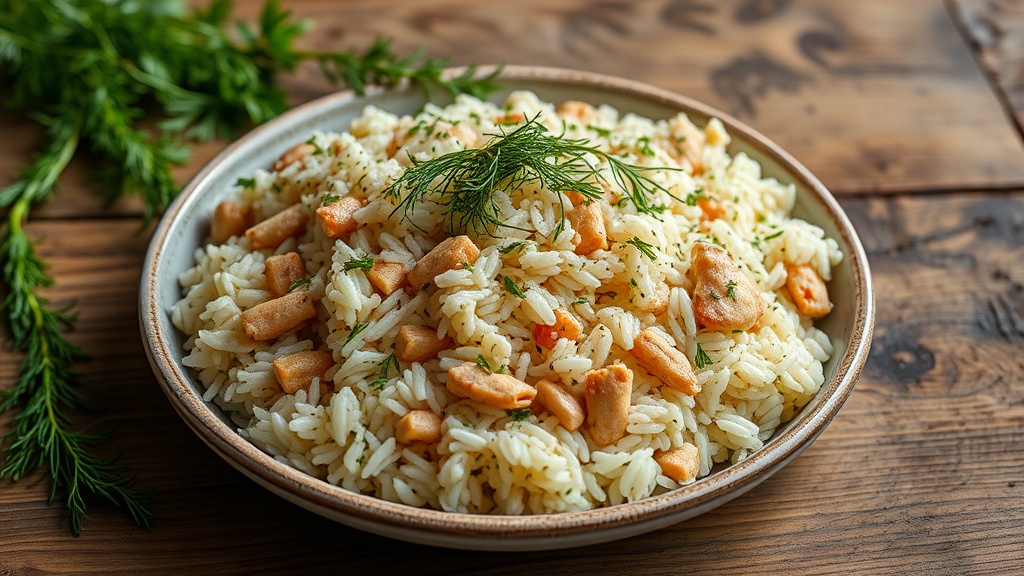
Timman Bagilla
Rice with dill and fava beans · serves 4 · 45 min
Ingredients: 300 g basmati or amber rice, rinsed and soaked 30 min; 300 g shelled broad (fava) beans, fresh or frozen — green, and left whole; 1 very large bunch of fresh dill (60–80 g), chopped, stalks and all; 60 g butter or ghee; 1 tsp ground cardamom; ½ tsp turmeric; salt; 2 tbsp oil. Optional: a piece of flatbread or a sliced potato for the crust.
Method: Boil the soaked rice in well-salted water for 5–6 minutes only, until the grain is soft at the edge and still hard at the core, then drain. Blanch the beans 2 minutes if fresh; frozen need nothing. Heat the oil in a heavy pot, lay flatbread or potato slices on the base if you want the crust, then build in layers: rice, dill, beans, rice, dill, beans, finishing with rice, mounding it toward the middle. Poke three or four holes down through it with a spoon handle, dot with the butter, sprinkle the cardamom and turmeric, cover the lid with a cloth and steam on the lowest possible heat for 30–35 minutes. Turn out and fold together gently so the beans and dill are through the rice rather than in stripes.
💡 Fresh dill only — dried gives you nothing but a colour. Iraqis eat this in spring when the broad beans are young, and it goes with lamb, or with nothing but yoghurt. The crust at the bottom, hikaka, is the part people fight over.
🍪 Recipe: Kleicha
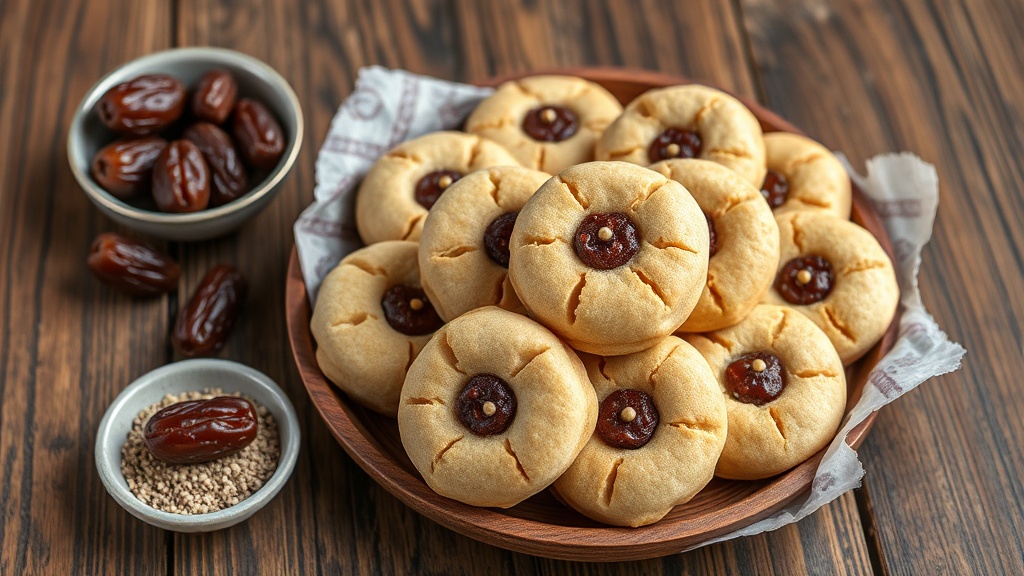
Kleicha bi Tamur
Iraq's national biscuit, date-filled · makes ~40 · 1 h plus resting
Ingredients: Dough: 500 g plain flour; 200 g butter or ghee, melted; 7 g dried yeast in 60 ml warm milk; 60 ml warm milk more; 2 tbsp sugar; 1 tbsp ground cardamom; 1 tsp ground fennel or aniseed; 1 tsp salt; 2 tbsp rose water. Filling: 500 g soft date paste (or pitted dates blitzed smooth); 40 g butter; 1 tsp cinnamon; 1 tsp cardamom; a little oil to loosen. To finish: 1 egg yolk beaten with milk; sesame or nigella seeds.
Method: Rub the melted butter into the flour, sugar, spices and salt, add the yeast milk and the rest of the milk and the rose water, and bring together into a soft dough. Knead briefly, cover, rest 1 hour. Warm the date paste with the butter and spices until it is spreadable, and cool. Roll the dough into a rectangle about 3–4 mm thick, spread the date paste over it in a thin even layer right to the edges, and roll up tightly from the long side like a Swiss roll. Slice into rounds about 1.5 cm thick and lay them cut side up. Brush with egg yolk, scatter sesame, and bake at 180 °C for 15–20 minutes until just golden — pale, not brown.
💡 The cardamom is not a background note; kleicha should smell of it across the room. Iraqi families bake these by the kilo for Eid, and every household insists on its own ratio of dough to date. Wooden qalib moulds for the stamped version are still sold in the Baghdad bazaar.
☕ Chai, Arak and the Date
Chai
The centre of Iraqi social life, and refusing it is close to impossible. Black tea, often Ceylon, brewed very strong in the top pot of a two-tier samawar arrangement and diluted from the bottom, served very sweet in small waisted glasses called istikan on a saucer. In the south it may be flavoured with cardamom; in winter with dried lime. Baghdad's tea houses — the Shahbandar on Al-Mutanabbi Street above all, rebuilt after the 2007 bombing that killed the owner's sons — are institutions.
Coffee and the south
Qahwa, cardamom-heavy Arabic coffee poured from a long-spouted dallah into tiny handleless cups, is the tribal and southern drink, served in threes and stopped by shaking the cup. Iraqi coffee houses are for men, chess, dominoes and argument, and have been the country's political space for a century.
Alcohol
Complicated and getting more so. Iraq historically had a real drinking culture — Baghdad's Christian- and Yazidi-run liquor shops, arak with mezze on the Tigris, and a local beer industry. Arak, the aniseed spirit that clouds with water, is the national drink where there is one. A parliamentary ban on importing, producing and selling alcohol, passed in 2016 and enforced from 2023, has closed most of the shops; the Kurdistan Region does not apply it. Enforcement elsewhere is uneven and the trade has moved to smuggling. Do not treat any of this as an invitation.
Dates, sharbat and laban
Date syrup (dibis) with geymar cream is breakfast; date ma'mool and halawa are everywhere. Sharbat — rose, tamarind, lemon-mint, or the almost fluorescent red sharbat al-ward — is what is poured at weddings and in Ramadan. Laban or shineena, salted diluted yoghurt, is the drink for a hot day and for anything cooked with too much chilli.
🏛️ Baghdad
A city of roughly 8 million people, founded in 762, destroyed in 1258, and comprehensively rebuilt, bombed, fought over and rebuilt again since. Almost nothing above ground is older than the thirteenth century, and Baghdad is nonetheless one of the more interesting cities in the region — a place with a very strong sense of what it used to be and a lot of concrete blast walls.
The Iraq Museum
The reason to come, and now genuinely excellent: the Sumerian, Akkadian, Assyrian and Babylonian galleries hold objects that anywhere else would each be a national treasure — the Warka Vase, the Mask of Warka, the Nimrud ivories, the gold of Ur. It was looted in 2003, spent years closed, and reopened in 2015. Give it most of a day and take a guide.
Al-Mutanabbi Street
The book market, most alive on a Friday morning, when the whole street is covered in books laid on the ground and the Shahbandar café at the end of it is full of old men, smoke and photographs of the dead. Nearby are the restored Qishla clock tower and the riverfront, which has been genuinely improved in the last few years.
What else stands
The Mustansiriya madrasa of 1233, one of the oldest surviving universities anywhere, which the Mongols spared. The Abbasid Palace. The Kadhimiya shrine, with two gold domes and four minarets, in the north of the city — enormously important to Shia Muslims and visitable with respect and modest dress. The Martyr's Monument and the Victory Arch of crossed swords, both Saddam-era and both extraordinary as objects whatever one thinks of the man who built them.
The feel of it
Traffic, heat, generators, checkpoints, and — in the good years — restaurants along Abu Nuwas Street grilling masgouf by the river, families out at midnight in Zawra Park because midnight is when it is cool enough, and a young cultural scene around Karrada and the Book Forum. The Green Zone was opened to ordinary traffic in 2019, which mattered to Baghdadis more than most foreign reporting registered.
🕌 Najaf, Karbala and Samarra
Two of the four holiest cities in Shia Islam are in Iraq, and they receive a volume of pilgrimage that dwarfs the country's ordinary tourism by several orders of magnitude. They are also, for a non-Muslim visitor who behaves properly, among the most welcoming places in the country.
Najaf
The burial place of Imam Ali, cousin and son-in-law of the Prophet, first Shia Imam and fourth caliph — the shrine's gold dome and its vast marble courtyard are one of the great sights of the Islamic world. Najaf is also the seat of the hawza, the oldest and most prestigious Shia seminary, and of Ayatollah Sistani. Beside it lies Wadi al-Salam, the Valley of Peace, which is by most measures the largest cemetery on Earth: several million graves over more than nine square kilometres, continuously used for 1,400 years.
Karbala
Where Husayn, grandson of the Prophet, was killed with his companions in 680 AD — the event that defines Shia Islam's understanding of injustice and martyrdom, commemorated at Ashura and, forty days later, at Arbaeen. Two shrines face each other across an open square, Husayn's and that of his half-brother Abbas, and the space between them is full at all hours. During Arbaeen the city receives numbers that are difficult to believe until you see the satellite imagery.
Samarra
Ninth-century imperial capital on the Tigris, a UNESCO World Heritage site, and home to the Malwiya — the spiral minaret of the Great Mosque, 52 metres of brick ramp winding to the top, one of the most distinctive structures in the world. Also the al-Askari shrine, whose golden dome was destroyed by bombing in 2006 and has been rebuilt. Samarra is in a formerly contested area and access has been variable.
Visiting properly
Non-Muslims can generally enter the outer courtyards and are often welcomed further; the rules vary by shrine and by moment and are administered on the spot. Women need a chador, which is lent at the gate; men need long trousers and sleeves. Photograph people only with permission, never during prayer. Behave as you would in someone's home, because that is the register. Iraqi pilgrims will almost certainly try to feed you.
🏺 The South: Ur, Uruk and the Marshes
Southern Iraq is flat, hot, agricultural and stacked with the oldest cities in the world. It is also where the two rivers meet, where the oil is, and where the 2019 protests were fiercest.
Ur
Near Nasiriyah, and the most visitable ancient site in Iraq: the Great Ziggurat, built around 2100 BC by Ur-Nammu and partly reconstructed, standing three storeys out of the plain, plus the royal tombs, the residential quarter, and a house traditionally shown as Abraham's. Pope Francis visited in 2021, which did more for Iraqi tourism than any campaign. Nearby Eridu is, by Sumerian tradition, the first city of all.
Uruk
Less reconstructed and more important: the city where urban life and writing began, occupied from around 5000 BC, home of Gilgamesh, and the source of the earliest tablets. What is there today is a huge, largely unexcavated mound with the remains of the Eanna precinct — it needs imagination and a guide, and it is the place where cities were invented.
The Ahwar
The southern marshes, a UNESCO World Heritage site since 2016 for both nature and culture: reed beds, buffalo standing chest-deep, houses and guest halls (mudhif) built entirely of bundled reeds in a form recognisable on 5,000-year-old Sumerian carvings. The Ma'dan, the Marsh Arabs, have lived here continuously since Sumer. Drained by Saddam, partly refilled after 2003, and now drying again — see the water section above. A boat trip out of Chibayish was, in the good years, the single most extraordinary day available in Iraq.
Basra
Iraq's only port city and its economic engine, founded in 638, once called the Venice of the East for its canals and famous for its poets, its date palms and its Jewish and Christian merchant families. It has had a very hard forty years: war, the Shatt al-Arab front line, salt in the water, the 2018 water crisis and riots. The canals are silted and polluted, the old shanashil houses are mostly collapsing, and the will to restore them exists in a city with no money.
🏔️ The North: Mosul, Nineveh and Lalish
Northern Iraq is the Assyrian heartland and the most religiously mixed part of the country, and it has been the most comprehensively wrecked in the last decade. It is also where the recovery has been most visible.
Mosul
Iraq's second city, on the Tigris opposite the ruins of Nineveh, held by ISIS from 2014 to 2017 and largely destroyed in the retaking. The Old City was flattened; the Great Mosque of al-Nuri and its famous leaning minaret, al-Hadba, were blown up in 2017 and are being rebuilt under a UNESCO programme, along with the al-Tahera and al-Saa'a churches — the mosque and the churches restored together, deliberately. The university library, whose million books were burned, has been restocked partly by donation. Mosul in recovery is a genuinely moving place.
Nineveh and Nimrud
Nineveh, the last Assyrian capital, sits under and beside modern Mosul: the Mashki and Adad gates, the great walls, and the mound of Kuyunjik where Ashurbanipal's library was found. Nimrud, 30 km south, was the earlier capital and held the Northwest Palace with its reliefs; ISIS bulldozed and blew up substantial parts of it in 2015. Both are being assessed and partly stabilised, and the losses are permanent.
Lalish
The holiest place of the Yazidi religion, a small valley of conical fluted stone spires north-east of Mosul. Visitors of any religion are welcome and are asked to walk barefoot from the entrance, and not to step on thresholds. There is a sacred spring, an olive-oil-lit sanctuary, and the tomb of Sheikh Adi. After 2014 it became the point of return for a community that had been scattered, and going there and behaving well is one of the more worthwhile things a visitor to Iraq can do.
Hatra and Ashur
Hatra, in the desert south-west of Mosul, is a Parthian-era caravan city with a spectacular temple complex that mixes Hellenistic, Roman and eastern styles, and that twice held off Roman sieges. ISIS damaged it in 2015; it survived better than feared. Ashur, the first Assyrian capital on the Tigris, is a World Heritage site in danger — partly because a dam project has threatened to flood it for decades. Both need permits and settled security.
📋 Practical Information
⚠️ Do not travel to Iraq at present. Since 28 February 2026 the country has been a theatre of the wider war: American bases on Iraqi soil have been struck, the Kurdistan Region has absorbed more than a thousand drones and missiles with dozens killed, and Erbil airport has been targeted repeatedly, most recently on 2 September. Airspace and flights are unreliable. The section below is written for the peacetime that preceded this and will follow it — the entry rules, prices and advice are the ones that applied and will apply again, not a recommendation to go now. Checked 6 September 2026.
Entry, in normal times
Iraq liberalised sharply from 2021: visa on arrival for EU citizens including Czechs, valid 60 days, cost $77, at Baghdad, Erbil, Sulaymaniyah, Basra and Najaf airports and at the Turkish and Jordanian land borders. The Kurdistan Region issues its own entry stamp; a Kurdistan stamp alone does not entitle you to travel into federal Iraq, and this catches people out at the internal checkpoints. An Israeli stamp in your passport is a refusal. Rules here have changed repeatedly — verify before every trip.
Money and costs
The Iraqi dinar (IQD). Cash economy: bring US dollars in new, clean, unmarked notes and change them locally, because cards are barely accepted outside a few hotels and international ATMs are scarce. In the good years a mid-range hotel ran 1,400–2,400 Kč a night, a restaurant meal 100–250 Kč, a driver for a full day 1,500–2,500 Kč, and the domestic flights were cheap. Guided archaeological tours are the main cost and the main reason it works.
Getting around, in normal times
Domestic flights between Baghdad, Basra, Erbil and Sulaymaniyah. Long-distance shared taxis on the main roads. Checkpoints are the governing fact of road travel — frequent, slow, and requiring your passport in your hand rather than in a bag. Most foreign visitors travel with a driver or a fixer, which is not paranoia: it is how you get through the checkpoints and how you get permits for the archaeological sites, several of which require paperwork from the State Board of Antiquities.
Etiquette and practicalities
Dress modestly — long trousers and covered shoulders for everyone, a headscarf for women at shrines and in conservative areas. Do not photograph checkpoints, military, police, bridges or government buildings, and ask before photographing people. Right hand for eating and giving. Do not drink the tap water. Plugs are a mix of European C/F and British G, 230 V — bring both. Summer in the south genuinely reaches 50 °C; the season is October to April, and spring in Kurdistan is the best of it.
For Czech travellers: the MZV ČR advisory for Iraq is at the highest level and covers the whole country, Kurdistan included. The Czech Embassy in Baghdad is the responsible mission. Ordinary Czech travel insurance excludes war and unrest, so a standard policy is worth nothing here — read the exclusions rather than the brochure. Register in DROZD and note the mzv.cz emergency contacts before departure if you are in the region for any reason.
❓ Misconceptions
"Iraq has always been sectarian."
Sunni–Shia difference is real and old; sectarian politics as the organising principle of the Iraqi state is not — it dates in its current form from the institutions built after 2003, which allocated power by sect and thereby made sect the thing worth fighting over. Baghdad's neighbourhoods were mixed until 2006 and intermarriage was ordinary. This matters because "they have always hated each other" is the sentence that excuses everyone from examining what was actually built.
"Iraq is all desert."
A third of it is. The north-east is mountains reaching 3,600 m, with oak forest, snow, waterfalls and orchards; the centre and south are irrigated alluvial plain; the far south is the largest wetland in western Eurasia. Iraq has more standing water and more snow than most people's mental image allows, and in April the Kurdish hills are covered in wildflowers.
"The Hanging Gardens were in Babylon."
Nobody has ever found a trace of them at Babylon, and Nebuchadnezzar — who documented his building works exhaustively — never mentions them. The Babylonian sources are silent; all the descriptions are Greek and second-hand. Stephanie Dalley's well-argued case puts them at Nineveh, built by Sennacherib, who did leave a record of an elaborate irrigated garden and the aqueduct to supply it. Of the Seven Wonders, this is the one that may have been in the wrong city.
"Everything was destroyed and there's nothing left to see."
A great deal was destroyed and a great deal was not. The Iraq Museum is open and full. Ur's ziggurat is intact and standing. Erbil Citadel, Samarra's spiral minaret, Najaf and Karbala, Lalish, the marshes and the Kurdish mountains are all there. Mosul's al-Nuri mosque is being rebuilt. The losses were real; "there is nothing left" is not true and does the recovery no favours.
"Iraqis hate Westerners."
The consistent report of every foreign visitor of the last decade is close to the opposite: unusual, insistent, sometimes overwhelming hospitality, and a clear distinction drawn between governments and people. That is not a reason to be careless about the war. It is a reason not to confuse the security situation with the social one.
"Arabic is the only language."
Kurdish is also official, constitutionally, throughout Iraq. Neo-Aramaic is spoken by Assyrians, Chaldeans and Mandaeans, and Turkmen around Kirkuk. Iraqi Arabic itself carries a visible substrate of Akkadian and Aramaic words — some of the vocabulary in a Baghdad market has been in continuous local use for four thousand years.
✍️ Author's Note
Writing about Iraq honestly means holding two things at once that most coverage keeps apart. This is the place where writing, cities, law, the wheel, arithmetic and literature were invented, and where a third of what a European calls their intellectual inheritance was translated, argued with and passed on. It is also a country where almost nobody alive has had an ordinary peacetime adulthood, and which as of this month is being hit again in someone else's war.
Neither of those cancels the other, and the trap is to let the second swallow the first. Iraq is not a synonym for a war. It is a real country with a book market, a maqam tradition, a dish it argues about, and a fifteen-million-person walk to Karbala — and the honest way to write about it is to give the civilisation the space it earns and then be straight about what has happened since.
The 2026 sections are dated on purpose and will be wrong soon. Where accounts conflict — the wider war produces contested claims daily — that is said rather than resolved, and the numbers here are the ones on the public record as of 6 September 2026. For the closure of the Strait of Hormuz, which is what has destroyed Iraq's oil revenue this year, there is a separate page.
On the images
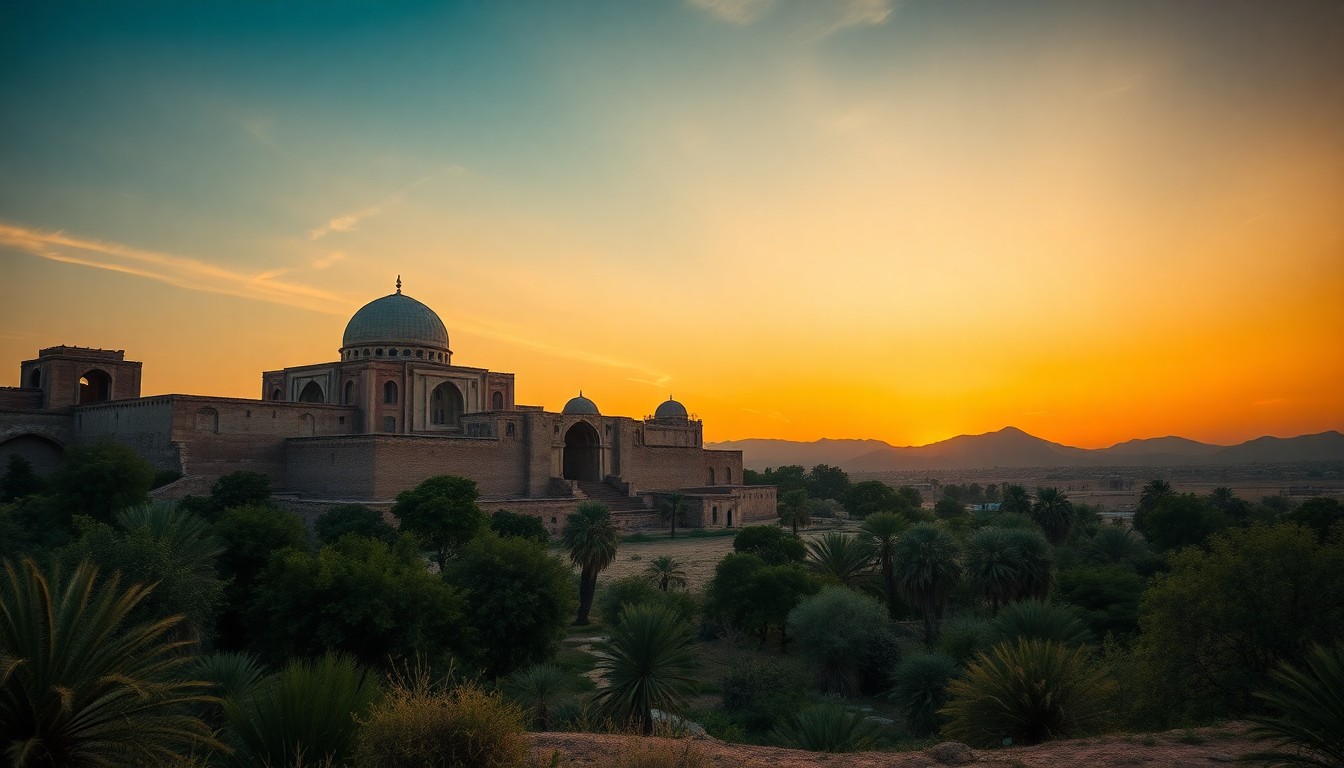
The site's image store holds exactly one Iraq photograph — the hero — where a country with this much to look at would normally have twenty. That one is an illustration rather than a document: a domed brick complex above palm groves with mountains behind, which is atmospheric and corresponds to no identifiable Iraqi monument. Iraq's great shrine domes are gold, and Baghdad has no mountains behind it. It is used as a mood image and labelled as one, and there is deliberately no caption claiming it is anywhere in particular.
Three recipe images came from the shared folder. One was left out entirely: the masgouf photograph showed a whole unsplit fish on mashed potato with chips, and masgouf is defined by being butterflied flat from the back and served on bread with onion — wrong on the only feature that makes the dish itself. The other two are used with corrections stated in their captions: the timman bagilla has the dill right and no fava beans at all, and the kleicha are thumbprint biscuits with a date on top where real kleicha is rolled and sliced so the date shows as a spiral.
Support This Project 🌍
This World Travel Factbook is a labor of love – free to use for all travelers. If you find it helpful, consider supporting its continued development.