


🇮🇱 Israel at a Glance
🌍 Overview
📅 How this page is written. Israel and the conflict around it are argued about more than almost any subject on Earth. This page states facts with dates and sources of contention attached, uses each side's own terms where they differ and says which is which, and does not adjudicate the claims. Everything about the current situation is dated and was checked on 6 September 2026; that material ages faster than anything else here.
Israel is a country of about 22,145 km² — roughly the size of Moravia, or a quarter of Czechia — with around 10.1 million people. It is 470 km from north to south and, at its narrowest, about 15 km from the Mediterranean to the West Bank. You can drive from the Lebanese border to the Red Sea in six hours.
Within that space are the Western Wall and the Temple Mount, the Church of the Holy Sepulchre, al-Aqsa — the holiest sites of Judaism, principal sites of Christianity and the third holiest of Islam — the lowest point on the surface of the Earth, one of the world's densest concentrations of technology companies, and an unresolved territorial and national conflict that has run for over a century.
The state
Founded on 14 May 1948 as a Jewish state following the UN partition plan of 1947 and the end of the British Mandate. It is a parliamentary democracy with a 120-seat unicameral Knesset elected by nationwide proportional representation with a 3.25% threshold — a system that produces many parties, permanent coalitions and frequent elections. It has no written constitution, governing instead by a set of Basic Laws.
The people
About 73% Jewish, 21% Arab — Israeli citizens who are mostly Muslim, with Christian and Druze minorities — and the rest others. The Jewish population is itself made up of Ashkenazi, Mizrahi and Sephardi communities, Ethiopian Israelis, a million Russian-speakers who arrived after 1990, and a fast-growing Haredi ultra-Orthodox minority. Israeli society is far less homogeneous than outside coverage suggests and argues with itself constantly.
The economy
GDP per head is comparable to Western Europe. The country has the highest R&D spending as a share of GDP in the world, more companies on NASDAQ than any country except the US and China, and a technology sector — "Start-Up Nation" — that has produced Waze, Mobileye, Check Point and Wix. Alongside it sit high living costs, one of the widest inequality gaps in the OECD, and a housing market that has driven repeated protests.
What visiting is like
Intense, informal, argumentative, hot, and much smaller than its place in the news suggests. In normal times it is an outstanding destination — the archaeology alone would justify a fortnight — and the practical, safety and access position has changed repeatedly since October 2023. The next section gives the position as of the date above and the safety section the detail.
⚠️ Where Things Stand — 6 September 2026
📅 Checked 6 September 2026, and dated on purpose. This is the fastest-ageing section on the page. If you are reading it much later, treat it as history and go to MZV ČR, your own foreign ministry and the airlines for the current position. Where the parties give different accounts, that is stated rather than resolved.
Gaza
A ceasefire has been in place since 10 October 2025, framed by a twenty-point plan announced by the American president. Its first phase held: all twenty living Israeli hostages were released within three days, and the last of the twenty-eight deceased hostages' remains was recovered on 26 January 2026. Beyond that it has largely stalled. Fighting is dramatically reduced but has not stopped — figures cited by monitoring organisations put deaths since the ceasefire at more than 700 Palestinians and four Israelis. Israel says its strikes target commanders violating the terms; Hamas says Israel is in breach through continued operations and aid restrictions and has rejected disarmament proposals on that basis.
Gaza's governance and reconstruction
A Board of Peace and a Palestinian technocratic committee were named in January 2026, with Nikolay Mladenov appointed Director-General and High Representative for Gaza, but neither body is operating on the ground. Reconstruction has barely begun against a scale of destruction that UN assessments describe as unprecedented in the region. This is the part of the plan on which almost nothing has moved.
The regional war
Separately and much more recently: on 28 February 2026 the United States and Israel began strikes on Iran, and Iran has retaliated against Israel, against US bases and against Gulf states. A ceasefire held from 8 April, a US–Iran memorandum was signed in mid-June, and the arrangement broke down from early July. There is no ceasefire between the United States and Iran as of early September. There has also been a 2026 Lebanon war, whose own ceasefire framework is holding patchily, and repeated Houthi missile and drone attacks on Israel from Yemen.
What that means for a visitor
Israel was removed from the British foreign office's do-not-travel list in June 2026, with longstanding restrictions retained near the Gaza, Lebanon and Syria borders. Most regional airports are open, and airlines are cancelling and rerouting at short notice, sometimes with hours of warning. Air-raid alerts and shelter drills are a live possibility across the country. Gaza, Lebanon, Syria, Iraq, Iran and Yemen are under do-not-travel advice from essentially every government. Nothing here is a substitute for the advisory your own ministry publishes today.
🏷️ The Names, and Why They Are Contested
Almost every place name in this part of the world carries a claim, and using one term rather than another is read as taking a side. This page uses the most widely recognised English forms and notes the alternatives, because pretending the disagreement is not there would be its own kind of distortion.
Israel
Yisra'el, first attested outside the Bible on the Egyptian Merneptah Stele of about 1208 BC, which names a people called Israel in Canaan — the earliest known reference. The Biblical etymology has it as "one who wrestles with God", from Jacob's night at the Jabbok. The modern state adopted the name in 1948 after considering alternatives including Judea and Zion.
Palestine
From Latin Syria Palaestina, the name the Roman Empire applied to the province after the Bar Kokhba revolt of 132–136 AD, itself derived from the Philistines. It was the standard geographic name for the region for eighteen centuries, including under the British Mandate. Today it is also the name of the State of Palestine, recognised by around 150 UN member states and holding UN non-member observer state status since 2012.
The West Bank / Judea and Samaria
The territory west of the Jordan captured by Israel in 1967. West Bank is the internationally standard term and comes from Jordanian administration between 1948 and 1967. Judea and Samaria is the term used by the Israeli government and much of the Israeli public, and derives from the ancient regions. Which one a speaker uses is generally a reliable indicator of their politics.
Jerusalem
Israel's Basic Law of 1980 declares Jerusalem "complete and united" its capital. The UN Security Council declared that law null and void, and most states — including Czechia — keep their embassies in Tel Aviv, while the United States and a small number of others moved theirs to Jerusalem from 2018. Palestinians claim East Jerusalem as the capital of a future state. The status of the city is one of the core unresolved issues, and this page's fact box says "Jerusalem (see text)" for exactly that reason.
🗺️ Geography
Israel is a narrow strip running north–south along the eastern Mediterranean, and it packs an improbable range of landscapes into it: snow in the north, a rainforest-humid coast, and hyper-arid desert covering more than half the country.
Four strips
West to east: the coastal plain, where most of the population lives; the central highlands running from the Galilee through the hills of Jerusalem; the Jordan Rift Valley, part of the Great Rift running from Turkey to Mozambique; and, in the south, the Negev, a triangular desert making up over half the land area.
The Dead Sea
The lowest exposed land on Earth, its surface currently around 430 m below sea level and falling roughly a metre a year. It is about ten times as salty as the ocean, which is why you float and why nothing lives in it. It is also shrinking fast: diversion of the Jordan for agriculture and mineral extraction have cut its inflow, its area has fallen by a third since 1960, and thousands of sinkholes have opened along the retreating shore, closing beaches and roads.
North and high ground
Mount Hermon on the Syrian border reaches 2,814 m at its summit, with the Israeli-controlled slope up to 2,236 m — the country's only ski area and its water tower. Below it are the Golan Heights, captured from Syria in 1967 and annexed by Israel in 1981 in a move not recognised by the UN, and the Sea of Galilee, a freshwater lake 210 m below sea level that is Israel's main natural reservoir.
Makhtesh and the far south
The Negev holds a landform that occurs almost nowhere else: the makhtesh, an erosion crater formed by water cutting through a hard cap into softer rock beneath and draining out one end. Makhtesh Ramon is 40 km long, 500 m deep and genuinely spectacular. At the very bottom of the country, Eilat sits on the Red Sea with coral reefs at the northern limit of their range, on a coastline that is 12 km long.
🗺️ Map
Israel lies between about 29.5° and 33.3° north. It borders Lebanon, Syria, Jordan and Egypt, and the Palestinian territories of the West Bank and Gaza Strip. Its internationally recognised boundaries are themselves part of what is disputed, which is why maps of this region differ depending on who drew them.
The distances
Tel Aviv to Jerusalem 65 km, about an hour by road and 30 minutes by the fast train. Tel Aviv to Haifa 95 km. Tel Aviv to Eilat 350 km, four hours' drive or a 50-minute flight. The whole country is smaller than the Vysočina and Jihomoravský regions combined, and the reflex to plan long transfers is misplaced — almost everything is a day trip.
The Green Line
The 1949 armistice line, drawn in green pencil on the original map, marks the boundary between Israel as recognised by most of the world and the territories occupied in 1967. It is not an international border, was never intended as one, and remains the reference point for almost every diplomatic proposal since. Israel's separation barrier, begun in 2002, follows it in places and departs from it substantially in others.
Getting around
Israel Railways runs along the coast and inland to Jerusalem and Beersheba and is good and cheap. Intercity buses — Egged and others — go everywhere. Public transport largely stops for Shabbat, from Friday afternoon to Saturday evening, which catches out almost every first-time visitor; sherut shared taxis run then, and Haifa's buses do too. A rental car is the practical answer for the Galilee and the Negev.
Neighbours and crossings
Land crossings to Jordan at Allenby/King Hussein near Jericho, Sheikh Hussein in the north and Yitzhak Rabin near Eilat have historically been open to tourists, subject to closures. The Egyptian crossing at Taba serves Sinai. Crossings to Lebanon and Syria do not exist. Whether any given crossing is open changes with the security position and must be checked on the day.
🌦️ Weather
Mediterranean on the coast and in the north, arid to hyper-arid in the south, with a single wet season and a long, reliably rainless summer. The variation over 470 km is extreme: in February it can be snowing in Jerusalem and 25 °C in Eilat on the same afternoon.
The seasons
Summer (June–September) is hot, dry and long: Tel Aviv 30 °C with punishing humidity, Jerusalem 30 °C and dry, the Dead Sea and Eilat regularly over 40 °C. Winter (December–March) brings essentially all the rain, mostly to the north and centre; Jerusalem is cold and wet at 800 m and gets snow most years. It almost never rains in Eilat.
When to go
March to May and October to November, unambiguously. Spring brings wildflowers across the Galilee and the northern Negev and temperatures in the low twenties. Autumn is warm sea and clear light. Avoid July and August for anything involving walking, and avoid the desert entirely in high summer unless you are on a beach at Eilat with a hotel behind you.
Shabbat and the holidays
Not weather, but it governs a trip more than weather does. Shabbat runs from sunset Friday to nightfall Saturday: most shops, many restaurants and nearly all public transport stop, and Jerusalem in particular becomes very quiet. The autumn High Holidays — Rosh Hashanah, Yom Kippur, Sukkot — close much of the country for weeks, and on Yom Kippur everything stops including the airport, the roads and broadcasting. Check the Hebrew calendar before booking.
What to bring
Sun protection that you will actually use, a hat, and far more water than feels necessary — the desert is genuinely dangerous for the unprepared and people die of heat exposure at Masada and in the makhteshim most years. Modest clothing for religious sites of all three faiths: covered shoulders and knees, and a head covering for men at the Western Wall, which is provided. Good shoes: everything worth seeing involves stones.
🏺 Canaan to Rome
This is one of the most intensively excavated pieces of ground on Earth, and it has been continuously inhabited for a very long time: Jericho, just east of Jerusalem in the West Bank, has settlement layers going back some 11,000 years and is among the oldest known towns anywhere.
Canaan and the Israelites
The Bronze Age land of Canaan sat on the road between Egypt and Mesopotamia and was fought over by both. The Merneptah Stele of about 1208 BC carries the first known mention of a people called Israel. The archaeological consensus on how the Israelites emerged is contested and has moved a long way from the Biblical account: the dominant view now sees them arising largely from within Canaanite society rather than arriving as conquerors from outside.
The kingdoms
A united monarchy under David and Solomon around 1000 BC is described in the Bible; its scale is debated among archaeologists, with maximalists and minimalists disagreeing sharply about how much of a state existed. What is not in doubt is that by the ninth century there were two kingdoms — Israel in the north and Judah in the south — attested in Assyrian and Moabite inscriptions. Israel fell to Assyria in 722 BC.
Exile and return
Babylon destroyed Jerusalem and the First Temple in 586 BC and deported the Judean elite. Cyrus the Great allowed the return from 538 BC and the Second Temple was built. What followed was Persian, then Hellenistic rule; the Maccabean revolt against the Seleucids from 167 BC produced the Hasmonean kingdom, and the rededication of the Temple is the origin of Hanukkah.
Rome
Roman control from 63 BC; Herod the Great rebuilt the Temple on a platform whose western retaining wall is the Western Wall today, and built Masada, Caesarea and Herodium. The First Jewish–Roman War ended with the destruction of the Second Temple in 70 AD; the Bar Kokhba revolt of 132–136 ended with mass death, the barring of Jews from Jerusalem, and the province's renaming to Syria Palaestina. Roman-era Judaism reorganised around the synagogue and the text, which is the origin of rabbinic Judaism.
✡️ Diaspora, and the Birth of Zionism
For eighteen centuries the land was Byzantine, then Arab from 638, then Crusader, Ayyubid, Mamluk and — from 1517 to 1917 — Ottoman. Jewish communities remained continuously present, notably in Jerusalem, Safed, Tiberias and Hebron, but the great majority of Jews lived elsewhere, and the return to Zion was a religious longing rather than a political programme.
Why it became political
Nineteenth-century European nationalism, and nineteenth-century European antisemitism. The pogroms in the Russian Empire from 1881 pushed two million Jews to emigrate, overwhelmingly to America. The Dreyfus affair in France from 1894 — the framing of a Jewish officer for treason, amid open antisemitic mobilisation in the most emancipated country in Europe — convinced Theodor Herzl, a Budapest-born Vienna journalist, that assimilation would not protect Jews and that they needed a state.
Herzl
Der Judenstaat in 1896, the first Zionist Congress at Basel in 1897. Herzl wrote in his diary afterwards that he had founded the Jewish state and that in fifty years everyone would see it; the state was declared fifty-one years later. Zionism was one nationalism among the many that reshaped Europe in that period, and it was a minority movement among Jews for most of its first forty years.
The aliyot
Successive waves of immigration: the First Aliyah from 1882, the Second from 1904 — socialist, secular, founders of the kibbutz movement and of Tel Aviv in 1909 — and later waves driven by European persecution. The population of the land was overwhelmingly Arab: roughly half a million people in 1880, of whom Jews were perhaps 25,000.
Balfour, and the contradiction
In November 1917 the British foreign secretary wrote a letter — the Balfour Declaration — stating that His Majesty's Government viewed with favour "the establishment in Palestine of a national home for the Jewish people", while adding that nothing should prejudice "the civil and religious rights of existing non-Jewish communities". Britain had already made overlapping commitments to Arab leaders in the McMahon–Hussein correspondence and, with France, divided the region between themselves in Sykes–Picot. Almost every subsequent dispute has a root in those three documents.
🇬🇧 The Mandate, and 1948
Britain governed Palestine under a League of Nations mandate from 1920 to 1948 and spent most of that time trying and failing to reconcile the two commitments it had made. Jewish immigration rose sharply as Nazism spread; Arab opposition rose with it. The Arab revolt of 1936–39 was suppressed, and Britain then restricted Jewish immigration by the 1939 White Paper at precisely the moment European Jews most needed refuge.
The Holocaust
Six million Jews were murdered in Nazi-occupied Europe, around two thirds of the Jewish population of the continent — including some 80,000 Czech and Moravian Jews, most of whom passed through Terezín. The moral and political effect on the argument for a Jewish state was decisive, and the presence of hundreds of thousands of survivors in displaced-persons camps whom no country would take made the question urgent.
Partition
Britain handed the problem to the United Nations, whose Resolution 181 of 29 November 1947 proposed partition into a Jewish and an Arab state with Jerusalem under international administration. Jewish leaders accepted; Arab leaders and states rejected it, on the grounds that it awarded 56% of the territory to a third of the population. Civil war began immediately. Czechoslovakia voted for partition and, uniquely, supplied the arms and aircraft that Israel's forces used in 1948 — a fact taught in Israeli schools and largely forgotten in Czechia.
14 May 1948
David Ben-Gurion declared the State of Israel as the Mandate expired. Five Arab states invaded the next day. The war ran to 1949 and Israel ended it holding 78% of Mandate Palestine — more than partition had allotted — with Jordan holding the West Bank and East Jerusalem and Egypt holding Gaza. No Palestinian state came into being.
Two names for one event
Israelis call 1948 the War of Independence. Palestinians call it the Nakba, the catastrophe: around 700,000 Palestinians — over half the Arab population — left or were expelled from what became Israel, and were not permitted to return. Israeli historians including Benny Morris have documented expulsions and massacres alongside flight; the balance between the two, and the question of intent, remains one of the most bitterly contested subjects in the field. In the years that followed, some 850,000 Jews left or were expelled from Arab and Muslim countries, most of them settling in Israel. Both displacements happened; both are used politically; neither cancels the other.
💥 1956, 1967, 1973
Three wars in seventeen years set the map and the politics that everything since has been argued within.
Suez, 1956
Israel invaded Sinai in coordination with Britain and France after Egypt nationalised the Suez Canal. Militarily successful and diplomatically a disaster for all three: American and Soviet pressure forced withdrawal, and it marked the end of British and French power in the region. Israel withdrew in 1957 in exchange for freedom of navigation and a UN force in Sinai.
The Six-Day War, 1967
The single most consequential event in the modern history of the region. Amid escalating threats, the removal of the UN force and the closure of the Straits of Tiran, Israel launched a pre-emptive strike on 5 June 1967 and in six days destroyed the Egyptian, Jordanian and Syrian air forces and captured Sinai, the Gaza Strip, the West Bank including East Jerusalem, and the Golan Heights — territory three and a half times its own size. The occupation that began then is still running, and is the fact around which everything else turns.
What 1967 created
Israeli control over a large Palestinian population without citizenship. The settlement movement, which began within months and now numbers around 700,000 Israelis in the West Bank and East Jerusalem — regarded as illegal under the Fourth Geneva Convention by the International Court of Justice, the UN Security Council and almost every state, and defended by Israel on grounds of historical claim and disputed rather than occupied status. And UN Resolution 242, whose formula of "land for peace" has framed every negotiation since and whose exact wording both sides read differently.
Yom Kippur, 1973
Egypt and Syria attacked on 6 October 1973, the holiest day of the Jewish year, achieving complete surprise. Israel recovered and ended the war across the Suez Canal, but the shock destroyed the sense of invulnerability from 1967, ended Golda Meir's government, and — by restoring Egyptian confidence — made peace possible. Anwar Sadat went to Jerusalem in 1977 and the Camp David accords of 1978 produced the 1979 peace treaty: Israel returned all of Sinai, Egypt recognised Israel, and the treaty has held for nearly fifty years. Sadat was assassinated for it in 1981.
🕊️ Occupation, Intifada and Oslo
The two decades after 1973 turned the conflict from a war between states into a struggle between Israel and the Palestinians themselves — and produced the closest thing to a settlement that has yet existed.
Lebanon, 1982
Israel invaded Lebanon to expel the PLO, reached Beirut, and was in occupation of the south until 2000. The massacre of Palestinian and Lebanese civilians by Lebanese Phalangist militia at Sabra and Shatila in September 1982, in an area under Israeli military control, led an Israeli commission of inquiry to find Defence Minister Ariel Sharon personally responsible for not preventing it, and he resigned. The war was deeply divisive inside Israel and produced its first mass anti-war movement.
The First Intifada, 1987–93
A largely unarmed popular uprising in the occupied territories — strikes, boycotts, stone-throwing, mass civil disobedience — met with what the Israeli defence minister called a policy of "force, might and beatings". Around 1,200 Palestinians and 160 Israelis were killed. It put the Palestinians rather than the Arab states at the centre of the conflict, damaged Israel's international standing, and made negotiation politically possible.
Oslo, 1993–95
Secret talks in Norway produced mutual recognition between Israel and the PLO, a handshake between Yitzhak Rabin and Yasser Arafat on the White House lawn in September 1993, and the creation of the Palestinian Authority with limited self-rule in parts of the West Bank and Gaza — Areas A, B and C, a division meant to last five years and still in force after thirty. Jordan signed peace with Israel in 1994. Rabin, Peres and Arafat shared the Nobel Peace Prize.
Why it failed
There is no agreed answer and the question is the heart of the argument. What is not disputed: Rabin was assassinated on 4 November 1995 by an Israeli religious extremist opposed to the accords; settlement construction continued and accelerated through the Oslo years; Hamas suicide bombings killed scores of Israeli civilians and destroyed public confidence; and the Camp David summit of July 2000 between Barak, Arafat and Clinton collapsed without agreement, each side blaming the other. Whether either party negotiated in good faith is argued to this day.
🧱 The Second Intifada to 2023
The failure of Camp David was followed by the most violent period since 1948 to that point, and by a set of unilateral moves that replaced negotiation as the organising logic on both sides.
The Second Intifada, 2000–05
Triggered in September 2000 and far more violent than the first: suicide bombings in Israeli buses, cafés and hotels killed around 1,000 Israelis, most of them civilians, and Israeli military operations and reoccupation of West Bank cities killed around 3,000 Palestinians. It ended Israeli public support for the Oslo framework, essentially permanently, and it produced the separation barrier — 700 km of wall and fence begun in 2002, credited by Israel with ending the bombings, ruled contrary to international law in an advisory opinion of the International Court of Justice in 2004 where it runs beyond the Green Line.
Disengagement and Hamas
In 2005 Israel unilaterally withdrew all settlers and soldiers from Gaza, dismantling 21 settlements. In 2006 Hamas won Palestinian legislative elections; in 2007 it took full control of Gaza after fighting with Fatah, splitting the Palestinian polity in two — Hamas in Gaza, the Palestinian Authority in the West Bank — a split that has never healed. Israel and Egypt imposed a blockade on Gaza that has been in place ever since.
Rounds
Major Israeli operations in Gaza in 2008–09, 2012, 2014 and 2021, each following rocket fire and each killing Palestinians in the hundreds to over two thousand, with Israeli deaths in the tens. The pattern — escalation, operation, ceasefire, no political change — became so established that commentators called it "mowing the grass", a phrase that tells you a good deal about where the process had got to.
Israel's own crisis
Domestically, five elections in under four years to 2022, and then in 2023 a government proposal to curtail the powers of the Supreme Court that produced the largest protest movement in the country's history — hundreds of thousands in the streets weekly for nine months, with military reservists refusing to serve. Israel entered October 2023 more internally divided than at any point since 1948, which is part of the context for what happened next.
🕯️ 7 October 2023 and the Gaza War
On the figures below. Casualty numbers in this conflict are contested and are used politically by everyone. Where a figure comes from one party it is attributed. Where independent bodies have assessed the numbers, that is said. Nothing here is presented as settled that is not.
On 7 October 2023, Hamas and allied groups broke out of Gaza and attacked southern Israel, killing around 1,200 people — the large majority civilians, including at the Nova music festival and in the kibbutzim along the border — and taking 251 hostages into Gaza. It was the deadliest day for Jews since the Holocaust and the worst intelligence and defence failure in Israel's history.
Israel's response was the longest and by far the deadliest campaign of the conflict. The Gaza health ministry's cumulative toll, which UN agencies and several independent studies have treated as broadly credible in its overall magnitude while disputing categorisation, passed 60,000 deaths; Israel disputes the proportion of combatants among them. The great majority of Gaza's 2.2 million people were displaced, repeatedly; UN and satellite assessments put the share of buildings damaged or destroyed at around 70%; and the IPC famine-monitoring body determined famine conditions in parts of the territory in 2025.
The legal proceedings
Two cases are running and neither is concluded. South Africa v. Israel at the International Court of Justice, alleging genocide: the court has issued provisional measures ordering Israel to prevent genocidal acts and enable aid, without ruling on the merits, which will take years. Israel rejects the allegation absolutely and calls the case a distortion. Separately the International Criminal Court issued arrest warrants in November 2024 for Israeli Prime Minister Benjamin Netanyahu and former defence minister Yoav Gallant, and for Hamas commander Mohammed Deif; Israel and the United States reject the court's jurisdiction.
Inside Israel
The country was not united behind the conduct of the war. A hostage families' movement held weekly mass demonstrations for over a year demanding a deal, opinion polls showed majorities blaming the government for the failure of 7 October, and reservist service ran for far longer than any Israeli generation had experienced. The state commission of inquiry into the failures of 7 October has been a central political fight in itself.
Internationally
Recognition of a Palestinian state by further European countries including Spain, Ireland and Norway in 2024, and by others since; arms-supply restrictions by some governments; the largest protest movements over a foreign conflict in decades in many Western countries; and a sharp documented rise in both antisemitic and anti-Muslim incidents in Europe and North America. The Czech government's position through the period was among the most consistently supportive of Israel in the EU.
The ceasefire
Announced on 10 October 2025 under a twenty-point plan. All twenty living hostages were released within three days; the last remains of the twenty-eight who had died were recovered on 26 January 2026. Israeli forces withdrew to agreed lines. Beyond that first phase the plan has largely stalled — see the current situation.
🚨 The 2026 Regional War
The war that began in February 2026 is a different conflict from the Gaza war, overlapping with it in time and actors, and it is the reason travel to the whole region is currently constrained. It is covered in more detail on the Strait of Hormuz page, which is where its global consequences are concentrated.
What happened
On 28 February 2026 the United States and Israel began strikes on Iran, targeting its nuclear and ballistic-missile programmes. Iran's Supreme Leader Ali Khamenei was killed in the opening strikes and was succeeded by his son. Iran retaliated with missiles and drones against Israel, against American bases across the region, and against Gulf states, and moved to close the Strait of Hormuz.
The sequence since
A ceasefire from 8 April; an American naval blockade of Iranian ports from 13 April to 29 May; a US–Iran memorandum signed in mid-June; breakdown from early July; and renewed exchanges through the summer, with the heaviest in more than a month in the first days of September. There is no ceasefire between the United States and Iran as of the date on this page.
The other fronts
A 2026 Lebanon war, whose ceasefire framework is holding only patchily, and continuing Houthi missile and drone attacks on Israel from Yemen, which have repeatedly closed Israeli airspace at short notice. Iranian strikes have also hit Oman, the UAE, Kuwait, Bahrain, Jordan and Iraq — this has never been contained to the two original parties.
What it means practically
For a visitor: air-raid alerts anywhere in the country are a live possibility, airlines cancel and reroute with hours of notice, and travel insurance almost universally excludes war. Israelis live with a national shelter system, a phone alert app and a set of drills that are second nature to them and are not to you. If you go, learn where the shelter is in your accommodation on the first evening, before you unpack.
⚖️ Understanding the Conflict Without Being Told What to Think
This section exists because a travel page that skips the conflict is useless and one that adjudicates it is dishonest. What follows is an attempt to set out what each side claims, what is legally established and by whom, and what is genuinely open — and then to stop.
The two national claims, stated fairly
The Israeli claim: the Jewish people are indigenous to this land, maintained continuous presence and attachment through eighteen centuries of dispersion and persecution culminating in the Holocaust, and have the same right to national self-determination in their homeland as any other people; the state was established lawfully under a UN resolution and has been attacked repeatedly since. The Palestinian claim: the Arab population of Palestine was the overwhelming majority of its inhabitants when a European movement began settling there, was dispossessed in 1948 without consent or compensation, has lived under military occupation since 1967 without political rights, and has the same right to self-determination. Both of these are coherent claims held sincerely by millions of people, and the conflict is intractable precisely because it is not a case of one true claim and one false one.
What is legally established, and by whom
That the West Bank, East Jerusalem and Gaza are occupied territory to which the Fourth Geneva Convention applies, and that Israeli settlements there are unlawful: this is the position of the International Court of Justice (advisory opinions of 2004 and 2024), the UN Security Council (resolution 2334 of 2016) and almost every state including Czechia. Israel rejects it, arguing that the territories were not the sovereign territory of any state before 1967, that the Convention therefore does not apply, and that the claims are historical as well as legal. That disagreement is real, but it is not symmetrical in international law: the overwhelming weight of legal opinion is on one side of it, and saying so is a description rather than a judgement.
The core unresolved issues
Every serious negotiation since 1993 has foundered on the same five. Borders — how close to the 1967 lines, and what land swaps. Jerusalem — whether it can be shared, and who administers the holy sites. Refugees — the Palestinian claim of a right of return, which Israel rejects as incompatible with a Jewish-majority state. Settlements — 700,000 people whose removal is politically almost unimaginable and whose presence makes a contiguous Palestinian state harder every year. Security — what Israel requires and what a Palestinian state would be permitted.
Words that are choices
Occupied versus disputed. Security barrier versus apartheid wall. Terrorist versus militant versus fighter. Settlement versus community. Judea and Samaria versus West Bank. Whether the word apartheid or genocide applies — used by several major human rights organisations and by UN special rapporteurs, rejected absolutely by Israel and by many others, and the subject of an unfinished case at the ICJ. There is no neutral vocabulary available, only vocabulary whose loading you are aware of or are not.
Two things worth saying to a traveller. First, you will meet Israelis and Palestinians whose views span the entire range, including many who hold none of the positions their side's spokesmen articulate, and the most useful thing you can do is listen for longer than is comfortable before forming a sentence. Second, criticism of the Israeli government is not antisemitism and support for Israel is not support for everything it does — and both of those confusions are made constantly, in both directions, by people who find them convenient.
👥 A Society That Argues With Itself
Israel is far more internally divided than the phrase "the Israelis" allows, and the internal fault lines matter as much to daily life as the external conflict.
Arab citizens of Israel
About 21% of the population — roughly two million people, mostly Muslim with Christian and Druze minorities, descended from those who remained in 1948. They are citizens with the vote and are represented in the Knesset and the Supreme Court; they also face documented inequality in state spending, land allocation and planning permission, and the 2018 Nation-State Law, which declared national self-determination in Israel unique to the Jewish people and downgraded Arabic from official to "special" status, was seen by many as a formal statement of second-class citizenship. Most describe themselves as Palestinian citizens of Israel, and the terminology itself is contested.
Religious and secular Jews
A spectrum rather than a binary, and a genuine social conflict. Roughly: hiloni secular, around 45%; masorti traditional; dati religious Zionist; and Haredi ultra-Orthodox, around 13% and growing fast because of a birth rate over six. The Haredi exemption from military conscription — which most Israelis serve and which is the central shared experience of Jewish Israeli life — is one of the most explosive domestic issues in the country and has brought down governments.
The Druze and the Bedouin
The Druze, about 150,000, follow a distinct religion, are Arabic-speaking, and — unusually among Arab citizens — serve in the military by community agreement, with a strong record in it. The Bedouin of the Negev, about 300,000, include tens of thousands living in villages the state does not recognise and therefore does not connect to water, electricity or roads, which is a long-running and unresolved domestic dispute.
Everyday texture
Military service — 32 months for men, 24 for women, with exemptions — means most Israelis meet most kinds of Israeli in their late teens, and it shapes the informality, the directness and the absence of deference that visitors notice immediately. Israelis interrupt, argue, ask personal questions within minutes and take offence far less easily than Europeans expect. It reads as rudeness for about two days and then stops.
🗳️ How Israel Is Governed
A parliamentary democracy with an electoral system designed for maximum representation and minimum stability: a single nationwide constituency, pure proportional representation, a 3.25% threshold, and 120 seats. No party has ever won an outright majority in the country's history, so every government is a coalition and every small party is a potential kingmaker.
The institutions
The Knesset elects the President, a largely ceremonial head of state. The Prime Minister leads the government. The Supreme Court, sitting also as the High Court of Justice, has been unusually powerful in the absence of a constitution — any citizen can petition it directly — which is why the 2023 attempt to curtail it produced the largest protests in Israeli history.
No constitution
The 1948 declaration promised one and the Knesset never agreed on it, chiefly because the relationship between religion and state could not be settled. Instead there are Basic Laws, passed like ordinary legislation but treated as quasi-constitutional. The result is that the scope of judicial review, the definition of the state and the rights of minorities all rest on contested legal interpretation rather than an agreed text.
The religious status quo
An arrangement dating to 1947: no civil marriage — Jewish marriage and divorce are under Orthodox rabbinical jurisdiction, and Israelis wanting a civil or interfaith marriage fly to Cyprus, which the state then recognises; public transport and most businesses stop on Shabbat; kashrut in state institutions. Roughly half the Jewish population is secular and resents it, and it has never been possible to change.
The current period
Benjamin Netanyahu is Israel's longest-serving prime minister, in office 1996–99 and again from 2009 with a short break, and has been on trial on corruption charges since 2020, which he denies. The politics of the last five years — repeated elections, the judicial-reform fight, 7 October and its inquiries, and the wars since — have been more turbulent than any comparable period, and the composition of the next government is genuinely unpredictable.
💡 Start-Up Nation
A country with almost no natural resources, no domestic market to speak of and closed land borders with most of its neighbours built one of the world's most research-intensive economies. How it did that is a real question with a set of partial answers rather than one.
The numbers
Israel spends the highest share of GDP on civilian R&D of any country in the world, around 6%. It has more companies listed on NASDAQ than any country except the United States and China. Technology is roughly a fifth of GDP and over half of exports. Intel, Microsoft, Google, Apple and Nvidia all run major R&D centres there, and Intel has been the country's largest private employer for years.
Why
Several things at once: military technology units — Unit 8200 in signals intelligence above all — that train thousands of young people in systems engineering and then release them at 21 with a network; a million Soviet immigrants arriving after 1990, a disproportionate number of them engineers and scientists; deliberate state venture funding through the Yozma programme in the 1990s; and a culture that is comfortable with argument, improvisation and failure.
The other half
High-tech employs about a tenth of the workforce and produces most of the growth, which means the rest of the economy does not feel prosperous. Israel has among the highest costs of living in the OECD, among the widest inequality, and low workforce participation in two large and fast-growing communities — Haredi men and Arab women. The 2011 social justice protests over housing costs were the largest in the country's history until 2023, and none of the underlying problems has been solved.
Water and gas
Two genuine achievements. Israel recycles around 85–90% of its wastewater for agriculture, by far the highest rate in the world, and desalinates most of its drinking water; a country that was defined by water scarcity now exports water expertise and, in some years, water. And large offshore natural gas fields — Tamar and Leviathan — found from 2009 have made it an energy exporter to Egypt and Jordan, which is a strategic change as much as an economic one.
🕍 Jerusalem
About one square kilometre of walled Old City contains the holiest site in Judaism, one of the two holiest in Christianity and the third holiest in Islam, stacked physically on top of one another. There is no other place like it, and there is no way to visit it without walking through the middle of the argument.
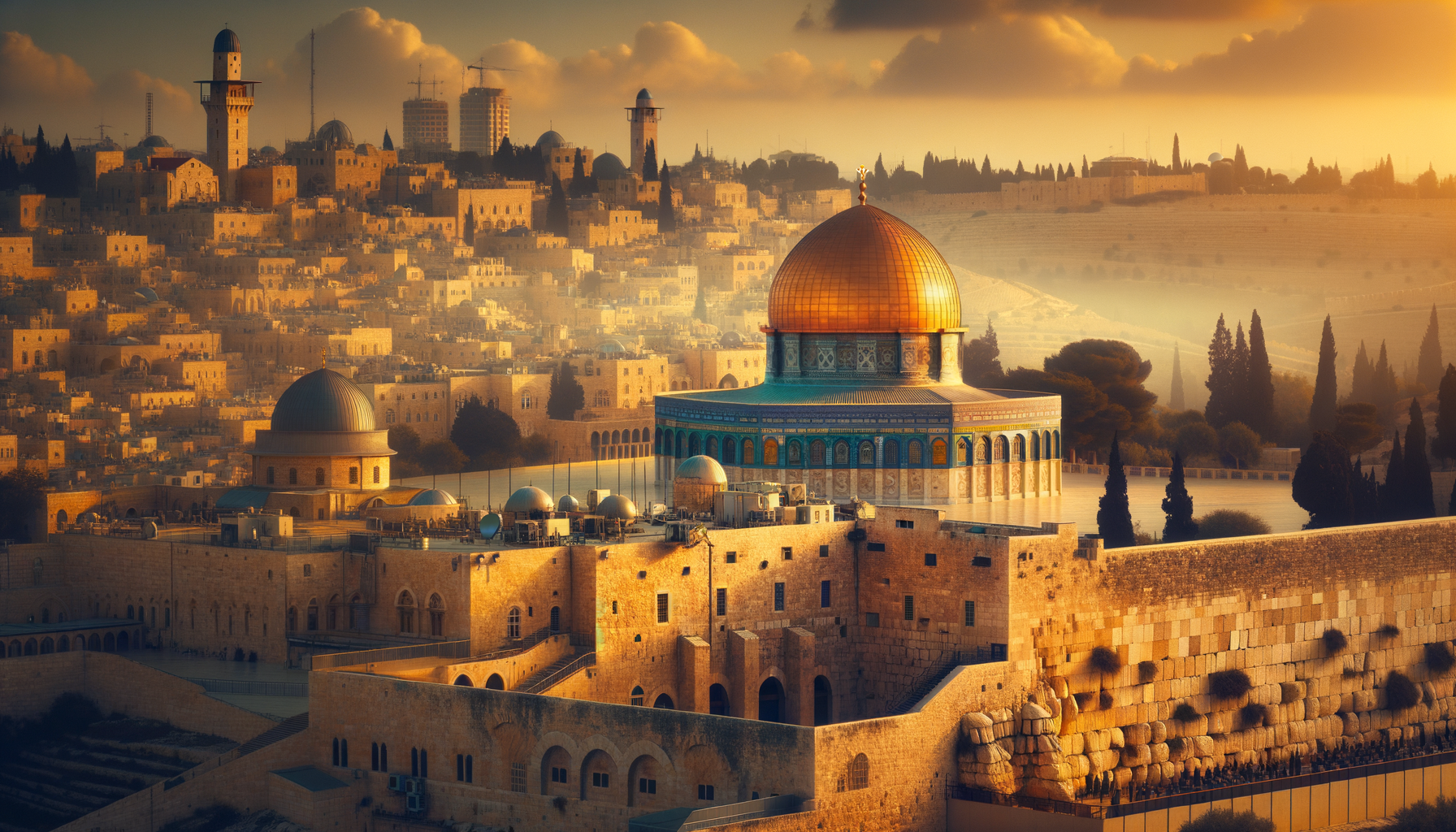
The Temple Mount / al-Haram al-Sharif
The most contested thirty-five acres on Earth. Site of the First and Second Temples; site since 691 AD of the Dome of the Rock and of al-Aqsa Mosque, the third holiest site in Islam. Administered by a Jordanian Waqf under an arrangement dating to 1967, with Israeli security control of access. Non-Muslims may visit at restricted hours through one gate and may not pray; the question of Jewish prayer there is one of the most incendiary issues in the entire conflict and has repeatedly triggered violence. Check whether it is open on the day — it frequently is not.
The Western Wall
The exposed western retaining wall of the platform, and the closest accessible point to where the Temple's Holy of Holies stood. It is a functioning open-air synagogue with separate men's and women's sections, open at all hours and free. Dress modestly; men are given a paper kippah at the entrance; do not photograph on Shabbat. The Western Wall Tunnels, running north along the buried continuation of the wall, are excellent and must be booked.
Church of the Holy Sepulchre
Built over the sites Christian tradition identifies as Golgotha and the tomb, first under Constantine in 326 AD. It is shared under a Status Quo arrangement fixed in 1757 between six denominations, which is why an immovable ladder has stood on a window ledge since at least 1757 because no one may move it, and why the keys have been held by two Muslim families since the twelfth century to stop the Christians fighting over them. It is chaotic, crowded, dark and extraordinary.
Everything else
The four quarters — Jewish, Muslim, Christian, Armenian — and the ramparts walk on the sixteenth-century Ottoman walls. Yad Vashem, the Holocaust memorial and museum, which is the most important thing in the city outside the Old City and needs half a day. The Israel Museum with the Dead Sea Scrolls and a large model of Second Temple Jerusalem. The City of David excavations, which are archaeologically significant and politically contested because of where they are and who runs them. And Mahane Yehuda market, which by night is the best eating and drinking in the city.
🏖️ Tel Aviv
Founded on sand dunes north of Jaffa in 1909 by sixty-six families dividing plots by lottery with seashells, and now a city of about 470,000 in a metropolitan area of four million. It is, deliberately, the opposite of Jerusalem: secular, hedonistic, expensive, loud, and facing the sea rather than inward.
The White City
Tel Aviv holds around 4,000 Bauhaus and International Style buildings — the largest concentration in the world — built mostly in the 1930s by architects who had trained in Germany and left after 1933, and adapted for the climate with balconies, brise-soleil and raised pilotis. UNESCO listed the White City in 2003. Rothschild Boulevard and the streets around Bialik Square are where to see it; the Bauhaus Center runs walking tours.
The beach and the city
Fourteen kilometres of Mediterranean beach with a continuous promenade, used year-round, and matkot — the incessant paddle-ball game whose sound is the acoustic signature of the Israeli coast. Behind it: Neve Tzedek, the first Jewish neighbourhood outside Jaffa and now the prettiest quarter; Florentin for street art and bars; Sarona, a restored nineteenth-century German Templer colony now full of restaurants; and the Carmel Market.
Jaffa
The ancient port at the southern end, some 4,000 years old and mentioned in Egyptian and Biblical sources, absorbed into Tel Aviv in 1950 and now the city's most interesting quarter: the flea market, the restored alleys, the clock tower, and a mixed Jewish and Arab population that makes it the one part of the metropolis where the country's actual demography is visible on the street.
Nightlife and the rest
Tel Aviv is a genuine late city — dinner at ten, bars until dawn — and has one of the largest LGBT scenes in Asia, with a Pride event that has drawn a quarter of a million people. It is also very expensive, consistently in the world's ten priciest cities in the cost-of-living surveys. Beyond the obvious: the Tel Aviv Museum of Art, ANU – Museum of the Jewish People, and the Palmach and Rabin Center museums for the country's own account of itself.
🌿 The Galilee, the Golan and the Coast
Northern Israel is green, hilly, agricultural and — for a visitor who has only seen Jerusalem and Tel Aviv — surprisingly gentle. It also holds most of the Christian sites, most of the wine, and most of the country's Arab and Druze towns.
Around the Sea of Galilee
A freshwater lake 210 m below sea level, 21 km long, ringed by the sites of the Gospels: Capernaum, with a synagogue built over the one Jesus is said to have taught in; the Mount of Beatitudes; Tabgha; and the Jordan baptism site at Yardenit. Tiberias on the western shore is one of Judaism's four holy cities and where the Jerusalem Talmud was compiled.
Nazareth and Safed
Nazareth is Israel's largest Arab city, about 78,000 people, mostly Muslim with a large Christian minority, and holds the Basilica of the Annunciation. It has an excellent and under-visited food scene. Safed (Tzfat), in the mountains at 900 m, is the centre of Kabbalah — where Isaac Luria taught in the sixteenth century — with blue-painted alleys, ancient synagogues and an artists' quarter.
The Golan and Hermon
Captured from Syria in 1967 and annexed in 1981 in a move recognised by almost no one except the United States since 2019; around 25,000 Israelis and a similar number of Druze, most of whom have declined Israeli citizenship, live there. It is high, green, volcanic, full of hiking and waterfalls at Banias and the Yehudiya reserve, and it is where a large share of Israel's best wine now comes from. Note that its status is disputed and border areas are military zones.
Haifa and Akko
Haifa, the third city, climbs Mount Carmel above its port and is Israel's most genuinely mixed Jewish–Arab city; the Baha'i Gardens, a UNESCO site, are nineteen terraces of formal garden running down the mountain to the shrine of the Báb. Akko (Acre), further north, is a walled Ottoman port built directly on top of an intact Crusader city that you walk through underground — a UNESCO site, a working Arab town, and the best hummus argument in the country.
🏜️ The Dead Sea, Masada and the Negev
More than half the country is desert, and it is the half most visitors give the least time to. It is also where the landscape stops resembling anywhere in Europe.
The Dead Sea
Floating in it is exactly as strange as advertised — the water is ten times saltier than the ocean and you cannot sink. Rules that people ignore and should not: do not shave beforehand, do not put your face in, do not swallow any, and rinse thoroughly afterwards. The mud is genuinely mineral-rich and genuinely a cosmetics industry. The sea is shrinking about a metre a year and sinkholes have closed several beaches, so check which are open rather than driving to one you read about.
Masada
Herod's clifftop fortress above the Dead Sea, and the site where, according to Josephus — the only source — the last Jewish rebels killed themselves in 73 or 74 AD rather than be taken by Rome. It became a founding myth of the modern state, and Israeli archaeologists have since argued at length about how much of Josephus to believe. Go for sunrise up the Snake Path, or take the cable car; by ten in the morning in summer it is dangerous. The Roman siege ramp and the outline of eight legionary camps are still visible from the top, which is the most impressive thing there.
Qumran and Ein Gedi
Qumran, where a Bedouin shepherd found the first of the Dead Sea Scrolls in a cave in 1947 — around 900 manuscripts, a thousand years older than any previously known Hebrew Bible text, now mostly in Jerusalem. Ein Gedi, a freshwater oasis in the cliffs above the Dead Sea with waterfalls, ibex and hyrax wandering the car park, and a nature reserve that is the single best short walk in the region.
The Negev and Eilat
Makhtesh Ramon at Mitzpe Ramon — 40 km long, 500 m deep, and a landform that essentially only occurs in this desert. Timna Park near Eilat, with copper mines worked since the Egyptian New Kingdom and rock formations including Solomon's Pillars. Avdat and Shivta, Nabataean towns on the Incense Route and a UNESCO site. And Eilat on the Red Sea, which is a resort town of no great charm attached to the northernmost coral reef in the world, which is worth the trip.
🙏 Visiting Holy Sites Properly
Three religions, dozens of denominations, and a set of rules that are partly about respect and partly about not causing an incident. None of it is difficult and all of it is noticed.
Dress, everywhere
Covered shoulders and knees for everyone at every religious site of every faith, and this is enforced at the door rather than suggested. Women should carry a scarf: it covers shoulders at churches, hair at mosques and the Western Wall's women's section on some occasions. Men receive a paper kippah at the Western Wall. Shoes off at mosques. Nothing sleeveless, nothing above the knee, and shorts will get a man turned away from the Church of the Holy Sepulchre.
Shabbat and photography
Do not photograph at the Western Wall or in religious neighbourhoods on Shabbat — operating a camera is prohibited work, and in Mea Shearim in Jerusalem it will produce a real confrontation. Do not photograph people at prayer anywhere without asking. In ultra-Orthodox areas dress conservatively and do not drive on Shabbat; the signs asking you not to are meant.
The Temple Mount specifically
Non-Muslim visiting hours are short, are through the Mughrabi Bridge next to the Western Wall only, and are cancelled often — on Fridays, on Muslim holidays, and whenever the security situation dictates. Non-Muslim prayer, and any visible religious object or gesture, is prohibited and is enforced by both the Waqf and the Israeli police. This is not bureaucracy: it is the arrangement holding one of the most flammable places on Earth in place, and visitors who test it cause genuine harm.
Bethlehem and the West Bank
The Church of the Nativity is in Bethlehem, which is in the West Bank under Palestinian Authority administration, about 10 km from Jerusalem through a checkpoint. It is normally straightforward for foreign tourists — most go on a day tour, or by Arab bus from Damascus Gate — but Israeli citizens may not enter Area A, hire cars are usually not insured there, and access depends entirely on the security situation. Jericho and Hebron are the other standard destinations and Hebron in particular should only be done with a guide, of which there are two competing versions and both are worth hearing.
🥙 Food
Israeli food is one of the more interesting cuisines in the world precisely because it is contested. It is a Levantine base — Palestinian, Lebanese, Syrian — layered with what Jews brought from Morocco, Iraq, Yemen, Ethiopia, Poland, Germany, Georgia and Bukhara, compressed into seventy-five years and one small country. That produces both extraordinary cooking and a genuine argument about whose food it is.
The argument, stated
Hummus, falafel, tabbouleh, za'atar, msabbaha and maqluba are Levantine Arab dishes that long predate the state of Israel, and calling them Israeli — as menus abroad routinely do — is experienced by Palestinians as appropriation of one of the few things they still hold. Israelis point out that Mizrahi Jews from Arab countries brought many of the same dishes with them as their own tradition. Both statements are true. The honest formulation is that these are regional dishes cooked by everyone here, and that the naming is a live grievance worth not being careless about.
The core
Hummus — properly a hot dish eaten for breakfast or lunch at a dedicated hummusiya, wiped with bread, never a supermarket dip. Falafel in pita with salads, tahina and pickles. Sabich, an Iraqi-Jewish pita of fried aubergine, hard-boiled egg, amba and tahina, and arguably the best thing in the country. Shakshuka, North African eggs in tomato and pepper. Shawarma and meorav yerushalmi, the Jerusalem mixed grill.
Salatim and the meze table
Sit down in a good restaurant and a dozen small plates arrive before you have ordered — pickles, matbucha, aubergine in tahina, cabbage, beetroot, hummus, labneh — and they are usually free and refilled. This is salatim, and it is one of the great pleasures of eating in the country and a reliable way to be full before the main course you have already ordered arrives.
Kosher, and the modern scene
Kashrut is widespread but far from universal: much of Tel Aviv is not kosher and pork and shellfish are on plenty of menus. Where a restaurant is kosher it will be either meat or dairy and never both, and will close for Shabbat. Alongside all this is a serious modern restaurant culture — chefs like Yotam Ottolenghi and Michael Solomonov have made it internationally visible — and the markets, Mahane Yehuda in Jerusalem and Carmel in Tel Aviv, are the best places to eat in either city.
🍷 Wine, Arak and Coffee
Wine
Wine has been made here for five thousand years — the ancient presses are all over the country — and the modern industry, restarted by Baron Edmond de Rothschild in the 1880s, spent a century making sweet sacramental wine and about thirty years becoming genuinely good. The quality regions are the Golan Heights and the Upper Galilee, both high and cool, and the Judean Hills. Golan Heights Winery, Yarden, Domaine du Castel, Tzora and Recanati are the names to look for. Note that wine from the Golan carries the territorial question with it in some export markets.
Arak
The Levantine aniseed spirit, drunk across the region and by everyone in it — poured over ice and topped with water, at which point it turns milky white. Israelis drink it with meze, with grilled meat and, in Tel Aviv, in cocktails. It is closely related to Greek ouzo and Turkish rakı and is not a cousin of them so much as a sibling.
Beer
Goldstar and Maccabee are the mass-market lagers, and Goldstar is the one people are fond of. Since about 2010 there has been a real craft scene — Malka, Alexander, BeerBazaar — and Tel Aviv and Jerusalem both have good beer bars. Taybeh, from a Christian Palestinian village in the West Bank, is the region's best-known Palestinian brewery and is widely available in Israel.
Coffee, and the other drinks
Israeli café culture is serious and continuous — the country runs on hafuch, the local flat white. Turkish coffee with cardamom is what you get outside cafés and in Arab towns. Limonana, frozen lemon and mint, is the summer drink and is better than it sounds. Sachlav, a hot orchid-root drink with cinnamon and nuts, is the winter one. And the tap water is safe everywhere, which for the region is not a given.
🍳 Recipe: Shakshuka

North African in origin — Tunisian and Libyan Jews brought it — and now the default Israeli breakfast, brunch, late supper and hangover cure. It takes twenty-five minutes and nothing in it is difficult.
Shakshuka
Eggs poached in pepper and tomato · serves 2–3 · 25 min
Ingredients: 3 tbsp olive oil; 1 large onion, sliced; 2 red peppers, in strips — not diced; 3 garlic cloves, sliced; 1 tin (400 g) good plum tomatoes, hand-crushed, plus 2 fresh tomatoes chopped if you have them; 1 tsp sweet paprika; ½–1 tsp ground cumin; a pinch of caraway if you want it Tunisian; chilli to taste, or a spoon of harissa; 1 tsp sugar; salt; 4–6 eggs; parsley or coriander; bread, and ideally a lump of feta.
Method: Use a heavy pan you can put on the table — cast iron, 24–26 cm. Soften the onion and peppers in the oil over medium heat for a good ten minutes, until they are properly soft and starting to colour; this is the step that decides whether it tastes of anything. Add the garlic and the spices and stir for a minute until they smell. Add the tomatoes, the sugar and salt, and simmer 10–15 minutes until it is thick enough that a spoon drawn through it leaves a channel. Make wells with the back of a spoon, crack an egg into each, season the eggs, cover, and cook on a low heat for 5–8 minutes — the whites set and the yolks stay runny, and this is the only part where timing matters. Scatter herbs and crumbled feta, and take the pan to the table with bread.
💡 The sauce is better made the day before, and shakshuka is one of the few dishes where a tin of tomatoes genuinely beats mediocre fresh ones. In Israel it is eaten at any hour and there is a green version with spinach, chard and herbs instead of tomato that is arguably better.
🧆 Recipe: Falafel

⚠️ The one rule that cannot be broken: use dried chickpeas, soaked. Never tinned, never cooked. Cooked chickpeas contain too much water, the mixture will not hold, and the balls disintegrate in the oil. Every failed batch of homemade falafel in history has this cause.
Falafel
Fried chickpea and herb fritters · makes ~25 · 20 min + overnight soak
Ingredients: 250 g dried chickpeas, soaked in plenty of cold water for at least 12 hours and drained — do not cook them; 1 small onion, roughly chopped; 4 garlic cloves; a very large bunch of flat parsley (40 g) and the same of coriander — this quantity is the point; 1½ tsp ground cumin; 1 tsp ground coriander; ½ tsp baking powder; ½ tsp bicarbonate of soda; 1 tsp salt; black pepper; chilli to taste; 2 tbsp flour or chickpea flour if needed; sesame seeds, optional; oil for deep frying. To serve: pita, hummus, tahina sauce, chopped tomato and cucumber, pickled turnip, amba, harissa.
Method: Put the drained raw chickpeas, onion, garlic and herbs in a food processor and pulse to a coarse, damp, sand-like texture — you want it fine enough to hold and coarse enough to see. Do not purée it. Mix in the spices, salt and pepper, cover and rest in the fridge for an hour. Just before frying, stir in the baking powder and bicarbonate — these go in last or they lose their lift — and add a little flour only if the mixture will not hold a shape when squeezed. Form walnut-sized balls or patties, pressing firmly. Heat oil to 170–175 °C, fry in small batches for 3–4 minutes until deep golden brown, and drain. Eat within minutes: falafel has a shelf life of about a quarter of an hour.
💡 Test one ball first. If it falls apart, the mixture is too wet — a spoonful of flour and another rest fixes it. Oil that is too cool gives you a greasy, pale falafel and oil that is too hot gives you a raw middle, so a thermometer earns its place. And make the tahina sauce properly: raw tahina, cold water added slowly until it seizes and then loosens to cream, lemon, garlic, salt.
✈️ Getting There
Air access has been repeatedly disrupted since October 2023 and again since February 2026. Airlines have suspended, resumed and re-suspended routes at short notice, and Israeli airspace has closed with hours of warning. Everything below describes the normal pattern; confirm the actual position with the airline before booking anything non-refundable. Checked 6 September 2026.
Ben Gurion
Ben Gurion Airport (TLV) near Lod, 20 km from Tel Aviv and 50 from Jerusalem, handles essentially all traffic. A train runs from inside the terminal to Tel Aviv in 20 minutes and to Jerusalem in about 30, and it is much the best way in — except on Shabbat, when it does not run and you need a sherut or a taxi. Ramon Airport near Eilat takes some charter traffic.
From Prague
In normal times direct flights Prague–Tel Aviv run several times a week on El Al and Smartwings, about 3 h 30 min, with returns from roughly 6,000–12,000 Kč depending on season. Indirect options via Vienna, Istanbul, Athens or Larnaca are usually available when direct services are suspended. Because suspensions have been frequent, book flexible fares and take out cover that pays for cancellation by the airline.
Security, and what to expect
Israeli airport security is the most thorough in the world and is profile-based questioning rather than only machines. Expect to be interviewed on departure — sometimes at length, sometimes more than once — about who packed your bag, where you stayed, whom you met and why you came. It is normal, it is not personal, and the correct response is to answer straightforwardly and allow three hours before departure. Visitors with Arab or Muslim names, journalists and anyone with stamps from Lebanon, Syria, Iran or Iraq are questioned more, which is a documented pattern and a real complaint.
The stamp
Israel stopped stamping passports in 2013 and issues a paper entry card instead — keep it, you need it for hotels and the VAT refund. This matters because Lebanon, Syria, Iran, Libya, Yemen and several others refuse entry to anyone with evidence of a visit to Israel. An Israeli stamp is no longer the issue; an Egyptian or Jordanian land-border stamp from a crossing that only serves Israel still is.
📋 Practical Information
Entry
Czech citizens do not need a visa for stays up to 90 days and receive a paper entry card. A passport valid six months beyond entry is required. Israel has an ETA-IL electronic authorisation scheme for visa-exempt nationals — check whether it applies to you before travelling, because the rollout has moved. Entry is at the discretion of the border officer and refusals, while uncommon for ordinary tourists, do happen and cannot be appealed at the airport.
Money and costs
The new Israeli shekel (ILS, ₪). Israel is expensive — Tel Aviv is regularly in the world's ten costliest cities. A café breakfast 350–500 Kč, a restaurant main 500–900 Kč, a falafel or sabich in pita 90–150 Kč, a beer 180–250 Kč, a mid-range double in Tel Aviv 4,000–7,000 Kč. Cards are accepted universally and contactless is standard. Tipping is 12–15% in restaurants and is expected.
Getting around
Trains and buses are cheap, frequent and good, and both take the rechargeable Rav-Kav card, which you buy at any station — cash is no longer accepted on most buses. Everything stops for Shabbat, roughly Friday afternoon to Saturday nightfall, except in Haifa and in Arab towns; sherut shared minibuses run on the main routes and taxis work. Driving is on the right, roads are good, and Israeli driving is assertive.
Practicalities
Plugs are type H, three round pins in a triangle — an Israeli speciality. European type C two-pin plugs fit the same sockets, so a Czech charger will usually work, but anything with an earthed plug will not; bring an adapter. Voltage 230 V. Tap water is safe. Mobile coverage is excellent and local SIMs are cheap. Hebrew and Arabic are official and English is very widely spoken. Emergency numbers: 100 police, 101 ambulance, 102 fire.
For Czech travellers: the Czech Embassy in Tel Aviv is at 23 Zeitlin Street, and Czechia — like most states — has not moved its embassy to Jerusalem, although it opened a Czech House there in 2021. Czech–Israeli relations are unusually warm and the 1948 arms supply is remembered on the Israeli side far better than on the Czech. Standard Czech travel insurance excludes war and unrest, which in the current situation is not a theoretical exclusion — read the policy rather than the brochure. Register in DROZD and read the current MZV ČR advisory, which distinguishes between areas rather than treating the country as one.
🚨 Safety
⚠️ Position as of 6 September 2026, and it changes. Do not treat this as current if you are reading it later. Gaza, Lebanon, Syria, Iran, Iraq and Yemen are under do-not-travel advice from essentially every government. Israel itself was removed from the British foreign office's do-not-travel list in June 2026, with restrictions retained near the Gaza, Lebanon and Syria borders. Read your own ministry's advisory today, and read the whole of it rather than the headline.
Rockets and alerts
Israel has a national siren network and a public shelter system, and every building has a shelter or a reinforced room by law. Download the Home Front Command app before you arrive; it gives geolocated alerts. On a siren you have between 15 and 90 seconds depending on where you are — the further south, the less. Go to the nearest shelter or stairwell, stay 10 minutes, and if you are outdoors lie flat with your hands over your head. Ask where the shelter is when you check in. Israelis will tell you calmly and are used to it; you will not be.
Where not to go
The Gaza periphery, the Lebanese border and the Syrian border including parts of the Golan are restricted or dangerous and are marked as such. In the West Bank, most tourist destinations — Bethlehem, Jericho — have normally been accessible on organised visits, but conditions vary sharply by day and by area, settler and military violence have both risen since 2023, and hire cars are usually not insured in Area A. Do not go to Gaza.
Ordinary crime, and the desert
Violent crime against tourists is rare and Israel is a very safe country in the ordinary sense — petty theft in Tel Aviv beach areas is the usual complaint. The hazards that actually injure visitors are different: heat, which kills people at Masada and in the Negev most summers; flash floods in desert canyons, which can arrive from rain that fell 50 km away under blue sky; and the Dead Sea, where the salt in an eye or a swallowed mouthful is a genuine medical event.
Behaving sensibly
Carry your passport or entry card; you can be asked for it. Expect bag checks and metal detectors at the entrance to every mall, station, market and bus, which is normal and quick. Do not photograph soldiers, checkpoints or military installations. Do not leave bags unattended anywhere — an unattended bag is treated as a bomb and will be destroyed by a robot, which happens weekly. And be careful about political conversation with strangers in a way you would not need to be elsewhere: everyone here has lost someone or knows someone who has.
❓ Misconceptions
"Israel is a desert country."
More than half of it is desert, and the rest is not. The coastal plain is humid Mediterranean, the Galilee is green and hilly with real winters, and there is a ski lift on Mount Hermon. In February you can be snowed on in Jerusalem in the morning and swimming in Eilat in the afternoon, and people do exactly that.
"Israelis are all religious."
Around 45% of Jewish Israelis describe themselves as secular and Tel Aviv is one of the least religious cities in the developed world. The country is also 21% Arab, mostly Muslim, with Christian and Druze minorities. The religious–secular argument is one of the sharpest internal divisions in Israeli politics, which is not what a country of uniform piety would look like.
"The conflict is ancient and religious."
It is modern and national. Jews, Muslims and Christians lived alongside one another in Ottoman Palestine, with the ordinary frictions of the period and without a war over sovereignty, because the question of who governed the land as a nation-state had not been posed. The conflict in its present form dates from the early twentieth century and is between two national movements with claims to the same territory. Religion supplies the symbols and raises the stakes; it is not the cause.
"Hummus and falafel are Israeli."
They are Levantine Arab dishes that predate the state by centuries, and menus abroad describing them as Israeli are a live grievance for Palestinians. Mizrahi Jews from Arab countries also brought them as their own tradition, which is why the argument is not simple. Saying "Levantine" or "Middle Eastern" costs nothing and is more accurate.
"You can't visit as a tourist right now."
Israel is open, flights operate, hotels and sites are functioning, and — as of the date on this page — it is not under blanket do-not-travel advice from most governments, though several regions are. That is not the same as saying it is a normal time to go. Whether to travel is a judgement about risk tolerance and about the appropriateness of tourism in a country at war, and both parts of that are yours to make with current information.
"Jerusalem is Israel's undisputed capital."
Israel says so and governs from there. Most of the world does not recognise it, keeps embassies in Tel Aviv — Czechia among them — and regards East Jerusalem as occupied territory. A small number of states, led by the United States since 2018, have moved their embassies. Palestinians claim East Jerusalem as their capital. All of that is simultaneously true and is why the question is a core final-status issue rather than a matter of fact.
✍️ Author's Note
This was the hardest page on this site to write, and the difficulty is not the history — it is that any sentence about this place is read as a position, including the ones that are trying not to be. There is no vocabulary here that is not somebody's vocabulary. What I have tried to do instead is attach dates and sources to everything, set out each side's claim in the strongest form its own advocates would recognise, say clearly where international legal opinion has settled and where it has not, and then decline to hand down a verdict from a travel page.
Two consequences of that worth stating. The conflict sections are longer than a guidebook would normally carry, because leaving them thin would be a choice too, and a dishonest one. And the current-situation and safety sections are dated in their headings, because in September 2026 the position changes month to month and a page that pretends otherwise is worse than no page.
What I would say to someone deciding whether to go, when the security situation permits it: the country is extraordinary and exhausting in equal measure, and the single most valuable thing a visitor can do is spend time on both sides of the line — Jerusalem and Bethlehem, a Jewish Israeli host and a Palestinian one, the Israel Museum and a Nazareth kitchen — and to listen a great deal longer than feels natural before concluding anything. Almost everyone who does that comes back with a more complicated view than they left with, which is the correct outcome.
On the images
The site's image store holds exactly one Israel photograph — the Jerusalem hero — where a country with this much to look at would normally have twenty. It is an illustration rather than a documentary photograph, and within those limits it is right: the Dome of the Rock on the Temple Mount platform above the Herodian retaining wall, Jerusalem limestone, cypresses, and the particular gold evening light the city is known for. The fine detail should not be relied on, and there is no photograph anywhere in the set of Tel Aviv, the Dead Sea, Masada, the Galilee or the Negev.
Two recipe images came from the shared folder and both are usable. The shakshuka is right in substance and wrong in presentation — it should arrive in the cast-iron pan it was cooked in, with the peppers still visible as strips. The falafel is accurate as far as it goes, and what it cannot show is the two things that matter most: that the inside should be bright green with herbs, and that nobody in the region eats it as balls on a plate rather than stuffed into bread with half a salad bar.
Support This Project 🌍
This World Travel Factbook is a labor of love – free to use for all travelers. If you find it helpful, consider supporting its continued development.