

🇮🇲 Isle of Man at a Glance
🌍 Overview
The Isle of Man sits almost exactly in the middle of the Irish Sea, roughly equidistant from England, Scotland, Ireland and Wales, and is 572 km² — about the size of the district of Prague-East — with around 85,000 people. It is 52 km long and 22 km at its widest, and you can drive from one end to the other in an hour.
It is also, for its size, one of the most genuinely unusual places in Europe. It has its own thousand-year-old parliament, its own currency, its own language brought back from extinction, its own tailless cat and four-horned sheep, a motorcycle race on public roads that is the most dangerous sporting event in the world, and the distinction of being the only entire nation designated a UNESCO Biosphere Reserve.
Three things to get straight
It is not part of the United Kingdom. It has never been in the European Union, not even before Brexit. And it is not a country in the sense of being a sovereign state — it is a Crown Dependency, a constitutional arrangement explained in its own section below and genuinely unlike anything else.
Tynwald
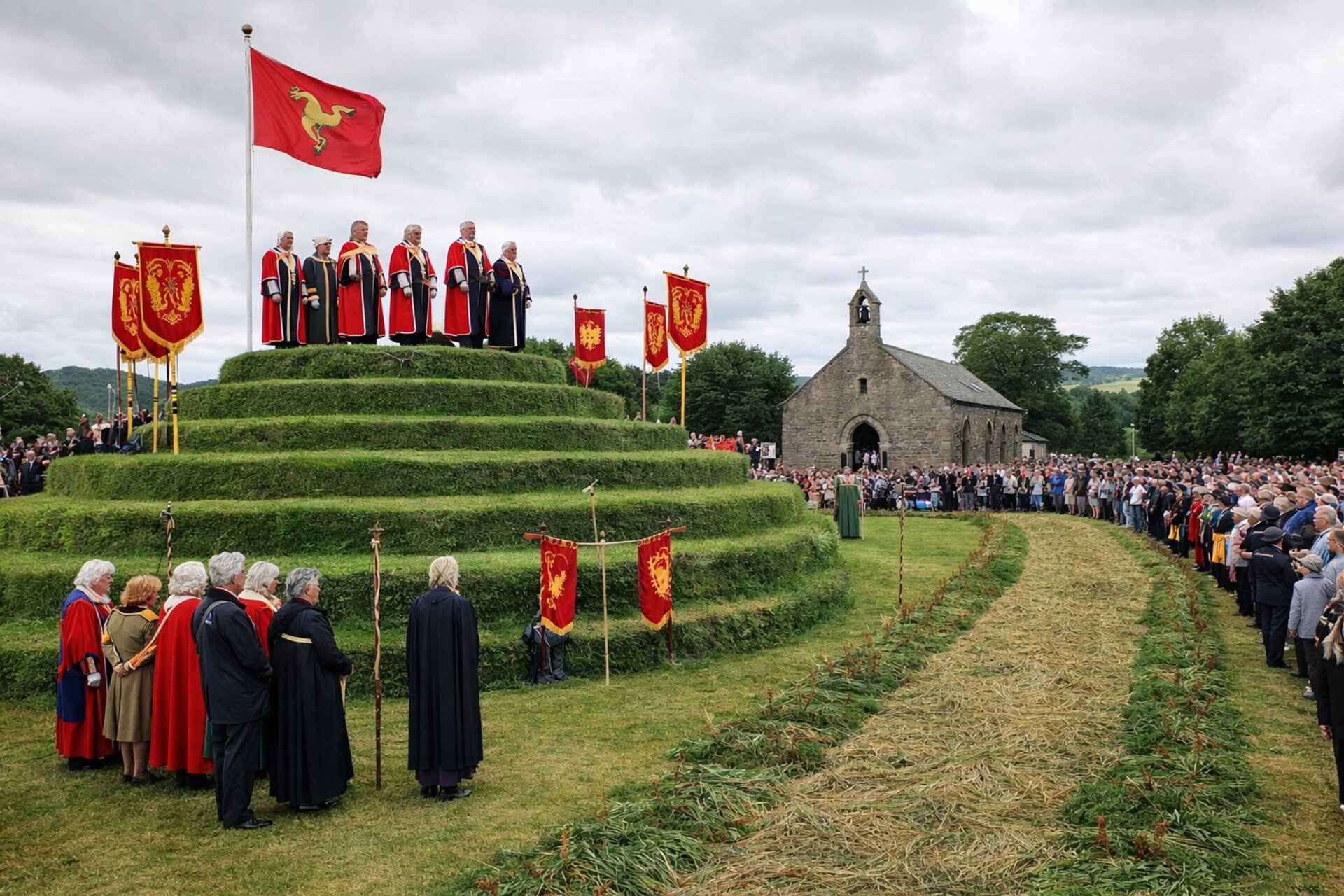
The parliament, Tynwald, claims descent from a Norse assembly of around 979 AD and describes itself as the oldest continuously functioning parliament in the world. Iceland's Alþingi is older by about fifty years but was suspended for forty-five years in the nineteenth century; Tynwald has not stopped. Every July it still meets in the open air on a stepped grass mound and proclaims its new laws aloud, in English and Manx, or they do not take effect.
The TT
The Isle of Man TT has been run since 1907 on 60.7 km of ordinary public roads closed for the purpose, over 264 corners, with stone walls, kerbs, houses and telegraph poles at the edge of the track. Lap speeds now exceed 217 km/h average. More than 270 people have died on the course. It is the most dangerous regularly held sporting event on Earth and it is also the island's largest annual event by a very wide margin.
What it is like
Green, hilly, wet, and much more varied than 572 km² has any right to be: cliffs, glens, moorland, a mountain, sandy bays and a limestone coast. It is prosperous, quiet, extremely safe, has no motorway and — outside the mountain section, which has no speed limit at all — no hurry. It is also expensive, and the finance sector that pays for the prosperity is a substantial and contested part of the story.
👑 A Crown Dependency, Which Is Not What Most People Think
The Isle of Man is a possession of the Crown that is not part of the United Kingdom, not a British Overseas Territory, and not an independent state. The King is Lord of Mann — a title, not a kingship, and the island's toast is the Queen, Lord of Mann or now the King, Lord of Mann. Jersey and Guernsey have the same status by a different route.
Who does what
The island runs its own domestic affairs entirely: its own parliament, government, courts, laws, taxes, health service, police, post office, currency and internet domain (.im). The United Kingdom is responsible for its defence and, by convention, its international representation — although the island now negotiates and signs some agreements in its own name with UK consent. There is no Manx representation at Westminster and no Westminster representation on Man.
Never in the EU
This is the one people get wrong most often. Under Protocol 3 to the UK's 1972 accession treaty, the Isle of Man was in the EU customs union and free-trade area for goods but outside it for everything else: no free movement of people, no agriculture or fisheries policy, no EU funds, no European elections, and EU citizens had no right to live or work there. When the UK left in 2020 that arrangement lapsed and the island signed a customs agreement with the UK instead.
The Common Travel Area
Man is inside the Common Travel Area with the UK, Ireland, Jersey and Guernsey, so travel from Britain or Ireland involves no passport control. For everyone else, including EU citizens, it applies UK immigration rules — which since 23 April 2026 means an ETA. See the practical section.
The money
The Manx pound is issued by the Isle of Man Government at parity with sterling and is legal tender only on the island. British notes and coins circulate freely and interchangeably. Manx money is not legal tender in the UK and shops there may refuse it — a genuine and common nuisance, so spend it or change it before you leave. The Manx pound coin famously carries a different reverse design each year and the notes carry the triskelion.
🏷️ Mann, Ellan Vannin, and the Three Legs
The island's name in Manx is Ellan Vannin, "island of Mannin". Mannin or Manannán is the sea god of Irish and Manx mythology — Manannán mac Lir, son of the sea — who in legend owned the island and hid it from enemies in a cloak of mist, which anyone who has waited for a ferry in fog will find plausible. English "Man" and "Manx" come from the same root; the spelling Mann with two Ns is used in formal and legal contexts.
The triskelion
Three armoured legs joined at the hip, running clockwise — the ny tree cassyn, the three legs of Man. It has been the island's emblem since at least the thirteenth century and probably arrived with the Scottish kings, who may in turn have taken it from Sicily, which uses a very similar three-legged badge. The motto around it is Latin: Quocunque jeceris stabit — "whichever way you throw it, it will stand", which is either a statement about resilience or the most Manx sentence ever written.
The flag and the anthem
A red field with the triskelion, formally adopted in 1932. The island has two anthems: Arrane Ashoonagh Vannin, the Manx national anthem, and God Save the King as the royal anthem, and which is played depends on whether the occasion is national or royal. At Tynwald Day both are used.
Manx names
Surnames on the island are unlike anywhere else and are worth noticing: Quayle, Kelly, Corlett, Cannell, Quilliam, Kermode, Quirk, Costain, Christian. Many begin with C, K or Q because they are contractions of Gaelic Mac — Mac Phaayl became Quayle, Mac Thormod became Kermode. Fletcher Christian of the Bounty was from a Manx family.
The fairies
Manx folklore is dense with them, and one custom is entirely alive: everyone crossing the Fairy Bridge on the main road from Douglas to Castletown says "hello, fairies" or the Manx moghrey mie. Locals do it. Bus drivers do it. The superstition is that failing to greet them brings bad luck, and during TT week the number of riders who observe it is not small. There is also a rule against saying the word for rat aloud — you say longtail instead — which fishermen took seriously and some still do.
🗺️ Geography
A single ridge of hills runs down the middle of the island from north-east to south-west, cut by deep wooded glens, with a flat and sandy plain in the north and a limestone coast in the south. Nowhere on Man is more than 6 km from the sea.
Snaefell
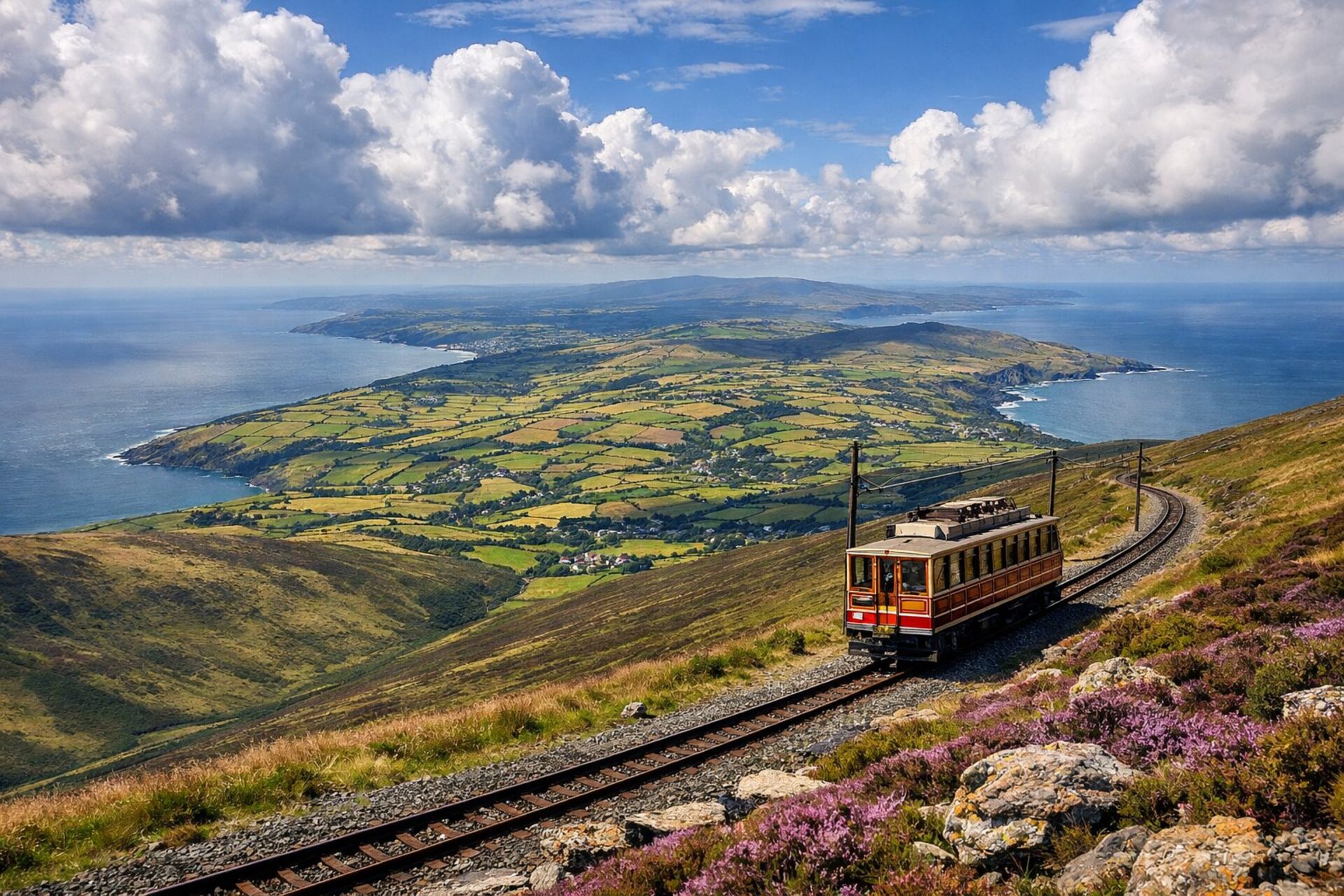
The only mountain, at 621 m — from Old Norse snæfjall, snow mountain. A Victorian electric mountain railway has run to the summit since 1895, and the claim made at the top is that on a clear day you can see six kingdoms: England, Scotland, Ireland, Wales, Mann and Heaven. Clear days are the constraint. The Mountain Road over its flank is the fastest part of the TT course and has no speed limit.
The north
Flat, sandy and geologically young — the Ayres, a shingle and dune coast at the northern tip ending at the Point of Ayre lighthouse, is glacial outwash and is still growing. Behind it lie the Curraghs, a wetland of willow carr that is a national nature reserve and, improbably, holds a self-sustaining wild population of red-necked wallabies descended from escapees from the wildlife park in the 1960s.
The south and the Sound
Limestone country around Castletown, then the cliffs and chasms of the far south-west. At the very end is the Sound, a tide-torn strait a few hundred metres wide separating the island from the Calf of Man, and one of the best places in Britain and Ireland to watch seals, seabirds and, in summer, basking sharks.
The glens
Eighteen national glens, mostly wooded ravines running down to the sea, all free to enter and maintained by the government. Glen Maye, Dhoon Glen, Ballaglass and Groudle are the ones to walk. There are also 160 km of coastal path — the Raad ny Foillan, the Way of the Gull — which circles the entire island and is walkable in about five days.
🗺️ Map
The island lies at about 54.2° N, 4.5° W, some 50 km from the Cumbrian coast of England, 45 km from Northern Ireland, 55 km from Scotland and 80 km from Wales. It has no land border with anyone.
The towns
Douglas on the east coast is the capital and holds about a third of the population. Ramsey in the north, Peel on the west coast, Castletown in the south — the former capital — and Port Erin and Port St Mary at the southern tip. Everything else is villages. There are seventeen ancient parishes and the parish is still the unit people identify with in the countryside.
Getting around
Buses run everywhere and are good. The heritage railways are transport as much as attraction: the steam railway south to Port Erin, the Manx Electric Railway north to Ramsey, the Snaefell line, and the horse trams along Douglas promenade. A car helps for the glens and the west, and there is no motorway and very little traffic outside Douglas.
The Mountain Road
The A18 over Snaefell has no general speed limit — one of very few public roads in Europe of which that is true. It is not an invitation: it is a two-lane road over a mountain with stone walls, sheep on the carriageway and weather that closes in without warning, and it kills people every year outside race week as well as during it.
Distances
Douglas to Peel 18 km. Douglas to Ramsey 25 km. Douglas to Port Erin 25 km. The whole TT course is 60.7 km and takes an ordinary car about an hour and a quarter to drive at legal speeds; the lap record on a motorcycle is under 17 minutes, which is the most useful single fact for understanding what the race is.
🌦️ Weather
Maritime, mild, wet and windy, with the sea moderating everything. Extremes are rare: the record high is around 29 °C and hard frost is unusual. What is not rare is wind and Manannán's cloak — the sea fog that can shut the island in for days and is the main reason flights and ferries get cancelled.
The numbers
Summer highs typically 16–19 °C, winter lows around 3–5 °C. Rainfall about 800 mm a year on the coast and over 1,900 mm on Snaefell. Sunshine is best in May and June. The island is windy enough that the tree line on exposed ground is essentially at sea level, which is why the uplands are bare and the glens are the only woodland.
When to go
May to September. Late May and early June is TT fortnight — the island's population effectively doubles, accommodation is booked a year ahead and costs several times normal, roads close for hours at a time, and if you have come for quiet glens and heritage railways this is precisely the wrong time. If you have come for the TT there is no other time. Late August has the Manx Grand Prix, which is the amateur version and much calmer.
Road closures
During TT and Manx Grand Prix practice and racing, the Mountain Course closes completely — that is a 60 km loop taking in a third of the island's road network — for several hours a day, on a published schedule. Villages inside the loop become genuinely unreachable by road. Check the closure timetable before planning any journey in those weeks; visitors who do not, spend a lot of the day sitting at a barrier.
What to bring
A waterproof shell and layers. Proper footwear for the glens and the coastal path, which are muddy for most of the year. Nothing you need is unavailable in Douglas, and everything costs more than it would in Britain.
🪨 Before the Norse
People arrived after the ice, around 8000 BC, when the island may still have been joined to Britain by a land bridge across what is now the shallow northern Irish Sea. What they left is out of proportion to the island's size.
The megaliths
Cashtal yn Ard near Maughold, a 40-metre Neolithic chambered cairn and one of the largest in the British Isles. King Orry's Grave at Laxey. Meayll Circle above Port Erin, an unusual arrangement of six pairs of chambers in a ring, which has no close parallel anywhere. All are free to visit and mostly empty of people.
The Celts and the crosses
By the Iron Age the island was Brythonic-Celtic speaking, and Gaelic arrived from Ireland in the early centuries AD along with Christianity — traditionally with St Maughold and, in legend, via St Patrick, who is said to have landed at Peel. The island is dotted with keeills, tiny single-cell drystone chapels of which around 200 sites are known, and with early Christian stone crosses.
The cross slabs
The island's greatest archaeological treasure is a collection of over 200 carved stone crosses and slabs spanning the Celtic and Norse periods, gathered into shelters at parish churches — the collection at Maughold is the best. They record the moment the two cultures met: Christian crosses carved with runic inscriptions and with scenes from Norse pagan myth, including Odin being eaten by the wolf Fenrir on a cross at Kirk Andreas. There is nowhere better to see the two religions sharing a single stone.
The Braaid
A site near Marown where a Celtic roundhouse and two Norse longhouses stand within metres of each other, the older round and the newer rectangular. It is the clearest physical statement anywhere of what happened to Manx society in the ninth century, and you can walk up to it from a lay-by.
⚔️ The Kingdom of Mann and the Isles
Norse raiders arrived around 800 and stayed. Within a century or two the island was Scandinavian in law, government and much of its place-naming, and from the eleventh century it was the centre of a genuine maritime kingdom: the Kingdom of Mann and the Isles, ruling Man together with the Hebrides — an empire of sea lanes stretching several hundred kilometres.
Godred Crovan
The founder of the ruling dynasty, who took the island in 1079 after the battle of Skyhill near Ramsey. He survives in Manx tradition as King Orry, and the Milky Way is still called Raad Mooar Ree Gorree — King Orry's Great Road. His descendants ruled for nearly two centuries, playing Norway, Ireland, Scotland and England against one another with the skill of people who knew they were small.
What the Norse left
The parliament, which is the big one — Tynwald is þingvǫllr, assembly field, the same word as Iceland's Þingvellir. The administrative division of the island into six sheadings, from Old Norse. A great many place names ending in -by (farm), -wick (bay), -fell (hill) and -garth. And the ship burials, of which the Balladoole boat grave is the most striking — a Norseman buried in his ship, on top of a Christian cemetery, with a woman who may not have gone willingly.
1266 and after
Norway ceded the Isles to Scotland by the Treaty of Perth in 1266, and Man then spent a century being fought over by Scotland and England before settling under English lordship in 1333. In 1405 Henry IV granted it to Sir John Stanley, and the Stanley family — later the Earls of Derby — ruled it as Lords of Mann for nearly three hundred years, followed by the Dukes of Atholl. For most of that time the Crown had almost nothing to do with the island.
Peel Castle
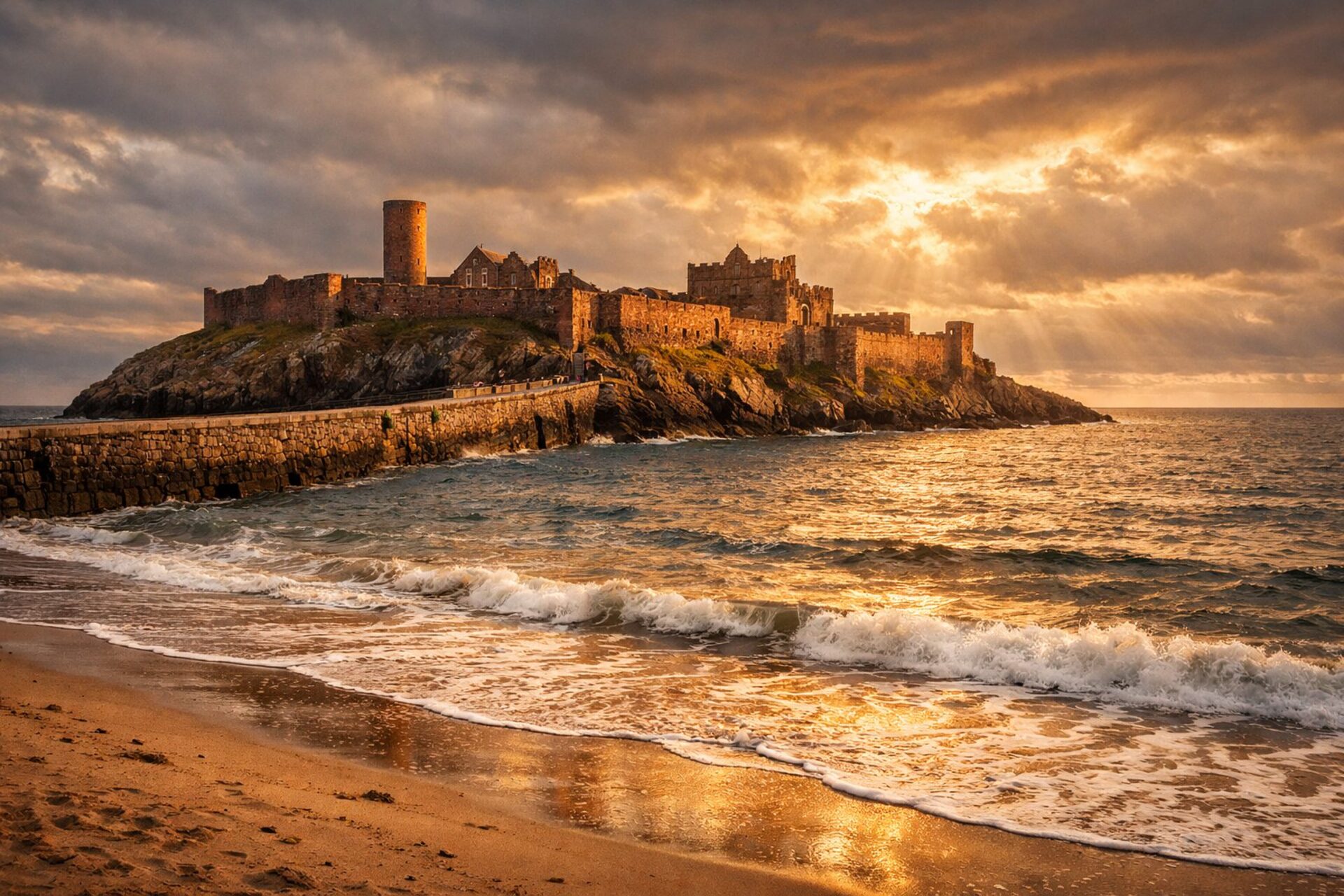
The seat of the kingdom, on St Patrick's Isle at Peel, and the single best place to stand and understand this history: an eleventh-century round tower of the Irish type, the ruined cathedral of St German, and the red sandstone curtain wall the Stanleys built round the lot. Excavation there produced the Pagan Lady of Peel, a tenth-century Norse woman's grave with a magnificent glass-bead necklace, now in the Manx Museum.
⚖️ Tynwald, and a Thousand Years of Not Stopping
Tynwald is the parliament of the Isle of Man and it claims, with reasonable justification, to be the oldest continuously functioning parliament in the world. The conventional date given is 979 AD, which is a round number rather than a documented one — but the institution is unquestionably Norse, unquestionably medieval, and unquestionably has never been dissolved or suspended.
The claim, examined
Iceland's Alþingi was founded around 930 and is older. But it was abolished in 1800 and not restored until 1845, so it has a forty-five-year gap. Tynwald has none. The honest formulation, which the Manx themselves use, is the oldest continuous parliament — and it is fair.
How it works
Two chambers: the House of Keys, 24 members directly elected, and the Legislative Council, 11 members mostly chosen by the Keys. They sit separately and also together as Tynwald Court. The head of government is the Chief Minister; the King's representative is the Lieutenant Governor. There are no political parties in any meaningful sense — almost all members sit as independents, which makes Manx politics personal, local and very hard to explain to outsiders.
Tynwald Day
5 July, the national day, held in the open air at St John's on the four-tiered Tynwald Hill. The whole legislature processes from the chapel along a rush-strewn path; the titles of every act passed in the previous year are proclaimed aloud in English and Manx; and any citizen may come forward and present a petition for redress directly to the parliament. The proclamation is not ceremonial decoration — an act that is not promulgated at Tynwald within eighteen months ceases to have effect.
Firsts
Tynwald gave women the vote in national elections in 1881 — the first national legislature in the world to do so, though initially only to property-owning women. It abolished the death penalty in practice long before it did so formally, and its last execution was in 1872. It has also, at various points, been ahead of Britain on some things and stubbornly behind on others: judicial birching of young offenders was only abolished in 1993, after the European Court of Human Rights ruled against it, and homosexuality was decriminalised only in 1992.
🏴☠️ Smuggling, Revestment and the Victorian Century
For most of the eighteenth century the Isle of Man's principal industry was smuggling — known locally, with some pride, as the running trade. Because the island was outside the British customs system but a few hours' sail from four coastlines, it was the perfect warehouse.
The running trade
Merchants imported brandy, rum, tea, tobacco and wine legally into Douglas at low Manx duty, and small boats then ran them into England, Scotland and Ireland at night. At its height in the 1750s the trade was substantial enough to be a real drain on the British Treasury, and Douglas grew rich on it.
Revestment, 1765
Britain's answer was to buy the problem. The Revestment Act of 1765 transferred the lordship of the island from the Duke of Atholl to the British Crown for £70,000, and the customs loophole closed. The Manx economy collapsed. The date is remembered on the island as a bad one, and the Atholls' further claims dragged on until the Crown bought out the remaining rights in 1828.
The Victorian boom
The island's second act was tourism. From the 1870s steamers brought hundreds of thousands of working-class holidaymakers a year from Lancashire and Yorkshire — at the peak, over 600,000 in a season to an island of 55,000 people. Douglas built the promenade, the boarding houses, the Gaiety Theatre, the Villa Marina, the horse trams and the electric railways. Almost everything a visitor now finds charming was built in that thirty-year rush.
And the internment
A darker use of the same infrastructure. In both world wars the island's empty boarding houses were turned into internment camps: around 25,000 in the First World War at Knockaloe near Peel, and in 1940 some 14,000 in the Second, a majority of them Jewish refugees from Nazi Germany and Austria interned as enemy aliens. The Hutchinson camp in Douglas held so many artists and academics that it ran its own university and is remembered as "the artists' camp". The Manx Museum covers it honestly, and there is a Knockaloe visitor centre.
🏦 Finance, and the Modern Island
Mass tourism collapsed in the 1960s and 70s when cheap flights took Lancashire to Spain instead. What replaced it was offshore finance, and the island has spent fifty years living on it.
How it works
The Isle of Man has no capital gains tax, no inheritance tax, no stamp duty and no wealth tax. Personal income tax is 10% and 21% with a cap, and the standard rate of corporation tax is zero, with 10% on banking and 20% on Manx land income. VAT is charged at UK rates under a customs and revenue-sharing agreement with the UK, which supplies a large share of government income. Finance, insurance, e-gaming and corporate services together make up something over a third of the economy.
The argument about it
The island rejects the label tax haven and points to a long list of transparency commitments, the OECD and EU compliance assessments it has passed, automatic information exchange and a public register regime. Critics — the Tax Justice Network among them — point to secrecy scoring, the aircraft-and-yacht VAT registration schemes exposed in the Paradise Papers in 2017, and the sheer scale of assets under administration relative to 85,000 people. Both accounts contain true statements, and a visitor will notice mainly that Douglas has a great many discreet brass plates.
What else pays
E-gaming, which is large and licensed. Space, oddly: the island has built a satellite and space-services cluster and a disproportionate number of companies in that sector are registered there. Film — the Isle of Man Film fund co-financed a long run of features from the 1990s. And the TT, which alone is worth tens of millions to the economy in a fortnight.
The population question
Around 85,000 people and slowly ageing, with a government actively trying to attract working-age residents. About half the population was born off-island, mostly in the UK, which is a live cultural issue: house prices, the survival of Manx identity, and the balance between the finance economy and everything else are the things Manx politics argues about, in the absence of parties to argue through.
🗣️ Gaelg: A Language That Was Declared Dead
Manx — Gaelg or Gailck — is a Goidelic Celtic language, closely related to Irish and Scottish Gaelic, written since the seventeenth century in an idiosyncratic English-based orthography devised by a bishop rather than the Gaelic spelling used in Ireland and Scotland. That is why Ellan Vannin looks nothing like its Irish cognate and why Manx text is far easier for an English speaker to attempt aloud.
The death
It was the majority language into the early nineteenth century and then collapsed with extraordinary speed, for the usual reasons: English was the language of commerce, of the courts, of the tourist trade and of getting on, and parents stopped passing it on. Ned Maddrell, a fisherman from Cregneash, died on 27 December 1974 and is generally described as the last native speaker. UNESCO listed the language as extinct.
The recovery
And then it stopped being extinct. Enthusiasts had recorded the last speakers on wax cylinders and tape in the 1940s and 50s — those recordings are the reason the revival has an accent to work from. Teaching, then a language officer, then in 2001 the Bunscoill Ghaelgagh, a primary school at St John's where all subjects are taught through Manx. In 2015 UNESCO reclassified the language from extinct to critically endangered, which is the direction almost no language moves in.
Where it is now
Around 2,200 people report some ability and a few dozen children are growing up with it as a first language — the first native speakers in fifty years. It is on road signs, on the currency, in the Tynwald Day proclamation, in place names everywhere, and in a small but real body of new music, podcasts and children's books. It is not a majority language and will not become one, and it is also no longer dying, which is the whole point.
A few words
Moghrey mie (good morning), Fastyr mie (good afternoon), Gura mie ayd (thank you), Slane lhiat (goodbye), Traa dy liooar — "time enough", the island's unofficial motto and a whole attitude to deadlines. And Ellan Vannin, which is also the title of the song everyone stands up for.
🏍️ The TT
⚠️ The number that matters: more than 270 people have died on the Mountain Course — competitors, marshals and spectators — since racing began there in 1907. It is by a wide margin the most dangerous regularly held sporting event in the world, and this section describes it as such rather than as a spectacle.
The Isle of Man TT — Tourist Trophy — has been run since 1907, on the Snaefell Mountain Course since 1911. The course is 60.7 km of ordinary public roads, closed for the duration, with 264 named corners, a climb from sea level to 422 m and back, and a track edge made of stone walls, kerbstones, hedges, telegraph poles, houses and — famously, at Ballaugh Bridge — a humpback that launches the bikes into the air.
Riders start at ten-second intervals against the clock rather than in a bunch. The lap record now stands at over 217 km/h average for the whole 60.7 km, which means sustained speeds well over 300 km/h between hedges. A lap takes under 17 minutes.
Why it exists here
Because Britain would not allow racing on closed public roads and Tynwald would. The island passed the necessary legislation in 1904 for car trials, and motorcycles followed in 1907. That single legislative difference is the entire reason the event is Manx, and it is a good illustration of what legislative independence actually buys a small place.
The deaths
The toll is not a historical artefact: riders die most years. The worst single year was 1970 with six. Every rider knows the figure and enters anyway, and the arguments for and against the event's continuation are made on the island itself, not only outside it. Spectators have also been killed, and the marshals — around 500 volunteers — take real risk. If you go, stand where the marshals tell you, behind the bales and the hedges, and understand that a bike leaving the road at 250 km/h does not stop for a fence.
What it is like to be there
The island's population roughly doubles for a fortnight in late May and early June. Roads close on a published timetable for practice and racing; the paddock is open and you can walk up to the machines and the riders; and the Mad Sunday tradition sees the Mountain Road opened one-way to the public, which produces its own casualty list every year. Accommodation must be booked a year in advance and prices are several times normal.
Names
Joey Dunlop of Northern Ireland, 26 TT wins, killed racing in Estonia in 2000, has a statue at Bungalow on the Mountain. Michael Dunlop, his nephew, has since passed him. John McGuinness, Ian Hutchinson, Peter Hickman. The Manx Grand Prix in late August is the amateur and classic meeting on the same course — the same danger with a tenth of the crowd, and for a visitor a far more pleasant way to see it.
🚋 The Railways
For an island of 85,000 people the Isle of Man has an absurd quantity of working Victorian railway, and none of it is a preserved line run by volunteers on Sundays — it is government-owned public transport that happens to be a hundred and thirty years old.
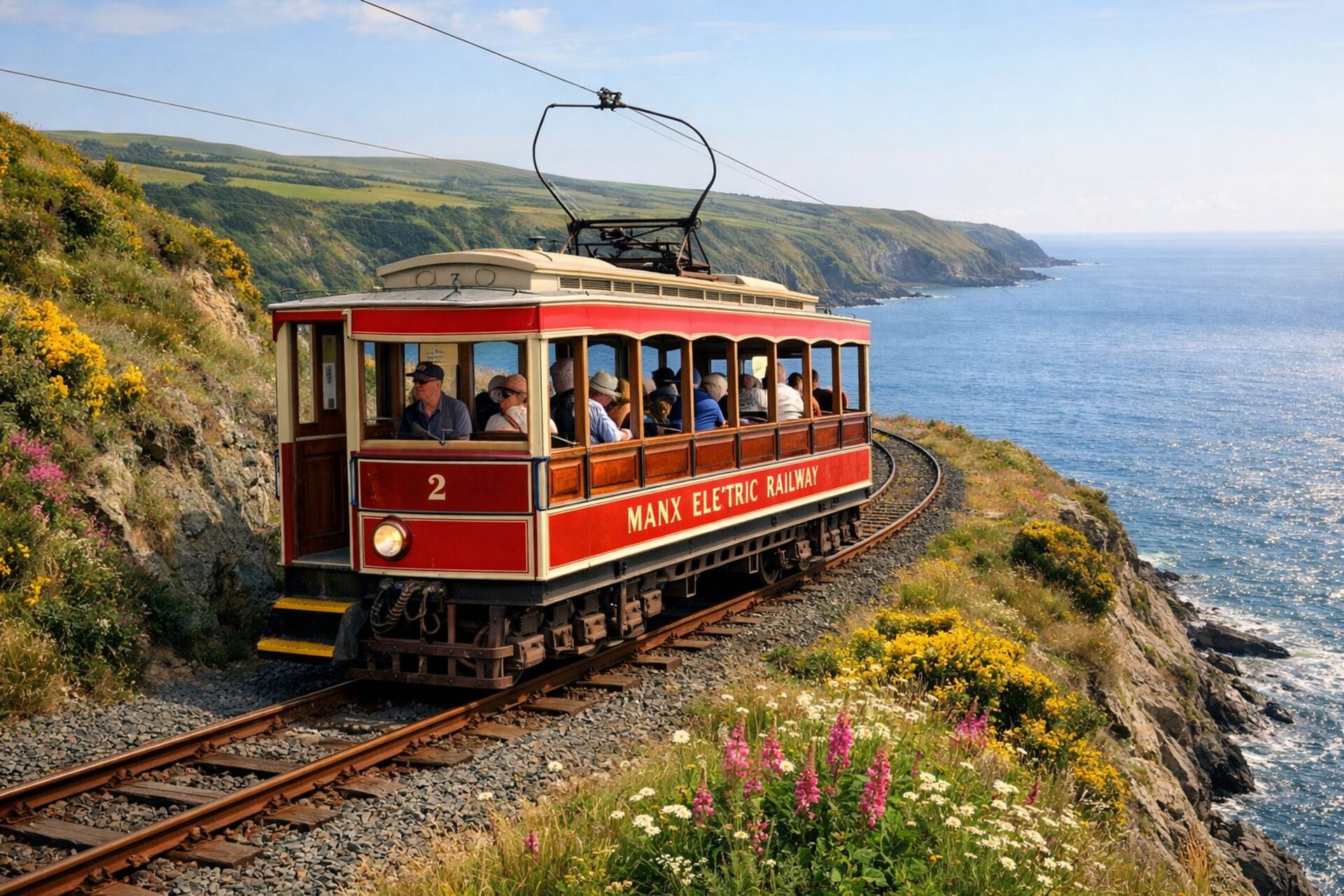
Manx Electric Railway
Opened 1893, running 28 km from Douglas along the cliffs through Laxey to Ramsey on 914 mm gauge. Wooden open-sided saloons, trailers, the original overhead. It carries commuters, schoolchildren and tourists indiscriminately, and the section around Bulgham Bay is one of the great coastal railway rides in Europe.
Snaefell Mountain Railway
Opened 1895, 8 km from Laxey to the 621 m summit on 1,067 mm gauge, with a Fell centre rail used only for braking. Six cars, all original 1895 bodies. It is the only mountain railway in the British Isles and the view at the top, on the right day, is the whole point of the island.
The steam railway
1874, 25 km from Douglas to Port Erin on 914 mm gauge, with the original locomotives and coaches — the surviving remnant of a network that once reached Peel and Ramsey. It runs through the southern farmland and is unhurried in a way that is now hard to find anywhere.
Douglas horse trams
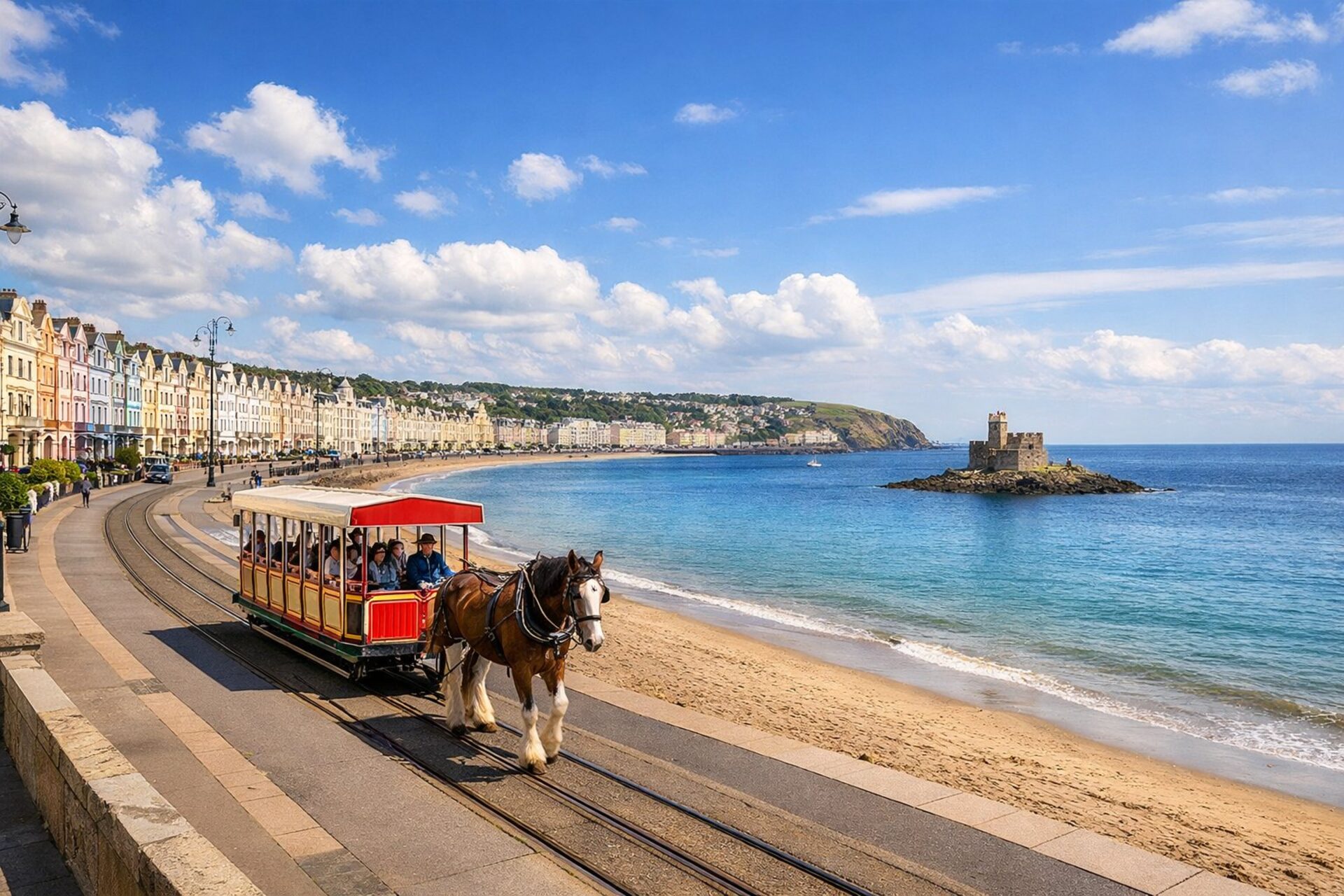
Running along the promenade since 1876 and the oldest surviving horse-drawn tramway in the world. The horses are Shires and Clydesdales, they work short shifts, and they retire to a home for retired tram horses at Richmond Hill which is exactly as Manx as it sounds. The line has been threatened repeatedly and saved every time by public feeling.
⚙️ The Laxey Wheel and the Mines
In the nineteenth century the Isle of Man was a serious mining district. The Great Laxey Mine was at one point among the largest producers of zinc ore in the world and also worked lead and silver, and the problem it had is the problem all deep mines have: water.
How it works
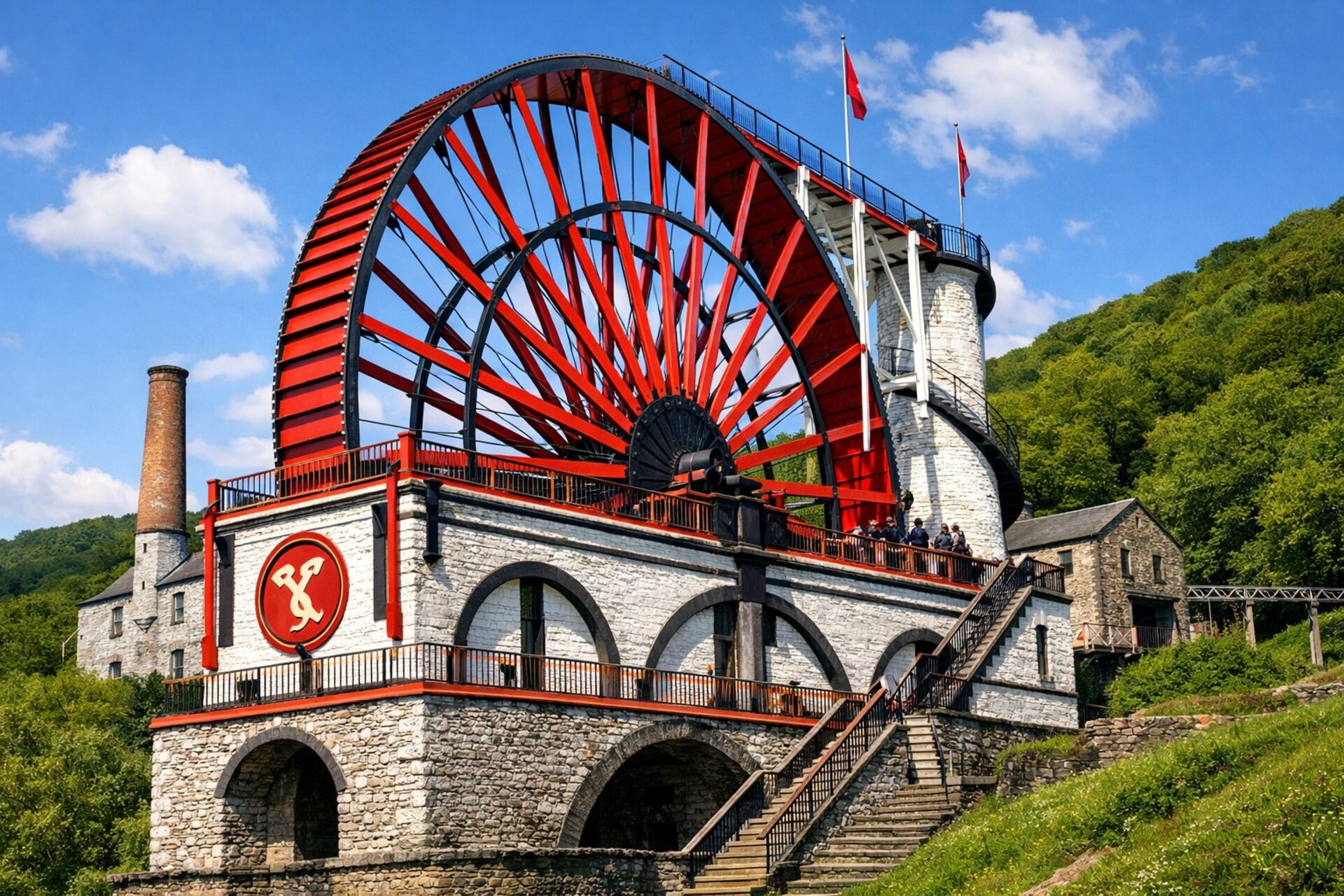
The wheel is pitchback: water gathered from the hillsides is brought by underground ducts to a masonry tower, rises by its own pressure to the top of the wheel and pours into the buckets on the near side. The wheel turns, and a 200-metre rod running on rockers along the hillside converts the rotation into a reciprocating stroke that worked pumps 460 m underground. It lifted about 1,140 litres a minute. There is no engine and never was one — it is entirely gravity, water and iron.
Climbing it
You can walk up the spiral staircase to the viewing platform at the top of the wheel, which is the point of the visit. You can also walk the restored rod duct along the hillside to the mine yard, and ride the Great Laxey Mine Railway, a 480 mm gauge line with two replica locomotives, into the valley. The whole complex is Manx National Heritage and is the island's most visited paid attraction.
The mines themselves
Laxey's shafts went to over 600 m and its workings were extensive enough that the miners' washing floors, the man-engine shaft and the rail tunnels survive. Mining collapsed at the end of the nineteenth century with the price of zinc and lead, and the island's second great extractive industry — the Foxdale lead mines in the centre — went the same way. There is a real and largely untold social history under the pretty red wheel.
Laxey village
Worth an afternoon in itself: the wheel, the mine railway, the woollen mills that still weave Manx tartan and tweed, the harbour, and the interchange where the Manx Electric Railway meets the Snaefell Mountain Railway — which means you can arrive by Victorian tram, go up a mountain by Victorian tram, and come back for the largest waterwheel on Earth, all in one day and all on the same ticket.
🎻 Music, Cregneash and What Survived
Manx traditional culture came within a generation of disappearing entirely and was saved, in large part, by people going round the island in the 1890s and again in the 1940s writing it down and recording it before the last carriers of it died.
The collectors
Dr John Clague, the Gill brothers and A. W. Moore collected several hundred Manx tunes and songs in the 1890s. In the 1940s the Irish Folklore Commission and later Yn Çheshaght Ghailckagh recorded the last native Manx speakers on disc and tape. Without those two efforts there would be no Manx music revival and no Manx language revival, because there would have been nothing to revive from.
The music now
A living session and festival scene, small but real: Yn Chruinnaght, the inter-Celtic festival at Peel every July, and a network of sessions in Peel, Douglas and Port Erin. The tunes are jigs, reels and hornpipes with a distinct Manx flavour, and the songs — Ellan Vannin, Mylecharaine, the carol tradition of the Oie'll Verrey — are sung. Dance was reconstructed from a handful of surviving descriptions and is now taught in schools.
Cregneash
A hill village near the southern tip preserved as a living folk museum — thatched crofts, a working farm with Loaghtan sheep, a smithy and a weaver's cottage — where the buildings are the ones that were there. It was one of the last strongholds of the Manx language, and Ned Maddrell, its last native speaker, was born here. It also stood in for its own reality in the 1935 film The Manxman era of documentary work.
Hop tu naa
The Manx Halloween, on 31 October, and a survival rather than an import: children carve lanterns from turnips rather than pumpkins — the older Celtic practice — and go round singing the Hop tu naa song, which is in Manx and is about Jinny the Witch. Turnip carving is genuinely harder than pumpkin carving, which Manx children will tell you at length.
🌿 An Entire Nation as a Biosphere
In 2016 UNESCO designated the whole Isle of Man — land, coast and territorial sea — as a Biosphere Reserve. It is the only entire jurisdiction in the world to hold that designation, everywhere else being a region within a country. It is a commitment rather than a protection, but it has driven real policy on marine reserves and land management.
The sea
The waters around the island are the good part. Basking sharks — the second largest fish in the world — gather off the south and west coasts in early summer in numbers that made this one of the first places they were seriously studied. Grey and common seals, bottlenose and Risso's dolphins, minke whales. The island has established several marine nature reserves, and the Ramsey Bay reserve has produced measurable recovery in scallop stocks — a rare piece of good fisheries news.
The birds
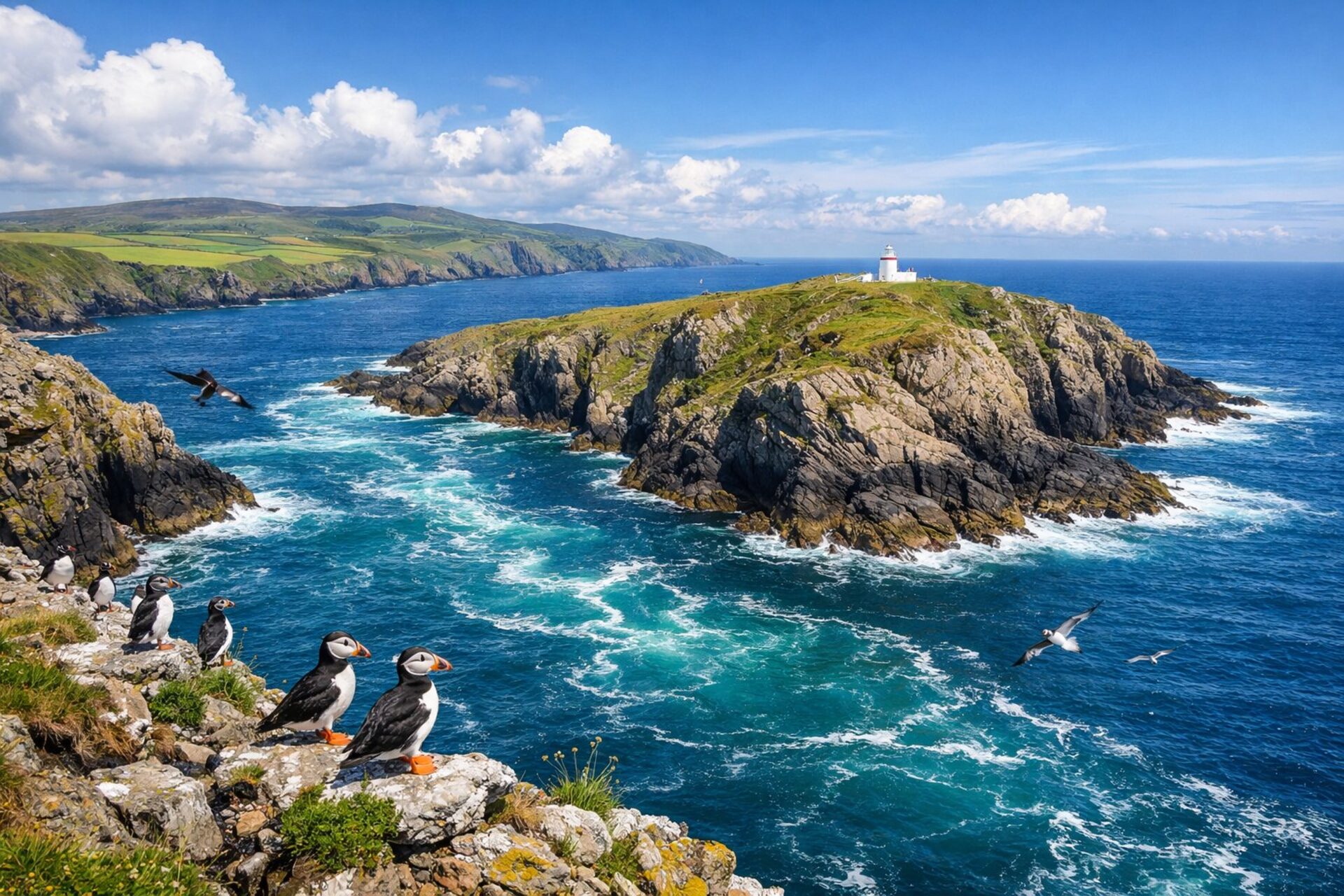
Choughs, the red-billed crow that is rare almost everywhere, are common here and are a genuine Manx speciality. Hen harriers roost in the Curraghs in internationally significant numbers. Puffins, razorbills, guillemots and kittiwakes on the Calf and the western cliffs. And the Manx shearwater, which is named after the island — the species was described from a colony on the Calf that was wiped out by rats in the seventeenth century and has now, after a rat eradication programme, begun to return.
What is missing and what was added
There are no snakes, no moles, no badgers, no foxes and no squirrels — the island was cut off early and stayed small. What it does have, entirely by accident, is a self-sustaining wild colony of red-necked wallabies in the Curraghs, descended from a pair that escaped the wildlife park around 1965 and now numbering in the hundreds. They are Australian, they are wild, and they are on an island in the Irish Sea.
The Manx cat and the Loaghtan
The Manx cat is tailless because of a genuine dominant mutation in a small island population; the gene is lethal when inherited from both parents, and cats carrying it can suffer serious spinal problems, which is why responsible breeding is a real welfare issue and not a curiosity. The Manx Loaghtan is a small dark-brown primitive sheep that commonly grows four horns and sometimes six; it nearly died out in the 1950s, has been brought back, and its meat is a protected Manx product.
👥 The People
Around 85,000 people, of whom roughly half were born off the island — mostly in England. That single figure explains a good deal about modern Manx society: it is prosperous, it is open, and it worries constantly and openly about whether it is still itself.
Manx and comeover
The vocabulary is precise and not entirely joking. A Manxman is born on the island. Someone who moved there is a comeover, sometimes for life; the children of comeovers are, in the old joke, stayovers. The word ghaa or the phrase when I came over is heard constantly. None of this is hostile — the island is genuinely welcoming — but the distinction is real and everyone knows where they stand in it.
Small-place life
Everyone knows everyone, which cuts both ways. Crime is very low and doors go unlocked in villages; anonymity is impossible and gossip is a functioning information system. Politics is personal rather than partisan, and a Member of the House of Keys represents a few thousand people and will be stopped in the supermarket about it. The island has one daily-ish newspaper, one commercial radio station and a very active set of Facebook groups, which between them constitute the public sphere.
Religion and institutions
Nominally Anglican through the Diocese of Sodor and Man — one of the oldest dioceses in the British Isles, whose name preserves the Norse Suðreyjar, the southern isles, i.e. the Hebrides it no longer contains. The Bishop of Sodor and Man sits in the Legislative Council, which makes the Isle of Man one of very few places where a bishop still has a legislative seat. Methodism was historically strong in the countryside and the chapels are everywhere.
Sport
The TT above everything. Beyond it, the island competes as its own nation at the Commonwealth Games and the Island Games — which it hosted in 2001 — and has produced athletes out of all proportion to its size: the cyclist Mark Cavendish, the most successful sprinter in Tour de France history with 35 stage wins, is from Douglas. Cammag, the old Manx stick-and-ball game related to Irish hurling and Scottish shinty, died out around 1900 and has been revived as an annual match at St John's.
🏛️ Douglas
The capital, about 27,000 people, wrapped around a two-kilometre sweep of bay. It is two towns overlaid: the Victorian seaside resort built for the Lancashire trade, and the modern financial centre that pays the bills. Both are visible from the promenade in a single glance.
The Manx Museum
The place to start, and it is free. Manx National Heritage's main museum covers the whole island story properly — the Neolithic, the cross slabs, the Pagan Lady of Peel's necklace, the Norse ship burials, the TT, the internment camps, the language. The national art gallery and the reading room are in the same building. Give it three hours.
The promenade
Two kilometres of Victorian terraces, the horse trams running along the front, and the Tower of Refuge on Conister Rock in the bay. At the north end is the terminus of the Manx Electric Railway; at the south, the harbour and the ferry terminal. The Gaiety Theatre, an 1900 Frank Matcham house restored to its original decoration, is one of the finest surviving Victorian theatres anywhere and gives backstage tours.
Around the town
The House of Keys and Tynwald's chambers, which can be visited. Onchan and the headland walks north. Marine Drive south along the cliffs to Douglas Head, which is a spectacular one-way road and walk. And the Great Union Camera Obscura on Douglas Head, an 1892 Victorian curiosity with eleven lenses, open in summer.
Eating and staying
A better food scene than 27,000 people would suggest, driven by the finance salaries: several genuinely good restaurants, a strong pub scene and good seafood. It is expensive — comparable to a prosperous English town rather than a cheap island — and during TT fortnight accommodation goes to several times normal and books out a year ahead.
🌅 Peel and the West
Peel is the island's third town, its fishing port and, for most visitors, the most likeable place on it: red sandstone, a working harbour, a beach, a castle on an island, and the sun going down into the Irish Sea.
Peel town
About 5,000 people. The castle on St Patrick's Isle across the causeway; the House of Manannan, a genuinely good interpretive museum of the Celtic, Viking and maritime island; the harbour and the kipper smokehouses; and the beach, which faces west and is the reason Peel is nicknamed the sunset city. Yn Chruinnaght, the inter-Celtic festival, is held here in July.
The kippers
Peel has smoked herring since the nineteenth century and Moore's Traditional Curers still does it over oak in the original smokehouse, which you can walk into. Manx kippers are undyed — the pale golden-brown colour is smoke, not the dye used in mass-market kippers — and they are posted worldwide. Whether you like kippers at all is a separate question, but these are the real thing.
Niarbyl and the west coast
Niarbyl, a headland of thatched cottages and a rocky tail running into the sea south of Peel, is the classic west-coast view and was the setting for the film Waking Ned Devine. The geology here is internationally significant: the Iapetus Suture, the join where two ancient continents collided and the ocean between them closed, comes ashore at Niarbyl and you can put a hand on both sides of it.
St John's and Tynwald Hill
Inland from Peel, the ceremonial centre of the island: Tynwald Hill, the Royal Chapel, the arboretum, and the Bunscoill Ghaelgagh, the Manx-language school. On any day but 5 July it is a quiet field with a stepped mound in it, which is somehow more impressive than it would be otherwise.
🏰 Castletown and the South
The southern quarter has the island's best-preserved castle, its oldest town, its limestone coast and its wildest headland, and it is the part most visitors underuse.
Castletown
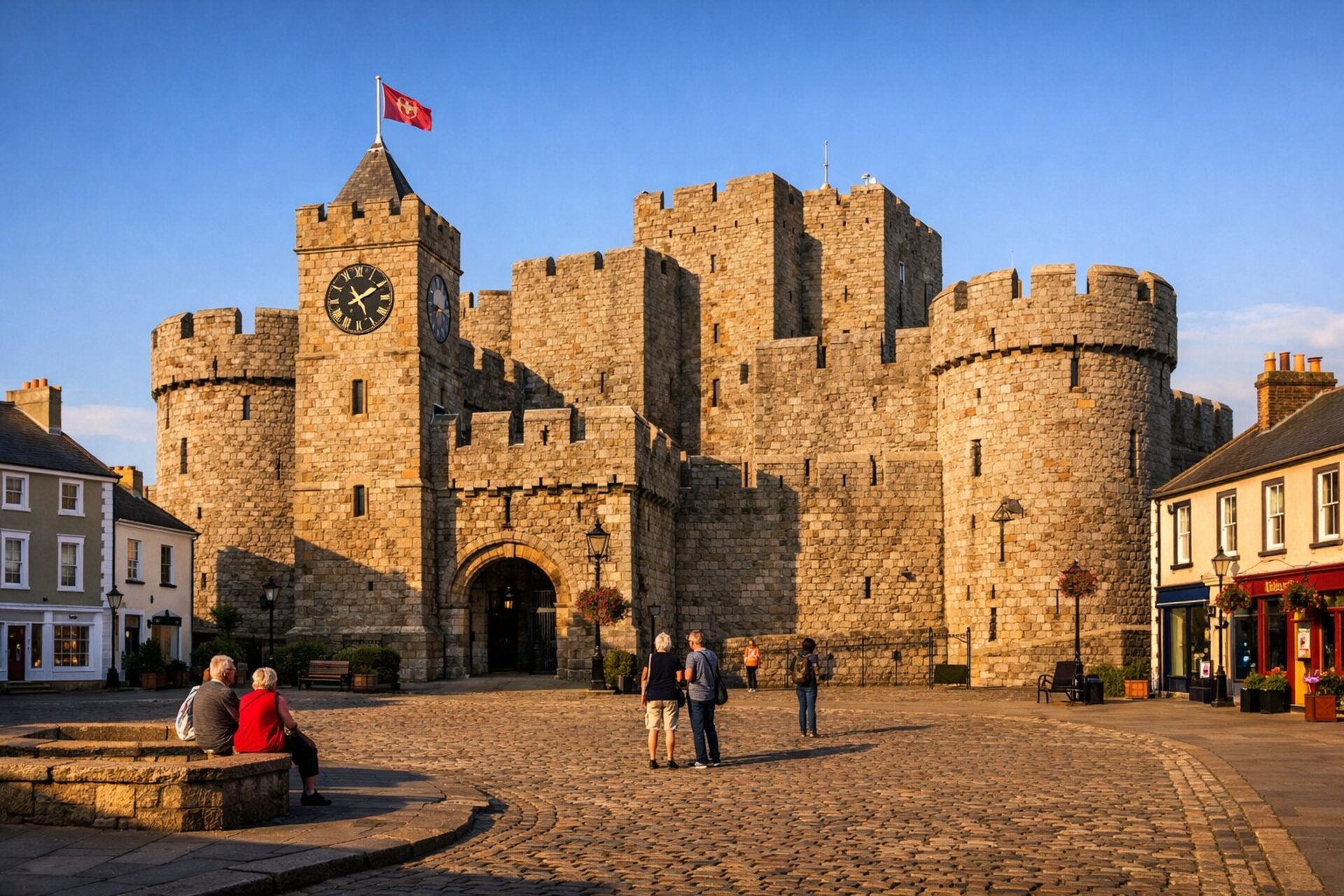
The capital until 1869, and it still looks it: a small grey limestone town round a harbour with the castle in the middle of it. The Old House of Keys, restored to its 1866 appearance, runs a re-enactment of a sitting that is much better than it sounds, and the Nautical Museum holds the Peggy, an armed yacht of 1789 found bricked up in a cellar in 1935 and one of the oldest surviving vessels of her kind in the world.
Port Erin and Port St Mary
Two small resort towns at the southern tip, sharing a sheltered bay and a beach each. Port Erin is the terminus of the steam railway and has a railway museum; boats to the Calf of Man leave from both in summer. The walk between them over the headland is short and good.
Cregneash and the Sound
The folk village on the hill, and then the road ends at the Sound, looking across the tide race to the Calf. There is a café built into the hillside with a view that justifies the drive on its own, and seals on the rocks below almost every day. This is the corner of the island where Manx was last spoken as an ordinary language.
The Chasms and the coast
East of the Sound the cliffs are cut by the Chasms — deep vertical fissures in the rock, some of them metres wide and unfenced — with the Sugarloaf stack offshore. It is a genuinely dangerous place in poor visibility and a spectacular one otherwise. The coastal path from Port St Mary round to Port Erin takes about four hours and is the best day's walking on the island.
🌾 Ramsey, the North and the Glens
North of Snaefell the island changes: the hills stop, the land flattens into farmland, and the coast becomes shingle and dune. It is the quietest quarter and it has the beaches.
Ramsey
The second town, about 8,000 people, on a wide bay with a long sandy beach and the Queen's Pier, an 1886 iron pier under long restoration. It is the northern terminus of the Manx Electric Railway, which is much the best way to arrive. Milntown, a house and garden just outside, is worth an afternoon.
The Ayres and Point of Ayre
The northern tip: a shingle and heath coast of a kind found almost nowhere else in the region, a national nature reserve with rare lichens and breeding terns, and the Point of Ayre lighthouse of 1818, built by Robert Stevenson — grandfather of the novelist. The beach here is enormous and usually empty and you can see Scotland.
The Curraghs
The willow wetland behind the Ayres: a national nature reserve of international importance for its hen harrier roost, and next to it the Curraghs Wildlife Park, from which the wallabies escaped and around which they now live wild. Boardwalks let you into the wetland proper.
The glens and Maughold
Ballaglass, Dhoon and Glen Mona run down to the sea on the east coast and all are reachable by the Manx Electric Railway, which means you can ride to one, walk down it, and pick the tram up again. Maughold, on its headland, has the best of the island's cross slabs in a shelter in the churchyard, a well, a lighthouse and one of the finest coastal views on Man.
🍽️ Food
Manx food is British island food with a strong maritime bias and two or three things that are genuinely its own. The raw materials are excellent — the sea, the sheep and the dairy — and the island has spent the last twenty years getting much better at doing something with them.
Queenies
The island's flagship product: queen scallops, Aequipecten opercularis, smaller and sweeter than the king scallop, dredged and increasingly hand-dived in Manx waters. Manx Queenies hold PDO protected status — the first Manx product to do so — and the standard preparation is three minutes in a hot pan with butter, garlic and bacon, and nothing else. There is a Queenie Festival in Port St Mary in July.
Kippers
Herring split, brined and cold-smoked over oak — the Manx ones undyed, so pale gold rather than the mahogany of the dyed mass-market kipper. Peel has been doing it since the 1860s. Eaten at breakfast, grilled or poached, with brown bread and butter. The Manx herring fishery that supported it collapsed in the twentieth century and most of the fish is now brought in, which the smokehouses will tell you if you ask.
Loaghtan and the land
Manx Loaghtan lamb and hogget — dark, lean, slightly gamey meat from the four-horned native sheep, a protected product and worth ordering where you see it. Manx cheddar and Manx butter from an island dairy herd. Spuds and herrin', potatoes boiled in their skins with salt herring, is the historic national dish and is honest peasant food rather than restaurant food.
Bonnag and the sweet end
Bonnag is Manx soda bread — a heavy, slightly sweet round loaf leavened with bicarbonate and buttermilk, usually with dried fruit, sliced thick and buttered. Every family has a version and there is a competition at the agricultural shows. Also Manx broth, a long-cooked beef, barley and root soup, and the local ice cream and fudge, which the island produces in quantity.
🍺 Okells, Whiskey and the Fairy Bridge
Okells
The island brewery, founded 1850 by Dr William Okell and still brewing in Douglas. It is subject to the Manx Beer Purity Act of 1874 — the island's own reinheitsgebot, passed by Tynwald, restricting beer to malt, sugar, hops and water — which is why Okells Bitter tastes the way it does and why the island has a genuine claim to a beer-purity tradition of its own. Bushy's is the other and smaller brewery and is the one with the TT reputation.
Manx spirits
Fynoderee makes gin on the island with foraged Manx botanicals and has become the visible local brand. There is now a working Manx whiskey distillery, which after a long gap makes the island a whiskey producer again. Manx Spirit — a spirit re-distilled on the island — is the older and stranger product and is a genuine curiosity of excise law.
Pubs
Ordinary British pub culture with Manx particulars. Licensing is Manx rather than UK. The pubs to know are the old ones in Peel and Castletown and the Creg-ny-Baa on the Mountain Road, which is a landmark of the TT course and is packed to the walls in race week and pleasantly empty the rest of the year. The Raven at Ballaugh sits beside the bridge the bikes jump.
The Fairy Bridge
Not a drink, but it goes with the journey. On the main A5 between Douglas and Castletown there is a small stone bridge where everyone says hello to the fairies as they cross. There are ribbons and notes tied to the trees beside it. Ask a Manx driver whether they do it and they will tell you they do not believe in it, and then say it anyway.
🐚 Recipe: Manx Queenies
🚫 The supplied photograph for this recipe has been left out. It showed a plate of flat fried batter pancakes flecked with chopped herbs, with salad and a pair of chopsticks. Queenies are scallops. There was not one in the picture, and nothing about it was Manx. Better no image than one that shows a different dish from a different continent.
The island's signature dish, and the shortest recipe on this site. The whole art of it is not overcooking them: a queen scallop is small, and the difference between perfect and rubber is about forty seconds.
Manx Queenies with Bacon and Garlic
Queen scallops in butter · serves 2 as a starter · 10 min
Ingredients: 400 g queen scallops, cleaned, roe on or off to taste — king scallops sliced in half work but are not the same thing; 4 rashers of streaky bacon, cut into lardons; 40 g butter; 2 fat cloves of garlic, finely sliced not crushed; a splash of dry white wine or dry cider; a good squeeze of lemon; a handful of parsley, chopped; black pepper. To serve: bonnag or brown bread, and more butter.
Method: Dry the scallops thoroughly on kitchen paper — wet scallops steam instead of colouring, and this is the step people skip. Fry the bacon in a wide heavy pan until the fat runs and it starts to crisp, and lift it out. Turn the heat to high, add the butter, and when it foams put the scallops in in one layer with space between them, working in two batches if you have to. Leave them alone for 45–60 seconds until the underside is golden, turn them, add the garlic, and give them another 30–45 seconds only. Return the bacon, splash in the wine and let it hiss away, then off the heat with the lemon, the parsley and plenty of pepper. Serve immediately with bread to get the pan juices.
💡 Ninety seconds is the whole cooking time and it is not an approximation. If they are still translucent in the middle when they come out they will finish on the way to the table; if they are opaque and firm in the pan they are already too late. On the island this is eaten with a pint of Okells and no ceremony at all.
🍞 Recipe: Bonnag
🚫 This recipe's photograph has also been left out. The file named for bonnag showed seared pieces of meat in a jus with yellow vegetables on a restaurant plate. Bonnag is a loaf of bread. The two things have nothing whatever in common, and captioning a plate of meat as Manx soda bread would be worse than showing nothing.
The Manx household bread: a soda-leavened fruit loaf that takes ten minutes to make and needs no yeast, no proving and no skill. Every Manx family has a recipe and every one of them is the correct one.
Bonnag
Manx fruit soda bread · one loaf · 10 min + 45 min
Ingredients: 450 g plain flour; 1 tsp bicarbonate of soda, sieved; 1 tsp cream of tartar (or use 2 tsp baking powder in place of both); ½ tsp salt; 75 g cold butter, cubed; 75 g sugar; 150 g mixed dried fruit — sultanas, currants and raisins, and a little mixed peel if you like; about 300 ml buttermilk (or milk soured with a tablespoon of lemon juice); 1 egg, beaten, optional, for a richer loaf.
Method: Heat the oven to 190 °C. Sift the flour with the soda, cream of tartar and salt, then rub in the butter with your fingertips until it looks like coarse breadcrumbs. Stir in the sugar and the dried fruit. Make a well, pour in most of the buttermilk and the egg if using, and bring it together quickly and lightly with a knife or one hand — the dough should be soft and just short of sticky, and the less you work it the better the loaf. Turn out onto a floured board, shape into a round about 5 cm deep, put it on a floured tray and cut a cross most of the way through. Bake 40–45 minutes until it is well browned and sounds hollow underneath. Cool on a rack.
💡 It goes stale fast, which is why it is made in small quantities and eaten the same day, sliced thick, with salted Manx butter and a mug of tea. Day-old bonnag toasts well. There is a plain version without fruit or sugar that is eaten with cheese, and a treacle version that is darker and stickier — both are equally traditional and Manx families will argue about which is the real one.
✈️ Getting There
The island is reachable by air from about a dozen airports in Britain and Ireland and by ferry from four ports. There is no direct connection from anywhere in continental Europe, and there never has been, so from Prague this is always a two-leg journey.
Flying
Isle of Man Airport (IOM) at Ronaldsway in the south, 15 km from Douglas. Routes to London (Gatwick, Heathrow, City, Luton), Manchester, Liverpool, Birmingham, Bristol, Belfast, Dublin, Edinburgh and Glasgow, mostly on Loganair, easyJet and Aer Lingus Regional. Flight time from Manchester or Liverpool is about 45 minutes. Fog cancels flights with some regularity — build a buffer day at the end of any trip with a fixed onward connection.
The ferry
The Isle of Man Steam Packet Company, founded in 1830 and the oldest continuously operating passenger shipping company in the world, sails to Douglas from Heysham (3 h 45) and Liverpool (2 h 45 by fast craft), and seasonally from Belfast and Dublin. It is the way to bring a car or a motorcycle, and during TT fortnight it is booked out many months in advance.
From Prague, in practice
Fly Prague to Manchester, London, Liverpool or Dublin and connect. Manchester is usually the cleanest: direct from Prague, then a 45-minute hop, and if the connection fails you can drive to Heysham for the boat. Total journey 6–9 hours door to door. Reckon on 5,000–9,000 Kč return for the whole thing outside TT, and considerably more inside it. Note that a UK connection means clearing UK border control on the way through.
On arrival
Buses meet flights and ferries and go to Douglas. Taxis exist and are not cheap. Car hire is available at the airport and is worth it for the glens and the west, though the bus and railway network covers most of what visitors want. Note again: the Mountain Road has no speed limit and rental agreements sometimes have things to say about it.
📋 Practical Information
⚠️ Two things that catch European visitors out, and both are new or counter-intuitive. Since 23 April 2026 EU citizens including Czechs need an ETA to enter, and it is not free. And the European Health Insurance Card does not work here — the island is outside the EU and its reciprocal health agreement is with the United Kingdom only. Both are covered below. Checked 6 September 2026.
Entry and the ETA
The Isle of Man launched its own Electronic Travel Authorisation scheme on 9 April 2026 and began full enforcement on 23 April 2026. Czech citizens, like all EU nationals, now need one for stays of up to six months. It costs £20, is valid two years or until the passport expires, and is applied for online at gov.uk or through the UK ETA app. ETAs issued by the UK, Jersey, Guernsey and the Isle of Man are mutually recognised, so one covers all four. You need a passport — a Czech ID card is not enough. Arrivals from within the Common Travel Area face no routine border control, but you still need to hold the ETA.
Health — read this
The EHIC and the Czech EU card are not valid on the Isle of Man. The island is not in the EU and its reciprocal healthcare agreement covers UK residents only. An EU visitor who needs treatment will be charged in full, and there is no ambiguity about it — the Manx government publishes a leaflet whose title is essentially "make sure you're covered". Take commercial travel insurance and make sure the policy names the Isle of Man rather than assuming it falls under either the EU or the UK. Emergency number 999 or 112. There is one general hospital, Noble's, near Douglas; anything complex is flown to Liverpool.
Money and costs
The Manx pound at parity with sterling; UK notes and coins are used interchangeably. Manx money is not legal tender in the UK, so spend it before you go. Costs are broadly British and towards the higher end: pub main 380–550 Kč, restaurant main 600–900 Kč, pint 150–180 Kč, a mid-range hotel double 3,000–4,500 Kč — and several times all of that during TT fortnight. Cards everywhere; contactless universal. There is a Go Explore travel card that covers all the buses and heritage railways and is very good value.
Practicalities
Plugs are British type G, three rectangular pins, 230 V — you need an adapter and it is not the European one. Mobile roaming: the Isle of Man is outside EU roaming rules and outside UK domestic tariffs, so a Czech SIM may charge international rates and a UK SIM may too. Check before you land; this catches people out with real bills. Driving is on the left. Tipping is British: 10% in restaurants, nothing in pubs. The island is very safe and the main hazards are the roads, the cliffs and the weather.
For Czech travellers: there is no Czech consular presence on the island; consular matters are handled by the Czech Embassy in London. MZV ČR issues no warning beyond ordinary caution. Register in DROZD if you are walking the coastal path or going out on boats. And note that because the island is neither the EU nor quite the UK, the reflex assumptions a Czech traveller carries about both — health cover, roaming, ID cards — are wrong here in three separate ways, which is the single most useful thing on this page.
❓ Misconceptions
"It's part of the UK."
It is not, and never has been. It is a Crown Dependency — a self-governing possession of the Crown with its own parliament, laws, courts, taxes, health service and currency. The UK handles defence and most foreign representation. There are no Manx MPs at Westminster and no UK laws apply automatically. The same is true of Jersey and Guernsey, and none of the three is in the United Kingdom.
"It left the EU with Brexit."
It was never in the EU. Under Protocol 3 it was inside the customs union for goods and outside everything else — no free movement, no CAP, no EU funds, no European elections. Brexit changed the legal plumbing and did not change the island's membership status, because there was none to change.
"Tynwald is a ceremonial survival."
It is the working legislature, sitting monthly, passing the island's laws and holding its government to account. The open-air ceremony on 5 July is not a re-enactment either: an act that is not promulgated aloud at Tynwald within eighteen months ceases to have effect. It is a real legal requirement dressed in a thousand-year-old ritual.
"Manx is a dialect of English."
It is a Celtic language, Goidelic branch, a sister of Irish and Scottish Gaelic and mutually intelligible with neither easily. The confusion arises because it is written in an English-based spelling system — Ellan Vannin rather than the Irish-style spelling — so it looks less foreign on the page than it sounds in the mouth.
"Manx cats are just cats with docked tails."
The taillessness is a genuine dominant mutation in a small closed island population. It is also a serious matter: the gene is lethal in homozygous form, so kittens inheriting it from both parents do not survive, and cats carrying it can have spinal and bowel problems. Responsible breeders always cross tailless with tailed. This is a welfare issue rather than a novelty.
"The TT is just a bike race."
It is run on public roads with stone walls and houses at the edge, at average speeds over 217 km/h, and has killed more than 270 people. No governing body would sanction a course like it today; it exists because it predates the rules and because Tynwald can legislate to close its own roads. Treat it as what it is — an extraordinary and genuinely lethal event — rather than as a motorsport weekend.
✍️ Author's Note
The Isle of Man is the best argument I know against judging a place by its size. Five hundred and seventy-two square kilometres contains a parliament older than any other still sitting, a language that came back from being officially extinct, the largest working waterwheel on Earth, the oldest electric tramcars still in service, the oldest horse tramway, the oldest passenger shipping company, and the most dangerous sporting event in the world. Any one of those would carry a country ten times the size.
What a visitor should actually do with it: slow down and use the trams. The temptation on a small island is to hire a car and see everything in two days, and it works, and it is much worse than the alternative. The Manx Electric Railway to Laxey, the mountain line to the summit, the steam train to Port Erin and the coastal path in between is a week that is genuinely unlike a week anywhere else, and the island was built for exactly that pace. Traa dy liooar — time enough.
One thing that deserves saying plainly and is easy to skate over: the island's prosperity rests on a finance industry whose ethics are argued about, and the argument is a real one with substance on both sides. The page states the island's position and its critics' position and does not resolve it, because it is not resolvable from a travel page. It is worth knowing that the money that restored the Gaiety Theatre and keeps the horse trams running comes from somewhere.
On the images
This is a small set — nine files — and unusually accurate for it. The Tynwald Day photograph is close to flawless, down to the rushes on the processional way. The Laxey Wheel, Peel Castle, Douglas promenade with its horse tram and Tower of Refuge, the Manx Electric Railway car, the Snaefell descent and the Calf of Man with its puffins are all right in substance. Where lettering appears it is generated nonsense — the tramcar says "ELE'TRIC" — and one detail is wrong and checkable: the clock on Castle Rushen has a single hand in reality and two in the picture.
One image was left out. The file named 01-hero is a second attempt at the Laxey Wheel and gets the defining features wrong: no masonry tower, no spiral staircase, no aqueduct pillar, wrong colour, and set on an open hillside rather than in the wooded glen where the wheel actually stands. Since the set already contains an accurate photograph of the same subject, the page uses that one and drops this.
Both recipe images were left out as well, and these were not close calls. The file named for queenies showed fried batter pancakes with chopsticks and contained no scallop of any kind. The file named for bonnag showed seared meat in a jus, where bonnag is a fruit loaf. In both cases the picture would have told a reader something flatly untrue about the dish, so the recipes run without images and say why. It is also worth noting what is missing from the set entirely: there is no photograph of the TT, which is the single thing the island is best known for.
Support This Project 🌍
This World Travel Factbook is a labor of love – free to use for all travelers. If you find it helpful, consider supporting its continued development.