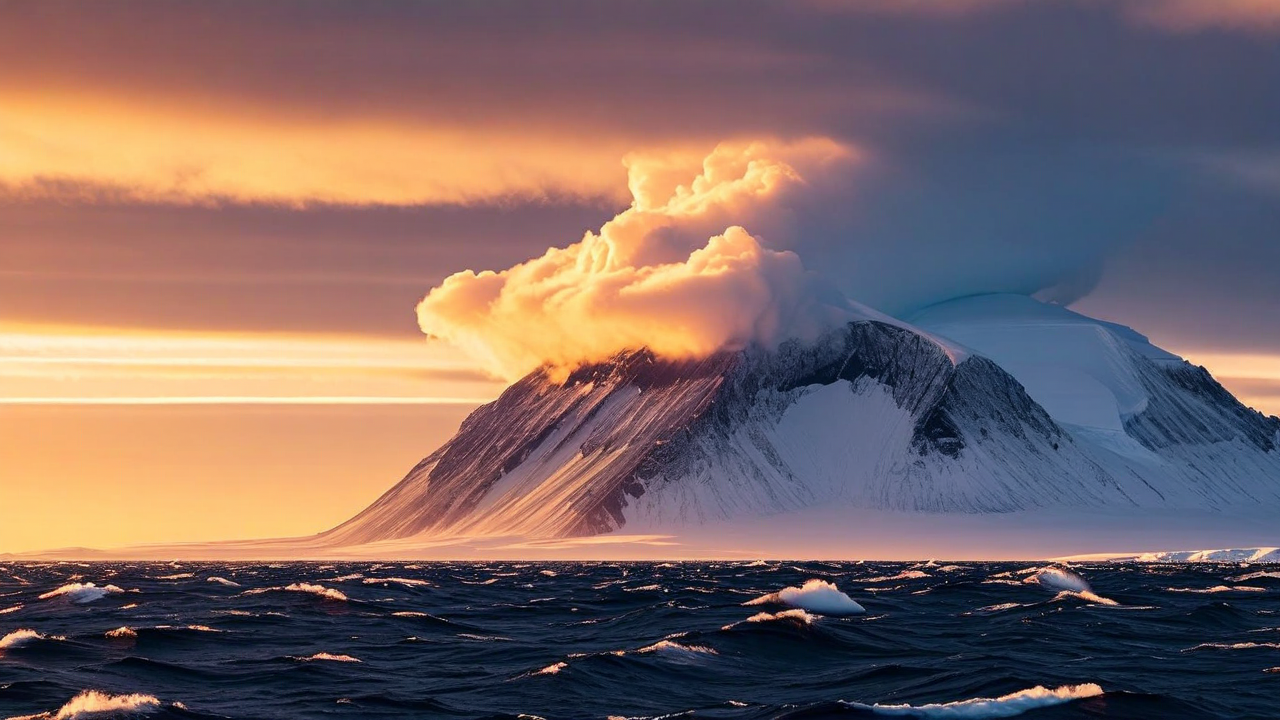



🌍 Jan Mayen at a Glance
🌋 Overview
Jan Mayen is one of the world's most isolated volcanic islands — a 55-kilometer sliver of rock and ice rising from the Norwegian Sea, roughly 600 kilometers north of Iceland and 1,000 kilometers east of Greenland. The island is dominated by Beerenberg (2,277 m), the northernmost active subglacial volcano on Earth, whose glaciers tumble directly into the Arctic Ocean. There are no permanent civilian inhabitants; the only residents are approximately 18 Norwegian military and meteorological personnel stationed at the Olonkinbyen settlement on the island's southern tip.
Part of the Kingdom of Norway since 1929 and administered by the county governor of Nordland, Jan Mayen occupies one of the most strategically important positions in the North Atlantic. The island served as a critical weather station during World War II and later housed a LORAN-C navigation station until 2015. Today it remains significant for weather forecasting, seismological monitoring, and Arctic research. Tourism is virtually nonexistent — reaching Jan Mayen requires either a military supply flight or a multi-day voyage through some of the roughest waters in the North Atlantic.

Beerenberg Unveiled
On rare clear days, the full majesty of Beerenberg (2,277 m) is revealed — its glaciated flanks plunging into the Arctic Ocean.
🗺️ Geography & Geology
Jan Mayen stretches 55 kilometers from northeast to southwest but is only 2.5 kilometers wide at its narrowest point, where a low-lying isthmus connects the island's two distinct halves. The northern section, Nord-Jan, is dominated entirely by the Beerenberg stratovolcano and its massive glacial system — the volcano's ice cap covers approximately 115 km² and feeds numerous glaciers that reach the sea. The southern section, Sør-Jan, is a plateau of older volcanic terrain rising to about 769 meters at Rudolftoppen.
Beerenberg last erupted in 1985, following a major eruption in 1970 that produced lava flows reaching the sea on the northeast coast. The volcano sits atop the Mid-Atlantic Ridge where the North American and Eurasian tectonic plates diverge, making it one of the most volcanologically significant sites in the Arctic. The surrounding waters are extraordinarily deep — the ocean floor drops to over 2,000 meters just kilometers from shore. The climate is harsh but moderated by the Gulf Stream: average temperatures range from -6°C in February to 5°C in August, with fog and strong winds dominating throughout the year.

Arctic Shoreline
The dramatic volcanic coastline of Jan Mayen, shaped by centuries of eruptions, glacial erosion, and relentless North Atlantic storms.
📜 History
Jan Mayen's human history is surprisingly rich for such a remote place. The island was likely known to Irish monks and Norse sailors in the medieval period, but its "official" discovery is attributed to Dutch whaling captain Jan Jacobszoon May van Schellinkhout, who charted it in 1614. Throughout the 17th century, Jan Mayen became a hub of Dutch and Basque whaling operations — at its peak, several hundred men would overwinter in crude shelters along the coast, boiling blubber in try-works along the beaches. The remains of these whaling stations can still be seen today.
Austria-Hungary established a scientific station during the First International Polar Year (1882–1883), producing the first detailed maps and meteorological records. Norway began continuous weather observations in 1921 and formally annexed the island in 1929. During World War II, Jan Mayen became strategically vital: Norwegian and Allied forces maintained the weather station despite German attempts to establish their own presence, and the island's meteorological data proved crucial for planning D-Day and other operations. The Cold War brought a LORAN-C navigation station, operated until its decommissioning in 2015.
🦅 Wildlife & Nature
Despite its harsh environment, Jan Mayen supports remarkable wildlife. The island is home to one of the world's largest colonies of northern fulmars, estimated at over 100,000 breeding pairs. Little auks, Brünnich's guillemots, Atlantic puffins, and glaucous gulls nest along the coastal cliffs. Arctic foxes — the island's only native land mammal — patrol the beaches year-round, surviving on seabird eggs, fish, and marine invertebrates.
The surrounding waters are among the most productive in the North Atlantic. The Jan Mayen Exclusive Economic Zone covers approximately 293,000 km² and supports significant populations of cod, haddock, shrimp, and other commercially valuable species. Blue whales, fin whales, and humpback whales feed in the nutrient-rich upwelling zones near the island, and the area is increasingly recognized as an important marine biodiversity hotspot as Arctic waters warm.

Olonkinbyen
The Norwegian station at Olonkinbyen — Jan Mayen's only settlement, home to about 18 personnel who maintain weather and military operations year-round.
🏠 Life at the Station
Olonkinbyen ("Olonkin City") is Jan Mayen's sole settlement — a cluster of buildings on the flat southern tip of the island housing the Norwegian Armed Forces and the Norwegian Meteorological Institute. The roughly 18 personnel rotate on four-month or one-year tours, maintaining weather observations, seismological equipment, and military communications. The station has a small gym, sauna, library, and even a bar — essential amenities for maintaining morale during the long polar nights.
Resupply comes by ship approximately four times per year and by occasional military cargo flights using the island's gravel airstrip (IATA code: ZXB). There is no public access to Jan Mayen — visitors require permission from the Norwegian Armed Forces. The rare civilian visitors are typically scientists, journalists, or amateur radio operators mounting DXpeditions (Jan Mayen is one of the rarest "entities" in amateur radio, making contacts from the island highly prized by operators worldwide).
🍷 Wine, Spirits & Drinking Culture
Jan Mayen has no wine production and no permanent civilian population. The remote Norwegian volcanic island in the Arctic Ocean — dominated by the Beerenberg volcano (the world's northernmost active volcano) — hosts only a Norwegian meteorological station with a rotating crew of approximately 18 people. Any alcohol consumed is brought by supply ships.
✍️ Author's Note Radim Kaufmann
Jan Mayen is so remote, so volcanic, so Arctic, that its very name sounds like an invention. The 18 meteorologists who staff the weather station through the polar winter have one of the loneliest drinking experiences on Earth, sharing whatever the supply ship brought with the northern lights as their only company.
📋 Visiting Information
Jan Mayen is not a tourist destination in any conventional sense. There are no commercial flights, no hotels, no infrastructure for visitors, and no scheduled transport. Access requires either a berth on one of the Norwegian military or Coast Guard supply vessels (extremely difficult to arrange) or a private expedition vessel willing to make the multi-day crossing from Iceland, Svalbard, or mainland Norway through frequently violent seas.
That said, a handful of expedition cruise companies occasionally include Jan Mayen as a stop on Arctic itineraries between Iceland and Svalbard. These visits are entirely weather-dependent — landing is only possible in calm conditions on specific beaches, and Beerenberg is more often than not shrouded in cloud and fog. For those who do manage to land, the experience is extraordinary: standing on volcanic black sand beneath a glacier-capped volcano, surrounded by wheeling fulmars, with no other humans for hundreds of kilometers in any direction.
📸 Gallery

Beerenberg volcano from sea

Beerenberg close-up

Beerenberg and glacier valley

Beerenberg glacier

Jan Mayen island view

Jan Mayen sign
Jan Mayen coast
Meteorological station
Map of Jan Mayen
✍️ Author's Note
Jan Mayen occupies a special place in my imagination — not because I've been there (I haven't), but because it represents the kind of place that makes you realize just how vast and varied this planet still is. A volcanic island with a glacier-capped peak rising from the Arctic Ocean, staffed by 18 Norwegians who spend their days measuring the weather and their evenings in the world's most remote bar.
What strikes me most about Jan Mayen is its role in history. This tiny, fog-bound island helped win World War II — its weather reports were essential for planning the D-Day landings. It reminds us that sometimes the most consequential places are the ones nobody has heard of. If you ever get the chance to join an expedition cruise that stops here, take it. You may never see Beerenberg through the clouds, but you'll know it's there — and that knowledge alone is worth the voyage.
— Radim Kaufmann, Kaufmann World Travel Factbook
Support This Project 🌍
This World Travel Factbook is a labor of love – free to use for all travelers.
