

🇰🇼 Kuwait at a Glance
🌍 Overview
Kuwait is 17,818 km² — about a quarter of the Czech Republic, or roughly Moravia — at the head of the Arabian Gulf, wedged between Iraq and Saudi Arabia. It has around 4.9 million people, of whom close to 70% are foreign nationals, and it sits on something like 6–7% of the world's proven oil reserves in a country you can cross in two hours.
It is also the Gulf state that outsiders understand least. Kuwait had an elected parliament with real teeth decades before its neighbours had anything of the sort, it has the region's oldest and liveliest press, and it never turned itself into a tourist product the way Dubai and Doha did. Then in May 2024 the Emir dissolved that parliament and suspended parts of the constitution for up to four years, and the story of Kuwait right now is what happens next.
The state
A constitutional emirate under the Al Sabah family, ruling since the eighteenth century. The 1962 constitution is the most liberal in the Gulf on paper. Since 10 May 2024 the National Assembly has been dissolved and seven constitutional articles suspended for a period not exceeding four years, with the Emir and cabinet exercising legislative power. Sheikh Meshal Al-Ahmad Al-Jaber Al-Sabah has been Emir since December 2023. See the politics section.
The people
Around 4.9 million, and the composition is the single most important social fact: roughly 1.5 million citizens and some 3.4 million foreign residents — Indians, Egyptians, Bangladeshis, Filipinos, Syrians, Pakistanis and others, on employer-tied residency that confers no path to citizenship. Alongside them the bidoon, a long-standing stateless population, and since 2024 a rapidly growing number of people whose citizenship has been revoked.
The economy
Oil, and then oil. Hydrocarbons supply around 90% of export earnings and government revenue, the Burgan field is one of the largest ever found, and the Kuwait Investment Authority — founded in 1953, the world's oldest sovereign wealth fund — holds several hundred billion dollars against the day the oil stops mattering. Diversification has been talked about since the 1980s and delivered slowly; the budget has been running large deficits on paper for years.
What visiting is like
Underrated, uncomplicated and not designed for you. Kuwait gets a fraction of the leisure visitors its neighbours do, has no beach-resort industry and no alcohol whatsoever, and is genuinely hot beyond what most Europeans have experienced. What it has instead is an excellent museum and cultural scene, the best food in the Gulf by a margin many will defend, a real old souq, and a society that has not been rearranged for tourists.
🏷️ The Name and the Fort
Kuwait is a diminutive: from kūt, a fort or a house built near water — so al-Kuwayt is "the little fort". The fort in question was built in the early eighteenth century on the bay by the Bani Khalid, and the settlement that grew around it took its name from the building.
The Utub and the Al Sabah
In the early 1700s a group of families of the Utub confederation, migrating from central Arabia, settled at the fort. They divided responsibilities in a way that shaped everything since: the Al Sabah took government, the Al Khalifa took trade and later left to found the ruling house of Bahrain, and the Al Jalahma took the sea. Sabah I was chosen as ruler around 1752, and his family has ruled ever since — one of the longest continuous dynasties in the Arab world.
The bay
Kuwait exists because of Kuwait Bay, a deep natural harbour on a coast that has almost none. That single geographical fact made it a port for the caravan trade to Aleppo and Baghdad, a shipbuilding centre, and the base for a pearling and long-distance dhow fleet that reached India and East Africa. Everything about Kuwait before oil is downstream of having somewhere to anchor.
The flag
Green, white and red horizontal bands with a black trapezoid at the hoist, adopted at independence in 1961. The colours are the Arab Revolt colours read through a line of classical poetry: green for the fertile land, white for deeds, red for the blades of battle, black for the fields of combat. It is one of the few flags with a documented poetic source rather than a heraldic one.
The alternation that ended
For decades the emirship alternated between two branches of the family, the Al-Jaber and the Al-Salem, an informal balance that kept the house stable. That pattern has broken down in the recent successions, and the current Emir and Crown Prince are both from the Al-Jaber line. Succession politics inside the Al Sabah is one of the two great unknowns about Kuwait's next decade; the parliament is the other.
🗺️ Geography
Kuwait is flat, dry, small and hot, and its geography is best understood as three things: a bay, a desert and a border. There is no permanent river, no lake, no mountain worth the name and almost no natural fresh water, and the country exists at its current size because of what is underneath it.
The land
Gravel and sand desert, essentially level, rising very gently inland to the Mutla Ridge at about 306 m — the highest point in the country and a modest escarpment rather than a hill. There is no permanent surface water anywhere. Vegetation is sparse desert scrub, and what looks like empty ground supports a surprising amount of life for about six weeks after winter rain.
The bay and the islands
Kuwait Bay cuts deep into the coast and gives the country its port and its capital. Nine islands, all but one uninhabited: Bubiyan, the largest and a militarised mudflat of considerable ecological importance; Warbah, tiny and strategically enormous because it commands the Khor Abdullah waterway; and Failaka, the only one with a real history and, before 1990, a real population.
The border problem
Kuwait's boundaries were drawn at the Uqair Conference in 1922 by Sir Percy Cox, who reportedly redrew them personally on a map, and the country lost about two thirds of its claimed territory to Najd. Two Neutral Zones were created, one with Saudi Arabia — partitioned in 1969, with the oil still shared — and one with Iraq. Iraq's periodic claim that Kuwait is its nineteenth province rests on Ottoman administrative history and was the stated pretext in 1990.
Climate, honestly
Among the hottest inhabited places on Earth. Summer runs May to September with daily highs routinely 45–50 °C; Mitribah recorded 53.9 °C in July 2016, one of the highest reliably measured temperatures ever taken in Asia. Humidity on the coast in late summer makes it worse. Winter, by contrast, is genuinely pleasant — 15–20 °C by day — and can be cold at night, with occasional frost inland and very rare snow flurries.
Dust and the shamal
The shamal, a north-westerly wind, brings dust storms that can reduce visibility to nothing, ground flights and coat the entire country in a fine layer. They are most frequent in early summer and in winter. Kuwait also sits downwind of the drying Mesopotamian marshes, which has made regional dust worse over the past three decades.
Water from the sea
Kuwait has essentially no renewable fresh water and produces almost all of it by desalination — it was the first country in the world to do so at industrial scale, from 1951, and the technology transformed what the Gulf could support. Per-capita water and electricity use are among the highest on Earth, both heavily subsidised, and both run on the same hydrocarbons the country sells.
🏺 Dilmun, Alexander and the Pearl Divers
Failaka
The island in the mouth of the bay is Kuwait's archaeological treasure. It was a Dilmun settlement from around 2000 BC — the Bronze Age trading civilisation centred on Bahrain that linked Mesopotamia to the Indus — with a temple, seals and substantial remains. Later it became Ikaros, a Greek colony founded under Alexander the Great or his successors around 325 BC, with a fortress, a temple to Artemis and an inscription instructing the settlers on their rites.
What happened to Failaka
It was continuously inhabited into the twentieth century, with villages, a fishing fleet and a couple of thousand people. In 1990 the Iraqi army evacuated the population, mined the island and used it as a firing range; the residents were never resettled. What is left is ruined villages, unexploded ordnance in places, the archaeological sites and a day-trip ferry. It is the strangest and most affecting place in the country.
The trading town
From the eighteenth century Kuwait was a serious port: caravans to Aleppo and Baghdad, dhows to India, Zanzibar and East Africa, and one of the best shipbuilding industries in the Gulf — Kuwaiti boom and baghlah vessels were built on the beach at what is now the centre of the city. The British East India Company moved its Gulf terminus here in 1793 during a dispute with Basra, which was the town's first real windfall.
Pearling
Before oil, pearls were the economy. Fleets of several hundred boats sailed each summer for the ghaws al-kabir, the great dive: four months at sea, divers going down on a weighted rope to 10–20 m dozens of times a day with a nose clip and no equipment, on a diet of rice and dates and fish, financed by captains who financed themselves through merchants, in a chain of debt that was frequently inherited. The songs of the pearl fleet, the fijiri, are still performed.
The collapse
Two blows in quick succession destroyed it. Mikimoto's cultured pearls reached the market from the 1920s and the price of natural pearls fell out of the bottom; then the Great Depression removed the luxury market entirely. Kuwait in the 1930s was genuinely destitute — a town of perhaps 70,000 with a dead economy and a famine within living memory. The oil concession signed in 1934 arrived at exactly the right moment.
The wall and the Ikhwan
Kuwait built a mud wall around the town three times, the last in 1920, when the Ikhwan raiders of Ibn Saud attacked. At the Battle of Jahra in October 1920 a heavily outnumbered Kuwaiti force held the Red Fort until relief arrived. The wall came down in 1957; its five gates were kept and still stand, marooned on traffic islands along the line of the old perimeter, which is now a ring road.
🛢️ Oil, and What It Bought
Burgan
Oil was struck at Burgan in 1938 and, because of the war, exported only from 1946. It turned out to be the second-largest oil field ever discovered after Ghawar in Saudi Arabia, with reserves originally estimated in the tens of billions of barrels, and unusually cheap to produce — the oil is under natural pressure, close to the surface and near the coast. Kuwait went from destitution to the highest per-capita income in the world in about fifteen years.
The welfare state
The money was spent, deliberately and early, on a comprehensive welfare system for citizens: free education through university including study abroad, free healthcare, subsidised housing, guaranteed public-sector employment, and subsidised fuel, water and electricity. It was and is genuinely generous, it produced high literacy and one of the Arab world's best-educated populations — and it created a public payroll that absorbs the great majority of working citizens and a private sector staffed almost entirely by foreigners.
The KIA
The Kuwait Investment Authority was founded in 1953 — eight years before independence, when Kuwait was still a British protectorate — making it the world's oldest sovereign wealth fund. It manages several hundred billion dollars through the General Reserve Fund and the Future Generations Fund, which receives a fixed share of state revenue every year and, by law, may not normally be drawn on. It kept the government running in exile in 1990–91 and is the reason Kuwait could rebuild.
The numbers now
Around 2.5 million barrels a day of capacity, subject to OPEC+ quotas, and reserves that would last a century at current rates. Hydrocarbons remain roughly 90% of exports and state revenue. The Al-Zour refinery, one of the largest in the Middle East, came fully on stream in the mid-2020s and moves Kuwait further down the value chain. Budgets have shown large deficits on paper for years, covered by reserves and by the persistent absence of any meaningful non-oil tax.
The vulnerability
Not geology but concentration. A state whose revenue is 90% one commodity, whose citizens overwhelmingly work for that state, and whose energy demand peaks with the summer air conditioning it subsidises, has limited room to manoeuvre when the oil price falls. Successive governments have proposed subsidy reform, VAT and public-sector restructuring; the abolished parliament blocked most of it, and its absence has not yet produced the reforms its critics promised.
What is being built
Mubarak Al Kabeer Port on Bubiyan island, contracted to China State Construction Engineering, intended to make Kuwait a northern Gulf logistics hub and eyed nervously by Iraq, which is building its own competing port at Al-Faw. A new terminal at Kuwait International Airport. The long-promised Silk City in the north. And a capital-spending programme of roughly USD 10 billion announced for 2026–27, which is the government's answer to the diversification question.
🇰🇼 Independence and the Parliament
The British period
Kuwait signed a protection agreement with Britain in 1899 under Mubarak the Great, largely to fend off Ottoman absorption, ceding control of foreign affairs. It remained a British protectorate until 19 June 1961. Within a week of independence Iraq claimed the country; British troops returned briefly, then were replaced by an Arab League force, and the claim was shelved rather than dropped.
The 1962 constitution
Kuwait's founding document, drafted with unusual seriousness and still the most liberal in the Gulf. It establishes an elected National Assembly of 50 members with the power to question and dismiss ministers, to reject legislation, and — uniquely in the region — to hold the prime minister to account. It also guarantees free expression and assembly in terms the state has repeatedly narrowed by ordinary law.
A parliament that actually fought
For sixty years the National Assembly did what Gulf parliaments do not: it grilled ministers, forced resignations, blocked budgets, investigated corruption and made governing genuinely difficult. It was suspended unconstitutionally in 1976 and 1986, restored after popular pressure, and dissolved constitutionally more than a dozen times. The resulting gridlock is why Kuwait built less than its neighbours — and it was also the one place in the Gulf where power was contested in public.
Women's suffrage
Kuwaiti women won the right to vote and stand for office in May 2005, after a campaign of decades. Four women were elected in 2009. Female participation in higher education and the professions is high — women are a clear majority of university students — while personal-status law remains restrictive and the citizenship law discriminates against women who marry foreigners, which is directly relevant to the current revocations.
The bidoon
Between roughly 90,000 and 100,000 stateless residents, mostly of Bedouin descent, whose families did not register or were not registered as citizens at independence. They have no passports, restricted access to state education, healthcare, employment and civil documentation, and no route to naturalisation in practice. The issue has been unresolved for sixty years, has produced protests and prosecutions, and is the country's most serious standing human rights problem.
Corruption and the reckoning
A wave of high-level corruption cases from the early 2020s — including the Army Fund and Citizens' Fund scandals, which reached the family of a former prime minister — did enormous damage to public confidence and was one of the stated justifications for the 2024 intervention. Prosecutions have continued since, alongside a broad campaign against fraudulent citizenship and forged documents.
💥 1990–91
On 2 August 1990 Iraq invaded and annexed Kuwait, and for seven months the country ceased to exist. It is the defining event of modern Kuwait, it is within living memory for anyone over about forty, and it is the thing a visitor most needs to understand before they open their mouth about the region.
Why
Iraq emerged from eight years of war with Iran owing Kuwait some USD 14 billion and much more to others, with an army it could not demobilise and an economy it could not restart. Baghdad accused Kuwait of overproducing oil to depress the price and of slant-drilling into the shared Rumaila field, demanded debt forgiveness and territory, and revived the old claim that Kuwait was historically part of Basra province. Negotiations at Jeddah collapsed on 1 August.
The invasion
Iraqi forces crossed at 2 a.m. on 2 August 1990 and reached the city within hours. The Dasman Palace was stormed and Sheikh Fahad Al-Ahmad, the Emir's brother, was killed on its steps. The ruling family and much of the government escaped to Saudi Arabia. Kuwait was declared Iraq's nineteenth province, street names were changed, and around half the population — Kuwaitis and foreign workers alike — fled or were expelled.
The occupation
Seven months of systematic looting of everything portable — museums, hospitals, the national archive, cars, the contents of the central bank — alongside detention, torture and summary killings documented by Amnesty and by the UN. More than 600 Kuwaitis and others were taken to Iraq as prisoners and disappeared; remains have been returned in batches ever since, most recently within the past few years. A domestic resistance operated throughout, and its members are national figures.
Liberation
A coalition of 35 countries under UN authorisation began air operations on 17 January 1991 and the ground campaign on 24 February. Kuwait City was liberated on 26 February and the war stopped on 28 February — 100 hours after the ground offensive began. Retreating Iraqi columns were destroyed on the road north at what became known as the Highway of Death, an episode still argued over.
The fires
As they withdrew, Iraqi forces set fire to around 700 oil wells and opened others to spill. The fires burned for ten months, turned day into night across the country, and were extinguished by international teams — including the Hungarian Big Wind jet-engine rig — by 6 November 1991. Something like 11 million barrels were also released into the Gulf in one of the largest marine spills in history. Oil lakes and tarcrete still scar the desert and remediation continues.
What it left
A country rebuilt fast and a politics permanently altered. Kuwait's relationship with the United States dates from here and remains close; the Palestinian community, whose leadership backed Iraq, was expelled almost entirely and never returned; and relations with Iraq took twenty years to normalise, with the border, the Khor Abdullah waterway and reparations settled only gradually. Compensation payments to Kuwait through the UN Compensation Commission were completed in 2022.
🏛️ Politics Now — 6 September 2026
📅 Checked 6 September 2026. Kuwait is a little over two years into a constitutional suspension declared for a maximum of four. This section describes the position; it does not take a side.
What happened on 10 May 2024
Emir Sheikh Meshal Al-Ahmad Al-Jaber Al-Sabah, in a televised address, dissolved the National Assembly elected only a month earlier and suspended seven constitutional articles — 51, parts of 56, part of 71, 79, 107, 174 and 181 — for a period not exceeding four years. Legislative power passed to the Emir and the cabinet. The stated purpose was a comprehensive review of the democratic process, in the face of what the Emir described as paralysis, obstruction and the exploitation of the constitution.
What the suspended articles do
Between them they are the parliamentary system. Article 51 vests legislative power jointly in the Emir and the Assembly; 79 requires the Assembly's approval for a law; 107 requires elections within two months of a dissolution; 174 and 181 govern constitutional amendment and forbid suspending the constitution except under martial law. Suspending 181 is the part constitutional lawyers focus on, since it is the clause that was supposed to prevent this.
Where it stands in 2026
No elections have been held and none has been scheduled. The four-year window runs to May 2028. The government has legislated by decree at speed on matters the Assembly had blocked for years — debt, subsidies, residency and the mortgage law among them — which supporters present as proof of the point and critics as proof of the concern. Several former MPs and commentators have been prosecuted for criticism, and the press, once the freest in the Gulf, has visibly narrowed.
The citizenship revocations
The most serious development, and the one least covered abroad. Since 2024 a Supreme Committee for Verifying Kuwaiti Nationality has revoked citizenship from a very large number of people — reported figures exceed 42,000 — on grounds of fraudulent acquisition, dual nationality and, most numerously, the repeal of the provision under which foreign women acquired citizenship by marriage. Decree-Law No. 52 of 2026 widened the grounds further, extended consequences to dependants and classified nationality decisions as acts of sovereignty not subject to judicial review.
The criticism
In June 2026 a UN expert warned that the withdrawals are disproportionately harming women and children and are creating statelessness on a large scale — in effect reproducing and expanding the bidoon problem the state has failed to solve for sixty years. Human rights organisations have called for the amendments to be repealed. The government's position is that it is correcting decades of fraudulent naturalisation and that nationality is a sovereign matter.
The argument, fairly put
Supporters of the 2024 intervention point to two decades of deadlock in which populist blocs blocked reform, budgets went unpassed, ministers were driven out and corruption flourished — and to real progress since. Opponents point out that the constitution has been suspended by the authority it was meant to constrain, that the review has produced no published roadmap, and that a state which can revoke citizenship without judicial review has changed the relationship between ruler and ruled in a way that is hard to reverse. Both readings are held by serious Kuwaitis.
👥 Citizens, Residents and the Bidoon
Kuwait's social structure is unlike anything in Europe and cannot be understood through a European vocabulary. Roughly 30% of the population are citizens and around 70% are not, and the two groups live under different laws, in different economies and, to a considerable degree, in different countries.
Citizens
About 1.5 million people with a legal status that carries free education and healthcare, subsidised housing and utilities, guaranteed public employment, a share of the state's income and — before 2024 — a vote. It is inherited through the father and is extremely hard to acquire. The category is subdivided by article of the nationality law, which determines political rights and which is what the current revocations turn on.
Residents
About 3.4 million people on the kafala system: residency tied to a named employer, who controls the visa, and historically the ability to leave a job or the country. Reforms have softened some of the worst features and the structural asymmetry remains. Indians are the largest single group, followed by Egyptians; domestic workers, mostly women from South and South-East Asia, are the most vulnerable category and were brought under a labour law only in 2015.
The bidoon
Bidoon jinsiya, "without nationality" — between roughly 90,000 and 100,000 people, mostly descendants of Bedouin who did not register in the 1960s. They hold no passport, face restrictions on schooling, employment, marriage registration and even death certificates, and are treated by the state as illegal residents with unverified claims. Successive plans to resolve the status have not been implemented. Every serious account of Kuwait has to include them.
What the visitor sees
A city in which the person serving you coffee, driving your taxi, staffing the hotel and building the tower is almost certainly not Kuwaiti and cannot become Kuwaiti, and in which that fact is unremarkable to everyone involved. Visitors should be aware of it rather than lecture about it, and should be conscious that a passing complaint to a manager about a worker can have consequences out of proportion to anything in Europe.
The diwaniya
The distinctive Kuwaiti institution and the reason its politics developed as they did. A diwaniya is a reception room, usually a separate building beside the house, where men gather most evenings to drink tea, talk and argue. Historically it is where merchants organised against rulers, where the 1938 reform movement and the 1989–90 pro-constitution movement began, and where election campaigning still substantially happens. There is no Gulf equivalent, and being invited to one is the best thing that can happen to a visitor.
Women
Kuwaiti women vote (since 2005), hold ministerial office, are a substantial majority of university students and work in large numbers. They also cannot pass citizenship to their children on the same terms as men, face a restrictive personal-status law, and are disproportionately represented among those losing citizenship since 2024. Kuwait is simultaneously more liberal than most of its neighbours on this and a long way from equality.
🏙️ Kuwait City
The capital and, effectively, the country: something over 3 million people live in the metropolitan area and everything happens there. It is a low-rise city with a cluster of towers on the waterfront, laid out for cars along ring roads that follow the line of the demolished city wall, and it is far more interesting on foot than it first appears.
The Kuwait Towers
The national symbol and one of the best buildings in the Gulf: three tapering concrete spires completed in 1979, two carrying spheres clad in 41,000 enamelled steel discs in eight shades of blue and green, designed by the Danish firm VBB with Malene Bjørn. The largest sphere holds a water reservoir and a restaurant; the upper sphere revolves. They were shot up in 1991 and restored, and they are what Kuwait puts on its money.
Souq Al-Mubarakiya
The old market at the heart of the city, and the single best reason to come. Two centuries old, rebuilt after a fire, and still a working souq rather than a heritage exercise: spices, oud, dried limes, gold, textiles, Persian carpets, a fish market, and a row of open-air restaurants where the whole city eats in winter. Go in the evening, eat, and get lost in it.
The museums
Better than the visitor numbers suggest. The Tareq Rajab Museum, a private collection of Islamic art, manuscripts, jewellery and costume hidden in a basement in Jabriya, saved from the occupation by being bricked up. The Sheikh Jaber Al-Ahmad Cultural Centre, a vast opera and concert complex opened in 2016. The National Museum and its restored planetarium, still recovering from what happened to it in 1990. And Bait Al-Sadu for Bedouin weaving.
Al Shaheed Park and the wall gates
Al Shaheed Park is the largest urban park in the Gulf, built along the line of the old city wall, with two good underground museums, a memorial to the martyrs of the occupation, and a rare thing in Kuwait — somewhere pleasant to walk outdoors, at least for five months of the year. The five surviving gates of the 1920 wall stand along the same line, isolated on traffic islands.
The Grand Mosque and the modern city
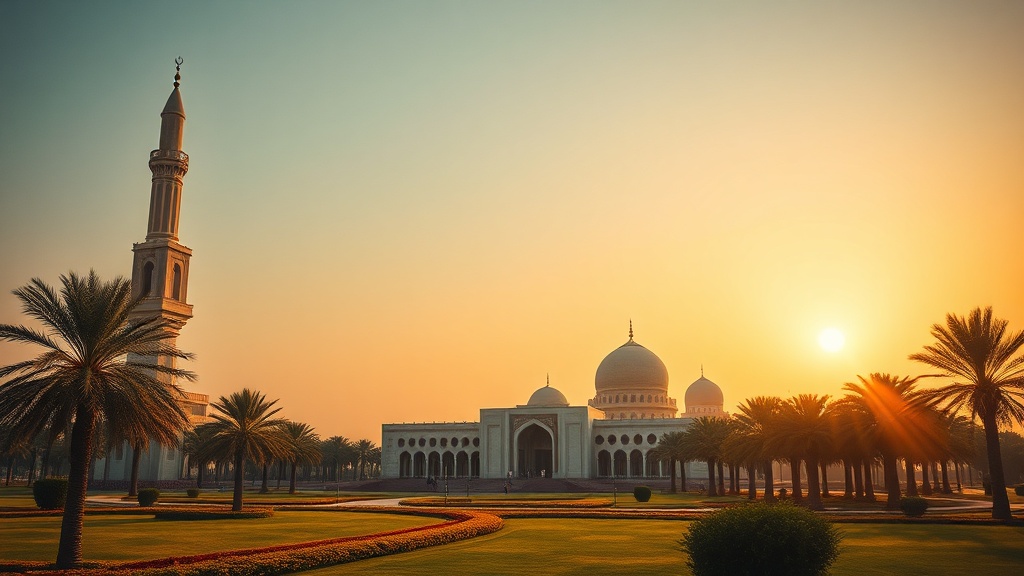
The Grand Mosque, opened in 1986, holds 10,000 worshippers under a 26 m dome and offers free guided tours to non-Muslims, which is worth taking. Beyond it: the Al Hamra Tower, a 414 m twisted concrete sculpture that is one of the more original tall buildings anywhere; the corniche along the bay; and the malls, which are where Kuwaitis actually spend the summer because outdoors is not an option.
Failaka, and getting out
The ferry to Failaka runs from Ras Al-Ardh and is the best day trip in the country — Bronze Age Dilmun, a Hellenistic fortress, abandoned villages from 1990 and a beach. Also worth the drive: the Mutla Ridge and the northern desert; Al Jahra and the Red Fort; and the camping season, when in winter tens of thousands of Kuwaitis move into elaborate tented compounds in the desert for weeks at a time, which is the most Kuwaiti thing there is.
🏜️ The Desert and What Lives in It
The empty three quarters
Almost the whole country outside the city is flat gravel desert, and it is not empty in the way it looks. After winter rain it greens briefly and produces an intense, short-lived flush of annual plants — the rabi'a, the desert spring — which is what the camping season is built around and which lasts about six weeks.
Camping season
From November to March a very large share of Kuwaiti families move into the desert. These are not tents in the European sense: compounds with generators, air conditioning, satellite television, carpets, majlis rooms and full kitchens, pitched in more or less the same spot each year, for weeks or months. It is the country's principal leisure activity, an enormous social phenomenon, and a serious environmental pressure on fragile ground.
Wildlife
Thin but real. Desert foxes, jerboas, hares, monitor lizards, the spiny-tailed lizard (dhub), and snakes including the saw-scaled viper. Arabian oryx and gazelle have been reintroduced in fenced reserves. And birds: Kuwait sits on a major flyway and the mudflats and the reserves see very large numbers of migrating waders, flamingos, raptors and passerines — it is a genuinely good and almost unknown birding destination in spring and autumn.
The reserves
Jahra Pool, a wetland reserve on the bay and the best birding site in the country. Sabah Al-Ahmad Natural Reserve, a large fenced area in the north where the desert has been allowed to recover, with oryx and gazelle. Bubiyan island, ecologically important and largely off limits. Access to several requires permission arranged in advance.
The sea
Kuwait Bay and the northern Gulf are shallow, warm and productive, and the fishing tradition is old and serious — zubaidi (silver pomfret) is the prestige fish and commands prices that startle visitors, alongside hamour, sheim and the shrimp season. Coral exists on the offshore islands and is stressed by heat and development. The 1991 spill did enormous damage from which recovery has been partial.
The scars
The desert still carries 1991. Oil lakes, tarcrete — a hardened crust of oil, soot and sand — and contaminated soil cover a substantial area, and remediation funded by UN compensation has been running for years. There is also unexploded ordnance and mine residue in places, mostly cleared and marked. Off-road driving on undisturbed ground damages a surface that takes decades to recover.
🍛 Food
Kuwaiti food is the best-argued case in the Gulf and it deserves the argument: a genuine cuisine built where the sea, the desert and the Indian Ocean trade met, with Persian, Indian and East African spicing on a base of rice, fish and lamb. It is more interesting than anything in the neighbouring states and almost nobody outside the region has eaten it.
Machboos
The national dish. Basmati rice cooked with meat, chicken or fish in a spiced stock, coloured and scented with baharat — the local spice blend — plus loomi, dried black limes, which give the sour, slightly fermented, unmistakably Gulf note. Turmeric and saffron for colour, onion and tomato for the base, and the whole thing served on a platter with the meat on top and daqoos, a thin tomato sauce, poured over.
Fish, and zubaidi
Kuwait was a fishing town before it was anything else and eats accordingly. Zubaidi, silver pomfret, is the prized fish and is expensive enough to be a status purchase. Mutabbaq samak — fried fish served on rice cooked in its stock with tamarind and spices, the name meaning the fish that is turned over onto the rice — is the great Kuwaiti fish dish. Also mumawwash, rice with fish and dill, and the shrimp of the winter season.
The rest of the table
Harees, wheat and meat pounded together for hours into a smooth savoury porridge, eaten at Ramadan. Jireesh, crushed wheat with meat. Margoog and tashreeb, stews poured over bread. Murabyan, shrimp with rice. Balaleet, sweet vermicelli with cardamom and rosewater topped with a plain omelette — the classic Kuwaiti breakfast and much better than it sounds.
Bread and breakfast
Khubz from a tandoor-style oven, and the Iranian-influenced flatbreads sold hot from bakeries all over the city. Chebab, saffron and cardamom pancakes eaten with cream cheese and date syrup. Nikhi and bajilla, chickpeas and broad beans sold hot from carts in winter. A Kuwaiti breakfast is one of the underrated meals of the Middle East.
Sweets
Gers ogaily, a saffron and cardamom sponge cake baked in a big round tin, sprinkled with sesame, and traditionally made for travellers — the name is associated with a family recipe from the pearling era. Luqaimat, fried dough balls in date syrup. Sago pudding, rangina and, universally, dates, which are offered constantly and are not decorative.
Eating out
Kuwait eats out enormously. Everything from the outdoor restaurants at Mubarakiya to serious Lebanese, Iranian, Indian and Japanese places, and a fast-food density that is among the highest in the world — with the diabetes and obesity rates to match, which is a recognised public-health emergency. The homegrown chains are good, the food-delivery culture is total, and eating at 11 p.m. is normal.
👨🍳 Two Recipes
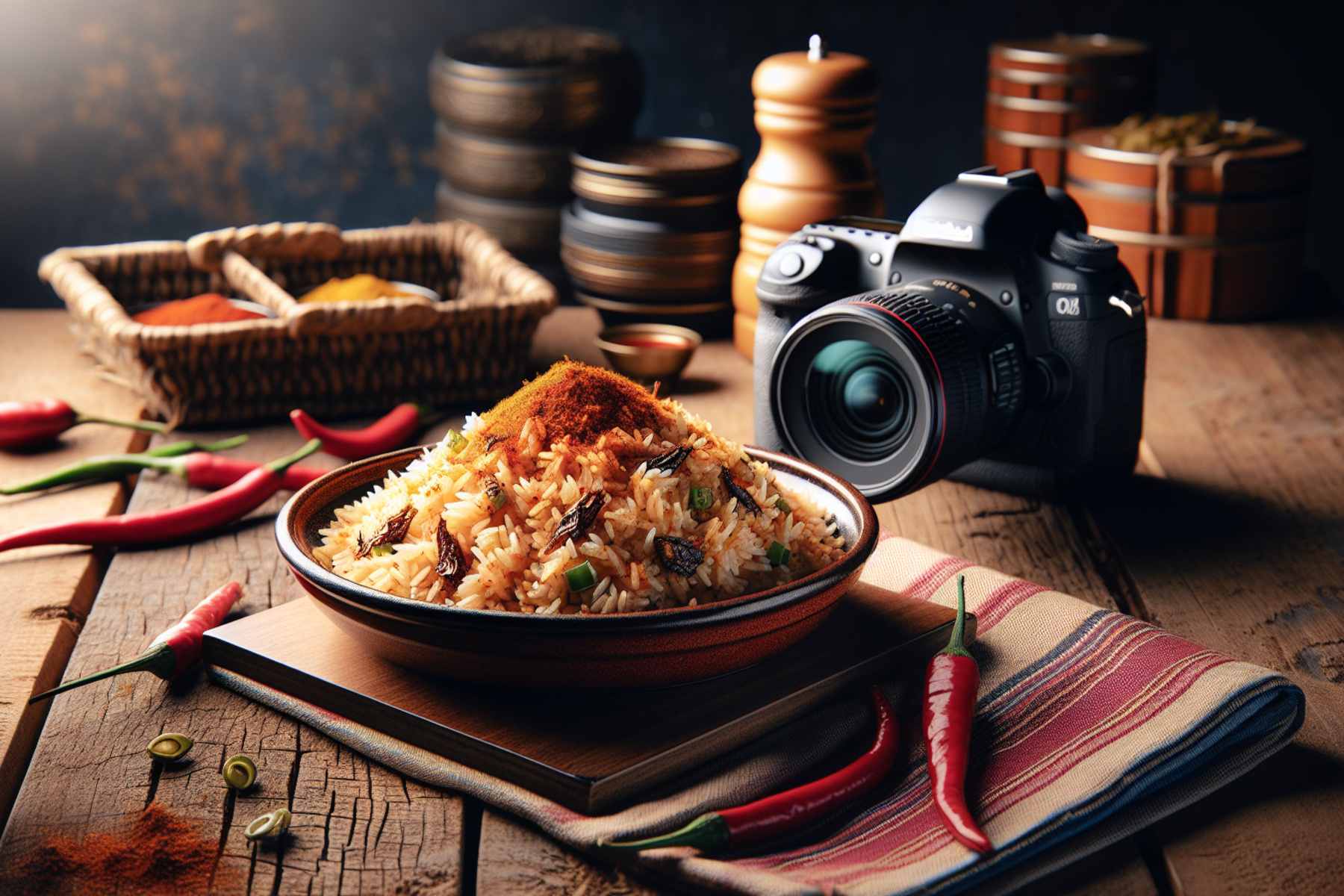
Chicken Machboos
Kuwait · serves 4–6 · 1½ hours · one large heavy pot with a lid
Ingredients: 1 whole chicken, jointed into 8, or 1.2 kg thighs and drumsticks · 500 g basmati rice, rinsed and soaked 30 minutes · 3 onions, sliced · 3 tomatoes, chopped · 4 cloves garlic and a thumb of ginger, crushed to a paste · 3–4 loomi (dried black limes), pierced twice each · 2 tbsp baharat (or 1 tsp each ground cumin, coriander, black pepper, cinnamon, cardamom, cloves and nutmeg) · 1 tsp turmeric · 1 cinnamon stick · 4 cardamom pods · 2 bay leaves · a pinch of saffron in 2 tbsp hot water · 3 tbsp ghee or oil · salt. Daqoos: 4 tomatoes blended, 2 cloves garlic, 1 tsp baharat, a little oil.
Method: Fry the onions in the ghee over medium heat until deep gold, 12–15 minutes — this is the flavour base and rushing it is the commonest mistake. Add the garlic-ginger paste, then the whole spices and baharat, and cook a minute until fragrant. Add the tomatoes and cook down to a thick base. Add the chicken, turning it in the mixture, then the loomi, salt and about 1 litre of water. Cover and simmer 35–40 minutes until the chicken is done. Lift the chicken out and set it aside. Measure the stock — you want roughly 1.5 times the volume of the drained rice — top up if needed, bring to the boil, add the rice, stir once, and cook uncovered until the liquid is level with the surface. Trickle over the saffron water, cover tightly, and steam on the lowest heat 20 minutes without lifting the lid. Meanwhile grill or fry the chicken pieces briefly to colour them. Serve the rice on a platter with the chicken on top and daqoos alongside.
💡 The loomi is not optional and is not substitutable with fresh lime — it is a different flavour entirely, sour and slightly fermented, and it is what makes this a Gulf dish rather than a pilaf. Middle Eastern shops sell them; pierce or crack them so the inside infuses. And do not stir the rice once it is steaming.
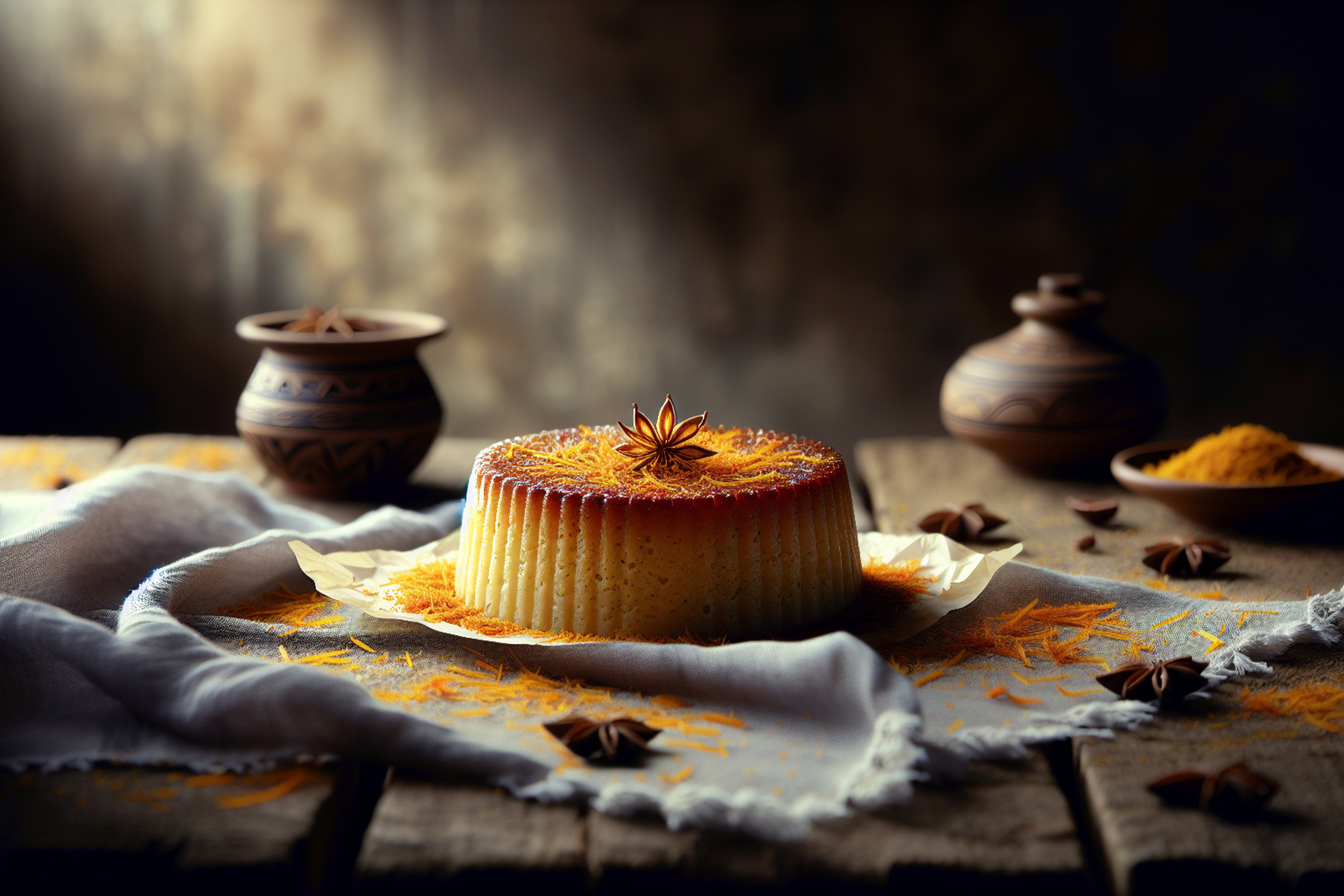
Gers Ogaily
Kuwait · one 24 cm cake, 10–12 slices · 20 minutes plus 40 minutes baking · a round tin and an electric whisk
Ingredients: 4 eggs, at room temperature · 200 g caster sugar · 180 ml neutral oil · 200 g plain flour · 2 tsp baking powder · a generous pinch of saffron ground and steeped in 3 tbsp warm milk or rosewater for 20 minutes · 1 tsp ground cardamom · 1 tbsp rosewater · 2 tbsp sesame seeds · a pinch of salt.
Method: Steep the saffron first and leave it — the colour and perfume need the full twenty minutes. Whisk the eggs and sugar together at high speed for a full 8–10 minutes until pale, tripled in volume and holding a ribbon; there is no other raising agent doing serious work here and this is the entire structure of the cake. Trickle in the oil while still whisking, then the saffron milk and the rosewater. Sift the flour, baking powder, cardamom and salt over the top and fold gently by hand in as few movements as will combine it. Pour into a lined 24 cm tin, scatter the sesame seeds generously over the surface, and bake at 175 °C for 35–45 minutes until deep gold and a skewer comes out clean. Cool in the tin.
💡 Two rules: whisk the eggs far longer than feels reasonable, and fold the flour in far more gently than feels reasonable. Skimp on the first and the cake is dense; overwork the second and it is tough. It keeps for several days, travels well — which is the point of it — and is eaten with cardamom tea or Arabic coffee, never on its own.
☕ Coffee, Tea and No Alcohol
Gahwa
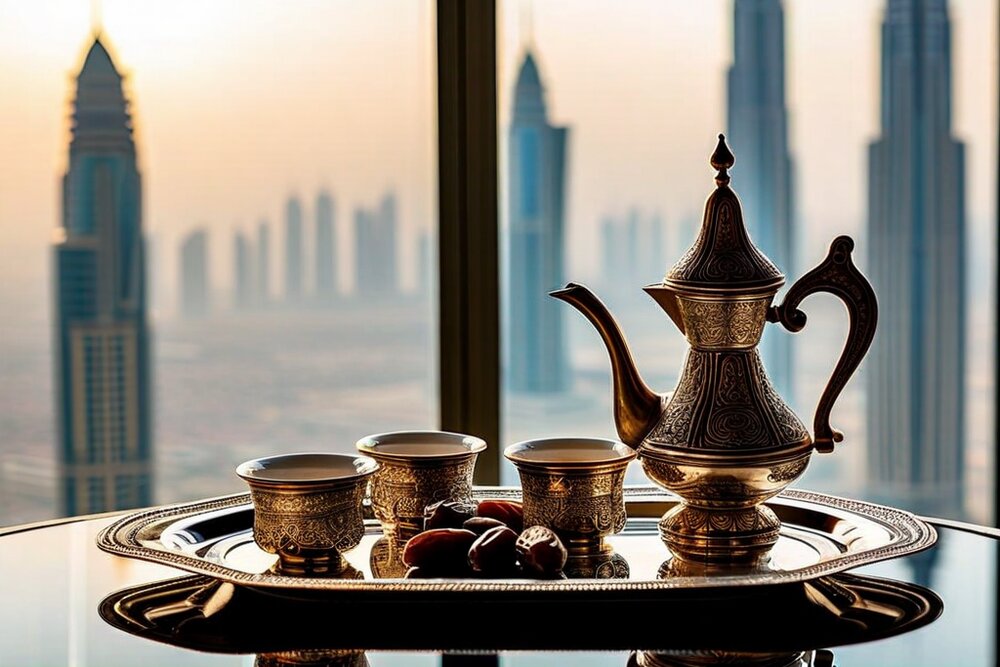
Arabic coffee, and a ritual rather than a drink. Lightly roasted beans ground with a great deal of cardamom, sometimes saffron and cloves, brewed in a dallah and poured into small handleless cups filled only about a third. It is bitter, pale, aromatic and served with dates. The etiquette matters: take the cup with your right hand, expect it to be refilled repeatedly, and when you have had enough shake the cup gently from side to side as you hand it back — otherwise it keeps coming.
Tea
Drunk constantly and often preferred to coffee: chai with cardamom, sometimes with saffron or mint, sweet, served in small glasses. Chai haleeb, tea with evaporated milk, is the everyday version. And in the cafés and specialty roasteries of Kuwait City there is a serious third-wave coffee scene that would hold its own in any European capital.
Alcohol: none, and mean it
Kuwait is completely dry. Alcohol has been banned since 1964, there are no licensed premises, no hotel bars, no duty-free on arrival and no exceptions for foreigners. Importing, possessing, selling or consuming alcohol is a criminal offence carrying fines, imprisonment and deportation, and arriving with a bottle in your luggage is a serious matter rather than a formality. Do not pack any. Do not accept an invitation to a bootleg gathering; the domestic trade in smuggled and home-distilled spirits is dangerous both legally and, with methanol poisoning incidents on record, physically.
What people drink instead
Enormous quantities of coffee and tea. Fresh juice — the juice bars are excellent and cheap. Laban, salted drinking yoghurt. Karak tea from roadside stands. Fizzy drinks in volumes that contribute to a real public health problem. And an entire mocktail industry in the restaurants, which is better developed than in countries where alcohol is available.
Water
Tap water is desalinated and blended, and is generally considered safe in Kuwait City, though almost everyone drinks bottled and the storage tanks in older buildings are the weak link. Bottled water is cheap and everywhere. Dehydration is the single most common health problem visitors have, and in summer it is not a minor one.
Shisha and tobacco
Widely smoked in cafés, and smoking rates are high. Indoor smoking bans exist and are enforced unevenly. Vaping is a legal grey area and e-cigarettes have been subject to import restrictions — check the current position before bringing them, because Gulf states have confiscated them at the airport.
💡 Culture and Etiquette
Hospitality
Take it seriously, because it is meant seriously. Coffee and dates arrive within a minute of you sitting down anywhere, refusing outright is awkward, and a Kuwaiti host will not let you pay for anything. If you are invited to a house or a diwaniya, go — it is the best thing that can happen to you here. Bring something small; sweets or good dates are correct, alcohol is a criminal offence and flowers are for hospitals.
Greetings and the right hand
Handshakes between men are normal and can be long, often with the left hand touching the forearm. Do not offer your hand to a woman unless she offers first — many Kuwaiti women will not shake hands with men, which is a religious observance and not a snub, and a hand on the heart is the correct response. Use the right hand for eating, giving and receiving. Do not show the sole of your foot.
Dress
Kuwait is more conservative than Dubai and less so than Saudi Arabia. For men: long trousers, sleeves; shorts are for the beach and the gym. For women: shoulders and knees covered, loose rather than tight, and a scarf in a bag for mosques. Nobody will require a foreign woman to cover her hair in the street. Swimwear is for hotel pools and private beaches only. In the malls, which are the main public space, dress as you would for a Czech office.
What is illegal that you would not expect
A partial list worth reading twice: alcohol in any quantity; pork import; public displays of affection, including between married couples; cohabitation by unmarried couples in theory, though hotels rarely ask; photographing people without consent, and government, military, oil or airport installations at all; swearing or rude gestures, including in traffic, which has led to prosecutions; criticism of the Emir, Islam or the ruling family, including on social media, including retrospectively. Drug offences carry extremely severe penalties, up to and including death for trafficking.
Ramadan
During the holy month, eating, drinking, smoking or chewing gum in public during daylight is illegal for everyone, Muslim or not, and is enforced. Working hours shorten, everything shifts to the night, and the city becomes extraordinary after sunset — the ghabga gatherings, the tents, the food. Visiting during Ramadan is rewarding if you plan around it and miserable if you do not. Check the dates, which move by about eleven days each year.
LGBT travellers
Same-sex relations are criminalised, and Kuwait has also legislated on gender expression — a law criminalising "imitation of the opposite sex" was struck down by the Constitutional Court in 2022, and the underlying attitude has not changed. Public attitudes are hostile and there is no legal protection. The practical advice is discretion; same-sex couples should expect questions about shared rooms outside the international chains.
🗣️ Arabic and English
The official language is Arabic. The working language of daily commerce is, to a remarkable degree, English, and a fair amount of business happens in Hindi, Urdu, Malayalam, Tagalog and Bengali because that is who is doing it.
Kuwaiti Arabic
A Gulf dialect, close to Bahraini and eastern Saudi speech, with a substantial vocabulary borrowed from Persian, Hindi/Urdu, Turkish and English — a direct legacy of the pearling and dhow trade. Kuwaiti speakers are proud of it and it is the language of a well-known television drama industry that is watched across the Gulf. Modern Standard Arabic is the written and formal register.
English
Extremely widespread. Signage is bilingual, menus are bilingual, government websites are bilingual, and educated Kuwaitis speak it well — often with an American accent, because of where they studied. A visitor can spend a week in Kuwait using nothing else and never be inconvenienced.
The other languages
Roughly a fifth of the population is Indian, and Kuwait has substantial Egyptian, Bangladeshi, Filipino, Pakistani, Sri Lankan and Syrian communities. In practice this means the person you are talking to may be more comfortable in English than in Arabic, and that a few words of Hindi or Tagalog go a surprisingly long way with people who almost never hear a foreigner attempt them.
Fifteen words
As-salamu alaykum — peace be upon you, the universal greeting; the reply is wa alaykum as-salam. Marhaba — hello. Shlonak? / shlonich? — how are you (to a man / to a woman), and very Kuwaiti. Zain — good. Shukran — thank you. Afwan — you're welcome. Min fadlak — please. Aiwa / la — yes / no. Kam? — how much? Wayid — a lot. Yalla — let's go. Inshallah — God willing, and used constantly and not always literally. Khalas — enough, done. Ma'a salama — goodbye. Ladheedh — delicious.
Names and titles
The Emir is Sheikh, as are members of the ruling family. Sayyid and Sayyida for Mr and Mrs; Ustadh for a teacher or a professional. Kuwaiti names carry the family name, which carries information about origin and status that outsiders should not attempt to interpret. And Abu or Umm plus the eldest son's name — father of, mother of — is a respectful and very common form of address.
A word about the script
Arabic numerals as used in Kuwait are the Eastern Arabic forms — ٠١٢٣٤٥٦٧٨٩ — which appear on some price tags, older signage and official documents alongside the Western ones. Learning the ten digits takes fifteen minutes and is the single highest-return piece of preparation for the Gulf.
🏛️ Heritage, and the Absence of a UNESCO Site
Kuwait has no UNESCO World Heritage site. It has a tentative list, a serious archaeological record and a national museum that was systematically looted in 1990, and the gap between what it has and what is inscribed says something about both the country and the process.
What is on the tentative list
Failaka island, with its Dilmun temple and Hellenistic fortress, is the strongest candidate and has been proposed for years. Also proposed: Sa'ad and Sae'ed area on Failaka, the Bubiyan wetlands, and elements of Kuwait's modernist architecture of the 1960s and 70s, which is a genuinely distinguished body of work by international architects and is disappearing fast.
The looting of 1990
During the occupation the Kuwait National Museum was stripped — the Al-Sabah collection of Islamic art, one of the finest in private hands anywhere, was crated and taken to Baghdad, and the building was set on fire on the way out. Most of the collection was returned under UN supervision after 1991, some of it damaged, some of it never accounted for. The museum has never fully recovered and the planetarium was rebuilt only relatively recently.
The modernist city that was demolished
Kuwait in the 1960s and 70s commissioned an extraordinary roll-call of architects — the Smithsons, Reima Pietilä, Kenzo Tange, Arne Jacobsen, TAC — and built a modernist capital that is studied by architectural historians. Much of it has since been demolished for towers and car parks. The surviving examples, including the Water Towers, the Sief Palace additions and the National Assembly building by Jørn Utzon, are the country's least-appreciated heritage.
The Utzon parliament
The National Assembly building, completed in 1982 by the architect of the Sydney Opera House, is a low concrete structure with two great sweeping canopies meant to evoke a Bedouin tent, arranged around a public covered street. It was badly damaged in 1991 and restored. That the building housing the Gulf's most combative parliament was designed as an open tent is an irony that Kuwaitis point out themselves.
The intangible
Al-Sadu weaving, the Bedouin women's craft of geometric wool textiles, is inscribed on UNESCO's intangible heritage list — Kuwait's one entry there — and the Bait Al-Sadu house in Kuwait City keeps it alive. Also the pearl-diving songs, dhow building, falconry (a shared regional inscription) and the diwaniya itself, which some have argued should be recognised.
Why the gap
Partly because Kuwait's most important heritage is on an island the army has controlled since 1991; partly because inscription requires a management plan and a long bureaucratic effort that the state has not prioritised; and partly because a country that rebuilt itself twice in fifty years — once on oil money and once after an occupation — has had a complicated relationship with keeping things. The demolition of the modernist city happened while nobody was arguing for it.
📅 When to Visit
The short answer
November to March. Outside those months Kuwait is genuinely, dangerously hot, and there is nothing a visitor can do about it except stay indoors. The winter window is pleasant, sociable and the season in which the country actually lives outdoors — the camping season, the outdoor restaurants, the corniche in the evening.
December–February
The best of it. Daytime highs of 15–20 °C, cold nights, occasional rain, and the desert briefly green. This is camping season, when much of the population decamps to the desert at weekends. It is also when the birding is best and when walking around the city is a pleasure rather than an ordeal. Bring a jacket; visitors consistently underpack for a Gulf winter night.
March–April and October–November
The shoulders, warm and workable — 25–35 °C — with the dust storms of early summer starting to appear in April and May. Late October and November are excellent. April is also when the desert flowers if the winter rain came, which it does not every year.
May–September: don't
Daily highs of 45–50 °C, humidity on the coast, and a country that functions entirely between air-conditioned interiors. Kuwait recorded 53.9 °C at Mitribah in July 2016. Outdoor sightseeing is not realistic, heatstroke is a genuine risk, and even Kuwaitis leave if they can — the summer exodus to Europe and Lebanon is a national custom. If you must come in summer, come for business and plan nothing outside.
The dates to plan around
National Day, 25 February, and Liberation Day, 26 February, are celebrated together with a fortnight of decoration, fireworks, and a water-spraying street festival that is genuinely joyous and completely soaks anyone in the vicinity. Ramadan transforms the country and is worth experiencing with preparation. Eid al-Fitr and Eid al-Adha close everything for several days. And Hala February, the shopping and events festival, fills the month.
How long
Three to four days covers Kuwait City properly, including the museums, the souq and a day on Failaka. A week lets you add the desert, the reserves and a slower pace. Kuwait works well as a two- or three-day stop on a Gulf itinerary and rewards more time than it usually gets — but it is not a two-week destination and nobody in Kuwait would claim otherwise.
🚗 Getting There and Around
Flights
Kuwait International Airport (KWI) is well connected across the Gulf, the Middle East, South Asia and Europe. Kuwait Airways and the low-cost Jazeera Airways are the national carriers; Jazeera in particular has built a substantial European network and is often the cheapest way in. A large new terminal has been under construction for years and the existing one is functional rather than impressive.
Driving
The default and effectively the only way to get around. Roads are excellent, fuel is among the cheapest in the world, and car hire is inexpensive. The problem is the driving itself: Kuwait has one of the higher road-fatality rates in the developed world, speeds on the ring roads are extreme, lane discipline is notional and tailgating is universal. Drive defensively, and be aware that a foreigner involved in an accident is in a legally uncomfortable position.
Taxis and apps
Uber and Careem both operate and are the sensible default — metered, traceable and cheap. Street taxis exist, are often unmetered and require negotiation. There is no rail network of any kind and no metro, though both have been announced repeatedly. Public buses run and are used almost exclusively by low-income expatriate workers.
Walking, and why not
Kuwait City is not built for pedestrians and for most of the year the climate forbids it anyway. There are exceptions worth knowing: the corniche along the bay in the evening, Al Shaheed Park, and Souq Al-Mubarakiya, which can only be done on foot. Everything else is a drive, including distances that look walkable on a map.
Failaka and the islands
The ferry to Failaka from Ras Al-Ardh takes about ninety minutes and runs on a schedule that is best confirmed by phone the day before. Day trips and organised tours exist. Bubiyan and Warbah are militarised and closed. Boat charters for the other islands and for fishing are available from the marinas and are a good winter day out.
Onward
Kuwait borders Iraq and Saudi Arabia. The Saudi land border at Nuwaiseeb is open and used heavily, and driving on to Saudi Arabia or Bahrain is straightforward with the right paperwork and insurance. The Iraqi border is a different proposition entirely and should not be part of a casual itinerary. Most visitors combine Kuwait with the other Gulf states by air.
📋 Practical Information
Entry
Czech citizens are eligible for a Kuwait eVisa, applied for online before travel, and for a visa on arrival at the airport — but note that visa on arrival is available only when arriving by air; anyone crossing by land or sea must have the eVisa in advance. Passport valid six months, and it must contain no evidence of travel to Israel, which is a real and enforced condition across the Gulf. The permitted stay is up to three months. Confirm the current rules before booking, as Gulf visa policy changes without much notice.
Health
No compulsory vaccinations from Europe. Standard precautions; the real risks are heat and dehydration, which in summer are serious rather than theoretical, and road accidents. Healthcare is good and expensive: public hospitals serve residents, and visitors use private clinics and pay. The EHIC does not apply and there is no Czech–Kuwaiti healthcare agreement, so commercial insurance is essential. Emergency number: 112.
Money
The Kuwaiti dinar (KWD) is the highest-valued currency in the world — roughly 1 KWD ≈ 3.2 USD — which makes arithmetic unintuitive: a price of 5 dinars is about 375 Kč, not 5 of anything familiar. It is pegged to a currency basket rather than to the dollar alone. Cards are accepted everywhere, ATMs are ubiquitous, and the local K-Net debit network is what everyone actually uses. Bring a little cash for the souq and for taxis.
Connectivity
Excellent. 5G is widespread, local SIMs from Zain, Ooredoo or STC are cheap and easy with a passport, and Wi-Fi is universal. Note that VoIP calling over WhatsApp, FaceTime and similar has been restricted at various times across the Gulf — check the current position, and do not rely on internet calling as your only way home. Some content is filtered.
Safety
Kuwait is very safe in the ordinary sense — violent crime against visitors is rare and petty crime is uncommon. The genuine risks are the road, the heat, and the law: see the culture section for the list of things that are criminal offences here and are not in Europe. Drug penalties are severe, including for quantities that would be trivial elsewhere and for prescription medications containing controlled substances — check before you pack anything, and carry a doctor's letter.
Regional context
Kuwait sits at the head of the Gulf between Iraq, Iran and Saudi Arabia, and regional escalation affects airspace and flight routing more than it affects the country itself. Check mzv.gov.cz before travelling and register in DROZD. Kuwait itself has been stable throughout the recent regional turbulence and visitors have not been targeted.
💵 What It Costs
Kuwait is expensive by regional standards for accommodation and cheap for fuel, food and transport, and the dinar makes it hard to judge until you have done the conversion a few times. As a rule of thumb, 1 KWD ≈ 75 Kč — verify the rate, which moves.
Sleeping
The weak point. There is no hostel culture and little budget stock, because Kuwait's visitors are overwhelmingly business travellers. A basic hotel KWD 20–35 (roughly 1,500–2,600 Kč); a good mid-range hotel KWD 40–70; the international chains on the waterfront KWD 80–150 and up. Apartment rentals are available and often better value for a stay of several days.
Eating
Where Kuwait is a bargain. A plate of machboos or a shawarma at a local place KWD 1–2.5 (75–190 Kč). A good restaurant meal KWD 8–15 a head. Coffee KWD 1–2. Eating at Souq Al-Mubarakiya in the evening costs very little and is the best meal you will have. There is no alcohol bill, which changes the arithmetic of a restaurant evening considerably.
Getting about
Fuel is among the cheapest on Earth — filling a tank costs a few dinars. Car hire from KWD 10–20 a day. An Uber across the city KWD 2–5. The Failaka ferry a few dinars. Local buses are under half a dinar and are not really aimed at visitors.
Sights
Cheap or free. Most museums charge a nominal fee or nothing; the Grand Mosque tour is free; Al Shaheed Park is free; the Kuwait Towers charge a small entry for the viewing sphere. The private Tareq Rajab museums charge a modest fee and are worth every fils. Kuwait is one of the few countries where the sightseeing is the least expensive part of the trip.
A realistic daily budget
Excluding flights and accommodation: KWD 10–20 a day covers food, transport and entry fees comfortably — roughly 750–1,500 Kč. With a mid-range hotel, budget KWD 55–90 a day all in, about 4,000–6,800 Kč. The hotel is the trip's dominant cost and the reason Kuwait reads as expensive.
Tipping
Not obligatory and increasingly expected in restaurants and hotels — round up or leave about 10%. Service charge is sometimes included; check the bill. Tip the person who carries your bag and the valet. Bear in mind that the people you are tipping are almost always migrant workers on low wages, and that a dinar means considerably more to them than it does to you.
🇨🇿 Notes for Czech Travellers
Flights from Prague
There is no direct flight. The practical routings are with Turkish via Istanbul, Qatar via Doha, Emirates or flydubai via Dubai, Etihad via Abu Dhabi, or Jazeera Airways connecting through one of its European points — Jazeera is often the cheapest option into Kuwait and is worth checking directly. Total journey time is typically 7–10 hours. Fares rise sharply around Eid and in the summer exodus.
The eVisa, step by step
Czech citizens can obtain a Kuwait eVisa online before travel or a visa on arrival at the airport. Use the official Kuwaiti government portal rather than the many agencies that charge several times the fee for the same form. You will need a passport valid six months with no Israeli stamps or visas, a confirmed hotel booking and a return ticket. If arriving overland from Saudi Arabia, you must have the eVisa in advance.
Money in Czech terms
The dinar is the world's strongest currency and the conversion is the thing Czech visitors get wrong. At roughly 75 Kč to 1 KWD — check the rate — a 2-dinar lunch is 150 Kč, a 12-dinar dinner is 900 Kč, a 50-dinar hotel night is 3,750 Kč and a 3-dinar taxi is 225 Kč. Fractions are in fils, a thousand to the dinar, so prices are written to three decimal places — 1.750 KWD is one dinar seventy-five, not one thousand seven hundred.
MZV ČR, DROZD and the embassy
The Czech Embassy is in Kuwait City. Register in DROZD before travelling and read the current advisory at mzv.gov.cz, which is worth reading here specifically for the legal section — the list of things that are criminal offences in Kuwait and unremarkable in the Czech Republic is longer than most visitors expect. The EHIC does not apply.
The alcohol point, stated once more
Because it is the mistake Czech travellers are most likely to make: Kuwait is completely dry and possession is a criminal offence. Do not pack a bottle as a gift, do not accept duty-free on the plane and carry it in, do not bring a hip flask, and do not assume a hotel will have a bar. People are prosecuted and deported for this every year, and being European is not a defence.
Czech traces
Modest but real. Czechoslovakia had trade relations with Kuwait from the 1960s and supplied machinery and industrial equipment; Czech firms have participated in construction and engineering contracts since. The Czech Republic has an embassy in Kuwait City and Kuwait one in Prague, and Kuwaiti medical tourism and property investment in Karlovy Vary and Prague is a small but visible phenomenon. Kuwaiti students have also studied at Czech universities in modest numbers for decades.
☪️ Religion
Kuwait is a Muslim country in which Islam is the state religion and the principal source of legislation, and it is also one of the more religiously plural societies in the Gulf — with a Shia minority large enough to matter politically and a Christian community with actual church buildings, which is rarer in the region than outsiders assume.
Sunni and Shia
Kuwaiti citizens are roughly 60–70% Sunni and 30–40% Shia — the largest Shia proportion in the Gulf outside Bahrain and Iraq. The Shia community is long-established, substantially of Persian and Iraqi descent, prominent in commerce, and politically significant; it has historically been loyal to the ruling family, which distinguishes Kuwait from Bahrain. Sectarian tension exists and is normally managed rather than expressed, and the state polices sectarian speech in both directions.
The 2015 attack
In June 2015 an Islamic State suicide bomber attacked the Imam Sadiq mosque in Kuwait City during Friday prayers during Ramadan, killing 27 people. The national response was striking: the Emir walked to the site, Sunni Kuwaitis donated blood and attended the funerals in large numbers, and the funeral prayers were held jointly. It is remembered as the moment the country deliberately refused the sectarian frame it was being offered.
Christians and others
Kuwait permits church buildings — Catholic, Anglican, Orthodox, Evangelical and others in Kuwait City — which serve the large expatriate communities and a small number of Kuwaiti Christians, a tiny group unique in the Gulf in holding citizenship. Hindu, Sikh and Buddhist residents number in the hundreds of thousands and have no permitted places of worship, which is a real and often-overlooked restriction. Proselytising by non-Muslims is illegal.
Practice
Prayer five times a day, audible from the mosques across the city; shops and offices pause briefly. Friday is the main day of the weekend, which runs Friday–Saturday. Observance among citizens is high but not uniform, and Kuwait is noticeably less strict in public enforcement than Saudi Arabia — there is no religious police, women drive, and mixed public space is normal.
Charity
Kuwait is, per head, among the most generous humanitarian donors in the world, and was designated a Humanitarian Centre by the UN in 2014 with the Emir named a Humanitarian Leader. Zakat and private charitable giving on a very large scale are ordinary features of Kuwaiti life, and Kuwaiti charities are major operators in crisis response across the Middle East and Africa.
For a visitor
Non-Muslims are welcome at the Grand Mosque on the free guided tours, which are genuinely informative and where robes are provided. Dress modestly everywhere. Do not eat or drink in public during Ramadan daylight. Do not discuss religion critically in public or online. And be aware that blasphemy and insulting religion are criminal offences with real sentences, applied to social media posts including old ones.
🎭 Arts, Media and the Kuwaiti Voice
The press that was
Kuwait had the freest press in the Arab world for decades — genuinely combative newspapers, a satirical tradition, and a publishing industry that made Kuwait City the region's intellectual capital in the 1960s and 70s. The magazine Al-Arabi, founded in Kuwait in 1958, was read across the Arab world. That freedom has narrowed substantially since 2024, with prosecutions for criticism of the Emir and the government, and Kuwait's press-freedom ranking has fallen.
Television drama
Kuwaiti TV drama is watched across the entire Gulf and is one of the country's real cultural exports — the Ramadan series in particular, produced at speed and consumed by everyone. Kuwaiti actors are regional stars and the Kuwaiti dialect is understood far beyond Kuwait largely because of it.
Music
The Gulf's khaliji music has deep Kuwaiti roots, and the pearl-diving fijiri songs — call-and-response work chants with hand drums and clapping, performed by crews at sea — are one of the region's most distinctive musical traditions and are still performed by dedicated ensembles. Kuwait also produced the composer and oud player Abdullah Al-Faraj and, more recently, a generation of regional pop stars.
Literature
A strong tradition, and one name in particular: Saud Alsanousi, whose novel The Bamboo Stalk won the International Prize for Arabic Fiction in 2013 and takes as its subject a young man of Kuwaiti-Filipino parentage caught between the two — which is to say, it is about exactly the thing Kuwaiti society finds hardest to talk about. Ismail Fahd Ismail is the elder figure of the Kuwaiti novel. Both are translated into English.
The cultural centres
The Sheikh Jaber Al-Ahmad Cultural Centre, opened in 2016, is one of the largest performing-arts complexes in the world — opera house, theatres, a concert hall — and programmes international orchestras and productions. Alongside it the Abdullah Al-Salem Cultural Centre, a very large museum complex covering science, natural history, fine arts and Arab-Islamic science, which is excellent and startlingly empty.
What is missing
Public cinema was banned for decades and has returned; live music venues are limited; there is no bar or club scene of any kind; and the censorship of books, films and art is real — the Kuwait book fair has drawn attention for the number of titles withdrawn. The result is a country with world-class cultural infrastructure and a constrained cultural life, which Kuwaiti artists discuss openly and with some frustration.
⚽ Sport
Football
The national obsession. Kuwait qualified for the 1982 World Cup in Spain — the country's only appearance, and the tournament in which a Kuwaiti prince walked onto the pitch to protest a French goal and got it disallowed, one of the more extraordinary incidents in World Cup history. Kuwait won the Asian Cup in 1980 and the Gulf Cup ten times. The domestic league is followed intensely; Al-Arabi, Kuwait SC and Qadsia are the big clubs.
The suspensions
Kuwait has twice been suspended by FIFA and the IOC over government interference in sports governance — most recently from 2015 to 2017, which cost it the 2016 Olympics as a nation, with Kuwaiti athletes competing under the Olympic flag. One of them, the shooter Fehaid Al-Deehani, won gold in double trap in Rio in 2016 as an Independent Olympic Athlete, the first person ever to win Olympic gold competing under no flag.
Motorsport and the sea
Powerboat racing is genuinely popular and Kuwait has produced world-class offshore racers. Dhow racing and traditional sailing are kept alive by clubs and by the annual regattas. And the desert produces a serious rally and dune-driving culture that is largely invisible to outsiders and enormous domestically.
Falconry and the old sports
Falconry is practised seriously and expensively, with the birds treated as members of the household and flown at bustard and hare in the winter season; it is inscribed on the UNESCO intangible heritage list as a shared Gulf tradition. Camel racing continues. And pigeon keeping, which sounds like a footnote and is a substantial and competitive pastime in the Gulf.
Handball and shooting
Kuwait is unexpectedly strong at handball and at shooting, which have produced most of its international medals. The shooting complex is world-class and hosts international events. And the national fencing, athletics and swimming programmes benefit from the kind of facilities a wealthy state can build.
What a visitor can see
A league football match in winter is cheap, well attended and a genuine window into Kuwaiti social life. The Kuwait Towers corniche and Marina Crescent fill with runners and cyclists on winter evenings. And the desert camps in season are, among other things, where a great deal of informal sport happens.
🌡️ Heat, Water and the Long Term
Kuwait faces the same question as every Gulf state and faces it earlier and harder: what does a country do when its climate is approaching the edge of human tolerance and its revenue comes from the fuel driving that.
The heat trajectory
Kuwait is already one of the hottest inhabited countries on Earth, and modelling for the region projects summer conditions by mid-century in which outdoor work becomes physiologically dangerous for parts of the day. Studies of Kuwaiti mortality data already show measurable excess deaths on the hottest days, concentrated among outdoor migrant workers. A summer working-hours ban exists and is enforced with varying rigour.
Water and energy
Almost all fresh water is desalinated, which is energy-intensive, and almost all energy comes from oil and gas. Per-capita electricity and water consumption are among the world's highest, both heavily subsidised, and summer demand strains the grid to the point of load-shedding. Reforming the subsidies is politically explosive; not reforming them means the arithmetic gets worse every year.
The 1991 legacy
Oil lakes, tarcrete and contaminated soil across a substantial share of the desert, plus the marine damage from the largest deliberate spill in history. Remediation funded through the UN Compensation Commission has been running for years and is genuinely large-scale, and it will not finish soon.
Air and dust
Kuwait has poor air quality by any measure: refinery and power-station emissions, traffic, and dust storms that have worsened as the Mesopotamian marshes and the Iraqi and Iranian drylands have dried. Respiratory illness rates are high. The shamal season and the regional dust events are a genuine health issue, not an inconvenience.
What is being done
Solar capacity — the Shagaya renewable complex — with a stated target of a substantial renewable share by 2030, though progress has been slower than announced. Waste and wastewater investment. A national environment authority with real statutory powers. And a sovereign wealth fund whose entire purpose is to make the country solvent after oil, which is the most substantial climate policy Kuwait has and is rarely described as one.
The honest position
Kuwait's per-capita emissions are among the highest in the world, its economy is 90% hydrocarbons, and its climate is moving in the wrong direction faster than almost anywhere. It also has an enormous financial cushion and a small population, which gives it more room to manage a transition than most petrostates. Whether it uses that room is the question, and the suspension of the body that used to argue about it publicly has not made the question easier to follow.
🔬 Curiosities
The world's strongest currency
The Kuwaiti dinar has been the highest-valued currency unit on Earth for decades — one dinar buys about 3.2 US dollars. It is not a measure of economic strength but of where the decimal point was put when the currency was introduced in 1961 at parity with the pound sterling, combined with a basket peg and a large reserve behind it. It is divided into 1,000 fils, so prices carry three decimal places.
Oil that burned for ten months
The 700 or so wells set alight in February 1991 burned until 6 November 1991, consuming an estimated five to six million barrels a day at their peak, turning midday dark across the country and depositing soot as far away as the Himalayas. The last fire was put out in a public ceremony attended by the Emir. Among the firefighting rigs was a Hungarian invention: two MiG-21 jet engines mounted on a tank chassis, blasting water into the flame.
The oldest sovereign wealth fund
The Kuwait Investment Board was set up in London in 1953, eight years before the country was independent, to invest oil revenue rather than spend it. It is the ancestor of every sovereign wealth fund in the world. Its successor kept the Kuwaiti state solvent and functioning from exile during the occupation, which is the most emphatic demonstration of the concept anyone has managed.
A prince stopped a World Cup match
At the 1982 World Cup, with France leading Kuwait 3–1, the Kuwaiti players stopped after hearing a whistle from the crowd and France scored. Sheikh Fahad Al-Ahmad, president of the Kuwaiti football association, came down onto the pitch and threatened to withdraw the team; the Soviet referee disallowed the goal. France won anyway. Eight years later Sheikh Fahad was killed defending the Dasman Palace against the Iraqi invasion.
Gold medal for no country
At Rio in 2016, with Kuwait suspended by the IOC, the shooter Fehaid Al-Deehani won the double trap competing as an Independent Olympic Athlete — the first person in history to win an Olympic gold medal representing no nation. The Olympic anthem was played and the Olympic flag raised. He had already won two bronzes for Kuwait in 2000 and 2012.
The towers that are water tanks
Beyond the famous three, Kuwait built 31 groups of mushroom-shaped water towers across the country in the 1970s — the Kuwait Water Towers, designed by the Swedish firm VBB, storing desalinated water at height and doubling as the country's most recognisable piece of infrastructure design. They won the Aga Khan Award for Architecture in 1980 and they are, functionally, a national monument made of plumbing.
🤝 Living Next to Iraq and Iran
Iraq, after 1990
The relationship took two decades to normalise and is now functional rather than warm. Iraq formally recognised the border under UN demarcation in 1994; diplomatic relations were restored after 2003; and the UN Compensation Commission completed Kuwait's reparations payments in 2022, closing a thirty-year file. Remains of Kuwaiti prisoners taken in 1990 are still occasionally recovered and returned, which keeps the wound open in a specific and personal way.
The Khor Abdullah dispute
The live issue. The waterway between Kuwait's Bubiyan island and Iraq's Al-Faw peninsula is governed by a 2012 navigation agreement that an Iraqi court declared unconstitutional in 2023, prompting a formal Kuwaiti protest and a diplomatic standoff. Underneath it sits commercial rivalry: Kuwait's Mubarak Al Kabeer Port on Bubiyan and Iraq's much larger Al-Faw port are competing for the same northern Gulf transit traffic.
Iran
Kuwait maintains relations with Iran and has generally played a mediating role, which its large Shia population makes both necessary and delicate. The relationship has been strained by espionage cases, by the offshore Durra / Arash gas field — which Kuwait and Saudi Arabia claim jointly and Iran also claims — and by regional escalation. Kuwait's instinct in every Gulf crisis has been to mediate rather than to take sides, and it has done so between Qatar and its neighbours, and between Iran and the Gulf states.
Saudi Arabia and the GCC
The closest and most complicated partnership. The two share the Divided Zone and its oil, and production there was suspended for five years in a dispute before restarting in 2020. Kuwait is a founding member of the Gulf Cooperation Council and hosted the mediation that eventually resolved the Qatar blockade — the late Emir Sheikh Sabah Al-Ahmad was the region's most respected mediator and his death in 2020 left a real gap.
The United States
Close, and dating from 1991. Kuwait is a major non-NATO ally, hosts substantial US military facilities including Camp Arifjan and Ali Al Salem air base, and was the logistical platform for the 2003 invasion of Iraq. Public gratitude for the liberation remains genuine and generational, though it coexists with sharp domestic criticism of American policy on Palestine.
The foreign-policy style
Small, rich, wedged between three large and difficult neighbours, and consequently committed to diplomacy as a survival strategy. Kuwait mediates, funds, hosts conferences and avoids taking sides — it did not join the Abraham Accords and has been notably firm on Palestine, it maintains relations with Iran, and it stayed out of the Yemen ground war. The approach is unglamorous and it has worked for sixty years.
💼 Working There
A large share of the Europeans who read this page will encounter Kuwait as a place of employment rather than a holiday, so it is worth setting out plainly what that involves.
The package
Salaries are tax-free — Kuwait has no personal income tax — and professional packages typically include housing or an allowance, health cover, an annual flight home and a schooling allowance for families. That is the attraction and it is real. What it is offset against: employer-tied residency, limited legal recourse, a hot and constrained environment, and the fact that no length of residence leads to citizenship or permanent settlement.
The kafala system
Residency is tied to a named sponsor, historically with power over your visa, your ability to change jobs and your ability to leave. Reforms have removed the worst features for professionals and the structure remains, and it is much harsher at the bottom of the labour market than the top. Never surrender your passport to an employer: it is illegal for them to hold it and it is nonetheless common at the lower end.
Domestic workers
The most vulnerable group in the country — largely women from the Philippines, India, Sri Lanka, Bangladesh and East Africa, living in employers' homes. Kuwait passed a domestic-workers law in 2015, the first in the Gulf, setting a minimum wage, rest days and hours; enforcement is the problem, and abuse cases including deaths have periodically caused diplomatic incidents with sending countries. Anyone employing domestic staff in Kuwait should know exactly what the law requires of them.
Kuwaitisation
A long-running policy of replacing foreign workers with citizens in the public sector and, by quota, in the private one. It has intensified since 2020 and periodically produces expulsion targets and contract non-renewals for expatriates in particular sectors and age brackets. If your plan depends on staying for a decade, understand that the policy environment is against it.
Practical work life
The weekend is Friday–Saturday. Hours shorten in Ramadan by law. Summer means life indoors from May to September. Alcohol is entirely absent, which visitors from Europe find harder than they expect socially rather than physically. Compounds and clubs provide expatriate social life, and there is a large and long-established Western community in Kuwait that is easy to plug into.
The advice
Read the contract and have it read by someone who knows Kuwaiti labour law; confirm what happens to the residency if you resign; keep your own documents; understand that a dispute with a sponsor is not resolved the way it would be in the EU; and register with the Czech Embassy and DROZD on arrival rather than when something has gone wrong.
⚖️ Tourism, Honestly
Kuwait receives very few leisure visitors and has never seriously tried to change that. It has no tourist visa industry to speak of, no beach resorts, no alcohol and no marketing budget aimed at Europe. That is the honest baseline, and it is also most of the appeal.
Why so few come
The heat for seven months of the year. The absence of alcohol, which removes the Gulf-stopover market. No beach product. Limited budget accommodation. A neighbour, Dubai, that spent thirty years building precisely the thing Kuwait did not. And a reputation, for Europeans over forty, permanently fixed to a news event from 1990.
What is genuinely good
Souq Al-Mubarakiya, a working two-hundred-year-old market. The food, which is the best in the Gulf. The museums — Tareq Rajab, the Cultural Centres, the National Museum — which are excellent and empty. Failaka, which is Bronze Age Dilmun, Hellenistic Greece and 1990 on one small island. The Kuwait Towers and the modernist architecture. And the winter desert, which very few outsiders ever see.
What it is not
It is not a beach holiday, a nightlife destination, a hiking country or a place to spend two weeks. It has limited interpretation at its sites, inconsistent opening hours, and a public realm designed for cars. And a visitor who arrives without reading the legal section of this page can get into trouble that would be inconceivable at home.
The stopover case
Kuwait's strongest proposition is three days in winter, either as a destination for someone curious about the Gulf beyond its shopping malls, or bolted onto a regional trip. Jazeera Airways makes it cheap to reach from Europe. Nobody will be there. That is not a complaint.
Travelling decently
Be conscious of who is serving you and under what terms. Tip properly. Do not photograph people without asking, especially women and especially workers. Do not treat the bidoon or the migrant labour situation as a conversational topic with Kuwaitis you have just met — it is discussed, but not by visitors on day one. And obey the drinking, Ramadan and photography rules absolutely rather than approximately.
The honest recommendation
Come in December, January or February. Give it three or four days. Base yourself in the city, hire a car or use Uber, eat at Mubarakiya every evening, do Failaka for a day, and see the Cultural Centre and the Tareq Rajab. Expect a country that is more interesting, better fed and considerably more complicated than its reputation — and one that has no particular interest in impressing you, which after Dubai is refreshing.
🔭 What Happens Next
The constitutional question
The four-year suspension runs to May 2028. Three outcomes are conceivable: the National Assembly is restored broadly as it was; it is restored with reduced powers under an amended constitution; or the suspension is extended or made permanent in substance. No roadmap has been published. Kuwaitis are divided, and the division does not run along the lines a European observer would expect — plenty of liberals were exhausted by the old parliament, and plenty of conservatives miss it.
The citizenship question
The revocations have created a new stateless population on top of the existing bidoon and have been carried out under a law that now excludes judicial review. Unwinding this would require political will that is not currently visible; leaving it in place stores up a problem that Kuwait has already demonstrated, over sixty years, that it does not know how to solve. This is the most consequential thing happening in the country and it is barely reported outside the region.
The economic question
A budget structurally in deficit on paper, a public payroll that absorbs most working citizens, subsidies nobody has been able to cut, a debt law that took years to pass, and a sovereign fund that exists precisely so that none of this is an emergency yet. Reform is now possible in a way it was not when parliament could block it. Whether the government uses that window is the test that the 2024 intervention set for itself.
The heat question
The one that does not negotiate. Kuwait's summers are approaching the limit of what outdoor human activity can tolerate, its water and power come from the fuel making it worse, and its population is concentrated on a coastal strip. It has money, a small population and time — but less of the last than the announcements suggest.
What is likely to stay the same
The Al Sabah. The oil. The demographic structure. The diwaniya. The mediating foreign policy. And the food. Kuwait has been through invasion, occupation, reconstruction and constitutional crisis in one lifetime and has remained recognisably itself throughout, which is not nothing.
Why this page ends here
Because the honest position is that Kuwait is at a genuine inflection point and nobody knows how it resolves — including Kuwaitis, who argue about it in every diwaniya in the country. What a travel guide can say is that the country is safe, hospitable, well fed and considerably more interesting than the two lines most people know about it, and that a visitor who comes in winter and pays attention will come away with a much better understanding of the Gulf than one who spends a week in a Dubai hotel.
📸 The Pictures on This Page — and a Note on the Archive
A note in the interest of honesty, and an unusually positive one. Kuwait's archive holds five usable files and — for the first time in a long run of these pages — none of them had to be rejected outright. All five are used. Three carry corrections, which is a much better ratio than this atlas has been getting.
A note on how the list was made
This page was first built by probing the live site for likely filenames rather than by listing the storage bucket, because the tool that enumerates it was unavailable at the time. The listing was obtained afterwards and it added one file the guessing had missed — arabic-coffee.jpg, the dallah and cups now in the drinks section. The inventory below reflects the full listing: six files in total.
The hero, used with a caveat
01-hero.jpg shows a large white mosque with a central dome and a single tall minaret in formal gardens at sunset. It is a plausible Gulf scene and it is not an identifiable Kuwaiti building — the minaret in particular is stylistically closer to Ottoman or Persian models than to Kuwait's Grand Mosque. It is used because it is accurate in kind and misleads about nothing specific. Kuwait's actual visual signature is the Kuwait Towers, and there is no photograph of them here.
Corrected: the coffee tray
kuwait-drink.jpg gets the dallah, the finjan cups and the dates exactly right — this is precisely how Kuwaiti hospitality looks. What it gets wrong is the view: the skyline through the window is Dubai, with the Burj Khalifa clearly visible. Kuwait City has nothing like it. Used in the drinks section with that correction.
Corrected: the machboos
kuwait-machboos.jpg has the loomi right, which is the hardest and most important detail. It has no meat or fish, in a dish defined by having them; it is styled with fresh red chillies, in a cuisine that is aromatic rather than hot; and the photographer's camera is in the frame — the third time that has happened in this atlas.
Corrected: the fish and the cake
kuwait-mutabbaq-samak.jpg shows a properly fried whole fish with crispy onion, and no rice at all — in a dish whose name means the fish turned over onto the rice, and where the rice cooked in the fish stock is half the point. kuwait-gers-ogaily.jpg has the saffron colour exactly right, and is baked as an individual portion rather than the large round cake it should be, is missing the sesame seeds, and carries a star anise that has nothing to do with the recipe.
What is missing
Everything the country actually looks like. There is no photograph in this archive of the Kuwait Towers, Souq Al-Mubarakiya, the Water Towers, Failaka, the Al Hamra Tower, Al Shaheed Park, the winter desert camps, a dhow, the wall gates, or one Kuwaiti person. Five images is more than several countries in this atlas have — and for a country with this much to look at, it is still a page written around a gap.
Support This Project 🌍
This World Travel Factbook is a labor of love – free to use for all travelers. If you find it helpful, consider supporting its continued development.