

🇱🇻 Latvia at a Glance
🌍 Overview
Latvia is 64,589 km² — about four fifths of Czechia — with roughly 1.84 million people and falling. It is the middle one of the three Baltic states, it is more than half forest, and its highest point, Gaiziņkalns, is 312 m, which is lower than a good many Czech villages.
It is also a country where a single city carries almost everything. About a third of all Latvians live in Riga, and something over half in the wider Riga region; the rest of the country is emptying. Riga is genuinely one of the great cities of northern Europe — a Hanseatic old town, a nineteenth-century boulevard grid, and the largest concentration of Art Nouveau architecture anywhere — and it is the reason most visitors come.
The state
A parliamentary republic. The Saeima has 100 seats, elected for four years by open-list proportional representation with a 5% threshold, and it elects the president. Edgars Rinkēvičs has been president since July 2023 — the first openly gay head of state in the EU. The government fell in May 2026 and Andris Kulbergs has led a caretaker coalition since 28 May. A general election is on 3 October 2026. See the politics section.
The people
Around 63% ethnic Latvians and 24% Russians, with Belarusians, Ukrainians, Poles and Lithuanians making up most of the rest — one of the most ethnically divided populations in the EU, and the fact that shapes Latvian politics more than any other. The population has fallen by roughly a quarter since 1991 through emigration and a low birth rate, and it is still falling.
The economy
A small, open, fully integrated EU economy. Latvia joined the EU and NATO in 2004, the euro in 2014 and the OECD in 2016. GDP is around USD 54 billion and growth in 2026 is modest — forecasts cluster between 1.4% and 2%. Transit, timber, food, and a large and genuinely good IT and fintech sector; the transit business that once ran on Russian oil and coal is gone and is not coming back.
What visiting is like
Easy, cheap by Western European standards, and much more rewarding than its reputation. Riga is a two- or three-day city that people regularly extend. Beyond it: 500 km of quiet Baltic coast, the Gauja valley, a scatter of small towns with real character, and forest. What you should not expect: mountains, dramatic weather in your favour, or much English in the countryside.
🏷️ Latvija, and Who the Latvians Are
Latvija takes its name from the Latgalians, one of the four Baltic tribes — Latgalians, Couronians, Semigallians and Selonians — who, together with the Finnic Livonians, were living here when the German crusaders arrived. The modern nation is a nineteenth-century construction assembled out of those tribes and a shared language, and Latvians are quite clear-eyed about that.
The language
Latvian is, with Lithuanian, one of only two surviving Baltic languages — a separate branch of Indo-European, not Slavic, and among the most archaic living Indo-European languages, which makes it a standing object of interest to linguists. It is spoken by fewer than two million people on earth. Its survival through seven centuries of German, Polish, Swedish and Russian rule is the central fact of Latvian identity.
The flag
Carmine red with a white stripe, and by tradition one of the oldest flags in the world — it is described in the Rhymed Chronicle of Livonia in the 1280s as a banner carried by Latgalian troops from Cēsis, and the legend has it dyed by the blood of a wounded chief. Whether or not the chronicle means what Latvians take it to mean, the flag was readopted in 1918 and again in 1990 and is treated with real seriousness.
The dainas
Latvia's national literature is not a book. It is roughly 1.2 million short four-line folk songs — dainas — collected by Krišjānis Barons in the late nineteenth century into the Cabinet of Folksongs, now on the UNESCO Memory of the World register. They are pre-Christian in feel, compressed, unsentimental, and about work, nature, the sun and the seasons. Latvians will quote them at you.
Not "the Baltics", exactly
Latvia, Estonia and Lithuania are lumped together for good historical reasons and are genuinely different. Estonian is a Finnic language and Estonia looks north to Finland; Lithuania is Catholic, was a great medieval power, and looks south to Poland; Latvia is Lutheran in the west and centre, Catholic in Latgale, has no imperial past of its own, and sits between the two. Saying so to a Latvian is a good way to start a conversation.
🗺️ The Land
Latvia is flat, wet and wooded. Glaciers left it a landscape of low moraine ridges, several thousand lakes, extensive bogs and a very large amount of forest — the forest cover figure is above half the country and has been rising for decades as farmland is abandoned. There is nothing here that a Czech would call a mountain and there is more genuine wilderness than in most of central Europe.
The Daugava
The river that made the country. It rises in Russia, runs 1,020 km through Belarus and Latvia and reaches the sea at Riga, and for a thousand years it was the trade route that linked the Baltic to the Dnieper and Byzantium. Latvians call it Daugava māte, mother Daugava, without embarrassment. Three Soviet-era hydro dams sit on it; a fourth, at Daugavpils, was cancelled after protests in 1987 that are usually counted as the start of the independence movement.
The coast
Around 500 km of Baltic shoreline, almost all of it low, sandy and backed by pine — long empty beaches, dunes, small fishing villages and hardly any development outside Jūrmala. The Gulf of Riga is shallow and mild; the open coast of Kurzeme is windier and colder. Cape Kolka, where the two meet, is a genuinely strange place where the seas collide over a sandbank.
The four regions
Vidzeme in the north-east, the most forested and the location of the Gauja; Kurzeme (Courland) in the west, coastal, historically its own duchy; Zemgale in the south, flat, black-soiled and the best farmland; and Latgale in the south-east, Catholic, Russian-speaking in large part, poorest and most distinct. They are on the coat of arms and people identify with them.
Bogs and forest
The raised bogs — Ķemeri, Teiči, Cena — are one of the country's real specialities, with boardwalks, black pools and a light that photographers love. The forests are working forests, mostly pine, birch and spruce, and Latvians treat them as a public larder: mushrooming and berry picking are a national habit with a right of access to back them up.
The weather
Maritime-continental and not gentle. Summers are mild — high teens to mid twenties — with long light: in June it does not get properly dark. Winters run around −3 to −7 °C, snow cover is normal in January and February, and the shoulder seasons are grey, wet and long. Latvians will tell you the country has two summers a year and one of them is in September, and they are broadly right.
Wildlife
Substantially better than most of Europe. Wolves, lynx and beavers are established; brown bears are returning from the east; elk and roe deer are everywhere; and the country is a major bird migration corridor — Pape and the Kolka spit are serious birdwatching sites, and Latvia has one of the densest populations of white storks in the world, with nests on poles in almost every village.
📜 Crusaders, Hansa and Seven Centuries of Someone Else
The essential fact of Latvian history is that from 1200 to 1918 the Latvians did not rule themselves. Germans, Poles, Swedes and Russians did, in that rough order, and in most of those centuries the local aristocracy remained German whatever the flag over the castle. That is not a grievance Latvians dwell on; it is the frame everything else fits into.
The Livonian Crusade
German merchants reached the Daugava in the twelfth century and the Church followed. Bishop Albert founded Riga in 1201 and the Brothers of the Sword — later absorbed into the Teutonic Order — spent the next thirty years conquering and forcibly Christianising the Baltic tribes. The Couronians and Semigallians held out longest; Semigallian resistance was not broken until 1290. The result was Livonia, a patchwork of church and order territories with a German ruling class and a Latvian peasantry.
Hanseatic Riga
Riga joined the Hanseatic League and became one of its major eastern ports, shipping grain, flax, hemp and timber west and taking salt and cloth east. It was a German-speaking merchant city with its own law and considerable independence, and the Old Town street plan, the brick churches, the guild halls and the warehouses on Vecpilsētas iela are what is left of it.
Poles, Swedes and the Duchy of Courland
Livonia broke apart in the Livonian War (1558–83). The north and Riga went eventually to Sweden — the "good Swedish times" of Latvian folk memory, which brought Lutheranism, schools and the first Latvian-language printing; Latgale went to Poland-Lithuania and stayed Catholic, which is why it is still different today. In the west the Duchy of Courland and Semigallia became a curious semi-independent state that under Duke Jakob in the seventeenth century built a fleet, ran ironworks, and briefly held colonies in Tobago and on the Gambia.
Russia
Peter the Great took Riga in 1710 and the rest followed by 1795. Under the Russian Empire the Baltic German nobility kept its land and privileges, and Riga grew into the empire's third industrial city — shipyards, rubber, railway carriages, the Russo-Balt car works — with a population that quadrupled in the nineteenth century and a working class that was Latvian. Serfdom was abolished here in 1817–19, decades before Russia proper.
The Awakening
The First Latvian National Awakening of the 1850s–80s produced newspapers, the first Song Festival in 1873, Barons's collection of the dainas, and an educated Latvian middle class that had not existed before. The 1905 revolution was exceptionally violent in Latvia — manor houses burned, punitive expeditions followed, thousands were killed or exiled — and it created the generation that would declare independence thirteen years later.
The riflemen
In the First World War the front ran across Latvia for years and the country was devastated. The Latvian Riflemen, raised as national units in the Russian army, fought with a reputation for extraordinary discipline; after 1917 many of them went over to the Bolsheviks and became Lenin's guard, while others fought for Latvian independence. That split — the same men, two irreconcilable causes — runs through the whole twentieth century here.
🕯️ 1918, and What Was Done to Latvia
18 November 1918
Independence was proclaimed in the Riga National Theatre while German troops were still in the city, and then had to be won: the War of Independence against Soviet forces and against German Freikorps units under von der Goltz ran until 1920, when Soviet Russia signed a peace treaty renouncing all claims to Latvia "for all future time". The interwar republic ran a large land reform that broke up the German estates, and after a 1934 coup was governed authoritarianly by Kārlis Ulmanis.
The Molotov–Ribbentrop Pact
In August 1939 Germany and the USSR secretly assigned Latvia to the Soviet sphere. Latvia was forced to accept Soviet bases in October, and in June 1940 the Red Army occupied the country; a staged election produced a parliament that requested admission to the USSR. Almost the entire Baltic German population — 700 years of it — had already left under a German resettlement agreement. Western states, including the United States, never recognised the annexation as legal.
14 June 1941
The first mass deportation: over 15,000 people from Latvia, disproportionately the educated and the officer class, loaded into cattle wagons in a single week and sent to Siberia, families split at the station. A week later Germany invaded. Under German occupation almost the whole of Latvia's Jewish population — around 70,000 people — was murdered, at Rumbula, at Biķernieki and in the towns, with the participation of local auxiliary units. The Salaspils camp is the other name people know.
Between two armies
Latvians were conscripted by both sides, including into the Waffen-SS Latvian Legion, largely by compulsion — a subject that remains genuinely painful and is regularly misused by outsiders in both directions. Roughly 200,000 people fled west in 1944–45 ahead of the returning Red Army, creating the exile communities that kept the Latvian question alive for fifty years, and armed resistance by the "forest brothers" continued into the early 1950s.
25 March 1949
The second and larger deportation: around 42,000 people from Latvia in three days, mostly farming families, to force through collectivisation. Between 1940 and 1953 Latvia lost something like a third of its population to war, murder, flight and deportation. Both deportation days are national days of remembrance, and the Occupation Museum on the edge of the Old Town is where visitors should go first if they want to understand the country.
Soviet Latvia
Heavy industry was built and manned largely by workers brought in from elsewhere in the USSR; the Latvian share of the population fell from around three quarters to barely half. Russification of administration and education was systematic and the 1959 purge of the "national communists" removed the last Latvian leadership willing to resist it. This demographic engineering is the direct origin of the citizenship and language questions that still dominate Latvian politics.
🎶 The Singing Revolution and 1991
It started with a river and a bomb
Two environmental campaigns opened the door: the successful fight in 1986–87 against a hydro dam at Daugavpils, and the campaign against the Riga metro. Both were about ecology on paper and about who decides on Latvia in fact, and they were the first mass political action the authorities could not simply crush.
The Popular Front
Founded in 1988, the Tautas fronte grew to a quarter of a million members and won the 1990 elections to the Supreme Soviet, which on 4 May 1990 declared the restoration of independence with a transition period. Latvia's legal position was never that a new state was being created: it was that the 1918 republic had been illegally occupied and continued to exist.
The Baltic Way
On 23 August 1989, the fiftieth anniversary of the Molotov–Ribbentrop Pact, roughly two million people joined hands in a continuous human chain of about 675 km from Tallinn through Riga to Vilnius. It is on the UNESCO Memory of the World register, it remains the most effective piece of political theatre of the late twentieth century, and every Latvian over forty can tell you where they stood.
The barricades
In January 1991, after the killings in Vilnius, Latvians built barricades of concrete blocks, farm machinery and lorries around the parliament, the radio building and the bridges in Riga and held them for days in the cold. Soviet OMON units attacked the Interior Ministry on 20 January; several people were killed, including two cameramen. The Barricades Museum in the Old Town tells it well and the bonfire smell is still part of how people remember January.
21 August 1991
During the Moscow coup Latvia declared full independence with immediate effect. Recognition followed within weeks, Russian troops finally left in 1994, and the last Russian facility — the Skrunda radar — closed in 1998. Then came the hard part: hyperinflation, the collapse of Soviet industry, mass emigration, a banking crisis in 1995 and the brutal contraction of 2008–10, in which Latvian GDP fell by around a fifth and the government chose internal devaluation over devaluing the currency.
Citizenship, and the argument that never ended
In 1991 citizenship was restored to the citizens of the pre-1940 republic and their descendants; those who had arrived during the Soviet period, mostly Russian-speakers, became non-citizens — a special status with a passport, residence and most rights, but no vote and no EU citizenship, obtainable by naturalisation with a language and history exam. It was defensible as the logic of state continuity and it left several hundred thousand people in limbo. The number has fallen a long way but the category still exists and it remains the single most contested thing about modern Latvia.
🏛️ Politics Now — 6 September 2026
📅 Checked 6 September 2026. Latvia votes in under four weeks, on 3 October 2026, and the government that will fight the election was formed in an emergency in May. Everything below will look different by November.
The drone that brought down a government
On 7 May 2026 two drones crossed into Latvia from Russian territory and one exploded at an oil storage facility at Rēzekne in Latgale, damaging four empty tanks. Nobody was hurt. They were Ukrainian drones, aimed at Russian Baltic oil terminals and pushed off course — Ukraine's foreign ministry and several NATO governments attributed the drift to Russian electronic warfare. Prime Minister Evika Siliņa demanded the resignation of defence minister Andris Sprūds, saying counter-drone systems had not been fielded fast enough.
The collapse
Sprūds's party, The Progressives, withdrew from the coalition on 13 May. Siliņa lost her majority and resigned on 14 May 2026, saying that "political envy and narrow party interests" had displaced responsibility. President Rinkēvičs then did something unusual: he asked an opposition MP, Andris Kulbergs of the United List, to form a government. Kulbergs assembled a four-party coalition — United List, New Unity, National Alliance and the Union of Greens and Farmers — and was confirmed on 28 May with 66 votes.
Who runs the country today
President Edgars Rinkēvičs, in office since July 2023, previously eleven years as foreign minister and the most internationally recognisable Latvian politician. Prime minister Andris Kulbergs, a businessman turned politician, heading what is effectively a five-month caretaker administration. The defence ministry went to Raivis Melnis, an army colonel — a signal in itself.
The election on 3 October
The fifteenth Saeima. Fourteen parties or alliances are standing, the threshold is 5%, and the system is open-list proportional across five constituencies — Riga gains two seats this time, Latgale and Kurzeme lose one each. Late-summer polling has been volatile, with the United List leading on the back of the crisis, Latvia First — the populist party of Ainārs Šlesers — second, and several established parties including New Unity and the Union of Greens and Farmers uncomfortably close to the threshold.
The Russian-speaking vote
The other structural question. For Stability! and the remnants of the old Harmony electorate represent a substantial Russian-speaking minority whose parties have been excluded from every coalition since independence and which has been squeezed since 2022 by the language reforms, the removal of Soviet monuments and the security climate. Roughly a fifth of Latvia's residents cannot vote at all. Any honest description of Latvian democracy has to hold both halves of that.
What is not contested
Almost everything foreign. Support for Ukraine, NATO membership, the defence build-up and hostility to Moscow are cross-party consensus positions held by every group with a realistic chance of entering government. Latvian elections are fought over cost of living, health care, corruption, regional decline and personalities — not over which way the country faces.
🛡️ On the Border
Latvia has 284 km of border with Russia and 173 km with Belarus, no strategic depth, and a capital two hundred kilometres from that border. Since 2022 it has behaved accordingly, and the change in the country over four years is the single biggest thing a returning visitor notices.
The money
Defence spending has gone from around 2% of GDP in 2021 to roughly 4.7–4.9% in 2026 — about EUR 2.16 billion. In March 2026 the Saeima legislated a floor of at least 5% of GDP from 2027. For a country of 1.84 million people that is an extraordinary reallocation, and it is politically uncontroversial in a way that would astonish most western Europeans.
Conscription is back
The State Defence Service was reintroduced on 1 January 2024 after a fifteen-year gap: eleven months of service, initially with volunteer places and a lottery for the rest, with the aim of training up to 4,000 conscripts a year by 2028 and reaching a peacetime force of about 31,000 and a wartime mobilisation capacity of some 61,000. The Zemessardze home guard, which never went away, is the other half of the answer.
Leaving the mine treaty
In 2025 Latvia, together with Estonia, Lithuania, Poland and Finland, moved to withdraw from the 1997 Ottawa Convention banning anti-personnel landmines, arguing that the threat environment had changed fundamentally. Humanitarian organisations condemned it as the first reversal of a major disarmament norm in decades. Latvia's position is that it will not use mines against civilians and that it needs the option for its own border. Both statements can be true and the precedent still matters.
The Baltic Defence Line
Latvia is building physical fortifications along its eastern border — bunkers, dragon's teeth, anti-tank ditches and stockpiled obstacles — as part of a coordinated Baltic programme, alongside a hardening of the Belarusian frontier against the organised migration pressure that began in 2021. NATO's multinational brigade in Latvia is Canadian-led and has been growing since 2022; the Lielvārde and Lielvārde-adjacent air infrastructure is being upgraded.
Cutting the last wire
On 8–9 February 2025 the three Baltic states disconnected from the Soviet-era BRELL ring with Russia and Belarus and synchronised with the continental European grid through Poland. It was done in a weekend, without blackouts, after years of preparation, and it ended the last physical dependence on Moscow. Since then repeated damage to undersea cables and pipelines in the Baltic Sea has moved the security conversation to the seabed.
The drones, again
The May incident was not isolated. Drones — Ukrainian, drifting under Russian jamming — came down in Latvia in March, May, June and August 2026, and in Lithuania, Estonia and Finland as well. Damage has been trivial; the political effect has not. The Baltic governments have been careful to place responsibility on Russia as the aggressor rather than on Kyiv, and have used the incidents to press for a denser NATO air defence. As a visitor you will notice none of this except as headlines.
🌏 Europe, NATO and Russia
The EU
Latvia joined on 1 May 2004, entered Schengen in 2007 and adopted the euro on 1 January 2014. It is a net recipient of EU funds on a scale that has visibly rebuilt the country — roads, water systems, schools, the restored old towns — and it is consistently among the most Atlanticist and most hawkish member states. Latvian public support for membership is solid and the argument is over how much, not whether.
NATO
Also 2004, and the reason the country sleeps at night. The enhanced Forward Presence battlegroup at Ādaži has been Canadian-led since 2017 and is being scaled toward brigade strength; Baltic Air Policing runs from Šiauliai in Lithuania and Ämari in Estonia. Latvia is one of the small group of allies to have passed 5% of GDP in law, and it says so in Brussels frequently.
The neighbours
Relations with Estonia and Lithuania are close, institutionalised and occasionally competitive — three small states that cooperate on defence, energy and Rail Baltica while quietly contesting who gets the headquarters. There is no serious friction. The joke that the Baltics are one country is best not made out loud.
Russia and Belarus
Diplomatic relations with Moscow are minimal and hostile. Latvia has closed most border crossings, banned Russian propaganda broadcasting, dismantled the Soviet Victory monument in Riga in 2022, restricted property purchases and tightened residence rules for Russian citizens, requiring language certification from long-term residents — a measure that caught elderly people and drew criticism from human rights bodies. The Belarusian border is treated primarily as a hybrid-pressure problem.
Ukraine
Latvia has been among the largest donors to Ukraine as a share of GDP anywhere in the world, has taken in tens of thousands of refugees relative to a population of under two million, and runs a national drone coalition supplying Ukrainian forces. Ukrainian flags on public buildings are not a 2022 gesture that faded; they are still there in 2026.
Rail Baltica
The great regional project and the great regional embarrassment: a European-gauge high-speed line from Tallinn through Riga to the Polish border, meant to open in 2026, now split into phases with a first-phase target of 2030 and parts of it single-track. Costs have multiplied several times over, Latvia's premier has publicly asked the EU for more money, and Polish officials have suggested the full line will not exist before the 2040s. Riga's new central station is being built regardless.
💰 The Economy
The shape of it
GDP around USD 54 billion, GDP per head roughly EUR 23,000, and growth in 2026 running 1.4–2% after a weak 2023–24 — slower than Lithuania, which is the comparison Latvians actually make. Services dominate; industry is timber and wood products, food, metalworking and pharmaceuticals; agriculture is small but grain and dairy exports are real.
The end of the transit business
For thirty years Latvia's ports at Ventspils, Riga and Liepāja and the railway that fed them made good money moving Russian oil, coal and fertiliser to the sea. That trade collapsed after 2014 and ended after 2022. Latvijas dzelzceļš, the state railway, lost most of its freight, and the ports have had to reinvent themselves around timber, grain, containers and — increasingly — offshore wind logistics. It is the largest single economic adjustment the country has made since the 1990s.
Timber
Latvia's most underrated industry. Forest covers more than half the country, forestry and wood processing are a major share of exports, and Latvian sawn timber, plywood and pellets go across Europe. The industry is also the country's loudest environmental argument, over clear-felling rates and over how much of the forest is genuinely old.
Tech and finance
Riga has a real IT sector, several genuine international successes and a well-known startup scene relative to its size. The banking sector is a different story: Latvia spent the 2010s as a conduit for non-resident money from the former Soviet Union, which ended in 2018 with the collapse of ABLV after a US Treasury finding, and a wholesale clean-up. Compliance is now heavy and Latvian banks are dull, which is precisely the intention.
The demographic problem
The real long-term constraint. The population has fallen from about 2.66 million in 1990 to roughly 1.84 million, through emigration to Ireland, Britain and Germany after 2004 and 2008 and through one of Europe's lowest birth rates. Latgale has emptied hardest. Wages have risen sharply, which has slowed the outflow, but the shape of the population pyramid is fixed for a generation.
Energy
Latvia has an unusual advantage: the huge Inčukalns underground gas storage facility, one of the largest in Europe, which lets it and its neighbours ride out a winter. Electricity is largely hydro on the Daugava plus wind and biomass, with a large planned offshore wind build-out, and the country is now synchronised westward. Russian gas is gone; the LNG terminal at Klaipėda in Lithuania and the Baltic connector do the rest.
🏙️ Riga
Riga is the largest city in the Baltic states — around 600,000 people — and it is the reason to come. It is three cities laid on top of each other: a compact Hanseatic old town, a nineteenth-century boulevard ring built when Riga was the Russian Empire's third industrial city, and a Soviet outer belt. The first two are exceptional and both are inside the UNESCO World Heritage inscription of 1997.
Vecrīga, the Old Town
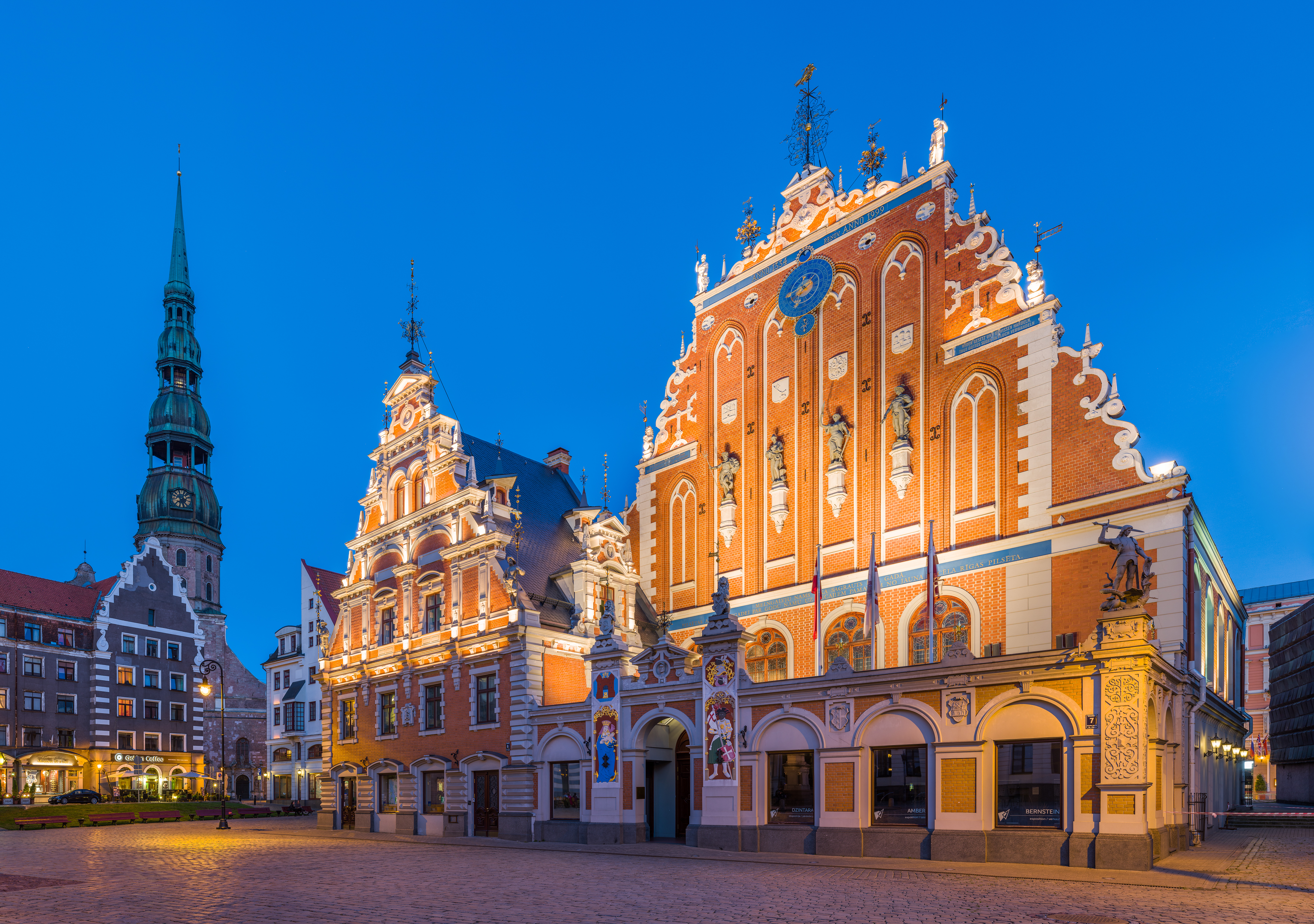
Small enough to cross in fifteen minutes and best walked without a plan. Dome Square and the cathedral with its 6,718-pipe organ; St Peter's, whose tower lift gives the best view in the country; the House of the Blackheads, a 1334 guild house flattened in 1941 and rebuilt from photographs in 1999; the Three Brothers, the oldest dwellings in the city; the Swedish Gate; and the Powder Tower. Much of it is reconstruction, which Latvians will tell you unprompted.
The Central Market
Five vast Zeppelin hangars, brought from Vainode and re-erected beside the railway in the 1930s, holding one of the largest markets in Europe. Fish in one, meat in another, dairy, vegetables, and a sprawl of stalls outside. It is not a tourist attraction that has been prettified — it is where Riga shops — and it is the single best hour in the city. Go in the morning, eat something, and watch.
The Occupation Museum
The black box on Latviešu strēlnieku laukums, telling the story of 1940–1991 through both occupations. It is unsentimental, extremely well done and the correct first stop for any visitor who wants the country to make sense. Next door, the Corner House — the former KGB headquarters on Brīvības iela — is open as a museum and is a much harder hour.
The Freedom Monument
Milda, 42 m of travertine and copper, raised by public subscription in 1935, holding up three gilded stars for the three regions. That the Soviets did not demolish it is a small miracle; that people were arrested for laying flowers at it is the point. There is a permanent honour guard and a changing of it on the hour, and Latvians are quietly serious about it.
The other Riga
Miera iela for coffee and the alternative end of town; Kalnciema kvartāls across the river for restored wooden architecture and a Saturday market; Āgenskalns and Ķīpsala for the wooden houses that are Riga's other great architectural tradition and are far less protected than they should be; and the Academy of Sciences, Stalin's birthday cake, with an observation deck and a fine view back at the Old Town.
Two days, or four
Two days does the Old Town, the market, the Art Nouveau district and one museum. Four lets you add Jūrmala, the wooden suburbs, the Motor Museum — which is much better than it sounds and owns Stalin's and Brezhnev's cars — and an evening at the opera, which is world-class and costs a fraction of what it would in Vienna.
🎨 The Art Nouveau City
This is Riga's genuine claim to a superlative. Roughly a third of all buildings in central Riga are Art Nouveau — Jugendstil — which is the highest concentration of the style of any city in the world, ahead of Brussels, Vienna and Barcelona. It happened because Riga was booming, rich and building fast at exactly the moment the style peaked, between about 1899 and 1914, and because almost none of it was bombed.
Alberta iela
The street everyone photographs, and rightly. Eight of its buildings are by Mikhail Eisenstein — a city engineer with no architectural training and an unrestrained eye — and they are the most extravagant: screaming masks, sphinxes, peacocks, blue and gold tile, faces four metres across. Numbers 2a, 4, 6, 8 and 13 are the ones. His son Sergei Eisenstein, born in Riga, went on to make Battleship Potemkin.
Elizabetes iela and the rest
Elizabetes 10a and 10b are Eisenstein at full volume. But the style is everywhere — Strēlnieku iela, Antonijas, Vīlandes, Ausekļa, Brīvības, Tērbatas, the whole quarter north of the park — and the pleasure is in walking with your head up and finding it yourself rather than ticking off five facades.
National Romanticism
The Latvian variant, and the more interesting one. Architects including Eižens Laube, Konstantīns Pēkšēns and Aleksandrs Vanags stripped away the decoration, used heavy natural materials, steep roofs and folk-derived ornament, and produced something recognisably national at exactly the moment Latvian national feeling was forming. Tērbatas 15/17 and Brīvības 47 are good examples.
Going inside
The Riga Art Nouveau Centre at Alberta iela 12 — Pēkšēns's own apartment, with its spiral staircase — is the one interior open to the public and worth the ticket. It is also, quietly, the building where Latvian painter Janis Rozentāls lived. Several cafés and hotels in the district occupy original interiors; look up in any stairwell you are allowed into.
The wooden city
Riga's other, less celebrated architecture: two-storey wooden apartment houses, thousands of them, in Āgenskalns, Ķīpsala, Grīziņkalns and Torņakalns, some with Art Nouveau detail carved in pine. It is a genuinely rare survival in Europe, it is decaying, and every year a few more burn or are demolished. Kalnciema kvartāls shows what restoration can do.
A caveat
The Art Nouveau district is a residential neighbourhood, not an open-air museum. People live behind those facades, courtyards are private, and the street can get crowded with groups in July. Go early, be quiet, and do not push a camera through a doorway.
🌲 Forest, Bog and Coast
Gauja National Park
The oldest and best-known — 900 km² along the Gauja valley an hour from Riga, with red sandstone cliffs, caves, forest and three towns strung along it. Sigulda has the cable car across the valley, the bobsleigh track and the ruins of the Livonian Order castle; Turaida has the red-brick castle everyone photographs; and Cēsis, at the far end, is arguably the loveliest small town in Latvia. Autumn here is the reason Latvians talk about the golden season.
Ķemeri
The bog, half an hour west of Riga near Jūrmala. A boardwalk loops out over black pools, stunted pines and sphagnum, and the raised bog at sunrise, with mist on the water, is the single most photographed landscape in Latvia — deservedly. There are also sulphur springs, an abandoned sanatorium of extraordinary decayed grandeur, and good birding. Go early; the car park fills.
The Kurzeme coast
The wild half. North from Ventspils the shore is empty, pine-backed and strewn with boulders, and the villages of the Livonian coast — Mazirbe, Košrags, Vaide — are the last home of the Livonians, a Finnic people whose language now has effectively no native speakers left. Cape Kolka is where the Gulf of Riga meets the open Baltic over a shallow bank, with waves running at each other from two directions.
Slītere and Pape
Slītere National Park covers the Kolka spit and the ancient shoreline cliff behind it — a migration bottleneck where hundreds of thousands of birds funnel past in spring. Lake Pape in the far south-west has a bird ringing station, wild horses and aurochs-type cattle grazing the meadows, and almost no visitors.
Jūrmala
The resort strip: 33 km of white sand backed by pine and by several thousand wooden summer villas, twenty minutes by train from Riga. It was the Soviet Union's Baltic riviera and its faded sanatoria and new spa hotels sit side by side. Majori and Dzintari are the busy part; walk twenty minutes in either direction and you have the beach to yourself. The water is shallow, brackish and, in August, warm enough.
How to be in it
Latvia has an effective right of access to forests and shorelines, marked trails are decent and improving, and the Baltic Coastal Hiking Route runs the length of the country as part of the E9. Mushrooming in September is close to a national sport and Latvians will be visibly pleased if you join in. The one genuine hazard is ticks: tick-borne encephalitis is endemic here and vaccination is a serious recommendation, not a formality.
🏘️ Beyond Riga
Kuldīga
Latvia's newest UNESCO World Heritage site, inscribed in 2023 for a remarkably intact old town of low wooden and brick houses from the seventeenth and eighteenth centuries, when it was the capital of the Duchy of Courland. It also has the Venta rapid, the widest waterfall in Europe at 249 m and only about two metres high, where fish once leapt into nets held by the duke's men, and a long brick bridge of 1874.
Cēsis
The prettiest small town in the country: a medieval Livonian Order castle you tour by lantern, a walkable centre of pastel houses, a good art scene, and an outsized place in national memory as the site of the decisive 1919 battle. An hour and a half from Riga and an easy day trip, or a much better overnight than most people realise.
Liepāja
The one with the edge. A port and former closed Soviet naval city on the west coast, with the extraordinary Karosta district — a tsarist naval base turned Soviet garrison, half-ruined, with an Orthodox cathedral, a former military prison you can sleep in, and the fortifications collapsing into the sea. Also the best beach in any Latvian city, a strong music tradition, and the amber-coloured concert hall.
Ventspils
The rich one. Oil transit money built a town of obsessive tidiness — flowerbeds, painted cows, a narrow-gauge railway, spotless Blue Flag beaches — and it is either charming or slightly unreal depending on your mood. Excellent with children. The transit business that paid for it has largely gone, which is a story the town does not tell on its signboards.
Daugavpils and Latgale
Latvia's second city is majority Russian-speaking, sits on the Daugava near the Belarusian border, and holds a huge nineteenth-century fortress whose artillery arsenal is now the Mark Rothko Art Centre — Rothko was born here in 1903. Latgale beyond it is the poorest and most distinct region: Catholic, with the pilgrimage basilica at Aglona, a living pottery tradition, blue lakes and a dialect that some argue is a separate language.
Rundāle
The Baroque palace in Zemgale, built by Rastrelli — the architect of the Winter Palace — for the Duke of Courland in the 1730s, wrecked in the twentieth century and restored across fifty years by one obsessive director. The gold hall, the white hall and the rose garden are the closest thing Latvia has to Versailles, and it is an hour and a quarter from Riga. Combine it with Bauska castle.
🍽️ The Food
Latvian cooking is northern, seasonal and much better than its reputation, which was formed when the only thing foreigners ate here was a Soviet canteen. The base is rye, pork, potato, dairy, fish, cabbage, beetroot, peas, dill and forest food — berries, mushrooms, game. In the last fifteen years Riga has grown a serious New Nordic-influenced restaurant scene working from exactly that list, and Latvia now has restaurants that would hold their own anywhere.
Rupjmaize
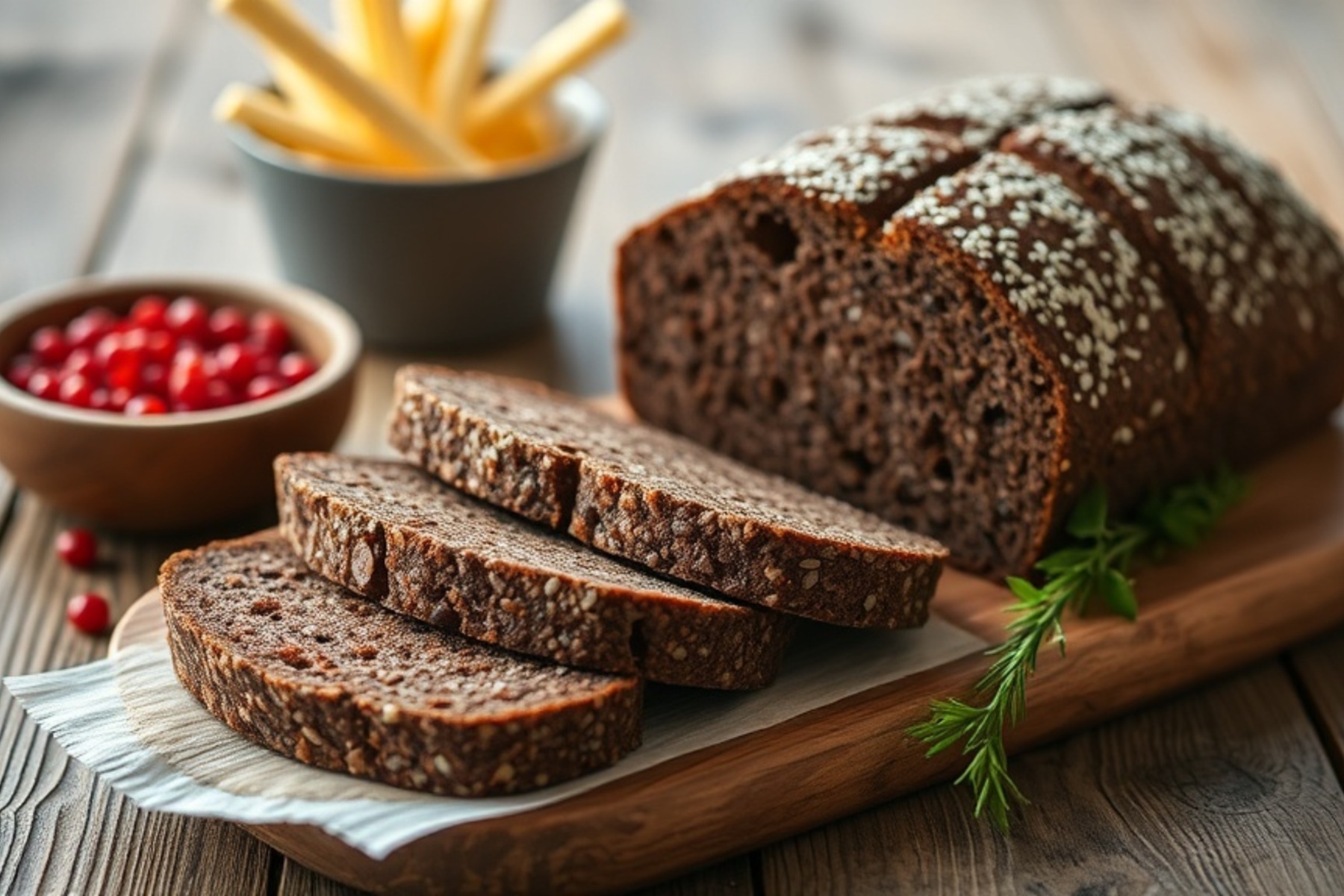
Dark sourdough rye, dense, moist, faintly sweet from the scalded flour and caraway, and the food Latvians abroad miss most. It keeps for a week, it is eaten with everything, and it turns up in dessert as well. If you take one thing home from the Central Market, take a loaf. Sklandrausis — an open rye tart of carrot and potato purée from Kurzeme — is its close relative and has EU protected status.
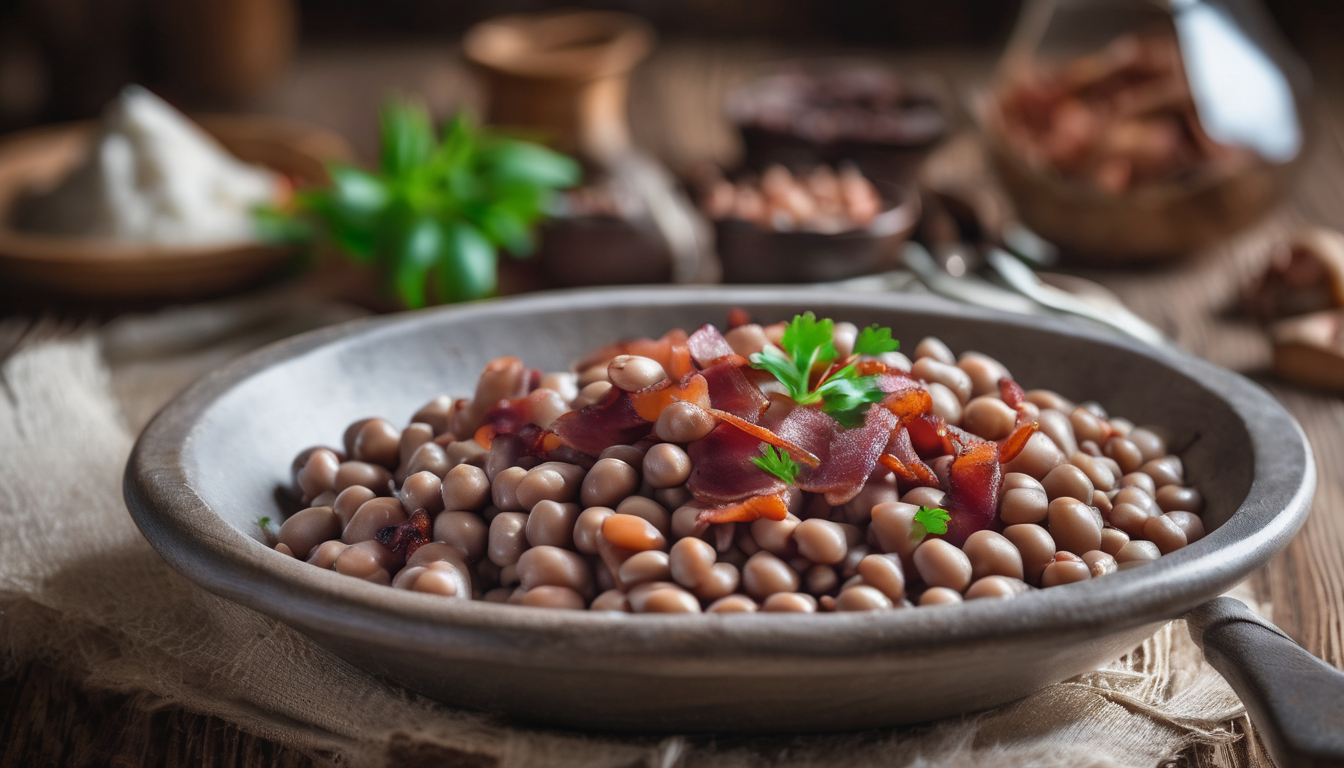
Pelēkie zirņi ar speķi
Grey peas with fat bacon and onion: a bowl of large brown-grey peas, fried speck, and often a glass of buttermilk beside it. It is the national dish, it is a Christmas dish above all, and it is the plainest thing in this guide. The tradition says you must not leave a single pea, or you will cry through the coming year.
Fish
The Baltic delivers herring, sprats and eel. Riga sprats in oil, smoked over alder in Salacgrīva and tinned, were a Soviet luxury export and are still the country's most recognisable food product; smoked fish stalls along the coast, especially around Salacgrīva and the Kurzeme villages, sell flounder and eel hot from the smokehouse and are worth a detour.
Soups and the everyday
Skābeņu zupa (sorrel soup with egg), aukstā zupa — the shocking-pink cold beetroot and kefir soup of high summer, which every Baltic country claims — frikadeļu zupa with meatballs, and grey pea or barley soups in winter. Alongside them: pork cutlet, potato pancakes, pīrāgi (small bacon-filled crescent rolls that appear at every celebration), and cottage cheese in every possible form.
Sweet
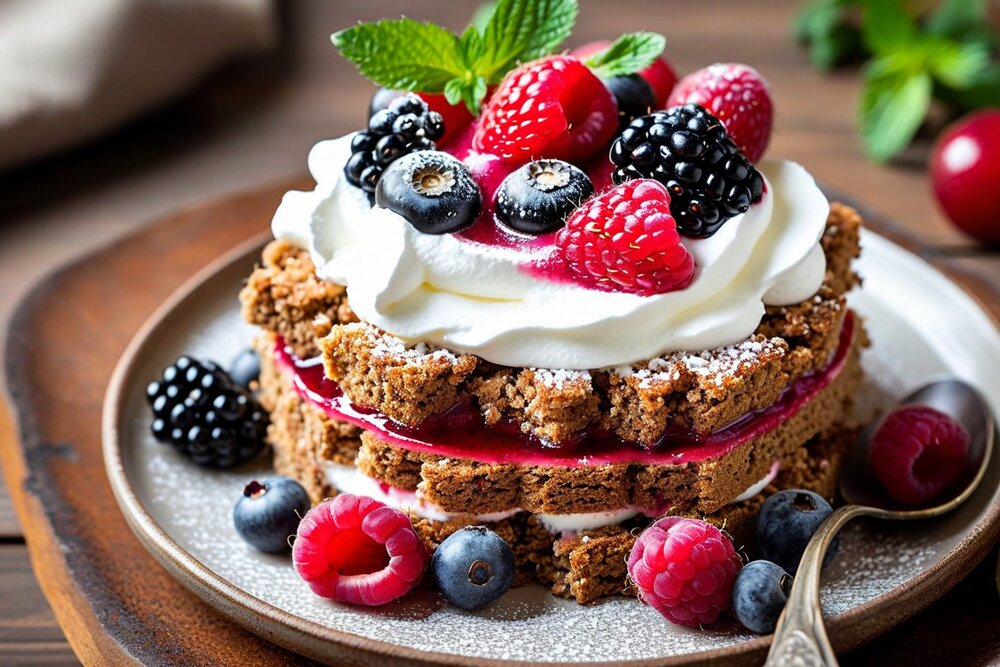
Rupjmaizes kārtojums, layers of toasted rye breadcrumbs, whipped cream and cranberry jam, is the dessert to order. Debessmanna is a whipped cranberry-semolina mousse, pink and airy. Biezpiena siers is a caraway curd cheese, and Laima chocolate — the Riga factory whose clock is the city's meeting point — is what people bring home.
Eating out
Riga runs from EUR 6 canteen lunches at the excellent Lido chain to tasting menus at a fraction of Nordic prices. The self-service canteen is the great Latvian value proposition and there is no stigma attached to it. Outside Riga, choice narrows sharply after 8 p.m. and in small towns on Sundays; in the countryside, plan meals rather than assume them.
👨🍳 Two Recipes
One savoury, one sweet, and both built on the same loaf of rye bread.
Pelēkie zirņi ar speķi
Serves 4 · 15 minutes plus overnight soaking
Ingredients: 400 g dried grey peas (Latvian pelēkie zirņi; brown or maple peas are the closest substitute — do not use green split peas), 250 g fatty smoked bacon or speck in 1 cm dice, 2 large onions finely chopped, black pepper, salt, optional 200 ml buttermilk or kefir to serve.
Method: Soak the peas in plenty of cold water overnight. Drain, cover with fresh unsalted water and simmer gently for about an hour, until tender but still holding their shape — salt only near the end, or the skins toughen. Meanwhile render the bacon slowly in a dry pan until the fat runs and the pieces begin to crisp; add the onion and cook until soft and golden, about ten minutes, in the bacon fat. Drain the peas, tip them into the pan with the bacon and onion, turn everything together over a low heat for two or three minutes so the peas take up the fat, and grind over plenty of black pepper. Serve hot in bowls, with a glass of cold buttermilk alongside.
💡 It is meant to be plain. Resist the urge to add garlic, herbs or stock — Latvians will tell you, correctly, that it then stops being this dish.
Rupjmaizes kārtojums
Serves 4 · 25 minutes plus 2 hours chilling
Ingredients: 250 g dark rye bread (rupjmaize), 3 tbsp sugar, 1 tsp ground cinnamon, 300 ml double cream, 1 tbsp icing sugar, 250 g thick cranberry jam or lightly sweetened cranberry purée, optional 2 tbsp Riga Black Balsam or dark rum.
Method: Blitz the rye bread to coarse crumbs, spread on a tray with the sugar and cinnamon and toast in a 170 °C oven for 12 to 15 minutes, stirring twice, until dry and fragrant; cool completely — this step is what makes or breaks the dish. Whip the cream with the icing sugar to soft peaks. If using, stir the Balsam or rum into the cranberry jam. Then layer in glasses or a glass bowl: crumbs, cranberry, cream, crumbs, cranberry, cream, finishing with a scatter of crumbs. Chill at least two hours so the crumbs soften slightly but do not dissolve. Serve cold, with a few whole cranberries on top.
💡 Use real sour cranberry, not a sweet berry compote. The whole point is the collision of sour fruit, sweet cream and dark bitter bread.
🥃 Black Balsam, Beer and Birch Sap
Riga Black Balsam
The national drink and an acquired taste. A jet-black herbal bitter of 45%, made in Riga to a recipe traced to 1752 from a long list of botanicals — wormwood, valerian, ginger, oak bark, linden, raspberry, bilberry — sold in a distinctive matte ceramic bottle. Neat it is medicinal and challenging. It is far better in hot blackcurrant juice or tea in winter, or in coffee, and there are now blackcurrant and cherry versions that are considerably easier. Catherine the Great is said to have been cured by it, which is exactly the kind of claim a bitters brand keeps.
Beer
Latvia takes beer more seriously than visitors expect. Aldaris, Cēsu, Užavas and Valmiermuiža are the established names — Užavas unfiltered is the one to try — and there is a substantial craft scene in Riga. In the countryside look for farmhouse ale in Latgale and the north-east, which is a genuine survival of a pre-industrial brewing tradition and not a marketing exercise.
Kvass
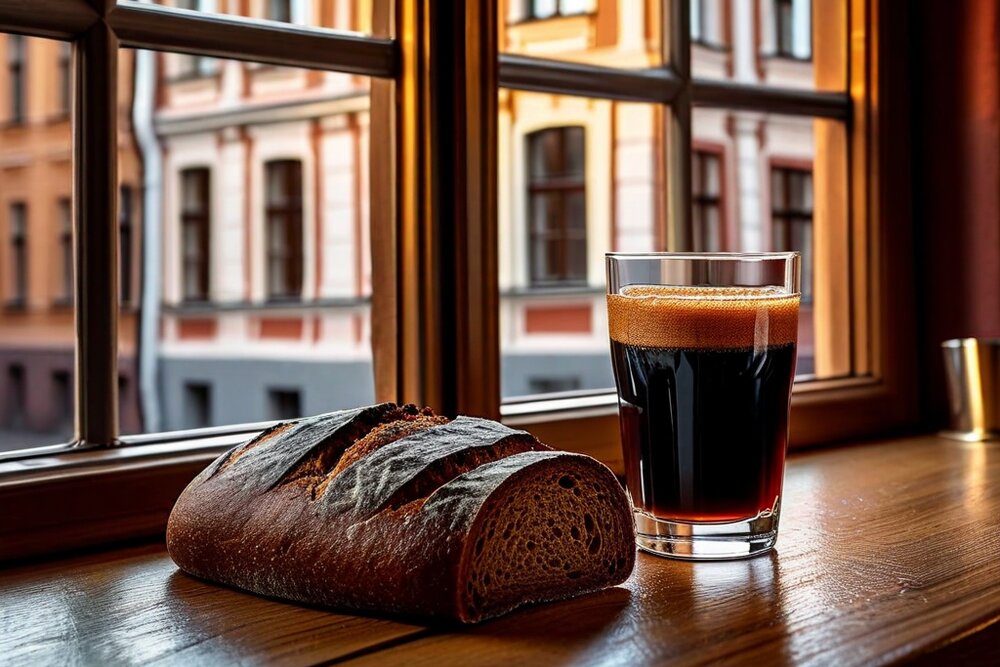
Fermented rye bread drink, dark, slightly sour, barely alcoholic and sold from tanks on the street in summer. It is the everyday non-alcoholic drink of the region and it tastes far better than a description of it suggests. It is also the natural partner to a slice of rupjmaize, which is the same raw material twice.
Birch sap
Bērzu sula, tapped from birches for two or three weeks in early spring, drunk fresh, lightly fermented or bottled. It is faintly sweet, slightly mineral and it is one of the genuinely distinctive things you can drink in Latvia. Increasingly sold commercially, including sparkling versions, and it appears in cocktails in Riga.
Wine, sort of
Grape wine is not a Latvian product, but fruit and berry wine very much is — rhubarb, blackcurrant, apple and quince from small producers, and sparkling rhubarb wine that is better than it sounds. Abava and Sabile deserve a mention: Sabile's hillside vineyard was once listed as the northernmost in the world in the Guinness Book of Records, and it still makes wine, more for the record than for the taste.
Practicalities
Alcohol is sold in shops from 10:00 to 22:00 and not outside those hours — a rule that catches visitors regularly. The legal age is 18, drink-driving limits are strict and enforced, and drinking in public places is prohibited. Latvian drinking culture is heavy by Nordic standards and moderating; the state has been raising excise and shortening hours for years.
🎶 The Song Festival, Jāņi and the Dainas
Two things explain Latvian culture to an outsider: a choir festival that assembles a large fraction of the nation once every five years, and a midsummer night that empties the cities. Both are older than the state and both are taken seriously in a way that has nothing to do with tourism.
The Song and Dance Festival
First held in 1873, held every five years, and inscribed by UNESCO — together with the Estonian and Lithuanian equivalents — as a Masterpiece of the Intangible Heritage of Humanity. Tens of thousands of singers and dancers, most of them amateurs from village and workplace choirs, converge on Riga for a week; the closing concert at the Mežaparks open-air stage runs to a choir of some 15,000 people and an audience far larger. The 2023 edition marked the 150th anniversary; the next is due in 2028.
Why it matters
Because it was the vehicle. Under Soviet rule the festivals continued with an approved programme, and in 1985 and 1990 the crowds simply refused to stop singing the forbidden songs — the same mechanism that gave the whole period the name Singing Revolution. Gaismas pils and Pūt, vējiņi are not just songs here.
Jāņi
Midsummer, on the night of 23–24 June, and the biggest holiday of the year — larger, in practice, than Christmas. Everyone named Jānis is honoured, oak wreaths for the men and flower wreaths for the women, bonfires that must burn until sunrise, caraway cheese (Jāņu siers), beer, and a great deal of singing of līgo songs. Cities empty. Two public holidays cover it. If you can be in Latvia for one date, be there for this one.
The dainas
The 1.2 million four-line folk songs collected by Krišjānis Barons are the deep layer under all of it — pre-Christian, terse, and concerned with the sun, the seasons, work, orphans and the dead. The Cabinet of Folksongs, the purpose-built oak filing cabinet Barons designed to hold them, is on the UNESCO Memory of the World register and is displayed at the National Library.
Art and music
The National Library — Gunnar Birkerts's "Castle of Light" on the left bank — is worth visiting for the building alone. The Latvian National Museum of Art holds the nineteenth- and twentieth-century Latvian canon, Purvītis and Rozentāls above all. In music Latvia produces far more than its size warrants: the conductors Mariss Jansons and Andris Nelsons, the composer Pēteris Vasks, the Latvian Radio Choir, and Riga's opera house, which is very good and very cheap.
Manners
Latvians are reserved with strangers, direct once you are past that, and not given to small talk — visitors from more effusive cultures often read this as coldness and it is not. Take shoes off indoors. Handshakes, not embraces. Punctuality matters. Do not raise the Soviet period, the Legion or the Russian minority as an opening topic; if a Latvian raises it, listen.
🗣️ Latvian, Russian and English
Language is the most politically charged subject in the country and it is impossible to describe Latvia honestly without it. Latvian is the sole state language and about 60% of the population speak it as a first language; Russian is the first language of roughly a third and has no official status at all — a 2012 referendum on making it a second state language was defeated by about three to one.
The shape of Latvian
Two grammatical genders, seven cases, a stress that is almost always on the first syllable, and long and short vowels that change meaning. It is hard for an English or Czech speaker but the Czech will at least recognise the case system and the free-ish word order. Written in Latin script with diacritics: ā, ē, ī, ū are long vowels; č, š, ž as in Czech; ģ, ķ, ļ, ņ are palatalised.
A survival list
Sveiki — hello. Labdien — good day. Paldies — thank you. Lūdzu — please, and also you're welcome. Jā / nē — yes / no. Cik maksā? — how much? Atvainojiet — excuse me. Uz redzēšanos — goodbye. Priekā! — cheers. Even a badly pronounced paldies is noticed and appreciated.
The reform
Since 2022 Latvia has moved decisively to end Russian-language schooling. The transition to teaching entirely in Latvian completed with the 2025/26 school year, and Russian is being phased out as a second foreign language from 2026/27, to be replaced by official EU languages. Supporters call it the completion of a thirty-year unfinished job and the end of segregated education; critics, including some human rights bodies, point to the practical cost to children and teachers mid-education. The LSM reporting on the transition has been candid that it has not been smooth.
Russian in daily life
You will hear it constantly — in Riga, in Daugavpils, everywhere. It is not illegal, it is simply not official, and its public use has become socially loaded since 2022 in a way it was not before. Visitors who speak Russian should be aware that opening in Russian to a stranger can land badly with some Latvians and be entirely welcome with others; opening in English avoids the question.
Livonian and Latgalian
Livonian, the Finnic language of the north Kurzeme coast, has effectively no remaining native speakers and a small determined revival movement. Latgalian, spoken in the south-east, is protected by law as a "historic variant" of Latvian; whether it is a dialect or a separate language is an argument you should let Latvians have among themselves.
English
Widespread and good in Riga, in tourism, and among anyone under about forty. Patchy in small towns and rural areas, where the older generation is more likely to have Russian than English. Signage in Riga is bilingual or trilingual; outside it, expect Latvian only.
⛪ Lutherans, Catholics and the Least Religious Country in Europe
Three churches, roughly equal
Latvia is the only country in the world where Lutheranism, Catholicism and Orthodoxy are all major denominations of comparable size — a direct map of who ruled which part when. Lutheranism came with Swedish rule to the north and centre, Catholicism held in Polish-ruled Latgale, and Orthodoxy arrived with the Russian Empire and with Russian-speaking settlement.
And yet
Latvia consistently ranks among the least religious countries in Europe by any measure of belief and practice — a legacy of fifty years of state atheism laid over a population that was never fervent. Churches are full at Christmas and Easter and quiet otherwise. This does not stop religious institutions from mattering culturally, and it does not stop midsummer, which is older than all of them.
What to see
Riga Cathedral (the Dome), begun in 1211, with one of the great historic organs of Europe; St Peter's, with the viewing tower; the Nativity of Christ Cathedral, a full-dress Russian Orthodox cathedral of the 1880s that was a planetarium under the Soviets and is now restored; and the Aglona Basilica in Latgale, where up to a hundred thousand pilgrims gather on 15 August.
The Orthodox split
In 2022 the Saeima legislated that the Latvian Orthodox Church is fully independent of the Moscow Patriarchate — an unusual step for a parliament to take about a church, done for security reasons, and one Moscow does not recognise. It is a small, sharp illustration of how far the war has reached into ordinary institutions here.
The old gods
Dievturība, a reconstructed Latvian pagan religion assembled in the 1920s from the dainas, is small but real and has legal recognition. More to the point, the pre-Christian layer survives everywhere in practice rather than in doctrine: in midsummer, in the sun symbols on textiles and gates, in the Jāņi fire, and in the way Latvians talk about the forest.
The Jewish history
Riga had a large and old Jewish community, and Latgale's small towns were shtetls. Almost all of it was destroyed in 1941: some 25,000 people were shot at Rumbula over two days in November and December, and tens of thousands more at Biķernieki and across the country, alongside Jews deported here from Germany and Austria. The memorials at Rumbula and Biķernieki, the restored Peitav Synagogue and the ruin of the Great Choral Synagogue in Riga are the places to go.
👥 Two Communities, One Country
The numbers
Around 63% ethnic Latvians, 24% Russians, and about 3% each Belarusians and Ukrainians, plus Poles and Lithuanians. The Latvian share was around 77% in 1935 and fell to just over 52% by 1989 through wartime losses, deportations and Soviet-era in-migration; it has risen since 1991 as Slavic residents emigrated and through natural change. In Riga and Daugavpils the balance is much closer than the national figure suggests.
Non-citizens
The unresolved category. People who settled during the Soviet period and did not naturalise hold alien's passports — residence, most civil rights, travel, but no vote in national elections and no EU citizenship. From a peak of around 700,000 in 1995 the number has fallen below 150,000, mostly through naturalisation, emigration and death, and children born since 2020 receive citizenship automatically. It has been criticised for thirty years by Russia — self-servingly — and, in more measured terms, by the Council of Europe and the OSCE.
Since 2022
The screw has tightened. Russian citizens resident in Latvia were required to pass a Latvian language test to retain permanent residence, with deadlines that caught a number of elderly people and drew criticism; Russian television has been taken off the air; Soviet monuments including the large Victory memorial in Riga were dismantled in 2022; and the education transition completed in 2025/26. The government frames all of this as overdue de-occupation; a substantial minority of residents experience it as directed at them personally. Both perceptions are real.
Emigration
The other social fact. Free movement after 2004 and the crash of 2008–10 sent several hundred thousand Latvians to Ireland, Britain, Germany and the Nordics. Whole districts of Latgale and Kurzeme lost their working-age population; some have come back as wages rose, but far fewer than left. Latvia has one of the fastest-shrinking populations in the world and it is the quiet background to every political debate.
Society today
Small, well-educated, digitally competent — public administration is almost entirely online — and unequal by EU standards, with a stark gap between Riga and everywhere else. Life expectancy, especially male life expectancy, is among the lowest in the EU, and alcohol and cardiovascular disease are the reasons. LGBT rights moved fast in a socially conservative country: Latvia introduced civil partnerships in 2024, and has had an openly gay head of state since 2023.
Ukrainians
Latvia took in tens of thousands of Ukrainian refugees relative to a population under two million, with a broad public consensus and very little of the backlash seen elsewhere in Europe. Ukrainian is now heard in Riga alongside Latvian and Russian, Ukrainian children are in Latvian schools, and support for Ukraine remains one of the few things nobody here argues about.
🏛️ UNESCO and What Is Protected
Historic Centre of Riga
Inscribed in 1997 for three overlapping things: the medieval and later urban fabric of the Hanseatic town, the nineteenth-century planned extension with its boulevards and parks, and — the reason explicitly cited — the unparalleled quality and quantity of its Art Nouveau architecture together with its nineteenth-century wooden buildings.
Struve Geodetic Arc
Inscribed in 2005: a chain of survey stations running 2,820 km from Norway to the Black Sea, set up between 1816 and 1855 to measure the shape of the earth. Thirty-four points in ten countries are protected and two of them are in Latvia. They are stone markers in fields, they are not a sight, and they are one of the more charming things on the World Heritage list.
Old Town of Kuldīga
Inscribed in 2023, the newest and the one to make an effort for: an unusually complete small town of the seventeenth and eighteenth centuries from the era of the Duchy of Courland, in wood and brick, with its street pattern and scale intact. It is three hours from Riga and most visitors never get there.
Intangible heritage
The Baltic Song and Dance Celebrations (with Estonia and Lithuania), and the Suiti cultural space — a small Catholic community on the Kurzeme coast with archaic drone singing, distinctive dress and its own traditions, listed as needing urgent safeguarding.
Memory of the World
Two Latvian entries: Krišjānis Barons's Cabinet of Folksongs, and the documentary record of the Baltic Way of 23 August 1989, held jointly with Estonia and Lithuania.
What is not listed and should be
Riga's wooden architecture outside the inscribed zone, which is a rare survival in Europe and is being lost to fire, neglect and development a few buildings a year; the Livonian coastal villages; and the industrial heritage of Liepāja's Karosta, which is spectacular, dangerous and largely unprotected.
📅 When to Go
Latvia has a short, generous summer and a long, grey rest of the year, and the difference between them is larger than the temperature figures suggest. Light is the real variable: around midsummer it barely gets dark, and in December it is dark by four.
June to August
The season. Temperatures in the high teens to mid twenties, the sea warm enough by late July, the coast and the national parks at their best, and the long northern evenings that are the actual reason to come in summer. Jāņi on 23–24 June is the highlight of the year. Riga is busy but never oppressively so, and prices rise modestly rather than absurdly.
September
The best-kept secret and, many Latvians would say, the best month. Warm days, cold nights, the forests turning, mushroom season in full swing, the Gauja valley at its most photographed, and the crowds gone. The Riga Restaurant Week and a full concert season restart. If you can only take one week, take the first half of September.
May and October
Genuinely good shoulder months with a gamble attached. May brings the birch leaf, birdsong, birch sap and the first warm days; October brings colour and rain in unpredictable proportions. Both are cheap, both are quiet, and both need a proper coat.
Winter
Cold — typically −3 to −7 °C, colder inland, with snow lying through January and February — and dark, with about six hours of usable light in December. What it gives you is a Baltic Christmas market season, snow in the Old Town, cross-country skiing and skating, the Sigulda bobsleigh track open to the public, and Black Balsam in hot blackcurrant juice, which suddenly makes complete sense.
What to pack
Layers, in every month. A waterproof shell year-round. In summer, insect repellent for the forest and coast — mosquitoes near the bogs in June and July are serious. In winter, real boots and a hat. And in any month from spring to autumn, be aware of ticks if you are going into long grass or forest.
Dates to plan around
Jāņi, 23–24 June, when the country shuts and the cities empty. 18 November, independence day, with a torchlight procession and fireworks over the Daugava. The Song and Dance Festival, next expected in 2028, which fills every bed in Riga and is worth planning a year ahead for. And the two remembrance days, 25 March and 14 June, which are solemn rather than closed.
🚆 Getting There and Around
Flying
Riga (RIX) is the largest airport in the Baltic states and the hub of airBaltic, which is the reason Riga is easy to reach from almost anywhere in Europe. Wizz Air and Ryanair also serve it. The airport is 10 km from the centre: bus 22 costs a couple of euros and takes half an hour, the taxi about EUR 15, and there is a direct express bus. Liepāja and Ventspils have tiny airports; Vilnius and Tallinn are four hours by bus.
Buses
The workhorse. Riga's international coach station beside the Central Market runs frequent services to Vilnius (4 h), Tallinn (4.5 h), Kaunas, Warsaw, Tartu and further, and a dense domestic network to every town in the country. Comfortable, cheap, punctual, bookable online. For most journeys in Latvia the bus is better than the train.
Trains
A limited network — Riga to Jūrmala, Sigulda and Cēsis, Daugavpils, Jelgava, Liepāja — but the Jūrmala line in particular is excellent: trains every half hour, twenty minutes, a euro or two. Rolling stock has been renewed. There is no international passenger service to Vilnius or Tallinn worth using, which is precisely what Rail Baltica is supposed to fix, and will not before 2030.
Driving
Easy. Roads are decent on the main corridors and often gravel in the countryside — plenty of Latvian roads are unsurfaced and perfectly fine at 60 km/h. Headlights on at all times, seatbelts, zero-tolerance policing of speed and drink, winter tyres compulsory from 1 December to 1 March. Car hire in Riga is cheap. Watch for elk and deer at dusk, which is not a formality here.
In Riga
Walk. The Old Town and the Art Nouveau district are twenty minutes apart on foot and the centre is compact. Trams, trolleybuses and buses run on a single ticket bought from the driver or a kiosk, and there is a good bike-share and a growing network of lanes. Taxis are fine if metered; use Bolt, which is everywhere and cheap.
Crossing borders
Estonia and Lithuania are Schengen and invisible. The Russian and Belarusian borders are effectively closed to ordinary travel: most crossings are shut, queues at the remainder are long, and government advice against travel to both countries is unambiguous. Do not plan a Latvia–Russia leg.
📋 Practical Information
Entry
Latvia is in the EU and Schengen. EU, EEA and Swiss citizens need only an ID card. Most other Western nationals — UK, US, Canada, Australia, Japan — enter visa-free for 90 days in any 180; the EU's ETIAS authorisation for visa-free non-EU travellers is being introduced and its start date has moved more than once, so check before booking rather than assuming.
Money
The euro since 2014. Latvia is close to cashless: cards work everywhere including buses, markets and small cafés, and contactless is universal. ATMs are plentiful. Carry a small amount of cash for rural stalls and the occasional smoked-fish shack, and nothing more.
Health
The EHIC / GHIC gives EU and UK visitors access to the state system on the same terms as Latvians — which means with the same co-payments — and does not replace travel insurance. Care in Riga is good; rural provision is thin. Pharmacies (aptieka) are well stocked and staff usually speak English or Russian. The one country-specific risk is tick-borne encephalitis, which is endemic: if you plan to walk in forest or long grass, get vaccinated well in advance and check yourself after every walk. Lyme disease is also present.
Safety
Latvia is safe. Violent crime against visitors is rare; the realistic risks are pickpocketing in the Old Town and around the market, and the Riga stag-party economy, which has produced a well-documented pattern of inflated bills, spiked drinks and aggressive touts in a handful of Old Town bars and strip clubs. Avoid anywhere you were invited to by someone on the street, and check the price before you order.
Connectivity
Excellent. Latvia has some of the fastest and cheapest mobile internet in Europe, EU roaming applies for EU SIMs, and free wifi is close to universal in cafés and public buildings. Public administration is almost entirely digital.
Practicalities that catch people
Alcohol is not sold in shops before 10:00 or after 22:00. Shoes come off indoors, always. Tipping is 5–10% in restaurants and not expected elsewhere. Tap water is safe and good. Smoking is banned indoors in public places. And 18 November and the Jāņi holidays close almost everything.
💵 What It Costs
Latvia is no longer cheap in the way it was in 2005, but it remains substantially less expensive than Scandinavia or Germany and is broadly comparable to Czechia, with Riga a little dearer than Prague for accommodation and a little cheaper for food.
A bed
Hostel dorm in Riga EUR 15–25; a good three-star or apartment double EUR 60–95; a design or four-star hotel in the Old Town EUR 110–170. Outside Riga, guesthouses and country hotels run EUR 45–80 and are often excellent value; Jūrmala spa hotels in July are the one place where prices become genuinely Scandinavian.
A meal
Lunch at a Lido or similar self-service canteen EUR 6–10 and no worse for it; a main course in a normal Riga restaurant EUR 12–20; a serious tasting menu at one of the top places EUR 70–110, which is a third of the Copenhagen price for comparable cooking. Coffee EUR 2.50–3.50, a half-litre of beer EUR 4–6 in the centre and EUR 3 outside it.
Getting around
A Riga public transport ticket is around EUR 1.50 from a kiosk. The train to Jūrmala is under EUR 2, the bus to Cēsis about EUR 5, Riga to Liepāja about EUR 12, and the coach to Vilnius or Tallinn EUR 15–25 booked ahead. Car hire from EUR 35 a day, fuel roughly EUR 1.65–1.75 a litre.
Museums and culture
Cheap by European standards. Most museums EUR 5–12; the Occupation Museum operates on donations; St Peter's tower about EUR 9. Opera and ballet tickets from around EUR 15, and good seats for EUR 40, at a house of genuine international standard — this is the best-value cultural experience in the Baltic states and visitors routinely miss it.
A daily budget
Backpacking: EUR 55–75 a day. Comfortable mid-range travel with a hotel, restaurant meals and a museum: EUR 120–170. Riga at the expensive end with fine dining and a spa hotel: EUR 250 upward. A week in Latvia for two people, mid-range and excluding flights, lands around EUR 1,400–2,000.
Where the money goes further
Everything outside Riga, and everything in the shoulder season. A country guesthouse, a bus, a market lunch and a national park cost a fraction of the equivalent in Riga in July, and the experience is often the better one.
🇨🇿 For Czech Travellers
Getting there from Prague
airBaltic flies Prague–Riga direct, in about 1 hour 50 minutes, usually daily or near-daily; Ryanair has also operated the route seasonally. Return fares are typically 2 500–6 000 Kč, at the low end outside July and August and if booked early. It is one of the easiest short-haul destinations from Prague and Latvians will often be as surprised as you are that the flight is so short.
Entry
Latvia is in the EU and Schengen: a Czech ID card is enough, no passport, no registration, no limit on the length of a tourist stay. There is nothing to arrange.
MZV ČR and DROZD
There is a Czech embassy in Riga (Elizabetes iela), which handles Latvia directly — check current contact details and any travel advisory on mzv.cz before departure. Registration in DROZD (drozd.mzv.cz) is quick and sensible for any trip, and for a country on NATO's eastern flank in 2026 it costs you nothing to be on the list.
Health insurance
The European Health Insurance Card works — Latvia is in the EU, so the EHIC gives you state care on Latvian terms, including Latvian co-payments, which are not trivial. Take commercial travel insurance as well, and if you plan to cycle, hike or go on the Sigulda bobsleigh track, check that the policy covers it.
Prices in Czech terms
A Riga hotel double runs roughly 1 500–2 400 Kč, a canteen lunch 150–250 Kč, a restaurant main 300–500 Kč, a beer 100–150 Kč, an opera ticket from 380 Kč. A week for two, mid-range, comes to about 35 000–50 000 Kč including flights. Accommodation is a little dearer than Prague; food, transport and culture are comparable or cheaper.
Czech connections
Two peoples with a similar instinct about the twentieth century. Czechoslovakia and Latvia recognised each other in the 1920s and had close interwar relations; the Baltic Way of 1989 and the Velvet Revolution belong to the same season and Latvians remember that. Škoda is common on Latvian roads, Czech beer is stocked in Riga bars, and there is a small Czech community in Riga. For a Czech visitor, the National Romanticism of the Art Nouveau district — folk motifs pressed into a modern international style — will look immediately familiar.
🗺️ Routes Through the Country
A long weekend
Riga only, and do not apologise for it. Day one: the Old Town, St Peter's tower, the Central Market and the Occupation Museum. Day two: the Art Nouveau quarter on foot, the National Library, an afternoon in Āgenskalns or Kalnciema, opera in the evening. Day three: the train to Jūrmala for the beach and the wooden villas, or to Sigulda for the Gauja valley.
One week, no car
Riga three nights → train to Sigulda and Cēsis for two nights in the Gauja valley → bus to Liepāja for Karosta and the beach → bus back to Riga with a night in Jūrmala. Entirely feasible on public transport and it shows you the three faces of the country: the city, the forest and the coast.
Ten days with a car
Riga → Rundāle and Bauska → Kuldīga for the UNESCO old town → the Kurzeme coast north through Pāvilosta and Ventspils to Cape Kolka and the Livonian villages → back down the Gulf coast → Ķemeri bog → Gauja and Cēsis → Riga. This is the trip that actually shows you Latvia.
The eastern loop
For a second visit. Riga → Aglona → Daugavpils for the fortress and the Rothko centre → the lakes of Latgale around Rāzna → Ludza and the potters of Latgale → back via Rēzekne. Poorer, emptier, Catholic, Russian-speaking and completely different in feel from anywhere west of it, and almost no foreign visitors go.
The Baltic capitals
The classic regional trip and it works. Vilnius → Riga → Tallinn, or the reverse, by coach — four to four and a half hours between each, comfortable and cheap. A week gives each city two nights and one day trip; ten days lets you add the Curonian Spit in Lithuania and the Gauja in Latvia. Riga is the one people expect least of and often like best.
What to skip
The Old Town bar strip after dark, for reasons set out under practical information. "Medieval" themed restaurants. And the temptation to see Latvia as a day and a half between Vilnius and Tallinn — the country outside Riga is the half of it most visitors never open.
💡 Things Worth Knowing
The Christmas tree, allegedly
Riga claims the first decorated Christmas tree, put up by the Brotherhood of Blackheads in the town square in 1510, and there is a plaque in eight languages on Rātslaukums to prove it. Tallinn makes the same claim for 1441. The evidence on both sides is a chronicle entry about a tree and some merrymaking, and the two cities have been enjoying the argument for a century.
The jeans of the Soviet Union
Latvia's Soviet-era industry made things everyone in the bloc knew: VEF radios and the Minox spy camera, RAF minibuses, Riga's railway carriages, and the sprats in the flat tin. VEF's factory once employed 20,000 people. Almost none of it survived 1991, and the Motor Museum and the VEF district are where you go to see the traces.
A duchy with colonies
In the 1650s the Duchy of Courland — a territory smaller than Moravia, nominally a Polish vassal — ran one of the largest merchant fleets in Europe from Ventspils and held colonies on the island of Tobago and at the mouth of the Gambia. There is still a Great Courland Bay in Tobago and a monument to the settlers. It is the least likely fact about Latvia and it is entirely true.
The widest waterfall in Europe
The Venta rapid at Kuldīga is 249 m across and about two metres high — a technicality that Latvians deploy with a completely straight face. In spring, vimba and lamprey run it, and in the ducal era men stood on the rocks catching fish in baskets as they jumped, which is why the town's coat of arms has a fish in mid-air.
More storks than almost anywhere
Latvia has one of the highest densities of white storks on earth — something over ten thousand pairs — nesting on poles, chimneys and purpose-built platforms in more or less every village. They arrive in April and leave in August, and Latvians track their return the way other countries track the first swallow.
The flag rules
Latvia legislates the exact shade of its flag — a specific carmine red, darker than most reds, in a 2:1:2 ratio — and there are formal rules about when it flies at half mast, which is more often than you might think: 25 March, 14 June, 4 July and 1 August are all days of remembrance. If you see black ribbons on flags in Riga in June, that is what it is.
🧳 Tourism, Honestly
What is genuinely excellent
Riga, which is a first-rank European city that most people have never considered. The Art Nouveau quarter, which really is the best in the world. The Central Market. The opera and the choral music. The coast, which is empty in a way no other Baltic Sea shoreline is. And the food scene, which has quietly become very good indeed.
What is oversold
The "hidden gem" framing — Riga has had a million-plus visitors a year for two decades. Jūrmala as a luxury destination, which it is for about six weeks. And any tour that promises "medieval Riga": a great deal of the Old Town is a careful post-1991 reconstruction of what was destroyed in 1941 and after, which is interesting in itself but is not the same as old.
The stag party problem
Riga spent the 2000s and 2010s as a cheap-flight stag destination and the residue is still there in a handful of Old Town streets: scams, spiked drinks, inflated bills, and touts steering visitors into clubs where the bill arrives at three hundred euros. The city has worked hard on it and it is much better than it was. The rule remains: never follow a stranger to a bar.
Language and welcome
Latvians are reserved and this is not unfriendliness — service can feel brisk to a southern European and entirely normal to a Czech. English is easy in Riga and thin in the countryside. A labdien on entering a shop and a paldies on leaving will change the temperature of every interaction you have.
Accessibility and seasons
Riga's Old Town is cobbled and its Art Nouveau buildings are almost all walk-ups; accessible provision has improved but is uneven. And be realistic about the calendar: from November to March many rural attractions, guesthouses and coastal restaurants simply close, and the country genuinely is dark and cold. Nobody should be surprised by that, and everybody is.
The security question people ask
Latvia borders Russia and Belarus, drones have come down on its territory in 2026, and it is an entirely safe country to visit — those statements sit together without contradiction. Ordinary life in Riga is completely normal. The sensible precautions are the ordinary ones: travel insurance, DROZD or your own country's registration, and a glance at your foreign ministry's advisory before you book. Nothing more than that.
🔭 What Comes Next
3 October, and after
The immediate question is what coalition emerges from a fragmented, volatile field and whether the caretaker arrangement of the summer becomes something more durable. Latvian coalitions are habitually four- or five-party affairs and habitually short-lived — the country has had a great many governments since 1991 — and the direction of travel on security, Europe and Ukraine will not change whichever of them forms.
Five per cent, forever?
Defence spending is legislated at a minimum of 5% of GDP from 2027. For a country of 1.84 million that is a permanent, very large reallocation from health, education and pensions, and so far the political consensus behind it is solid. Whether it holds through a recession, or through a year in which Russia looks less threatening, is the real test and nobody in Riga expects to find out soon.
The population curve
The binding constraint on everything. A shrinking, ageing population with the workforce concentrated in Riga; Latgale and rural Kurzeme continuing to empty; and immigration — the obvious arithmetic answer — politically almost impossible in a country whose central historical experience is demographic engineering by an outside power. There is no comfortable solution and everyone knows it.
Rail Baltica
The line that was supposed to open in 2026 now targets 2030 for a first phase, in places single-track, with costs several times the original estimate and Polish officials talking about the 2040s. It will eventually exist and it will change the region when it does. In the meantime it is Latvia's most expensive lesson in what small states can and cannot build together.
Energy and the sea
Synchronised westward since February 2025, off Russian gas, with the Inčukalns storage as a strategic asset and a large offshore wind build-out planned in the Gulf of Riga. The vulnerability has moved from the pipeline to the seabed: cables and interconnectors in the Baltic Sea have been damaged repeatedly, and protecting them is now a NATO task.
The thing that will not change
Half the country under forest, a language spoken by fewer than two million people that has outlasted every empire that tried to replace it, a hundred thousand people who will sing together in a park in 2028, and bonfires on the shortest night. Latvia's political arrangements have been imposed and overturned repeatedly for eight hundred years. That layer has not moved.
📸 About the Pictures on This Page
This page carries five photographs and each one has been looked at properly before it was used. Below is what we had, what we kept and what we would change, because a picture that quietly teaches the reader something false is worse than no picture at all.
How the image list was built
This page was first assembled while the site’s storage listing was unavailable, so the file list was reconstructed by probing the live server for likely filenames. The listing was obtained shortly afterwards and it showed exactly what that method misses: a better hero image, a second drink photograph, and four duplicate recipe files saved under mangled versions of the same Latvian names. What follows reflects the full listing, not the guesses.
The hero image is the real thing
The photograph at the top of this page is the House of the Blackheads on Rātslaukums at blue hour, with the green spire of St Peter’s behind it — a genuine, accurate view of the actual building, and one you can go and stand in front of. Note only that the facade dates from 1999: the 1334 guild house was destroyed in 1941 and cleared by the Soviets in 1948, and this is the reconstruction, with the date worked into the gable.
The one it replaced
The file named 01-hero.jpg shows a handsome old-town square at sunset that is not Riga: no building in it matches the House of the Blackheads, Dome Square, the Three Brothers or anything else identifiable, and the domed tower at the far end does not exist. It held the hero slot until the storage listing turned up 01-hero-real.jpg. It is no longer on this page.
Grey peas: accurate
The pelēkie zirņi photograph is genuinely correct — the right peas, the right pork, the right rustic bowl. The only quibbles, noted in its caption, are that the pork is cut as thin cured strips rather than diced speķis and that the fried onion is barely visible.
The rye dessert: right dish, wrong berries
Rupjmaizes kārtojums is correctly built from rye crumb, cream and berry, but the photograph presents it as a firm plated cake rather than the loose layered dessert it is, and tops it with raspberries, blackberries and blueberries instead of the sour cranberry that defines it. Its caption says so.
Duplicates, and three strays
Storage holds four further copies of the two recipe photographs under garbled filenames (latvia-pelekie-ziri, latvia-pelkie-ziri, latvia-pelekie-zirni, latvia-rupjmaizes-krtojums). We looked at all of them; the versions used here are the better ones — one alternative shows the peas swimming in broth with white wheat bread, which is wrong on both counts. Separately, the Latvia image folder holds three files that belong to Abkhazia (New Athos, Voronya Cave, Lykhny village), filed here by mistake. They are not used on this page and the misfiling has been logged for the site owner.
The rule this site applies is simple: an image that is merely imperfect gets a caption saying so; an image that would actively teach the reader something false gets dropped. One Latvia file was dropped for showing a city that is not Riga. The five in use are accurate, two of them with the corrections noted in their captions.
Support This Project 🌍
This World Travel Factbook is a labor of love – free to use for all travelers. If you find it helpful, consider supporting its continued development.