

🇱🇧 Lebanon at a Glance
🌍 Overview
⚠️ Read this first. Lebanon fought a war between March and June 2026 that killed more than four thousand people and displaced over a million. A ceasefire has held since 16 April, with further agreements in June, but Israeli forces remain on Lebanese soil, strikes continue, and the disarmament of Hezbollah is unresolved. Most foreign ministries currently advise against travel to Lebanon, and against all travel to the south, the Bekaa and the Palestinian camps. This page describes the country; it is not an encouragement to go now.
Lebanon is 10,452 km² — roughly the size of Moravia, smaller than the Central Bohemian region — with around 5.4 million people, of whom a very large share are Syrian and Palestinian refugees. Within that space it holds two mountain ranges, a 225 km coast, eighteen officially recognised religious communities and five UNESCO World Heritage sites.
It is also a country that has been failing for seven years and being bombed for two. The currency lost more than 98% of its value from 2019, the banking system took depositors' savings and has not given them back, the port of the capital exploded in 2020, and the wars of 2024 and 2026 have wrecked the south, the southern suburbs of Beirut and much of the Bekaa. Lebanese people will describe all of this to you with a black humour that is itself part of the national character.
The state
A parliamentary republic under a confessional system: the president is always a Maronite Christian, the prime minister a Sunni Muslim, the speaker a Shia Muslim, and the 128 parliamentary seats are split equally between Christians and Muslims. Joseph Aoun, formerly army commander, became president in January 2025 after a two-year vacancy; Nawaf Salam, a former president of the International Court of Justice, is prime minister. Parliament extended its own term to 2028 in March 2026 rather than hold elections during the war.
The people
No census has been taken since 1932, and none will be, because the result would destabilise the whole confessional settlement. Estimates put the citizen population at roughly four million, split broadly between Shia, Sunni and Christian communities with a significant Druze minority. On top of that Lebanon hosts the highest number of refugees per head of any country on earth — Syrians and Palestinians — and has a diaspora several times larger than the resident population.
The economy
In its eighth year of collapse. GDP has fallen by something like 40% since 2018, the World Bank expects a further contraction of about 6.4% in 2026 because of the war, and the lira is officially pegged at 89,500 to the dollar after decades at 1,507. The economy has effectively dollarised: prices are quoted in dollars, salaries are paid in dollars where they can be, and cash is king because the banks are not trusted.
What visiting is like
In peacetime: one of the great destinations of the Mediterranean — Roman ruins, Phoenician ports, mountain monasteries, arguably the best food in the region and a hospitality that is genuinely startling. In September 2026: a country under a fragile ceasefire with foreign troops on its territory and travel advisories against it. Both of those are true and this page will keep saying so.
🏷️ The White Mountain and the Cedar
Lebanon comes from the Semitic root l-b-n, "white" — the snow on Mount Lebanon, visible from the coast for much of the year. It is one of the oldest place names still in use anywhere: it appears in the Epic of Gilgamesh, in Egyptian records of the third millennium BC, and around seventy times in the Hebrew Bible.
The flag
Red, white, red horizontal bands with a green cedar of Lebanon in the centre, adopted at independence in 1943. The cedar is the oldest national symbol in continuous use in the region; the white band is the snow, the red the blood spilled defending it. The tree on the flag is drawn with a green trunk, which is an artistic decision people argue about.
The cedars themselves
Cedrus libani built Solomon’s temple, the Phoenician fleets and Egyptian barges, and the forests were logged more or less continuously for four thousand years. What survives is a handful of small groves — the Forest of the Cedars of God at Bsharri, the Chouf reserve at Barouk, Tannourine — some of the trees more than a thousand years old. They are protected now, and threatened by a warming climate and by an insect that the warming has let move uphill.
The Phoenician question
Whether the modern Lebanese are "Phoenicians" rather than Arabs has been a live political argument for a century. Some Christian nationalists built an identity on it in the 1920s and 30s as a way of not being Arab; Arab nationalists rejected it. Genetics has since shown substantial continuity in the population across all communities, which satisfies nobody, because the argument was never really about ancestry.
Lubnan, Liban, Lebanon
Arabic Lubnan, French Liban — the French form is everywhere in Lebanese life because of the mandate and because much of the educated population is genuinely trilingual. Beirut street signs are in Arabic and French; conversation moves between Arabic, French and English within a single sentence, sometimes within a single word.
🗺️ Two Ranges and a Valley Between
Lebanon's geography is unusually simple to describe and explains almost everything about it: a narrow coastal strip, then Mount Lebanon running the length of the country, then the Bekaa valley, then the Anti-Lebanon range along the Syrian border. From the sea to the Syrian frontier is under 90 km at the widest point, and in that distance you climb to over 3,000 m and drop again.
Mount Lebanon
The spine, rising to Qurnat as-Sawda at 3,088 m, snow-covered from December to May — there are ski resorts within an hour of the beach, and the cliché about skiing and swimming on the same day is true, if pointless. Its steep valleys are the reason Maronite and Druze communities survived there for centuries: it was the classic refuge mountain of the Levant, and its politics still reflect that.
The Bekaa
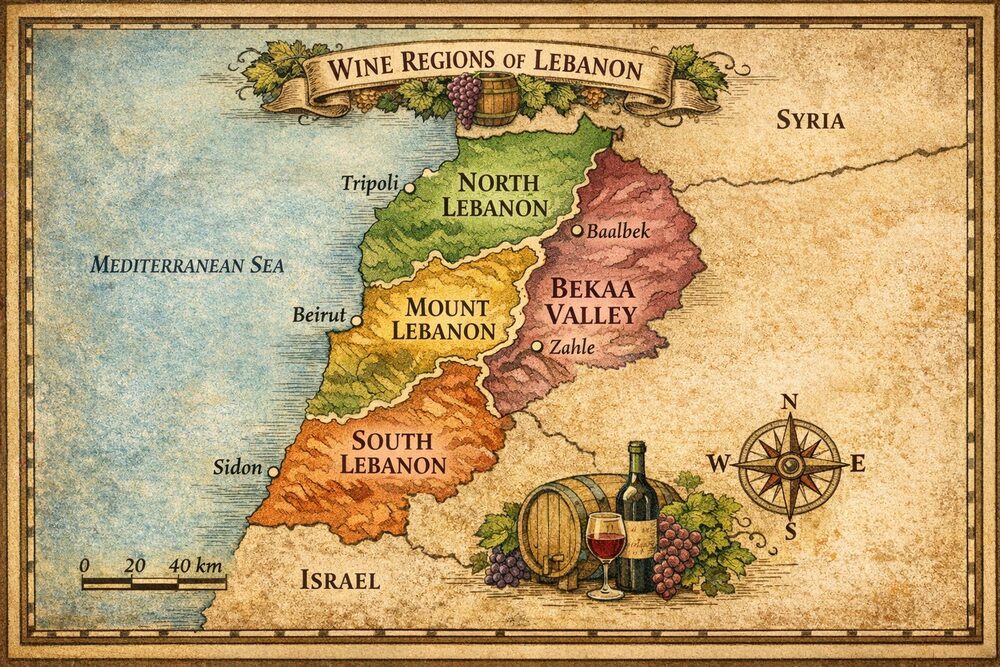
A high plain at 900 to 1,000 m between the two ranges, and geologically part of the Great Rift Valley. It is Lebanon’s farmland, its wine country and its most politically fraught region — historically the Hezbollah heartland in the north around Baalbek and Hermel, with a large Christian population around Zahlé. The Litani and the Orontes both rise here and flow in opposite directions.
The coast
About 225 km, more or less continuously built up: Tripoli, Byblos, Jounieh, Beirut, Sidon, Tyre. Almost every one of those was a Phoenician city and almost every one has been continuously inhabited for five thousand years or more. The coastal motorway that links them is where most Lebanese life happens, and the unregulated concrete along it is a national grievance.
Water
Lebanon is the best-watered country in the region, which is a permanent strategic fact. The Litani runs entirely inside Lebanon and its lower course marks the line Israel has repeatedly sought as a security boundary; the Hasbani feeds the Jordan. Despite the rain, water management is so poor that most households buy drinking water and many have intermittent supply.
Climate
Classic Mediterranean on the coast — hot humid summers around 30 °C, mild wet winters, most of the rain between November and March. The mountains are properly alpine: heavy snow, and the Bekaa is drier and more continental, hot in summer and frosty in winter. There is a genuine spring here, which is short, green and covered in wildflowers.
Earthquakes and fires
The country sits on the Dead Sea Transform and has a history of destructive earthquakes — the one in AD 551 destroyed Beirut and its famous law school and generated a tsunami. Summer forest fires have become severe and frequent, and the civil defence has been degraded by the economic collapse to the point where volunteers and neighbours often fight them.
📜 Phoenicians, Rome and the Mountain
The Phoenician cities
From roughly 1500 BC the coastal cities — Byblos, Sidon, Tyre, Berytus — were independent trading states whose ships ran the whole Mediterranean, founded Carthage and Cádiz, sold purple dye and cedar, and spread the alphabet that every European script descends from. Byblos gave Greek its word for book, and hence the Bible. They were never a single country and never called themselves Phoenicians; the Greeks did.
Persians, Alexander, Rome
Tyre held out against Alexander for seven months in 332 BC until he built a causeway to it that is still there as a permanent isthmus. Under Rome the coast prospered enormously: Berytus housed the empire’s most celebrated school of Roman law, whose jurists shaped the Justinian code, and at Baalbek — Heliopolis — the Romans built the largest temple complex in their empire, on a scale nobody has fully explained.
Christianity and the Maronites
Christianity arrived early and never left. The Maronites, following a fifth-century Syriac monk, took refuge in the mountain from Byzantine and later Muslim authority, kept their own liturgy and eventually entered communion with Rome. The Druze, an eleventh-century offshoot of Ismaili Islam, settled the southern mountain and the Chouf. Those two communities, and their long alternation of alliance and slaughter, are the core of Mount Lebanon’s history.
Arabs, Crusaders, Mamluks
The Arab conquest of the 630s brought Islam to the coast and the Bekaa while the mountain stayed largely Christian and Druze. The Crusaders held the coast for two centuries — the County of Tripoli, the castles at Byblos and Sidon — before the Mamluks destroyed the crusader states and rebuilt Tripoli inland, which is why Tripoli today has the finest Mamluk old city outside Cairo.
The Ottoman mountain
Four centuries of Ottoman rule, but with an unusual degree of local autonomy. Fakhr al-Din II, a Druze emir who ruled from 1590 and briefly built a state stretching well beyond modern Lebanon, is claimed as a founding figure; he was executed in Istanbul in 1635. Silk, and French and Italian merchants buying it, tied the mountain to Europe long before any Europeans ruled it.
1860, and the first partition
Communal war between Druze and Maronites in 1860 killed thousands and triggered a French military intervention. The settlement created the Mutasarrifate of Mount Lebanon, an autonomous Christian-majority province under international guarantee — the direct ancestor of the modern state, and the origin of the idea that Lebanon’s communities need a constitutionally guaranteed share of power.
🕯️ Greater Lebanon, Independence and the Civil War
Greater Lebanon, 1920
France took the mandate after the Ottoman collapse and in 1920 proclaimed Grand Liban, enlarging the Christian-majority mountain with the Muslim-majority coast, the Bekaa and the south. That decision created a viable state and a permanent demographic problem: the Christian majority it was designed around was gone within decades, and the constitutional arithmetic never caught up.
Independence and the National Pact
Independence came in 1943, sealed by an unwritten National Pact: Christians would not seek Western protection, Muslims would not seek union with Syria, and the offices of state would be divided by sect with a 6:5 Christian majority in parliament. It worked for thirty years and produced the era people still mean when they call Beirut the Paris of the Middle East — banking, publishing, universities, and a tolerance unmatched in the region.
Why it broke
Because the balance it rested on stopped being true. The Shia population grew fastest and had the least; the arrival of the PLO after 1970, with an armed state-within-a-state in the south and in Beirut, was intolerable to much of the Christian community; and the region’s conflicts — Israeli, Syrian, Palestinian, later Iranian — were all fought out on Lebanese ground. Anyone who tells you the civil war was simply about religion is simplifying.
The war, 1975–1990
Fifteen years, an estimated 120,000 dead, a million displaced, Beirut split along the Green Line. Syrian troops entered in 1976 and stayed until 2005. Israel invaded in 1978 and again in 1982, reaching Beirut; the massacres at Sabra and Shatila followed. The US Marine barracks bombing of 1983 and the kidnapping era made Lebanon the byword for a state that had ceased to exist. Hezbollah was founded in this period, with Iranian sponsorship, in the Shia south.
Taif, 1989
The Saudi-brokered Taif Agreement ended the war by rebalancing the confessional system to 50:50 Christian–Muslim, moving executive power from the Maronite president to the Sunni-led cabinet, and requiring all militias to disarm. Every militia disarmed except Hezbollah, which was reclassified as a resistance movement against the continuing Israeli occupation of the south. That exception is the unresolved centre of Lebanese politics thirty-seven years later.
2000 to 2006
Israel withdrew from southern Lebanon in 2000. The assassination of former prime minister Rafic Hariri in February 2005 brought a million people onto the streets in the Cedar Revolution and forced Syrian troops out after twenty-nine years. In 2006 a Hezbollah cross-border raid triggered a 34-day war that killed around 1,200 Lebanese and destroyed much of the southern infrastructure, and ended with UN Resolution 1701, which nobody has ever fully implemented.
💸 The Collapse, the Port and the Long Descent
How the money worked
For thirty years Lebanon ran on dollars sent home by the diaspora, deposited in Lebanese banks at extraordinary interest rates, lent to the central bank, and used to defend a peg of 1,507 lira to the dollar and fund a state that collected little tax. The World Bank later described it, in unusually blunt language, as a Ponzi scheme. When the inflows slowed in 2019, it stopped.
October 2019
A proposed tax on WhatsApp calls brought the country onto the streets in the largest cross-sectarian protests in its history — kellon yaani kellon, "all of them means all of them". Within weeks the banks had closed, then reopened with informal capital controls that have never been legislated: depositors simply could not get their dollars. Savings were later converted at rates that destroyed most of their value. Nobody has been held responsible.
What that did
The lira went from 1,507 to the dollar to more than 89,000. Inflation ran in the hundreds of per cent. Public electricity collapsed to a couple of hours a day, replaced by private diesel generators sold by neighbourhood operators. Doctors, nurses and teachers emigrated in numbers. The middle class was wiped out and something like 80% of the population was assessed as living in multidimensional poverty.
4 August 2020
2,750 tonnes of ammonium nitrate, seized from a ship in 2013 and stored in Hangar 12 of the port of Beirut for seven years despite repeated written warnings to officials, detonated. At least 218 people were killed, over 6,000 injured, and much of eastern Beirut was destroyed. It was one of the largest non-nuclear explosions ever recorded and it was heard in Cyprus.
The investigation
Obstructed for years. Judge Tarek Bitar’s inquiry was repeatedly frozen by legal challenges from politicians he tried to question, and Hezbollah demanded his removal; deadly street violence in Tayouneh in 2021 followed a protest against him. He resumed work in January 2025 and concluded the investigation in March 2026, indicting around seventy people including politicians, security chiefs and civil servants, and referring the file to the public prosecutor. Six years on, no one has been convicted of causing the explosion.
The political vacuum
Lebanon had no president from October 2022 to January 2025 — thirteen failed parliamentary sessions — and a caretaker government throughout. The election of Joseph Aoun and the appointment of Nawaf Salam were possible only after Hezbollah had been badly weakened in the 2024 war and after the fall of Assad in Syria removed its supply line. That is the political ground on which everything since has stood.
💥 The 2024 and 2026 Wars
📅 Checked 6 September 2026. This is a live situation and the account below will date quickly. Check your own foreign ministry’s advisory and current reporting before relying on any of it.
The 2023–24 round
Hezbollah began firing across the border on 8 October 2023, the day after the Hamas attack on Israel, in what it called a support front for Gaza. A year of exchanges emptied villages on both sides. In September 2024 Israel escalated massively: the pager and radio attacks, the killing of Hassan Nasrallah and most of Hezbollah’s senior command, an air campaign on the southern suburbs of Beirut and the south, and a ground incursion. Around 4,000 people were killed in Lebanon and over a million displaced before the ceasefire of 27 November 2024.
What that ceasefire required
Hezbollah to withdraw north of the Litani, the Lebanese Army and UNIFIL to deploy south of it, Israel to withdraw within sixty days. Israel did not fully withdraw, keeping five hilltop positions, and continued near-daily strikes it described as enforcement. Hezbollah did not disarm. The ceasefire held in the sense that full-scale war stopped; it did not hold in any other sense.
How 2026 started
On 28 February 2026 the United States and Israel struck Iran, and Iran’s supreme leader Ali Khamenei was killed. On 2 March Hezbollah fired into northern Israel for the first time since 2024, framing it as pressure to stop the attack on Iran rather than as part of that war. Israel responded with a full air campaign on Beirut and the south, and on 16 March began ground operations, destroying the Litani bridges to cut the south off.
What it cost
More than 4,300 Lebanese killed and over 12,000 injured by Israeli strikes, according to Lebanese figures; over 1.2 million displaced; forty Israeli soldiers killed; seven UN peacekeepers killed. Villages along the border were demolished. It was, in scale, worse than 2006 and comparable to the whole of 2024 compressed into three months.
The ceasefires
An initial ten-day cessation on 16 April 2026, extended repeatedly; the Islamabad Memorandum of 15 June covering the US–Iran conflict with a Lebanon component; a truce announced on 19 June; and a US-brokered framework deal announced on 26 June that includes the full disarmament of Hezbollah, which Hezbollah rejected. High-intensity fighting stopped around 20 June. Israeli withdrawal from some buffer areas began in July, with the Lebanese Army deploying behind it from 21 July.
Where it stands now
On 7 August 2026 the Lebanese cabinet committed to disarming all militias including Hezbollah, with a stated target of 31 December. Hezbollah’s leadership publicly rejected disarmament and called on the government to stop negotiating. Israeli forces remain in parts of the south and continue targeted strikes; Israel says it will keep a security zone "as long as necessary". Prime minister Salam’s stated priority is full Israeli withdrawal. Nothing about this is settled.
🏛️ Politics Now — 6 September 2026
Who is in charge
President Joseph Aoun, elected on 9 January 2025 after a 26-month vacancy and thirteen failed votes. He was commander of the Lebanese Armed Forces from 2017 and is the fifth soldier to hold the office; he was acceptable to the United States and Saudi Arabia and, at the time, unopposable by a weakened Hezbollah. Prime minister Nawaf Salam, a jurist and former president of the International Court of Justice, has led the government since February 2025.
Parliament extended itself
Elections were due on 10 May 2026. In March, with the war under way, parliament voted 76 to 41, with four abstentions, to extend its own term by two years to 31 May 2028. Most Christian parties voted against and called it a democratic abuse; supporters argued that a credible vote was impossible while a million people were displaced. Lebanon has extended its parliament before, in 2013, 2014 and 2017.
The disarmament question
This is the whole of Lebanese politics at the moment. The state has committed on paper to a monopoly on weapons; the army has been confiscating launchers, destroying depots and taking over tunnels south of the Litani; Hezbollah accepts none of it as applying to its own strategic arsenal and argues that disarmament while Israeli troops sit on Lebanese soil is surrender. Both positions have a coherent internal logic and there is no obvious way to satisfy both.
Hezbollah after the wars
Militarily degraded — its leadership decimated twice, its Iranian supply route through Syria cut by the fall of Assad, and its finances squeezed. Politically it remains the largest single force in the Shia community, with a parliamentary bloc, a ministry, a social welfare network and a genuine constituency among people whose villages Israel has flattened twice in two years. Weakened is not the same as gone, and outside commentary regularly confuses the two.
Reform, or not
The IMF has had a staff-level agreement with Lebanon since 2022 that has never been implemented, because the conditions — bank restructuring that allocates losses, a capital control law, an audit of the central bank — would fall on the same political and financial class that would have to legislate them. The Aoun–Salam government has made more progress on banking legislation than any of its predecessors, which is a low bar it has genuinely cleared.
The mood
Bleak and stubbornly functional. There is real relief that the presidency was filled and real scepticism that anything structural will change. Emigration continues; the people who can leave have mostly left. Anyone who tells you Lebanon is about to collapse should be asked what they think has been happening since 2019, and anyone who tells you it is recovering should be asked which part.
🌏 Syria, Israel, Iran and the Gulf
Syria after Assad
The single biggest change in Lebanon’s environment in fifty years. The Assad regime fell in December 2024, ending both the Syrian tutelage that dominated Lebanon from 1976 to 2005 and the land corridor that armed Hezbollah from Iran. Relations with the new Damascus are cautious and unsettled, the border remains a smuggling and security problem, and the future of the roughly 1.5 million Syrian refugees in Lebanon — and the pressure on them to return — is now a live and contested question.
Israel
No peace treaty, no diplomatic relations, a legally disputed Blue Line rather than an agreed border, and a maritime boundary agreement of 2022 that is the single successful negotiation between them. Israel occupied southern Lebanon from 1978 to 2000 and holds positions there again now. The Shebaa Farms dispute keeps a formal claim alive. Under the 2026 framework, US mediators are pressing for something closer to a normalised border arrangement; Lebanese politics of every stripe treats normalisation as poison.
Iran
Hezbollah’s founder, financier and armourer since 1982. The killing of Khamenei in February 2026 and the damage to Iran’s regional position have loosened but not severed that relationship. How much money and weaponry still reaches Lebanon, and by what route now that Syria is closed, is one of the genuinely unanswered questions of 2026.
The Gulf
Saudi Arabia and the UAE bankrolled Lebanese reconstruction after 2006 and then walked away as Hezbollah’s dominance grew, banning imports and discouraging their citizens from travelling. Since 2025 there has been cautious re-engagement tied explicitly to the disarmament question: Gulf money for reconstruction is available, and it is conditional. That conditionality is now one of the strongest levers on Lebanese politics.
France, the US and the UN
France retains a mandate-era attachment and hosts donor conferences; the United States is the decisive external actor, mediating the ceasefire and funding the Lebanese army; UNIFIL has patrolled the south since 1978 and its future is under review, with troop-contributing countries increasingly reluctant after peacekeeper deaths in 2026. The Special Tribunal for Lebanon, which convicted a Hezbollah member in absentia over the Hariri killing, closed in 2023.
The Palestinians
Around 200,000 Palestinian refugees registered in Lebanon, many in twelve camps that the state does not police, barred by law from most professions and from owning property. It is the oldest unresolved refugee situation in the country and one of the least discussed by outsiders. Ain al-Hilweh near Sidon, the largest camp, has seen repeated deadly factional fighting.
💰 An Economy in Its Eighth Year of Collapse
The numbers
GDP has fallen from around USD 55 billion in 2018 to roughly a third of that. The World Bank expects a contraction of about 6.4% in 2026, reversing the fragile stabilisation of 2025 and attributing it directly to the war. Public debt was restructured by default in March 2020 — Lebanon’s first ever — and remains unresolved with bondholders.
The banks
The unhealed wound. Depositors have not had access to their pre-2019 dollar savings for seven years; there is still no capital control law, so the restrictions are informal and arbitrary; and the losses — on the order of USD 70 billion — have never been formally allocated between the state, the central bank, the banks and the depositors. Every Lebanese conversation about money comes back to this.
Dollarisation
In practice the country runs on physical US dollars. Shops price in dollars, salaries are paid in dollars where possible, and a large cash economy has grown up outside the banking system — which has, in turn, made Lebanon a serious concern for financial-crime regulators and got it grey-listed by the FATF in 2024. The lira survives for small transactions and government salaries at the pegged 89,500.
Remittances and the diaspora
The lifeline. Remittances run in the region of a quarter to a third of GDP, among the highest ratios in the world, sent by a diaspora that is several times the size of the resident population — Brazil alone is usually said to have more people of Lebanese descent than Lebanon does. Without those transfers the country would not function at all.
What is left of the productive economy
Agriculture in the Bekaa — fruit, potatoes, and a genuinely good wine industry; some pharmaceuticals and food processing; a stubborn services and design sector; and hashish, grown openly around Baalbek, which is one of the largest cash crops in the country and was moving toward legal medicinal regulation before the wars intervened. Tourism, once a fifth of GDP, is at a fraction of its peak.
Electricity
The clearest measure of state failure. Électricité du Liban has absorbed tens of billions in subsidies over three decades and supplies a few hours a day at best; the rest comes from neighbourhood diesel generators whose owners are effectively an unregulated private utility, with their own price lists and their own politics. Solar panels have spread rapidly on Lebanese roofs since 2021, which is the one genuinely hopeful energy story here.
🏙️ Beirut
Beirut has been destroyed and rebuilt at least seven times in five thousand years, most recently in 2020. It is a city of maybe two million in its greater area, built up a hill from a Mediterranean headland, and it is simultaneously one of the most cultured and one of the most damaged cities on the sea.
Downtown
Rebuilt after the civil war by Solidere, the company created for the purpose and associated with Rafic Hariri, into an elegant, expensive and famously lifeless district of restored Ottoman and mandate facades. The Roman baths, the Mohammad al-Amin Mosque and St George’s Maronite Cathedral stand side by side, which is the standard photograph of Lebanon and is also just what the street looks like. Much of it was damaged again in 2020 and the recovery has been partial.
Gemmayzeh and Mar Mikhael
The nineteenth-century streets east of downtown, full of bars, galleries and Lebanese-Ottoman houses with triple-arched windows — and the districts that took the full force of the port explosion, being directly in front of it. Their restoration, much of it done by volunteers and NGOs rather than the state, is one of the few genuinely uplifting things to have happened in Beirut since 2019.
The Corniche and Hamra
The seafront promenade running past the Pigeon Rocks at Raouché is where Beirut walks, fishes, smokes and argues in the evening, and it is free, which matters. Hamra behind it was the intellectual heart of the Arab world in the 1960s, home of the American University of Beirut — whose campus and its museum are worth an afternoon on their own — and is now faded and still interesting.
The museums
The National Museum is superb and its own story: its collection was encased in concrete during the civil war to survive fifteen years on the Green Line, and the photographs of that operation are displayed alongside the Phoenician sarcophagi. The Sursock Museum, a mandate-era mansion turned modern art gallery, was wrecked in 2020 and reopened in 2023. Mim, a private mineral museum, is unexpectedly world-class.
The scars
The Holiday Inn and the Barakat building (Beit Beirut) still stand shot through with holes as deliberate memorials of a war the state has otherwise refused to memorialise — there is no official museum of the civil war, because there is no agreed account of it. The port itself, with its collapsed grain silos, is visible from much of the city.
What Beirut is like now
Expensive in dollars, dark at night where generators do not reach, chaotic to drive in, and socially astonishing — the restaurant and nightlife scene has survived a collapse, an explosion and two wars, partly out of defiance. The gap between a Gemmayzeh restaurant bill and a public-sector salary is the single most jarring thing a visitor sees.
🌊 The Coastal Cities
Byblos (Jbeil)
Claimed as the oldest continuously inhabited city in the world, with layers from the Neolithic through the Phoenicians, Romans and Crusaders on one archaeological site above a small harbour, plus a Crusader castle, a souk and a row of fish restaurants. It is a UNESCO site, it is 40 km from Beirut, and it is the single most pleasant half-day in Lebanon.
Tripoli
Lebanon’s second city, poor, conservative, Sunni-majority, and holder of the finest Mamluk architecture outside Cairo — madrasas, hammams, khans and a vast crusader citadel above them all. Its souks are working souks. It also has Rachid Karami, an unfinished Oscar Niemeyer fairground of 1962, abandoned mid-construction when the war came, which is one of the strangest and most beautiful modernist ruins anywhere and is now UNESCO-listed.
Sidon (Saida)
A Crusader sea castle on a causeway, a Mamluk-era souk, the Khan al-Franj caravanserai, and a soap museum in an old soap factory that is far better than it sounds. Just outside it is Ain al-Hilweh, the largest Palestinian refugee camp in Lebanon, which is not a place for visitors and which has seen repeated deadly factional fighting.
Tyre (Sour)
The Phoenician city that founded Carthage, and a UNESCO site with two large Roman archaeological zones — including the largest Roman hippodrome ever found, with a triumphal arch and a necropolis along the road that ran to it. Tyre also has the loveliest beach in the country and an old Christian quarter of ochre houses. It is in the war zone: it was struck repeatedly in 2024 and 2026 and is currently not a place to plan a trip to.
Jounieh and the bay
North of Beirut, a bay of high-rises, a casino and a cable car (the téléphérique) climbing to the shrine of Our Lady of Lebanon at Harissa, a colossal white statue that looks out over the sea and is a pilgrimage site for Christians and Muslims both. The view justifies the ride.
What has happened to the coast
Unregulated construction has consumed most of the shoreline, public beach access is contested and often illegally privatised, and sewage and rubbish disposal have been a national scandal since the crisis of 2015 when Beirut’s waste went uncollected for months. The Mediterranean here is beautiful and in places you should not swim in it.
🏔️ The Mountain, the Cedars and the Chouf
The Qadisha Valley
The Holy Valley, a deep gorge in the north where Maronite, Jacobite, Melkite, Armenian and Ethiopian monastic communities lived in cliff-face hermitages and rock-cut monasteries from the earliest centuries of Christianity. Deir Qannoubine, Mar Lichaa and Qozhaya can be walked between; the first Arabic-script printing press in the Middle East is at Qozhaya. It is a UNESCO World Heritage site, jointly with the cedar forest above it.
The Cedars of God
Arz el-Rab at Bsharri: a small grove of ancient Cedrus libani, some more than a thousand years old and a few claimed to be far older, standing at about 2,000 m below the ski slopes. It is what remains of the forests that built Solomon’s temple and Phoenician ships. Also at Bsharri: the museum of Khalil Gibran, who was born here and whose The Prophet has never gone out of print in a century.
The Chouf
The Druze mountain south-east of Beirut. The Chouf Cedar Reserve at Barouk is by far the largest protected cedar area in the country and the best place to walk among them. Below it, Beiteddine is a nineteenth-century emir’s palace of extraordinary Ottoman-Levantine craftsmanship, with a summer festival in normal years; Deir el-Qamar nearby is a preserved seventeenth-century town.
Skiing
Real, and cheaper than the Alps. Mzaar Kfardebian above Faraya is the largest resort, at 1,850–2,465 m, with the season running roughly January to March; Laqlouq and the Cedars are smaller. The joke about skiing in the morning and swimming in the afternoon is technically achievable and no Lebanese person has ever bothered doing it.
Jeita Grotto
Two vast limestone cave systems in the mountain 18 km from Beirut — an upper gallery walked on foot with some of the largest stalactites in the world, and a lower gallery crossed by boat on an underground river. It was a finalist in the New7Wonders of Nature campaign, which Lebanon took extremely seriously. Photography inside is banned, which is worth knowing before you carry a camera up there.
Walking it
The Lebanon Mountain Trail runs about 470 km from Andqet in the far north to Marjaayoun in the south, through 76 villages, in 27 day-stages with village guesthouses along the way. It is one of the best-organised long trails in the Middle East, it is a genuine achievement of Lebanese civil society, and its southern sections are currently not usable for the obvious reason.
🏛️ Baalbek and the Bekaa
If Lebanon had only one monument it would be enough. Baalbek — Roman Heliopolis — is the largest temple complex the Roman empire ever built, and it is in the northern Bekaa, in the part of the country most affected by the wars, which is the central problem with recommending it.
The Temple of Jupiter
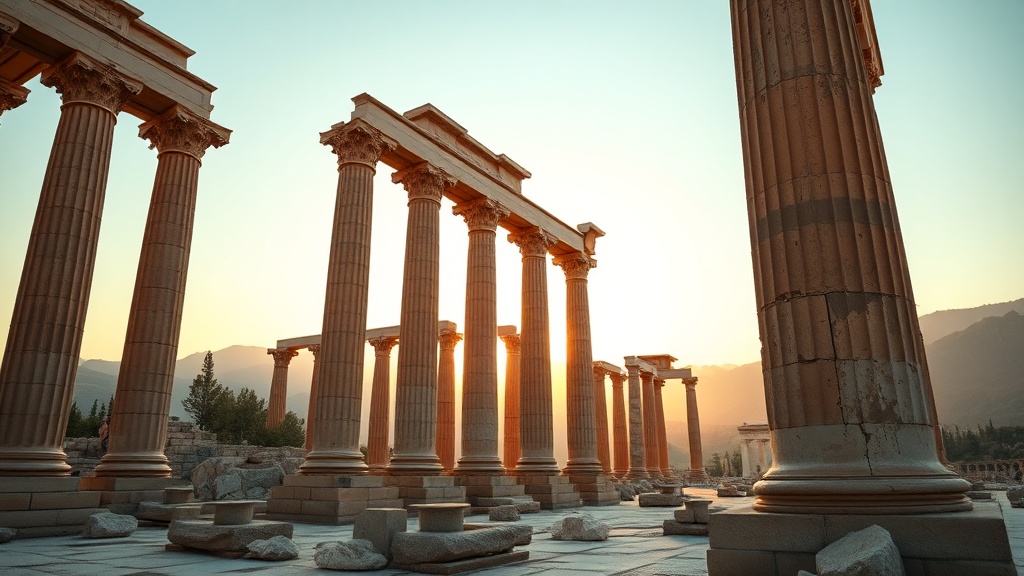
Six columns remain of an original fifty-four. They are nearly 20 m tall and stand on a podium built from stone blocks weighing around 800 tonnes each — the so-called trilithon — with a still larger stone, the Hajjar al-Hibla, lying unfinished in the quarry nearby at over a thousand tonnes. How the Romans moved them is genuinely debated by engineers, which is why the site attracts a certain amount of nonsense from people who prefer aliens.
The Temple of Bacchus
Beside it, and the reason to come: a temple better preserved than the Parthenon, its colonnade almost complete, its cella roofed in antiquity and its carved doorway intact. It is larger than the Parthenon and almost nobody outside the region has heard of it. The Baalbek International Festival has staged concerts between these columns since 1956, interrupted by wars including this one.
Anjar
Half an hour away and completely different: a walled Umayyad city of the early eighth century, laid out on a Roman grid with two colonnaded avenues crossing at a tetrapylon, a palace and a mosque. It is the only major Umayyad urban site in Lebanon, it was inhabited for only a few decades, and it is a UNESCO World Heritage site that receives almost no visitors.
The wine country
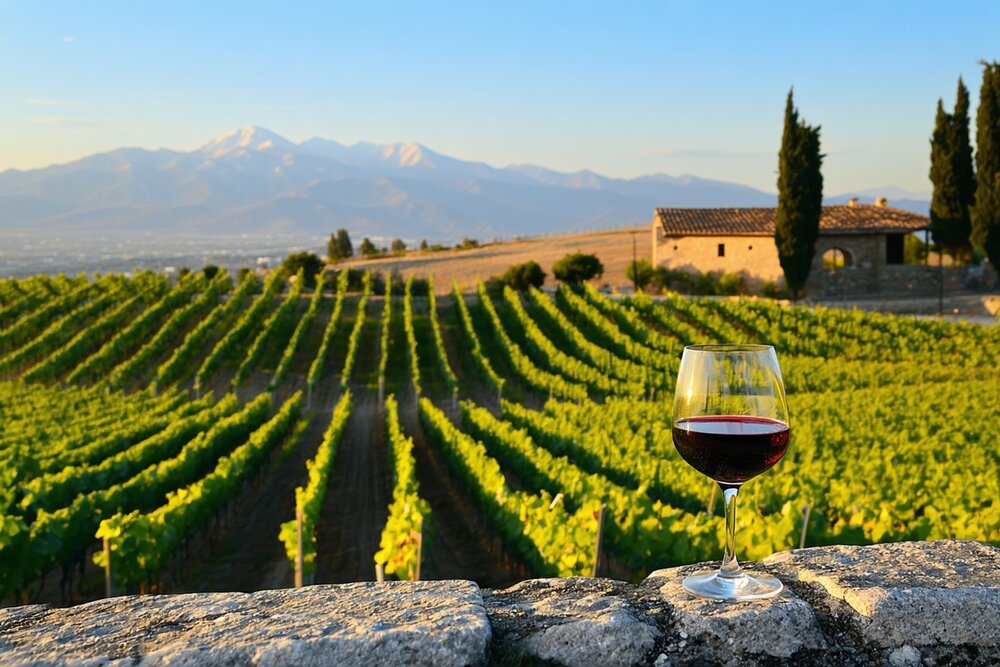
Around Zahlé and the western Bekaa, at 900–1,000 m with hot dry summers and cold winters — conditions that produce genuinely good wine and have done since the Phoenicians. Château Ksara, founded by Jesuits in 1857, is the oldest and stores its wine in Roman-era caves; Château Musar is the internationally famous one, whose reds are unlike anything else and which kept making wine through the civil war; Château Kefraya, Ixsir and a couple of dozen smaller producers make up the rest.
Zahlé
The largest majority-Christian city in the Middle East by some counts, on the Berdawni river, famous within Lebanon for its riverside restaurants where mezze is taken seriously as a formal institution. In peacetime it is where Lebanese people go to eat.
The problem
The northern Bekaa around Baalbek and Hermel has been a Hezbollah stronghold, a hashish-growing region and a place of weak state authority for decades, and it was heavily bombed in 2024 and again in 2026. Baalbek town was struck; the ruins themselves have so far escaped major damage, which archaeologists have described as luck. Foreign ministries advise against all travel there and have done for years.
🍽️ The Food
Lebanese cooking is the best-known cuisine of the Arab world and, in most people's honest opinion, the best. It is built on olive oil, lemon, garlic, parsley, mint, chickpeas, bulgur, yoghurt and lamb, and its organising principle is mezze — not a starter course but a way of eating in which twenty or thirty small dishes arrive over two or three hours and the table talks its way through them.
The mezze table
Hummus and moutabbal (smoked aubergine with tahini); tabbouleh, which in Lebanon is a parsley salad with a little bulgur and not the other way round; fattoush with fried bread and sumac; labneh; warak enab, stuffed vine leaves; kibbeh in several forms; sujuk and makanek sausages; batata harra; raw onion, radishes and olives that arrive without being ordered.
Kibbeh
The national dish and a category rather than a recipe. Kibbeh nayeh is raw minced lamb pounded with fine bulgur and spices, eaten with olive oil and mint — a Sunday institution in Christian villages; kibbeh maqliyeh are the fried torpedo-shaped croquettes with a spiced meat and pine-nut filling; kibbeh bil sanieh is baked in a tray in layers. Getting the shell thin enough is the mark of a cook.
Man'oushe
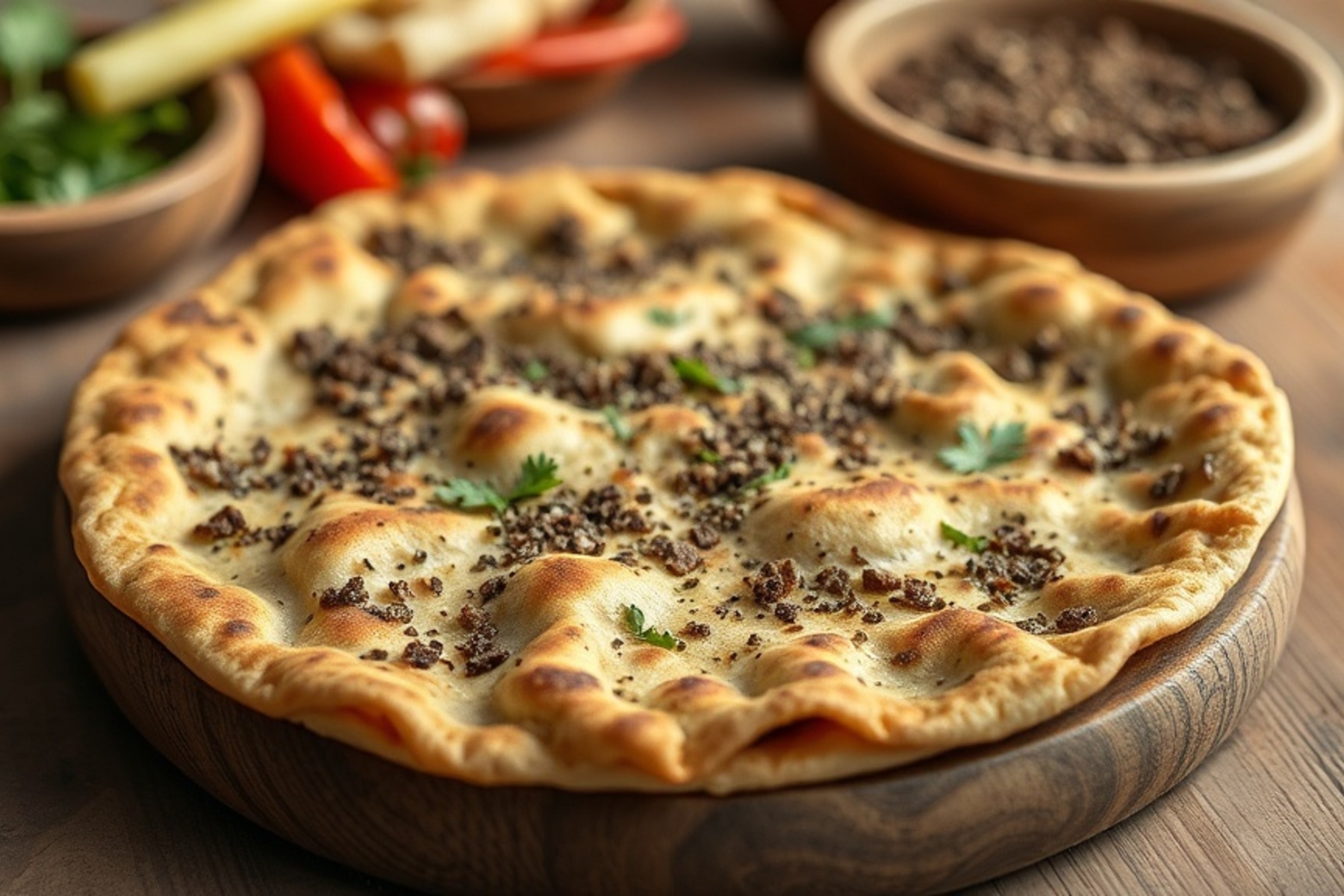
Breakfast, and the most everyday food in the country: a flatbread baked in a hot oven with a topping, sold from neighbourhood bakeries from six in the morning. Za’atar — wild thyme, sumac and sesame mixed to a paste with olive oil — is the classic; jibneh (cheese), kishk and lahm baajine (minced meat) are the others. It is folded in half and eaten walking.
The grill and the big dishes
Shish taouk, chicken with garlic sauce; lahm mishwi; shawarma carved off the vertical spit; kafta. And the home cooking that restaurants rarely serve: mujaddara (lentils and rice with fried onion), molokhia, kousa mahshi (stuffed courgettes) and fatteh.
Sweet
Baklava from Tripoli, which claims the best in the country; knafeh, sweet cheese under semolina pastry, eaten inside a sesame bread roll for breakfast, which sounds wrong and is not; maamoul at Easter and Eid; halawet el-jibn; and ashta clotted cream with honey and pistachios in everything.
Vegetarians
Lebanon is one of the easiest countries in the world to be vegetarian or vegan in, because the Christian fasting tradition produced a whole repertoire of sayamiyeh dishes without any animal products at all. A mezze table can be entirely meat-free and nobody will treat it as a concession.
👨🍳 Two Recipes
The two things Lebanese people abroad make first: the salad that everybody outside Lebanon gets wrong, and the bread that is breakfast.
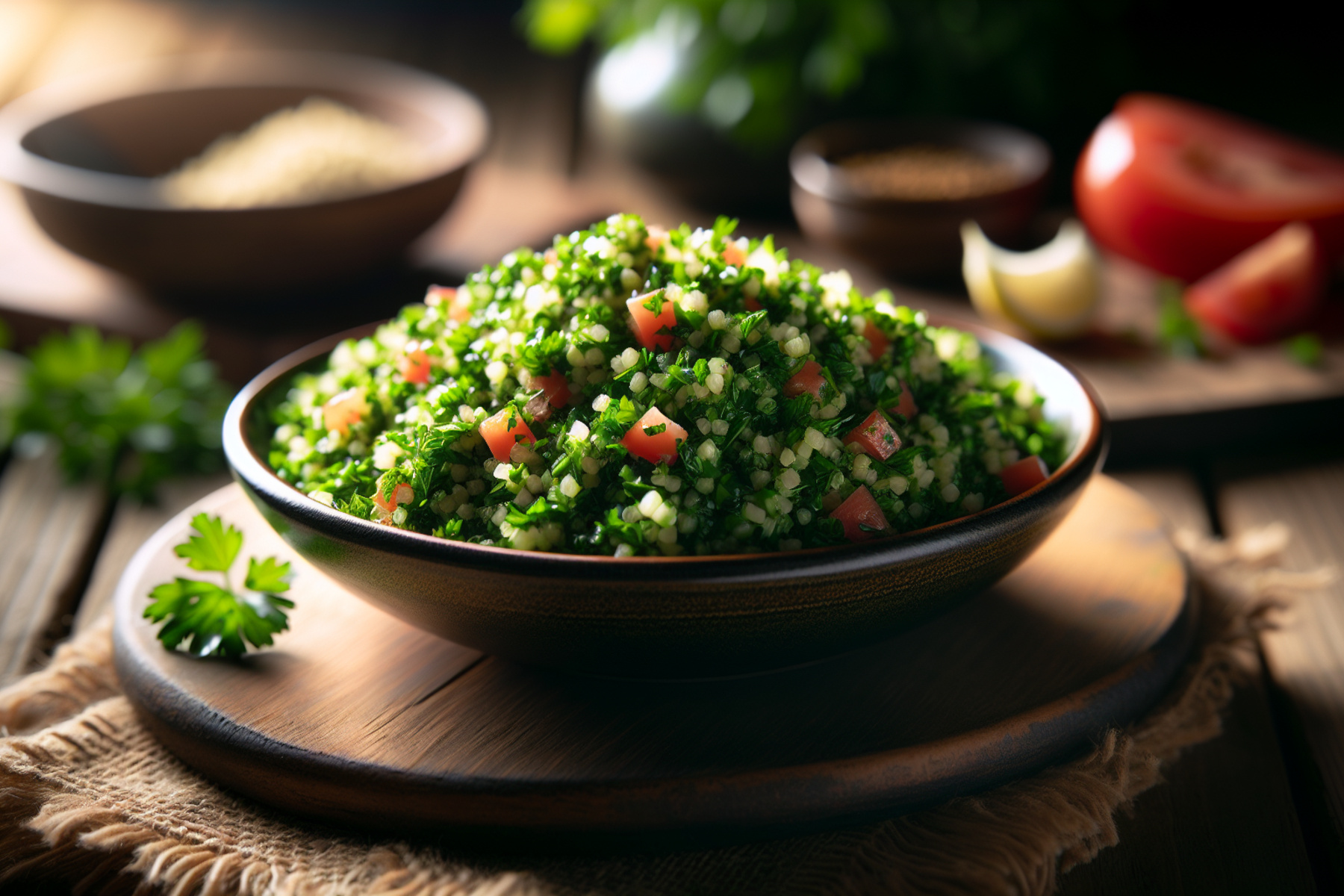
Tabbouleh
Serves 4 · 30 minutes
Ingredients: 4 large bunches of flat-leaf parsley (about 300 g leaves), 30 g fine bulgur (#1 grade), 3 firm ripe tomatoes, 4 spring onions or 1 small white onion, a small bunch of mint, juice of 2 lemons, 80 ml good olive oil, 1/4 tsp ground allspice or cinnamon, salt. Romaine leaves or young cabbage to scoop.
Method: Rinse the bulgur and leave it to soften in the juice of one lemon for 15 minutes — it should not be soaked in water and should not be cooked. Wash and dry the parsley very thoroughly, strip the leaves, gather them tightly and slice as finely as your knife allows; do not chop them in a processor, which bruises them into a paste. Chop the mint the same way. Dice the tomatoes small, salt them lightly and let them drain for five minutes. Slice the onion very fine. Combine parsley, mint, onion, tomato and the softened bulgur, dress with the remaining lemon juice, the olive oil, the allspice and salt, and toss just before serving so it does not weep. Serve with lettuce leaves to scoop it up with.
💡 The proportions are the whole point: this is a parsley salad with a little bulgur. If your bowl looks beige rather than green, you have made something else.
Man'oushe bi Za'atar
Makes 6 · 30 minutes plus 90 minutes rising
Ingredients: For the dough: 500 g plain flour, 7 g dried yeast, 1 tsp sugar, 1.5 tsp salt, 300 ml warm water, 3 tbsp olive oil. For the topping: 6 heaped tbsp za’atar mix (dried wild thyme, sumac, toasted sesame, salt), about 100 ml good olive oil.
Method: Mix the yeast and sugar into the warm water and leave 10 minutes until foaming. Add to the flour and salt with the oil and knead 10 minutes to a soft, elastic dough; cover and leave to rise 90 minutes until doubled. Meanwhile stir the za’atar and olive oil together to a loose, spreadable paste — it should pour slowly off the spoon, not sit dry in the bowl. Heat the oven as hot as it goes, ideally 250 °C, with a baking stone or heavy tray inside. Divide the dough into six, roll each out to about 20 cm and 5 mm thick, and press dimples all over with your fingertips. Spread the za’atar paste right to the edge and bake one or two at a time for 6 to 8 minutes, until the base is set and the edge just colours; the top should stay pale, not crisp. Fold in half and eat immediately, with mint leaves, tomato and olives.
💡 Do not let it brown like a pizza. A man’oushe is soft and foldable, out of the oven and into your hand within a minute.
🍇 Arak, Wine and Coffee
Arak
The national spirit: grape distillate flavoured with aniseed, traditionally distilled three times and aged in clay. It is drunk with mezze, not after it, and it is served one part arak, two parts water, then ice — in that order, because adding ice first shocks the anise oils and ruins the drink. It turns milky white when the water goes in. Village arak from a family still is a real thing and is considerably stronger than the label suggests.
Wine
Lebanon has been making wine for something like five thousand years and the modern industry dates from 1857, when Jesuits at Château Ksara planted French vines and stored the wine in caves the Romans had cut. Around fifty producers now work mostly in the Bekaa, with newer plantings in Batroun and the north. Reds dominate — Cabernet, Syrah, Cinsault and Carignan blends — and the indigenous white grapes Obeidi and Merwah are being taken seriously again.
Château Musar
The one wine drinkers abroad know. Serge Hochar kept making wine at Ghazir through the civil war, getting grapes across the Bekaa and through militia checkpoints in almost every vintage, and the results — oxidative, volatile, long-lived, unlike any other red on earth — became a cult. It is the closest thing Lebanon has to a globally famous product and it exists because of a decision to keep working through a war.
Coffee
Ahweh, Turkish-style, boiled in a rakwe, usually with cardamom, served in small cups: sada (no sugar), wasat (medium), hilweh (sweet). Refusing coffee is close to impossible. Fortune-telling from the grounds in the upturned cup is a genuine social ritual and not a tourist act.
Other things in a glass
Jallab, a dark syrup of date and grape molasses with rose water, served over crushed ice with pine nuts and raisins, which is the great summer drink; ayran; fresh pomegranate and sugarcane juice from street carts; almaza, the local lager, which is unremarkable and cold; and a small craft-beer scene in Beirut that survived the collapse.
Practicalities
Alcohol is legal, widely available and unremarkable in most of the country — Lebanon is by a distance the most relaxed Arab state about it. It is much less visible in conservative Sunni Tripoli and in Shia areas of the south and Bekaa, where you should not expect to find it and should not make a point of asking.
🎭 Music, Words and the Diaspora
Fairuz
Not a singer so much as an institution. For seventy years Fairuz has been what Lebanon plays in the morning — every taxi, every kitchen, across every sect and every side of every war. She sang through the civil war without taking a side and refused to perform in Lebanon during it. Her songs with the Rahbani brothers are the closest thing the country has to a shared text.
Music now
Ziad Rahbani, her son, made jazz-inflected political theatre and music that satirised everybody; Marcel Khalife set Mahmoud Darwish to oud; Mashrou’ Leila became the most prominent Arabic-language indie band of the 2010s before harassment over its openly gay frontman ended their touring. Beirut’s underground electronic scene was, before 2019, one of the most interesting in the region.
Writers
Khalil Gibran from Bsharri, whose The Prophet is among the best-selling books ever published; Amin Maalouf, who writes in French and sits in the Académie française; Elias Khoury and Hanan al-Shaykh; and a strong tradition of graphic novels and comics, including Samandal. Lebanon printed and published for the whole Arab world for decades: the saying was that Cairo writes, Beirut prints and Baghdad reads.
The diaspora
Between eight and fourteen million people of Lebanese descent live outside Lebanon — more than three times the resident population. Brazil alone has several million; there are large communities in Argentina, the United States, France, Australia and West Africa. Carlos Slim, Salma Hayek, Shakira, Amal Clooney and Carlos Ghosn are all of Lebanese descent, and Lebanese people will tell you so within about an hour of meeting you.
Hospitality and how to behave
Guests are pressed with food and drink to a degree that visitors find overwhelming; refuse three times and accept, which is the local grammar. Dress is European in Beirut and the Christian mountain and modest in Tripoli, the south and the Bekaa — cover shoulders and knees there. Take your shoes off in homes. Someone will insist on paying; let them win the second round and offer clearly the first time.
What not to raise
The civil war, unless a Lebanese person raises it first — there is no agreed account of it and the people who fought it are still in politics. Which sect somebody belongs to. Hezbollah, in either direction. Israel, at all. Lebanese people discuss all of these constantly among themselves and the calculation for a foreigner is entirely different.
🗣️ Arabic, French and English in One Sentence
Lebanon is genuinely trilingual in a way few countries are, and the mixing is not a sign of poor education but a class and cultural marker in its own right. The standard Beirut greeting — hi, kifak, ça va? — is a joke about it that Lebanese people make themselves.
Arabic
Modern Standard Arabic is the official language; what people actually speak is Lebanese Arabic, a Levantine dialect with a substantial Syriac substrate and a great many French and Turkish loanwords. It is the dialect most widely understood across the Arab world, because Lebanese television, music and dubbing exported it for fifty years.
French
A mandate legacy that stuck. Roughly 40–45% of the population has some French; much of the private school system teaches in it, universities including Saint-Joseph work in it, and Lebanon is a full member of the Francophonie. Street signs in Beirut are bilingual Arabic–French. It is strongest among Christians and the older educated class and it is slowly losing ground to English.
English
Now the language of business, technology and the young, taught in most schools, and dominant at the American University of Beirut. In Beirut you can function entirely in English. In Tripoli, the Bekaa and the south, much less so, and Arabic or a translation app becomes necessary.
A survival list
Marhaba — hello. Ahlan wa sahlan — welcome. Shukran — thank you. Kifak / kifik — how are you (to a man / a woman). Yalla — let’s go, and the single most-used word in the country. Habibi — used constantly and to almost anyone. Sahtein — said before eating. Inshallah — which, depending on tone, means yes, maybe, or no.
Arabizi
Lebanese written in Latin letters with numerals for the sounds Latin script lacks — 3 for ayn, 7 for ha, 2 for hamza, so kifak becomes kifak but ahwe becomes 2ahwe. It is how most young Lebanese text and it is worth recognising if you are reading anything informal.
Names and places
Almost every place has an Arabic name and a French one and often an English rendering: Jbeil is Byblos, Saida is Sidon, Sour is Tyre, Tripoli is Trablous. Road signs use both, road directions from people use whichever comes to hand, and maps disagree.
☪️ Eighteen Sects and a Constitution Built on Them
Lebanon officially recognises eighteen religious communities, and its entire political system is built on distributing power between them. There is no civil marriage — Lebanese couples who want one fly to Cyprus, which is a genuine and widely used industry — and personal status law is administered by fifteen separate religious courts.
Who is here
Shia Muslims, concentrated in the south, the northern Bekaa and Beirut’s southern suburbs; Sunni Muslims, in Beirut, Tripoli, Sidon and the Akkar; Maronite Christians, in Mount Lebanon and the north; Druze, in the Chouf and the Aley district; and Greek Orthodox, Greek Catholic, Armenian Orthodox and Catholic, Syriac, Assyrian, Chaldean, Coptic, Latin, Protestant, Alawite, Ismaili and a tiny Jewish community. Rough thirds are the usual shorthand and no reliable figures exist.
Why there is no census
Because the last one, in 1932, produced the Christian majority on which the whole constitutional settlement rests, and everyone knows the result would be different now. Counting is therefore politically impossible, which means Lebanon distributes power on the basis of demographic facts that are nearly a century out of date and cannot be updated without renegotiating the state.
How the system works
The president is Maronite, the prime minister Sunni, the speaker Shia; the deputy prime minister and deputy speaker Greek Orthodox; the army commander Maronite; the central bank governor Maronite. Parliament is split 64:64 between Christians and Muslims and every seat within that is allocated to a specific sect in a specific district. It has kept the peace since 1990 and it has made reform close to impossible, because every reform threatens somebody’s share.
What it feels like
Less oppressive day to day than it sounds. Beirut neighbourhoods are mixed, friendships and workplaces cross the lines, and most Lebanese people are visibly tired of the whole apparatus — the 2019 protests were explicitly cross-sectarian. But everyone knows everyone’s sect from their name and their village, jobs and contracts flow along those lines, and in a crisis the system reasserts itself fast.
Religion you can see
Church bells and the call to prayer in the same minute, in the same street, is not a cliché here. Mar Charbel at Annaya, Our Lady of Lebanon at Harissa and the Maronite monasteries draw pilgrims including Muslim ones; Ashura in Nabatieh is observed intensely; Christmas and Eid are both public holidays and both are celebrated widely across communities.
The Jewish community
Beirut had a substantial Jewish community into the 1960s, centred on Wadi Abu Jamil, and the Maghen Abraham synagogue there was restored in the 2010s. Almost no one is left — a few dozen people — and the community’s history is one of the least-discussed parts of the Lebanese story.
👥 Refugees, Emigration and the People Who Stayed
Syrians
Lebanon hosts roughly 1.5 million Syrian refugees in a country of about four million citizens — the highest ratio anywhere on earth. They live in informal settlements and rented rooms rather than camps, because the state refused formal camps; they are legally barred from most work and are frequently subject to curfews, raids and deportations. Since Assad’s fall the political pressure to return them has intensified sharply, and so has the argument about whether Syria is safe enough for that.
Palestinians
About 200,000 registered, some of them third and fourth generation, in twelve camps administered by UNRWA. They cannot own property, are barred from dozens of professions, and the camps are outside the state’s security control by a 1969 agreement. It is a seventy-seven-year-old situation that Lebanese politics has never resolved because resolving it means either naturalisation, which would upset the confessional balance, or return, which is not in Lebanon’s gift.
Emigration
The oldest Lebanese story. People have been leaving since the silk crisis of the 1860s, and the collapse since 2019 has produced the largest wave in decades — doctors, nurses, engineers, academics. Something like a third of physicians left. Anyone with a second passport or a Gulf job has used it, and the people who remain are disproportionately those who could not.
Migrant domestic workers
Perhaps 250,000 women, mostly from Ethiopia, Bangladesh, the Philippines and Sri Lanka, employed under the kafala sponsorship system that ties their legal status to an employer and excludes them from labour law. Abuse is well documented and the collapse made it worse, with workers abandoned outside their embassies when employers could no longer pay. Lebanese civil society campaigns against kafala; it has not been abolished.
Women
Lebanese women are prominent in business, medicine, journalism and civil society and have been since long before the region’s norm shifted. They also cannot pass citizenship to their children, are subject to fifteen different religious personal-status codes on marriage, divorce and custody, and are badly under-represented in parliament. The gap between social visibility and legal status is the widest of any country in this factbook.
What survives
A civil society and an NGO sector that has effectively substituted for the state — the volunteers who cleared the glass after the port explosion, the groups that run food distribution and clinics, the Lebanon Mountain Trail association, the people restoring Mar Mikhael house by house. When Lebanese people say the state has abandoned them they usually follow it by describing what they organised instead.
🏛️ UNESCO
Five inscribed World Heritage sites for a country the size of Moravia, and a sixth on a list nobody wants to be on.
Anjar (1984)
The Umayyad city of the early eighth century in the Bekaa, laid out on a Roman grid with colonnaded avenues, a tetrapylon, palace and mosque, inhabited for only a few decades before it was abandoned. The only major Umayyad urban site in Lebanon and one of the least visited.
Baalbek (1984)
The largest Roman temple complex ever built, with the Temple of Bacchus better preserved than the Parthenon and stone blocks nobody has satisfactorily explained the moving of. In the northern Bekaa and, for the moment, effectively unreachable for foreign visitors.
Byblos (1984)
Continuous habitation from the Neolithic, the Phoenician city that gave Greek its word for book, and a Crusader castle on top of the whole stratigraphy. The most accessible of the five and the one to see if you see one.
Tyre (1984)
Two Roman archaeological zones including the largest hippodrome found anywhere in the Roman world, a monumental arch and a necropolis, on the site of the Phoenician city that founded Carthage. Repeatedly struck in 2024 and 2026; damage to the town has been extensive and the site’s condition is a live concern.
Qadisha and the Cedars (1998)
The Holy Valley’s cliff-face monasteries and hermitages, inscribed together with the Forest of the Cedars of God above it — a joint cultural and natural listing, and the one that most directly ties the landscape to the country’s identity.
Rachid Karami, and the danger list
Oscar Niemeyer’s unfinished international fair at Tripoli, begun in 1962 and abandoned when the civil war came, was inscribed in 2023 and placed simultaneously on the List of World Heritage in Danger — a modernist ruin of enormous concrete arcs and a dome, decaying in a city that cannot afford to fix it. It is the sixth site and the most unexpected.
📅 When to Go
In a normal year the answer is easy and the country is genuinely well suited to travel. In 2026 the security situation matters more than the season, and the advice below assumes a Lebanon that is not currently on offer.
April to June
The best months. Warm but not yet humid on the coast, the mountains green and full of wildflowers, snow still on the peaks above Bsharri, and everything open. Easter is a major event in the Christian towns and worth timing for.
September to November
The other good window. The sea is at its warmest into October, the summer humidity has broken, the grape harvest is in and the Bekaa wineries are working. November brings the first rain and the first snow on the tops.
July and August
Hot, humid and, on the coast, uncomfortable at around 30 °C with high humidity — but this is also when the diaspora comes home, the festivals run (Baalbek, Beiteddine, Byblos in normal years), the mountain towns fill and prices rise. It is the loudest and most social time of the year and the least comfortable weather.
December to March
Winter: rain on the coast, real snow in the mountains, ski season from about January to March. Cold, short days and many mountain roads closed, but Beirut is mild and the mountain restaurants and hotels stay open for skiers.
Ramadan and the feasts
Ramadan shifts each year; in Muslim-majority areas restaurants close during daylight and life moves to the night, while Beirut and the Christian areas carry on normally. Both Christmas and the two Eids are public holidays, and Lebanon is one of the few countries where you can plausibly be invited to celebrate all of them.
The real determinant
None of the above matters if the ceasefire fails. As of September 2026 the south, the Bekaa and the southern suburbs of Beirut are subject to continuing Israeli strikes, and the situation has changed abruptly twice in two years. Any plan for Lebanon should be one you can cancel.
🚕 Getting There and Around
Flying
Beirut–Rafic Hariri International (BEY) is the only commercial airport, 9 km south of the centre, and it is the country’s single point of failure — it has closed during every escalation, and airlines have suspended and resumed service repeatedly through 2024 and 2026. Middle East Airlines is the flag carrier and kept flying when others would not. Check that your airline is actually operating before you book anything else.
Overland
The Syrian border is the only land crossing, at Masnaa and in the north; it is open, it is busy, and travelling on to Syria is a separate decision with its own advisories. There is no crossing to Israel and there never has been. There are no ferries of consequence.
Taxis and services
The service (say it the French way) is a shared taxi running a route: you flag it, name your destination, and if it suits the driver you get in with whoever else is going that way, for a fixed low fare. A private taxi is a taxi and costs several times more — agree the price before you get in. Bolt works in Beirut and removes the negotiation entirely, which is worth it.
Buses and vans
There is no integrated public transport. Old buses and private minivans run the coastal road and the main intercity routes from Cola and Dora in Beirut, cheaply and without timetables; you wave one down and pay the conductor. It works, it is slow, and it is not something most visitors attempt on their first day.
Driving
Cars are the practical way to see the country and Lebanese driving is genuinely alarming: lane markings are decorative, motorcycles come the wrong way, and enforcement is minimal. Roads themselves are decent on the coast and narrow and steep in the mountains. Fuel is available but has been rationed during crises. Many visitors hire a driver for the day at USD 80–120, which is the sensible option.
Checkpoints
Army checkpoints are routine on intercity roads and entirely normal: slow down, dip your lights at night, have a passport, be polite, and do not photograph them. Hezbollah and other party checkpoints exist in some areas and are a different matter — if you are being taken somewhere by a local driver, take their judgement over your own.
📋 Practical Information
⚠️ Safety comes before everything else on this page. As of September 2026 most Western foreign ministries advise against all travel, or against all but essential travel, to Lebanon, and against all travel to southern Lebanon below the Litani, the Bekaa including Baalbek and Hermel, the Syrian border areas and the Palestinian camps. Travel insurance is normally void where such advice exists. Check your own ministry’s current wording — not this page — before making any decision.
Visas
In normal times Lebanon is easy: citizens of the EU including Czechia, the UK, the US, Canada and Australia have been able to obtain a free single-entry visa on arrival for one month, extendable, provided the passport contains no Israeli stamp or evidence of travel to Israel — that is an absolute bar and it includes Israeli exit stamps and Jordanian or Egyptian border stamps that reveal an Israeli crossing. Rules have shifted during the wars; verify with the embassy before departure.
Money
Bring US dollars in cash, in good condition, in a mix of denominations. This is not optional advice: the banking system does not work normally, many ATMs do not dispense, foreign cards are unreliable outside a handful of Beirut hotels and restaurants, and almost everything is priced in dollars. Exchange to lira only for small purchases. Do not expect to be able to solve a cash problem once you are there.
Electricity and water
Mains power runs a few hours a day; every hotel and most flats have a generator subscription, and there are daily windows when nothing works. Water is not drinkable from the tap anywhere — buy bottled, which everyone does. Hot water and heating in winter depend on the generator too.
Health
Lebanese private hospitals in Beirut are excellent and expensive, and were the best in the region for decades; the public system and rural provision have been hollowed out by the collapse and by emigration of staff. Bring any medication you need, because pharmacy shortages have been chronic. Comprehensive insurance including medical evacuation is essential, and check the war-and-terrorism exclusions specifically, because most standard policies have them.
Connectivity
Alfa and touch sell tourist SIMs at the airport; data is expensive by regional standards and coverage is good in populated areas. Internet has improved from its 2021 low but power cuts take it down with them. Buy a local SIM rather than relying on roaming.
Behaviour and law
Homosexuality is not explicitly criminalised but article 534 on "unnatural intercourse" has been used against LGBT people and enforcement has hardened since 2022; discretion is necessary. Photographing military installations, checkpoints, the airport and the port is prohibited and taken seriously. Drug penalties are severe despite the open hashish cultivation. Drones are effectively banned.
💵 What It Costs
Lebanon is no longer the cheap country the collapse briefly made it. Prices are dollarised, and Beirut restaurant and hotel prices are now comparable to southern Europe while wages are a fraction of it — which is the central injustice of the current economy and something visitors notice within a day.
A bed
Hostel dorm in Beirut USD 15–25; a mid-range hotel or apartment double USD 60–110; the surviving international hotels USD 150–250. Guesthouses in the mountains and along the Lebanon Mountain Trail run USD 35–70 with dinner and are far better value than the capital.
A meal
A man’oushe from a bakery USD 1–2; a shawarma or falafel sandwich USD 3–5; a full mezze dinner for two with arak in a proper restaurant USD 50–90; a Beirut fine-dining bill whatever you are willing to pay. Coffee USD 2–4. Eating from bakeries and street counters is both the cheapest and one of the best ways to eat here.
Getting around
A service shared taxi hop in Beirut USD 1–2; a Bolt across the city USD 4–8; an intercity van to Byblos or Tripoli USD 2–4; a private taxi Beirut–Byblos USD 30–40; a driver for a full day USD 80–120. Car hire from USD 40 a day plus fuel.
Sites and culture
Archaeological sites are cheap: Baalbek, Byblos, Tyre and Anjar each around USD 4–8. Jeita Grotto is the expensive one at roughly USD 20. Museums USD 5–10. Winery tours in the Bekaa USD 10–20 with a tasting.
A daily budget
Travelling simply, with vans and guesthouses: USD 50–70 a day. Comfortably, with a hotel, restaurant meals and a share of a driver: USD 130–190. Beirut at the top end: whatever you like. Note that in a country with sporadic power and no functioning banking, a contingency reserve in cash is part of the budget, not an extra.
Tipping
Expected: 10% in restaurants where service is not included, small notes for the person who parks your car, carries your bag or shows you around a site. In an economy where a public salary can be worth under USD 200 a month, this matters more than the amounts suggest.
🇨🇿 For Czech Travellers
Before anything else: the advisory
Check mzv.cz for the current Czech travel advisory on Lebanon before you plan anything. As of September 2026 the ministry, like its European counterparts, advises against travel to Lebanon, with an absolute warning for the south, the Bekaa and the border regions. Czech commercial travel insurance is void in areas covered by such a warning, which means a hospital bill or an evacuation would be entirely yours.
Getting there from Prague
No direct flight. The usual routings are Prague–Istanbul–Beirut with Turkish Airlines, Prague–Vienna or Frankfurt–Beirut, or via Dubai, Doha, Amman or Athens with Middle East Airlines on the final leg. Journey time 6–10 hours with one stop; return fares in normal periods 12 000–22 000 Kč. Flights are suspended and resumed at short notice during escalations, so book flexible fares.
Visas
Czech citizens have in normal times received a free one-month visa on arrival at Beirut airport. The absolute condition is that the passport shows no trace of travel to Israel — no Israeli stamp, no Jordanian or Egyptian stamp from an Israeli land crossing. If your passport has any of that, you will be refused entry and put on the next flight. Confirm current practice with the Lebanese embassy before travelling.
MZV ČR, DROZD and the embassy
There is a Czech embassy in Beirut (Baabda) — verify the current address and emergency contact on mzv.cz, since operations have been reduced during the fighting. Registration in DROZD (drozd.mzv.cz) is not optional common sense here: it is how the ministry reaches you if an evacuation is organised, and Czech citizens were assisted out of Lebanon during the 2024 escalation.
Health and money in Czech terms
The European Health Insurance Card does not apply — Lebanon is outside the EU/EEA. Beirut private hospitals are good and require payment, often up front and in dollars. Take US dollars in cash, not korunas and not a reliance on cards. A mezze dinner for two runs roughly 1 200–2 100 Kč, a mid-range hotel night 1 400–2 600 Kč, a day with a driver 1 900–2 800 Kč.
Czech connections
Czechoslovakia had close commercial and academic ties with Lebanon before 1975 and Beirut was a hub for Czechoslovak trade with the Arab world; a number of Lebanese doctors and engineers of the older generation studied in Prague, Brno or Bratislava and will say so with pleasure if you mention it. There is a small Lebanese community in Czechia, and Škoda is a common sight on Lebanese roads. For a Czech reader, the more useful parallel is a country where the political settlement froze in place after a war and every subsequent generation has had to live inside it.
🗺️ Routes Through the Country — When It Is Possible
These are the itineraries Lebanon supports in a normal year. Several of them cross areas currently under travel warnings, and they are set out here as a description of the country rather than as a plan for this autumn.
Long weekend, north only
Beirut two nights — National Museum, downtown, the Corniche, Gemmayzeh — then Byblos and Jeita Grotto as a day trip, and Harissa for the view. All of it within an hour of the capital and all of it in the part of the country least affected by the fighting.
One week
Add the north: Tripoli for the Mamluk souks and the Niemeyer fairground; the Qadisha valley and the Cedars of God with a night in Bsharri; and the Chouf for Beiteddine, Deir el-Qamar and the cedar reserve. This is the itinerary that shows you Lebanon without going anywhere currently advised against.
Ten days, the full country
The above plus the Bekaa — Anjar, a winery or two around Zahlé, and Baalbek — and the south to Sidon and Tyre. It is the trip that includes four of the five World Heritage sites and it is the one that is not currently available: the Bekaa and everything south of Sidon are under the strongest warnings.
Walking
The Lebanon Mountain Trail, 470 km in 27 stages from Andqet to Marjaayoun, staying in village guesthouses. Sections can be walked individually; the association arranges guides and accommodation and the money goes into the villages. The northern and central stages are the ones to consider.
Food and wine
A trip built entirely on eating: Beirut’s bakeries and mezze houses, Tripoli for sweets, Zahlé’s riverside restaurants, the Bekaa wineries, and a village lunch in the Chouf. Lebanese food is worth crossing a continent for and this is the version of the country that survives everything else.
What not to do
Do not go to the south, the Palestinian camps, the Syrian border or Baalbek and Hermel on the strength of a guidebook, a YouTube video or a local assurance that it is fine. Do not treat a lull as a resolution. And do not go anywhere in Lebanon without insurance that you have read and that actually covers where you are going.
💡 Things Worth Knowing
The alphabet came from here
The Phoenician consonantal alphabet, developed in these coastal cities in the second millennium BC, is the direct ancestor of Greek, Latin, Cyrillic, Arabic, Hebrew and most of the scripts in use today. The city of Byblos gave Greek biblion, book, and from there the Bible. You are reading a descendant of Lebanese writing right now.
Two hundred and eighteen days without a president
Actually much worse: Lebanon has had a vacant presidency four times, most recently for twenty-six months from October 2022 to January 2025, across thirteen failed parliamentary sessions. It also spent 2014–16 without one for twenty-nine months. The state carries on, after a fashion, which tells you something about how much of it depends on the presidency.
No civil marriage
There is none, at all. Every marriage in Lebanon is performed by one of fifteen recognised religious authorities, so interfaith couples and secular couples either convert or fly to Cyprus for a civil ceremony that Lebanon will then register. Larnaca has a small industry built on this. Civil marriages contracted inside Lebanon have been attempted a handful of times and remain legally contested.
The biggest stone anyone ever cut
At Baalbek, the Hajjar al-Hibla — the Stone of the Pregnant Woman — and two others found beside it in the 2010s weigh in the region of 1,000 to 1,650 tonnes and are among the largest worked monoliths on earth. They were never moved from the quarry. The blocks that were moved, into the temple podium, are around 800 tonnes each.
A hundred and twenty-eight seats, sixty-four each
Lebanon’s parliament is split exactly half Christian and half Muslim regardless of population, and every one of those seats is further reserved for a named sect in a named district — Maronite seats in Batroun, Greek Orthodox in Koura, Druze in Aley, and so on. There is no other legislature on earth arranged quite like it.
The Musar vintages
Château Musar missed only two vintages during fifteen years of civil war, in 1976 and 1984, and made wine in all the others by moving grapes from the Bekaa to the coast through militia checkpoints and shelling. Wine writers treat the 1970s and 80s bottles as historical documents as much as drinks, and Lebanese people treat the fact itself as the point.
🧳 Tourism, Honestly
What Lebanon is, at its best
A country where you can stand in the largest Roman temple ever built in the morning, eat the best food in the Middle East at lunch, and walk among thousand-year-old cedars in the afternoon, all inside about 90 km. The hospitality is not a tourist-board line: strangers will invite you into houses. In a good year it is one of the most rewarding countries in the region.
What it is in September 2026
A country under a fragile ceasefire, with foreign troops on its soil, continuing airstrikes, more than a million people displaced within the last six months, and travel advisories against it from most of the governments whose citizens read this page. Those two paragraphs are both accurate and this page will not pretend the first one cancels the second.
The "it’s fine in Beirut" argument
You will hear it, often from Lebanese people and from travellers already there, and it is partly true — central and eastern Beirut and the Christian mountain have functioned through both wars. It is also how people get caught out: the situation changed within hours in September 2024 and again in March 2026, the airport is the only way out, and it closes. Weigh local reassurance against the fact that residents have nowhere else to go and you do.
If you do go anyway
Register with your embassy and with DROZD or its equivalent. Buy insurance that explicitly covers the conditions and read the war exclusions. Keep dollars in cash, a charged power bank and a paper copy of your documents. Know where your embassy is. Have a plan for the airport being shut — realistically, the Syrian land border, which is its own decision. Stay north of Beirut, avoid crowds and political events, and take local advice on which streets, not just which regions.
The ethics of it
Tourism was a fifth of the Lebanese economy and its collapse has hurt guesthouse owners, guides and drivers badly, and many of them would very much like you to come. That is a real argument. It does not outweigh the possibility of needing an evacuation that someone else has to organise, and of taking up a place in it.
What to do instead, for now
Read Lebanese writers, cook the food, drink the wine — Musar, Ksara and Kefraya are all exported to Europe — and keep the country on the list. Lebanon has been written off repeatedly since 1975 and has come back every time, and the people who make it worth visiting are still there.
🔭 What Comes Next
The December deadline
The government has committed to disarming all militias by 31 December 2026. Hezbollah has publicly refused. Either the state finds a formula that lets Hezbollah give up its strategic weapons without calling it surrender, or the deadline passes and everyone pretends otherwise, or there is a confrontation between the Lebanese Army and a Lebanese party. None of those three is comfortable and the third would be catastrophic.
Israeli withdrawal
The other half of the same equation. Israel holds positions in the south and says it will keep a security zone as long as necessary; Lebanon says withdrawal must come first. The US-brokered framework tries to sequence the two. Sequencing has failed twice since November 2024.
Reconstruction
Two wars have destroyed tens of thousands of homes in the south, the Bekaa and Beirut’s southern suburbs, and there is no money. Gulf funding is explicitly conditional on disarmament; the state is bankrupt; Iranian money for Hezbollah’s own reconstruction network is reduced and politically toxic. Over a million displaced people are waiting on the answer to a political question.
The banks, eventually
Nothing structural improves until the losses of 2019 are formally allocated and the banking system is restructured, which requires legislation that the political and financial class has avoided for seven years. There has been more movement under Aoun and Salam than before. "More than before" is doing a lot of work in that sentence.
May 2028
Parliament extended itself to then. Whether the election happens, and whether Hezbollah contests it as an armed party or a disarmed one, is the single question that will determine what Lebanon looks like at the end of the decade. Two further extensions would not be unprecedented here.
The thing that does not change
Six thousand years of cities on this coast, a cuisine that the whole region borrows from, a diaspora three times the size of the country that keeps sending money home, and a population that has rebuilt Beirut seven times. Lebanon’s political arrangements have collapsed repeatedly. The place has not.
📸 About the Pictures on This Page
Lebanon has the worst image folder in this factbook, and the reason is worth stating plainly: most of the files stored under Lebanon are photographs of somewhere else entirely.
Thirteen files that are not Lebanon
The site’s storage holds twenty images under Lebanon. Thirteen of them belong to Abkhazia — Sukhumi’s promenade, Lake Ritsa, the Gagra colonnade, New Athos monastery, Pitsunda cathedral, Voronya Cave, Lykhny village and a Caucasian feast table — misfiled here, by their own filenames. None of them is used on this page. The previous version of this page did use one of them: it showed 15-voronya-cave.jpg, a cave in Abkhazia, as an illustration of Lebanon. That has been removed.
The hero, with a caveat
The image at the top of this page shows a Roman colonnade at sunset. It is a plausible Roman ruin and it is not identifiably Baalbek: the columns are of ordinary size, whereas Baalbek’s six surviving Jupiter columns are nearly 20 m tall and unmistakable, and no arrangement in the photograph corresponds to the actual site. Treat it as an evocation of Roman Lebanon rather than a record of it.
The wine map: unusually good
lebanon-wine-regions-map.jpg is one of the best country maps this project has encountered. The outline is broadly right, the Mediterranean, Syria and Israel are correctly placed, and Tripoli, Beirut, Sidon, Baalbek and Zahlé are all in the right places — Zahlé in particular, which is the actual centre of Lebanese wine. Its four regions are a simplification rather than an error. We have used it as drawn.
The vineyard: right idea, wrong country
bekaa-valley-vineyard.jpg has vines and a snow-streaked range, which the Bekaa genuinely has. The cypresses and the tiled farmhouse are Tuscan rather than Lebanese and the real Bekaa is wider, drier and barer. Its caption says so. A near-identical lower-resolution copy is stored as wine-culture.jpg and is not used.
Rejected: two named wines, one unlabelled bottle
Two files are named for real, specific Lebanese wines — Château Ksara Réserve du Couvent and Ixsir Grande Réserve. Both show the same stock composition, mirrored, with a completely unlabelled bottle beside a glass. Presenting an anonymous bottle as a named producer’s wine is a small fabrication and we will not do it. Ironically their backgrounds — a bare tawny range above vines — look more like the real Bekaa than the vineyard picture we did use.
Rejected: the kibbeh
lebanon-kibbeh.jpg shows rectangular grilled meat pieces beside a mound of bulgur and some carrot sticks. Kibbeh is either a pointed torpedo-shaped fried croquette, a raw pounded lamb dish, or a baked tray cut into diamonds — never this. It is a picture of kebab with a pilaf, filed under the name of the national dish, and it has been left out.
The rule this site applies is simple: an image that is merely imperfect gets a caption saying so; an image that would teach the reader something false gets dropped. For Lebanon that meant using three of twenty-three files, correcting two of those three in their captions, and reporting the misfiled Abkhazian images to the site owner.
Support This Project 🌍
This World Travel Factbook is a labor of love – free to use for all travelers. If you find it helpful, consider supporting its continued development.