🇲🇺 Mauritius at a Glance
🌍 Overview — Everyone Here Came From Somewhere Else
Mauritius has no indigenous population. When the Portuguese and then the Dutch arrived, the island was empty of people — and full of animals that had never met one. Every single person on Mauritius today is descended from someone who was brought here, came here or was born to those who were: Dutch and French settlers, enslaved Africans and Malagasy, indentured labourers from India, Chinese traders. That fact organises the entire country.
It is 2,040 km² — a quarter the size of the Central Bohemian Region — with about 1.26 million people, which makes it one of the most densely populated countries in Africa. And it is, by GDP per head, the richest state in Africa, having gone from sugar monoculture to textiles to tourism to financial services within two generations.
What the republic includes
The main island (2,040 km² including its dependencies), Rodrigues 560 km east, which is autonomous and culturally very different, plus the tiny Agaléga islands and the St Brandon shoals. Mauritius also claims — and since 2025 has a signed treaty over — the Chagos Archipelago, which has its own section below because the story is not finished.
Where it is
In the south-west Indian Ocean, about 900 km east of Madagascar and 200 km north-east of Réunion, in the Mascarene group formed by a hotspot volcanic chain. It is well outside anyone's neighbourhood, which is why it stayed uninhabited until the seventeenth century.
The people
Roughly two thirds Indo-Mauritian — descendants of indentured labourers, of whom around three quarters are Hindu and a quarter Muslim — around a quarter Creole, descended mainly from enslaved Africans and Malagasy and largely Catholic, a small Sino-Mauritian community, and a very small but historically dominant Franco-Mauritian minority. Ethnic categories are used openly in Mauritian public life in a way most European visitors find startling.
The languages
English is the official language of government and law; French dominates the press and much of business; and Mauritian Creole (Kreol Morisien) is the mother tongue of roughly nine people in ten. Almost everyone operates in at least two of these and often three, plus an ancestral language.
The economic story
In 1961 the future Nobel laureate James Meade wrote a report predicting that Mauritius faced almost certain disaster: one crop, no minerals, a population explosion and deep ethnic division. It became instead one of the most-cited development success stories in the world. What it did and did not get right is worth a section of its own.
2026 in one line
Navin Ramgoolam governs after an extraordinary 60–0 sweep of the elected seats in November 2024, inherited a much worse fiscal position than had been admitted, is running a consolidation budget, and is waiting on Chagos money that has not arrived because the British legislation stalled and Washington changed its mind.
🏷️ Named for a Dutch Prince Who Never Came
Arab and Swahili sailors knew the island as Dina Arobi. The Portuguese, who sighted it around 1507 and did not settle, called it Cirne — possibly after a ship, possibly after the dodo. In 1598 a Dutch fleet landed and named it Mauritius, after Maurits van Nassau, Prince of Orange and stadtholder of the Dutch Republic, who never went anywhere near it. The French renamed it Isle de France in 1715; the British took it in 1810 and put the Dutch name back.
Kreol Morisien
A French-lexifier creole formed among enslaved people on the plantations, and now the everyday language of almost the whole population regardless of ancestry — which makes it the one thing every Mauritian shares. It got an official orthography in 2011, entered schools as an optional subject in 2012, and has been used in the National Assembly since 2014. That trajectory, from despised patois to parliamentary language in one generation, is a real achievement.
Why English is official
Because the British took the island in 1810 and left the French language, the French legal code and the French planter class in place — a deal struck at the capitulation. The result is a country with English law and administration, French culture and media, and a Creole population, which is why Mauritian bureaucracy is in English, the newspapers are in French, and the argument in the corridor outside is in Creole.
Ancestral languages
Bhojpuri was until recently the second-most-spoken language, brought by indentured labourers from eastern Uttar Pradesh and Bihar, and it is now in steep decline as families shift to Creole and French. Hindi, Urdu, Tamil, Telugu, Marathi and Hakka are taught in schools and used liturgically, more as heritage than as daily speech.
Communalism, named openly
Mauritius allocates parliamentary seats partly by community: eight "best loser" seats have historically been assigned to balance under-represented groups, using categories fixed by the 1972 census. The system has been criticised by the UN Human Rights Committee and has been repeatedly reformed around the edges without being abolished. Whatever one thinks of it, it means ethnicity is an explicit constitutional category here.
The Franco-Mauritians
Around 1% of the population, descended from the eighteenth-century French planters, and still holding a very large share of the sugar estates, the hotel groups and the conglomerates. Mauritius is a democracy in which political power went to the Indo-Mauritian majority after independence and a great deal of economic power did not move. This is discussed constantly and rarely in print.
What Mauritians call themselves
Mauritian first, then almost always something else as well — and the balance between those is the country's oldest running argument. The national motto, chosen at independence, is Stella Clavisque Maris Indici: the star and key of the Indian Ocean.
🗺️ A Worn-Down Volcano Inside a Ring of Coral
Mauritius is what is left of a large shield volcano that rose from a hotspot about eight to ten million years ago and has been eroding ever since. The central plateau sits at 400–600 m; around it stand isolated jagged peaks that are the harder remnants of the old crater rim; and almost the entire coast is ringed by a fringing coral reef enclosing a shallow lagoon. That reef is why Mauritius has the beaches it does.
The mountains, honestly
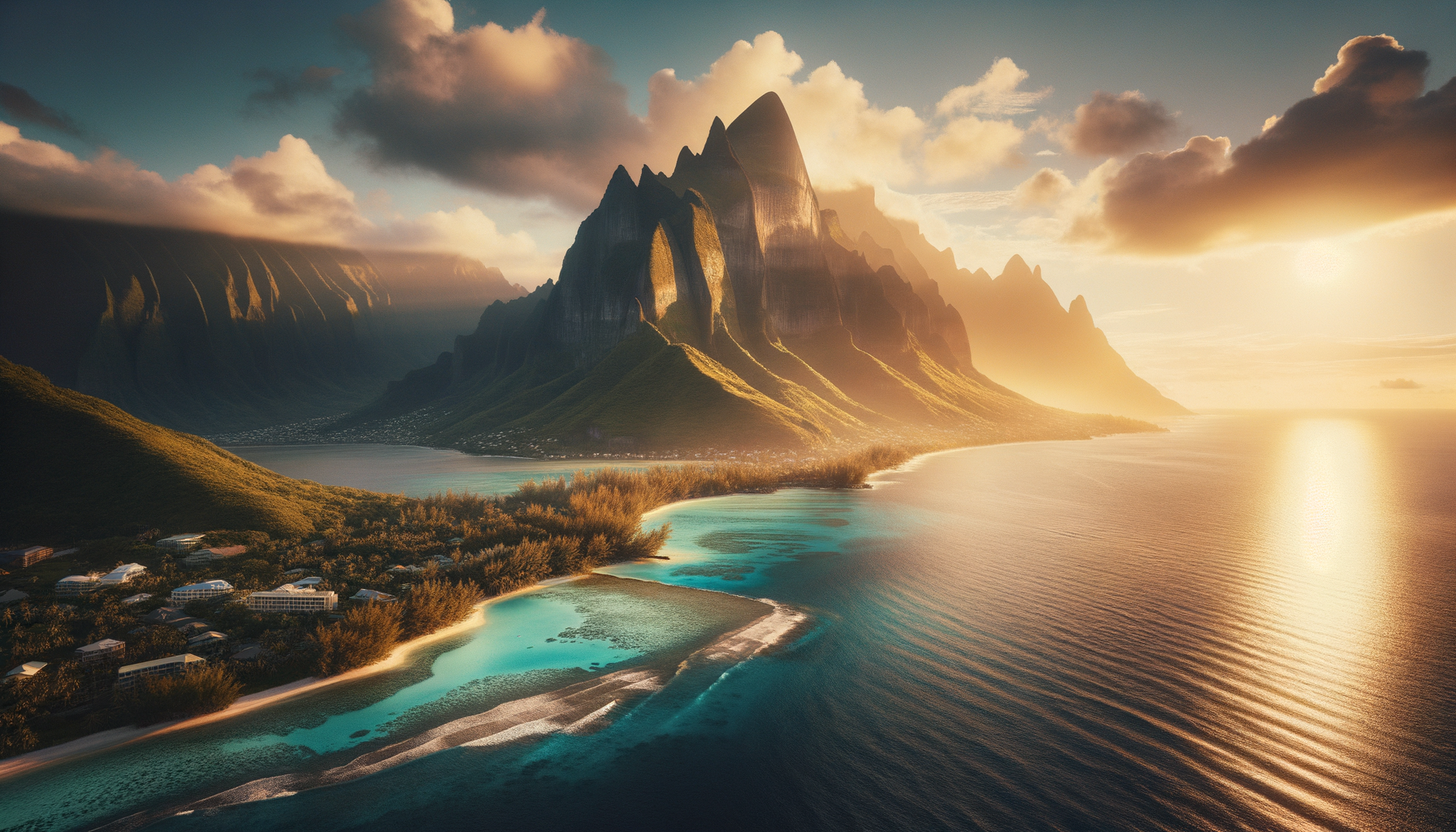
They are dramatic in shape and modest in height. The highest point, Piton de la Petite Rivière Noire, is 828 m. Pieter Both (823 m) has a boulder balanced on its summit, Le Pouce (812 m) is a thumb, and Le Morne Brabant is a 556 m basalt monolith on a peninsula. This matters for the gallery below: images that show Mauritius with two-thousand-metre serrated ridges are showing somewhere else.
The lagoon and the reef
About 150 km of fringing reef encloses lagoons that are shallow, warm and pale turquoise, and that break the ocean swell before it reaches the sand. The gaps in the reef — the passes — are where the fishing boats go out and where the surf is. Without the reef there would be no lagoon, no sheltered swimming and no tourism industry.
Water and rain
Genuinely wet by island standards: the central plateau gets 3,000–4,000 mm a year, the west coast around 900. Mauritius has real rivers, waterfalls and reservoirs, which is why it could grow sugar without irrigation and why it looks green from the air. Water stress is still an issue in dry years, and the distribution network loses a great deal.
Cyclones
The season runs November to April and Mauritius is squarely in the south-west Indian Ocean cyclone belt. The warning system is excellent and graduated — classes I to IV, broadcast constantly, with class III meaning the whole country shuts down. Historic strikes: Carol (1960) and Gervaise (1975) are the ones older Mauritians name. Building standards are good and casualties are now low.
Chamarel and the south-west
The most interesting landscape: the Seven Coloured Earths, dunes of volcanic clay weathered into distinct red, brown, violet and blue-grey bands; the Chamarel waterfall at 100 m; the gorges of Black River; and the tea country around Bois Chéri. This corner of the island looks nothing like the beach resorts.
Rodrigues
560 km east, 108 km², about 43,000 people, volcanic and hilly with an enormous lagoon roughly twice the size of the island itself. It is overwhelmingly Creole, Catholic, agricultural and slow, has been autonomous since 2002 with its own Regional Assembly, and feels like a different country. People who love Mauritius often love Rodrigues more.
🦤 The Dodo, and the Ecology That Went With It
The dodo (Raphus cucullatus) was a flightless pigeon, about a metre tall, that evolved on an island with no ground predators and therefore had no reason to fear anything. The Dutch arrived in 1598. The last widely accepted sighting is 1662, and the species was almost certainly gone by 1690. It is the standard symbol of human-caused extinction and it is on the national coat of arms of the country that killed it.
What actually killed it
Not, mostly, being eaten — Dutch sailors recorded the meat as tough and unpleasant. The dodo was destroyed by the animals that came with the ships: rats, pigs, monkeys, cats and dogs, which ate the eggs and chicks of a bird that nested on the ground and laid a single egg. The forest clearance did the rest. It is a lesson about invasive species more than about hunting.
How little survives
There is no complete stuffed dodo anywhere in the world. The Oxford specimen — the only one with soft tissue, and the source of all dodo DNA — was reduced to a head and a foot after the rest decayed and was discarded in the eighteenth century. Everything else is bone. The Mare aux Songes swamp in the south-east, where thousands of dodo bones were found from 1865 and again from 2005, is the world's main source.
What went with it
The dodo is famous and it was not alone. Mauritius also lost the Rodrigues solitaire, the broad-billed parrot, the Mauritius blue pigeon, two species of giant tortoise, the Mauritian giant skink, a flightless red rail and several bats and reptiles. Around 2% of the original native forest remains. This is one of the most comprehensively destroyed island ecologies on earth.
The tambalacoque story
A widely repeated claim holds that the tambalacoque tree cannot germinate without passing through a dodo's gut, and that the species has been dying out since 1662. It is a lovely story and it is not well supported — the trees do germinate without any such treatment and there are young ones. Mauritian guides tell it anyway; treat it as folklore rather than botany.
The conservation that worked
And then the genuinely remarkable part. The Mauritius kestrel was down to four known birds in 1974, including one breeding female, and is now a population in the hundreds — one of the most successful raptor recoveries ever achieved. The pink pigeon and the echo parakeet were pulled back similarly. Carl Jones and the Mauritian Wildlife Foundation did this, and it is a real counterweight to the dodo story.
Where to see it
Île aux Aigrettes, a 26-hectare coral islet off Mahébourg, is being restored to native ebony forest with giant tortoises reintroduced as ecological stand-ins for the extinct ones, and pink pigeons and kestrels present. Guided visits only, run by the Wildlife Foundation, and it is the single most worthwhile paid excursion on the island.
⛵ Dutch, French, British — Three Attempts at the Same Island
The Dutch, 1638–1710
Two attempts at settlement, both eventually abandoned. The Dutch cut the ebony, introduced sugar cane, deer, pigs and rats, ate what they could and left in 1710 having found the place unprofitable. Their lasting contributions were the name, the sugar cane, the deer that Mauritians still hunt, and the extinction of the dodo.
The French, 1715–1810
The French took the empty island in 1715, renamed it Isle de France, and built something. Bertrand-François Mahé de La Bourdonnais, governor from 1735, founded Port Louis as a naval base, built the docks and the aqueduct, and made the island the hub of French power in the Indian Ocean. Sugar plantations expanded and with them the importation of enslaved people from Madagascar, Mozambique and East Africa.
The corsairs
During the Revolutionary and Napoleonic wars, Isle de France became a privateering base that did serious damage to British Indian Ocean trade. Robert Surcouf is the famous name. This is precisely why Britain eventually decided the island had to be taken.
Grand Port and the fall
In August 1810 the French won the Battle of Grand Port — the only clear French naval victory of the Napoleonic wars, and the only naval battle inscribed on the Arc de Triomphe. Four months later a British force of over 10,000 landed in the north and the island surrendered in a week. Mauritius is where France won the battle and lost the island.
The British terms
The capitulation of December 1810 let the colonists keep their language, their religion, their laws and their property — property meaning, at that date, enslaved people. Britain honoured it. This is why Mauritius has a French civil code under an English constitutional system, and why the planter class survived the change of flag intact.
Slavery, and its end
Slavery was abolished across the British Empire in 1835 — later here in practice, and after Britain had spent two decades failing to suppress a continuing illegal trade to the island. Around 70,000 people were freed. Compensation was paid to the owners; the freed people received nothing, largely left the estates, and became the nucleus of the Creole population, many of them settling on marginal coastal land.
⚓ Aapravasi Ghat — Half a Million People Through One Gate
When the enslaved population walked off the sugar estates in 1835, the planters needed labour, and the British Empire invented a new system to supply it: indenture. Between 1834 and 1920, around half a million people, overwhelmingly from India, arrived in Mauritius under contract. The stone steps and depot where they landed at Port Louis are now a UNESCO World Heritage Site — Aapravasi Ghat, inscribed in 2006.
The Great Experiment
Mauritius was chosen deliberately as the first trial of the system, which is why the site matters beyond this island. What was tested here was rolled out to the Caribbean, Fiji, Natal, Réunion and Malaya, moving on the order of two million people worldwide. The modern Indian diaspora across three oceans begins substantially with what happened on these steps.
What indenture was
A five-year contract, wages, rations, a return passage in principle, and in practice: recruitment often by deception, a long voyage in conditions close to those of the slave ships that preceded it, a legal regime of passes and criminal penalties for leaving the estate, and a return passage that most never took. It was not slavery and it was not free labour, and the Mauritian phrase for it — engagisme — carries all of that.
The site
What survives is a fragment: the stone steps up from the harbour, part of the hospital block, the sheds. It is small, quiet and unspectacular, and it is one of the most historically consequential places in the Indian Ocean. The Beekrumsing Ramlallah Interpretation Centre next to it does the explaining and does it well.
2 November
Arrival Day, a national public holiday, marks the landing of the first indentured labourers from the Atlas in 1834. Mauritian families trace themselves to a ship and a number in the immigration register, and the Indian Immigration Archives at the University of Mauritius hold the records — one of the most complete migration archives anywhere, and heavily used by descendants across the world.
Le Morne, the other side
The counterpart site: Le Morne Brabant, the basalt monolith at the south-west tip, inscribed by UNESCO in 2008 as a symbol of resistance to slavery. Maroons — escaped enslaved people — lived in its caves and on its ledges. The tradition, more oral than documented, is that when a police detachment climbed up in 1835 to tell them slavery had been abolished, the maroons assumed they were being recaptured and jumped. 1 February is Abolition of Slavery Day.
Two holidays, two histories
Mauritius formally commemorates both: 1 February for abolition and 2 November for indenture. Holding both in the national calendar is not a small thing in a country where those two histories belong to two different communities, and it is one of the more deliberate pieces of nation-building here.
🏛️ Sixty to Nil, and What Came After
Mauritius is a parliamentary republic with a ceremonial president, a prime minister who holds the power, and a National Assembly of 70 members — 62 directly elected in three-member constituencies plus two for Rodrigues, with up to eight further "best loser" seats allocated to balance community representation. It has held free elections continuously since independence in 1968 and has never had a coup, which in its region is remarkable.
10 November 2024
One of the most lopsided results any democracy has produced. The opposition Alliance du Changement led by Navin Ramgoolam won every single one of the 60 directly elected seats on the main island, wiping out the outgoing government of Pravind Jugnauth completely. Jugnauth lost his own seat. It was a 60–0 sweep.
Why it happened
A cost-of-living squeeze, a sense of dynastic entitlement, and above all the "Missie Moustass" wiretap leaks — a flood of recordings released in the weeks before the vote, apparently of senior figures' private phone calls, which the government responded to by briefly shutting down social media days before polling. That decision was reversed within a day and is widely thought to have finished them.
Navin Ramgoolam
Prime minister for the fourth time, having previously served 1995–2000 and 2005–2014. A medical doctor and barrister, and the son of Sir Seewoosagur Ramgoolam, the country's first prime minister and the central figure of independence. He also holds the finance portfolio, which means the budget is his personally.
The dynasty problem
Mauritian politics has been dominated for sixty years by three families — Ramgoolam, Jugnauth and Bérenger — in shifting alliances. The 2024 result replaced one dynasty with another. That is a real critique and it does not diminish the fact that power changed hands cleanly by ballot, again, as it has done repeatedly since 1968.
What they found
The new government's central claim on taking office was that the public finances were significantly worse than had been disclosed. The deficit for the year came in at 9.3% of GDP. Public debt is running around 88% of GDP in mid-2026. Whether that is inheritance or presentation is contested; the numbers themselves are not.
Institutions
Mauritius consistently ranks at or near the top of African governance and democracy indices, has an independent judiciary with final appeal to the Judicial Committee of the Privy Council in London, a free and combative press, and free education and healthcare. It also has recurring problems with political appointments, procurement and the politicisation of state media. Both of those are the standing description.
🏝️ Chagos — Won on Paper, Still Not Delivered
In 1965, three years before independence, Britain detached the Chagos Archipelago from Mauritius to create the British Indian Ocean Territory, in exchange for £3 million and under conditions Mauritius has always argued were coerced. Between 1968 and 1973 the entire population — the Chagossians, around 1,500 to 2,000 people — was forcibly removed, dumped in Mauritius and the Seychelles, and the largest island, Diego Garcia, was leased to the United States as a military base.
The legal campaign
Mauritius pursued it for decades and won. In February 2019 the International Court of Justice held in an advisory opinion that the detachment was unlawful and that the UK should end its administration "as rapidly as possible". In May 2019 the UN General Assembly endorsed that by 116 votes to 6. Britain ignored both for five years.
The deal, October 2024
Then it moved. In October 2024 the UK announced agreement to transfer sovereignty of the Chagos Archipelago to Mauritius while retaining Diego Garcia under a long lease. The treaty was signed on 22 May 2025: the base for 99 years with a possible 40-year extension, and UK payments averaging £101 million a year in 2025–26 prices — roughly £3.4 billion over the term.
And then it stalled
The UK implementing legislation has not passed. A parliamentary debate on the bill was withdrawn in January 2026 after the Conservative opposition tabled an amendment calling for a pause in light of changed geopolitical circumstances. In the same month President Trump reversed the American position, calling the deal an act of "great stupidity" — reporting links this to friction over whether the UK would permit certain US operations from Diego Garcia. In February 2026 the Maldives lodged formal objections over maritime boundaries.
Where it stands
As of the middle of 2026 the treaty is signed and unimplemented. Mauritius has said it is consulting international law firms about suing the United Kingdom over the delay. The reason is not only principle: the 2026–27 budget was built assuming Chagos receipts, and without them the consolidation plan has a hole in it.
The Chagossians themselves
Frequently the missing party. Many Chagossians and their descendants — in Mauritius, the Seychelles and Crawley in England — have argued that a deal negotiated between two states about their homeland, without their consent and without a guaranteed right of return to Diego Garcia itself, repeats the original wrong in a new form. Resettlement of the outer islands is envisaged; Diego Garcia remains a base.
India's position
India has backed Mauritius throughout and moved closer since. During Ramgoolam's visit in September 2025, India announced a special economic package reported at around US$680 million and offered assistance with surveillance and management of the Chagos marine protected area. Mauritius sits in the middle of an Indian Ocean in which India, China, the US and France all want position.
💵 The Miracle, and the Bill for It
In 1961, James Meade led a report on Mauritius that concluded the outlook was close to hopeless: a single crop, a population growing at 3% a year, no minerals, no manufacturing and dangerous ethnic tension. Meade won the Nobel Prize in economics sixteen years later; his forecast for Mauritius was comprehensively wrong, and the country is now a standard case study in why development economists should be humble.
How it was done
In stages. Sugar preferences under the Lomé Convention supplied capital. An export processing zone from 1970 turned that into textiles, employing women in large numbers and changing Mauritian society as much as the economy. Tourism was built deliberately as a high-value, low-volume sector. Then offshore financial services, and latterly ICT and business process outsourcing. Each stage paid for the next.
The India treaty
For two decades the engine was a double taxation avoidance agreement with India that made Mauritius the routing point for an enormous share of foreign investment into India. It was renegotiated in 2016, phasing out the capital gains exemption and ending the round-tripping model. Mauritius has spent the years since rebuilding the sector on substance rather than treaty arbitrage.
The grey lists
Mauritius was placed on the FATF grey list in February 2020 and the EU's high-risk list in the same year — a serious blow to a jurisdiction selling itself as clean. It reformed hard and was removed by FATF in October 2021 and by the EU in January 2022. The episode is a reminder of how exposed a small financial centre is to other people's rule changes.
Where it stands in 2026
Growth of around 2.8% forecast for 2026 by the IMF — respectable and well below the rates of the boom years. Public debt around 88% of GDP. The 2026–27 budget targets a deficit of 3.7% of GDP against 9.3% the year before, with public sector debt projected below 80% by 2029. Ramgoolam has been careful to call this consolidation rather than austerity; the distinction is doing a lot of work.
The structural issues
An ageing population — Mauritius has one of the oldest age structures in Africa and a generous universal pension that is a large and growing budget line. A shortage of skilled labour, met increasingly by importing workers from Bangladesh, India and Madagascar. A property and hotel sector exposed to European demand. And sugar, once everything, now a small and subsidised remnant.
Still the richest
For all of that, Mauritius has the highest GDP per head in Africa, universal free healthcare and education through university, near-universal literacy, life expectancy around 75, and a functioning welfare state. Whatever the criticisms below, that is the baseline, and it was built in sixty years from a sugar island.
👥 A Plural Society That Works, Mostly
The composition
Around 1.26 million people on the main island and Rodrigues. Roughly two thirds Indo-Mauritian, a quarter Creole, small Sino-Mauritian and Franco-Mauritian communities. Religion tracks it: about 48% Hindu, 26% Christian (mostly Catholic), 17% Muslim, plus Buddhists and others. There has been no census question on ethnicity since 1972, so every figure quoted is an estimate built on that.
How it holds together
Mostly through structure rather than sentiment: proportional balancing in parliament, public holidays for every major community's festivals, state funding across religions, and a shared language nobody's ancestors brought with them. It is not a post-ethnic society and does not claim to be. It is a society that has built machinery for managing difference and has largely kept it working.
Where it has failed
In February 1999, the death in police custody of the Creole singer Kaya triggered several days of the worst rioting in Mauritian history, with deaths and destruction. It exposed something the machinery does not fix: the malaise créole — the persistent economic and educational disadvantage of the Creole population, descendants of the enslaved, who did not get the land, the state jobs or the political representation that other groups secured.
Education
Free through university, with a fiercely competitive examination culture inherited from the British system. The CPE primary exam, long the great sorting mechanism of Mauritian childhood, was replaced in 2017 by a nine-year continuous scheme intended to reduce the pressure. Private tuition remains near-universal and is an entire shadow economy.
Health and welfare
Free public healthcare, a universal non-contributory old-age pension paid to every citizen over 60 regardless of means, free public transport for students, the elderly and the disabled. It is a genuinely comprehensive welfare state at African income levels, and the pension in particular is politically untouchable and fiscally heavy.
Diaspora
Substantial Mauritian communities in France, the UK, Australia and Canada, built by emigration of the educated over decades. Remittances matter less than the return flow of skills and capital, and a good proportion of Mauritian professionals have worked abroad and come back — which is one of the quieter reasons the country works.
🏙️ Port Louis
The capital, founded by La Bourdonnais in 1735 as a naval base on the only good harbour on the leeward coast, and now a working city of about 150,000 that swells enormously by day and empties at night. It is hot, loud, crowded and not pretty, and it is the only place on the island where you see Mauritius rather than the tourism product.
The Central Market
The reason to come. Vegetables, fruit, spices, medicinal herbs, textiles, and upstairs the food stalls where you eat dholl puri, gato pima, boulettes and drink alouda. It is the single best introduction to Mauritian food anywhere on the island and it costs almost nothing. Go before noon.
Aapravasi Ghat
The UNESCO indenture site, by the harbour, with the interpretation centre next door. Small, quiet, and the most important thing in the city. An hour, and read the panels.
Caudan Waterfront
The redeveloped harbour front — shops, restaurants, a cinema, the casino, and the Blue Penny Museum, which holds the two 1847 "Post Office" stamps, among the most valuable stamps in the world, displayed for ten minutes at a time under low light. The waterfront is where Port Louis is comfortable for visitors; the market is where it is interesting.
The religious geography in four streets
Within a short walk: the Jummah Mosque of 1852, an extraordinary building blending Indian, Creole and Islamic architecture; St Louis Cathedral; the Kwan Tee Pagoda, the oldest Chinese temple in the southern hemisphere; and Tamil kovils. That compression is the country in miniature.
The Champ de Mars
The oldest racecourse in the southern hemisphere, opened in 1812 — the British used horse racing deliberately to reconcile the French colonists to the new administration, and it worked. The season runs roughly March to November and race days are a genuine cross-community event, chaotic and worth attending.
Practicalities
Come by day and by bus or Metro Express — the light rail opened in 2019 and now runs from Curepipe through the plateau towns to Port Louis, and it is the easiest way in. Traffic and parking are dreadful. The city genuinely empties after about 17:00 and is not somewhere to spend an evening.
🏖️ The North and East — Beaches, Boats and Sugar
Grand Baie
The tourism capital of the north: a sheltered bay, catamarans, restaurants, bars and the closest thing Mauritius has to a nightlife strip. It is developed and unashamed about it. Pereybère next door is smaller and has a better public beach; Cap Malheureux at the northern tip has the red-roofed chapel that appears on half the postcards, and a view out to the northern islets.
The northern islets
Coin de Mire (Gunner's Quoin), Île Plate and Îlot Gabriel — a standard catamaran day trip from Grand Baie with snorkelling and a barbecue on the sand. Touristy, and the water genuinely is that colour.
Pamplemousses
The Sir Seewoosagur Ramgoolam Botanical Garden, founded by Pierre Poivre in 1770 and one of the oldest botanical gardens in the southern hemisphere. It is famous for the giant Victoria amazonica waterlilies, the palm collection and the talipot palm that flowers once after decades and then dies. Take a guide at the gate or you will miss most of it.
The sugar story
L'Aventure du Sucre at Beau Plan, in a converted 1797 sugar factory, is the best museum in the country and does not flinch: it covers slavery, indenture, the plantation economy and the industry's decline as well as the machinery. Allow two hours and buy the unrefined sugars in the shop.
The east coast
Quieter and windier, with the big lagoon at Trou d'Eau Douce and the boat across to Île aux Cerfs — a resort islet with genuinely superb sand and, in season, a great many people on it. Belle Mare has the best long beach on the island. The east is where the wind is, which is why the kitesurfers are there.
Mahébourg and the south-east
The old capital of the French period, a low-key town with a good Monday market, the naval museum in a colonial house, and the launch point for Île aux Aigrettes. The Blue Bay marine park nearby has the best accessible snorkelling on the main island. The airport is fifteen minutes away.
⛰️ The South-West — Le Morne, Chamarel, Black River
The most interesting third of the island, and the part that has least to do with beach holidays. It holds the World Heritage monolith, the national park, the coloured earths, the tea country and a coastline that is wilder than the north.
Le Morne Brabant
A 556 m basalt monolith on a peninsula, inscribed by UNESCO in 2008 as a symbol of resistance to slavery — maroons sheltered on its cliffs and summit. The hike to the top takes about three hours return, the upper section is steep and requires a guide, and the view over the lagoon is the best on the island. It is also the site of the famous "underwater waterfall" illusion, which is a sand-and-silt effect visible only from the air.
Chamarel
The Seven Coloured Earths — dunes of weathered volcanic clay in bands of red, brown, violet and blue-grey that famously separate again if mixed. Small, fenced, undeniably touristy, and geologically real. Next to it the Chamarel waterfall drops 100 m into a gorge, and just up the road is the Rhumerie de Chamarel, the country's best agricultural rum distillery.
Black River Gorges
The national park, covering about 68 km² and containing essentially all that is left of Mauritius's native upland forest — the last 2% or so. It holds the surviving endemic birds: the Mauritius kestrel, pink pigeon, echo parakeet, cuckooshrike and olive white-eye. Marked trails from the Pétrin and Plaine Champagne entrances; the viewpoint over the gorges is on the road and free.
Grand Bassin
Ganga Talao, a crater lake in the highlands held sacred by Mauritian Hindus as connected to the Ganges, with an enormous statue of Shiva at the entrance. During Maha Shivaratree in February or March, several hundred thousand pilgrims walk here from across the island, many barefoot, carrying decorated wooden kanwar. It is the largest Hindu festival anywhere outside India and it is extraordinary.
The tea country
Around Bois Chéri the plateau is under tea, and the estate runs a museum and tasting with a view down to the coast. The Route du Thé links it with the colonial house at Saint Aubin and the Domaine des Aubineaux. Vanilla is grown here too.
The wild south coast
From Baie du Cap round to Souillac the reef stops and the ocean hits the rock directly: Gris Gris, the cliffs at Le Souffleur, the natural bridge at Pont Naturel. Do not swim here. It is the only stretch of coast where Mauritius looks dangerous, and it is a useful corrective after a week of lagoon.
🐐 Rodrigues
560 km east, 108 km² of hilly volcanic island inside a lagoon roughly twice its own size, with about 43,000 people. It is overwhelmingly Creole and Catholic, mostly agricultural and fishing, and it is culturally further from Port Louis than the distance suggests. Rodriguans call the main island "Maurice" as though it were a foreign country, which functionally it is.
Autonomy
Rodrigues has had its own Regional Assembly and executive since 2002, with control over most local affairs while remaining part of the Republic. It sends two members to the National Assembly in Port Louis. The autonomy settlement is one of the quieter successes of Mauritian governance.
What it is like
Small, hilly, hot, slow. Port Mathurin is the capital and its Saturday market is the week's event. There are no big resorts; accommodation is guesthouses and small hotels. People keep goats and cattle, grow onions and limes, fish the lagoon, and play music. The pace is genuinely different and people who go tend to extend their stay.
The lagoon
Enormous — around 200 km², several times the land area — and the centre of everything. Octopus fishing on the flats at low tide is a defining Rodriguan activity, with a closed season now enforced to let stocks recover. Île aux Cocos is a protected seabird islet with terns and noddies in large numbers, visited by permit with a guide.
Walking and caves
The island is small enough to walk across and the trails are good — the Grande Montagne nature reserve is a restoration project comparable to Île aux Aigrettes, replanting native forest and reintroducing the Rodrigues fody and warbler. The Caverne Patate limestone caves in the south-west are where the bones of the extinct Rodrigues solitaire were found.
The food and the music
Rodriguan cuisine is more Creole and less Indian than the main island's — octopus curry and octopus salad above all, plus smoked and salted fish, sausages, honey and limes. The music is séga tambour, faster and more African than the main island's sega, played on goatskin drum, triangle and accordion, and it was inscribed on UNESCO's intangible heritage list in 2017.
Getting there
Air Mauritius flies from Plaisance several times daily, about 90 minutes, on a small aircraft with a strict baggage allowance. There is also a slow cargo-and-passenger ship, the Anna, which takes a day and a half and is not for the delicate. Book the flight early — it fills with Rodriguans, not tourists.
🐬 In the Water
Diving
Good rather than world-class on the main island, and better than its reputation. The best of it is in the north around Coin de Mire — the Holt's Rock and Whale Rock sites — and off Flic en Flac on the west, where the Cathedral cave dive is the signature. Several wrecks have been sunk deliberately. Water is 22–28 °C; the season for visibility is roughly November to April.
Snorkelling
Blue Bay Marine Park in the south-east is the accessible one, with real coral and a glass-bottom boat industry that has damaged parts of it. Trou aux Biches and Île aux Cerfs are easy. The honest position: Mauritian reef has been hit hard by bleaching and by sedimentation, and a diver who knows the Red Sea or the Maldives will find it thin.
Dolphins at Tamarin
Spinner and bottlenose dolphins rest in Tamarin Bay in the mornings and there is a large boat industry taking people to swim with them. It is popular, it is regulated on paper, and the number of boats crowding resting animals has been criticised by researchers for years. If you go, pick an operator that keeps its distance and does not chase; better still, watch from the boat.
Big game fishing
The drop-off is close to shore on the west coast and Mauritius has held world records for blue marlin. Black River is the base and the season is roughly November to April. It is expensive and, increasingly, tag-and-release with the good operators.
Kitesurfing and surfing
Le Morne is the destination — One Eye is a genuinely famous left-hand reef wave and the lagoon there is a world-class kite spot, best from June to September when the south-east trades are strongest. Tamarin Bay is the historic surf break, the subject of the 1974 film Forgotten Island of Santosha, which is how Mauritius got onto the surf map.
The Wakashio
On 25 July 2020 the bulk carrier MV Wakashio ran onto the reef off Pointe d'Esny and spilled around 1,000 tonnes of fuel oil into the lagoon beside the Blue Bay marine park and the Ramsar wetland. Tens of thousands of Mauritians turned out to build booms from sugarcane leaf and their own hair. It was the country's worst environmental disaster, it triggered the largest protests in decades, and the ecological consequences are still being assessed.
🌱 Two Per Cent of the Forest
What was lost
Mauritius is one of the most comprehensively deforested places on earth: roughly 2% of the original native forest survives in fragments, almost all of it in the Black River uplands. Sugar took the lowlands, ebony logging took the rest, and introduced deer, pigs, macaques and rats have prevented regeneration ever since. Around 100 endemic plant species are down to fewer than 50 individuals each.
What was saved
The Mauritius kestrel from four birds in 1974 to a self-sustaining population; the pink pigeon from about ten to several hundred; the echo parakeet from perhaps a dozen to over 800. The work was done largely by the Mauritian Wildlife Foundation with Carl Jones, and it changed the field's assumptions about how small a population can be and still be recoverable.
Island restoration
Île aux Aigrettes and Round Island are the flagship projects: remove every introduced mammal, weed out the exotic plants, replant natives, and reintroduce reptiles and birds — including Aldabra giant tortoises as functional replacements for the extinct Mauritian ones, grazing and dispersing seeds as the originals did. It is one of the more sophisticated rewilding programmes anywhere.
The reef
Bleaching events in 1998, 2016 and since have hit hard, compounded by sediment from land clearance, nutrient runoff, boat anchor damage and the Wakashio spill. The lagoon protects the coast and the coast protects the economy, so this is not only an environmental question. Coral restoration projects exist and are small relative to the problem.
Sea level and coastline
Mauritius is not a low atoll and will not disappear, but its beaches are eroding measurably and its lagoon is warming. The coastal hotel strip, which is a large share of the economy, is built exactly where the erosion is. Some hotels have started to build back and to restore dunes; most have not.
The invasive problem, ongoing
Long-tailed macaques, introduced by the Dutch, are both an agricultural pest and a target of the research-primate export trade, which is a live and unattractive controversy — Mauritius is one of the world's largest exporters of macaques for laboratories. Deer, wild pigs, rats and the giant African land snail remain uncontrolled outside the reserves.
🪔 A Calendar With Everybody's Holidays In It
Mauritius has around fifteen public holidays and they are distributed deliberately across communities: Hindu, Muslim, Christian, Chinese and the two national commemorations of slavery and indenture. This is not decorative. Attending each other's festivals is a normal Mauritian habit and it is one of the mechanisms by which a plural society holds.
Maha Shivaratree
February or March, and the largest event of the year. Several hundred thousand pilgrims in white walk to the crater lake at Grand Bassin, many barefoot and many carrying elaborately decorated wooden kanwar arches built over weeks. It is the biggest Hindu pilgrimage anywhere outside India, and the roads fill with walkers and with stalls feeding them free.
Divali
October or November, and the one everybody joins in. Houses across the island are lined with lamps, sweets are exchanged across religious lines as a matter of course, and Mauritian Divali is genuinely a national rather than a communal festival. Fireworks, and a great deal of food.
Thaipoosam Cavadee
January or February, the Tamil festival, and the most physically striking: devotees pierce their cheeks and tongues with small skewers and carry the cavadee, a decorated wooden arch with pots of milk, in procession to the kovil after weeks of fasting. It is public, it is not staged for visitors, and it should be watched respectfully or not at all.
Eid and Christmas
Eid al-Fitr is a public holiday and the mosques and the streets around them fill. Christmas is a summer holiday here — 30 °C, beach picnics, and Catholic midnight mass. Père Laval's pilgrimage on 9 September draws people of every religion to the tomb of the nineteenth-century missionary at Sainte-Croix, which is a distinctly Mauritian phenomenon.
Chinese Spring Festival
January or February, centred on Port Louis Chinatown, with firecrackers, lion dances and wax cakes. The Sino-Mauritian community is small — perhaps 2–3% — and its festival is a national holiday, which tells you how the system works.
The two national days of memory
1 February, Abolition of Slavery Day, commemorated at Le Morne. 2 November, Arrival Day, commemorated at Aapravasi Ghat. And 12 March, which is both Independence Day (1968) and Republic Day (1992). A country that puts both slavery and indenture in its official calendar has decided something about itself.
🍽️ Four Cuisines That Stopped Being Separate
Mauritian food is what happens when Indian, Creole African, Chinese and French cooking share an island for two hundred years and stop keeping track. It is one of the genuinely great fusion cuisines and it happened by accident rather than by chef. The best of it is eaten standing up at a street stall for the equivalent of thirty crowns.
Dholl puri
The national street food and an object of real devotion. A thin, soft flatbread with ground yellow split peas kneaded into the dough itself — the pea filling is inside, not alongside — griddled, served in pairs, and filled with rougaille, butter bean curry, pickled vegetables and chilli paste, then rolled. Sold from carts and eaten with the hands. The best-known stalls in Port Louis sell thousands a day.
Rougaille
The base sauce of Creole Mauritius: tomatoes, onion, garlic, ginger, thyme, curry leaves and chilli, cooked down, with sausage, fish, chicken or eggs in it. If a Mauritian dish is red, it is probably a rougaille. Every household makes it and every household's is correct.
The Indian layer
Curries of every kind, milder and soupier than most Indian equivalents; briani, the Mauritian biryani, layered with potato and eaten at weddings and on Sundays; farata; samoussas; gato pima, the split-pea and chilli fritters that accompany everything; and satini, the chutneys — coconut, tomato, tamarind.
The Chinese layer
Mine frite (fried noodles) and bol renversé — the "upside-down bowl", rice pressed into a bowl with stir-fried meat and vegetables and a fried egg, inverted onto the plate — are eaten by everyone as ordinary Mauritian food. So are niouk yen dumplings and boulettes, the steamed dumplings sold in broth from stalls.
The sea
Vindaye — fish or octopus fried and then pickled in ground mustard seed, turmeric, garlic and vinegar, packed in oil and eaten cold, ideally the next day. The name descends from Portuguese vinha d'alhos, the same root as vindaloo. Also octopus curry (ourite), smoked marlin, and camarons, freshwater prawns, which are expensive and worth it.
Sweet things
Gâteau patate — small deep-fried sweet-potato turnovers stuffed with sweetened grated coconut, sold from trays; note the shape, because it matters in the gallery below. Napolitaine, a shortbread sandwich with jam under lurid pink icing, the classic Mauritian tea cake. Alouda, which is a drink but functions as a dessert. And the fruit — lychee, longan, mango, pineapple sold with chilli salt.
👨🍳 Two Recipes That Work Abroad
The dholl puri is the national dish and is genuinely difficult to make well outside Mauritius, so what follows is the rougaille that fills it — the sauce that underpins half of Mauritian cooking — and the vindaye, which travels perfectly.
Rougaille Saucisses — Creole Tomato Sauce with Sausages
Serves 4 · 15 min prep · 40 min cooking · the everyday dish of Creole Mauritius
Ingredients: 500 g good pork sausages (Mauritians use a chilli-spiced Creole sausage; a coarse Toulouse or a spicy fresh chorizo works); 800 g ripe tomatoes, chopped, or 2 tins of chopped tomatoes; 2 onions, sliced; 5 cloves garlic, crushed; 1 thumb of ginger, grated; 4 sprigs fresh thyme; 8 curry leaves if you have them; 2 spring onions; 1 red chilli, or a spoon of chilli paste; ½ tsp turmeric; oil; salt; a handful of coriander.
Method: Cut the sausages into thick slices or leave whole, and brown them hard in a little oil in a wide pan; take them out. Soften the onions in the same pan until translucent, then add garlic, ginger, thyme, curry leaves and turmeric and cook two minutes until it smells right. Add the tomatoes and the chilli, season, and cook uncovered on a medium heat for about 25 minutes, stirring occasionally, until the sauce has thickened and the oil has begun to separate at the edges — this is the point where a rougaille becomes a rougaille rather than a tomato sauce. Return the sausages, add a splash of water if it is too tight, and simmer another 10 minutes. Finish with the spring onions and coriander.
💡 The two rules: cook the tomato long enough that it darkens and the oil separates, and do not add sugar. Serve with plain rice, and with gato pima if you can. The same sauce with prawns, salt cod, chicken or eggs poached into it is four more dinners.
Vindaye de Poisson — Mauritian Mustard-Pickled Fish
Serves 4 · 20 min prep · 15 min cooking · best made a day ahead and eaten cold
Ingredients: 700 g firm fish in thick steaks or 3 cm cubes — tuna is classic, but swordfish, kingfish or a firm white fish work; 3 tbsp yellow mustard seeds; 1 tbsp ground turmeric; 8 cloves garlic; 1 thumb ginger; 4 green chillies, slit; 2 large onions, sliced into rings; 150 ml neutral oil; 100 ml white vinegar; salt.
Method: Salt the fish and fry it in oil until just cooked and lightly coloured, then lift it out onto paper. Grind the mustard seeds coarsely — a spice grinder or a mortar — and pound or blend them with the garlic, ginger, turmeric and a splash of the vinegar into a thick paste. Heat the remaining oil in the pan, add the paste and fry it gently for three or four minutes until it darkens and stops smelling raw. Add the onion rings and the slit chillies and cook two minutes more — they should stay crisp. Take the pan off the heat, stir in the rest of the vinegar, taste for salt, and fold the fish through so every piece is coated. Pack it into a jar or a bowl, press it down so the oil covers the top, cool, and refrigerate.
💡 Eat it the next day, cold or at room temperature, with bread or plain rice. It is a pickle, not a hot dish, and the vinegar and mustard need overnight to do their work. It keeps in the fridge for several days and improves for the first two.
🥤 Alouda, Rum and Phoenix
Alouda
The drink of the Port Louis market and the one to try first: milk, basil seeds, agar jelly, vanilla or almond syrup and ice, sometimes with a scoop of ice cream. The basil seeds swell into little translucent spheres and the texture is the point. It descends from the Persian and Indian falooda and it is what Mauritians drink on a hot afternoon.
Rum, seriously
Mauritius makes both molasses rum and, increasingly, agricultural rum from fresh cane juice, and the quality has risen sharply. Chamarel, Saint Aubin, New Grove and Penny Blue are the names; the Chamarel distillery in the south-west does the best tour. Local drinking rum is cheap and rough and turns up as rhum arrangé, steeped with vanilla, fruit and spices in a jar behind every bar.
Phoenix
The national beer, brewed since 1963, a straightforward lager that has won more international medals than a beer from a small island has any right to. Blue Marlin is its stronger sibling. Beer is drunk cold, in quantity, and generally with something fried.
Tea
Mauritius grows tea on the plateau around Bois Chéri, and Mauritian tea is drunk with milk, sweet, and very often vanilla-flavoured, which is the local signature and which visitors either take to immediately or not at all. The estate does tastings on the Route du Thé.
The soft drinks
Freshly pressed sugarcane juice with lime at roadside stalls in the cutting season. Coconut water. And a national attachment to a locally bottled range of syrupy sodas that will not be to everyone's taste. Tap water in the towns is treated and generally fine; most people drink bottled anyway.
Alcohol and the law
Freely available, sold in supermarkets and bars, no religious restriction at national level. Drink-driving enforcement is serious and the limits are low. The one thing to know is that Mauritian drinking rum is much stronger than it tastes when it arrives in a fruit punch at a beach bar.
🥁 Sega, and the Culture That Came Out of Slavery
Sega
The music and dance of the Creole population, created by enslaved people on the plantations and long suppressed as vulgar. Traditional sega tipik is played on the ravanne — a large goatskin frame drum heated over a fire to tune it — with the maravanne rattle and the triangle, sung in Creole, with a dance of small rapid steps and swaying hips in which the feet never leave the ground. It was inscribed on UNESCO's intangible heritage list in 2014.
What sega is about
The lyrics were and are about hardship, love, drink, gossip and the plantation. It was music made by people who were not allowed much else, performed on Saturday nights around a fire on the beach, and it carries that history in it. What is played at hotel buffets is a sanitised, sped-up descendant; the real thing is worth seeking out on Rodrigues or at a village soirée.
Kaya and seggae
Joseph Réginald Topize, known as Kaya, fused sega with reggae to create seggae in the 1980s and became the voice of Creole Mauritius. He died in police custody in February 1999 after an arrest for cannabis possession at a legalisation rally, and the riots that followed were the worst in the country's history. He is a national figure and his death remains the reference point for the malaise créole.
Séga tambour of Rodrigues
Faster, more percussive and more African than the main island's sega, played on drum, triangle and accordion, with its own dance. Separately inscribed by UNESCO in 2017. If you get to Rodrigues, this is the thing to hear.
Writing
Mauritius produces a startling amount of literature for its size, mostly in French. Ananda Devi is the major contemporary novelist and is widely translated; Nathacha Appanah's Le Dernier Frère is the best-known Mauritian novel abroad; and J. M. G. Le Clézio, the 2008 Nobel laureate in literature, is a Mauritian citizen of Franco-Mauritian descent who writes about the island repeatedly.
Sport and the everyday
Football is followed with the intensity of a country whose own league is small and whose loyalties are to European clubs. Horse racing at the Champ de Mars is the mass spectator sport. And the genuinely national pastime is eating outdoors: on Sundays the public beaches fill with extended families, cooking pots, sound systems and card games, which is Mauritius at its best and is free to join in near.
🏛️ Two World Heritage Sites, Both About Slavery
Aapravasi Ghat
Inscribed 2006. The immigration depot at Port Louis through which around half a million indentured labourers passed between 1834 and 1920, and the place where the British Empire ran its first trial of indenture as a replacement for slavery. What survives is a fragment of the steps, hospital and sheds. Its significance is global rather than architectural: the modern Indian diaspora across three oceans begins substantially here.
Le Morne Cultural Landscape
Inscribed 2008. The basalt monolith at the south-western tip, used as a refuge by maroons — escaped enslaved people — and inscribed specifically as a symbol of resistance to slavery, with the oral tradition and the physical landscape counted together. The two sites deliberately mark the two halves of Mauritian history, and the country asked for both.
The intangible list
Sega tipik (2014), séga tambour of Rodrigues (2017), geet-gawai (2016) — the Bhojpuri women's pre-wedding song and ritual cycle — and the séga chagossien (2019), the sega of the displaced Chagossian community, which is inscribed as heritage in need of urgent safeguarding. Four inscriptions covering Creole, Indo-Mauritian and Chagossian traditions.
On the tentative list
Black River Gorges and the surviving native forest, the Trou aux Cerfs and volcanic landscape, and Île aux Aigrettes as an ecological restoration site. Mauritius has no natural World Heritage site, and given how little of the original ecology survives, an inscription would be as much about the restoration work as about what remains.
The colonial buildings
Eureka House at Moka, an 1830s Creole mansion with 109 doors, kept as a museum and the best surviving example of the type. Château de Labourdonnais in the north, restored with its orchards and rum distillery. L'Aventure du Sucre in the old Beau Plan factory. And the Line Barracks and the Government House in Port Louis.
The stamps
A footnote that Mauritians do not treat as one: the 1847 "Post Office" one penny and two pence were the first stamps issued anywhere in the British Empire outside Britain, and the engraver's error made them among the most valuable stamps in existence. The Blue Penny Museum bought a pair at auction in 1993 for a reported US$2 million and shows them in the dark.
🗣️ Three Languages Before Breakfast
You need nothing. English is official and universally understood in tourism and administration; French is what most people are more comfortable in; and Creole is what they actually speak to each other. A visitor gets by entirely in English, and gets on considerably better with a little French.
Kreol Morisien basics
Bonzour — hello. Ki manier? — how are you? Mo bien — I'm well. Mersi — thank you. Silvouple — please. Wi / Non. Komie sa? — how much? Mo pa konpran — I don't understand. Korek — fine, OK, agreed, and the single most useful word in the language.
How the creole works
Vocabulary largely from French, with the definite article often fused onto the noun — lakaz (house, from la case), lamer (sea), diri (rice, from du riz). Grammar is not French at all: no conjugation, no grammatical gender, tense carried by preverbal markers — ti for past, pou for future, pe for the progressive. A French speaker recognises the words and cannot follow the sentences.
The status shift
Within a generation Creole has gone from a stigmatised patois to a language with a standard orthography (2011), a place in the school curriculum (2012), use in parliament (2014) and a growing literature. It is now the strongest available argument that Mauritius is a single nation rather than several communities sharing an island.
Which language when
English for anything official, written or legal — laws, forms, court, parliamentary records. French for newspapers, television, advertising, and most professional conversation. Creole for everything else, including the conversation that happens immediately after the professional one ends. Mauritians switch constantly and without noticing.
Place names
Overwhelmingly French — Trou aux Biches, Flic en Flac, Grand Baie, Belle Mare, Baie du Cap — with Indian and Creole names inland: Triolet, Goodlands, Quatre Bornes, Rose Hill. Flic en Flac is thought to come from an old Dutch phrase meaning free flat land, which is the only Dutch survival on the map.
A note on register
Mauritian politeness is French-inflected: greet before you ask, bonjour or bonzour on entering a shop, and expect small talk before business. Direct Northern European bluntness reads as rudeness. This costs thirty seconds and changes the interaction.
📅 When to Go
May–June and September–November
The best windows. Warm and dry, 22–27 °C, low humidity, the sea still around 24 °C, and prices below the peaks. October and November are particularly good. This is when people who have been before choose to come.
December–March, the hot wet season
27–33 °C, humid, and the cyclone season, which peaks January to March. It rains hard and briefly rather than all day, the sea is at its warmest, and the island is at its greenest. It is also the European and South African high season, so it is the most expensive and most crowded time. Diving visibility is at its best.
July–August, the cool dry season
20–25 °C by day, cooler on the plateau and genuinely cool at night, with the south-east trades blowing hard. Excellent for walking and for kitesurfing at Le Morne, less so for lying on a beach — the east and south coasts get windy. Whale watching off the west coast is at its best.
The wind, and which coast
The trades blow from the south-east most of the year, so the east and south-east coasts are windier and cooler and the north and west are calmer and hotter. If you want flat water and sun, go north or west; if you want wind, go east. This matters more than the season for choosing where to stay.
Cyclones, practically
Warnings are graded I to IV, announced constantly on radio and by siren, and taken seriously — class III means everything closes and you stay indoors. Hotels handle it competently. A cyclone can cost you two or three days of a trip and is very unlikely to endanger you. Travel insurance that covers weather disruption is worth having in that window.
Dates worth timing
Maha Shivaratree (February or March) at Grand Bassin — the single most impressive thing in the Mauritian calendar. Divali (October or November). Chinese Spring Festival (January or February). 1 February at Le Morne and 2 November at Aapravasi Ghat for the commemorations. Race days at the Champ de Mars, March to November.
✈️ Getting There from Central Europe
The airport
Sir Seewoosagur Ramgoolam International (MRU) at Plaisance in the south-east, about 45 minutes from Port Louis and 15 from Mahébourg. Modern, efficient, one terminal. The national carrier is Air Mauritius, which flies to Paris, London, Geneva, several Indian and African cities, and Réunion.
From Prague, realistically
No direct flight. Three routings work. Via Paris — Air France or Air Mauritius, around 11 hours from CDG, and usually the shortest total. Via the Gulf — Emirates through Dubai, Qatar through Doha, Turkish through Istanbul, generally the best value and often the best aircraft. Via Réunion or Johannesburg if you are combining. Total journey 14–19 hours.
What it costs
Return Prague–Mauritius typically 20,000–40,000 Kč, with the Gulf carriers at the lower end and the December–February peak at the upper. Booking three to five months ahead makes a real difference. Charter and package deals from Czech operators appear in winter and can undercut scheduled fares substantially.
Entry — easy
Czech citizens get a visa-free stay of up to 90 days on arrival for tourism. You need a passport valid six months beyond arrival, a return or onward ticket, proof of accommodation and of sufficient funds — these are actually checked at the desk more often than in most places. There is an online arrival form to complete before travel; check the current requirement, as it has changed several times.
Health
No yellow fever requirement unless arriving from an endemic country. No malaria. Dengue and chikungunya occur, so repellent is sensible. Healthcare is good — free in public hospitals for emergencies, and there are excellent private clinics. Standard travel insurance is enough; this is not a place that needs evacuation cover in the way the last few countries in this series did.
Getting around
Buses are cheap, extensive, slow and an experience. Metro Express light rail runs Curepipe–Port Louis and is the fastest way along the plateau. Taxis are plentiful and should be negotiated before departure. Car hire is the practical answer for seeing the island — €30–50 a day, and note that Mauritius drives on the left.
📋 Practical Details
Money
The Mauritian rupee (MUR), roughly 1 Kč to 2 MUR as a mental shortcut — check the rate. Cards are accepted almost everywhere including small shops; ATMs are everywhere; contactless is normal. Tipping is not obligatory and 5–10% is appreciated. Keep some cash for markets, buses and street food.
Power and connectivity
230 V, and the plugs are a genuine nuisance: Mauritius uses the British type G three-pin and also the old type C two-pin, sometimes in the same room. Bring a UK adapter. Mobile data is cheap and good — buy a local SIM at the airport for a few euros. Country code +230; emergency 999 or 112.
Driving
On the left, a British legacy. Roads are good and there is a motorway spine. The hazards are dogs, pedestrians on unlit roads at night, and a local driving style that treats indicators as optional. A Czech licence is accepted for short stays. Fuel is not cheap by regional standards.
Safety
Mauritius is safe by any reasonable measure and violent crime against visitors is rare. What does happen is opportunistic theft — from beaches, from parked hire cars, from hotel rooms. Do not leave anything on the sand while you swim. There is a synthetic drug problem in some urban areas that does not touch visitors.
In the sea
The lagoon is safe; the danger is outside the reef and in the passes, where currents are strong and people drown every year. Swim inside the reef unless you know the spot. Watch for stonefish on rocky and seagrass bottoms — wear reef shoes when walking in shallow water, and know that the treatment is hot water and a hospital, quickly. The south coast beaches without reef are not for swimming at all.
Etiquette and dress
Beachwear on the beach, covered up elsewhere — Mauritius is more conservative than a resort brochure suggests, and topless sunbathing is not acceptable outside private hotel beaches. Remove shoes and cover shoulders and knees at temples and mosques. Ask before photographing people, and particularly before photographing at Grand Bassin during Shivaratree.
💰 What It Costs
Two completely different countries depending on how you do it: the resort island is expensive by any standard, and the ordinary island is inexpensive. Approximate 2026 prices, with the rupee at roughly 2 MUR to 1 Kč.
Sleeping
A guesthouse or self-catering studio €35–70 a night (900–1,750 Kč). A mid-range hotel €90–160. A four-star beach resort €200–350. The five-star names on the west and east coasts run €400–1,200 and upward. Renting an apartment through the usual platforms in Flic en Flac, Grand Baie or Trou aux Biches is where the value is.
Eating
This is where Mauritius is a bargain. Street food: dholl puri from a cart 25–40 MUR (roughly 12–20 Kč), gato pima a few rupees, a bol renversé 150–250 MUR. A meal in a local tabagie or a Chinese restaurant €5–10. A good seafood dinner €20–35. A hotel restaurant, whatever the hotel decides.
Getting around
Bus fare 25–45 MUR (12–22 Kč) for most journeys. Metro Express similar. Car hire €30–50 a day, less for a week. Taxi Port Louis to Grand Baie around €25–35, airport to the west coast €40–55 — always agree the price first.
Doing things
Île aux Aigrettes guided visit around €18 and the best value on the island. Black River Gorges is free. Chamarel Seven Coloured Earths about €8. Catamaran day trip €50–80. Two-tank dive €90–110. Le Morne guided hike €35–50. Rodrigues return flight €200–320.
A week, roughly
Self-catering, hire car, eating locally with two restaurant dinners, four paid excursions: €700–1,100 for two people (17–27,000 Kč) on the ground. The same week in a four-star resort on half board: €2,000–3,500. Flights from Prague add 20,000–40,000 Kč return per person.
The honest advice
Mauritius is sold as a luxury destination and works extremely well as an ordinary one. A hire car, a rented flat, the market in Port Louis, the buses and the street food will give you a better week than a resort at a third of the cost — and it is the only way you will see the country rather than the lagoon.
🇨🇿 For Czech Readers
MZV ČR
No travel warning. Mauritius is one of the more straightforward long-haul destinations available — politically stable, low crime, good healthcare, English and French spoken, and a functioning state. The advisory content that matters is ordinary: sun, sea currents outside the reef, mosquito-borne illness, and the cyclone season from November to April. DROZD registration takes ten minutes and is worth it for the cyclone window.
No embassy
There is no Czech embassy in Mauritius. The country is covered from the Czech Embassy in Pretoria, South Africa, and there is honorary consular representation on the island — worth confirming the current arrangement on mzv.cz before travelling. In practice, as an EU citizen you can also approach France, which has a full embassy in Port Louis and by far the largest European presence, under Article 20(2)(c) TFEU.
Entry — genuinely easy
Czech citizens travel visa-free for up to 90 days. Passport valid six months beyond arrival, return ticket, proof of accommodation and funds — and unlike many places, these are often actually asked for at immigration, so have the hotel booking on your phone. There is an online arrival declaration to complete before departure; check the current form, because the requirement has changed repeatedly.
Getting there from Prague
No direct flight and there never has been. The practical routes are via Paris (shortest), via Dubai, Doha or Istanbul (usually the best value and the best aircraft), or on a Czech charter package in the winter season, which can undercut scheduled fares substantially. Reckon 14–19 hours total and 20,000–40,000 Kč return.
The Czech connection
Modest but real. Mauritius has been a mid-market Czech winter destination for two decades, sold as the affordable alternative to the Maldives and the Seychelles, and Czech tour operators run seasonal packages. There is no Czech community and no historical bilateral story worth inventing — but unlike most countries in this series, a Czech traveller here is unremarkable rather than unique.
Scale, for a Czech reader
Mauritius is 2,040 km² — about four times the area of Prague, or a quarter of the Central Bohemian Region — with 1.26 million people, slightly fewer than Prague. Its highest point, 828 m, is a little lower than Lysá hora. And you can drive from one end to the other in about ninety minutes.
🎲 Things That Are True About Mauritius
The country killed its own national bird
The dodo was gone within about eighty years of the first Dutch landing, is the standard emblem of human-caused extinction worldwide, and appears on the coat of arms and the currency of the country responsible. There is no complete stuffed specimen anywhere on earth.
An economist predicted disaster and won a Nobel anyway
James Meade's 1961 report concluded Mauritius faced near-certain economic failure. He received the Nobel Prize in economics in 1977. Mauritius became the richest country in Africa. Both of these things are true and development economists have been citing the pair of them ever since.
The only French naval victory of the Napoleonic wars is here
The Battle of Grand Port, August 1810 — the only clear French win at sea in the entire conflict, and the only naval battle inscribed on the Arc de Triomphe. Britain took the whole island four months later.
Sixty seats to nil
In November 2024 the opposition won every single one of the 60 directly elected parliamentary seats, and the sitting prime minister lost his own constituency. Very few functioning democracies have ever produced a result that lopsided.
The stamps are worth more than most buildings
The 1847 "Post Office" one penny and two pence were the first stamps issued anywhere in the British Empire outside Britain, and an engraver's error made them among the rarest in the world. Mauritius bought a pair back at auction in 1993 for a reported two million dollars and shows them in a darkened room for ten minutes at a time.
Half a million people through one gate
Around 500,000 indentured labourers landed at the stone steps of Aapravasi Ghat in Port Louis between 1834 and 1920. It was the first trial of a system that went on to move roughly two million people to the Caribbean, Fiji, Natal and South-East Asia. A large part of the modern Indian diaspora begins on those steps.
🔭 What Happens Next
The Chagos money
The treaty is signed and the British legislation is stuck, with Washington having reversed position in January 2026 and the Maldives objecting in February. Mauritius has budgeted for receipts it has not received and is consulting lawyers about suing the UK. This is the single largest uncertainty facing the government, and it is entirely in other people's hands.
The fiscal correction
A deficit of 9.3% of GDP and debt near 88% have to come down, and the government is doing it while insisting the word is consolidation and not austerity. The IMF forecasts around 2.8% growth for 2026. The politically hard part is the universal pension, which is large, growing, popular and untouchable.
Ageing
Mauritius has one of the oldest populations in Africa and a fertility rate well below replacement. The working-age share is shrinking, skilled labour is already imported from Bangladesh, India and Madagascar, and the pension and health bills grow every year. This is a European demographic problem arriving in a middle-income country that has not finished getting rich.
What the economy becomes next
Sugar is a remnant, textiles moved to cheaper countries, tourism is mature and exposed, and financial services has been rebuilt once already after the India treaty was renegotiated and the grey-listing. The bets being placed are on fintech, the blue economy, medical tourism and Africa-facing services. Mauritius has reinvented itself three times; there is no particular reason to assume it cannot do it again, and no guarantee.
The reef and the coast
Bleaching, sedimentation, beach erosion and the aftermath of the Wakashio. The hotel strip sits precisely where the erosion is, and the lagoon that makes the tourism possible is the thing under pressure. Coral restoration is under way and is small relative to the problem.
What is genuinely secure
The democracy, which has changed governments peacefully at the ballot box for nearly sixty years and did so spectacularly in 2024. The Creole language, which has gone from stigma to parliament in a generation. The conservation work, which saved four species other people had written off. And the plural settlement, which is imperfect, explicitly engineered, and has held where a great many better-resourced countries' have not.
🧭 How to Actually Visit
Leave the resort
The single most useful piece of advice. Mauritius sold as a package is a beach, a buffet and a hotel sega show. Mauritius with a hire car and a rented flat is a market, a mountain, a national park, four religions, five cuisines and a genuinely interesting country. The second version costs less.
The three days that matter
Port Louis — the central market before noon, Aapravasi Ghat, the Blue Penny stamps. The south-west — Black River Gorges, Chamarel, Le Morne, the wild south coast. Île aux Aigrettes — the restored islet, the tortoises, the pink pigeons and what conservation can actually achieve. Everything else is optional.
Where to base yourself
North (Grand Baie, Trou aux Biches, Pereybère) for calm water, restaurants and boat trips. West (Flic en Flac, Tamarin) for sunsets, dolphins and diving. East (Belle Mare, Trou d'Eau Douce) for the best beaches and the most wind. South-west (Le Morne, Bel Ombre) for the scenery and the hiking. Two bases beat one.
Eat where the queue is
The dholl puri cart with twenty people waiting is the right dholl puri cart. Port Louis market upstairs, the stalls at Quatre Bornes and Rose Hill, the roadside tabagies. The best food in Mauritius is street food and it costs almost nothing, which is a rare combination in a country with this many five-star hotels.
Add Rodrigues
If you have ten days or more, spend three of them on Rodrigues. Ninety minutes by air, a completely different island, no resorts, superb octopus, and the version of Mauritius that has not been built over. People who do this generally say it was the best part of the trip.
Time it around a festival
Maha Shivaratree if you can — several hundred thousand people walking to a crater lake is not something you see elsewhere. Divali is easier to fit in and just as welcoming. Being present at somebody else's festival is normal here and visitors are made welcome at all of them.
📸 Gallery — Two Images, Two Corrections, One Rejection
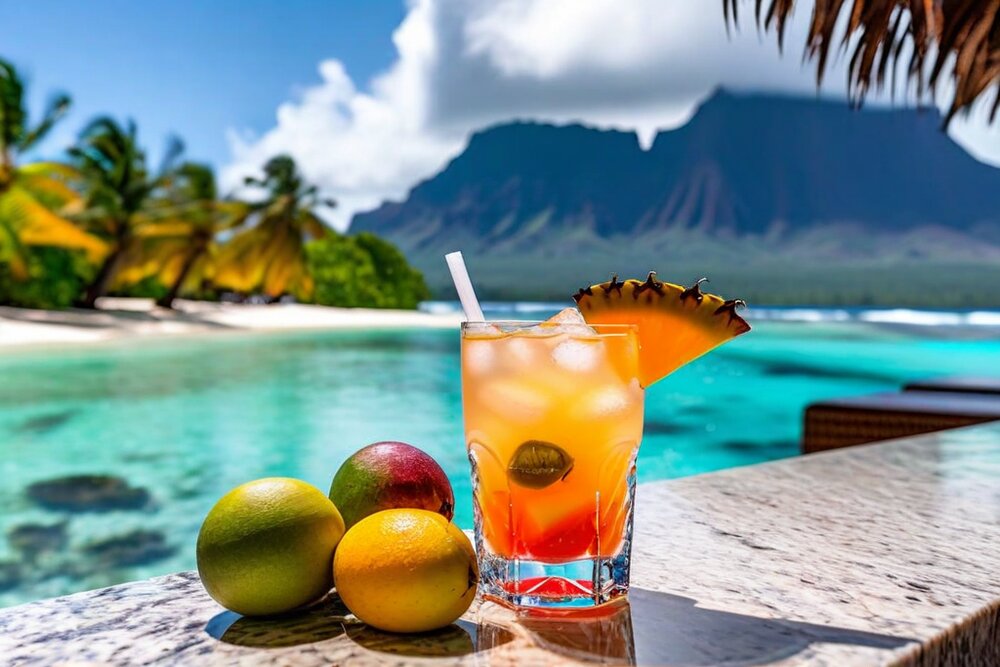
The bucket holds two images for the country — 01-hero.jpg and mauritius-drink.jpg — plus three recipe files. Around a hundred candidate filenames were tested and nothing else exists. Checked specifically for the defect classes found earlier in this series: no counterfeit publisher logo on either file, and no fabricated Wikimedia hotlinks on the old page. Four of the five files are usable with corrections, which is a better result than the last three countries.
Used with correction: dholl puri
mauritius-dholl-puri.jpg is in the right family and gets the register right — soft griddled flatbreads with a yellow pulse curry, Indo-Mauritian street food. The correction is the defining one: in a real dholl puri the ground yellow split peas are kneaded into the dough itself and show as a speckled yellow layer inside a very thin bread. These are plain and unstuffed. The accompaniment should also be butter bean curry and rougaille, not whole chickpeas.
Used with correction: vindaye
mauritius-vindaye.jpg gets the essential character right — a yellow mustard-and-turmeric paste on fish, sitting in oil — and that is more than most files in this project manage. Three corrections: vindaye is made with firm fish in steaks or cubes, classically tuna, not a whole flatfish; it should be full of sliced onion rings, whole mustard seeds and slit green chillies; and it is a pickle eaten cold, ideally the next day, not a hot plated fish.
Rejected: gâteau patate
mauritius-gateau-patate.jpg shows a purple sweet-potato pudding baked in a fluted ceramic dish. Mauritian gâteau patate is nothing like that: it is a small individual turnover of sweet-potato dough wrapped around sweetened grated coconut and deep-fried, golden-brown, sold from a tray by the half dozen, about the size of a samosa. Wrong form, wrong cooking method and wrong colour — Mauritian sweet potato is orange or white, not the purple of the Okinawan variety used here.
What is missing
There is no image of Port Louis, of the central market, of Aapravasi Ghat, of Le Morne itself, of the Seven Coloured Earths, of Grand Bassin during Shivaratree, of a dodo skeleton, of a sega ravanne, or of Rodrigues. Two files cannot carry a country whose interest is almost entirely in its people and its history rather than its coastline.
The pattern across this stretch
Martinique, Mauritania and now Mauritius have each yielded exactly two country images plus a handful of recipe files, all of them generic tropical stock. That is not a coincidence about these three countries; it looks like a gap in how the image set was built. Worth checking whether the whole M range shares it.
How this list was made
By systematic HTTPS probing, because the AWS connection has now been unavailable for seven consecutive countries, plus targeted checks for the counterfeit-logo and fabricated-Wikimedia-URL defects found earlier. Every numbered slot and every plausible bare name was tested; only two country files exist. Treat the list as a minimum — a proper bucket listing is owed for the whole run from Luxembourg onward.
Support This Project 🌍
This World Travel Factbook is a labor of love – free to use for all travelers. If you find it helpful, consider supporting its continued development.