

🇲🇷 Mauritania at a Glance
🌍 Overview — Mostly Sand, and Not Mostly Empty
Mauritania is 1,030,700 km² — larger than Egypt, twice the size of France, thirteen times Czechia — with about five million people in it. Around three quarters of the country is Sahara. The southern strip along the Senegal River is the only part that reliably gets rain, and it holds a disproportionate share of both the agriculture and the population.
It sits exactly on the hinge between the Arab world and Black Africa, and that position is not a metaphor here: it is the country's central political fact, its main social fault line, and the reason for most of what follows on this page. Mauritania is a member of the Arab League and of the African Union; its official language is Arabic and its national languages are Pulaar, Soninke and Wolof; and the relationship between those two halves of the country has never been comfortably settled.
What it is
The Islamic Republic of Mauritania — one of only a handful of states with "Islamic Republic" in its formal name. Sharia is the source of law, alcohol is illegal, and the constitution declares Islam the religion of the people and the state. It is also a functioning if flawed electoral republic with a president serving his second and final term.
Where it is
Bounded by Western Sahara to the north-west, Algeria to the north-east, Mali to the east and south-east, and Senegal to the south-west across the river. It has 750 km of Atlantic coast with some of the richest fishing grounds on earth, and almost nobody living on most of it.
The people
Three broad groups, and the vocabulary matters. Bidhan or Beydane — "white Moors", Arab-Berber, historically the ruling group. Haratin — "black Moors", Hassaniya-speaking, descended from enslaved people, and the largest single group. Afro-Mauritanians — Halpulaar (Fulani), Soninke, Wolof and Bambara, concentrated in the south. There is no reliable published ethnic census, which is itself a political decision.
The thing it is best known for
Mauritania was the last country in the world to abolish slavery, by decree in 1981, and did not make it a criminal offence until 2007. Hereditary servitude has not disappeared. It has its own section below, because summarising it in a card would be dishonest.
The thing it should be known for
It is the one part of the Sahel that has held. Mauritania has not suffered a jihadist attack on its own soil since 2011, while Mali, Burkina Faso and Niger have lost control of much of their territory. How it managed that is genuinely interesting and is examined below.
2026 in one line
President Mohamed Ould Ghazouani is in his second and final term with Mokhtar Ould Djay as prime minister; gas is flowing from the offshore GTA field; Canary Islands arrivals have fallen by 60% under a deal with Spain and the EU, while 144 people died on one boat off Nouadhibou in July; and in May two members of parliament were jailed for four years for insulting the president.
🏷️ Named After a Kingdom That Was Somewhere Else
The name comes from Mauretania, the Roman province of the Berber Mauri — which was in what is now northern Morocco and western Algeria, roughly 1,500 km north of here. The French applied the classical name to a territory the Romans never reached and whose inhabitants had no connection to the original province. Mauritanians did not choose it and it describes nothing about the country.
The languages
Arabic is the sole official language. The spoken variety is Hassaniya, a Bedouin Arabic dialect carried west by the Beni Hassan in the fifteenth century, with a heavy Berber substrate — it is far from Modern Standard Arabic and Levantine speakers struggle with it. Pulaar, Soninke and Wolof have the status of national languages. French remains widely used in business and administration and its position is politically contested.
What was lost with Berber
Before the Beni Hassan arrived, this was Berber-speaking country. Zenaga Berber survived into the twentieth century and is now down to a few hundred elderly speakers in the south-west. The Arabisation of Mauritania is not ancient history; it is a process still visible in living memory, and the same argument is now playing out between Arabic and the African languages of the south.
The Arabisation dispute
Successive governments have made Arabic the language of schooling and administration, which Afro-Mauritanians have consistently read as a policy of exclusion — French, whatever its colonial baggage, was at least neutral between the two communities. The language of instruction has repeatedly triggered riots and strikes, most seriously in 1966 and 1979, and it remains live.
Zawaya and Hassan
Traditional Bidhan society divided into Hassan — warrior lineages who took tribute — and Zawaya or marabout lineages, who did not fight and instead held religious learning, taught, arbitrated and traded. Chinguetti and Ouadane were Zawaya towns. That division shaped which families became scholars and which became soldiers, and its traces are still legible in Mauritanian politics.
Names and tribes
Tribal affiliation is not a curiosity here; it is a working part of political and social life, and everybody can place everybody. Ould means "son of" and Mint "daughter of" — so Mohamed Ould Ghazouani and Dimi Mint Abba. A Mauritanian name generally tells you a lineage before it tells you anything else.
A country of extremes on paper
Mauritania has one of the world's two remaining non-decimal currencies: the ouguiya is divided into five khoums. The only other one is Madagascar's ariary. In practice the khoum is worthless and nobody uses it, but it is still the legal subdivision.
🗺️ Three Countries in One Border
Mauritania divides into bands running roughly east–west. The far north is true Sahara: rock, gravel and dune, effectively without rain. The centre is Sahel, thorn scrub and seasonal grazing. The southern strip along the Senegal River is the chemama — flood plain, millet, sorghum, rice, and the only genuinely green part of the country. Almost all Mauritania's agriculture happens in that last band, which is a few dozen kilometres wide.
The Adrar and the Tagant
Two sandstone plateaux in the interior, cut by canyons and holding date-palm oases at their feet — Terjit, Atar, Chinguetti, Ouadane. This is the most spectacular landscape in the country and the historic heartland of Moorish scholarship. The palmeries are also where the surviving nomadic economy still touches the ground.
The Richat Structure
The Eye of the Sahara: a set of concentric rings about 40 km across in the desert near Ouadane, clearly visible from orbit and used by astronauts as a landmark since the Gemini programme. It was long thought to be an impact crater; it is now understood as a deeply eroded geological dome — an uplifted igneous intrusion whose layers of differing hardness have weathered into rings.
The coast
750 km of Atlantic shore where cold water upwelling makes one of the most productive fisheries on the planet. It is also almost entirely uninhabited — a shoreline of dune and wreck. The two exceptions are Nouadhibou, the fishing and iron-export port, and Nouakchott, which the sea is now encroaching on.
The highest point
Kediet ej Jill near Zouérat, at 915 m. It is an enormous mass of magnetite — so ferrous that compasses do not work reliably on it, and it is the reason the mining town and the railway exist. The mountain is being progressively dismantled and shipped to Europe and China.
Climate
Hot and dry, at scale. Summer daytime temperatures in the interior routinely pass 45 °C. Rain in the north can be a few millimetres a year, in the south 400–600 mm concentrated in a July-to-September wet season. The harmattan blows dust from December to March and reduces visibility for days.
Desertification
The droughts of 1968–1973 and 1983–1985 destroyed the herds and effectively ended the nomadic economy: in 1965 around two thirds of Mauritanians were nomadic, today under 5%. That collapse is why Nouakchott exists at its current size, and why the country's demography and politics look the way they do. Sand encroachment on towns, roads and the Chinguetti libraries continues.
🐫 Almoravids, Gold and the Caravan Cities
The Bafour and the green Sahara
Rock art across the Adrar and the Tagant shows cattle, giraffe and hunting scenes from a period when the Sahara was savanna. As it dried after about 3000 BC, populations moved south and east, and the ancestors of the Soninke built the settlements at Tichitt — dry-stone villages from around 2000 BC that are among the oldest surviving architecture in West Africa.
Ghana, and the gold
The Ghana Empire — the Soninke Wagadu, no relation to modern Ghana — flourished from roughly the sixth century, with its capital at Koumbi Saleh in what is now south-eastern Mauritania. Arab geographers described it as the land of gold. It controlled the southern end of the trans-Saharan trade: gold and enslaved people going north, salt and goods coming south.
The Almoravids
In the eleventh century a religious reform movement among the Sanhaja Berbers of this desert produced the Almoravids, who went on to conquer Morocco, found Marrakesh, and take control of Muslim Spain, defeating Alfonso VI at Sagrajas in 1086. An empire that reached from the Senegal River to the Ebro began in the Mauritanian Sahara — and Mauritanians are entirely aware of this.
The caravan towns
Ouadane (1147), Chinguetti (13th century), Tichitt and Oualata grew as staging posts on the routes between the Maghreb and the Niger bend, and became centres of Islamic learning with substantial private libraries. Chinguetti was a gathering point for pilgrims heading to Mecca and is by long local tradition counted as the seventh holiest city of Islam — a claim no wider authority endorses and which Mauritanians hold to firmly.
The Beni Hassan
Arab tribes from the Maghreb pushed into this desert from the fourteenth century. The decisive event was the Char Bouba war of 1644–74, which the Berber Sanhaja lost. The settlement was that the Hassan Arabs took political and military power, the Berber-descended Zawaya took religion and learning, and the language became Hassaniya Arabic. Modern Moorish society is the direct product of that war.
The slave trade
The trans-Saharan routes carried enslaved people north for a thousand years, and the emirates of this region were both raiders and traders. This is the origin of the Haratin: Black Africans taken into Moorish society over centuries, converted, made Hassaniya-speaking, and held in hereditary servitude. Understanding modern Mauritania requires understanding that this system is not an import from Europe but an indigenous institution of great age.
🇫🇷 The French, and a Capital Built From Nothing
A late and reluctant conquest
France declared a protectorate in 1903 and did not finish subduing the north until 1934. Mauritania was administered as an afterthought of French West Africa, from Saint-Louis in Senegal — the colony's capital was in another country, which tells you the level of investment. Xavier Coppolani, the architect of the conquest, was assassinated at Tidjikja in 1905.
What France did and did not build
Very little: a few administrative posts, some wells, no railway except the mining line built later, almost no schools. At independence Mauritania had a handful of university graduates and no capital city. The French did, however, formally abolish slavery in 1905 — a decree they made no serious attempt to enforce, because enforcing it would have meant confronting the tribal chiefs they governed through.
Nouakchott, 1958
Because the colony had no capital, one was built. In 1958 Nouakchott was a village of a few hundred people beside a small fort. It was chosen for its neutrality between north and south and its access to the sea, and construction began for a planned city of 15,000. It now has around 1.5 million — a hundredfold overshoot, driven almost entirely by drought refugees.
Independence, 1960
On 28 November 1960 Mauritania became independent under Moktar Ould Daddah, who ruled for eighteen years as a one-party state. Morocco refused to recognise it until 1969, claiming the territory as part of a Greater Morocco, and blocked its UN membership until 1961. Mauritania left the CFA franc zone and created the ouguiya in 1973.
The Western Sahara catastrophe
In 1975 Mauritania joined Morocco in partitioning Spanish Sahara, taking the southern third. It was a disastrous decision: the Polisario Front attacked Nouakchott itself twice, the war consumed a budget the country did not have, and the army — enlarged tenfold to fight it — overthrew Ould Daddah in July 1978. Mauritania renounced all claims and withdrew in 1979.
What that started
The 1978 coup began a cycle. Mauritania then had military rule, coups or coup attempts in 1979, 1980, 1984, 2003, 2005 and 2008. Maaouya Ould Taya ruled from 1984 to 2005 and is the figure most associated with the anti-Black repression of 1989–91. It is against that background that the events of 2019 have to be understood.
🔁 Six Coups, and Then Something Different
Between the overthrow of Ould Daddah in 1978 and the election of 2019, no Mauritanian president left office by losing an election. Power moved by coup, by managed succession, or not at all. What happened in 2019 was therefore a genuine departure, and it is the reason Mauritania is discussed differently from its neighbours today.
1989–1991, the passif humanitaire
The most painful episode in the country's post-independence history. A border dispute with Senegal escalated into communal violence and then into state action against Afro-Mauritanians: tens of thousands were stripped of documents and expelled to Senegal and Mali, land in the river valley was reallocated, and several hundred Black soldiers and officials were extrajudicially killed — including a group hanged at Inal in November 1990 on the anniversary of independence.
The amnesty
In 1993 the Taya government passed a law granting amnesty to the security forces for those events. It has never been repealed. There has been a partial return of refugees since 2007 and a formal apology from President Abdel Aziz, but no trials and no full accounting. For Afro-Mauritanians this is the central unresolved question about the state, and calling for the amnesty law's repeal remains politically dangerous.
2005 and 2008
Taya was removed in 2005 by a junta that ran a genuinely competitive election in 2007 — and the winner, Sidi Ould Cheikh Abdallahi, was overthrown fifteen months later in August 2008 by his own guard commander, Mohamed Ould Abdel Aziz, who then won the elections of 2009 and 2014.
2019, the departure
Abdel Aziz declined to change the constitution to seek a third term, and in June 2019 power passed to Mohamed Ould Ghazouani, his long-time associate and former defence minister, in an election the opposition disputed but did not overturn. It was the first transfer of power between elected presidents in Mauritanian history. That the successor was a regime insider is the obvious qualification; that it happened at all was not obvious in advance.
And then the prosecution
In a further surprise, Abdel Aziz was investigated, charged, and in December 2023 sentenced to five years for illicit enrichment and money laundering — with the sentence subsequently increased on appeal. A former Mauritanian head of state being convicted by the courts of his own country was without precedent.
Why the calm holds
Mauritania has had no jihadist attack on its soil since 2011, and the explanations offered are: a serious professionalisation of the army and its mobile desert units; a state-backed programme of theological dialogue with imprisoned militants, some of whom were released after recanting; heavy investment in border surveillance; and — this part is widely alleged and officially denied — a tacit non-aggression understanding with armed groups operating in northern Mali. It has worked, which is more than can be said for any neighbour's strategy.
🏛️ How It Is Governed, and 2026
A presidential republic with a directly elected president limited to two five-year terms, a National Assembly of 176 seats, and an executive that dominates. Since the 2023 elections the president's party, El Insaf, has held a comfortable parliamentary majority. Elections happen, are competitive at the margins, and are not generally believed by the opposition to be clean.
Mohamed Ould Ghazouani
President since August 2019, re-elected in June 2024 with around 56% of the vote, and now serving a second and final term. A career soldier who ran the army and then the interior ministry, he is credited with the security policy that has kept Mauritania out of the Sahel's collapse and with a markedly less confrontational style than his predecessor. Mokhtar Ould Djay has been prime minister since August 2024.
Biram Dah Abeid
The anti-slavery campaigner who founded the IRA movement, has been imprisoned repeatedly, and has finished second in successive presidential elections — around 22% in 2019 and again second in 2024. A Haratin activist becoming the country's leading opposition figure is a genuine change in Mauritanian politics, and the fact that he runs, polls strongly and remains free is itself informative about where the country now sits.
May 2026 — the two MPs
On 4 May 2026, members of parliament Marieme Cheikh Dieng and Ghamou Achour were sentenced to four years in prison for insulting the president and for statements about racial discrimination. Whatever the specifics, the shape of it is clear: speech about ethnicity and the head of state is prosecutable, and parliamentary status is no protection. This is the clearest available marker of the limits of Mauritanian political openness.
Press and civil society
Mauritania scores comparatively well among Arab and Sahelian states on press freedom indices and has a real independent press, an active civil society and functioning courts — alongside an apostasy law that carries a mandatory death sentence since 2018, prosecutions for blasphemy, and cases like the one above. Both halves of that sentence are true.
Foreign policy
Careful and non-aligned in practice. Member of the Arab League and the African Union; hosted the G5 Sahel until Mali, Burkina Faso and Niger withdrew and the organisation was dissolved at the end of 2023; maintains working relations with Morocco and Algeria simultaneously, which is a difficult trick; and has become an important partner for the EU on migration. It broke relations with Israel in 2009 and has not restored them.
Where the money comes from
State revenue rests on iron ore, fish licences, gold, and now gas — plus substantial external support, including the €210 million EU package agreed in March 2024 tied to migration cooperation and development. That last item is the clearest illustration of how a country with five million people and a thousand kilometres of empty coast has become strategically valuable to Europe.
⛓️ The Last Country to Abolish It
Mauritania abolished slavery by presidential decree in 1981 — the last country in the world to do so. That decree provided no penalty for holding a slave. It took until 2007 for slavery to be made a criminal offence, and until 2015 for it to be defined as a crime against humanity with penalties up to twenty years and special courts to try it.
Estimates of how many people remain in hereditary servitude vary enormously and are contested by the government, which maintains the practice has ended. Independent researchers and the UN Special Rapporteur have consistently found that it has not. Prosecutions remain in the low tens of cases.
What it actually is
Not chattel slavery in the plantation sense. It is hereditary status: families born into servitude to other families, working without pay, unable to own property or marry freely, with children belonging to the master's household. It is enforced by economic dependence, by illiteracy, by isolation in rural areas, and — importantly — by religious framing, with some masters teaching that submission is a religious duty and that paradise depends on it.
The Haratin
The descendants of enslaved Black Africans absorbed into Moorish society over a thousand years. They speak Hassaniya, are Muslim, are culturally Moorish, and are probably the largest single group in the country — yet they hold a fraction of the land, the wealth and the senior positions. Even where formal enslavement has ended, the caste position frequently has not.
The activists
SOS Esclaves, founded by Boubacar Ould Messaoud, and the IRA of Biram Dah Abeid are the two main organisations. Both have been refused legal registration for long periods; both have had leaders jailed. Abeid was imprisoned for burning books of Islamic jurisprudence he said were used to justify slavery — an act that made him internationally known and locally very dangerous to be.
12 March 2026
Boubacar Ould Messaoud died, aged 80. Himself born into a slave family, he founded SOS Esclaves in 1995, was imprisoned for it, and spent thirty years documenting cases the state said did not exist. He was the most respected figure in Mauritanian human rights work, and his death this year removed the person who had done the most to keep the subject on the record.
Why it persists
Because it is old, indigenous and woven into religious authority rather than imposed from outside; because the affected population is rural, poor and illiterate; because freed people often have nowhere to go and no economic alternative; and because the state has treated the issue as a reputational problem to be managed rather than a crime to be prosecuted. The 2015 law is good on paper and thinly used in practice.
What has changed
Genuinely: the law exists, special courts exist, a few convictions have been obtained, the subject is discussed openly in Mauritanian media, a Haratin activist is the leading opposition candidate, and a government agency (Tadamoun) works on the consequences. None of this is nothing. It is also, on the evidence, nowhere near sufficient.
🛶 The Atlantic Route
Mauritania has become one of the principal departure points for the sea crossing to the Canary Islands — around 800–1,500 km of open Atlantic in an open fishing pirogue. It is among the deadliest migration routes in the world, and Mauritania now sits at the centre of Europe's attempt to close it.
Why here
Because the crossing from Nouadhibou and the coast north of Nouakchott is the shortest practical Atlantic route once departures from Morocco and Western Sahara are policed; because Mauritania hosts very large numbers of people already displaced from Mali; and because the country is stable enough to be reached overland from across West Africa. The boats are ordinary wooden fishing pirogues with an outboard.
The scale, and the fall
Arrivals in the Canaries reached nearly 47,000 in 2024. In 2025 they fell to around 17,000 — a drop of about 60% — attributed to tighter patrolling of the West African coast following agreements with Spain and the EU. Malians are now the largest single nationality arriving in the archipelago.
18 July 2026
A pirogue that had left The Gambia was found drifting off Nouadhibou after 25 days at sea. UNHCR reported 144 dead or missing; Mauritanian authorities rescued survivors. It is among the worst single losses recorded on the route and it happened this year, in the middle of the period when arrival numbers were falling.
The Malian refugees
Separately and much larger in number: Mauritania hosts roughly 309,000 refugees and asylum seekers, of whom about 177,000 are registered with UNHCR and 97% are Malian. Mbera camp in the far south-east was built for 70,000 and holds over 120,000, with another 173,000 living among host communities. For a country of five million, this is an enormous burden borne with remarkably little friction.
The EU deal
In March 2024 the European Union and Mauritania agreed a package worth around €210 million covering migration management, border capacity, and support for refugees and host communities. Human rights organisations have documented pushbacks and expulsions into the desert border areas since. Both the funding and the criticism are matters of record.
What a visitor sees
Not much, directly — this is a coastal and border phenomenon rather than an urban one. But it is part of why there are checkpoints on the road north, why foreigners' documents are inspected more than the crime rate would suggest, and why Nouadhibou has a larger security presence than a fishing town of its size otherwise would.
💵 Iron, Fish, Gold and — Since 2025 — Gas
Mauritania is a resource economy with a small population and thin manufacturing. GDP per head is in the low thousands of dollars, poverty is concentrated in the rural south and east, and roughly a quarter to a third of the workforce is in agriculture and herding that contributes a small fraction of GDP. Four things earn foreign currency.
Iron ore
The oldest pillar. SNIM, the state mining company, extracts ore at Zouérat and ships it 700 km by rail to Nouadhibou. It has been the backbone of the export economy since the 1960s, it built the railway, and it is the single largest employer in the formal economy. Grades are high and the market is China.
Fish
Some of the richest waters on earth, and historically the most poorly captured value. Licences are sold to European, Chinese, Russian and Turkish fleets; the domestic processing industry is small; and local artisanal fishers — including the Imraguen — have watched stocks decline. Fisheries agreements with the EU are politically sensitive and periodically renegotiated.
Gold
The Tasiast mine, operated by Kinross, is one of West Africa's larger gold operations and has expanded substantially. There is also very extensive artisanal gold mining in the north, which began around 2016, draws tens of thousands of people into the desert, and comes with mercury contamination, deaths in unshored pits, and a parallel economy the state only partly controls.
Gas, from 2025
The Grand Tortue Ahmeyim (GTA) field straddles the maritime border with Senegal and is operated by BP and Kosmos Energy for both countries. Production began in December 2024 and the first LNG cargo shipped in April 2025, with a first-phase capacity of about 2.5 million tonnes a year from a floating facility. It is the largest single change to Mauritania's economy in decades.
Green hydrogen, on paper
Mauritania has extraordinary solar and wind resources and almost no people in the way, and several very large green hydrogen and ammonia projects have been announced — Aman, Nour and others — with headline capacities that would dwarf the current economy. Almost none of it has been built. Treat the announcements as intentions, not as infrastructure.
The structural problem
All four pillars are extractive, capital-intensive and employ few people. Mauritania's difficulty is not earning foreign exchange; it is converting that into jobs, schools and services for a young and rapidly urbanising population. Gas revenue makes that problem easier to fund and does not by itself solve it.
🏙️ Nouakchott — A Village That Became a Third of a Country
In 1958 Nouakchott had a few hundred inhabitants and a small colonial fort. It was designated the capital of a country that did not yet exist, planned for 15,000 people, and built on flat sand a few kilometres from the sea. It now holds around 1.5 million — close to a third of the entire national population — and almost all of that growth is people who arrived because their animals died.
How it grew
The droughts of 1968–73 and 1983–85 destroyed the herds that the nomadic economy depended on. Families walked to the capital and put up tents on the sand at the edge of town; the tents became shacks, the shacks became kebbe quarters, and the city expanded outward faster than any plan. The result is a low, enormous, largely unplanned city with no old town, because there was nothing here to be old.
What to see
Honestly, not much in the museum sense. The Port de Pêche at sunset is the exception and is genuinely worth arranging your day around: hundreds of hand-painted wooden pirogues coming in through the surf, the catch landed on the beach and sold on the spot, and a scene of controlled chaos that has not been arranged for anybody's benefit.
The markets
Marché Capitale for everything, the Marché aux Chameaux for livestock on the edge of town, and the Moroccan Mosque and Saudi Mosque as the main landmarks. The Musée National is small and has been intermittently closed; check before making a trip.
The sea is coming
Nouakchott is built on a low sand plain a few metres above sea level, behind a dune cordon that has been breached repeatedly. Parts of the city flood; salt water has entered the aquifer; and the World Bank and others rank it among the African cities most exposed to sea-level rise. The port and the airport road are the pinch points.
Living conditions
Electricity and water supply are better than they were and still unreliable in the outer quarters. Sanitation is poor across much of the city. There is a genuine middle class, a lot of new construction along the main avenues, and — a few streets away — households living without a connection to anything. The contrast is not hidden.
Nouadhibou
The second city, 470 km north on the Western Sahara border: the iron ore terminal, the fishing fleet, a free zone that has never quite taken off, and the famous ship graveyard in the bay, where decades of vessels were abandoned. Many have now been removed under a clean-up programme, so the graveyard is smaller than the photographs suggest.
📜 Chinguetti, Ouadane and the Libraries in the Sand
The ancient ksour of Ouadane, Chinguetti, Tichitt and Oualata were inscribed on the UNESCO World Heritage list in 1996. They are the surviving trading and religious towns of the trans-Saharan caravan network, built in dry-stone and mud, and they hold private family libraries of Arabic manuscripts that in some cases have never been catalogued.
Chinguetti
Founded in the thirteenth century, and by local tradition the seventh holy city of Islam — a status no external authority recognises but which is held with complete conviction here, and which arose because Chinguetti was the assembly point for West African pilgrims travelling to Mecca. The Friday mosque, with its square stone minaret topped by ostrich eggs, is the emblem of the country and appears on the currency.
The manuscripts
A handful of families in Chinguetti hold libraries of Qur'ans, hadith collections, law, grammar, astronomy, mathematics and medicine, some dating to the eleventh century. They are family property, shown by the owners, stored in dry rooms and wooden chests, and in most cases without any conservation beyond care. The Habott library is the best known. Photography is restricted and permission is asked, not assumed.
And the sand
Chinguetti is losing. The old quarter across the wadi is being buried — sand is at window height on some houses and several streets are simply gone. Desertification, the loss of the palm belt that once broke the wind, and limited resources for the tree-planting and wall-building that would slow it mean the town is measurably smaller than it was fifty years ago. UNESCO listing has not stopped this.
Ouadane
Founded in 1147 and once the richest of the four, a stone town on a hillside above a palmery, largely abandoned since the seventeenth century and now a spectacular ruin field with a small living village beside it. It is about 120 km from Chinguetti on a hard piste and it is the most atmospheric of the four.
Oualata
Far to the south-east near the Mali border, and completely different in character: the houses are decorated with painted geometric designs in red and white around the doorways and inside the courtyards, a tradition maintained by women and unlike anything else in the country. Also a major manuscript centre. Very hard to reach and worth it.
Tichitt
The oldest, and the hardest of all to get to — a dry-stone town below a cliff on the edge of the Tagant, near Neolithic settlement sites of about 2000 BC. Its population has fallen to a few hundred. Together the four ksour are a single UNESCO inscription and together they are one of the great surviving records of the Saharan trade.
🏜️ The Adrar, the Oases and the Eye
Atar and the Adrar
Atar is the gateway town for the whole region — the airstrip, the fuel, the 4x4s and the guides. From here the Adrar plateau opens out: sandstone escarpments, black gravel plains, canyons, palm-filled valleys, and the erg dunes to the east. This is the classic Mauritanian desert landscape and the reason the small tourism industry exists.
Terjit
A narrow gorge with a hot spring and a cold spring running out of the rock under a dense canopy of date palms, twenty minutes off the road from Atar. After a day in the desert it is genuinely startling. It is also the single most visited spot in Mauritania, which by local standards means you might see another ten people.
The Richat Structure
The Eye of the Sahara, 40 km across, near Ouadane. On the ground it is not obvious — you see ridges and different-coloured bands of rock, and the shape only resolves from the air or from a satellite image. Some operators fly it. Geologically it is an eroded dome, not an impact crater, and the ring pattern is differential weathering of tilted layers.
Camel trekking
The thing to do here, and it is not a theme-park version: multi-day treks from Chinguetti or Ouadane with a guide, camels and a cook, sleeping on mats under the stars, with no infrastructure of any kind between camps. Three to seven days is typical, October to March only, and you go with an established operator or not at all.
The dunes and the erg
East of Chinguetti the erg Ouarane begins — proper sand sea, dunes to 100 m, no roads, no wells for long stretches. Crossing it requires either camels and a guide who knows the wells or a properly equipped 4x4 convoy. This is the part of Mauritania that people picture and it is the part that requires the most preparation.
Rock art and fossils
The Adrar holds Neolithic engravings — cattle, giraffe, hunters — from the green Sahara period, at sites such as Agrour Amogjar near Atar. There are also large areas of marine fossils and prehistoric stone tools lying loose on the surface. All of it is protected in law and removing any of it is both illegal and, obviously, the wrong thing to do.
🚂 The Longest Train in the World
Once or twice a day a train leaves the mine at Zouérat and runs 704 km across the desert to the port at Nouadhibou. It is typically two to three kilometres long, with 200 or more wagons hauled by three or four locomotives, carrying around 20,000 tonnes of iron ore. It is regularly described as the longest and heaviest train in the world, and riding it is the single most famous thing a traveller can do in Mauritania.
Riding the ore
You climb into an open wagon on top of the iron ore and sit there for 12 to 18 hours. It is free. It is also brutally cold at night, extremely dusty — the ore powder gets into everything and everyone arrives black — and completely without facilities of any kind. There is one passenger carriage on some services, which is cheap, dirty and comparatively civilised.
How to do it
Bring: a sleeping bag and a mat, a scarf or shemagh to cover your face, goggles, warm clothes, four litres of water, food, a torch, and clothes you will throw away. Get to the loading point at Choum or Zouérat and ask — schedules are approximate and the train leaves when it leaves. Going Nouadhibou to Choum means travelling on empty wagons, which is cleaner and much less interesting.
Is it safe
Reasonably, if you are sensible, and people do it every week. The genuine risks are cold, dehydration, and getting on or off a moving train. The route passes close to the Western Sahara berm in places. Do not do it alone as a first trip to the region; go with a guide or with people who have done it, and tell somebody your plan.
Choum
The halfway settlement where most travellers get on or off, and from where you take a shared vehicle across to Atar and the Adrar. It is a scattering of buildings, a water point and a lot of waiting. This combination — train to Choum, road to Atar, camels from Chinguetti — is the classic Mauritanian itinerary.
The line itself
Built by the mining company in 1963 to get ore to the sea without crossing Spanish Sahara, which meant a longer route through Mauritanian territory including a tunnel near Choum. It has been carrying ore continuously ever since, and the entire national railway network consists of this one line.
Why it matters beyond the photograph
Because SNIM and this railway are the reason Nouadhibou exists at its present size, the reason there is a wage economy in the north, and a substantial share of the state's export revenue. The train that backpackers ride for the story is also the country's main artery.
🐦 Banc d'Arguin — Waders, Dolphins and the Imraguen
Banc d'Arguin National Park was inscribed on the UNESCO World Heritage list in 1989 and covers 12,000 km² of shallow coastal water, sandbank, mudflat and desert coast between Nouakchott and Nouadhibou. It is one of the most important sites on earth for migratory shorebirds, and the contrast — a desert coast holding millions of birds — is the whole point of it.
The birds
Over two million wintering waders, on some counts the largest concentration anywhere in the world: knot, dunlin, bar-tailed godwit, curlew sandpiper, ringed plover, arriving from breeding grounds in Siberia, Greenland and northern Europe. It also holds huge breeding colonies of terns, cormorants, flamingos, pelicans and spoonbills. Birds ringed in the Netherlands are recovered here routinely.
The Imraguen
A small community of perhaps a few thousand who have lived on this coast for centuries and are the only people permitted to fish inside the park, using traditional lanche sailing boats and shore nets. Their name means roughly "those who gather life". They live in a handful of villages and their permitted fishery is a rare example of a national park with an inhabited traditional use zone.
Fishing with dolphins
The Imraguen practised a genuine cooperative fishery with wild bottlenose dolphins: fishermen beat the water with sticks, dolphins drove shoals of mullet toward the shore into the waiting nets, and both took a share. It is one of very few documented human-cetacean cooperative fisheries in the world. It has declined sharply with the collapse of mullet stocks and changes in fishing practice, and it may not survive.
Cap Blanc
At the northern end near Nouadhibou is one of the last colonies of the Mediterranean monk seal, one of the world's most endangered marine mammals. The colony was reduced to a few dozen animals by a mass mortality event in 1997 and has recovered slowly since under strict protection. Access is heavily restricted, correctly.
Visiting
You need a permit, obtained in Nouakchott or at the park office, and a guide. The usual access is via Iwik, a few hours off the Nouakchott–Nouadhibou road, where you can arrange a boat and stay in basic accommodation. Go between November and March for the wintering birds. It is not set up for casual tourism and that is part of its condition.
The threats
Industrial fishing pressure just outside the park boundary, the offshore oil and gas development along this coast, and plastic. The GTA gas field lies well to the south, but the general industrialisation of the Mauritanian shelf is the background concern for everybody who works on this coast.
👥 A Young, Urbanising, Divided Society
The numbers
Around five million people, growing at roughly 2.5% a year, with a median age around 20. Urbanisation has gone from about 10% at independence to roughly 60% now. Literacy is around two thirds and considerably lower among rural women. This is a young country in a hurry and a country whose social structures were built for a nomadic society that no longer exists.
The caste question
Beyond the Bidhan–Haratin–Afro-Mauritanian division there is an older stratification within each group: warrior, religious, tributary, artisan and griot lineages, and descendants of the enslaved. Marriage across these lines remains difficult. Anybody trying to understand Mauritanian politics without this map will misread it, and the map is not published anywhere official.
Islam
Sunni, Maliki, with a strong Sufi presence — the Tijaniyya and Qadiriyya orders are widespread. Mauritanian religious scholarship has real prestige across the Muslim world, and the mahadra, the itinerant desert school where students memorise the Qur'an and study law and grammar, is a living institution that has produced scholars for a thousand years.
Leblouh
The practice of force-feeding girls to make them heavy, historically an ideal of beauty and a marker of a family's wealth in Moorish society, sometimes beginning at age five. It has declined substantially, is officially discouraged, and has not disappeared — surveys still find it in rural areas, and a modern version using appetite-stimulating and veterinary drugs has appeared in the cities, with real medical consequences.
Women
Mauritanian women hold a stronger position in Moorish society than the region's reputation suggests: divorce is common and carries no great stigma, divorced women often celebrate it, and property is frequently held by women. That coexists with early marriage, very high rates of female genital cutting in some communities, low female literacy in rural areas, and legal disadvantage. Again, both halves are true.
Everyday hospitality
Mauritania is a country where a stranger who arrives at a tent is fed, and where the tea will be made regardless of whether anyone has anything else. Travellers consistently report the hospitality as the strongest impression of the trip. It coexists with a society that is stratified and unequal in ways that are visible once you know what you are looking at.
🕌 An Islamic Republic, and What That Means on the Ground
The legal position
The constitution makes Islam the religion of the people and the state and the sole source of law. Sharia applies in family and criminal law. Alcohol is illegal for Muslims and effectively unobtainable outside a small number of licensed premises in Nouakchott serving foreigners. Public non-observance during Ramadan is an offence.
Apostasy
In 2018 parliament amended the penal code to make the death penalty mandatory for apostasy and blasphemy, removing a judge's previous discretion to accept repentance. No execution has been carried out — Mauritania has not executed anyone since 1987 — but people have been sentenced, and the blogger Mohamed Cheikh Ould Mkheitir spent five years in prison for an article on caste and religion before being released and leaving the country.
The mahadra
The distinctive institution of Mauritanian Islam: a scholar teaching a circle of students, often literally under a tent in the desert, working through Qur'an memorisation, Maliki jurisprudence, Arabic grammar and logic. Students bring their own supplies and study for years. Mauritanian graduates of this system teach across the Gulf and West Africa, and it is why a country this small has outsized religious authority.
Sufism
The Tijaniyya and Qadiriyya orders are deeply established, and Mauritanian Islam has historically been the scholarly, poetic, Sufi-inflected kind rather than the austere. That tradition is one of the reasons the country has been comparatively resistant to jihadist recruitment — the state's dialogue programme with imprisoned militants worked partly by putting them in front of scholars they could not out-argue.
For a non-Muslim visitor
You will be treated with courtesy and no proselytising pressure. Dress modestly — long trousers or skirt, shoulders covered, and for women a scarf carried and used when appropriate. Do not eat or drink in public during Ramadan daylight. Do not bring alcohol. Do not attempt to discuss religion critically; the apostasy law is not a theoretical instrument.
Ramadan travel
Ramadan changes everything: restaurants closed by day, shortened opening hours, exhausted and short-tempered drivers, and then an entirely different city after sunset. It is a fascinating time to visit and a difficult one to get anything practical done in. Check the dates before booking.
🍽️ Meat, Millet, Milk and Rice
Mauritanian food sits where the country sits — Moorish desert cooking of meat, milk and dates in the north, and West African cooking of rice, fish and sauce in the south. Neither tradition is elaborate: this is the food of a herding society and of a river valley, and it is generous rather than refined.
Thieboudienne
The national dish by adoption, borrowed from Senegal and universal along the coast and the river. Broken rice cooked in a tomato-based sauce with a whole stuffed fish, cassava, carrot, cabbage and aubergine, coloured deep red-orange, served on a communal platter and eaten with the right hand. It should look red, not yellow — a point that matters for the gallery below.
Mechoui
A whole lamb or kid roasted over or in the ground, the celebration food and the thing brought out for guests. Camel is also eaten, particularly the hump and the liver, and camel meat is a normal butcher's item rather than an exotic one. Meat is served in quantity and refusing it is difficult.
Couscous and cereals
Couscous of wheat or millet with meat and vegetables in the Moorish tradition. In the south, millet and sorghum as porridge, and maru we-llham — rice with meat — as the everyday meal across the country. Bread is a French-derived baguette in the towns and flat bread elsewhere.
Milk
Central to Moorish diet in a way that is hard to overstate. Fresh camel milk, curdled milk, and above all zrig — camel or goat milk thinned with water and sweetened with sugar, drunk cold and in quantity. It is a drink, not a dish; that distinction matters below.
Fish and dates
On the coast, fish is abundant, cheap and excellent — grilled courbine, sea bream, and enormous quantities of octopus that mostly goes to Japan and Spain. In the oases, dates are the crop and the summer guetna date harvest is a season of festivals when families return to the palmeries.
Practicalities of eating
Meals are frequently eaten seated on a mat around a communal dish, with the right hand only. Guests are served first and served more than they can eat. Vegetarian food is difficult in the interior and possible on the coast. Restaurant culture in the western sense barely exists outside Nouakchott and Nouadhibou.
👨🍳 Two Recipes That Work
One from each half of the country: the Senegalese-derived rice-and-fish dish everyone eats, and the milk drink that is the taste of the desert.
Thieboudienne — Rice and Fish, the Mauritanian Way
Serves 6 · 40 min prep · 1 h 30 cooking · the national dish
Ingredients: 1 kg firm white fish in thick steaks (grouper, sea bass or cod), skin on; 500 g broken rice (or ordinary long-grain, broken up); 4 tbsp tomato purée; 400 g tinned chopped tomatoes; 2 large onions; 6 cloves garlic; 1 bunch flat parsley; 1 Scotch bonnet chilli; 1 tbsp dried fish or shrimp powder if you can get it, or 1 tbsp fish sauce; 1 small cabbage in wedges; 2 carrots; 1 aubergine; 300 g cassava or potato; 1 sweet potato; oil; salt and black pepper; 1 stock cube.
Method: First the stuffing: pound the parsley, half the garlic, half a chilli, salt and pepper into a rough green paste. Cut a deep slit in each fish steak and push the paste inside. Heat oil in a large heavy pot and fry the fish pieces on both sides until coloured, then lift them out. In the same oil soften the chopped onions and remaining garlic, add the tomato purée and cook it out for five minutes until it darkens — this step is what makes the colour, so do not rush it. Add the tinned tomatoes, the dried fish or fish sauce, the stock cube and about 1.5 litres of water. Simmer 20 minutes. Add the vegetables in order of hardness — cassava and carrot first, then cabbage, aubergine and sweet potato — and cook until each is tender, lifting each out as it is done and keeping it warm. Return the fish for the last 10 minutes, then lift it out too. You should now have a deep red broth. Measure it: you need about twice the volume of the rice. Stir the rice into the broth, cover tightly and cook on the lowest heat for 25–30 minutes without stirring. Pile the rice on a large platter, arrange the fish and vegetables on top, and serve with lime.
💡 Two things separate a real thieboudienne from a tomato rice: cooking the purée until it darkens, and cooking the rice in the fish broth rather than separately. The prized part is the caramelised crust at the bottom of the pot, called xoon, which is scraped up and shared.
Zrig — Sweetened Camel Milk
Serves 4 · 5 minutes · the drink of the desert, not a dish
Ingredients: 1 litre camel milk if you can get it, otherwise goat milk, or half whole cow's milk and half plain drinking yoghurt or kefir; 300–500 ml cold water; 3–5 tbsp sugar; a small pinch of salt; ice if you have it.
Method: Whisk the milk with the water until completely combined — the proportion is to taste and ranges from a third water to half. Add sugar and whisk until dissolved; Mauritanian zrig is sweeter than most visitors expect, so start at three spoons and work up. Add the pinch of salt, which is not optional and is what stops it tasting like sweetened milk. Chill hard and serve very cold in a glass or a bowl. If you are using cow's milk, the yoghurt or kefir supplies the faint sourness that real camel milk has.
💡 This is what is put in front of a guest arriving out of the heat, and it is drunk in quantities that surprise people. It is also, in a country where much of the population was until recently nomadic, close to a complete food.
🫖 Three Glasses
The tea ceremony — atay — is the central social ritual of Mauritania and the thing a visitor will encounter first, most often, and most memorably. It is not a drink you order. It is a process, performed by one person for a group, that takes the better part of an hour and that structures how people sit and talk.
How it is made
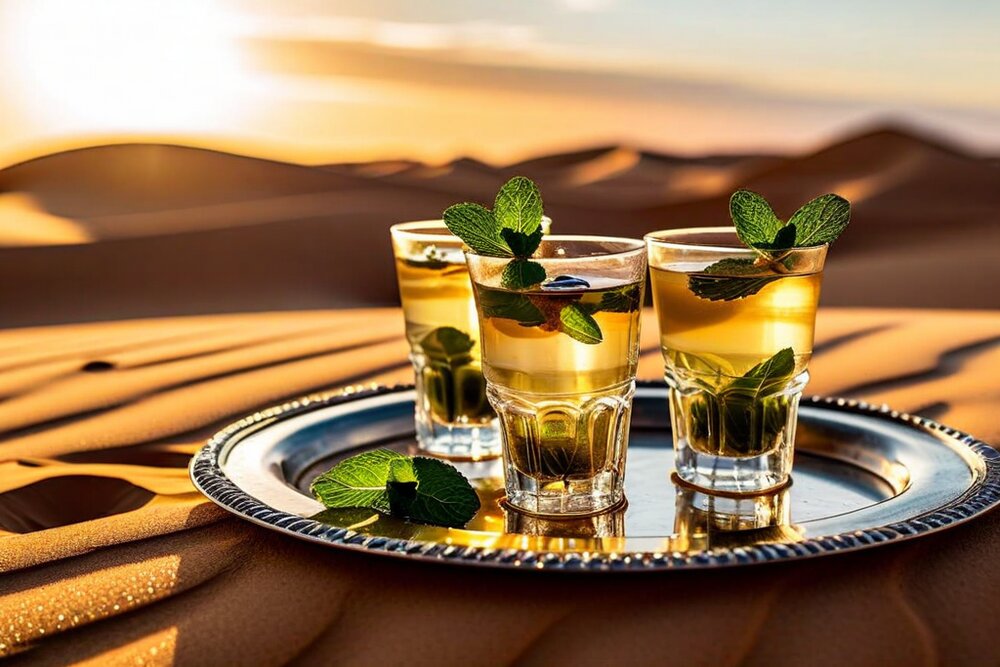
Green gunpowder tea from China, a very small pot on a charcoal brazier, an enormous quantity of sugar, and fresh mint. The tea is brewed strong, then poured repeatedly between glass and pot from a height — sometimes half a metre — to aerate it and build a thick head of foam on each glass. The foam is the mark of a good pourer and is not optional.
Three glasses
Three rounds are served from the same leaves, each weaker and sweeter than the last, and the saying attached to them is known across the Sahara: the first is bitter like death, the second sweet like life, the third gentle like love. Leaving after the first is a small insult; leaving after the second is noticed. Plan for the full three.
The role of the pourer
Usually a younger man of the household, and the pouring is a performed skill — the height of the pour, the depth of the foam, the sound. It is also the mechanism that keeps the group in place: nobody leaves in the middle of tea, so the ceremony is how negotiations, arguments and visits are given time.
What it means for a traveller
You will be offered tea constantly, by drivers, guides, shopkeepers and strangers, and accepting is the single easiest way to be treated well in Mauritania. Do not offer to pay. Do not rush it. If you have somewhere to be, say so before the water goes on rather than after the second glass.
The health warning
The sugar content is genuinely enormous — several tablespoons per small pot — and Mauritanians drink several rounds a day. Diabetes rates are rising accordingly, and it is a recognised public-health issue that runs directly through the country's most cherished social institution.
Zrig, the other one
Alongside tea, the drink of the country is zrig — thinned, sweetened camel or goat milk, served cold. Between them, tea and zrig cover essentially all Mauritanian hospitality. There is no alcohol, and hibiscus juice (bissap) and ginger juice from the Senegalese tradition are the other common cold drinks.
🎵 Griots, the Ardin, and the Desert Blues
The iggawin
Moorish society has a hereditary musician caste, the iggawin — griots — who hold genealogy, praise poetry and history, and who are simultaneously indispensable and socially subordinate. A family's status is announced by its griots. Marrying one is not done. This is the same institution found across the Sahel, in a distinctively Moorish form.
The instruments
The ardin, a large gourd harp with ten to fourteen strings, played only by women. The tidinit, a four-string lute played by men and a direct ancestor of the West African ngoni family. And the tbal, a large kettle drum, also played by women. Mauritanian music is built on modes that map onto social and emotional registers in a system musicians can explain at length.
Dimi Mint Abba
The country's most famous musician internationally, who won the Umm Kulthum prize in Tunis in 1977 and toured widely before her death in 2011. Her recordings are the standard entry point to Mauritanian music and remain startling — a huge voice over ardin and tidinit, at once ancient and unlike anything else in African music.
Malouma
The other name to know: a singer who took the griot tradition into political and social protest, sang about women's rights and poverty in a country where that was not done, was banned from state radio for years, and later became a senator. Her career is a fair summary of how far Mauritanian public life has and has not moved.
Poetry
Hassaniya poetry is a living high art, not a museum form, and a good poet is a genuinely important person. Verse is composed and recited at gatherings, used in argument, and used in politics. Mauritania is sometimes called bilad al-milyun sha'ir — the land of a million poets — and the claim is made with a straight face.
Crafts and other things
Silverwork, leather chests and cushions, woven mats, and the painted geometric decoration of Oualata. Football is followed intensely and the national team, the Mourabitounes, reached the Africa Cup of Nations for the first time in 2019 and again since — an achievement treated as a national event. Camel racing is the traditional sport.
🏛️ Two World Heritage Sites, Both Under Pressure
Banc d'Arguin National Park
Inscribed 1989 as a natural site: 12,000 km² of shallows, sandbank and desert coast holding one of the largest concentrations of wintering shorebirds on earth, plus the Imraguen fishery and the Cap Blanc monk seal colony. The pressures are industrial fishing at the boundary, offshore hydrocarbon development along the coast, and plastic.
The ancient ksour
Inscribed 1996 as a cultural site: Ouadane, Chinguetti, Tichitt and Oualata together, as the surviving fabric of the trans-Saharan trading and religious towns. The threat named in the listing and still unresolved is sand encroachment combined with depopulation — the towns are shrinking faster than they can be maintained.
The manuscripts
Not separately inscribed and arguably the country's most important cultural asset: private family libraries in Chinguetti, Ouadane, Oualata, Tichitt and Boutilimit holding thousands of Arabic manuscripts on law, theology, astronomy, mathematics, medicine and grammar. Digitisation projects have made progress; conservation of the physical objects lags badly behind.
On the tentative list
Mauritania's tentative list includes the Richat Structure, the archaeological site of Koumbi Saleh — the presumed capital of the Ghana Empire — the rock art of the Adrar and the Tagant, and the Azougui Almoravid site near Atar. Koumbi Saleh in particular would be a significant inscription.
The record-keeping problem
Mauritania has very limited archaeological and conservation capacity and a great deal to look after across a million square kilometres. Much of the survey work has been done by foreign missions, funding is intermittent, and the practical protection of a site in the Adrar is whatever the local community chooses to do about it.
Nomadic heritage
The tent, the camel saddle, the mahadra, the tea ceremony, Hassaniya poetry and the ardin repertoire are all intangible heritage of an economy that has essentially ended within living memory. Very little of it is formally inscribed. The people who hold it are getting older, and the transmission chain is thinner every decade.
🗣️ Arabic, French and Three More
You will get by with French in Nouakchott, Nouadhibou, Atar and with anyone in the tourism or business economy. Outside that, Hassaniya Arabic is the working language of most of the country, and in the south you will hear Pulaar, Soninke and Wolof. English is genuinely rare.
Hassaniya, briefly
A Bedouin Arabic dialect with a strong Berber substrate and its own vocabulary. Modern Standard Arabic will be understood by educated speakers but is not what people speak; a Levantine or Egyptian Arabic speaker will struggle. It is written when written at all in Arabic script, and poetry in it is a serious literary tradition.
The essentials in Hassaniya
Salam alaykum — the universal greeting, and the reply alaykum salam. Shukran — thank you. La shukran — no thank you. Ashhal? — how much? Ma vhemt — I don't understand. Inshallah — used constantly and meaning anything from certainly to almost certainly not. Labas? — all well?
Greetings take time
A Mauritanian greeting is a sequence, not a word: health, family, journey, the state of things, each asked and answered, often several times over, before any business begins. Cutting it short reads as rude. This is not an obstacle to getting things done; it is getting things done.
French, and its politics
Widely used in administration, business and higher education, and not official. Arabisation policy has steadily reduced its role in schooling, which Afro-Mauritanians read as exclusionary since French was the neutral option between Arabic and their own languages. A visitor benefits from French; be aware that using it is not politically weightless.
The southern languages
Pulaar (Fulani), Soninke and Wolof are national languages with real speaker communities in the river valley and in Nouakchott. They are taught to a limited extent and used in broadcasting. Whether they should be languages of instruction is one of the country's oldest unresolved arguments.
Practical advice
Bring functional French. Learn the greeting sequence. Get a guide who speaks Hassaniya if you go into the Adrar or the south-east, which you will need anyway for the roads and the permissions. Written signage is in Arabic and French; road signs outside the main routes are largely absent.
📅 When to Go — and the Security Question
November–February, the only sensible window
Daytime 22–30 °C, cold desert nights that genuinely require a sleeping bag, clear air after the summer haze, and the wintering birds at Banc d'Arguin. This is when the desert treks run, when the charter flights to Atar operate in some seasons, and effectively the whole tourist season.
March–May
Still workable in March, then heating rapidly. April and May bring the harmattan at its worst in some years — dust that reduces visibility for days and makes the desert unphotographable and unpleasant. Prices are lower and so is the value of being there.
June–September
Do not. Interior temperatures routinely exceed 45 °C, the south gets its rain and its mosquitoes, and the desert is genuinely dangerous for the unacclimatised. The exception is the guetna, the summer date harvest in the oases, which is a real cultural event if you can stand the heat.
Where you can and cannot go
This matters more than the season. The west and centre — Nouakchott, Nouadhibou, the coast road, Atar, Chinguetti, Ouadane, Terjit, Banc d'Arguin — are the areas normally travelled and where the tourism such as it is operates. The eastern and south-eastern border regions with Mali, and the far north-east toward Algeria, carry serious warnings from every European foreign ministry and should not be entered without professional security advice.
Mines and the border
The border zone with Western Sahara contains landmines, and this is not historical: people are killed and injured by them. Do not leave established tracks anywhere near that frontier, and do not attempt the crossing at Guerguerat other than on the road. Vehicles that break down off-piste in that area are a genuine emergency.
The honest security summary
Mauritania has had no jihadist attack on its territory since 2011 and is markedly safer than Mali, Burkina Faso or Niger. It is not, however, risk-free: the eastern borders are porous, kidnapping of Westerners in the Sahel remains a business, and the good record is a policy outcome rather than a natural condition. Travel in the west and centre with a reputable operator; do not improvise in the east.
✈️ Getting There from Central Europe
The airport
Nouakchott–Oumtounsy International (NKC), opened in 2016, about 25 km north of the city. It is modern, small and straightforward. Nouadhibou (NDB) takes some international flights and Atar (ATR) has historically received seasonal European charters for the desert season — check whether any are running, because it changes year to year.
From Prague, realistically
No direct route and no easy one. The usual options are one stop via Paris (Air France to Nouakchott), via Casablanca (Royal Air Maroc, often the cheapest), or via Istanbul (Turkish Airlines). Mauritania Airlines flies to Paris, Madrid and several West African capitals. Total journey 10–16 hours; expect 18,000–30,000 Kč return.
Visa
Czech citizens need one, and it is normally issued on arrival at Nouakchott airport — currently around €55, payable in cash euros, with a passport valid six months and biometric capture on the spot. Land borders are less predictable and the Moroccan crossing in particular has had periods where visas on arrival were not issued. Verify with the embassy in Paris or Brussels before you rely on it.
Overland
The classic route is south from Morocco through Western Sahara to the Guerguerat crossing and on to Nouadhibou — a long drive through a no-man's-land that must be done on the road because of mines. Southward, the crossing to Senegal at Rosso is notorious for hassle and unofficial charges; the Diama crossing further west is slower to reach and much easier.
Getting around inside
Shared bush taxis and minibuses connect the main towns on the tarred roads: Nouakchott–Nouadhibou, Nouakchott–Rosso, Nouakchott–Atar, Nouakchott–Néma. Beyond that it is 4x4 with a driver, arranged in Atar or Nouakchott, and this is not optional for the Adrar. Internal flights are limited and unreliable.
Health
Yellow fever certificate is required if you are arriving from an endemic country and is sensible regardless. Malaria prophylaxis is advised for the south and the river valley, less so for the desert north. Medical facilities are limited outside Nouakchott and serious cases mean evacuation to Europe or Morocco — insurance with evacuation cover is essential, not optional.
📋 Practical Details
Money
The ouguiya (MRU), redenominated in 2018 at 10 old to 1 new — so old prices quoted in MRO are ten times the new figure, and people still quote both. It is a closed currency: you cannot obtain it outside the country and cannot legally take it out. Bring euros in cash. Cards work at some Nouakchott hotels and almost nowhere else. ATMs exist in the capital and are unreliable.
Power and connectivity
220 V, type C and F plugs — Czech plugs fit without an adapter, one of the few conveniences here. Power cuts are frequent outside the centre of Nouakchott. Mobile coverage (Mauritel, Mattel, Chinguitel) is good in towns and along the main roads and absent in the desert. Buy a local SIM at the airport; it is cheap and you will need it.
Alcohol and Ramadan
Alcohol is illegal. Do not bring it, do not attempt to buy it, and do not assume a hotel bar exists. During Ramadan, do not eat, drink or smoke in public during daylight. These are not soft conventions.
Dress and conduct
Cover shoulders and knees, men included. Women should carry a scarf and use it around mosques, in villages and in conservative company. Ask before photographing anyone — and never photograph military installations, the presidential palace, checkpoints or the port, where cameras genuinely cause trouble.
Checkpoints and the fiche
You will be stopped repeatedly on intercity roads. The standard practice is to carry a stack of printed fiches — a sheet with your passport details, profession, vehicle and itinerary — and hand one over at each post. Prepare thirty of them before you travel; it turns a twenty-minute stop into a two-minute one and every guide will tell you the same.
Safety, day to day
Petty crime is low by regional standards and violent crime against foreigners is rare. The real hazards are road traffic (bad drivers, worse vehicles, animals at night — do not drive between towns after dark), heat and dehydration, and getting lost or stuck off-piste, which in the Sahara is life-threatening rather than inconvenient. Never take a desert route without a local guide, a satellite communicator and more water than you think.
💰 What It Costs
Cheap for daily living and expensive for anything organised, because organised means a 4x4, a driver, fuel and a guide. Approximate 2026 figures; the ouguiya runs at very roughly 1 Kč to 1.5 MRU, but bring euros and think in those.
Sleeping
An auberge in Atar or Chinguetti — a mattress in a room or under an awning — €8–20 (200–500 Kč). A mid-range hotel in Nouakchott €40–80. The two or three international-standard hotels in the capital €90–150. In the desert on a trek you sleep on a mat and it is included.
Eating
A plate of rice and meat or fish at a local gargotte €2–5 (50–125 Kč). A restaurant meal in Nouakchott €8–20. Grilled fish on the coast is excellent and cheap. Bottled water is cheap and you will drink a great deal of it. Tea is free and constant.
The 4x4, which is the real cost
A Land Cruiser with a driver and fuel in the Adrar runs roughly €100–160 a day (2,500–4,000 Kč), and it is the item that determines your budget. Shared between three or four people it becomes reasonable. Add a guide, a cook and camels for a trek and reckon €70–120 per person per day all in.
The train
Free in an ore wagon. A seat in the passenger carriage where one runs is a few euros. The shared taxi from Choum to Atar is around €10. This is, by a wide margin, the cheapest famous journey in the world.
Fees and extras
Visa on arrival around €55. Banc d'Arguin permit and boat, roughly €40–70 including the guide. Bush taxi Nouakchott–Atar €12–18, Nouakchott–Nouadhibou €20–25. Local SIM with data €5–10.
A two-week trip, roughly
Flights from Prague 18,000–30,000 Kč. On the ground, with a shared 4x4, a five-day camel trek, the train, Banc d'Arguin and modest accommodation: €900–1,500 per person (22–37,000 Kč). Travelling alone raises the vehicle cost sharply; find people in Atar or book through an operator who will pair you up.
🇨🇿 For Czech Readers
MZV ČR
The Czech Foreign Ministry advises caution for Mauritania generally and against travel to the border regions with Mali and Algeria and to the eastern and south-eastern provinces. The west and centre — Nouakchott, the coast, Atar, the Adrar — are travelled by Czechs and by other Europeans every season. Register in DROZD: here it is not a formality, because you may be a very long way from anyone who can help.
No embassy
There is no Czech embassy in Mauritania and no honorary consul on the ground. The country is covered from the Czech Embassy in Rabat, Morocco. In an emergency the practical route is the same as everywhere: as an EU citizen you are entitled under Article 20(2)(c) TFEU to consular protection from any other EU member state's mission, and in Nouakchott that means France, Spain or Germany, all of which are represented.
Visa
Required, and normally issued on arrival at Nouakchott airport for about €55 in cash euros, with biometrics taken on the spot. Land borders are less reliable for this. Because the rules for small states change with little announcement, confirm with the Mauritanian embassy in Paris or Brussels before booking anything non-refundable.
Insurance, seriously
Medical facilities outside Nouakchott are basic and a serious problem means evacuation to Morocco or Europe at very high cost. Standard Czech travel insurance frequently excludes desert expeditions, camel trekking and riding freight trains. Read the policy, and if you intend to ride the ore train or trek in the Adrar, buy cover that explicitly includes it.
Any Czech connection?
Almost none, and it is more honest to say so than to invent one. Czechoslovakia had diplomatic relations and a modest development presence in West Africa; there is no Czech community in Mauritania, no direct flight, and no historical episode linking the two countries. What there is: a small but real stream of Czech desert travellers and photographers who go for the Adrar and the ore train, and who are usually the only Czechs in the country that week.
Scale, for a Czech reader
Mauritania is 1,030,700 km² — about thirteen times Czechia — with five million people, half the Czech population, in it. That is roughly 5 people per km² against Czechia's 136. The ore train's 704 km run is a little further than Prague to Zagreb, and it crosses country in which you can travel for hours and see nothing at all.
🎲 Things That Are True About Mauritania
The last to abolish slavery
By decree in 1981 — later than any other country on earth — and without any criminal penalty attached until 2007. Twenty-six years passed between abolishing something and making it illegal to do it, which is a sentence worth reading twice.
A currency divided into five
The ouguiya is split into five khoums, making Mauritania one of only two countries in the world with a non-decimal currency. The other is Madagascar, whose ariary divides into five iraimbilanja. Neither subdivision has any practical value and both are still legally current.
An empire began in this desert
The Almoravids emerged from a religious reform movement among Sanhaja Berbers here in the eleventh century, went on to found Marrakesh, conquer Morocco and take control of Muslim Spain. An empire stretching to the Ebro started among nomads in what is now Mauritanian sand.
You can ride a three-kilometre train for nothing
The iron ore train from Zouérat to Nouadhibou is among the longest and heaviest in the world, and travellers ride on top of the ore in open wagons, free, for twelve to eighteen hours. You arrive completely black with iron dust and it is the best-known thing anyone does in this country.
Fishermen who worked with wild dolphins
The Imraguen of the Banc d'Arguin coast beat the water to summon wild bottlenose dolphins, which drove shoals of mullet into their shore nets in exchange for a share. It is one of a handful of genuine human–cetacean cooperative fisheries ever documented, and it is now close to extinct as mullet stocks have collapsed.
A capital built for 15,000
Nouakchott was a village of a few hundred in 1958, was designated capital of a country that did not yet exist, and was planned for fifteen thousand people. Drought pushed it to around 1.5 million — roughly a hundred times its design capacity, and close to a third of everyone in the country.
🔭 What Happens Next
Gas money, and what it buys
GTA came online in December 2024 and started exporting in April 2025. The question is the ordinary resource-state one: whether the revenue funds schools, clinics, water and a domestic power supply, or whether it accumulates around the capital and the contracts. Mauritania's record on iron ore and gold does not settle the question either way, and the second phase and the separate BirAllah field are still to come.
The security bet
Fifteen years without an attack is a remarkable record and it rests on a policy — army reform, theological engagement, border investment, and reportedly an understanding with groups in northern Mali. Understandings can lapse. With Mali, Burkina Faso and Niger under juntas and the G5 Sahel dissolved, Mauritania is now a stable state on a very long border with a collapsing region.
Slavery and caste
The law is in place and barely used; the leading opposition figure is a Haratin activist; and Boubacar Ould Messaoud died in March 2026, removing the movement's most respected voice. Whether the next decade brings prosecutions and land reform, or another generation of management, is the single most important question about this society.
The unresolved 1989–91 file
The amnesty law of 1993 still stands. Refugees have returned and an apology has been made; nobody has been tried. Every so often the demand for repeal resurfaces, and the four-year sentences handed to two MPs in May 2026 for statements about racial discrimination indicate how much room there currently is to press it.
Water, sand and the coast
Desertification continues, Chinguetti is still being buried, and Nouakchott is one of the African cities most exposed to sea-level rise — built on a low sand plain behind a breached dune cordon, with salt already in the aquifer. Adaptation for a city of 1.5 million that was planned for 15,000 is a problem of a different order to anything else on this list.
What is durable
The manuscripts, if they are conserved. The mahadra, which has survived a thousand years and every government. The poetry, the tea and the hospitality, none of which need funding. And the fact that this is a country which, in a region where states are failing, has not — which is worth more than any of the resource numbers.
🧭 How to Actually Visit
Be clear that this is not a holiday
There is no beach resort, no restaurant scene, no nightlife and no alcohol. Mauritania is for people who want the Sahara, the caravan towns, the manuscripts, the birds or the train. Those things are genuinely world-class. Everything around them is basic, and going expecting otherwise wastes an expensive trip.
The classic two weeks
Fly to Nouakchott. Bus or fly to Nouadhibou, ride the ore train to Choum overnight, shared taxi to Atar. Base there for the Adrar: Terjit, Chinguetti, Ouadane, the Richat, and a three-to-five-day camel trek. Return by road to Nouakchott, stopping at Banc d'Arguin via Iwik. That is the trip, and it is very good.
Use an operator
There are a small number of established Mauritanian agencies in Atar and Nouakchott, and going through one is not a luxury: it gets you the vehicle, the driver who knows the pistes, the permissions, the fiches, and someone who will notice if you do not come back. Independent desert travel here without local support is not adventurous, it is reckless.
Take the tea
Say yes every time. Sit for all three glasses. This is how Mauritania works and it is where the trip actually happens — the conversations over the brazier will be what you remember, not the photographs.
Buy locally and carefully
Silverwork, leather cushions and chests, woven mats, dates. Do not buy manuscripts, fossils, rock-art fragments or Neolithic tools: exporting them is illegal, and removing them from the Adrar is straightforward looting even when a man on the roadside offers you one.
Where not to go
The Mali and Algeria border regions and the eastern and south-eastern provinces, which carry serious warnings for good reasons. The Western Sahara border zone off the road, which is mined. And anywhere off-piste without a guide, a satellite communicator and someone who knows where you are.
📸 Gallery — Two Images, and Three Recipe Files That Are All Wrong
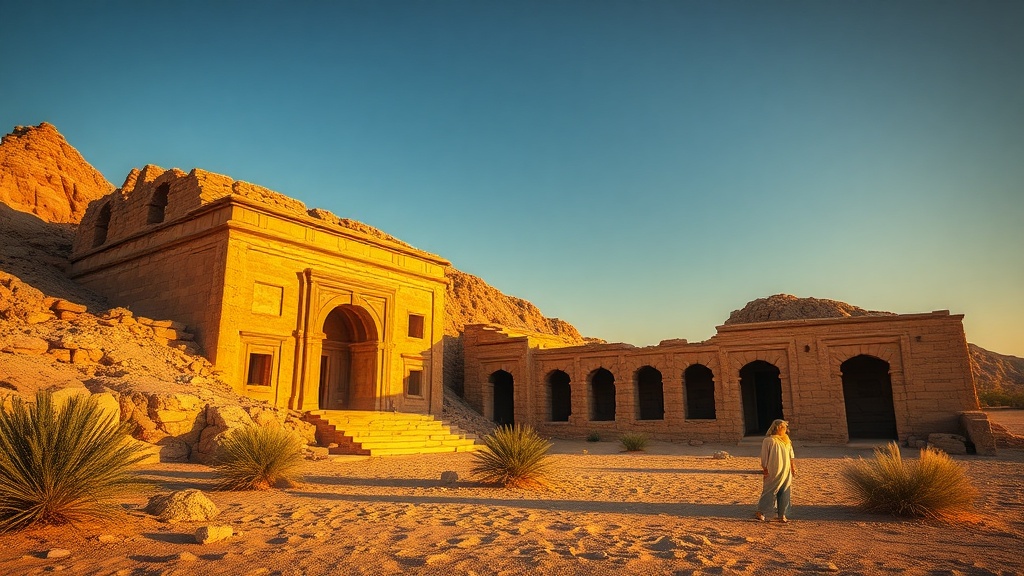
The bucket holds two images for the entire country — 01-hero.jpg and mauritania-drink.jpg — plus three recipe files. Around a hundred candidate filenames were tested and nothing else exists. There is no misfiled Abkhazian set, no fabricated Wikimedia hotlink of the kind found on the Martinique page, and — checked specifically after the Martinique finding — no counterfeit publisher logo on either file. Both are usable. All three recipe images are not.
Rejected: zrig, shown as a meat stew
mauritania-zrig.jpg shows a red meat-and-potato stew in a clay dish. Zrig is a drink — camel or goat milk thinned with water and sweetened, served cold, and one of the two things put in front of every guest in this country. This is not a small inaccuracy of garnish; it is a beverage filed as a casserole. Rejected outright.
Rejected: thieboudienne, shown as pale noodles
mauritania-thieboudienne.jpg shows pale yellow vermicelli with braised meat and chickpeas on a decorated plate — a Gulf or Central Asian dish. Real thieboudienne is broken rice cooked in a deep red tomato broth with a whole stuffed fish and cassava, cabbage, carrot and aubergine. The colour alone gives it away: the defining step of the dish is cooking the tomato purée until it darkens. Rejected.
Rejected: medfouna, shown as a rice pilaf
mauritania-medfouna.jpg shows a yellow spiced rice with chickpeas and coriander. Medfouna — "the buried one" — is a round stuffed flatbread filled with spiced minced meat, onion and almonds and baked in sand or ash. It is bread, not rice. It is also Moroccan rather than characteristically Mauritanian, so the file is doubly odd. Rejected.
Three out of three
This is the first country in the project where every single recipe image is wrong, and one of them is wrong by category. The recipes on this page were therefore written without illustration, from the actual dishes: thieboudienne as it is really made, and zrig as the drink it really is.
What Mauritania should have
The Chinguetti minaret with its ostrich eggs. A manuscript open in a Habott library room. The ore train two kilometres long. The pirogues landing at the Nouakchott fish port. The Richat from the air. Terjit's palms. Two million waders at Banc d'Arguin. The bucket contains a generic desert ruin and a tray of tea.
How this list was made
By systematic HTTPS probing, because the AWS connection has now been unavailable for six consecutive countries, and by checking specifically for the two defect classes found on the Martinique page. Every numbered slot and every plausible bare name was tested; only two files exist. Treat the list as a minimum. A proper bucket listing is owed for Luxembourg, Mali, Malta, the Marshall Islands, Martinique and Mauritania alike.
Support This Project 🌍
This World Travel Factbook is a labor of love – free to use for all travelers. If you find it helpful, consider supporting its continued development.