

🇳🇪 Niger at a Glance
🌍 Overview — the Sahara With a Country Attached
Niger is 1 267 000 km² — sixteen times Czechia, the largest country in West Africa — and roughly two thirds of it is Sahara. Almost everybody lives in the thin southern strip along the border with Nigeria and along the loop of the river, which is why a country the size of two Frances feels, on the ground, like a long thin one.
It is also the youngest country on earth by median age (about 15), has among the highest fertility rates ever recorded in a national population, and sits at or near the bottom of the Human Development Index. And since 26 July 2023 it has been run by a military council that has left ECOWAS, expelled the French and American armies, nationalised the French uranium mine, and — in March 2025 — replaced the constitution with a transition charter that makes Hausa the national language and demotes French to a working one.
Where it is
Landlocked, in the middle of the Sahel, touching seven countries: Algeria and Libya across the Sahara to the north, Chad to the east, Nigeria and Benin to the south, Burkina Faso and Mali to the west. The nearest port is Cotonou in Benin, roughly 1 000 km from Niamey, and the border with Benin has been the subject of a running quarrel since the coup.
The name
From the river, not the other way round, and the river's name is older than any modern account of it — most likely from Tuareg egerew n-igerewen, "river of rivers", rather than from Latin niger, black, which is a colonial folk etymology that will not die. Niger and Nigeria are named after the same river and are entirely different countries; in English the French pronunciation nee-ZHER is standard for this one.
Who lives here
About 53 % Hausa, 21 % Zarma-Songhai, 11 % Tuareg, 9 % Fulani (Peul), 5 % Kanuri, plus Toubou, Arabs and the small Gourmantché minority. Over 99 % Muslim, overwhelmingly Sunni of the Maliki school with strong Sufi brotherhoods. See the peoples section.
How it is governed
By the CNSP — Conseil national pour la sauvegarde de la patrie — under General Abdourahamane Tiani, who was sworn in on 26 March 2025 as transitional president for five years under a charter that replaced the constitution and dissolved all political parties. The elected president he overthrew, Mohamed Bazoum, has been held in the presidential palace since July 2023.
What it sells
Uranium — Niger has been one of the world's significant producers since 1971 and supplied a meaningful share of France's reactor fuel for fifty years — plus gold, crude oil since 2011 and, since 2024, through a pipeline to Benin that keeps being switched off. Also livestock, cowpeas and onions: the violet de Galmi onion is a genuinely famous West African export.
⚠️ Can you go?
Honestly: most of it, no. This page is written for readers who want to understand Niger, and for the small number who will actually go. Czech citizens need a visa and a yellow fever certificate, MZV ČR advises against travel to large parts of the country, there is no Czech embassy, and the desert north that the country is famous for has been effectively closed to tourism since 2010. Read the practical section before anything else.
🏷️ The River That Goes the Wrong Way
The Niger is the third longest river in Africa at about 4 200 km, and it does something no other great river does: it starts 240 km from the sea and immediately runs away from it, north-east into the Sahara, before turning through a great right-angled bend and coming back south to the Atlantic.
The boomerang
It rises in the Guinea highlands, almost within sight of the ocean, and flows north-east through Mali to Timbuktu — the edge of the desert — then swings south-east through Niger and Nigeria to a delta on the Gulf of Guinea. European geographers could not make sense of it for centuries, and Mungo Park died in 1806 trying to follow it down.
Why it does that
Because it used to be two rivers. The upper Niger once ended in a lake in what is now the Sahara — the inland delta in Mali is its remnant — and a separate, shorter river drained the Nigerian highlands to the sea. As the Sahara dried after about 4000 BCE, headward erosion let the lower river capture the upper one. The bend is the join.
What it does for Niger
It clips the south-western corner of the country for about 550 km, and on that thin ribbon sit Niamey, the rice fields, the market gardens and the giraffes. The rest of Niger has no permanent surface water at all. For a country this size to hang off one river's shoulder is the single most important fact of its geography.
The two floods
Unusually, the Niger at Niamey floods twice a year. The local flood comes with the Sahel rains in August and September; the black flood arrives in December and January, months later, having come all the way down from the Guinea highlands through the Malian inland delta. Farmers plan around both, and the second one catches visitors out.
Lake Chad
Niger's other water, in the far south-east, and a standing lesson in what the Sahel is doing. Lake Chad has shrunk from roughly 25 000 km² in the 1960s to a small fraction of that, splitting into a northern and a southern basin; the shrinkage is driven by both rainfall decline and irrigation withdrawal, and it partly reverses in wet years. The collapse of its fishing economy is part of the background to the insurgency in Diffa.
Hippos, manatees and crocodiles
The Niger still carries hippopotamus — there is a resident population at Ayorou, north of Niamey, which is one of the easiest wildlife sightings in the country — and the rare, nearly blind West African manatee. Nile crocodile survives in the river; the West African crocodile, the smaller species the ancient Egyptians kept in temples, persists in isolated Saharan gueltas, including in Mauritania and Chad.
🗺️ Geography — Three Climate Bands and a Line That Keeps Moving
Niger is a cross-section of the southern Sahara. Everything about it — where people live, what they grow, who fights whom — follows from where the rain line sits in a given decade, and the rain line moves.
The Saharan zone
Roughly 65 % of the country, north of about the 17th parallel: under 100 mm of rain a year and in places effectively none. Sand seas (erg), gravel plains (reg), the Aïr massif and the Djado plateau. Fewer than 200 000 people, almost all of them Tuareg, Toubou and Arab, plus the oasis towns of Bilma and Fachi.
The Sahelian zone
A belt across the middle with 100–600 mm a year, falling in a single short rainy season. This is pastoral country: cattle, sheep, goats and camels moved north in the wet and south in the dry, on transhumance routes that are hundreds of years old and increasingly blocked by farms. Tahoua, Agadez's southern fringe, northern Zinder.
The Sudanian strip
The thin southern edge, 600–800 mm, and the only part of Niger where rain-fed farming is reliable. It holds Maradi, Zinder, Dosso and the bulk of the population. Millet and sorghum, cowpeas, groundnuts, and the great markets that face south into Nigeria rather than west to the capital.
The Aïr
A granite massif rising out of the desert to Mont Idoukal-n-Taghès, 2 022 m, the highest point in Niger. Its wadis hold water below the surface, which makes gardens possible at Timia and Iférouane — famous for oranges and pomegranates in the middle of the Sahara. The Aïr and Ténéré Natural Reserves are a UNESCO World Heritage Site and have been on the List of World Heritage in Danger since 1992.
Desertification, carefully
The popular image — a wall of sand marching south — is wrong. What is real is a long-term decline in rainfall since the 1960s, with partial recovery since the 1990s, combined with a population that has quadrupled in fifty years. The result is land degradation around settlements rather than an advancing front. The re-greening of the Maradi and Zinder regions — farmer-managed natural regeneration, several million hectares with more trees now than in 1975 — is one of the genuine environmental good-news stories of Africa, and it was done by farmers, not projects.
Dinosaurs
The Ténéré's sandstones are one of the great Cretaceous fossil beds on earth. Nigersaurus, with over five hundred teeth in a straight-edged jaw like a vacuum cleaner; Sarcosuchus imperator, the "SuperCroc", twelve metres long; Ouranosaurus, with a sail down its back; Jobaria. Most were excavated by Philippe Taquet from the 1960s and by Paul Sereno from the 1990s, and the question of where the fossils end up is a live one in Niamey.
🏜️ The Ténéré — the Desert Inside the Desert
Ténéré is Tuareg for "emptiness", or "where there is nothing", and it is applied to the sand sea east of the Aïr — about 400 000 km² of it, an area the size of Germany and Poland together, with no permanent inhabitants outside two oasis towns.
⭐ The Tree of Ténéré
For decades, the most isolated tree on earth: a solitary acacia standing 400 km from any other tree, marking a well on the caravan route, mapped by cartographers because there was nothing else to map. In 1973 a lorry driver hit it. The trunk was taken to the national museum in Niamey and a metal sculpture stands in its place. It has become the standard Nigerien metaphor for anything precious and easily lost, and Nigeriens use it that way without irony.
The salt caravans
The azalai — camel caravans carrying dates and salt from Bilma and Fachi to the markets of Agadez and beyond. Bilma's salt is evaporated in rectangular pits, moulded into cones (kantu) and pillars, and traded mostly for animal feed rather than human consumption. Trucks took most of the traffic decades ago and the caravans shrank, but they have not stopped, and the route still runs a week's march with no water between wells.
Fachi and Bilma
Two oases, roughly 140 km apart and several hundred from anything else. Fachi is a walled Kanuri village of maybe two thousand people under a cliff; Bilma is bigger, with palm gardens, the salt workings and a fort. Both are genuinely remote in a way very few inhabited places are, and both have been effectively off-limits to foreign visitors since the kidnappings of 2008–2011.
The Djado plateau
Far to the north-east, a sandstone plateau with abandoned mud-brick citadels — Djado and Djaba — whose builders are not securely identified, and with some of the richest rock art in the Sahara: giraffe, elephant, cattle and chariots, from the period between about 10 000 and 3 000 years ago when this was savanna. Since the 2010s the area has been a gold-rush zone and an armed-group corridor toward Libya.
⭐ The Dabous giraffes
On a rock outcrop in the Aïr, two life-size giraffes carved into sandstone — the larger is over 5 metres tall — made roughly 8 000 years ago and among the largest and finest animal petroglyphs anywhere in the world. They are extraordinary, they are barely protected, and the only realistic way most people will see them is in photographs.
⚠️ Why nobody goes
Saharan tourism in Niger was a real industry until about 2007: Paris–Dakar came through, Agadez ran expeditions, and the Ténéré was on a certain kind of traveller's list. It ended with the second Tuareg rebellion, then a series of kidnappings of Europeans by AQIM between 2008 and 2011, then the collapse of Libya. Foreign ministries have advised against the north ever since, and the tourism economy of Agadez has not come back.
👥 The Peoples — Six Nations in One Border
Hausa
Over half the population, concentrated in Maradi and Zinder, and the largest ethnic group in West Africa when you count across into northern Nigeria. Traders, farmers and city-builders, with a written literature in Ajami (Arabic script) going back centuries and a language that works as the lingua franca of the whole region — which is exactly why the 2025 charter made it the national language.
Zarma and Songhai
About a fifth of the country, in the west around Niamey, Dosso and Tillabéri, speaking closely related languages and descended from the Songhai empire. They were the group best placed at independence and have been disproportionately represented in the state, the army and the civil service ever since — one of the quiet structural facts of Nigerien politics.
Tuareg
The Kel Tamasheq, about a tenth of the population, in the Aïr and the north, with a written script — Tifinagh — descended from ancient Libyco-Berber, a matrilineal inheritance tradition, and the famous inversion in which men veil and women do not. Historically organised in confederations under an amenokal; the Sultanate of Agadez is the surviving institution. Two rebellions since independence; see that section.
Fulani
The Peul or Fulɓe, spread from Senegal to Sudan and about a tenth of Niger — the classic cattle pastoralists of the Sahel, moving herds on transhumance routes that cross every border in the region. The Wodaabe, a subgroup in Niger, hold the Guérewol. Across the Sahel, Fulani herders have been caught between farmer conflict and jihadist recruitment, and the collective blame that follows is one of the region's most dangerous dynamics.
Kanuri and Toubou
Kanuri in the south-east around Diffa and out at Fachi, heirs of the thousand-year Kanem-Bornu empire and the people most directly hit by Boko Haram. Toubou in the far east and north-east — Saharan pastoralists straddling Chad, Libya and Niger, historically outside anyone's administration and central to the smuggling and gold economies of the Djado.
Language, officially
Before 2025: French official, ten national languages recognised. Since the transition charter of 31 March 2025: Hausa is the national language, and French and English are "working languages" — a deliberate demotion of French and a deliberate nod to the anglophone neighbour to the south. In practice French remains the language of government paperwork and Hausa the language of the market, which is roughly what it was before.
🏰 Before France — Songhai, Bornu and the Hausa Cities
There is a persistent idea that the Sahel was empty before colonisation. Niger's territory held, at various times, one of the largest empires in African history, a state that lasted a thousand years, and a network of walled trading cities that made a fortune on the trans-Saharan trade.
Songhai
Centred on Gao on the river, Songhai became the largest empire in African history by area under Sonni Ali (1464–92) and Askia Muhammad (1493–1528), running from the Atlantic to the edge of what is now Niger and controlling Timbuktu and Djenné. It was destroyed in 1591 at the battle of Tondibi by a Moroccan expedition of a few thousand men carrying arquebuses — one of the clearest cases in history of gunpowder ending a state. Niger's Zarma are its descendants.
Kanem-Bornu
One of the longest-lasting states anywhere: the Sayfawa dynasty ruled Kanem and then Bornu, around Lake Chad, from roughly the 9th century to 1846 — nearly a thousand years. Islamic from the eleventh century, literate, diplomatically active as far as Cairo and Tripoli, and the power that controlled the eastern trans-Saharan route. Its heartland straddles modern Niger, Nigeria and Chad.
The Hausa city states
Not an empire but a network of walled trading cities — the Hausa bakwai — each with its own ruler, market, ward system and dyeing pits: Kano, Katsina, Zaria, Gobir, Daura, Rano, Biram. Gobir and later Damagaram (Zinder) lie in modern Niger. They fought each other constantly and traded with everyone, and they are the origin of the Hausa commercial culture that still runs the region.
Agadez and the Sultanate
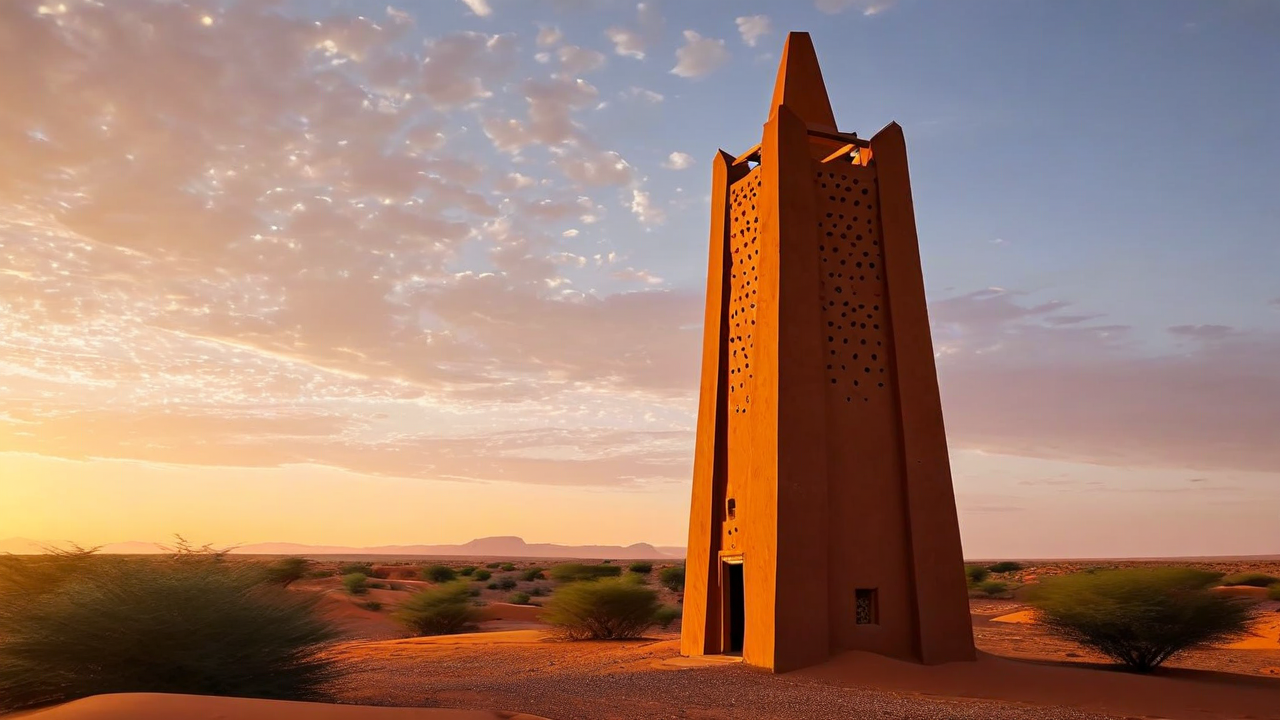
Founded around the fifteenth century as the meeting point of the Tuareg confederations and the trans-Saharan trade, with a sultanate established about 1449 that still exists. At its height Agadez had perhaps 30 000 people and controlled the salt, gold and slave routes north. Its mud-brick mosque, rebuilt in 1515, has a 27-metre minaret — the tallest mud-brick structure in the world — and the old town is a UNESCO World Heritage Site.
The Sokoto jihad
In 1804 the Fulani scholar Usman dan Fodio declared jihad against the Hausa kings of Gobir, whom he accused of syncretism and oppression, and within a decade had built the Sokoto Caliphate — the largest state in Africa in the nineteenth century, covering most of northern Nigeria and reaching into southern Niger. It reshaped religion, law and language across the whole region, and the emirates it created still exist as traditional institutions.
What the trade was
Salt, gold, leather, cloth, kola nuts, horses — and people. The trans-Saharan slave trade ran for over a thousand years and moved an estimated several million people north across the desert; Agadez, Bilma and Zinder were on it. The Nigerien state formally criminalised the remaining forms of hereditary servitude in 2003, and in 2008 the ECOWAS Court of Justice ruled in Hadijatou Mani's favour against Niger for failing to protect her from slavery — a landmark case brought by a Nigerien woman who had been sold at twelve.
🇫🇷 1890–1960 — the Column and the Colony
⚠️ The Voulet-Chanoine mission
The French conquest of Niger is inseparable from one of the worst-documented atrocities of the European scramble for Africa. In 1898–99 a column under captains Paul Voulet and Julien Chanoine marched east from Senegal to link French holdings, burning villages, massacring inhabitants and hanging guides. At Birni-N'Konni in May 1899 they killed a large part of the town's population — estimates run into the thousands.
How it ended
Paris sent Lieutenant-Colonel Klobb to relieve them. Voulet had him shot dead on 14 July 1899, declared himself no longer French — "I am an outlaw, a black chief" — and was killed days later by his own tirailleurs. The French army's inquiry concluded the officers had gone mad in the heat, a verdict that served everyone in Paris and convinced nobody since. It is still taught in Niger and still barely known in France.
The colony
Niger was declared a military territory in 1900, a civilian colony in 1922, and administered as the poorest, emptiest and least-invested part of French West Africa. Resistance continued for decades: the Kaocen revolt of the Aïr Tuareg besieged Agadez for three months in 1916–17 before being crushed with artillery. The colonial state extracted taxes and conscripts and built very little.
Independence
3 August 1960, under Hamani Diori, whose party had beaten the more radical Sawaba movement of Djibo Bakary — a contest decided partly by French administrative pressure ahead of the 1958 referendum, in which Niger voted to stay in the French Community while Guinea voted out. Sawaba was banned, went into exile and attempted an incursion in 1964; its suppression set the tone for thirty years.
Diori and the drought
Diori ruled for fourteen years, one-party, close to Paris, and was brought down by the Sahel drought of 1968–74, which killed a large share of the national herd and a great many people, and during which grain aid was widely believed to have been stolen by officials. The perception of a government eating the famine is what ended him — a pattern that recurs across the Sahel and that returns in Niger's own recent politics.
Kountché
Lieutenant-Colonel Seyni Kountché took power on 15 April 1974 and ruled until his death in 1987. Austere, personally incorruptible by regional standards, repressive, and lucky: uranium revenues from Arlit peaked in his first years and paid for roads, schools and the buildings of central Niamey. When the uranium price collapsed in the 1980s the money went with it, and Niger has never had a comparable windfall since.
🗳️ 1990–2023 — Four Republics and Four Coups
Niger has had seven constitutions, five coups d'état and one very long run of unfinished transitions since 1960. The period from 1990 to 2023 is the story of a democracy that kept being interrupted, kept being restored, and then in 2021 achieved something it had never managed before — only to lose it two years later.
The national conference
1991: a sovereign national conference, the model used across francophone Africa that year, stripped the ruling party of power and opened multi-party politics. The Third Republic followed in 1993 and was overthrown by Colonel Baré Maïnassara in January 1996. Baré was himself assassinated by his own presidential guard in April 1999, on the airport tarmac, an event the official account described as an "unfortunate accident".
Tandja and the tazartché
Mamadou Tandja won in 1999 and 2004 and then, in 2009, dissolved the constitutional court and ran a referendum to extend his own term — the campaign was called tazartché, Hausa for "continuation". The army removed him in February 2010, ran a one-year transition under Salou Djibo and handed power back, which is the one genuinely creditable military intervention in the country's history.
Issoufou
Mahamadou Issoufou, president 2011–2021, two terms, no third. He survived a coup attempt in 2015, presided over an economy that grew and a security situation that got steadily worse, and drew serious criticism over the jailing of opponents and journalists and over a defence procurement scandal. He then did the thing nobody expected: he left, and won the Mo Ibrahim Prize for it.
Bazoum
Mohamed Bazoum won the run-off in February 2021 and was inaugurated on 2 April, in Niger's first transfer of power from one elected president to another in sixty-one years of independence. An attempted coup two days before the inauguration failed. Bazoum was an Arab from Diffa, from a small minority, a former philosophy teacher, and unusually willing to say difficult things in public — about slavery, about population growth, about the army.
What he tried
Bazoum kept the French and American counter-terrorism partnerships while quietly opening negotiations with some armed groups; he pushed hard on girls' education and on keeping girls in school past marriage age, which was genuinely unpopular in parts of the country; and he talked openly about Niger's fertility rate in a way no previous president had. Measured on attacks and deaths, Niger was doing better in 2022–23 than Mali or Burkina Faso.
⚠️ And then
On 26 July 2023 the presidential guard — the unit whose job was to protect him, under a commander he had reportedly been about to replace — detained Bazoum in the palace. He has been there ever since. See the next sections.
⚔️ The Tuareg Rebellions
The grievance
Tuareg territory was divided at independence among Niger, Mali, Algeria, Libya and Burkina Faso, and in Niger the north held the uranium while the government, the army and the money sat in the Zarma-dominated south-west. Add the droughts of 1973–74 and 1984–85, which destroyed the herds and drove tens of thousands into Algeria and Libya as labourers — the ishumar, from the French chômeur, unemployed — and you have the conditions.
Libya
Many ishumar were recruited into Gaddafi's Islamic Legion in the 1980s, fought in Chad and Lebanon, and came home trained and armed. This is the single most important external input into every Tuareg rebellion since, and the collapse of Libya in 2011 repeated it on a larger scale — the weapons that flooded out of Libyan arsenals are the proximate cause of the Malian collapse of 2012 and much of what followed.
1990–1995
Triggered by the Tchintabaraden massacre of May 1990, when the army killed a large number of Tuareg civilians in reprisal for an attack on a police post. The rebellion that followed ran five years and ended in the Ouagadougou peace accord of April 1995, with decentralisation, integration of fighters into the army, and development promises that were only partly kept.
2007–2009
The MNJ — Mouvement des Nigériens pour la Justice — rose over the same grievances plus a new one: uranium prospecting permits issued to Chinese, Canadian and other companies across Tuareg pastures without consultation. President Tandja refused to call it a rebellion, calling the fighters bandits and drug traffickers, declared a state of alert in Agadez and expelled the foreign press. It ended in 2009 through Libyan mediation.
Why Niger held and Mali did not
In 2012 the Malian Tuareg rebellion took half the country and was hijacked within months by jihadist groups. Niger's north did not rise. The usual explanations are that Niger had integrated more former rebels into the state and army, that Issoufou moved fast to court northern leaders and to disarm returnees from Libya, and that Agadez's sultanate and elders had more standing than their Malian equivalents. It is the one part of Sahel policy that observers generally agree Niger got right.
⚠️ The unfinished part
None of the peace accords resolved the underlying argument, which is about who the north belongs to and who gets the money out of it. Integration of ex-combatants stalled, promised development spending mostly did not arrive, and when the uranium concession was renegotiated the north saw little of the difference. The quiet since 2011 has rested on a small number of personal arrangements and on the migration economy rather than on a settlement.
💥 Three Wars at Once
Niger is the only country in the world fighting significant jihadist insurgencies on three separate fronts simultaneously, with different groups, different grievances and no connection between them except that they all exploit the same weak state.
West — the tri-border
The Liptako-Gourma region where Niger, Mali and Burkina Faso meet, and the deadliest place in the Sahel. Islamic State in the Greater Sahara (ISGS / IS Sahel Province) operates here; it killed four American and four Nigerien soldiers at Tongo Tongo in October 2017, an ambush that became a major US political story, and has carried out repeated massacres of civilians in Tillabéri. JNIM, al-Qaeda's Sahel coalition, operates in the same space and fights ISGS as well as the states.
South-east — Boko Haram
The Diffa region on Lake Chad, facing Nigeria. Boko Haram and its Islamic State-aligned splinter ISWAP have raided across the lake since 2015; several hundred thousand people in Diffa are displaced or refugees, the pepper economy that sustained the region collapsed, and a state of emergency has been more or less permanent for a decade. ISWAP is the more disciplined and more dangerous of the two.
North — trafficking and Libya
Less an insurgency than a smuggling and armed-group corridor: gold from the Djado and Tchibarakaten fields, weapons and fuel from Libya, cocaine crossing from the Gulf of Guinea toward Europe. Armed groups here are as often criminal as ideological, and the distinction matters less than analysts would like.
The numbers
Across the central Sahel the death toll has risen more or less every year since 2015, and since 2021 the Sahel has accounted for more deaths from terrorism than any other region on earth by a wide margin. Niger's own losses among soldiers have been severe: single ambushes killing dozens of troops have become routine, and the army's casualties are the most politically explosive fact in the country — see the junta section.
What the foreign forces did
France ran Operation Barkhane from Chad and Mali with a base at Niamey; the United States built Air Base 201 at Agadez for roughly US$110 million, one of the largest US construction projects in Africa, flying armed drones over the Sahara. Both are gone: the Americans completed withdrawal in September 2024, the French in December 2023. The insurgencies did not stop, and no honest account claims they were stopped before either.
The civilian side
Both jihadist groups and state forces have been credibly accused of mass killings of civilians in Tillabéri and Diffa, and human rights organisations have documented military abuses in Niger as in Mali and Burkina Faso. Communities caught between them have in places negotiated their own local truces with armed groups — which the state treats as collaboration. This is the ordinary texture of the war and it is what the casualty tallies leave out.
⚠️ 26 July 2023 — the Coup
What happened
On the morning of 26 July 2023 the presidential guard sealed the palace and detained President Mohamed Bazoum. Its commander, General Abdourahamane Tiani, had reportedly been told he was about to be replaced. Negotiations ran through the day; that evening a group of officers read a statement on state television dissolving the constitution. By 28 July the army high command had fallen in behind the guard rather than fight it, and Tiani declared himself head of the CNSP.
Why it worked
Not because the coup was well planned — it was close to improvised — but because no part of the armed forces was willing to shoot at another part, and because Bazoum had no popular mobilisation to call on. Chief of staff General Abdou Sidikou Issa issued a statement citing the risk of a "deadly confrontation" and the need to avoid bloodshed, which in practice meant acquiescence.
⚠️ Bazoum
He has been held in the presidential residence in Niamey since 26 July 2023, with his wife, for over three years, without trial. He was reported to have gone for long periods without electricity and with limited food, and his son was detained separately. The ECOWAS Court of Justice ordered his release in December 2023; the junta ignored it and stripped his immunity in mid-2024 with a view to trying him for treason. Human Rights Watch and the UN Working Group on Arbitrary Detention both call the detention arbitrary.
The ECOWAS ultimatum
ECOWAS gave the junta seven days to restore Bazoum, then authorised a standby force and closed borders, froze assets and cut electricity supply from Nigeria — which had been providing a large share of Niger's grid power. The intervention never came. Nigeria's senate refused to authorise it, Mali and Burkina Faso declared that an attack on Niger would be an attack on them, and Algeria opposed. By early 2024 ECOWAS was negotiating, and by February 2024 it lifted most sanctions with nothing to show.
Why people cheered
Crowds in Niamey did come out for the coup, and the honest reading is complicated. Genuine anger at fifteen years of foreign counter-terrorism operations that did not stop the killing; anger at French economic privilege, of which the uranium concession was the symbol; the sanctions themselves, which hit ordinary people immediately; and a generation that grew up with the Sahel's wars and had no memory of anything working. It was not manufactured, and it was also not the whole country.
What it was not
It was not a popular revolution — it was a palace guard acting to save its commander's job, which the rest of the army then ratified. Both things are true at once, and accounts that pick one are the reason so much commentary on the Sahel is useless.
🛻 Agadez and the Road North
For about a decade Agadez was the busiest transit point on the central Mediterranean migration route, and the single largest cash economy in northern Niger. Then the European Union paid Niger to close it, and the consequences are one of the clearest case studies anywhere in what externalised border control actually does.
How the route worked
West Africans — Nigerians, Senegalese, Gambians, Ivorians, Guineans — travelled legally within ECOWAS free movement as far as Agadez, then bought a place on a pick-up going north to Sebha or Qatrun in Libya, usually in weekly convoys escorted by the army as far as the border. At the peak in 2016, IOM counted well over 300 000 people moving north through Agadez in a year.
What it paid for
Drivers, fixers, ghettos (transit houses), fuel sellers, food sellers, mechanics, money changers. Estimates of the sector's value to the Agadez region run into the tens of millions of dollars a year — in a region whose tourism industry had been dead since 2007 and whose pastoral economy was shrinking. It employed a great many young men who had few other options, which is exactly the population armed groups recruit from.
⚠️ Law 36 of 2015
Passed under heavy EU pressure and supported through the EU Emergency Trust Fund for Africa, it criminalised the transport of migrants north of Agadez — that is, it made a journey illegal at the point where it left ECOWAS territory — with sentences of up to ten years. Hundreds of drivers were arrested, over a thousand vehicles were confiscated, and recorded northbound flows fell sharply within two years.
What it did not do
It did not stop people travelling. It pushed them onto longer routes further from wells and further from any road, drove prices up, and handed the business to smugglers willing to take the risk — which is to say the more ruthless ones. Deaths in the desert are close to uncountable and are widely believed to exceed those in the Mediterranean. The reconversion fund meant to give former drivers alternative livelihoods reached only a fraction of them and is generally judged to have failed.
Repealed, November 2023
One of the junta's earliest and most popular acts was to repeal Law 36, describing it explicitly as a law adopted under foreign influence and against the interests of Niger. Convictions under it were quashed. Northbound movement through Agadez rose again, and the EU lost its main instrument in the central Sahara at the same moment it lost its military presence.
Why it matters beyond Niger
Agadez is the standard exhibit in the argument about externalised migration control: whether paying a transit state to criminalise movement reduces migration or merely displaces it, and what it costs the transit state politically. Niger's answer, delivered by repeal within four months of the coup, was that the political cost had been high and the benefit had gone somewhere else.
🏛️ The CNSP — How Niger Is Governed Now
The transition charter
On 26 March 2025, following a national conference in Niamey in February attended by some seven hundred delegates, General Abdourahamane Tiani was sworn in as transitional president for five years under a charter that replaces the constitution. He was promoted to army general the same day and signed a decree dissolving all political parties. The five years are described as flexible and as counting from that date, which puts any notional return to elections in 2030.
What the charter does
It makes Hausa the national language and French and English "working languages"; it concentrates executive, legislative and much judicial authority in the presidency and an appointed council; it creates a consultative body in place of a parliament; and it removes the party system entirely rather than banning specific parties. Whatever else it is, it is not a caretaker arrangement.
⚠️ The mutiny of August 2026
In August 2026 a group of officers — reportedly including special-forces units — moved against Tiani in Niamey. It failed; deputy leader General Salifou Modi announced its failure on state television. Reporting attributes the attempt to anger over mounting army casualties against IS Sahel Province and JNIM, and attributes the junta's survival in part to external support. Read any single account of it carefully: this is contested territory and the primary sources are thin.
Repression
Human Rights Watch's 2026 report documents the continued arbitrary detention of Bazoum, of ministers from the elected government, and of journalists and human rights defenders. Several media outlets have been suspended, a number of journalists arrested, and foreign broadcasters — RFI and France 24 — were taken off the air in the first weeks after the coup and have not returned.
What the junta delivers
Not nothing, which is why simple accounts fail. It renegotiated resource terms hard and got more for the state; it repealed the migration law; it removed foreign troops that a large part of the public had stopped believing in; and it has cultivated a genuinely effective sovereignty message. What it has not delivered is security — attacks and army deaths have risen, not fallen, since July 2023 — or any timetable for handing power back.
Bazoum, still
Three years and counting in the presidential residence, no trial, immunity stripped, an ECOWAS court order ignored. Whatever one thinks of the politics, this is the single fact that any account of Niger since 2023 has to keep in view, because it is the one the government most wants forgotten.
🌍 The Realignment — Out of ECOWAS, Into the AES
The most consequential thing about the 2023 coup is not what it did inside Niger but what it did to West Africa's architecture. Three Sahelian states have now left the region's fifty-year-old economic community and formed their own bloc, and the French security order in the Sahel has ended.
Leaving ECOWAS
Niger, Mali and Burkina Faso announced withdrawal from the Economic Community of West African States in January 2024, and the exit took effect in January 2025. ECOWAS had been one of the more effective regional bodies in the world — free movement of 400 million people, a common passport, a genuine record of reversing coups — and losing three members and half its land area is a serious blow to it.
The Alliance of Sahel States
The AES began as a mutual defence pact in September 2023 and was formalised as a confederation in July 2024, with a rotating presidency, talk of a common passport and a joint force, and periodic talk of leaving the CFA franc. Its cohesion is real and is built on a shared position — anti-French, anti-ECOWAS, military-led — rather than on economic complementarity, since all three are landlocked and sell similar things.
France out
The French ambassador was expelled in September 2023 and the last French soldiers left in December 2023. The military agreements were denounced, French aid stopped, and the visible symbols — the Niamey base, the language of partnership — went with them. Coming after withdrawals from Mali (2022) and Burkina Faso (2023), it ended France's military position in the Sahel, and Chad and Senegal asked French forces to leave in 2024–25 as well.
The United States out
Harder for Washington, because the Agadez drone base was its main intelligence platform for the central Sahara. The junta revoked the military agreement in March 2024 after a US delegation raised Niger's contacts with Russia and Iran; American forces completed withdrawal in September 2024 and handed over a base that had cost around US$110 million to build.
Russia, Turkey, Iran, China
Russia signed military agreements and instructors arrived in April 2024; the relationship is real but smaller than in Mali, and the Africa Corps that replaced Wagner has a mixed record. Turkey sells drones and has become a major supplier across the Sahel. Iran has been reported to be interested in uranium, which is what set off the row with Washington. China holds the oil: CNPC operates the Agadem field and built the pipeline.
⚠️ Benin and the pipeline
The Niger–Benin pipeline, 1 930 km from the Agadem oilfield to the port of Sèmè-Kpodji, was completed in 2023–24 and is the biggest single thing in Niger's economy. It has also been repeatedly interrupted: Niger kept its land border with Benin closed after the coup, Benin briefly blocked loadings in May–June 2024, several Nigeriens were arrested at the Beninese terminal, and the pipeline has been sabotaged several times on the Nigerien side. A landlocked exporter whose only route runs through a neighbour it is quarrelling with is in a structurally weak position, and everybody involved knows it.
☢️ Uranium — Arlit, Orano and Fifty Years of Argument
For half a century the single best-known fact about Niger outside Africa was that French nuclear power ran partly on Nigerien uranium. In June 2025 the government nationalised the mine, and the argument moved to an arbitration tribunal in Washington.
Arlit
A town built in the desert in 1969 around the Somaïr open pit, with a second operation, Cominak, at Akokan from 1978. Nigeriens call Arlit le deuxième Paris, which started as a joke about wages and stopped being funny. Cominak's underground mine closed in 2021 after 43 years, leaving around 20 million tonnes of tailings, and the rehabilitation of the site is a long-running dispute of its own.
What Niger got
Less than most Nigeriens believe it should have, and more than the most popular version of the story allows. Uranium was typically around a third of export earnings but a much smaller share of the budget; the price collapsed in the 1980s and again after Fukushima in 2011; and the concession terms were renegotiated in 2014 after a long public fight, bringing the royalty regime closer to Niger's mining code. The grievance is real, the arithmetic is more complicated than the slogan.
The health argument
Greenpeace and the French association Sherpa, with local NGOs, have documented radioactive contamination around Arlit — scrap metal from the mine sold in local markets, elevated radon, contaminated groundwater. Areva, Orano's predecessor, disputed the findings and funded health observatories. Independent measurement in the area remains limited, which is itself part of the problem.
⚠️ Nationalisation, June 2025
On 19–20 June 2025 Niger announced the nationalisation of Somaïr, in which Orano held 63 % against state-owned Sopamin's 37 %. The government's stated grievance: that between the mine's start in 1971 and 2024 Orano had taken 86,3 % of production. Orano rejected the takeover, called it expropriation, and went to arbitration.
The arbitration
An ICSID tribunal at the World Bank ordered Niger not to sell or transfer the stockpiled uranium pending the outcome. Niger has asserted a "legitimate right" to sell its own resources and has signalled it will put the stock on the market anyway; Orano values the seized stockpile in the hundreds of millions of dollars. There is no quick resolution, and the case will set a reference point for resource nationalism across the region.
Getting it out
The practical problem nobody mentions in the political version: Niger is landlocked and uranium concentrate has to travel about 1 500 km by road to Cotonou, through Benin, with whom relations are bad, or through Burkina Faso and Togo. Border closures since 2023 have stopped exports for long periods. Owning the mine and being able to sell from it are different achievements.
💵 The Economy — Oil, Onions and Not Much Else
Where it stands
GDP per head is roughly US$600–650 — among the lowest figures in the world — and Niger sits at or very near the bottom of the Human Development Index. Around 40 % of the population lives below the international extreme poverty line, and the great majority of employment is subsistence agriculture and informal trade.
Oil
Production started at Agadem in 2011 with a small Chinese-built refinery at Zinder for the domestic market. The pipeline to Benin, opened in 2024, raised capacity several-fold and is the main reason growth forecasts for Niger have been high on paper — growth in the high single digits in a good year. The catch is that it only works when the pipeline is running; see the Benin quarrel.
Agriculture
Millet and sorghum on rain-fed land, cowpeas (niébé) — Niger is one of the world's largest producers and exports mostly to Nigeria — onions, above all the violet de Galmi, which is the standard onion of West African cooking and one of the few Nigerien brands anyone in the region knows, and livestock, which is both an export and the country's savings account.
The currency
The West African CFA franc (XOF), pegged to the euro at 655,957 francs to €1 — a peg that has not moved since the euro's creation and that traces back to a French colonial arrangement of 1945. The AES states periodically threaten to leave it; none has, because leaving would mean building a central bank and defending a new currency with reserves they do not have. Treat announcements as signalling until a note is printed.
Aid, sanctions and the budget
Before 2023 external assistance funded a large share of the budget; the coup cost Niger much of that, plus ECOWAS sanctions that froze assets and closed borders for seven months. The sanctions were lifted in February 2024 but bilateral aid from the EU and the US has not returned to previous levels. The government has leaned on domestic revenue, on the regional bond market and on resource renegotiations.
What would actually change things
Two numbers. Electricity: a very small share of the rural population has a grid connection, and Niger imported most of its power from Nigeria until the coup made that political. Fertility: at roughly six births per woman, the population is on a path to double within about a generation, which means the economy has to run hard simply to keep GDP per head flat. Everything else in Nigerien development policy is downstream of those two.
👥 Society — the Youngest Country on Earth
The demography
Median age about 15. Roughly half the population is under fifteen years old. The total fertility rate, around six children per woman, has been the highest or near-highest recorded of any country for two decades. The population was under 4 million at independence and is around 27,5 million now; the UN's projections for the end of the century are startling enough that people assume they are typos.
Why it is so high
Not one reason. Very early marriage, low female education, high child mortality within living memory (which rationally raises desired family size), the economic logic of children as labour and old-age security in a country with no pensions, and religious and social norms that make large families a mark of standing. Contraceptive prevalence is low and unmet demand for it is substantial, which means part of the gap is supply, not preference.
⚠️ Child marriage
Niger has the highest rate of child marriage in the world: around three quarters of women are married before eighteen and a very large minority before fifteen. The legal minimum age for girls has long stood at 15 under the civil code, customary and religious marriage operates alongside it, and repeated attempts to raise it and to pass a family code have failed against organised religious opposition. This is the single hardest social fact about the country and it is the reason the education numbers look as they do.
Education
Adult literacy is around a third, and much lower among women. Enrolment has risen substantially, completion has not kept pace, and the insurgencies have closed hundreds of schools in Tillabéri, Tahoua and Diffa. Bazoum's push to keep girls in school past the age at which they are typically married was among the more serious attempts anyone has made at the problem, and it did not survive his removal in any recognisable form.
Slavery, legally and actually
Hereditary servitude was formally criminalised in 2003. In 2008 the ECOWAS Court of Justice found Niger liable for failing to protect Hadijatou Mani, who had been sold as a wahaya — a fifth wife — at the age of twelve, in a landmark judgment against a state for failing to act on slavery within its borders. Anti-Slavery International and the Nigerien organisation Timidria maintain that descent-based servitude persists in parts of the country.
What holds it together
Extended family, Islam, and the trading networks that run south into Nigeria. For all the violence at the edges, Nigerien society has a reputation in the region for civility and restraint — the ethnic arithmetic that has torn neighbours apart has been managed here with more care, the Tuareg question was handled better than in Mali, and there has been no religious pogrom of the kind Nigeria has seen repeatedly. That is not nothing, and it is the most underreported fact about the place.
🧠 Fifteen Things About Niger That Are True
It is two thirds Sahara
And almost everybody lives in a thin strip along the southern border. The country is the size of two Frances and functions like a long thin one.
The river runs away from the sea first
The Niger rises 240 km from the Atlantic and flows north-east into the desert before turning round. It is two rivers that were joined by erosion when the Sahara dried.
The world's most isolated tree stood here
The Tree of Ténéré, an acacia 400 km from any other tree, marked on maps because there was nothing else to mark. A lorry driver hit it in 1973.
It has the world's tallest mud-brick minaret
27 metres, at Agadez, rebuilt in 1515, re-plastered by hand using the projecting wooden beams as scaffolding.
The last wild giraffes in West Africa live an hour from the capital
About 600 West African giraffes, a distinct pale subspecies, at Kouré — recovered from roughly fifty animals in the 1990s, on unfenced farmland, with no predators.
It is the youngest country on earth
Median age around 15. Roughly half the population has not started secondary school.
Tuareg men veil and Tuareg women do not
The tagelmust is worn by adult men. Inheritance in several Tuareg groups has been matrilineal, and the written script, Tifinagh, has traditionally been taught by women.
A French officer declared himself a black chief and was shot by his own men
Captain Voulet, in 1899, after murdering the colonel sent from Paris to arrest him. The column he led massacred its way across what is now Niger.
Some of the biggest dinosaurs ever found came out of the Ténéré
Nigersaurus with over five hundred teeth, the twelve-metre crocodile Sarcosuchus, the sail-backed Ouranosaurus.
Salt still crosses the desert on camels
The azalai to Bilma and Fachi runs a week between wells. Trucks took most of the trade decades ago; the caravans did not stop.
French is no longer the official language
Since March 2025 the national language is Hausa; French and English are merely "working languages".
It fights three separate insurgencies at once
Islamic State and al-Qaeda affiliates in the west, Boko Haram and ISWAP in the south-east, and armed trafficking networks in the north.
Europe paid it to criminalise a journey
Law 36 of 2015 made moving people north of Agadez a crime. It displaced the routes rather than stopping them, and the junta repealed it in 2023.
Farmers grew millions of trees back without being asked
Farmer-managed natural regeneration in Maradi and Zinder has put more trees on the land than there were in 1975, across millions of hectares. It is the largest environmental success in the Sahel and almost nobody planned it.
It nationalised a French uranium mine and is now in arbitration
Somaïr, June 2025. A World Bank tribunal has ordered the stockpile frozen; Niger says it will sell it anyway.
🏙️ Niamey — a Capital on One Bank
Niamey was a fishing village of a few thousand people when the French made it the colonial capital in 1926, moving it from Zinder because the river gave access and because Zinder was too close to the British in Nigeria. It now holds well over a million and a half people and it is the only city in Niger that feels like a capital.
The shape of it
Low, dusty, spread out, and built along the left bank of the Niger, with the Kennedy Bridge (1970) and the Chinese-built Friendship Bridge (2011) crossing to the right. Wide avenues from the Kountché years, neem trees, and a river that is genuinely beautiful at sunset from the Petit Marché side.
⭐ The National Museum
Properly the Musée National Boubou Hama, and one of the best museums in West Africa in the most unexpected form: a park containing pavilions of regional architecture, a crafts village where you can watch silversmiths and weavers working, a small and rather sad zoo, dinosaur skeletons from the Ténéré, and the trunk of the Tree of Ténéré. Founded in 1959 and deliberately designed as somewhere Nigeriens would actually go, which they do.
Markets
The Grand Marché burnt down in 1982 and again in 2000 and was rebuilt both times; it is the commercial centre. The Petit Marché is more manageable. The Wadata market is where the livestock is, and the artisan village at the museum is where the silver, leather and Tuareg crosses are, at fixed prices that are fair rather than cheap.
Buildings
The Grande Mosquée, Libyan-funded in the 1970s, whose minaret you can climb for the best view in the city. The Palais des Congrès and the ministries from the uranium years. The Hôtel Gaweye on the river, which was the place everybody stayed and which has had a complicated recent history. The Sunday sunset along the corniche is the city's social event.
⚠️ Security in the capital
Niamey itself has generally been safer than the regions, and life in the city is ordinary. But there have been attacks in the wider Tillabéri region that reaches to within an hour of town, the Kouré giraffe reserve saw a jihadist attack in August 2020 in which six French aid workers and two Nigeriens were murdered, and foreign ministries treat the whole west of the country as high risk. Move with local advice, not with a guidebook from before 2020.
Getting around
Shared taxis are the standard and cost a few hundred CFA a hop; you flag one, state your destination, and it takes you if it is going that way. Motorcycle taxis (kabu-kabu) are faster and less safe. There is no meaningful public transport network and no metered taxi culture, so agree the fare first.
🕌 Agadez — the Gate of the Desert
If Niger has a single iconic place it is Agadez: a mud-brick city on the southern edge of the Sahara, the seat of a sultanate founded in the fifteenth century, a UNESCO World Heritage Site, and for a decade the busiest migration hub in Africa. It is also, at present, effectively closed to ordinary visitors.
⭐ The Grande Mosquée
Rebuilt in 1515 on a fourteenth-century foundation, with a 27-metre minaret that is the tallest mud-brick structure in the world. Its projecting wooden toron beams are not decoration: they are permanent scaffolding for the annual re-rendering that a mud building needs to survive the rains, and the whole town turns out for it. You could climb it; whether you can now depends entirely on who is in charge of the quarter.
The old town
Inscribed by UNESCO in 2013 as the Historic Centre of Agadez: a dense quarter of earthen houses, the sultan's palace, caravanserais and the covered markets, laid out around the mosque. The architecture is not a preserved museum — it is occupied, repaired and lived in, which is why it has survived and also why it is fragile.
The Sultanate
Established around 1449 and still in existence, the Sultan of Aïr in Agadez is one of the significant traditional authorities of the Sahel — a mediator between Tuareg confederations, between the north and the state, and between communities and armed groups. Nigerien governments of every stripe have worked through the sultanate because it can deliver agreements the state cannot.
The crosses
The croix d'Agadez and its two dozen or so regional variants — Iferouane, In Gall, Tahoua, Zinder — are the best-known Tuareg silverwork, cast by the inaden smith caste using lost-wax and a technique passed within families. The symbolism is argued about endlessly and no explanation is authoritative. They are the one souvenir from Niger anyone will recognise, and good ones are sold at the museum in Niamey.
What Agadez has been
Salt and gold caravans; the Kaocen revolt of 1916–17; the Paris–Dakar rally; the Tuareg rebellions; the base for Ténéré expeditions until 2007; the migration hub from 2012; the US drone base from 2016 to 2024; a gold-rush staging point for the Djado. Very few towns of eighty-odd thousand people have been so many things in a century.
⚠️ Going there
Agadez has an airport with domestic flights from Niamey. Getting there is not the problem. The problem is that foreign ministries advise against travel to the region, insurance will not cover you, and a foreigner in Agadez without an established local structure is a kidnapping risk in a way that was not true twenty years ago. If you are going anyway, you will know more about the current situation than this page can tell you.
🏯 Zinder, Maradi and the Hausa South
Zinder
The colonial capital until 1926 and the historic seat of the Sultanate of Damagaram, a Hausa state that in the nineteenth century was powerful enough to cast its own cannon. The Birni quarter is a walled old town of earthen houses with the characteristic painted and moulded Hausa façades — geometric relief plasterwork around the doorways — and the sultan's palace is still occupied. It is the most architecturally rewarding town in the country after Agadez.
Maradi
The commercial capital and the fastest-growing city: closer to Kano than to Niamey in every sense, oriented south into Nigeria, and the hub of the groundnut, cowpea and onion trade. Nothing about it is picturesque and everything about it explains the Nigerien economy. The naira–CFA exchange in Maradi's market moves faster than any official rate.
The Nigeria border
It runs 1 500 km and it is, in practice, the most important economic relationship Niger has. Hausa on both sides, families on both sides, currency arbitrage, fuel smuggling in both directions depending on subsidy policy, and grain that moves according to whichever harvest failed. When Nigeria closes its border — as it did in 2019 over rice — southern Niger feels it within a week. ECOWAS sanctions in 2023 closed it from the other side.
Birni-N'Konni and Dosso
Birni-N'Konni sits on the Nigerian border and carries the memory of the 1899 massacre by the Voulet-Chanoine column. Dosso is the seat of the Zarma Djermakoy, another surviving traditional chieftaincy, and the junction where the road from Benin meets the road to Niamey — which makes it the pressure point for everything that comes through the port of Cotonou.
⭐ The re-greening
The most important thing in southern Niger is not a monument. From the mid-1980s, farmers around Maradi and Zinder stopped clearing the natural regrowth off their fields and started protecting and pruning it — farmer-managed natural regeneration. Over roughly five million hectares there are now substantially more trees than in 1975, with measurable gains in yields, fodder, firewood and household income. It was driven by a change in who was understood to own the trees, and it spread farmer to farmer.
Hausa architecture
Worth looking for specifically: the zaure entrance hall, the vaulted azara roof built on palm-rib ribs without timber beams, and the moulded and painted geometric relief on façades that reaches its peak in Kano and Zinder. It is a mature architectural tradition with its own vocabulary and it gets almost no attention outside the region.
🏜️ Crossing the Ténéré — What It Was Like
This section is written in the past tense on purpose. Between roughly 1970 and 2007 the Ténéré crossing was one of the classic overland journeys on earth, and a modest but real industry in Agadez existed to run it. It has not been possible for most of two decades, and this is what it was.
The route
Agadez east to Fachi and Bilma, then either back or north-east toward the Djado. Roughly 600 km of open sand with no road, navigated by compass, GPS and the shape of the dunes, in convoys of at least two vehicles because a single breakdown in the Ténéré is fatal. Guides were Tuareg and the good ones were very good indeed.
The Arbre du Ténéré, before
For most of the twentieth century the tree was the navigation mark for the whole crossing — the only vertical object in tens of thousands of square kilometres, standing over a well that had been dug to a depth of about 35 metres. Drivers steered by it for days. A metal sculpture stands there now and the trunk is in the Niamey museum. It remains the most-told story in Niger.
The dunes and the light
The erg of Bilma carries some of the largest dunes in the Sahara. What people who did the crossing describe is not the size of them but the silence and the temperature swing — well over 40 °C in the afternoon and close to freezing before dawn in January, with no sound at all in between.
Bilma's salt pits
Rectangular evaporation pans cut into the clay, filled from a saline spring, worked by hand and by family, with the crystallised salt moulded in cones in palm-fibre forms. It is not fine table salt — most of it is animal salt, traded south for grain and cloth — and the trade has run continuously for a very long time. The pans, worked at dawn with the palms behind them, are one of the great photographic subjects of the Sahara.
⚠️ Why it stopped
The 2007–09 rebellion put the north under military control and mined parts of the Aïr. Then between 2008 and 2011 AQIM kidnapped Europeans in Niger, Mali and Mauritania, including four French nationals seized at Arlit in September 2010 and held for over three years. Then Libya collapsed. Insurance vanished, ministries issued do-not-travel advice, and an economy built over thirty years ended inside three.
What replaced it
Migration, then gold. The Djado gold rush from 2014 and the Tchibarakaten fields brought tens of thousands of artisanal miners into the far north-east, with mercury, collapsed shafts, armed groups taxing the sites and no state presence to speak of. It is dangerous, unregulated and one of the larger cash economies in the country, and it gets almost no coverage.
🦒 Wildlife — the Last Giraffes and the Last Wild Cheetah
⭐ The giraffes of Kouré
About 60 km from Niamey lives the entire world population of the West African giraffe (Giraffa camelopardalis peralta) — a pale, lightly marked subspecies that once ranged from Senegal to Lake Chad. It fell to roughly fifty animals in the mid-1990s and has recovered to around 600, which is one of the genuinely great conservation stories in Africa.
Why it worked
There is no fence and no national park. The giraffes live on farmland, among people, eating the leaves of trees that farmers regenerated — the re-greening and the giraffes are the same story. Local guides have a monopoly on taking visitors out, which gives the villages a direct stake. There are no lions or hyenas left to prey on them, which helps. A second population was translocated to Gadabedji in 2018 to spread the risk.
⭐ The W-Arly-Pendjari complex
W National Park, named for a double bend in the river, spans Niger, Benin and Burkina Faso and is a UNESCO World Heritage Site — the largest and most important protected area in West Africa, holding the region's last significant elephant population, buffalo, roan, hartebeest, hippo and the last West African lions. It is also in the middle of the tri-border insurgency, and large parts of it are no longer under state control.
Termit and Tin Toumma
A vast reserve in the east, created in 2012 and among the largest protected areas in Africa, holding the last wild addax in the world — a desert antelope reduced to perhaps a few dozen animals — plus dama gazelle, dorcas gazelle and the Saharan cheetah. The oil concession at Agadem sits inside the same landscape, which tells you how the competing claims run.
What is gone
The scimitar-horned oryx was declared extinct in the wild and has been reintroduced in Chad rather than Niger. West African lions number in the low hundreds across the whole region. The last Nigerien elephant herds outside W are tiny and conflicted with farmers. Sahelian wildlife has taken one of the heaviest hits anywhere on earth and it is barely reported.
Birds
Better news, and the reason serious birders still find a way in. The Niger river at Ayorou and the wetlands of La Tapoa hold enormous numbers of Palearctic migrants in the northern winter — this is where a large share of Europe's waders, warblers and raptors go. Ostrich survives in the Termit; Arabian bustard and Nubian bustard are Sahelian specials that people travel for.
🛶 The River — Ayorou, the Pirogues and the Rice
Ayorou
About 200 km upstream of Niamey, near the Malian border: a river town with islands, a resident hippopotamus population that can be seen from a pirogue for a modest fee, and a Sunday market that has been one of the best in the Sahel — Songhai, Tuareg and Fulani traders, livestock, salt, blankets. Tillabéri region's security has made it difficult since 2017, which is a real loss.
Pirogues
The long narrow planked canoes are the river's transport, fishing platform and freight system. Fishing is largely done by the Sorko, a Songhai specialist group with their own traditions and their own relationship to the river spirits — which persists comfortably alongside Islam and is not considered a contradiction by anyone involved.
Rice and gardens
The irrigated perimeters along the river grow rice, and the banks grow the dry-season market gardens — lettuce, cabbage, tomato, onion — that feed Niamey. It is a tiny share of Niger's land and a large share of its food security, and it is the part of Nigerien agriculture most exposed to what happens upstream in Mali and Guinea.
Kandadji
The Kandadji dam, upstream of Ayorou, has been under discussion since the 1970s and under construction, on and off, since 2008 — designed to irrigate tens of thousands of hectares, generate power and regulate the river. It has been delayed by financing, by contractor withdrawal and by security, and it has displaced tens of thousands of people. Whether it is finished, and on what terms for the displaced, is one of the larger open questions in the country.
The spirits
Songhai and Zarma Holey possession cults — the spirit pantheon that Jean Rouch filmed in Les maîtres fous (1955) and returned to for fifty years — remain part of the religious landscape of the river, particularly around Niamey and Tillabéri. They coexist with orthodox Islam in a relationship that has grown more strained as reformist currents have spread, which is a quiet but real cultural conflict.
Sunset
Not a joke and not filler. The stretch of river at Niamey at the end of the day — pirogues, cattle crossing, the light through the dust — is what people who have lived in Niger talk about first when you ask them what they miss. Whatever else is true about the country, it has that.
🎉 The Cure Salée and the Guérewol
⭐ The Cure Salée
The "salt cure": at the end of the rains, in September, Tuareg and Wodaabe herders converge on the salt-rich pastures around In-Gall and Tegguidda-n-Tessoumt, north-west of Agadez, to let their animals drink the mineral-rich water and graze the salty grass that puts condition on them before the dry season. It is a working event that became a festival.
What happens there
Camel races and camel parades, Tuareg tende drumming and sung poetry, negotiation over pasture and water for the coming year, marriages arranged, disputes settled, and — the part that gets photographed — the Wodaabe Guérewol. The state has at times formalised it with a date and a stage, which participants regard with the resignation you would expect.
⭐ The Guérewol
The Wodaabe male beauty contest, and one of the most striking cultural events anywhere. Young men spend hours on makeup — yellow or red ochre on the face, a black line down the nose, kohl round the eyes, white teeth and eye-whites emphasised because both are the marked criteria of beauty — put on ostrich-feather headdresses, and dance in a line for hours, rising on tiptoe, rolling their eyes and baring their teeth.
Who judges
Young women, chosen from among the lineages present, walk the line and select. The criteria are explicit and stated: height, whiteness of teeth and eyes, straightness of nose, charm. A selection can lead to a marriage, including one that removes a woman from an existing marriage, which is socially recognised. It inverts almost every assumption a European visitor arrives with, which is exactly why it is so often photographed badly.
Wrestling
Lutte traditionnelle is the national sport and it is taken very seriously: an annual national championship rotating between regions, the Sabre National as the trophy, wrestlers as public figures, and a following in Niger comparable to football's elsewhere. Bouts are short, the aim is to put any part of the opponent's back or head to the ground, and the ceremonial around it — drums, praise singers, amulets — is half the event.
The other calendar
Tabaski (Eid al-Adha) is the largest family event of the year and moves the country's sheep. Ramadan reorganises daily life completely. The Bianou festival in Agadez, at the Islamic new year, fills the old town with turbaned processions and drums, and is the one urban festival that has continued through everything.
🎸 Music — Tuareg Guitar and the Griots
Niger has produced one of the most internationally successful African guitar traditions of the last twenty years, and almost none of the people who buy the records could find the country on a map.
Where the guitar came from
From the ishumar — the Tuareg who went to Algeria and Libya as labourers in the 1970s and 1980s, picked up cheap electric guitars, and invented a style that transposed the cyclical patterns and drone of the imzad fiddle and the tende drum onto strings. It began as protest music circulated on cassettes during the rebellions and became, thirty years later, a global genre marketed as "desert blues" — a label the musicians tolerate rather than use.
Mdou Moctar
From Abalak, self-taught on a guitar he built himself from wood and bicycle-brake cable. He starred in Akounak Tedalat Taha Tazoughai (2015), a Tuareg-language remake of Purple Rain filmed in Agadez, and his albums Ilana (2019) and Afrique Victime (2021) put a Nigerien band on international festival stages. He is a genuinely extraordinary guitarist and the political content of the lyrics is not decorative.
Bombino
Omara Moctar, from Agadez, exiled during the rebellions, recorded on a mountaintop by an American producer and later in Nashville by Dan Auerbach of the Black Keys and in Woodstock. Nominated for a Grammy in 2019. Between him and Mdou Moctar, Agadez has exported more guitar music per capita in the last decade than almost anywhere.
Etran and the rest
Etran de L'Aïr, a family wedding band from Agadez playing a rougher, faster, more danceable version of the same music, recorded straight to tape and one of the most enjoyable things to come out of the Sahel. Les Filles de Illighadad, from a village with no electricity, who brought tende — the women's drum-and-vocal tradition the guitar music was derived from — back onto the record and onto the stage.
Griots
In Hausa and Zarma society the praise singer is a hereditary professional: genealogist, historian, political commentator and, when necessary, weapon. The Hausa maroki and the Zarma jesere hold the lineages, and the instrument is the molo or the goge one-string fiddle. This is the older and more socially embedded music and it has nothing to do with the export market.
Where to hear it
Realistically: on record. Live music in Niamey exists and the festival circuit around the Cure Salée has run intermittently, but the Festival de l'Aïr and the Agadez festivals have been repeatedly cancelled for security since 2007. The recordings — Sahel Sounds' catalogue in particular — are excellent and are where almost everyone encounters this music.
🍽️ Food — Millet, Groundnut and Very Little Waste
Nigerien cooking is built on millet and sorghum, thickened with groundnut, soured with tamarind or baobab leaf, and stretched. It is a cuisine of a place where the rains fail one year in five, and it is very good in a way that has nothing to do with abundance.
⭐ Tuwo
The staple: millet or sorghum flour cooked into a stiff, smooth swallow that is moulded into a ball and eaten with the right hand, pinched off and dipped into soup. The word is Hausa; the technique is shared across the Sahel and into Nigeria. The crucial thing — the thing every photograph of it gets wrong — is that it is firm. It holds its shape against the sauce. A loose porridge is a different dish.
The soups that go with it
Miyan kuka, from powdered baobab leaf, thick and slightly slippery and a little sour. Miyan taushe, pumpkin and groundnut with meat. Miyan kubewa, okra. All of them lean on groundnut paste and on dawadawa — fermented locust bean, black, pungent, and the single most important seasoning in West African cooking, which does for the Sahel what fish sauce does for South-East Asia.
⭐ Dambou
Steamed granules, and Niger's most distinctive dish. Flour — traditionally millet, often cassava now — is rubbed with water into small even grains, steamed, loosened with oil, and steamed again. What makes it Nigerien rather than North African is that chopped moringa leaves are worked through the grain, so the finished dish is flecked green and tastes faintly of the leaf. Without the moringa it is just couscous.
⭐ Kilishi
Dried spiced beef and Niger's great export to the rest of West Africa. Beef is sliced into large sheets so thin they are nearly translucent, sun-dried, coated in a paste (labu) of ground groundnut, chilli, ginger, cloves and onion, dried again, then flash-roasted over coals. It keeps for months without refrigeration in 40 °C heat, which is the entire point, and it is better than any jerky.
Fura da nono
The other thing Niger runs on: fura, balls of spiced millet dough, crumbled into nono, soured cow's milk, and drunk. It is breakfast, it is what herders live on, and it is sold from calabashes by Fulani women at every market. Nutritionally it is close to ideal for the climate and the work, and it is the single most common thing anyone actually eats.
At the table
Eaten with the right hand from a shared bowl, sitting on a mat. Guests are served first and generously in a society where that costs something. Meat is grilled at roadside stalls — suya-style skewers dusted with groundnut and chilli, or dan wake dumplings — and the standard drinks are sweet tea, bissap (hibiscus), tamarind juice and ginger. Alcohol is uncommon and largely confined to expatriate settings in Niamey.
🍳 Four Nigerien Recipes
A note before the recipes. Niger has six food photographs on this site and one of them is the right dish. The others are plain couscous filed as dambou, a loose porridge filed as tuwo, a stew shot with a Moroccan tagine, Indian naan, and a dessert that could not exist. They are catalogued in the author's note. The one that is right is below, with what it gets wrong stated in the caption.
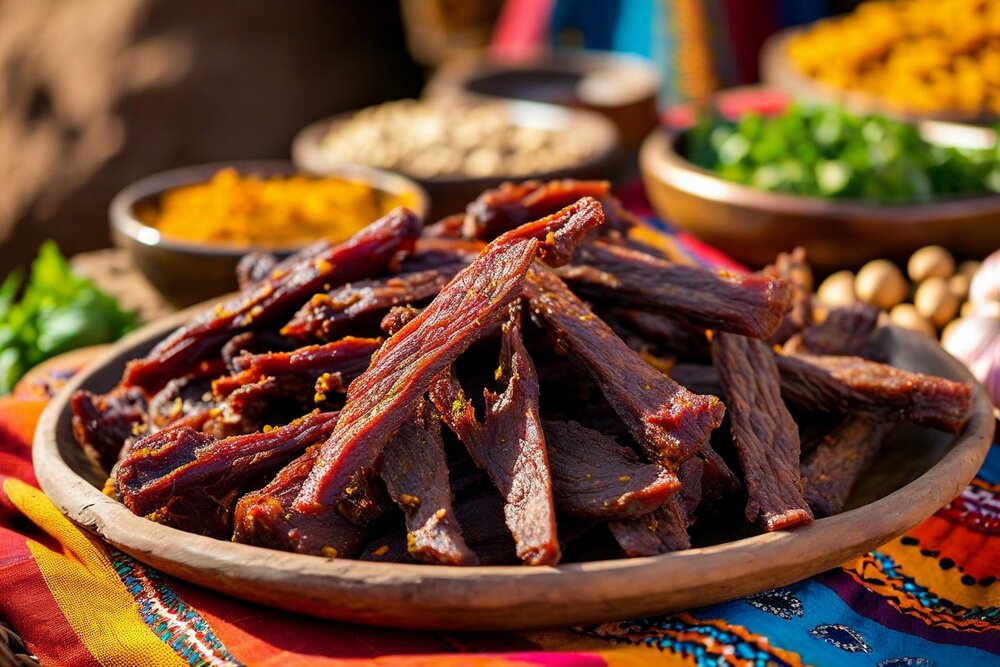
Kilishi
Dried spiced beef · makes about 250 g · 2 days
Ingredients: 800 g lean beef (topside or silverside) · 150 g roasted groundnuts, ground to a paste in a blender · 2 tbsp ground ginger · 1–3 tbsp ground dried chilli, to taste · 1 tbsp onion powder (or 1 onion blitzed and strained) · 1 tsp garlic powder · ½ tsp ground cloves · 1 tbsp groundnut oil · 1 tsp salt · about 150 ml water
Method: Freeze the beef for an hour, then slice it as thin as you physically can — 2 mm or less, across the grain, in the largest sheets the muscle allows. Lay the sheets out without overlapping on racks and dry them: a full day in strong sun, or 4 hours in a dehydrator or a fan oven at its lowest setting with the door ajar, until leathery but still flexible. Meanwhile mix the ground groundnuts with the spices, salt, oil and enough water to make a thick, spreadable paste — the consistency of soft peanut butter. Dip or brush each dried sheet on both sides so it is thinly coated, then return to the racks and dry again, several hours, until no longer tacky. Finish over hot coals or under a very hot grill for 30–60 seconds a side, watching constantly — the groundnut burns instantly. Cool completely before storing.
💡 The thinness is the dish. Thick slices give you jerky with a peanut coating; paper-thin slices give you something that snaps and dissolves. If your sheets tear while you are coating them, they are the right thickness.
Dambou
Steamed millet with moringa · serves 4 · 45 minutes
Ingredients: 300 g millet flour (or fine semolina, or cassava gari, at a pinch) · about 150 ml water · 2 large handfuls fresh moringa leaves, stripped from the stalks and finely chopped (spinach or fresh fenugreek is the nearest substitute) · 3 tbsp groundnut oil · 1 tsp salt · 1 small onion, very finely diced · 1 mild chilli, chopped · optional: a squeeze of lime
Method: Put the flour in a wide shallow bowl with the salt. Sprinkle water over it a little at a time while rubbing the flour between your palms with a rolling motion — the aim is small even granules, like coarse couscous, with no dry flour and no wet lumps. This takes ten minutes and cannot be rushed. Work the chopped moringa through the granules so the green is evenly distributed. Line a steamer with a cloth, add the mixture loosely without packing it, and steam over boiling water for 15 minutes. Tip into a bowl, drizzle with half the oil, and fluff and break up any clumps with a fork. Return to the steamer for a further 10 minutes. Finish with the rest of the oil, the raw onion and the chilli.
💡 Uneven granules cook unevenly and give you a mixture of raw flour and paste, so spend the time on the rubbing. The moringa is not a garnish — it goes in before the first steaming and it is what makes this dambou rather than couscous.
Tuwo with miyan kuka
Millet swallow with baobab-leaf soup · serves 4 · 1 hour
Ingredients: For the tuwo: 400 g millet or sorghum flour (fine maize meal works) · 1,2 l water · a pinch of salt. For the miyan kuka: 400 g beef or goat on the bone, in pieces · 4 tbsp kuka (powdered baobab leaf) · 3 tbsp groundnut paste · 2 tbsp dawadawa (fermented locust bean), crushed · 1 onion · 2 tomatoes · 1–2 dried chillies · 1 tbsp ground crayfish or dried fish (optional but traditional) · oil · salt
Method: Start the soup: simmer the meat with the onion, a dried chilli and salt until tender, about 45 minutes, keeping the broth. Fry the tomato in a little oil, add the crushed dawadawa, the groundnut paste slackened with broth, the crayfish and the meat, and simmer 10 minutes. Sprinkle the kuka powder over the surface in a thin, even layer and do not stir for two minutes — dumping it in and stirring makes lumps that never go. Then stir gently; it will thicken and go slightly slippery, which is correct. For the tuwo: bring the water to the boil with the salt, whisk in about a third of the flour and cook 10 minutes, then add the rest a little at a time, working it against the side of the pan with a strong wooden spoon until it is smooth, very stiff and pulls away cleanly. Wet a bowl, press the tuwo into it, turn it out as a dome.
💡 Judge the tuwo by whether it holds a shape you can pinch off with one hand. If a spoonful slumps, it needs more flour and more beating.
Fura da nono
Millet balls in soured milk · serves 4 · 30 minutes
Ingredients: 250 g millet flour · 1 tsp ground ginger · ½ tsp ground cloves · ½ tsp ground black pepper · a pinch of salt · about 120 ml hot water · 800 ml soured milk or plain kefir (or natural yoghurt slackened with water) · sugar or honey to taste
Method: Mix the flour with the spices and salt, then add hot water gradually, working it into a firm dough. Roll into balls the size of a small plum and drop into simmering water for 10 minutes, until they float and firm up. Drain, and while still hot pound or mash them — traditionally in a mortar with a splash of the cooking water — into a smooth, thick paste, then reroll into balls and let cool. To serve, crumble one or two balls into a calabash or bowl, pour over the soured milk, sweeten, and work it with a spoon until it is a thick, slightly grainy drink.
💡 It is made to be drunk, not eaten with a spoon, and it should be thick enough to coat the sides of the bowl. The spicing is variable and personal; ginger is the one nobody leaves out.
🍵 Tea — Three Glasses, and What They Mean
⭐ The three glasses
Green gunpowder tea, boiled hard with a great deal of sugar and a handful of mint if there is any, and served in three rounds. The Saharan formula — heard from Morocco to Chad — is that the first is bitter as death, the second sweet as life, the third gentle as love. Leaving before the third is a real discourtesy, and the whole thing takes an hour or more, which is the point.
The foam
The head of foam on the glass is not incidental — it is the mark of a well-made glass, and it is produced by pouring from height between two glasses repeatedly to aerate the tea before serving. A Saharan tea-maker is judged on the foam and on the pour, and both are genuinely skilled.
What else people drink
Bissap, hibiscus flowers steeped and sweetened, deep red and sharp, sold frozen in plastic sachets at every roadside. Tamarind juice. Ginger juice, strong enough to hurt. Nono, the soured milk that goes with fura. Bottled water is widely available in towns and is what visitors should be drinking.
Coffee
Not really a Nigerien drink, with one exception: the Nescafé-and-condensed-milk stands that appear on every corner at dawn, often run by Togolese or Beninese, serving instant coffee with powdered milk and a slab of buttered baguette. It is bad coffee and an excellent institution.
Alcohol
Niger is over 99 % Muslim and alcohol is not part of ordinary social life. It is legal and it is available — Nigerian Star and Gulder beer, and the local Bière Niger when it is in production — in hotels and a small number of bars in Niamey, and effectively nowhere else. Drinking in public outside those settings is a straightforward way to give offence.
Millet beer, historically
Sorghum and millet beer (burukutu, dolo) is a West African tradition and is drunk in the non-Muslim south of several neighbouring countries. In Niger it survives only in small pockets and is socially marginal. Anyone telling you it is a Nigerien national drink has confused the country with Burkina Faso, where it genuinely is one.
🕋 Islam, the Sultans and the Written Word
How Islam arrived
Gradually and from the north-east, along the trade routes, from about the eleventh century in Kanem and later in the Hausa cities and Songhai — first among rulers and merchants, then, much more slowly, in the countryside. The version that settled is Maliki Sunni, heavily shaped by Sufi brotherhoods: the Tijaniyya above all, and the Qadiriyya, which carry the everyday religious authority in most of the country.
Marabouts
The local religious teacher, jurist, healer and amulet-maker, and a central figure in Nigerien life. Qur'anic schools — where boys learn to write suras on wooden boards, wash them off and write them again — reach far more children than state schools do in some regions. The almajiri system, in which boys are sent away to study and beg for their keep, is a real social problem on both sides of the Nigerian border and is regularly promised reform.
Reformist currents
Since the 1990s, Salafi and Izala movements have spread from northern Nigeria, opposing Sufi practice, saint veneration, spirit cults and much of the existing religious establishment. This is the main religious fault line in Niger, and it runs between Muslims rather than between religions. It is also entirely distinct from the jihadist insurgencies, and conflating them is the commonest analytical error made about the Sahel.
The sultanates and chieftaincies
Niger retained its traditional authorities rather than abolishing them: the Sultan of Agadez, the Sultan of Damagaram in Zinder, the Djermakoy of Dosso, the Sarkis of the Hausa towns, and hundreds of canton and village chiefs, all with a legally recognised role in land disputes, marriage and local mediation. In much of the country they are the state people actually deal with.
Ajami
Hausa, Fulfulde, Kanuri and Tamasheq have all been written in Arabic script — Ajami — for centuries, and a great deal of West African poetry, jurisprudence, history and correspondence exists in it. Colonial administrations promoted Latin script (boko, from which Boko Haram, "Western education is forbidden", takes its name), and the Ajami library is still being catalogued. It is one of the great under-read archives in the world.
Christians and others
Well under 1 % of the population, mostly Catholic and evangelical, concentrated in Niamey and among southern minorities and expatriates. Relations have historically been quiet; the exception was January 2015, when protests nominally about Charlie Hebdo turned into riots in Zinder and Niamey in which churches were burned and people were killed — an event Nigeriens themselves generally read as having had as much to do with domestic politics as with a French magazine.
📰 Media, Press Freedom & Resources
What happened after 2023
RFI and France 24 were taken off the air within days of the coup and have not returned. Several domestic outlets have been suspended, the media regulator's powers were widened, and journalists have been arrested — Human Rights Watch's 2026 report documents the detention of journalists and human rights defenders alongside politicians. Press freedom rankings have fallen sharply from what had been, before 2023, a comparatively decent position for the region.
What to read from inside
Aïr Info, based in Agadez, has been the best source on the north — migration, gold, the Tuareg regions — for two decades, and its founder Ibrahim Manzo Diallo has been arrested more than once. Le Sahel is the state paper and should be read as such. ANP is the state news agency. Studio Kalangou, run by the Fondation Hirondelle, broadcasts in five national languages and is the most widely heard independent radio.
What to read from outside
Jeune Afrique and RFI Afrique for francophone coverage. Sahel Tribune and Le Monde's Africa desk. For data rather than narrative, ACLED's conflict dataset is the reference and is free. The Timbuktu Institute and Clingendael publish the most careful field research on the Nigerien Sahel.
Books and film
Finn Fuglestad, A History of Niger 1850–1960, is the standard academic history. Bertrand Taithe, The Killer Trail, is the definitive account of the Voulet-Chanoine column. Jean Rouch's films — Moi, un noir, Jaguar, Les maîtres fous — were made in and around Niger and invented a large part of modern ethnographic cinema. Mahamat-Saleh Haroun is Chadian, not Nigerien, and is often miscredited here.
Nigerien cinema
There is a real tradition: Oumarou Ganda, who acted in Rouch's Moi, un noir and then directed his own films including Cabascabo (1969); Moustapha Alassane, a pioneer of African animation. The national film prize is named for Ganda. Most of the work is hard to find and is being digitised slowly.
A caution on sources
Coverage of the Sahel since 2023 is heavily contested, and a great deal of what circulates — in both directions — is produced by information operations rather than by reporting. Russian-linked networks push one line and French and American institutional voices another. Check whether a claim has a named source on the ground before repeating it, and treat single-source reports of coups, massacres and foreign troop movements with particular care.
💸 What It Actually Costs
Niger is cheap in the way a country with almost no tourist infrastructure is cheap: the things ordinary people buy cost very little, and the things a foreign visitor needs — a secure hotel, a vehicle with a driver, a fixer — cost a great deal. Prices are September 2026 in CFA francs, which are pegged at 655,957 to €1, so 1 000 CFA ≈ €1,52 ≈ 38 Kč.
Beds
A basic auberge room in Niamey 15 000–25 000 CFA. A mid-range hotel with reliable power, air conditioning and a generator 45 000–80 000 CFA. The international-standard hotels used by diplomats and NGOs 90 000–160 000 CFA. Outside Niamey, Agadez, Zinder and Maradi have decent hotels; elsewhere, expect very basic.
Food
A street plate of rice and sauce 500–1 000 CFA. Grilled meat by weight at a roadside grill 2 000–4 000 CFA. A proper restaurant meal in Niamey 6 000–15 000 CFA. A bottle of water 300–500 CFA; a beer in a hotel bar 2 000–3 000 CFA. Fura da nono from a calabash, a few hundred francs.
Getting around
Shared taxi in Niamey 300–500 CFA a hop. A bush taxi or minibus between towns 5 000–15 000 CFA depending on distance. The reputable long-distance bus lines — SNTV, Rimbo, Air Transport — Niamey to Zinder or Agadez for roughly 15 000–25 000 CFA, taking most of a day. A 4×4 with driver, which is what most foreign visitors actually need, 60 000–120 000 CFA a day plus fuel.
The giraffes
Kouré is the one genuinely accessible excursion. Reserve entry plus the compulsory local guide runs on the order of 10 000–15 000 CFA per person, and transport from Niamey — a taxi hired for the half-day or a 4×4 — is the larger cost. Go at first light or late afternoon; the animals are easier to find and the light is better.
Daily budget
For an independent traveller staying in cheap places and using shared transport, 20 000–30 000 CFA a day is realistic. With a mid-range hotel and taxis, 50 000–80 000 CFA. With a vehicle and driver, which is how most people who go actually travel, 120 000–200 000 CFA.
💳 Money
This is a cash economy. ATMs exist in Niamey (BOA, Ecobank, Bank of Africa, Sonibank) and work unreliably; they exist in Agadez, Zinder and Maradi and work less reliably still. Cards are accepted at a handful of Niamey hotels and nowhere else. Bring euros in cash — the CFA peg makes them the best currency to change — and bring more than you think. Mobile money (Airtel, Moov) is widely used domestically and hard for a visitor to set up.
🌡️ Climate & When to Go
⭐ The only comfortable window
November to February. Days in the high twenties to mid-thirties, nights genuinely cold in the desert — below 10 °C in the Aïr in January, and freezing is not unheard of. This is the harmattan season and also the only time a European visitor will find the heat ordinary rather than dangerous.
March to June — the hot season
The reason Niger has a reputation. Daytime maxima in Niamey routinely exceed 42 °C in April and May, and the north goes higher; Bilma and the Ténéré reach the high forties. Humidity is low, which helps, but this is heat that kills people every year and it is not a season to travel in for pleasure.
June to September — the rains
The single short rainy season, hivernage: violent, brief storms, usually in the late afternoon, preceded by a wall of dust. Temperatures drop and the Sahel turns startlingly green for eight weeks. Unpaved roads become impassable, which matters everywhere outside the main axes, and this is also the peak of malaria transmission and of the meningitis season's tail.
The harmattan
From roughly December to February, a dry north-easterly carries Saharan dust across the whole country. Visibility drops to a few kilometres, the sun goes pale, flights are occasionally disrupted, and everything you own acquires a fine red coating. It is also what makes the nights cold. Bring lip balm, eye drops and a scarf, which is what the chèche is for.
Events worth timing
The Cure Salée at In-Gall in September, if the security situation and your circumstances ever permit it. Bianou in Agadez at the Islamic new year. The national wrestling championship, which rotates between regions and is usually in the dry season. Tabaski moves through the calendar and is the biggest family event of the year.
What to pack
Loose, long, light clothing that covers arms and legs — this is a Muslim country and it is also simply the sensible desert answer. A chèche or scarf, bought locally, for dust and sun. A warm layer for desert nights. Sunglasses, high-factor sun cream, lip balm. A serious water strategy. A torch, because power cuts are routine. Modest dress for women is expected and for men means not wearing shorts in town.
✈️ Getting There & Getting Around
The airport
Diori Hamani International (NIM), 12 km south-east of Niamey. Small, functional, and the only realistic international entry point. Mano Dayak International (AJY) at Agadez and the airports at Zinder and Maradi handle domestic and occasional charter traffic.
⚠️ Who flies there, and why to check
Routes to Niamey have changed repeatedly since 2023 — Nigerien airspace was closed to French aircraft, sanctions closed it more broadly for seven months, and carriers have come and gone. The airlines that have generally served Niamey through this period are Turkish Airlines via Istanbul, Royal Air Maroc via Casablanca, Ethiopian via Addis Ababa, ASKY via Lomé and Air Côte d'Ivoire via Abidjan. Verify current schedules directly with the airline rather than trusting an aggregator; this is the one practical detail on this page most likely to be out of date.
Overland
Possible in principle from Burkina Faso, Mali, Nigeria, Benin and Chad, and a bad idea in practice on most of those routes because of the security situation and the state of relations. The Benin border, which carries the port traffic and the pipeline, has been repeatedly closed or restricted since 2023. Do not plan an overland itinerary from a map.
Roads
The paved network is essentially one east-west axis — Niamey to Dosso, Birni-N'Konni, Maradi, Zinder and on to Diffa — plus the road north to Tahoua, Agadez and Arlit, the route de l'uranium. Off that, everything is laterite or sand. Road traffic accidents are one of the leading causes of death for foreigners in the Sahel, and driving at night outside towns is genuinely dangerous for reasons that include but are not limited to armed groups.
Buses and bush taxis
The bus companies — SNTV, Rimbo, Air Transport — run the main axis with fixed departures and are the sane option. Bush taxis (Peugeot estates and minibuses) go everywhere else, leave when full, and are overloaded by design. Both are used by everyone and neither is comfortable.
⚠️ Checkpoints and permits
Expect frequent military and gendarmerie checkpoints, and carry your passport, visa and — if you have one — your travel authorisation at all times. Travel to several regions requires official permission, and travel north of the 20th parallel has required a specific permit for years. Photographing anything official, military or governmental will get you arrested. Ask before photographing people.
📋 Practical Information
⚠️ Entry — visa required
Czech and other EU citizens need a visa in advance. There is no Nigerien embassy in Prague; MZV ČR points Czech applicants to the Embassy of Niger in Berlin. You also need a passport valid at least six months and — this one is mandatory, not advisory — a valid yellow fever vaccination certificate, which is checked on arrival. Visa on arrival has existed at times for some nationalities and should not be relied on.
⚠️ Where not to go
MZV ČR advises against travel north of Agadez, to the entire Libyan border area, and to the Lake Chad region, and requires special permission for anything above the 20th parallel. Most other Western foreign ministries go considerably further and advise against all travel to the whole country or to everything outside Niamey. The tri-border area with Mali and Burkina Faso and the Diffa region are the highest-risk zones.
Kidnapping
This is the risk that distinguishes Niger from most difficult destinations. Westerners have been abducted in Niger for ransom by AQIM-linked groups since 2008, including from Arlit in 2010 and from a hotel in Niamey; several have been held for years and some have been killed. It is why insurance is unavailable, why NGOs move in convoy, and why an unaccompanied foreign traveller outside Niamey is making a specific and serious decision.
Health
Yellow fever certificate mandatory. Strongly recommended: hepatitis A and B, typhoid, tetanus-diphtheria-polio, meningococcal ACWY (Niger is in the meningitis belt and epidemics are real), rabies for anything rural, and malaria prophylaxis — falciparum malaria is present year-round and intense after the rains. Cholera outbreaks occur. Drink only bottled or treated water and be conservative about food.
Medical care
Limited even in Niamey and effectively absent outside it. The Clinique Gamkalley and a small number of private clinics in the capital are the reference points. Medical evacuation insurance is not optional, and you must check that your policy covers a country under a do-not-travel advisory — many do not, which is the practical reason most independent travel to Niger does not happen.
Day to day
Power 220 V, 50 Hz, European two-pin plugs. Power cuts are frequent; carry a torch and a power bank. Mobile coverage (Airtel, Moov, Zamani) is good in towns and absent across most of the country; a local SIM needs a passport. Friday is the main prayer day and much closes around midday. Greetings are extended and skipping them is rude. The left hand is not used for eating or for handing things over.
🇨🇿 For Czech Readers
Getting there from Prague
No direct flight and no short routing. The realistic options are Praha → Istanbul → Niamey with Turkish Airlines, Praha → Casablanca → Niamey with Royal Air Maroc, or Praha → Addis Abeba → Niamey with Ethiopian via a European hub. Total 12–20 hours depending on the connection. French carriers have not served Niamey since 2023, so routings through Paris that appear in old guidebooks do not exist.
⚠️ Visa and vaccination
Czechs need a visa. There is no Nigerien embassy in the Czech Republic and MZV ČR directs applicants to the Embassy of Niger in Berlin; allow weeks, not days, and expect to need an invitation or a confirmed hotel booking. A valid yellow fever certificate is compulsory and is checked at the airport — without it you can be refused entry or vaccinated on the spot, neither of which you want.
What it costs from Prague
Return flights typically 18 000–32 000 Kč depending on routing and season. On the ground, the CFA franc's euro peg makes conversion easy: 1 000 CFA ≈ 38 Kč. A street meal is around 30 Kč, a decent Niamey hotel 1 700–3 000 Kč a night, a 4×4 with driver 2 500–4 500 Kč a day. Take euros in cash — they change at the fixed peg and are far easier than crowns or dollars.
⚠️ MZV ČR
The Ministry of Foreign Affairs describes Niger's security situation as long-term deteriorated, driven by Libya, the Malian Tuareg conflict and Boko Haram in northern Nigeria. It advises against travel north of Agadez, to the whole Libyan border zone and to the Lake Chad area, and notes that travel above the 20th parallel needs special permission. It also warns against travelling long routes alone, since there are no repair facilities and no reliable food or water over long distances. Check mzv.gov.cz before you book.
Embassy and DROZD
There is no Czech embassy in Niger. The country falls under the Embassy of the Czech Republic in Abuja, Nigeria, which is also accredited to Benin, Cameroon, Chad and Equatorial Guinea — one mission for six countries, at a distance of about 1 000 km from Niamey with no direct flight. Register in DROZD before you travel; for Niger this is not a formality, and note the EU consular-protection rule that lets a Czech citizen approach any EU member state's embassy where Czechia has none.
Insurance — read the exclusions
Standard Czech travel insurance will not cover you in a country under a do-not-travel advisory, and most policies exclude it explicitly. If you are going, you need a specialist policy for high-risk destinations, with medical evacuation without a low cap, and you should assume kidnap-and-ransom cover is a separate product that ordinary travellers cannot buy. If your reason for going is tourism, the honest advice from this page is to read it, look at the photographs, and go to Senegal or Mauritania instead.
✍️ Author's Note — Nine Photographs, Three Usable
Every page in this collection is built after an inventory of the images that actually exist for the country. Niger has nine, and three are usable. Five of the six food photographs are wrong, and the old page's hero is wrong in a way that is worth writing down carefully, because it is a new category.
🏛️ The wrong architectural world
The hero of the page this one replaces shows a mud building with a pointed ogee portal, carved lattice screens and small domed kiosks with finials on the roof — a Maghrebi kasbah crossed with an Indo-Islamic chhatri. Sahelian banco architecture has none of those features. It has flat roofs, battered buttressed walls and projecting toron beams, and the fact that it looks like nothing else is the entire reason Agadez and Djenné are World Heritage Sites. Right continent, wrong architectural world. Not displayed.
What the new hero does instead
01-hero.jpg is at least in the right tradition: mud brick, beam sockets, desert light. It is still not a photograph of a named building, and in particular it is not the minaret of the Agadez mosque, which is a stepped square tower bristling with beams. The caption says so. This page names no monument it cannot show.
🍽️ The one food photograph that is right
niger-kilishi.jpg shows dried spiced beef with groundnuts and chilli — the correct dish, which is one more than Nicaragua managed. It is displayed with its error named: real kilishi is cut into sheets so thin they are nearly translucent, and the picture shows thick jerky sticks.
The four that are wrong, and how
niger-dambou.jpg: plain yellow couscous. Dambou is steamed with moringa leaves worked through the grain and is flecked green — the moringa is the dish. niger-tuwo.jpg: a loose porridge in liquid. Tuwo is a stiff swallow that holds its shape; texture is the dish. niger-traditional-niger-stew.jpg: a generic stew photographed with a Moroccan tagine in the frame. All three are the pattern this log has recorded again and again — the ingredient list is read, the technique is not.
⚠️ The filler series, fifth confirmed instance
niger-niger-flatbread.jpg is Indian naan with avocado. niger-niger-sweet-treat.jpg is a fluted moulded pudding with sugar raining out of an empty sky onto a board of sand. Both belong to the *-flatbread.jpg / *-sweet-treat.jpg series that this project has now found wrong in five countries. Note the doubled country name in the filenames — niger-niger- — which is the series' signature: a template that concatenated the slug twice. Neither is displayed.
Formats
01-hero.jpg is a PNG served under a .jpg name, 1,32 MB. That is now eight countries and twenty-one files in the running log, and it wants a single pass over the whole bucket rather than another per-country footnote.
On the text. Niger is a country where the difference between what is true now and what was true five years ago is unusually large, so everything time-sensitive here was checked in September 2026 against reporting rather than recalled: the transition charter of 26 March 2025 and the demotion of French; the ECOWAS exit completing in January 2025; the French and American withdrawals of December 2023 and September 2024; the nationalisation of Somaïr in June 2025 and the ICSID order that followed; and the mutiny of August 2026, which is recent enough and contested enough that this page says what is reported and no more. Anyone reading this later should assume the political sections have moved and check the sources listed above.
Support This Project 🌍
This World Travel Factbook is a labor of love – free to use for all travelers. If you find it helpful, consider supporting its continued development.