🇳🇬 Nigeria at a Glance
🌍 Overview — One African in Four
Nigeria holds somewhere around 235 million people — the exact figure is genuinely disputed, because the last census was in 2006 and counting Nigerians is a political act. Whatever the number, it is the most populous country in Africa by a very wide margin, the sixth most populous on earth, and on current projections it will pass the United States before mid-century. Roughly one African in four is Nigerian.
It is also, at 923 769 km², only about eleven and a half times the size of Czechia — so the density that follows from those two numbers is the first thing to understand about the place. And it is a country that did not exist before 1 January 1914, when a British administrator amalgamated two protectorates for administrative and budgetary convenience, and whose name was suggested by a journalist he later married.
Where it is
The Gulf of Guinea coast of West Africa, between Benin and Cameroon, with Niger to the north and a short border with Chad at Lake Chad. It stretches from mangrove and rainforest on the coast to the edge of the Sahel in the far north-east — about 1 000 km from sea to savanna, which is why the country contains several unrelated climates and several unrelated ways of life.
Who lives here
Officially more than 250 ethnic groups and by linguistic count over 500 languages, one of the highest totals of any country. Three groups dominate the arithmetic: Hausa-Fulani in the north, Yoruba in the south-west, Igbo in the south-east — together maybe 60 % — and then Ijaw, Kanuri, Ibibio, Tiv, Efik, Nupe, Edo and two hundred more. See the peoples section.
Religion
Roughly half Muslim and half Christian, split along a geography that runs broadly north to south, with a contested middle belt in between. Twelve northern states adopted sharia criminal law from 1999. The Christian half includes some of the largest Pentecostal congregations in the world. This division is the organising fact of Nigerian politics and it is not the same thing as the country's violence, which is more complicated — see the section on that argument.
How it is governed
A federal presidential republic of 36 states plus the Federal Capital Territory of Abuja, with a bicameral National Assembly, an informal but strong convention that the presidency rotates between north and south, and a requirement that a winner take at least 25 % of the vote in two thirds of the states. President Bola Ahmed Tinubu, of the APC, took office on 29 May 2023. The next general election is due in February 2027.
What it sells
Crude oil — around 1,4 million barrels a day including condensate, well below its OPEC quota history and far below what the reserves would allow, because of theft, vandalism and underinvestment. Plus LNG, cocoa, sesame, cashew, urea and, increasingly, refined products from the Dangote refinery. And films and music, which earn less but travel further.
⚠️ 2026 in one line
Inflation down from a peak near 35 % in late 2024 to the mid-teens after a CPI rebasing, the naira stabilised at a much weaker level, reserves rebuilt — and simultaneously a nationwide security emergency declared in November 2025 after a wave of mass school kidnappings, a defence minister resigned, and a US president threatening military action over the killing of Christians. Both halves are true at once.
🏷️ The Name, and the Country That Was Assembled
Who named it
Flora Shaw, colonial editor of The Times, proposed "Nigeria" in an article in 1897 as a tidier alternative to "Royal Niger Company Territories". She later married Frederick Lugard, the man who would govern the place. A country named by a journalist and assembled by her husband is a fair summary of how much of Africa's map was made.
⭐ 1 January 1914
Lugard amalgamated the Northern and Southern Protectorates into the Colony and Protectorate of Nigeria. The reason was partly administrative and substantially financial: the north ran a deficit and the south's customs revenue could cover it. Lugard's own wording — the north as the poor husband, the south as the rich wife — has been quoted against the arrangement ever since, and Nigerians still call 1914 "the amalgamation" as though it were a marriage nobody consented to.
What was joined
On one side the Sokoto Caliphate, a literate Islamic state with a functioning bureaucracy, and the Kanem-Bornu tradition behind it. On the other the Yoruba kingdoms, the Kingdom of Benin, and the acephalous, village-republic Igbo societies of the south-east, which had no kings at all. There was trade between them and there had never been a single polity covering them.
Indirect rule
Lugard's system: govern through existing rulers, cheaply. It worked in the north, where emirs already administered, and it was largely fictional in the south-east, where the British appointed "warrant chiefs" over societies that had never had chiefs. The Aba Women's War of 1929 — tens of thousands of Igbo and Ibibio women protesting taxation and the warrant chiefs, dozens shot dead — is the clearest evidence of how badly that graft took.
The scale problem
Almost everything difficult about Nigeria is a scale problem. A federation of 36 states in which the centre collects the oil money and shares it out; an election in which the winner needs geographic spread as well as votes; a police force of around 370 000 for 235 million people, which is roughly a third of the ratio the UN suggests. Governing this is genuinely hard, and Nigerians are less impressed than foreigners by explanations that skip that.
"Giant of Africa"
The self-description, and it is not empty: the largest economy on the continent in most years, the largest population, the largest film industry by output, the most globally successful popular music, and the largest army in West Africa, which has intervened in Liberia and Sierra Leone. It is also a country where roughly a third of people live in extreme poverty, which is the other half of the same sentence.
🗺️ Geography — From Mangrove to the Edge of the Sahel
The bands
From the coast inland: mangrove swamp, then freshwater swamp and rainforest, then the Guinea savanna of the middle belt, then Sudan savanna, and in the far north-east the Sahel. Rainfall falls from over 4 000 mm a year in the south-east to under 500 mm at the Niger border. The same country contains Africa's wettest inhabited places and its drought belt.
The rivers
The Niger enters from the north-west and the Benue from the east, and they meet at Lokoja in a confluence that is the geographic centre of the country and the boundary of everything — north from south, Islam from Christianity, savanna from forest. Below Lokoja the Niger runs south to the delta. The Kainji dam on the Niger, opened in 1968, is the country's main hydropower station.
⭐ The Niger Delta
About 70 000 km² — one of the largest river deltas in the world and the largest wetland in Africa: mangrove, creeks, rainforest and around 30 million people. It is also where the oil is, and it has been comprehensively poisoned. Ogoniland alone was the subject of a 2011 UNEP report estimating a clean-up that would take 25 to 30 years; it is still barely under way. Oil spills here run into the thousands per decade, from both corrosion and deliberate tapping.
Highlands
The Jos Plateau in the middle belt, around 1 200 m, cool enough that the British built a hill station there and tin was mined for a century. The Mambilla Plateau in the south-east, 1 500–1 800 m, where Nigerian tea grows. And the Chappal Waddi area on the Cameroon border, around 2 400 m and the country's high point, in the Gashaka-Gumti park.
Lake Chad and the north-east
Nigeria's corner of Lake Chad has been at the centre of the lake's shrinkage — from roughly 25 000 km² in the 1960s to a small fraction, with partial recovery in wet years — and the collapse of the fishing and farming economy around it is part of the background to Boko Haram. Borno and Yobe states are the driest, poorest and most damaged part of the country.
Erosion and the coast
Two slow disasters. In the south-east, gully erosion has eaten thousands of ravines out of the Anambra and Abia landscape, some of them tens of metres deep, swallowing roads and houses. On the coast, sea-level rise and subsidence threaten Lagos directly; the artificial peninsula of Eko Atlantic was built partly as a sea wall for Victoria Island and is criticised for pushing erosion onto the communities next door.
👥 The Peoples — Three Big Ones and Two Hundred Others
Nigeria is usually described through three groups, which is useful arithmetic and bad anthropology: the other 250-odd peoples are not a footnote, and the middle belt in particular is a mosaic of dozens of small nations whose politics is nothing like the big three.
Hausa and Fulani
The largest bloc, in the north. Hausa are the ancient city-state and trading people whose language is the lingua franca of the whole Sahel; the Fulani are the cattle pastoralists whose scholars conquered the Hausa states in the Sokoto jihad of 1804 and then merged with them. "Hausa-Fulani" is a real fusion at the elite level and a simplification at the village level, where Fulani herders and Hausa farmers are distinct and sometimes in conflict.
Yoruba
The south-west, about 45–50 million people, urban for centuries — Ibadan, Ife, Oyo, Abeokuta, Lagos. A tradition of kings (oba) and a highly developed religious system, Ifá divination and the òrìṣà, which crossed the Atlantic with the slave trade and became Santería in Cuba and Candomblé in Brazil. Roughly half Christian and half Muslim, in the same families, which is why Yorubaland is the standard counterexample to the idea that Nigeria's divisions are inevitable.
Igbo
The south-east, about 35–40 million. Historically acephalous — no kings, no centralised state; authority was in lineage elders, age grades, title societies and village assemblies, which is why the British had to invent chiefs to rule through. Overwhelmingly Christian, overwhelmingly commercial, and dispersed across every Nigerian city through an apprenticeship system (igba boi) that has been studied as one of the world's largest business incubators.
The others
Ijaw in the delta, the fourth largest group and the core of the delta militancy. Kanuri in Borno, heirs of Kanem-Bornu and the people Boko Haram emerged among and killed most of. Tiv and Idoma in Benue; Nupe, Gwari, Berom and dozens more on the Plateau; Efik and Ibibio around Calabar; Edo in Benin City; Urhobo, Itsekiri, Isoko in the delta.
The middle belt
The band across the centre — Plateau, Benue, Nasarawa, Taraba, southern Kaduna — where dozens of small, mostly Christian peoples sit between the Muslim north and the Christian south. It is where the farmer-herder conflict is worst, where Jos has had repeated communal massacres since 2001, and where Nigerian violence is least reducible to a single explanation.
Naming
Nigerian personal names carry meaning and are worth listening to. Yoruba names record circumstances of birth — Babatunde, father returns; Abeni, we asked and got her; and the Oluwa- prefix for God. Igbo names are often statements — Chukwuemeka, God has done well; Nnamdi, my father is alive. Hausa names are largely Arabic. Asking what a name means is a normal and welcome question.
🏺 Before 1914 — Nok, Ife, Benin and the Caliphate
Nigeria's territory holds one of the deepest art-historical sequences in the world, and the fact that most people outside Africa cannot name any of it is itself a piece of history.
Nok
Terracotta heads and figures from the Jos Plateau and the Kaduna valley, dating from roughly 1500 BCE to 500 CE — among the oldest figurative sculpture in sub-Saharan Africa. The Nok culture also produced some of the earliest iron smelting in West Africa. Most Nok pieces in circulation were looted, which has wrecked the archaeological context and is the reason so much about the culture is unknown.
⭐ Ife
From about the 12th to 15th centuries, the Yoruba city of Ile-Ife produced naturalistic heads in terracotta, copper and brass of a technical and observational quality that, when Leo Frobenius found them in 1910, he refused to believe were African and attributed to survivors of Atlantis. The heads are portraits, cast by lost-wax, and they are among the great achievements of world sculpture. Ife is also, in Yoruba tradition, where the world was made.
⭐ Benin
The Kingdom of Benin — Edo, no relation to the modern Republic of Benin — ruled from Benin City from about the 13th century, with an oba, a guild system and a court art of cast brass plaques and heads that recorded its own history on the pillars of the palace. Its earthworks, the Iya, are among the largest earth structures ever built by human beings — thousands of kilometres of bank and ditch. See the next section.
Igbo-Ukwu
Excavated in the 1950s and 1960s in the south-east: bronze and copper objects of extraordinary delicacy — a roped pot, a fly-whisk handle, ornaments with insects and shells modelled onto them — radiocarbon-dated to around the 9th century CE, centuries earlier than anyone expected, in a society with no king and no city. The dating was disputed for decades largely because it was inconvenient.
Oyo and the savanna kingdoms
The Oyo Empire dominated Yorubaland and beyond from the 17th to the early 19th century on the strength of a cavalry army and control of trade to the coast, and collapsed in civil war in the 1830s — the collapse that fed the later stages of the Atlantic slave trade and scattered Yoruba speakers across the Americas. To the north-east, Kanem-Bornu ran for nearly a thousand years; to the north-west, the Hausa city states.
The Sokoto Caliphate
Usman dan Fodio's jihad of 1804 created the largest state in nineteenth-century Africa, covering most of northern Nigeria and reaching into Niger and Cameroon. It was a literate, administratively serious polity, and it was still functioning when the British conquered it in 1903 — after which they kept its emirs in place and governed through them. That decision is why northern Nigeria's traditional institutions survived intact and why the sultan of Sokoto still matters.
🗿 The Benin Bronzes — the 1897 Sack and What Came After
This is the single best-documented case of colonial art looting in the world, and it is the reason the word "restitution" is now in the vocabulary of every major museum.
What they are
Around 3 000 to 5 000 objects: cast brass plaques that faced the pillars of the Oba's palace, commemorative heads, ivories, coral regalia. They record Benin's own history — kings, wars, Portuguese traders in sixteenth-century armour — and they were made by a guild of casters working for the court. "Bronzes" is a misnomer; most are brass, some of it from European manillas traded into the kingdom.
⚠️ 1897
A British party travelling to Benin City against the Oba's explicit instruction during a religious period was ambushed and most of it killed. Britain responded with a punitive expedition: in February 1897 some 1 200 troops took the city, burned much of it, deposed and exiled Oba Ovonramwen, and removed the entire palace art collection. The objects were auctioned in London to defray the cost of the expedition, which is a sentence worth reading twice.
Where they went
The British Museum holds over 900. The Ethnologisches Museum in Berlin holds around 500. Others are in Vienna, Leipzig, Dresden, Hamburg, Stockholm, Oxford, Cambridge, Glasgow, Boston, New York and dozens of smaller collections, plus an unknown number in private hands. Their dispersal is exactly the shape of the late-Victorian museum world.
The returns
Movement has been real and recent. Germany transferred ownership of over 1 100 objects in 2022 and has physically returned a first tranche. The University of Aberdeen and Jesus College, Cambridge returned pieces in 2021; the Smithsonian transferred 29; the Horniman, the Church of England, the Netherlands and others have followed. The British Museum has not, and says it is prevented by the British Museum Act 1963.
⚠️ The complication
In March 2023 outgoing president Buhari issued a declaration recognising the Oba of Benin as owner and custodian of the returned objects, rather than the federal government or the planned Edo Museum of West African Art. That reopened an argument — between the palace, the Edo state government and the national commission — about who receives what, and several European institutions paused mid-process while it was resolved. Restitution turns out to require answering "to whom", and that question is Nigerian, not European.
Where to see them in Nigeria
The National Museum, Lagos, on Onikan, holds a serious collection including Benin and Nok material and is the best single museum in the country. The National Museum in Benin City holds bronzes in the city they came from. The MOWAA institute in Benin City, designed by Adjaye Associates, opened its first building in 2024 and is the intended home of returned work.
🇬🇧 The British Century — Palm Oil, Lugard and the Warrant Chiefs
Before the flag
Britain's interest was commercial long before it was territorial. The Atlantic slave trade ran through the Bight of Biafra and the Bight of Benin for three centuries; after abolition, the same creeks exported palm oil, which lubricated British industry, and the same merchant families handled it. Lagos was annexed in 1861, nominally to suppress slaving. The Royal Niger Company held a charter from 1886 and governed the interior as a business until the Crown bought it out on 1 January 1900.
Conquest
The north fell between 1900 and 1903 — Kano and Sokoto taken by small columns with machine guns against cavalry. In the south the process was piecemeal and violent: Benin in 1897, the Aro Confederacy in 1901–02, and a long series of expeditions through the Igbo hinterland that continued into the 1920s. There was no single war and no single surrender, which is one reason there is no single national founding story.
Indirect rule, and where it failed
Lugard's doctrine of governing through existing authorities was cheap and it preserved northern institutions almost intact — including, deliberately, by restricting Christian missions and Western education in the north. In the south-east it required inventing warrant chiefs over a society that had never had any, which produced corrupt petty despots and, in 1929, the Aba Women's War: tens of thousands of Igbo and Ibibio women mobilised through market networks, dozens shot dead by police, and the system substantially reformed afterwards.
The education gap
One decision shapes Nigerian politics to this day. Missionary schools spread rapidly in the south and were restricted in the north to protect the emirates. By independence the south had a large educated class and the north had very few graduates, which meant southerners filled the civil service and the professions everywhere — including in northern cities — and northern politicians entered independence determined not to be governed by them. Almost every subsequent crisis has that asymmetry somewhere in it.
Regionalism
The constitutions of the 1940s and 1950s built Nigeria as three regions — Northern, Western, Eastern — each dominated by one ethnic group and each with its own premier, party and civil service. It was a structure that made the three big groups into permanent political blocs and made every minority a permanent minority. Nigeria has been subdividing ever since: 3 regions, then 12 states in 1967, 19, 21, 30, and 36 since 1996.
Nationalism
Herbert Macaulay from the 1920s, then Nnamdi Azikiwe (Igbo, NCNC), Obafemi Awolowo (Yoruba, Action Group) and Ahmadu Bello (northern, NPC). Independence came on 1 October 1960 without an armed struggle, with Azikiwe as governor-general and then president and Abubakar Tafawa Balewa as prime minister. It was negotiated, constitutional, and structurally fragile from the first day.
🇳🇬 1960–66 — the First Republic and How It Broke
The shape of it
A Westminster parliamentary system over three regions, in which no party could win nationally without a coalition, and in which the Northern Region alone held more than half the country's population — a census fact that made northern political dominance structural and made every census a fight. The censuses of 1962 and 1963 were both disputed and both rejected by somebody.
The crises
1962: the Action Group split and the Western Region was placed under emergency rule; Awolowo was jailed for treasonable felony. 1964: a federal election boycotted in parts of the south. 1965: the Western Region election was so blatantly rigged that the region collapsed into arson and killing — the period known as Wetie. By the end of 1965 large parts of the country were ungoverned.
⚠️ January 1966
A coup by mostly Igbo majors killed the prime minister Balewa, the northern premier Ahmadu Bello, the western premier Akintola and the finance minister, and left the eastern premier alive. Whatever the plotters intended, the pattern of who died made it read in the north as an Igbo coup. General Aguiyi-Ironsi, an Igbo, took power and then abolished the federal structure in favour of a unitary state, which confirmed the reading.
⚠️ The pogroms
In July 1966 a counter-coup by northern officers killed Ironsi and installed Lt Col Yakubu Gowon. Through May to October 1966, mobs and soldiers in northern cities killed Igbo civilians — estimates run from 10 000 to 30 000 — and perhaps a million Igbos fled east. This, more than the coups, is what made secession happen: the Eastern Region concluded that its people were not safe anywhere else in Nigeria.
Aburi
In January 1967 the military leaders met at Aburi in Ghana and agreed a loose confederal arrangement. Both sides then published incompatible versions of what had been agreed, the federal government legislated a twelve-state structure that broke the Eastern Region into three, and on 30 May 1967 Colonel Odumegwu Ojukwu declared the independent Republic of Biafra.
What was at stake underneath
The twelve-state decree gave the oil-bearing minority areas their own states, separate from the Igbo heartland. Both sides understood exactly what that meant. The Biafran war was about security and dignity after the pogroms, and it was also about who would own the oil of the delta, which had started flowing in 1958.
⚔️ Biafra, 1967–70
Between one and three million people died, most of them children, most of them of starvation. It was the war that invented the modern humanitarian NGO, the war that put famine on television, and the war whose memory still organises politics in south-eastern Nigeria almost sixty years later.
The war
Biafra was outnumbered perhaps ten to one and had almost no arms industry. It held for thirty months, invaded the Mid-West in 1967 and reached within a hundred kilometres of Lagos, was pushed back, lost Port Harcourt and with it its access to the sea in May 1968, and fought the rest of the war encircled and shrinking. It surrendered on 15 January 1970; Ojukwu had flown out days before.
⚠️ The blockade
The federal government imposed a total land, sea and air blockade and declared that starvation was a legitimate weapon of war — Chief Obafemi Awolowo, the federal finance commissioner, said so publicly. Protein deficiency produced kwashiorkor on a mass scale; the swollen bellies and reddened hair of Biafran children became the defining images of famine for a generation, and they are the reason those images are now a visual cliché.
The airlift
Because there was no legal corridor, food came in at night on unlit aircraft landing on a widened road at Uli. Joint Church Aid — nicknamed "Jesus Christ Airlines" — and the Nordchurchaid operation flew thousands of sorties and it was, for a time, the largest civilian airlift since Berlin. Pilots were killed. It also, unavoidably, helped Biafra keep fighting, which is the argument humanitarians have been having with themselves ever since.
What it created
A group of French doctors who worked in Biafra with the Red Cross concluded that neutrality and silence were complicity, and founded Médecins Sans Frontières in 1971. The idea of témoignage — that a relief agency should speak publicly about what it sees — comes directly out of this war.
Who backed whom
Britain and the Soviet Union armed the federal government. France gave Biafra covert support through Gabon and Côte d'Ivoire. Only five states recognised Biafra: Tanzania, Gabon, Côte d'Ivoire, Zambia and Haiti. The war was conducted, unusually for the period, largely outside the Cold War's normal lines.
After
Gowon's formula was "No victor, no vanquished", and reintegration was faster and less vengeful than most civil wars manage. But the £20 rule — under which every Igbo bank account, whatever its former balance, was exchanged for twenty pounds — and the indigenisation decree that followed while Igbos had no capital are remembered in the south-east as a deliberate impoverishment. The grievance is live: see IPOB.
🛢️ 1970–1999 — the Oil Boom and the Men in Uniform
The boom
Oil revenue multiplied many times over after the 1973 price shock, arriving in a country that had just fought a civil war. Gowon's remark that Nigeria's problem was not money but how to spend it is the most quoted sentence in Nigerian economic history. The state built universities, roads, a new capital and FESTAC '77; it also acquired the habit of spending oil money on imports and letting agriculture, which had been the export base, decline into insignificance.
The coups
Gowon (1966–75) overthrown while at an OAU summit; Murtala Muhammed (1975–76), genuinely popular, assassinated in an attempted coup after six months; Obasanjo (1976–79), who then did the rare thing and handed over to a civilian; the Second Republic under Shehu Shagari (1979–83), remembered chiefly for corruption; Buhari (1983–85) in his first, military incarnation; Babangida (1985–93); Abacha (1993–98); Abubakar (1998–99).
Abuja
The decision to move the capital from Lagos was taken in 1976 — Lagos was congested, coastal and Yoruba, and a new capital in the geographic centre was meant to belong to nobody. Construction ran through the boom and the bust; the capital formally moved on 12 December 1991. It is one of the few purpose-built capitals that has actually filled up.
⚠️ June 12
The 1993 election is widely accepted as the freest Nigeria had held, and was won by Moshood Abiola, a Yoruba Muslim, with support across the whole country. Babangida annulled it. The protests and repression that followed brought down his government, produced an interim administration, and delivered the country to General Sani Abacha. Abiola died in detention in 1998. 12 June is now Nigeria's Democracy Day, moved there from 29 May in 2018.
⚠️ Abacha and Ken Saro-Wiwa
Abacha's five years were the worst: opposition figures jailed and killed, a treasury looted on a scale that has been traced through Swiss, British and Jersey accounts — recovered Abacha loot is still being repatriated in tranches decades later. In November 1995 his government hanged the writer Ken Saro-Wiwa and eight other Ogoni activists after a tribunal universally condemned as a sham; their campaign was against Shell's operations in Ogoniland. The Commonwealth suspended Nigeria the same week.
The handover
Abacha died suddenly in June 1998. His successor, General Abdulsalami Abubakar, ran a rapid transition and handed power to an elected president on 29 May 1999. That was the start of the Fourth Republic, which has now lasted longer than all Nigeria's previous civilian periods combined.
🗳️ The Fourth Republic — 1999 to 2023
Obasanjo, 1999–2007
The general who had handed over in 1979 returned as an elected president. His two terms brought debt relief — the Paris Club deal of 2005–06 wrote off roughly US$18 billion — banking consolidation, telecoms liberalisation that took Nigeria from under half a million phone lines to tens of millions, and the creation of the EFCC anti-corruption agency. They also brought the introduction of sharia criminal law in twelve northern states from 1999, the Odi and Zaki Biam military reprisals, and a failed attempt to secure a third term.
Yar'Adua and Jonathan, 2007–2015
Umaru Musa Yar'Adua won an election even his own party's observers called badly flawed, granted the Niger Delta amnesty in 2009 that ended the militancy, and died in office in 2010 after a constitutional crisis over who was governing while he was ill abroad. Goodluck Jonathan, an Ijaw from the delta, completed the term and won in 2011. His period saw the 2012 fuel subsidy protests (Occupy Nigeria), the rise of Boko Haram, and the Chibok abduction of 276 schoolgirls in April 2014.
⭐ 2015
Jonathan lost to Muhammadu Buhari and conceded by telephone before the final results were announced — the first time in Nigerian history that an incumbent president lost an election and handed over peacefully. Whatever else is said about Jonathan, that phone call is the most important single act in the Fourth Republic.
Buhari, 2015–2023
Elected on anti-corruption and security, re-elected in 2019. Two recessions, in 2016 and 2020; a fixed and heavily defended naira with a parallel market at twice the official rate; a fuel subsidy that consumed a growing share of the budget; and a security situation that deteriorated on every front. Also the #EndSARS protests of October 2020 against police brutality, and the shooting at the Lekki toll gate on 20 October, which a judicial panel later characterised as a massacre and which the federal government disputes.
How power rotates
An unwritten but real convention — zoning — that the presidency alternates between a northerner and a southerner every two terms, with running mates balancing religion. It is not in the constitution and it is broken when convenient, and it explains more about Nigerian candidate selection than any policy question does.
The 2023 election
Bola Ahmed Tinubu (APC) won with about 37 % against Atiku Abubakar (PDP) and Peter Obi (Labour), whose campaign mobilised young urban voters — the Obidients — on a scale nobody had predicted and who won Lagos State, Tinubu's own base. Turnout was the lowest on record at around 27 %, results transmission failed on the night, and the courts upheld the outcome. Tinubu was sworn in on 29 May 2023.
💵 The Tinubu Reforms — Two Shocks in One Sentence
In his inaugural address on 29 May 2023, Tinubu said four words that were not in the prepared text: "subsidy is gone." Within weeks the central bank also let the naira float. Nigeria has been living inside the consequences ever since, and whether they were right is the central argument in the country.
The subsidy
Nigeria had subsidised petrol for decades — it exported crude and imported refined fuel, then sold it below cost. It consumed an enormous share of government revenue, a large fraction was stolen through fictitious import claims, and it disproportionately benefited people who owned cars. Removing it was recommended by every economist and attempted by every previous president; the 2012 attempt triggered Occupy Nigeria and was partly reversed. Tinubu removed it in a sentence, without a cushioning package in place.
The naira
In June 2023 the central bank collapsed the multiple exchange-rate windows and let the naira trade freely, followed by a second devaluation in January 2024. The official rate went from around 460 to well over 1 400 to the dollar. It ended the arbitrage industry that had grown up around the old system; it also destroyed savings, repriced every import, and put the cost of living up by more than most households could absorb.
⚠️ What it cost
Inflation peaked around 34,8 % in late 2024, with food inflation higher. Real incomes fell sharply; the World Bank estimated millions more Nigerians pushed into poverty. There were protests — the #EndBadGovernance demonstrations of August 2024 — and they were met with force and with treason charges against participants including minors, which were later dropped.
And what it bought
By 2026 the picture is genuinely mixed rather than simply bad. Inflation has fallen to the mid-teens after a CPI rebasing in 2025 and is still falling; the naira has stabilised at its new, much weaker level; external reserves passed US$45 billion at the end of 2025; the government is no longer borrowing from the central bank to fund itself; and growth is running around 4 %. State governments' revenue allocations roughly doubled in nominal terms.
The tax reform
The other half of the programme: a set of tax acts signed in 2025 raising the exemption threshold so that the lowest-paid pay no income tax, consolidating agencies into a single revenue service, and changing how VAT is shared between states — the last of which was fought hard by the north, which consumes less of the VAT-generating economy. It took effect in January 2026.
The honest summary
The reforms addressed real distortions that everyone agreed were unsustainable, and they were executed with almost no sequencing and no meaningful social protection first. Both halves of that sentence are held by serious people in Nigeria, and the February 2027 election will be fought on which half voters believe.
⚠️ Boko Haram and ISWAP — the War in the North-East
Where it came from
A preaching movement in Maiduguri, Borno State, around Mohammed Yusuf from the early 2000s, rejecting Western education and the Nigerian state in a region with the country's worst poverty and education figures. Boko Haram is a Hausa nickname meaning roughly "Western education is forbidden"; the group's own name is Jama'atu Ahlis Sunna Lidda'awati wal-Jihad.
⚠️ 2009
Security forces crushed an uprising, killing around 800 people, and then executed Yusuf in police custody in Maiduguri — an extrajudicial killing filmed and widely circulated. The movement went underground under Abubakar Shekau and returned as an insurgency. Nigerian and international analysts broadly agree that the manner of the 2009 crackdown converted a movement into a war.
What it did
Bombings in Abuja, including the UN building in August 2011; mass attacks on villages, mosques and churches; the abduction of 276 schoolgirls from Chibok in April 2014, which produced the #BringBackOurGirls campaign and of whom dozens have never returned; the capture of territory across three states in 2014–15; and the systematic use of women and girls as suicide bombers, which is close to unique in scale.
The split
In 2016 the Islamic State, to which Shekau had pledged allegiance in 2015, replaced him with Abu Musab al-Barnawi, creating ISWAP — Islamic State West Africa Province — and leaving Shekau's faction, JAS, separate. The two fought each other. ISWAP is the larger and more disciplined, taxes and governs populations around Lake Chad rather than simply raiding them, and concentrates its attacks on military targets. Shekau was killed in May 2021, reportedly by detonating himself when ISWAP fighters cornered him.
Now
The war has not ended. ISWAP continues to overrun army positions in Borno and Yobe; the JAS remnant resumed deliberate mass killing of civilians in 2025–26. Around 2 million people remain displaced in the north-east and the humanitarian operation there is one of the largest in the world. Total deaths since 2009, direct and indirect, are usually put in the range of 350 000, the great majority from the collapse of health, food and water systems rather than from weapons.
What has been tried
A Multinational Joint Task Force with Chad, Niger and Cameroon, which has been weakened by the coups in its neighbours; a mass surrender and deradicalisation programme (Operation Safe Corridor) through which tens of thousands have passed, which is genuinely unusual and genuinely contested; and the Borno state government's controversial policy of closing displacement camps and returning people to garrison towns.
🔫 The Banditry Crisis and the 2025 Emergency
The north-west's violence is not the north-east's. It is largely non-ideological, it is organised around cattle rustling, illegal gold mining and kidnapping for ransom, and by 2026 it kills and displaces more people than Boko Haram — which is why the shorthand that reduces Nigerian insecurity to jihadism is wrong.
Who the bandits are
Armed groups operating from forest reserves across Zamfara, Katsina, Sokoto, Kaduna and Niger states, with some estimates putting the total at around 30 000 fighters in the north-west. Their origins are in farmer-herder conflict, the collapse of rural policing, the spread of small arms after Libya, and the extraordinary profitability of ransom — which is now a substantial informal economy.
Mass school kidnapping
It has become a recognised tactic. Chibok, 2014: 276 girls. Dapchi, 2018: 110 girls. Kankara, 2020: over 300 boys. Kuriga, Kaduna, March 2024: around 280 pupils. Kebbi and Niger states, 18–21 November 2025: several hundred schoolchildren in a matter of days. Oyo State, 15 May 2026: 46 people from three schools — the first mass school kidnapping in southern Nigeria, which is why it frightened people so much. Lassa, Borno, 29 June 2026: 36 students.
⚠️ The nationwide security emergency
In late November 2025, after the Kebbi and Niger abductions, President Tinubu declared a nationwide security emergency and ordered mass recruitment: 20 000 additional police officers, taking the force toward 50 000 new hires, plus forest guards to be deployed into the reserves the groups operate from. The defence minister resigned in early December 2025, officially for health reasons.
Why it is hard
The police are federal — there is no state or local police force, which for a country of 235 million and 923 769 km² is the structural problem everyone identifies and nobody has fixed. The army is deployed on internal security in most of the 36 states, which it is neither trained nor equipped for. State governments have responded by funding their own vigilante and "security outfit" forces — Amotekun in the south-west, Ebubeagu in the south-east — which fills a gap and creates a new one.
Ransom
Paying is illegal under a 2022 amendment and is done constantly, by families selling land and livestock, because the alternative is a relative's death. Estimates of total ransom paid run into the tens of millions of dollars a year and are guesses. The money buys weapons and motorcycles, which is the loop.
What it means for a visitor
Kidnapping in Nigeria overwhelmingly targets Nigerians, and the vast majority of incidents are on rural roads in the north-west, north-central and parts of the south-east and delta. Foreigners have been taken, and a foreign national is a high-value target. The practical rules are in the practical section: no intercity road travel outside the south-west, fly between cities, and do not move after dark.
🗺️ The Other Three Conflicts
Nigerian insecurity is usually reported as one thing. It is at least five, with different causes, different actors and different geographies, and the only thing they share is a state that cannot police its own territory.
Farmer-herder violence
The middle belt, and by some counts the deadliest conflict in the country in several recent years. Fulani pastoralists moving south as the Sahel dries and grazing routes close, into settled farming communities in Benue, Plateau, Nasarawa and southern Kaduna. It is a resource conflict with an ethnic and religious overlay — the herders mostly Muslim, the farmers mostly Christian — which makes it very easy to report badly. Massacres have run to hundreds of dead in single incidents, in both directions.
Jos and the Plateau
Jos has had recurring communal massacres since 2001, with major episodes in 2008, 2010 and repeatedly since. The underlying legal mechanism matters: Nigeria distinguishes "indigenes" of a state from "settlers", and indigene status controls access to scholarships, jobs and land — so families resident for four generations can still be legally foreign in their own city. Almost every Nigerian communal conflict has this rule somewhere underneath it.
The Niger Delta
Militancy over oil revenue and environmental destruction escalated from the 1990s — MEND from 2006 attacked pipelines and kidnapped oil workers and cut national output by a third. The 2009 amnesty bought peace with stipends and contracts; it worked, and it institutionalised a payment system that has to be renewed. Meanwhile oil theft — illegal tapping, artisanal refining in the creeks — runs at a scale that materially reduces national production and poisons the delta further.
⚠️ IPOB and the south-east
The Indigenous People of Biafra, founded by Nnamdi Kanu and driven by Radio Biafra, revived secessionist politics from 2012. Kanu was arrested in 2015, jumped bail, was extraordinarily rendered from Kenya in 2021, and after years of litigation was convicted of terrorism in November 2025 and sentenced to life imprisonment. IPOB's armed wing and the Monday "sit-at-home" order — originally a protest, now enforced by violence — have cost the south-east enormous economic damage and many lives.
Shia and the IMN
The Islamic Movement in Nigeria, Shia, under Ibrahim Zakzaky. In December 2015 the army killed a very large number of its members at Zaria — a judicial inquiry put the dead at over 340, buried in a mass grave — and detained Zakzaky for years. The movement was proscribed in 2019. It is a sixth conflict and almost nobody outside Nigeria has heard of it.
Adding up
ACLED and the Nigeria Security Tracker both record several thousand civilian deaths a year across these theatres. Nigerians are the overwhelming majority of the victims in every one of them, and they are Muslim and Christian in numbers that track the population. That is the fact the next section is about.
🇺🇸 The 2025 Designation and the Argument About Christians
In October–November 2025 the United States designated Nigeria a Country of Particular Concern for religious freedom, and President Trump said the US could go into Nigeria "guns-a-blazing" to stop what he described as a mass slaughter of Christians, ordering the Pentagon to prepare for possible action. This is now a defining feature of Nigeria's foreign position and it deserves setting out carefully rather than taking a side by omission.
What was designated
The CPC list names states the US State Department finds responsible for or tolerant of severe violations of religious freedom. Nigeria had been designated in 2020, removed in 2021, and was re-designated in 2025 after sustained lobbying in Washington, notably by Senator Ted Cruz. Trump announced it alongside a statement that "radical Islamists" were responsible for mass killing of Christians and a threat to cut off assistance.
What is true
Christians in Nigeria are killed for being Christian. Boko Haram and ISWAP have specifically targeted churches, clergy and Christian communities; the Owo church massacre of June 2022 killed dozens at Mass; priests are kidnapped routinely in the middle belt; and in farmer-herder violence the victims are frequently Christian farming communities. Open Doors and several church bodies have documented this for years and it is not invented.
What is left out
Boko Haram and ISWAP have killed far more Muslims than Christians — they operate in the overwhelmingly Muslim north-east, they attack mosques, and they regard Nigerian Muslims who reject them as apostates. Banditry in the north-west, which now kills and abducts more people than jihadism, is almost entirely Muslim-on-Muslim and motivated by money. Farmer-herder violence runs in both directions. Characterising the whole as a religious genocide of Christians does not survive contact with the casualty geography.
What the Nigerian government said
Abuja rejected the characterisation, insisted that its security problem is not religious persecution, and pointed out that the country's constitution guarantees religious freedom. It also — and this matters — cannot credibly claim to be protecting anybody, since it visibly fails to protect Christians and Muslims alike, which is the real scandal and the one both sides of this argument talk past.
What happened next
By late 2025 the State Department was describing a broad programme rather than a strike: diplomacy, possible sanctions, assistance and intelligence sharing with the Nigerian government. No military action has occurred. The episode has nonetheless reshaped Nigerian politics — it strengthened arguments in Abuja about sovereignty, it gave domestic actors on every side a foreign lever, and it arrived as Nigeria entered the run-up to the 2027 election.
How to read coverage
Two failure modes dominate. One treats every Nigerian death as religious persecution and produces a number for "Christians killed" with no denominator. The other dismisses the religious dimension entirely because the first version is exaggerated. Neither is honest. The usable sources are ACLED, the Nigeria Security Tracker, HRW and Nigerian investigative outlets, all of which disaggregate by actor and location — see the media section.
🏭 The Economy — Oil, a Refinery and 235 Million Customers
The shape
GDP of roughly US$370–380 billion in 2026 with growth around 4 % — usually the largest or second largest economy in Africa depending on exchange rates and whose rebasing you use. GDP per head is around US$1 600, which is the number that matters, and a third of the population lives in extreme poverty. Oil is only around a tenth of GDP but historically the great majority of export earnings and a large share of government revenue.
Oil, honestly
Production of roughly 1,4 million barrels a day including condensate — below Nigeria's historical capacity and below what its reserves support. The gap is explained by theft and sabotage, decades of underinvestment while the joint-venture funding model broke down, the exit of the international majors from onshore assets (Shell, Exxon, Eni and TotalEnergies have all sold down onshore in the 2020s), and until recently a subsidy regime that destroyed the economics of the downstream.
⭐ The Dangote refinery
The single biggest thing to happen to the Nigerian economy in a generation. Built by Aliko Dangote at Lekki outside Lagos at a cost of around US$20 billion, it began processing in 2024 and by 2026 runs at about 700 000 barrels a day after a maintenance turnaround — already the largest single-train refinery in the world. An expansion to 1,4 million b/d at an estimated US$14,3 billion is announced for 2029, and in September 2026 the refinery opened a public offering targeting up to ₦2,15 trillion, billed as Africa's largest equity raise.
Why it matters and why it is contested
A country that exported crude and imported petrol now refines at home, which removes an enormous import bill and the fraud that grew around it. It has also created a single dominant private supplier in a market the state used to control, and the fights between Dangote, the regulator, the state oil company and the fuel marketers' unions have been continuous. Whether Nigeria has swapped a public monopoly for a private one is a real question and Nigerians argue about it constantly.
What else there is
Agriculture employs the most people and is chronically under-mechanised; Nigeria is the world's largest producer of cassava and yam and a major cocoa exporter. Telecoms and fintech — MTN and Airtel, and the payments companies Flutterwave, Paystack (bought by Stripe in 2020), Interswitch and Moniepoint — make Lagos the largest startup hub in Africa. Cement, largely Dangote again. And Nollywood and music, which earn less than they are worth.
The hard constraints
Electricity. Installed capacity is a fraction of what the population needs and actual delivered power is lower still; almost every business runs a diesel generator, which is a tax on everything. The grid has collapsed nationally multiple times a year for decades. Roads and ports: Apapa's congestion is legendary. And the exchange rate, which after the float is no longer overvalued but is now volatile in a way importers find hard to plan around.
🧠 Fifteen Things About Nigeria That Are True
One African in four is Nigerian
Around 235 million people — the most populous country in Africa by a very wide margin and the sixth on earth. The exact figure is disputed because the last census was in 2006 and counting is political.
It was created on 1 January 1914
By a British administrator amalgamating two protectorates, largely because the northern one ran a deficit and the southern one had customs revenue.
It was named by a journalist
Flora Shaw of The Times, in 1897. She later married Lugard, the man who assembled it.
Over 500 languages are spoken in it
One of the highest totals of any country on earth. English is the official language and Nigerian Pidgin is what most of the country actually uses across ethnic lines.
Its sculptors were casting portrait heads in the 13th century
The Ife heads were so accomplished that the German who found them in 1910 concluded they must be from Atlantis rather than accept that Africans had made them.
Britain sold a palace's art collection to pay for taking it
The Benin Bronzes were removed in the punitive expedition of 1897 and auctioned in London to defray the expedition's costs.
A famine on television created Médecins Sans Frontières
French doctors who worked in Biafra founded MSF in 1971 because they concluded that neutral silence was complicity.
Starvation was announced as a policy
The federal finance commissioner said publicly during the Biafran war that starvation was a legitimate weapon. Between one and three million people died, most of them children.
An incumbent president once conceded by telephone
Goodluck Jonathan called Muhammadu Buhari in 2015 before the final results were announced — the first peaceful electoral removal of a Nigerian president.
It makes more films than almost anyone
Nollywood releases well over a thousand titles a year and is usually ranked second or third in the world by output.
Its pop music is a global export
Afrobeats — Burna Boy, Wizkid, Davido, Tems, Asake, Rema — fills arenas on three continents and has its own Grammy category since 2024.
The world's largest single-train refinery is outside Lagos
The Dangote refinery, about 700 000 barrels a day, with an announced expansion to 1,4 million.
There is no state police force
Policing is entirely federal — around 370 000 officers for 235 million people — which is the structural problem everyone names and nobody has fixed.
You can be a foreigner in the city you were born in
The indigene/settler distinction governs access to scholarships, jobs and land, and it descends through the father's origin, not residence.
A US president threatened to invade it in 2025
Over the killing of Christians. The violence is real; the casualty geography does not support the description, because Boko Haram has killed far more Muslims and the north-west's kidnappers are in it for money.
🏙️ Lagos — the City That Runs on Itself
Nobody knows how many people live in Lagos. The 2006 census said 9 million and the state government said 17; current estimates for the metropolitan area run from 16 to over 20 million, and it is among the fastest-growing large cities in the world. It is not the capital and it is unmistakably the centre of the country.
The geography of it
A lagoon, a mainland, and a set of islands and a sand spit between the lagoon and the Atlantic. Lagos Island is the old commercial core; Victoria Island and Ikoyi are the money; Lekki is the long eastward expansion along the peninsula; Ikeja holds the airport and the state government; and the mainland — Surulere, Yaba, Mushin, Oshodi, Agege — is where most Lagosians actually live.
⭐ Makoko
The stilt settlement on the lagoon, tens of thousands of people in houses on poles with canoes for streets, an economy of fishing and sawmilling, and a permanent threat of demolition. It is photographed constantly and usually badly. It is also where the Makoko Floating School was built in 2013, won architecture prizes, and collapsed in 2016 — a fair summary of how design interventions in Lagos tend to go.
Traffic
The defining experience. Go-slow is the local word and journeys of a few kilometres can take hours. The danfo — yellow minibuses with a driver and a conductor hanging out of the door shouting the destination — is the transport of the city and is being slowly regulated out. The Blue Line and Red Line rail lines opened in 2023–24 and are the first meaningful rail the city has had; the BRT corridors work better than their reputation.
What to actually do
The National Museum on Onikan for the Nok and Benin material. Lekki Conservation Centre, a patch of preserved swamp forest with a 400 m canopy walkway and monkeys, twenty minutes from Victoria Island. Nike Art Gallery in Lekki, four floors of contemporary Nigerian work, free, run by Nike Davies-Okundaye. Freedom Park on Broad Street, a colonial prison converted into a cultural venue. Terra Kulture for theatre and books. Balogun and Lekki markets for fabric.
Eating and going out
Lagos nightlife is the best in West Africa and it starts late — nothing before eleven, everything after one. Victoria Island and Lekki for restaurants and clubs; Yaba and Surulere for cheaper and more interesting. Suya from a roadside mai suya after midnight is a Lagos institution. Elegushi and Tarkwa Bay beaches at weekends — Tarkwa reached only by boat and much the better of the two.
⚠️ Practical Lagos
Use ride-hailing (Uber, Bolt) rather than street taxis; do not use your phone visibly in traffic, because "one-chance" and window snatching are real; agree everything in advance; avoid moving after dark on the mainland if you do not know it. Lagos is not the most dangerous part of Nigeria by a long way — that is the north-west and the middle belt — but it is the part where a visitor is most likely to be robbed.
🏛️ Abuja, Kano and the North
Abuja
Purpose-built from 1976, formally the capital since 12 December 1991, laid out on a master plan around Aso Rock, a 400 m granite monolith that gives the presidency its shorthand name. Wide roads, low density, a National Mosque and a National Christian Centre facing each other across the axis, and — like every planned capital — a satellite ring of unplanned settlements where the people who service it live. It is safe, expensive, and not interesting in the way Lagos is.
⭐ Kano
The oldest continuously inhabited city in the country and for a thousand years the great trading terminus of the trans-Saharan routes. The city walls, begun in the eleventh century, once ran 14 km; the Emir's palace is still occupied; the Gidan Makama museum is in a fifteenth-century building. And the Kofar Mata dye pits, in use since 1498 — indigo pits worked by hand, the oldest functioning dye pits in Africa, and one of the few places where you can watch a five-hundred-year-old industrial process still being done for money.
Kaduna and Zaria
Kaduna was the colonial capital of the Northern Region and remains the north's political hinge, with a river that functions as the line between its Muslim and Christian halves after repeated riots. Zaria holds an older walled city, the Emir's palace, the great mud Friday mosque attributed to the master builder Babban Gwani, and Ahmadu Bello University, the largest in sub-Saharan Africa.
Sokoto and Katsina
Sokoto is the seat of the Sultan, the most senior Muslim traditional authority in Nigeria and a national figure in a way no other traditional ruler is. Katsina was one of the seven original Hausa city states and had one of the great Islamic scholarly traditions of West Africa. Both are in the middle of the banditry belt and neither is currently a realistic destination.
Jos and the Plateau
1 200 m up and genuinely cool, which is why it was a colonial hill station and why the tin mines drew a century of migration. The Jos Museum and its Museum of Traditional Nigerian Architecture, with full-scale reconstructions of building traditions from across the country, are outstanding and neglected. The city has also had recurring communal massacres since 2001 and is a sad case of somewhere that used to be everyone's favourite Nigerian town.
Maiduguri
The capital of Borno, the birthplace of Boko Haram, a city that has absorbed a million displaced people and, remarkably, kept functioning — the University of Maiduguri has stayed open throughout. It is not a destination and it should be named, because the standard account of the north-east leaves out that ordinary urban life there has continued for fifteen years under conditions almost nowhere else has faced.
🌴 The South — Benin City, Calabar, Enugu and the Delta
Ibadan
For much of the twentieth century the largest city in tropical Africa by area, a Yoruba war-camp city that grew into a metropolis of rusting corrugated roofs spread over hills. The University of Ibadan, founded 1948, is the country's oldest and educated most of the first generation of Nigerian writers and civil servants. Cocoa House, built in 1965, was the tallest building in tropical Africa.
⭐ Benin City
Capital of the Kingdom of Benin, the city the British burned in 1897, and the home of the bronze-casting guild that still works on Igun Street — a UNESCO-recognised living craft tradition where you can watch lost-wax casting done as it has been for centuries. The National Museum on Ring Road holds bronzes; the Oba's palace is active; and the MOWAA institute is being built as the home for returning work.
Ile-Ife and Oshogbo
Ile-Ife is where the world was made in Yoruba tradition and where the great heads were cast; the Ife Museum holds the most important of them. Oshogbo holds the Osun-Osogbo Sacred Grove, a UNESCO World Heritage Site — riverside forest full of sculptural shrines largely made from the 1950s by the Austrian artist Susanne Wenger with local artists, and the site of an annual festival that draws hundreds of thousands. It is the single most extraordinary place in southern Nigeria.
Calabar
On the Cross River near Cameroon, historically a major slaving port and later the capital of the Oil Rivers Protectorate, and by reputation the cleanest city in Nigeria and the best food. The Slave History Museum in the old Marina; the Drill Ranch primate sanctuary; and the Calabar Carnival every December, which calls itself Africa's biggest street party and has a decent claim.
Enugu and the south-east
Enugu grew around coal from 1909 and was the capital of the Eastern Region and then of Biafra. Onitsha has the largest market in West Africa by most measures; Aba makes shoes and clothing at a scale that supplies much of the region and has an unearned reputation for counterfeits. The region's Monday sit-at-home, enforced by IPOB-aligned gunmen, closes commerce one day a week and is enormously destructive.
Port Harcourt and the creeks
The oil city, built by the British in 1913 and named for a colonial secretary, and the base for the whole delta industry. The creeks around it are where the environmental destruction is, where the militancy was, and where artisanal refining continues. It is not a tourist destination and it is one of the most consequential places in Africa.
🦍 Wildlife — What Is Left, and Where
Nigeria's wildlife has taken one of the heaviest hits anywhere on earth, from hunting, habitat clearance and a population that has grown sixfold since independence. What survives does so in a handful of places, and two of them matter globally.
⭐ Cross River gorillas
The rarest gorilla subspecies in the world: perhaps 300 animals total, in a scatter of hill forests along the Nigeria–Cameroon border, of which maybe a third are on the Nigerian side in Afi and the Mbe Mountains and Cross River National Park. Community-led protection through the Conservation Association of the Mbe Mountains has stopped the hunting that was killing them. You will not see one; the point is that they are still there.
Gashaka-Gumti
Nigeria's largest national park, 6 700 km² on the Cameroon border, ranging from lowland forest to the montane grassland around Chappal Waddi at about 2 400 m. It holds chimpanzees (the Nigeria-Cameroon subspecies), elephants, buffalo and over 500 bird species, and it is very hard to reach — which is why it still holds them.
Yankari
In Bauchi State, the best-known reserve and the one place a visitor can realistically see elephants — a population of a few hundred, Nigeria's largest. Also baboons, waterbuck, roan. The Wikki Warm Spring, a crystal-clear spring pouring out of a cliff at a constant 31 °C, is genuinely lovely and swimmable. Security in Bauchi has been variable; check before planning a trip around it.
Okomu and Omo
Two remnants of the lowland rainforest that once covered the whole south. Okomu, in Edo State near Benin City, is small, accessible from Benin City in a morning, and holds white-throated monkeys, forest elephants and a canopy tower. Omo, a biosphere reserve in Ogun State, is heavily encroached. Both illustrate what happened to Nigeria's forest: the country has lost the great majority of its primary rainforest.
⚠️ Pangolins and the trade
Nigeria became, in the 2010s, the world's largest single transit point for trafficked pangolin scales and a major one for ivory, with seizures at Lagos and Apapa ports running to tens of tonnes. Enforcement has improved — there have been significant prosecutions since 2021 — and the country remains central to a trade that is emptying the forests of half of Africa.
Birds
Over 900 species. The Amurum forest reserve near Jos is the base of the A. P. Leventis Ornithological Research Institute and the best-studied site in the country; the Hadejia-Nguru wetlands in the north-east hold enormous numbers of Palearctic migrants when they have water; and the Ibadan malimbe is an endemic that exists in a handful of south-western forest patches.
✝️☪️ Religion — Half and Half, and Everything That Follows
The split
Roughly 50 % Muslim, 45–50 % Christian and a small remainder practising traditional religions openly, with the Muslim share concentrated in the north and the Christian in the south and the middle belt. Nobody publishes an authoritative figure, because the census stopped asking about religion after 1963 precisely to avoid the fight. Both halves are large enough that Nigeria is simultaneously one of the largest Muslim countries and one of the largest Christian countries on earth.
Islam in Nigeria
Overwhelmingly Sunni, Maliki, with deep Sufi roots — the Qadiriyya and Tijaniyya brotherhoods, which carry ordinary religious authority. Since the 1970s Izala and other reformist movements have contested Sufi practice; there is a small, harassed Shia minority; and jihadist groups are a tiny fringe that most Nigerian Muslims regard as their own worst enemy, with good reason.
Sharia in twelve states
From 1999, beginning with Zamfara, twelve northern states extended sharia to criminal law. In practice it applies to Muslims, alcohol and hudud offences; the high-profile stoning sentences of the early 2000s — Safiya Hussaini, Amina Lawal — were overturned on appeal in sharia courts themselves, and no stoning has been carried out. Blasphemy cases continue to produce convictions and, worse, lynchings: the killing of Deborah Samuel in Sokoto in 2022 is the case most often cited.
Christianity
Catholic and Anglican from the nineteenth-century missions, and then something distinctively Nigerian: the Pentecostal megachurches. The Redeemed Christian Church of God's camp on the Lagos-Ibadan expressway holds monthly services that draw crowds in the hundreds of thousands; Winners' Chapel's auditorium near Ota seats 50 000 and was for years the largest church building in the world. These churches are global: RCCG has parishes in more than a hundred countries.
Prosperity, and its critics
The prosperity gospel is the dominant idiom of Nigerian Pentecostalism and its pastors are among the richest men in the country, which is itself a Nigerian argument — conducted in Nigerian newspapers, comedy and fiction far more sharply than by any foreign observer. The churches also run universities, hospitals and enormous welfare operations in a country where the state runs few.
Traditional religion
Neither extinct nor marginal, though usually practised alongside rather than instead of Islam or Christianity. Ifá divination and the òrìṣà of Yorubaland have been recognised by UNESCO and have millions of adherents across the Americas; the Osun-Osogbo festival draws enormous crowds; masquerade traditions — Egungun, Mmanwu, the Ekpe societies — are alive across the south.
🗣️ Language — English, Pidgin and Five Hundred Others
Why English
Because no Nigerian language could be chosen without the other two big ones objecting, and because the colonial state left it in place. English is the language of government, law, higher education and the national press, and it is a minority first language — most Nigerians speak it as a second or third language and many not at all.
⭐ Nigerian Pidgin
The real national language. An English-lexified creole with West African grammar, spoken with varying fluency by perhaps 100 million people and rising, and the medium of comedy, music, advertising and — since 2017 — the BBC News Pidgin service. It is not broken English; it has consistent structure (dey for the continuous, don for the perfect, go for the future) and a growing written form. How far? — how's it going. Wetin dey happen? — what's up. No wahala — no trouble.
The big three
Hausa, perhaps 90 million speakers including second-language, the lingua franca of the whole Sahel, written in both Latin (boko) and Arabic (ajami) script, and with a major broadcast and literary presence. Yoruba, around 50 million, tonal, with an enormous literature and a diaspora religious vocabulary. Igbo, around 40 million, tonal, with a dialect continuum so wide that the standard literary form was assembled and is not anyone's home speech — a live grievance.
The other 500
Fulfulde, Kanuri, Tiv, Ibibio, Efik, Edo, Ijaw, Nupe, Idoma, Igala, Berom and hundreds more, many with a few thousand speakers and no written form. Nigeria contains one of the densest concentrations of linguistic diversity on earth, much of it in the middle belt and the Plateau, and a substantial number of those languages will not survive the century.
UNESCO and Igbo
UNESCO has warned that Igbo — a language with tens of millions of speakers — is at risk, because urban Igbo parents increasingly raise children in English only. Whether the warning is overstated is argued about; the underlying behaviour is not in dispute and is visible in Lagos and Abuja every day.
Talking to Nigerians
English works everywhere you are likely to go, and the register is more formal than British or American speakers expect — full sentences, titles, "sir" and "ma" used routinely, and a real dislike of brusqueness. Greetings come before business, always. Learning three words of Pidgin will change how a conversation goes more than any other single thing a visitor can do.
🎬 Nollywood — the Industry That Invented Itself
How it started
In 1992 an electronics trader in Lagos named Kenneth Nnebue had a consignment of blank VHS tapes he could not sell, so he shot a film to put on them. Living in Bondage, in Igbo with subtitles, about a man who sacrifices his wife for wealth and is haunted by her, sold in the hundreds of thousands on the street. That is the founding story and it is true, and it explains the industry's whole character: made for direct sale, made fast, made for an audience that was already there.
The scale
Nigeria produces somewhere between 1 000 and 2 500 titles a year depending on what you count, which puts it second or third in the world by volume behind India. It employs, by government estimates, over a million people, making it one of the largest employers in the country after agriculture. The old model was a film shot in a week or two for a few tens of thousands of dollars, sold on disc at Alaba market.
New Nollywood
From around 2010, a second industry grew alongside the first: bigger budgets, cinema releases, and now streaming. The Wedding Party (2016), King of Boys (2018), Citation, The Milkmaid. Netflix and Prime Video both commissioned Nigerian originals at scale from 2020, then both pulled back on African commissioning in 2024–25, which was a genuine shock to a sector that had reorganised around them.
The Oscar problem
Lionheart (2018), directed by and starring Genevieve Nnaji, was Nigeria's first submission to the Academy Awards and was disqualified for being mostly in English — English being Nigeria's official language. The decision was widely criticised (Ava DuVernay's response was the most quoted) and it exposed how badly the category's rules fit a country whose national language is the coloniser's.
Kannywood
The Hausa-language industry, based in Kano, entirely separate, with its own stars, its own musical numbers borrowed from Indian cinema, and its own censorship board, which has banned films and jailed singers. It is a large industry in its own right and almost invisible in accounts of "Nollywood", which is a southern, English-and-Igbo-and-Yoruba story.
What to watch
Living in Bondage (1992) for the origin; The Figurine (2009) and October 1 (2014) by Kunle Afolayan; Half of a Yellow Sun (2013) from Adichie's Biafra novel; King of Boys (2018) by Kemi Adetiba; Eyimofe (2020), the best-reviewed Nigerian film of recent years; and anything by C. J. Obasi, whose Mami Wata (2023) won at Sundance.
🎷 Music — Highlife, Fela, and the Afrobeats Takeover
The older forms
Highlife came from Ghana and became Nigerian in the 1950s and 60s — horns, guitars, dance bands, and in the east Osita Osadebe and Oliver De Coque. In the west, jùjú: talking drums, guitars and praise singing, taken to its peak by King Sunny Adé and Ebenezer Obey, and its rougher cousin fuji, out of Muslim Yoruba were music, whose king was Sikiru Ayinde Barrister.
⭐ Fela
Fela Anikulapo Kuti (1938–1997) fused highlife, jazz and Yoruba rhythm into Afrobeat — with an "eat", singular, and not the same thing as today's Afrobeats — and used it to attack every Nigerian government of his lifetime in Pidgin so direct it could not be misread. Zombie (1976), about the army, provoked a raid on his commune in which a thousand soldiers burned the compound and threw his mother from a window; she died of her injuries. He delivered her coffin to the barracks and wrote Coffin for Head of State.
What Fela built
The Kalakuta Republic, declared independent of Nigeria; the Shrine, his club, now run by his son Femi as the New Afrika Shrine in Ikeja and hosting Felabration every October; a drummer, Tony Allen, whom Brian Eno called possibly the greatest drummer who ever lived; and a body of twenty-minute songs that is one of the great political discographies in any language.
⭐ Afrobeats
The plural. A Lagos studio sound that emerged in the 2000s and became, in the 2020s, one of the most commercially successful popular musics on earth. Wizkid's feature on Drake's One Dance (2016) was the doorway; Burna Boy won a Grammy in 2021 and has sold out stadiums in London and New York; Davido, Tems, Rema, Asake, Ayra Starr, Tiwa Savage. The Grammys added a Best African Music Performance category in 2024, won by Tems.
Alté and the edges
Around the mainstream, a scene that rejects it: alté — alternative — with Cruel Santino, Odunsi, Amaarae (Ghanaian-American but of the same world). Plus a serious Nigerian hip-hop lineage in M.I Abaga, Falz and Vector, and the street-pop of Zlatan and Olamide, in Yoruba and Pidgin, which is what Lagos actually plays.
Gospel
The largest-selling music in Nigeria by volume and almost invisible abroad. Sinach's Way Maker has been covered by churches worldwide and is one of the most-sung modern hymns in any language, which is not a sentence most people expect about a Nigerian songwriter.
📚 Literature and Art
⭐ Achebe
Chinua Achebe's Things Fall Apart (1958) has sold over 20 million copies in some sixty languages and is the most widely read African novel ever written. It answered the European novel of Africa — Conrad, Cary — from the inside, in English, using Igbo proverb structure, and it did so eleven years before the country it is set in went to war with itself. Achebe's The Trouble With Nigeria (1983) opens with a sentence Nigerians still quote at each other about leadership.
Soyinka
Wole Soyinka won the Nobel Prize in 1986, the first African laureate in literature. Playwright above all — Death and the King's Horseman, A Dance of the Forests, written for independence and so uncomfortable that it nearly was not performed — plus memoir (Aké), poetry and a lifetime of political confrontation that included two years in solitary confinement during the Biafran war for trying to broker a ceasefire.
The generations after
Buchi Emecheta, Flora Nwapa — the first African woman to publish a novel in English — Ben Okri, Booker winner in 1991 for The Famished Road; and then the wave that made Nigerian fiction globally normal: Chimamanda Ngozi Adichie (Half of a Yellow Sun, Americanah), Teju Cole, Helon Habila, Chigozie Obioma, Akwaeke Emezi, Ayọ̀bámi Adébáyọ̀ and Abi Daré.
Amos Tutuola
Worth naming separately. The Palm-Wine Drinkard (1952), written in unschooled English by a Lagos messenger and published in London to bafflement and then to Dylan Thomas's delighted review, is a Yoruba folk-epic that broke every rule of the novel. Nigerian critics were embarrassed by it for decades and it has outlasted most of what embarrassed them.
Art
The Zaria Art Society of the late 1950s — Uche Okeke, Bruce Onobrakpeya, Demas Nwoko — invented "natural synthesis", pulling Igbo uli line drawing and other indigenous idioms into modernist practice. Ben Enwonwu's Tutu, lost for decades, was found in a London flat in 2017 and sold for over £1,2 million. Contemporary: Njideka Akunyili Crosby, Yinka Shonibare, Peju Alatise, Victor Ehikhamenor.
Where to see it
Art X Lagos, the continent's most important art fair, every November. The Nike Art Gallery in Lekki, free, enormous, and run by an artist who also teaches adire dyeing. Rele, SMO Contemporary and the Yemisi Shyllon Museum at Pan-Atlantic University, which is the first purpose-built university art museum in the country.
🍽️ Food — Pepper, Palm Oil and the Swallow
Nigerian cooking is built on a base of blended pepper and tomato, cooked hard in palm or groundnut oil until the oil separates, and it is hot — not as a garnish but as a structural ingredient. Almost every meal is either rice, a swallow with soup, or something grilled.
⭐ Jollof
Long-grain rice cooked in a base of blended tomato, red pepper and scotch bonnet until the grains take the colour and the bottom catches — the smoky party jollof bottom is the point, not a mistake. It is West African, not exclusively Nigerian, and the Jollof Wars between Nigeria, Ghana, Senegal and Sierra Leone are a genuine and entirely enjoyable continental argument. Senegal's thieboudienne is the ancestor; the Wolof are where the name comes from.
⭐ Egusi
Ground melon seeds cooked in palm oil with stock, meat, stockfish and crayfish, with bitter leaf or spinach folded in at the end. The seeds thicken the soup and, if you do not stir too much, cake into lumps — which is correct and deliberate. Eaten with a swallow. It is the most characteristic Nigerian dish there is and almost nobody outside the diaspora has tried it.
Swallows
The starch you eat soup with, pinched off with the right hand and swallowed rather than chewed. Pounded yam (the aristocrat), eba (from cassava gari), amala (from yam flour, dark brown, Yoruba), fufu (fermented cassava, pungent), semo and tuwo in the north. Which one you prefer is a regional identity marker and people will ask.
The other soups
Ogbono, from wild mango seed, intensely drawing and slippery. Efik afang and edikang ikong from Calabar, which most Nigerians will tell you is the best food in the country. Banga, from palm nut, in the delta. Ofe nsala, white and peppery, from the south-east. Miyan kuka and miyan taushe in the north.
⭐ Suya
The national street food: beef sliced thin, packed with yaji — a rub of ground groundnut, chilli, ginger and spices — skewered and grilled over wood coals by a mai suya, served on newspaper with raw onion, tomato and more yaji. The crust is the dish. It is northern, Hausa, and it is sold on every street in the country after dark.
The rest of it
Pepper soup, a thin, fiercely hot broth with catfish or goat, eaten when you are ill or drinking. Moin moin, steamed bean pudding. Akara, bean fritters, for breakfast with pap. Puff-puff, fried dough. Asun, peppered smoked goat. Nkwobi and isi ewu, cow foot and goat head in palm-oil paste, eaten with beer and taken very seriously in the south-east.
🍳 Four Nigerian Recipes
A note before the recipes. Nigeria has three food photographs on this site and two of them are the right dish — the best ratio this project has recorded. Both are shown below with their errors named. The third, filed as suya, is chunky kebab meat with no spice crust at all, and since the crust is the entire dish, it is not shown. Details are in the author's note.
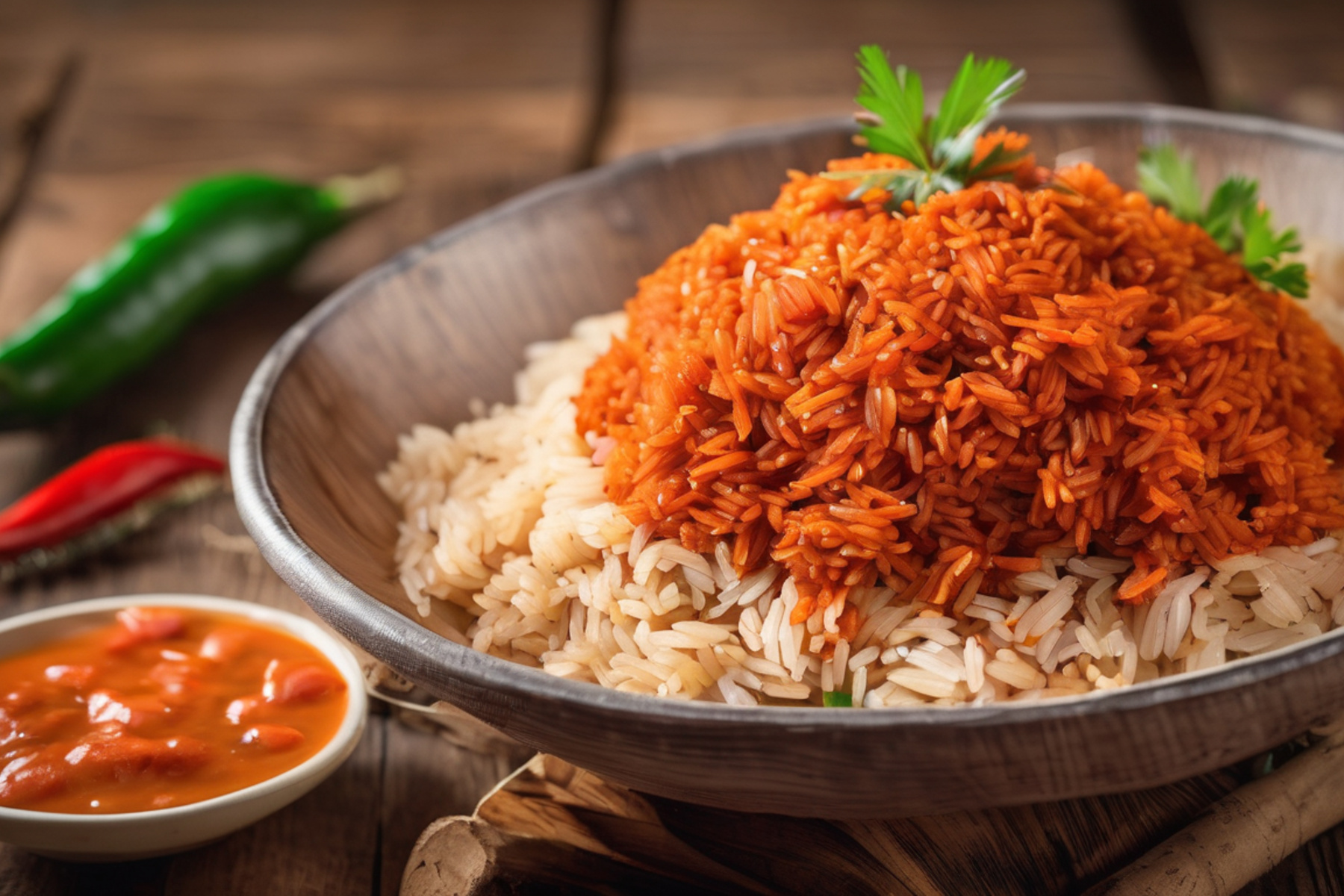
Party jollof rice
Main · serves 6 · 1 hour
Ingredients: 600 g long-grain parboiled rice, washed until the water runs clear · 6 plum tomatoes · 2 red bell peppers · 1–2 scotch bonnets (whole for heat, blended for fire) · 2 onions, one blended and one sliced · 4 tbsp tomato paste · 120 ml groundnut or vegetable oil · 700 ml chicken or beef stock · 2 bay leaves · 1 tsp thyme · 1 tsp curry powder · 1 tsp white pepper · salt
Method: Blend the tomatoes, bell peppers, scotch bonnet and one onion to a smooth purée. Heat the oil in a heavy pot, fry the sliced onion until soft, add the tomato paste and fry it for 3–4 minutes until it darkens — this step is not optional and it is where the depth comes from. Pour in the blended purée and cook it down over a medium heat, stirring occasionally, for 20–25 minutes, until the oil visibly separates and floats on top. That is the signal; nothing before it. Add the stock, bay, thyme, curry, white pepper and salt and bring to a boil. Stir in the washed rice so the liquid sits about a centimetre above it. Cover with foil and then the lid, drop the heat as low as it goes, and leave it 25–30 minutes without opening it. For party jollof, turn the heat up for the last 3–4 minutes to catch the bottom. Rest 10 minutes, then fold from the bottom up.
💡 Do not stir it while it steams and do not add water. If it is underdone, sprinkle a little hot stock down the side and re-cover. The slightly burnt bottom is the flavour everyone is actually there for.
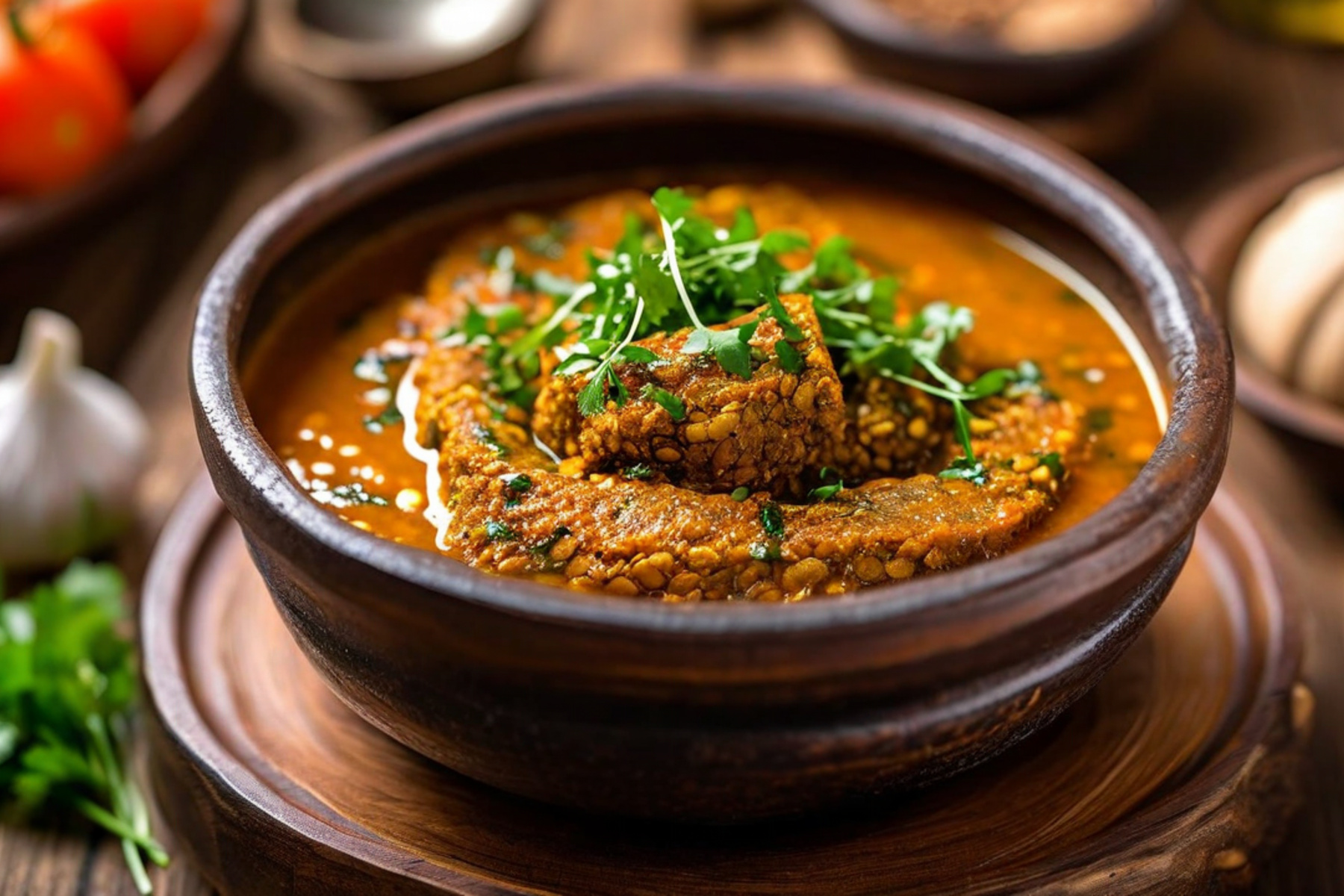
Egusi soup
Main · serves 6 · 1½ hours
Ingredients: 250 g ground egusi (melon seeds) · 150 ml red palm oil · 600 g assorted beef and tripe, or goat · 2 pieces stockfish, soaked · 2 tbsp ground crayfish · 1 large onion, half blended and half sliced · 4 tomatoes and 2 red peppers, blended · 1–2 scotch bonnets · 2 stock cubes · 300 g bitter leaf (washed and squeezed) or spinach or ugu · salt
Method: Boil the meat with the sliced onion, a stock cube and salt until tender, about 45 minutes; keep the stock. Mix the ground egusi with the blended onion and a little water into a thick paste. Heat the palm oil in a wide pot until it is fluid but not smoking — overheated palm oil turns bitter and loses its colour. Fry the blended tomato and pepper for 10 minutes, then add the meat, stockfish and crayfish. Now drop the egusi paste in spoonfuls across the surface and do not stir for five minutes. Add stock to loosen, then simmer 20 minutes, stirring only enough to stop it catching, so the egusi sets into lumps. Season, add the scotch bonnet whole, and finally stir the bitter leaf or spinach through and take it off after two minutes.
💡 Bitter leaf must be washed and wrung out repeatedly first or the soup will be genuinely bitter. Serve with pounded yam or eba, and eat it with your right hand.
Suya
Street food · serves 4 · 40 minutes plus resting
Ingredients: 600 g beef sirloin or topside, sliced very thin against the grain · For the yaji: 100 g roasted groundnuts, ground and the oil blotted off with kitchen paper · 2 tbsp ground dried chilli · 1 tbsp ground ginger · 1 tbsp onion powder · 1 tsp garlic powder · ½ tsp ground cloves · 1 stock cube, crushed · 1 tsp salt · groundnut oil for basting · to serve: raw red onion, tomato, more yaji
Method: Blot the ground groundnuts until they are a dry powder — any oil left in makes the rub clump and burn. Mix all the yaji ingredients. Slice the beef as thin as you can (freeze it 45 minutes first), thread it lengthways onto soaked skewers in a flat ribbon rather than in cubes, and press the yaji into both sides until the meat is completely coated. Rest 30 minutes. Grill over hot wood or charcoal, close to the coals, 2–3 minutes a side, basting once with oil. Dust with more yaji off the heat. Serve on paper with thick-sliced raw onion and tomato and a small heap of yaji to dip into.
💡 Thin and flat, not cubed: cubes cannot take enough crust, and the crust is the dish. If your yaji burns before the meat cooks, the slices are too thick.
Pepper soup
Starter or remedy · serves 4 · 40 minutes
Ingredients: 800 g catfish steaks, or goat on the bone · 2 tbsp pepper soup spice (a blend of uda negro pepper, ehuru calabash nutmeg, uziza seed and grains of paradise, ground) · 1 onion, chopped · 2 scotch bonnets · 2 cloves garlic and a thumb of ginger, crushed · 1 stock cube · a handful of uziza or basil leaves · 1,2 l water · salt
Method: If using goat, simmer it with the onion, garlic, ginger and stock cube for 45 minutes until nearly tender. For catfish, bring the water to a boil with the aromatics first and cook only 10 minutes. Add the pepper soup spice and the whole scotch bonnets and simmer 15 minutes — the broth should stay thin and translucent; this is not a thickened soup. Add the fish or the tender goat and cook until just done. Tear in the uziza or basil leaves at the very end and take it off the heat immediately.
💡 It is supposed to make your nose run. Served in Nigeria for colds, for hangovers, after childbirth and with beer, which covers most of life.
👥 Society — Owambe, Aso Ebi and the Diaspora
⭐ Owambe
The Yoruba word for a large party, and by extension the Nigerian social institution: weddings, funerals, child-naming ceremonies and chieftaincy installations run at a scale and expense that visitors find hard to credit. A wedding of a thousand guests is unremarkable. Money is sprayed over the dancers, live bands play, and the event is simultaneously a celebration, a status display and a mutual-aid mechanism.
Aso ebi
"Family cloth": guests at an owambe buy and wear a fabric chosen by the hosts, so that the photographs show a colour-coded crowd. It is also a fundraising mechanism, since the hosts sell the cloth. Nigerian textile culture more broadly — adire indigo resist-dyeing in Yorubaland, akwete weaving in the south-east, aso oke for ceremony — is one of the richest in the world and the gele, the tied headwrap, is an art form with professional tiers.
Titles and respect
Chieftaincy titles are live, awarded by traditional rulers, and used in full — a business card may carry several. Age hierarchy is real: you greet an elder before speaking, Yoruba men prostrate and women kneel in traditional greeting, and using "sir" and "ma" is normal rather than obsequious. Calling someone by their first name without the honorific reads as rudeness rather than friendliness.
Football
The Super Eagles: African champions in 1980, 1994 and 2013, Olympic gold in Atlanta 1996 — beating Brazil and Argentina on the way, still the defining Nigerian sporting memory — and six World Cups. The under-17 team has won the youth World Cup five times, more than anyone. The Premier League is watched with total seriousness; the roadside viewing centre with a generator and plastic chairs is a national institution.
⭐ The diaspora
Around 1,7 million Nigerians abroad, sending home remittances of roughly US$20 billion a year — among the largest flows to any African country and bigger than foreign direct investment. Nigerian-Americans have among the highest educational attainment of any US demographic group; Nigerian-British and Nigerian-Canadian communities are large and rising. The word for the emigration wave is japa, Yoruba for "to flee", and it is the dominant conversation among young professionals.
Humour
Nigeria runs on jokes about Nigeria, and the self-mockery is fast, merciless and constant — in Pidgin, on X, in the comedy skit industry that is now a real export, and in the everyday habit of naming the country's absurdities before a foreigner can. Visitors who join in are welcome. Visitors who lead with it are not, which is the same rule as everywhere.
📰 Media, Press Freedom & Resources
Nigeria has the largest and liveliest press in Africa and also a state that jails journalists. Both are true, and the second has been getting worse.
The papers
Premium Times and Sahara Reporters for investigations — Premium Times is a member of the international consortium that broke the Panama and Pandora Papers. The Punch, The Guardian Nigeria, Vanguard, ThisDay, Daily Trust (the paper of record in the north, and essential for reading the north on its own terms), BusinessDay for the economy and Nairametrics for numbers.
Data, not narrative
ACLED for conflict events, free and disaggregated by actor and location. The Nigeria Security Tracker at the Council on Foreign Relations. SBM Intelligence for kidnapping economics. The National Bureau of Statistics for inflation and the rebased CPI. For any claim about who is being killed and by whom in Nigeria, these are the sources that will settle it.
⚠️ Press freedom
Journalists are detained routinely, usually under the Cybercrimes Act, whose "cyberstalking" provision was written for harassment and is used for reporting; a 2024 amendment narrowed it and arrests continued. Reporters have been held for stories about state governors, the military and the central bank. Nigeria sits in the lower half of the RSF index and the trend since 2023 is downward. Foreign correspondents work relatively freely; Nigerian journalists do not.
Radio and broadcast
Radio is still the medium that reaches the most people. BBC Hausa has an audience in the tens of millions and is politically significant in the north; BBC News Pidgin, launched in 2017, was the corporation's bet on where Nigerian media is going and has been vindicated. Channels TV and Arise News are the main private broadcasters; NTA is the state one.
Books to read
Chinua Achebe, There Was a Country, on Biafra, from the inside and contested. Karl Maier, This House Has Fallen, the best single foreign account of the country's fragility. Michela Wrong is about Kenya, not Nigeria, and is often misrecommended here. Max Siollun on the military years — Oil, Politics and Violence and What Britain Did to Nigeria — is the most reliable modern historian writing for a general reader.
Online
Nigerian X (Twitter) is one of the loudest and most inventive corners of the internet, and it is also where rumour moves fastest — the government banned Twitter for seven months in 2021 after it deleted a presidential post. Treat viral casualty figures, massacre claims and coup rumours as unverified until a named outlet with a reporter on the ground carries them.
💸 What It Actually Costs
The naira float made Nigeria cheap in foreign currency and expensive for Nigerians, which is the whole story of the last three years in one sentence. Prices are September 2026; at roughly ₦1 500 to US$1, ₦1 000 ≈ 14 Kč. Always confirm the rate before converting anything here.
Beds
A basic guesthouse in Lagos ₦25 000–45 000. A decent mid-range hotel with power backup and water ₦60 000–120 000. Business hotels in Victoria Island, Ikoyi or Abuja ₦200 000–450 000, which is where most foreign visitors end up because they are the ones with reliable generators, water and security. Outside Lagos and Abuja everything is cheaper and more variable.
Food
A plate of rice and stew at a bukka (local canteen) ₦1 500–3 000. Suya by weight from a roadside grill ₦3 000–6 000. A proper restaurant meal in Victoria Island ₦15 000–40 000. A bottle of beer ₦1 500–2 500 in a bar. Bottled water ₦300–500; the sachet water ("pure water") that most of the country drinks is ₦50 and is not for visitors.
Getting around
A ride-hailing trip across Lagos ₦4 000–15 000 depending on distance and surge, which is the only sane way to move. A danfo hop ₦300–800. A domestic flight Lagos–Abuja ₦150 000–300 000 one way — domestic flying is expensive and it is what you should be doing instead of driving between cities. A car with driver for a day ₦60 000–150 000.
Seeing things
Lekki Conservation Centre ₦5 000–10 000. The National Museum in Lagos is a few thousand naira. Nike Art Gallery is free. Yankari park entry and a safari drive run to tens of thousands of naira including the vehicle. Photography fees are charged at many sites and are normal, not a scam.
Daily budget
A visitor staying in mid-range hotels and using ride-hailing should budget ₦120 000–250 000 a day, which is roughly 1 700–3 500 Kč. Staying in business hotels and flying between cities, double that. Nigeria is not a backpacking country in practice — the accommodation tier that would make it cheap mostly does not exist for foreigners, and the savings are not worth what they cost you.
💳 Money
Cards work in Lagos and Abuja hotels, malls and better restaurants, and Nigeria's domestic payment infrastructure is genuinely good — bank transfers by phone are how most transactions happen. ATMs are everywhere and have low per-withdrawal limits, so expect several. Bring clean US dollars as backup; change them at a bank or a hotel, never with someone who approaches you. Card fraud is a real risk — use one card, watch it being swiped, and check statements.
🌡️ Climate & When to Go
⭐ The best window
November to February. The rains have stopped everywhere, the north is comfortable, the coast is hot but bearable, and December is when the diaspora comes home — "Detty December", a month of concerts, parties, weddings and carnivals in Lagos and Calabar that is the single most enjoyable time to be in the country and also the most expensive and most booked out.
The south
Two rainy seasons, roughly April to July and September to October, with a short dry break in August that Nigerians call the August break. The south-east gets over 3 000 mm a year, the Niger Delta more. Temperatures sit in the high twenties to low thirties all year with humidity that makes it feel worse; there is no cool season on the coast.
The north
One rainy season, roughly June to September, and a long hard dry season. March to May is brutal — Kano, Maiduguri and Sokoto regularly exceed 40 °C, and the north-east goes higher. The dry-season nights, by contrast, are genuinely cold on the Plateau and in the far north, which surprises people.
Harmattan
December to February: a dry, dusty north-easterly off the Sahara that drops humidity, hazes the sky, cracks lips and skin, and reduces visibility enough to delay flights. It is also what makes the northern nights cool and the southern days bearable. Bring moisturiser and lip balm; every Nigerian does.
Events
Calabar Carnival through December. Osun-Osogbo festival in August, in the sacred grove. Argungu fishing festival in Kebbi, historically in February–March and repeatedly suspended for security. Eyo in Lagos, irregular and announced at short notice. Durbar in Kano, Katsina and Zaria at the two Eids — massed horsemen in front of the emir, and one of the great spectacles of Africa when security permits it.
What to pack
Light cotton, long sleeves for mosquitoes in the evening, and something smart: Nigerians dress well and turning up scruffy reads as disrespect, not as travel authenticity. A rain shell for the south in season. Mosquito repellent with DEET and long trousers after dusk. A torch and a power bank for the outages. And modest dress in the north — covered shoulders and knees, and no shorts on men in a northern city.
✈️ Getting There & Getting Around
The airports
Murtala Muhammed International (LOS) in Lagos and Nnamdi Azikiwe International (ABV) in Abuja carry almost all international traffic; Port Harcourt, Kano and Enugu have some. Lagos arrivals have a reputation for hustle — solicitation for "help" at immigration and baggage — that is deserved. Arrange your pickup in advance, know the name of your driver, and do not accept help you did not ask for.
✈️ Who flies there
Plenty, which makes Nigeria far easier to reach than most of this region. Turkish via Istanbul, Lufthansa via Frankfurt, Air France via Paris, KLM via Amsterdam, British Airways and Virgin via London, Qatar via Doha, Emirates via Dubai, Ethiopian via Addis, EgyptAir via Cairo, Royal Air Maroc via Casablanca. One stop from almost anywhere in Europe.
⚠️ Domestic flying, not driving
This is the single most important practical rule on this page. Fly between Nigerian cities. Intercity roads outside the south-west carry a real and well-documented kidnapping risk, and road traffic accidents are a serious danger independently of that. Domestic carriers — Air Peace, Ibom Air, ValueJet, Arik — are frequent on the main routes. Delays are normal; build in slack and do not book tight connections.
In the cities
Uber and Bolt work in Lagos, Abuja, Port Harcourt and Ibadan and are what you should use. Danfo minibuses and keke (three-wheelers) are cheap and are for people who know the city. Okada motorcycle taxis are banned across much of Lagos and are dangerous everywhere. Lagos's BRT corridors and the new Blue and Red Line trains are legitimate options on their routes.
Trains and buses
The Abuja–Kaduna standard-gauge line and the Lagos–Ibadan line both work and are comfortable; the Abuja–Kaduna line was attacked and passengers kidnapped in March 2022 and has since resumed with heavy security. For long-distance road, the established coach companies (GUO, ABC, God is Good) are the safest road option, but see the rule above.
Checkpoints
Frequent, police and military, and mostly routine. Keep your passport and visa accessible, stay polite and unhurried, keep your hands visible, and do not photograph anything. Solicitation for small payments happens; a foreign visitor with a driver will usually find the driver handles it.
📋 Practical Information
⚠️ Visa
Czech and other EU citizens need a visa in advance. Nigeria launched a new e-visa system in 2025, replacing the old visa-on-arrival scheme, and it is applied for online with a passport valid at least six months, a photograph, a return ticket and either a hotel booking or a letter of invitation with the inviter's details. Rules and fees have changed more than once — check the current official portal and your nearest Nigerian mission before assuming anything on this page.
Yellow fever
A yellow fever vaccination certificate is required for entry and is checked. Nigeria also asks arriving travellers to register health details online; the requirement has come and gone, so check at booking. Vaccination against yellow fever must be at least ten days before arrival to be valid.
⚠️ Where not to go
Most Western foreign ministries advise against all travel to the north-east (Borno, Yobe, Adamawa), the north-west (Zamfara, Katsina, Sokoto, Kaduna, Kebbi, Niger), much of the middle belt, and the riverine Niger Delta, and against all but essential travel to a good deal more. Lagos, Abuja, the south-west and Calabar are where ordinary visits happen. Read the current advisory rather than this paragraph, which will age.
Health
Malaria is year-round and intense across the whole country and is the single biggest health risk to a visitor — take prophylaxis, use repellent, sleep under a net or in air conditioning. Recommended: hepatitis A and B, typhoid, tetanus-diphtheria-polio, meningococcal ACWY (the north is in the meningitis belt) and rabies for rural stays. Lassa fever is endemic and has annual outbreaks; avoid contact with rodents and food stored where they can reach it. Cholera outbreaks occur.
Medical care
Private hospitals in Lagos and Abuja — Reddington, Lagoon, St Nicholas, Cedarcrest — are adequate for most things; public hospitals are not, and doctors' strikes are frequent. Medical evacuation insurance is essential and should be checked against the current travel advisory, because many policies void cover for areas under a do-not-travel warning.
Day to day
Power is 240 V, 50 Hz, UK three-pin plugs. Take a power bank: the grid fails constantly and "NEPA has taken light" is a phrase you will hear daily. Mobile data (MTN, Airtel, Glo, 9mobile) is cheap and good; a SIM needs your passport and a NIN registration, so buy it at an official shop. Tipping ("dash") is normal and small. And expect to be asked directly what you earn and whether you are married; it is curiosity, not rudeness.
🇨🇿 For Czech Readers
Getting there from Prague
One stop from Prague to Lagos or Abuja with Turkish via Istanbul, Lufthansa via Frankfurt or Munich, KLM via Amsterdam, Air France via Paris or Qatar via Doha. Total 11–16 hours depending on the connection. This is one of the easiest long-haul African destinations to reach from Prague, which surprises people who assume otherwise.
What it costs from Prague
Return flights typically 16 000–28 000 Kč, cheapest in the rainy season and dearest in December, when the diaspora flies home and Lagos fares double. On the ground, at roughly ₦1 500 to the dollar, ₦1 000 ≈ 14 Kč: a local canteen plate about 30 Kč, a beer 25–35 Kč, a business hotel night in Victoria Island 3 000–6 500 Kč, a Lagos–Abuja flight 2 200–4 500 Kč.
⚠️ Visa — apply well ahead
Czechs need a Nigerian visa. Since 2025 it is applied for through Nigeria's e-visa system, which replaced visa-on-arrival, and you will need a passport valid six months, a return ticket and a hotel booking or invitation letter. There is no Nigerian embassy in Prague — the mission accredited to Czechia is in Berlin — so allow weeks and confirm the current procedure with the official portal before booking non-refundable travel.
⭐ The Czech embassy in Abuja
Unusually for this collection: Czechia has a resident embassy in Nigeria. It sits at 5 Gnassingbe Eyadema Street, Asokoro, Abuja, and is accredited not only to Nigeria but to Benin, Niger, Chad, Cameroon and Equatorial Guinea, with consular reach further still. If something goes wrong in Nigeria you have a Czech diplomatic mission in the country, which you do not have in most of the region.
MZV ČR and DROZD
The ministry advises the highest level of caution, avoiding crowds, large gatherings and places of religious significance, and registering before travel. Register in DROZD. Read the current advisory at mzv.gov.cz and note that it distinguishes sharply between regions — the blanket impression that Nigeria is uniformly dangerous is not what the advisory actually says, and nor is the opposite.
Insurance and the practical bits
Check that your policy covers Nigeria at all and that it is not voided by the regional advisories; many Czech policies exclude countries or regions under a do-not-travel warning, and Nigeria has several such regions inside it. Make sure medical repatriation is covered without a low cap. Malaria prophylaxis needs a Czech travel-medicine consultation about six weeks ahead, and the yellow fever certificate is compulsory and must be at least ten days old on arrival.
✍️ Author's Note — Six Photographs, and the Best Food Ratio Yet
Every page in this collection is built after an inventory of what images actually exist for the country. Nigeria has six and three are usable — but the interesting result is that two of the three food photographs are the right dish, which after Niger's one in six and Nicaragua's zero in four is the best ratio this project has recorded.
🍽️ Why the food worked here
A hypothesis worth writing down: the two that are right, jollof rice and egusi soup, are the two Nigerian dishes with the largest international profile — jollof in particular is the subject of a continental argument that generates enormous quantities of correctly labelled photography. The dishes this project has seen go wrong are consistently the ones that are locally famous and internationally invisible: nacatamal, dambou, tuwo, pinol. The image bank appears to be accurate exactly where the wider internet already is.
What was shown, and its errors
nigeria-jollof-rice.jpg: correct rice, wrong presentation — it is piled on a bed of plain white rice, which nobody does. nigeria-egusi-soup.jpg: the caked lumps of ground melon seed in palm oil are exactly right and the caking is deliberate technique, but it is garnished with coriander microgreens instead of having bitter leaf folded through the soup. Both are displayed with those errors stated in the caption.
⚠️ Suya without the crust
nigeria-suya.jpg shows chunky cubed meat on skewers with no spice crust at all. Suya is thin-sliced beef packed with yaji, a groundnut-and-chilli rub, and the crust is the entire dish — without it the picture is souvlaki. This is the same failure as the Nicaraguan nacatamal's corn husk: the one feature that identifies the dish is the one feature missing. Not displayed.
🏙️ Two skylines, neither of them Lagos
/countries/images/nigeria/hero.jpg, the old page's hero, is a global-financial-centre pastiche: a dense wall of glass towers, a marina, a domed convention centre and an illegible logotype on the tallest building. It reads as Dubai or Singapore; Victoria Island is far lower and sparser. Not displayed. The hero we do use, 01-hero.jpg, is more plausible in scale but has low hills on the right horizon and Mediterranean-blue water, and Lagos is flat with brown-green lagoon water — so its caption calls it an impression of a West African waterfront rather than a picture of Lagos.
🍷 The drink that is not in the photograph
palm-wine.jpg is two glazed ceramic pots on a table under a thatched roof. There is no palm wine in it. Palm wine is milky white, carried in gourds or jerrycans and drunk from calabashes or horns. Nothing in the frame could be captioned except "two pots", so it is not used. A new minor category for the log: the subject is simply absent.
Formats
01-hero.jpg is a WebP served under a .jpg name. That is nine countries and twenty-two files in the running log. The case for one pass over the whole bucket rather than another per-country footnote is now overwhelming.
On the text. Nigeria moves fast and is reported badly, so everything time-sensitive here was checked in September 2026 rather than recalled: the inflation path after the 2025 CPI rebasing and the naira's stabilisation; the nationwide security emergency declared in November 2025 after the Kebbi and Niger abductions, the 20 000-officer recruitment and the defence minister's resignation; the Oyo school kidnapping of May 2026, the first in the south; the Dangote refinery's turnaround to around 700 000 b/d and its September 2026 public offering; and the US Country of Particular Concern designation of late 2025 with the military threat that followed. On that last one this page states what is documented on all sides and names what each side leaves out, because the casualty geography is checkable and both popular versions of it are wrong.
Support This Project 🌍
This World Travel Factbook is a labor of love – free to use for all travelers. If you find it helpful, consider supporting its continued development.