⚠️ Travel Advisory — Sudan
Sudan is at the highest risk tier of every major advisory system. The US State Department rates Sudan Level 4 — Do Not Travel, and the US Embassy in Khartoum has been closed with consular services suspended since April 2023. The UK FCDO advises against all travel to Sudan, with an all-but-essential-travel carve-out only for the Hala’ib Triangle and Bir Tawil in the far north. No Western government is currently running evacuations.
The civil war that began in April 2023 is in its fourth year. Roughly 11 million people have been displaced and about 19.5 million — two in five Sudanese — face crisis-level acute food insecurity (IPC Phase 3+, May 2026), with famine conditions confirmed in El Fasher and Kadugli. This page is a cultural and historical reference, not an invitation to travel.
Sudan is a vast country in northeastern Africa, the third-largest on the continent after the Democratic Republic of Congo and Algeria, covering approximately 1.86 million square kilometers. It borders Egypt to the north, Libya to the northwest, Chad to the west, the Central African Republic and South Sudan to the south, Ethiopia and Eritrea to the east, and the Red Sea to the northeast. The population of roughly 53 million is concentrated along the Nile River system, particularly in and around the capital, Khartoum.
Sudan sits at the crossroads of the Arab and African worlds, with a culture that reflects centuries of interaction between Nubian, Arab, and sub-Saharan African peoples. The country is home to more ancient pyramids than Egypt — the pyramids of Meroë are among the most spectacular archaeological sites in Africa. However, decades of political instability, the civil war that began in April 2023 and now in its fourth year, and the resulting humanitarian catastrophe have made Sudan one of the most challenging countries on Earth to visit. Every major government advises against all travel.
Sudan's history stretches back to the ancient Kingdom of Kush, which rivaled and at times ruled Egypt. The Kushite kings built pyramids at Meroë (300 BC–350 AD) that served as royal tombs — over 200 survive, more than in all of Egypt. Christianity arrived in the 6th century, establishing Nubian Christian kingdoms that lasted until the 14th century, when Islam gradually became dominant following Arab migration and the spread of Sufi orders.
Modern Sudan was shaped by the Anglo-Egyptian Condominium (1899–1956), independence in 1956, and decades of civil war between the predominantly Arab-Muslim north and the Christian-animist south. South Sudan gained independence in 2011. Omar al-Bashir ruled from 1989 until his overthrow in 2019. The transition to civilian rule collapsed in October 2021 with a military coup, and in April 2023 fighting erupted between the Sudanese Armed Forces (SAF) and the Rapid Support Forces (RSF). The war has since partitioned the country in practice: the army recaptured Khartoum State in May 2025 and the government has been re-establishing itself in the capital, while the RSF consolidated in the west — El Fasher, the last army-held capital in Darfur, fell in October 2025 and was followed by mass atrocities against fleeing civilians. Through 2026 the fighting has centred on Kordofan, where El Obeid has been besieged and struck by drones, and on a SAF counter-offensive in Darfur. Roughly 11 million people have been displaced and famine conditions have been confirmed in El Fasher and Kadugli.
Sudan covers 1,861,484 km², making it the third-largest country in Africa after Algeria and the Democratic Republic of the Congo, and it shares land borders with seven states: Egypt, Libya, Chad, the Central African Republic, South Sudan, Ethiopia and Eritrea. Roughly 850 km of Red Sea coastline runs along the northeast, anchored by Port Sudan, the country’s principal seaport and, since 2023, its de facto administrative centre.
The Nile system is the organising fact of Sudanese geography. The Blue Nile arrives from Lake Tana in the Ethiopian highlands and the White Nile from the equatorial lakes to the south; they meet at Khartoum to form the main Nile, which then loops north through a series of cataracts and the Nubian Desert toward Lake Nubia on the Egyptian frontier. Away from the river, the north is true desert, the centre is semi-arid Sahel, and the south and southwest are savanna. The highest ground is the volcanic Jebel Marra massif in Darfur, whose Deriba Caldera reaches about 3,042 m — a cool, spring-fed highland island in an otherwise parched country.
Khartoum sits at the confluence of the Blue Nile (from Ethiopia) and the White Nile (from Uganda/South Sudan), which merge to form the main Nile flowing north to Egypt. This confluence, visible from the Tuti Island bridge, is one of Africa's great geographical landmarks. Before the war the metropolitan area — Khartoum proper, Omdurman and Khartoum North (Bahri) — held some 6–8 million people and served as the political, economic and cultural heart of Sudan; two years of urban warfare emptied much of it, and residents have been returning only gradually since the army retook the city in 2025.
Before the 2023 conflict, Khartoum offered the National Museum (housing rescued temples from the Nubia region), Omdurman's great souk (one of Africa's largest markets), and the Khalifa's House Museum documenting the Mahdist period. Omdurman is culturally richer than Khartoum proper, with the tomb of the Mahdi, traditional Sufi whirling dervish ceremonies on Friday evenings, and a vibrant street-food scene. The 2023–25 battle for the capital caused severe damage to its infrastructure and cultural institutions: the National Museum was looted and its collections plundered, and the Khalifa's House and much of the old souk were badly hit. Restoration work began after the army regained control of Khartoum State in May 2025.
Sudan's archaeological heritage is extraordinary and tragically undervisited. The Island of Meroë (UNESCO) contains the most extensive collection of Nubian pyramids — over 200 steep-sided structures in the desert, smaller than Egyptian pyramids but hauntingly beautiful against the Saharan landscape. Nearby, the Royal Baths of Meroë feature preserved stone lion fountains.
Other major sites include Jebel Barkal (UNESCO), a sacred mountain near Karima with temples dedicated to Amun; the temples of Naga and Musawwarat es-Sufra, featuring a remarkable blend of Egyptian, Greek, and African architectural styles; and Old Dongola, the medieval capital of the Christian Nubian kingdom of Makuria. The Nubian archaeological sites rival anything in Egypt but can be visited in near-solitude — if conditions allow.
Before Meroë became Nubia's great pyramid field, Kushite kings were building pyramids at a smaller, earlier site: El-Kurru, on the Nile's west bank near Jebel Barkal. Around 700 BCE, this became the first royal cemetery of the Kushite dynasty that would go on to conquer and rule Egypt itself as its 25th Dynasty — the so-called "Black Pharaohs." Among the earliest pyramid tombs here is that of King Kashta, whose name means simply "the Kushite," and whose reign laid the groundwork for his son Piye's eventual conquest of Egypt.
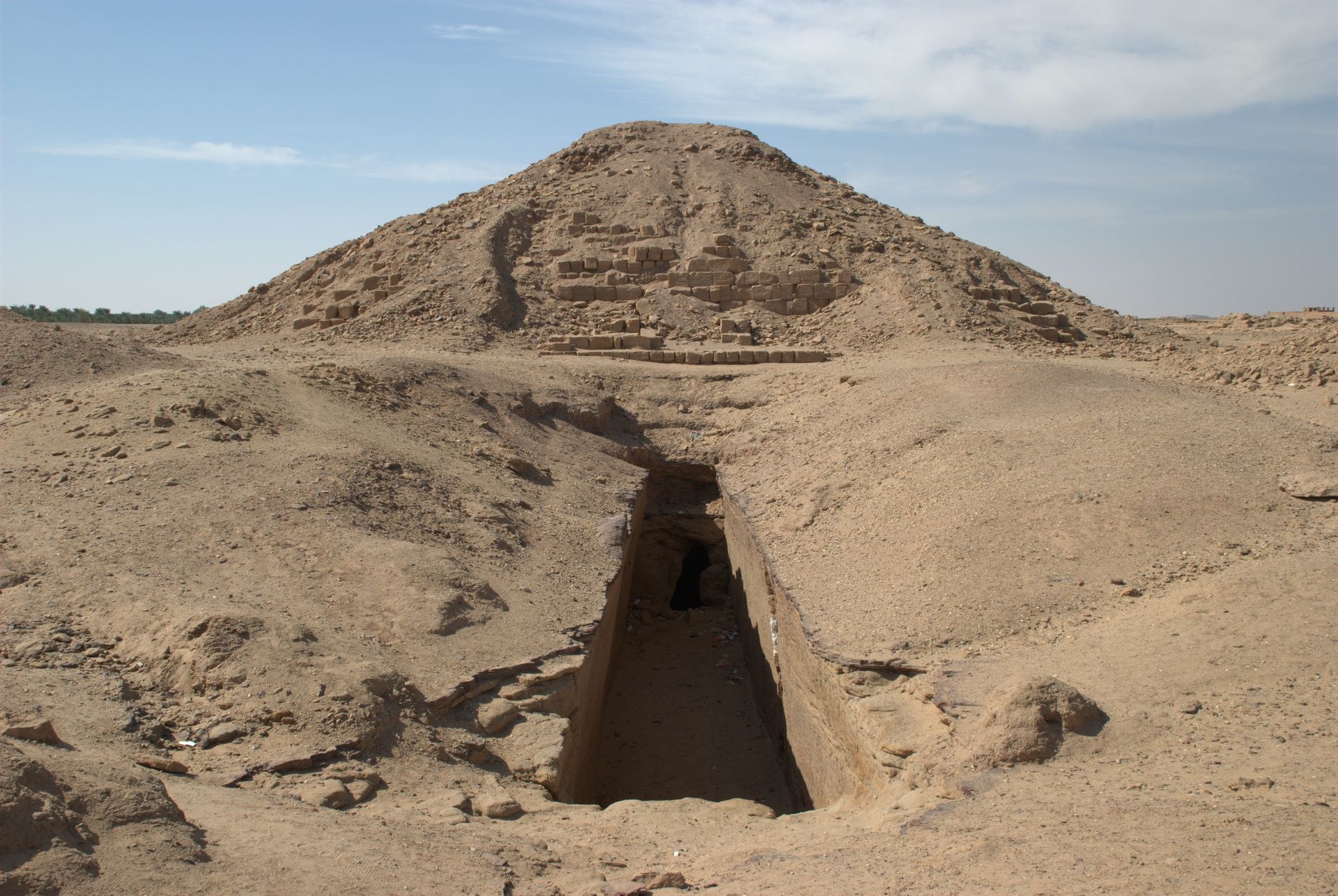
Unlike Egyptian pyramids, Nubian royal burial chambers sit beneath the pyramid rather than inside it — Kashta and his successors (Piye, Shabaka, Shabataka, and Tanwetamani are all buried alongside him at El-Kurru, together with 14 queens) were laid to rest in rock-cut chambers below ground, with a comparatively modest, steep-sided pyramid built above as a marker. The site was excavated by American archaeologist George Reisner in 1918-19, and while smaller and less visited than Meroë's more famous pyramid field further south, El-Kurru is where the whole Kushite pyramid-building tradition genuinely begins.
Sudan has no commercial wine production. Alcohol was banned outright by the Liquor Prohibition Act of 1983, and although a July 2020 reform package legalised drinking for non-Muslims, the prohibition remains in force for the Muslim majority and alcohol is effectively unavailable in public life. The hot Sahelian and desert climate would preclude viticulture even without the legal prohibition.
Sudan has a rich traditional beverage culture. Merissa (sorghum beer) is the most important traditional alcoholic drink, brewed by women and consumed widely in non-Muslim communities, particularly in the Nuba Mountains, Blue Nile, and Darfur regions. Araqi (a date-based spirit) is distilled clandestinely. Non-alcoholic beverages are more significant: Karkade (hibiscus tea, served cold — deep crimson, tart, and refreshing) is Sudan's national drink and one of the most distinctive beverages in North Africa. Aradaib (tamarind juice), gongolais (baobab fruit drink), and Sudanese coffee (served with ginger and spices in a jabana pot) are essential elements of daily life and hospitality.
Iced karkade is the colour of garnets and tastes of flowers and citrus; the coffee ceremony, performed with the jabana pot over coals and accompanied by burning incense, is one of the most gracious hospitality rituals in the Islamic world. In a country of immense difficulty, offering a stranger cold karkade in the punishing heat remains an ordinary act of profound generosity.
IMPORTANT — current status (2026): the armed conflict that began in April 2023 is ongoing, and the US (Level 4) and UK among others advise against all travel. The front has moved rather than closed: Khartoum State was retaken by the army in May 2025, while Darfur and Kordofan remain the active theatres. Khartoum International Airport, seized back by the army in March 2025, reopened to domestic flights on 22 October 2025; Sudan Airways resumed international services to Jeddah, Riyadh and Cairo from 12 February 2026, and the government declared the airport ready for full international traffic on 28 March 2026 — though drone attacks on the capital have repeatedly interrupted operations. Port Sudan has functioned as the de facto seat of government and main point of entry throughout. Roughly 11 million people are displaced. Any visit requires current, professional security advice.
Sudan requires a visa obtained in advance, and travel permits are needed for movement outside the capital and for photography. In more stable times Khartoum had direct flights from Cairo, Dubai, Istanbul and Addis Ababa. Accommodation ranged from basic hotels to a few international-standard properties. The Sudanese pound is the currency (high inflation is chronic). Arabic is the official language; English is spoken in educated circles. Sudan is predominantly Muslim; alcohol is prohibited for Muslims and, since a 2020 reform, tolerated in law but not in practice for non-Muslims. The climate is extremely hot, with temperatures exceeding 45°C in summer; November–February is the most comfortable period.

Pyramids of Meroë

Jebel Barkal

Nile confluence at Khartoum
Sudan broke my heart. When I first visited, the pyramids of Meroë were the most magical archaeological site I'd ever seen — ancient Nubian pyramids in empty desert, no other tourists, no fences, no ticket booth. Just you and 2,300 years of history. The Sudanese people were among the most hospitable I've encountered anywhere.
The ongoing conflict has caused unimaginable suffering, and it would be irresponsible to encourage travel to Sudan in its current state. But I include this entry because Sudan's archaeological and cultural heritage is extraordinary, and because I hope there will come a day when travelers can again stand before the pyramids of Meroë at sunrise and experience the warmth of Sudanese hospitality. That day cannot come soon enough.
— Radim Kaufmann, Kaufmann World Travel Factbook
Support This Project 🌍
This World Travel Factbook is a labor of love – free to use for all travelers.
📬 Stay Updated
