
🇨🇾 Cyprus at a Glance
🌏 Overview — Why Visit Cyprus
Cyprus is the Mediterranean's third-largest island and one of the most densely layered places in Europe: Neolithic villages, Mycenaean Greek settlement, Phoenician ports, Roman mosaics, Byzantine frescoes, Crusader castles, Venetian walls, Ottoman mosques and British colonial infrastructure, all inside 9,251 km² — an area smaller than the Moravian-Silesian and Zlín regions combined.
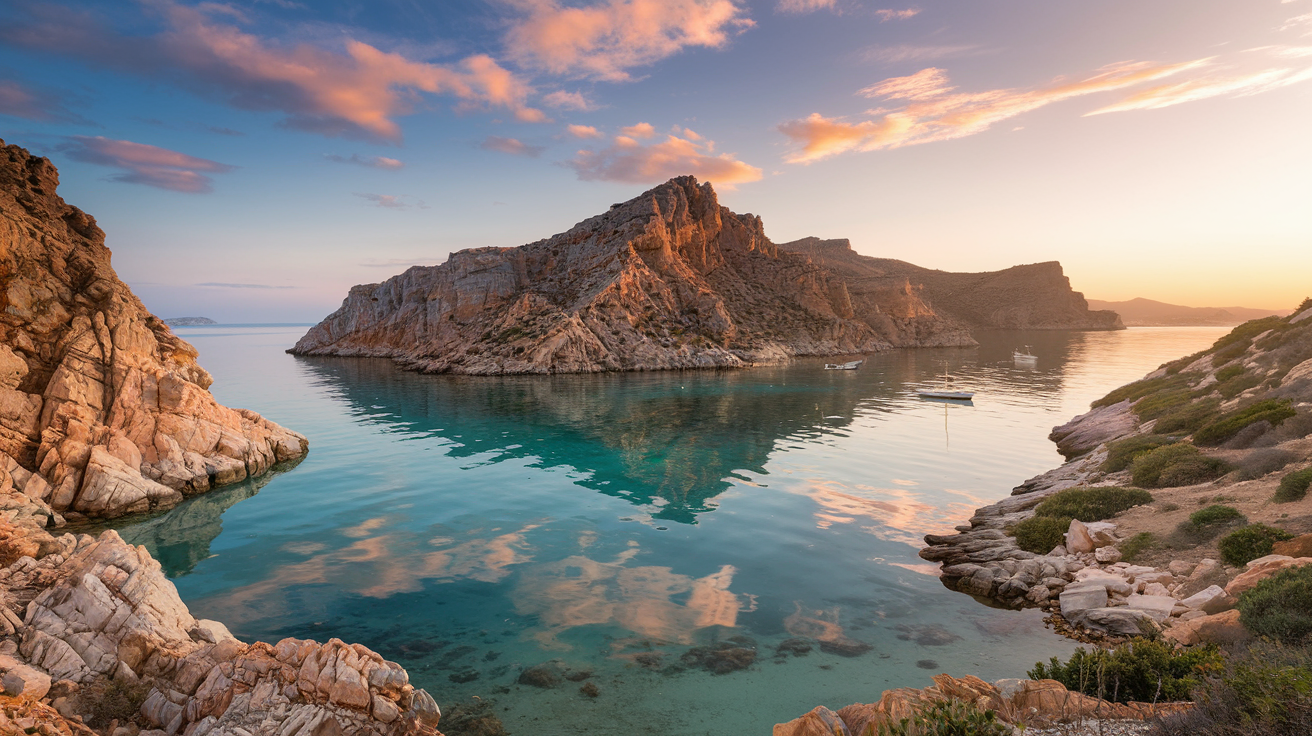
The headline attractions are genuinely first rank. The Paphos mosaics are among the finest Roman floors anywhere in the Mediterranean. The ten painted churches of the Troodos hold Byzantine frescoes that would draw crowds if they were in Italy and instead sit in barns on mountain roads. Choirokoitia has been occupied since around 7000 BCE. All three are UNESCO World Heritage.
The island is also, and inescapably, divided. Since 1974 a UN buffer zone has run 180 km across it, separating the Republic of Cyprus in the south — an EU member using the euro — from the self-declared Turkish Republic of Northern Cyprus, recognised only by Türkiye. Nicosia is the last divided capital in the world. Crossing is now routine and takes minutes, and doing it is one of the most instructive hours a visitor can spend anywhere in Europe.
What makes Cyprus work as a trip rather than a beach week is the compactness. You can dive the Zenobia wreck in the morning, eat a twenty-dish meze in a Larnaca taverna at lunch, and be 1,500 metres up in a pine forest by late afternoon. Nothing is more than two hours from anything else, everyone speaks English, the roads are excellent, and the food is very good and not expensive.
Two practical framings. Cyprus is an EU member using the euro since 2008, so for European visitors the money, the roaming and the healthcare arrangements are all straightforward. And it drives on the left — one of only three EU countries that do, with Ireland and Malta — which surprises a lot of people at the rental desk.
🏷️ Name & Identity
The name almost certainly comes from copper. Cyprus was the ancient world's principal source of the metal, mined here since about 4000 BCE, and the Latin cuprum — from aes Cyprium, "metal of Cyprus" — is why the English word is "copper" at all. A country that gave its name to an element is in rare company.
In Greek the island is Kýpros, in Turkish Kıbrıs. Both communities use both names for places, and most towns therefore have two: Nicosia is Lefkosía and Lefkoşa, Famagusta is Ammóchostos and Gazimağusa, Kyrenia is Kerýneia and Girne. Which name a person uses tells you something, and using both is the diplomatic choice.
The flag of the Republic is unusual in two ways: it is one of only two national flags to depict the outline of its own country (Kosovo's, adopted in 2008, is the other), and the outline is rendered in copper — the island's defining resource — above two crossed olive branches. Both the colour choices and the branches were deliberate attempts at neutrality between the Greek and Turkish communities in 1960. The design has outlived the settlement it was meant to symbolise.
Identity here is genuinely contested rather than merely complicated. Greek Cypriots are overwhelmingly Orthodox Christian and Greek-speaking; Turkish Cypriots are Muslim and Turkish-speaking; and both have a distinct Cypriot identity that does not fully coincide with mainland Greece or Türkiye. Alongside them are the Armenian, Maronite and Latin communities, constitutionally recognised and much older than the division.
🗺️ Geography & Regions
Cyprus covers 9,251 km² in the far eastern Mediterranean — closer to Syria (105 km) and Türkiye (75 km) than to Greece, which is over 800 km away. That position, at the junction of Europe, Asia and Africa, explains most of its history and a good deal of its food.
The Troodos massif
The island's green heart: an ophiolite complex — a slab of ocean floor thrust upward, which is why the copper is here — rising to 1,952 m at Mount Olympus. Pine forest, painted churches, vineyards and winter snow.
The Kyrenia range
A thin limestone spine along the northern coast, topped with Crusader castles at Saint Hilarion, Buffavento and Kantara. Entirely in the north.
The Mesaoria plain
The flat cereal-growing centre between the two ranges, with Nicosia in the middle of it. Baking hot in summer and where the buffer zone runs.
The south coast
Limassol, Larnaca, the salt lakes and the resort strip. Pebble and grey-sand beaches near the cities, better sand further east.
The west — Paphos and Akamas
The archaeological core plus the island's last roadless wilderness on the Akamas Peninsula, with turtle beaches and a monk-seal colony.
The east — Ayia Napa and the Karpas
The clearest water and whitest sand at Nissi and Konnos; beyond the buffer zone, the long empty Karpas peninsula with its wild donkeys.
The coastline runs 648 km. There are no permanent rivers — everything is seasonal — and water has been the island's structural constraint for three thousand years, which is why so much of the landscape is terraced and why desalination now supplies most of the drinking water.
📍 Map of Cyprus
The island is roughly 240 km east to west with a long tail — the Karpas peninsula — pointing north-east toward Türkiye. The UN buffer zone runs from Kato Pyrgos in the north-west to Famagusta in the east, cutting straight through Nicosia on the way.
Driving distances in the south are short: Larnaca to Nicosia 45 minutes, Larnaca to Limassol 45, Limassol to Paphos 50, Paphos to Ayia Napa about two and a half hours end to end. The motorway network is modern and free. Mountain roads in the Troodos are good but slow — budget double what the map suggests.
One mapping quirk worth knowing: navigation apps route inconsistently across the buffer zone, and some will refuse to plan a route into the north at all. Download offline maps for both sides before you travel, and know your crossing point in advance.
📜 History
Cyprus has been continuously inhabited for around ten thousand years. Choirokoitia, a Neolithic village of round stone houses occupied from roughly 7000 BCE, is one of the best-preserved prehistoric settlements in the eastern Mediterranean. It is also where archaeologists found, at nearby Shillourokambos, a human buried with a cat around 9500 BCE — the oldest known evidence of the relationship.
Copper made the island wealthy in the Bronze Age and drew everybody in. Mycenaean Greeks settled from the 12th century BCE and made it permanently Greek-speaking; Phoenicians founded Kition (modern Larnaca); then Assyrians, Egyptians and Persians took turns. Alexander's successors absorbed it, and Rome annexed it in 58 BCE. The Paphos mosaics date from this prosperous Roman period, when Cyprus was a quiet, rich provincial backwater.
Christianity arrived early and directly: Paul and Barnabas preached here around 45 CE, and the Church of Cyprus has been autocephalous — self-governing — since 431, one of the oldest such churches in the world. That independence has made the Archbishop a political as well as religious figure ever since; Archbishop Makarios III was the republic's first president.
Then the layers pile up fast. Richard the Lionheart took the island almost by accident in 1191 and sold it on; the Lusignan dynasty ruled a Latin Crusader kingdom for three centuries; Venice annexed it in 1489 and threw up the walls that still ring Nicosia and Famagusta; the Ottomans conquered it in 1570–71 after a brutal siege; and Britain took over the administration in 1878 and annexed it outright in 1914.
Independence came in 1960 after the EOKA insurgency, under a constitution designed to balance the two communities that broke down within three years. Intercommunal violence in 1963–64 brought UN peacekeepers, who are still there. In July 1974 a coup by the Greek military junta aiming at union with Greece triggered a Turkish military intervention; by August, Türkiye held roughly the northern 36% of the island. Around 160,000 Greek Cypriots fled south and 45,000 Turkish Cypriots moved north. The Republic of Cyprus joined the EU in 2004, weeks after Greek Cypriots rejected and Turkish Cypriots accepted the UN's Annan reunification plan. Talks have continued, without result, ever since.
Where things stand in 2026. Nikos Christodoulides has been President of the Republic since 28 February 2023. On the Turkish Cypriot side the federalist Tufan Erhürman defeated the two-state advocate Ersin Tatar by a wide margin on 19 October 2025, and the two leaders have met regularly since — UN Secretary-General Guterres sat down with both in Nicosia on 29 July 2026, and in August 2026 they agreed to weekly meetings, with new crossing points at Athienou and Mia Milia the immediate sticking point. Cyprus held the rotating presidency of the EU Council from 1 January to 30 June 2026, and the parliamentary election of 24 May 2026 returned DISY (17 seats) and AKEL (16) at the top while the far-right ELAM rose to third with 8; two new parties, ALMA and Fidias Panayiotou's Direct Democracy, took four seats each. The year's shock came from outside: during the Iran war, Iranian-made drones launched from Lebanon struck the British base at RAF Akrotiri on 1–2 March 2026, damaging a hangar and briefly putting Cyprus on a US "reconsider travel" advisory, which was lifted on 1 June 2026.
🚧 The Division & Crossing the Green Line
You cannot understand Cyprus without understanding the line, and you cannot understand the line without crossing it. Since 1974 a UN-patrolled buffer zone — the Green Line, named for the pencil a British commander used on a map in 1963 — has run 180 km across the island. It is a few metres wide in central Nicosia and several kilometres wide on the Mesaoria plain, and inside it are abandoned villages, a sealed airport and farmland worked under UN supervision.
What is where
The Republic of Cyprus controls the southern 59%: EU member, euro, internationally recognised. The Turkish Republic of Northern Cyprus holds 36%, uses the Turkish lira and is recognised only by Türkiye. British Sovereign Base Areas hold about 3%.
Crossing on foot
The Ledra Street checkpoint in the heart of old Nicosia is the classic crossing: five minutes, passport shown at two huts, and you are in a different country. Ledra Palace, a few hundred metres west, is the other pedestrian crossing.
Crossing by car
Agios Dometios (Nicosia), Astromeritis, Pergamos, Strovilia and Limnitis among others. You need your passport and separate car insurance bought at the crossing — your southern rental policy does not cover the north.
The legal point
The Republic considers entry to the island via the north — that is, flying into Ercan or arriving by sea at Kyrenia or Famagusta — to be illegal entry. Fly into Larnaca or Paphos, then cross by land, and none of this affects you.
Rental cars
Most southern rental companies forbid taking the car north, or void the insurance if you do. Check the contract; the usual solution is to cross on foot and take a taxi or a separate northern rental.
Property
Do not buy property in the north. Much of it has contested title arising from 1974 displacement, and EU courts have ruled against purchasers. This is not a theoretical risk.
A word on how to talk about it. Both communities lost homes, both have dead, and both tell the story starting at a different year. Visitors who arrive with a settled opinion tend to get a polite silence. Visitors who ask, and then listen to someone in Nicosia and someone in Lefkoşa on the same day, get something far more valuable — and the two accounts will not reconcile, which is the point.
👥 People & Culture
About 1.3 million people live on the island — 983,000 in the government-controlled areas at the end of 2024 (Cystat) and somewhere between 300,000 and 380,000 in the north, where the last census was in 2011 and figures are disputed because of mainland Turkish settlement. At the last all-island census in 1960 Greek Cypriots made up around 78% and Turkish Cypriots 18%; today roughly a fifth of the Republic's residents are foreign nationals. Alongside the two communities are the recognised Armenian, Maronite and Latin minorities and a large resident population of British, Russian, Ukrainian, Romanian and Filipino origin.
Philoxenia
The Greek concept of hospitality to strangers is not a tourist-brochure line here. Expect to be given things: fruit from a garden, a shot of zivania, a plate you did not order. Refusing outright is the rude option; accepting a little is correct.
Coffee is a ritual
Greek coffee in the south, Turkish coffee in the north, made identically and named according to politics. Ordered by sweetness — sketos plain, metrios medium, glykos sweet — and drunk slowly, over an hour, with conversation as the actual point.
The kafeneio
The village coffee house: men, backgammon, small cups, loud argument. Still the social centre of inland villages, and visitors are welcome if they sit down quietly.
Family and church
Both matter more than in most of the EU. Name days are celebrated more than birthdays, Orthodox Easter is the year's largest event by a wide margin, and Sunday lunch is a fixed institution.
Paniyiri
The village festival around a saint's day — food stalls, souvla smoke, a band, and dancing that goes very late. If you pass one, stop.
Music
Byzantine chant in church, tsiattista — improvised rhyming duels between two singers — at weddings, and Greek laïkó and Turkish pop everywhere else.
One thing worth knowing about how Cypriots see themselves: many Greek Cypriots and Turkish Cypriots will tell you, quietly and separately, that they have more in common with each other than with Athens or Ankara — the same food under different names, the same village humour, the same dialect words. That sentiment coexists with unresolved grief on both sides, and neither cancels the other.
🗣️ Language
Greek and Turkish are both official languages of the Republic, though in practice Greek dominates the south and Turkish the north. English is spoken almost universally — a legacy of British administration until 1960 and of the tourism economy since — so no visitor will struggle. Road signs in the south are bilingual Greek and Latin script; in the north they are Turkish.
Cypriot Greek is a distinct dialect, not simply an accent, and mainland Greeks sometimes need a moment with it: it keeps double consonants, uses sh sounds Greek lost centuries ago, and has a stock of Venetian, Ottoman and English loanwords. Cypriot Turkish similarly diverges from Istanbul Turkish. Both are sources of considerable local pride and gentle mutual mockery.
Kaliméra / Günaydın
Good morning, south / north.
Efcharistó / Teşekkürler
Thank you. In Cypriot Greek you will also hear the shorter efcharistó poli for "thanks a lot".
Parakaló / Lütfen
Please — and in Greek also "you're welcome" and "can I help you", which is efficient.
Yiámas / Şerefe
Cheers. Used constantly, and expected before the first sip.
Kalí órexi / Afiyet olsun
Enjoy your meal. Said to you by everyone, including strangers at the next table.
Siga siga
Slowly, slowly. The island's operating philosophy, applied to traffic, service and reunification talks alike.
For Czech and Slovak visitors there is one small false friend worth flagging: the Greek ne (ναι) means yes, not no. It causes a predictable amount of confusion at every taverna table, and remembering it makes ordering considerably smoother.
🏛️ Nicosia — the Last Divided Capital
Nicosia — Lefkosía in Greek, Lefkoşa in Turkish — is the world's last divided capital, and the only one where you can walk from the European Union into a state almost nobody recognises in about ninety seconds. It is also a real city with a real life, not a monument to its own problem, and it is the most interesting place on the island by some distance.
The old city sits inside a perfect Venetian star fort: eleven heart-shaped bastions and a circular wall built in 1567 to hold off the Ottomans, which it failed to do within three years. The wall survives almost intact and the buffer zone slices straight through the circle it encloses.
The southern half
An EU capital that has grown into itself: the restored Laiki Geitonia quarter, the boutiques and bars along Ledra and Onasagorou, and a genuinely good creative scene around Faneromeni square. The Cyprus Museum holds the island's archaeological treasures across eleven thousand years and is the single best museum in the country. The Leventis Municipal Museum tells the city's own story, and the Shacolas Tower observatory on Ledra Street gives you the whole divided city from above in one view.
The northern half
Through the Ledra Street checkpoint and immediately different: Ottoman street plan, the call to prayer, and prices roughly halved. The Selimiye Mosque is the thirteenth-century Gothic cathedral of Saint Sophia with minarets added — a French Crusader church, essentially intact, functioning as a mosque for four hundred and fifty years. Next to it the Büyük Han, a 1572 Ottoman caravanserai restored into a courtyard of craft shops and a very good café, is the most beautiful building in either half.
Doing it properly
Give Nicosia a full day and cross in the middle of it. Museum and walls in the morning in the south, lunch of meze, checkpoint after lunch, Selimiye and Büyük Han in the afternoon, Turkish coffee in the han courtyard, back before the checkpoint's late closing. Take your passport, take euros and a few Turkish lira, and expect the whole crossing formality to take less time than the coffee.
🏺 Paphos — Aphrodite's Coast
The entire Paphos archaeological area is a UNESCO World Heritage Site, and it earns it. This was the centre of the cult of Aphrodite in the ancient Mediterranean, and later the capital of Roman Cyprus, which is why the mosaics are as good as they are.
The Paphos mosaics
In the archaeological park at Kato Paphos: the Houses of Dionysos, Theseus, Aion and Orpheus, with more than 2,000 m² of 2nd–4th century floors. The Dionysos house alone justifies the trip — the detail and colour are extraordinary and they were found by a farmer ploughing in 1962.
Tombs of the Kings
Rock-cut underground chambers from the 4th century BCE, built with Doric columns around open courtyards in the Alexandrian manner. No kings were buried here; the name is later hyperbole. Go late in the day for the light.
Petra tou Romiou
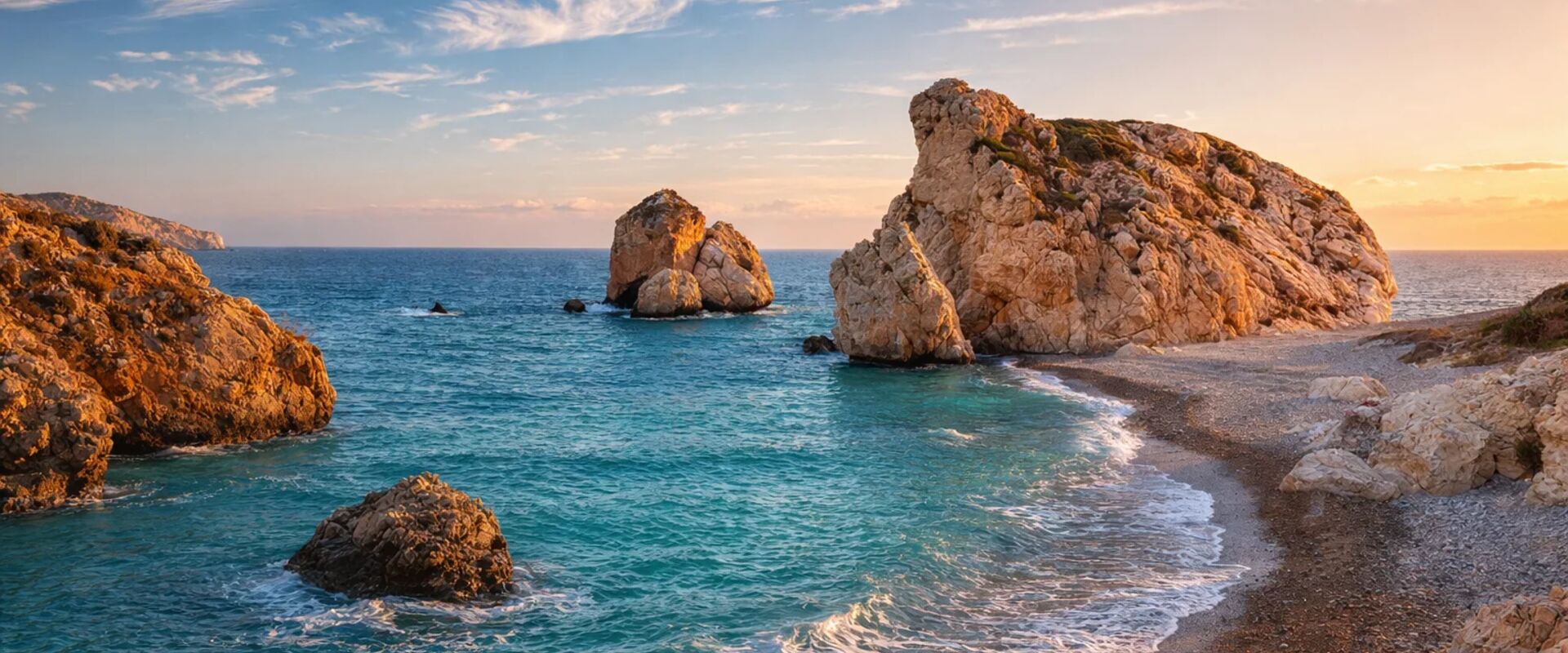
The sea stack 25 km east where Aphrodite is said to have risen from the foam. Pebbly, dramatic and extremely busy at sunset; the viewpoint above the road is better than the beach.
Paphos harbour and castle
A small medieval fort on the breakwater, a row of fish restaurants, and the most photogenic sunset in the south.
Agios Neophytos
A monastery 10 km inland built around a hermit's cave that he carved himself in 1159 and then decorated with frescoes. Quiet, strange and genuinely moving.
Akamas Peninsula
The roadless west tip: the Baths of Aphrodite, the Avakas gorge, Lara beach where green and loggerhead turtles nest, and the island's only monk seals. A 4×4 or a boat, and no facilities.
Paphos was European Capital of Culture in 2017, which paid for a well-judged restoration of the old town around the Ottoman market — worth an hour, and where locals actually eat, as opposed to the harbour.
🏖️ Limassol — the Working Coast
Limassol (Lemesós) is the island's second city, its main port, its business and shipping capital, and the least touristic of the coastal towns in the sense that it is busy with its own life. It has also changed faster than anywhere else on the island in the last decade, with a marina, a skyline of towers and a very large Russian-speaking community.
The medieval castle
Where Richard the Lionheart is said to have married Berengaria of Navarre in 1191, having just conquered the island in a fit of pique. Now the Cyprus Medieval Museum.
The old town
The restored lanes around the castle: meze tavernas, wine bars, the covered market, and the carob mill complex. The best evening in the city.
The seafront promenade
Molos, running 14 km — one of the longest continuous seafront walks in the Mediterranean, and full of joggers, families and cats at every hour.
Ancient Kourion
20 minutes west: a Greco-Roman city on a cliff with a 3,500-seat theatre still used for summer performances, the House of Eustolios mosaics, and a view down the coast that explains why they built there.
Kolossi Castle
A compact 15th-century Hospitaller keep in the middle of vineyards. This is where Commandaria was made for the Knights, and the name comes from their Grande Commanderie here.
Limassol Carnival
Ten days in February — the biggest and least restrained festival in Cyprus, ending in a grand parade. Book ahead.
The beaches immediately in the city are grey sand and pebble and honestly mediocre; Governor's Beach east of town, with its white chalk cliffs, and the long strand at Kourion to the west are both much better and fifteen minutes away.
⛪ Larnaca — Salt Lakes, Lazarus & the Zenobia
Most visitors arrive at Larnaca airport and drive straight past the town, which is a mistake. Larnaca is built over ancient Kition, a Phoenician city-kingdom, and its palm-lined Finikoudes seafront is the most relaxed urban beach on the island.
Church of Saint Lazarus
A 9th-century church over the tomb of Lazarus of Bethany, who by tradition came to Cyprus after his resurrection and served thirty years as bishop here. His sarcophagus is in the crypt and the iconostasis is exceptional.
The Salt Lake
A shallow seasonal lake that fills in winter and dries to a white crust in summer. From November to March it holds thousands of flamingos, ten minutes from the airport.
Hala Sultan Tekke
On the lake shore: the mosque over the tomb of Umm Haram, a relative of the Prophet who died here in 649. One of the most venerated Islamic sites in the eastern Mediterranean, and unusually peaceful.
The MS Zenobia
A Swedish ferry that capsized outside Larnaca harbour on her maiden voyage in 1980 with 104 lorries aboard. She lies on her side in 16–42 m of clear water and is consistently ranked among the ten best wreck dives in the world.
Choirokoitia
35 minutes away: the UNESCO-listed Neolithic village occupied from about 7000 BCE, with reconstructed round houses showing how people actually lived nine thousand years ago.
Lefkara
A hill village famous for lefkaritika lace and silverwork. Leonardo da Vinci is said to have bought an altar cloth here for Milan cathedral in 1481 — unprovable, and repeated in every shop.
The Zenobia deserves its own note: it is accessible to any qualified diver, the visibility is routinely 30 m, and the cargo — lorries still chained in rows on the vehicle decks — is the reason it is unforgettable rather than merely large. Dive centres in Larnaca run it several times a day.
🏔️ The Troodos Mountains
The Troodos is where Cyprus stops being a beach island. The massif rises to 1,952 m at Mount Olympus — not the Greek one — and is geologically remarkable: it is an ophiolite, a complete section of ocean crust and upper mantle pushed up onto land, which is studied by geologists worldwide and is the reason the copper is here at all.
For a visitor the point is threefold: it is ten degrees cooler than the coast in summer, it holds the island's greatest art, and it is where the wine comes from.
The painted churches
Ten small Byzantine churches in the Troodos are collectively UNESCO World Heritage, and they are the best reason to visit Cyprus. From the outside most look like barns — steep pitched roofs of wood shingle, built to shed snow, deliberately unremarkable under Ottoman rule. Inside they are covered floor to ceiling in frescoes from the 11th to 16th centuries.
Asinou (Panagia Phorbiotissa)
Near Nikitari. The finest of them: dense 12th-century frescoes in a tiny barrel-vaulted nave. A keyholder lives nearby and will open it; leave a donation.
Agios Nikolaos tis Stegis
"St Nicholas of the Roof", near Kakopetria — five centuries of overlapping painting in one building, which lets you watch Byzantine art change.
Panagia tou Araka
At Lagoudera, with some of the most refined Comnenian-period painting anywhere, dated precisely to 1192.
Kykkos Monastery
Not one of the ten, and completely different: the richest and most important monastery on the island, founded in 1100, gold-mosaicked and thronged. Archbishop Makarios began here and is buried on the ridge above.
Kakopetria, Omodos, Lofou
Stone villages with cobbled lanes, cool air and good tavernas. Omodos has the monastery and the wine; Lofou is the prettiest and emptiest.
Winter
There is skiing on Mount Olympus from roughly January to March — four short lifts, and the novelty of being on snow with the Mediterranean visible below.
Practical notes: several churches are locked and opened by a keyholder whose phone number is on the door, photography inside is usually forbidden and the ban is taken seriously, and shoulders and knees must be covered. Allow a full day and pick three churches rather than trying for all ten.
🌊 Ayia Napa, Protaras & Cape Greco
The south-east corner has the best sand and the clearest water on the island, and a reputation that only half fits. Ayia Napa was a fishing village that became a byword for club tourism in the 1990s and has since split into two towns occupying the same streets: a loud strip around the square, and a set of genuinely superb beaches that empty out by early evening.
Nissi Beach
The famous one: white sand, a sandbar you can wade to a small island across, and turquoise water. Busy and worth it, early.
Konnos Bay
A sheltered horseshoe between cliffs on the way to Cape Greco, and the prettiest bay in the country.
Fig Tree Bay, Protaras
Protaras is Ayia Napa's quieter family sibling ten minutes north, and this is its beach — consistently rated among Europe's best.
Cape Greco National Forest Park
Sea caves, natural arches, cliff paths and snorkelling straight off the rocks. Free, and the best walking on the coast.
The sea caves
West of Cape Greco: eroded limestone chambers you can swim into, reachable on foot or by boat. Go early, before the tour boats.
Ayia Napa Monastery
A 16th-century Venetian monastery around a sycamore tree in the middle of the party town — an incongruity that is very Cypriot.
Two additions worth the detour: the Museum of Marine Life and the underwater MUSAN sculpture park off Pernera, an artificial forest of 93 sculptures in 8–10 m of water that you can snorkel or dive. And Cape Greco at sunrise, when the light comes up over Syria and the whole coast is empty.
🕌 Northern Cyprus
The north is a third of the island, holds some of its finest architecture, and is visited by a small fraction of the people who come to Cyprus. Crossing for a day or two is straightforward, cheap and strongly recommended — with the practicalities in the Division section above taken seriously.
Kyrenia (Girne)
A near-perfect horseshoe harbour under a Venetian castle, with the Kyrenia Ship inside the castle museum — a Greek merchant vessel that sank around 300 BCE, one of the best-preserved ancient hulls ever raised. The most beautiful town on the island.
Bellapais Abbey
A ruined 13th-century Gothic abbey above Kyrenia in a village of lemon trees, where Lawrence Durrell lived and wrote Bitter Lemons. The refectory arcade over the plain is unforgettable.
Saint Hilarion Castle
A Crusader castle strung along a ridge at 700 m, said to have inspired Disney's Snow White castle. A steep climb, and a view over the whole northern coast.
Famagusta (Gazimağusa)
Venetian walls that withstood a ten-month Ottoman siege, and inside them the Lala Mustafa Pasha Mosque — the Gothic cathedral of St Nicholas with a minaret — plus the ruins of a reputed 365 churches.
Salamis
The ruins of the island's greatest ancient city, spread over a kilometre of coastline: gymnasium, baths, a theatre for 15,000, and almost nobody there.
The Karpas peninsula
The long empty tail of the island: wild donkeys, Golden Beach — an undeveloped 3 km strand where turtles nest — and the Apostolos Andreas monastery at the very tip.
Varosha, the sealed resort quarter of Famagusta, deserves a note of its own. In 1974 it was the most fashionable beach strip in the Mediterranean; its residents fled and it has stood empty and fenced ever since, decaying in full view. Part of it was reopened to visitors in 2020, which is internationally contested. It is an extraordinary and uncomfortable place, and worth thinking about why you are there before you go.
🤿 Beaches & Diving
Cyprus has 648 km of coastline and enough variety that where you stay changes the kind of swimming you get. The east has white sand and shallow turquoise water; the south has pebbles, chalk cliffs and deep clear water off rocks; the west is wilder and emptier.
Best sand
Nissi and Makronissos (Ayia Napa), Fig Tree Bay and Konnos (Protaras), Coral Bay (Paphos), Golden Beach (Karpas, north).
Best wild
Lara Bay on the Akamas — a protected turtle nesting beach with no facilities and a 4×4 track in. Do not drive on the sand; nests are marked.
Best snorkelling
Cape Greco's rocks and caves, the MUSAN sculpture park off Pernera, and the rocky entries around Coral Bay.
The Zenobia
The wreck off Larnaca: 172 m long, on her side in 16–42 m, with lorries still chained on the decks. Among the world's top ten wreck dives and accessible from Open Water level down to deep technical.
Other diving
The Amphorae Caves near Paphos, Cape Greco's caverns and canyons, and the HMS Cricket wreck. Water is 16–17 °C in winter and 27 °C in late summer; visibility is good year-round.
Turtles
Green and loggerhead turtles nest at Lara and Alagadi (north) from June to August. Both have monitoring programmes and both welcome respectful visitors at the right hours.
Blue Flag status is widespread and the water quality across the island is consistently among the best measured in Europe. What Cyprus does not have is tides worth speaking of, or dangerous surf on the south coast — which makes it unusually good for swimming with children.
🍜 Cuisine
Cypriot food is Greek in structure, Levantine in seasoning and its own thing in practice. The organising principle is meze: not a starter but a whole meal of fifteen to thirty small dishes arriving in waves for two or more hours. Order it once, order nothing else, and do not fill up on the first six things that arrive — this is the classic beginner's mistake and the tavernas find it funny.
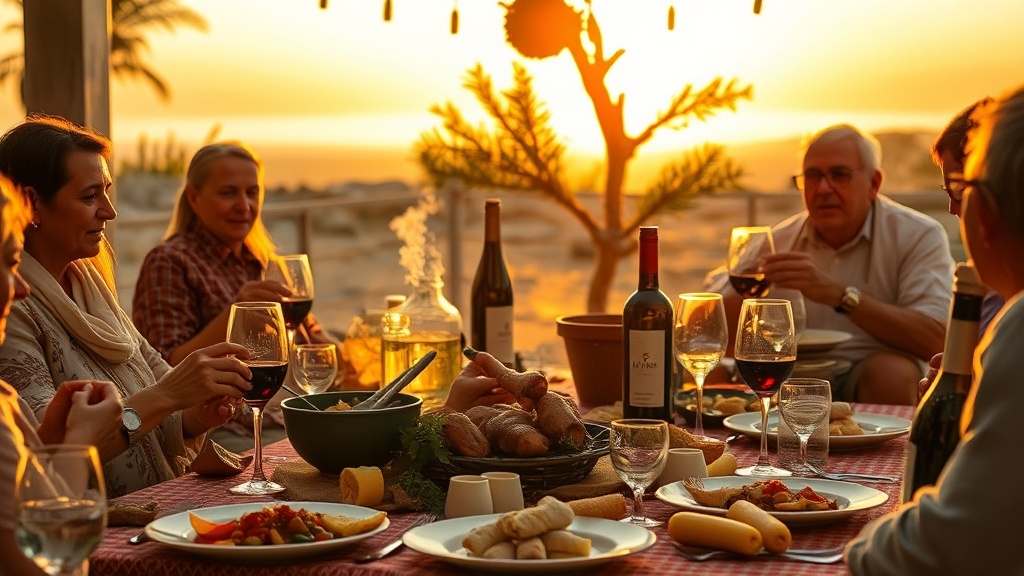
Halloumi
The island's most famous export, and since 2021 an EU Protected Designation of Origin — genuine halloumi can only be made in Cyprus. Traditionally goat and sheep milk, folded with mint, and it grills without melting.
Souvla
Not souvlaki. Large chunks of pork or lamb on a long spit, turned slowly over charcoal for hours. The Sunday dish, and the thing every Cypriot family owns a rotisserie for.
Kleftiko
Lamb sealed in a clay oven with nothing but salt, bay and its own fat for four to six hours, until it collapses. The name means "stolen" — bandits buried it to hide the smoke.
Sheftalia
Minced pork and lamb wrapped in caul fat and grilled, so it bastes itself. The single best thing on a meze table.
Louvi, koupepia, afelia
Black-eyed beans with chard and lemon; stuffed vine leaves; pork braised in red wine and cracked coriander seed — the three that define home cooking.
Sweet things
Loukoumades (honey doughnuts), soutzoukos (grape must and almonds, made like a candle), glyko tou koutaliou (spoon sweets of preserved fruit), and Cyprus delight from Lefkara and Geroskipou.
Halloumi, done properly
The national cheese · 10 minutes
Ingredients: 250 g halloumi; lemon; fresh mint; olive oil; optionally watermelon.
Method: Slice the halloumi about 1 cm thick and pat it dry. Put it in a dry hot pan or on a grill with no oil at all — halloumi has enough fat to fry itself. Two to three minutes a side, until deep golden and squeaking. Off the heat, squeeze lemon over it immediately, add torn mint and a thread of good oil.
💡 Thinner than 1 cm and it goes leathery; oil in the pan and it boils rather than browns. Cold watermelon alongside is the classic Cypriot summer pairing and it genuinely works.
Kleftiko
Slow-roast lamb · the Sunday dish · serves 4
Ingredients: 1.5 kg lamb shoulder on the bone, in large pieces; 4 bay leaves; 1 tbsp dried oregano; 2 cinnamon sticks; 6 cloves garlic; 2 lemons; 500 g potatoes in big chunks; salt and pepper. Optionally 100 g halloumi.
Method: Season the lamb hard with salt, pepper and oregano, and leave it an hour. Put it in a deep dish with the potatoes, bay, cinnamon, whole garlic cloves and the juice of one lemon, and add no water and no oil. Seal the dish completely — a lid and a double layer of foil, or a paste of flour and water around the rim. Cook at 160 °C for four hours without opening it once. Rest 15 minutes, then open at the table.
💡 The seal is the whole technique — the meat cooks in its own steam. Tuck a few cubes of halloumi in with the potatoes for the last hour.
🍷 Wine, Zivania & Drinking
Cyprus has been making wine for around 5,500 years — the oldest evidence in Europe — and makes one wine that is genuinely unique. It also spent most of the twentieth century producing bulk fortified wine for the British and Soviet markets, and has spent the last twenty-five years recovering from that with a small-producer revival that is now producing seriously good bottles.
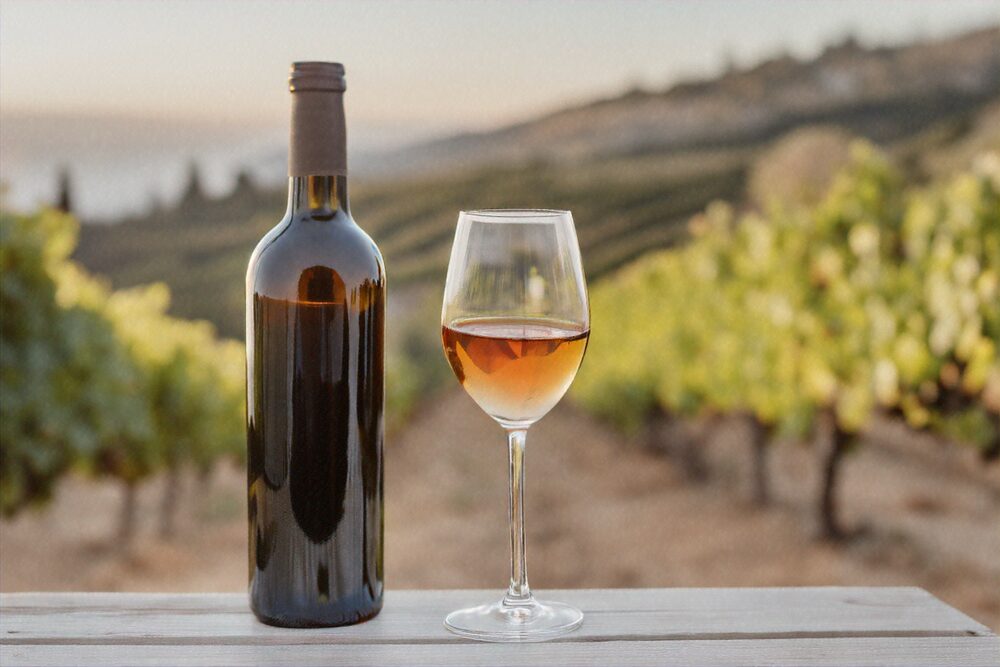
Commandaria
The oldest named wine still in production anywhere in the world, made since antiquity from sun-dried Xynisteri and Mavro grapes in fourteen villages on the Troodos foothills. Richard the Lionheart is said to have served it at his wedding here and called it "the wine of kings". Sweet, amber, dried-fig and caramel, and it ages for decades.
Xynisteri
The main native white: light, citrus and stone fruit, low alcohol, and excellent with meze. The best examples now come from high-altitude vineyards above 800 m.
Maratheftiko
The native red that matters — deep, structured and capable of real quality, though it is difficult to grow because it will not self-pollinate. The flagship of the revival.
Mavro
The workhorse black grape, planted everywhere, mostly unremarkable on its own and essential in Commandaria.
Zivania
The pomace spirit, 45% and up, distilled since the fifteenth century. Drunk as a shot, used as a cure-all, and applied externally to almost any injury by anyone over seventy.
Beer and coffee
KEO and Leon are the local lagers, cold and unpretentious. Coffee is the actual national drink — see People & Culture for how to order it.
The Troodos wine routes — seven marked routes through the vineyard villages — are the best way to do this, and Omodos, Vouni, Lofou and the Krasochoria ("wine villages") above Limassol all have small wineries that will pour for you without an appointment. Note that Cyprus is strict on drink-driving, so bring someone who is not drinking.
Phylloxera never reached Cyprus. That means many of the island's vines are ungrafted, on their own roots — rare in Europe and one of the reasons the old-vine Mavro and Xynisteri plantings are attracting international attention.
🏆 Kaufmann Wine Score — Cyprus
Rated on four criteria: Aroma (/25), Taste (/30), Finish (/20), Value (/25) — Total /100
| Wine | 🔴 Aroma | 🟡 Taste | 🟢 Finish | 🔵 Value | Total |
|---|---|---|---|---|---|
| KEO St John Commandaria (Xynisteri/Mavro, sun-dried) | 22 | 26 | 18 | 22 | 88 |
| ETKO Centurion Commandaria (aged solera-style) | 23 | 27 | 18 | 20 | 88 |
| Zambartas Maratheftiko (Krasochoria red) | 21 | 25 | 16 | 19 | 81 |
| Tsiakkas Yiannoudi (rare native red, Pelendri) | 21 | 24 | 16 | 20 | 81 |
| Kyperounda Petritis Xynisteri (high-altitude white) | 20 | 24 | 15 | 21 | 80 |
| Vlassides Xynisteri (Koilani, everyday white) | 19 | 23 | 14 | 22 | 78 |
95–100 Legendary · 90–94 Outstanding · 85–89 Very Good · 80–84 Good · 75–79 Average · <75 Below Average
🌡️ Climate & When to Go
Cyprus has the sunniest climate in the European Union — around 340 sunny days a year — and a proper Mediterranean pattern: hot dry summers, mild wet winters, and two near-perfect shoulder seasons that are the right answer for most visitors.
April–June
The best window. 22–30 °C, everything green and flowering, sea warm enough from mid-May, and the archaeological sites walkable at midday. Orthodox Easter falls in here and is worth planning around either way.
July–August
35–40 °C inland and genuinely punishing. Nicosia regularly passes 40 °C and Paphos ruins at 2 pm are a bad idea. Coastal breeze helps, the sea is 27 °C, and prices peak. Do sites at 08:00 and the beach after.
September–October
The other sweet spot: sea at its warmest, air back to 25–30 °C, grape harvest and wine festivals, and far fewer people.
November–March
Mild on the coast at 15–20 °C, wet by Cypriot standards, and snow on the Troodos with a short ski season. Some resort hotels close; the cities do not. Flamingos on the salt lakes.
Sea temperature
16–17 °C in February, 27–28 °C in August and September. Comfortable swimming from about May to November.
The heat is the real hazard
Summer sun here is stronger than most northern European visitors expect. SPF 50, a hat, more water than feels necessary, and no exposed archaeological site between noon and four.
✈️ Getting There & Around
Larnaca (LCA) is the main international airport, 45 minutes from Nicosia and Limassol. Paphos (PFO) is smaller, serves the west, and takes most of the low-cost traffic. Both are in the Republic and are the correct way to enter the island.
Airlines
Ryanair, Wizz Air, easyJet, Aegean, Cyprus Airways, Lufthansa, Austrian and the Gulf carriers all serve Larnaca; Paphos is heavily served from the UK and central Europe.
Ercan (north)
Reachable only via Türkiye. Entering the island through it is treated by the Republic as illegal entry and can cause problems later. Fly to Larnaca or Paphos and cross by land instead.
Rental car
The right choice. €25–45 a day, excellent roads, free motorways. Remember: Cyprus drives on the left, and the cars are right-hand drive.
Buses
Intercity buses connect the main towns cheaply and reliably; urban networks are thin and rural service is close to nonexistent. Fine for Larnaca–Nicosia–Limassol, useless for the Troodos.
Taxis and ride-hailing
Metered urban taxis, plus Bolt in the main cities. Shared "service taxis" between towns are cheap and slightly chaotic.
No trains
The Cyprus Government Railway closed in 1951. There is no rail transport of any kind.
Driving notes for continental Europeans: left-hand traffic takes about a day to stop being frightening and roundabouts are where mistakes happen. Signs are in kilometres. Speed and alcohol enforcement is camera-heavy and strict — the limit is 0.22 mg/l breath, and there is no tolerance in practice.
🇪🇺 Getting There from Central Europe
Cyprus is one of the easier long-ish Mediterranean trips from central Europe: about 3.5 hours flying, one time zone ahead (UTC+2, so an hour ahead of Prague), and no visa, currency or roaming complications for EU citizens.
Direct from Prague
Seasonal direct flights to Larnaca and Paphos, mostly summer charter and low-cost. Availability varies year to year, so check both airports before assuming a connection is needed.
Via Vienna or Athens
Austrian via Vienna and Aegean via Athens both connect year-round and are the reliable fallback out of season. Total journey around 6–7 hours.
Package or independent
Cyprus is heavily packaged out of central Europe, and in high season a flight-plus-hotel deal often beats booking separately. Independent travel with a hire car is better value off-season and much better for seeing the island.
Best time for a Czech traveller
May–June or September–October. Same sea, half the crowds, and the sites are actually walkable in the afternoon.
Entry and money. Cyprus is an EU member and uses the euro, so no exchange and no visa for Czech and Slovak citizens; an identity card is sufficient, though a passport is more practical if you plan to cross into the north. Cyprus is not in the Schengen area, so there is a passport check on arrival even from Prague — allow for it.
Health and roaming. EU roaming rules apply normally. The European Health Insurance Card covers state healthcare, but as everywhere it does not cover repatriation or private clinics — and in resort areas the clinic you walk into is often private, so commercial travel insurance is still worth having. Check mzv.gov.cz before travelling and consider registering in the DROZD system; the Czech Republic has an embassy in Nicosia.
Two things that catch Czech visitors out. Cyprus drives on the left — one of only three EU countries, with Ireland and Malta — so factor that into whether you want to hire a car. And plugs are British type G, three rectangular pins at 240 V: your continental adapter will not fit and neither will your charger without one. Buy the adapter at home, where it costs a fifth of the airport price.
📋 Practical Information
Money
Euro in the Republic since 2008; cards accepted almost everywhere, ATMs plentiful. The north uses the Turkish lira, but euros are accepted at a poor rate — change a small amount if you are staying more than a few hours.
Visa
EU/EEA citizens need no visa; an ID card suffices for entry. Cyprus is in the EU but not yet in Schengen, so expect a border check — the Commission approved its readiness on 14 August 2026 and a Council vote was pending in autumn 2026, so check the current status before you fly. Non-EU rules broadly follow the Schengen list but are set separately — verify before booking.
Electricity
240 V, type G — the British three-pin plug. A continental europlug does not fit. Most hotels can lend an adapter but do not rely on it.
Driving
On the left. Motorways are free and excellent. Alcohol limit 0.22 mg/l breath, enforced. Mountain roads are narrow with no barriers in places.
Water
Tap water is safe throughout the Republic, though heavily chlorinated and not delicious; most people drink filtered or bottled. Much of the supply is desalinated.
Health
EU standard, EHIC accepted at state facilities, good private hospitals. Emergency number is 112 across the island, including the north.
Safety
One of the lowest crime rates in the EU, and safe to walk anywhere at night. The genuine hazards are sun, heat and unfamiliar left-hand driving. The Iranian drone strikes on the British base at Akrotiri in March 2026 briefly put Cyprus on a US Level 3 advisory; it went back to Level 1 on 1 June 2026 and flights and tourism run normally.
Dress and etiquette
Shoulders and knees covered in churches and mosques; women should carry a scarf for mosques. Photography is often banned inside painted churches and the ban is taken seriously.
The military rule. Cyprus has a heavily militarised buffer zone, two British Sovereign Base Areas and active installations on both sides. Do not photograph anything military, including checkpoints, watchtowers and personnel, and do not photograph into the buffer zone. This is one of the few rules on the island that is enforced without humour.
Tipping: service is often included at 10%; if not, round up or leave 5–10%. Cypriots tip modestly and nobody expects a foreign standard.
💰 Costs for Travellers
Cyprus is mid-priced by EU standards — cheaper than Greece's popular islands in high season, more expensive than the Balkans, and unusually good value for food. The north is roughly 30–50% cheaper than the south for everything.
Accommodation
€40–70 a night for a guesthouse or simple hotel, €80–150 mid-range, considerably more in Ayia Napa and Limassol in August. Village houses in the Troodos are excellent value.
Meze for two
€35–50 including wine, for twenty-plus dishes and three hours at the table. The best-value meal in the Mediterranean.
Everyday meal
€10–15 for a souvlaki or sheftalia plate; €3 for a coffee that comes with a glass of water and no time limit.
Rental car
€25–45 a day, less for a week off-season. Fuel is around the EU average and motorways are free.
Site entry
€4.50 for the Paphos archaeological park, €4.50 for Kourion, €2.50 for Choirokoitia. A multi-site card is available and pays for itself in three visits.
Two-tank dive on the Zenobia
€90–120 including gear. Among the better-value world-class dives anywhere.
Realistic budgets: €60–90 per person per day independently with a shared hire car, guesthouses and taverna food; €130–200 for hotels, restaurants and activities. Backpacking under €50 works off-season but public transport limits what you can see.
🏨 Accommodation
Where you base yourself matters less than on bigger islands — nothing is more than two hours away — but it still shapes the trip.
Larnaca
The practical base: airport on the doorstep, central for the whole south, cheapest of the coastal towns, and a pleasant seafront. Best for a first visit and for divers.
Paphos
For the archaeology and the west. Kato Paphos is touristy; the old town uphill is better and cheaper. The base for Akamas.
Limassol
For city life, restaurants and wine country. The most urban option and the most expensive.
Nicosia
Underrated as a base — most visitors day-trip and miss the evenings, which are the best part. Hotels are business-priced midweek and cheap at weekends.
Ayia Napa / Protaras
For beaches, and for nightlife if that is the point. Protaras for families, Ayia Napa for everything else.
Troodos villages
Restored stone houses in Kakopetria, Omodos, Lofou and Kalopanayiotis — agrotourism properties that are among the best-value and most memorable stays on the island. Cool in summer, with fireplaces in winter.
The pattern that works best for a week: three nights on the coast, two in a Troodos village, and one in Nicosia — with the Green Line crossing on the Nicosia day. It costs no more than staying put and shows you three entirely different countries.
🏛️ UNESCO World Heritage
Cyprus has three UNESCO World Heritage Sites, and unusually they cover three entirely different eras — Neolithic, Roman and Byzantine — which between them sketch the whole arc of the island's history.
Paphos (1980)
The entire archaeological area: the Roman mosaic houses of Dionysos, Theseus, Aion and Orpheus, the Tombs of the Kings, the odeon, the Saranta Kolones Crusader fort and the remains of Aphrodite's sanctuary at Palaipaphos.
Painted Churches in the Troodos Region (1985, ext. 2001)
Ten small Byzantine and post-Byzantine churches and monasteries with frescoes from the 11th to 16th centuries, hidden under barn-like shingle roofs across the mountains.
Choirokoitia (1998)
One of the best-preserved Neolithic settlements in the eastern Mediterranean — round stone houses inside a defensive wall, occupied from around 7000 BCE. Five reconstructed houses show how it worked.
Cyprus also has five entries on UNESCO's Representative List of Intangible Cultural Heritage: Lefkara lace (lefkaritika, 2009) and the improvised sung poetry duels called tsiattista (2011), both still practised rather than performed, plus three shared inscriptions — the Mediterranean diet (2013), the art of dry-stone walling (2018) and Byzantine chant (2019, with Greece).
In the north, Salamis, the walled city of Famagusta and Bellapais Abbey are all of clear World Heritage quality but cannot be inscribed, because listing requires nomination by a recognised state party. The division has consequences for conservation funding too, and a number of monuments on both sides are on watch lists as a result.
🎭 Festivals & Events
Orthodox Easter (April/May)
By far the biggest event of the year, and quite different from the western one: the Saturday midnight resurrection service, bonfires, fireworks, and a Sunday of souvla smoke over every village. Dates move and rarely match the Catholic calendar.
Limassol Carnival (February)
Ten days of parades, costume and satire ending in the Grand Carnival Parade. The most exuberant thing that happens on the island.
Kataklysmos (June)
The Festival of the Flood, at Pentecost — a genuinely Cypriot celebration found nowhere else in Orthodoxy, with seaside water-throwing, boat races, food stalls and sung poetry duels. Larnaca does it best.
Paphos Aphrodite Festival (September)
Grand opera staged in front of the medieval castle on the harbour. Three nights, and the setting does most of the work.
Wine festivals (September–October)
Limassol's week-long wine festival plus village harvest festivals through the Krasochoria. The Commandaria Festival at Kalokhorio celebrates the world's oldest named wine.
Anthestiria (May)
Flower festivals in the coastal towns, descended directly from an ancient Athenian spring festival.
Green Monday (Kathara Deftera)
The start of Lent: everyone goes to the countryside, flies kites and eats a vegan picnic. A public holiday and a lovely thing to stumble into.
Independence Day (1 October)
Plus Greek Independence Day on 25 March and Ochi Day on 28 October, both widely marked in the south.
🔬 Fascinating Facts
The island named an element
Copper takes its name from Cyprus, not the other way round: Latin aes Cyprium, "metal of Cyprus", became cuprum, became copper.
The oldest known pet cat
At Shillourokambos, a human was buried with a cat around 9500 BCE — the earliest evidence anywhere of the relationship between people and cats, and 4,000 years before Egypt.
The oldest named wine still made
Commandaria has been produced continuously in the same villages by broadly the same method since antiquity. No other named wine can claim that.
A flag showing its own map
Cyprus was the first country whose national flag depicted the outline of the country itself — in copper, above olive branches. Only Kosovo has done the same since, in 2008.
The last divided capital
Nicosia has been split since 1963 and formally since 1974. Berlin was the other one, and it stopped in 1989.
Drives on the left
One of only three EU member states that do, along with Ireland and Malta — a British administrative legacy that survived independence.
Halloumi is legally Cypriot
Since 2021 halloumi/hellim carries EU Protected Designation of Origin, so cheese made anywhere else cannot use the name. Unusually, the PDO covers both communities.
A slab of ocean floor
The Troodos massif is an ophiolite — a complete section of oceanic crust and mantle thrust onto land. Geology students come from all over the world to walk on it.
⭐ Notable People
Zeno of Citium (c. 334–262 BCE)
Born in Kition, today's Larnaca. Founded Stoicism in Athens — arguably the most influential thing anyone from Cyprus has ever done.
Saint Barnabas (d. c. 61)
Born in Salamis, travelled with Paul, and the founder of the Church of Cyprus. The rediscovery of his tomb near Famagusta in 478 secured the self-governing status the church had been granted in 431.
Archbishop Makarios III (1913–1977)
Archbishop and first president of the Republic — a religious leader who ran a country, survived several assassination attempts and was deposed by the 1974 coup.
Michael Cacoyannis (1922–2011)
Director of Zorba the Greek and of the finest films made of Euripides. Born in Limassol.
Nikos Christodoulides (b. 1973) and the political line
President since 28 February 2023 and the face of the EU Council presidency in the first half of 2026. His predecessors include the EU's only Communist head of state, Dimitris Christofias (2008–13) — a reminder that Cypriot politics does not map onto European assumptions.
Marcos Baghdatis (b. 1985)
Reached the Australian Open final in 2006 and the Wimbledon semi-final the same year, from an island of a million people.
Tufan Erhürman, Ersin Tatar and Mustafa Akıncı
The northern leaders of the last decade, representing the two opposed positions — federation (Akıncı, Erhürman) or two states (Tatar) — that the talks have not bridged. Erhürman, a federalist, defeated Tatar on 19 October 2025 and has been meeting Christodoulides regularly since.
Anna Vissi (b. 1957)
Born in Larnaca, and for four decades one of the biggest names in Greek-language pop.
📰 Media & Press Freedom
The Republic of Cyprus has a free press and is classified as Free by Freedom House, but it has been sliding in the Reporters Without Borders index — 80th of 180 in the 2026 World Press Freedom Index (score 56.9), the second-lowest EU member state, ahead only of Greece — with the usual regional weaknesses around media ownership concentration and political proximity.
The main Greek-language dailies are Phileleftheros, Politis and Haravgi; the Cyprus Mail has published in English since 1945 and is the best single source for a visitor. CyBC is the public broadcaster, running television and radio in both Greek and Turkish, and there is a lively commercial radio scene.
In the north, media operate under a different and more constrained framework, with Kıbrıs and Yenidüzen the main papers and BRT the public broadcaster. Turkish Cypriot journalism has a strong independent streak, and criticism of Ankara's influence is a live and sometimes risky subject — the still-unsolved 1996 assassination of Yenidüzen columnist Kutlu Adalı is still discussed.
The one media reality every visitor notices is that each side's coverage of the division is entirely self-contained. Read the Cyprus Mail and Yenidüzen on the same morning about the same event and you will get two internally coherent accounts with almost no overlap. That is not a scandal; it is the most efficient possible introduction to the problem.
⚽ Sports
Football is the dominant sport. The Cypriot First Division is followed with an intensity out of proportion to the island's size, and APOEL, Omonoia, AEK Larnaca, Anorthosis and Apollon have all made real runs in European competition — APOEL reached the Champions League quarter-final in 2012, which remains the island's proudest sporting week. The newest name is Pafos FC: champions for the first time in 2025, they became the second Cypriot club to reach the Champions League proper, finished 22nd in the 2025–26 league phase — beating Slavia Prague 4–1 on the final matchday — and went into the February 2026 knockout play-offs.
Tennis
Marcos Baghdatis took Cyprus to an Australian Open final and a Wimbledon semi-final in 2006. Courts are everywhere and the winter climate makes the island a training destination.
Winter training
Cyprus is a major off-season base for northern European football clubs and athletics teams — reliable sun in January, and full-sized facilities in Larnaca, Paphos and Limassol.
Shooting and sailing
The island's Olympic medals have come from the water and the range: Pavlos Kontides took silver in the Laser class at London 2012, the country's first Olympic medal, and silver again in the ILCA 7 at Paris 2024 — still Cyprus's only two Olympic medals, both his. Shooting is a genuine national strength.
Basketball — EuroBasket 2025 host
Limassol's Spyros Kyprianou Arena hosted Group C of FIBA EuroBasket 2025 (28 August – 4 September 2025) with Spain, Italy, Greece, Georgia and Bosnia. It was Cyprus's first-ever EuroBasket appearance; the hosts lost all five games, but the arena was full for every one.
Cycling and running
The Cyprus Challenge and the Limassol and Paphos marathons run in the cool months; the Troodos climbs are serious training ground and quiet outside summer.
Rally
The Cyprus Rally has been a WRC and ERC fixture on the mountain gravel roads for decades, and is followed obsessively.
Watching a match
Tickets are cheap and easy at the gate outside the big derbies. The Nicosia derby between APOEL and Omonoia is not a beginner's fixture.
🎒 Packing for Cyprus
A UK plug adapter
Type G, three rectangular pins, 240 V. Your continental charger will not fit any socket on the island. Buy it before you fly.
Serious sun protection
SPF 50, a real hat and sunglasses, April to October. The UV here is higher than anywhere most northern European visitors have been.
Modest layer for churches
Shoulders and knees covered for churches, monasteries and mosques; a scarf for women at mosques. A light long-sleeved shirt covers both this and the sun.
Water shoes
Many of the south-coast beaches are pebble or rock entry. Cheap, and they change how much swimming you actually do.
Warm layer for the Troodos
It is 10 °C cooler up there in summer and genuinely cold and wet in winter. A fleece even in July if you are going to the churches.
Passport, not just an ID card
An ID card gets EU citizens into the Republic, but a passport makes crossing the Green Line simpler and is what the northern checkpoint expects.
Walking shoes with grip
Archaeological sites are uneven polished stone, and the gorge and church walks are rough underfoot.
Snorkel and mask
Cape Greco, the sea caves and the MUSAN sculpture park all reward having your own, and rental is scarce outside resorts.
Leave behind: a European plug adapter that is not type G, and any assumption that you will be comfortable at an unshaded archaeological site in the middle of an August afternoon.
📸 Photo Gallery
Our Cyprus photo library is still small, and several files previously filed under Cyprus turned out to show somewhere else entirely. Been to Cyprus? Send your photos to photos@kaufmann.wtf to be featured here with full credit.
Photographs most wanted: the Ledra Street checkpoint, the Paphos mosaics, an Asinou or Panagia tou Araka interior, the Venetian walls of Nicosia from the air, Kyrenia harbour, the Zenobia's lorry decks, and a souvla spit at a village paniyiri.
🌐 Useful Resources
Deputy Ministry of Tourism
The official portal, unusually well kept, with site opening hours that are actually current: visitcyprus.com
Department of Antiquities
Opening times and ticket prices for the archaeological sites and museums, including the multi-site card.
Intercity buses
Timetables and fares for the routes between Nicosia, Larnaca, Limassol, Paphos and Ayia Napa: intercity-buses.com
Maps
OpenStreetMap is markedly better than Google for village and mountain roads, and handles the buffer zone more sensibly. Download both sides offline.
Emergencies
112 across the whole island, north and south. Cyprus is in the EU, so EU consular protection applies.
UNESCO
The three inscriptions and their justifications: whc.unesco.org
Czech travellers should check the current advice at mzv.gov.cz and can register in the DROZD system; the Czech Republic maintains an embassy in Nicosia. Note that consular assistance in the north is complicated by the lack of recognition — one more reason to enter the island through Larnaca or Paphos.
📚 Recommended Reading
Bitter Lemons of Cyprus — Lawrence Durrell
The classic memoir of late-colonial Cyprus, written from a village house in Bellapais as the EOKA insurgency began. Beautiful, partial, and essential.
Echoes from the Dead Zone — Yiannis Papadakis
A Greek Cypriot anthropologist crosses to the north and interrogates his own side's story. The single most useful book for understanding the division.
The Sunrise — Victoria Hislop
A novel of Famagusta and Varosha in 1974 — the most accessible way into what happened to that city.
Small Wars — Sadie Jones
The EOKA years from a British army family's perspective, and unsparing about it.
Cyprus: A Modern History — William Mallinson
A straightforward account of the twentieth century for readers who want the politics without a novelist's frame.
The Cyprus Problem: What Everyone Needs to Know — James Ker-Lindsay
Short, even-handed and the fastest route to understanding why the talks keep failing.
On screen: Michael Cacoyannis's films for Cypriot cinema at its best, and any documentary footage of the Ledra Street crossing opening in 2003 — when thousands of people queued to walk into the other half of their own city for the first time in twenty-nine years.
✍️ Author's Note
"I crossed into northern Nicosia on foot through the Ledra Street checkpoint on a quiet Tuesday morning. Two huts, two passport stamps, ninety seconds. Within a hundred metres the alphabet changed, the church bells became the call to prayer, and the price of a coffee halved. But the stones underfoot — Venetian, Ottoman, Byzantine, all in the same pavement — refused to pick a side."
"That un-dramatic walk taught me more about Cyprus than any museum. I had coffee with a man in the south who lost a house in Famagusta and coffee with a man in the north who lost one in Limassol, on the same afternoon, and both told me the same story with the villains reversed. Neither was lying. That is the shape of the thing, and no visitor should leave without having sat through both halves of it."
"And then, because this is Cyprus, you drive an hour into the Troodos and a woman with a key on a string opens a building that looks like a hay barn, and inside are frescoes from 1192 that nobody else is looking at. An hour after that you are eating sheftalia under a vine with a carafe of something a farmer made. The island is small enough to cross in two hours and deep enough that you never really finish it. Siga siga."
— Radim Kaufmann, September 2026
Support This Project 🌍
This World Travel Factbook is a labor of love – free to use for all travelers. If you find it helpful, consider supporting its continued development.
