
🇳🇿 New Zealand at a Glance
🌍 Overview — The Last Place People Found
New Zealand is the last substantial landmass on earth that human beings reached. Polynesian voyagers arrived around 1250–1300 CE — within the lifetime of Genghis Khan's grandchildren, and after the Norse had already been to Newfoundland. Europeans came five centuries after that. Everything strange about the place follows from how long it was left alone.
It is 268 021 km², about three and a half times Czechia, holding 5,3 million people and roughly 23 million sheep. It sits 2 000 km from its nearest neighbour across the Tasman Sea, which is a genuinely enormous distance, and its second nearest is Antarctica.
Where it is
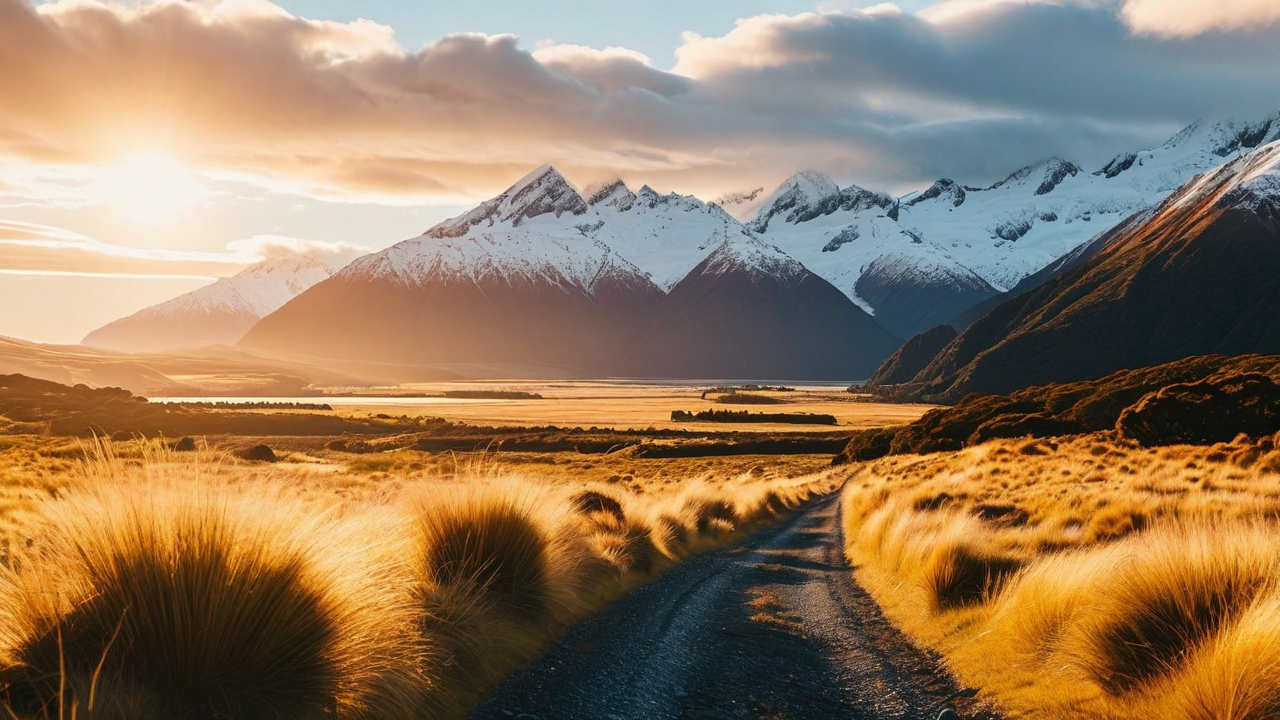
The south-west Pacific, straddling 34° to 47° south — the mirror image of Italy and the Balkans in the north. The North Island is volcanic and subtropical at its top; the South Island is bigger, colder, emptier and split its whole length by the Southern Alps. Plus Stewart Island and the subantarctic islands south of that.
Two names
Aotearoa — usually translated "land of the long white cloud" — and New Zealand, after a Dutch province, via a Dutchman who never landed. Both are used officially, often together, and the question of which comes first is a live political argument. See the next section.
Who lives here
About 70 % European descent, 17,8 % Māori, 17,3 % Asian and 8,9 % Pacific peoples — the percentages exceed 100 because people may tick more than one, which is itself the point. Auckland alone holds a third of the country and is the largest Polynesian city in the world.
How it is governed
A constitutional monarchy under King Charles III, with a single-chamber 120-seat parliament elected by MMP — mixed-member proportional, adopted by referendum in 1993 — which guarantees coalitions. There are seven Māori electorates alongside the general ones. There is no written constitution and no upper house; the Treaty of Waitangi does much of the work a constitution would.
The economy
Small, rich, open and narrow: dairy above all (Fonterra alone is around a fifth of goods exports), then meat, wood, wine, horticulture and tourism. GDP per head is high and productivity is stubbornly low, house prices are among the world's least affordable relative to income, and the country is a long way from every market it sells to.
2026 in one line
An economy climbing slowly out of a hard recession — the Reserve Bank cut the cash rate from 5,50 % in mid-2024 to 2,25 % and has held it there since — unemployment around 5,3 %, a Treaty argument that has not cooled since the 2024 hīkoi, and a general election on 7 November 2026 that the polls say is close.
🏷️ Aotearoa, New Zealand, and Who Gets to Say
Nieuw Zeeland
Abel Tasman sighted the west coast in December 1642, lost four men in a fatal encounter in what he named Murderers' Bay, and left without ever setting foot ashore. Dutch cartographers named the place Nova Zeelandia after the province of Zeeland — "sea land" — and Cook anglicised it 127 years later. The country is therefore named after a flat Dutch province by a man who never landed.
Aotearoa
Usually rendered "land of the long white cloud" (ao cloud, tea white, roa long), and the story is that it is what Kupe's crew saw first. Historically it may have referred only to the North Island, with the South Island as Te Waipounamu (the greenstone waters) and the North as Te Ika-a-Māui, the fish of Māui. The name spread to the whole country in the nineteenth century, partly through Māori-language newspapers.
The fish and the canoe
The Māori geography is worth carrying with you. The North Island is a fish that Māui hauled up from the sea: Wellington harbour is its mouth, Northland its tail, Lake Taupō its heart. The South Island is Māui's canoe and Stewart Island its anchor stone. Aoraki, the highest peak, is an ancestor turned to stone. These are not decorations — they are the underlying map, and place names all over the country assume you know it.
The argument now
Using Aotearoa in official contexts has become ordinary — passports say Aotearoa New Zealand, ministries have Māori names, the public broadcaster uses it constantly — and it is also contested, with NZ First campaigning explicitly against it in government departments. A 2022 petition to change the country's name formally went nowhere. Nobody disputes that both names exist; the fight is about which one leads.
The flag that stayed
In 2015–16 New Zealand held two referendums on replacing its flag, at a cost of around NZ$26 million, largely at the urging of Prime Minister John Key, who disliked the resemblance to Australia's. The final contest was the existing flag against a black-and-blue silver fern design; the old flag won 56,6 % to 43,2 %. Widely read as a vote against the process rather than for the flag.
Kiwi
A flightless bird, a nickname for the people, and — only for foreigners — a fruit. In New Zealand the fruit is kiwifruit, never "kiwi", and calling a New Zealander a kiwi is entirely friendly while calling the fruit one is a small giveaway. The fruit is also Chinese: Actinidia from the Yangtze valley, grown here from 1904 and renamed in 1959 for the American market because "Chinese gooseberry" was a Cold War liability.
🗺️ Geography — Long, Thin, and Standing on a Plate Boundary
New Zealand is 1 600 km long and rarely more than 400 km wide, so nowhere in the country is more than about 130 km from the sea. It also sits directly on the collision between the Pacific and Australian plates, which is why it has mountains at all and why it shakes.
The Southern Alps
The South Island's spine: a 500 km range thrown up along the Alpine Fault, with eighteen peaks over 3 000 m and Aoraki / Mount Cook at 3 724 m. It is rising about 10 mm a year and eroding almost as fast. The range is also a wall: the West Coast gets up to 10 000 mm of rain a year and Central Otago, 100 km east, gets 350 mm and is a semi-desert.
The Alpine Fault
One of the most studied faults in the world, and one of the most predictable, which is not reassuring. It has ruptured roughly every 250–300 years for the last eight ruptures; the last was in 1717. GNS Science puts the probability of a magnitude-8 event in the next fifty years at around 75 %. When it goes it will cut the South Island's roads, power and communications in half for weeks.
The volcanoes
The North Island sits over a subduction zone and has the Taupō Volcanic Zone running through its middle. Lake Taupō is a caldera: its Hatepe eruption around 232 CE was one of the most violent of the last five thousand years and coloured skies over Rome and China. Ruapehu, Ngāuruhoe and Tongariro are active; Taranaki is a near-perfect cone that is overdue; Auckland is built on a field of 53 volcanoes and the field is not extinct.
Earthquakes people remember
Napier, 1931: magnitude 7,8, 256 dead, the town rebuilt in Art Deco and now trades on it. Christchurch, 22 February 2011: magnitude 6,2 but shallow and directly under the city, 185 dead, the cathedral and most of the centre destroyed, and a rebuild that is still not finished fifteen years later. Kaikōura, 2016: magnitude 7,8, which ruptured more than twenty faults at once and lifted the seabed two metres, stranding a colony of pāua and crayfish above the tide.
The West Coast
A strip between the Alps and the Tasman Sea: rainforest growing down to the beach, glaciers — Franz Josef and Fox — that come lower than any others outside the poles at this latitude, and 33 000 people in an area the size of Belgium. It is the wettest, emptiest and most weather-beaten part of the country and the locals are proud of all three.
The offshore bits
New Zealand claims one of the world's largest exclusive economic zones, over 4 million km², plus the Ross Dependency in Antarctica, the subantarctic islands (UNESCO World Heritage, and an extraordinary seabird refuge), the Kermadecs, and free association with the Cook Islands, Niue and Tokelau — whose people are New Zealand citizens.
🍃 Eighty Million Years Alone — a Country of Birds
New Zealand broke away from Gondwana about 80 million years ago, before mammals had radiated, and drifted off with a cargo of dinosaurs, tuatara, frogs and plants and no land mammals at all except two kinds of bat. In that vacuum the birds took every job mammals do elsewhere: grazing, browsing, digging, hunting. A very great many of them stopped flying, because nothing on the ground could catch them.
The moa
Nine species, the largest — the South Island giant moa — standing 3,6 m to the top of an extended neck and weighing up to 230 kg. They had no wings at all, not even vestigial bones, which is unique among birds. They were hunted out within roughly 150–200 years of human arrival, along with the Haast's eagle that preyed on them — a 15 kg raptor with a 3 m span, the largest eagle ever to have lived, which went when its food did.
The tuatara
Not a lizard. Sphenodon punctatus is the sole survivor of the Rhynchocephalia, an order that separated from lizards and snakes about 250 million years ago. It has a functioning third eye on the top of its skull in juveniles, a metabolism so slow it breathes once an hour at rest, and it lives well past a century — a captive male at Southland Museum, Henry, became a father at about 111.
Kiwi
Five species, nocturnal, flightless, with nostrils at the tip of the bill — unique among birds — a sense of smell birds are not supposed to have, marrow-filled bones rather than hollow ones, and an egg that can be 20 % of the female's body weight, proportionally among the largest of any bird. Around 68 000 remain and the population falls about 2 % a year in unmanaged areas, almost entirely because of stoats and dogs.
Kākāpō
The world's only flightless parrot, nocturnal, the heaviest parrot alive at up to 4 kg, which breeds only when the rimu trees mast and freezes when frightened — a strategy that worked perfectly against eagles and not at all against cats. It fell to 51 birds in 1995. Every living kākāpō is named, individually monitored and has had its genome sequenced; the population is now around 240–250, which is a triumph and still a rounding error.
What went wrong
Polynesian settlers brought the kiore (Pacific rat) and the dog; Europeans brought ship rats, cats, pigs, goats, deer and possums, and then — catastrophically — deliberately introduced stoats, ferrets and weasels in the 1880s to control the rabbits they had also introduced. Scientists at the time warned it would be a disaster for the birds. It was. Around a third of New Zealand's land bird species are already extinct.
The plants
About 80 % of the vascular flora is endemic. Southern beech (Nothofagus), kauri — which live 2 000 years and are dying of a soil pathogen — rimu, tōtara, the tree ferns that put a silver fern on the national badge, and divaricating shrubs: a wiry, tangled growth form found here far more than anywhere else, which is widely argued to be a defence evolved against moa browsing. The plants are still hiding from a bird that has been gone seven hundred years.
🛶 The Arrival — the Greatest Feat of Navigation in Human History
Getting to New Zealand from East Polynesia meant sailing 3 000 km across open ocean, into prevailing winds, to a target you had no reason to believe existed, in a double-hulled canoe, and then being able to go back and tell people. It was done around 1250–1300 CE, and it is the single most impressive thing anybody has ever done in a boat.
How they navigated
Without instruments: a memorised star compass of rising and setting points, the swell patterns refracting off islands beyond the horizon, cloud formations that sit over land, phosphorescence, the flight lines of land-nesting birds at dusk. The tradition was very nearly lost and was reconstructed from the 1970s — the voyaging canoe Hōkūle'a sailed Hawaii to Tahiti in 1976 without instruments and settled the argument about whether it had been deliberate.
Kupe
The traditions name Kupe as the discoverer, chasing a giant octopus from Hawaiki. Whether Kupe was one man, several, or a compressed memory of many voyages is debated; what is not debated is that the migration was planned. The canoes carried women, children, kūmara, taro, gourds, dogs and rats — you do not load a boat like that by accident.
The waka and whakapapa
Iwi trace descent from named canoes — Tainui, Te Arawa, Mataatua, Aotea, Takitimu, Kurahaupō and others — and a person's whakapapa (genealogy) states their canoe, mountain, river and ancestor before their own name. In a formal mihi you introduce yourself in that order. It is a system of memory and of law: whakapapa establishes rights.
Adapting to a cold country
East Polynesian crops mostly failed. Coconut, breadfruit and banana would not grow; kūmara (sweet potato) survived only with elaborate storage pits and, in the South Island, barely at all. So Māori became hunters and gatherers of an unfamiliar land — moa, seals, fish, fernroot, tītī — and developed a technology and a seasonal round with no Polynesian precedent. This is a culture that had to reinvent itself within two generations.
Pounamu and pā
Pounamu, greenstone — nephrite jade from the South Island's west coast — became the most valuable material in the country, traded the length of both islands and worked into adzes, hei-tiki and the mere, a short flat club that is a chief's weapon and a treasure. As population grew and resources tightened, fortified pā appeared from around 1500, terraced hillsides with palisades and ditches; there are thousands of them and their earthworks are visible all over the North Island.
The Chatham Islands
A branch went east to the Chathams around 1500 and became the Moriori, who developed Nunuku's law — an absolute renunciation of killing. In 1835 two mainland iwi invaded; the Moriori council debated and chose to keep the law. They were killed and enslaved, and the last person of solely Moriori descent died in 1933. The Waitangi Tribunal reported on it in 2001 and a Crown settlement and apology followed. It is the hardest story in Māori history and Māori historians tell it.
⛵ 1642–1840 — Tasman, Cook, Sealers and Muskets
Tasman, 1642
Abel Tasman arrived in December, anchored off what is now Golden Bay, and a misread encounter — Māori blowing a challenge on a pūtātara, the Dutch answering with trumpets, which read as acceptance of the challenge — ended with four Dutch sailors killed. Tasman left without landing and Europe ignored the place for 127 years.
Cook, 1769
James Cook in the Endeavour circumnavigated and charted both islands with an accuracy that was still in use in the twentieth century. He had Tupaia aboard, a Ra'iātean navigator-priest who could speak with Māori and whose presence is the reason the voyage was not simply a series of fights — though it began with several, and Cook's men killed Māori at Poverty Bay in the first week. Cook came back twice more.
Sealers and whalers
From the 1790s: sealing gangs on the southern coasts who wiped out the fur seal rookeries within thirty years, then shore whaling stations. Ports like Kororāreka (Russell) in the Bay of Islands became notorious — "the hellhole of the Pacific" — and the contact was genuinely two-way: Māori traded flax, timber, potatoes and pork, crewed on ships, and some travelled to Sydney and London.
⚠️ The Musket Wars
The most consequential period nobody outside New Zealand has heard of. From about 1807 to 1837, muskets acquired through trade unbalanced a system of warfare that had been fought with clubs, and iwi that got them first — Ngāpuhi above all under Hongi Hika — raided the length of the country. Estimates of the dead run from 20 000 to 40 000, with vast displacements: this is why some iwi are where they are today. Māori society was already reeling when the Crown arrived.
The missionaries
Samuel Marsden preached the first Christian service in 1814. The missions' lasting contribution was the written Māori language: a standard orthography by the 1820s, a Bible translation, and printing presses. Literacy in Māori spread very fast — by the 1840s a higher proportion of Māori could read and write in their own language than English labourers could in theirs, which is exactly why the Treaty of Waitangi was a written document in te reo.
He Whakaputanga, 1835
Before the Treaty there was the Declaration of the Independence of the United Tribes of New Zealand, signed by northern chiefs in 1835 and acknowledged by the British Crown. It declared sovereign independence and asked Britain for protection. Its existence matters enormously to the modern legal argument: five years before the Treaty, Britain had formally recognised that Māori chiefs held sovereignty — which makes what the Treaty did or did not transfer a much sharper question.
📜 The Treaty of Waitangi — Two Texts That Do Not Say the Same Thing
On 6 February 1840, at Waitangi in the Bay of Islands, representatives of the Crown and around 45 Māori chiefs signed a treaty; copies went round the country and roughly 540 chiefs signed in total, more than 500 of them the Māori-language text. It is New Zealand's founding document. It is also two documents, and the difference between them is the central fact of New Zealand public life.
The problem, in one word
The English text says Māori cede "sovereignty". The Māori text, Te Tiriti, says they cede kāwanatanga — a transliteration of "governorship", the word the missionaries had used for Pontius Pilate's office. It then guarantees chiefs tino rangatiratanga, full chieftainship, over their lands, villages and treasures. In Māori, the chiefs granted a government and kept their authority. In English, they gave the authority away.
Article by article
Article 1: the cession above. Article 2: guarantees Māori tino rangatiratanga over lands, forests, fisheries and taonga — treasures, a word that has since been held to include the Māori language and the radio spectrum. Article 3: gives Māori the rights and duties of British subjects. There is also a widely recognised oral fourth article on religious freedom, spoken at Waitangi and not written down.
Which text governs
International law generally applies contra proferentem — an ambiguity is read against the party that drafted it — and the related doctrine that a treaty should be understood as the indigenous signatories understood it. That points to Te Tiriti. New Zealand courts and the Waitangi Tribunal now work from "the principles of the Treaty", a bridge built precisely because the two texts cannot be reconciled word for word.
What happened next
Almost immediately, the opposite of what Article 2 promised. Land was bought under pressure and confiscated outright, the Native Land Court from 1865 converted collective title into individual shares that could then be sold off piecemeal, and by the early twentieth century Māori retained a small fraction of the country. In 1877 Chief Justice Prendergast declared the Treaty "a simple nullity", and that remained the legal position for most of a century.
Waitangi Day
6 February is the national day and it is not a comfortable one. Since the 1970s the commemoration at the Treaty grounds has been a site of protest as much as celebration, with prime ministers heckled and occasionally jostled. New Zealand is one of very few countries whose national day is routinely used to state that the country has not kept its founding promise, and whose politicians turn up anyway to be told so.
Why it matters to a visitor
Because you will meet it constantly: in the bilingual signage, in the welcome at a marae, in the name of every government department, in a land dispute on the news. New Zealand is unusual in that its central political argument is conducted in public and in two languages, and a visitor who knows the shape of it will understand a great deal more of what they see.
⚔️ The New Zealand Wars and the Confiscations
Between 1845 and 1872 the Crown fought a series of wars against Māori across the North Island, at the peak committing around 18 000 imperial troops — more than were sent to any other colonial campaign of the period. New Zealand spent a century calling them the "Māori Wars" or the "Land Wars", taught them barely at all, and only made their teaching compulsory in schools in 2022.
The Kīngitanga
In 1858, seeking a way to hold land collectively and deal with the Crown as an equal, Waikato iwi established a Māori King — Pōtatau Te Wherowhero. The Kīngitanga was not a rebellion; it was an attempt at parity. The Crown treated it as sedition, and in July 1863 Governor Grey invaded the Waikato.
Ōrākau and Gate Pā
The war produced set pieces New Zealand still teaches. At Ōrākau (1864), 300 defenders surrounded by 1 400 troops were offered surrender and replied — in the words handed down — "Ka whawhai tonu mātou, āke, āke, āke": we will fight on, for ever and ever. At Gate Pā the same year, Māori built an engineered trench-and-bunker system that absorbed the heaviest bombardment of the wars and inflicted a severe defeat on the British — and the modern trench system arguably starts there.
⚠️ The confiscations
The most consequential act. Under the New Zealand Settlements Act 1863 the Crown confiscated roughly 1,6 million hectares — much of Waikato, Taranaki and the Bay of Plenty — from iwi declared to be in rebellion, including from iwi and individuals who had not fought at all. Raupatu, confiscation, is the single largest grievance in New Zealand history and the basis of the biggest modern settlements.
Parihaka, 1881
The episode that shames the state most. At Parihaka in Taranaki, Te Whiti o Rongomai and Tohu Kākahi led a community of passive resistance — ploughing confiscated land and pulling up survey pegs, unarmed, refusing violence. On 5 November 1881, 1 600 troops invaded. They were met by children singing and offering bread. The village was destroyed, the leaders imprisoned without trial. The Crown formally apologised in 2017, 136 years later. Parihaka predates Gandhi's campaigns by two decades and is far less known.
Te Kooti
Te Kooti Arikirangi was deported to the Chatham Islands without trial, escaped with 168 followers in 1868 by seizing a schooner, and fought a four-year guerrilla campaign through the Urewera before being pardoned. He founded the Ringatū faith, which still has adherents. He is the most complicated figure in the wars and neither side has ever been able to file him neatly.
What the wars cost
Māori population fell from perhaps 100 000 in 1769 to about 42 000 by 1896 — introduced disease first, then war, land loss and the poverty that followed. Settler opinion at the time widely expected Māori to die out altogether, and policy was framed accordingly. They did not, and the recovery from that low point is the central fact of twentieth-century Māori history.
🗳️ 1893 and After — a Country That Liked Experiments
For a colony at the end of the world, nineteenth-century New Zealand was extraordinarily willing to try things first — and its self-image as a social laboratory, earned in that period, is still doing work in its politics today.
Votes for women, 1893
On 19 September 1893 New Zealand became the first self-governing country in the world to grant all adult women the vote, after a campaign led by Kate Sheppard whose final petition carried nearly 32 000 signatures — about a quarter of the adult Pākehā women in the country — and was unrolled down the floor of the House. Sheppard is on the ten-dollar note. Women could not stand for parliament until 1919, which the country mentions less often.
The welfare experiments
Old-age pensions in 1898, among the first anywhere. Compulsory industrial arbitration. And then the first Labour government of 1935, which built state houses in tens of thousands, introduced a comprehensive Social Security Act in 1938 with free hospital care and a universal pension, and is the foundation of what New Zealanders still expect from their state.
Gallipoli and the wars
New Zealand sent about 100 000 men to the First World War from a population of just over a million — proportionally among the highest of any combatant — and roughly 18 000 died. ANZAC Day, 25 April, marks the Gallipoli landing and is observed far more seriously than Waitangi Day: dawn services in every town, and attendance has been rising, not falling, for thirty years. The Māori Battalion in the Second World War became the most decorated New Zealand unit and its veterans returned to a country that still would not let them into some pubs.
Hillary
Edmund Hillary, a Auckland beekeeper, reached the summit of Everest with Tenzing Norgay on 29 May 1953, and then spent the rest of his life building schools and hospitals in Nepal through the Himalayan Trust. He is on the five-dollar note, he was the only New Zealander to appear on a banknote in his lifetime, and his reported first words on returning to camp — "Well, we knocked the bastard off" — are quoted here with genuine affection.
⚡ The 1984 reforms
The hard turn. Facing a currency crisis, the fourth Labour government under David Lange, with Roger Douglas as finance minister, deregulated faster and further than almost any developed economy has: subsidies abolished overnight, tariffs stripped, state assets sold, the dollar floated, the central bank given an inflation target. Farm subsidies went to zero — the most radical agricultural liberalisation anywhere, still cited internationally, and survived. Unemployment tripled, inequality rose sharply and has not come back down, and "Rogernomics" is still an insult.
Nuclear-free
See the next section — the same Lange government, and the thing New Zealanders are proudest of.
☢️ Nuclear-Free — the Fight New Zealand Picked and Won
In 1985 New Zealand refused a US Navy port visit because the Americans would not say whether the ship was nuclear-armed, and was effectively thrown out of the ANZUS alliance for it. Forty years later the policy is untouchable: no party proposes reversing it, and it is close to the centre of how the country sees itself.
How it started
French and American testing in the Pacific. New Zealand sent two navy frigates to Mururoa in 1973 with a cabinet minister aboard, as a protest presence against French atmospheric tests, and took France to the International Court of Justice. Public opinion hardened through the seventies; by 1984 around two thirds of New Zealanders wanted the ships kept out.
The USS Buchanan
In February 1985 the US requested a visit by the destroyer Buchanan. American policy was to neither confirm nor deny nuclear weapons aboard; New Zealand policy was that it had to know. The visit was refused. Washington suspended its security obligations under ANZUS and downgraded intelligence sharing, and New Zealand discovered it could live with that.
💣 The Rainbow Warrior
And then, on 10 July 1985, French DGSE agents bombed the Greenpeace ship Rainbow Warrior at its berth in Auckland harbour, killing the photographer Fernando Pereira. It was a state-sponsored terrorist attack by a friendly Western government on the soil of an ally, and it is impossible to overstate what it did to New Zealand opinion. Two agents were caught, convicted of manslaughter, and released to a French Pacific base after France threatened New Zealand's butter access to the EEC.
The law
The New Zealand Nuclear Free Zone, Disarmament, and Arms Control Act 1987 banned nuclear weapons and nuclear-powered ships from New Zealand's territory and waters. It is still in force. The United States restored a working defence relationship only gradually, and the first US warship to visit in 33 years came in 2016 — a conventionally powered one, and Washington did not ask for an exception.
What it means now
It is the clearest case of a very small country accepting a real economic and strategic cost for a position, and being vindicated by its own public permanently. It also shapes current policy: New Zealand's caution about AUKUS, its independent line on China compared with Australia's, and its instinct to work through multilateral institutions rather than alliances all trace back to 1985.
The other 1985 legacy
The Rainbow Warrior was raised, stripped and scuttled at Matauri Bay, where it is now a dive site and an artificial reef. There is a memorial above it. Fernando Pereira's daughter was thirteen; she has spoken publicly in New Zealand several times since, and France's formal apology and compensation came only after arbitration.
🤝 The Waitangi Tribunal and the Settlements
New Zealand is doing something no other settler country has seriously attempted: a systematic legal process for investigating historical breaches of its founding treaty and negotiating redress for them, running continuously since 1975. It is slow, it is incomplete, the sums are a fraction of what was taken, and it is still the most advanced indigenous-settlement machinery in the world.
The Tribunal
The Waitangi Tribunal was created in 1975 to hear claims of Crown breaches of the Treaty, and in 1985 its jurisdiction was extended back to 1840, which is what made it consequential. It is a commission of inquiry: it investigates, it reports, and its findings are recommendations rather than binding orders — but its reports are meticulous, public, and have shaped every settlement since.
How a settlement works
The Tribunal establishes the history; the iwi and the Crown then negotiate directly. A settlement typically has three parts: a historical account and a Crown apology agreed word by word, cultural redress (place names restored, sites returned, co-management of rivers and mountains), and financial and commercial redress — a capital sum and rights of first refusal over Crown land. Each one is then passed as its own Act of Parliament.
The big ones
Waikato-Tainui (1995): NZ$170 million and a personal apology signed by the Queen for the invasion and confiscation. Ngāi Tahu (1998): NZ$170 million for almost the entire South Island, plus the return of Aoraki. Ngāti Porou, Tūhoe, Taranaki iwi and dozens more since. Total settlements to date are of the order of NZ$2,5 billion — against a value of what was taken that is usually estimated in the tens of billions, which every settlement deed acknowledges.
Tūhoe and Te Urewera
The most radical outcome. The Tūhoe settlement (2014) included a Crown apology for killings, scorched-earth campaigns and starvation in the Urewera, and it did something legally unprecedented: Te Urewera, formerly a national park, ceased to be owned by anyone. The Act declares it a legal person in its own right, with its own legal identity and rights, governed by a board. The Whanganui River got the same status in 2017. These are now cited worldwide in environmental law.
What settlements are not
They are not compensation and every deed says so — they are explicitly a fraction, accepted so the relationship can move on. They do not transfer private land, which is a persistent misconception. And they create iwi corporations — Ngāi Tahu and Waikato-Tainui are now substantial commercial entities — which has produced its own internal arguments about whether corporate structures serve the people they were built for.
Where it stands in 2026
Most historical claims are settled or in negotiation; the Tribunal's work has shifted to contemporary claims — health, education, child welfare, water rights — which are politically much hotter because they concern present policy rather than past wrongs. The current government has moved to narrow the Tribunal's scope and has been the subject of several urgent inquiries in return.
✊ 2024–26 — the Treaty Principles Bill and the Hīkoi
The 2023 election produced a three-party coalition — National under Christopher Luxon, with ACT and NZ First — and the coalition agreement contained a commitment that set off the largest Māori-rights mobilisation in the country's history.
What the bill proposed
ACT's Principles of the Treaty of Waitangi Bill would have written a statutory definition of the Treaty's principles into law and put it to a referendum. Its three principles gave the Crown full power to govern, said Māori rights under Article 2 apply only where they are held under law, and declared everyone equal before the law. Supporters called it equality; opponents said it rewrote a bilateral treaty unilaterally, by a party with 8,6 % of the vote, and removed the distinct rights Article 2 guarantees.
⚠️ The hīkoi, November 2024
A hīkoi — a protest march — set off from Cape Reinga at the top of the country on 10 November 2024 and walked the length of the North Island, gathering as it went. On 19 November it reached Parliament. Crowd estimates range from about 42 000 upward, with the movement over its nine days counted above 80 000; on any count it was the largest protest in support of Māori rights in New Zealand's history and one of the largest protests of any kind.
The haka in the chamber
During the bill's first reading, Hana-Rāwhiti Maipi-Clarke, then 22 and the youngest MP in 170 years, tore up a copy of the bill and led a haka across the floor of the House, joined by her Te Pāti Māori colleagues and the public gallery. The footage went round the world. She and two colleagues were later suspended for it in the most severe punishment handed to sitting MPs in New Zealand's parliamentary history.
It was defeated
The bill got to a second reading on 10 April 2025 and was voted down 112 to 11 — supported only by ACT. National had agreed to back it to select committee and no further, and honoured that. The select committee received about 300 000 submissions, the most on any bill in New Zealand history, overwhelmingly opposed.
What did not end
The wider argument. The government has also pursued the Regulatory Standards Bill, changes to the Marine and Coastal Area Act tightening the test for customary marine title, the removal of Treaty clauses from various statutes, a narrowing of the Waitangi Tribunal's remit, and the disestablishment of the Māori Health Authority. Each has drawn urgent Tribunal inquiries. The Treaty Principles Bill lost; the direction of travel it belonged to has not stopped.
Where 2026 sits
A general election on 7 November 2026. Polling through the year has been close — Labour and National trading a narrow lead, with the coalition's combined support roughly holding — and Te Pāti Māori, the Greens, ACT and NZ First all matter under MMP. This page is published in September 2026, before that vote, and deliberately does not guess the result.
🏛️ How New Zealand Is Governed
No constitution
New Zealand has no single written constitution and no upper house — the Legislative Council was abolished in 1951. Parliament is one chamber of 120 seats and is legally supreme: it can amend almost anything by simple majority. What restrains it is convention, the courts, the Treaty, and a political culture that mostly does not want to find out what happens if you push.
MMP
Adopted by referendum in 1993 after two elections in the 1980s where the party with more votes lost, mixed-member proportional gives everyone two votes — one for an electorate MP, one for a party. The party vote decides the shape of Parliament; the threshold is 5 % or one electorate seat. The result, by design, is that no party has governed alone since 1993 except briefly, and coalition negotiation is the normal business of politics.
The Māori seats
Seven electorates reserved for voters on the Māori roll, which anyone of Māori descent may choose to join. They date from 1867 — created originally to limit Māori influence, since the property franchise would otherwise have given Māori collective landowners far more seats — and have since become a protected feature that Māori overwhelmingly want kept. Abolishing them is periodically proposed and has never happened.
The parties
National (centre-right), Labour (centre-left), ACT (classical liberal, right), NZ First (populist, Winston Peters, who has been kingmaker repeatedly across four decades), the Greens, and Te Pāti Māori. The current government is National–ACT–NZ First, formed after the 2023 election with Christopher Luxon, a former Air New Zealand chief executive, as prime minister.
Jacinda Ardern
Prime minister 2017–2023, internationally the most recognised New Zealander of the era. Her response to the Christchurch mosque attacks of 15 March 2019 — 51 people murdered — is what she is remembered for abroad: she refused to say the killer's name, wore a headscarf to meet the community, and Parliament banned military-style semi-automatics within 26 days with near-unanimous support. Her Covid elimination strategy gave New Zealand one of the world's lowest death rates and, in its later stages, some of its longest lockdowns; she resigned in January 2023 saying she had "no more in the tank", which was itself unusual.
Politics as practised
Small, informal and accessible to a degree that startles visitors: MPs are in the phone book, prime ministers queue for coffee, and the whole apparatus fits in a few buildings in Wellington. New Zealand routinely tops or near-tops Transparency International's corruption index. The flip side is a very small elite: the same few hundred people run the politics, the boards, the media and the universities, and everyone has met everyone.
💵 The Economy — Milk, Distance and a House Price Problem
New Zealand's economy is small, wealthy, open and unusually narrow. It sells food and raw materials to the other side of the world, buys almost all its manufactured goods, and has spent forty years failing to solve the productivity problem that follows from being five million people a very long way from anywhere.
Dairy
The dominant export. Fonterra, a farmer-owned cooperative, handles the great majority of New Zealand's milk and is on its own responsible for a large share of goods exports; the country produces about 3 % of world milk and trades something like a third of what crosses borders. China is by far the largest customer, which is a strategic exposure everyone here is aware of. Dairy is also the main source of the nitrate pollution in the rivers — see conservation.
Meat, wood, wine, kiwifruit
Lamb and beef, with sheep numbers down from a peak of 70 million in 1982 to around 23 million as dairy took the land. Radiata pine forestry. Wine — see its own section — which went from nothing to a serious export in forty years. And kiwifruit, marketed globally by Zespri, which is a rare case of a New Zealand company owning a premium brand rather than selling a commodity.
Tourism
Normally the largest or second-largest export earner, worth several billion a year, with about 3,3 million international visitors in a good pre-pandemic year against 5,3 million residents. It collapsed to nothing in 2020–21 behind the world's tightest border and has climbed back unevenly since. In October 2024 the International Visitor Levy tripled to NZ$100, which the industry fought and lost.
⚠️ Housing
The defining domestic problem. New Zealand has some of the least affordable housing in the developed world relative to income, concentrated in Auckland; a generation is locked out; and the country's wealth is parked in residential property rather than productive investment, which is a large part of the productivity story. Every government of the last twenty years has promised to fix it and none has.
Where it is in 2026
Coming out of a bad recession. The Reserve Bank raised the Official Cash Rate to 5,50 % to break inflation, then cut hard: it was 2,25 % by November 2025 and has been held there since. Unemployment rose to 5,4 % at the end of 2025 and eased to about 5,3 % in the March 2026 quarter. Growth is forecast around 1,4 % in 2026 and better in 2027. It is a recovery and it does not yet feel like one.
The brain drain
The chronic structural issue. New Zealanders have free access to live and work in Australia, where wages are substantially higher, and departures spike whenever the two economies diverge — net migration losses to Australia hit record levels in 2024. Roughly a million New Zealanders live overseas, about a sixth of the total, one of the highest diaspora ratios in the OECD.
👥 Society — Understatement, the Outdoors and Tall Poppies
Tall poppy syndrome
The defining social reflex, and New Zealanders name it themselves: conspicuous success invites cutting down. Self-promotion is genuinely uncomfortable here, achievements get deflected with a joke, and the highest praise available is that someone is "good value" or "a good keen man". It produces a likeable, low-friction society and it is also, as New Zealanders will tell you in the same breath, part of why ambitious people leave.
She'll be right, and No. 8 wire
Two national mottos. "She'll be right" is a cheerful refusal to worry about a problem before it happens. No. 8 wire — the gauge of farm fencing wire — stands for improvised, do-it-yourself competence: the belief that a New Zealander can fix anything with what is in the shed. Both are real, both are affectionately mocked here, and both explain a surprising amount about how the country works and where it cuts corners.
The outdoors
Not a hobby, an assumption. Tramping (hiking), fishing, surfing, hunting, the bach or crib — a modest holiday cottage — and the Department of Conservation hut network: around 950 huts and 14 000 km of track on public land, bookable online for a few dollars a night, which is a piece of public infrastructure with no real equivalent anywhere. About a third of the country is protected conservation land.
Pacific New Zealand
Auckland is the largest Polynesian city on earth. Sāmoan, Tongan, Cook Islands, Niuean, Fijian and Tokelauan communities are central to the city's culture, its churches, its music and its rugby. The Dawn Raids of the 1970s — police raids on Pacific families' homes at dawn to find visa overstayers, while overstayers of other nationalities were left alone — were formally apologised for by the government in 2021.
The uncomfortable statistics
New Zealand has a persistently high youth suicide rate, among the worst in the OECD, and one of the highest reported rates of family violence in the developed world. Māori and Pacific people are over-represented in prison, in poor health outcomes and in child poverty by large margins. New Zealanders discuss all of this openly and the honest summary is that it is a very pleasant country to visit and a harder one to be poor in than its image suggests.
What is easy
Casual friendliness, genuinely low corruption, safe streets by international standards, drinkable water everywhere, an accent that flattens vowels in a way you will start imitating by day four, and a national willingness to give a stranger a lift. New Zealanders are, by broad consensus of people who travel, among the easiest people in the world to deal with.
🗿 Māori Today — Renaissance, Marae and Tikanga
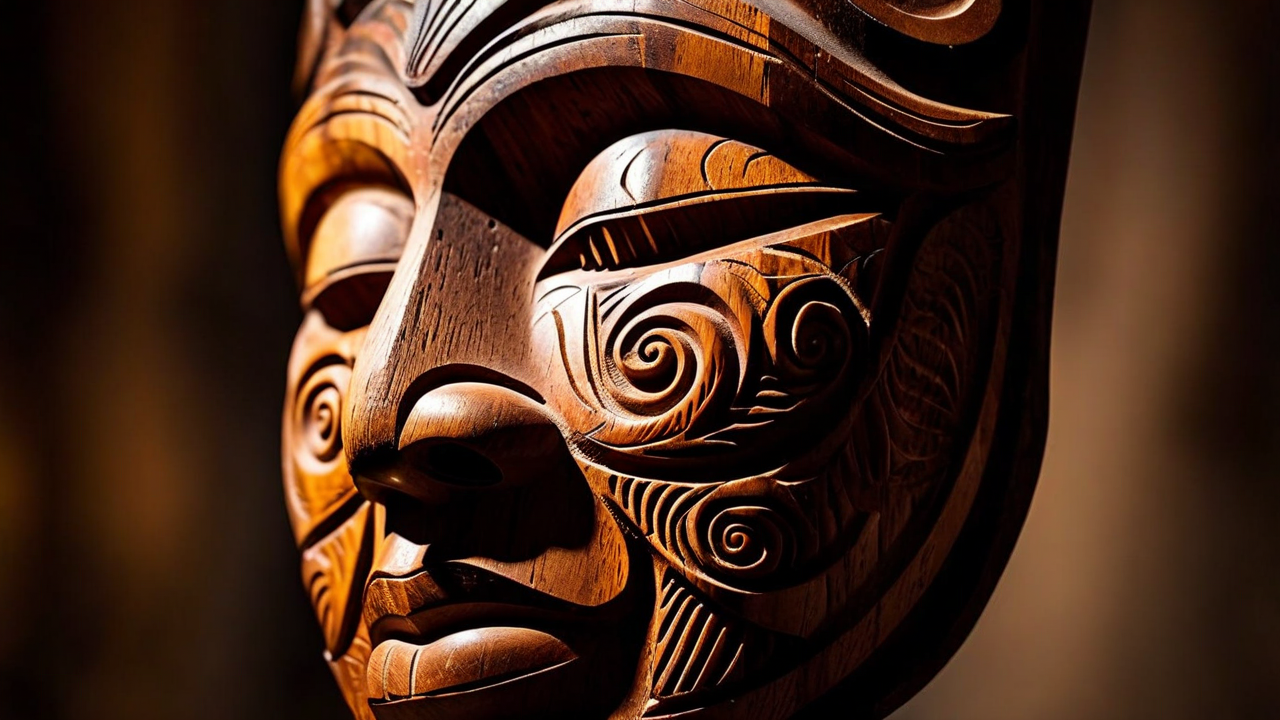
Around 17,8 % of New Zealanders identify as Māori — roughly 900 000 people — and the population is young, urban and growing faster than the national average. The story of the last fifty years is a recovery that at the start of the twentieth century almost nobody expected.
Te Reo Māori
In the 1970s fewer than 5 % of Māori children could speak the language; corporal punishment for speaking it at school was within living memory. The response was structural: kōhanga reo (language-nest preschools) from 1982, kura kaupapa (immersion schools), Māori Television from 2004, and official language status in 1987. It is not saved — fluency is still low — but it is normal: every New Zealander knows kia ora, whānau, mahi, kai, and government departments carry Māori names as a matter of course.
The marae
The communal centre of Māori life: the wharenui (meeting house), the marae ātea (the open ground in front of it, where formal challenge and speech happen), and the wharekai (dining hall). Visitors enter by pōwhiri — a formal welcome with challenge, calls, speeches, song and finally the hongi, the pressing of noses that shares breath. If you are offered this, accept, follow your host, take your shoes off, and do not eat or wear a hat inside the wharenui.
Tikanga and tapu
Tikanga is correct practice — protocol, custom, the right way. Tapu (restricted, sacred) and noa (ordinary, free) organise a great deal of it: why food and the head do not mix, why you do not sit on tables, why water is used to lift tapu after a funeral or a visit to a burial ground. Tikanga has increasingly been recognised in New Zealand courts as a source of law in its own right, which is a substantial and contested development.
The haka
Not one dance but many. Ka Mate, the one the All Blacks are famous for, was composed by Te Rauparaha around 1820 and its intellectual property is legally recognised as belonging to Ngāti Toa. Haka are performed at funerals, graduations, welcomes and protests as often as at sport, and a spontaneous haka at a New Zealand funeral is one of the most affecting things you can witness.
Moko
Traditional tattoo — moko kauae on the chin for women, mataora on the face for men — has returned strongly since the 1990s. A newsreader wearing moko kauae on prime-time television, a Member of Parliament, a judge: all now ordinary, all of which caused arguments when each first happened. It is a statement of whakapapa, not a fashion, and it is not something a visitor gets.
Where the friction is
Māori remain over-represented in every negative statistic and under-represented in wealth and health. The arguments of the 2020s — over co-governance of water, over the Treaty Principles Bill, over Māori wards on councils, over te reo in department names — are at bottom a single argument about whether the Treaty created a partnership between two parties or simply made everyone equal citizens. Both positions are sincerely held by large numbers of New Zealanders.
🗣️ Language — English, Te Reo, and the Vowels
Three official languages
Te Reo Māori (official since 1987), New Zealand Sign Language (2006) — one of very few countries to give a sign language full official status — and English, which is official by usage rather than statute. That ordering is deliberate and is how New Zealand's own agencies list them.
The accent
New Zealand English has undergone a vowel shift that Australians find endlessly amusing: the i in "fish and chips" is centralised toward a schwa, e raises toward i ("pen" toward "pin"), and a raises toward e ("pat" toward "pet"). The result is that six and sex are a genuine source of confusion, and "deck" is a word Australians ask New Zealanders to say.
Eh, and the rising terminal
"Eh?" tags the end of sentences constantly and means roughly "right?" or "don't you think?" — it is a solidarity marker rather than a question. The high rising terminal — statements that go up at the end — is often attributed here, and the linguistic evidence suggests it entered New Zealand English partly from Māori and Pacific speakers.
Māori words in ordinary English
Far more than in Australian or British English, and increasing. Kia ora (hello, be well), whānau (extended family), kai (food), mahi (work), puku (belly), mana (prestige, authority, standing), tapu, hui (meeting), kaupapa (purpose, agenda), tamariki (children), aroha (love, compassion). You will hear all of these on the radio news.
How to pronounce it
The rules are regular and worth five minutes. Wh is an f — whānau is "faa-no". Ng is the sound in "singer", and it can start a word. R is a light tap, close to a d. Vowels are pure and Italianate: a as in father, e as in bet, i as in machine, o as in more, u as in food. A macron (ā, ē, ī, ō, ū) doubles the length and changes the meaning. Whakatāne, Taupō, Whanganui — try them.
The h in Whanganui
A worked example of the politics of a single letter. The river and the iwi have always been Whanganui; the town was spelled Wanganui from the 1850s, because the local dialect softens the wh. After a long and bitter local argument, the Minister for Land Information ruled in 2015 that the official spelling would be Whanganui. Both spellings are still seen and the argument still has a pulse.
🧠 Fifteen Things About New Zealand That Are True
First country to give women the vote
19 September 1893, the first self-governing nation anywhere. Kate Sheppard's final petition ran to nearly 32 000 signatures and was unrolled down the floor of Parliament.
The last big place people found
Polynesian voyagers reached it around 1250–1300 CE — after the Norse had already reached Newfoundland. Everything else habitable had been settled thousands of years earlier.
No native land mammals
Except two species of bat. Eighty million years of isolation left the jobs of grazing, browsing and hunting to birds, which is why so many of them stopped flying.
The moa had no wings at all
Not reduced wings — no wing bones whatsoever, which is unique among birds. The largest stood 3,6 m to the top of a raised neck, and the eagle that hunted them had a 3 m span and was the largest ever to have lived.
More sheep than people, still
About 23 million sheep to 5,3 million people — a ratio of roughly 4:1, and a collapse from 70 million sheep in 1982, when it was 22:1. Dairy took the land.
A river is a legal person
The Whanganui River (2017) and Te Urewera (2014) have legal personality in their own right: they are not owned by anyone, they have rights, and they are represented in court by appointed guardians. These are now cited in environmental law worldwide.
Nuclear-free since 1987
New Zealand refused a US warship in 1985 because Washington would not say whether it carried nuclear weapons, and was effectively expelled from ANZUS for it. Forty years later no party proposes reversing the law.
France bombed Auckland
On 10 July 1985 French secret-service agents sank the Greenpeace ship Rainbow Warrior in Auckland harbour, killing a crew member. A friendly Western government committed a lethal terrorist attack on the soil of an ally.
The longest place name in the world
Taumatawhakatangihangakoauauotamateaturipukakapikimaungahoronukupokaiwhenuakitanatahu — 85 letters, a hill in Hawke's Bay, and it means roughly "the place where Tamatea, the man with the big knees, who slid, climbed and swallowed mountains, played his flute to his loved one".
The Alpine Fault is overdue
It has ruptured roughly every 250–300 years for the last eight ruptures. The last was 1717. The estimated probability of a magnitude-8 event in the next fifty years is around 75 %.
Auckland is a Polynesian city
It holds a third of New Zealand's population and is the largest Polynesian city on earth — more Sāmoans, Tongans and Cook Islanders than any city in the Pacific itself.
Kiwifruit is Chinese
Actinidia from the Yangtze valley, grown in New Zealand from 1904, and renamed from "Chinese gooseberry" in 1959 because the old name was unsellable in Cold War America.
Farm subsidies went to zero
In 1984 New Zealand abolished agricultural subsidies essentially overnight — the most radical liberalisation of farming anywhere — and the sector survived and is more efficient for it. It is cited in every international argument about farm support.
Bungy jumping was commercialised here
A. J. Hackett and Henry van Asch opened the world's first commercial bungy site at the Kawarau Bridge near Queenstown in 1988, after Hackett jumped off the Eiffel Tower to publicise it. The idea is Vanuatu's land-diving; the industry is New Zealand's.
An MP led a haka in Parliament
In November 2024, during the first reading of the Treaty Principles Bill, Hana-Rāwhiti Maipi-Clarke — then 22, the youngest MP in 170 years — tore up the bill and led a haka across the floor of the House. The video was seen hundreds of millions of times.
🌋 The North Island — Volcanoes, Steam and Most of the People
Three quarters of New Zealanders live on the North Island, and it is the warmer, busier, more Māori and more volcanic of the two. Its middle is a live volcanic zone and its north is subtropical.
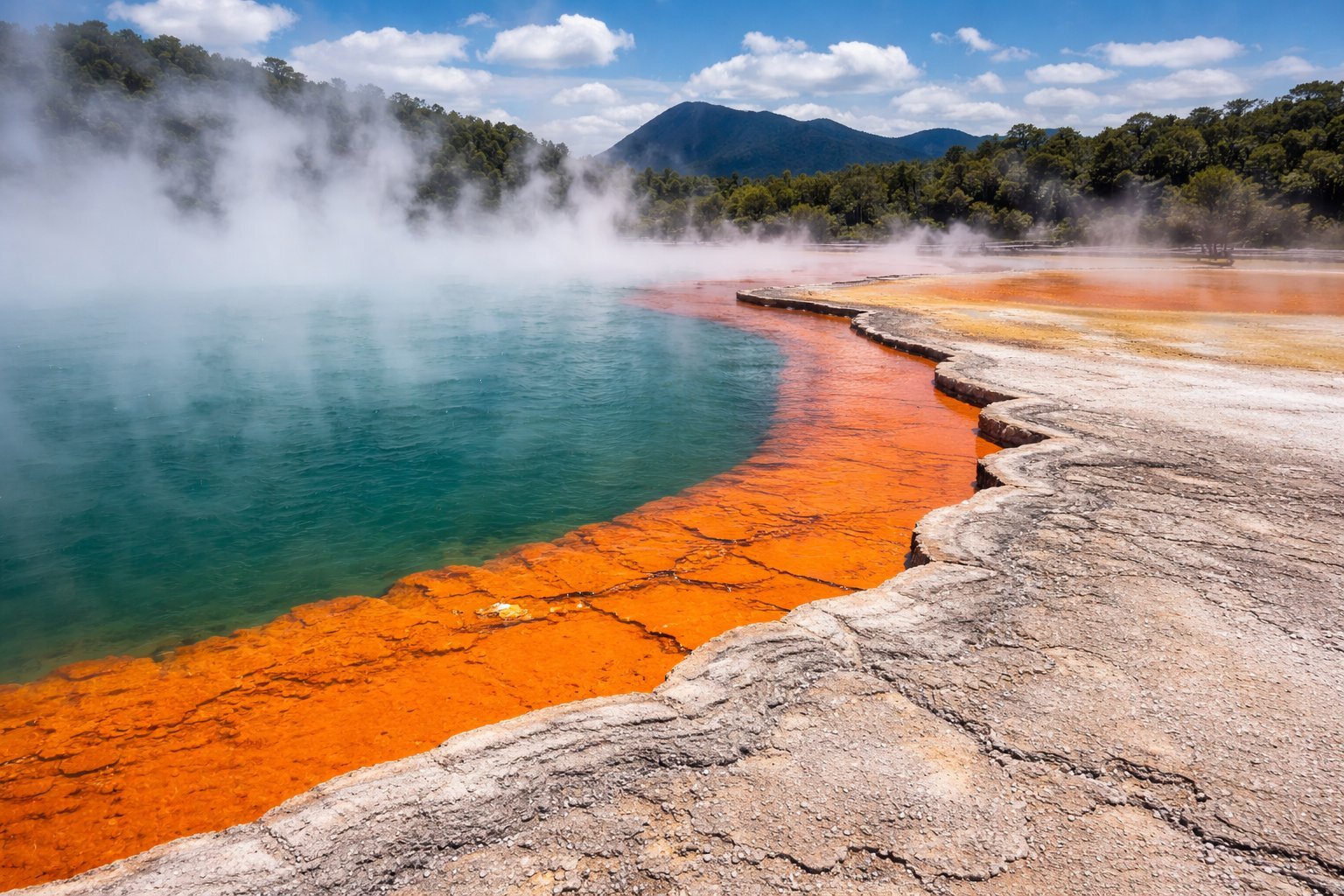
Rotorua
The geothermal capital and the centre of Te Arawa. Sulphur in the air, mud pools bubbling in the municipal park, and the country's most developed Māori cultural tourism — of which Whakarewarewa, a living village where people cook in the steam and have done for centuries, is the real thing rather than a show. Wai-O-Tapu and Waimangu are the geothermal parks; Waimangu's valley was created by the 1886 Tarawera eruption, which killed around 120 people and destroyed the Pink and White Terraces, then considered the eighth wonder of the world.
Tongariro
The country's first national park, gifted to the nation by Te Heuheu Tūkino IV of Ngāti Tūwharetoa in 1887 specifically to protect it — the first national park anywhere created by an indigenous gift. It is a dual World Heritage site, listed for both nature and Māori cultural values. The Tongariro Alpine Crossing, 19,4 km past steaming craters and the Emerald Lakes, is the most walked day hike in New Zealand and the mountains are sacred, which is why the summit of Ngāuruhoe is asked not to be climbed.
Taupō and the lake
Lake Taupō is a caldera the size of Singapore, and the Hatepe eruption around 232 CE that formed its present shape was among the most violent of the past five millennia — Roman and Chinese chroniclers recorded red skies. Today it is a trout-fishing and watersports lake with a town on it. The Huka Falls nearby push the entire Waikato River through an 15 m gap.
Northland and the Bay of Islands
The subtropical top: Waitangi and its treaty grounds, Kerikeri with the country's oldest buildings, Cape Reinga where Māori tradition says spirits depart, and the surviving kauri forests — including Tāne Mahuta, about 2 000 years old and 51 m tall, which you now approach across a boot-washing station because kauri dieback is spread by soil on shoes.
Taranaki and the Waikato
Mount Taranaki is an almost perfectly symmetrical 2 518 m cone on the west coast — it stood in for Mount Fuji in The Last Samurai — and in 2025 it was granted legal personhood as Te Kāhui Tupua, the third such case in New Zealand. The Waikato is the dairy heartland and the seat of the Kīngitanga at Tūrangawaewae marae.
Coromandel and East Cape
The Coromandel peninsula for Hot Water Beach, where you dig your own hot pool at low tide, and Cathedral Cove. The East Cape is the least visited road in the North Island, strongly Māori, with the first sunrise in the world at the East Cape lighthouse and a road that takes twice as long as the map says.
🏙️ Auckland, Wellington, Christchurch
Auckland
1,7 million people, a third of the country, built across an isthmus between two harbours and on top of 53 volcanic cones in a field that is not extinct. It is the largest Polynesian city in the world and one of the most ethnically diverse anywhere — around 40 % of residents were born overseas. Do: the Auckland War Memorial Museum (superb Māori and Pacific collections), Rangitoto by ferry, Waiheke for wine, and the West Coast beaches, Piha and Karekare, where the black iron sand is dangerous and stunning.
Wellington
The capital, and much the most likeable city. 215 000 people wedged between a harbour and steep hills, so it is compact and walkable, with the highest café density in the country, a serious theatre and film scene, and the wind: it is one of the windiest cities on earth, averaging gusts over 60 km/h on about 175 days a year. Do: Te Papa, the national museum, which is free and genuinely excellent; the cable car and the botanic garden; Zealandia, a fenced 225-hectare ecosanctuary inside the city where kākā and tīeke have re-established; and Weta Workshop.
Christchurch
The South Island's largest city and the most changed. The 22 February 2011 earthquake killed 185 people and destroyed most of the centre, including the CTV building where 115 died. Fifteen years on it is a rebuilt city with a young centre, a Cardboard Cathedral by Shigeru Ban that was meant to be temporary, and the ruined Anglican cathedral still being argued over. The 185 Empty Chairs memorial is the one that stops people. It remains the most English-looking city in New Zealand, with a river called the Avon and punting on it.
Dunedin
Scottish to its bones — the name is the Gaelic for Edinburgh — with New Zealand's oldest university, the country's best Victorian and Edwardian architecture, a steep street that holds a world record (Baldwin Street), and an albatross colony on the Otago Peninsula that is the only mainland royal albatross breeding site on earth. Also yellow-eyed penguins, sea lions on the beach, and a student culture involving burning furniture.
Queenstown
The adventure capital: bungy, jetboats, skydiving, skiing, paragliding, on a lake under the Remarkables. It is beautiful, it is extremely commercial, it is the most expensive place in the country, and it has a genuine housing crisis because workers cannot afford to live in the town they serve. Wānaka, an hour away, is what Queenstown was twenty years ago and is heading the same way.
Napier and the smaller ones
Napier was flattened by the 1931 earthquake and rebuilt entirely in Art Deco, which makes it one of the most coherent 1930s townscapes in the world. Nelson for sunshine and arts, New Plymouth for the Coastal Walkway and the Len Lye Centre, Invercargill for the bottom of the country and a motorcycle museum that is much better than that sounds.
🏔️ The South Island — Alps, Fiords and Almost Nobody
The South Island is larger than the North and holds about a quarter of the population. Its west is rainforest and glacier, its east is dry plain and tussock, and between them is a 500 km wall of mountains.
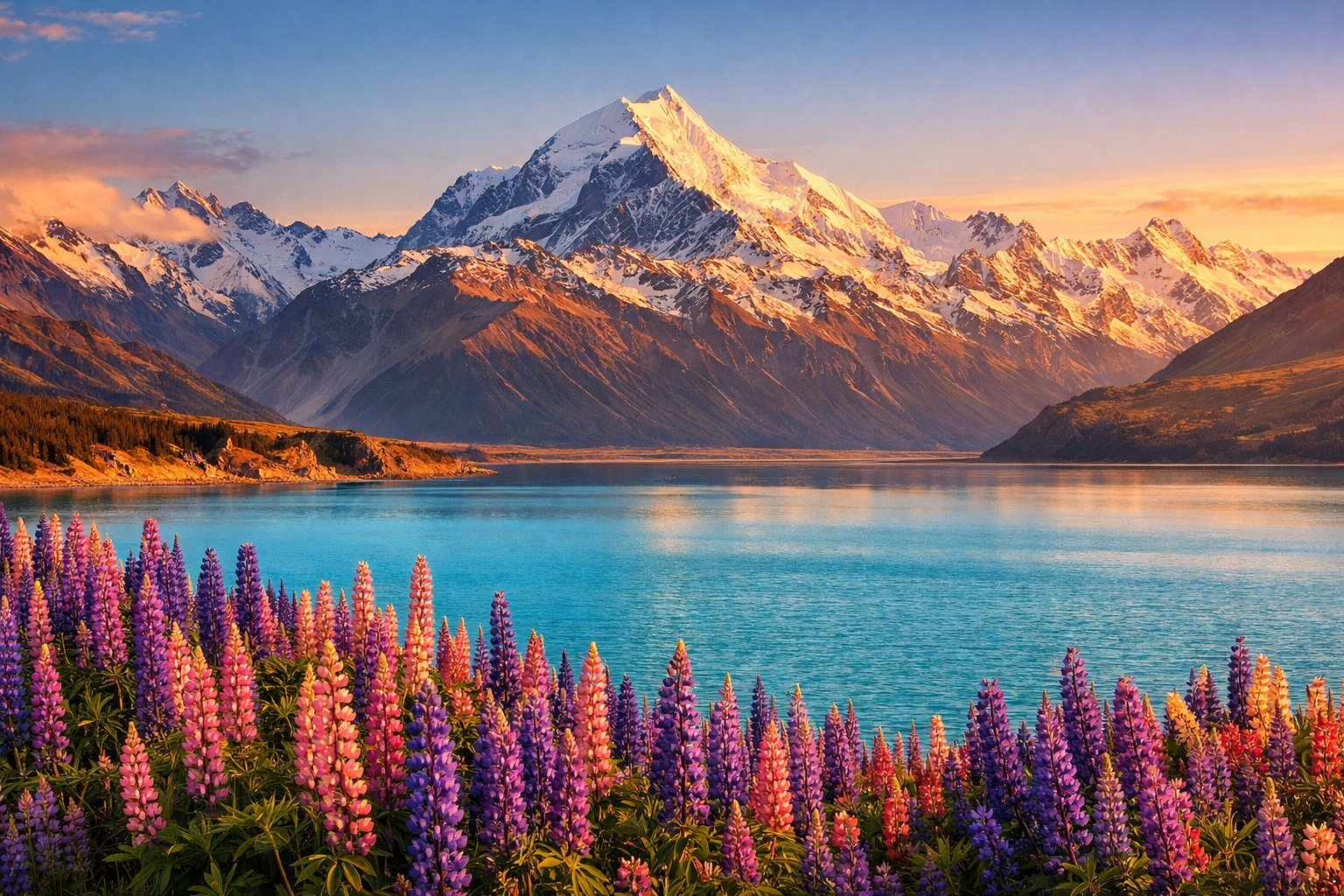
Aoraki / Mount Cook
3 724 m, and it used to be ten metres higher: a rock avalanche took the summit off in 1991. Edmund Hillary trained here. The Hooker Valley Track is a flat three-hour return walk to a glacial lake with the mountain at the end of it and is the single best short walk in the country. The surrounding Mackenzie Basin is an International Dark Sky Reserve, one of the largest in the world.
Fiordland
1,2 million hectares of the emptiest country in New Zealand, part of the Te Wāhipounamu World Heritage area. Milford Sound — properly Piopiotahi — gets up to 8 000 mm of rain a year, which means the waterfalls are best in the rain, which is the opposite of most advice you will get. Doubtful Sound is larger, quieter and harder to reach. The Milford Track, 53,5 km over four days, has been called the finest walk in the world since 1908 and must be booked months ahead.
The West Coast
Rainforest to the shoreline, the Franz Josef and Fox glaciers descending to 300 m above sea level through temperate forest — both in fast retreat, and both now reached by helicopter rather than on foot because the terminal faces have become unstable. Punakaiki's pancake rocks and blowholes, and a road along the Tasman that is among the great coastal drives.
Central Otago and the Mackenzie
The dry interior: schist tors, thyme-covered hills, the gold-rush ghost towns of Bannockburn and St Bathans, and the country's most extreme climate — −25 °C has been recorded at Ranfurly and 38 °C in summer. It is also the world's southernmost significant wine region. The Otago Central Rail Trail, 152 km of former railway, started New Zealand's cycle-trail network.
Marlborough and Nelson
The sunny top of the island. The Marlborough Sounds are drowned river valleys, and the ferry from Wellington threads them for an hour — one of the great public-transport journeys anywhere. Abel Tasman National Park has golden beaches and a coastal track you can walk or kayak. And Marlborough is where two thirds of New Zealand's wine comes from.
Stewart Island / Rakiura
The third island, 400 people, 85 % national park, and the best place in the country to see a kiwi in the wild — the Stewart Island tokoeka forages in daylight on the beaches, which no other kiwi does. It is also a Dark Sky Sanctuary and one of the most reliable places on earth to see the aurora australis.
🐦 Wildlife — What Is Left and Where to See It
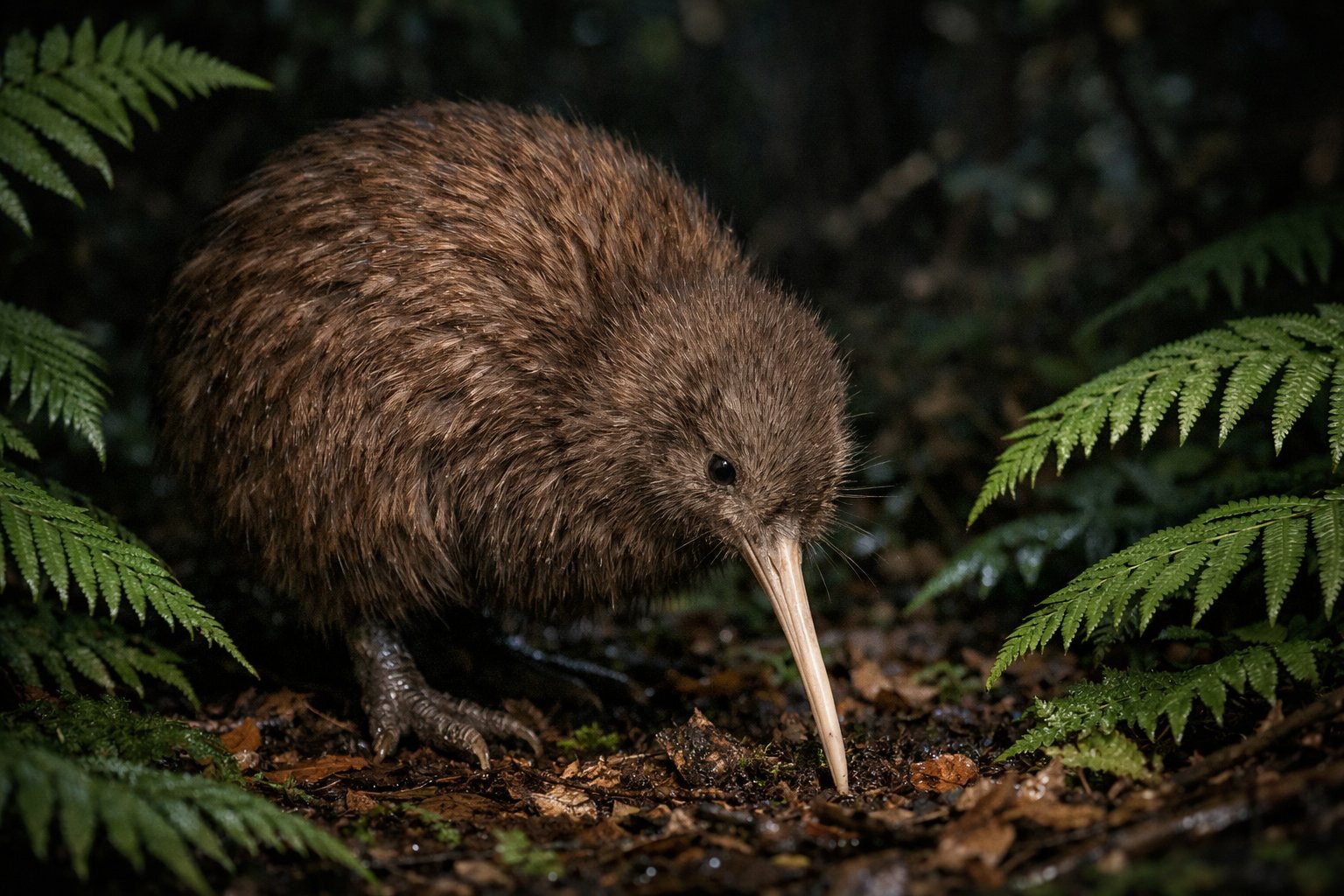
Where to see a kiwi
Almost never by accident. Reliable options: Stewart Island, where the tokoeka forages by day; a guided night walk on Kāpiti Island, at Zealandia in Wellington, or in the Ōkārito forest on the West Coast; or a captive nocturnal house — the National Kiwi Hatchery in Rotorua and the West Coast Wildlife Centre both run serious breed-for-release programmes and are worth the money.
The other birds
Kea — the world's only alpine parrot, ferociously intelligent, which will strip the rubber from your car and has been shown to use tools and understand probability. Kākā, tūī (which sings in two voice boxes at once and mimics), korimako/bellbird, pīwakawaka/fantail, takahē — declared extinct in 1898 and rediscovered in 1948 in a Fiordland valley, now about 500 birds — and the kākāpō, at around 240–250 and every one of them named.
Marine
Kaikōura is one of the few places on earth where a deep submarine canyon comes close inshore, so sperm whales are resident year-round, along with dusky dolphins in pods of hundreds. Hector's dolphin is the world's smallest and rarest marine dolphin, found only here; its North Island subspecies, the Māui dolphin, is down to about 54 adults and is one of the most endangered mammals alive. Fur seals are everywhere and back from near-extinction.
Penguins
Three you can see: the kororā/little blue, the world's smallest penguin, which comes ashore at dusk at Oamaru; the hoiho/yellow-eyed, one of the world's rarest, on the Otago Peninsula and in the Catlins; and the tawaki/Fiordland crested, which nests in rainforest, which is not where you expect to find a penguin.
Where there are no birds
Worth stating plainly: much of mainland New Zealand's forest is now quiet. Early European accounts describe a dawn chorus so loud it woke people on ships offshore. Most of that is gone, eaten by stoats, rats and possums, and what visitors take for pristine wilderness is often an intact forest with its animals removed. This is why the fenced sanctuaries are such a revelation — go to Zealandia and hear what the whole country used to sound like.
⚠️ What not to do
Do not feed kea — it kills them, and they are already endangered. Do not approach fur seals or get between one and the sea. Keep dogs away from anywhere kiwi live; a single dog can destroy a local population in a night. And clean your boots at every trailhead station, for kauri dieback and didymo — these are not theatre, they are the front line.
🛡️ Predator Free 2050 and the Rivers
New Zealand is attempting one of the most ambitious conservation projects any country has ever set itself, and at the same time has one of the developed world's worse records on fresh water. Both facts are true and they are the same country arguing with itself.
Predator Free 2050
Announced in 2016: the complete eradication of rats, stoats and possums from the entirety of New Zealand by 2050. Nothing on this scale has been attempted anywhere. The techniques were developed here — New Zealand has cleared predators from over 100 offshore islands, including Campbell Island at 11 300 hectares, which was the largest rat eradication ever done — and the mainland problem is a different order of magnitude.
The 1080 argument
The tool that makes it possible and the thing New Zealanders fight about most. Sodium fluoroacetate, aerially dropped, is used on a scale seen nowhere else. It works: treated forests show dramatic recovery in kōkako, kea and mōhua. It also kills non-target animals including some kea and dogs, it is deeply opposed by parts of the hunting and rural community, and signs at trailheads warn of drops. The science consensus supports it; the public argument is not settled and is often very ugly.
The sanctuaries
Zealandia in Wellington was the first fully fenced urban ecosanctuary in the world and its birds have spilled into the city — Wellington now has kākā in suburban gardens because of it. Maungatautari, Tāwharanui, Orokonui and dozens of community projects follow the model. And the predator-free ethic is now domestic: hundreds of thousands of households run backyard traps.
⚠️ The rivers
The uncomfortable half. Intensive dairy conversion has put nitrate, phosphorus and sediment into waterways at a scale the "100 % Pure New Zealand" tourism slogan cannot survive contact with: a substantial majority of monitored lowland rivers are unsafe to swim in, and roughly three quarters of native freshwater fish species are threatened or at risk. The National Policy Statement on freshwater has been tightened, loosened and tightened again with each change of government.
Carbon and cows
New Zealand's emissions profile is unusual: about half comes from agriculture, mostly biogenic methane from ruminants, which no other developed country has to deal with at that share. The proposal to price agricultural emissions — inevitably called "the fart tax" — has been introduced, withdrawn, redesigned and deferred repeatedly since 2003, and is currently deferred again.
Where it succeeds
It is worth ending on the record: the black robin recovered from five birds in 1980, including a single fertile female called Old Blue, to over 250 today — the tightest genetic bottleneck any bird has ever come back from. The takahē is being returned to the wild. The kākāpō has quintupled. New Zealand's conservation practitioners are, by common consent, the best in the world at this, largely because they have had the most practice.
🏉 Rugby, the Haka and a Country's Nerves
It is difficult to overstate what rugby union does in New Zealand. The All Blacks have won roughly three quarters of every test match they have ever played across more than 120 years, which is the best sustained record of any team in any professional sport anywhere. A country of five million has been the best in the world at something for a century, and it has organised a great deal of its self-image around that.
The record
Three Rugby World Cups — 1987, 2011 and 2015, the last making them the first team to retain it. A win rate that has never dropped below about 70 %. And a scar: between 1987 and 2011 they were favourites at every tournament and won none of them, which New Zealanders describe in the language of national therapy. The 2011 final, won 8–7 at home, was watched by most of the country through their fingers.
The haka
Performed before every test since 1905. Ka Mate was composed by Te Rauparaha around 1820, and its intellectual property is legally recognised as belonging to Ngāti Toa under their Treaty settlement. Since 2005 the team has sometimes performed Kapa o Pango, written for them, which ends with a throat-cutting gesture that caused an international argument and which Māori commentators explained as drawing breath into the lungs, not cutting a throat.
⚠️ The Springbok tour, 1981
Rugby's darkest moment here and the closest New Zealand has come to civil disorder. The government allowed the apartheid-era South African Springboks to tour; the country split down the middle. Matches were invaded, one was cancelled when protesters occupied the pitch, a Cessna flour-bombed the final test at Eden Park, and police in riot gear baton-charged crowds in New Zealand streets for the first time. Families stopped speaking to each other. It is still the reference point for how deeply sport and politics are tangled here.
The Black Ferns
The women's team, and by the trophy count the more successful side: six Rugby World Cups. Their 2022 home tournament final at Eden Park was watched by 42 579 people, a world record for a women's rugby match, and is widely credited with changing the domestic view of the women's game overnight.
Everything else
Cricket — the Black Caps, and the 2019 World Cup final that New Zealand lost on boundary countback after tying twice, which the rest of the cricketing world still apologises for. Netball, genuinely major here. Sailing: Team New Zealand has won the America's Cup in 1995, 2000, 2017 and 2021, from the smallest country ever to hold it. Rowing, cycling and a remarkable per-capita Olympic medal record. And Lydia Ko in golf.
Going to a game
Super Rugby runs February to June, the NPC provincial competition August to October, and internationals in July and the spring. Tickets are cheap by European standards and crowds are family-heavy and good-humoured. If you get the chance, go to a club or provincial match rather than a test — the small-town Saturday game with a sausage sizzle is closer to what the sport actually is here.
🪂 Adventure — the Industry New Zealand Invented
New Zealand did not invent risk, but it industrialised it. The modern commercial adventure-tourism sector — the idea that you can sell a stranger a carefully managed brush with danger — was substantially built here in the 1980s and exported.
Bungy
A. J. Hackett and Henry van Asch opened the world's first commercial bungy operation at the Kawarau Bridge near Queenstown in 1988, after Hackett publicised it by jumping illegally off the Eiffel Tower. The idea came from the land divers of Pentecost Island in Vanuatu, whose ritual was filmed by the BBC — a debt the industry acknowledges unevenly. Kawarau is 43 m; the Nevis is 134 m and eight and a half seconds of freefall.
Jetboats
Genuinely a New Zealand invention: Bill Hamilton developed the modern waterjet in the 1950s to get up the shallow braided rivers of Canterbury, and the Hamilton jet is now used by navies and rescue services worldwide. The tourist version — the Shotover Jet through a rock canyon at 85 km/h with 360-degree spins — is a proper piece of engineering heritage disguised as a thrill ride.
Skydiving and flying
Tandem jumps over Lake Wānaka, Queenstown, Taupō and Franz Josef, typically from 12 000 or 15 000 feet, with scenery that is the entire selling point. Paragliding off the Coronet Peak and Treble Cone. And scenic flights over Aoraki and the glaciers, including ski-plane landings on the Tasman Glacier.
Caving and canyoning
Waitomo is the famous one: limestone caves lit by glowworms — Arachnocampa luminosa, a fungus gnat larva whose light lures prey into sticky threads — seen either from a quiet boat or by black-water rafting, which means floating through the caves on an inner tube in a wetsuit. Canyoning in the Routeburn and Wānaka areas.
⚠️ The safety record
Worth stating honestly. New Zealand's adventure industry is heavily regulated and generally very safe, and it has had bad accidents — the Carterton balloon crash (2012, 11 dead), the Fox Glacier plane crash (2010, 9 dead), and the Whakaari / White Island eruption on 9 December 2019, which killed 22 people on a tour of an active volcano and led to a series of criminal prosecutions under health and safety law. Whakaari remains closed to visitors. Check that your operator is audited and certified, and read your travel insurance's adventure-sports clause before you book anything.
The Great Walks
The gentler end, and for many people the best of the country. Ten Great Walks — Milford, Routeburn, Kepler, Abel Tasman, Tongariro Northern Circuit, Heaphy, Rakiura, Lake Waikaremoana, Paparoa and Whanganui Journey — with booked huts, maintained tracks and, for the popular ones, a booking scramble the morning the season opens. Beyond them are 950 backcountry huts that need no booking and cost a few dollars.
🎬 Middle-earth, and What the Film Industry Did
The Lord of the Rings
Peter Jackson shot all three films simultaneously in New Zealand between 1999 and 2000 across more than 150 locations, and the trilogy took 17 Academy Awards, with The Return of the King sweeping all eleven it was nominated for. The government appointed a Minister for Lord of the Rings — this is real — and the films are generally credited with adding billions to tourism over the following two decades.
What you can actually visit
Most locations are simply landscape and were restored afterwards, which is why Hobbiton at Matamata is the one real set: rebuilt permanently for The Hobbit, and now a commercial attraction with a working pub. Tongariro was Mordor, the Southern Alps were Misty Mountains, Glenorchy and the Paradise valley were Isengard and Lothlórien. Wellington holds the studios — Wētā Workshop runs tours and the Wētā Cave is free.
Wētā
The lasting asset is not the films but the capability. Wētā Workshop (practical effects, props, armour) and Wētā FX (digital) built in Wellington are among the best in the world and have worked on Avatar, the Marvel films, District 9 and Dune. Gollum's performance capture, developed here with Andy Serkis, changed how the whole industry does digital characters.
The other New Zealand cinema
Which is much stranger and often better. Jane Campion's The Piano (1993) won the Palme d'Or and three Oscars; Once Were Warriors (1994) is a brutal, essential film about urban Māori life that New Zealand still argues about; Whale Rider (2002) got a 13-year-old Keisha Castle-Hughes an Oscar nomination. And Taika Waititi — Boy, Hunt for the Wilderpeople, What We Do in the Shadows, then Jojo Rabbit and an Oscar — has done more than anyone to put a specifically Māori comic voice on screen worldwide.
The Hobbit law
The uncomfortable footnote. In 2010, during a dispute with actors' unions over collective bargaining, the government passed legislation — drafted in days, after direct negotiation with Warner Bros — reclassifying film production workers as independent contractors so they could not bargain collectively, in exchange for the films staying in New Zealand. It is known as "the Hobbit law", it was partially repealed in 2022, and it is the standard case study in what a small country will do to keep a studio.
What to watch before you come
Hunt for the Wilderpeople for the bush and the humour. Whale Rider for the East Coast and the Treaty in miniature. Once Were Warriors if you want the other side of the postcard. The Piano for Karekare beach. And Boy, which is the funniest and saddest film on the list.
🍽️ Food — Pacific, Pasture and a Very Good Coffee Habit
New Zealand food went from British-colonial meat-and-three-veg to something genuinely distinctive in about thirty years, and the drivers were the produce, the Pacific and Asian immigration, and a national obsession with coffee that outstrips almost anywhere.
🌿 Hāngī
The Māori earth oven and the country's oldest cooking method: a pit, stones heated in a fire for hours, then meat, kūmara, potato, pumpkin and cabbage in baskets on top, covered with wet sacking and earth and left to steam for three to four hours. It comes out soft and faintly smoky and it is a communal dish — you do not make a hāngī for two. Eat it at a marae or at Rotorua, and note that in Rotorua some are cooked in geothermal steam instead, which is a genuinely local variant.
🥝 Kiwifruit, kūmara and the produce
The raw material is the real strength: lamb that is grass-fed year-round, Bluff oysters (a dredged wild oyster with a short, ferociously anticipated season from March), green-lipped mussels, whitebait in spring — a translucent juvenile fish eaten in a fritter, priced like truffles and the subject of an ongoing conservation argument — and kūmara, the Polynesian sweet potato that came in the canoes.
☕ Coffee, seriously
New Zealand's espresso culture is world-class and predates the global third wave. The flat white was invented here or in Sydney — both claim it, the argument is unresolvable and enjoyed by both — and the correct version is a double ristretto with steamed milk and a thin, glossy microfoam, not a latte. Wellington has one of the highest café densities on earth. A bad coffee in New Zealand is genuinely hard to find.
🥧 Pavlova
A meringue base — crisp outside, marshmallow inside — with whipped cream and fruit, canonically kiwifruit and passionfruit. Australia and New Zealand have disputed its origin for a century; the Oxford English Dictionary came down on New Zealand's side in 2010, citing a 1927 recipe, and Australians remain unconvinced. It is named for the ballerina Anna Pavlova, who toured both countries in 1926.
🍟 The everyday canon
Fish and chips wrapped in paper, eaten at the beach, with the fish being hoki, snapper or the frankly named "shark" (rig). The mince and cheese pie, a national institution with an annual Supreme Pie Awards taken entirely seriously. The sausage sizzle outside a hardware shop on a Saturday, raising money for something. Hokey pokey ice cream — vanilla with lumps of honeycomb toffee — which is a New Zealand invention and is the second most popular flavour in the country.
🥢 Lamingtons, L&P and the rest
Lamingtons (Australian, adopted). Afghan biscuits — cocoa, cornflakes, chocolate icing, half a walnut — whose name has no agreed explanation. Marmite, which is a different and sweeter product from the British one and which New Zealanders will defend at length. L&P, Lemon & Paeroa, a lemon soft drink from a mineral spring, marketed as "world famous in New Zealand", which is the best self-deprecating slogan any country has produced.
🍳 Three New Zealand Recipes
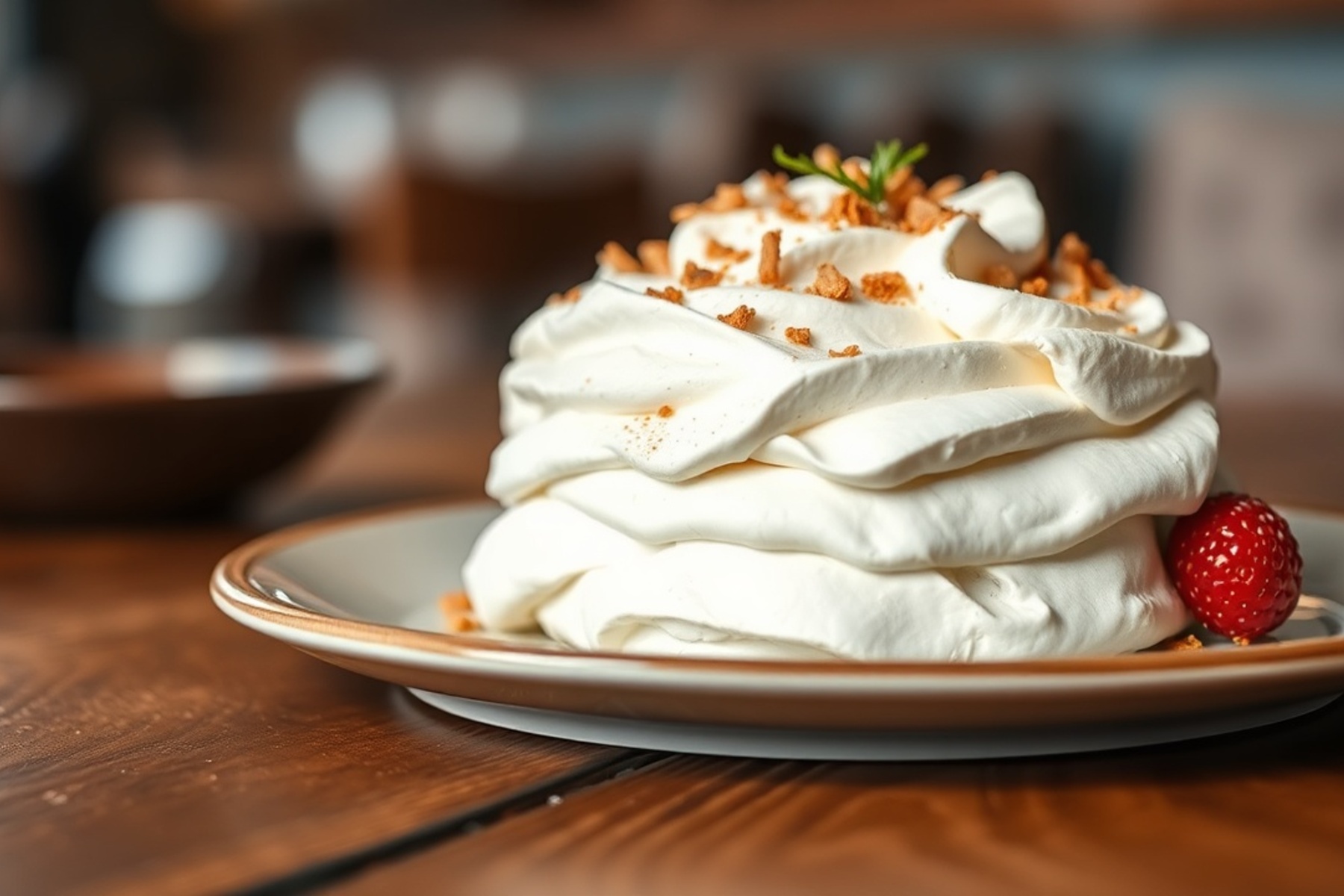
🥧 Pavlova
The national dessert · serves 8 · 2 hours plus cooling
Ingredients: Meringue: 4 egg whites at room temperature · 250 g caster sugar · 2 tsp cornflour · 1 tsp white vinegar · ½ tsp vanilla · a pinch of salt. To top: 300 ml cream, whipped to soft peaks and unsweetened · 3 kiwifruit, sliced · the pulp of 3–4 passionfruit · optional strawberries.
Method: Heat the oven to 150 °C and draw a 20 cm circle on baking paper. Whisk the whites with the salt to soft peaks, then add the sugar a tablespoon at a time, whisking a full minute between additions — this is the whole recipe, and rushing it is why pavlovas weep. When it is stiff, glossy and shows no grain when you rub a little between your fingers, fold in the cornflour, vinegar and vanilla. Pile it onto the circle and shape it with a slight hollow in the top and steep sides. Put it in, immediately turn the oven down to 120 °C, and bake 1 hour 15 minutes. Then turn the oven off and leave it in there, door closed, until completely cold — overnight is ideal. Assemble only just before serving: cream, then kiwifruit, then the passionfruit poured over.
💡 The cornflour and vinegar are what make a pavlova rather than a meringue: they keep the middle soft. Never assemble in advance — cream on meringue collapses it within the hour — and never sweeten the cream, because the base already carries 250 g of sugar.
🌿 Hāngī — the Home Oven Version
Earth-oven flavours without the earth · serves 8 · 4 hours
Ingredients: 1,5 kg lamb shoulder or pork shoulder, bone in · 1 whole chicken, jointed · 1 kg kūmara (orange sweet potato), in large chunks · 1 kg waxy potatoes · 500 g pumpkin · 1 green cabbage, quartered · 2 onions · a large handful of soaked, unbleached muslin or clean cotton cloth · water · salt and pepper. Optional and important for the flavour: a small piece of mānuka or other hardwood, smoked separately, or a few drops of good liquid smoke.
Method: The real thing: dig a pit, burn hardwood down over river stones for three hours, rake out the embers, lay wet cloth and baskets of food on the stones, cover with more wet cloth and then earth to seal it completely, and leave it 3–4 hours. No steam should escape; if it does the hāngī is spoiled. At home: line a large roasting tin with wet muslin. Put the meat on the bottom, root vegetables around it, pumpkin and onion above, cabbage on top — cabbage takes the least cooking and protects everything below. Season, add 200 ml water, fold the cloth over, cover tightly with foil and a lid. 150 °C for 3½ hours. Do not open it. The meat should fall apart and everything should taste faintly of everything else.
💡 Two honest notes. The smoke is the flavour you cannot fake at home, and a genuine hāngī tastes of earth and mānuka in a way an oven simply does not reproduce. And if you get the chance to eat a real one — at a marae, at a community fundraiser, in Rotorua — take it, because this recipe is a memory of that, not a substitute.
🍪 Afghan Biscuits
The strangest and best New Zealand biscuit · makes 20 · 40 minutes
Ingredients: 200 g butter, softened · 75 g caster sugar · 175 g plain flour · 25 g cocoa · 50 g cornflakes, not crushed · a pinch of salt. Icing: 150 g icing sugar · 2 tbsp cocoa · about 2 tbsp boiling water · 20 walnut halves.
Method: Cream the butter and sugar until pale. Sift in the flour, cocoa and salt and mix to a stiff dough. Fold in the cornflakes as gently as you can — they must stay in recognisable pieces, and this is what makes the texture. Roll walnut-sized balls, place on a lined tray and flatten slightly with a fork. Bake at 180 °C for 15 minutes. They will still be soft; leave them on the tray to firm up. Cool completely, then ice with the cocoa icing and press half a walnut into each before it sets.
💡 Nobody knows where the name comes from and every proposed explanation has been contested. The biscuit is in the 1934 Edmonds Cookery Book — the country's domestic bible, in more New Zealand kitchens than the Bible — and is unchanged since. Do not crush the cornflakes.
🍷 Wine — Forty Years From Nothing to World Class
In 1970 New Zealand had about 400 hectares of vines and made mostly fortified wine of no interest to anyone. Today it has around 42 000 hectares, exports to a hundred markets, and gets a higher average price per litre for its wine than any other significant exporting country. The whole industry is younger than most of the people running it.
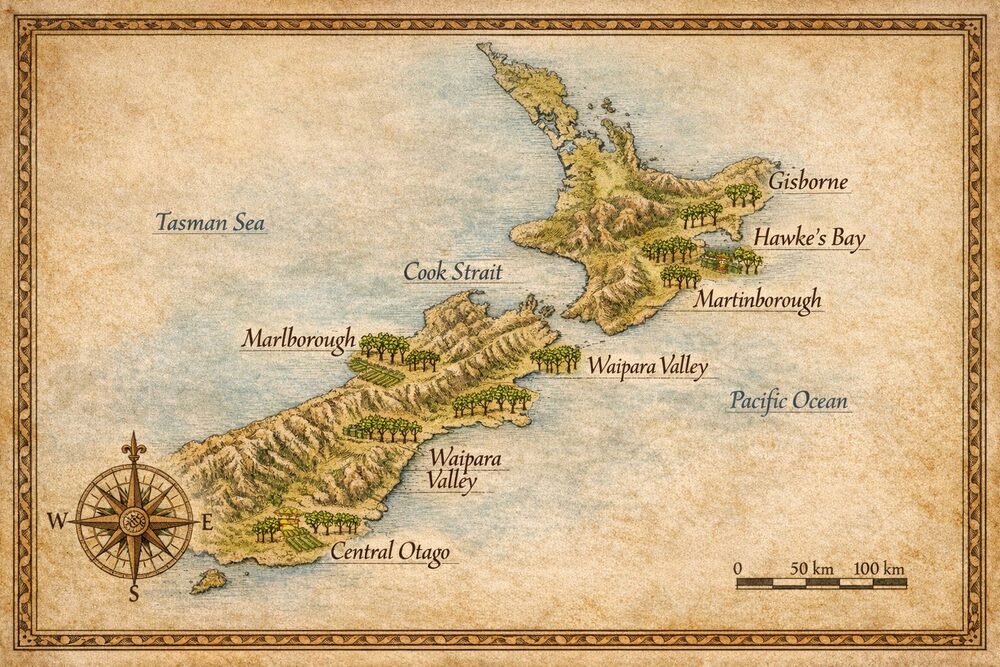
Marlborough sauvignon blanc
The wine that made the country. Montana planted the first vines in Marlborough in 1973; by the mid-1980s the style — explosively aromatic, gooseberry and cut grass and passionfruit, driven by a long cool ripening season and huge diurnal swings — had rewritten what the world thought sauvignon blanc could be. Marlborough is now about two thirds of all New Zealand wine. Producers to look for: Cloudy Bay (the original export sensation), Greywacke, Dog Point, Seresin.
Central Otago pinot noir
The world's southernmost significant wine region, at 45° south, in a semi-continental climate that should not work and does: schist soils, huge day-night swings, and pinot noir of real concentration and structure. Sub-regions differ sharply — Bannockburn, Gibbston, Bendigo, Wānaka. Look for Felton Road, Rippon (on the shore of Lake Wānaka and one of the most beautiful vineyards anywhere), Burn Cottage, Mt Difficulty.
Hawke's Bay
The oldest region and the one that makes the serious reds: Bordeaux blends and syrah from the Gimblett Gravels, a stony former riverbed whose heat-retaining stones make it the warmest terroir in the country. Te Mata Coleraine, Craggy Range Le Sol, Trinity Hill. Hawke's Bay chardonnay is also, quietly, the best in New Zealand.
Martinborough and the rest
Martinborough, an hour over the hill from Wellington, makes small-production pinot of great finesse — Ata Rangi, Dry River — in a village you can walk around in an afternoon with a tasting at each end. Waipara in north Canterbury for riesling and pinot. Nelson for aromatic whites. Gisborne, once the bulk-chardonnay engine, now smaller and better.
Screwcaps and sustainability
New Zealand led the world to the screwcap: the industry moved almost wholesale to Stelvin closures from 2001 and over 95 % of production is now sealed that way, which more or less ended cork taint as a problem here. Sustainable Winegrowing New Zealand certifies around 96 % of the vineyard area, and a substantial organic and biodynamic sector sits on top of that.
Visiting
Waiheke Island, 40 minutes by ferry from downtown Auckland, is the easiest wine day in the country and makes good syrah and Bordeaux blends. Marlborough is best by bicycle — the Blenheim vineyards are flat and close together and several dozen cellar doors are within an easy ride. Central Otago needs a car or a tour, and the drive alone justifies it. Tasting fees are modest and usually refunded against a purchase.
📰 Media, Press Freedom & Resources
New Zealand consistently ranks in the top ten to twenty of the RSF press freedom index and has a small, concentrated media market under real commercial pressure — two facts that are increasingly in tension.
What to read and watch
RNZ (Radio New Zealand) is the public broadcaster and the best single source — ad-free, well-resourced and with a strong Pacific desk. The New Zealand Herald (Auckland), The Post (Wellington) and The Press (Christchurch) are the metropolitan dailies. Stuff and 1News online. Newsroom and The Spinoff for analysis and long-form — The Spinoff in particular has done the best public explaining of the Treaty arguments of the last five years.
Māori media
Whakaata Māori (Māori Television) since 2004 and Te Ao Māori News, plus a network of iwi radio stations established from the 1980s under Treaty language obligations. These are not niche outlets: they broke and led much of the coverage of the 2024 hīkoi, and mainstream newsrooms follow them on Treaty stories.
⚠️ The pressure
The market is shrinking fast. Newshub, one of the two commercial television newsrooms, closed in 2024; TVNZ has cut current-affairs programmes; regional papers have closed or merged. The government's Public Interest Journalism Fund (2021–23) supported newsrooms and was attacked as buying favourable coverage — a charge its recipients reject — and its wind-up left a hole nobody has filled.
📚 Reading
Michael King, The Penguin History of New Zealand — the standard single volume, readable and fair, and the place to start. Anne Salmond, Two Worlds and Between Worlds on first contact, which are outstanding. Vincent O'Malley, The Great War for New Zealand on the Waikato invasion. Ranginui Walker, Ka Whawhai Tonu Matou / Struggle Without End for the Māori account. And Keri Hulme, the bone people (Booker Prize 1985), Witi Ihimaera, Patricia Grace and Eleanor Catton (Booker 2013) for the fiction.
🎬 Watching
Whale Rider, Once Were Warriors, Hunt for the Wilderpeople, Boy, The Piano. Documentary: Merata: How Mum Decolonised the Screen, about the pioneering Māori film-maker Merata Mita, made by her son. And RNZ's and Stuff's long-form video journalism on the Treaty and on freshwater is free and very good.
Search terms that work
"Te Tiriti o Waitangi two texts difference" · "Waitangi Tribunal report full text" · "hīkoi mō te Tiriti November 2024" · "Predator Free 2050 progress" · "Alpine Fault rupture probability GNS" · "kākāpō recovery programme". For anything about the Treaty, read the Tribunal's own reports — they are public, they are exhaustively sourced, and they are better than every summary of them.
💸 What It Actually Costs
New Zealand stopped being a cheap destination some time around 2015 and has not gone back. It is now comparable to western Europe for most things and more expensive for some — an island economy importing nearly all its manufactured goods, with high wages and a 15 % GST included in every displayed price.
🛏️ A bed
Hostel dorm NZ$40–65. A motel unit — the backbone of New Zealand accommodation, and better than the word suggests, usually with a kitchenette — NZ$150–230. A mid-range hotel double NZ$200–320. DOC campsites from NZ$8–25 per person and backcountry huts NZ$5–25 a night, which is the best-value accommodation network in the world. Queenstown is roughly 40 % above everywhere else.
🍽️ Eating
A flat white NZ$5,50–6,50. A café brunch NZ$22–30. A pub main NZ$28–38; a decent restaurant main NZ$38–52. Fish and chips for two NZ$25–35. A pint NZ$12–15. Supermarkets (Pak'nSave cheapest, then Countdown/Woolworths, then New World) are expensive by European standards — dairy and meat are exported at world prices and New Zealanders pay them.
🚗 The car, which you will need
Public transport between towns is thin. Car hire NZ$55–110 a day; a campervan NZ$120–300. Petrol around NZ$2,60–2,90 a litre. Distances are deceptive — the roads are two-lane, winding and slow, and Auckland to Wellington is 8 hours, not the 5 the map suggests. Budget NZ$60–80 a day for fuel if you are moving daily.
⛴️ Getting between the islands
The Interislander or Bluebridge ferry, Wellington to Picton, 3,5 hours through the Marlborough Sounds: NZ$60–90 per passenger and NZ$180–350 for a car, booked ahead. Flying is often cheaper if you are not taking a vehicle — internal flights on Air New Zealand and Jetstar run NZ$70–200 one way if booked early.
🪂 The activities
This is where budgets die. Bungy at Kawarau NZ$225, the Nevis NZ$345. Tandem skydive NZ$399–579. Shotover Jet NZ$169. Milford Sound cruise NZ$110–160. Glacier heli-hike NZ$599–699. Whale watching at Kaikōura NZ$165. Pick two or three; doing all of them is a second airfare.
📊 Honest totals
Backpacking — hostels, self-catering, a shared car, DOC huts: NZ$110–150 a day. The ordinary version — motels, eating out once a day, a hire car, an activity every few days: NZ$300–420 a day per person. Three weeks for two, excluding international flights, realistically NZ$13 000–20 000 (roughly €7 200–11 000). Add the NZ$100 International Visitor Levy and the NZ$23 NZeTA on arrival.
🌡️ Climate & When to Go
Remember the hemisphere
Seasons are inverted. Summer is December to February, winter is June to August, and Christmas is a barbecue on the beach. New Zealanders take their long holiday from Christmas to late January, so that is the single busiest and dearest period of the year — book everything months ahead or avoid it.
✅ February–April
The best window, and it is not close. February and March are warm, settled and drier than midsummer, the domestic holiday crowd has gone back to work, the sea is at its warmest, and April brings autumn colour in Central Otago and Arrowtown. This is when New Zealanders themselves travel.
✅ October–November
Spring: lambs, long days, waterfalls at full volume from the snowmelt, fewer people and lower prices. The weather is less reliable and the alpine passes can still close, but Fiordland in November with meltwater coming off every cliff is extraordinary.
❄️ June–September
Ski season: Queenstown, Wānaka, Mount Ruapehu and the club fields. The South Island is cold and clear, the North Island is mild and wet, prices outside the ski towns are at their lowest and the tourist infrastructure thins out. Some Great Walks close and alpine tracks need real equipment.
⚠️ The UV, which is the real hazard
New Zealand has among the highest ultraviolet levels of any inhabited country — up to 40 % stronger than at equivalent northern latitudes, because of the thin ozone above the Southern Ocean, the clean air, and the elliptical orbit bringing the earth closer to the sun in the southern summer. New Zealand and Australia have the highest melanoma rates in the world. You will burn in fifteen minutes in December. Hat, shirt, factor 50, and take it seriously — this is the single most underrated risk here.
Four seasons in one day
A cliché and accurate. The country sits in the Roaring Forties with nothing upwind for thousands of kilometres, so weather crosses it fast. In the mountains a fine morning becomes a whiteout by afternoon, and people die in the New Zealand backcountry every year because they set out in shorts. Carry a shell, a warm layer and a hat on any alpine walk regardless of the forecast, and check MetService mountain forecasts, not the town ones.
✈️ Getting There & Getting Around
The flight
There is no short way. From Europe it is 24–30 hours with at least one stop — realistically via Dubai, Doha, Singapore, Hong Kong, Shanghai or Los Angeles. Auckland is the main gateway; Christchurch and Wellington take some long-haul and trans-Tasman traffic. Auckland–New York and Auckland–Doha are among the longest scheduled flights in the world.
⚠️ The NZeTA
Do this before you fly. Almost all visa-waiver visitors — Czechs and other EU citizens included — must hold an NZeTA (Electronic Travel Authority) before boarding: apply on the official Immigration New Zealand app or website, it costs NZ$17 via the app or NZ$23 online, and the separate International Visitor Levy of NZ$100 is charged at the same time. It is valid two years. Airlines will deny boarding without it and every year people are turned away at European airports for not having one.
🛂 Biosecurity — the strictest border you will meet
Take this seriously, because New Zealand does. Declare all food, plant material, wooden items and used outdoor equipment on the arrival card. Hiking boots, tents and fishing gear must be clean and will be inspected. The fine for an undeclared apple is NZ$400 on the spot, issued without discussion, and larger penalties apply for anything serious. If in doubt, declare it — declaring costs nothing and they are helpful about it.
🚗 Driving
On the left. Your national licence works for a year if it is in English or accompanied by a translation. Roads are narrow, winding and often unsealed in the back country; there are few motorways. Common visitor mistakes: one-lane bridges (the arrow shows who gives way), overtaking lanes that end abruptly, and above all underestimating journey times — never plan by the map's straight lines. Overseas drivers are over-represented in serious crashes and everyone here knows it.
🚌 Buses, trains and planes
InterCity covers most towns by coach and is cheap if booked ahead; hop-on-hop-off backpacker networks (Kiwi Experience, Stray) suit some people and appal others. Trains are scenic rather than practical — the TranzAlpine across the Southern Alps and the Coastal Pacific along the Kaikōura coast are journeys in their own right. Internal flying is quick and often cheap.
🚚 Campervans
An enormous part of how New Zealand is travelled, and there are rules. A certified self-contained vehicle may use freedom camping areas; a non-certified one may not, and fines are issued. The CamperMate and Rankers apps show where you may legally stop. New Zealanders have become notably less tolerant of freedom camping over the last decade, entirely because of visitors who ignored the rules.
📋 Practical Information
💵 Money
The New Zealand dollar (NZD), roughly NZ$1 = 13–14 Kč and €1 ≈ NZ$1,85. Effectively cashless — cards work everywhere including small-town cafés and DOC huts' honesty boxes have mostly gone online. Note the local quirk: many merchants charge a surcharge for contactless or credit, usually 2–2,5 %, displayed at the till. Tipping is not expected at all and no one will chase you for it.
⚕️ Health and ACC
No dangerous animals — no snakes, and the only venomous spider, the katipō, is rare and shy. The genuinely unusual thing is ACC: New Zealand's no-fault accident compensation scheme covers everyone including visitors for treatment of accidental injury, which means a broken leg on a hiking track will be treated without a bill. It does not cover illness, repatriation, or your losses — so you still need travel insurance, and it must cover any adventure activity you intend to do.
🌊 Water safety
The most likely way a visitor comes to harm. New Zealand's drowning rate is high, its beaches have strong rip currents, and many are unpatrolled. Swim between the flags; if caught in a rip, do not fight it — float, raise an arm, and let it take you out until it weakens, then swim parallel to the beach. West Coast beaches on both islands are far more dangerous than they look.
🏕️ The outdoors code
Tell someone your plan and your expected return — use the AdventureSmart / Outdoor Intentions system. Carry a personal locator beacon for any serious backcountry trip; they can be hired cheaply at outdoor shops and DOC visitor centres and they have saved a great many lives. Sign the intentions book at the hut. And do not rely on phone coverage, which vanishes the moment you leave a road.
🔌 Practicalities
230 V, 50 Hz, plug type I — the Australian/NZ angled three-pin, which is not compatible with Czech plugs, so bring an adapter. Time UTC+12 (+13 with daylight saving, late September to early April), which is 10–12 hours ahead of Prague. Emergency number 111. Tap water is excellent everywhere. Smoking is heavily restricted and vaping is everywhere.
🙏 Etiquette
Easy, with a few local notes. Take your shoes off entering a house, always. Do not sit on tables or pillows — a Māori-derived norm that is now general and which visitors breach constantly. Do not call New Zealanders Australian, and expect gentle mockery if you do. Do not make jokes about sheep; they are twenty years past funny. And if someone asks you to a marae, say yes, follow your host, and do not be the person taking photographs during the pōwhiri.
🇨🇿 For Czech Readers
New Zealand is one of the longest journeys a Czech traveller can make — it is close to the literal antipode of central Europe — and one of the easiest to arrange once you are on the plane. There is no visa, the paperwork is two online forms, and the country is set up for independent travellers to a degree few places are.
Getting there from Prague
24–32 hours with one or two stops. The practical routings are Prague → Dubai / Doha / Abu Dhabi → Auckland (Emirates, Qatar, Etihad, one stop plus usually a technical stop), Prague → Singapore → Auckland (Singapore Airlines, generally the most comfortable), or Prague → Shanghai / Hong Kong → Auckland. Return fares run 28 000–55 000 Kč, cheapest in May–August, dearest around the southern Christmas. Consider an open-jaw — into Auckland, out of Christchurch — which usually costs nothing extra and saves you a day of backtracking.
⚠️ NZeTA and the levy — before you fly
Czech citizens travel visa-free for up to 90 days, but you must have an NZeTA before boarding: apply on the official Immigration New Zealand app (NZ$17, about 230 Kč) or website (NZ$23), plus the International Visitor Levy NZ$100 (about 1 350 Kč) charged with it. Allow up to 72 hours, though it is usually minutes. Valid two years. Use only the official immigration.govt.nz site or app — the search results are full of agents charging four times the price for the same form.
The working holiday visa
Worth knowing about because it is genuinely generous. Czechs aged 18–30 can apply for a Working Holiday Visa under a bilateral scheme — twelve months, the right to work, with an annual quota that has historically not filled. Thousands of Czechs have used it, largely in hospitality, fruit picking and ski resorts, and it is the single cheapest way to actually see the country properly.
MZV ČR and DROZD
The Czech Ministry of Foreign Affairs issues no travel warning — New Zealand is among the safest countries on earth. Registration in DROZD (drozd.mzv.gov.cz) takes two minutes and is genuinely worth doing here, not because of crime but because of earthquakes, volcanic activity and the backcountry: this is a country where a natural event can cut a region off, and the embassy knowing you are in Fiordland is not a formality.
Consular reality
There is no Czech embassy in New Zealand. The country falls under the Czech Embassy in Canberra, Australia (+61 2 6290 1386) — a four-hour flight away — with honorary consulates in Auckland and Christchurch that can help with advice and a lost passport but cannot issue full documents. As an EU citizen you may approach any EU member state's mission; Germany and France have full embassies in Wellington. MZV emergency line +420 222 264 000.
Money and budget in crowns
NZ$1 ≈ 13–14 Kč. A flat white is about 80 Kč, a café brunch 300–410 Kč, a restaurant main 520–710 Kč, a motel unit 2 000–3 100 Kč a night, a DOC hut 70–340 Kč, car hire 750–1 500 Kč a day and a bungy jump 3 000 Kč. Three weeks for two, excluding flights, realistically 170 000–270 000 Kč; with flights, 230 000–380 000 Kč. Doing it in a campervan with DOC campsites cuts that by roughly a third.
Insurance and the plug. Two concrete things. First, the plug is type I — the Australian angled three-pin — which does not fit a Czech socket adapter for Europe; buy the right one at home, because in New Zealand a traveller adapter costs four times what it costs in Prague. Second, your EHIC/EKUZ does not apply. New Zealand's ACC scheme will treat a visitor's accidental injury without charge, which is remarkable and often misunderstood — but it does not cover illness, repatriation, cancellation or your losses, and a medical flight home from Auckland is a high-six-figure crown bill. Buy proper cover (Allianz, ČSOB, Generali, UNIQA; roughly 1 200–3 500 Kč for three weeks) and make sure it explicitly names bungy, skydiving, canyoning, skiing and multi-day tramping if you intend any of them — standard policies exclude all of these by default.
The Czech connection. There is a small but real Czech presence: a few thousand people of Czech and Slovak descent, concentrated in Auckland and Wellington, with a Czech and Slovak club in each and an honorary consulate in both. The notable name is the geologist and glaciologist community — Czech scientists have worked on the Antarctic programme through the New Zealand gateway at Christchurch, which is the departure point for Scott Base and for much of the international Antarctic effort. And in the other direction: New Zealand's most-read author in Czech is probably Eleanor Catton, whose The Luminaries came out in Czech translation and whose West Coast gold-rush setting is a real place you can drive through in an afternoon.
📸 Photo Gallery — Thirty-One Files and Three Attempts at One Word
An authoritative listing of the image store on 14 September 2026 found thirty-one files for this entry — twenty-six in the country folder and five recipe images, the largest set in this collection. Six are used, five were rejected, and the rest were left out as duplicative or surplus. One group of three files explains something about how these images are produced.
🚨 Three files, one mangled word, three wrong pictures
There are three hāngī files, and they exist as three files only because the macrons in "hāngī" were mangled three different ways in the filename: new-zealand-hangi.jpg, new-zealand-hngi.jpg and new-zealand-h-ngi.jpg. Each mangling was apparently treated as a separate dish and generated separately. All three are wrong, in three different directions: a Central European charcuterie board with cold cuts and sliced bread; seared pork belly on noodles in broth; and assorted meat on a bed of bright green artificial grass. A hāngī is meat and root vegetables steamed for hours in an earth oven under wet sacking and soil. None of the three is within reach of it, and the encoding bug is why there are three.
❌ The crayfish with claws
new-zealand-crayfish.jpg shows an animal with large pincer claws. The New Zealand crayfish — kōura, the red rock lobster Jasus edwardsii — is a spiny lobster and has no claws at all: long antennae, spined armour, no pincers. What is on the plate is a clawed lobster from the other side of the world, and its limbs are badly assembled even for that. Not used.
❌ The hobbit-hole that is not Hobbiton
03-hobbiton.jpg is a generic round green door in a grass bank — not the Hobbiton Movie Set at Matamata, which is a real, licensed, commercial place with a specific appearance. After finding forged National Geographic logos on the Martinique and Netherlands heroes, this project is not going to illustrate a named real attraction with a picture of a place that does not exist. There is no honest caption for it, so it is not displayed.
⚠️ The pavlova with no pavlova
new-zealand-pavlova.jpg is used with its error named: it is essentially a pile of whipped cream. A pavlova is defined by its meringue — crisp shell, marshmallow middle — and the New Zealand version is topped with kiwifruit and passionfruit. Neither the meringue nor the fruit is in the picture. Same class of error as Nepal's dal bhat photographed without any rice in it.
⚠️ Four more PNGs called .jpg
01-hero (1,63 MB), 02-milford-sound (1,59 MB), 04-queenstown (1,72 MB) and new-zealand-h-ngi (1,65 MB) are PNG files served with a .jpg extension and Content-Type: image/jpeg. Sixth country in this defect family, after Namibia, Nauru, Nepal (as WebP), the Netherlands and New Caledonia — which now makes eighteen affected files across six countries.
✅ What is used, and it is a good set
The hero, tussock and the Southern Alps, honest and claiming no named place. Aoraki over Lake Pukaki, used with the point named that the famous lupins are an invasive weed under active control. The Champagne Pool, entirely accurate, captioned to say it is at Wai-O-Tapu rather than in Rotorua. A whakairo carving with pāua eyes, correct in every element. A kiwi with the anatomy right. And the wine map, only the second usable one in this whole collection — see below.
The wine map is the second one that works. After the Netherlands, new-zealand-wine-regions-map.jpg is the second map from that generated series that could actually be published, and for the same reason: New Zealand genuinely is a major wine country and Marlborough, Central Otago, Hawke's Bay, Gisborne, Martinborough and Waipara are the real regions in roughly the right places. Two errors are named in its caption: "Waipara Valley" is printed twice, the second time far to the south-west where no such place exists, and the scale bar is out by roughly a factor of two — the same scale-bar fault found on every other map in the series.
If you have your own photographs of New Zealand — a hāngī being lifted, a kea on a car roof, the Hooker Valley in cloud, a real Hobbiton, the aurora from Rakiura — this project would be glad to hear from you at photos@kaufmann.wtf.
✍️ Author's Note
The fact about New Zealand that I cannot get past is the silence. Early European accounts describe a dawn chorus so loud that sailors anchored offshore were woken by it — a continent's worth of birdsong coming off two islands. Walk into most mainland New Zealand forest today and it is beautiful and it is quiet. The trees are the same trees. What is missing is everything that lived in them, eaten by animals that arrived in the last two hundred years, several of which were introduced deliberately by people who had been warned exactly what would happen. Visitors photograph that forest as pristine wilderness. It is a magnificent empty room.
Which is also why the conservation effort here moves me more than any other country's. Predator Free 2050 — eradicating every rat, stoat and possum from an entire country — is either the most ambitious environmental project on earth or a fantasy, and New Zealanders are attempting it anyway, with aerial poison drops they fight bitterly about, with fenced sanctuaries, and with several hundred thousand households running traps in their own gardens. The black robin came back from five birds and one fertile female. The kākāpō is at 240-odd and every single one has a name. Nobody else is this good at it because nobody else has needed to be.
On the Treaty I want to be careful, because it is not my argument and New Zealanders are conducting it perfectly well without European commentary. What I would say is this: the two texts do not say the same thing, that is a matter of record rather than opinion, and a country that built a tribunal to investigate its own founding breaches, published the findings in full, apologised iwi by iwi in words the injured party had to agree to, and gave legal personhood to a river as part of a settlement has done something no other settler nation has seriously tried. That process is incomplete and the sums are a fraction of what was taken. It is also, by a distance, the best attempt anyone has made.
And the 2024 hīkoi is the part I would tell a European friend about. A bill to redefine the Treaty by statute, promoted by a party with 8,6 % of the vote; a march that set off from the top of the country and walked the length of the North Island; tens of thousands at Parliament; a 22-year-old MP tearing up the bill and leading a haka across the floor of the House; 300 000 submissions, the most in New Zealand's history; and then the bill defeated 112 to 11, with the governing party voting it down. Whatever you think of the substance, that is a democracy in extremely good working order, conducted almost entirely without violence, in two languages.
For a visitor the practical advice is short. Take half as many places and twice as long — the roads are slower than the map, and three weeks doing the South Island properly beats three weeks doing both islands badly. Sleep in DOC huts at least once; five dollars for a bunk in a mountain valley is the best-value thing in the country and it will tell you more about New Zealanders than any tour. Wear the sunscreen, because the UV here is genuinely dangerous and not a joke. And if anyone invites you onto a marae, drop whatever else you had planned.
I have not been to New Zealand. Everything on this page is read — from the Tribunal's own reports, from Michael King and Anne Salmond and Vincent O'Malley, from RNZ and The Spinoff, from the Reserve Bank's own numbers — and where it sounds confident about what the place feels like, treat that as a European working from documents and photographs, several of which turned out not to be of New Zealand at all. Where it is confident about dates and figures, the source is named. The one thing I would ask of a New Zealand reader who finds an error here is to tell me, and I will fix it.
— Radim Kaufmann, 2026
Support This Project 🌍
This World Travel Factbook is a labor of love – free to use for all travelers. If you find it helpful, consider supporting its continued development.